FULL STORY:A Stray Dog Hugged Me in the Subway When I Had Forgotten How to Feel—Then He Led Me to the Woman He Had Been Trying to Save
FULL STORY CONTINUATION
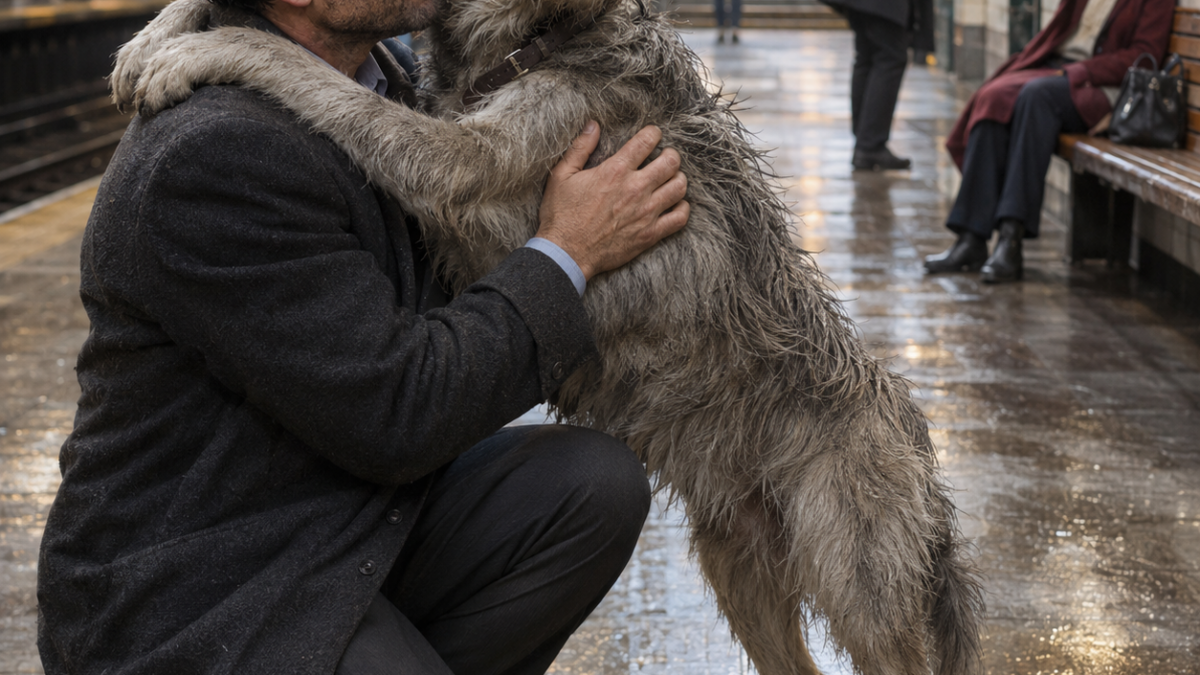
People passed around us.
I heard pieces of their reactions.
“Oh my God.”
“Look at that.”
“That’s adorable.”
Someone laughed.
Someone took a photo.
Normally I would have hated the attention.
That morning, the entire station seemed to disappear.
There was only the dog.
His fur smelled faintly of rain and city dust.
His weight rested against me with complete confidence.
No hesitation.
No embarrassment.
No concern about whether I had earned affection.
He simply gave it.
I do not know how long we stood that way.
A minute?
Two?
Ten?
Time had behaved strangely for years, so I had stopped trusting it.
Eventually, the dog lowered himself.
Sat at my feet.
Looked up.
I crouched.
“Who do you belong to?”
He licked my hand.
“No collar?”
Nothing.
“No owner?”
He grabbed the bottom edge of my wet coat gently between his teeth.
Not hard.
A tug.
Then he released it.
Walked a few steps.
Turned.
Looked back.
I stared.
“You want me to follow you?”
He moved again.
Stopped.
Looked back.
I glanced at the station clock.
Late.
Very late.
Meeting.
Manager.
Office.
Consequences.
Then I looked at the dog.
For the first time in years, something felt more important than being on time for a life I barely wanted to inhabit.
“All right.”
I whispered.
“Lead the way.”
He moved through the subway system as if he had memorized it.
Down one corridor.
Across a platform.
Through a transfer tunnel.
Every few yards he checked behind him.
Still there?
Yes.
I followed.
At one point I almost stopped.
This was absurd.
I was a grown man abandoning a work meeting to follow an unknown dog through public transit.
If anyone had asked me what I was doing, I would have had no respectable answer.
That may have been part of the appeal.
For years, every decision had been respectable.
None had made me feel alive.
We boarded a train.
The dog settled near the doors.
No one stopped him.
Maybe because everyone assumed he belonged to someone.
Maybe because city people develop a talent for ignoring what they cannot categorize.
I stood nearby.
At the third stop, he got off.
I followed.
This station was smaller.
Older.
Half-empty.
I had never used it.
The dog climbed the stairs.
Turned left.
Then walked toward a bench at the far end of the platform.
A woman sat there.
Old.
Maybe seventy.
Maybe older.
Clean but worn coat.
Old-fashioned hat.
Hands wrapped around a cigarette.
Her face held the kind of exhaustion that has nothing to do with sleep.
The dog ran to her.
She bent.
Touched his head.
Then he turned around.
Ran back to me.
Then to her again.
Back to me.
I stopped several feet away.
The woman looked up.
Her eyes were red.
Not from smoke.
From crying.
I pointed toward the dog.
“Is he yours?”
She gave a small, tired smile.
“Jack?”
So he had a name.
I looked down.
“Jack.”
His ears moved.
The woman shook her head.
“No.”
“He isn’t mine.”
I frowned.
“Then whose is he?”
Her smile changed.
Sad.
Soft.
“Jack doesn’t belong to anyone.”
Pause.
“He chooses people.”
Her name was Margaret.
She came to the station most mornings.
Same bench.
Almost the same time.
Sometimes she had coffee.
Sometimes nothing.
Jack had appeared months earlier.
A stray.
No one knew where he slept at first.
No collar.
No one successfully claimed him.
People in the neighborhood fed him.
Margaret fed him more consistently.
“He found me on a morning when I had decided there wasn’t much point in getting up anymore.”
she said.
I sat beside her.
Jack lay between us.
His head rested on his paws.
“What happened?”
I asked.
Margaret stared down the tracks.
“My husband died years ago.”
“I’m sorry.”
“So am I.”
Then she laughed softly.
“That sounded rude.”
“No.”
“It sounded honest.”
She looked at me for the first time with interest.
“You understand that?”
“Unfortunately.”
She nodded.
“My husband died.”
“Then the house went.”
“Money.”
“Circumstances.”
“Bad decisions.”
She waved one hand.
“Pick whichever explanation sounds least embarrassing.”
“I ended up renting one room across town.”
“Most friends disappeared.”
“Some died.”
“Some moved.”
“Some became tired of hearing the same sadness.”
Her cigarette trembled slightly between her fingers.
“I stopped believing anything would change.”
Jack lifted his head.
Margaret looked down at him.
“Then this one arrived.”
She scratched behind his ear.
“I fed him.”
“He sat beside me.”
“That was the arrangement.”
She smiled.
“I gave him food.”
“He reminded me I was still capable of caring whether another living thing came back tomorrow.”
I understood more than I wanted to.
“What was he doing at the other station?”
Margaret looked amused.
“Finding you, apparently.”
“That doesn’t answer the question.”
“Jack has been strange lately.”
“How strange?”
“He goes out in the morning.”
“I thought dogs did that.”
“He comes back with people.”
I stared.
“What?”
“Yesterday, it was a young couple.”
“They were arguing so loudly on the platform I could hear them before I saw them.”
“Jack went over.”
“Hugged the woman.”
“Then the man.”
“Then brought them here.”
“What happened?”
“They sat.”
“We talked.”
“They came back this morning before you.”
I looked around.
“Why?”
“Coffee.”
Margaret shrugged.
“Maybe they liked me.”
“Maybe Jack made them feel guilty.”
Then her expression changed.
“These past weeks have been difficult.”
“How?”
She looked down.
“I stopped leaving my room for several days.”
“Why?”
“Because some mornings, getting dressed felt pointless.”
Jack raised his head again.
Margaret continued.
“He started waiting outside my door.”
“If I did not come out, he would scratch.”
“Then leave.”
“And somehow he began bringing people.”
“Here?”
“Yes.”
“Why?”
Margaret looked at me.
“You’ll have to ask him.”
Jack yawned.
Helpful.
I should have left.
I was more than an hour late by then.
My phone had vibrated several times.
I ignored it.
Margaret asked:
“What happened to you?”
The question was so direct I almost laughed.
“Nothing.”
“That’s usually not true.”
I looked at Jack.
He had returned to sleep.
Traitor.
Margaret said:
“You don’t have to tell me.”
That made me want to.
So I told her about Émiliana.
Not everything.
At first.
Only that she left.
That I had spent two years blaming myself.
That the apartment felt quieter each month.
That friends had disappeared.
Margaret asked:
“Did they disappear?”
I knew what she meant.
I looked away.
“I stopped answering.”
“Ah.”
“That is not the same thing.”
“No.”
Her voice was gentle.
“It can feel the same.”
I told her about work.
How invisible I felt.
How I had stopped expecting anyone to notice anything about me.
How I sometimes rode the subway home surrounded by hundreds of people and felt completely separate from every one of them.
Margaret listened.
No advice.
No interruption.
That itself felt unusual.
When I finished, she took one final drag from her cigarette, extinguished it carefully, and said:
“When I was young, I thought life punished us for mistakes.”
I waited.
She looked toward the tracks.
“If something bad happened, I searched backward.”
“What did I do?”
“Where did I fail?”
“Who did I hurt?”
“Then I got old.”
A faint smile.
“I realized life is not that organized.”
I almost laughed.
She continued.
“Sometimes things end.”
“Sometimes people leave.”
“Sometimes we fail.”
“Sometimes they do.”
“But life isn’t always punishment.”
“What is it, then?”
Margaret looked down at Jack.
“Practice.”
“For what?”
“Beginning again.”
I said nothing.
She continued:
“Jack taught me something.”
“What?”
“That love waits in places where you are convinced everything is over.”
My throat tightened.
Margaret looked at me.
“Maybe that’s why he picked you.”
I missed the meeting.
My manager was furious.
Not dramatically.
Worse.
Professionally disappointed.
I invented no elaborate excuse.
“Personal issue.”
He sighed.
“Next time, call.”
“Okay.”
Something strange happened.
I did not feel devastated.
The world continued.
No one fired me.
The company did not collapse because I missed one meeting.
I completed my work.
Went home.
The apartment was still empty.
But something had changed.
I kept thinking about Jack.
His paws over my shoulders.
Margaret.
Beginning again.
The next morning, I left thirty minutes early.
I told myself it was because I wanted to make sure Margaret was all right.
That was only partly true.
She was on the bench.
Jack beside her.
When he saw me, he stood.
Tail wagging.
He did not hug me that time.
Apparently the dramatic introduction had been enough.
Margaret smiled.
“You came back.”
That sentence hit harder than it should have.
“So did you.”
“I live nearby.”
“Still counts.”
I handed her coffee.
She looked at the second cup.
“For me?”
“Yes.”
“What if I hate coffee?”
“Then I have made a terrible mistake.”
She took it.
“I love coffee.”
Good.
The new routine began quietly.
I left home earlier.
Took a different route.
Sat beside Margaret.
Sometimes ten minutes.
Sometimes thirty.
Jack lay between us.
People moved through the station.
Occasionally he disappeared for a while.
Sometimes returned alone.
Sometimes with someone who stopped to pet him.
Once he brought a delivery worker who had missed his train.
Another morning, an exhausted student.
Most did not stay long.
That was fine.
Jack did not appear to require long-term contracts.
He created brief collisions between people.
That seemed enough.
Margaret told stories.
About her husband.
About a bakery where she once worked.
About dances when she was young.
About her first apartment.
About the worst landlord in human history.
I started laughing more.
At first it felt unnatural.
Like using a muscle after an injury.
Then easier.
One day, Margaret shivered.
I noticed.
The next morning I brought a blanket.
She stared.
“I am not eighty-five.”
“How old are you?”
“None of your business.”
“Then take the blanket.”
She did.
Jack immediately tried to sit on it.
Margaret pushed him off.
“This is mine.”
He ignored her.
She taught me to knit.
That was not something I expected to say about my life.
“You’re doing it wrong.”
Margaret slapped my fingers lightly.
“I’m trying.”
“You’re strangling the yarn.”
“It’s yarn.”
“It knows.”
I looked at her.
“You sound insane.”
“Keep knitting.”
Eventually I made something resembling a scarf.
Small.
Crooked.
Uneven.
Gray with one blue section because I bought the wrong yarn.
I wrapped it around Jack’s neck.
He sat proudly for approximately six seconds.
Then tried to chew the end.
Margaret laughed so hard she cried.
I laughed too.
The photo she took became the first image I had saved voluntarily in months.
People at work noticed.
That surprised me.
One coworker said:
“You seem different.”
“How?”
“Less dead.”
“Thank you?”
She laughed.
My manager asked if I was seeing someone.
“Are you in love?”
I answered before thinking:
“Yes.”
He raised his eyebrows.
I almost corrected myself.
Then stopped.
Because it was true.
Not romantic love.
Something broader.
Friendship.
Compassion.
Belonging.
The sensation of caring whether another person had breakfast.
The experience of someone noticing when I did not appear.
The willingness to laugh.
It was love.
Just not the kind people expect when they ask the question.
I began answering old messages too.
Slowly.
One friend first.
Then another.
I wrote:
Sorry I disappeared.
One replied almost immediately:
I figured you needed time. Coffee?
I stared at the screen.
All those months I had interpreted silence as abandonment.
Maybe some of it was simply people waiting for permission to return.
I met him.
Awkward at first.
Then not.
No dramatic reconciliation.
Just coffee.
Conversation.
A friendship reopened.
Margaret approved.
“Jack’s work.”
I said.
She shook her head.
“Jack gets too much credit.”
Jack, beside her feet, looked pleased.
Three months passed.
Rain turned into colder mornings.
My life did not become perfect.
Work remained work.
The apartment did not magically stop containing memories of Émiliana.
Some nights hurt.
Some mornings still felt heavy.
But heaviness was no longer the only thing.
There were also breakfasts.
Margaret.
Jack.
Messages.
Knitting disasters.
Coffee.
Plans.
That was enough to change the balance.
Then one morning Margaret said:
“Come home with me.”
I almost choked.
“Excuse me?”
“My room.”
“That sounded less alarming in your head?”
She rolled her eyes.
“I want to show you something.”
Margaret rented a small room on the other side of the city.
Modest.
Clean.
Everything carefully arranged.
A narrow bed.
Small table.
Two cups.
Books stacked beneath a chair.
A photograph on the wall.
Young man.
Maybe thirty in the photo.
Dark hair.
Serious eyes.
Something about him felt familiar.
“Who is that?”
Margaret went quiet.
“My son.”
I turned.
“You have a son?”
“Yes.”
“You never told me.”
“You never asked.”
Fair.
“Where is he?”
“Another city.”
“When did you last see him?”
She looked at the photograph.
“Ten years.”
The number shocked me.
“What happened?”
Margaret sat.
“Pride.”
“One argument became two.”
“Then years.”
“Then too much time passed.”
“Whose fault?”
She gave me a look.
“You are getting nosy.”
“Correct.”
She sighed.
“We both had enough fault.”
“Have you tried contacting him?”
“Not recently.”
“Why?”
“Because ten years is a long time.”
“That isn’t an answer.”
Margaret looked irritated.
Good.
She had used that tactic on me too many times.
I continued.
“Do you want to see him?”
Her face changed immediately.
There.
“Yes.”
A whisper.
“Then let’s find him.”
Finding him was not impossible.
It simply took work.
Old addresses.
Public records.
A few phone calls.
Margaret remembered a former employer.
One lead failed.
Another worked.
Two weeks passed.
Margaret alternated between hope and terror.
“What if he doesn’t want me?”
“What if he does?”
“What if he has a family?”
“Then you meet them.”
“What if he hates me?”
I did not know what to say.
So I borrowed her words.
“Life teaches us to begin again.”
She glared.
“I hate when people use my own wisdom against me.”
“Good.”
We eventually found an address and then a way to contact him.
I did not pretend it would be simple.
I told him only enough.
Your mother is alive.
She wants to see you.
She has regretted the distance.
He did not answer immediately.
That day, Margaret barely spoke.
Jack stayed beside her.
The next day, still nothing.
Then a message.
Short.
I need time.
Margaret cried.
“That’s not no.”
I said.
She nodded.
“That isn’t no.”
Several evenings later, I sat with Margaret in her rented room drinking tea.
Jack lay near the door.
We were discussing nothing important.
Weather.
The station.
My terrible scarf.
Then someone knocked.
Margaret froze.
Not nervous.
Completely still.
Jack stood.
His ears lifted.
Another knock.
Margaret looked at me.
“You expecting someone?”
“No.”
Neither was I.
I opened the door.
The man from the photograph stood outside.
Older.
Gray at his temples.
Same eyes.
Red now.
Wet.
He looked past me.
Margaret stood slowly.
For several seconds, neither spoke.
Then she whispered his name.
I stepped aside.
He entered.
Margaret lifted one hand as though she was not sure she had permission to touch him.
He crossed the room in two steps.
And wrapped his arms around her.
Margaret made a sound I had never heard from another person.
Not exactly crying.
Not exactly laughter.
Ten years leaving the body all at once.
Her son buried his face against her shoulder.
“I’m sorry.”
she said.
“No.”
he answered.
“I’m sorry.”
“I should’ve called.”
“I should’ve answered.”
“I was angry.”
“So was I.”
Neither sentence solved ten years.
The embrace did not erase what had happened.
But it began something.
That was enough.
I backed toward the hallway.
This was not my moment.
Jack followed.
I closed the door gently.
We sat outside.
I lowered myself to the floor.
Jack pressed against my side.
Inside, I could hear Margaret crying.
Her son too.
I wrapped an arm around the dog.
“Look what you did.”
Jack licked my chin.
I laughed.
“No modesty at all.”
Then I held him tighter.
“Thank you.”
He looked at me.
“For what?”
I whispered.
“For teaching me how to love people again.”
Jack rested his head against my chest.
No answer.
None needed.
Margaret’s son stayed for hours.
His name mattered less to the original story than the fact that he returned.
They talked.
Slowly.
Painfully.
There were accusations.
Apologies.
Silences.
Questions.
But there was also tea.
And later laughter.
The sound came through the door.
I knew then that reunion did not mean pretending the ten years never happened.
It meant deciding the eleventh year could be different.
My own life continued changing.
Not dramatically.
Honestly.
I still worked at the same office.
But I began speaking more.
Someone asked my opinion in a meeting and I actually gave it.
The first time, everyone simply nodded and continued.
I nearly laughed.
For years, I believed nobody wanted to hear me.
Maybe I had simply stopped speaking.
That realization hurt.
But it also freed me.
I opened Émiliana’s books.
Finally.
Not because I wanted her back.
Because I was tired of living around objects that felt haunted.
One was a novel she had loved.
There was an old receipt between the pages.
Restaurant.
Two coffees.
One pastry.
A normal day from our life.
I held it.
Cried.
Then put it back.
Grief did not disappear because Jack hugged me.
Healing is not that theatrical.
But now grief had somewhere to sit beside other emotions.
It was no longer the entire room.
I thought often about the first morning.
Why me?
Hundreds of people crossed that station.
Why did Jack look at me?
Maybe scent.
Body language.
Chance.
Maybe he saw someone moving too slowly.
Maybe there is no mystical answer.
Margaret liked the mystical explanation.
“He knows.”
“Knows what?”
“Who needs him.”
“That is scientifically questionable.”
“I am old enough not to care.”
Fair.
Jack became part of our family without anyone formally declaring it.
He stopped being “the stray.”
Margaret fed him.
I paid for veterinary care when we could finally persuade him into a clinic.
Her son bought him a proper collar.
The young couple Jack had brought before me sometimes visited.
Someone at the station kept water for him.
He belonged nowhere.
Therefore somehow he belonged everywhere.
Eventually, though, he spent most nights with Margaret.
Then more time with her son when he began visiting regularly.
And often with me.
No one seemed concerned about the technical arrangement.
Jack had been managing humans longer than we had been managing him.
Margaret’s son started joining us for breakfast.
At first occasionally.
Then often.
They were rebuilding carefully.
He had a life in another city.
Responsibilities.
History.
There would be no instant return to what they lost.
But he called.
She answered.
That alone was enormous.
One morning, Margaret’s phone rang while we sat on the bench.
She looked at the screen.
Her face lit.
“My son.”
Jack’s tail thumped.
I smiled.
“Answer.”
“I know.”
“You’re staring.”
“I’m enjoying the moment.”
“Margaret.”
She answered.
“Hello?”
Her voice changed.
Softer.
More alive.
Jack rested his head against her shoe.
I looked down the platform.
A train arrived.
People rushed past.
Nobody knew they were walking around a miracle that looked like an ordinary phone call.
I stopped resenting the crowds.
Before Jack, the subway had represented everything wrong with my life.
Hundreds of people.
No connection.
Now I started seeing details.
A father holding his daughter’s backpack.
A woman moving aside for an older passenger.
Teenagers laughing.
Someone carrying flowers.
A stranger holding the door.
None of it was extraordinary.
That was the point.
The world had always contained warmth.
I had stopped looking for it.
Jack made looking impossible to avoid.
He greeted people.
Leaned against strangers.
Once sat beside a businessman who spent five minutes pretending not to care before finally petting him.
Jack closed his eyes.
The man smiled.
Tiny thing.
Maybe nothing changed.
Maybe something did.
We rarely know the full consequence of kindness.
That became another lesson.
I sometimes wondered whether the people who photographed Jack hugging me that first morning still had the pictures.
Maybe somewhere on a stranger’s phone is an image of the exact second my life began turning.
A wet man.
Gray dog.
Crowded station.
No context.
They probably thought it was cute.
They had no idea.
Neither did I.
At work, my manager eventually said:
“You’re doing better.”
I looked up.
“Was I doing badly?”
He hesitated.
“Not at the work.”
That answer stopped me.
Then:
“You just seemed far away.”
I stared.
People had noticed.
Maybe not enough.
Maybe I had been unfair in believing nobody saw me at all.
I asked:
“Why didn’t anyone say anything?”
He looked embarrassed.
“I didn’t know if it was my place.”
Fair.
Humans are complicated.
Jack did not have that problem.
He saw me.
He hugged me.
No policy review required.
I began inviting people into my apartment again.
First one friend.
Then two.
Pizza.
Nothing elegant.
The room changed when voices entered it.
I had forgotten that.
For years I had thought the apartment itself was lonely.
Of course it was not.
Rooms are neutral.
We fill them with absence or presence.
I had chosen absence because presence felt risky.
Jack slept beneath the table while my friends argued about movies.
I looked around and nearly cried.
Not from sadness.
From recognition.
This was life.
Messy.
Ordinary.
Loud.
Available.
Margaret continued knitting.
I improved enough to make a second scarf for Jack.
Margaret inspected it.
“Better.”
“High praise.”
“Still ugly.”
“Cruel.”
“Accurate.”
Jack wore it anyway.
He loved nothing aesthetically.
A useful quality.
Émiliana eventually became a memory I could hold without punishing myself.
That took time.
I stopped asking:
Why wasn’t I enough?
Started asking:
What happened to us?
Different question.
Less cruel.
Maybe we both failed.
Maybe neither knew how to repair what had broken.
Maybe sometimes relationships end without a villain.
I still regretted things.
But regret and self-condemnation are not the same.
Margaret had been right.
Life was not an organized punishment system.
You do not earn loneliness through mistakes.
One evening I told her that.
She smiled.
“Finally.”
“Do not take all the credit.”
“Jack can have some.”
“Generous.”
She looked down.
Jack was sleeping against the bench.
“Truth is, he taught me too.”
“What?”
“That waiting for life to return isn’t the same as participating in it.”
I thought about the days she had stopped leaving her room.
“And now?”
“Now I get up.”
Simple.
Huge.
Margaret’s son began helping her search for a slightly better place to live.
Nothing luxurious.
Just a small apartment.
Closer to him when possible.
She resisted.
“I can manage.”
He answered:
“I know.”
“I still want to help.”
I watched.
That sentence contained ten years of repair.
Not:
You can’t manage.
Not:
You need me.
Simply:
I want to help.
Margaret accepted.
Slowly.
Jack adapted to every change as if humans were the strange ones for worrying.
New room?
Fine.
New food bowl?
Fine.
New person?
Smell first.
Decide later.
He remained the same dog.
Large.
Gray.
Rough-haired.
Deep-eyed.
Still capable of startling people by hugging them.
He hugged less often than before.
Maybe because his work became easier once people around him stopped being quite so lost.
That is my preferred theory.
One rainy morning, almost a year after we met, I arrived at the station soaked again.
Same weather.
Same wet shoes.
I stopped in the main hall.
For a moment, the memory was so strong I could see him.
Jack sitting in the crowd.
Watching.
Waiting.
Then he actually appeared from behind a column.
Not memory.
Real Jack.
He ran toward me.
I laughed.
“Don’t you dare.”
He stood.
Paws on my shoulders.
Hug.
People around us smiled.
Exactly like the first time.
Except everything was different.
I hugged him back.
No breaking this time.
No sudden awakening.
Just gratitude.
Margaret arrived shortly afterward.
“So dramatic.”
she said.
“He started it.”
“You encourage him.”
“Probably.”
Her son followed carrying coffee.
Three cups.
He handed me one.
Jack tried to inspect them.
We sat together.
Same station.
Different lives.
That image became one of my favorites.
No one rescued from danger.
No emergency.
No extraordinary event.
Just three people and one dog having breakfast in a place that had once represented loneliness.
Sometimes healing is simply returning to the scene with a different heart.
The young couple Jack had brought before me eventually got married.
Or at least they told Margaret they planned to.
She claimed full credit.
I said:
“Jack.”
She nodded.
“Fine.”
“Shared credit.”
Jack remained neutral.
People began calling him “the subway dog.”
I hated the nickname slightly.
He was more than a novelty.
But perhaps every community turns love into shorthand.
Jack did not care.
He cared about food.
Warm places.
People.
Margaret.
Me.
Her son.
The young couple.
Anyone who looked like they had forgotten something important.
Maybe.
I started carrying dog treats.
This was humiliating.
One day, a coworker saw them in my coat.
“You don’t own a dog.”
“It’s complicated.”
“How complicated can dog ownership be?”
“Very.”
I walked away.
I also began volunteering some weekends with a local animal group.
Not because Jack inspired a sudden mission to save every stray.
That would be another story.
I simply wanted to give time.
Walk dogs.
Clean.
Help.
The first afternoon, I came home exhausted.
Jack inspected me intensely.
Probably smelled fifteen other dogs.
His expression seemed offended.
“Professional jealousy?”
He sneezed.
Margaret said:
“He knows you’ve been cheating.”
Ridiculous.
My loneliness did not vanish forever.
That needs saying.
There were still nights when the apartment felt too quiet.
Anniversaries.
Certain songs.
A restaurant Émiliana and I used to visit.
Some mornings I woke with that old heaviness.
But now I knew heaviness was weather.
Not identity.
Weather changes.
You wait.
You call someone.
You go to the station.
You find Margaret.
You scratch Jack behind the ears.
You participate.
That was the difference.
For years, I had believed loneliness meant nobody loved me.
Jack taught me another possibility.
Sometimes loneliness means you have stopped allowing love to reach you.
Not always.
But for me, partly.
That truth was uncomfortable.
Then liberating.
Because if some doors had closed from the inside, I could open them.
Margaret’s son once thanked me privately.
We were outside her apartment.
Jack sniffing along the sidewalk.
He said:
“I don’t know how you found her.”
I looked at Jack.
“I didn’t.”
He followed my gaze.
“He brought you?”
“Yes.”
He smiled.
“My mother told me.”
Then:
“I thought she was exaggerating.”
“She usually is.”
“I heard that!”
Margaret shouted through the window.
We laughed.
Her son grew quiet.
“Ten years.”
“I know.”
“I lost ten years.”
I said:
“You have now.”
He looked at me.
I clarified.
“You have now.”
“Not then.”
He understood.
There was no way to return ten years.
Only to stop losing more.
That was exactly what Margaret had taught me.
Begin again.
Jack’s greatest talent was not hugging.
Not navigation.
Not matchmaking.
It was interruption.
He interrupted routines.
Isolation.
Arguments.
Self-pity.
He inserted himself physically into whatever emotional story someone was telling themselves.
I am alone.
Paws.
Nobody sees me.
Paws.
Nothing can change.
Follow me.
Maybe humans need interruption more often.
I often wonder what would have happened if I had kept walking that first morning.
Probably nothing dramatic.
I would have attended the meeting.
Taken notes.
Worked.
Gone home.
Coffee.
Sleep.
Another day.
Maybe Jack would have hugged someone else.
Maybe Margaret’s son would still eventually return.
Maybe I would have found another path out.
Lives contain many possible exits.
I am grateful I took that one.
The books Émiliana left remained on my shelf.
Eventually I read all of them.
One was terrible.
I laughed because she had loved it.
For the first time, that memory did not hurt entirely.
I could disagree with her again.
Even in absence.
That felt strangely healthy.
I never contacted Émiliana asking to return.
That would have misunderstood everything.
Jack did not teach me to reverse my life.
He taught me to re-enter it.
Different thing.
The past remained past.
I could love what had been and still move forward.
Margaret taught me that too.
She did not get her husband back.
She got her son back.
Not the same love.
Still love.
Life rarely replaces exactly what it takes.
Sometimes it gives something new.
Three years in fog.
One dog hug.
That sounds too simple.
It was not.
The hug opened a door.
I still had to walk through.
Margaret listened.
I had to keep returning.
My friends answered.
I had to reply.
Her son came.
They had to talk.
Healing is collaborative.
Jack simply started the meeting.
Today, I am not the same man who stood dripping rainwater onto the subway floor.
I still work.
Still drink black coffee.
Still sometimes stare out the window.
But now I often have somewhere to go afterward.
Breakfast with Margaret and her son.
A walk with Jack.
Coffee with an old friend.
Dinner at my apartment.
Plans.
The word itself once felt impossible.
Plans.
Jack is no longer truly a stray.
Not because someone filed ownership paperwork and declared him property.
Because he belongs.
To Margaret.
To her son.
To me.
To the station workers who greet him.
To the young couple who bring treats.
To a strange little family that did not exist until he began collecting us.
Maybe Margaret was right from the beginning.
Jack doesn’t belong to anyone.
He chooses.
And then somehow the chosen people begin belonging to each other.
Every morning we still meet at that small station when schedules allow.
Not because I need to commute through it anymore.
Sometimes I deliberately travel out of my way.
Breakfast.
Coffee.
Margaret’s stories.
Her son’s terrible jokes.
Jack at our feet.
People pass.
Most do not know us.
Some recognize Jack.
Children smile.
We sit.
Alive.
Present.
Connected.
The opposite of invisible.
One morning, I asked Margaret:
“Do you remember what you told me the first day?”
“I say many profound things.”
“You said life teaches us to begin again.”
“Obviously profound.”
“Do you still believe it?”
She looked at her son across the platform.
Then at Jack.
Then at me.
“Yes.”
“More now.”
I understand why.
Beginning again does not mean forgetting.
Margaret remembers her husband.
I remember Émiliana.
Her son remembers ten lost years.
None of those disappear.
Beginning again means deciding memory is not the only place where love gets to live.
That is different.
That is harder.
And better.
Jack never said any of this.
He never gave advice.
Never told me to forgive myself.
Never told Margaret to call her son.
Never told her son to come home.
He did something more convincing.
He showed up.
Then asked us to follow.
The first morning, his paws rested on my shoulders.
I remember the exact warmth.
The weight.
The absurd intimacy of being embraced by a creature who knew nothing about me.
No history.
No mistakes.
No failures.
No reasons I had manufactured for believing I did not deserve comfort.
To Jack, none of that mattered.
There was a man in front of him who looked like he needed contact.
So he gave it.
Maybe human love becomes complicated because we ask whether someone has earned it.
Dogs sometimes skip that step.
That does not mean boundaries do not matter.
Or that love fixes everything.
It means kindness can arrive before explanation.
Sometimes that is what makes explanation possible later.
Margaret once said:
“You were easier to talk to after Jack hugged you.”
I laughed.
“You had known me four minutes.”
“Exactly.”
“You were emotionally unavailable for at least the first two.”
“Rude.”
“Accurate.”
Jack wagged.
Traitor.
Her son later asked why I kept visiting.
I considered.
“At first?”
“Yes.”
“Because Jack brought me.”
“And after?”
I looked at Margaret.
“Because she noticed I was gone before I ever disappeared.”
Margaret looked away.
Eyes suddenly wet.
That was friendship.
I had spent years believing nobody noticed me.
Then a woman I had known for three months began calling if I missed breakfast.
“Where are you?”
“Work.”
“You could send a message.”
“Yes, Mom.”
“Do not call me that.”
“Sorry.”
Pause.
“Eat something.”
“Okay, Mom.”
She hung up.
I laughed for ten minutes.
Her son loved that story.
She did not.
The office changed too.
Or perhaps I did.
I greeted people.
Ate lunch away from my desk.
Accepted invitations.
Once organized drinks after work.
My manager said:
“Who are you?”
“Apparently social.”
“Terrifying.”
Work remained imperfect.
But being seen requires participation.
I learned that slowly.
The most surprising part was that I began noticing other lonely people.
Not because I became an expert.
Because loneliness has a posture.
Eyes down.
Phone as shield.
Leaving quickly.
Never staying for conversation.
I did not tackle strangers in the subway.
That was Jack’s department.
But sometimes I asked:
“You okay?”
Sometimes:
“Want coffee?”
Most said yes.
Some no.
That was fine.
Kindness does not need guaranteed return.
One afternoon, I saw Jack hug another stranger.
A woman sitting alone.
He approached.
She smiled nervously.
Then he stood.
Paws on her shoulders.
Her face changed.
The exact change I remembered.
Surprise.
Resistance.
Then surrender.
She hugged him.
I looked at Margaret.
“He’s doing it again.”
She nodded.
“Busy.”
“Do you think he’ll bring her here?”
“Probably.”
The woman eventually followed.
Of course.
We made room on the bench.
That was what our little group had become.
Not an institution.
Not therapy.
Just room.
Sometimes room is enough.
I do not know Jack’s history before Margaret.
That bothered me once.
Where did he come from?
Who left him?
Was he lost?
Had someone loved him?
We searched enough to be confident nobody obvious was looking for him.
Beyond that, mystery.
Eventually I stopped needing the answer.
Jack lived in present tense.
I could learn from that.
The scarf I knitted him eventually fell apart.
No surprise.
Margaret saved a piece.
“Why?”
“Memory.”
“You save everything.”
“Age.”
“You use age to excuse all your behavior.”
“It works.”
Jack received another scarf.
Professionally made.
He preferred mine.
Or perhaps I choose to believe that.
Years from now, I know life will change again.
People age.
Schedules shift.
Relationships change.
Nothing remains exactly as it is.
That knowledge once terrified me.
Loss made me try to avoid attachment because attachment creates something that can be lost.
Jack taught me the obvious flaw.
Avoiding love because it can end means living inside the ending before it even happens.
That is not protection.
It is surrender.
Margaret knew that better than I did.
She lost her husband.
Then her home.
Then ten years with her son.
Still, when Jack appeared, she fed him.
Tiny act.
But feeding something is hope.
You are assuming tomorrow exists.
That he will return.
That you will be there.
Hope can look like a bowl of food.
My first act of hope was following Jack.
I did not know that then.
I thought I was skipping work.
Maybe all beginnings look smaller while they are happening.
Sometimes I still pass through the original station where Jack hugged me.
The main hall remains crowded.
People still move quickly.
Advertisements change.
Coffee shop changed owners.
Nothing marks the spot.
No plaque:
Here a man remembered he was alive.
Probably for the best.
I know where it happened.
That is enough.
If I could speak to myself from that morning, I would not tell him:
Everything will be fine.
That would be dishonest.
Life remains difficult.
People leave.
Relationships fail.
Grief returns.
I would tell him something smaller.
Look up.
There is a dog watching you.
Let him come closer.
Then follow.
That is how life returned to me.
Not all at once.
First paws on shoulders.
Then a bench.
Then coffee.
Then Margaret.
Then laughter.
Then old friends.
Then her son at the door.
Then breakfast with people who would notice if I did not come.
One connection leading to another.
Jack did not change everything by magic.
He changed direction.
Sometimes that is enough.
Margaret’s son once asked me whether I believed Jack deliberately brought people who needed help.
I smiled.
“I don’t know.”
Margaret answered for me.
“Yes.”
He looked at her.
“How can you know?”
She shrugged.
“I’m old.”
He laughed.
“That isn’t evidence.”
“It is enough for me.”
Jack slept through the debate.
For me, the question no longer matters.
Maybe Jack smelled stress.
Maybe he liked certain people.
Maybe he simply behaved socially and we gave meaning to it.
Meaning does not become false just because behavior has an explanation.
He hugged me.
I followed him.
I met Margaret.
She helped me.
I helped her.
Her son returned.
That chain is real.
Whatever started it is almost secondary.
Today Jack is part of our family.
Not through ownership.
Through repetition.
He is there.
Morning after morning.
Bench after bench.
Breakfast after breakfast.
That is how families are often built.
Not declarations.
Showing up.
I finally understand what Margaret meant when she said:
“Jack chooses people.”
Maybe he chooses people.
Maybe people choose each other after he gives them permission.
Either way, I was chosen.
That mattered to a man who had spent years believing he deserved invisibility.
The deepest change was not that I stopped being alone.
It was that I stopped believing loneliness was punishment.
Émiliana leaving did not mean I had been sentenced.
Friends drifting away did not prove I was unlovable.
Pain is not evidence of guilt.
Sometimes pain is simply pain.
And life, as Margaret said, asks whether you will begin again.
I did.
Slowly.
Badly.
With coffee.
A crooked dog scarf.
Conversations on benches.
A few returned phone calls.
Nothing impressive.
It worked anyway.
The photograph of Margaret’s son is still on her wall.
Now there are new photographs beside it.
Recent ones.
Her and him.
Jack in the middle.
One with me.
Margaret complained that my eyes were closed.
I said:
“Use another.”
She refused.
“That’s the real one.”
Maybe she is right.
Families do not need perfect photographs.
They need people who return.
That may be the entire meaning of Jack.
Return.
He returned to Margaret when she stopped coming out.
He brought strangers back.
He brought me into her life.
Her son returned.
I returned to friends.
Returned to myself.
All from one animal who kept refusing to accept closed doors as final answers.
When I hug Jack now, he no longer feels like a stranger.
But I still remember the first embrace.
Crowded station.
Rain dripping from my coat.
Warm fur against my face.
My arms hanging uselessly for one second because I had forgotten how to receive affection.
Then closing around him.
That second mattered.
I let myself hold on.
Jack never spoke.
That is the most beautiful part.
No perfect advice.
No motivational speech.
No explanation of grief.
He did not say:
You are worthy.
You are not alone.
Start again.
He simply acted as though all three were already true.
Eventually, I believed him.
Now, when someone asks me what changed my life, I could say:
A dog.
It sounds ridiculous.
So I usually tell the longer version.
A subway.
A rainy morning.
A hug.
An elderly woman.
A lost friendship with life.
A son who came home.
A stray who became family.
But even the long version comes down to something very simple.
We all deserve to be loved, even when we have forgotten how to ask.
Sometimes the world reminds us gently.
Sometimes through another person.
And sometimes—
through four paws, rough gray fur, and a wordless embrace from a dog who somehow knew exactly where the loneliness was.








