FULL STORY:A Golden Retriever Was Trapped 60 Feet Down a Cliff, Barking Until His Voice Seemed to Break— I Risked My Life to Bring Him Back, But the Most Heartbreaking Part of Buddy’s Rescue Happened After We Reached His Family…
FULL STORY
I looked at the sky.
We had a shrinking window.
The dog tried to shift again and yelped.
That sound decided it.
I looked at our team leader.
“I’m going down.”
He studied the wall.
“Wind’s getting worse.”
“I know.”
“Loose rock halfway down.”
“I saw it.”
“If he panics when you reach him, he could knock both of you off that shelf.”
“I know.”
He stared at me.
Eleven years working together had made long conversations unnecessary.
Finally, he nodded.
“Double line.”
“Agreed.”
We built the anchor.
Checked it.
Checked it again.
Then I clipped in.
Before lowering over the edge, I looked down at the dog.
He was still watching me.
Terrified.
Hurting.
Alone.
I had no idea what his name was.
No idea who owned him.
No idea whether he trusted strangers.
All I knew was that somewhere beneath me was an animal who had survived a sixty-foot fall and was still barking because some part of him believed somebody might answer.
I lowered myself over the edge.
The wind hit me immediately.
Behind me, one of my teammates called:
“Take it slow!”
I planted one boot against the rock.
Then the other.
Twenty feet.
Thirty.
Loose gravel slipped beneath my right foot and disappeared into the ravine.
The dog watched every movement.
When I reached the last fifteen feet, he began growling.
Not aggressively.
Fear.
Pure fear.
I stopped descending.
“Okay.”
His ears flattened.
“I’m not coming closer yet.”
The wind swallowed my voice.
I waited.
Then lowered another foot.
His growl deepened.
I stopped again.
There are rescues where speed saves lives.
And there are rescues where moving too fast destroys the little trust keeping everything together.
I had to figure out which kind this was.
I lowered myself until my boots touched the narrow shelf.
The dog pressed himself against the rock wall.
His entire body shook.
I unclipped one hand from the descent line and slowly lowered myself to one knee.
“Hey.”
His eyes stayed locked on mine.
“I know.”
His breathing was ragged.
“I know you’re scared.”
His nose twitched.
I extended my hand.
Not toward his face.
Just into the empty space between us.
Then I waited.
Five seconds.
Ten.
Twenty.
The dog stared at my hand.
And somewhere above us, my radio crackled.
“Owners located. They’re heading toward us.”
The golden retriever’s ears moved.
I smiled.
“Sounds like somebody’s looking for you.”
The dog’s tail struck the rock once.
And then, very slowly, he crawled toward me.
FULL STORY CONTINUATION
He moved only a few inches.
Then stopped.
His injured rear leg dragged behind him.
I could see the pain every time his body shifted.
“Easy.”
I kept my hand still.
“Don’t prove anything to me.”
Another gust of wind came through.
The dog flattened himself.
Small pieces of gravel skittered across the ledge and vanished into the darkness beneath us.
My radio crackled again.
“You stable?”
I pressed the transmit button.
“Stable. Dog’s conscious. Rear-leg injury, likely fracture. He’s scared but responsive.”
“Can you secure him?”
“Working on trust first.”
A pause.
Then:
“Copy.”
That was one thing I appreciated about my team.
Nobody told me to hurry unless hurry actually mattered.
The dog looked at me.
I looked back.
Golden retrievers have expressive faces.
Maybe that sounds sentimental.
After eleven years of animal rescue, I stopped apologizing for noticing things like that.
Fear looks different from aggression.
Exhaustion looks different from surrender.
This dog was scared almost beyond his ability to think, but he was not giving up.
His eyes kept checking me.
My hands.
My harness.
The rope above us.
Then my face again.
I lowered my voice.
“You’ve had a bad day, haven’t you?”
His ears moved.
“Me too.”
That wasn’t true yet.
But I was willing to negotiate.
He crawled another inch.
Then another.
His front paw touched my glove.
He jerked backward immediately.
I stayed still.
“That’s okay.”
He looked at my hand.
Then tried again.
This time, he sniffed my glove.
I felt his breath against the leather.
And then something changed.
Not dramatically.
No sudden burst of trust.
His shoulders simply lowered.
The tension in his face softened.
I moved my hand slowly beneath his chin.
He let me touch him.
“Good boy.”
His eyes closed for half a second.
That was enough.
I shifted closer.
He did not growl.
I ran one hand carefully along his neck and shoulders, checking for obvious injuries.
No major bleeding.
No obvious chest trauma.
Rear leg bad.
Possibly other bruising.
Shock was a concern.
But considering the fall, he was unbelievably lucky.
“Okay,” I whispered. “Now we do the part you’re not going to like.”
I reached for the rescue harness.
His eyes opened wider.
“Yeah. I know.”
The hardest part of rescuing a frightened animal isn’t always getting near them.
Sometimes it is convincing them that the strange thing you are fastening around their body is not another threat.
I showed him the harness.
Let him smell it.
Moved slowly.
One loop.
Pause.
Another.
When I had to shift his injured leg, he cried out.
The sound stabbed through me.
“I know.”
He tried to twist away.
I pulled back.
“No rush.”
Above us, daylight was fading.
There absolutely was a rush.
But he didn’t need to know.
I waited until his breathing slowed.
Then tried again.
This time he let me.
I secured the chest.
Checked the straps.
Then clipped the secondary line.
My radio sounded.
“Status?”
“Dog secured.”
“Copy. Ready to raise?”
I looked at him.
He looked up.
Sixty feet of rock.
Wind.
Rope.
Fear.
“Almost.”
I wrapped part of my body around him so he wouldn’t swing freely.
Then pressed the radio.
“Ready.”
The line tightened.
We lifted.
Immediately, the dog panicked.
His paws scrabbled against the stone.
“Easy!”
He twisted.
I wrapped one arm tighter around his chest.
“Hey! Look at me.”
His eyes found mine.
“Look at me.”
Another foot upward.
The shelf dropped away beneath us.
He whimpered.
I held him.
“I’ve got you.”
The words came automatically.
You say them during rescues whether the animal understands English or not.
Maybe the animal understands tone.
Maybe the words are for you.
“I’ve got you.”
The rope rose.
Ten feet.
The dog stopped fighting.
Twenty.
His breathing remained fast, but his head had settled against my chest.
Thirty.
The wind swung us several inches away from the wall.
My shoulder slammed into rock.
Pain shot down my arm.
The dog yelped.
“Hold!”
The line stopped.
Above us, somebody shouted:
“You okay?”
I pressed the radio.
“Fine.”
My shoulder disagreed.
“Dog?”
“Fine.”
That was what mattered.
We waited for the gust to pass.
Then continued.
Forty feet.
Fifty.
At the rim, hands appeared.
One rescuer grabbed my harness.
Another took the dog’s support line.
“Watch the leg!”
“We’ve got him.”
They pulled the dog over first.
Then me.
The moment my knees hit solid ground, I felt the adrenaline leave my body.
It is strange how quickly strength disappears when your nervous system decides the emergency is over.
My hands shook.
My back hurt.
My shoulder throbbed.
But the golden retriever was lying on a blanket.
Alive.
One of the rescuers began checking him.
I removed my helmet.
“What do we have?”
“Rear-leg injury. Shock. Breathing okay.”
“Owners?”
“Thirty seconds out.”
Almost as if summoned by the words, we heard someone running through the trail.
Then a man shouted:
“Buddy!”
The dog’s head snapped up.
Everything changed.
“Buddy!”
A woman appeared behind the man.
And a little boy behind her.
Maybe seven years old.
Crying so hard he could barely breathe.
“Buddy!”
The golden retriever tried to stand.
“Easy!”
Too late.
Pain or no pain, he knew those voices.
The man dropped to his knees.
Buddy dragged himself toward him.
The woman covered her mouth.
The little boy screamed:
“Buddy!”
I have witnessed reunions hundreds of times.
Lost dogs.
Injured dogs.
Animals found after fires, floods, falls, and accidents.
This one hit differently.
Maybe because of how alone Buddy had looked on that ledge.
Maybe because of the child.
Maybe because the dog had been holding himself together for exactly this moment.
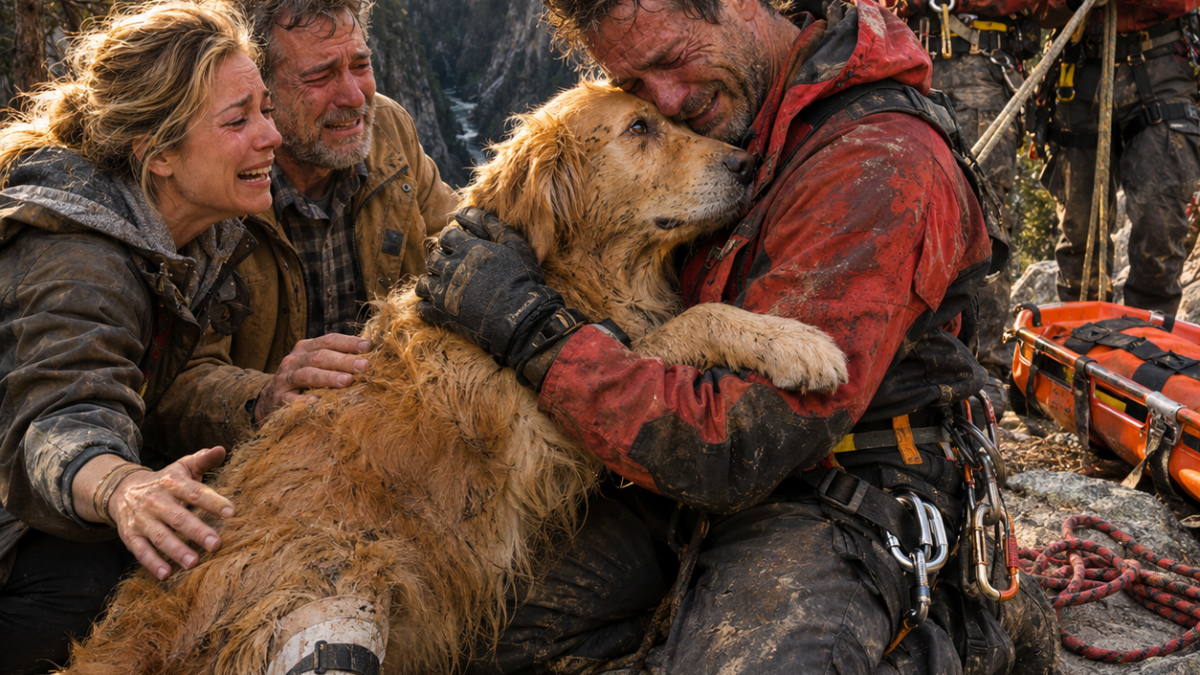
The man wrapped his arms around Buddy’s neck.
The woman dropped beside them.
The little boy pressed his face into the dog’s shoulder.
Buddy’s tail began thumping against the blanket.
Again.
Again.
Again.
I sat back on my heels.
Nobody spoke.
We didn’t need to.
The young rescuer beside me removed one glove and wiped his face with the back of his hand.
Dust, he would probably claim later.
I knew better.
The man looked toward us.
“Who went down?”
One of my teammates pointed at me.
“He did.”
The man stood.
Walked over.
Then stopped.
He looked like he wanted to say something.
Nothing came.
Finally:
“Thank you.”
I nodded.
“You’re welcome.”
He wiped his face.
“We’ve been searching almost three hours.”
I looked toward Buddy.
“He kept calling.”
The man glanced back at the dog.
“We thought…”
His voice broke.
He stopped.
I knew the rest.
We thought he was dead.
We thought we had lost him.
We thought we were too late.
The woman looked at me.
“Is he going to be okay?”
“He needs a veterinarian immediately.”
Her face tightened.
“I think the rear leg is fractured. He’s also been through a significant fall and shock. But he’s alert, breathing well, and he’s strong.”
“Will he live?”
I looked at Buddy.
His head rested on the boy’s lap.
The child was whispering something into his fur.
“Yes.”
The woman started crying again.
“He’ll need treatment,” I continued. “But yes. I believe he’s going to live.”
The man closed his eyes.
For a moment, he just stood there.
Then he whispered:
“Thank God.”
We arranged to carry Buddy to their vehicle.
The trail was uneven, and there was no chance I was letting an injured dog walk it.
We placed him on a transport board with blankets supporting the injured leg.
The little boy refused to leave his side.
“What’s your name?” I asked.
He told me.
I won’t use it here.
He was seven.
His story belongs partly to him.
“What happened?” I asked gently.
His father answered.
“Buddy saw a squirrel.”
The boy looked miserable.
“He pulled the leash out of my hand.”
The father immediately touched his son’s shoulder.
“Not your fault.”
The boy’s lip trembled.
“I should’ve held tighter.”
“No.”
His mother crouched.
“It was an accident.”
The boy looked at Buddy.
“What if he can’t run anymore?”
I glanced at the father.
Then the boy.
“We don’t know that.”
He looked at me.
“Really?”
“Really.”
“His leg looks broken.”
“It probably is.”
The boy’s face fell.
“But dogs heal.”
He looked back at Buddy.
“Even from that?”
“Sometimes.”
I smiled.
“And he seems pretty determined.”
Buddy’s tail moved.
The boy almost smiled.
“See?”
That got him.
Just a little.
We carried Buddy toward the parking area.
The light was fading fast.
One of our team walked ahead with a flashlight.
Another stabilized the transport board.
I stayed near Buddy’s head.
He was exhausted now.
His eyes half closed.
Every few steps, he opened them to check where his family was.
The little boy remained beside us.
His mother repeatedly told him to watch the trail.
He repeatedly ignored her.
Buddy mattered more than roots and rocks.
We reached the car.
The woman climbed into the rear seat with a blanket.
I lifted Buddy carefully.
My shoulder protested.
I ignored it.
“Ready?”
She nodded.
We placed him across the seat.
The moment his body settled, he shifted his head onto her lap.
She laughed through tears.
“Oh, Buddy.”
He sighed.
A huge, tired sigh.
As though he had finally reached the place where he could stop fighting.
The man shook my hand.
Then held on.
“I don’t know how to thank you.”
“You don’t need to.”
“You went down there.”
“That’s the job.”
“That wasn’t just a job.”
I looked at him.
People say that sometimes.
They mean well.
But the truth is, it was the job.
And I love that the job asks people to do things that look unreasonable from the outside.
“Take care of him,” I said.
“We will.”
The little boy stood beside the open car door.
He looked at me.
“Are you the one who went down?”
“Yes.”
“Were you scared?”
His parents looked embarrassed.
I smiled.
“Yes.”
That surprised him.
“But you’re a rescuer.”
“Rescuers get scared.”
“Then how do you go?”
I thought about it.
“You make sure your equipment is right.”
He listened seriously.
“You trust your team.”
Another nod.
“And then you decide whether somebody needs you more than you need to feel comfortable.”
He stared at me for several seconds.
Then said:
“I want to do that.”
His father laughed softly.
“Let’s get through second grade first.”
The boy frowned.
I smiled.
“That’s a good start.”
They climbed into the car.
The father shut the rear door.
Buddy lay against the woman.
The boy squeezed into the seat beside him.
Then the car pulled away.
We watched the taillights disappear between the trees.
I thought that was the end.
It wasn’t.
We stood in the parking area gathering gear.
Harnesses.
Ropes.
Helmets.
Carabiners.
Routine.
The work after the work.
My shoulder had stiffened.
My knees hurt.
The adrenaline shaking had returned.
The young rescuer approached while I sat on the back bumper removing my gloves.
“Can I ask you something?”
“You’re going to anyway.”
He smiled.
Then looked toward the road where Buddy’s family had disappeared.
“What happened back there?”
“What do you mean?”
“The dog.”
I waited.
“When they were leaving.”
I looked at him.
He frowned.
“No. You didn’t see?”
“See what?”
He stared at me.
Then laughed.
“You really didn’t.”
One of the other rescuers looked over.
“What?”
The young guy pointed toward the trail.
“When the family first got him.”
“What about it?”
“He went to them.”
“Yes.”
“Then he came back.”
I stopped.
“What?”
The young rescuer’s expression softened.
“Buddy.”
He pointed at me.
“He came back to you.”
I genuinely did not remember.
Too much had been happening.
People.
Equipment.
Injuries.
Instructions.
He continued.
“You were still kneeling near the blanket.”
I looked toward the empty road.
“He left his family for a second.”
The young rescuer smiled.
“Walked right back over.”
Memory surfaced.
Not completely.
A golden shape.
Weight against my leg.
At the time I thought we were repositioning him.
The young rescuer continued.
“He put his head on your knees.”
I froze.
“He did?”
“For maybe five seconds.”
Another teammate joined us.
“More like ten.”
The young guy nodded.
“Then he went back to them.”
I stared at both of them.
“You’re serious?”
They laughed.
“How did you miss it?”
“I was checking the harness.”
“You were staring right at him.”
“I don’t remember.”
The older teammate smiled.
“Adrenaline.”
I sat there.
Then the memory sharpened.
Buddy leaving his family.
Three-legged, barely able to move.
Crossing those few feet.
His body leaning against me.
His head resting on my thighs.
I had touched his neck automatically.
Then he moved away.
At the time, I processed it as nothing.
Now the moment returned differently.
I looked at the young rescuer.
“He came back?”
“Yeah.”
“Why?”
He shrugged.
“That’s what I was going to ask you.”
The forest had become quiet.
Night was coming.
Wind moved through the upper branches.
For several seconds, none of us spoke.
Finally, the young rescuer said:
“Does that happen often?”
“No.”
“How often?”
“Never to me.”
His eyebrows rose.
“Seriously?”
“Eleven years.”
I thought through every rescue.
Dogs trapped under buildings.
Dogs in drainage pipes.
Cats on roofs.
Animals in floodwater.
Injured wildlife.
Pets pulled from wreckage.
Animals sometimes cling to rescuers during fear.
Sometimes refuse to leave.
Sometimes bite the person saving them.
Fear makes behavior unpredictable.
But this had happened after Buddy was safe.
After his family arrived.
After everything he wanted had been returned to him.
He still came back.
The young rescuer asked:
“Do you think he knew?”
“Knew what?”
“That you saved him.”
I looked toward the dark ravine.
“I don’t know.”
“Dogs understand stuff.”
“They do.”
“Then maybe he was saying thanks.”
One of the older guys laughed gently.
“You’ve been here three months and already sound like a Disney movie.”
The young rescuer shrugged.
“Tell me I’m wrong.”
Nobody did.
I looked at my gloves.
Then said:
“Maybe gratitude.”
The young guy waited.
“Maybe he understood I helped.”
I thought about Buddy sniffing my glove on the ledge.
His fear.
His decision to move closer.
“Or maybe he just wanted to make sure I was okay.”
The young rescuer smiled.
“That’s somehow worse.”
“Worse?”
“More emotional.”
That made us laugh.
The tension finally broke.
We packed the remaining gear.
Before climbing into the vehicle, the young rescuer looked toward the ravine.
“Was it worth it?”
I knew what he meant.
The descent.
The wind.
The risk.
The injury.
The possibility that one mistake could have put one of us beside Buddy at the bottom.
I smiled.
“Always.”
“Every time?”
“Every time.”
We got into the truck.
And drove home.
The ride back to the center was unusually quiet.
Normally after a successful rescue, somebody talks.
Bad jokes.
Food.
Equipment complaints.
The young guy asking too many questions.
That night, almost nothing.
I watched the forest slide past the window.
And thought about Buddy.
Sixty feet.
The fall alone should have killed him.
Maybe a branch slowed him.
Maybe he struck the slope instead of falling vertically.
Maybe luck sometimes arrives without explanation.
What mattered was that he landed on a ledge barely wide enough to hold him.
Injured.
Unable to climb.
Separated from his family.
And he barked.
Again.
Again.
Again.
That detail stayed with me.
Animals don’t understand rescue systems.
Buddy didn’t know someone would call us.
He didn’t know ropes existed.
He didn’t know trained people could descend ravines.
All he knew was that he was alone.
So he called.
And continued calling.
Maybe that sounds simplistic.
But humans are not always better at that.
People sometimes stop asking for help because they think nobody is listening.
A dog on a rock shelf had done the opposite.
He kept making noise until someone answered.
Back at the center, we unloaded everything.
Ropes inspected.
Harnesses checked.
Hardware returned.
Incident report started.
My shoulder had bruised badly by then.
One teammate told me to get it examined.
I promised I would.
He knew I probably wouldn’t unless it worsened.
The young rescuer sat across from me while we finished paperwork.
“You’re putting ‘golden retriever’?”
“Yes.”
“Name?”
“Buddy.”
He smiled.
“Good name.”
I looked up.
“Apparently because he’s their best friend.”
The kid—because despite being an adult, he sometimes still felt like one—looked almost offended by how emotional that made him.
“That’s brutal.”
“What?”
“That name after today.”
I laughed.
“You’ll toughen up.”
“Do you?”
“What?”
“Get tougher.”
I thought.
“No.”
He waited.
“You get better at functioning while something affects you.”
“That sounds worse.”
“Sometimes.”
I finished the report.
He looked toward the drawer beside my desk.
“What’s in there?”
“Nothing.”
“You opened it.”
“I needed a pen.”
“What’s all that paper?”
I glanced at the drawer.
Letters.
Photos.
Thank-you cards.
Children’s drawings.
Notes.
Things families had sent after rescues.
“The reasons.”
He frowned.
“Reasons for what?”
I closed the drawer.
“For days when this job stops making sense.”
He looked at me.
“Does that happen?”
“Yes.”
He leaned back.
“You said it’s always worth it.”
“It is.”
“Then how does it stop making sense?”
I thought about the difference.
“Something can be worth doing and still hurt.”
He nodded slowly.
That answer would make more sense to him later.
It always does.
Three days passed.
No word about Buddy.
I told myself that was good.
Families with recovering pets have more important things to do than call rescuers.
Still, every morning, I wondered.
Did the leg require surgery?
Internal injuries?
Did shock cause complications?
Was he walking?
Eating?
The rescue had ended for us at the parking lot.
For Buddy, recovery had only begun.
On the fourth morning, dispatch called across the center.
“This is for you.”
He held up an envelope.
Handwritten.
My name on the front.
No return address I recognized.
I opened it.
Inside was a photograph.
Buddy.
Lying on a couch.
Rear leg bandaged.
Eyes bright.
Tail blurred because it was moving.
Beside him sat the little boy.
Both arms around Buddy’s neck.
Buddy was licking his cheek.
I smiled before reading anything.
Then I unfolded the letter.
The father had written it.
He explained that Buddy’s leg had indeed been fractured.
The veterinarian expected a full recovery.
No major internal injuries.
He was already trying to run despite strict instructions not to.
That sounded like Buddy.
Then the letter changed.
The father wrote:
There is something you didn’t know.
I kept reading.
The day Buddy fell was their son’s seventh birthday.
The family had chosen the hike as part of the celebration.
Buddy chased a squirrel.
Pulled free.
Disappeared.
They searched for three hours.
At first, they shouted his name.
Then they heard nothing.
Their son became convinced Buddy was dead.
He cried until he could barely walk.
The parents had tried to stay hopeful for him.
Then someone told them a dog had been found in the ravine.
They drove as close as possible.
Ran the rest.
That was the moment they appeared at the trail.
I looked at the photograph again.
The little boy smiling.
Buddy licking his face.
Then continued reading.
You did not only save our dog.
I stopped.
Read the line again.
You saved our son’s birthday from becoming the day he lost his best friend.
I swallowed.
Nobody in the center spoke to me.
Maybe they noticed.
Maybe they didn’t.
I kept reading.
The father described the moment Buddy returned to me after reaching his family.
They had seen it too.
His wife had cried harder.
The little boy had asked why Buddy went back.
The father said he didn’t know how to answer.
Then he wrote:
We decided Buddy knew.
Maybe not in the way humans understand things.
But he knew you were the person who came down when he was alone.
Then the final paragraph.
Our son says he wants to become a rescuer when he grows up.
And below that:
“I want to be the one who goes down.”
I read the letter twice.
Then a third time.
The young rescuer walked over.
“What happened?”
I handed him the photograph.
He looked.
“Buddy.”
I nodded.
“He’s okay?”
“Full recovery expected.”
“Hell yes.”
Then he noticed my face.
“What else?”
I handed him the letter.
He read silently.
When he reached the final line, he laughed.
Then covered his mouth.
“Oh, man.”
“Yeah.”
He gave it back.
“What are you going to do with it?”
I opened the drawer beside my desk.
The reasons.
I placed the letter inside.
On top.
Months passed.
Buddy’s rescue became one story among many.
Calls don’t stop because one rescue stays with you.
A horse stuck in mud.
A dog trapped behind storm debris.
A cat inside a drainage culvert.
A deer tangled in fencing.
Wildlife calls.
Search calls.
Days when everybody goes home happy.
Days when they don’t.
That is why the drawer matters.
Sometimes effort does not produce the ending you want.
Rescue work teaches humility quickly.
We do not control whether injuries are survivable.
We control preparation.
Response.
Skill.
Care.
And whether we show up.
One year after Buddy, I had one of those difficult calls.
A dog had been hit by a vehicle and gone down an embankment.
We got there.
We brought him up.
He didn’t survive.
The family arrived minutes later.
There was no miracle.
No tail wag.
No letter about recovery.
That night, I sat alone at the center after everyone left.
I opened the drawer.
Not intentionally looking for Buddy.
Just something.
The photograph was near the top.
Buddy on the couch.
Bandaged leg.
Boy wrapped around him.
I pulled out the letter.
Read it again.
Almost a year had passed.
Buddy was probably running by then.
Maybe chasing squirrels again despite everyone’s best efforts.
The boy was eight.
Maybe he had changed his mind about becoming a rescuer.
Seven-year-olds often do.
Or maybe he hadn’t.
I read the line.
I want to be the one who goes down.
And I remembered something.
Rescue is not made meaningful only by success.
If you let yourself believe that, failure destroys you.
The meaning is in showing up when something vulnerable needs somebody.
Sometimes you bring them home.
Sometimes you give them a chance.
Sometimes you simply make sure they are not alone.
Buddy had been one of the good days.
A day when everything difficult led somewhere beautiful.
You need those days.
They help you survive the others.
The youngest member of our team changed after Buddy.
Not overnight.
But I saw it.
When he first joined us, he wanted action.
Rope work.
Technical descents.
The dramatic stuff.
He was excellent physically.
Fast.
Strong.
Fearless in the irritating way young rescuers sometimes are before experience teaches them that fear is information.
After Buddy, he became more patient.
During one rescue involving a frightened dog trapped beneath a collapsed porch, he spent almost forty minutes lying in mud with one arm extended.
The dog kept growling.
Everyone else became impatient.
He didn’t.
“Let him decide,” he said.
Eventually, the dog crawled toward him.
Afterward, I smiled.
“What?”
He asked.
“Nothing.”
“You’re doing that old-guy smile.”
“I’m not old.”
“You absolutely are.”
I nodded toward the rescued dog.
“Nice job.”
He looked at the animal.
Then shrugged.
“Trust first.”
I smiled again.
Buddy had taught him that.
Not me.
Several months later, his probationary period ended.
He was officially a full member of the rescue team.
No more trainee designation.
No more somebody standing behind every decision.
He found me checking harnesses one morning.
“I wanted to say something.”
“That sounds dangerous.”
“Seriously.”
I looked up.
He shifted awkwardly.
“Thank you.”
“For what?”
“For Buddy.”
I frowned.
“I didn’t bring Buddy to the ravine.”
He laughed.
“No.”
Then he became serious.
“That day changed how I think about this.”
I waited.
“When I joined, I thought rescue was about being the guy who could go where other people couldn’t.”
I nodded.
Common mistake.
He continued.
“I thought bravery was the whole thing.”
“What do you think now?”
He looked at the ropes.
“It’s about being useful.”
That answer surprised me.
He continued.
“Anybody can want to look brave.”
He smiled.
“But the dog doesn’t care whether you look brave.”
“No.”
“He cares whether you get him home.”
I laughed softly.
“Now you’re getting somewhere.”
He looked toward the drawer.
“Still have the letter?”
“Yes.”
“Good.”
He nodded.
Then turned to leave.
“Hey.”
He looked back.
“Welcome.”
He grinned.
And walked away.
People ask why I stayed in rescue work for eleven years.
Now more.
The answers they expect are dramatic.
Adrenaline.
Heroism.
Love of animals.
Those are parts of it.
But heroism is a dangerous word.
It makes the job sound like you need to feel extraordinary.
Most days, you don’t.
Most days, you feel tired.
Your equipment is heavy.
Your knees hurt.
Paperwork waits.
Weather is miserable.
Calls arrive during dinner.
Pay is not impressive.
You miss weekends.
You smell terrible.
You see scared animals and frightened families.
And sometimes, despite everything, you lose.
So why stay?
Because sometimes the line tightens.
The harness holds.
The frightened animal decides to trust you.
You bring him over the edge.
A family appears.
A child screams his dog’s name.
And an animal who owes you nothing turns away from the people he loves for one brief moment, walks back, and rests his head on your knees.
That is enough.
It has to be.
I never saw Buddy again in person.
Sometimes people are disappointed when I say that.
They imagine he visited the station every Christmas.
That the family became lifelong friends.
That the little boy grew up and joined my team.
Real life doesn’t always provide those perfect loops.
Buddy returned to his family.
That was the point.
They had a life before I met them.
They deserved one afterward.
The photograph and letter were enough.
Occasionally I wondered what he looked like older.
Golden retrievers gray around the face beautifully.
Maybe by now his muzzle had gone white.
Maybe he still chased squirrels.
Maybe his family held the leash tighter.
I hoped so.
I hoped the boy remembered his seventh birthday not as the day Buddy fell, but as the day Buddy came home.
And I hoped Buddy forgot the ravine entirely.
Animals may be better at that than we are.
They do not always build identities around the worst thing that happened to them.
They recover.
Return to the people they love.
Sleep.
Eat.
Run.
Trust again.
There is something humans could learn from that.
Years after the rescue, I still occasionally drive near that trail.
Not for sentimental pilgrimages.
Work takes us through the area.
Every time, my eyes go toward the tree line.
The ravine is invisible from the road.
But I know where it is.
I remember the wind.
The loose stone.
The golden body against gray rock.
My hand stretched into empty space.
Waiting.
I remember Buddy’s nose touching my glove.
The first moment he chose to trust me.
People focus on the descent.
Sixty feet sounds dramatic.
But the descent was technical.
Equipment.
Training.
Procedure.
The hard part was the last three feet.
Me.
Buddy.
Fear.
No equipment can force trust.
You earn it slowly.
Sometimes by doing almost nothing.
That lesson followed me beyond rescue work.
Not every frightened thing needs to be pulled.
Sometimes it needs somebody willing to stay still long enough for it to move toward safety by choice.
One afternoon, a group of new volunteers came through the center.
I was asked to speak.
I hate speaking.
Give me a cliff and a rope over a microphone any day.
One volunteer asked:
“What’s the most memorable rescue you’ve ever done?”
Everyone looked at me.
There were more technically difficult answers.
More dangerous ones.
More dramatic ones.
I thought of Buddy.
“Golden retriever.”
A few people smiled.
“What happened?”
“He fell about sixty feet into a rocky ravine.”
Their expressions changed.
“Did he live?”
“Yes.”
“What made it memorable?”
I almost told the whole story.
Instead, I said:
“After we brought him up and reunited him with his family, he came back.”
“Back where?”
“To me.”
I touched my knees.
“Put his head here.”
The room became quiet.
One person asked:
“Why?”
I smiled.
“I don’t know.”
That answer bothered them.
People want meaning explained.
Sometimes explanation cheapens meaning.
Maybe gratitude.
Maybe reassurance.
Maybe scent.
Maybe Buddy simply associated me with safety and came back instinctively.
All possible.
None remove the beauty.
I continued.
“Rescue work teaches you that not everything meaningful needs a perfect explanation.”
Nobody wrote that down.
Good.
Some things should be remembered instead.
A few months after that talk, I opened the drawer and found Buddy’s photograph fading slightly at the edges.
That bothered me.
I made a copy.
Put the original in a protective sleeve.
The letter too.
My younger teammate—no longer young, no longer a trainee—walked past.
“Preserving history?”
“Apparently.”
He looked at the photo.
“Still your favorite?”
“I don’t rank rescues.”
“That’s a yes.”
I laughed.
He leaned against the desk.
“Do you think that kid became a rescuer?”
“I’ve wondered.”
“How old would he be now?”
We calculated.
Older than either of us wanted to admit.
“Could be applying somewhere.”
“Maybe.”
He smiled.
“Would be crazy if he showed up here.”
“It would.”
We both knew life probably would not give us that scene.
And that was okay.
Maybe he became a teacher.
Mechanic.
Doctor.
Accountant.
Maybe he forgot he ever said he wanted to become a rescuer.
The important thing was that for one day, an adult stranger descending into a ravine showed him what help looked like.
Children carry images longer than we realize.
Perhaps that was enough.
The letter remains in my drawer.
There are more letters now.
More photographs.
More reasons.
One from a family whose cat survived a house fire.
One from an elderly woman whose dog we found during flooding.
Crayon drawings.
Christmas cards.
A photograph of a three-legged dog running on a beach.
The drawer barely closes.
On difficult days, I open it.
Buddy is still there.
Bandaged leg.
Tail blurred.
Little boy hugging him.
Whenever I see it, I remember the exact weight of Buddy’s head against my knees.
Or maybe I remember the memory of remembering it.
After enough years, those two things blur.
It doesn’t matter.
The feeling remains.
The day Buddy fell, he had no reason to trust me.
From his perspective, I appeared above him wearing strange equipment.
Descended on ropes.
Moved into the tiny space where he had been hiding.
Touched him while he hurt.
Wrapped straps around his body.
Then lifted him into open air.
Every instinct could have told him to fight.
For a while, it did.
Then he chose something else.
Trust.
Not because I explained the plan.
Because I stayed.
Because I moved slowly.
Because when he growled, I listened.
Because when he hurt, I stopped.
Trust was not something I demanded.
It was something he eventually offered.
And once he did, it became my responsibility not to betray it.
That is still the part of rescue work that humbles me most.
Animals hand you something fragile.
Their fear.
Their body.
Their next few minutes.
You may never see them again.
But for that moment, you owe them everything you know how to give.
If you ask what I remember most clearly about that day, it isn’t the cliff.
It isn’t the wind.
It isn’t even Buddy’s injury.
It’s the silence after he returned to me.
Everyone noticed.
His owners.
My teammates.
Even the little boy.
A dog who had been desperate to reach his family turned away from them.
Came back a few feet.
Lowered himself despite the injured leg.
And rested his head on me.
Nobody laughed.
Nobody made a joke.
For several seconds, everyone simply watched.
We all understood the same thing without being able to prove it.
Buddy did not need anything from me anymore.
That was what made it different.
He was safe.
His people were there.
He could leave.
Instead, he came back.
Maybe only to smell me again.
Maybe to check me.
Maybe because dogs are more aware of human emotion than we understand.
Or maybe, in whatever language exists between species, he was saying the simplest thing possible.
I know what you did.
Thank you.
Then he went home.
I think about that whenever someone calls rescue work heroic.
Heroism implies a moment.
I think the deeper part is repetition.
Showing up again.
Going down again.
Checking the harness again.
Answering the next call even after the last one hurt.
The young rescuer who asked me whether Buddy was worth the risk now teaches new members.
I watched him train somebody recently.
The trainee was rushing a frightened dog during an exercise.
He stopped her.
“Slow down.”
She said:
“But we need to secure him.”
“Yes.”
“Then why wait?”
He crouched.
Held out his hand.
“Because trust first.”
I heard those words.
And smiled.
He looked over.
Saw me.
Rolled his eyes.
“What?”
“Nothing.”
“Stop doing the old-man smile.”
“Still not old.”
He laughed.
Then returned to the trainee.
I walked away.
That may be Buddy’s longest rescue.
Not the day we pulled him from the ravine.
The lesson that kept moving afterward.
From dog to rescuer.
From rescuer to teammate.
From teammate to trainee.
Maybe someday to someone else.
There is a photograph on my desk now.
Not Buddy’s.
That stays in the drawer.
This one shows the ravine.
Taken weeks after the rescue.
Nothing special.
Trees.
Rock.
Sky.
If you didn’t know what happened there, you would drive past it without looking.
I like that.
Important places rarely announce themselves.
A hospital room.
A parking lot.
A kitchen table.
A rocky ravine.
Their significance comes from what happened when somebody needed another person.
The ravine taught me something I had spent years trying to articulate.
You do not always get thanked.
You should not need to.
You do the work because the life at the other end matters.
Buddy’s return was extraordinary precisely because I expected nothing.
Had he climbed into the car without looking back, the rescue would still have been worth every risk.
The fact that he came back was a gift.
Not payment.
The last time I read the father’s letter, I noticed a line I had somehow ignored for years.
Near the end, before the note about his son wanting to become a rescuer, he had written:
We hope you understand that Buddy is not just a dog in our house.
I smiled.
Rescuers hear that sentence constantly.
“He’s not just a dog.”
“She’s family.”
“He saved me.”
“My children grew up with him.”
People sometimes apologize for caring that much.
They shouldn’t.
Love does not become foolish because the creature receiving it has four legs.
Buddy was part of that family’s daily life.
Breakfast.
Walks.
Birthdays.
Bad days.
Good days.
The sound of paws in a hallway.
A head against somebody’s knee.
A child learning responsibility.
Parents learning patience.
Losing him would have left a hole outsiders might underestimate.
When I descended that ravine, I thought I was rescuing a dog.
The letter reminded me that rescue rarely stops with the individual you physically carry.
You pull one life back.
Sometimes an entire family comes with it.
I am older now.
My knees complain more after descents.
My shoulder still occasionally reminds me of that rock wall when the weather changes.
I am no longer the person who automatically volunteers for every difficult rope assignment.
Younger people are faster.
Stronger.
That is how it should be.
Sometimes I supervise.
Sometimes I stay topside.
The first few times, that bothered me.
It felt like stepping away from the part of the job that made me useful.
Then I watched the young rescuer—the one who saw Buddy come back—descend on a call.
He moved carefully.
Checked every point.
Spoke gently to the animal.
Exactly as someone once taught him.
When he reached the bottom, I realized usefulness changes shape.
You go down.
Then someday, you hold the rope for someone else.
Both matter.
A trainee once asked me whether I ever regretted taking a dangerous call for “just an animal.”
I knew she did not mean disrespect.
She was young.
Trying to understand where risk boundaries belonged.
So I answered seriously.
“We never ignore human safety.”
She nodded.
“We never create another victim just because we want a dramatic rescue.”
Another nod.
“But ‘just an animal’ is the wrong way to frame it.”
She listened.
“The question is whether we can do something safely enough to give a living creature a chance.”
I looked toward our rope equipment.
“If yes, we try.”
She asked:
“Even if nobody owns it?”
“Yes.”
“Even if nobody ever knows?”
“Yes.”
“Why?”
I smiled.
“Because the animal knows whether it hurts.”
She went quiet.
That answer had taken me years to simplify.
Buddy had owners.
A child waiting.
A family that thanked us.
That made the ending beautiful.
But the worth of the rescue existed before we knew any of that.
When I went over the edge, he was simply a dog I had never seen.
No name.
No story.
No seven-year-old boy.
No letter.
Just golden fur on gray rock.
That was enough.
It still is.
Sometimes, very late at the center, when everyone else has gone home and the radios are finally quiet, I open the drawer.
The photograph sits near the front.
Buddy.
Bandage.
Boy.
Blurred tail.
The father’s letter folded behind it.
I know parts of the letter by heart now.
But one line still gets me.
Our son says when he grows up, he wants to be the one who goes down.
I don’t know if he ever did.
Maybe that isn’t the point.
For one moment, a seven-year-old looked at the world and saw that when something falls somewhere dangerous, somebody can choose to go after it.
That is not a bad thing for a child to believe.
Maybe not a bad thing for adults either.
If Buddy were still alive now, he would be old.
Maybe very old.
Golden face pale around the muzzle.
Moves slower.
Sleeps more.
Still lifts his head when someone says his name.
I like imagining him that way.
Not on the ledge.
Never on the ledge.
Home.
Where he belongs.
Maybe that is what rescue is supposed to do to memory.
At first, the danger is everything.
Then, with time, home becomes the larger part of the story.
I hope that happened for his family.
It happened for me.
When I first thought about Buddy, I saw the ravine.
Now I see the photograph.
A couch.
A child.
A healed dog trying to wag his tail faster than the camera could capture.
That is the ending.
Not the fall.
Not the rope.
Not me.
Home.
Eleven years into rescue work, I thought I understood why I kept doing it.
Buddy corrected me.
I used to think it was about saving lives.
That is part of it.
But the deeper reason is connection.
A frightened creature deciding you are safe.
A family seeing someone they love returned to them.
A young rescuer discovering that courage is not the absence of fear.
A little boy realizing strangers sometimes go down cliffs for lives they have never met.
A letter arriving days later and sitting in a drawer for years.
One rescue touches another life.
Then another.
Then another.
You rarely see the full distance.
Maybe you’re not supposed to.
You just hold your part of the rope.
People still ask me whether going sixty feet down in worsening wind for a dog was worth it.
My answer has never changed.
Yes.
Not because Buddy thanked me.
Not because his owners wrote a letter.
Not because the story became something I remembered years later.
It was worth it the moment I looked over the edge and saw a frightened animal still trying to survive.
Everything after that was a gift.
The family arriving.
The child crying.
Buddy’s tail moving.
His head against my knees.
The photograph.
The letter.
The young rescuer becoming a professional.
All gifts.
But the reason came first.
Something was alive down there.
And we had a way to help.
That was enough.
If you had stood beside me on that trail after Buddy left, you would have seen nothing remarkable.
Four tired rescuers.
Dirty equipment.
A forest getting dark.
A man sitting on a bumper with shaking hands.
No music.
No applause.
No cameras.
Just people packing ropes.
But inside that ordinary moment, something had changed.
I knew it.
My teammates knew it.
The youngest one definitely knew it.
A dog who had fallen sixty feet had reminded all of us why we had come.
Not for recognition.
Not for gratitude.
Not to feel brave.
To answer.
That is all rescue really is at the beginning.
Something calls.
You answer.
Buddy barked from a ledge because he had no other language for help.
Someone heard.
Someone called us.
We went.
He trusted.
We brought him home.
And before leaving, he came back once.
Just once.
Long enough to rest his head on my knees.
Long enough for an entire rescue team to fall silent.
Long enough for me to remember it years later whenever the work became heavy.
I still don’t know exactly what Buddy meant.
Maybe I never will.
But if I had to choose words for that moment, I would choose the simplest ones.
You came down for me.
I know.
And every time I open that drawer and see his photograph, I hear my own answer again.
Every time, Buddy.
Every single time.








