FULL STORY:A golden-coated dog ripped the brown leather bag from my hand in the middle of a crowded subway platform, circled it while making a sound so broken that hundreds of rushing commuters slowly stopped to stare, then looked straight into my eyes as if I were the only person alive who could understand what he was begging me to do.
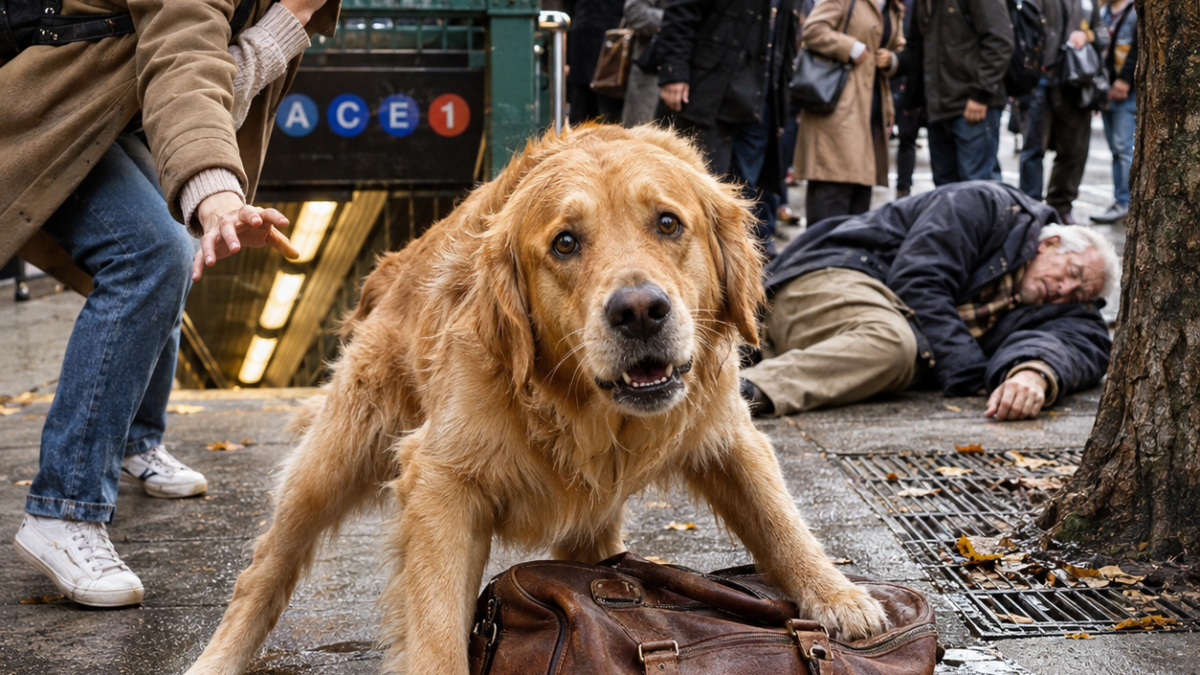
FULL STORY CONTINUATION
The dog did not run like an animal escaping.
That was the first thing I noticed.
He kept checking me.
Five steps.
Turn.
Look.
Run.
Stop.
Wait.
When I slowed near the turnstile because a crowd blocked my way, he came back.
Not all the way.
Just far enough to make sure I was still there.
Then he let out that sound again.
It wasn’t quite a bark.
It was a high, trembling cry that seemed to begin somewhere deeper than his throat.
People moved away from him.
I moved closer.
“I’m coming.”
I said it without thinking.
The dog’s ears lifted slightly.
Then he turned and ran.
I had absolutely no idea what I was doing.
The rational part of my mind was screaming.
You don’t know this animal.
You don’t know where he is taking you.
You have work.
You are already late.
Someone could be using the dog to lure people somewhere.
That last thought almost stopped me.
Almost.
Then he turned at the top of the subway stairs.
Looked back.
And I saw desperation again.
Not aggression.
Not excitement.
Desperation.
I followed.
Outside, the morning felt impossibly bright after the station.
Cars moved through the intersection.
A delivery truck blocked half the street.
Someone was arguing into a phone near a coffee shop.
The dog stopped at the curb.
Looked left.
Then right.
He crossed.
I hurried after him.
“You better know what you’re doing.”
I muttered.
He did.
Two blocks.
Then a small neighborhood park.
He ran through the open gate.
Past a bench.
Past a woman pushing a stroller.
Straight toward a large tree near the center.
That was when I saw the man.
He was lying on the ground.
At first, my mind refused to understand the shape.
Gray jacket.
One arm stretched away from his body.
Cane several feet away.
Eyes closed.
The dog reached him first.
He licked the man’s hand.
Pawed at his chest.
Barked.
Then looked at me.
Every trace of frantic energy seemed to collapse into one simple message.
Here.
I dropped my bag and ran.
“Sir?”
Nothing.
I knelt.
“Can you hear me?”
I touched his shoulder.
His skin looked pale.
His breathing was there.
Slow.
Shallow.
I did not know enough medicine to diagnose anything.
I knew enough to call emergency services.
I pulled out my phone.
The dog paced beside me.
“Stay.”
I had no idea whether he knew the command.
He stopped anyway.
Maybe because he heard my voice change.
Maybe because his job was done.
I told the dispatcher:
“Older man.”
“Unconscious or barely conscious.”
“Breathing.”
“Park near Westbridge station.”
“No, I don’t know his name.”
Then the man moved.
A tiny sound.
His eyes opened halfway.
“Sir?”
His lips moved.
I leaned closer.
“Rocky.”
I looked at the dog.
The dog immediately put one paw on the man’s chest.
“Rocky?”
The man’s eyes shifted toward him.
“Good boy.”
His voice was barely air.
Rocky whined.
Then looked at me.
The desperation in his eyes had changed.
There was something else there now.
Relief.
The paramedics arrived in less than ten minutes.
It felt like thirty.
They checked blood pressure.
Pulse.
Glucose.
One of them looked at the reading and immediately began treatment.
“He’s diabetic.”
The other paramedic asked.
The man nodded weakly.
The first paramedic looked at me.
“You family?”
“No.”
“Friend?”
“No.”
I almost laughed because of how absurd the truth sounded.
“His dog found me in the subway.”
The paramedic paused.
“What?”
Rocky stood pressed against the stretcher.
“He came into the station.”
“He grabbed my bag.”
“He made me follow him.”
The paramedic looked at the dog.
Then at me.
Then back at the patient.
“Well.”
He said.
“That’s a new one.”
They explained that the man’s blood sugar had dropped dangerously low.
Another half hour without help could have become much more serious.
Maybe he would have awakened.
Maybe not.
Maybe someone else would have found him.
Maybe.
I learned later that grief and gratitude both feed on that word.
Maybe.
But Rocky had not waited for maybe.
His person fell.
So he went looking for someone.
The hardest part came when they tried to load the man into the ambulance.
Rocky refused to move.
He planted his feet beside the stretcher.
Whined.
Then tried to climb in after him.
“Rocky.”
The old man whispered.
The dog froze.
“Go.”
Rocky did not go.
His entire body trembled.
A paramedic looked at me.
“Is there anyone who can take him?”
“I don’t even know this man’s name.”
The old man heard.
“Harold.”
I moved closer.
“What?”
“Harold Brennan.”
His voice was stronger now.
“Rocky.”
He reached one shaky hand toward the dog.
Rocky pushed his nose into it.
The paramedic said they could work something out regarding Rocky once they reached the hospital, especially because Harold was conscious enough to identify him and no immediate alternative caretaker was present.
I watched the ambulance doors close.
Rocky inside.
Head visible for half a second.
Then gone.
I stood alone in the park.
My bag at my feet.
The world resumed.
Jogger.
Stroller.
Traffic.
Somebody laughing nearby.
I looked at the tree where Harold had been lying.
Then at my leather bag.
I should have gone to work.
Instead, I stood there for another five minutes.
I don’t know why.
Something had happened.
I just did not yet understand that it had happened to me too.
I was forty minutes late.
Meg knew immediately.
Meg knew everything immediately.
She worked beside me at a small independent bookstore café where we both did a little of everything—coffee, orders, inventory, customer complaints, and occasional crisis management when somebody spilled tea into the poetry section.
She took one look at me.
“Katie.”
“What?”
“What happened?”
“Nothing.”
“You look like somebody told you a ghost story in an elevator.”
I put down my bag.
Then stared at it.
Meg followed my eyes.
“What happened to your bag?”
“Dog saliva.”
She blinked.
“Start over.”
So I did.
The station.
The crying dog.
The park.
Harold.
The ambulance.
When I finished, Meg had stopped pretending to organize receipts.
“That dog found you?”
“Yes.”
“Out of a whole station?”
“Yes.”
“And dragged your bag?”
“Yes.”
“And then took you directly to his owner?”
“Yes.”
Meg leaned both palms against the counter.
“Katie.”
“I know.”
“No.”
“You don’t know.”
“What?”
“You have to go to the hospital.”
I laughed.
“No.”
“Yes.”
“We’re strangers.”
“You followed his dog through downtown.”
“You’ve moved beyond stranger etiquette.”
“He might not even remember me.”
“Rocky will.”
I looked away.
That was exactly the problem.
I could not stop thinking about Rocky.
His eyes.
The sound he made.
The way he put his paw on Harold.
All afternoon, I made mistakes.
Wrong change.
Forgot tea.
Put a book order under the wrong customer name.
Meg finally took a cup from my hand.
“Go.”
“I’m scheduled until six.”
“I will cover.”
“No.”
“Katie.”
“I can’t just visit a random man in the hospital.”
“You can.”
“That is literally what visiting hours are for.”
“What am I supposed to say?”
“Hello.”
“You almost died.”
“Your dog stole my purse.”
“Good afternoon.”
I smiled despite myself.
Meg softened.
“You want to go.”
I hated when she was right.
“Yes.”
“Then go.”
The hospital smelled like antiseptic and overheated air.
I nearly turned around twice.
Hospitals carried their own kind of memory for me.
Dennis.
I will not tell you every detail of losing Dennis.
Some things remain mine.
What matters is that hospitals had become places where doors closed and answers changed and eventually someone stopped using the word “when” and began using the word “if.”
For a long time afterward, I avoided them unless absolutely necessary.
That evening, I stood in the lobby thinking maybe this was not necessary.
Then I heard a bark.
One.
Somewhere down a hallway.
My feet moved before I decided anything.
Harold was awake.
Rocky lay on the floor beside his bed.
His head rested across Harold’s slippered feet.
The moment I appeared in the doorway, Rocky lifted his head.
Then stood.
Tail.
One slow wag.
Then faster.
Harold turned.
His face brightened.
“I knew you’d come.”
I stopped.
“You did?”
He looked at Rocky.
“He did.”
Rocky walked toward me.
No frantic circles this time.
No crying.
He pressed his nose against my bag.
Then looked up.
I crouched.
“Hello again.”
Rocky leaned against me.
His body was warm.
Solid.
Alive.
I put my arms around his neck.
Something inside me loosened.
Only slightly.
Enough.
Harold looked better.
Color in his face.
IV line.
Hospital wristband.
Glucose stabilized.
A nurse had apparently bent several rules to allow Rocky to remain temporarily while a neighbor arranged to help later.
Harold said the staff had been charmed.
I said:
“Rocky has no respect for policy.”
Harold smiled.
“Runs in the family.”
I pulled a chair closer.
“How are you feeling?”
“Embarrassed.”
“That seems unnecessary.”
“I’ve managed diabetes for twenty years.”
“One bad morning doesn’t erase nineteen good years.”
He studied me.
“That sounds like something someone once told you.”
I looked away.
Maybe.
Harold did not ask.
Not yet.
Instead:
“I owe you my life.”
“No.”
“Yes.”
“Rocky found me.”
“And you followed him.”
“That was mostly bad judgment.”
“Sometimes good things are hiding inside bad judgment.”
Rocky put his chin on my knee.
Harold watched him.
Then looked at my bag.
His expression changed.
Softly.
“Oh.”
I touched the leather.
“What?”
“That bag.”
“What about it?”
He leaned back.
Closed his eyes for a second.
Then opened them.
“I think I know why he chose you.”
I wish I could describe the room before Harold said Jenny’s name.
Because afterward, everything changed.
Before:
A hospital room.
Stranger.
Dog.
Coincidence.
After:
Grief recognized grief.
Harold rubbed one hand over the blanket.
“Rocky belonged to my daughter.”
His voice had changed.
Not weak.
Careful.
As if every word needed to be lifted with both hands.
“Her name was Jenny.”
I said nothing.
Harold continued.
“She died two years ago.”
“Cancer.”
“Fast.”
“She was thirty-two.”
Thirty-two.
Young enough that the number felt offensive.
Rocky looked toward Harold at Jenny’s name.
His ears lifted.
Harold noticed.
“He still knows.”
I looked at Rocky.
“Of course he does.”
Harold smiled sadly.
“Jenny adopted him as a puppy.”
“She said he looked too serious for his own face.”
“He slept in her room from the first night.”
“Then eventually in her bed, despite three months of her swearing dogs didn’t belong on furniture.”
I smiled.
“Dogs usually win that debate.”
“Rocky won all debates.”
Harold’s eyes brightened with tears.
“When Jenny got sick, he changed.”
“How?”
“He stopped leaving her.”
“Bathroom.”
“Bedroom.”
Hospital appointments when allowed.”
“If she cried, he climbed beside her.”
“If she couldn’t sleep, neither did he.”
“He would put his nose under her hand.”
Harold swallowed.
“And after she died…”
Rocky lowered his head.
Harold reached down.
“He stopped eating.”
“For nearly three weeks.”
“I thought I would lose him too.”
My throat tightened.
“What did you do?”
“Sat beside him.”
“Talked.”
“Put food down.”
“Took it away.”
“Put it down again.”
“Walked him even when he didn’t want to.”
“Cried where he could see me.”
“I don’t know if dogs understand grief.”
He looked at Rocky.
“But he understood mine.”
Then Harold pointed to my bag.
“Jenny had one.”
My hand tightened around the strap.
“What?”
“Brown leather.”
“Almost exactly like yours.”
“She carried it everywhere.”
“Work.”
“Doctor.”
Grocery store.”
“Toward the end, it held medication, notebooks, a bottle of water, things she needed to feel independent.”
Harold smiled faintly.
“Rocky associated that bag with her.”
I looked down.
Suddenly the bite marks on the strap felt different.
“He’s seen other brown bags since?”
“Of course.”
“What did he do?”
“Usually looked.”
“Sometimes sniffed.”
“Then kept walking.”
Harold’s eyes met mine.
“But today…”
“He came to me.”
“Yes.”
“There were hundreds of people.”
“I know.”
“Why me?”
Harold was quiet.
Then said:
“I have a theory.”
I waited.
“He saw the bag first.”
“But I think he saw something in you second.”
My chest tightened.
“What?”
“Someone who would stop.”
“That’s all.”
I shook my head.
“No.”
“Most people would stop.”
Harold gave me a tired smile.
“Would they?”
I remembered the platform.
Phones.
People moving.
The man telling me not to follow.
The woman filming.
Maybe.
Maybe not.
Harold continued:
“When you knelt beside me in the park, I saw your face.”
“I know that face.”
“What face?”
“The face of someone who has lost somebody.”
I stopped breathing for a second.
Rocky pressed his head harder against my leg.
Harold’s voice softened.
“Who was he?”
I stared at him.
“How do you know it was a man?”
“I don’t.”
“Lucky guess.”
I should have refused.
We had known each other less than a day.
Instead:
“Dennis.”
The name left my mouth quietly.
Rocky looked up.
Harold said nothing.
Which was exactly right.
No:
I’m sorry.
No:
How long?
No:
What happened?
He simply waited.
So I gave him one more piece.
“He brought me coffee in bed.”
Harold smiled.
“That sounds useful.”
“He was annoying.”
“Those are often the useful ones.”
I laughed.
Then cried.
Just like that.
No warning.
One second laughter.
Next tears.
I turned away, embarrassed.
Rocky stood.
Put his front paws against the chair.
Then laid his head across my lap.
I covered my face.
Harold began crying too.
No one apologized.
We talked for almost two hours.
Jenny loved flowers.
Not sophisticated flowers.
Anything that survived her neglect.
She sang badly in the shower.
Read aloud to Rocky when he was a puppy.
Mystery novels.
Cookbooks.
The backs of cereal boxes.
Whatever was nearby.
Dennis brought me coffee.
He danced in the kitchen without music.
He always stole the crispy edges from roasted potatoes and pretended he was “quality testing.”
He hated folding laundry.
He made me laugh when I wanted to stay angry.
For months after he was gone, I kept buying the coffee he liked even though I never drank it.
Harold understood that.
He kept buying Jenny’s favorite cereal.
Rocky refused to eat it.
So the boxes accumulated.
“Grief is ridiculous.”
Harold said.
“Yes.”
“You know something is gone.”
“But your hand still reaches for it.”
I looked at him.
“Yes.”
Rocky moved from my lap to Harold’s feet.
Then back.
As if he had decided his job was distributing weight equally.
Before I left, Harold held out his hand.
I took it.
“Katie.”
“Yes?”
“Rocky chose you today.”
“I think he chose my bag.”
Harold smiled.
“Maybe.”
“Let me believe otherwise.”
“Fine.”
Then his expression became serious.
“I don’t know what you believe about things that happen after people die.”
Neither did I.
He continued:
“But sometimes I think Jenny left pieces of herself in Rocky.”
“Not magically.”
“Just…”
He searched.
“The way love teaches an animal what to notice.”
“What matters.”
“Who might be safe.”
I looked at Rocky.
Harold said:
“Maybe he saw Jenny’s bag.”
“Maybe he saw sadness.”
“Maybe he saw a woman who would follow.”
“Maybe that’s enough.”
Then he squeezed my hand.
“If you ever need somebody…”
He glanced at Rocky.
“We’re available.”
Rocky wagged.
I smiled through tears.
“Same.”
The following morning, I entered the subway station differently.
That was the first change.
Usually I went directly to the same place on the platform.
Same pillar.
Same bench if available.
Same position relative to the third train door.
Routine had become one of the ways I survived after Dennis.
Predictability kept grief from surprising me.
But that morning I stood in the middle.
Bag in hand.
Looking around.
Searching for golden fur.
Rocky was not there.
Of course he wasn’t.
Harold was recovering.
Rocky was with him.
Still, I looked.
And for the first time in years, I noticed other people.
A woman helping an old man down the stairs.
A teenager holding the elevator for someone with a stroller.
A tired nurse leaning against a wall with her eyes closed.
A little boy sharing half a muffin with his father.
The station had always contained humanity.
I had simply been moving too quickly through my own grief to see it.
Harold came home two days later.
I knew because he called.
“Rocky has become unbearable.”
“What did he do?”
“Stole my sock.”
“That sounds medically significant.”
“I blame you.”
I smiled.
“You called just to report theft?”
“No.”
A pause.
“Dinner Sunday?”
I almost said no.
Not because I didn’t want to go.
Because wanting to go frightened me.
New relationships after loss can feel like disloyalty.
Nobody warns you.
Dennis was gone.
I knew.
Yet accepting another person into my life sometimes felt as though I were moving his chair away from the table.
Harold must have sensed my hesitation.
“No pressure.”
He said.
Those words helped.
“Sunday.”
I answered.
Harold lived in a modest apartment nine subway stops from mine.
Jenny’s presence was everywhere.
Not like a shrine.
Like a life that had stopped but had not been erased.
A photograph near the bookshelf.
Jenny laughing, Rocky as a puppy in her arms.
Another beside the kitchen.
Jenny wearing gardening gloves covered in mud.
Rocky lying on her feet.
And on a chair near the front door—
a brown leather bag.
I froze.
Harold noticed.
“I should’ve warned you.”
I walked toward it.
The resemblance to mine was almost ridiculous.
Same color.
Similar shape.
Worn handles.
Rocky approached.
Sniffed Jenny’s bag.
Then sniffed mine.
He sat between them.
I started crying.
Again.
Apparently tears had become the entrance fee to Harold’s apartment.
Harold stood beside me.
“He used to sleep with it.”
“What?”
“After Jenny died.”
“I couldn’t move it for months.”
“I tried putting it away.”
“He found the closet and scratched the door until I opened it.”
“So you left it.”
“Yes.”
“Eventually he stopped sleeping beside it.”
“But I never moved it again.”
I reached toward the handle.
Stopped.
“Can I?”
“Of course.”
The leather was softer than mine.
Worn smooth where Jenny’s hand had held it.
For one impossible second, she became real to me.
Not just the dead daughter in Harold’s story.
A woman who carried too much in her bag.
Loved flowers.
Sang badly.
Read cereal boxes to a puppy.
Thirty-two.
I whispered:
“Hi, Jenny.”
Rocky leaned against my leg.
Dinner became Sunday dinner.
Not every week at first.
Then most.
Harold cooked badly.
I cooked slightly less badly.
Rocky supervised.
I learned about diabetes faster than Harold thought necessary.
He accused me of hovering.
I told him nearly dying in a park forfeited his right to complain for at least six months.
He said:
“Jenny used to say things like that.”
That stopped me the first few times.
Then eventually it made me smile.
Meg met them.
Rocky adored her immediately.
I was offended.
“You made me chase you through a subway station.”
I told him.
“Meg arrives with cheese and receives unconditional love.”
Meg scratched his ears.
“Good judgment.”
Harold said:
“Rocky has always been easily bribed.”
“That contradicts your theory that he’s spiritually perceptive.”
I said.
Harold pointed at Meg.
“Both can be true.”
One Sunday, Harold showed me Jenny’s garden journal.
She had kept notes.
Not careful botanical notes.
Chaotic ones.
Rose bush still angry.
Tomatoes finally stopped pretending to die.
Rocky dug up basil AGAIN.
There were sketches.
Pressed leaves.
A photograph of a puppy with dirt on his nose.
I laughed until I cried.
Harold watched.
Then said:
“You know what I missed most?”
“What?”
“Hearing someone else laugh at her jokes.”
That sentence stayed with me.
Grief is not only missing the dead.
It is missing the people who remember them with you.
When the last person who remembers a private joke disappears, some part of the dead person becomes harder to reach.
Harold had spent two years carrying Jenny alone.
I understood.
I had done something similar with Dennis.
People knew Dennis.
But not the Dennis who used the wrong lyrics confidently.
Not the Dennis who put grocery-store flowers in coffee mugs because he could never find a vase.
Not the Dennis who once spent twenty minutes arguing that burnt toast was “caramelized bread.”
Those versions lived mostly inside me.
So I told Harold.
And Harold listened.
Then he told me more about Jenny.
Sunday after Sunday, two dead people slowly returned to the room through stories.
Not ghosts.
Memory.
There is a difference.
Rocky became the bridge.
He insisted on walks.
Harold needed them.
So did I.
We walked through parks.
Past coffee shops.
Sometimes near the tree where Harold collapsed.
The first time we returned, Rocky slowed.
Sniffed the ground.
Looked at Harold.
Then at me.
Harold said:
“Do you remember?”
Rocky wagged.
I don’t know whether he did.
But I did.
Harold touched my arm.
“If you hadn’t followed him…”
“Don’t.”
I said.
“What?”
“I don’t like that sentence.”
“Why?”
“Because it makes everything after depend on one decision.”
“It did.”
“Maybe.”
I looked at Rocky.
“But somebody else might have followed.”
“Someone else might have found you.”
Harold smiled.
“You’re uncomfortable being important.”
“Yes.”
“That is unfortunate.”
“Why?”
“Because you are.”
I rolled my eyes.
Rocky barked once.
Traitor.
Months passed.
One evening, Harold called me after midnight.
My heart stopped when I saw his name.
“Harold?”
“I’m fine.”
“You better be.”
“I fell.”
I was already getting dressed.
“Where?”
“Bathroom.”
“Are you hurt?”
“Pride.”
“Anything else?”
“Hip.”
“Can you stand?”
“No.”
“Did you call emergency services?”
A pause.
“Harold.”
“Rocky brought me the phone.”
Of course he did.
“Call them.”
“I called you.”
“Call them now.”
I stayed on the line until help arrived.
It was not another diabetic emergency.
No fracture.
Bad bruise.
One night for observation.
But something changed.
Harold was aging.
That reality had always existed.
Now I could see it.
He hated the idea of accepting more help.
“I can manage.”
“That’s what you said before the park.”
“Low blow.”
“Effective?”
“Yes.”
We made practical changes.
Medical alert device.
Better glucose monitoring.
Neighbor with a key.
I became one of his emergency contacts.
When the form asked relationship, Harold looked at me.
“What should I put?”
“Friend.”
He smiled.
“Family seems easier.”
I stared.
He looked away.
“No pressure.”
That phrase again.
I took the pen.
Wrote:
Family friend.
Halfway.
Enough.
Rocky aged too.
Slower than Harold.
Faster than I wanted.
Gray began appearing around his muzzle.
Harold pretended not to notice.
I noticed everything.
One day Rocky struggled getting onto the couch.
Harold said:
“He slipped.”
Next week, same.
“Floor’s slippery.”
Third week, I bought dog steps.
Harold looked offended.
“He doesn’t need those.”
Rocky immediately used them.
I raised one eyebrow.
Harold muttered:
“Show-off.”
A year after the subway incident, Harold suggested we go back to the station.
“Why?”
“To thank it.”
“You want to thank public transportation?”
“The location.”
“That’s worse.”
He smiled.
“Humor an old man.”
So we went.
Rocky with us.
My brown bag on my shoulder.
Jenny’s stayed home.
The platform was crowded.
Just like that first morning.
Nobody recognized us.
Good.
We stood near the place where Rocky had grabbed my bag.
Harold looked around.
“Where?”
I pointed.
“There.”
Rocky sniffed.
Then sat.
A train arrived.
People rushed off.
People rushed on.
Nobody knew a life had changed there.
I liked that.
Harold said:
“What were you thinking?”
“When?”
“When he took the bag.”
“I thought he was stealing it.”
Rocky looked offended.
“Then?”
“I thought he was crazy.”
“Then?”
I looked at Rocky.
“I saw his eyes.”
Harold nodded.
“Jenny used to say his eyes made it impossible to lie to him.”
“That sounds manipulative.”
“She was.”
We laughed.
Then a woman dropped a glove near us.
Rocky picked it up.
Carried it to her.
She crouched.
“Oh, thank you.”
Rocky wagged.
Harold whispered:
“Still working.”
The anniversary affected me more than I expected.
Because it marked one year of knowing Harold.
One year of Rocky.
One year since I had begun saying Dennis’s name aloud again.
That last part mattered.
Before Rocky, I had stopped talking about Dennis unless someone else brought him up.
I thought silence protected me.
Instead, silence turned grief into a sealed room.
Harold opened windows.
Not intentionally.
By talking about Jenny.
By crying without apology.
By keeping her bag in a chair.
By saying:
“She loved this.”
“She hated that.”
“She would have laughed.”
He taught me that remembering was not refusing to move forward.
It was carrying someone differently.
I started talking to Dennis sometimes when I was alone.
Not because I believed he was physically listening.
Maybe he was.
Maybe not.
The point was not theology.
The point was that love had once been conversational.
Silence felt unnatural.
So I told him things.
“Meg burned the coffee again.”
“Harold tried to fix his own sink and created indoor weather.”
“Rocky ate half a sandwich including paper.”
“I miss you.”
That last one never became easy.
But it stopped feeling forbidden.
One rainy Sunday, Harold gave me Jenny’s gardening gloves.
I refused.
“No.”
“Why?”
“They’re hers.”
“Yes.”
“Exactly.”
“They’ve been in a drawer two years.”
“So?”
“So Jenny hated wasted things.”
“You can’t know she would want me to have them.”
Harold smiled.
“She wrote your name.”
I froze.
“What?”
He handed me a note.
Not old.
His handwriting.
I glared.
“You are terrible.”
He laughed.
“I wanted to make a point.”
“You committed emotional fraud.”
“Did it work?”
“No.”
I took the gloves.
Yes.
We planted flowers outside Harold’s apartment building with permission from management.
Jenny’s favorites.
Some failed.
Some survived.
Harold said:
“She would approve.”
“Of the dead ones?”
“Especially.”
Rocky dug up one.
Full circle.
Harold nearly cried laughing.
Then came the day Harold finally asked about Dennis’s last morning.
Not how he died.
The last ordinary morning.
That distinction allowed me to answer.
Coffee.
Of course.
Dennis had brought it to me.
He had forgotten sugar.
I complained.
He said:
“Builds character.”
I threw a pillow.
He laughed.
That laugh.
The one I thought would always exist in the next room.
Harold listened.
No interruption.
I said:
“I don’t remember what I said when he left.”
“That bothers me.”
“Why?”
“What if it was nothing?”
Harold looked at me.
“Katie.”
“What?”
“Most last words are nothing.”
I stared.
He continued:
“People say see you later.”
“Don’t forget milk.”
“Drive safe.”
“Call me.”
“We only turn them into sacred text afterward.”
Tears filled my eyes.
“I wish I remembered.”
“You remember coffee.”
“Yes.”
“His laugh.”
“Yes.”
“That’s enough.”
Rocky placed his head on my foot.
For once, I believed it might be.
Harold’s health stabilized.
He followed medical advice mostly because I threatened to recruit Meg as additional enforcement.
Rocky remained his shadow.
When Harold checked glucose, Rocky watched.
When Harold napped, Rocky slept beside him.
When Harold moved too slowly, Rocky moved slowly too.
There was something humbling about watching a dog adapt his pace to an aging person.
He never seemed impatient.
Humans could learn something.
One winter, Harold became ill with pneumonia.
Not dramatic.
Serious enough.
Hospital.
Four nights.
Rocky could not stay continuously.
He stayed with me.
That first night in my apartment, Rocky walked from room to room looking for Harold.
He stood by the front door.
Whined.
My chest broke.
“Hey.”
I sat on the floor.
“He’s coming back.”
Rocky stared.
I had no proof.
Hospitals had taught me to fear promises.
So I corrected myself.
“He’s getting help.”
“That part is true.”
Rocky came closer.
Lay beside me.
Jenny’s dog.
Harold’s dog.
Somehow my dog for one frightened night.
We slept on the living-room floor.
Harold came home.
Rocky nearly knocked him over.
I caught Harold.
“You’re supposed to protect him.”
Harold said.
“I am.”
“From you.”
Rocky whined.
Harold knelt slowly.
The dog pressed his whole body against him.
Harold buried his face in Rocky’s fur.
“I missed you too.”
I turned away.
Some moments do not need witnesses.
I still witnessed.
After that illness, Harold made a request.
“If something happens to me—”
“No.”
“Katie.”
“No.”
“Adults finish sentences.”
“Not this one.”
He waited.
Eventually:
“Fine.”
I sighed.
“Continue.”
“If something happens to me, Rocky goes to you.”
I stared.
“No.”
Harold looked hurt.
“Why?”
“Because you’re not using me to rehearse dying.”
“I am being responsible.”
“Do you have plans?”
“Yes.”
“Good.”
“Then keep them in the folder.”
“Katie.”
I looked at Rocky.
Older.
Gray muzzle.
Head on Harold’s foot.
My throat tightened.
Harold said quietly:
“I need to know.”
I hated him then.
A little.
Because love makes selfish people of us.
It makes us want others to live partly so we don’t have to hurt.
I whispered:
“Yes.”
Harold exhaled.
“Thank you.”
“But you are not allowed to use this as motivation to die.”
He laughed.
“Noted.”
That conversation haunted me.
Not because Harold was dying.
He wasn’t.
Because someday Rocky would lose Harold.
Or Harold would lose Rocky.
One of them would go first.
After Jenny, they had rebuilt a life around each other.
I started wondering whether love was cruel because it always contained a future absence.
Then Meg said:
“That is a stupid argument.”
We were closing the café.
“What?”
“If loving ends in losing, your conclusion is don’t love?”
“I didn’t say that.”
“You’re thinking loudly.”
I glared.
Meg continued:
“Dennis ended.”
“Would you erase him?”
“No.”
“Rocky lost Jenny.”
“Would he be better if she never adopted him?”
“No.”
“Harold will lose somebody or be lost.”
“So will you.”
“So will me.”
“Terrible grammar.”
“Emotional moment.”
She wiped the counter.
“Loss is the bill.”
“Love is what you bought.”
I stared.
“That is horrible.”
“I know.”
“Also maybe true.”
“Unfortunately.”
The second anniversary of the subway came.
Harold insisted on dinner.
Rocky got a steak.
This seemed unfair given his role had been stealing my bag.
Harold toasted:
“To bad judgment.”
I raised my glass.
“To diabetic people who leave home without enough glucose.”
He frowned.
“Hostile.”
“To dogs who ignore boundaries.”
Rocky wagged.
“And women who follow strangers.”
We drank.
Then Harold became quiet.
“Jenny would’ve liked you.”
My eyes filled.
“You don’t know that.”
“I do.”
“How?”
“You don’t let me get away with anything.”
“She didn’t either.”
I smiled.
Then:
“Dennis would’ve liked you.”
Harold looked surprised.
“Really?”
“No.”
“He hated men who overcook steak.”
Harold laughed so hard he coughed.
Rocky barked.
We laughed harder.
For a moment, Jenny and Dennis were not tragedies.
They were two absent people who would probably have had opinions about dinner.
That was healing.
Years moved.
Rocky slowed more.
Harold began using a cane more regularly.
I changed jobs.
Meg married.
Life did not pause simply because grief had become meaningful.
That mattered.
I used to believe moving forward meant leaving Dennis behind.
Then I learned life expands.
It does not necessarily replace.
Harold and Rocky fit beside Dennis.
Not over him.
Beside.
One spring morning, Rocky refused breakfast.
Harold called me immediately.
Old grief had made both of us suspicious of skipped meals.
Vet.
Tests.
Nothing catastrophic.
Stomach upset.
Medication.
By evening he ate chicken.
Harold nearly cried with relief.
“So dramatic.”
I said.
“You came to the vet before I did.”
“Research.”
“Hypocrite.”
Rocky stared between us.
Probably waiting for more chicken.
The brown bag remained important.
Mine aged.
The strap Rocky had bitten carried a permanent mark.
I never repaired it.
Meg asked why.
“Character.”
I said.
Dennis would’ve approved.
Harold laughed the first time he saw the bite marks years later.
“Rocky’s autograph.”
Exactly.
Jenny’s bag remained beside Harold’s chair.
Eventually the leather cracked.
Harold rubbed conditioner into it.
Not because anyone used it.
Because caring for an object sometimes becomes another way of caring for memory.
I stopped thinking that was unhealthy.
Not everything must be discarded to prove acceptance.
One day, Harold asked:
“Would you like Jenny’s bag someday?”
“No.”
Fast answer.
He nodded.
“Good.”
I stared.
“Good?”
“I was testing whether you had learned boundaries.”
“You are insufferable.”
He smiled.
Then:
“It goes to my granddaughter.”
I blinked.
“Jenny had a daughter?”
“No.”
“My sister’s granddaughter.”
“Jenny adored her.”
“She’ll know what it is.”
Good.
Objects should go where stories can continue.
Rocky’s favorite place eventually became the sunny patch beside Harold’s window.
He spent hours there.
Sometimes sleeping.
Sometimes watching the street.
I wondered whether he still looked for Jenny.
That thought hurt until Harold said:
“Maybe he isn’t waiting for the dead.”
“Maybe he’s just watching pigeons.”
I laughed.
We give animals enormous symbolic jobs because human grief is greedy.
Sometimes a dog is simply watching a pigeon.
Rocky deserved that too.
Harold began volunteering once a month with a diabetes education group.
He told the story of collapsing in the park.
Not to dramatize Rocky.
To tell older people to carry glucose properly.
Wear medical identification.
Tell people where they are going.
He hated admitting mistakes.
That made the talks effective.
Rocky occasionally attended.
People cared more about him.
Harold accepted second place with poor grace.
“I nearly died.”
He complained.
“Rocky was emotionally compelling.”
I said.
“I was unconscious.”
“Exactly.”
“Very weak storytelling.”
I started volunteering with a grief-support organization.
That surprised everyone including me.
Not as a counselor.
I made coffee.
Set chairs.
Welcomed people.
Sometimes that is enough.
The first evening, a woman stood in the doorway unable to enter.
I recognized the face.
The face Harold claimed Rocky had recognized in me.
Loss.
Not visible exactly.
But familiar.
I said:
“You don’t have to talk.”
She looked relieved.
She sat.
That was all.
On the train home, I touched the bite mark on my bag.
Rocky had taught me to stop.
Harold taught me to stay.
Dennis had taught me that love could still be worth remembering after it became painful.
Maybe this was what grief was becoming.
Not lighter.
Shared.
Years after that first morning, I was riding the subway when a dog barked behind me.
I turned immediately.
Different dog.
Different person.
Nothing wrong.
I smiled at myself.
For years I had searched the platform for Rocky.
Then stopped.
Not because I forgot him.
Because I no longer needed the original miracle repeated.
Once was enough.
Harold and I returned to the park every spring.
Same tree.
He called it his “almost monument.”
I hated the phrase.
We would sit.
Rocky between us.
People passed without knowing.
Sometimes Harold brought food.
Always enough glucose now.
I checked.
He complained.
I ignored him.
One afternoon he said:
“You know what bothered me after Jenny died?”
“What?”
“People saying I was strong.”
I nodded.
“I hated that too.”
“They meant kindness.”
“I know.”
“But strength became a job.”
“Yes.”
“If I cried too much, they looked worried.”
“If I laughed, they looked relieved.”
“I wanted to tell them I could be broken and alive at the same time.”
I looked at Rocky.
“So could he.”
Harold nodded.
“He almost starved.”
“Then one day he ate.”
“Not because he stopped missing her.”
“Because hunger returned.”
“That’s life.”
I thought about Dennis.
Maybe healing was not choosing life once.
Maybe it was appetite returning in tiny forms.
Coffee tasting good.
A joke.
Sunday dinner.
A dog waiting by the door.
Rocky began having trouble with stairs.
Harold’s apartment had an elevator, thankfully.
Still, getting into cars became difficult.
I bought a ramp.
Harold protested.
Rocky used it instantly.
Again.
We laughed.
“You two keep conspiring against my dignity.”
Harold said.
“Your dignity has survived worse.”
“Park incident?”
“Your cooking.”
He threw a napkin at me.
Rocky tried to eat it.
There came a morning when I realized Harold had become family without any formal moment.
No declaration.
No adoption paperwork.
No dramatic promise.
I was at work when my phone rang.
The caller ID displayed his name.
Meg said:
“Your dad’s calling.”
I answered automatically:
“He’s not my dad.”
Then stopped.
Meg smiled.
“What?”
“Nothing.”
The label did not matter.
Family is sometimes the person whose medical appointments you write on your calendar without deciding to.
The person who knows what Dennis did with toast.
The person whose dog has a bowl in your apartment.
The person who can say Jenny’s name and make you smile even though you never met her.
That was Harold.
That was Rocky.
At Christmas, Harold came to my apartment.
He brought Jenny’s old recipe for pie.
It was terrible.
We ate it anyway.
I put one photograph of Dennis near the table.
Harold brought a small picture of Jenny.
Not because we were building an altar.
Because they belonged in the room.
We raised glasses.
“To people who should be here.”
Harold said.
I added:
“And people who are.”
Rocky barked.
“Yes.”
I said.
“And dogs who demand inclusion.”
Later that night, after Harold fell asleep on the couch, I sat on the floor beside Rocky.
He was gray now.
Older.
Still beautiful.
I ran my hand along his head.
“You know what you did?”
He sighed.
“You went into a subway station.”
“You stole a stranger’s bag.”
“You changed everything.”
Rocky opened one eye.
Then closed it.
I smiled.
Dogs are unimpressed by legacy.
Good.
Maybe humans should be too.
I wish I could tell you grief eventually disappears.
It doesn’t.
Dennis remained.
Jenny remained.
Harold could be laughing and suddenly go quiet when a song played.
I could wake from a dream in which Dennis was alive and spend the first few seconds believing it.
Rocky sometimes stopped beside brown leather bags.
Not often.
But occasionally.
He would look.
Then continue.
That was the part that made me cry most.
He remembered.
And kept walking.
I began to understand why Rocky’s choice at the station affected Harold so deeply.
Harold wanted to believe Jenny was still connected somehow.
That she had sent help.
I never told him that was impossible.
I also never told him it was certain.
We did not need certainty.
We had a dog.
A bag.
A crowd.
A person who stopped.
Sometimes meaning does not require proving.
One afternoon, years later, Harold asked:
“Do you still think he chose you because of the bag?”
“Yes.”
“Only?”
I looked at Rocky.
Then at Harold.
“No.”
Harold smiled.
“What else?”
“I think Rocky needed someone willing to believe him.”
Harold nodded.
“That sounds right.”
“And maybe I needed someone to ask me to follow.”
Harold’s eyes filled.
“That too.”
There is a kind of grief where the world becomes very small.
Home.
Work.
Train.
Home.
You avoid places attached to memory.
Avoid people who ask questions.
Avoid happiness because happiness feels dangerous.
Rocky broke that pattern violently.
He literally took something from my hands and ran.
Follow.
That was his entire argument.
And because I followed, Harold lived.
But that is only half of what happened.
I followed Rocky out of the station.
Then somehow, slowly, he led me back into life.
I returned to places Dennis and I had loved.
Not all at once.
Coffee shop.
Park.
A restaurant we went to on anniversaries.
The first time I sat alone at our old table, I cried before ordering.
The waitress asked if I wanted to move.
“No.”
I said.
“I want this one.”
I ate.
Survived.
Next time hurt less.
Grief does not reward avoidance.
It waits.
Sometimes patiently.
Sometimes disguised as a dog holding your bag.
Harold came with me once to a café Dennis loved.
I told him:
“This was his chair.”
Harold immediately moved.
“What?”
“I was sitting in it.”
I laughed.
“You don’t have to.”
“I am not risking haunting.”
“You believe in ghosts now?”
“I believe in respectful seating.”
Rocky settled under the table.
We ordered coffee.
I told Harold the story of Dennis accidentally putting salt instead of sugar in mine once and trying to convince me it was a “European thing.”
Harold laughed.
I laughed.
Then I realized something.
I had just remembered Dennis without the memory ending in death.
That was new.
Harold did the same with Jenny.
Stories stopped always ending:
Then she got cancer.
Then she died.
Instead:
Jenny once drove three hours with a plant in the passenger seat because she was convinced it would “get stressed” in the trunk.
Jenny once dyed her hair red and hated it before the towel came off.
Jenny named Rocky after a fictional boxer and spent years denying this.
“Did she?”
I asked.
“Absolutely.”
“She claimed it was a mountain.”
“Liar.”
“A terrible one.”
Rocky wagged at his name.
Jenny became more alive through details.
So did Dennis.
The fourth year after the subway incident, Harold turned eighty.
We held a small dinner.
Meg came.
Neighbors.
Two people from his diabetes group.
Rocky wore a blue bandanna.
Harold hated attention.
Which made the party excellent.
At the end, I gave him a framed photograph.
The park.
Harold sitting beneath the tree.
Rocky beside him.
Me on the other side.
Taken months earlier.
Nothing dramatic.
He stared.
Then touched the frame.
“This looks like a family.”
My throat tightened.
“It does.”
He looked at me.
No words.
He didn’t need them.
Later, Harold gave me another photograph.
Jenny.
Age maybe twenty-five.
Brown leather bag over her shoulder.
Rocky young beside her.
Jenny was laughing at something outside the frame.
I stared.
“What?”
Harold said.
“She doesn’t look like me.”
“No.”
“Then why did Rocky—”
Harold smiled.
“Told you.”
“Not your face.”
“What?”
“Something else.”
I rolled my eyes.
But I kept the photograph.
Not because I believed I was Jenny’s replacement.
I was not.
Nobody replaces the dead.
That idea is cruel to everyone.
I kept it because I wanted to remember the woman whose love had taught Rocky what loyalty looked like.
That love had traveled farther than she ever knew.
From Jenny.
To Rocky.
To Harold.
To a subway station.
To me.
The fifth year, Rocky became noticeably old.
Not dying.
Old.
Longer naps.
Slower walks.
More gray.
Harold adjusted.
Shorter routes.
More rests.
Water bottle.
I joined them more often.
We stopped beneath trees.
Rocky watched squirrels.
Harold complained about young people walking too fast.
I reminded him he had collapsed in a park because he ignored breakfast.
He said:
“You weaponize history.”
“Learned from professionals.”
One afternoon, a little girl asked to pet Rocky.
Harold said yes.
Rocky leaned into her hand.
The girl asked:
“How old is he?”
“Old enough to know better.”
Harold said.
She giggled.
Then noticed the gray.
“Is he going to die?”
Her mother looked horrified.
“Emma!”
Harold smiled.
“Someday.”
The girl became serious.
“Will you be sad?”
“Yes.”
“Then why have a dog?”
Her mother apologized again.
Harold shook his head.
“Good question.”
He looked at Rocky.
“Because being sad someday is not a good reason to miss loving someone today.”
I turned away.
I pretended to watch traffic.
I was crying.
Harold knew.
Said nothing.
That sentence became one of mine.
I wrote it down.
Not because it solved grief.
Because it described the bargain.
Dennis.
Jenny.
Rocky.
Harold.
Meg.
Everyone.
Love never promises permanence.
Only presence while presence is possible.
I had once believed the safest response to losing Dennis was reducing how much of myself could be attached to anyone again.
No new dog.
No dependent relationships.
No people who could become necessary.
It sounded rational.
Then Rocky ran into my life already loving someone else.
Already grieving someone else.
Already at risk of losing Harold.
He did not ration himself.
He did not say:
I loved Jenny enough.
I cannot love Harold.
He stayed.
Loved again.
Then somehow made room for me.
That may be the greatest thing animals teach us.
The heart is not a room with one chair.
Harold once asked if I wanted a dog.
I said:
“No.”
Rocky looked offended.
“I want this dog.”
Harold laughed.
“He is unavailable.”
“Then no.”
Years later, I did eventually adopt one.
A shy mixed-breed female from a shelter.
Her name was Molly.
She hid under my kitchen table for three days.
I knew what June would have done with Bella.
Sit nearby.
Talk.
Wait.
So I did.
On day four, Molly put her nose against my knee.
I called Harold immediately.
“I have a dog.”
“What?”
“I have a dog.”
“You adopted one?”
“Yes.”
“Rocky!”
I heard him shouting away from the phone.
“She finally developed judgment!”
I laughed.
Rocky barked in the background.
When Molly met Rocky, she was terrified.
Rocky ignored her.
Perfect strategy.
He sniffed grass.
Lay down.
Waited.
Eventually Molly approached.
Sniffed his tail.
Rocky looked back.
No reaction.
By the end of the afternoon, Molly was lying three feet away.
Harold said:
“He learned from Jenny.”
I said:
“I learned from Rocky.”
Maybe love passes through generations like that.
Not blood.
Behavior.
Patience copied from someone who once practiced it on you.
My apartment changed.
Dog bed.
Water bowl.
Hair everywhere.
Dennis would have loved Molly.
That thought no longer destroyed me.
It comforted me.
Progress.
One evening, I found my old brown leather bag on the floor.
Molly had pulled it down.
For one second, I panicked.
Then laughed.
The strap still had Rocky’s bite marks.
I repaired nothing.
I carried it until the leather became too worn for daily use.
Then I hung it near the door.
Not as shrine.
History.
Sometimes Molly sniffed it.
I wondered if she smelled Rocky.
Probably.
Dogs live in worlds of memory we cannot access.
Harold and I eventually stopped marking the anniversary of the park formally.
We did not need to.
Still, every May, we somehow ended up there.
Same tree.
Different weather.
Rocky older.
Molly joining.
One year Harold brought two coffees.
“Dennis style.”
“What does that mean?”
“I forgot sugar.”
I laughed so hard I nearly spilled mine.
Some dead people become part of the jokes of people they never met.
That is not betrayal.
It is continuation.
There were still bad days.
Jenny’s birthday.
Dennis’s birthday.
Anniversaries.
Hospital smells.
Songs.
Unexpected photographs.
Sometimes Harold called and said only:
“Bad day.”
I understood.
Sometimes I did the same.
No advice.
No fixing.
We would walk the dogs.
Or sit.
That was enough.
One winter evening, snow began falling heavily.
Harold looked out his window.
“Jenny loved this.”
“Snow?”
“She hated driving in it.”
“Loved watching it.”
Rocky slept beside him.
Molly near me.
Harold said:
“I used to think if I stopped hurting, it meant she mattered less.”
I looked at him.
“So did I.”
“What changed?”
I thought.
“Rocky.”
Harold smiled.
“Same.”
Because Rocky had grieved Jenny terribly.
Then eaten again.
Played again.
Saved Harold.
Trusted me.
His love for Jenny had not disappeared when his life continued.
If a dog could understand that instinctively, maybe we could learn.
Eventually people stopped asking how I knew Harold.
When someone did, he would say:
“My dog kidnapped her.”
I would correct:
“He stole my bag.”
Harold:
“Kidnapping accessories.”
Rocky wagged.
Every version became funnier with time.
Pain can become story without becoming trivial.
That was another lesson.
One Saturday, Harold asked me to help organize Jenny’s things.
Not everything.
One closet.
We sat on the floor.
Books.
Scarves.
Photographs.
Receipts she had inexplicably kept.
A scarf still smelled faintly like her perfume or maybe Harold imagined it.
We found Rocky’s first collar.
Tiny.
Harold held it.
“He was impossible.”
“You still have evidence.”
Rocky, ancient by then, slept nearby.
Harold placed the collar beside him.
For a moment, puppy and old dog existed in the same room.
I cried.
Harold smiled.
“Good tears?”
“No.”
“Which kind?”
“All of them.”
Accurate.
At the bottom of one box was a handwritten note from Jenny.
Not dramatic.
A list.
Buy soil.
Call Dad.
Rocky’s meds.
Katie???
We froze.
“Katie?”
I whispered.
Harold stared.
Then laughed.
“Different Katie.”
I laughed so hard I fell sideways.
For five years, Harold had suggested cosmic connection.
The universe finally made a joke.
“Jenny clearly predicted me.”
I said.
“Absolutely.”
“What was this Katie?”
“No idea.”
“Perfect.”
We kept the note.
Because grief needs ridiculous moments too.
If this were a different kind of story, I might tell you Rocky lived forever.
He didn’t.
No dog does.
But his ending is not the part of this story I want to rush toward, and it was not the ending of the original miracle that brought us together.
For many years after that subway morning, Rocky remained with Harold.
He walked.
Slept.
Ate.
Aged.
Loved.
He had already lost Jenny.
He did not spend the rest of his life only grieving her.
He built a second life beside Harold.
Then widened it enough to include me.
That is the truth that matters.
And Harold?
He remained stubborn.
Diabetic.
Occasionally reckless about food.
Emotionally manipulative regarding invitations.
Very alive.
We became family without paperwork.
He eventually gave me a key to his apartment.
Then complained that I used it to check his refrigerator.
I told him medical surveillance was the price of affection.
He called me authoritarian.
Rocky took my side.
Usually because I carried treats.
Years after we met, I asked Harold one final time:
“Do you really believe Rocky chose me because I was grieving?”
He thought.
“No.”
I blinked.
“You’ve changed your story?”
“A little.”
“What do you believe now?”
He looked at Rocky sleeping in the sun.
“I think the bag caught his attention.”
“Yes.”
“I think panic made him search.”
“Yes.”
“And then he tried people.”
“What?”
Harold shrugged.
“Maybe you weren’t the first person he approached.”
I remembered the station.
Rocky moving through the crowd.
Maybe.
“He found the person who stopped.”
Harold said.
“That’s less mystical.”
“Yes.”
“Does it bother you?”
I thought.
“No.”
“Why?”
“Because it means anybody could have helped.”
Harold smiled.
“But you did.”
There it was.
Not destiny.
Choice.
Maybe that was more beautiful.
I had spent years waiting for signs from Dennis.
Dreams.
Songs.
Coincidences.
Anything that said:
I am still here.
Rocky helped me stop demanding signs.
Because whether Jenny sent him or not did not change what happened.
A dog needed help.
I stopped.
Harold lived.
We became family.
Love returned to places in me I thought had closed.
That was enough.
More than enough.
I still use the subway.
I still notice dogs.
I still stop more often than I used to.
Not recklessly.
I did not literally develop a habit of following every unfamiliar animal into side streets.
Meg would like that clarification on record.
But I notice.
Someone struggling with stairs.
A person crying quietly.
A lost glove.
A frightened dog.
A confused elderly man staring at a ticket machine.
Rocky taught me the difference between being delayed and being interrupted.
Sometimes an interruption is life asking whether you are awake.
The brown bag eventually became too fragile to carry.
I placed it on a shelf near my front door.
Rocky’s teeth marks remained.
Molly sniffed them whenever she passed.
One evening Harold visited and saw it.
“You kept that?”
“Obviously.”
“Sentimental.”
“You kept cereal for two years.”
“Low blow.”
We sat.
Rocky beside him.
Molly beside me.
For a moment I imagined Jenny and Dennis watching.
Not literally.
Maybe.
I did not need to decide.
Harold said:
“Good bag.”
I smiled.
“Best theft victim I’ve ever owned.”
When people ask what Rocky did that day, I usually answer:
“He saved Harold.”
That is true.
But incomplete.
Rocky also saved something in me.
Not my life.
I was alive.
I went to work.
Paid bills.
Ate.
Slept.
Functioned.
But functioning is not always the same as living.
Grief had taught me to move through crowds without seeing anyone.
Rocky forced me to see.
First him.
Then Harold.
Then Jenny.
Then Dennis again.
Then myself.
The morning after the hospital, I had stood in the subway looking for Rocky.
Years later, I stood there again.
Alone.
My old bag no longer on my shoulder.
Molly at home.
Harold having breakfast, properly, because I had already called to check.
Rocky sleeping beside him.
I watched commuters.
Hundreds.
Everyone carrying something invisible.
Fear.
Deadlines.
Illness.
Divorce.
Hope.
Grief.
Somebody they missed.
Somebody waiting for them.
For the first time, I understood what Harold meant when he said Rocky saw something in my eyes.
Maybe dogs do.
Maybe they don’t.
Humans can, if we slow down.
A young man rushed past me.
Dropped a transit card.
I picked it up.
“Excuse me!”
He turned.
I handed it over.
“Thank you.”
Small.
Nothing.
He left.
The train arrived.
Doors opened.
Everyone moved.
I stayed still for another second.
Thinking about a dog crying beside a brown leather bag.
A man under a tree.
A woman named Jenny who loved flowers.
A man named Dennis who brought coffee to bed.
And the strange path grief had taken through all of us.
I used to believe grief was a burden you became stronger by carrying alone.
I was wrong.
Grief becomes survivable when someone puts a hand beneath the other side.
Sometimes that someone is a friend.
Sometimes an old man in a hospital bed.
Sometimes a dog who once stopped eating because the woman he loved disappeared.
Rocky never stopped loving Jenny.
Harold never stopped being her father.
I never stopped loving Dennis.
None of us had to.
That was the secret.
Moving forward did not require leaving anyone behind.
It required learning a new way to carry them.
And that is why the thing I remember most about that crowded subway station is not the staring commuters.
Not the phones recording.
Not even the moment Rocky stole my bag.
I remember the instant I knelt.
Rocky stopped circling.
He looked at me.
His entire body trembling.
His eyes begging for something he had no words to explain.
For one second, neither of us moved.
Then I said:
“Okay.”
That was all.
One word.
Okay.
I will listen.
Okay.
I will follow.
Okay.
Show me.
Rocky turned toward the stairs.
And I followed him into a life I did not know was waiting.
Years later, Harold once asked me what I thought Jenny would say if she could see us.
I told him:
“She’d probably want her bag back.”
He laughed.
Then:
“And Dennis?”
I thought.
“He’d ask why nobody brought coffee.”
Harold smiled.
Rocky lifted his head at our voices.
Then slowly crossed the room.
He rested his head on my knees exactly the way he had done in the hospital all those years earlier.
His muzzle was gray now.
His body slower.
But his eyes were the same.
Gentle.
Steady.
Knowing without asking.
I ran my hand along his head.
“You found me.”
I whispered.
Harold heard.
“No.”
He said softly.
I looked up.
He smiled through wet eyes.
“He found us.”
Rocky’s tail tapped the floor.
Once.
Then again.
And that was the moment I finally understood.
Rocky had run into a crowded station because Harold needed someone.
But maybe grief had already made three lonely creatures out of us.
An old man who had buried his daughter.
A dog who had lost his best friend.
And a woman who had forgotten how to say the name of the man she loved without breaking.
Rocky did not erase any of that.
He did something smaller.
And much more important.
He brought us together.
Jenny remained gone.
Dennis remained gone.
Nothing magical changed those facts.
But Harold no longer carried Jenny’s stories alone.
I no longer carried Dennis alone.
And Rocky no longer had to search every brown leather bag wondering whether the person he loved had somehow returned.
He had learned something too.
People leave.
Love doesn’t always leave with them.
Sometimes it changes hands.
Sometimes it waits in an old photograph.
Sometimes it sleeps at the foot of a bed.
Sometimes it arrives in the middle of a crowded subway station, grabs your bag, and refuses to let you keep walking.
I bent down and kissed the top of Rocky’s head.
“Good boy.”
His tail moved again.
Harold looked out the window.
The afternoon sun fell across Jenny’s old leather bag near the chair and across Rocky’s golden-gray coat.
For once, nobody in the room was trying not to cry.
We had learned better.
There are tears that belong to pain.
There are tears that belong to gratitude.
Sometimes they are the same tears.
And if I could return to that first morning and speak to the woman standing on the subway platform—tired, closed off, annoyed because a strange dog had grabbed her favorite bag—I would tell her only this:
Follow him.
Not because every strange turn in life leads somewhere meaningful.
Not because grief is a puzzle designed by fate.
Not because lost people send dogs to fix the living.
Follow him because someone needs help.
Follow him because his eyes are asking you to stop.
Follow him because kindness does not always arrive with an explanation.
And follow him because sometimes, while you think you are being led toward the person who needs saving, you are also being led toward the people who will teach you how to live with what could never be saved.
I followed Rocky out of that station.
He led me to Harold.
Harold led me to Jenny.
Jenny’s memory led me back to Dennis.
And somehow, after years of believing grief had taken every road forward away from me, I found myself walking again.
Not away from Dennis.
Not past him.
Forward with him somewhere inside me.
Harold with Jenny inside him.
Rocky carrying both the girl he lost and the people he still had.
That was enough.
It remains enough.
Because maybe that is what love looks like after loss.
Not forgetting.
Not replacing.
Not “moving on.”
Just making room.
One more chair.
One more story.
One more Sunday dinner.
One more dog resting his head on your knees.
And one day, almost without noticing when it happened, you look around the room and realize the grief is still there—
but it is no longer the only thing there.
There is laughter.
There is coffee.
There are flowers growing badly on a windowsill because Jenny would have liked them.
There is a photograph of Dennis smiling beside a cup he always forgot to sweeten correctly.
There is Harold arguing about whether eighty is actually old.
There is Molly asleep under the table.
There is Rocky in the sunlight.
There is life.
And sometimes, after you have lost enough, simply being able to say that again feels like the greatest miracle of all.
There is life.








