FULL STORY:A Freezing Puppy Guarded an Army Bag Until His Last Breath—Then the Dead Radio Spoke, and I Recognized the Voice of the Friend I Had Failed Seven Years Earlier
FULL STORY CONTINUATION
The growl that came from the puppy was so thin it barely deserved the name.
It sounded less like a threat than a request spoken through teeth.
Please do not take the last thing I have.
I knew that language.
Maybe that was why I did not push him away.
I opened the zipper only far enough to slip one hand inside.
Waterproof sleeves.
Folded cloth.
Something metallic.
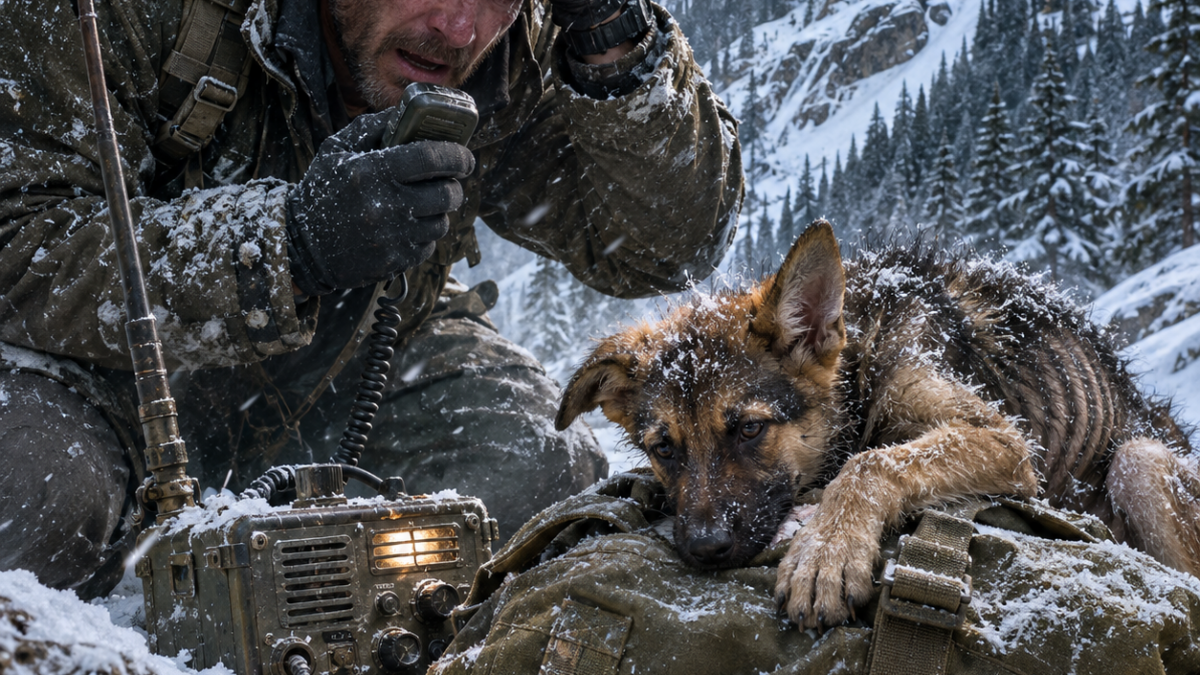
Then my fingers found a handheld VHF radio.
I lifted it slowly.
The dog watched every inch of the movement.
“I said you keep the bag.”
His paw remained on the strap.
Apparently we had a temporary treaty.
I pressed the transmit button.
“Cedar Crown, this is Owen Hartley at the Lake Crescent south service gate.”
Static.
Then:
“You have my radio?”
An old man.
Weak, but alert.
“I have your radio, your bag, and a dog who appears to have appointed himself armed security.”
Silence.
Then the old man said something that made the puppy’s ear twitch.
“He isn’t my dog.”
A pause.
“But tell him I’m sorry I told him to stay.”
I looked at the animal.
His paw pressed harder against the canvas.
“Name?”
I asked.
“Mine or the dog’s?”
“Let’s begin with the one capable of answering.”
“Earl Whitcomb.”
“Cedar Crown Lookout.”
“Upper room.”
“Western side.”
I stood.
The road above me vanished through cedar and snow.
“How long has your heat been out?”
“Long enough to develop strong opinions about winter.”
“That is not a medical measurement.”
“You sound like Grace.”
“Who is Grace?”
“Mallory.”
“Search and rescue.”
“She enjoys telling men when they are doing something foolish.”
“Sounds useful.”
“She is exhausting.”
I pulled out my satellite phone.
Ninety seconds after county dispatch picked up, Grace Mallory was in my ear.
She did not waste time with introductions.
Coordinates.
Road conditions.
Visibility.
Temperature.
Earl’s responsiveness.
Structural condition.
Only after all that did she ask:
“And you?”
“Fine.”
“People who say fine that quickly are usually inconvenient.”
“I’m retired military.”
“That explains the inconvenience.”
I almost smiled.
Almost.
The northern rescue approach was blocked by fallen timber.
Teams were mobilizing from Port Angeles and Forks.
Two hours at best.
Possibly longer.
Earl did not have two comfortable hours.
His voice was already dragging at the edges.
“I’m going up.”
I said.
Grace went silent.
Then:
“You are going to assess whether you can go up.”
“That is what I meant.”
“No, it isn’t.”
She was annoyingly correct.
I turned back toward the puppy.
The maintenance shed beside the road had one door hanging crooked in the wind.
Inside, I found an empty food packet, a wool blanket, a cracked water jug, and a dog-rescue sling.
Earl had not abandoned him.
He had found him.
Fed him.
Sheltered him.
Then gone up to the lookout.
The storm had torn the shed door loose.
The puppy must have panicked, dragged the Army bag outside, and followed Earl’s scent until exhaustion stopped him.
I crouched.
“You need a name.”
The puppy sneezed.
“Not useful.”
Another sneeze.
I looked at his face.
The black mask.
The serious amber eyes.
One proud ear.
One undecided.
“Scout.”
He stared.
“You look like a Scout.”
No reaction.
“Good talk.”
I slid one arm beneath him.
He immediately twisted toward the bag.
“Relax.”
His front paw reached desperately.
So I lifted both.
Scout.
And the bag.
The second the canvas settled beside him in my truck, his whole body loosened.
Not relaxed.
He was too cold for that.
But less terrified.
I put a blanket over him.
He kept one paw touching the bag.
That was when I understood something strange.
The dog did not seem interested in what was inside.
He cared that the bag remained.
The smell.
The person attached to it.
Proof.
I had spent seven years doing the opposite.
Jesse’s voicemail sat on an old phone in a drawer.
Mary’s letters went from kitchen table to cabinet to somewhere I did not have to see them.
The cracked brass bell Jesse once pried from a wrecked crab boat still hung from my truck keys, but I had trained myself not to hear it.
Scout apparently believed that if something mattered, you pressed your whole body against it.
I believed you put it far enough away to survive.
One of us was probably healthier.
Unfortunately, it was the starving dog.
Grace patched another man into our radio traffic.
“Ben Caldwell.”
His voice was younger.
Tight.
“I maintain Cedar Crown.”
“The west wall was reinforced eight years ago.”
“Eastern stairs were due for replacement in March.”
Then he stopped.
Grace said:
“Ben.”
“I was supposed to inspect them yesterday.”
There it was.
Guilt.
Another language I recognized instantly.
“Why didn’t you?”
A child coughed somewhere behind him.
Ben went silent.
“My daughter had a fever.”
I looked out at the road.
“You stayed with your kid.”
“Yes.”
“And now you think you caused a tower to collapse because you didn’t inspect stairs twenty-four hours earlier.”
“I didn’t say that.”
“You didn’t need to.”
Grace cut in.
“We are not conducting group therapy over emergency radio.”
Good woman.
“Ben, structural facts only.”
He gave them.
West wall strongest.
Maintenance window opened inward.
East side compromised.
Awning beneath the western window unreliable.
“Unreliable how?”
I asked.
“Old.”
“That is not engineering.”
“It means don’t trust your life to it.”
“Better.”
Earl came over the channel.
“If anybody is planning to risk his neck for me, I’d like to formally object.”
“Objection recorded.”
I said.
“Denied.”
Grace:
“No one has denied anything.”
“Right.”
“Assessing.”
“I dislike you.”
“I have survived worse reviews.”
I drove.
Slowly.
The mountain had started removing options one at a time.
Snow covered ruts.
Branches dragged across the roof.
Visibility came and went.
Earl gave me landmarks whenever he could.
Old pump sign.
Sharp bend.
Broken culvert.
Then his voice would disappear into static long enough to make my chest tighten.
Every five minutes, Grace made me ask orientation questions.
“What’s beside your radio?”
“White mug.”
“What’s on it?”
“A trout.”
“Ugly or respectable?”
“Ugly.”
Grace said:
“Cognition intact.”
I said:
“Judgment questionable.”
Earl managed a laugh.
Scout’s head lifted at the voice.
His tail moved once.
Not a wag.
Recognition.
“You know him.”
I murmured.
Scout lowered his nose to the bag.
A cedar had fallen across the road seventeen minutes later.
Too large to cut with anything I carried.
Roots still attached uphill.
Trunk wedged across both shoulders.
Grace asked:
“Can you reverse?”
“Yes.”
“Then remember that remains an acceptable option.”
I got out.
Studied the tree.
Winch.
Recovery strap.
Slope.
Root angle.
I could shift enough of the trunk to create a passage if the root plate held.
Ben warned:
“Do not pull straight downhill.”
“I wasn’t planning to.”
“You sound like a man planning exactly that.”
“Your faith is inspiring.”
Grace’s voice arrived like a ruler against both our knuckles.
“Stop using jokes as structural reinforcement.”
Scout watched from the passenger seat.
Then noticed the bag had been moved into the truck bed while I arranged gear.
He began pawing at the door.
“It is six feet away.”
Paw.
“You can see it.”
Paw.
“Scout.”
He tried to squeeze through the opening when I cracked the door.
“For the love of—”
I brought the bag back.
Put it behind the passenger seat.
One paw touched the strap.
Instant calm.
“You’re a tyrant.”
Scout closed his eyes.
I moved the cedar.
It took twenty-two minutes.
Grace informed me of this as if I had been wasting time arranging flowers.
I guided the truck through the gap with inches to spare.
Then Earl coughed over the radio.
A long, ugly sound.
No one joked after that.
The road eventually became too dangerous for the truck.
Clear ice beneath snow.
Outside edge falling into a ravine.
I parked against the uphill shoulder.
Chocked the wheels.
Marked the truck.
Loaded rope, first-aid gear, heat packs, emergency blankets, water, the rescue sling.
Then I lifted the Army bag.
Scout stood.
“No.”
He made a sound like he had been personally betrayed.
“You’re riding.”
I placed him in the sling against my chest.
He twisted until he could see the bag.
I adjusted the straps.
One paw reached the canvas.
He stopped fighting.
“Democracy.”
I told him.
“Working beautifully.”
We walked.
Without the truck, the mountain became enormous.
Boots crunching.
Hardware clicking.
Wind in cedar.
Earl’s voice appearing every few minutes like someone striking a match in the dark.
After half a mile, Scout began squirming.
I put him down.
His legs trembled, but his nose went immediately to the snow.
Then forward.
He was not magically navigating.
Trail markers showed the route.
But he knew Earl’s smell.
The old man’s gloves.
Food.
The towel in the shed.
Scout moved with a certainty that did not belong to his exhausted body.
Earl crackled over the radio.
“You still have the bag?”
“Yes.”
“And the dog?”
“Unfortunately.”
Scout looked back at me.
Earl said:
“Good.”
“You knew him for half a day.”
“Some souls announce themselves early.”
That sounded ridiculous.
And true.
The slope crossing nearly killed the three of us.
Ice hid beneath a thin skin of snow.
I clipped a safety line around a cedar and moved sideways.
Halfway across, the surface beneath my right boot fractured.
My legs went out.
Snow slid.
I dropped hard onto one knee.
The line caught.
The Army bag slipped from my shoulder.
I watched it slide downhill.
Scout lunged.
“Scout!”
His jaws locked around the strap.
The leash snapped taut.
The bag caught against a root.
For maybe three seconds, we were an absurd chain.
Cedar.
Rope.
Me.
Dog.
Bag.
Three seconds were enough.
I crawled down.
Grabbed the handle.
Pulled both back.
When we reached stable ground, I lay on my back staring up into falling snow.
Scout stood over the canvas, sides heaving.
“Listen carefully.”
I told him.
“The bag can be replaced.”
“You cannot.”
He sneezed directly into my face.
I laughed.
Actually laughed.
And immediately felt guilty.
February 3.
Jesse’s date.
Not a day for laughing.
That was one of my private rules.
Scout did not know the rules.
He leaned against the bag.
Closed his eyes.
And something I had believed for seven years shifted one degree.
Maybe remembering Jesse did not require suffering every second I remembered him.
Maybe pain was not proof of loyalty.
Maybe the dead did not become less loved if the living laughed.
The radio crackled.
“Owen?”
Earl.
“I’m here.”
“Dog?”
I held the radio near Scout.
The puppy produced a tired huff.
Earl breathed out.
“Best thing I’ve heard all day.”
I tightened the bag strap.
Lifted Scout.
Kept climbing.
Cedar Crown appeared through the trees like a ship stranded on a mountain.
Old timber legs.
Windows around the top room.
Eastern staircase collapsed into broken rails and snow.
Heavy wet snow sagged over part of the roof.
A pale face appeared behind the western window.
Scout barked.
Earl lifted one hand.
“I see you.”
I said into the radio.
“I have been difficult to miss for eighty years.”
“Do not stand.”
“You remove all pleasure from rescue.”
Grace demanded visual assessment.
I sent video.
Ben talked me through the reinforcement history.
The tower was damaged.
Not necessarily failing.
But damaged structures do not care about good intentions.
Grace said:
“I am not ordering you to climb.”
“Understood.”
“If you choose to approach, two independent lines.”
“Understood.”
“Test anchors.”
“Yes.”
“Stay out of the awning fall zone.”
“Copy.”
“If the wall shifts, descend.”
“Yes.”
“No debate.”
“Grace.”
“What?”
“You have mistaken me for someone argumentative.”
Nobody answered.
Even Earl was too cold for that lie.
I secured Scout beneath cedar cover.
Emergency blanket.
Short tether.
Army bag beside him.
He pressed one paw down.
Then stared at the tower.
“I know.”
I said.
“I’m going.”
I built the rope system.
Then checked it again.
And again.
There is no shame in repetition when gravity is involved.
I started up.
Cold wood.
Icy braces.
Most of my weight on rope.
Halfway, wind pushed me hard enough that my shoulder struck the wall.
The entire structure creaked.
“Status?”
Grace demanded.
“Attached.”
“That was not the question.”
“Shoulder impact.”
“Function normal.”
“Wall movement minor.”
Then Scout barked below.
Not at me.
At the roof.
I looked up.
A slab of wet snow broke loose.
I flattened against the wall.
It thundered past.
Exploded against lower braces.
For one second everything became white.
Then still.
Ben swore.
Grace said:
“Save blame for later.”
Smartest thing anyone had said all day.
I reached the window.
Frozen latch.
Cracked frame.
Pry tool.
One careful push.
Then another.
Wood split.
The window opened inward.
No warmth came out.
Only cold air that smelled like paper, metal, dust, and an old building losing a fight.
Earl Whitcomb sat wrapped in an emergency blanket beside a radio desk.
White hair.
Red knit cap.
Hands shaking.
Still irritated.
“You look younger over radio.”
I said.
He blinked.
“You look less annoying through glass.”
“Good.”
I crossed low.
Checked pulse.
Pupils.
Coordination.
He was cold enough that every minute mattered.
“You’re going out the window.”
“I had gathered.”
“Harness.”
“Follow instructions.”
“I used to give instructions.”
“Today contains disappointments for everyone.”
Then I noticed a long metal box near his chair.
“That stays.”
“No.”
“What’s in it?”
Earl looked at it.
For the first time, sarcasm left him.
“A man who has waited nine years.”
I understood almost none of that.
But I understood the face.
“Fine.”
I clipped the box to a separate line.
“Box first.”
Then Earl.
Getting an eighty-year-old man out a window is difficult even when the building is not trying to collapse.
He gripped the frame.
“Let go.”
He looked down.
“Earl.”
“I heard you.”
“Then demonstrate.”
He let go.
I lowered him.
Ten feet.
Eight.
Six.
Then the awning groaned.
Ben’s voice exploded in my ear.
“Move him west!”
I increased the descent as much as I safely could.
Earl’s boots touched snow.
The awning collapsed.
Timber and wet snow crashed through the exact space beneath the window.
The tower shook.
I swung against the wall.
My radio tore free and dangled from its safety cord.
Grace was saying my name.
Again.
Again.
I got air back.
Grabbed the radio.
“I’m here.”
There was one second of silence.
Then:
“When you are safely on the ground, I will explain why prolonged silence after structural collapse is professionally discouraged.”
“Looking forward to it.”
“You sound amused.”
“Never.”
I descended.
The moment my boots hit snow, Scout nearly pulled his tether loose.
I released him.
He ran straight past me.
Hit Earl’s chest.
Earl dropped to his knees and wrapped both arms around him.
The sound he made was half laughter.
Half apology.
“I told you to stay in the shed.”
Scout licked his mustache.
Then turned.
Trotted back to the Army bag.
Put one paw on it.
Earl looked at me.
“Good.”
I was exhausted enough to be rude.
“What is good about a half-frozen puppy guarding luggage like national security?”
Earl did not answer.
Not yet.
The storm made returning to the truck impossible.
Grace directed us toward an emergency cabin half a mile southwest.
Half a mile becomes a different unit when one person is recovering from hypothermia and another person is carrying half the mountain.
I supported Earl.
Carried the bag.
Carried the metal box.
Scout walked near Earl’s boots.
The cabin appeared at dusk.
Inside:
Firewood.
Cast-iron stove.
Emergency socks.
First-aid kit.
Old cocoa packets.
Luxury.
I got Earl into dry clothes.
Wrapped him.
Warm liquids slowly.
No roasting himself against the stove.
Grace monitored him over radio.
Earl complained about being called “patient.”
Grace told him he was “a problem with a blanket.”
I liked her more every hour.
Scout lay between the stove and the Army bag.
One paw on canvas.
Finally, when Earl’s hands stopped shaking violently, I nodded toward it.
“You said good.”
“When he guarded the bag.”
“Why?”
Earl looked down.
“Because he remembered what I forgot.”
Then he opened it.
And everything I expected was wrong.
No classified files.
No weapons.
No cash.
No secret operation.
Paper.
That was all.
Photographs.
Folded flags.
Letters.
Service cards.
Transfer documents.
Old envelopes.
A thick blue ledger.
Earl lifted the first waterproof sleeve.
“Harold Benson.”
A photograph of a broad man beside a boat trailer.
“Navy.”
“Fixed motors after he came home.”
“Charged widows less and lied about labor so they wouldn’t think he pitied them.”
Another.
“Alice McKenna.”
“Army nurse.”
“Kept peppermint candy in both pockets because hospital waiting rooms made people taste metal.”
Another.
“Raymond Sutter.”
“Marine.”
“Hated salmon.”
“Cooked it every Friday because his wife believed it added years to a man’s life.”
“She lived to ninety-six.”
“So he lost the argument.”
I stared at him.
“What is this?”
Earl rested one hand on the bag.
“People.”
The project had begun sixteen years earlier.
A funeral director called the local veterans chapter.
There was a folded flag no family had claimed.
The veteran had outlived everyone who knew him.
Earl took the flag to a quiet spur trail.
Read the man’s name aloud.
Placed a modest stone there with permission from the landowner.
Then another came.
And another.
A photograph from a niece.
Letters from a church.
Service papers discovered in a motel room.
A widow with no space but no heart for throwing away fifty years of someone’s life.
The memorial trail eventually held thirty-eight stones.
Not grand monuments.
Names.
Branch of service.
Sometimes one small human detail.
Something ridiculous enough to prove the person had lived outside a uniform.
But the county now controlled the land.
New fire corridor.
Trail rerouting.
Safety concerns.
The memorial could remain only if records were verified, permissions clarified, maintenance organized, and public access made safe.
Earl hated committees.
So he carried too much alone.
The bag had become his moving archive.
He had been storing parts of the collection at Cedar Crown because his own cabin was undergoing electrical work.
“You put irreplaceable records inside a deteriorating lookout.”
I said.
“I did not request deterioration.”
“That is a remarkable defense.”
He ignored me.
“The last files are difficult.”
“Partial names.”
“Nicknames.”
“Stories from people who are dead now.”
“Then you need help.”
His face hardened.
“Help becomes procedure.”
“Procedure can kill memory.”
I looked around the freezing cabin.
“One man can also freeze in a tower because he thinks canvas is a congregation.”
Scout lifted his head.
Pressed his paw harder against the bag.
Earl looked at him.
Then smiled sadly.
“He followed me from a roadside stop this morning.”
“I gave him half my sandwich.”
“Put him in the shed.”
“Food.”
“Water.”
“I intended to take him down afterward.”
“So he decided you were his person.”
“Clearly poor judgment.”
“Excellent judgment compared with some humans I know.”
Earl looked at my pocket.
The cracked brass bell had clicked when I shifted.
“What is that?”
“Nothing.”
“Nothing makes less noise.”
I stood.
“Your temperature is improving.”
“That is also not an answer.”
We sat with the fire between us.
Scout asleep.
Bag open.
Thirty-eight lives around us.
The metal box remained closed.
Finally Earl touched it.
“My brother’s name was Peter.”
He said it like confession.
“Navy.”
“I was Army.”
“We spent forty years making that everyone else’s problem.”
Their mother had become ill.
Memory failing.
Earl stayed nearby.
Handled medications.
Appointments.
Bills.
Leaks.
Emergencies.
Peter came when he could.
Then less often.
One argument became every old argument.
Earl accused Peter of abandoning duty.
Peter accused Earl of making sacrifice into a weapon.
Their mother sat between them asking about a ferry no one had mentioned.
Peter walked out.
Did not return before she died.
At the funeral, the brothers shook hands like strangers concluding business.
Then silence.
Years.
Decades.
Peter died nine years before I met Earl.
A woman settling his estate sent Earl a folded flag.
And a letter.
The letter was still sealed.
Inside the metal box.
“You never opened it?”
“No.”
“Why?”
Earl stared into the fire.
“If he forgave me, then I wasted forty years defending something nobody was attacking anymore.”
“And if he didn’t?”
“Then at least the waste has a reason.”
Neither option sounded merciful.
Scout sighed.
Earl looked at me.
“Now yours.”
“No.”
“You have one.”
“No.”
“Men like you don’t use boxes.”
He said.
“You use weather.”
“Work.”
“Driving.”
“Schedules.”
His accuracy irritated me.
I took the brass bell from my pocket.
Set it on the table.
“Jesse Callahan.”
Saying the name aloud made the room smaller.
“He was on my team.”
“Friend?”
“Brother without paperwork.”
Jesse could repair almost anything.
Except his own truck.
He believed mechanical neglect could be defeated through optimism and profanity.
A week before he died, we argued.
He wanted me to come home.
Mary was making soup.
He said I always found work whenever people expected me to behave like a human being.
I told him to worry about himself.
Night before surgery, he called.
I watched the phone ring.
Did not answer.
“Why?”
Earl asked.
“Tired.”
“Angry.”
“Proud.”
“Choose one.”
“All.”
The next morning Jesse had complications.
A stroke.
Then he was gone.
Doctors told me answering would not have changed anything.
I believed them logically.
Not emotionally.
For seven years, Mary sent me a card.
Soup.
Stories.
No pressure.
I never went.
Earl looked at the bell.
“Because if you show up, the missed call stops being the last word.”
I stared at him.
Old man had spent one night with me and was already becoming intolerable.
Scout stood.
Walked away from the Army bag.
Three steps.
Pressed his shoulder against my shin.
Warm.
Thin.
Real.
I put my hand on his neck.
That was the first time Scout willingly left the bag when nobody was carrying it.
I noticed.
I pretended not to.
Earl finally opened the metal box.
Not the letter.
Just the lid.
Peter’s folded flag.
Three handwritten pages.
Yellowed envelope.
Earl touched it.
Then closed the box again.
“Tomorrow.”
He said.
“Maybe.”
“Maybe is better than never.”
We slept.
Or approximated it.
Morning came clear.
The storm had passed east.
Grace said rescue crews could reach the memorial junction in about ninety minutes.
We packed.
Earl wanted to go directly to pickup.
Then the map showed the memorial trail only a few hundred yards off the safe route.
“No.”
He said immediately.
“We have not discussed it.”
“I’m not stopping there.”
“Fine.”
I folded the map.
“We walk the safe route.”
“When we reach the junction, you decide again.”
“I have decided.”
“No.”
“You have prepared an argument.”
He glared.
I had apparently become Grace.
We ate emergency oatmeal.
Scout attempted to steal Earl’s bowl.
Things improved.
At the junction, Scout pulled toward the narrow spur.
Earl stopped.
Snow covered most of the trail.
One weathered post remained.
Scout sniffed.
Pulled again.
“He followed my snowmobile scent yesterday.”
Earl said.
“Maybe.”
“He does not know what’s there.”
“No.”
Earl looked at Scout.
“Useful animal.”
“Doesn’t understand enough to make excuses.”
Then he stepped onto the memorial trail.
I followed.
No applause.
Some decisions become smaller when people clap too early.
The first stone emerged under snow.
Harold Benson.
Fixed what others threw away.
Next.
Alice McKenna.
Peppermint for frightened mouths.
Raymond Sutter.
The man who hated salmon but cooked it for love.
Names.
Not heroic summaries.
People.
At the end, thirty-eight stones curved around a clearing.
One empty place waited near a split cedar.
Earl knelt.
Opened the metal box.
Peter’s flag.
The letter.
His thumb rested against the seal.
“I could do this at home.”
“Yes.”
“I could let Ruth Ann read it.”
“Yes.”
“You’re useless.”
“You aren’t asking for help.”
I said quietly.
“You’re asking for permission to leave.”
That landed.
He opened the envelope.
Three pages.
Peter had not written a clean apology.
Thank God.
Real people rarely do.
He wrote that Earl had turned duty into a courtroom.
He admitted he had run from their mother’s illness because watching her disappear terrified him.
He wrote that both brothers had spoken true things cruelly and cruel things as if they were true.
Then childhood.
Rain on the roof.
Their old dog sleeping between their beds because neither boy would admit he was afraid of dark.
Before they became men who counted every injury, they had loved each other without measurement.
At the end, Earl whispered one line.
“If you’re still angry, be angry.”
His voice failed.
Then:
“Just don’t pretend I was never your brother.”
Earl cried.
Not gracefully.
Thank God again.
Then a pile of snow dropped from a branch onto Scout’s nose.
The dog exploded into a sneeze so violent his whole body jumped.
Earl stared at him.
Then laughed through tears.
I laughed too.
Nothing sacred was damaged.
The moment became more human.
Earl took an engraved stone from the bag.
PETER WHITCOMB
Below it:
BROTHER. SAILOR. ENEMY OF DECENT HARMONICA.
I looked at him.
“You made that before opening the letter?”
“I never doubted the harmonica.”
We placed Peter’s stone.
No salute.
No speech.
Earl simply said:
“Peter.”
The forest accepted the name.
Then I saw another stone inside the bag.
Blank.
Smooth.
Spare.
I picked it up.
Jesse’s name came into my head.
Clear.
Immediate.
My fingers froze.
Earl said nothing.
Scout sniffed the stone.
Sat between Peter’s marker and me.
In the distance, snowmobile engines approached.
One name had come home.
Another was not ready.
Not yet.
For once, not yet did not mean never.
Grace arrived first.
The woman looked exactly like her voice.
Practical.
Gray cap.
Red rescue vest.
Clipboard energy even without a clipboard.
She checked Earl before saying hello.
Then me.
“I have prepared several remarks regarding unsanctioned rope work on unstable structures.”
“I appreciate professional development.”
“You will receive it when I am certain hypothermia has not made you cheerful.”
Ben arrived behind her.
Went straight to Earl.
“I should’ve checked the station yesterday.”
Earl shook his head.
“Your daughter had a fever.”
“I should have gone after.”
“And if she got worse while you were on a mountain, you would have built a prison out of that too.”
Ben looked away.
I looked at Earl.
He noticed.
“Do not.”
“I said nothing.”
“Your face did.”
Grace interrupted.
“We are transporting.”
“Confession circle may resume below freezing level.”
Scout rode down wrapped in an emergency blanket.
His nose out.
One paw resting on the Army bag in Earl’s lap.
But something had changed.
Earl held the bag with one hand.
The other rested on Scout.
Earl spent a night at Olympic Medical Center.
Mild hypothermia.
He objected to the word mild.
Then objected to the hospital gown.
Bed alarm.
Fall-risk label.
Essentially medicine.
Scout went to a veterinary clinic.
No microchip.
No major frostbite.
No fractures.
Underweight.
Dehydrated.
Cracked pads.
Irritated stomach.
The vet said:
“This dog appears to have survived primarily on stubbornness.”
I looked at Scout.
“Family trait.”
No owner came forward.
Animal control started the required hold.
Until it ended, I could not adopt him.
I could foster.
Three days later, Scout entered my house wearing an orange collar and behaving as though every doorway might lead back to the mountain.
I bought him a bed.
He ignored it.
I put the empty Army bag near the fireplace.
All the records had been removed and secured.
Scout circled it.
Lay down with his chest pressed against the canvas.
That night, he slept.
So did I.
Mostly.
Scout discovered civilization quickly.
Refrigerators.
Beef treats.
Sofas.
My left sock, which he apparently identified as a strategic enemy.
He also discovered that pressing his cold nose against the side of my neck before dawn produced impressive results.
The first time, I nearly put my shoulder through the headboard.
He looked delighted.
“You are becoming difficult to defend.”
His folded ear leaned farther.
No one claimed him.
No matching missing-dog report appeared in neighboring counties.
When the legal hold ended, I signed the adoption papers.
The clerk asked:
“Keeping Scout?”
I looked at him chewing a rubber mat with total concentration.
“He already ignores the name professionally.”
“Changing it now might damage morale.”
Scout Hartley became official.
I bought him a brass tag.
Not bell-shaped.
I could not do that yet.
That same week, Earl called.
“Library basement.”
“What?”
“Meeting.”
“Why?”
“The county.”
“Who?”
“Ruth Ann.”
“Ben.”
“Grace.”
“You.”
“I did not agree.”
“Scout has.”
Then he hung up.
Ruth Ann Phelps ran historical archives with the expression of a woman personally offended by unverified dates.
Silver hair.
Cranberry cardigan.
Tortoiseshell glasses.
Three boxes of labeled folders.
Earl tried to explain the county situation.
She corrected him before he finished.
The memorial was not being destroyed.
But the trail was unsafe.
New management corridor.
Drainage problems.
Blind drop.
Poor emergency access.
By spring, they needed:
Verified identities.
Permission where possible.
Documented custody.
Maintenance plan.
Safer route.
Earl tapped the blue ledger.
“I know who they are.”
Ruth Ann removed her glasses.
“You know what you remember.”
“What you were told.”
“And what is documented.”
“Those are related.”
“They are not identical.”
Earl looked wounded.
“Memory matters.”
Ruth Ann nodded.
“So does not carving the wrong name into stone.”
Ben opened maps.
He could design a lower trail.
Grace could approve emergency access if Ben did not create what she called “a handrail fantasy.”
Scout lay beneath the table with his chin on the Army bag.
I sat because he was sitting on my boot.
That was my excuse.
Not a good one.
But excuses do not need quality when they are protecting avoidance.
Ruth Ann pushed a file toward me.
“Twenty names are confirmed.”
“Nine need family or custody clarification.”
“Nine are politely smoke.”
Earl looked offended.
“Smoke?”
“Stories without enough evidence.”
He left the room that day angry.
Returned the next meeting.
That was progress.
March came.
Then April.
The veterans chapter back room filled with scanners, folders, coffee cups, handwritten permissions, and people who claimed they were dropping something off and stayed three hours.
Earl hated the bureaucracy.
Then respected it.
One memorial stone had carried the wrong legal name for six years because everyone knew the veteran by a nickname.
Ruth Ann found the real record.
Another person believed to have died without family turned out to have a nephew in Spokane who had sent Christmas cards until the final year.
Earl took every correction personally.
“I failed them.”
“No.”
I told him once in the rain.
“You preserved enough truth for someone else to finish it.”
He looked at Scout.
Scout looked at a sandwich.
No wisdom available there.
The project became bigger than Earl.
That frightened him.
Then saved it.
Families came.
Volunteers.
Retired nurses.
Veterans.
Church members.
Ben’s daughter, Nora, did homework in the corner while adults told stories about people whose lives contained both service medals and laundry.
Scout developed a strange instinct for the person sitting most rigidly.
If someone stared too long at a photograph, Scout pressed against a leg.
If Ruth Ann cursed paperwork, he put his chin on her table.
Once he stole Ben’s carpenter pencil and destroyed it.
Ben held up the remains.
“That was my good pencil.”
Earl said:
“It died in public service.”
Ruth Ann replied:
“It died undocumented.”
Everyone laughed.
Including Ruth Ann.
She denied it.
Meanwhile, Mary’s card remained on my mantel.
Not drawer.
Mantel.
That was movement.
Small movement.
But real.
Soup at six.
Jesse still gets blamed for the good stories.
Door open.
I read it in April.
Did not go.
But I read it.
One wet morning in May, Scout woke me before dawn.
I sat at the kitchen table.
The old phone lay in front of me.
Jesse’s voicemail.
Seven years.
Twenty-eight seconds.
I had saved it.
Never listened.
My thumb hovered.
Scout nudged my hand.
The phone almost hit the floor.
“You have catastrophic timing.”
He sat.
The cracked bell rested nearby.
No wind.
Still, when Scout moved the table slightly, the bell gave its dry little click.
I pressed play.
Jesse’s voice filled the kitchen.
Older technology made it thin.
Death made it unbearable.
“Owen.”
Then a laugh.
He apologized for being a jackass.
Then added, very Jesse-like, that I had also been one.
He said Mary insisted growth required an accurate inventory.
Surgery at eight.
Soup Friday.
Come if I could.
Call if I couldn’t.
Then his voice changed.
“I miss you, brother.”
A pause.
“We’ve got time.”
The message ended.
I did not cry at first.
My whole body locked.
Then my shoulders folded.
Scout came around the table.
Pushed his head beneath my hand.
Stayed.
I played the message again.
Not to punish myself.
That was new.
I wanted to hear Jesse alive.
Funny.
Annoying.
Wrong about tomorrow.
Still my friend.
The next day, I drove to Port Townsend.
I made it as far as the church parking lot where Mary held the annual soup supper.
Then stopped.
Scout sat beside me.
Door twenty yards away.
I touched the cracked bell.
“Not today.”
I whispered.
But this time the words did not mean never.
The county approved Ben’s preliminary route in June.
Fundraising.
Volunteer labor.
Inspections.
Ruth Ann secured a historical preservation grant by writing a proposal so exact it probably frightened money into cooperation.
Grace approved the emergency plan.
With conditions.
Several.
Ben framed one of her warnings in the work shed.
Earl began recording stories.
Peter’s name caught in his throat the first attempts.
Then came easier.
He described his brother’s harmonica as sounding like furniture being dragged down stairs.
Ruth Ann kept the line.
“Verified by surviving brother.”
Earl looked insulted.
And pleased.
I brought the blank stone to the site one evening.
Set it on a workbench.
Jesse’s name waited.
I held the engraving tool.
Did not turn it on.
Scout lay beside the stone.
No paw on it.
No panic.
Just nearby.
He had changed too.
Not everything important needed to be held down anymore.
By late autumn, the path stopped looking like construction.
It looked like a place meant for people.
Ben built a small bridge over a wet runnel.
Grace inspected every rail as though gravity had filed personal complaints.
Ruth Ann moved original documents into climate-controlled archives.
Earl objected.
Of course.
The Army bag was cleaned.
Not restored.
Its scratches remained.
Its water stain remained.
Ruth Ann wanted it in a display case.
Earl wanted it on a peg.
They compromised.
Glass case.
Hinged front.
Peg inside.
“This is how standards collapse.”
Ruth Ann said.
“One emotionally manipulative peg at a time.”
Scout, now broad-chested and healthy, slept beneath the table while volunteers worked.
Most days both ears stood.
When tired, the left one leaned.
People came with stories.
Photographs.
Recipes.
Letters.
Medals.
A nurse remembered Alice McKenna praying quietly beside patients who had no one else.
A niece brought the terrible lemon pie recipe from Edwin Malone and admitted the family had waited years for revenge.
The pie was as bad as promised.
Ben ate a full slice because he was polite.
His face suggested combat experience.
Nora painted signs for children.
Earl recorded audio.
The bag that Scout had once guarded from starvation and snow became a doorway for people to bring names back into the room.
Then Earl did something I did not expect.
He scheduled the memorial opening for February 3.
Exactly one year after the rescue.
I stared.
“That date?”
“Yes.”
“Why?”
“Some dates are already carrying weight.”
He said.
“If you leave them in the dark, they get heavier.”
I hated how much sense that made.
Mary heard about the opening through a chain of church friendships too complicated to reconstruct.
Late January, a letter arrived.
Not a card.
A real letter.
Cream envelope.
Round handwriting.
It sat on my table two days.
On day three, Scout stole my glove.
Dropped it on top.
Then stared.
“You understand extortion?”
He picked up the glove.
Placed it back on the envelope.
I opened Mary’s letter.
She planned to come to the memorial if I could bear seeing her.
She had found a photograph of Jesse holding the cracked bell.
He was making a ridiculous face because she told him to look sincere.
She wrote that Jesse had meant to apologize after our argument.
She did not ask whether I had listened to the voicemail.
She did not demand confession.
Soup would come with her.
If the church basement felt too far, she would put it in thermoses.
At the bottom:
No pressure.
Door still open.
I read the letter twice.
Then took out the old phone.
Played Jesse’s message.
Pain came.
But it did not take all the oxygen this time.
I called Mary.
Four rings.
“Owen?”
My name in her voice nearly broke me.
“I listened.”
Silence.
Then Mary asked:
“Was he rude?”
I laughed.
“Immediately.”
“That sounds like my son.”
I told her I would be at the opening.
She said:
“Bring the dog.”
“Scout may attend as security.”
“Good.”
“Jesse trusted dogs more than committees.”
I looked at Scout.
“That may have been Jesse’s strongest judgment.”
The visitor cabin received its final displays during opening week.
The Army bag went inside the glass case.
A wooden sign beneath it read:
NO ONE HERE IS ONLY A NAME.
Beside the case, I asked Ben to install a hook.
I hung Jesse’s cracked brass bell from it.
Ruth Ann studied the tarnished metal.
“Do you want it polished?”
“No.”
Earl nodded.
“Good.”
He said.
“Some things lose the truth if you make them shine too much.”
The bell did not ring.
The crack prevented anything clean.
When cold air moved through the cabin, it made a rough little click.
Enough.
The night before opening, I placed Jesse’s blank stone on the worktable.
Engraving tool beside it.
Scout lay at my feet.
I rested one hand on the stone.
“Tomorrow.”
Scout closed his eyes.
No objection.
February 3 returned clear and cold.
Fresh snow lay along the cedar rails.
Sun rose pale over the Olympic foothills.
The new trail had been cleared before dawn.
By midmorning, people arrived.
Canes.
Boots.
Wheelchairs.
Children.
Veterans.
Widows.
Families carrying photographs wrapped in towels.
Scout greeted the first twelve visitors as though he personally owned the county.
His coat had filled out.
Black and gray-brown.
Cream chest.
Brass tag polished by normal life.
The left ear began leaning by noon.
Too much social responsibility.
Mary arrived carrying two enormous thermoses.
Soup.
Of course.
She wore a dark green wool coat.
Silver threaded her hair.
Her eyes were Jesse’s.
For several seconds, neither of us moved.
Then she said:
“You brought security.”
Scout wagged.
“I warned you.”
She looked at him.
“Jesse would have spoiled you beyond repair.”
Scout leaned against her.
Traitor.
Earl began the ceremony without a podium.
He said podiums encouraged speeches to dress better than they behaved.
People stood among the cedar trees.
He talked about the danger of reducing a human life to one official thing.
Rank.
War.
Death.
The hardest day.
The proudest achievement.
Harold Benson was not only Navy.
He fixed motors and lied about labor charges so widows could keep their dignity.
Alice McKenna was not only an Army nurse.
She kept peppermint in her pockets for frightened mouths.
Edwin Malone was not only Coast Guard.
He made lemon pie that should probably have required federal warning labels.
People laughed.
Good.
Laughter returned the dead to human size.
Ruth Ann spoke about records.
Ben thanked volunteers.
Nora held his hand.
Grace stood at the edge with a radio, pretending emotion required authorization.
Then Earl reached Peter’s stone.
PETER WHITCOMB
BROTHER. SAILOR. ENEMY OF DECENT HARMONICA.
Earl read it.
His voice caught once.
“He was worse than that.”
People laughed with him.
Then he looked at me.
No announcement.
No pressure.
Just room.
I carried the blank stone forward.
Mary stood a few feet away.
The engraving tool felt heavier than rope.
First letter.
J.
Uneven.
Then E.
S.
S.
E.
I stopped.
Breathed.
Then:
CALLAHAN.
Beneath it, I carved:
FIXED BROKEN THINGS EXCEPT HIS OWN TRUCK.
Mary made a sound halfway between laughter and grief.
I had prepared a speech.
Weeks of drafts.
All of it suddenly sounded fake.
So I said what was true.
“Jesse sang hymns like he was negotiating with the melody.”
Mary smiled through tears.
“He called every dog ‘sir’ until proven otherwise.”
“He thought soup could solve arguments, even though he started more arguments than soup could reasonably fix.”
People laughed.
I looked toward the visitor cabin.
Wind touched the broken bell.
Click.
Then I said:
“The night before his surgery, he called me.”
Silence.
“We had argued.”
“I saw his name.”
“And I let the phone ring.”
Mary looked at me.
For seven years, that moment had belonged only to me.
Now I gave it air.
“I thought if I punished myself long enough, it proved Jesse mattered.”
“I thought avoiding Mary…”
I looked at her.
“…and the soup, and every story where he was alive again somehow respected him.”
My voice shook.
“I listened to the message.”
Mary’s eyes filled.
“He called to apologize.”
“He also called me a jackass.”
A small laugh moved through the crowd.
“He said he missed me.”
“He thought we had tomorrow.”
Mary stepped closer.
I looked at her.
“I should have answered.”
She did not say:
No.
She did not tell me:
It wasn’t your fault.
She said:
“Yes.”
That honesty hit harder than comfort.
“You should have answered.”
I closed my eyes.
Then she took my hand.
“Because he loved you.”
“And because he wanted his brother back before breakfast.”
Her voice shook.
“But, Owen…”
I opened my eyes.
“He did not call to give you custody of the rest of your life.”
That sentence finally broke whatever I had protected for seven years.
I cried.
In public.
Did not hide.
Did not turn away.
Mary put one hand against my cheek.
Then pulled me into her arms.
She smelled like cold wool.
Soup.
Salt air.
A boat shop I had not entered in years.
For once, grief did not feel like punishment.
It felt like being allowed back into a room I had locked myself out of.
Somewhere behind us, Earl sniffed loudly.
Ruth Ann became intensely interested in the printed program.
Ben stared at his bridge.
Grace maintained professional surveillance of absolutely nothing.
Then Scout decided the ceremony had become too emotionally stable.
He grabbed Earl’s glove.
Ran.
“Scout.”
He looked back.
Kept going.
“That is my good glove!”
Earl shouted.
Ruth Ann called:
“It has not been inventoried!”
Ben chased him.
Nora cheered for the dog.
Scout circled a bench.
Dodged Ben.
Returned only after Mary produced a biscuit.
He dropped the glove beside Jesse’s stone.
Accepted payment.
Sat.
The entire ceremony dissolved into laughter.
Earl picked up his glove.
Offended.
Smiling.
Exactly right.
By late afternoon, most people had gone.
Snow began falling softly.
I walked the trail with Scout.
Name after name.
Not monuments.
People.
Bad pie.
Peppermint.
Salmon.
Broken motors.
Terrible harmonica.
Off-key hymns.
A missed call.
A letter finally opened.
The kind of ridiculous details grief often erases first if you let it.
At Jesse’s stone, I stopped.
Through the visitor-cabin window, I could see the old Army bag hanging safely in its case.
The cracked bell beside it.
One year earlier, Scout would have run straight back to the bag.
Checked it.
Touched it.
Guarded it.
Instead, he looked once.
Then leaned against my leg.
Warm.
Heavy.
Present.
I put my hand on his neck.
“Yeah.”
I whispered.
“I noticed too.”
The bag was safe.
Earl no longer needed to carry thirty-eight lives by himself.
Peter’s letter had been opened.
Jesse’s voicemail had been heard.
Mary’s door had never actually closed.
Ben had learned one missed inspection did not make him responsible for a storm.
Ruth Ann had turned memory into records strong enough to last.
Grace had turned dangerous terrain into a route people could actually walk.
Scout had learned that something important could leave his paw and still be there when he looked again.
And me?
I was still learning.
Healing had not erased February 3.
Jesse was still dead.
I had still ignored the call.
Earl still lost forty years with Peter.
Nothing we did could revise those facts.
But maybe healing was never revision.
Maybe it was refusing to let the worst moment become the only thing still alive.
Snow had nearly erased the mountain road the year before.
It had not destroyed the road.
Only covered the tracks.
Someone still had to go back.
Clear the path.
Speak the name.
Open the letter.
Answer the invitation.
Let another living hand carry part of the weight.
Scout leaned harder into my leg.
I looked down.
One ear standing.
The other beginning to fold with fatigue.
“You hungry?”
His whole head lifted.
Of course.
Across the clearing, Mary was packing soup.
Earl was arguing with Ruth Ann about archive humidity.
Ben was inspecting a rail he had already been forbidden to inspect.
Grace had caught him.
Nora was laughing.
The broken bell clicked once when the cabin door opened.
Not a clean sound.
Never would be.
But I finally understood why Jesse kept it.
Some broken things still know how to call you home.
I followed Scout toward the light.








