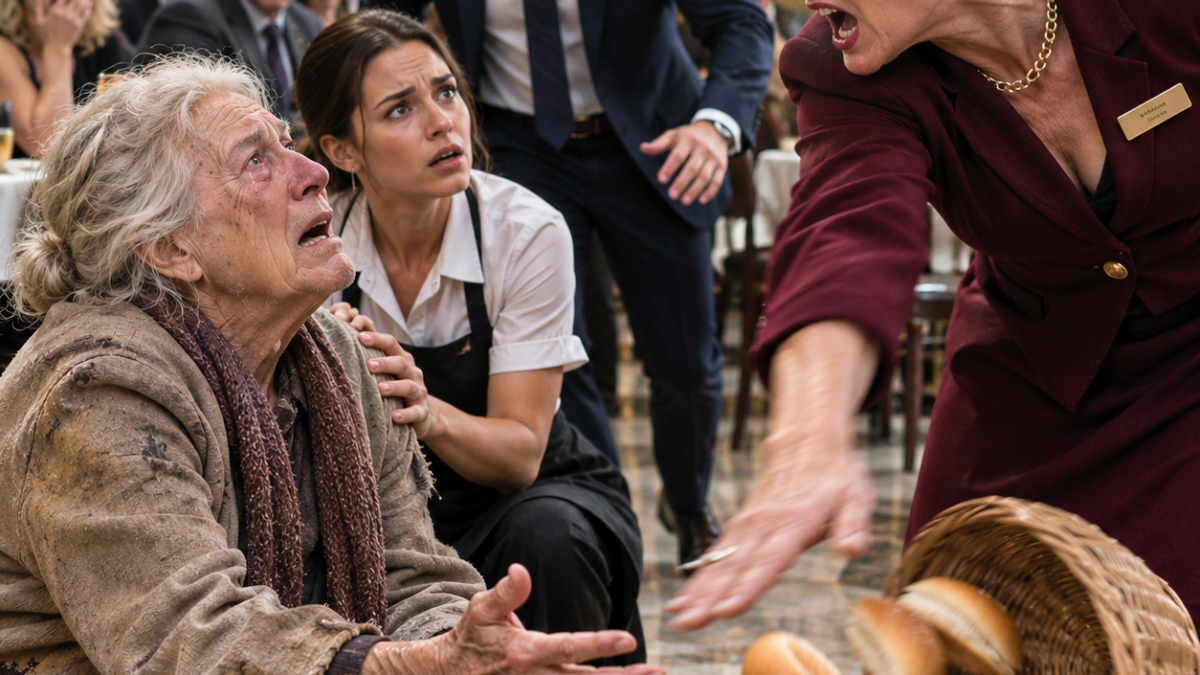
FULL ENDING:“THIS ISN’T A SHELTER FOR THE HOMELESS! GET OUT!” A Restaurant Manager Slapped Bread From My Hand in Front of a Packed Dining Room, Then Fired the Young Employee Who Tried to Help Me—But Just as I Stood There Humiliated, My Grandson Walked In, Looked at Me on the Marble Floor, and Whispered One Word: “Grandma?”
PART 2 and FULL ENDING  Thank you

“Ma’am, please.”
She gently took my hand.
“You don’t need to do that.”
Victoria exhaled sharply.
“Maya.”
Maya looked up.
“She was hungry. I’ll pay for it.”
Victoria stared at her.
“Then go with her.”
Maya froze.
Victoria smiled.
“You’re fired.”
For one second, Maya’s hand loosened around my elbow.
I felt the hesitation.
Fear has weight.
Rent.
Tuition.
Groceries.
A younger brother.
A sick parent.
Whatever this job meant to her was contained in that tiny pause.
Then Maya tightened her grip and helped me stand anyway.
That was when footsteps stopped behind us.
A familiar voice said:
“Grandma?”
I looked up.
Daniel Mercer stood at the end of the table.
His gaze moved from my old sweater…
to Maya holding my arm…
to the broken bread on the floor…
and finally to Victoria Crane.
Victoria opened her mouth.
Nothing came out.
I removed my wool hat.
“Hello, Daniel.”
His face went white.
FULL STORY CONTINUATION
Daniel crossed the room so fast that one of the servers had to move out of his way.
“Grandma, what happened?”
Victoria found her voice first.
“Mr. Mercer, I can explain.”
I looked at Daniel.
“No.”
Then I looked at her.
“Let her.”
Daniel stopped.
He knew that tone.
He had heard it when he was twelve and lied about breaking a neighbor’s window with a baseball.
He had heard it when he was twenty-three and nearly invested half his inheritance in a ridiculous technology company started by a college roommate.
Whenever I said, Let them explain, what I really meant was:
I want to hear which version they choose before I show them what I already know.
Victoria straightened her vest.
Her whole face changed.
The contempt disappeared.
Her voice softened into the warm, polished tone I had heard from her during board presentations.
“There has been a misunderstanding.”
Maya was still holding my arm.
Her fingers trembled.
Daniel looked at the bread.
“What misunderstanding?”
Victoria smiled carefully.
“This woman—”
Then she stopped.
The word suddenly seemed dangerous.
Daniel’s eyes hardened.
“My grandmother.”
“Yes.”
Victoria swallowed.
“Your grandmother entered the dining area and took food from the display.”
I raised an eyebrow.
“She picked up one roll?”
“Yes.”
“A roll that would have been discarded after afternoon service?”
Victoria hesitated.
“That isn’t the issue.”
Daniel’s voice dropped.
“Then what is?”
“Standards.”
There it was.
One of those words people use when they want cruelty to sound professional.
Standards.
Efficiency.
Presentation.
Policy.
I had spent more than forty years in hospitality.
I knew every one of them.
Victoria continued.
“We have policies regarding non-guests accessing guest service.”
Daniel looked at me.
“Did anyone ask whether you were a guest?”
“No.”
“Did anyone ask if you wanted to purchase anything?”
“No.”
Victoria interrupted.
“She was dressed—”
Silence.
Even she heard herself halfway through the sentence.
Daniel turned slowly.
“She was dressed what?”
Victoria’s mouth opened.
Closed.
I helped.
“Poorly.”
“Mrs. Mercer, that isn’t what I meant.”
“You said this wasn’t a homeless shelter.”
Victoria glanced around.
Every employee was listening.
Good.
“I was attempting to prevent disruption.”
“What disruption?” Daniel asked.
“She was taking food.”
“One bread roll.”
“Yes.”
“That was going to be thrown away.”
“That is not the point.”
“Then explain the point.”
Victoria’s expression tightened.
“The point is that if we allow anyone to walk in from the street and take things, we lose control of the environment.”
I almost admired how smoothly she said it.
Anyone.
From the street.
Things.
Control.
Not one elderly woman.
Not bread.
Not hunger.
A management problem.
I asked quietly:
“What did I do after you knocked the bread from my hand?”
She looked at me.
“You bent down.”
“To pick it up.”
“Yes.”
“And Maya?”
Victoria’s eyes moved toward her.
“She interfered.”
Maya stiffened.
Daniel noticed.
“How?”
“She contradicted me in front of guests.”
“What did she say?”
Maya answered herself.
“I said I would pay for the bread.”
Daniel looked at her.
“And then?”
Maya swallowed.
“Ms. Crane told me to go with her.”
“With my grandmother?”
“Yes.”
“And fired you?”
Maya nodded.
Victoria stepped forward.
“She disobeyed a direct instruction.”
“What instruction?”
“To maintain guest standards.”
That word again.
I had heard enough.
I turned toward Daniel.
“Do you know why there are bread baskets in this hotel instead of individually wrapped portions?”
He looked confused by the question.
“No.”
“Your grandfather hated packaged bread.”
Daniel’s expression softened slightly.
He remembered Thomas.
Everyone in our family did.
I touched the silver basket.
“Thomas grew up poor.”
Victoria looked at me but said nothing.
“His mother cleaned rooms in a small hotel in Pittsburgh. Sometimes she came home with leftover bread because the kitchen staff knew it would otherwise be thrown away.”
Several employees nearby looked surprised.
Daniel knew the story.
Most of them didn’t.
“When Thomas and I opened our first property, he made one rule.”
I looked down at the broken roll.
“No person who asks for bread leaves hungry.”
The room was still.
“We have had that rule for forty-one years.”
Victoria whispered:
“I wasn’t aware.”
“That,” I said, “is the problem.”
Daniel asked the dining room to be temporarily cleared.
Guests were moved to the lounge.
Complimentary drinks.
No drama.
No announcement.
That was appropriate.
The employees stayed.
So did Victoria.
Maya remained beside me.
Her face had lost color.
“Sit down,” I told her.
“I’m okay.”
“That was not a suggestion.”
She gave a small, nervous smile and sat.
Daniel pulled out another chair for me.
I stayed standing.
My knees hurt.
I ignored them.
“Grandma,” he said, “why didn’t you tell me you were coming?”
I reached into my cloth handbag.
“Because then everyone would have behaved beautifully.”
I placed the anonymous letter on the table.
Daniel read it.
Once.
Twice.
Then looked toward Victoria.
Her face went still.
“Who sent this?”
“I don’t know.”
He looked at Maya.
Her eyes widened.
“Not me.”
“I didn’t say it was.”
“Sorry.”
The apology came too fast.
That bothered me.
Daniel must have noticed too.
He lowered his voice.
“Maya, you don’t have to apologize.”
She nodded.
Then apologized again.
“Sorry.”
Victoria gave a quiet laugh.
“There. Exactly.”
We all turned.
“What?” Daniel asked.
“This is absurd.”
She folded her arms.
“Your grandmother came here dressed to create a situation.”
I said nothing.
“She intentionally withheld her identity.”
“Yes.”
“You expected me to fail some secret morality test.”
“No.”
Victoria’s eyes flashed.
“Really?”
“I came to see whether a letter was true.”
“You came disguised as a homeless woman.”
“I wore an old sweater.”
“You let people believe you were poor.”
“I let people believe whatever they wanted to believe.”
Victoria stared.
I continued.
“No one asked who I was.”
“That is manipulative.”
“Perhaps.”
I nodded.
“But I did not tell you to slap bread from my hand.”
Her face reddened.
“I did not tell you to say this wasn’t a shelter.”
Nothing.
“I did not tell you to fire Maya.”
Still nothing.
“I did not create your choices.”
Daniel’s gaze shifted toward Victoria.
That one landed.
She tried another direction.
“You have no idea what this location deals with.”
Daniel frowned.
“What does that mean?”
“We get people coming in off the street.”
“What people?”
Victoria hesitated.
Then finally said it.
“Homeless people.”
No polite phrase.
No management language.
Just truth.
“They use the bathrooms.”
“They sit in the lobby.”
“They ask guests for money.”
“Sometimes they smell.”
“Sometimes they frighten paying customers.”
Daniel listened.
Some of what she said could be true.
Running a hotel was not charity work.
Safety matters.
Guests matter.
Boundaries matter.
But none of it justified humiliation.
I asked:
“What is the written policy?”
She looked at me.
“What?”
“Regarding non-guests.”
She glanced at Daniel.
He answered.
“Security can intervene for harassment, threats, trespassing after warning, solicitation in restricted areas, or disruption.”
“Is hunger listed?”
“No.”
“Old clothing?”
“No.”
“A woman touching one bread roll?”
“No.”
Victoria’s jaw tightened.
“It isn’t that simple.”
“You’re right.”
That surprised her.
I continued.
“Leadership rarely is.”
Daniel called Serena Patel from Human Resources.
She arrived twenty minutes later.
Serena had worked for Mercer Hospitality nine years.
Calm.
Sharp.
Not easily intimidated.
She greeted me, then Daniel, then Victoria.
Her gaze stopped on Maya.
“What happened?”
Daniel handed her the letter.
Then said:
“I want a formal review of the last twelve months of complaints involving Victoria and this location.”
Victoria stepped forward.
“Based on what?”
Daniel looked at her.
“Today.”
“One staged incident?”
“And the letter.”
“Anonymous.”
“Yes.”
“That means nothing.”
“Then the review will prove that.”
She stared at him.
“Are you suspending me?”
Daniel paused.
I watched him.
This mattered.
Power is often tested most clearly in how it handles accusation.
He looked at Serena.
“Administrative leave pending review.”
Victoria laughed in disbelief.
“You’re suspending a regional director because your grandmother came here dressed like a vagrant?”
The word hit the room hard.
Daniel’s expression changed.
So did Serena’s.
Maya looked down.
I said quietly:
“Thank you.”
Victoria turned.
“For what?”
“For making this easier.”
Her face tightened.
“You wanted me gone.”
“No.”
“You came hunting for me.”
“I came looking for truth.”
“And because you happen to be family, you get to decide what truth is?”
I almost smiled.
“Actually, no.”
I looked at Serena.
“That’s why I don’t want to run the investigation.”
Victoria blinked.
Daniel looked at me too.
I continued.
“Bring in outside employment counsel.”
Serena nodded immediately.
Victoria’s face changed.
She had expected family revenge.
A direct firing.
A dramatic humiliation she could later frame as unfair treatment.
Process was harder to attack.
Daniel said:
“Agreed.”
Victoria picked up her handbag.
“You are making a catastrophic mistake.”
“Maybe.”
Daniel nodded.
“That is why we investigate.”
“You’re choosing a housekeeper over me.”
Maya’s head snapped up.
The tone did the damage.
Not the occupation.
Daniel’s eyes became cold.
“Should I trust people according to salary?”
“That is not what I meant.”
“It sounded like it.”
Victoria looked toward me.
“You wanted this.”
I met her eyes.
“No.”
“I wanted to know what happened when you thought nobody powerful was watching.”
Her gaze flickered.
“You were right about one thing.”
“What?”
“I do have power.”
I looked toward Maya.
“She doesn’t.”
Then back at Victoria.
“That is why what you did to her matters more than what you did to me.”
For the first time, Victoria had no answer.
She left through the service corridor.
The doors closed.
Silence.
Then Maya started crying.
Not loudly.
She covered her mouth as though she was ashamed of the sound.
I sat beside her.
“What are you apologizing for?”
“I don’t know.”
That hurt more than anything Victoria had said.
People who spend too long around unpredictable authority apologize automatically.
Daniel crouched beside her chair.
“You are not fired.”
She looked at him.
“But Ms. Crane—”
“Did not have grounds to terminate you for helping a guest.”
“I wasn’t sure she was a guest.”
Daniel looked at me.
I answered.
“That should not matter.”
Maya’s face crumpled.
Serena touched her shoulder.
“Maya, has something like this happened before?”
Maya’s eyes moved toward the other employees.
Most looked away.
One young man didn’t.
He stepped forward.
His name tag read AARON PIKE.
Twenty-two.
Busser.
He said:
“Yes.”
Serena turned.
“What happened?”
Aaron swallowed.
“She calls people trash.”
Victoria’s leave had lasted less than fifteen minutes, and the wall had already cracked.
Another employee stepped forward.
Then another.
Stories emerged slowly at first.
A dishwasher sent home after asking for gloves because his hands were cracked.
A housekeeper threatened with reduced hours for refusing to clean a room where a guest had become aggressive.
A server told her accent sounded “cheap.”
A maintenance worker ordered to use a broken cart because repairing it would hurt monthly expenses.
An elderly man removed from the lobby during heavy rain because Victoria said he was “lowering the visual standard.”
A pregnant employee denied a stool during a twelve-hour shift until another manager quietly brought one.
Maya sat with both hands in her lap.
I looked at Daniel.
His face had gone gray.
This was the real blow.
Not what happened to his grandmother.
What had been happening inside a business he believed he was running well.
Aaron finally said:
“We didn’t think anybody would believe us.”
Daniel’s voice was quiet.
“Why?”
Aaron glanced at Serena.
Then at me.
Then finally at Daniel.
“Because her numbers were good.”
That sentence hurt him.
I could see it.
Her numbers were good.
Revenue.
Ratings.
Labor.
Complaint rates.
Excellent.
Which meant employees had learned something dangerous.
If the numbers looked right, their pain was probably wrong.
Daniel nodded slowly.
“That is my responsibility.”
No defense.
No excuse.
For that, I was proud of him.
The outside review began the next morning.
Serena brought in an employment-law firm from another city.
Daniel hated the expense.
I reminded him that trust costs more after you lose it.
Employees were interviewed without direct supervisors present.
Emails preserved.
Schedules reviewed.
Complaint records compared.
Security footage secured.
I stayed away.
That was difficult.
I wanted answers.
But I knew something else.
If I hovered over the investigation, employees might tell me what they thought an owner wanted to hear.
I had already come once to see what happened when power was hidden.
I was not going to ruin the second part by making power too visible.
Daniel came to my house that evening.
He carried soup.
“Did you cook this?”
“No.”
“Good.”
We sat at my kitchen table.
For ten minutes, he barely spoke.
Then he said:
“I failed.”
I stirred the soup.
“Perhaps.”
“Grandma.”
“What?”
“You’re supposed to tell me I couldn’t have known.”
“Couldn’t you?”
He stared.
I looked at him.
“Did nobody ever leave?”
“People leave hospitality.”
“Did anyone transfer suddenly?”
“Yes.”
“Did anyone complain about Victoria?”
“Not formally.”
“What does formally mean?”
“Through the employee portal.”
“Do employees believe the portal is anonymous?”
He stopped.
There it was.
“I don’t know.”
“Then it isn’t anonymous in any meaningful sense.”
Daniel rubbed his forehead.
“I checked the surveys.”
“Surveys tell you what people believe is safe to type.”
He looked down.
“I promoted her.”
“Yes.”
“I praised her.”
“Yes.”
“I gave her authority over three properties.”
“Yes.”
“You are not helping.”
“I am not supposed to make you comfortable.”
His eyes lifted.
I softened.
“Daniel.”
“What?”
“You made a mistake.”
“A big one.”
“Yes.”
“You do not become a bad leader because you made a bad decision.”
He stared.
“You become one if protecting your ego matters more than correcting it.”
That landed.
He nodded.
Then said:
“What if I hadn’t walked in yesterday?”
We both knew.
I answered anyway.
“Maya would have been fired.”
“And you?”
“Probably escorted outside.”
Daniel closed his eyes.
“That’s what I can’t stop thinking about.”
“Good.”
He looked at me.
“Good?”
“Yes.”
“Remember it.”
Two days later, Victoria struck back.
I should have expected it.
A local business publication contacted Mercer Hospitality for comment regarding “an alleged staged incident involving a senior family shareholder and a female executive.”
Someone had talked.
The reporter’s email included a statement from Victoria’s attorney.
According to it, I had entered the property “under false pretenses,” provoked employees, concealed my identity, and used my family relationship to engineer a public humiliation.
Victoria also claimed she was being punished for enforcing “consistent security and service standards.”
Daniel called me furious.
“They’re trying to make you the story.”
“They should.”
Silence.
“What?”
“I did conceal my identity.”
“Grandma.”
“It’s true.”
“You did not provoke her.”
“No.”
“But I did come intentionally.”
He stopped.
“What are you saying?”
“That we answer honestly.”
Daniel hated that.
Public relations people hate uncontrolled honesty.
I continued.
“I received a complaint.”
“I came without announcing myself.”
“I dressed simply.”
“I did not identify myself.”
“Victoria slapped bread from my hand, insulted me, and fired an employee who helped me.”
“That is what happened.”
Daniel sighed.
“What about the investigation?”
“Say an independent review is underway.”
“That’s it?”
“That’s it.”
“They’re going to make it look like a setup.”
“It was a test.”
He went quiet.
I corrected myself.
“No.”
“It was an observation.”
“Either way, people can criticize me.”
I leaned back.
“Let them.”
“Why?”
“Because if our case depends on everyone thinking I behaved perfectly, then our case is weak.”
Daniel said nothing.
“Let evidence do its job.”
That became our statement.
Short.
Uncomfortable.
True.
The public story lasted three days.
Then something unexpected happened.
Former employees began contacting the outside investigators.
Not because they loved me.
Most had never met me.
They had read about Victoria.
A former front-desk supervisor described being forced to alter guest-complaint classifications so certain incidents did not count against Victoria’s metrics.
A housekeeping employee produced messages in which Victoria wrote:
Do not reward people for weakness. If someone complains every time they’re tired, cut the hours until they become grateful for the ones they get.
Another message said:
We are a luxury property. Employees need to understand that poor people can work here, but they should never make the place feel poor.
That sentence made me physically ill.
The investigation expanded.
Victoria’s excellent numbers began to look different.
Guest complaints had not simply decreased.
Some had been reclassified.
Labor costs had fallen partly because experienced workers left and were replaced with cheaper, less experienced staff.
Turnover had risen.
But turnover had not been included in Daniel’s regional-performance presentation.
Because he had not asked.
That mattered.
He came to my office one afternoon holding a stack of printed reports.
“You were right.”
“About what?”
“The numbers.”
I looked at the pages.
“No.”
He frowned.
“What?”
“The numbers were right.”
He stared.
“Labor costs did fall.”
“Yes.”
“Revenue did rise.”
“Yes.”
“Complaints did decline on the dashboard.”
“Exactly.”
I tapped the report.
“The problem wasn’t that the numbers lied.”
Daniel looked at me.
“The problem was we asked them to tell us something they couldn’t.”
That silenced him.
Revenue could not tell him whether Maya was afraid.
Labor cost could not tell him why good employees left.
Guest ratings could not tell him how a delivery worker was treated at the side door.
Metrics are not evil.
They are simply limited.
People become dangerous when they confuse measurement with morality.
One week into the review, Maya stopped showing up.
She called out sick twice.
Then Serena found her resignation letter.
Daniel phoned me immediately.
“She quit.”
I closed my eyes.
“Did she say why?”
“She says she can’t walk into the building without feeling sick.”
There it was.
The cost no investigation could erase.
Daniel sounded crushed.
“I offered a transfer.”
“Did she want one?”
“No.”
“Then let her go.”
“Grandma, she did the right thing.”
“Yes.”
“And this is what she gets?”
“No.”
I stood.
“This is what happened because we failed to protect her before she did the right thing.”
Daniel went silent.
That was harder.
Because it was true.
We could restore her paycheck.
We could not instantly restore trust.
I asked:
“What does she want?”
“Finish nursing school.”
“Then help her do that.”
“How?”
“We already have an education foundation.”
Daniel understood.
“The Mercer Service Scholarship.”
“Yes.”
“She qualifies.”
“Then send her the application.”
He hesitated.
“Will that look like hush money?”
“Not if we handle it like every other applicant.”
He nodded slowly.
“No special award?”
“No.”
“No press release?”
“Absolutely not.”
“Good.”
That was how Maya left the Grand Meridian.
Not promoted.
Not made into a corporate mascot.
She walked away because she had every right to decide the place was no longer worth the emotional cost.
I respected that more than if she had stayed for our redemption story.
The investigation reached its first formal climax at a special board meeting three weeks later.
Victoria was allowed to appear with counsel.
So were Daniel, Serena, and the outside investigators.
I attended because I still held twenty-eight percent of the company and because Victoria’s attorney had specifically accused me of engineering her removal.
The meeting took place in a conference room on the twenty-ninth floor.
Glass walls.
City skyline.
Polished oak table.
The sort of room where people say terrible things politely.
Victoria entered wearing navy.
No burgundy.
Her face looked thinner.
She did not look at me.
Her attorney began by presenting the case as retaliation.
He argued that Victoria had enforced legitimate standards and had been subjected to a “family-driven disciplinary process” after failing to recognize a disguised shareholder.
He emphasized that I had concealed my identity.
True.
He argued that Daniel’s immediate administrative leave decision was emotionally influenced.
Also possibly true.
Then he said:
“Ms. Crane should not lose a distinguished career because an owner’s relative wanted to conduct a morality experiment.”
One board member looked at me.
I said nothing.
The outside investigator, Karen Liu, waited until he finished.
Then she opened a binder.
She did not mention bread.
Not at first.
She presented twelve months of staff turnover.
Then schedule changes.
Then complaint classifications.
Then emails.
Then text messages.
Then security recordings showing Victoria ordering staff to remove non-disruptive people from public areas based on appearance.
One clip showed an elderly man sitting near the lobby doors on a rainy evening.
He held a bus schedule.
Victoria approached.
No audio.
But staff testimony described what followed.
He was told the lobby was “for customers.”
He pointed toward the rain.
She pointed toward the door.
He left.
No shouting.
No scene.
Just a wet old man disappearing into the storm.
The room became very quiet.
Victoria’s attorney objected to context.
Karen nodded.
Then presented two employee statements and the man’s later complaint, which had been logged under “general inquiry” rather than “guest concern.”
Victoria leaned toward her lawyer.
Whispered.
Then Karen showed the email.
Change classification. Not a guest. Does not count.
Daniel looked like he might be sick.
That was his dashboard.
One fewer complaint.
Clean numbers.
A wet man.
That was the equation.
Karen continued.
Maya’s firing was not isolated.
Three other workers had received schedule reductions within ten days of challenging Victoria.
One resigned.
One transferred.
One stayed because, in his words:
My mother needed my insurance and I couldn’t risk making her mad.
The board listened.
No theatrical gasps.
That made it worse.
Real wrongdoing becomes heavier when read in calm voices.
Finally, Karen presented Victoria’s own statement from her interview.
She had said:
Luxury requires exclusion. If everyone feels equally entitled to the space, then the brand loses value.
That sentence ended whatever remained of her defense.
Not because luxury businesses cannot control access.
They can.
Because she had built a personal philosophy in which dignity itself was part of what had to be restricted.
Victoria finally spoke.
“I was hired to improve the property.”
Nobody interrupted.
“And I did.”
Her voice shook.
“Revenue is up.”
“Guest ratings are up.”
“Costs are down.”
She looked toward Daniel.
“You praised me for all of that.”
Daniel did not look away.
“Yes.”
“Then don’t sit there pretending I became this by accident.”
That struck him.
She continued.
“You told managers to improve margins.”
“Yes.”
“You told us the Grand Meridian needed to feel exclusive.”
“Yes.”
“You told us labor was too high.”
“Yes.”
Her attorney touched her arm.
She pulled away.
“No.”
She pointed toward Daniel.
“He gets to sit there now and act horrified because his grandmother got embarrassed?”
Daniel inhaled.
I watched him carefully.
This was the moment he could protect himself.
Blame Victoria.
Say she misunderstood.
Say none of this reflected his leadership.
He did not.
“You’re right.”
Everyone looked at him.
Victoria stopped.
Daniel continued.
“I did tell you those things.”
Her face changed.
“I praised your numbers.”
“Yes.”
“I rewarded outcomes without asking enough about methods.”
Victoria’s eyes narrowed.
“So this is my fault?”
Daniel shook his head.
“No.”
“This is your conduct.”
Then he looked down briefly.
“But the environment that let it grow is partly my responsibility.”
The room remained silent.
That mattered more to me than Victoria’s fate.
Daniel was learning.
Victoria laughed bitterly.
“Convenient.”
“No.”
He met her gaze.
“It is humiliating.”
She said nothing.
“I promoted you.”
“I defended you.”
“I told the board you represented the future of guest experience.”
Daniel swallowed.
“I was wrong.”
I saw several board members shift.
Executives are trained to avoid sentences like that.
Daniel said it anyway.
Then Victoria looked at me.
“You’re enjoying this.”
I felt almost sorry for her.
Almost.
“No.”
“Don’t lie.”
“I’m not.”
“You came into my hotel dressed like someone you’re not.”
I leaned forward.
“That is where you are wrong.”
She stared.
“I was wearing my own sweater.”
A few people looked down.
“I rode a bus.”
“I picked up bread.”
“I did not pretend to be poor.”
“You decided poor was what I looked like.”
Victoria’s eyes hardened.
I continued.
“And even if I had been homeless, hungry, confused, or broke, you would still be sitting here answering for the same behavior.”
Her attorney began to speak.
I raised one hand.
“This was never about whether you recognized me.”
I looked around the table.
“It was about whether you believed a person needed status before she deserved dignity.”
Victoria looked at me with something close to hatred.
Then, unexpectedly, tears filled her eyes.
“I worked my entire life to get into rooms like this.”
Her voice cracked.
There it was.
Not justification.
But history.
“My mother cleaned offices.”
“My father drove trucks.”
“We had nothing.”
I listened.
“I learned that people treat you differently when you look poor.”
She laughed once.
“So I stopped looking poor.”
No one spoke.
“I worked.”
“I learned wine.”
“Clothes.”
“Language.”
“Everything.”
Her hands shook.
“And when I got power, I made sure nobody ever looked at me the way people looked at my mother.”
I felt my chest tighten.
Pain can explain a person without excusing them.
Victoria continued.
“Do you know what luxury guests complain about?”
“Yes,” I said.
She looked at me.
“Everything.”
“People sleeping in lobbies.”
“People asking for water.”
“Employees who look tired.”
“Children who cry.”
“Someone’s accent.”
“Someone’s clothes.”
She wiped one cheek angrily.
“You think I invented this?”
“No.”
That surprised her.
“I think you learned it.”
I paused.
“And then you decided the safest way never to be looked down on again was to become the person looking down.”
The room went completely still.
Victoria’s face changed.
For a second, I saw not a monster.
A frightened girl who had built armor and then sharpened it into a weapon.
But empathy is not absolution.
I continued.
“Understanding why you became cruel does not mean the people beneath you had to keep paying for it.”
She looked down.
That was the last time she spoke during the meeting.
The board voted unanimously to terminate Victoria’s employment for documented management misconduct, retaliation, and policy violations.
Not for insulting me.
Not for failing to identify an owner.
That distinction went into the record.
It mattered.
Victoria left through the same conference-room door she had entered ninety minutes earlier.
No security escort.
No public humiliation.
No applause.
Real consequences do not need theater.
After she left, the board remained seated.
Daniel stood.
“I want to resign as operating president.”
My head snapped up.
“No.”
He looked at me.
“Grandma.”
“No.”
The board chair, Henry Bell, raised a hand.
“Let him finish.”
Daniel looked around.
“I failed to identify a culture problem.”
“I rewarded a leader who harmed employees.”
“I ignored turnover signals.”
“I allowed our management scorecards to become too narrow.”
He paused.
“I think accountability requires—”
I interrupted.
“Accountability requires correction.”
He looked at me.
“Not disappearance.”
Henry nodded slowly.
I continued.
“If every leader resigned after discovering a serious mistake, corporations would be run exclusively by people who had never admitted one.”
A few people smiled.
Daniel didn’t.
“You think I should stay?”
“I think you should stop making this about whether you deserve punishment.”
That stung.
Good.
“Ask what the company needs.”
He looked around the table.
The board ultimately kept him.
With conditions.
Independent culture review.
Revised management metrics.
Quarterly reporting on employee retention and complaints.
A new ethics channel outside the direct reporting chain.
Not symbolic.
Structural.
Daniel accepted every condition.
That was the right ending to the meeting.
Not victory.
Work.
Maya applied for the scholarship.
She almost withdrew.
She called me one evening.
“I feel weird.”
“About what?”
“Taking money from your family.”
“It is not my money.”
“It’s literally called the Mercer Foundation.”
“Details.”
She laughed nervously.
“I don’t want people thinking I got it because of what happened.”
“Then let the committee decide.”
“They know who I am.”
“No.”
She went quiet.
“What?”
“I had your identifying information removed for the first review.”
“That’s allowed?”
“It is now.”
She laughed.
“You changed the process?”
“Yes.”
“Because of me?”
“Because the old process was stupid.”
She was silent.
Then:
“What if I don’t get it?”
“Then you will still be the woman who helped me stand.”
That mattered more to her than I expected.
Maya received the scholarship.
Not the largest.
Enough to cover one year of tuition and clinical fees.
She cried when Serena called.
Then she called me.
“I got it.”
“I know.”
“You knew?”
“I was told after the committee voted.”
“You’re terrible at pretending.”
“I’m seventy-eight. Pretending is tiring.”
She laughed.
Then cried again.
“Evelyn?”
“Yes?”
“Thank you.”
“No.”
She sighed.
“Why do you always do that?”
“Because I am not paying you for kindness.”
“Then what am I supposed to say?”
“Promise me you will finish nursing school.”
She went quiet.
“I promise.”
“That’s enough.”
The anonymous letter writer was eventually identified.
Her name was Rebecca Owens.
Former front-desk employee.
Six years at the Grand Meridian.
She had resigned two months earlier.
She had a disabled son and feared Victoria would sabotage references if Rebecca complained while still employed.
The final incident that pushed her to write me involved an older man waiting in the lobby for a bus during a downpour.
Victoria ordered him outside.
Rebecca had given him an umbrella.
Victoria later wrote her up for “unauthorized guest engagement.”
That phrase infuriated me more than profanity would have.
Unauthorized guest engagement.
Translation:
You were kind without permission.
Daniel offered Rebecca her job back.
She declined.
Good.
She had found another position.
Better hours.
Better manager.
We sent a letter thanking her.
No money.
No nondisclosure agreement.
No request for publicity.
Just thanks.
She wrote back one line.
Please make sure the next person doesn’t have to leave before someone listens.
Daniel framed it in his office.
The reforms began slowly.
That mattered.
I had no interest in a “kindness initiative” with posters and mugs.
Culture does not change because someone prints the word RESPECT in blue letters.
We changed systems.
Employee complaints could go through an independent third party.
Managers could no longer reduce an employee’s hours within thirty days of a complaint without secondary review.
Exit interviews were handled outside the local reporting chain.
Management bonuses included employee retention, safety incidents, and verified culture measures.
But I warned Daniel about numbers again.
“Do not turn kindness into another dashboard.”
He sighed.
“What do you want me to do, Grandma, just feel the culture?”
“No.”
“Then what?”
“Go downstairs.”
“Where?”
“Housekeeping.”
He stared.
“You want me to inspect rooms?”
“No.”
“I want you to follow a housekeeper for a full shift.”
His face changed.
“You’re serious.”
“Extremely.”
He did.
The first day nearly killed him.
He called me at seven that evening.
“Twenty-three rooms.”
“That’s normal.”
“Three bathrooms had glitter.”
I laughed.
“Children exist.”
“One guest left food everywhere.”
“Yes.”
“Someone called because the towels weren’t fluffy enough.”
“Hospitality.”
He groaned.
Then became quiet.
“Grandma.”
“Yes?”
“Her knees.”
I knew immediately.
“The woman I shadowed.”
“What about them?”
“She has knee braces.”
“Many do.”
“She still pushed a linen cart with a bad wheel.”
“Why?”
“Maintenance request had been open three months.”
I waited.
Daniel swore softly.
“There it is,” I said.
“What?”
“Leadership.”
“Not the speech.”
“Not the board meeting.”
“The wheel.”
He fixed the cart problem the next morning.
Then reviewed maintenance-request backlogs across all properties.
Small things.
Useful things.
Those mattered more than public apologies.
We restored Thomas’s bread policy in writing.
Not as charity theater.
Simple.
At every Mercer property with food service, employees could offer bread and water to a person in need without requiring a purchase.
If someone became threatening, security protocols still applied.
Compassion and safety were not enemies.
The Grand Meridian added a modest basket near the lobby café.
A sign read:
PLEASE TAKE WHAT YOU NEED.
I hated the sign at first.
“It’s performative.”
Daniel argued.
“If people have to ask, some won’t.”
I hated when he was right.
“Fine.”
He smiled.
“Thank you.”
“Don’t enjoy it.”
Three months later, Maya sent me a photograph.
Blue nursing scrubs.
Hair pulled back.
Exhausted smile.
Her message read:
FIRST CLINICAL ROTATION. I HAVE NEVER BEEN THIS TIRED IN MY LIFE.
I replied:
GOOD. BUILD CHARACTER.
She sent:
VICTORIA SAID THE SAME THING ABOUT WORKING OVERTIME.
I nearly dropped my phone.
Then another message came.
KIDDING. I LOVE YOU.
I learned how to use the laughing emoji that day.
Victoria remained out of my life for over a year.
Then a letter arrived.
Handwritten.
I almost threw it away.
Not because I hated her.
Because I no longer needed anything from her.
Curiosity won.
She wrote that she spent the first six months blaming me.
Then Daniel.
Then Maya.
Then “cancel culture,” which almost made me stop reading.
Eventually, after failing to land another executive role, she took a management job at a small independent hotel.
Lower pay.
No regional title.
She began working with a career coach.
Her letter said:
I spent years believing efficiency was morality. If someone slowed the system, I classified them as a problem. If someone looked poor, I assumed they would make the property look poor. If an employee needed flexibility, I believed they lacked discipline. I called those beliefs standards because that word sounded better than fear.
I read that twice.
Then:
What happened to me as a child may explain why I became obsessed with status. It does not excuse what I did after I got it.
That sentence mattered.
Then:
The part I am most ashamed of is not how I treated you. You had power. I treated Maya worse because I believed she had none.
I sat quietly for several minutes.
People rarely say the exact thing you need to know they have understood.
Victoria had.
Maybe.
Words are easy.
Behavior is harder.
Still, I wrote back.
Two sentences.
Thank you for writing. I hope you build a life in which you never need someone beneath you in order to feel successful.
Then I signed:
Evelyn Mercer.
No title.
Maya graduated nursing school two years after the bread incident.
She invited me.
Daniel came too.
Three hours in terrible folding chairs.
I complained every twenty minutes.
Daniel told me to behave.
Then Maya’s name was called.
She walked across the stage.
Cap crooked.
Smile enormous.
I stood.
So did Daniel.
I shouted:
“That’s my girl!”
Daniel looked horrified.
“You are eighty.”
“So?”
“You told me graduation ceremonies require dignity.”
“I changed my mind.”
Maya heard me.
She laughed while taking her diploma.
Outside, her mother hugged me hard enough to shift my glasses.
“You helped my daughter.”
I shook my head.
“She helped me first.”
Maya groaned.
“You two are going to do this forever.”
Probably.
She began working in an emergency department.
Long shifts.
Hard work.
Real responsibility.
Months later, she sent a photograph from the Grand Meridian.
She was still in scrubs.
Standing beside the bread basket.
Holding one roll.
Her message:
STILL NOT HOMELESS. STILL TAKING ONE.
Daniel replied:
PAY FOR IT.
Maya:
EVELYN OWNS 28%. BILL HER.
I had accidentally acquired another grandchild.
The Grand Meridian recovered too.
Not instantly.
Employee trust does not return because executives announce values.
For months, turnover remained high.
Some people had already decided to leave.
Others stayed cautiously.
Daniel met with departments.
Not town halls full of speeches.
Smaller groups.
No managers present.
He asked three questions:
Who can you disagree with safely?
What happens when someone makes a mistake?
Who gets forgiven here?
Those answers told him more than our expensive engagement survey ever had.
One housekeeper said:
“Guests get forgiven.”
That sentence became another turning point.
A wealthy guest could scream at staff and receive champagne.
An employee five minutes late because a bus broke down received a warning.
Daniel changed several policies after that.
Not blindly.
Standards still existed.
But context entered the room.
Leadership became less about consistency as sameness and more about consistency as fairness.
That distinction took us years to understand.
One year after Victoria’s termination, Daniel presented new results to the board.
Revenue remained strong.
Labor costs were slightly higher.
Turnover had dropped significantly.
Guest ratings remained high.
Employee complaints initially increased.
One board member looked concerned.
Daniel smiled.
“Good.”
The man frowned.
“Good?”
“Yes.”
“We made reporting safer.”
He looked around the table.
“If complaints drop because people are afraid to speak, that is not success.”
I nearly applauded.
I didn’t.
I am still capable of restraint.
Sometimes.
The story of my disguise spread internally.
Employees started calling it “The Bread Incident.”
I disliked the name.
Too cute.
Public humiliation is not cute.
Then another problem appeared.
Employees at other properties became suspicious of elderly women in old sweaters.
I discovered this myself.
I walked into one of our hotels wearing an ordinary coat.
A hostess treated me with exaggerated kindness.
“Would you like water, Mrs.—ma’am?”
“Why are you talking like that?”
She turned bright red.
“Like what?”
“Like I’m secretly testing you.”
Her expression answered.
I went home furious.
Daniel laughed when I told him.
“It isn’t funny.”
“It’s a little funny.”
“No.”
“Grandma, you went undercover.”
“Once.”
“You created folklore.”
“That was not the lesson.”
“What is?”
I looked at him.
“Treat people properly because they are people.”
He nodded.
“Not because they might secretly own the building.”
“Exactly.”
We changed the training.
No heroic story about the disguised owner.
No surprise billionaire lesson.
The training version began with Maya.
An employee believed an elderly woman was hungry.
Helping that woman might cost her job.
She helped anyway.
That was the point.
At eighty, I stepped down from the board.
I was tired of meetings.
Daniel organized a farewell dinner.
I told him not to make it sentimental.
He made it sentimental.
There were speeches.
Old photographs.
Thomas standing outside our first twelve-room motel.
Me wearing enormous glasses in 1984.
Daniel as a child stealing cookies from the kitchen.
Then Daniel approached the microphone.
“Grandma told me not to tell the bread story like she was clever.”
Laughter.
I glared.
“So I won’t.”
Good.
He became serious.
“The lesson was never that an elderly woman in a brown sweater might secretly own part of the company.”
The room quieted.
“If Evelyn had actually been homeless, Victoria’s behavior would still have been wrong.”
I lowered my eyes.
“If Maya had helped someone with no powerful relative walking through the door, Maya still should have been protected.”
Daniel paused.
“Character is not how we treat powerful people disguised as powerless.”
His voice tightened slightly.
“It is how we treat powerless people when we believe they will remain powerless.”
That did it.
I cried.
Thomas would have cried too.
Then denied it.
After the speech, Daniel handed me a small wooden box.
Inside was a miniature silver bread basket.
Engraved underneath:
NO ONE LEAVES HUNGRY.
I stared.
“You’re becoming sentimental.”
“Genetics.”
“Not from me.”
He kissed my forehead.
“Sure, Grandma.”
I keep that little basket on my kitchen shelf.
When visitors ask, I tell them about Maya.
Not me.
Maya.
Because by then I understood something more clearly.
I was never truly vulnerable that afternoon.
I was embarrassed.
Angry.
Insulted.
But I had money.
A house.
Family.
Legal power.
A company.
One phone call could change everything.
Maya had none of that protection.
She believed I was a stranger with nothing.
Then Victoria gave her a choice.
Keep your job.
Or help the woman everyone thinks is nobody.
Maya hesitated.
That hesitation is important.
Kindness without fear is easy.
She was afraid.
Then she helped me anyway.
That was courage.
Years later, Maya and I were having coffee when I finally asked:
“Why did you do it?”
“What?”
“Help me.”
She looked embarrassed.
“You were hungry.”
“That isn’t enough of an answer.”
She thought.
Then said:
“My grandmother.”
“What about her?”
“She came to this country with almost nothing.”
Maya looked toward the window.
“She cleaned hotel rooms.”
I stopped.
Thomas’s mother had too.
Maya continued.
“People used to treat her like she was invisible.”
Her eyes filled.
“When I saw you bending down for the bread…”
She swallowed.
“I saw her.”
Two grandmothers.
Two hotel cleaners.
Different generations.
One roll.
I reached across the table and held her hand.
“That is enough of an answer.”
On my eighty-first birthday, I returned to the Grand Meridian.
No announcement.
No disguise.
Just my normal coat and a cane.
Daniel was traveling.
I sat near the afternoon service.
The bread basket was there.
I ordered tea.
Twenty minutes later, an older man entered.
Unshaven.
Two plastic grocery bags.
Wet shoes.
He stood near the entrance, uncertain.
A hostess approached.
For one second, my chest tightened.
I did not recognize her.
Good.
This was a real test precisely because no one knew I cared.
The hostess smiled.
“Can I help you?”
The man looked embarrassed.
“My bus is late.”
“Okay.”
“Can I sit for a minute?”
“Of course.”
He looked toward the café.
“I don’t have money.”
“That’s fine.”
She pointed toward the bread.
“Would you like something to eat?”
He blinked.
“Can I?”
“Please.”
She handed him a napkin.
“Coffee too?”
He looked suspicious.
“How much?”
“Nothing.”
The man took one roll.
Then another after she told him he could.
He sat.
Ate.
Left twenty minutes later when his bus arrived.
No manager appeared.
No owner revealed herself.
No applause.
Nothing dramatic.
That was the best moment in the entire story.
Because kindness had become boring.
Normal.
Exactly what it should be.
I called Daniel afterward.
“Who is Grace?”
“Who?”
“The hostess at the Grand Meridian.”
He laughed.
“Are you secretly testing people again?”
“No.”
“You promised.”
“I asked a name.”
“Grace Nolan.”
“Give her a compliment.”
“For what?”
“Doing her job.”
He went quiet.
Then understood.
“I will.”
People sometimes ask whether I forgave Victoria.
I don’t know.
Forgiveness is a word people treat like a finish line.
I no longer hate her.
I hope she changed.
I also believe terminating her was correct.
Compassion does not require restoring someone to a position where they harmed others.
Understanding someone’s pain does not mean handing them power again.
Both can be true.
As for Daniel, I forgave him faster.
Not because he was family.
Because he changed his behavior.
Apologies are words.
Accountability is architecture.
He rebuilt systems.
He listened differently.
He became less impressed by people who managed upward.
He stopped entering departments only through executive offices.
Once, I found him in a laundry room trying to understand why industrial dryers kept failing.
He looked miserable.
I smiled.
“Leadership.”
He glared.
“Go home.”
I laughed all the way to the elevator.
Thomas would have loved the reforms.
He also would have complained that we had turned simple decency into a twelve-page policy.
He hated policies.
I loved them.
That was our marriage.
He believed people would usually do the right thing if given permission.
I believed permission should be written down.
We spent forty-three years arguing about it.
Perhaps we were both right.
The brown sweater still hangs in my closet.
Daniel has tried three times to throw it away.
I threatened to remove him from my will.
He stopped.
Sometimes I wear it to the grocery store.
Not as a test.
Because it is comfortable.
I am old enough to value comfort over elegance.
People treat me differently depending on what I wear.
That remains educational.
Some doors open faster.
Some employees smile more.
Some do not.
Most people are ordinary.
Ordinary kindness is underrated.
I also still have the photograph of Thomas’s mother.
Her name was Ruth.
Hotel maid.
Widowed young.
Worked double shifts.
Thomas told me once that when he was nine, Ruth came home carrying three dinner rolls wrapped in a napkin.
He ate two immediately.
Saved one for breakfast.
That memory lived inside him when he opened our first hotel.
That is why he made the bread rule.
Not charity.
Memory.
Thomas knew what hunger felt like after hearing his mother’s stomach growl while she insisted she had already eaten.
He built a company partly because he wanted never to feel powerless again.
The difference between Thomas and Victoria was what they did with that memory.
Thomas remembered hunger and became generous.
Victoria remembered humiliation and became hierarchical.
Pain does not choose your character for you.
It gives you material.
You still decide what to build.
That realization helped me understand Victoria without excusing her.
Maybe that is one of the privileges of old age.
You become less interested in simple villains.
Not because harm matters less.
Because you have lived long enough to know people are usually built from contradictions.
Fear.
Ambition.
Memory.
Pride.
Shame.
Choice.
Victoria had choices.
So did Daniel.
So did Maya.
So did I.
The entire story was nothing but choices.
Victoria saw an old woman and chose contempt.
Maya saw the same woman and chose compassion.
Daniel saw evidence of his own failure and chose responsibility instead of denial.
I received power and chose, eventually, not to use it only for revenge.
Every ending came from those choices.
The bread itself was worth less than a dollar.
We would have thrown it away.
Yet that one roll exposed an entire structure.
A manager’s cruelty.
A company’s blind spots.
A grandson’s leadership weakness.
An employee’s courage.
A dead man’s forgotten principle.
It changed schedules.
Policies.
Bonuses.
Careers.
A nursing education.
A culture.
All because one piece of bread hit marble.
That is almost ridiculous.
But organizations are often revealed by tiny things.
A broken cart.
A bathroom key.
A ten-minute break.
A cup of water.
A bread roll.
Grand strategies tell you what a company wants to believe.
Small moments tell you what it actually believes.
I thought the most satisfying moment would be Victoria seeing Daniel call me Grandma.
It wasn’t.
At the time, yes.
I would be lying if I said there was no satisfaction in watching her face change.
There was.
I am human.
But that feeling lasted minutes.
What lasted was Maya’s graduation.
Daniel admitting he had been wrong.
Rebecca writing that employees should not have to leave before someone listens.
Grace handing bread to a stranger without knowing I was watching.
Those moments were larger.
Revenge gives a sharp satisfaction.
Change gives a deeper one.
A few years after the incident, Maya called me from the emergency department.
It was after midnight.
I was already in bed.
“Are you okay?”
“Yes.”
“Then why are you calling an eighty-two-year-old woman at midnight?”
She laughed.
“I had a patient.”
“That usually happens in hospitals.”
“Very funny.”
Her voice softened.
“Older woman.”
“No family.”
“Came in dehydrated.”
“She kept apologizing.”
My heart tightened.
“For what?”
“Everything.”
“Taking time.”
“Needing water.”
“Being there.”
Maya paused.
“She reminded me of you that day.”
I smiled.
“Poor woman.”
“Evelyn.”
“What?”
“I bought her dinner.”
I closed my eyes.
“Good.”
“She tried to refuse.”
“What did you say?”
Maya laughed.
“I told her someone once taught me hungry people don’t need to earn bread.”
I lay there in the dark.
Thomas.
Ruth.
Me.
Maya.
A patient none of us would ever meet.
Kindness moving forward.
That may be the closest thing I know to immortality.
Daniel eventually became CEO.
Not because of the bread incident.
Because he grew into the job.
That incident simply accelerated part of the growing.
At his first company-wide meeting as CEO, he said something I did not expect.
“People sometimes ask me what my grandmother taught me about hospitality.”
He looked toward where I sat in the second row.
“I tell them she taught me that nobody should ever have to wonder whether the person in front of them is secretly powerful before deciding whether to be kind.”
I nodded.
Good.
Then he smiled.
“She also taught me to never let her near an anonymous employee hotline.”
Everyone laughed.
I laughed too.
Fair.
Afterward, he walked me to my car.
“Was that acceptable?”
“Mostly.”
“Mostly?”
“You made me sound difficult.”
“You are difficult.”
“True.”
He opened the door.
I stopped before getting in.
“Daniel.”
“Yes?”
“I’m proud of you.”
He looked surprised.
Perhaps I did not say it enough.
His eyes filled.
“Thank you.”
I touched his cheek.
“Your grandfather would be too.”
That broke him.
He hugged me on the sidewalk.
At eighty-two, I am too old to pretend tears are embarrassing.
I cried with him.
The Grand Meridian still has the afternoon bread basket.
I know because Maya sends me photographs whenever she visits.
Grace eventually became an assistant manager.
Aaron finished community college and moved into hotel operations.
Serena became chief people officer.
Rebecca remained at her new job and never came back, which I still consider a success.
Not every wronged employee needs to return for the company’s redemption.
Sometimes leaving is their victory.
Victoria, according to one brief note years later, became general manager of a small independent inn.
No grand title.
No luxury chain.
I heard she had a good reputation there.
I hope that is true.
People are allowed to become better somewhere else.
They do not have to return to the place they harmed to prove it.
As for me, I am older now.
My knees hurt.
I use a cane on bad days.
Thomas’s photograph sits beside my bed.
Sometimes I talk to him.
Yes, I know that sounds sentimental.
I no longer care.
I tell him about Daniel.
Maya.
The company.
The bread.
I tell him he was right.
That one is painful.
He would enjoy it too much.
I can almost hear him.
“Took you long enough, Evie.”
I would tell him to shut up.
Marriage, apparently, continues after death in its own strange way.
The last time I visited the Grand Meridian, I stood in the lobby beneath the chandelier.
People passed.
Business travelers.
Families.
Staff.
A housekeeper pushing towels.
A courier carrying boxes.
An old man reading a newspaper.
A child dragging a suitcase shaped like a dinosaur.
Life.
Nobody knew I owned part of the building.
Perfect.
I walked toward the café.
Grace saw me.
Smiled.
Not exaggerated.
Not afraid.
“Mrs. Mercer.”
“Grace.”
“Bread?”
I laughed.
“Absolutely.”
She handed me a roll.
No charge.
I held it for a moment.
Warm.
Simple.
Then Maya appeared behind me.
She had come straight from the hospital.
Blue scrubs.
Hair messy.
She stole the roll from my hand.
“Excuse me.”
“I’m hungry.”
“Buy your own.”
She took a bite.
“Future Mrs. Mercer?”
I stared at her.
She burst out laughing.
Daniel walked in at exactly the wrong moment.
“What?”
“Nothing,” I said.
Maya almost choked.
Grace shook her head.
For a second, I was seventy-eight again.
Bread on marble.
Fear.
Silence.
Then the memory passed.
The present stayed.
Maya alive and laughing.
Daniel wiser.
Grace confident.
A hotel changed.
I smiled.
People want stories like mine to end with punishment.
Victoria fired.
Fine.
That happened.
But punishment is not the ending I carry.
The ending is a stranger sitting in the lobby eating bread without being humiliated.
The ending is Maya wearing nursing scrubs.
The ending is Daniel asking employees questions instead of only reading dashboards.
The ending is Grace offering coffee without checking someone’s wallet.
The ending is a business remembering why it was built.
That satisfies me far more than watching someone lose a title.
When Victoria slapped my hand, she believed she was defending the Grand Meridian from someone who did not belong.
She was wrong about almost everything.
But most of all, she was wrong about belonging.
Hospitality is not the art of deciding who deserves dignity.
It is the discipline of extending dignity before you know whether someone can repay it.
Thomas knew that.
Maya knew it.
I had forgotten parts of it.
Daniel had reduced it to metrics.
Victoria had inverted it completely.
One bread roll brought it back.
If you ask me who the hero was, I will tell you immediately.
Not me.
I came protected by wealth, family, ownership, and age.
I could walk away.
Maya could not.
She thought helping me might cost her job.
Then she helped anyway.
That is courage.
If you ask me who changed the most, I would say Daniel.
Because he learned something difficult.
Good people can create environments where bad behavior succeeds if they reward outcomes without examining methods.
Leadership is not being personally kind.
It is building systems where cruelty is expensive and truth is safe.
If you ask me whether Victoria was evil, I would say no.
She was frightened, ambitious, ashamed of where she came from, addicted to status, and willing to use power cruelly.
That was bad enough.
You do not need monsters for harm.
Ordinary human weakness can do plenty.
And if you ask what I learned—
I learned that kindness matters most when you believe nobody important is watching.
Because someone important is always there.
The person receiving it.
I still remember the exact feeling of Maya’s hand around mine.
Victoria said:
“Then go with her. You’re fired.”
Maya hesitated.
Just one second.
Then she tightened her grip.
Helped me stand.
That was the entire story before Daniel ever arrived.
Everything after was consequence.
She had already passed the test.
Not mine.
Life’s.
Victoria looked at my old brown sweater and saw someone beneath her.
Maya looked at the same sweater and saw someone hungry.
One saw status.
One saw a person.
That difference changed a hotel.
Changed a company.
Changed my grandson.
Changed Maya’s future.
And changed me.
The bread hit the marble.
The room went silent.
A manager chose cruelty.
A young employee chose compassion.
Then my grandson walked in and said one word.
“Grandma?”
Everyone remembers that part.
But I remember what happened before it.
Because character is not revealed when powerful people enter the room.
Character is revealed in the seconds before anyone knows they are coming.
And that is why, after all these years, whenever someone asks me what happened at the Grand Meridian, I never begin with Daniel.
I begin with Maya.
The frightened young woman who believed I was nobody—
and helped me anyway.








