FULL ENDING:“STAY IN THE KITCHEN! REAL SOLDIERS DON’T NEED TO SEE YOU!” My Mother’s Boyfriend Called Me a 31-Year-Old Failure in Front of Four Army Men—Then I Walked Into the Living Room Wearing My Major’s Uniform, and One Sergeant Suddenly Shot to His Feet and Shouted: “ATTENTION!”
One hung beside the back door like a religious object.
Wendell loved that cap.
More than the cap, he loved what it made people assume.
Authority.
Experience.
Sacrifice.
Leadership.
When Wendell spoke, he expected everyone else to begin from the position that he had already earned the right to be correct.
And during breakfast on my first Saturday home, I realized that expectation had spread into my mother’s house.
I came downstairs at eight.
Wendell stood in the kitchen holding a coffee cup in one hand and resting the other on his hip.
“It’s eight o’clock.”
I opened the cabinet where Mom had kept the mugs since I was twelve.
“It is.”
“In this house, everybody is up before seven.”
I almost laughed.
My parents had bought that house twenty-six years earlier.
Wendell had lived there eleven months.
“I wasn’t aware we had morning formation.”
He did not smile.
“I’m serious.”
I poured coffee.
“In this house, I expect discipline.”
There are sentences that reveal more than the speaker intends.
That was one of them.
Then Mom walked in.
“Good morning, honey.”
She kissed my cheek.
Then looked at Wendell.
Just for a second.
But I saw it.
Caution.
Not affection.
Not curiosity.
She checked his face before deciding what expression belonged on hers.
That worried me more than anything he had said.
Wendell pointed his mug toward me.
“Your mother tells me you’re between jobs.”
Mom frowned instantly.
“I never said—”
“Somebody has to tell her the truth, Ruth.”
He looked at me.
“At thirty-one, you should know what you’re doing with your life.”
I could have ended the performance right there.
My military ID was upstairs.
My uniform was hanging in a garment bag.
I could have told him my rank.
My branch.
My assignments.
I could have watched his face change before breakfast.
Instead, I added cream to my coffee.
“What would you recommend?”
His shoulders relaxed.
He thought I was asking sincerely.
“Discipline.”
I nodded.
“Responsibility.”
“Okay.”
“A real career.”
“Interesting.”
“When I was in the Army, nobody wasted years trying to ‘find themselves.’”
There it was.
His favorite subject.
Himself in uniform.
Wendell could turn any conversation into a lecture on the Army.
The dishwasher.
Traffic.
Young people.
Property taxes.
My mother’s gardening schedule.
If a neighbor parked badly, Wendell would say:
“In my unit, that kind of carelessness got corrected immediately.”
If Mom forgot milk:
“In the Army, logistics failures have consequences.”
If someone disagreed with him:
“People today have no respect for chain of command.”
The irony was almost impressive.
That afternoon, he announced that four “real soldiers” were coming to dinner.
“Maybe they can teach you something.”
Then he gave me a slow smile.
“And stay in the kitchen until I call you.”
I stared at him.
“Excuse me?”
“I don’t want you wandering in saying something ignorant and embarrassing me.”
Mom froze.
“Wendell.”
“What?”
“That’s rude.”
He laughed.
“I’m teasing.”
He was not.
Then he looked at me again.
“These men have careers. Structure. Responsibility.”
He paused deliberately.
“Maybe listen more than you talk.”
I looked at my mother.
Her eyes dropped.
And something inside me went completely still.
Because by then I already suspected Wendell Pruitt had built his entire authority on one enormous lie.
He had never been a command sergeant major.
In fact, his real connection to the military was so far from the life he described that I had started wondering not only what he was hiding—
but what my mother had begun surrendering because she believed him.
PART2
I had suspected Wendell’s military stories before that visit.
Not because veterans all sound alike.
They do not.
The Army is enormous.
A mechanic remembers one kind of service.
An infantryman another.
An intelligence officer another.
Units reorganize.
Names change.
Memories blur.
People misremember years.
A veteran saying one strange thing does not make him a liar.
But Wendell’s career became more impressive every time he told it.
At Christmas, he had been a senior NCO who “worked around generals.”
By Easter, he had “advised brigade commanders.”
By July, he had apparently been personally responsible for thousands of soldiers and major logistics operations overseas.
His units moved depending on his audience.
One story placed him in Kuwait.
Another in Iraq.
Another suggested Afghanistan without quite saying the word.
His ribbons changed.
His position changed.
Once, during a phone call, he told Mom he had “commanded a platoon when I was a CSM.”
That sentence bothered me.
Not because senior enlisted leaders cannot lead or influence soldiers.
Obviously they do.
But the way he described rank, positions, units, and authority sounded less like lived experience and more like someone who had learned the vocabulary from other people’s stories.
Still, I said nothing.
His lies were not automatically my problem.
Then Mom changed.
That became my problem.
Phone calls grew shorter.
She stopped talking about Patricia Miller, her best friend of twenty-three years.
When I asked why, Mom said:
“Wendell thinks Patricia is a bad influence.”
My mother was sixty.
Patricia’s greatest vice was ordering dessert before dinner.
Then Mom stopped pottery.
“Wendell says I’m spending too much.”
The woman owned her house outright.
Had retirement income.
Had never needed permission to buy clay.
Then she stopped traveling with her church group.
“Wendell doesn’t like me being gone overnight.”
That was when I arranged to stay with her during my Georgia assignment.
Officially, I was nearby for work.
Unofficially, I needed to see her face.
And now, after less than forty-eight hours in the house, I understood why my instincts had been screaming.
It was not one dramatic act.
It was atmosphere.
Mom asked before turning on music.
She waited until Wendell finished speaking even when he interrupted her.
She changed what she wore when he made a face.
She checked his reaction before ordering takeout.
Control rarely announces itself as control.
Often it arrives disguised as standards.
Concern.
Respect.
Good judgment.
Discipline.
That evening, I found her setting the dining table for the military dinner.
She placed a water glass above each knife.
Correctly.
Wendell walked in.
Looked.
Then tapped one glass.
“These go on the right.”
Mom stared.
“They are on the right.”
“Farther right.”
“They’re fine.”
Wendell sighed.
“Ruth.”
One word.
Her shoulders lowered.
She moved every glass.
That bothered me more than if he had shouted.
I looked at him.
“You know she had them right.”
His eyes sharpened.
“This is how I want the table set.”
Mom said quickly:
“It doesn’t matter.”
And there it was.
The sentence controlled people say most often.
It doesn’t matter.
The glass doesn’t matter.
The music doesn’t matter.
The friend doesn’t matter.
The vacation doesn’t matter.
The way he speaks to me doesn’t matter.
Eventually you look around and everything that made you yourself has become too small to be worth a fight.
“Mom,” I said, “help me upstairs for a second.”
Wendell answered for her.
“She’s busy.”
I looked directly at him.
“I asked Mom.”
His jaw tightened.
Mom whispered:
“I can go.”
Upstairs, I closed my bedroom door.
She immediately folded her arms.
“What?”
“Are you happy?”
She blinked.
“Jo.”
“Are you?”
“Of course.”
I waited.
Mom hated silence.
Always had.
She filled it.
“Wendell is particular.”
“You’re afraid of upsetting him.”
“I’m not afraid.”
“You checked his face before saying good morning yesterday.”
“That is ridiculous.”
“You moved water glasses you had already set correctly because he said one word.”
“It wasn’t worth arguing.”
“That’s not what I asked.”
Her eyes moved toward the closed door.
Then back.
“He gets embarrassed when people correct him.”
“Mom.”
“Not everybody has to fight about everything.”
“No.”
I softened my voice.
“But when did you stop fighting about anything?”
That landed.
Her mouth opened.
Closed.
I sat beside her.
“Has he hit you?”
Her face changed instantly.
“No.”
I believed her.
“Threatened you physically?”
“No.”
“Stopped you from leaving?”
“No.”
“Controlled your money?”
“No.”
Too fast.
I noticed.
So did she.
“Mom.”
“I said no.”
“Okay.”
I stopped.
A military intelligence officer should know better than anyone that pushing a frightened person until they defend the thing hurting them is not the same as discovering truth.
So I changed direction.
“For the record, your glass placement was correct.”
Mom stared at me.
Then almost smiled.
“I know.”
That tiny smile felt like proof she was still in there.
The afternoon of dinner, Wendell transformed the house into his personal headquarters.
He moved furniture.
Checked the bourbon.
Polished the glass of the shadow box above the fireplace.
That shadow box had bothered me since Christmas.
Inside were medals, ribbons, insignia, and badges arranged to suggest a long Army career.
Not impossible.
But wrong enough to notice.
The spacing looked decorative rather than official.
Several items represented periods or categories that made his spoken timeline difficult to reconcile.
I did not touch it.
I did not photograph it.
I did not access military databases I had no professional reason to search.
My position did not give me the right to use government systems to settle family suspicions.
Instead, I did what anybody could legally do.
I asked questions.
Looked at publicly available records.
Spoke with one retired veteran who knew Wendell years earlier.
Found an old local newspaper mention from the period Wendell claimed to be deployed.
It placed him at a civilian job.
The story became clearer.
Wendell had enlisted in the Army Reserve at nineteen.
He served briefly.
About sixteen months.
Separated as a private first class after attendance and disciplinary issues.
No combat deployment.
No twenty-seven-year career.
No sergeant major academy.
No senior leadership.
No command sergeant major appointment.
He had military service.
That part was real.
Almost everything after it was invention.
By Saturday afternoon, I was certain enough to know what I was dealing with.
I still had not told Mom.
I wanted to understand more first.
Then Wendell put on his black CSM cap.
Inside the house.
He inspected himself in the hallway mirror.
I leaned against the doorway.
“You planning to wear that through dinner?”
He looked offended.
“It’s part of who I am.”
The answer made me sadder than I expected.
Because maybe that was true.
The lie had become part of who he was.
Then he looked at me.
“Remember what I said.”
“I remember.”
“Kitchen until I call you.”
Mom said:
“She can sit with us.”
“No.”
“Wendell.”
He smiled.
“This will be good for her.”
I nodded slowly.
“You may be right.”
He mistook agreement for surrender.
The first guest arrived at 5:37.
Staff Sergeant Daniel Ruiz.
Active duty.
Logistics.
Polite.
He shook Wendell’s hand and thanked Mom for having him.
The second guest was Sergeant First Class Marcus Hale.
The moment I heard his voice through the kitchen doorway, I almost laughed.
Marcus and I had worked together two years earlier during a multinational intelligence-support exercise.
More importantly, he had attended a briefing I gave three days earlier during my current Georgia assignment.
He knew exactly who I was.
Whether he knew this was my mother’s house was another question.
The third guest was Captain Elena Brooks.
The fourth, Sergeant First Class Tony Whitaker.
All active-duty.
All local enough that Wendell had apparently met them through community events or acquaintances.
From the kitchen, I heard Wendell greeting each of them like old comrades.
“Come in, soldier.”
“You know how it is—once Army, always Army.”
“Make yourself at home.”
Marcus answered politely.
“Roger that.”
His voice had that careful neutrality experienced soldiers use when they have noticed something strange but have not yet decided whether it matters.
Mom entered the kitchen.
Her face was pink.
“I’m sorry.”
“For what?”
“This.”
I looked at the roast.
“Food looks good.”
“Not dinner.”
She lowered her voice.
“Him telling you to stay in here.”
“No.”
“He shouldn’t.”
“No.”
“He gets nervous around military people.”
I looked toward the living room.
“He claims he spent twenty-seven years surrounded by them.”
Mom stared at me.
I let the sentence sit.
Then said:
“I need you to do something tonight.”
“What?”
“Nothing for me.”
She frowned.
“What does that mean?”
“Whatever happens, don’t protect me from Wendell.”
Her face tightened.
“Josephine.”
“I’m not going to start a fight.”
“What are you going to do?”
“Tell the truth.”
Fear crossed her face.
Not of me.
Of what truth might cost.
I took her hand.
“Mom.”
Her fingers were cold.
“You do not have to decide anything tonight.”
That mattered.
“I’m not here to replace Wendell’s control with mine.”
Her eyes filled.
“Then what are you here to do?”
“Make sure you know what is real.”
She stared at me for a long moment.
Then nodded.
From the living room, Wendell’s voice grew louder.
“Back when I was running logistics for the brigade in Baghdad…”
I stopped cutting carrots.
Marcus asked:
“What brigade, Sergeant Major?”
Wendell answered quickly.
“Third.”
Captain Brooks said:
“Third Brigade?”
“Right.”
“Which division?”
Long pause.
“You know how things were over there. Units shifted constantly.”
Marcus answered:
“Sure.”
I could hear skepticism forming.
Wendell continued anyway.
“We had people attached from all over. Half the time I was doing work three ranks above what anybody expected.”
Whitaker asked:
“What years were you in Baghdad?”
Another pause.
“Different rotations.”
“What years?”
Wendell laughed.
“Hell, son, after long enough they all run together.”
They do not all run together when the career itself never happened.
Then he shifted topics.
To me.
Of course.
“My girlfriend’s daughter is staying here.”
Mom corrected softly:
“My daughter.”
“I know what I mean, Ruth.”
He continued:
“Thirty-one and still hasn’t figured out a proper career.”
Captain Brooks asked:
“What does she do?”
“Little art things.”
I almost dropped the knife.
I had taken one ceramics course when I was twenty.
That had apparently become my life.
“She says she’s figuring herself out.”
I had never said that.
Marcus was silent.
Then:
“What’s her name?”
Wendell laughed.
“Josephine.”
Silence.
Half a second.
Enough.
Marcus asked:
“Josephine what?”
“Calloway.”
Another pause.
Captain Brooks said:
“Major Calloway?”
Wendell laughed loudly.
“No. God, no.”
Nobody else laughed.
“She doesn’t have that kind of discipline.”
I put down the knife.
Mom closed her eyes.
That was enough.
I went upstairs.
My Army service uniform was in a garment bag because I had a formal requirement later that week.
Everything was already pressed.
I dressed carefully.
Not for revenge.
That distinction mattered to me.
I did not add anything.
Did not borrow anything.
Did not decorate a costume.
I simply put on the life I had actually lived.
Twelve years of Army service.
Graduate education.
Overseas assignments.
Long nights.
Early mornings.
Good leaders.
Bad leaders.
Responsibility.
Mistakes.
Awards I had earned.
Rank insignia I had earned.
I pinned my hair.
Straightened the jacket.
Looked at myself in the mirror.
Then thought about Wendell telling my mother that discipline meant silence.
I had known command sergeants major.
Real ones.
Some of the best leaders I had ever met.
Men and women who could silence a room without raising their voices because everybody knew their competence.
People who protected soldiers from foolishness above them.
Who corrected officers respectfully.
Who took responsibility when things failed.
Who never needed to announce their title over breakfast.
Wendell had copied the costume of authority without understanding the service underneath it.
I went downstairs.
He was in the middle of another story.
“…and the colonel tells me, ‘Pruitt, I need you to straighten this entire battalion out.’ I told him—”
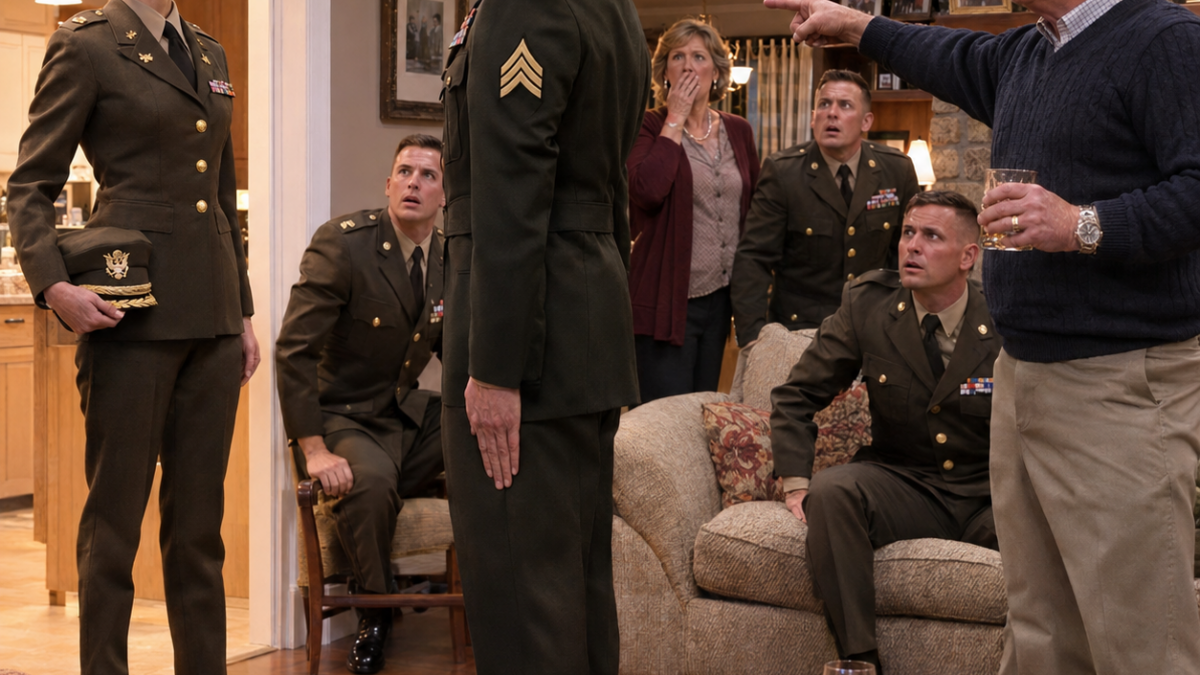
I stepped into the living room.
Marcus saw me first.
His eyes widened.
Then training and surprise collided.
He snapped to his feet.
“ATTENTION!”
Ruiz stood immediately.
Whitaker stood.
Captain Brooks rose.
Mom gasped.
Wendell turned.
He stared.
At the uniform.
At my rank.
At my ribbons.
At me.
Color disappeared from his face so fast I actually saw it happen.
Marcus recovered first.
“Ma’am.”
I nodded.
“At ease.”
The soldiers relaxed.
Wendell did not.
He looked as though someone had removed gravity from the room.
“You…”
I smiled.
“Hi, Wendell.”
Mom’s hand went to her mouth.
Captain Brooks looked from him to me.
Then back.
Marcus had begun fighting a smile.
Wendell finally managed:
“You’re…”
“A major.”
His mouth moved.
Nothing came out.
I helped.
“United States Army.”
Marcus, apparently unable to resist, added:
“Military intelligence.”
Wendell looked at him.
Marcus arranged his face into perfect professional neutrality.
“Sir.”
That sir was technically unnecessary.
Emotionally, it was devastating.
Mom sat hard on the sofa.
“Josephine.”
I turned.
She looked hurt.
Not because of Wendell.
Because of me.
“You never told me.”
My stomach dropped.
“I tried.”
“You’re a major?”
“Yes.”
“When?”
“Nine months ago.”
Her eyes filled.
“Nine months?”
I remembered the phone call.
The promotion ceremony.
Mom had answered.
Wendell had friends over.
She said she would call back.
She never did.
I had been hurt.
Then busy.
Then stubborn.
Now guilt moved through both of us at once.
Mom stood.
Walked toward me.
Touched the rank insignia carefully.
“My baby.”
“Mom.”
She laughed and cried.
Then hugged me.
Over her shoulder, I watched Wendell.
A decent man who had misunderstood me might have felt embarrassed.
Wendell looked angry.
That told me more than any confession.
He did not mind being wrong.
He minded losing status.
“Well.”
He forced a laugh.
“You certainly know how to make an entrance.”
I looked toward the kitchen.
“I tried staying where you told me.”
Ruiz stared at the floor.
Whitaker coughed into one fist.
Mom turned toward Wendell.
“You told her to stay in the kitchen?”
“It was a joke.”
“No.”
Mom’s voice was soft.
“You told her twice.”
“Ruth.”
“You said you didn’t want her embarrassing you.”
“I was teasing.”
“You weren’t.”
Silence.
My mother had contradicted him in front of other people.
The significance of that was not lost on either of us.
Wendell glanced around the room.
“We don’t need to make a scene in front of guests.”
Mom’s mouth opened.
For a second I expected the old reflex.
You’re right.
Sorry.
Instead, she said:
“Why not?”
Captain Brooks’s eyebrows rose.
Marcus looked impressed.
I almost smiled.
Wendell shifted quickly.
“Well, obviously Josephine has been keeping some things from us.”
Interesting.
His lie was already becoming my deception.
I answered calmly.
“I never claimed to be unemployed.”
“You let me think it.”
“Yes.”
“Why?”
“Because I wanted to know how you treated somebody you considered unsuccessful.”
The room became very quiet.
His face darkened.
“That’s manipulative.”
“Possibly.”
I nodded.
“But informative.”
Wendell looked toward Mom.
“See? This is what I mean. She comes into this house—”
“My house.”
Mom said it quietly.
Wendell stopped.
She looked surprised by herself.
Then said it again.
“My house.”
He recovered.
“Our house.”
“No.”
Mom stared at him.
“You live here.”
The words landed.
“You did not buy it.”
He laughed nervously.
“Ruth, this is ridiculous.”
Maybe.
But I had watched my mother give away dozens of tiny boundaries.
This one mattered.
Marcus cleared his throat.
“Mr. Pruitt.”
Wendell turned.
Marcus’s expression was neutral again.
“If you don’t mind me asking, where did you complete the Sergeants Major Course?”
Wendell’s face changed.
“You may mind your own business.”
Marcus nodded once.
“Understood.”
Captain Brooks asked:
“What unit did you retire from?”
“I’m not on trial here.”
“Nobody said you were.”
“I served.”
Mom looked at him.
That sentence sounded different now.
Not I served twenty-seven years.
Just I served.
I saw the retreat.
So did everyone else.
I asked:
“What year did you retire?”
“Two thousand nine.”
“From active duty?”
“Yes.”
“Where?”
“Fort Benning.”
Plausible enough for the time.
Marcus asked:
“Which organization?”
Wendell snapped:
“What is this, an interrogation?”
“No, sir.”
Marcus’s politeness sharpened.
“You invited us because you said you had served as a command sergeant major. People tend to know people.”
Wendell’s hands curled.
“I don’t owe you my résumé.”
“No.”
I said.
“You don’t.”
Then looked at his cap.
“But if you use a résumé to establish authority, you should probably expect questions about it.”
His eyes locked on mine.
“I know exactly what you’re doing.”
“So do I.”
Mom looked between us.
Then toward the shadow box.
Something in her face changed.
“Josephine.”
“Yes?”
“You know.”
It was not a question.
I took a breath.
“Yes.”
Wendell stepped toward me.
“What did you do?”
“Nothing improper.”
“You accessed my military records?”
“No.”
He looked almost disappointed that he could not accuse me of misconduct.
I continued.
“I would never use restricted systems for a personal dispute.”
Marcus nodded slightly.
“I used public information. I asked people who knew you. I compared your own stories.”
Mom whispered:
“Tell me.”
Wendell turned toward her.
“Ruth, don’t.”
She stared.
“Don’t what?”
“Listen to this.”
Her face went still.
“You have spent two years telling me to listen to you.”
He said nothing.
“I want to hear her.”
That was the second boundary.
Stronger.
I hated being the person delivering the next words.
But truth does not become kinder by delaying it once someone has asked.
“Wendell did serve.”
Mom looked relieved for half a second.
Then I continued.
“He enlisted in the Army Reserve when he was young.”
Wendell’s jaw flexed.
“He served about sixteen months.”
Mom’s eyes moved toward him.
“No.”
He said nothing.
“He separated as a private first class.”
Mom’s face emptied.
“No combat deployment.”
Silence.
“No twenty-seven-year career.”
I looked at his cap.
“No command sergeant major.”
Mom stared at him.
“Is that true?”
Wendell’s breathing became heavy.
“Ruth—”
“Is that true?”
“I served.”
“That is not what I asked.”
“I wore the uniform.”
“For sixteen months?”
He looked away.
Mom whispered:
“You told me twenty-seven years.”
“I was young.”
“What does that mean?”
“I had issues.”
“Twenty-seven years?”
“Ruth.”
“You told me you were in Iraq.”
“I supported people who—”
“Were you in Iraq?”
Silence.
The whole room seemed to shrink around him.
“Were you ever deployed?”
Wendell looked at the floor.
“No.”
Mom closed her eyes.
One syllable had just erased the biography she had been living beside.
I expected yelling.
Mom did something worse.
She sat down.
Very calmly.
Then pointed at the cap on Wendell’s head.
“Take it off.”
He stared.
“What?”
“The hat.”
“Ruth.”
“Take it off.”
He laughed in disbelief.
“This is childish.”
Captain Brooks shifted slightly.
Marcus watched.
Mom repeated:
“Take that hat off in my house.”
Wendell slowly removed it.
The embroidered words faced us.
COMMAND SERGEANT MAJOR.
Mom stared at them.
Her chin trembled.
“You made me believe you knew what leadership was.”
“I do.”
“No.”
Her voice shook.
“You know what power feels like.”
Wendell opened his mouth.
She kept going.
“You corrected everything I did.”
“Ruth—”
“The way I set the table.”
“That was—”
“The way I dressed.”
“You asked my opinion.”
“My friends.”
“Patricia was disrespectful.”
“No.”
Mom’s voice rose.
“Patricia disagreed with you.”
Wendell looked at me as though I had placed these thoughts in her mouth.
I hadn’t.
Maybe I had simply opened a window.
Mom continued.
“You told me I embarrassed you when I laughed too loudly at dinner.”
“You were drinking.”
“One glass of wine.”
Her eyes filled.
“You told me women married to military leaders understood presentation.”
Wendell froze.
That was new to me.
Mom was not done.
“You told me I had no idea what discipline looked like.”
“I was trying to help.”
“You told me to stop singing because it was childish.”
My chest tightened.
There it was.
The missing music.
“You said grown women don’t need to make noise to get attention.”
Wendell rubbed his face.
“I said a lot of things.”
“Yes.”
Mom nodded.
“You did.”
Captain Brooks spoke for the first time in several minutes.
“Ma’am.”
Mom looked at her.
“I’m sorry you’re going through this.”
Wendell snapped:
“Elena, stay out of it.”
Captain Brooks’s expression changed immediately.
Not angry.
Cold.
“Mr. Pruitt.”
Marcus stood.
Ruiz sat straighter.
Whitaker’s jaw tightened.
Nobody shouted.
Wendell suddenly looked very aware that every “real soldier” he had invited now saw him without the story.
He turned back to me.
“You happy?”
“No.”
That answer seemed to confuse him.
“You wanted to humiliate me.”
“No.”
“You wore that uniform in here for exactly that reason.”
“I wore the uniform because you told my mother I was an embarrassment to ‘real soldiers.’”
His face reddened.
“You could have corrected me privately.”
“Yes.”
I nodded.
“I could have.”
“Then why didn’t you?”
“Because privately you had already convinced Mom that disagreeing with you meant disrespecting military experience.”
He glanced at her.
I continued.
“You invited an audience because you thought the audience would make you stronger.”
His expression hardened.
“You built the stage, Wendell.”
I took a breath.
“I just walked into the room.”
He stepped toward me.
“Be very careful.”
Captain Brooks stood fully now.
Marcus did too.
I remained where I was.
Mom saw all of it.
“Don’t threaten my daughter.”
Wendell swung toward her.
“I am not threatening anybody!”
“You just told her to be careful.”
“I mean with what she says.”
“No.”
Mom stood.
“You mean she should stop because you are losing control of the room.”
Wendell stared at her.
That sentence had not come from me.
Or Marcus.
Or an attorney.
It came from Ruth.
The woman he had spent months training to measure herself through his reactions.
I watched him realize it.
His face changed.
Not shame.
Fear.
“This is ridiculous.”
He laughed once.
“You people are turning a relationship disagreement into some kind of abuse story.”
Mom’s face went pale.
I did not speak.
That word needed to belong to her if it belonged anywhere.
Wendell continued:
“I have never hit you.”
“I know.”
“Never threatened you.”
Mom hesitated.
“No.”
“Never stopped you from going anywhere.”
“No.”
“There.”
He looked around triumphantly.
“So apparently I’m a monster because I had opinions.”
Mom stared at him.
Then asked:
“Why did I stop seeing Patricia?”
His triumph disappeared.
“I didn’t make you.”
“You said she was trying to destroy us.”
“She hated me.”
“She didn’t trust you.”
“Same thing.”
Mom shook her head.
“Why did I quit pottery?”
“You complained about the cost.”
“I complained about one glazing fee.”
Wendell looked away.
“Why did I stop traveling?”
“You said you didn’t like sleeping in hotels.”
“No.”
Mom’s voice broke.
“You said women in serious relationships don’t disappear overnight with girlfriends.”
“That is not what I—”
“It is exactly what you said.”
Her hands were trembling now.
“Why did I start showing you every credit card receipt?”
Silence.
My stomach tightened.
That was more serious.
Wendell looked at her.
“You were overspending.”
“It is my retirement income.”
“We share a household!”
“The house is paid off.”
“I contribute.”
Mom laughed once.
“You pay the electric bill and half the groceries.”
His face reddened.
Mom continued.
“I started asking if I could buy shoes.”
“I never said you needed permission.”
“No.”
Tears rolled down her face.
“You just made the next three days miserable if I bought something you didn’t approve of.”
Wendell looked toward the soldiers.
Embarrassed.
Exactly as Mom had once been.
That was the difference.
She was finally saying things where other people could hear.
Isolation had protected him.
Witnesses changed the room.
He turned to me again.
“This is your fault.”
Mom stepped between us.
Not dramatically.
Just enough.
“No.”
Her voice shook.
“This is yours.”
Wendell stared at her.
“You don’t mean that.”
“Yes.”
“You’re upset.”
“Yes.”
“Let’s talk tomorrow.”
“No.”
“Ruth.”
“I want you out.”
Silence.
Even I had not expected it that fast.
Wendell blinked.
“What?”
“Pack a bag.”
He laughed.
“You cannot be serious.”
“I am.”
“Where exactly do you think I’m supposed to go?”
Mom’s mouth trembled.
Then something old and fierce returned to her eyes.
“The Army taught you self-reliance, didn’t it?”
Marcus made a strangled sound that might have been a cough.
I looked down to hide a smile.
Wendell did not find it funny.
“I live here.”
“For eleven months.”
“Our relationship—”
“Is over for tonight.”
“For tonight?”
Mom nodded.
“I am not making lifetime decisions while I’m this angry.”
That impressed me.
She was not letting rage substitute for thought.
“But you are leaving this house tonight.”
Wendell looked at me.
“You told her to say that.”
Mom’s entire face changed.
“No.”
He stopped.
“I said it.”
She pointed toward the stairs.
“Go pack.”
He stood there for almost ten seconds.
Then turned.
Walked upstairs.
Nobody spoke until his bedroom door slammed.
Mom flinched.
I moved toward her.
She lifted one hand.
“Not yet.”
So I stopped.
Captain Brooks came closer instead.
Not military.
Woman to woman.
“Ms. Calloway, do you want us to leave?”
Mom looked around the room.
At the four soldiers Wendell had invited as props.
At me.
At the untouched dinner.
Then she laughed.
A shaky, broken laugh.
“I have a roast big enough for twelve people.”
Marcus smiled.
“That sounds like an order.”
Mom wiped her face.
“No.”
Then looked toward the stairs.
“We’ve had enough orders.”
That sentence made my throat tighten.
She took a breath.
“You can stay if you want.”
Ruiz nodded.
“We’d be honored.”
Wendell came downstairs twenty minutes later carrying two duffel bags.
The command-sergeant-major cap was gone.
So was the dark polo with the Army emblem.
He wore a plain button-down shirt.
Without the costume, he looked smaller.
Not physically.
Human.
He stopped near the front door.
Mom walked toward him.
I stayed in the dining room.
This needed to be hers.
He spoke quietly.
I could not hear the first sentence.
Mom shook her head.
He said something else.
She answered:
“No.”
He reached for her arm.
Not violently.
She stepped back before he touched her.
“Don’t.”
His hand dropped.
He looked toward me.
Then the soldiers.
Humiliation flashed across his face again.
That still mattered more to him than Mom’s pain.
He opened the door.
Then turned back.
“You’re making a huge mistake.”
Mom looked at him.
“Maybe.”
My heart stopped because the word reminded me of another kind of courage.
Then she continued:
“But it will be my mistake.”
Wendell stared.
There was nothing to say to that.
He left.
Mom closed the door.
Turned the deadbolt.
Kept one hand on it for several seconds.
Then whispered:
“I need a locksmith.”
I walked toward her.
“Yes.”
She started crying.
Patricia arrived before dessert.
Mom called her.
I heard only half the conversation.
“Pat?”
Silence.
“I’m sorry.”
Long silence.
Then Mom started crying harder.
Twenty minutes later, a silver Honda pulled into the driveway.
Patricia came through the door in orthopedic sandals, purple glasses, and enough righteous fury to power the neighborhood.
She took in the scene.
Four soldiers.
Me in dress uniform.
Mom crying.
Wendell’s fake shadow box over the fireplace.
Then said:
“Well.”
She put down her purse.
“Apparently I missed a parade.”
Mom laughed through tears.
Then Patricia hugged her.
No lecture.
No I told you so.
Just:
“I’m here.”
That was friendship.
Dinner happened.
Not the dinner Wendell planned.
A better one.
Marcus told Mom about his wife and two daughters.
Ruiz helped carry plates.
Captain Brooks complimented Mom’s roast until Mom made her promise to take the recipe.
Whitaker washed dishes.
Mom objected.
He said:
“Ma’am, I have been trained in advanced sink operations.”
She laughed.
It was the first real laugh I had heard from her all weekend.
Every laugh sounded like furniture being put back where it belonged.
Later, Marcus leaned toward me.
“I knew Pruitt was full of it before you came in.”
“Why?”
“He called himself ‘the CSM of Third Brigade.’”
“Could happen.”
“Then he told me a command sergeant major reports directly to the Secretary of the Army.”
I closed my eyes.
“Oh.”
“Yeah.”
Captain Brooks overheard.
“He also said officers salute command sergeants major indoors.”
Mom stared.
“They don’t?”
I looked at her.
“No.”
She began laughing so hard she had to put down her fork.
For months, Wendell had treated military jargon like scripture.
Now one ridiculous detail after another fell apart.
And something beautiful happened.
Mom stopped looking ashamed.
She started looking angry.
Anger can be healthy when shame has occupied too much space.
After the soldiers left, Mom sat at the kitchen table.
I had changed out of uniform.
My jacket hung over a chair.
For a while neither of us spoke.
Then she said:
“Please don’t tell me you’re proud of me.”
That surprised me.
“Okay.”
“I feel stupid.”
“You aren’t.”
“I believed him.”
“You trusted him.”
“I let him change me.”
My chest tightened.
“Mom.”
“I stopped singing.”
Her voice broke.
“I know.”
“I stopped seeing Patricia.”
“I know.”
“I quit pottery.”
“I know.”
She looked down at her hands.
“I started asking permission to buy things with my own money.”
There it was.
Financial control.
Not theft.
Not yet.
But conditioning.
“I don’t understand how I became that woman.”
I sat beside her.
“You did not wake up one morning and hand him your life.”
She cried.
“No.”
“You handed him one argument because you were tired.”
I took her hand.
“Then one dinner.”
“Then one friend.”
“One receipt.”
“One song.”
Her shoulders shook.
“You thought keeping peace was cheaper than fighting every time.”
Mom looked at me.
“That doesn’t make it your fault.”
“I should have known.”
“Known what?”
“That something was wrong.”
I swallowed.
“So should I.”
She shook her head.
“You were gone.”
“I called.”
“Not enough.”
The words hurt.
They were also true.
I nodded.
“Not enough.”
Mom reached for my hand.
“I didn’t say that to hurt you.”
“I know.”
“I helped hide it.”
“I know.”
Silence.
Then she whispered:
“Stay in here tonight.”
“Your room?”
She nodded.
“I don’t want to sleep upstairs.”
So I did.
We sat in my childhood bedroom drinking tea until almost three.
Mom kept looking at my uniform hanging on the closet door.
“Major.”
“You keep saying it.”
“I missed it.”
“You missed a ceremony.”
“I missed nine months of knowing.”
I looked down.
“I should have told you again.”
She cried.
“I should have called you back.”
Both could be true.
That became the theme of the next year.
Multiple truths.
Wendell lied.
Mom trusted.
I stayed away.
Mom hid things.
Wendell controlled.
Mom cooperated sometimes because cooperation felt safer.
None of those truths canceled the others.
At 2:18 a.m., she asked:
“Do you think he loved me?”
That was the hardest question.
“Yes.”
She looked surprised.
“I think he probably did.”
“How can somebody love you and do that?”
I thought about leaders.
Families.
Human beings.
“Love doesn’t automatically make someone healthy.”
Mom looked down.
“I loved him.”
“I know.”
“I still do, a little.”
“I know.”
“Does that make me pathetic?”
“No.”
She wiped her face.
“Would you take him back?”
“No.”
She laughed.
“Of course not.”
I smiled.
“I’m military intelligence. We are famous for uncomplicated personal lives.”
She laughed harder.
Good.
At 7:12 the next morning, Mom called a locksmith.
Before coffee.
I approved of her priorities.
Then the bank.
Then her attorney.
Then the alarm company.
New locks.
New garage code.
New alarm code.
New online passwords.
Wendell had been an authorized user on one credit card.
Mom removed him.
She had also given him view access to one household account because he claimed it was easier for budgeting.
Removed.
Her attorney confirmed the house was solely in Mom’s name.
No joint deed.
No ownership transfer.
The relief on her face made me realize she had not been certain.
That scared me.
“Did you sign anything involving the house?”
“I don’t think so.”
“Mom.”
Her face fell.
“I signed papers.”
“What papers?”
“I don’t know.”
The previous night’s relief disappeared.
“What did he say they were?”
“Insurance.”
“Medical.”
“One was estate planning.”
I felt my body go cold.
“Where are they?”
“Office.”
We spent three hours going through the desk.
Insurance.
Utility bills.
Medical authorization.
Credit card forms.
Tax documents.
Nothing transferring the house.
Then I found a folder labeled PLANNING.
Inside were photocopies of Mom’s property-tax statements.
A home valuation.
Her retirement-account summary.
Life-insurance information.
And a draft estate-planning worksheet.
Not signed.
But filled out in Wendell’s handwriting.
Under Primary Beneficiary, he had written his own name.
Under Residence / Intended Disposition, he had written:
Retain for surviving partner / possible life estate.
Mom sat beside me.
Staring.
“I never saw that.”
“Good.”
“What does life estate mean?”
I explained only generally.
Then stopped myself.
“We’ll let your attorney explain the exact implications.”
Mom looked at me.
“You’re doing that on purpose.”
“What?”
“Not taking over.”
“Yes.”
Her eyes filled.
“Thank you.”
That was when I knew how careful I needed to be.
If I responded to Wendell’s control by becoming the new person who made every decision, Mom would still be controlled.
Just by somebody who loved her more.
That was not freedom.
Her attorney, Evelyn Shaw, reviewed everything Monday.
No deed transfer.
No changed will.
No beneficiary form had been completed with the institutions that mattered.
The medical authorization was limited and revocable.
The financial view access had already been removed.
The draft worksheet, while concerning, did not itself transfer anything.
Mom sat across from Evelyn with both hands clasped tightly.
“So I’m not trapped?”
Evelyn looked at her.
“No.”
Mom exhaled.
Then began crying.
I looked away.
Sometimes relief needs privacy too.
Evelyn waited.
Then asked Mom:
“What do you want?”
Mom looked startled.
“What?”
“Not what Josephine wants.”
I appreciated that.
“Not what Wendell wanted.”
Evelyn leaned forward.
“What do you want?”
Mom thought for almost a minute.
Then said:
“I want everything to stay mine until I decide otherwise.”
“Good.”
“I want Josephine as emergency contact.”
I nodded.
“But not owner of anything.”
“Good.”
“I want Patricia as backup.”
Evelyn smiled.
“Excellent.”
Mom continued.
“And if I ever change my will, I want somebody to explain it when I’m not tired and nobody is sitting beside me telling me what I should do.”
Evelyn wrote that down.
Mom looked at me.
That was the first morning I saw her rebuilding on purpose.
Wendell called seventeen times that week.
At first, Mom did not answer.
His messages changed tone.
Ruth, we need to talk.
Then:
I’m sorry you were embarrassed.
Not I’m sorry I lied.
Then:
Josephine manipulated the whole thing.
Then:
You know me better than they do.
Then:
After everything I did for you, this is how you repay me?
Mom played that one twice.
Then looked at me.
“Same speech.”
“What?”
“He always becomes the person who sacrificed most.”
She deleted it.
A small action.
A big shift.
Two days later, she received a handwritten letter.
Wendell.
She wanted me to read it first.
I refused.
“Why?”
“Because it’s addressed to you.”
“What if it upsets me?”
“It probably will.”
“Helpful.”
I smiled.
“You can stop whenever you want.”
She stared at the envelope.
Then opened it.
I sat across the room.
She read slowly.
Her face changed several times.
Anger.
Sadness.
Disbelief.
At the end, she folded it.
“What did he say?”
Mom stared at the paper.
“That he lied because people respected him more when they thought he had served longer.”
That was at least honest.
“He says he was ashamed.”
I nodded.
“He says he started exaggerating in his thirties.”
One lie becoming history.
“He says he never expected it to become…”
She looked at the page.
“His identity.”
I thought about the caps.
The shadow box.
The speeches.
The constant lectures.
“What does he say about you?”
Mom’s mouth tightened.
“He says my daughter poisoned me against him.”
There was the familiar escape.
“And?”
“He says he was only trying to help me become more organized.”
I almost laughed.
Mom did.
Not happily.
“He still doesn’t understand.”
“No.”
She folded the letter again.
Then placed it in a drawer.
“What are you going to do?”
“Nothing.”
That surprised me.
“No answer?”
“No.”
“Why?”
Mom looked at me.
“Because for two years I answered every accusation.”
Her voice steadied.
“I don’t owe him another defense.”
That was stronger than any speech I could have written for her.
Meanwhile, Wendell’s military story began collapsing outside our family.
Marcus called me.
Not in an official capacity.
“Thought you should know.”
“What?”
“Pruitt has been speaking at local veterans events.”
My stomach tightened.
“What kind?”
“Civic stuff. School assemblies. Fundraisers. Veterans breakfasts.”
“As a retired CSM?”
“Yes.”
“Any money?”
“Some honorariums, apparently.”
That made the situation more serious, though I refused to jump to conclusions.
“Documentation?”
“Veterans association is reviewing.”
“Good.”
“Want me to send anything?”
“No.”
He paused.
“No?”
“I’m staying out of the process unless somebody formally needs a statement about what I personally witnessed.”
Marcus sounded amused.
“You’re no fun.”
“I’m responsible.”
“That too.”
I continued:
“Do not turn this into a social-media mob.”
“I wasn’t planning to.”
“Good.”
Because I did not want revenge.
Not because Wendell deserved protection from truth.
Because truth did not need embellishment.
If he had falsely claimed service in ways that produced financial benefit, appropriate people could determine what mattered legally.
If he had merely lied socially, organizations could decide whether they wanted him representing them.
Facts.
Not vengeance.
The local veterans association reviewed its records.
Wendell had joined as a veteran, which he technically was.
But he had repeatedly represented himself internally and publicly as a retired command sergeant major.
The organization removed him from a ceremonial leadership role and canceled a scheduled keynote address.
A few small speaking honorariums were voluntarily repaid after questions were raised.
There was no dramatic arrest.
No federal agents.
No judge.
Real life is often less cinematic.
But socially, his invented career collapsed.
People stopped calling him Sergeant Major.
The hat disappeared.
The speeches stopped.
His biggest punishment was brutally simple.
He had to become Wendell again.
Mom struggled despite all of that.
That surprised her.
“He lied.”
“Yes.”
“He controlled everything.”
“Yes.”
“I know leaving was right.”
“Yes.”
“Then why do I miss him?”
We were sitting on the back porch.
I took a moment before answering.
“Because the part of you that loved him did not receive new evidence and instantly die.”
Her eyes filled.
“I hate that.”
“I know.”
“He made me feel safe at first.”
“I know.”
“After your dad died, I hated sleeping alone.”
My throat tightened.
She rarely talked about that.
“Wendell checked the doors.”
“Fixed things.”
“Made breakfast.”
“Drove on long trips.”
She looked embarrassed.
“Those things happened too.”
“Yes.”
“I feel like if I admit he was good sometimes, it means I’m excusing the rest.”
“No.”
She looked at me.
“Good memories do not invalidate bad behavior.”
I took her hand.
“And bad behavior does not require you to pretend every good moment was fake.”
Mom cried.
“That’s inconvenient.”
“Extremely.”
She laughed.
Then wrote something on a sticky note later that afternoon.
Missing him does not mean I need him back.
She placed it beside the kitchen phone.
I never forgot it.
Patricia came back into her life fully.
Thursday lunches.
Book club.
Pottery.
The first afternoon Mom returned to the pottery studio, she called me afterward.
“I made a bowl.”
“Congratulations.”
“It’s terrible.”
“That sounds normal.”
“I forgot half of what I knew.”
“You’ll remember.”
There was a pause.
Then she whispered:
“I felt like myself.”
I closed my eyes.
That mattered more than the bowl.
Wendell came to the house once more.
Three months after the dinner.
Mom told me afterward.
Not before.
That was important.
“He came by.”
My entire body tightened.
“Did he come inside?”
“No.”
“Did you feel safe?”
“Yes.”
“What did he want?”
“To talk.”
“About?”
“Everything.”
I waited.
Mom continued.
“He said he was sorry about the military lie.”
“What exactly?”
“That he had been ashamed of leaving the Reserve early.”
That made sense.
Not excuse.
Sense.
“He said the first time he told somebody he had stayed in longer, she looked impressed.”
Mom shook her head.
“Then another person.”
“Then another.”
“A lie that worked.”
“Yes.”
She looked toward the yard.
“Eventually he built a whole man.”
That was exactly what had happened.
“What did you say?”
“I told him I was sorry he had been ashamed.”
That surprised me.
Then Mom added:
“And I told him his shame did not give him permission to make me ashamed of myself.”
I felt something swell in my chest.
“What did he do?”
“Cried.”
“And you?”
“Cried.”
“Then?”
“I told him goodbye.”
No dramatic slam.
No police.
No performance.
A boundary.
That was the kind of ending that lasts.
Six months later, Wendell sent me a letter.
I almost threw it away.
Then decided honesty deserved one chance to be read.
He wrote that seeing me in uniform had humiliated him more deeply than he had admitted.
Then, surprisingly, he acknowledged why.
Not because I was a major.
Because he had spent two days treating me like somebody who did not deserve respect.
Then discovered the person he had dismissed possessed exactly the status he valued most.
That exposed something ugly in him.
I respected you after I saw the uniform.
He wrote.
I should have respected you before.
That line I kept.
Then:
I liked the way people listened when they thought I had been important.
Another honest line.
Eventually I could not tell whether I wanted respect or obedience.
That was better.
Near the end, he wrote:
Your mother deserved neither my lies nor my corrections.
I folded the letter.
I did not reply.
An apology can be real without reopening a door.
My relationship with Mom changed after Wendell.
Not because she became dependent on me.
I refused to let that happen.
If anything, she became more stubborn.
Which I considered excellent.
She started disagreeing loudly.
I would suggest replacing a rug.
“No.”
A doctor.
“I already have one.”
A security system.
“Stop managing me.”
I smiled every time.
Once she snapped:
“You are not in command here.”
I answered:
“Yes, ma’am.”
“Don’t ‘ma’am’ me.”
Perfect.
Every disagreement felt like proof she had regained something.
Then Mom started asking about my career.
Real questions.
Not classified work.
Rank.
Promotion.
Leadership.
Army life.
One afternoon she asked:
“Do people stand every time you walk into a room?”
I laughed.
“No.”
“Marcus did.”
“He panicked.”
“He shouted.”
“He enjoys drama.”
“I like Marcus.”
“I know.”
She smiled.
Then said:
“Wendell would hate knowing Marcus impressed me more.”
“Mom.”
“What?”
“You’re becoming petty.”
“I’m healing.”
Apparently those could coexist.
A year after the dinner, Mom hosted another gathering.
Same living room.
Same dining table.
Different atmosphere.
Patricia came.
Marcus and his wife.
Captain Brooks.
Several neighbors.
Mom cooked too much food.
Nobody was ordered into the kitchen.
Nobody corrected the glasses.
At one point Marcus looked toward me.
“Remember the last military dinner here?”
Mom pointed a serving spoon at him.
“We do not discuss traumatic history before dessert.”
Marcus straightened.
“Yes, ma’am.”
She grinned.
“See? That is military discipline.”
Everyone laughed.
Later, I found Mom near the fireplace.
The space where Wendell’s shadow box had hung was empty.
“What are you putting there?”
“I don’t know.”
Months later she decided.
A photograph of herself and Dad in their thirties.
Dad covered in paint.
Mom laughing.
Kitchen cabinets half-installed behind them.
No medals.
No title.
No caption.
Just two people building something real.
I understood.
She had reclaimed the wall from performance.
The strangest part of my own recovery was examining why the “ATTENTION!” moment had felt so satisfying.
It did.
I was not going to lie.
After Wendell had mocked me, watching his face when Marcus stood felt good.
For several seconds, I enjoyed possessing the authority he worshipped.
That bothered me later.
Because rank is power too.
Legitimate power is still power.
I did not want to become the kind of person who thought having more status made me more human.
Marcus and I talked about it over coffee one afternoon.
“I enjoyed shouting attention,” he admitted.
“I know.”
“Probably too much.”
“Absolutely.”
He smiled.
Then became serious.
“The point wasn’t really that you outranked him.”
“I know.”
“It was that he thought only people with rank deserved respect.”
I looked at him.
Marcus continued.
“Then the biggest rank in the room belonged to the woman he put in the kitchen.”
I laughed.
“Still sounds petty.”
“A little.”
He shrugged.
“But educational.”
Fair.
Mom eventually told me when she first realized Wendell was changing her.
Not the dinner.
Months earlier.
She had been washing dishes.
Singing Motown.
Wendell walked into the kitchen.
Asked her to stop.
She thought he was joking.
He said:
“You’re sixty years old, Ruth. Act like it.”
Mom stopped.
Not because he ordered her.
Because she felt embarrassed.
She did not sing the next day.
Or the next.
“I remember thinking the house sounded more respectable.”
Her eyes filled.
“Then one day I realized it just sounded quiet.”
That sentence hurt me more than the fake rank.
Control can be measured by what disappears.
Music.
Friends.
Clothes.
Jokes.
Opinions.
Volume.
A person’s natural shape.
Two years later, I visited on a Saturday morning.
At seven-forty, Aretha Franklin shook the downstairs windows.
I walked into the kitchen.
Mom stood barefoot in flamingo pajama pants, making pancakes.
Hair wild.
Singing terribly.
I leaned against the doorway.
“What happened to discipline?”
She turned.
Pointed the spatula at me.
“In this house, everybody sleeps as late as they damn well want on Saturday.”
I laughed.
“But breakfast ends at nine.”
“Yes, ma’am.”
“Better.”
There she was.
Whole.
Not exactly the woman before Wendell.
People do not return to an earlier version after something changes them.
She was something new.
A woman who knew how quietly she could disappear and therefore guarded her own voice more carefully.
The military issue eventually faded.
Wendell stopped appearing at veterans events.
Years later, I heard through Marcus that he had joined a men’s accountability group through his church.
Apparently he had begun speaking honestly about lying about his career.
I hope it helped him.
I mean that.
Not because I wanted reconciliation.
Because a man who spends decades creating a false self becomes trapped by it too.
But his growth was no longer my mother’s job.
She did not owe him supervision.
Forgiveness does not require monitoring somebody’s rehabilitation.
Mom never seriously dated again.
Not because Wendell destroyed love.
She simply discovered she liked her life.
Patricia.
Pottery.
Trips.
Garden.
Book club.
Bad singing.
She once told me:
“I spent two years wondering whether a man approved of me.”
Then looked around her backyard.
“I had forgotten how peaceful it is not to be evaluated.”
I think about that sentence often.
Especially as a leader.
People perform poorly when they believe they are being judged every second.
Families do too.
Good leadership does not create constant self-consciousness.
It creates enough safety for people to think.
Wendell had mistaken surveillance for discipline.
Three years after the dinner, I was promoted again.
Mom attended the ceremony.
This time she knew.
She sat beside Patricia.
Marcus was there too.
Afterward, Mom walked toward me and touched the new insignia carefully.
“I know this one.”
“You studied?”
“Marcus taught me.”
“Traitor.”
Mom smiled.
Then said:
“But you’re still taking the trash out when we get home.”
Some chains of command remain eternal.
“Yes, Mom.”
“Good.”
That night we went back to the house.
Same kitchen.
Same hallway.
The old black CSM cap turned up in a storage box Wendell had apparently left behind.
Mom pulled it out.
Stared.
“Oh.”
“What do you want to do?”
She thought.
Then started removing the embroidered patch.
Not dramatically.
No fire.
No scissors.
No ritual.
She simply worked the stitching loose.
“What are you doing?”
“Making it honest.”
The gold patch came away.
Underneath was a plain black cap.
Mom looked at it.
“Better.”
Then dropped it into a donation box.
That image stayed with me.
Sometimes healing does not require destroying an object.
Just removing the lie.
Then you see what was always underneath.
Just a man.
Just a hat.
No borrowed rank.
Years later, Mom had a minor surgery.
Nothing life-threatening.
But the preoperative forms made her anxious because Wendell’s old estate-planning pressure had made paperwork feel dangerous.
She called me.
“I know I’m being ridiculous.”
“You’re not.”
“I hate signing things now.”
“Then don’t sign until you understand them.”
She laughed softly.
“That sounds obvious.”
“Most important things do after you learn them.”
At the hospital, a nurse began explaining one document quickly.
Mom raised her hand.
“Slow down.”
The nurse stopped.
Mom asked questions.
Read every page.
Signed only after she was comfortable.
I sat beside her saying nothing.
That moment made me prouder than if she had shouted at Wendell again.
Freedom is often boring.
Paperwork.
Passwords.
Asking questions.
Taking time.
The years softened some memories.
Not erased.
Softened.
Mom could eventually tell the dinner story and laugh.
Especially the part where Marcus yelled “ATTENTION!”
She exaggerated his volume each year.
By year five, according to Mom, windows shook.
Marcus insisted this was slander.
At Thanksgiving, Patricia once asked:
“Josephine, did Wendell really turn white?”
Mom answered before I could.
“Like copy paper.”
We laughed.
That did not mean the hurt had disappeared.
It meant the memory no longer owned the room.
The last time Wendell and Mom ever spoke was almost four years after they separated.
They ran into each other at a grocery store.
Mom called me afterward.
“You’ll never guess.”
“What?”
“I saw Wendell.”
I sat down.
“You okay?”
“Yes.”
“What happened?”
“He looked old.”
That surprised me.
He was only a few years older than Mom.
“What did you say?”
“He said hello.”
“And?”
“I said hello.”
“Then?”
“He asked how I was.”
“What did you say?”
Mom laughed.
“I said, ‘Very loud.’”
I nearly choked.
“Mom.”
“What?”
“That’s vicious.”
“No.”
She sounded delighted.
“That’s healing.”
Apparently she had never abandoned that theory.
Wendell had smiled.
According to Mom.
Then told her he was glad.
No apology.
No request.
Just glad.
Maybe that was enough for two people who no longer belonged in each other’s lives.
Mom grew older.
So did I.
Military careers move quickly while you are inside them.
Assignments.
Moves.
Deployments.
Schools.
Promotions.
Losses.
Colleagues retiring.
Suddenly the people who once looked impossibly senior are asking you what you think.
I carried the lesson of Wendell’s house into every leadership position I held afterward.
Not the dramatic part.
Not the uniform reveal.
The kitchen.
The way Mom checked his face before speaking.
That image became one of my private tests for leadership.
When I walked into a room, did people become more cautious or more capable?
Did disagreement shrink?
Did people wait for my expression before deciding what they thought?
If so, something was wrong.
Rank can force silence.
It cannot manufacture trust.
Wendell knew how to create silence.
He called it discipline.
I learned never to confuse them.
One of the best command sergeants major I later worked with was a woman named CSM Denise Walker.
Thirty years in.
Tough.
Brilliant.
She could dismantle nonsense with one raised eyebrow.
I once told her a cleaned-up version of Wendell’s story.
Not names.
Just the situation.
She listened.
Then said:
“You know what fake leaders always love?”
“What?”
“Ceremony.”
I smiled.
“Because ceremony makes hierarchy visible.”
She nodded.
“Real leadership gets tested when nobody is standing at attention.”
That became another sentence I carried.
Mom loved Denise immediately when they eventually met.
Not because of her rank.
Because Denise asked Mom about pottery.
Wendell would have spent dinner talking about himself.
Denise spent twenty minutes asking how glazing temperatures worked.
Later Mom whispered:
“That woman is terrifying.”
“Why?”
“She listens too carefully.”
I laughed.
“That’s why she’s good.”
At sixty-seven, Mom entered one of her pottery pieces in a local show.
A blue bowl with an uneven rim.
She won honorable mention.
She called me as though she had been promoted to general.
“I won.”
“Won what?”
“Honorable mention.”
“That is not winning.”
“It is emotionally equivalent.”
I sent flowers.
The card said:
For a woman with no discipline.
Mom called me immediately.
“You think you’re funny.”
“Sometimes.”
“I’m keeping the card forever.”
She did.
By then, Wendell had become almost a story from another lifetime.
That is what recovery eventually did.
At first every choice was about him.
New locks because of Wendell.
Pottery because Wendell stopped her.
Patricia because Wendell separated them.
Then slowly those things became about Mom again.
Locks were just locks.
Pottery was pottery.
Patricia was Patricia.
Music was music.
That is when I knew Wendell was really gone.
Not when he moved out.
When he stopped being the reference point.
If people hear only the first half of this story, they think the satisfying ending is obvious.
Arrogant fake veteran mocks a woman.
Woman turns out to be an Army major.
Real soldiers stand.
Fake veteran turns white.
Perfect.
I understand the appeal.
But that was not the ending.
It was barely the beginning.
Because humiliating Wendell did not automatically restore my mother.
Truth created an opening.
Mom still had to walk through it.
She had to change locks.
Call the bank.
Face the paperwork.
Admit what she had tolerated.
Call Patricia.
Return to pottery.
Learn to spend her own money without rehearsing an explanation.
Sleep alone again.
Miss a man she knew she should not invite back.
Rebuild trust in herself.
Those were the victories.
Quiet.
Unphotographed.
Much harder than putting on a uniform.
And Wendell?
His most meaningful consequence was not that soldiers laughed at his stories.
They mostly didn’t.
Good professionals understand humiliation can make people dangerous.
The real consequence was that his borrowed authority stopped working.
Mom stopped obeying.
Veterans stopped validating his false rank.
He had to speak as himself.
For a man who had spent decades hiding from himself, that may have been the hardest punishment possible.
Years later, Mom asked me one night:
“Do you think he would have become controlling if he had really been a command sergeant major?”
The question made me laugh.
“No.”
“Why?”
“Because rank doesn’t make somebody healthy or unhealthy.”
I thought of excellent senior leaders.
Terrible ones.
“Uniforms don’t create character.”
Mom nodded.
“Apparently hats don’t either.”
“Especially hats.”
She smiled.
Then became serious.
“I think I believed him because I wanted the story.”
“What story?”
“Decorated soldier.”
“Strong man.”
“Somebody who knew what to do.”
She looked down.
“After your father died, I was tired of deciding everything alone.”
That confession softened something in me.
“I wanted somebody certain.”
I understood.
Wendell offered certainty.
Not wisdom.
Certainty.
Those can look similar when you are grieving.
“What would you tell yourself now?”
Mom thought.
Then smiled.
“Date the man.”
“Not the résumé.”
Good advice.
When Mom turned seventy, I asked what she wanted for her birthday.
“No party.”
“Dinner?”
“No.”
“Trip?”
“No.”
“What?”
She smiled.
“I want the kitchen painted.”
“Orange?”
“Absolutely not.”
Dad would have been disappointed.
She chose yellow.
Patricia and I helped.
Marcus came one afternoon and immediately got paint on the ceiling.
Mom told him the Army had clearly failed him.
He saluted with the roller.
Badly.
Mom laughed until she cried.
At one point, she turned on Motown.
Loud.
Nobody asked her to lower it.
I stood in the doorway holding a paintbrush.
For a second I remembered the first morning of my visit.
Wendell telling everyone when to wake.
Mom checking his face.
The missing songs.
Then I looked at her now.
Yellow paint in her hair.
Patricia dancing.
Marcus ruining the ceiling.
And thought:
This is what victory looks like.
Not somebody defeated.
Somebody restored.
When my own retirement from the Army eventually came years later, Mom sat in the front row.
Older.
Smaller.
Still loud.
During the ceremony, somebody spoke about my career.
Assignments.
Leadership.
Service.
Mom cried through almost all of it.
Afterward, she hugged me.
Then whispered:
“You know what I’m proudest of?”
I expected something military.
“Tell me.”
“You never became Wendell.”
I stared.
She smiled.
“You could have.”
That was one of the deepest compliments she ever gave me.
Not because I believed I was beyond failure.
Because I knew exactly what she meant.
Power always offers the same temptation.
People obey.
You begin believing obedience proves you are right.
It doesn’t.
Mom died years later.
Peacefully.
Not part of the original story people like to hear, but part of the whole one.
She was seventy-eight.
Cancer.
Short illness.
She faced it the way she had eventually learned to face everything.
Questions.
Documents read carefully.
Decisions made slowly.
She chose hospice herself.
Patricia came every day.
I took leave.
Marcus visited once and brought flowers.
Mom looked at him and said:
“Still standing at attention?”
He laughed and cried.
“Yes, ma’am.”
“No.”
She whispered.
“Sit down.”
He did.
On one of her final good afternoons, I sat beside her bed.
Music played quietly.
Aretha.
Of course.
Mom looked toward the photograph of her and Dad on the wall.
The one that replaced Wendell’s fake military shadow box.
“Jo.”
“Yes?”
“Do you remember the dinner?”
I laughed.
“Which one?”
She smiled weakly.
“You know.”
“I remember.”
“Marcus yelled very loudly.”
“He did.”
“Wendell looked terrible.”
“He did.”
Mom closed her eyes.
“I used to think that was the night you saved me.”
My throat tightened.
“You saved yourself.”
“I know.”
Her eyes opened.
“That took me years to understand.”
I took her hand.
Then she said:
“You know what really saved me?”
“What?”
“That you didn’t tell me what to do next.”
I swallowed.
“You could have.”
“Yes.”
“You had evidence.”
“Rank.”
“Confidence.”
She smiled.
“All the things I thought I needed.”
Her fingers squeezed mine weakly.
“But you made me choose.”
Tears filled my eyes.
“I was terrified.”
“I know.”
“Still.”
Mom breathed slowly.
“That was respect.”
I bent over her hand and cried.
Because after everything, that was what the story had always been about.
Not rank.
Respect.
Mom died two weeks later.
Patricia on one side.
Me on the other.
Music in the room.
No one telling her to lower it.
When we cleaned the house, I found three things in the kitchen drawer.
The sticky note.
Missing him does not mean I need him back.
The honorable-mention card from her pottery show.
And the note I had sent with the flowers.
For a woman with no discipline.
She had kept all three.
I laughed until I cried.
Then Patricia handed me another box.
Inside was the plain black baseball cap.
The fake CSM patch had been removed years earlier.
“Why did she keep this?”
Patricia shrugged.
“She said it reminded her that titles can come off.”
That sounded like Mom.
I kept the cap.
Not the patch.
Just the plain hat.
It sits in a box with some of her things.
Not as a monument to Wendell.
As a reminder.
Under every title is a person.
Judge the person.
People still ask me about that night occasionally.
Usually veterans who heard the story through Marcus.
“Did somebody really yell attention?”
“Yes.”
“Did Wendell really turn white?”
“Yes.”
“Did you plan the entrance?”
Not exactly.
I planned to tell the truth.
Marcus supplied the theatrics.
And yes, for one brief moment, it felt incredible.
But if you ask me now which sound I remember most, it is not Marcus shouting.
It is Mom, later that night, in the kitchen.
Singing.
Off-key.
Loud.
Free.
Wendell once believed military discipline meant entering a room and making everybody adjust to you.
He was wrong.
Some of the strongest leaders I have known entered rooms and made everyone else more capable of being themselves.
That is harder.
It requires confidence that does not depend on obedience.
He believed respect traveled downward through rank.
Wrong again.
Respect moves in every direction or it is not respect.
He thought people who had less status deserved less patience.
That was the ugliest lie of all.
Because he treated me badly only when he believed I was nobody important.
And that is how I learned exactly who he was.
If I could speak to the version of myself standing in that kitchen while Wendell said:
“Stay in here. I don’t want you embarrassing me in front of real military men.”
I would tell her not to rush.
Let him talk.
Let him invite the audience.
Let him describe his imaginary deployments.
Let him explain leadership.
Let him tell everyone you have no discipline.
Let him build the entire room around a lie.
Then go upstairs.
Put on what you have actually earned.
Walk back downstairs.
And do not gloat.
You will not need to.
Truth has a presence of its own.
But I would tell her something else too.
The uniform will not fix Mom.
The soldiers will not fix Mom.
Exposing Wendell will not fix Mom.
That part will take time.
It will take a locksmith.
A banker.
An attorney.
A friend named Patricia.
A pottery studio.
Pancakes.
Bad singing.
Tears.
Lonely nights.
Small decisions.
A woman learning, over and over, that disagreement does not require permission.
That is where the real story begins.
Wendell Pruitt invited soldiers into my mother’s house because he wanted witnesses to his authority.
He told me to stay in the kitchen because he believed I had none.
Then I walked into the living room wearing the uniform I had actually earned.
Marcus stood.
The others followed.
Wendell turned white.
And for a few seconds, the hierarchy he worshipped reversed itself.
But my rank was never the thing that defeated him.
Truth did.
And truth did something far more important than expose a liar.
It gave my mother one clear moment in which she could finally see that the man constantly telling her to become smaller had never been standing above her at all.
He had simply convinced her to keep looking down.
The moment she lifted her head, his power began to disappear.
Years later, when I think of Ruth Calloway, I do not see her crying beside the front door after Wendell left.
I see the yellow kitchen.
Flamingo pajama pants.
Aretha Franklin shaking the windows.
Pancake batter on her cheek.
Her pointing a spatula at me and saying:
“In this house, everybody sleeps as late as they damn well want on Saturday.”
That is the ending I keep.
Not the fake command sergeant major.
Not his embarrassment.
Not the shadow box.
My mother.
Loud again.
Because there is a difference between making someone lose power and helping someone reclaim their own.
I did the first accidentally.
Mom did the second herself.
And when the soldiers left that first night, when Wendell’s bags were gone and the front door was locked, I heard her start singing while she washed the dinner plates.
I stood in the hallway listening.
She noticed me.
“What are you smiling at?”
I shook my head.
“Nothing.”
She pointed a wooden spoon toward the drying rack.
“Then stop staring and help.”
I walked into the kitchen.
“Yes, ma’am.”
She smiled.
And the house sounded like ours again.








