FULL ENDING:“SEVEN YEARS IN THE DARK… AND HE STILL DIDN’T FORGET HOW TO LOVE!” I Cut the Chain on an Abandoned Barn—What This Broken Dog Did When He Finally Felt the Sun Left Me in Tears
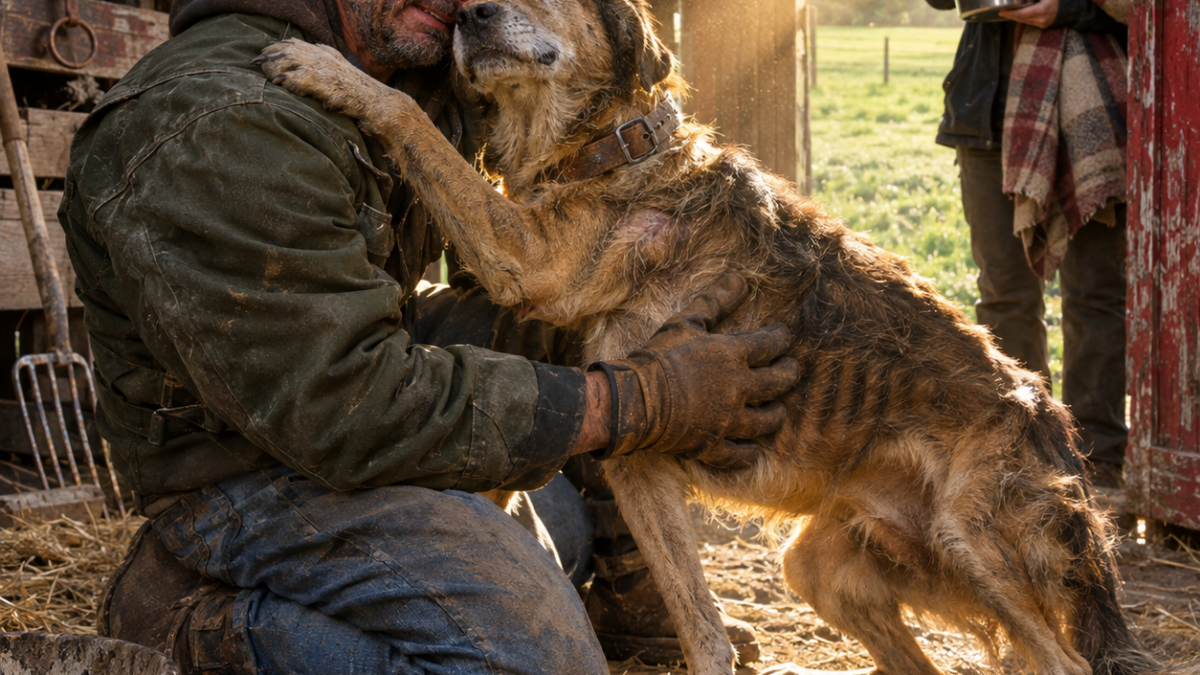
FULL ENDING
Robert was waiting beside an old pickup when I arrived.
He was in his early fifties.
Work boots.
Brown jacket.
Hands rough from years of outdoor labor.
He did not walk toward me.
He looked toward the barn.
“You hear it again?”
I asked.
He nodded.
“Once.”
“How long have you owned the property?”
“Eleven days.”
“Been inside that barn?”
“Couldn’t.”
He pointed.
Heavy chain across the door.
Rust-coated padlock.
The barn leaned slightly to one side.
Roof sagging.
Several boards warped open enough to show darkness between them.
Robert lowered his voice.
“I looked through there.”
He indicated a crack.
“I saw a dog.”
My stomach tightened.
“You’re sure?”
“Yes.”
“Alive?”
He stared at me.
“Those eyes were looking back.”
Frank arrived ten minutes later.
He had worked with me nearly eight years.
Twenty years total in animal services.
Almost impossible to shock.
He stepped from his truck, studied the barn and said:
“I already hate this.”
“Same.”
We approached slowly.
The smell reached us first.
Damp wood.
Old hay.
Animal waste.
Rust.
Years without fresh air.
I called softly:
“Hey, sweetheart.”
Nothing.
Then a scrape.
Very faint.
From the rear corner.
Robert stood several feet behind us.
Frank crouched beside a gap between boards.
Looked in.
His expression changed.
“Rachel.”
I moved beside him.
At first I saw nothing.
Darkness.
Then two eyes.
Amber.
Wide.
Motionless.
Watching the narrow line of morning that slipped between the boards.
I had seen terrified animals before.
These eyes were different.
They did not seem focused on us.
They were focused on the light.
As if light itself were an object.
Something remembered but no longer understood.
I whispered:
“Oh, baby.”
The dog blinked.
Once.
That was when I knew this case would follow me home.
We photographed the chain and door before touching anything.
Documented the condition.
Called the sheriff’s office because abandonment evidence needed to be preserved.
Then Frank brought bolt cutters.
The chain resisted.
Metal groaned.
The dog inside scrambled backward at the noise.
I heard claws scraping wood.
“Easy.”
I lowered my voice.
“Easy, sweetheart.”
Frank cut again.
The chain snapped.
The sound echoed through the barn.
For a second, everything went completely silent.
Then I placed both hands on the door.
It was heavier than expected.
Swollen by moisture.
I pushed.
At first, nothing.
Then wood shifted.
A thin blade of sunlight entered.
Dust swirled through it.
I pushed wider.
The beam became a river.
And in the farthest corner of that barn, pressed against the wall, I saw him.
PART2
He was medium-sized.
Golden beneath years of dirt.
At least, I thought he was golden.
His coat was so matted with dust, dried mud and debris that his actual color was almost impossible to identify.
Ribs showed.
Hips sharp.
Nails badly overgrown.
Half-flopped ears.
Long muzzle.
He was curled so tightly into the corner that his body seemed shaped by it.
Later, I measured the barn.
Roughly ten feet by eight.
That had been his world.
An old tin bucket stood beneath a hole in the roof.
Water had collected inside.
Broken boxes.
Rusting tools.
Mouse droppings.
Rotten hay.
No proper food bowl.
No bed.
No window.
Only cracks between boards.
Frank swore quietly behind me.
Robert made a sound that might have been a prayer.
I stepped inside.
The dog pushed himself harder against the wall.
No barking.
No growling.
Sometimes silence is more frightening.
A dog who growls is communicating.
A dog who has stopped expecting communication may simply disappear inward.
I stopped several feet away.
Lowered myself onto the filthy floor.
Hands on knees.
No eye contact.
No reaching.
Seventeen years had taught me patience.
“Hello.”
One ear moved.
“My name’s Rachel.”
Obviously, the words meant nothing.
Tone meant everything.
“You don’t know me.”
Another ear movement.
“That’s okay.”
Dust floated through the sunlight.
“You’ve had enough people making decisions for you.”
His eyes shifted toward me.
Then back toward the open door.
“I’m going to sit here.”
“That’s all.”
Minutes passed.
Frank remained outside.
Robert too.
Nobody rushed me.
The dog trembled.
Not the explosive shaking of panic.
A constant fine vibration running through his body.
I talked.
About nonsense.
My coffee.
The weather.
Frank’s terrible driving.
The fact that the Cowboys would probably disappoint everybody again.
Anything that kept my voice steady.
Eventually, his nose lifted.
He smelled the air.
Fresh air.
For perhaps the first time in years without damp boards filtering it.
Then his left front paw moved.
One inch.
Stopped.
I continued talking.
Another inch.
It took nearly twenty minutes for him to move three feet.
Each small step looked like a decision involving his entire history.
Closer.
Pause.
Closer.
Pause.
His body remained low.
When he reached me, he stopped just beyond my knee.
I placed one hand palm-down on the floor.
Nothing more.
His nose approached.
Touched my fingers.
Barely.
I held completely still.
He sniffed.
Long.
Detailed.
My fingers.
Wrist.
Sleeve.
Then he looked at my face.
I whispered:
“Good boy.”
His eyes closed for half a second.
I lifted my other hand slowly.
Touched the top of his head.
His entire body froze.
I nearly withdrew.
Then he exhaled.
A long trembling breath.
Not relaxation.
Not completely.
More like something heavy had shifted.
And then this dog who had spent years without a gentle human hand did something I will remember until the day I die.
He crawled forward.
Pressed his shoulder against my leg.
And leaned.
Not much.
But enough.
I put my arm around him loosely.
He stayed.
Frank later told me I sat on that dirty floor nearly forty minutes.
I believed it was ten.
Time behaves differently during moments you understand you will remember forever.
Eventually, I stood.
The dog immediately looked toward me.
I took one step toward the door.
He rose.
No leash yet.
No command.
He simply followed.
We reached the threshold.
Then he stopped.
One front paw remained inside.
One paw touched the sunlight.
He stood between two worlds.
Behind him:
darkness.
Dust.
Seven years.
Ahead:
grass.
Wind.
Sky.
Space without walls.
I did not pull him.
Frank whispered:
“Come on, buddy.”
The dog lifted his head.
Sunlight touched his face.
He squinted.
Then closed his eyes.
Wind moved his ears.
His nose rose.
He inhaled.
Once.
Again.
Then he stepped outside.
All four paws.
Real grass.
He froze.
I expected him to panic.
Run.
Crouch.
Instead, he looked down.
Lifted one paw.
Touched the grass again as though testing whether it would disappear.
Then another.
He took three slow steps.
Stopped.
And collapsed.
I rushed forward because I thought his legs had failed.
They had not.
He rolled.
Onto his side.
Then onto his back.
Four legs lifted toward the sky.
His belly exposed.
Face tilted into the November sun.
He closed his eyes.
I stopped moving.
Frank stopped.
Robert covered his mouth.
The dog remained there.
Completely vulnerable.
The most physically defenseless position an animal can choose.
After seven years in darkness.
After seven years with no reason to believe the outside world had anything kind to offer.
He rolled onto his back.
And trusted the sky.
I knelt beside him.
My vision blurred.
“Okay.”
My voice failed.
I scratched his chest.
Then his belly.
He placed one paw on my wrist.
Not holding.
Just touching.
And I cried.
I had been doing this job seventeen years.
I had learned how not to cry in front of owners.
How not to cry while carrying injured animals.
How to finish paperwork after horrible scenes.
That morning I stopped trying.
We named him Clancy.
Not immediately.
At first he was Case 22-417.
Male.
Golden mixed breed.
Estimated nine years old.
Severely underweight.
Chronic skin infections.
Overgrown nails.
Dental disease.
Muscle wasting.
Old untreated injuries but, astonishingly, no immediate life-threatening organ failure.
Our veterinarian, Dr. Melissa Greene, listened to his heart twice.
Then looked at me.
“Strong.”
“What?”
“His heart.”
She moved the stethoscope.
“For a dog this depleted?”
“Very strong.”
I touched Clancy’s shoulder.
He leaned into me.
Melissa looked through his bloodwork.
“Malnutrition.”
“Parasites.”
“Infection.”
“Several teeth need to come out eventually.”
“But?”
She smiled faintly.
“But he wants to be here.”
I swallowed.
“How do you know?”
“I don’t.”
She listened to his chest again.
“But his body has spent a long time refusing to quit.”
That sounded close enough.
The investigation took longer.
Records.
Previous owner.
Neighbors.
Property history.
We learned Clancy had belonged to the elderly man who previously owned the farm.
He had been young when he disappeared from public view.
Neighbors remembered a golden dog.
Then not seeing him anymore.
The former owner moved away years later after his health declined.
The barn remained locked.
Exactly what happened in every month of those seven years was impossible to reconstruct completely.
The physical evidence suggested Clancy survived on water collecting from the damaged roof, rodents and whatever edible material found its way into that space.
Somebody asked me later:
“How could a dog survive seven years like that?”
I had no satisfying answer.
Survival is not always logical.
Sometimes bodies continue because they can.
Sometimes hope remains without permission.
His first night at the shelter was terrible.
We gave him a quiet room.
Soft bed.
Water.
Small carefully measured meal because a severely undernourished animal cannot simply be offered unlimited food.
Clancy stood in the center of the room.
Did not lie down.
The room was larger than the barn.
That frightened him.
People assume animals deprived of space will immediately celebrate freedom.
But freedom can be terrifying when confinement is the only structure you understand.
He stood.
Hours.
If I moved toward the door, he watched.
If I opened it, he backed up.
Every doorway meant something.
Doors had once closed.
And stayed closed.
At eleven that night, I returned.
Clancy stood exactly where I had left him.
His food untouched.
I entered.
Sat on the floor.
“Remember me?”
His ears moved.
I took out a book from my bag.
Not because dogs understand novels.
Because silence felt too large.
I read aloud.
A mystery novel.
Terrible plot.
Clancy listened.
After twenty minutes, he took one step toward the bed.
Then another.
Eventually, he lay down.
Not on the bed.
Beside my shoe.
I stayed until he slept.
The next morning, food remained.
I called Frank.
“He won’t eat.”
Frank arrived with scrambled eggs.
“You know we have veterinary diets.”
“Dogs don’t know that.”
He sat.
Clancy looked at him.
Frank slid a tiny portion closer.
Nothing.
Then he took a bite himself.
I stared.
“You’re eating dog eggs.”
“They’re eggs.”
Clancy sniffed.
Frank placed another piece down.
Clancy moved.
Sniffed.
Ate.
One bite.
Then another.
Frank grinned.
“See?”
I called Melissa.
“He ate.”
She laughed.
“Rachel, it’s breakfast.”
“You didn’t see him yesterday.”
“I know.”
“He ate.”
“Good.”
I called Frank again even though he was sitting six feet away.
“He ate.”
Frank threw a paper towel at me.
That was how rehabilitation changed perspective.
Normal things became celebrations.
Food.
Sleep.
Tail movement.
One step through a doorway.
The first tail wag happened on day five.
Not a full wag.
Tip only.
I walked into his room.
“Morning, Clancy.”
The tail moved.
Tiny.
Then stopped.
I froze.
“Frank.”
He was in the hallway.
“What?”
“Come here.”
He entered.
Clancy’s tail did nothing.
Frank looked at me.
“You dragged me here for what?”
“He wagged.”
Frank stared.
“Rachel.”
“He did.”
“Congratulations.”
“Shut up.”
The next morning Clancy did it again.
Longer.
Frank saw.
He smiled.
Did not make fun of me.
Much.
Doors remained his greatest fear.
He could walk around his room.
Approach people.
Eat.
Drink.
Accept brushing.
But when a door began closing, Clancy flattened himself.
Eyes wide.
Breathing fast.
So we stopped closing doors around him whenever possible.
Not forever.
Recovery cannot become avoidance of the entire world.
But first he needed to learn something simple.
Doors could open again.
I made it a game.
Door partly closed.
Open.
Treat.
Again.
Close two inches.
Open.
Treat.
Weeks.
No rushing.
One day I closed the door fully for one second.
Clancy trembled.
Then I opened it.
He stared.
I repeated.
Closed.
Opened.
Closed.
Opened.
By the sixth repetition, his breathing had slowed.
He looked through the doorway.
Then at me.
I whispered:
“See?”
“You were right.”
“It opens.”
That sentence was for both of us somehow.
Hard floors frightened him.
Tile.
Concrete.
Anything without dirt or hay.
The first time we tried walking down the clinic hallway, Clancy placed one paw onto polished floor.
Slid slightly.
Panic.
Retreated.
So we built a path from towels and rubber mats.
Ten feet.
Then fifteen.
Every few days, one towel disappeared.
Eventually Clancy walked across the floor.
He looked back afterward.
I applauded.
Yes.
Actually applauded.
Clancy stared at me like I was embarrassing.
That felt like progress too.
Outside was different.
Outside he became someone else.
The first time I brought him into the fenced yard, sunlight covered half the grass.
Clancy stopped at the doorway.
His body stiffened.
I waited.
He stepped out.
Sniffed.
Walked.
Then trotted.
Two steps.
Three.
Stopped abruptly as if surprised by his own speed.
He looked at me.
I smiled.
“Go.”
Clancy ran.
Not far.
Maybe twenty feet.
His muscles were weak.
Coordination poor.
But for those seconds, he stretched his body.
Ears back.
Tail lifted.
Grass flying beneath his paws.
He stopped.
Turned.
Looked at me.
I started clapping.
“You ran!”
He stared.
“You ran, Clancy!”
Frank leaned on the fence.
“He’s a dog, Rachel.”
“I know!”
“He knows he ran.”
“I DON’T CARE.”
Clancy ran again.
Longer.
When he finished, he lay on his back in the sun.
Same as the first day.
That became his ritual.
Run.
Roll.
Sky.
I called Robert Carter often.
He always asked the same question.
“How’s the dog?”
“He ate.”
“He ran.”
“He slept on a bed.”
“He walked through a door.”
Each update made him quiet.
A month after the rescue, he visited.
Clancy was in the yard.
Robert stood outside the fence.
Nervous.
“He won’t know me.”
“Maybe.”
“I only saw him through the boards.”
“You were still the first person who stopped.”
Robert looked away.
“Heard scratching.”
“Could’ve been anything.”
“You checked.”
He nodded.
Clancy noticed him.
Walked toward the fence.
Robert crouched.
Clancy sniffed his fingers.
Then sat.
Robert’s eyes filled.
“I almost knocked that barn down.”
My chest tightened.
“I had the excavator coming Friday.”
He looked at Clancy.
“If I hadn’t cleared that brush first…”
Do not finish those sentences.
People torture themselves with alternate timelines.
I put a hand on Robert’s shoulder.
“But you did.”
He nodded.
“I did.”
Clancy pushed his nose through the fence.
Robert touched him.
For the first time.
Robert did not demolish the barn.
He repaired it.
Not as a barn.
As a workshop.
He removed rotten boards.
Reinforced the roof.
Installed three enormous windows.
When he told me, I laughed.
“What?”
“Nothing.”
“You think I’m crazy.”
“No.”
“Yes, you do.”
“Maybe slightly.”
He looked toward the building.
“I couldn’t leave it dark.”
That sentence stayed with me.
He replaced the door too.
The old chain remained hanging on one wall.
Not as a trophy.
A reminder.
Robert said:
“I want to remember what happens when people stop paying attention.”
I understood.
Clancy’s coat changed.
That sounds unimportant.
It was not.
After bathing, treatment, brushing and nutrition, the dirty brownish fur slowly revealed its real color.
Gold.
Warm wheat gold.
Sunlight seemed designed for him.
By January, when he stood outside, his coat caught light.
The first time I noticed, I thought about the barn.
A golden dog hidden in darkness.
It made me angry.
Then sad.
Then grateful.
Human beings often demand one emotion at a time.
Animals do not.
Clancy could make me feel all three in the same breath.
Some trauma surfaced unexpectedly.
Brooms.
Clancy did not fear.
Loud voices?
He flinched mildly.
Men?
Cautious but willing.
Chains?
Terrified.
The first time a kennel worker dropped a slip lead with a metal clip, it rattled against the floor.
Clancy threw himself backward.
Hit the wall.
Panted.
Would not approach me for ten minutes.
I understood immediately.
Chain sound.
Barn.
We changed equipment.
Then gradually worked on the sound.
Softly.
Distance.
Reward.
Choice.
Months later, Frank accidentally dropped keys near him.
Clancy looked.
Then returned to chewing his toy.
Frank stopped.
Looked at me.
“Did you see that?”
I smiled.
“I saw.”
This time we both celebrated.
Clancy had never played with a toy.
At least not with us.
We offered balls.
Rope.
Stuffed animals.
Nothing.
He stared.
One volunteer rolled a tennis ball.
Clancy watched it pass.
Looked at her as if she had dropped something accidentally.
Then one afternoon, Frank left a squeaky duck on the floor.
Clancy sniffed.
Picked it up.
It squeaked.
He dropped it.
Jumped backward.
Frank laughed.
Clancy stared at duck.
Approached.
Picked it up again.
Squeak.
This time he did not drop it.
He shook it.
Violently.
Frank cheered.
I heard from my office and ran in.
“What happened?”
“Duck murder.”
Clancy shook the toy again.
I laughed until I cried.
That duck became his favorite.
It slept in his bed.
Went outside.
Eventually lost one wing.
Still loved.
I kept thinking about seven years with nothing.
Then this dog discovering squeakers at nine years old.
Joy has no expiration date.
The shelter posted his story.
We were careful.
No graphic photographs.
No sensational language.
Just Clancy.
Barn.
Recovery.
Need for a special home.
Applications arrived immediately.
Dozens.
Then hundreds.
People wanted “the miracle dog.”
I hated that phrase.
Clancy did not need to become someone’s inspirational decoration.
He needed a quiet home.
Patience.
Fenced yard.
People willing to understand that progress might reverse.
No expectation of gratitude.
No cameras shoved into his face.
I rejected many applications.
One applicant wrote:
“We want him because his story is amazing and our children would love to show him at school.”
No.
Another wanted to start social media accounts.
No.
One wrote:
“We have a busy household with four dogs and three toddlers, but love heals everything.”
Love does not magically cure overwhelmed nervous systems.
No.
Then Anna and William Mercer applied.
Retired teachers.
Sixty-four and sixty-seven.
Small farm outside Tyler.
Large fenced yard.
No children at home.
No other animals after their elderly retriever had died the previous year.
Their application was boring.
Perfectly boring.
Why are you interested in Clancy?
Anna wrote:
Because our house is quiet, our yard gets sun all day, and we have no need for him to become anything quickly.
I read that sentence twice.
Then called.
Anna spoke softly.
William mostly listened.
They asked about medication.
Doors.
Floors.
Food.
Fear.
They did not ask:
“When will he be normal?”
They asked:
“What does he need when he’s scared?”
Good.
They visited three times.
First visit, Clancy stayed six feet away.
Anna sat on grass.
Read a book.
Did not call him.
After twenty minutes, he moved closer.
Second visit, William brought no treats.
He simply sat beside the fence.
Clancy approached.
Sniffed his shoe.
Third visit, Clancy put his head on Anna’s knee.
I had to walk away.
Frank found me in the supply room pretending to organise towels.
“You crying?”
“No.”
“You’re holding one towel for three minutes.”
“Go away.”
He laughed.
Then hugged me.
I hated him for approximately two seconds.
Before adoption, we did a home visit.
Anna and William’s farm was nothing like Clancy’s old one.
Open.
Bright.
White farmhouse.
Wide windows.
Fenced backyard.
Oak tree.
Covered porch.
Inside, rugs covered most hard flooring.
They had installed them after I mentioned his hesitation.
No pressure.
Just preparation.
Anna showed me a quiet room.
“This can be his.”
Door had been removed from hinges.
I looked at her.
“He may eventually want it back.”
“We saved it.”
William opened the back door.
Sunlight spilled across the floor.
“Yard’s through there.”
I swallowed.
Perfect.
Terrifying.
Because placing an animal you love means trusting somebody else with the part of you that formed around them.
That is shelter work nobody talks about enough.
Rescue asks you to attach.
Adoption asks you to release.
The day I brought Clancy home to them, he rode in my truck with his squeaky duck.
He still disliked crates.
So we used a secured harness system.
He watched the road.
Fields passed.
Sunlight.
Space.
I wondered whether his old life appeared anywhere in memory.
I hoped not.
Then realised forgetting was not required.
Safety could coexist with memory.
We arrived.
Anna stood on porch.
William behind her.
No crowd.
No balloons.
No “Welcome Clancy” sign.
Thank God.
I opened truck door.
Clancy stepped out.
Sniffed.
Looked at me.
Then toward Anna.
She did not move.
Clancy walked to porch.
Inside.
Living room.
Sniffed sofa.
Rug.
Table.
Then stopped at open back door.
William stepped aside.
Clancy went into yard.
Walked halfway across grass.
Sun covered him.
He sniffed.
Then—
as if completing a ritual older than all of us—
he rolled onto his back.
Paws toward sky.
Golden stomach in sunlight.
Anna covered her mouth.
William looked away.
I started crying.
Again.
Clancy wriggled in grass.
Then stayed still.
Eyes closed.
I whispered:
“He picked you.”
Anna cried harder.
Leaving was awful.
I had promised myself I would not make it dramatic.
Clancy did not need my emotional performance.
I knelt.
Touched his neck.
“You’re staying.”
His ears moved.
“This is home.”
He licked my chin.
Once.
Then walked toward Anna.
No hesitation.
It hurt.
Beautifully.
I drove away crying so hard I had to pull over.
Frank called.
“Well?”
“He stayed.”
“Good.”
“I hate this job.”
“No, you don’t.”
“I hate you.”
“No, you don’t.”
“Stop knowing me.”
That evening Anna sent one photograph.
Clancy asleep on a rug near the back door.
Squeaky duck under his chin.
No caption.
Did not need one.
I slept better that night than I had in months.
Adoption was not magically perfect.
Week two, thunderstorm.
Clancy hid beneath a table.
Would not eat dinner.
Anna sat nearby.
Read aloud.
Did not drag him out.
By morning he emerged.
Week four, William accidentally closed a bedroom door quickly.
Clancy panicked.
They reopened it.
Waited.
No forcing.
Week six, Clancy barked for the first time.
At a delivery truck.
Anna called me laughing.
“He barked!”
“You sound disappointed?”
“No!”
“He barked like he owns the place.”
Good.
Ownership.
Belonging.
Those are different from possession.
By spring, Clancy ran the entire yard.
Not twenty feet.
Circles.
Fast.
William sent a video.
Clancy tearing through grass, ears back, tail high.
He stopped beneath the oak.
Rolled over.
I watched five times.
Then eleven.
Frank found me.
“What?”
I handed him my phone.
He watched.
Smiled.
“Our barn dog.”
“No.”
I corrected.
“Their farm dog.”
Frank nodded.
“Better.”
I visited every month initially.
Clancy knew my truck.
The moment I turned up their driveway, he appeared at the fence.
Then ran.
Full speed.
The first visit, he nearly knocked me over.
He pressed his head into my shoulder.
I wrapped my arms around him.
“You remember.”
Of course he did.
Then he did the thing.
Stepped back.
Looked at me.
Rolled onto his back.
Every visit.
Same.
Anna called it “Clancy’s hello.”
I knew better.
It was not performance.
It was his language.
Trust.
Sky.
Safety.
Robert visited once too.
He stood outside the fence.
Clancy walked over.
Robert knelt.
“I’m glad I heard you.”
His voice broke.
Clancy sniffed his face.
Robert cried.
He showed us photographs of the renovated barn.
Three huge windows.
Workbench.
Tool cabinets.
White interior walls.
Sunlight everywhere.
Anna looked at me.
I could not speak.
Robert said:
“I leave the door open when I’m working.”
I asked:
“Why?”
He shrugged.
“Just do.”
Maybe he did not need to explain.
Some doors deserve to remain open.
Months became years.
Clancy became older.
Not broken.
Older.
There is a difference we need to respect.
His past remained part of him.
He still preferred doors open.
Still startled at chains.
Still liked sleeping where he could see exits.
But he also learned new things.
Car rides meant parks.
Hands meant scratches.
Footsteps in hallways did not always mean danger.
Rain on roofs could be peaceful.
Darkness at night was different from darkness you could not leave.
That distinction may have been one of the greatest gifts Anna and William gave him.
At bedtime, they turned out lights.
Clancy slept.
Because somewhere inside him he knew morning would open the door again.
One summer, Anna called.
“You need to come.”
My heart stopped.
“What happened?”
“He’s fine.”
“Do not begin phone calls like that.”
She laughed.
“Sorry.”
“What?”
“We bought him a kiddie pool.”
I frowned.
“Okay?”
“He discovered water.”
I drove out that weekend.
Clancy stood beside a shallow blue pool.
William tossed a toy inside.
Clancy stepped in.
Splash.
Paused.
Then splashed again.
No significance in original trauma.
No symbolic redemption.
Just dog.
Water.
Summer.
He pushed his nose beneath surface.
Sneezed.
Anna laughed.
I laughed.
Clancy chased the squeaky duck through water.
Simple joy.
That was perhaps the most healing thing.
Not everything needed to reference the barn.
Clancy was allowed to have experiences unrelated to survival.
I began noticing changes in myself too.
Before Clancy, burnout had been creeping up.
I had not admitted it.
Seventeen years.
Too many bad calls.
Too many animals.
Too many nights wondering whether anything mattered.
You save one.
Lose another.
Remove a dog from a chain.
Find another chain tomorrow.
Some days the work feels like emptying the ocean with a spoon.
Clancy did not solve that.
But he changed the question.
Maybe the goal was never to empty the ocean.
Maybe the goal was the dog in front of you.
One door.
One chain.
One call answered.
Robert could have ignored scratching.
He didn’t.
I could have treated Clancy like another case number.
I didn’t.
Anna and William could have chosen an easier dog.
They didn’t.
Small choices.
One life changed.
Sometimes one is enough to keep going.
Years after his rescue, I trained a new officer named Jenna.
First week, she cried after a neglect case.
Then apologised.
“I know we’re supposed to be professional.”
I stared.
“Who told you crying isn’t professional?”
She looked embarrassed.
“I just thought—”
“Feel it.”
I said.
“Then do your job.”
I showed her Clancy’s photograph.
Golden dog on his back in sunlight.
Told her the story.
Not every detail.
Enough.
She asked:
“How did he trust people after that?”
I answered:
“Slowly.”
Not magically.
Not because dogs forgive better than people.
Slowly.
With evidence.
Repeated.
Door opens.
Food arrives.
Hand is gentle.
Morning follows night.
Trust is built from reliable proof.
Clancy reached fourteen.
Then fifteen.
His muzzle turned white.
Hips stiffened.
Anna placed ramps.
William covered slippery floors.
The yard runs became walks.
Then slow walks.
But the rolling continued.
Sun.
Back.
Paws.
Sky.
Always.
I visited on his fifteenth birthday.
Anna had made a tiny meatloaf for him.
William put one candle in it.
Clancy tried to eat candle.
Normal dog.
Beautiful.
We laughed.
I sat beside him afterward.
His head rested on my shoulder.
The old gesture.
The one he first gave me at the shelter.
Front paws once on my chest.
Face in my neck.
Now he could not stand that way.
So I lowered myself to him.
“Remember the barn?”
I whispered.
Then immediately felt stupid.
Of course he did not remember in sentences.
Maybe his body remembered.
Maybe not.
I kissed his head.
“You don’t live there anymore.”
Clancy sighed.
At sixteen, his kidneys began failing.
Slowly.
Anna called before telling me veterinarian details.
“I wanted you to know.”
I sat at my desk.
Could not speak.
Frank had retired by then.
Robert had sold part of his property but kept the farmhouse and workshop.
Clancy’s story had become old enough that newer employees knew him from photographs, not memory.
Sixteen.
He had lived roughly seven years in darkness.
Then almost seven more with us and the Mercers.
For the first time, his life contained nearly as much freedom as confinement.
That mattered enormously to me.
I wanted the balance to tip.
One more year.
Please.
Maybe foolish.
But grief bargains with arithmetic.
Treatment helped.
Good months.
Then decline.
Clancy stopped running.
Still walked to sun.
Anna placed a bed in the brightest part of the living room.
He slept there.
Doors open.
Always.
One afternoon she sent a picture.
Clancy on his back in that bed.
White muzzle.
Four paws relaxed.
I stared for a long time.
Same dog.
Different body.
Same trust.
His final week came in early November.
Almost exactly seven years after Robert’s call.
Cold.
Fog.
Anna called.
“Rachel.”
I knew from her voice.
“I’m coming.”
No questions.
Clancy lay beneath the oak tree when I arrived.
Blanket.
Anna beside him.
William sitting on grass.
Their veterinarian had already explained options.
Clancy was tired.
Pain controlled.
Body failing.
I knelt.
His eyes opened.
Tail moved once.
That was enough to break me.
“Hey, warrior.”
We had chosen Clancy because of an old Irish association with red warriors and resilience.
Maybe linguistically imperfect.
Emotionally correct.
Clancy lifted his head.
I put my forehead against his.
“You did good.”
Anna cried.
William looked toward the fields.
I whispered:
“Sixteen years.”
Then corrected myself.
“No.”
“Seven in there.”
I pointed vaguely toward a past miles away.
“Almost nine out here.”
My throat closed.
“You won.”
I do not usually speak of survival as winning.
But Clancy deserved that word.
The light had more years in the end.
Not by much.
Enough.
We decided to let him go at home.
Outside.
Sunlight.
No clinic.
No closing doors.
The veterinarian came.
Clancy lay on his side.
Then, with enormous effort, rolled slightly toward his back.
Anna laughed through tears.
“Oh, Clancy.”
I placed my hand on his chest.
William scratched his ear.
Anna held his paw.
The vet administered medication.
Clancy’s breathing softened.
Wind moved the oak leaves.
Sun touched his white muzzle.
I watched his chest rise.
Fall.
Rise.
Fall.
Then still.
For several seconds no one moved.
I felt something in me return to that barn.
Dark corner.
Amber eyes.
One paw toward light.
Then threshold.
Grass.
Back.
Sky.
I cried harder than I had on rescue day.
Because rescue has adrenaline.
Goodbye has only love.
Anna whispered:
“He never went back into the dark.”
That sentence destroyed all of us.
Not literally.
Night came.
Rooms went dark.
But she meant what mattered.
He was never trapped again.
Never abandoned again.
Never left wondering whether a door would open.
Not once.
We scattered part of Clancy’s ashes beneath the oak.
Anna and William kept the rest.
They gave me his first old shelter collar.
I still have it.
Robert received a small memorial stone made from reclaimed wood from the original barn.
He placed it inside his workshop beneath the largest window.
It says only:
CLANCY
THE DOOR OPENED
Nothing else needed.
After Clancy died, Robert called me.
He was quiet.
“I wish I’d found him sooner.”
There it was.
The cruel sentence.
I answered:
“You found him when you found him.”
“But seven years.”
“I know.”
“Rachel…”
“You cannot rescue the past.”
Silence.
“You opened the future.”
Robert cried.
So did I.
Frank came out of retirement emotionally, if not officially.
He visited me that weekend.
Brought terrible coffee.
We sat outside the shelter.
He asked:
“You okay?”
“No.”
“Good.”
I looked at him.
“Good?”
“Means he mattered.”
I nodded.
Then said:
“You told me once hope is something already inside them.”
Frank smiled.
“Sounds profound.”
“You said it.”
“Then definitely profound.”
I laughed.
First time since Clancy died.
That laugh felt disloyal for half a second.
Then I remembered Clancy running.
Joy does not betray grief.
It proves grief had something worth losing.
Clancy’s story stayed with the shelter.
Not as marketing.
As training.
New staff saw photographs.
The first sunlight.
The yard.
Adoption.
Old Clancy beneath oak.
I always insisted they see the whole timeline.
People love before-and-after images.
Dark barn.
Golden dog.
They make recovery look instant.
It wasn’t.
There were months of fear.
Door training.
Food issues.
Bad days.
Setbacks.
Trust.
Time.
If you show only the miracle, you erase the work.
Clancy deserved the truth.
Healing was not the moment he rolled onto grass.
That was the beginning.
Healing was every morning afterward when a door opened and he learned it would not lock him away.
Robert eventually finished renovating the entire property.
The barn workshop became beautiful.
Wide windows.
Skylight.
He invited the shelter staff for lunch one year.
I stood inside.
Could barely recognise the place.
Sun everywhere.
The corner where Clancy had been curled was now beneath a workbench.
Robert noticed me looking.
“I thought about leaving it untouched.”
“Why didn’t you?”
He shrugged.
“Didn’t seem right.”
I understood.
Trauma does not need museums everywhere.
Sometimes rebuilding is the memorial.
A dark barn became a room full of windows.
That was enough.
On the wall hung the old chain.
Cleaned.
Mounted.
Not decorative.
Next to it, one photograph.
Clancy on Anna and William’s lawn.
On his back.
Sun.
Robert said:
“That’s why I kept the chain.”
I looked at him.
“So people see both?”
“Yeah.”
He touched the frame.
“This is what opening it did.”
Years passed.
I became a supervisor.
Then eventually director.
Seventeen years became twenty.
Twenty-three.
Twenty-seven.
I grew gray.
Frank grew more annoying.
Robert became a friend.
Anna and William adopted another senior dog eventually.
Not replacement.
Never.
A twelve-year-old mutt named Molly.
They sent me a photograph.
Molly lying beneath the oak.
I cried.
Of course.
The space could hold another life without erasing Clancy.
That was another thing he taught us.
Once a year, near the anniversary of his rescue, I visit the Mercers.
We sit beneath the oak.
No grand ceremony.
Coffee.
Stories.
Sometimes silence.
Anna once told me:
“The first month after he came here, I woke every night to check whether he was still in the house.”
“Why?”
“I think I couldn’t believe somebody had trusted us with him.”
William laughed.
“She checked every door too.”
Anna smiled.
“I wanted them open if he needed them.”
That was Clancy’s real legacy.
Open doors.
Not literal only.
Space.
Choice.
Permission to leave.
Trust means nothing if the other being has no choice.
Clancy stayed because he learned he could go.
That distinction matters.
I think often about his first touch.
Nose against my fingers.
So light.
I had experienced thousands of animal interactions.
Why that one?
Maybe because Clancy had so little evidence humans deserved another chance.
Yet he investigated anyway.
Not blind forgiveness.
Curiosity.
One sniff.
One step.
Trust began smaller than a heartbeat.
People sometimes say animals forgive humans too easily.
I disagree.
They do not owe our species forgiveness.
Clancy did not emerge loving humanity.
He emerged willing to investigate.
We earned the rest.
Meal by meal.
Door by door.
Hand by hand.
That is better than instant forgiveness.
It makes love an achievement shared by both sides.
I also reject the idea that suffering made Clancy special.
Suffering is not a gift.
Seven years in darkness did not make him noble.
He was noble despite it.
He deserved sunlight without having to earn it through pain.
He deserved grass from puppyhood.
Play.
Beds.
People.
None of what happened was necessary to create a beautiful dog.
The beauty was already his.
Neglect merely failed to destroy it.
That distinction matters.
When I tell school groups about Clancy, children always ask the same questions.
“Was he scared?”
“Yes.”
“Was he angry?”
“I don’t know.”
“Did he remember the bad man?”
“I don’t know.”
“How did he know to roll over?”
That one always stops me.
I answer:
“Because being safe was still somewhere inside him.”
Maybe scientifically imprecise.
Emotionally true.
His body remembered how to relax before his mind trusted the world.
Or perhaps rolling in grass simply felt good.
Either explanation makes me love him.
A little boy once asked:
“Why didn’t he run away when the door opened?”
I said:
“Maybe he didn’t know yet that he could.”
The boy frowned.
Then asked:
“Who taught him?”
I thought about it.
“The open door.”
He smiled.
Children understand symbolism faster than adults.
Clancy changed how our shelter handles long-term confinement cases.
More decompression.
More choice.
Visual access to exits.
Fewer forced interactions.
Slow introduction to open spaces.
Staff training around threshold fear.
We already knew much of this.
Clancy made us respect it differently.
Sometimes knowledge exists professionally before a particular animal makes it personal.
His photograph remains in my office.
Not barn.
Not emaciated.
Not sad.
Golden dog.
Back in grass.
Four paws up.
Sky.
New employees ask:
“Who’s that?”
I say:
“My teacher.”
Then explain.
I am older now than Frank was when I met Clancy.
Sometimes I think about retirement.
Then a call comes.
A dog behind a shed.
A cat inside a drain.
A neglected horse.
A scared animal that will not approach.
And for a while longer, I stay.
Not because Clancy told me every animal can be saved.
They cannot.
That is the hardest truth.
I stay because sometimes there is a barn.
Sometimes there is scratching.
Sometimes somebody like Robert notices.
Sometimes the chain can be cut.
Sometimes the door opens.
You have to be there for those times.
The last time I visited Robert’s workshop, rain was falling.
Sunlight still entered through the windows despite clouds.
He made coffee.
We stood near the old chain.
Robert asked:
“Do you ever think about what he did when nobody was there?”
All the time.
Seven years.
Days.
Nights.
Storms.
Heat.
Cold.
How did he spend them?
Did he scratch the door?
Bark?
Stop barking?
Watch light through cracks?
Dream?
I shook my head.
“I try not to.”
Robert nodded.
“Me too.”
Then he looked at Clancy’s photograph.
“I think about this instead.”
Good.
So do I.
Because Clancy’s life should not be reduced to what was done to him.
He was not “the dog in the barn.”
Not forever.
He was Clancy.
He liked squeaky ducks.
Sun.
Scrambled eggs.
Anna’s garden.
William’s boots.
Car rides after he learned they ended somewhere safe.
He hated thunderstorms.
Loved grass.
Snored.
Stole toast once.
Barked at delivery vans.
Splashed in a plastic pool.
Rolled onto his back whenever he saw me.
Grew old beneath an oak tree.
Was loved.
That is his life.
The barn was only the beginning we wished had been different.
It did not get to own the ending.
The source story says resilience is sometimes quiet.
I believe that more every year.
Resilience is not always fighting the chain.
Sometimes fighting exhausts you.
Sometimes resilience is continuing to breathe in the corner.
Drinking when rain comes.
Eating enough to survive another day.
Looking toward a crack of light.
Then, when the door finally opens, finding enough of yourself left to move one paw forward.
One inch.
Pause.
Another.
Until sunlight reaches you.
That was Clancy.
Not loud.
Not triumphant at first.
Just willing to move.
And maybe that is why the moment in the grass mattered so much.
He did not sprint.
Did not celebrate for us.
He stepped outside.
Felt grass.
Then let himself become vulnerable.
For seven years the world had taught him containment.
For one minute in sunlight, his body answered:
Maybe I can rest.
That was enough to make a seventeen-year veteran animal-control officer kneel in mud and cry.
It still is.
I keep one object from that day besides Clancy’s collar.
A small piece of wood.
Robert gave it to me when he repaired the barn.
It came from the original door.
Weathered.
Dark.
There is a narrow crack through it.
Exactly the kind sunlight had entered through.
I keep it beside Clancy’s photograph.
Sometimes when work is bad, I hold it toward my office window.
A thin line of light passes through.
Every time, I think the same thing.
The darkness can be enormous.
The opening only has to be big enough to begin.
Frank once laughed at that.
“You’re getting sentimental.”
“I’ve always been sentimental.”
“No, you were mean.”
“Still am.”
“Fair.”
Then he looked at the wood.
Said quietly:
“Good dog.”
That was Frank’s entire philosophy of grief.
Two words.
Enough.
Anna once asked whether I believed Clancy knew he had been rescued.
Interesting question.
Maybe not in the human sense.
He did not know police reports.
Investigations.
Adoption papers.
But I think he knew something changed.
Rain no longer determined whether he drank.
Hunger no longer depended on mice.
Doors opened.
People returned.
Hands touched gently.
Night ended in morning.
Maybe rescue is not an event animals understand.
Maybe it is repetition.
Today safe.
Tomorrow safe.
Again.
Again.
Until the body stops waiting for disaster.
Clancy eventually stopped waiting.
That was the real rescue.
There was one final photograph Anna sent about three months before he died.
Clancy was asleep in the yard.
Not on his back.
On his side.
Deep sleep.
Mouth slightly open.
Sun across his coat.
Behind him, the back door of the house stood open.
I printed it.
Because that photograph contains everything.
Dog asleep.
Door open.
He did not need to watch it anymore.
That is what seven years of freedom eventually gave him.
Not forgetting the door.
Not defeating the door.
No longer needing to guard it.
I cannot imagine a greater definition of healing.
If I could speak to the younger Clancy in that barn, I would not tell him:
“Everything will be okay.”
I hate promises nobody can guarantee.
I would tell him something smaller.
“There is grass outside.”
“There is sun.”
“There is a woman named Anna who will read beside you.”
“A man named William will leave the back door open.”
“Frank will feed you eggs.”
“Robert heard you.”
“You will have a stupid yellow duck.”
“You will run.”
“You will grow old.”
“You will be loved long enough that someday the years in the light will outnumber the years in the dark.”
That last one.
That is the promise I wish I could have given.
Because eventually—
they did.
Seven years.
That number used to be the headline.
Now when I think about Clancy, I count differently.
Years with Anna.
Years with William.
Spring mornings.
Summer grass.
Autumn leaves.
Winter beds.
Visits.
Runs.
Rolls.
Meals.
Doors opening.
The arithmetic changed.
The darkness did not disappear.
It became smaller relative to everything that came after.
Maybe that is what healing often is.
Not erasing.
Adding.
Adding so much life that the wound no longer occupies the whole story.
Clancy did that.
He filled the rest.
People sometimes ask why I still tell his story.
Because somebody may hear scratching.
Not literally.
Maybe a neighbor’s dog.
A frightened animal.
A person everybody else has stopped noticing.
Maybe they will think:
Someone else will deal with it.
Robert could have.
Instead, he stopped.
Looked through the crack.
Made a call.
The entire second half of Clancy’s life existed because one man did not walk away.
That deserves remembering.
I also tell it because people underestimate what old, frightened, neglected animals can become.
They want puppies.
Clean histories.
Easy personalities.
Predictability.
Clancy had none of that.
He came with fear.
Medical needs.
Years we could never give back.
And he became one of the most joyful dogs I ever knew.
Not because trauma makes animals grateful.
Because once safety appeared, he finally had room to be himself.
That self had been waiting.
Not destroyed.
Waiting.
When Anna adopted Molly years later, she told me something.
“I think Clancy taught us how not to rush love.”
I smiled.
“Yes.”
“Before him, I thought caring meant doing.”
“Now?”
“Sometimes caring means sitting close enough to be available and far enough away to let them choose.”
Exactly.
Clancy had taught that in the barn.
I sat.
He came.
Everything started there.
I have made mistakes in seventeen—now many more than seventeen—years of animal work.
Moved too fast.
Assumed too much.
Let frustration into my voice.
Taken cases home emotionally until I had nothing left for myself.
Clancy did not erase those mistakes.
He gave me one clear standard.
Leave room for choice whenever safety allows.
The first kindness I gave him was not touching his head.
It was waiting until he touched my hand.
That mattered.
There are days I wish his story had begun at the moment he stepped into sunlight.
I wish the barn part were fiction.
It wasn’t.
We cannot rewrite it.
But we can refuse to romanticize it.
He survived cruelty.
Cruelty did not make the sunlight beautiful.
Sunlight was beautiful because sunlight is something he should always have had.
Safety was his right, not his reward.
Love did not become valuable because he was deprived of it.
He deserved love from the beginning.
That is what I want people to remember.
And still—
when I close my eyes, I see him at the threshold.
One paw inside.
One outside.
The whole world waiting.
I remember wondering whether he would move.
Then he did.
One paw.
Then another.
Into light.
Into grass.
Into every day that followed.
Sometimes one step contains an entire future.
Clancy’s did.
The last time I stood at his memorial beneath Anna and William’s oak, I placed my hand on the bark.
No fancy plaque there.
Just a small flat stone.
CLANCY
Dates.
Nothing else.
Anna asked if we should add a quote.
I said no.
His story was too large for a stone.
We sat on the porch.
Molly slept nearby.
William poured coffee.
Sun filled the yard.
For a while nobody spoke.
Then Anna smiled.
“You know what I still see?”
“What?”
“That first day.”
“When you brought him?”
“Yes.”
“He walked out there.”
She pointed.
“Right there.”
“And rolled over.”
She laughed softly.
“We hadn’t even signed the final papers.”
“He knew.”
“Maybe.”
Then Anna corrected herself.
“No.”
“He didn’t know us yet.”
“He knew the yard.”
“The sun.”
“The door was open.”
I smiled.
That was enough.
An open door.
Grass.
Sun.
The freedom to decide what happened next.
Clancy had been denied all three for most of his early life.
Then he received them.
And he chose to stay.
That is the part that matters most to me.
Not that we rescued him.
That once he truly had choices—
he chose people again.
He chose Anna.
William.
Me.
Frank.
Robert.
He chose the yard.
The sofa.
The duck.
The world.
After everything the world had done, Clancy still found reasons to belong to it.
That is resilience.
Not forgetting the dark.
Not pretending it never happened.
Not turning suffering into something noble.
Resilience is discovering that darkness did not get the final vote.
I have seen thousands of animals since Clancy.
Some stayed with me.
Some blurred.
That is the truth of this work.
But every time I approach a frightened dog in a corner, I remember him.
I lower myself.
Turn slightly sideways.
Hands visible.
Voice quiet.
And I say some version of what I said that November morning.
“Hello.”
“I’m here.”
“No hurry.”
“We have time.”
Sometimes the animal comes.
Sometimes not.
Sometimes it takes minutes.
Sometimes days.
Sometimes weeks.
But I wait as long as the situation safely allows.
Because once, in a dark barn in eastern Texas, a golden dog moved his paw one inch toward me.
Then another.
And that small act of courage changed the way I understood my job forever.
The door had been chained for seven years.
Frank cut the chain in seconds.
The physical rescue was that simple.
Snap.
Door.
Light.
But opening a door and teaching someone they are free are not the same thing.
The second rescue took years.
Meals.
Hands.
Open thresholds.
Runs.
Bad days.
Good days.
Patience.
Anna.
William.
Every morning the back door opened again.
Every night no one locked him away.
That was how Clancy learned freedom.
Repetition.
Evidence.
Love made reliable.
And on the final morning of his life, there was no locked door.
No darkness.
No chain.
No filthy floor.
He lay beneath a tree with three people touching him gently.
Sun on his face.
Wind in his ears.
The sky he had once stared at as though it were a miracle stretched above him.
His body was old.
Tired.
Safe.
When his breathing stopped, nobody left him alone.
That matters to me.
More than almost anything.
The first seven years were stolen.
I cannot forgive that fact on his behalf.
But the years after were his.
Every one.
Nobody owned them except Clancy.
He ran with them.
Slept through them.
Rolled in them.
Trusted inside them.
Grew old in them.
And in the end, the light won the arithmetic.
When people see the photograph in my office, they usually smile.
A golden dog on his back.
Blue sky.
Grass.
Nothing obviously tragic.
Good.
That is exactly how I want his story to look from a distance.
Not a victim.
A dog enjoying the sun.
If someone asks, I tell them what came before.
But only after.
Because Clancy deserves to be introduced by joy.
So this is how I remember him.
Not eyes in darkness.
Not ribs.
Not chain.
I remember the second run across our little fenced yard.
The first run surprised him.
The second was chosen.
He looked at me.
Then ran again.
That was Clancy.
Once he understood freedom was allowed—
he chose more of it.
Again.
And again.
Until there was no reason to look back at the barn.
I sometimes wonder whether there are still animals living somewhere like he did.
Of course there are.
That thought hurts.
It also keeps phones answered.
Doors checked.
Complaints investigated.
Because somewhere, right now, there may be eyes behind boards.
A scratching sound.
A neighbor wondering whether to interfere.
Someone like Robert standing beside a locked building thinking:
Maybe it’s nothing.
I hope they look.
I hope they call.
I hope somebody brings bolt cutters.
And if the door opens—
I hope they do not expect the animal to immediately know what freedom means.
Sit down.
Speak softly.
Give it time.
Let the first paw be theirs.
Then the second.
The sunlight will still be there when they are ready.
Clancy taught me that.
The dog who spent seven years in darkness.
The dog whose heart somehow stayed strong.
The dog who walked out, felt grass beneath his paws, and rolled onto his back beneath an enormous Texas sky.
He did not know his story would travel.
Did not know anyone would call him resilient.
Did not know about investigations or rehabilitation or adoption.
He only knew that a door that had always been closed was suddenly open.
And despite every reason the world had given him to stay in the corner—
Clancy stood.
He walked toward the light.
And once he reached it—
he never belonged to the darkness again.








