FULL ENDING:He Climbed Down Where No One Else Could Reach—But When He Tried to Hand the Trapped Puppy Over, the Dog Refused to Let Go
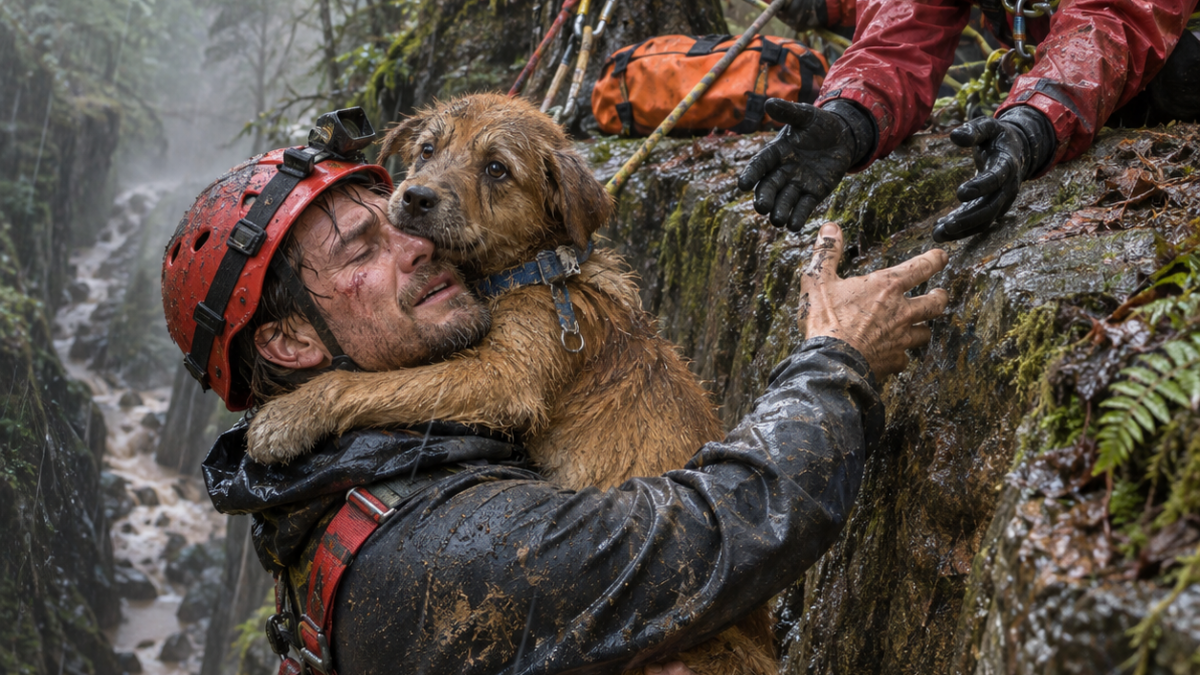
PART 2 and FULL ENDING  Thank you

“You good?”
“Good.”
David looked down.
“Call if the pipe narrows.”
“Copy.”
Emily stood several feet away, hands clasped against her chest.
“Please bring him out.”
I looked at her.
“We’ll do everything we can.”
Then I lowered myself into the dark.
The daylight disappeared faster than I expected.
Ten feet.
Fifteen.
Twenty.
Cold concrete pressed close around my shoulders.
Rainwater ran down the wall and into my sleeves.
My headlamp cut through damp air.
I smelled mud.
Mold.
Stagnant water.
Then blood.
At first I thought I had scraped my hand.
I looked down.
Not mine.
Thin red streaks marked the concrete.
Small.
Repeated.
Vertical.
Claw marks.
The dog had been trying to climb.
Again.
And again.
And again.
I stopped.
“Marcus.”
Radio crackled.
“Go ahead.”
“I’ve got blood on the wall.”
Silence.
Then:
“Copy.”
I lowered another few feet.
My boots touched water.
Maybe three inches deep.
I turned.
The beam from my headlamp swept across the bottom.
And there he was.
Small.
Brown.
Maybe eight or nine months old.
Sitting in a shallow puddle.
His entire body shaking.
His paws were raw.
Several nails broken.
Mud coated his belly.
Scratches ran along his legs and chest.
But it was his eyes I remember.
Not defeated.
Exhausted, yes.
Terrified.
But still watching.
Still waiting.
Still trying to understand whether the thing descending toward him was danger or rescue.
I switched off my radio speaker for a moment.
I wanted him to hear only my voice.
“Hey, little man.”
His ears moved.
“I’m here.”
He did not run.
“I’m going to get you out.”
He tried to stand.
His legs nearly folded.
Then he took one step.
Another.
Four, maybe five.
Every movement hurt.
I could see it.
But he kept coming.
Then he reached me.
And without hesitation, that terrified little dog pressed his entire body against my chest.
His heart was hammering.
I put both arms around him.
“That’s it.”
His head disappeared beneath my chin.
“You’re done fighting.”
I kissed the top of his muddy head before I even realized what I was doing.
“I’ve got you now.”
At the time, I believed I was making him a promise for the next ten minutes.
I had no idea I would spend the rest of his life keeping it.
FULL STORY CONTINUATION
I radioed upward.
“I have him.”
Marcus answered instantly.
“Condition?”
“Alive. Injured paws. Dehydrated probably. No obvious fracture from where I am.”
David’s voice cut in.
“Can you secure him?”
I looked at the dog.
He had wrapped himself so tightly against me that securing him was almost unnecessary.
Still, procedure mattered.
I used a rescue sling beneath his body, careful around his legs.
He whimpered once when fabric touched his right front paw.
“Sorry, buddy.”
His nose pressed harder into my neck.
I felt his breathing.
Fast.
Shallow.
But steady.
“We’re coming up.”
I tugged the line.
Marcus and David took tension.
The climb was slow.
The pipe was too narrow for a straightforward rope ascent.
I had to brace my back against one side, boots against the opposite wall, and work upward little by little.
The puppy remained against my chest.
At first I assumed he was simply exhausted.
Then I realized he was watching me.
Every time I stopped to reposition my feet, his eyes lifted.
Every time the rope moved, he tracked my face.
There was trust in that look.
Not the reasonable kind.
He did not know me.
He had no evidence I deserved it.
Maybe desperation creates its own mathematics.
He had been alone.
Something finally came down.
That something held him.
Therefore he held back.
Ten feet.
Fifteen.
My shoulders burned.
Sweat mixed with rainwater beneath my helmet.
Marcus called:
“You okay?”
“Fine.”
“Need a break?”
“No.”
David:
“You sound terrible.”
“Encouraging.”
The puppy’s body relaxed slightly.
His heartbeat slowed.
That almost made me stop climbing.
Here we were inside a cold concrete shaft, suspended on rope, darkness beneath us, and somehow this dog believed he had already reached safety.
That kind of trust can frighten you.
Because once a living thing believes you will protect it, failure becomes personal.
“Almost there.”
Daylight appeared overhead.
A white circle.
Then blue sky.
The dog noticed.
His ears lifted.
Marcus’s face appeared.
“I see you.”
“Good.”
He reached down.
“Give me the dog first.”
That was standard.
Pass the victim.
Then recover the rescuer.
I lifted the puppy carefully.
“Okay, buddy.”
Marcus extended both arms.
“You’re going up.”
The dog saw him.
And changed instantly.
His entire body stiffened.
“Easy.”
Marcus touched his side.
The puppy twisted.
His injured front legs wrapped around my forearm.
One paw caught my sleeve.
He buried his face against my neck.
Then came a sound I still hear sometimes.
Not a bark.
Not exactly a whine.
A deep trembling cry.
Panic.
Pure.
Animal panic.
His heart slammed against my chest.
Marcus froze.
“Whoa.”
“It’s okay.”
I tried loosening one leg.
The puppy tightened the other.
“Hey.”
His claws were damaged.
Still, he held on.
“Marcus is helping.”
No.
His whole body said no.
Marcus withdrew his hands slightly.
“Try again when he settles.”
I spoke quietly.
“You’re okay.”
The dog’s nose was pressed beneath my ear.
“You’re not falling.”
His trembling became worse.
And suddenly I understood.
Maybe not intellectually.
But enough.
He had fallen once.
We did not know how.
Maybe he slipped through the opening.
Maybe somebody abandoned him.
Maybe he had been wandering and stepped onto unstable ground.
Whatever happened, the last time the world moved beneath him, he ended up alone in darkness.
Now unfamiliar hands were trying to take him away from the one solid thing he had found.
Me.
“Marcus.”
“Yeah?”
“I’m coming out with him.”
Marcus nodded immediately.
“No problem.”
No teasing.
No argument.
He understood too.
He and David tightened the rope and guided me through the final section.
My shoulder cleared the opening.
Then helmet.
Then puppy.
Hands grabbed the back of my harness.
They pulled.
My knee hit grass.
Then both boots were on solid ground.
The puppy was still attached to me.
People applauded.
I barely heard them.
There were maybe twenty people gathered along the path.
Joggers.
Parents.
City workers.
Emily.
Someone had called local animal control.
A police officer had arrived.
None of them mattered at that second.
The puppy’s heartbeat was slowing.
His body was warm against mine.
Still shaking.
But less.
I sat in the grass.
“See?”
He lifted his head.
“Ground.”
His eyes met mine.
Brown.
Wide.
Exhausted.
“You made it.”
Emily approached.
Tears covered her face.
“He’s alive.”
“Yeah.”
“You saved him.”
I looked down.
The puppy had survived long before I arrived.
Hours of climbing.
Cold water.
Bleeding feet.
Fear.
“He saved himself.”
Emily shook her head.
“You went down there.”
“I helped.”
That answer sounded modest.
Maybe too modest.
The truth was more complicated.
I had gone into a drainage shaft to rescue a dog.
But something had happened down there that I did not understand yet.
I had felt useful in a way I had not felt in months.
Necessary.
Trusted.
And I had missed that feeling more than I knew.
My captain later asked why the rescue affected me so deeply.
At first, I said it was because the dog was young.
That was partly true.
Then I said the injuries.
Also true.
But the real reason went back almost a year.
Eleven months before Lincoln fell into that pipe, my partner at the station, Aaron Bell, died.
Not in a fire.
That would have made more sense to me.
He died in a motorcycle accident on his day off.
Thirty-four years old.
Wife.
Two daughters.
One stupid wet curve.
We had worked together seven years.
Shared meals.
Christmas shifts.
Arguments.
Calls you do not talk about afterward.
He knew when I was lying about being okay.
After his death, I kept working.
Of course.
Firefighters are very good at continuing.
We return uniforms.
Attend funerals.
Cook dinner.
Answer alarms.
Then somebody else sits in the empty chair.
People called me strong.
I hated that word.
What they meant was functional.
I was functional.
But something inside me had become quieter.
I still did the job.
I just stopped feeling why.
The station became tasks.
Calls.
Reports.
Equipment.
Shifts.
I had not told anyone that.
Not Marcus.
Not David.
Certainly not my captain.
Then a terrified puppy pressed himself against my chest in a dark pipe and trusted me completely.
Suddenly the job meant something again.
Not danger.
Not uniforms.
Not being brave.
Being present when something helpless needed somebody to come closer instead of walking away.
That was why I had joined.
Lincoln reminded me.
Before he even had a name.
We transported him to Richardson Veterinary Clinic.
Dr. Helen Richardson had worked with our department before.
Animal rescues.
Police dogs.
House fires.
She met us at the entrance.
The puppy remained in my arms.
“Can I examine him?”
I nodded.
Then tried to place him on the table.
Same reaction.
His legs tightened.
He whined.
Dr. Richardson stopped.
“Okay.”
She lowered her voice.
“We can do this gradually.”
I sat beside the table.
She examined him while one part of his body remained against me.
Paws first.
Superficial lacerations.
Two torn nails.
One partially avulsed claw requiring treatment.
Dehydration.
Mild hypothermia.
No fracture.
No internal injury evident on initial examination.
“Lucky kid.”
I looked down.
“Very.”
She scanned him.
Nothing.
Again.
“No microchip.”
“Collar?”
“None.”
“Any missing-dog reports?”
“Animal control is checking.”
The puppy watched me while she bandaged his paws.
When I stood to move away, he tried to follow.
Nearly fell.
I sat again.
“Okay.”
Dr. Richardson smiled.
“He’s made a decision.”
“About what?”
She nodded toward him.
“You.”
I laughed.
“He met me forty minutes ago.”
“Dogs are efficient.”
I stayed until my captain called.
“Michael.”
“Yes.”
“You coming back to work?”
I looked at the puppy.
“He’s stable.”
“That was not my question.”
I sighed.
“Yes.”
“Good.”
Then:
“How’s the dog?”
I smiled.
“Stable.”
“Bring updates or don’t come back.”
Firefighters.
Heartless men.
Naturally.
At the station, Marcus immediately asked:
“Did he finally let go?”
“Yes.”
“Liar.”
“Eventually.”
David placed a plate of food in front of me.
“You look awful.”
“Thanks.”
“The dog?”
“Fine.”
“Name?”
“No name.”
Marcus said:
“Pipe.”
“No.”
“Drain.”
“No.”
“Sewer.”
“Absolutely not.”
David:
“Hero.”
“Too much.”
Marcus:
“Marcus Junior.”
“I’d put him back.”
Marcus looked offended.
“You don’t deserve him.”
I stopped.
“Him?”
Both men looked at me.
David smiled.
“You’re adopting him.”
“No.”
Marcus laughed.
“You climbed out of a drain with a dog wrapped around your neck like a scarf.”
“That does not mean I’m adopting him.”
“Three days.”
“What?”
David pointed.
“Three days before you bring him home.”
“I don’t own a dog.”
Marcus:
“Exactly.”
I ignored them.
Bad decision.
They were right.
That first night, I dreamed of the pipe.
But the dog was not at the bottom.
Aaron was.
My dead partner sat in the water.
I tried climbing down.
The rope kept getting longer.
The distance never closed.
I woke at 3:11 a.m.
Heart pounding.
For almost a year, I had dreamed about Aaron rarely.
Now he was back.
I sat on the edge of the bed.
Dark apartment.
Quiet.
No dog.
I thought about the puppy.
Was he sleeping?
Was he scared?
Did he understand the clinic was safe?
I picked up my phone.
Stopped.
It was three in the morning.
I put it down.
Five minutes later, I called the clinic.
A veterinary technician answered.
“Richardson Veterinary Clinic.”
“This is going to sound ridiculous.”
“Try me.”
“I brought in the brown puppy from Lincoln Park.”
“Oh.”
Her voice brightened.
“The drain puppy?”
“Yes.”
“Is he okay?”
She laughed.
“I thought you were calling me.”
“I am.”
“He’s sleeping.”
“Good.”
“He ate a little.”
“Good.”
“He tried to chew his bandage.”
I smiled.
“Very good.”
Then she said:
“He keeps looking at the door.”
My smile faded.
“Okay.”
“Want me to tell him you called?”
I almost laughed.
Instead:
“Yes.”
“Please.”
After hanging up, I stared at the ceiling.
Three days.
David had said three days.
I suspected he was being generous.
The next morning, Emily Carter called the station.
She wanted an update.
Our dispatcher transferred her.
“Michael?”
“Yes.”
“How is he?”
“Recovering.”
She exhaled.
“Oh, thank God.”
Then:
“Has anybody claimed him?”
“Not yet.”
“I’ve posted in neighborhood groups.”
“Good.”
“Nothing so far.”
We talked about where she first heard him.
She had been walking near the drainage line and noticed crows gathering near the opening.
That drew her attention.
Then the whining.
“How long do you think he was down there?”
“I don’t know.”
Dr. Richardson estimated at least several hours, possibly overnight, based on dehydration and paw trauma.
Emily began crying quietly.
“I almost kept walking.”
“You didn’t.”
“I had headphones.”
“But you stopped.”
“What if I hadn’t?”
I knew that question.
Different details.
Same shape.
What if Aaron had taken a different road?
What if the rain had stopped ten minutes earlier?
What if?
I said:
“You heard him.”
She sniffed.
“Yeah.”
“That’s the part that happened.”
Silence.
Then:
“Thank you.”
“For what?”
“Going down.”
I looked at the empty chair across the station kitchen.
Aaron’s old place.
“Thank you for stopping.”
Maybe both things mattered.
Day two.
No owner.
No microchip record.
No matching lost-dog report.
Animal control shared photographs.
Nothing.
Day three.
I finished shift at eight.
Marcus did not say anything.
He only held up three fingers.
I told him where he could put them.
Then drove directly to the clinic.
Dr. Richardson saw me through the glass doors.
She smiled too quickly.
I knew.
“You planned this.”
“No.”
“Everyone planned this.”
“Michael, walk inside.”
I did.
The puppy was in a recovery room.
Small bed.
Blue blanket.
White bandages around two paws.
Sleeping.
I opened the door.
His eyes opened.
For half a second, nothing.
Then recognition hit his entire body.
He stood so quickly he stumbled.
Tail.
Not wagging.
Thrashing.
Whole body bending left and right.
He barked once.
I dropped to one knee.
“Hey!”
He ran.
Limping.
Bandaged paws sliding on the floor.
Straight into me.
His chest hit mine.
His head went beneath my chin.
Exactly like the pipe.
I wrapped both arms around him.
He made that low sound again.
Not panic this time.
Relief.
“You remember.”
His tail struck my leg repeatedly.
“Okay.”
I laughed.
“I remember too.”
Dr. Richardson stood in the doorway.
“You know, Michael…”
“No.”
“I haven’t said anything.”
“I know what you’re going to say.”
“He has no chip.”
“No.”
“No one has reported him missing.”
“No.”
“Animal control has cleared the required initial checks.”
“No.”
She folded her arms.
“He seems to have selected an owner.”
I looked at the dog.
He was licking my chin now.
Traitor.
“I work twenty-four-hour shifts.”
“Lots of firefighters own dogs.”
“I live alone.”
“He’ll survive.”
“My yard isn’t fenced.”
“Fences exist.”
“I didn’t come here to adopt him.”
She smiled.
“Why did you come?”
That was unfair.
I looked down.
The puppy had settled against my thigh.
One paw resting on my boot.
I touched his ear.
“I came to check on him.”
“Great.”
“Check complete.”
I did not move.
Neither did he.
Dr. Richardson waited.
I hated her.
“What happens if I don’t take him?”
“He goes through normal rescue placement.”
“Good.”
“Yes.”
“Someone will adopt him.”
“Probably.”
“How quickly?”
“Hard to know.”
I looked at his bandages.
“Do they know about the limp?”
“He may not have one long term.”
“May?”
“Soft tissue injuries.”
“What if somebody returns him?”
Dr. Richardson’s eyebrows rose.
“Interesting.”
“What?”
“You’re already worrying about hypothetical future adopters.”
“I’m asking.”
“Of course.”
The puppy put his chin on my knee.
I looked away.
“Damn it.”
Dr. Richardson laughed.
I called Marcus.
He answered:
“Lincoln.”
“What?”
“Name him Lincoln.”
I stared toward the clinic window.
Lincoln Park.
Where we found him.
“Why?”
“Because ‘Marcus Junior’ was rejected.”
I hung up.
Then looked at the dog.
“Lincoln?”
Ears up.
Dr. Richardson smiled.
“That sounds like a yes.”
“It was random.”
“Sure.”
Lincoln.
Strength.
Resilience.
A place.
A beginning.
It stayed.
He came home with me two days later after all required animal-control procedures and medical clearance.
I spent an obscene amount of money on supplies.
Bed.
Crate.
Food.
Leash.
Bowls.
Toys.
Baby gate.
Bandage covers.
Marcus came over.
Walked inside.
Looked at the living room.
“You said you weren’t adopting him.”
“I changed my mind.”
“There are seventeen dog toys.”
“Some were on sale.”
“You’ve become somebody’s mother.”
“Leave.”
Lincoln ran toward Marcus.
Then stopped.
Looked back at me.
I nodded.
“Go.”
He approached Marcus.
Sniffed.
Accepted a scratch.
Then returned to my leg.
Marcus noticed.
“He really does that.”
“What?”
“Checks where you are.”
I had noticed too.
Every room.
Every movement.
If I stood, Lincoln’s head rose.
If I crossed the apartment, he followed.
Bathroom.
Kitchen.
Laundry.
Nothing was private anymore.
At night, I placed his bed beside mine.
He slept there for twelve minutes.
Then I woke at 1:00 a.m. with him pressed against my back on the mattress.
“How did you get up here?”
Tail thump.
“You’re not staying.”
He stayed fourteen years.
But I did not know that yet.
The first week was difficult.
Lincoln hated closed doors.
If I stepped outside to take trash downstairs, he cried.
Not barking.
That same trembling sound from the pipe.
I returned once and found him scratching at the apartment door.
His healing paw bleeding slightly.
My chest tightened.
“Hey.”
He turned.
Ran to me.
I sat on the floor.
He climbed into my lap.
Too large.
Did not care.
“You’re safe.”
He trembled.
I repeated it.
“You’re safe.”
But safety is not a sentence.
It is repetition.
Coming back.
Again.
Again.
Again.
So we practiced.
Thirty seconds outside.
Return.
One minute.
Return.
Five.
Ten.
Lincoln learned.
Slowly.
I did too.
Dr. Richardson recommended a trainer experienced with separation anxiety.
Her name was Tanya Brooks.
She came to the apartment.
Observed us for fifteen minutes.
Then said:
“You’re making it worse.”
I stared.
“Excuse me?”
“You reassure him every time he gets anxious.”
“He was trapped underground.”
“I know.”
“So?”
“So your emotions tell him there is something to fear.”
I disliked her immediately.
Good trainers are often irritating because they notice what owners want to hide.
Tanya taught me routines.
Calm departures.
Calm returns.
Enrichment.
Predictability.
Not punishment.
Not forcing independence.
Building it.
Lincoln improved.
So did I.
Because, embarrassingly, I had been checking cameras constantly while away.
Was he breathing?
Was he crying?
Was he okay?
Tanya eventually asked:
“Who has the separation anxiety?”
I told her to leave.
She laughed.
When my shifts ran twenty-four hours, Marcus or David took Lincoln.
Sometimes Emily.
Yes.
Emily became part of his life.
The woman who heard him first deserved that.
The first time she visited, Lincoln sniffed her.
Then wagged.
Emily cried immediately.
“I knew it.”
“What?”
“He remembers my voice.”
Maybe.
Maybe not.
I let her believe it.
She sat on the floor.
Lincoln placed his head in her lap.
She whispered:
“I almost missed you.”
I looked away.
Some moments belong to the people inside them.
His paws healed.
The torn nails regrew.
Scars disappeared beneath fur.
One slight limp remained after heavy exercise.
Dr. Richardson said it might eventually fade.
It never completely did.
After long runs, his right front leg favored slightly.
I used to worry.
Then I began seeing it differently.
Not damage.
History.
A small physical reminder that once he had tried climbing impossible walls because giving up was not something his body understood.
Lincoln loved balls.
Obsessively.
The first one I bought was red rubber.
He carried it everywhere.
To bed.
To the water bowl.
Once dropped it into my shower.
I threw it down the hallway.
He chased.
Returned.
Again.
Again.
Again.
After twenty minutes, I said:
“That’s enough.”
Lincoln placed the ball directly on my foot.
“No.”
Ball on foot.
“I mean it.”
Ball.
Foot.
We negotiated badly.
He won.
The station loved him.
Technically, he was not a station dog.
Practically, everyone ignored technicalities.
He came during certain daytime visits.
Sat under the kitchen table.
Stole food.
Slept beside turnout gear.
Marcus bought him a toy fire engine.
David bought him a vest reading:
RESCUE SUPERVISOR
I objected.
Lincoln wore it constantly.
Traitor.
One afternoon, Captain Harris watched him asleep.
“You seem better.”
I looked up.
“What?”
“Since Aaron.”
The name still hurt.
I became defensive.
“I was fine.”
“No.”
I stared.
Captain Harris had worked twenty-eight years.
He was not sentimental.
That made it worse.
“You were functional.”
Same word I had used for myself.
“You stopped volunteering for training.”
“You stopped talking after calls.”
“You still did everything right.”
He looked toward Lincoln.
“You just weren’t here.”
I swallowed.
“And now?”
He nodded at the dog.
“You’re annoying again.”
I laughed.
Then almost cried.
“Thank you?”
“Highest compliment I’ve got.”
That night, I took Lincoln to Aaron’s grave.
First time I had gone in months.
I had avoided it because cemeteries make grief too organized.
Names.
Dates.
Rows.
Aaron was not a rectangle of granite.
He was burned pancakes.
Terrible jokes.
A laugh you heard from three rooms away.
I sat.
Lincoln sniffed the grass.
Then settled beside me.
“His name was Aaron.”
Lincoln looked at me.
“He would’ve liked you.”
Probably true.
“He liked anything that stole food.”
Tail.
I laughed.
Then:
“I stopped loving the job after he died.”
Hard sentence.
No one there but a dog.
Easier.
“I thought that meant I should quit.”
Lincoln rested his head against my knee.
“Then you fell into a sewer.”
He looked offended.
“Drainage shaft.”
Tail moved.
“You reminded me.”
Wind moved through trees.
No answer.
Didn’t need one.
I returned to full involvement at the department.
Training.
Mentorship.
Confined-space drills.
Animal rescue protocols.
Not because Lincoln transformed me magically.
Healing is rarely one event.
Therapy helped too.
Yes.
Firefighters eventually learn that mental health is another form of equipment maintenance.
Ignore something long enough and it fails when you need it most.
I began seeing Dr. Samuel Greene, a therapist who worked with first responders.
I told him about Aaron.
Then Lincoln.
He asked:
“Why do you think the dog mattered?”
“Trust.”
“Whose?”
I laughed.
“His.”
Dr. Greene waited.
I thought.
“Mine too, I guess.”
“What did you stop trusting after Aaron died?”
Harder.
“That the job means anything.”
“And Lincoln?”
“I went down.”
“He came toward me.”
“I got him out.”
Dr. Greene nodded.
“One successful rescue cannot erase a death.”
“I know.”
“But it can remind you that loss and usefulness can coexist.”
That stayed with me.
Loss and usefulness.
Not one replacing the other.
Both.
A year after Lincoln’s rescue, the city replaced part of the old drainage system.
Emily called.
“They’re sealing the shaft.”
“Good.”
“Want to come?”
“No.”
I went.
Of course.
Marcus too.
Lincoln came.
Workers had fenced the area.
The opening remained visible one final day.
Lincoln stopped when he saw it.
His body became still.
I watched carefully.
Would he panic?
Back away?
He sniffed.
Then walked closer.
Not too close.
I knelt.
“That’s where I found you.”
His ears moved.
Marcus said:
“Probably thinks you’re stupid.”
“Likely.”
Lincoln stared at the opening.
Then turned.
Picked up his red ball.
Dropped it at my feet.
I laughed.
“Okay.”
We played fetch in the park while workers prepared to close the place where he had almost died.
That felt right.
No ceremony.
No trauma performance.
Play.
Life replacing danger.
Emily took a photograph that day.
Lincoln running toward me.
Ball in mouth.
The drainage shaft blurred behind him.
She later framed it.
On the back she wrote:
HE CAME OUT.
Simple.
I still have it.
Lincoln’s story spread locally.
A newspaper wrote a short piece.
Then television.
I disliked most interviews.
Reporters wanted a simple headline.
FIREFIGHTER RESCUES PUPPY AND ADOPTS HIM
True.
Incomplete.
One asked:
“How does it feel to be a hero?”
I answered:
“I wore a harness and followed procedure.”
She seemed disappointed.
“Didn’t you risk your life?”
“Not recklessly.”
“What did Lincoln do when you saved him?”
“He panicked when someone tried to take him from me.”
That part they loved.
I understood why.
Visually powerful.
But I always tried to add:
“He had already spent hours saving himself.”
That mattered to me.
Rescue stories can accidentally turn victims into passive objects.
Lincoln was not passive.
He fought until he had nothing left.
Then he trusted help when it arrived.
Both required courage.
People began sending letters.
Photos of rescued dogs.
Stories.
One came from a teenager who had spent time in foster care.
She wrote:
When you said Lincoln held onto you because he finally found something safe, I understood that. I used to hold onto adults too hard and people called me difficult.
I read that line repeatedly.
Then showed Dr. Greene.
He said:
“Safety behaviors often look inconvenient to people who have always felt safe.”
That became another lesson.
Lincoln’s clinginess had not been disobedience.
It was survival.
Over time, once he believed I would return, he stopped needing to follow me to every door.
Trust changed behavior more effectively than force ever could.
Humans are not so different.
Three years passed.
Lincoln became strong.
Muscular.
Confident.
Still brown, though sunlight turned parts of his coat almost copper.
He loved children.
Hated skateboards.
Tolerated cats with philosophical disappointment.
He slept at the foot of my bed most nights.
Sometimes against my back.
He attended station barbecues.
Emily visited.
Dr. Richardson received Christmas cards featuring Lincoln wearing increasingly stupid hats.
She blamed me.
Marcus took most photos.
One afternoon, our crew responded to a house fire.
Family outside.
Everyone accounted for.
Then a woman screamed:
“My dog!”
I froze.
Not because of Lincoln exactly.
Memory.
The mother said the dog was upstairs.
Our interior team entered.
I was assigned outside command support that day.
For ten minutes, I watched another firefighter disappear into smoke.
I understood suddenly what the homeowner feels.
Powerless.
Begging strangers.
Minutes stretching.
Eventually firefighter Jenna Ruiz emerged carrying a small white terrier.
Alive.
The owner collapsed.
I watched her hold the dog.
Something inside me closed a circle.
Afterward, I told Jenna:
“Good work.”
She shrugged.
“Job.”
I smiled.
“Yeah.”
Then:
“Still good work.”
Ryan Keller? Different story. We stay Michael. No crossover.
Lincoln was waiting when I returned home.
Tail.
Ball.
Normal.
I knelt.
Pressed my forehead to his.
“You have no idea what you did to me.”
He licked my nose.
Fair answer.
At five, he developed an obsession with the backyard sprinkler.
At six, he learned opening the pantry door with his nose.
Disaster.
At seven, he stole an entire rotisserie chicken.
Marcus called it “professional advancement.”
At eight, the slight limp became more noticeable after long hikes.
We reduced distance.
Lincoln objected.
I ignored him.
At nine, gray appeared near his muzzle.
I pretended not to see.
People do this with aging animals.
Every white hair feels like theft.
But aging is also proof of what you were once afraid you would not get.
Years.
I had begged for Lincoln to survive one day.
Then one week.
Suddenly I had nine years.
Gratitude and fear began living together.
Dr. Richardson eventually retired.
Her final week, I brought Lincoln.
He walked into the clinic with confidence.
No more panic.
He remembered the place.
Maybe.
He greeted staff.
Dr. Richardson sat on the floor.
“My favorite disaster.”
Lincoln leaned against her.
She looked at me.
“You know I was right.”
“About what?”
“He chose you.”
I smiled.
“Maybe.”
“No maybe.”
She scratched his chest.
“He was terrified of every person who approached that first week.”
“Except you.”
I thought back.
“Why me?”
“You came into the place he thought nobody could reach.”
She shrugged.
“Animals remember who arrives during fear.”
That sentence stayed with me.
Not who says they care.
Who arrives.
Years earlier, I believed rescue was an event.
Alarm.
Response.
Extraction.
Transport.
Done.
Lincoln taught me rescue can be much longer.
Sometimes getting out of the hole is the first five percent.
Then comes healing.
Bandages.
Food.
Nightmares.
Trust.
Learning doors open and people return.
Learning pain does not predict abandonment.
Learning the world can become ordinary again.
That is rescue too.
When Lincoln was ten, Emily died unexpectedly.
Stroke.
I heard from her daughter.
The news hit harder than expected.
The woman who heard him first.
Gone.
I brought Lincoln to the memorial service with permission.
Emily’s daughter knelt.
“Mom talked about you constantly.”
Lincoln licked her hand.
She cried.
“She always said if she had walked faster that morning, she would have missed him.”
I thought of Emily’s old question.
What if I kept walking?
She hadn’t.
That was enough.
At the memorial, they displayed the photograph she took at the park.
Lincoln running.
Drain behind him.
HE CAME OUT.
I cried.
Lincoln rested beside my chair.
Another person gone.
Still us.
By eleven, his arthritis required medication.
No tragedy.
Age.
We adapted.
Shorter walks.
Soft bed.
Ramps.
I installed a ramp beside three porch steps.
Marcus came over.
“Fancy.”
“He needs it.”
“Sure.”
Lincoln ignored the ramp and jumped off the side.
I stared.
“Ungrateful animal.”
Marcus laughed for five straight minutes.
I retired from active firefighting when Lincoln was twelve.
Thirty? No, based on eleven years then maybe total 23. Enough.
My last shift was uneventful.
Medical calls.
False alarm.
One small kitchen fire.
Exactly how careers usually end.
Not cinematic.
At the station dinner, Captain Harris—retired but invited—gave a speech.
Marcus embarrassed me.
David showed photographs.
Then they brought Lincoln inside wearing the old RESCUE SUPERVISOR vest.
I cried.
Naturally.
Marcus said:
“Soft.”
I hugged him anyway.
Retirement changed Lincoln’s life more than mine.
Suddenly I was home.
He found this deeply inconvenient because his nap schedule depended on privacy.
I followed him.
He left rooms.
Roles reversed.
“Why are you avoiding me?”
He sighed.
Tanya, the old trainer, would have enjoyed it.
We spent mornings at Lincoln Park.
Yes.
Same park.
The drain was sealed years earlier.
Grass grew over most of the work area.
New children played nearby.
Nobody knew.
Lincoln sniffed trees.
I carried coffee.
Sometimes I stood where the opening had been.
Then kept walking.
I did not need memorials everywhere.
The living dog beside me was enough.
At thirteen, Lincoln’s hearing faded.
I learned hand signals.
He already knew some.
Come.
Stay.
Food.
Outside.
Ball.
He ignored stay selectively, proving hearing was never the only problem.
His eyes remained bright.
Appetite excellent.
He slept more.
I began counting good days without admitting it.
Dr. Richardson’s successor, Dr. Patel, was kind.
She never lied.
“His heart is strong.”
“Bloodwork decent.”
“Arthritis manageable.”
Good.
Enough.
Then one winter morning, Lincoln could not stand.
My stomach dropped.
I knelt.
“Hey.”
He tried.
Front legs worked.
Hind legs slipped.
I called Dr. Patel.
We went in.
Not death.
A spinal inflammation episode combined with severe arthritis.
Medication.
Rest.
Support harness.
Potential recovery.
I sat beside him.
Old fear returned.
Pipe.
Darkness.
Tiny dog unable to climb.
Lincoln looked at me.
Now gray.
Old.
Still trusting.
“I’ve got you.”
Same words.
Different year.
He improved.
Not completely.
Enough.
Walked again.
Slower.
The first time he crossed the yard without assistance, I applauded.
He looked embarrassed.
Good.
I began thinking about the end.
Not obsessively.
Responsibly.
What would I do when pain outweighed pleasure?
I had spent a career trying to preserve life.
Animals teach another form of courage.
Sometimes love asks you not to extend suffering simply because goodbye hurts you.
Dr. Patel and I discussed quality-of-life markers.
Eating.
Mobility.
Interest.
Pain.
Sleep.
Connection.
I hated every conversation.
Had it anyway.
Preparation does not summon loss.
It makes love less selfish when loss arrives.
Lincoln reached fourteen.
Impossible.
The puppy who nearly died in a drain had lived fourteen years.
His birthday was estimated, so we celebrated the rescue date.
Chicken.
Marcus.
David.
Emily’s daughter.
Dr. Richardson, retired.
Even Tanya.
Lincoln received too many treats.
No regrets.
That evening, after everyone left, he pressed against my chest.
Exactly as the first day.
Not panic.
Habit.
His way.
I held him.
“You never stopped doing that.”
Tail.
One thump.
Three months later, he stopped eating breakfast.
Then dinner.
Drank little.
Could barely stand.
Dr. Patel came to the house.
She examined him.
Eyes.
Heart.
Joints.
Then looked at me.
I knew.
“What would you do if he were yours?”
She did not hide behind professional distance.
“I would let him go before the bad days take everything else.”
I nodded.
Then cried.
Lincoln rested on his blanket near the back door.
Sunlight reached his paws.
No darkness.
No cold water.
No concrete.
No fear.
I lay beside him.
Marcus came.
David.
Then left.
This part belonged to us.
I held Lincoln against my chest.
Just as I had in the drain.
His breathing was slow.
“Hey, little man.”
His ears barely moved.
“I came to get you.”
I almost could not continue.
“Remember?”
His eyes opened.
Brown.
Cloudy with age.
Still him.
“You got out.”
I kissed his head.
“You had a whole life.”
My voice broke.
“You saved me too.”
I finally admitted it without embarrassment.
“You really did.”
Lincoln exhaled.
His head rested beneath my chin.
Same place.
Fourteen years later.
Dr. Patel administered medication gently.
Lincoln relaxed.
No struggle.
I whispered:
“You don’t have to hold on anymore.”
That sentence destroyed me.
Because holding on was what he had always done.
The pipe.
My arm.
The clinic.
My bed.
My life.
“You can let go.”
His breathing slowed.
Then stopped.
I remained there.
Still holding him.
For a long time.
The first night without Lincoln, I woke at 2:00 a.m. and reached down toward where his bed had been.
Empty.
I cried.
Of course.
But something was different from when Aaron died.
Different from the year I became numb.
Lincoln had taught me that grief was not proof life was over.
It was proof something mattered.
I got up the next morning.
Made coffee.
Walked.
Not because I was fine.
Because living and hurting are allowed to happen at the same time.
I kept his collar.
Not everything.
Collar.
Red ball.
Emily’s photograph.
The ridiculous rescue vest.
Marcus wanted it.
I refused.
Some boundaries.
Months later, I returned to Lincoln Park alone.
I stood where the drain used to be.
Grass.
Children.
A jogger.
Nothing dramatic.
I sat on a bench.
For a moment, I imagined that first whimper beneath concrete.
Then the headlamp.
The trembling body.
Four steps.
A puppy pressing against me as if he had known me forever.
I realized something.
I had spent years telling people I named him Lincoln after the park.
Partly true.
But the name eventually meant more.
It became the name of the moment my life reopened.
Not perfectly.
Not instantly.
But enough.
Aaron’s death had shut a door inside me.
Lincoln did not replace Aaron.
He made me willing to walk through another door.
A young man approached with a rescue dog.
Nervous terrier.
The dog stopped near me.
Would not come closer.
The owner apologized.
“She’s scared of men.”
“No problem.”
I looked away.
Did not reach.
Waited.
Five minutes later, the terrier sniffed my boot.
Then hand.
The owner smiled.
“She never does that.”
I laughed softly.
“Give her time.”
I knew something about that.
People still ask about Lincoln.
Videos remain online.
Articles.
Photos.
Some headlines exaggerate.
PUPPY REFUSES TO RELEASE HERO FIREFIGHTER
I dislike “hero.”
I understand marketing.
The truth was better.
A frightened puppy found one person while he was at the bottom of the worst place he had ever known.
He held on.
The person held back.
Then both kept doing it for fourteen years.
No hero required.
Just relationship.
I eventually began volunteering with a first-responder animal-rescue training program.
Not full-time.
Retired means retired, allegedly.
I taught confined-space basics.
Animal behavior.
Fear responses.
One slide showed no photograph.
Only words:
GETTING THEM OUT IS NOT THE SAME AS MAKING THEM FEEL SAFE.
Then I told Lincoln’s story.
Not every time.
Enough.
I told firefighters:
“Do not take resistance personally.”
“A terrified animal may bite the person helping.”
“May cling.”
“May freeze.”
“Safety is not obvious simply because danger ended.”
That lesson applies beyond dogs.
Everyone in emergency services knows.
One recruit asked:
“What if the dog won’t let go?”
I smiled.
“Then, if operationally safe, maybe you climb out together.”
The room laughed.
I did too.
Then I added:
“Sometimes that’s the whole rescue.”
I thought about Dr. Richardson often.
She had said:
“He seems to have chosen who he belongs to.”
At the time, I thought she meant adoption.
Years later, I understood belonging is not ownership.
Lincoln was never property emotionally.
He belonged with me because we became responsible for each other.
He made me walk.
Laugh.
Return home.
Talk.
Heal.
I fed him.
Protected him.
Paid outrageous veterinary bills.
He did the harder work.
He made me care again when caring felt dangerous.
Aaron’s widow once told me:
“You smile like yourself again.”
That was maybe two years after Lincoln arrived.
I said:
“Did I stop?”
“Yes.”
I did not know.
She looked at Lincoln.
“Thank him.”
“I do.”
She hugged me.
Then whispered:
“Aaron would have loved him.”
I nodded.
I believed her.
That mattered.
Years later, after Lincoln died, she sent me a card.
Inside:
Aaron would have been waiting for him.
I cried for half an hour.
Not because I knew that was true.
Because I wanted it to be.
Sometimes hope is allowed to exist without evidence.
For a forensic investigator, maybe not.
For grief?
Yes.
I still dream of the pipe occasionally.
But now the dream changes.
Sometimes I descend.
No dog.
Empty water.
Then I hear Lincoln behind me.
Already outside.
Barking impatiently.
Dreams make no sense.
I wake smiling.
Better than before.
The red ball sits on my bookshelf.
Faded.
Bite marks.
Worth nothing.
Priceless.
That is how objects become dangerous after love.
You begin with a three-dollar toy.
End with history.
I understand now why people save collars.
Tags.
Blankets.
Not because they confuse objects with animals.
Because love leaves fingerprints.
We like something physical to touch.
Emily’s daughter once asked whether I would donate Lincoln’s collar to a local firehouse display.
I declined.
Politely.
“That belonged on him.”
Then:
“It stays with me.”
She understood.
The station has photographs.
The story.
Enough.
Some things do not need to become public artifacts to be meaningful.
On the tenth anniversary of Lincoln’s rescue, before he died, the city planted a small tree in the park at Emily’s family’s request.
Not for Lincoln alone.
For community rescue volunteers.
A simple plaque:
FOR THOSE WHO HEAR THE CRY AND STOP.
That wording came from Emily’s daughter.
Perfect.
Because the story began before me.
With Emily hearing something.
Stopping.
Listening.
Calling.
Rescue is usually a chain.
Emily heard.
Dispatch answered.
Our crew arrived.
Marcus anchored.
David monitored.
I descended.
Dr. Richardson treated.
Animal control searched.
Friends helped.
Training supported.
One dog lived because many people did small parts correctly.
That truth matters more than a single hero.
I visit the tree sometimes.
Not ceremonially.
Walk past.
Touch bark.
Keep going.
Life does not need to become one endless memorial.
Lincoln certainly would have preferred a ball.
If you ask what I remember most clearly from the rescue, people expect the blood on the walls.
Or the darkness.
Or the climb.
No.
I remember the moment his paws wrapped around my arm.
The shock of it.
He was injured.
Exhausted.
Barely able to stand.
Yet when Marcus reached down, Lincoln found strength.
Not to fight us.
To hold me.
That gesture contained everything he knew at that moment:
I was alone.
You came.
Do not disappear.
Simple.
Devastating.
For years afterward, whenever I returned from work, Lincoln repeated a gentler version.
He would walk over.
Press against my chest or leg.
Remain there for several seconds.
Then move away.
Like an inspection.
You returned.
Good.
We continue.
I began needing that ritual too.
Maybe more than he did.
The strange thing about rescue is that we imagine direction.
Rescuer to victim.
Strong to weak.
Top of hole to bottom.
But relationships ruin that geometry.
I went down because Lincoln needed help.
I came back up carrying something I needed too.
Purpose.
Trust.
Connection.
A reason to care about tomorrow.
He could not know that.
Dogs do not need to.
They simply live honestly enough to expose what humans hide.
On the morning Lincoln died, after Dr. Patel left, I sat beside him until afternoon.
I kept remembering the first day.
Mud.
Water.
Blood.
Young body trembling.
Then looked at the old dog before me.
Gray muzzle.
Scarred paw.
Peaceful.
The distance between those two images was a life.
Not a rescue.
A life.
That distinction comforted me.
I did not save him for one afternoon.
We built years.
That is better.
When I finally stood, I whispered the same words I had spoken in the pipe.
“I’ve got you.”
Then corrected myself.
“No.”
I touched his head.
“We had each other.”
That was truer.
My name is Michael Reyes.
I spent more than two decades going where alarms sent me.
Burning kitchens.
Car wrecks.
Collapsed structures.
Flooded basements.
Dark spaces.
People often ask how firefighters keep descending into places everyone else is trying to escape.
Training.
Teamwork.
Duty.
Those are true.
But there is another answer.
Because sometimes something is waiting.
A person.
A child.
An animal.
A voice beneath the noise.
And if you know there is life down there, walking away becomes harder than going in.
Lincoln was waiting at the bottom of a drainage shaft.
He had fought until his paws bled.
When I reached him, he did not know my name.
Did not know my profession.
Did not know whether I was brave.
He knew only that someone had finally come.
So he stood.
Walked toward the light on my helmet.
Pressed himself against me.
And trusted.
That trust followed me out.
Into the clinic.
Into my apartment.
Into fourteen years of ordinary mornings.
It changed the way I understood my work.
Changed the way I understood grief.
Changed the way I understood rescue.
We like to imagine salvation as something dramatic.
Rope.
Darkness.
Applause.
Sunlight.
But the deeper rescue came afterward.
Breakfast.
Walks.
Returning home.
Learning separation was temporary.
Learning another living thing could depend on me without making loss inevitable.
Learning love was worth the risk even when I already knew how endings felt.
Lincoln did that.
Day after day.
No headlines.
The world remembers the photograph of me climbing out with a little brown dog wrapped around my neck.
I remember what happened after the cameras left.
He slept beside my bed.
Chewed furniture.
Stole chicken.
Helped me laugh.
Sat beside Aaron’s grave.
Ran through Lincoln Park.
Aged.
Trusted.
Died loved.
That is the story.
Everything else is the beginning.
If I could speak to the frightened puppy still trapped at the bottom of that pipe, I would tell him something neither of us knew.
“You will get out.”
“Your paws will heal.”
“You will have a yard.”
“A red ball.”
“People who know your name.”
“You will sleep somewhere warm.”
“You will become old.”
“And one day, many years from now, you will leave this world without being afraid.”
Then I would tell him the part about me.
“The man coming down for you is lost too.”
“He doesn’t know it.”
“Hold on.”
“He needs you.”
Maybe Lincoln already knew.
Because that is exactly what he did.
He held on when I tried to pass him upward.
Held on in the clinic.
Held on during the first nights.
Held on through years.
Then, at the very end, when I finally told him he did not need to anymore—
he trusted me one last time.
And let go.
That is why I still believe the strongest bonds are sometimes formed in places nobody would choose.
A drainage pipe.
A hospital room.
A firehouse after a funeral.
Places where someone says:
“I’m here.”
“I’ll get you out.”
Then discovers those words work in both directions.
I went down into darkness to save a small brown dog.
I climbed back into daylight carrying Lincoln.
And without realizing it, I also carried back the part of myself I thought grief had buried.
That is why, after all these years, when someone calls me the man who saved Lincoln, I always correct them.
“No.”
I tell them.
“We found each other.”
Because rescue was never only the rope.
It was never only the climb.
It was never only the moment his injured paws refused to release my arm.
The real rescue was everything that came after.
Fourteen years of a dog meeting me at the door.
Fourteen years of pressing his head against my chest.
Fourteen years of silently reminding me:
You came for me once.
I stayed for you after.
And in the end, that was more than enough.








