FULL ENDING :“YOU’RE A DISGUSTING, USELESS COW—ALL YOU’VE EVER DONE IS SPIT OUT BABIES!” My Husband Humiliated Me After 32 Years of Marriage at Thanksgiving—Then I Made His Entire Family Regret Laughing…
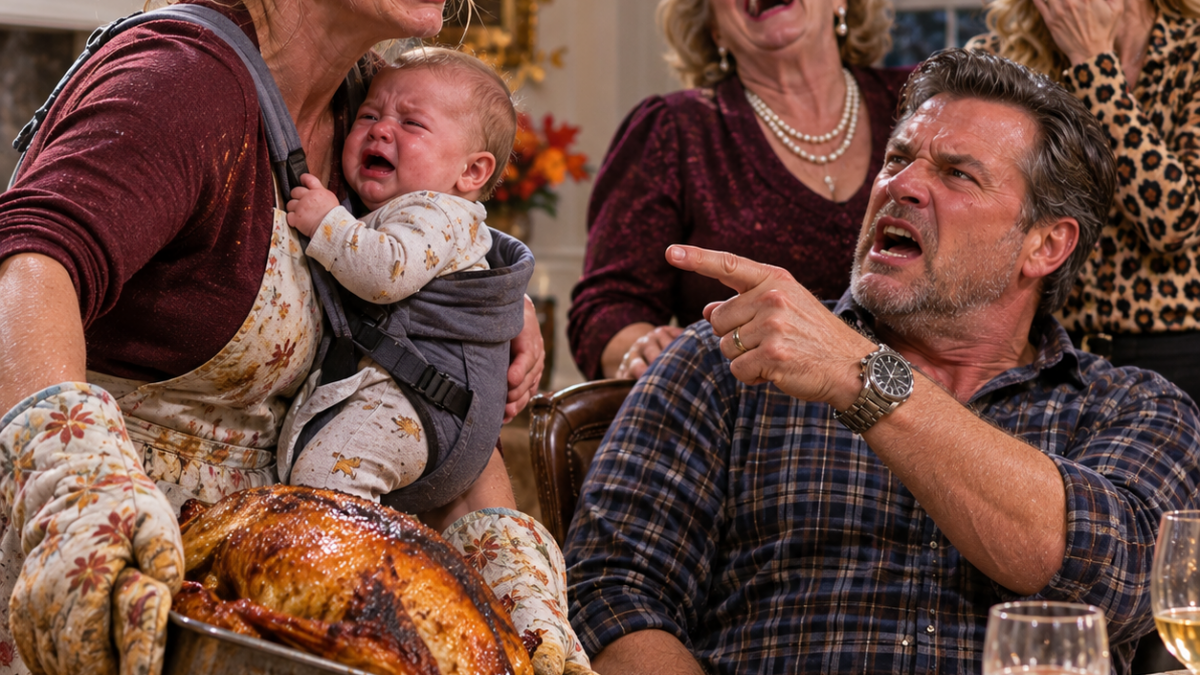
FULL ENDING
That morning, Leo was fussy and uncomfortable. I’d already contacted the pediatric nurse line and was following their instructions, watching him closely and planning to seek further care if his symptoms worsened.
But Richard’s family was coming for Thanksgiving.
His mother, Vivienne, expected the traditional meal.
His sister, Celeste, had already informed me that store-bought pie would be unacceptable.
And Richard wanted everything ready by one o’clock.
By ten that morning, I’d prepared the stuffing, made two pies, peeled potatoes, washed vegetables, and carried Leo around in a front carrier because he cried whenever I put him down.
I hadn’t showered.
My hair was twisted into a loose knot.
My old gray sweater had flour on one sleeve.
The elastic waistband of my pants was the only thing that felt comfortable against my still-recovering body.
At eleven, Richard entered the kitchen wearing a freshly pressed shirt.
He poured himself coffee.
Looked at the counter.
And frowned.
“Are the rolls done?”
“Almost.”
He checked his watch.
“Mom doesn’t like waiting.”
I adjusted Leo against my chest.
“Richard, could you hold him for twenty minutes? I need to get the turkey out and finish the gravy.”
He looked at our son.
Then at his shirt.
“I’m dressed.”
I stared.
“So?”
“I don’t want him spitting up on me before everyone arrives.”
He picked up his coffee.
“Besides, you’re better at that stuff.”
Then he walked away.
I stood there with one hand beneath my baby’s head and the other resting against the kitchen counter.
For a moment, I wanted to call him back.
I wanted to remind him that Leo was his son too.
Instead, I turned toward the oven.
Because there were still things to do.
At twelve-thirty, Vivienne arrived.
She kissed Richard.
Complimented his appearance.
Then looked me up and down.
“Oh, Eleanor.”
Her mouth tightened.
“Still haven’t found time to make yourself presentable?”
Celeste laughed behind her.
I managed a smile.
“It’s been a busy morning.”
Vivienne glanced at Leo.
“Another baby at your age. Honestly, I don’t know how you manage.”
Neither did I.
By one-fifteen, the food was almost ready.
Richard and his family were laughing in the living room.
My older children were scattered between their own homes, work commitments, and holiday visits; several would arrive later with their families, while the younger ones were occupied upstairs or helping with the parts of dinner they could manage.
I was alone in the kitchen with Leo.
Then, as I lifted the turkey from the oven, I heard Vivienne say my name.
“Eleanor really has let herself go.”
Celeste laughed.
I stopped.
Then Richard answered.
And with one sentence, the husband I’d spent thirty-two years loving turned our entire marriage into a joke.
PART2
“God, she’s like a bloated old pig.”
Richard’s voice came through the open doorway.
Clear.
Amused.
Completely unashamed.
“Sometimes she makes my skin crawl.”
I stood perfectly still.
The roasting pan was heavy in my hands.
Heat pushed through the oven mitts.
Leo whimpered against my chest.
Then Celeste laughed.
“Richard, that’s awful!”
But she said it the way people do when they’re delighted by something cruel.
Richard laughed harder.
“Come on, Celeste. You’ve seen her.”
Vivienne made a sound of agreement.
“She used to be such a pretty girl.”
“Used to,” Richard repeated.
Then he added, “Now she shuffles around the house in those ridiculous clothes, looking like she hasn’t seen a mirror in ten years.”
I looked down.
Flour on my sweater.
A small stain near the hem.
My swollen hands gripping the roasting pan.
Leo’s little cheek resting against my chest.
I waited for someone to defend me.
Surely his mother would say I’d given him eleven children.
Surely Celeste would remember the countless holidays I’d hosted so she wouldn’t have to cook.
Surely Richard would realize he’d gone too far.
Instead, he continued.
“She hasn’t accomplished anything in thirty-two years.”
Vivienne sighed.
“Well, she’s raised the children.”
Richard snorted.
“That’s not exactly an accomplishment when it’s all you’ve ever done.”
Something inside me went completely quiet.
He continued.
“She had all these big ideas when we got married. College degree, career plans, supposedly brilliant at English. Now she can barely put together a sentence without talking about diapers.”
Celeste burst into laughter.
Richard lowered his voice.
But I still heard every word.
“She’s just a useless baby-making machine. What am I supposed to do, bring her to business dinners? I’d be embarrassed to stand beside her.”
I stared at the closed kitchen cabinets.
For a moment, I wasn’t fifty-five.
I was twenty-three again.
Standing in a small apartment, holding a letter offering me a position at a publishing company.
I remembered Richard wrapping his arms around my waist and telling me he wanted a big family.
I remembered the promises.
We’ll build something beautiful together.
You can go back to work when the children are older.
I’ll take care of you.
I remembered holding our first daughter in a hospital room.
Then our second child.
Then another.
And another.
I remembered the children who had fevers at midnight.
The birthdays.
The school plays.
The broken bones.
The nights I slept in a chair beside a sick child because somebody needed to make certain they were breathing comfortably.
And the man who slept through almost all of it.
I remembered giving up jobs I wanted because childcare would have cost too much.
Turning down opportunities because Richard had another business trip.
Putting my own education and ambition on a shelf because there was always someone who needed me more.
I’d believed we were a team.
He earned the money.
I raised our family.
We were both contributing to the life we’d chosen.
But apparently, Richard had spent those years watching me give everything to our children and quietly deciding that the result made me disgusting.
My hands began trembling.
I looked down at the turkey.
The beautiful golden skin.
The stuffing I’d prepared before dawn.
The food I’d spent nine hours making for people who thought I was worthless.
And suddenly, I didn’t want to serve it.
I wanted them to understand what it felt like when someone stopped doing the work they’d spent decades taking for granted.
I adjusted my grip.
Turned toward the living room.
And pushed open the heavy oak door.
The living room door struck the wall with a crack that silenced everyone.
Richard looked up.
His wineglass stopped halfway to his mouth.
Celeste was still smiling.
Vivienne sat upright on the sofa, one hand resting against the pearls at her throat.
For a moment, they simply stared at me.
I could imagine what they saw.
A tired woman with flour on her clothes.
Gray strands escaping from her hair.
A baby crying against her chest.
A heavy roasting pan shaking in her hands.
Richard frowned.
“Eleanor, what the hell are you doing?”
I didn’t answer.
I walked toward the antique coffee table.
It was polished walnut, imported at ridiculous expense, and Richard had spent years warning the children not to scratch it.
He loved that table.
Sometimes I thought he cared more about the furniture than the people living around it.
I stopped beside it.
“Eleanor,” he snapped. “The dining room is the other way.”
I looked at his mother.
Then his sister.
Then at the man who’d just called me a useless baby-making machine.
My arms were shaking.
The roasting pan slipped from my grip and came down hard on the table.
The crash rang through the room.
The pan struck the polished surface with enough force to send gravy and cooking juices spilling across the tablecloth and over the edge.
A splash hit Richard’s trousers.
Another caught the lower half of Vivienne’s cream-colored sweater.
Celeste shrieked and jumped backward.
“MY GOD!”
Richard leaped to his feet.
“What are you doing?”
The table shook beneath the heavy pan.
A serving spoon clattered onto the floor.
Vivienne stared at the brown stain spreading across her cashmere.
“My sweater!”
She sounded as though I’d destroyed a priceless artifact.
I immediately checked Leo, making certain he was clear of the hot spill.
He startled at the noise and cried harder.
I took one step away from the table.
Then another.
Richard stared at me with a mixture of disbelief and outrage.
“Are you insane?”
I looked straight at him.
“No.”
My voice was so calm that it surprised even me.
“I heard you.”
His expression changed.
For a fraction of a second, I saw recognition.
Then he frowned.
“Heard what?”
I stared.
“You know what.”
Vivienne dabbed at her sweater with a napkin.
“This is completely unacceptable!”
I looked at her.
“You mean what your son said about me?”
Her eyes widened.
Celeste glanced toward Richard.
He gave a nervous laugh.
“Oh, come on, Eleanor.”
I said nothing.
“We were joking.”
I looked at the gravy dripping from the coffee table.
Then at my husband’s face.
“Really?”
He spread his hands.
“You can’t take a little teasing?”
I felt something inside me harden.
“Thirty-two years,” I said.
Richard blinked.
“What?”
“Thirty-two years of marriage.”
He rolled his eyes.
“Don’t start a speech.”
I looked directly at him.
“And eleven children.”
He sighed.
“Here we go.”
I took a breath.
“Is that what you call nothing?”
Nobody answered.
I looked toward Vivienne.
“You were laughing.”
She lifted her chin.
“Richard was venting. Married people are entitled to complain.”
I nodded slowly.
“About their spouse’s weight?”
Her face tightened.
“Eleanor—”
“About the body that carried eleven children?”
Celeste crossed her arms.
“Oh, don’t make this some dramatic feminist performance.”
I turned toward her.
“Did you enjoy the pies I made?”
She stared.
“What?”
“The ones you said had to be homemade.”
She looked confused.
“That’s not the point.”
“Did you enjoy having every holiday prepared for you?”
Richard slammed his glass onto the side table.
“Enough!”
Leo cried.
The sound went straight through me.
I looked down at him.
His little face was red with discomfort.
He was sick.
Tired.
Overstimulated.
And he needed care, not another adult shouting above him.
I unfastened the carrier carefully and lifted him into my arms.
Then I turned toward Richard.
“Hold your son.”
He stared at me.
“What?”
“Hold Leo.”
He looked at the baby’s tearful face.
Then at his stained trousers.
“Eleanor, I’m in the middle of—”
“Your son is sick.”
My voice cracked for the first time.
“He has a fever, and I’ve been caring for him while cooking since four this morning.”
Richard opened his mouth.
I stepped close enough to place Leo securely into his arms.
“His bottle and supplies are in the diaper bag beside the kitchen door. I’ve already spoken to the pediatric nurse.”
Richard clutched the baby awkwardly.
Leo wailed.
“What am I supposed to do?”
I stared at him.
For thirty-two years, that question had kept me moving.
Where’s my shirt?
What’s for dinner?
Did you call the school?
Why is the baby crying?
What am I supposed to do?
I’d answered every question.
Solved every problem.
Filled every gap.
But now I looked at the man who had fathered eleven children and said quietly, “Be his father.”
Richard went pale.
I untied my apron.
The fabric was damp and stained.
There was gravy on one corner and flour across the front.
I folded it once.
Then tossed it against his chest.
“The rest of Thanksgiving is self-serve.”
Celeste gasped.
Vivienne began protesting.
Richard stood frozen with Leo in his arms.
I looked toward the doorway.
Then back at him.
“Figure it out.”
I walked through the foyer.
Behind me, the room erupted.
Vivienne demanded towels.
Celeste complained about the ruined sweater.
Richard shouted for me to come back and clean the table.
Leo’s crying rose above them all.
For one second, my feet nearly stopped.
Every instinct I’d developed as a mother told me to turn around.
Take the baby.
Clean the mess.
Calm everyone.
Restore order.
But I’d spent thirty-two years restoring order after Richard created chaos.
I wasn’t going to do it automatically this time.
I grabbed my coat and keys.
Opened the front door.
And stepped into the freezing November wind.
Snow was blowing sideways across the driveway.
The sky had turned dark gray.
The trees bent in sharp gusts.
I pulled my coat around me and hurried to my car.
Richard appeared in the doorway with Leo held against his shoulder.
“ELEANOR!”
I stopped beside the driver’s door.
“YOU THINK YOU CAN JUST WALK OUT?”
I looked toward him.
“I’m taking a break.”
He laughed bitterly.
“A break? From what?”
The question almost took my breath away.
Then he shouted, “YOU’RE NOTHING WITHOUT ME!”
I opened my car door.
“You have no money! No career! No idea how the real world works!”
I got inside.
His voice carried across the driveway.
“YOU’LL BE CRAWLING BACK BY SUNRISE!”
I shut the door.
For a moment, I sat with both hands gripping the steering wheel.
My breathing was uneven.
My heart was pounding.
And tears were streaming down my face.
I could still hear Leo crying.
I couldn’t simply disappear while my sick baby needed me.
So before I started the engine, I sent Richard a message.
I am taking a short break to calm down. Check Leo’s temperature and follow the instructions beside his diaper bag. If his fever rises, his feeding changes, or he seems worse, contact the pediatrician immediately. I will arrange to come back for him shortly. Do not leave him unattended.
Then I called our oldest daughter.
“Grace?”
She answered cheerfully.
“Happy Thanksgiving, Mom! We’re about twenty minutes away.”
I tried to speak.
But the sound that came out wasn’t a word.
It was a sob.
Grace’s voice changed instantly.
“Mom?”
I covered my mouth.
“Mom, what’s wrong?”
I bent forward over the steering wheel.
For thirty-two years, I had learned how to cry without making noise.
Now I couldn’t stop.
“Grace,” I whispered, “I need you.”
She didn’t ask whether I was overreacting.
She didn’t tell me to calm down.
She simply said, “Tell me where you are.”
And that was when I understood how badly I’d needed someone to ask.
Grace found me in the parking lot of a small coffee shop less than ten minutes from the house.
She was thirty-one.
My firstborn.
The little girl who used to sit beside me while I folded laundry and ask why grown-ups looked sad when they thought nobody was watching.
Now she was a mother herself.
She climbed out of her car before I’d even opened my door.
“Mom!”
I stepped into the cold.
She rushed toward me.
Then stopped.
Her eyes moved over my face.
“What’s happened?”
I tried to tell her.
At first, the words came out in pieces.
Thanksgiving.
The turkey.
Leo.
Richard.
His mother.
His sister.
Then I repeated what I’d heard.
Bloated old pig.
Useless baby-making machine.
She makes my skin crawl.
Grace’s face changed.
For several seconds, she didn’t speak.
Then she whispered, “Dad said that?”
I nodded.
Her eyes filled.
“About you?”
I gave a broken laugh.
“Apparently.”
Grace shook her head.
“No.”
She stepped backward.
“No, he doesn’t get to say that.”
I looked down.
“I made a scene.”
Her expression hardened.
“What did you do?”
I told her about the roasting pan.
The gravy.
The table.
Richard holding Leo.
The apron.
The driveway.
I didn’t try to make the spill sound clever or harmless.
It had been a dangerous, impulsive reaction while carrying a baby, and I wished I’d put Leo somewhere safe before confronting them.
Grace listened.
Then asked the question I’d been dreading.
“Where’s Leo now?”
“With Richard. I gave him the care instructions and texted him again.”
She pulled out her phone.
“Then we’re going to get my little brother.”
I swallowed.
“Grace, I don’t want him growing up thinking his mother abandoned him.”
She stared at me.
“Mom.”
I looked up.
“You spent the last thirty-two years staying for everybody.”
Her voice trembled.
“Taking an hour to protect yourself doesn’t erase that.”
I began crying again.
She embraced me.
Then said quietly, “But you’re right about Leo. We’ll make sure he’s safe.”
I nodded.
“Okay.”
Grace stepped back.
“And after that, you and I are going to talk about what happens next.”
When we returned to the house, the driveway was full.
Two of my adult children had arrived.
My twenty-seven-year-old son, Noah, was standing near the garage with his wife.
My daughter Madison, twenty-four, had her coat over one arm.
They both looked confused.
Grace parked behind my car.
“What happened?” she asked Noah as we approached.
He looked toward the house.
“Dad says Mom had some kind of breakdown and ruined Thanksgiving.”
I closed my eyes.
Of course.
I had barely been gone an hour, and Richard had already chosen the version of events he wanted everyone to believe.
Grace’s jaw tightened.
“Did he tell you what he said about her?”
Noah frowned.
“What did he say?”
I stepped forward.
“Let’s check on Leo first.”
My son looked at my face.
Then nodded.
“Okay, Mom.”
Inside, the house smelled of turkey and spilled gravy.
The living room was a disaster.
Someone had moved the roasting pan to the kitchen.
Paper towels covered the coffee table.
Vivienne was sitting in a clean cardigan, complaining loudly that her sweater might be permanently stained.
Celeste stood beside the fireplace with her phone in her hand.
Richard was pacing.
Leo was in a portable bassinet near him, still fussy.
The moment Richard saw me, his face hardened.
“Well, look who came crawling back.”
Grace stepped through the doorway.
“Dad.”
He stopped.
“Grace, stay out of this.”
She looked toward me.
Then back at him.
“No.”
Richard stared at her.
“Excuse me?”
“I said no.”
My daughter crossed the room and looked down at Leo.
His face was flushed.
She glanced toward me.
“Have you checked his temperature?”
I reached for the thermometer in the diaper bag.
Richard rolled his eyes.
“For God’s sake, he’s fine.”
I turned toward him.
“That’s not your decision to make without checking.”
He stared.
“Don’t start again.”
I took Leo into my arms.
His little body relaxed against me.
I kissed his forehead.
“Hey, sweetheart.”
His crying softened.
I checked him and followed the nurse’s instructions, then called again to update the pediatric team about his symptoms.
Grace stood beside me.
Nobody interrupted.
Not even Richard.
For the first time all day, my son’s needs were the only thing in the room that mattered.
After making arrangements for Leo to be medically assessed, I turned toward my husband.
Richard stood with his arms folded.
His mother watched from the sofa.
Celeste looked irritated.
“Now that you’ve finished your performance,” Richard said, “perhaps you can apologize to everyone.”
I stared at him.
“Apologize?”
He gestured toward the table.
“You ruined the meal.”
Vivienne touched her sweater.
“And my clothes.”
Celeste added, “You frightened us half to death.”
Grace turned.
“Did any of you apologize to Mom?”
The room went quiet.
Richard glared.
“This is between your mother and me.”
“No,” Grace said.
Her voice shook with anger.
“You talked about her in front of Grandma and Aunt Celeste. You invited people into a conversation where you mocked her body and everything she’s done for this family.”
Vivienne straightened.
“Grace, you have no idea what you’re talking about.”
My daughter looked at her.
“I know enough.”
Noah stepped into the doorway.
He’d been listening.
His face was pale.
“Dad, what did you say?”
Richard exhaled dramatically.
“Oh, for heaven’s sake. Your mother misunderstood a joke.”
I looked at him.
A joke.
Again.
As though the word could undo thirty-two years of sacrifice and one afternoon of cruelty.
Noah looked toward me.
“Mom?”
I held Leo close.
Then repeated the words.
Every one I could remember.
I didn’t shout.
I didn’t embellish.
I simply told my adult children what their father had said while I was standing in the hallway.
When I finished, Noah looked physically sick.
He turned toward Richard.
“Did you really call her that?”
Richard said nothing.
My son’s voice hardened.
“Dad.”
Richard rubbed his forehead.
“I was venting.”
Noah stared.
“About Mom?”
“Everybody complains about their spouse sometimes.”
Grace stepped forward.
“Not like that.”
Madison wiped tears from her cheeks.
“You said she never accomplished anything?”
Richard looked toward her.
“Madison, don’t be dramatic.”
She shook her head.
“Eleven kids, Dad.”
Her voice broke.
“She raised us.”
Richard gave a frustrated laugh.
“Obviously I know that.”
“No,” Madison whispered.
“I don’t think you do.”
For a moment, I looked at my three grown children and saw them at different ages.
Grace at six, running through the kitchen with a missing front tooth.
Noah at ten, lying feverish in bed while I cooled his forehead.
Madison at fifteen, crying over a friendship that had ended.
I remembered how many nights I’d spent listening to them.
How many mornings I’d woken before them.
How many times I’d been exhausted and frightened and uncertain but kept showing up because they needed me.
Now they were standing in front of me.
Not as little children demanding that I solve everything.
As adults who could see what had been happening.
That nearly undid me.
Richard looked around the room.
Clearly unhappy that the conversation was no longer under his control.
“Your mother has been acting irrationally all day.”
Grace turned toward him.
“She’s been cooking since four this morning with a sick baby on her chest.”
He frowned.
“So?”
My daughter stared.
“So why weren’t you helping?”
“I had guests.”
Noah looked around.
“They’re your family, Dad.”
Richard’s face reddened.
“That doesn’t mean I should be stuck in the kitchen.”
A terrible silence followed.
I watched Noah’s expression change.
He had become a father two years earlier.
I’d seen him walk around his living room at three in the morning holding his crying daughter so his wife could sleep.
I’d seen him pack lunches and wash bottles.
I knew he understood something Richard had refused to learn.
Noah looked straight at his father.
“You’re not a guest in your own house.”
Richard said nothing.
My son continued.
“You live here.”
The words were simple.
They landed harder than any insult.
Grace touched my arm.
“Mom, you don’t have to stay here tonight.”
I looked down at Leo.
His little fingers were wrapped around my sweater.
For a moment, I felt the old fear rising.
Where would the younger children sleep?
What about their clothes?
Their school routines?
Their medications?
Their appointments?
Who would make sure everything happened?
Then Grace said something that made me look up.
“We’ll figure it out together.”
Not you’ll figure it out.
We’ll.
I swallowed.
And for the first time in years, I considered the possibility that being a mother didn’t mean carrying every responsibility alone.
We took Leo to be evaluated that afternoon.
Grace drove.
I sat in the back seat with my son secured in his car seat, watching his little chest rise and fall.
The doctor examined him, confirmed that he was stable, and gave us a plan for monitoring his symptoms and keeping him comfortable.
It was the first time that day I allowed myself to breathe properly.
Outside the clinic, snow was falling harder.
Grace helped me arrange Leo’s blanket.
Then she looked at me.
“Where do you want to sleep tonight?”
I opened my mouth.
Nothing came out.
I had no idea.
For thirty-two years, my answer had always been Richard’s house.
Our house.
The home where I’d changed thousands of diapers and cooked thousands of meals.
The place where every wall carried a memory.
But now, when I pictured walking through the front door, I felt sick.
Grace touched my shoulder.
“You can stay with us.”
I looked at her.
“Sweetheart, you have your own family.”
She smiled sadly.
“Where do you think I learned how to make room for someone?”
I began crying again.
She hugged me carefully around Leo’s car seat.
“Mom, you spent my entire childhood showing up when I needed you.”
Her voice trembled.
“Let me show up for you.”
That night, I slept in my daughter’s guest room.
Leo rested safely in the portable crib she’d prepared.
I could hear my granddaughter laughing downstairs.
The house smelled faintly of cinnamon and fresh bread.
And for the first time in years, I didn’t fall asleep worrying whether the dishes were finished.
Richard called after nine.
I’d just finished feeding Leo when the phone rang.
I stared at the screen.
Grace was sitting beside me, folding a blanket.
“You don’t have to answer,” she said.
I took a breath.
“I know.”
That was new.
I genuinely hadn’t known before.
I answered.
“Hello.”
Richard didn’t greet me.
“Where are the extra towels?”
I closed my eyes.
“Richard.”
“The kids need baths, and I can’t find the clean towels.”
I looked toward Grace.
She stared at me in disbelief.
I turned back to the phone.
“They’re in the upstairs linen closet.”
A pause.
“Which shelf?”
I almost laughed.
Not because it was funny.
Because after thirty-two years, this was the emergency that had finally prompted him to call.
“The middle shelf.”
He sighed.
“Well, you could have told me.”
I stared at the wall.
“You’ve lived in that house for thirty-two years.”
“What’s that supposed to mean?”
“It means you should know where the towels are.”
His voice hardened.
“Don’t start.”
I felt the familiar instinct to apologize.
Then I remembered his laughter.
The turkey.
The words.
She hasn’t accomplished anything.
I took a breath.
“Do you need to discuss one of the children?”
Silence.
Then he said, “We need groceries.”
“Then buy groceries.”
“Eleanor.”
“Yes?”
“Enough of this ridiculous punishment.”
I stared.
“My punishment?”
“You’re making everyone suffer because you overheard a private conversation.”
I closed my eyes.
A private conversation.
As though speaking cruelly about me became acceptable if he believed I couldn’t hear.
I said quietly, “I’m not coming back tonight.”
He scoffed.
“Fine. Stay with Grace and let her see how difficult you are.”
I looked at the sleeping baby.
“Good night, Richard.”
He shouted something.
I ended the call before he finished.
My hands were trembling.
Grace sat beside me.
Then she reached for my phone.
“Did he ask how Leo was?”
I stared at her.
No.
He hadn’t.
Not once.
The next morning, I woke in a panic.
For a moment, I didn’t recognize the room.
Then I looked at the clock.
Seven forty-three.
I sat upright.
I’d overslept.
The children needed breakfast.
Laundry needed to be started.
Richard would be furious.
I threw back the blanket.
Then stopped.
I wasn’t in our house.
Leo was sleeping peacefully nearby.
Grace had already checked on us.
Nobody was waiting downstairs to tell me I’d failed.
I sat on the edge of the bed.
And began crying.
It wasn’t the loud, desperate crying of the afternoon before.
It was quieter.
Almost bewildered.
Thirty-two years of waking before everyone else had left me unable to recognize rest when it was offered.
A soft knock came at the door.
“Mom?”
Grace stepped inside.
She carried a tray.
Toast.
Eggs.
A cup of tea.
I stared.
“What’s this?”
“Breakfast.”
I looked toward her.
“Sweetheart, you didn’t have to—”
She raised one hand.
“Don’t.”
I stopped.
She smiled.
“Just eat.”
I took the tray.
For a moment, I couldn’t speak.
Then I looked down at the toast.
I had prepared breakfast for eleven children through every stage of their lives.
School mornings.
Weekend mornings.
Holidays.
Exams.
Sports tournaments.
Sick days.
Snow days.
I’d carried trays upstairs when they were ill.
Made pancakes when they were sad.
Cut sandwiches into little shapes when they were too young to ask.
But I couldn’t remember the last time someone had brought me breakfast without expecting something afterward.
I looked up.
“Thank you.”
Grace’s eyes filled.
“You’re welcome, Mom.”
Then she sat beside me while I ate.
And for ten whole minutes, nobody asked me to do anything.
By Sunday evening, my phone was full of messages.
Some came from Richard.
Others from Vivienne and Celeste.
Vivienne wrote that I had humiliated the family.
Celeste demanded that I pay to clean her mother’s sweater.
Richard sent alternating apologies and accusations.
I shouldn’t have joked like that.
Then:
You’ve made your point. Come home.
Then:
It’s cruel to deprive the children of their mother over one stupid argument.
I stared at that last message for a long time.
For decades, he’d treated the children as my responsibility whenever caring for them was inconvenient.
Now that I wasn’t automatically available, he was accusing me of failing them.
I called him.
He answered immediately.
“Finally.”
“I want to talk about the children’s schedule.”
He sighed.
“Eleanor, just come home.”
“Leo is with me. The school-age children have their routines. We need to make arrangements that work for them.”
He scoffed.
“Arrangements?”
“Yes.”
“We’re married.”
“I know.”
“Then stop acting like we’re divorced.”
I took a breath.
“I need time apart, Richard.”
He was silent.
Then he laughed.
“You wouldn’t last a month without my income.”
I stared toward the window.
Grace’s little girl was playing in the yard with her father.
For a moment, I remembered how often Richard used to say he’d made it possible for me to stay home.
As though his career had been an act of charity.
As though the meals, childcare, housework, and years of unpaid labor hadn’t made that career possible.
I said quietly, “I guess we’ll find out.”
His voice sharpened.
“Don’t you dare threaten me.”
“I’m not threatening you.”
I swallowed.
“I’m telling you I’m not returning to the marriage the way it was.”
He went quiet.
Then he said, “You don’t get to decide that alone.”
For the first time, I almost smiled.
“Yes,” I replied. “I get to decide whether I will keep living with you.”
On Monday, I called an attorney.
Her name was Caroline Price.
She specialized in family law and had been recommended by someone Grace trusted.
I was nervous when I arrived.
I wore a clean sweater Grace had lent me and carried a folder filled with documents.
Birth certificates.
Tax records.
Mortgage information.
Bank statements.
Insurance information.
A handwritten list of expenses.
I felt foolish.
Like a woman who had spent decades managing a complicated household and somehow arrived at fifty-five without knowing how to manage her own future.
Caroline listened.
She didn’t smile politely when I described what Richard had said.
She didn’t call it a misunderstanding.
She asked questions.
How long had we been married?
Were all eleven children ours?
How many were minors?
What assets existed?
Did I have access to joint accounts?
Had Richard ever restricted my spending?
What did I want for the children?
What did I want for myself?
That last question stopped me.
I looked down.
“I don’t know.”
Caroline waited.
I swallowed.
“I haven’t thought about myself in a long time.”
She nodded.
“Then we don’t have to answer everything today.”
I felt tears gathering.
She continued.
“But there are things you should understand.”
We discussed the legal and financial realities of a long marriage.
Property division.
Marital assets.
Possible support.
Temporary arrangements.
Parenting responsibilities.
The children who were still minors.
The fact that unpaid caregiving could be highly relevant when evaluating the circumstances of the marriage.
I listened closely.
Then I asked, “Does it matter that I never built a career?”
Caroline looked straight at me.
“Eleanor, you raised eleven children while your husband built his.”
My throat tightened.
She continued.
“The financial value of a marriage isn’t measured only by which spouse received a paycheck.”
I stared at her.
For thirty-two years, Richard had made me feel as though every dollar in our household belonged to him because it came through his employer.
Now a lawyer was explaining that the life we’d built had been supported by my labor too.
I covered my mouth.
“I’m sorry.”
Caroline leaned forward.
“You don’t need to apologize for asking questions.”
I laughed through tears.
“People keep telling me that lately.”
She smiled.
“Then perhaps it’s something worth hearing more than once.”
The hardest part wasn’t the paperwork.
It was explaining the situation to our children.
Eleven children meant eleven different relationships with Richard.
Eleven different memories of our family.
Eleven different ways of understanding what had happened.
Some were adults with homes and partners of their own.
Some were in college or beginning careers.
Some were teenagers.
And several were still young enough to need reassurance about where they’d sleep and who would take them to school.
I didn’t want them to feel responsible for fixing our marriage.
I didn’t want them forced to choose between parents.
And I certainly didn’t want Richard turning them into messengers.
So I spoke to them honestly, in age-appropriate ways, without making them responsible for adult decisions.
To the younger ones, I said, “Mom and Dad are having serious problems, and we’re going to be living separately while we work through them. You haven’t caused this, and both of us are responsible for taking care of you.”
My eight-year-old daughter asked whether she’d still see her father.
“Yes,” I told her. “We’ll work out a safe, reliable schedule.”
My twelve-year-old son asked whether Thanksgiving had been his fault because he’d forgotten to help set the table.
I nearly broke down.
“No, sweetheart.”
I held his face gently.
“Absolutely not.”
My teenage daughter asked why I’d stayed so long if Richard was making me unhappy.
That question hurt more than I expected.
I thought carefully.
Then said, “Because I loved our family, and for a long time I believed things would get better.”
She looked at me.
“Did they?”
I swallowed.
“Not enough.”
She nodded slowly.
Then hugged me.
I didn’t tell her she needed to forgive her father.
I didn’t tell her she needed to hate him either.
I told her the truth.
Adults were responsible for their own behavior.
And children did not have to carry the consequences of decisions they hadn’t made.
Richard struggled with the new arrangements almost immediately.
Not because he was incapable of caring for his children.
He was intelligent.
Organized.
Successful in a demanding business career.
He could negotiate contracts and supervise large teams.
But at home, he’d spent decades pretending he couldn’t do things that didn’t interest him.
The first week, he called about the washing machine.
“The clothes keep coming out wrinkled.”
I looked at the phone.
“Did you take them out when the cycle ended?”
A pause.
“Is that what you’re supposed to do?”
I closed my eyes.
The second week, he called because our youngest school-age child had a project due.
“Why didn’t you tell me?”
“I put the school calendar information in the shared folder.”
He sighed.
“Eleanor, I don’t have time to check all that.”
I took a breath.
“Richard, that’s what parenting requires.”
He went quiet.
The third week, he called because he couldn’t remember which child had a dental appointment.
I told him where the appointment information was.
Then I stopped.
I couldn’t become his invisible assistant while living somewhere else.
If we were going to share parenting responsibilities, he would have to learn the routines.
I was willing to communicate necessary information.
I was willing to cooperate.
But I wasn’t willing to continue carrying his entire mental workload.
At first, he accused me of being spiteful.
Then he accused me of trying to make him look incompetent.
Finally, he began writing things down.
I heard from one of our older children that he’d bought a family calendar and taped it to the refrigerator.
I smiled when I heard that.
Not because he was suffering.
Because for the first time, he was doing something I had done every day for thirty-two years without applause.
He was paying attention.
A month after Thanksgiving, I returned to the house to collect some of my personal belongings.
Grace came with me.
Not because I was incapable of packing a suitcase.
Because she knew how much the house could unsettle me.
Richard was at work, and the visit had been arranged in advance.
I walked into our bedroom.
My side of the closet looked exactly as I’d left it.
A few cardigans.
Loose dresses.
Comfortable shoes.
Clothes purchased because they were practical, inexpensive, and easy to wash.
For years, Richard had complained that I dressed badly.
Yet whenever I suggested buying something nicer, he asked why I needed to waste money on clothes when I hardly went anywhere.
I opened a drawer.
Beneath a stack of old scarves was a wooden box.
I’d forgotten about it.
I carried it to the bed.
Grace appeared in the doorway.
“What’s that?”
I opened the lid.
Inside were photographs, letters, and a folder containing my university diploma.
I stared at it.
My name.
My degree.
The honors designation.
The date.
Thirty-three years earlier.
I lifted it out with trembling hands.
Grace sat beside me.
“Mom?”
I couldn’t speak.
Beneath the diploma lay an old letter from a publishing company.
An offer for an entry-level editorial position.
I’d received it shortly before marrying Richard.
I remembered the excitement.
The pride.
The way I’d called my mother and told her I’d been offered the first step toward the career I wanted.
Then Richard had proposed.
We’d talked about children.
About his dream of a large family.
About how we could make everything work.
I’d told myself the job could wait.
A year.
Two years.
Just until the baby was older.
Then another pregnancy came.
And another.
The years kept moving.
The letter remained in the box.
I held it carefully.
Grace leaned toward me.
“What’s that?”
I handed it to her.
She read the first paragraph.
Then looked up.
“Mom.”
I swallowed.
She stared at the page.
“You had a job offer from a publishing company?”
I nodded.
“When I was twenty-two.”
Her eyes widened.
“Why didn’t you take it?”
I looked down.
“Your father wanted us to start a family.”
Grace was quiet.
Then she said, “But you wanted to work with books.”
“Yes.”
“Did you love it?”
I smiled through tears.
“More than almost anything.”
She looked at the diploma.
Then at me.
“Why didn’t you ever tell us?”
I tried to answer.
But the truth was difficult.
For years, I’d stopped thinking about the young woman who wanted to work in publishing.
Not because I regretted having my children.
I didn’t.
I loved them with a depth I couldn’t begin to describe.
But somewhere along the way, I’d begun believing that loving them required forgetting every other dream.
And Richard had encouraged that belief.
I looked at Grace.
“I suppose I stopped believing it mattered.”
Her face crumpled.
“Mom.”
I wiped my eyes.
She held up the offer letter.
“It’s not too late for you to do something you love.”
I laughed sadly.
“Sweetheart, I’m fifty-five.”
“So?”
I stared at her.
She shrugged.
“You’ve spent thirty-two years teaching eleven children how to read, write, organize projects, solve problems, and keep going when things get difficult.”
Her voice trembled.
“You think you can’t learn something new?”
I looked down at the diploma.
For the first time in decades, I saw it as something other than a reminder of what I’d given up.
It was proof that the woman I’d been before Richard still existed.
She was older.
Tired.
Changed by motherhood.
But she hadn’t disappeared entirely.
I traced my finger over my name.
Then whispered, “Maybe I could try.”
Grace smiled.
“That’s all I’m asking.”
I started small.
There was no sudden six-figure job.
No wealthy publisher appearing at my door to tell me I’d been secretly brilliant all along.
I didn’t wake up the next morning transformed into a successful businesswoman.
My confidence was badly damaged.
My skills needed refreshing.
And I was still caring for a five-month-old baby who would soon be crawling around my apartment.
So I began with what I could manage.
I joined an online professional editing course.
I read.
I practiced.
I reviewed style guides and refreshed software skills that hadn’t existed when I first graduated.
Sometimes I studied while Leo napped.
Sometimes after his evening feeding.
Sometimes I could manage only twenty minutes before exhaustion caught up with me.
But the work belonged to me.
Nobody demanded it.
Nobody called it a waste of time.
Nobody stood over my shoulder complaining that I should be doing something more useful.
One evening, I sat at my kitchen table editing a practice manuscript.
Leo was sleeping nearby.
A mug of tea had gone cold.
I was working through a difficult paragraph when I suddenly realized I’d been smiling for nearly an hour.
I stopped.
Looked at the screen.
Then laughed.
There I was.
Fifty-five years old.
Wearing an old sweatshirt.
Still tired.
Still carrying the physical effects of eleven pregnancies.
And completely absorbed in work that had nothing to do with keeping someone else satisfied.
I remembered Richard’s words.
She hasn’t accomplished anything.
For the first time, they sounded less like a judgment and more like evidence of how little he’d understood.
A few months later, I began taking small paid editing assignments.
At first, they came through a local community organization that needed help with newsletters and educational materials.
The pay wasn’t enormous.
The deadlines were manageable.
And I had the flexibility to work around Leo’s needs and the younger children’s schedules.
I checked every document carefully.
Sometimes twice.
I worried that my work wouldn’t be good enough.
Then my first supervisor sent me an email.
Eleanor, your edits made this much clearer and more accessible. Thank you for the care you put into it.
I stared at those words for a long time.
Thank you.
Not Why did this take so long?
Not You should’ve done it differently.
Not That’s what you’re supposed to do.
Just gratitude for work I’d completed.
I forwarded the email to Grace.
She called almost immediately.
“Mom!”
I laughed.
“What?”
“You did it!”
I smiled.
“It was a newsletter.”
“And?”
“Grace—”
“Mom, you got paid to do something you love.”
My throat tightened.
“Yeah.”
She laughed.
“Then we’re celebrating.”
I looked toward Leo, who was playing on a blanket near my desk.
He grinned at the sound of my voice.
I smiled through tears.
“Okay.”
And that evening, Grace arrived with a small cake.
On top, in bright blue icing, she’d written:
CONGRATULATIONS, MOM.
I stood in the doorway staring at it.
Then began crying.
Grace hugged me.
“It’s just the beginning.”
I looked down at the cake.
For thirty-two years, I’d celebrated everybody else’s achievements.
Graduations.
Promotions.
New jobs.
Birthdays.
Engagements.
I’d baked cakes.
Bought flowers.
Taken photographs.
Arranged dinners.
Now someone had brought a cake for me.
Not because I’d kept the house clean.
Not because I’d cooked a perfect Thanksgiving meal.
Because I’d done something I’d wanted to do.
And my daughter thought it deserved celebrating.
Richard found out through the children.
He called one evening while I was finishing a project.
“I hear you’re doing some kind of writing job.”
I kept my voice neutral.
“Yes.”
He laughed.
“Editing newsletters?”
“That’s one part of it.”
He sighed.
“Eleanor, don’t embarrass yourself.”
I felt the old pressure in my chest.
I waited.
He continued.
“You’ve been out of the workforce for thirty years. The world doesn’t work the way it did when you were twenty-three.”
“I know.”
“Then why bother?”
I looked at the manuscript on my screen.
“Because I enjoy it.”
He went quiet.
Then said, “You always did have unrealistic ideas.”
I took a breath.
“Richard, is there something you need to discuss about the children?”
He sounded irritated.
“Can’t I call my wife?”
I closed my eyes.
“We’re separated.”
“That doesn’t mean you need to act like a stranger.”
I thought about the Thanksgiving table.
The laughter.
The words he’d chosen.
And the weeks when he’d called only to ask where the towels were.
I looked toward the screen.
“I’m not discussing my work with you.”
He scoffed.
“Fine.”
Then, almost casually, he added, “How much are they paying you, anyway?”
I smiled sadly.
“That isn’t something I’m going to justify.”
He began protesting.
I ended the call after confirming there were no urgent parenting matters.
Then I went back to editing.
My hands trembled for a few minutes.
But I kept working.
Every small paragraph I completed felt like another inch of ground reclaimed.
Richard’s mother called me only once after the separation began.
It was early spring.
Leo had started sitting with support.
The older children were adjusting to the new family routines.
I’d begun sleeping better and taking care of medical appointments I’d postponed for years.
My phone rang while I was preparing lunch.
Vivienne’s name appeared.
I almost didn’t answer.
Then I decided I wanted to hear what she had to say.
“Hello, Vivienne.”
Her voice was stiff.
“Eleanor.”
I waited.
“Richard tells me you’re still refusing to come home.”
“Yes.”
She sighed.
“Thirty-two years of marriage. Eleven children. Such a waste.”
I looked toward Leo.
He was sitting safely beside me, banging a soft toy against his play mat.
I smiled at him.
“I don’t consider my children a waste.”
“You know that’s not what I meant.”
I waited.
Vivienne continued.
“Men say things sometimes. It doesn’t mean they don’t love their wives.”
I felt my jaw tighten.
“Your son called me a useless baby-making machine.”
She made an irritated sound.
“He was frustrated.”
“He said my body disgusted him.”
“Oh, Eleanor, don’t be dramatic.”
I took a breath.
“Vivienne, would you have laughed if someone said those things about Celeste?”
Silence.
Then she said, “That’s different.”
“Why?”
She didn’t answer.
I continued.
“Would you have laughed if your husband said them about you?”
Her voice sharpened.
“Don’t bring my marriage into this.”
I looked toward the window.
“For thirty-two years, I’ve prepared Thanksgiving for your family. Christmas too. Birthdays. Anniversaries. Every time you visited, I cooked the meals you requested.”
She sighed.
“And we appreciated it.”
I swallowed.
“No. You expected it.”
A pause.
Then I said, “You never asked how tired I was.”
Vivienne didn’t answer.
“You never asked whether I needed help.”
Her voice hardened.
“I didn’t realize I had to thank you for taking care of your own household.”
I closed my eyes.
There it was.
The truth.
To Vivienne, my work wasn’t work.
It was an obligation.
Something I owed the family merely because I was a wife.
I said quietly, “That’s why we’re not going to agree.”
She scoffed.
“Richard deserves a woman who appreciates him.”
I looked at my sleeping child.
“Then I hope he learns to appreciate whoever chooses to share a life with him.”
Vivienne made an offended sound.
I continued.
“But I’m no longer willing to disappear to make him comfortable.”
Then I ended the call.
And returned to making lunch.
This time, I made exactly what I wanted.
The first real apology from Richard came in June.
Not during a dramatic visit.
Not with flowers.
Not in front of the children.
He sent a message asking whether we could speak about something besides the parenting schedule.
I agreed to a short conversation at a neutral location.
When he arrived, he looked older.
Not dramatically.
But the polished confidence I’d always associated with him had faded.
He sat across from me and folded his hands.
For a moment, neither of us spoke.
Then he said, “I’ve been thinking about Thanksgiving.”
I looked at him.
He swallowed.
“What I said was cruel.”
I waited.
He continued.
“You didn’t deserve that.”
My chest tightened.
I’d imagined hearing those words for months.
Sometimes I’d thought they would make everything easier.
But now, as I listened, I felt something more complicated.
Relief.
Sadness.
And the knowledge that an apology couldn’t return the years I’d spent believing I was worthless.
Richard looked down.
“I thought you knew I didn’t mean it.”
I shook my head.
“Richard, you said those things when you believed I couldn’t hear.”
He stared.
I continued.
“You weren’t trying to hurt me in an argument. You were telling your mother and sister what you thought of me.”
His eyes filled.
He looked away.
For a long moment, he didn’t answer.
Then he whispered, “You’re right.”
I felt tears gathering.
He looked back.
“I’ve been selfish.”
I said nothing.
“I thought because I worked long hours and brought in money, everything else was your responsibility.”
He swallowed.
“I never really considered what it cost you.”
I looked down.
“For thirty-two years.”
He nodded.
“I know.”
My voice trembled.
“No. I don’t think you do.”
He closed his eyes.
I continued.
“You’ve been taking care of the younger kids on your own for parts of the week. You’ve had to learn school schedules and laundry and appointments.”
He nodded.
“And it’s difficult.”
I leaned forward.
“That was my entire life, Richard.”
His face crumpled.
“Every day,” I whispered. “For decades.”
He covered his face.
I watched him.
For the first time, I wasn’t sure whether his tears were for me, for himself, or for the life he was beginning to understand he’d taken for granted.
Perhaps all three.
He lowered his hands.
“Can we start over?”
I felt my heart ache.
I remembered being twenty-three.
The man who’d promised me a beautiful family.
The future I’d imagined.
The dreams I’d laid aside because I trusted him.
Then I thought about the woman I’d become.
The one who’d stood outside the living room holding a turkey while her husband laughed at her body.
I looked straight at Richard.
“I want us to be decent parents to our children.”
He nodded quickly.
“Of course.”
“And I want you to keep taking responsibility for them.”
“I will.”
“But I’m not coming back to the marriage.”
He went still.
“Eleanor—”
I shook my head.
“I believe you’re beginning to understand that you hurt me.”
His eyes filled.
“But I can’t rebuild my life around the hope that you’ll never decide to humiliate me again.”
For a moment, he stared at me.
Then he lowered his head.
I didn’t reach across the table.
I didn’t try to make the moment easier for him.
I’d spent decades doing that.
Now I let him feel the consequences of what he’d done.
And when our conversation ended, I stood, took my coat, and walked out.
This time, nobody shouted that I’d be crawling back by sunrise.
The divorce took longer than I expected.
There were financial records to review.
Property issues to resolve.
Parenting arrangements to establish for the children who were still minors.
Questions about support, expenses, and the practical realities of ending a thirty-two-year marriage.
Nothing about it was easy.
Richard had earned the larger paycheck for most of our marriage, but that didn’t mean I’d contributed nothing.
Our home hadn’t maintained itself.
Eleven children hadn’t raised themselves.
Every promotion he’d celebrated had existed alongside school pickups, sick nights, medical appointments, meals, and countless ordinary responsibilities he rarely noticed.
I’d carried those responsibilities so he could devote more time to his career.
Now, for the first time, that contribution was being formally considered.
We eventually reached a financial settlement through the legal process.
The marital assets were divided according to the applicable requirements and the circumstances of our long marriage.
We established support and parenting arrangements.
And I was able to continue building an independent life without pretending that the unpaid labor I’d performed for thirty-two years had no value.
It wasn’t revenge.
I didn’t want to see Richard penniless.
I didn’t want our children to suffer.
I wanted fairness.
And I wanted the freedom to decide what happened to me next.
When the divorce was finalized, I walked out of the attorney’s office carrying a thin folder.
Grace was waiting outside.
She looked at my face.
“Mom?”
I stopped beside her.
For a moment, I couldn’t speak.
Then I nodded.
“It’s finished.”
Her eyes filled.
She stepped forward and hugged me.
I held on.
Thirty-two years.
Eleven children.
Thousands of breakfasts.
Thousands of nights.
A lifetime of believing my value depended on how much I could give.
Now that chapter of my life had ended.
I cried against my daughter’s shoulder.
But underneath the sadness was something I hadn’t felt in a very long time.
Peace.
That autumn, I accepted a regular part-time position helping edit educational materials for an adult-learning organization.
The work wasn’t glamorous.
I didn’t have an expensive office.
I didn’t travel across the world.
I didn’t suddenly become famous.
Some days, I still sat at my kitchen table with Leo playing nearby while I revised a document for the third time.
But I loved it.
I loved choosing the right words.
I loved improving a sentence until its meaning was unmistakable.
I loved the quiet satisfaction of finishing a project and knowing my judgment had made it better.
Most of all, I loved discovering that the things I’d learned before marriage hadn’t been erased.
I’d spent thirty-two years helping children learn to read, write, think, and express themselves.
I’d organized an enormous household.
Balanced competing schedules.
Managed emergencies.
Made difficult decisions with very little sleep.
Those experiences hadn’t turned me into the worthless woman Richard described.
They’d given me skills I had never learned to describe as skills.
I was still learning how to use them outside my home.
But I wasn’t starting from nothing.
I never had been.
One afternoon, my supervisor asked whether I’d consider taking on a larger project.
I looked at the schedule.
Thought about Leo.
My health.
My commitments to the younger children.
Then I said, “I’d like to discuss what that would involve.”
She smiled.
“Of course.”
The conversation was ordinary.
Professional.
Respectful.
But afterward, I sat in my car and cried.
Because nobody had ordered me to accept.
Nobody had mocked me for asking questions.
Nobody had told me that my dreams were selfish.
I’d been offered an opportunity.
And I was allowed to decide whether it fit my life.
The next Thanksgiving was nothing like the one before.
I didn’t wake at four in the morning.
I didn’t cook a twenty-pound turkey alone.
I didn’t carry a sick baby while everyone else sat drinking wine.
And I certainly didn’t spend the day listening for the sound of Richard’s footsteps so I could guess whether he was in a good mood.
Instead, Grace invited the family to her house.
We planned the meal together.
Every adult brought something.
Noah volunteered to handle the turkey.
Madison made the mashed potatoes.
One of the younger children proudly prepared a salad.
Grace’s husband took charge of the drinks and kitchen cleanup.
I made my mother’s pumpkin pie because I wanted to.
Not because anyone demanded it.
Not because someone would criticize me if I bought dessert from a bakery.
Because I loved the recipe.
It reminded me of her.
And because I finally had enough energy to enjoy making it.
Richard had his own holiday arrangements and time with the children under our parenting plan.
I wasn’t trying to erase him from their lives.
I simply no longer arranged my entire existence around keeping his family satisfied.
That afternoon, I arrived at Grace’s house holding the pie.
Leo was walking now, unsteady but determined, his little shoes squeaking against the kitchen floor.
He spotted me.
“Mama!”
I laughed.
He hurried toward me with both arms raised.
I set the pie down safely and lifted him.
“Oh, my sweet boy.”
He pressed his cheek against mine.
For a moment, I held him close.
I remembered him crying against my chest the Thanksgiving before.
His feverish little body.
The heavy roasting pan.
Richard’s laughter from the living room.
Then I looked around Grace’s warm kitchen.
Noah was laughing while he checked the turkey.
Madison was arguing playfully about how much butter belonged in the potatoes.
The younger children were setting the table.
Grace’s daughter was decorating place cards with little drawings of leaves.
There was flour on the counter.
A dish towel hanging from the oven handle.
Somebody had spilled cranberry juice.
Nobody was shouting.
Nobody was threatening punishment.
Nobody was laughing at the woman who’d spent the morning making everything happen.
And for the first time in decades, I wasn’t responsible for holding the entire holiday together.
I was simply part of it.
We gathered around the table as evening approached.
Not all eleven children could stay for the entire meal; some had their own families, schedules, and commitments.
But everyone had been included, and those who couldn’t join us in person had called or sent messages.
I looked at the faces around me.
My children.
Their partners.
My grandchildren.
The people I’d spent thirty-two years loving.
I thought about Richard’s words.
She hasn’t accomplished anything.
I looked toward Grace.
A capable, compassionate woman raising her own family.
Then Noah.
A father who understood that caring for a child wasn’t beneath him.
Madison.
Strong and thoughtful.
The younger ones, still growing into the people they would become.
And little Leo, sitting beside me in his high chair, happily inspecting a piece of soft food.
I’d spent years believing motherhood was my only achievement.
Now I understood something different.
It was a profound part of my life.
But it wasn’t proof that I had no other identity.
I was their mother.
I was also Eleanor.
A woman with a mind.
A degree.
A career beginning again.
A body that deserved rest and kindness.
And a future that hadn’t ended simply because I was fifty-five.
Grace stood and tapped her glass lightly.
“Before we eat, I want to say something.”
I looked up.
Her eyes found mine.
“Last Thanksgiving was hard for our family.”
The table grew quiet.
She continued.
“But something important came out of it.”
My throat tightened.
She smiled at me.
“Mom spent years making sure every one of us had what we needed.”
I looked down.
“She celebrated us when we succeeded. She comforted us when we failed. She taught us that loving somebody means showing up, even when you’re tired.”
My eyes filled.
Grace’s voice trembled.
“And this year, I want us to celebrate her.”
I stared at my daughter.
She lifted her glass.
“To Mom.”
Noah raised his.
“To Mom.”
Madison followed.
Then the others.
Around the table, voices joined.
“To Mom.”
I covered my mouth.
For a moment, I couldn’t speak.
Then Grace came around the table and embraced me.
I held her tightly.
And cried.
Not because I was finally receiving credit for every diaper, meal, and sleepless night.
I didn’t need my children to repay me for raising them.
I cried because they saw me.
Not as a servant.
Not as someone who existed to meet their needs.
As a person.
A woman they loved.
A woman whose happiness mattered too.
Later that evening, after the dishes were done and the younger children had settled down, I stepped outside onto Grace’s porch.
The night was cold.
A light snow drifted through the air.
I wrapped my sweater around myself and looked toward the quiet street.
Almost exactly one year earlier, I’d walked into a winter storm believing my life had just fallen apart.
I remembered Richard shouting from the doorway.
You’re nothing without me.
You’ll come crawling back by sunrise.
I thought about how frightened I’d been.
How certain I’d felt that leaving meant losing everything.
The house.
The family.
The life I’d built.
But standing beneath the porch light, I realized something.
I hadn’t lost my family.
My children were still my children.
My love for them hadn’t diminished.
My commitment to their well-being hadn’t disappeared.
What I’d lost was the belief that being a good wife required accepting cruelty.
And what I’d found was a woman I hadn’t allowed myself to know in thirty-two years.
A woman who liked reading.
Who loved language.
Who enjoyed a quiet morning.
Who could make decisions without seeking permission.
Who could say no.
Who could be tired.
Who could be imperfect.
Who could grow older without apologizing for the changes in her body.
Who could love her children deeply without sacrificing every other part of herself.
The back door opened.
Grace stepped onto the porch.
“Mom?”
I turned.
She smiled.
“There you are.”
I laughed softly.
“Just getting some air.”
She came beside me.
For a moment, we watched the snow.
Then she asked, “Happy?”
I considered the question.
A year earlier, I wouldn’t have known how to answer.
I would have said I was grateful for my family.
That we were blessed.
That Richard worked hard.
That everything was fine.
I would have offered the answer I thought a good wife and mother was supposed to give.
Now I looked toward the warm light spilling through the doorway.
I could hear my children laughing inside.
Leo was babbling happily.
Someone had started a card game.
The house was full of life.
And for once, I didn’t feel responsible for making every single moment perfect.
I smiled.
“Yes.”
Grace looked at me.
“Really?”
My eyes filled.
I nodded.
“Really.”
She took my hand.
And we went inside.
I still remember every word Richard said that first Thanksgiving.
I doubt I’ll ever forget them.
The contempt in his voice.
His mother’s laughter.
His sister’s amusement.
The way they discussed my body as though I weren’t a human being who had spent decades loving and caring for them.
But I no longer hear those words as a description of who I am.
They describe what Richard was willing to say about the woman who trusted him.
They reveal his cruelty.
Not my worth.
I won’t pretend that dropping the roasting pan was the wisest thing I ever did.
I was exhausted, devastated, and pushed beyond what I knew how to bear.
I am grateful no one was seriously hurt, especially Leo, and I would make a safer choice if I could relive those few seconds.
But I don’t regret refusing to serve dinner while the people I’d cooked for laughed at my humiliation.
I don’t regret walking out of that room.
I don’t regret asking for help.
And I don’t regret building a life in which I am allowed to matter.
For thirty-two years, Richard believed I had accomplished nothing because I didn’t bring home a paycheck.
He believed the wrinkles, exhaustion, and changes in my body were evidence that I had failed.
He believed my sacrifices made me less valuable instead of recognizing what they had made possible for our family.
But the greatest lesson of that Thanksgiving wasn’t delivered by a ruined meal or a stained cashmere sweater.
It came afterward.
When Richard had to become an active parent.
When our children began recognizing the work I’d quietly done.
When I found my old diploma.
When I earned my first paycheck from editing.
When I learned that I could build a future without begging anyone to appreciate me.
And when I finally looked in the mirror without hearing my husband’s contempt.
My husband called me a useless baby-making machine in front of his family, never imagining that the woman he’d spent thirty-two years taking for granted still had the strength to walk away.
He thought I would crawl back by sunrise because he believed he was everything I had.
But he was wrong. I had eleven children I loved, a mind he had never respected, dreams I hadn’t completely forgotten—and a life that was finally mine to live.








