FULL ENDING :“YOUR UNIFORM WON’T SAVE YOUR DAUGHTER, COLONEL!” My Son-in-Law’s Wealthy Family Threatened to Destroy Us—They Never Expected Me to Walk Into That Hospital
“Yes.”
Her expression softened.
“Your daughter asked for you. Let me check with her nurse.”
Those few seconds felt endless.
Finally, she returned and led me down a corridor.
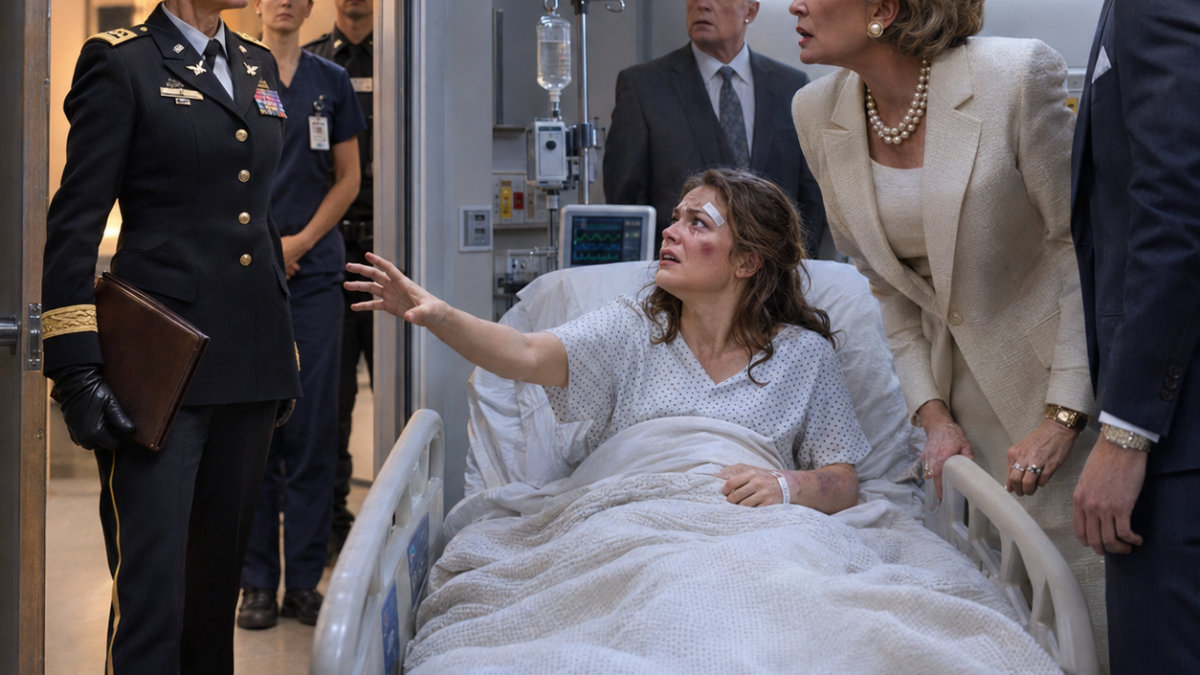
Abby was in an observation room, lying beneath a thin white blanket.
I had imagined injuries.
I had braced myself for bruises.
But seeing them on my own child nearly knocked the air from my lungs.
Her left eye was swollen. Her lower lip was split. Dark marks circled both upper arms.
The white dress she’d worn to a family dinner was torn at one shoulder.
She looked twenty-nine years old and six years old at the same time.
“Mom?”
I crossed the room and gathered her carefully into my arms.
She flinched before she recognized my touch.
That single movement hurt more than anything I had seen.
“I’m here, sweetheart.”
She gripped my uniform.
“I tried to call you.”
“I know.”
“They took my phone.”
“You’re safe with me now.”
Her shoulders shook.
I held her until her breathing slowed.
Then I heard a man’s voice from the doorway.
“She really knows how to put on a performance.”
I turned.
My son-in-law, Grant Whitlock, stood beside his mother and older brother.
Grant wore an expensive gray suit and an expression of bored irritation.
His brother Preston stood with his arms folded, looking almost amused.
And their mother, Constance Whitlock, smiled as though we’d met unexpectedly at a charity luncheon.
“Colonel Mercer,” she said. “I’m glad you’re here. Perhaps you can talk some sense into Abigail.”
I stepped between them and my daughter.
“What happened to her?”
Constance sighed.
“An unfortunate fall. She’s been very emotional lately.”
Abby whispered behind me.
“Mom, that’s not true.”
Grant rolled his eyes.
“Abigail, stop.”
She shrank backward.
I looked at him.
“Don’t speak to her.”
His eyebrows rose.
“Excuse me?”
“You heard me.”
Preston laughed quietly.
“Colonel, this is a family matter.”
“Then your family can explain why my daughter is terrified of you.”
Constance’s smile vanished.
“Be very careful about making accusations.”
She moved closer.
“Our family has friends in the courts, the media, and state government. Your uniform doesn’t intimidate us.”
Preston smirked.
“Take her home before we decide to sue.”
I glanced at Abby.
She was staring at the floor, trembling.
And suddenly I understood what these people expected.
They expected me to shout.
They expected me to threaten them with my rank.
They expected an angry confrontation they could twist into a story about an unstable mother interfering in her daughter’s marriage.
Instead, I looked at the nurse standing just outside the doorway.
“Would you please call hospital security,” I said calmly, “and ask whether my daughter can speak privately with the medical team and a law enforcement officer?”
Grant’s expression changed.
“There’s no need for that.”
I looked directly at him.
“That’s not your decision.”
Then Abby reached for my hand and whispered something I will never forget.
“Mom, they made me sign a statement before they brought me here.”
I turned toward her.
“What statement?”
Her eyes filled.
“The one saying I did this to myself.”
And behind me, for the first time, Constance Whitlock stopped smiling.
FULL STORY CONTINUATION
I had heard people lie before.
In my years as an officer, I had encountered soldiers who tried to hide mistakes, frightened people who changed their stories, and experienced professionals who believed that sounding confident would make their version of events more convincing.
But there was something particularly disturbing about watching three people stand in a hospital room and casually rewrite what had happened to an injured woman lying six feet away.
My daughter wasn’t a political problem.
She wasn’t an embarrassment.
She wasn’t some inconvenience to be managed.
She was a human being who had been hurt.
And the people standing in front of me seemed far more concerned about protecting themselves than making certain she received proper medical care.
I bent toward Abby.
“Sweetheart, look at me.”
Her good eye met mine.
“Did you sign something because you wanted to, or because you were afraid?”
Her face crumpled.
“Because I was afraid.”
Grant immediately stepped forward.
“That’s ridiculous. She signed a perfectly ordinary statement explaining the accident.”
I turned toward him.
“I’m speaking to my daughter.”
“She’s my wife.”
“And she’s an adult who can speak for herself.”
Constance made an impatient sound.
“Colonel, nobody is disputing that Abigail is upset. But this family has certain responsibilities. We cannot allow reckless accusations to damage people who’ve spent generations building a respectable name.”
I had to make a conscious effort not to respond to that sentence.
Not because I couldn’t find the words.
Because I could find too many.
Instead, I pulled a chair beside Abby’s bed and sat down.
I deliberately turned my back on the Whitlocks.
“Abby, what do you need right now?”
She looked past me at her husband.
Her breathing quickened.
I moved slightly so that I blocked her view.
“Just me, sweetheart.”
Her lips trembled.
“I want them gone.”
I nodded.
Then I looked toward the nurse.
“My daughter has asked for these visitors to leave.”
Constance laughed.
“Oh, surely we don’t need to become theatrical.”
The nurse stepped into the room.
“Mrs. Whitlock, the patient has the right to decide who remains with her.”
Grant looked irritated.
“I’m her husband.”
The nurse maintained her professional expression.
“That doesn’t override her wishes while she’s able to make her own decisions.”
Preston shook his head.
“This is absurd.”
I stood.
Abby caught my sleeve.
“Mom, don’t leave.”
I immediately sat back down.
“I’m not going anywhere.”
The nurse moved toward the doorway.
“I’m going to ask you three to wait outside.”
Constance’s eyes narrowed.
“Do you know who my family is?”
The nurse paused.
“Yes, ma’am. You’re visitors who have been asked to leave.”
For the first time since entering the room, I almost smiled.
Not because the situation was funny.
Because I had spent so long watching the Whitlocks act as though the rules applied differently to them that hearing someone state a simple boundary felt unexpectedly powerful.
Grant looked at Abby.
“This isn’t helping you, Abigail.”
She flinched.
I felt her grip tighten again.
“Please,” she whispered.
The nurse repeated her request.
This time, hospital security arrived.
The Whitlocks left reluctantly.
Constance was the last to go.
She paused at the doorway and looked directly at Abby.
“Think very carefully about what you’re doing.”
I stood.
“That’s enough.”
Constance’s gaze shifted to me.
“We’ll speak again, Colonel.”
“Only when Abby chooses to speak with you.”
Her mouth tightened.
Then she walked out.
The security officer remained near the doorway until the hall was clear.
Only then did Abby release a breath that sounded as though she’d been holding it for years.
I sat beside her.
“Baby, they’re gone.”
She looked at the door.
“Are they really?”
“Yes.”
“Can they come back?”
“Not without the hospital allowing it, and you’ve made your wishes clear. We’ll also ask the staff to make a note of it.”
She nodded faintly.
Then she began crying again.
Not the quiet tears she’d shed when I first arrived.
These were deep, exhausted sobs that seemed to come from somewhere she had been keeping locked away for a very long time.
I held her carefully.
She kept saying the same thing.
“I’m sorry, Mom.”
Again.
And again.
“I’m sorry.”
Finally, I took her face gently between my hands.
“Abigail, what are you apologizing for?”
She shook her head.
“For not telling you.”
I swallowed.
“You’re telling me now.”
“I should’ve called sooner.”
“Maybe. But you’re here now, and we’re going to deal with what’s in front of us.”
Her tears kept falling.
“I thought I could fix it.”
I nodded slowly.
That sentence told me more about the past two years of her marriage than I wanted to know.
She had been trying to fix something that wasn’t hers to fix.
And she’d been doing it alone.
When Abby was seven, she broke a vase in our living room.
It wasn’t expensive.
Just an old blue ceramic vase I’d bought at a flea market.
But she cried as though she’d destroyed something priceless.
When I asked what happened, she told me she’d been pretending the living room was a ballroom and had knocked it over while dancing.
I remember kneeling beside her.
“Did you mean to break it?”
“No, Mommy.”
“Did you tell me the truth?”
“Yes.”
“Then we’ll clean it up.”
She looked at me suspiciously.
“That’s all?”
“That’s all.”
She threw her arms around my neck.
For weeks afterward, she kept asking whether I was still upset about the vase.
I wasn’t.
But eventually I realized she wasn’t asking about the vase anymore.
She was trying to understand whether making a mistake could make someone stop loving her.
I told her it couldn’t.
I meant that.
I still did.
But sitting beside her hospital bed twenty-two years later, I wondered how many times someone had convinced her otherwise.
How many arguments had ended with Grant telling her she’d ruined everything?
How often had she apologized simply to make the shouting stop?
I looked down at her bruised arms.
The thought made me sick.
The doctor returned shortly afterward.
He introduced himself as Dr. Samuel Bennett.
He spoke gently to Abby, explaining that he wanted to review her injuries, make sure there were no immediate complications, and discuss whether she needed additional imaging or observation.
He didn’t rush.
He didn’t talk over her.
Most importantly, he didn’t ask her mother or her husband to answer for her.
He looked directly at Abby.
“Can you tell me what happened?”
She glanced at me.
I squeezed her hand.
“You can tell him.”
Her voice was barely audible.
“My husband’s family hurt me.”
Dr. Bennett nodded.
“Thank you for telling me. Can you explain what happened in your own words?”
Abby swallowed.
“They wanted me to sign papers.”
“What kind of papers?”
She stared at the blanket.
“Financial papers. And a statement about my marriage.”
I looked at her.
I hadn’t known anything about financial papers.
But I didn’t interrupt.
Dr. Bennett asked whether she wanted me present.
She nodded.
Then, slowly, she began to speak.
Grant had invited her to dinner at his parents’ estate outside Charlotte.
He told her they needed to discuss their marriage.
Abby had been considering a separation.
She hadn’t told me yet.
She said she wanted to be certain before involving anyone else.
The Whitlocks had already learned about her plans.
Constance had asked her to come to what she called a private family meeting.
Abby expected a difficult conversation.
She hadn’t expected to be trapped.
“They took my phone when I arrived,” she whispered.
“Who took it?” I asked.
“Preston.”
I felt my jaw tighten.
“He said everyone needed to be fully present for the discussion.”
Dr. Bennett waited.
Abby continued.
“Then Grant told me I couldn’t leave until we settled things.”
“What things?”
“The money. My reputation. What I was allowed to say if we separated.”
My stomach turned.
She had been married to Grant for four years.
During those years, she’d slowly withdrawn from friends and family.
Not completely.
She still called on birthdays.
She still came home for Christmas when she could.
But the spontaneous visits had stopped.
The long phone conversations had grown shorter.
Whenever I asked whether she was happy, she said she was tired.
I had believed her.
Now I wondered whether exhaustion had been the only thing she felt safe admitting.
Dr. Bennett asked, “What happened after they took your phone?”
Abby stared toward the window.
“Grant was angry.”
She swallowed.
“He said I was humiliating him.”
I felt her hand tremble.
“Then he grabbed me.”
Her voice broke.
I had to look away for a moment.
Not because I didn’t want to hear.
Because I needed to control the expression on my face.
If Abby saw how angry I was, she might stop talking.
She’d already spent too long managing other people’s emotions.
I wasn’t going to make her manage mine.
She continued.
“His mother kept saying I needed to understand what marriage meant in their family.”
Dr. Bennett remained quiet.
“Preston blocked the door.”
Abby’s eyes filled.
“I tried to leave. Grant pushed me back.”
She swallowed.
“Then they all started shouting.”
I squeezed her hand gently.
“You don’t have to rush.”
She nodded.
“He hit me.”
The words were almost inaudible.
I felt something inside me fracture.
But my voice remained steady.
“Grant?”
She nodded.
“Then Preston grabbed my arms when I tried to get away.”
She looked down at the bruises.
I wanted to stand.
I wanted to walk out of that hospital and confront every person who had contributed to her suffering.
But Abby needed me beside her.
So I stayed.
“What happened next?” Dr. Bennett asked.
“Constance slapped me. She said I’d better stop making things worse.”
Abby closed her eyes.
“They kept telling me I was destroying their family.”
She began crying.
“Then they made me stay in the guest house.”
I looked at the doctor.
He was listening carefully.
Abby continued.
“They said I couldn’t leave until I agreed to their version of what happened.”
“And what was their version?”
“That I fell. That I was upset and hurt myself.”
My daughter looked at me.
“They said if I told anyone the truth, they’d make sure nobody believed me.”
I thought of Constance’s expensive jewelry.
Grant’s casual arrogance.
Preston’s smile.
Their confidence in the hospital room.
It wasn’t the confidence of people who knew they’d done nothing wrong.
It was the confidence of people who believed consequences were something that happened to other families.
Dr. Bennett asked Abby whether she had lost consciousness or experienced any additional symptoms.
She answered as best she could.
He explained the medical steps he recommended, including documenting the injuries and arranging appropriate follow-up.
Then he asked whether she’d like to speak with a social worker and a patient advocate experienced in domestic violence cases.
Abby looked at me.
I nodded.
“That’s entirely your choice, sweetheart.”
She stared at her hands.
Then she whispered, “Yes.”
The next hour felt longer than many of the longest days of my military career.
Not because anything dramatic happened.
Because Abby was finally speaking openly, and every new detail showed me how carefully Grant had isolated her.
It hadn’t happened overnight.
There had been no single moment when he announced that he intended to control her life.
In the beginning, he’d been charming.
Thoughtful.
Attentive.
I remembered meeting him at a restaurant near Charlotte.
He had stood when I arrived and shaken my hand with confidence.
“Colonel Mercer,” he’d said. “It’s an honor.”
He’d asked about my service.
He’d praised Abby’s work.
He’d told me he admired strong women.
I had watched my daughter smile at him across the table.
I wanted to believe she’d found someone who appreciated her.
For a while, everything seemed normal.
Then the changes began.
Small ones.
Abby stopped going out with some of her old friends.
Grant said certain people were jealous of her marriage.
She began asking permission before making ordinary plans.
Grant insisted they needed to coordinate their schedules.
He criticized her clothes.
He described it as concern about the public attention his family received.
When she disagreed with him, he told her she was being immature.
When she became upset, he accused her of being dramatic.
Over time, she stopped challenging him.
I knew some of those things.
Not all.
But enough that I should have asked more questions.
I remembered one Christmas when Abby arrived wearing a beautiful green sweater and almost no makeup.
She looked exhausted.
I asked whether she was sleeping.
She told me Grant had been working late.
Later that evening, while we washed dishes, I asked whether everything was okay between them.
She smiled too quickly.
“Of course, Mom.”
I wanted to believe her.
So I did.
I had spent much of Abby’s childhood away on military assignments.
Her father and I divorced when she was young, and although we shared responsibility for raising her, I carried a quiet guilt about the birthdays and school events I’d missed.
When she became an adult, I was determined not to interfere.
I told myself I was respecting her independence.
Now I was beginning to understand that respect and silence aren’t always the same thing.
I could have asked more.
I could have made it easier for her to tell me something was wrong.
But I couldn’t change the years behind us.
I could only change what I did next.
A hospital social worker named Elena Ruiz came to speak with Abby.
She was calm, patient, and careful.
She explained that Abby had options.
She could speak with law enforcement.
She could request information about protective orders.
She could receive assistance with safety planning and a place to stay.
She could decide whom she wanted contacted.
And she did not need to make every decision that night.
That last point seemed to surprise my daughter.
“I don’t?” she asked.
Elena shook her head.
“No. You’ve been through something frightening. We can take this one step at a time.”
Abby looked at me.
For a moment, she seemed almost embarrassed.
Then she said, “I don’t want to go back to that house.”
I leaned closer.
“You don’t have to go back tonight.”
She nodded.
Elena asked whether Abby had somewhere safe to stay.
“My mom’s house,” Abby whispered.
I looked at her.
“My door is open.”
Her face crumpled.
“I thought you’d be disappointed.”
That nearly broke me.
“Abby, disappointed in what?”
“My marriage.”
I stared at her.
She continued.
“I thought you’d think I failed.”
I reached for her hands.
“Sweetheart, a marriage isn’t a military mission. You don’t have to stay in danger to prove you can finish what you started.”
She gave a small, broken laugh.
I squeezed her fingers.
“And leaving someone who hurts you isn’t failure.”
She looked at me for a long moment.
Then she nodded.
I could tell she didn’t fully believe it yet.
That was all right.
She had spent years hearing the opposite.
One conversation wasn’t going to undo everything.
Later that night, a police officer arrived to take Abby’s statement.
I remember his name because I wrote it down.
Detective Marcus Bell.
He was a middle-aged man with a tired expression and a calm manner.
He introduced himself, explained the purpose of the interview, and asked Abby whether she wanted me to remain.
She did.
He listened without interrupting while she described the incident.
Occasionally, he asked clarifying questions.
Who had taken her phone?
Where had she been kept?
Who had struck her?
What had she been told to sign?
When had she been allowed to leave?
Abby answered slowly.
At times, she cried.
At other times, she seemed almost detached from the words coming out of her mouth.
I recognized that exhaustion.
I had seen people reach the point where the mind protects itself by flattening everything.
The detective didn’t treat her pauses as evidence against her.
He gave her time.
When she finished, he asked whether she had copies of the documents she’d been forced to sign.
Abby shook her head.
“No.”
“Do you know where they are?”
“Preston took them.”
He wrote that down.
“Did anyone else see what happened?”
Abby hesitated.
Then she mentioned a housekeeper named Mrs. Alvarez.
“She came into the hallway when they were shouting.”
“Did she see anyone strike you?”
“I don’t know.”
“Did she speak to you?”
Abby nodded.
“She tried to bring me water. Constance told her to go downstairs.”
Detective Bell wrote another note.
“Do you know how we can reach her?”
Abby thought for a moment.
“I know her first name is Teresa. I don’t have her number.”
He nodded.
“That’s something investigators can look into.”
I leaned forward.
“Detective, the Whitlocks have already threatened legal action and mentioned their connections.”
He looked at me.
“Did they say that to you?”
“Yes.”
“What exactly did they say?”
I repeated Constance’s words as accurately as I could.
I also described Preston’s threat and Grant’s attempts to interrupt Abby in the hospital.
The detective wrote everything down.
Then he said something I appreciated.
“Colonel, I understand you’re concerned about their influence. I can’t promise you how quickly this investigation will move or what the outcome will be. But your daughter’s report needs to be handled according to the evidence.”
I nodded.
“That’s all I’m asking.”
And it was.
I didn’t want a special favor.
I didn’t want my military rank to open doors that should have been closed to other people.
I wanted Abby to receive the same protection and respect that every victim deserved.
I wanted the people who had hurt her investigated.
I wanted evidence preserved.
I wanted the truth heard.
And I wanted my daughter to be safe.
Nothing more.
Nothing less.
When Detective Bell finished, he gave Abby information about the report and explained how she could follow up.
He also encouraged her to speak with a victim advocate about protective measures.
After he left, Abby looked exhausted.
“Mom?”
“Yes?”
“Do you think they’ll believe me?”
I sat beside her.
“I believe you.”
She looked down.
“But everyone else?”
I thought carefully.
“I can’t promise what every person will say. But the hospital has documented your injuries, you’ve given your account, and the people helping you know how to handle cases like this.”
Her eyes filled.
“They’re going to say I’m crazy.”
“They may try.”
“They’ll say I’m lying.”
“They may try that too.”
She looked frightened.
I took her hand.
“But none of that changes what happened.”
She began to cry again.
I leaned closer.
“And Abby, you don’t have to convince everybody in Charlotte. You need to keep telling the truth to the people responsible for helping you.”
She nodded slowly.
Then she whispered, “Okay.”
We left the hospital after the medical team determined she was ready to be discharged with instructions for follow-up care.
I helped her into the passenger seat.
She moved slowly.
Every movement seemed to hurt.
I adjusted the seat belt carefully so it wouldn’t press against her bruised shoulder.
She stared straight ahead.
For a while, neither of us spoke.
Then she said, “Grant used to be nice.”
I kept my eyes on the road.
“I know.”
“He really was.”
“I believe you.”
She swallowed.
“I keep thinking about the beginning.”
I nodded.
That was something people outside abusive relationships often failed to understand.
They imagined someone must have seen the worst behavior immediately and chosen to ignore it.
But the worst behavior often arrived gradually.
Wrapped in affection.
Explained away as stress.
Followed by apologies.
Followed by promises.
Until the person experiencing it began questioning their own judgment.
Abby stared out the window.
“He used to bring me flowers.”
I said nothing.
“He remembered everything. My favorite restaurant. The kind of tea I liked. The songs I listened to when I couldn’t sleep.”
Her voice shook.
“Sometimes I think if I could just get back to that version of him—”
I glanced at her.
“Abby.”
She turned.
“Someone can have good memories with you and still be dangerous to you now.”
She looked down.
I continued gently.
“You don’t have to erase the beginning to recognize what happened later.”
Tears rolled down her cheeks.
“I wanted it to work.”
“I know.”
“I loved him.”
“I know, baby.”
She pressed her fingers against her forehead.
“That makes me feel stupid.”
“It doesn’t make you stupid.”
She shook her head.
“I should’ve seen it.”
“Maybe there were things you didn’t recognize at the time. That doesn’t make you responsible for what he chose to do.”
She stared ahead.
I let the silence settle.
I knew there would be many conversations like this.
Some days she’d be certain she wanted to leave.
Other days she’d miss Grant.
She might defend him.
She might blame herself.
She might feel furious one hour and guilty the next.
I couldn’t command those feelings away.
And I couldn’t rush her through them.
My job was to keep showing up.
That was something I knew how to do.
When we arrived at my house, Abby stood in the doorway for a long time.
I hadn’t changed much since she’d moved out.
The same blue sofa.
The same wooden dining table.
The same family photographs along the hallway.
Her childhood bedroom had become a guest room, but I’d kept a few things.
A small ceramic horse she’d painted in middle school.
A framed photograph from her college graduation.
A faded quilt her grandmother had made.
Abby walked slowly inside.
She looked around.
Then her face crumpled.
“I missed this house.”
I set her overnight bag near the stairs.
“This house missed you.”
She smiled faintly.
Then she looked at me.
“Can I sleep in my old room?”
“Of course.”
I helped her upstairs.
When she saw the quilt, she started crying again.
I sat beside her on the bed.
“What’s wrong?”
She touched the fabric.
“Nothing.”
I waited.
She swallowed.
“It’s just… nobody’s angry here.”
I felt my throat close.
For a long moment, I couldn’t speak.
Then I said, “No, sweetheart. Nobody’s angry at you.”
She leaned against me.
And I held her.
I thought about all the nights I’d returned from military assignments and gone upstairs to kiss her goodnight.
Sometimes she was already asleep.
Sometimes she pretended to be asleep because she wanted me to stay longer.
Once, when she was nine, she asked whether I was ever afraid.
I told her yes.
She looked shocked.
“But you’re a colonel.”
I laughed.
“I wasn’t always a colonel, baby.”
“Are colonels allowed to be scared?”
“Of course.”
“Then what makes them brave?”
I remember thinking carefully before answering.
“Doing what needs to be done even when they’re afraid.”
That night, sitting beside my injured daughter, I thought about those words again.
Abby had been terrified.
But she’d called me.
She’d spoken to the doctor.
She’d told a police officer what happened.
She’d left the people who were threatening her.
She hadn’t felt brave.
But she had been.
I brushed her hair away from her face.
“You did something very brave today.”
She shook her head.
“I just ran away.”
“No.”
I looked directly at her.
“You got yourself somewhere safer and asked for help.”
She swallowed.
“Does that count?”
“More than you know.”
The next morning, I woke before sunrise.
Habit.
Thirty years of military life had taught my body to wake long before most people wanted to be conscious.
I made coffee.
Then I stood at the kitchen window, looking out at the quiet street.
I hadn’t slept much.
Every time I closed my eyes, I saw Abby in that hospital bed.
The bruises.
The torn dress.
Her terrified expression.
And Grant standing in the doorway, acting annoyed because his wife had spoken.
My phone buzzed.
An unfamiliar number.
I stared at it.
Then a message appeared.
Colonel Mercer, this is Constance Whitlock. We need to discuss Abigail’s behavior before this situation escalates unnecessarily.
I read it twice.
Then another message arrived.
I suggest you consider the long-term consequences of allowing your daughter to make false accusations.
I felt my pulse rise.
I could have called her.
I could have told her exactly what I thought of her family.
I could have reminded her that threats were not going to frighten me.
Instead, I saved the messages.
Then I forwarded them to the contact information Detective Bell had provided, along with a brief explanation.
I wasn’t going to turn Abby’s case into a personal argument.
I wanted every relevant communication preserved.
A few minutes later, Abby appeared in the kitchen doorway.
She was wearing one of my old sweatshirts.
Her face was still swollen.
Her hair hung loosely around her shoulders.
She looked exhausted.
“Morning,” I said softly.
“Morning.”
“Want some tea?”
She nodded.
I put the kettle on.
She sat at the table.
Then she noticed my phone.
“Was that Grant?”
I hesitated.
“His mother.”
Her shoulders stiffened.
“What did she say?”
I told her.
I didn’t show her the messages immediately.
I asked whether she wanted to see them.
She shook her head.
“Not right now.”
“Okay.”
She stared at her hands.
“She’ll never stop.”
I placed the tea in front of her.
“We’re going to work with the people helping you to make a plan.”
Abby looked at me.
“You really think we can do this?”
I sat across from her.
“Yes.”
She looked doubtful.
I continued.
“It may be difficult. There may be legal proceedings. There may be people who say things you don’t deserve to hear.”
Her eyes filled.
“But you won’t have to handle it alone.”
She looked at the tea.
Then she whispered, “I don’t want to be afraid anymore.”
I reached across the table.
“I know.”
And for the first time since her phone call, she squeezed my hand without trembling.
Over the following days, the Whitlocks tried to turn everything into a negotiation.
Grant sent messages saying he loved Abby.
Then he accused her of ruining his life.
Then he apologized.
Then he threatened to reveal private information about their marriage.
His tone changed so often that reading the messages felt like watching a door swing back and forth in a storm.
One morning, he wrote:
I never meant for things to get out of control.
An hour later:
You know exactly how to push me.
Later that afternoon:
Come home and we can make this disappear.
Abby showed me the messages.
I didn’t tell her what to feel.
I simply asked, “How do they make you feel?”
She stared at the screen.
“Confused.”
I nodded.
“That makes sense.”
“He says he loves me.”
“What does he do when you tell him you’re afraid?”
She looked down.
“He gets angry.”
I let that answer sit between us.
She read the messages again.
Then she turned the phone facedown.
“I don’t want to answer.”
“You don’t have to answer right now. We can ask your advocate how to handle further contact.”
She nodded.
We saved the messages.
We kept a record of calls.
We followed the guidance Abby received about preserving evidence and limiting contact.
I also encouraged her to speak with an attorney experienced in family law and domestic violence.
She agreed.
The first appointment was difficult.
Abby sat beside me in a quiet office, looking as though she wanted to disappear into the chair.
The attorney, Rebecca Collins, spoke directly to her.
Not to me.
Not to my uniform.
Not to the Whitlock name.
To Abby.
She explained that the immediate priorities were safety, understanding the documents Abby had signed, and considering legal protections and separation-related issues.
She also explained that the investigation into the assault was separate from the civil legal questions surrounding the marriage.
There would be procedures.
Evidence.
Deadlines.
Decisions Abby would need to make.
And some things would take time.
I appreciated that Rebecca didn’t promise an easy victory.
Abby needed reality.
Not false reassurance.
When Rebecca asked about the documents she’d signed, Abby took a long breath.
“They made me sign two things.”
Rebecca leaned forward.
“What were they?”
“One said I fell and nobody hurt me.”
“And the other?”
Abby’s hands began to shake.
“It said I’d agreed not to make public statements damaging to the family.”
Rebecca wrote that down.
“Did you receive copies?”
“No.”
“Did you have an opportunity to review them independently?”
Abby shook her head.
“Were you told what would happen if you refused?”
She nodded.
“Grant said he’d destroy my reputation. Preston said their lawyers would make sure I lost everything.”
Rebecca’s expression remained professional.
“Thank you for explaining. We’ll need to obtain and review the actual documents before determining their legal significance.”
Abby stared at her.
“Does signing them mean I can’t tell the truth?”
Rebecca shook her head slightly.
“A document signed under alleged threats raises serious questions, and a private agreement doesn’t automatically erase criminal conduct or prevent someone from reporting abuse. But I don’t want to give you a definitive opinion until I’ve seen what you signed.”
Abby exhaled.
I could see the relief moving across her face.
Not because all her problems had disappeared.
Because someone had finally explained that she had options.
For weeks, the Whitlocks had used legal language like a weapon.
Now Abby was sitting with someone who used it to clarify rather than intimidate.
The difference mattered.
The first serious attempt to pressure Abby through someone outside the family came several days later.
A woman identifying herself as a public relations consultant contacted Abby’s attorney.
She wanted to arrange what she called a private resolution.
The proposed resolution involved a statement that the incident had been misunderstood.
Abby would receive help finding housing elsewhere.
The family would refrain from commenting publicly.
And everyone would agree to move forward.
Rebecca explained the proposal to Abby without telling her what decision to make.
Abby listened.
Then she asked, “Would I have to say they didn’t hurt me?”
Rebecca nodded toward the language in the draft.
“As written, yes. It appears they want you to retract or contradict important parts of your account.”
Abby stared at the document.
Then she looked at me.
I said nothing.
This decision belonged to her.
She took a breath.
“No.”
Rebecca waited.
Abby repeated it.
“No. I’m not signing that.”
Her voice shook.
But she didn’t look away.
“They hurt me. I’m not saying they didn’t.”
Rebecca nodded.
“I’ll communicate your decision.”
I watched my daughter sit a little straighter.
It was a small moment.
No shouting.
No dramatic declaration.
But I knew how much courage it had required.
For years, Abby had learned that disagreeing with a Whitlock meant punishment.
Now she’d said no.
And the room hadn’t exploded.
Nobody had grabbed her.
Nobody had screamed.
Nobody had locked a door.
She had simply made a decision.
After the appointment, we sat in my car for several minutes.
Abby stared through the windshield.
Then she whispered, “I thought she’d get angry.”
“Rebecca?”
She nodded.
I looked at her.
“Why would she?”
“Because I didn’t agree.”
I felt my heart ache.
I rested my hand on the steering wheel.
“Abby, people who respect you can disagree with you without punishing you.”
She stared at me.
Then she began crying.
“I forgot that.”
I reached across the console and held her hand.
“I know.”
The investigation progressed more slowly than either of us wanted.
Some days passed without updates.
Then Detective Bell would call with a question.
He asked Abby to clarify the order of events.
He asked about the guest house.
He asked whether she remembered who had brought her to the hospital.
He asked whether anyone had seen her before the incident.
Abby answered carefully.
She was frightened of making a mistake.
Sometimes she would pause and say she wasn’t certain about a detail.
Detective Bell told her to distinguish what she remembered from what she wasn’t sure of.
I thought that was important.
Truth didn’t require pretending to have a perfect memory.
Especially after a traumatic event.
Eventually, investigators contacted the housekeeper Abby had mentioned.
Teresa Alvarez.
I didn’t know what she told them at first.
Neither did Abby.
But several weeks later, Detective Bell informed us that investigators had obtained additional information relevant to the timeline.
He couldn’t discuss everything.
He didn’t promise arrests or convictions.
He simply said the investigation was continuing.
I understood.
In the Army, I’d learned to appreciate the difference between knowing something had happened and having sufficient evidence to prove specific facts through a formal process.
I believed Abby.
Completely.
But I also understood that the investigation needed to stand on its own.
I wasn’t going to interfere.
I wasn’t going to call in favors.
I wasn’t going to use my position to pressure anyone.
My daughter deserved a process that could withstand scrutiny.
And the Whitlocks deserved to be held accountable based on evidence, not my anger.
That distinction mattered more to me than ever.
The hardest moment of those first few weeks came on a Sunday afternoon.
Abby had been sitting in the living room reading.
I was in the kitchen preparing lunch.
Suddenly I heard her phone ring.
Then silence.
A few seconds later, I heard her crying.
I found her standing beside the sofa, staring at the screen.
“Abby?”
She looked at me.
“Grant called.”
I nodded.
“Did you answer?”
“No.”
She swallowed.
“He left a voicemail.”
I sat beside her.
“Do you want to talk about it?”
She nodded.
“He said he misses me.”
I waited.
“He said the house feels empty.”
Her eyes filled.
“He said he hasn’t been sleeping.”
I looked at her.
“And how did that make you feel?”
She covered her mouth.
“Guilty.”
I nodded.
She shook her head.
“I know what he did. I know I shouldn’t feel guilty.”
“Feelings don’t always follow what we know.”
She began crying.
“What if he really changes?”
I took a breath.
This was the moment I had been afraid of.
Not because I doubted Abby’s strength.
Because I understood how powerful years of emotional attachment could be.
I wanted to tell her Grant would never change.
I wanted to forbid her from speaking to him.
I wanted to make every decision for her until the danger had passed.
But that would only replace one kind of control with another.
So I asked a question.
“What would real change look like to you?”
She stared at me.
“I don’t know.”
“Would it involve blaming you?”
“No.”
“Would it involve threatening you?”
“No.”
“Would it involve asking you to lie about what happened?”
She shook her head.
“No.”
I squeezed her hand.
“Then you don’t have to decide whether he’s changed based on one voicemail.”
She looked down.
I continued.
“You can miss the person you thought he was and still protect yourself from the person who hurt you.”
She began crying harder.
I held her.
And for the next hour, we didn’t discuss Grant.
We made lunch.
We watched an old movie.
We sat together under a blanket.
Sometimes the most important part of helping someone recover isn’t delivering the perfect speech.
It’s showing them that ordinary life can still feel safe.
By the end of the first month, Abby had started seeing a counselor.
She didn’t tell me everything they discussed.
I didn’t ask.
Some things belonged to her.
But I noticed changes.
At first, she apologized whenever she needed anything.
If she used too much hot water.
If she left a cup in the sink.
If she needed a ride to an appointment.
One evening, she accidentally knocked a glass off the kitchen counter.
It shattered across the floor.
She froze.
Her face drained of color.
“I’m sorry,” she whispered.
I set down the vegetables I was chopping.
“Stay where you are, sweetheart. There may be glass near your feet.”
She stared at me.
I grabbed a broom.
“Are you hurt?”
She shook her head.
“Okay.”
I started sweeping.
Then I realized she was crying.
I stopped.
“Abby?”
She covered her face.
“I thought you were going to yell.”
I looked at the broken glass.
Then back at her.
“It’s a glass.”
She nodded.
“I know.”
I put the broom aside.
“Sweetheart, look at me.”
She tried.
“Nothing in this kitchen matters more than you.”
Her face crumpled.
I hugged her.
She whispered, “He used to get so angry.”
I closed my eyes.
Then I held her a little tighter.
Later that night, I lay awake thinking about how much fear a person can learn.
Not just fear of violence.
Fear of displeasing someone.
Fear of speaking.
Fear of making mistakes.
Fear of needing help.
It settles into the smallest routines.
Into how you wash dishes.
How you answer a question.
How you walk through a room.
And I understood that getting Abby physically out of the Whitlock house was only the beginning.
She still had to learn that she was allowed to live without permission.
A few weeks later, Rebecca called with an update on the civil legal matters.
The Whitlock attorneys had provided copies of the documents Abby had signed.
Rebecca had reviewed them.
There were serious concerns about the circumstances under which they’d been obtained.
She explained the available legal approaches and what additional information would be useful.
Abby listened carefully.
Then she asked, “Can they use these papers to stop me from leaving the marriage?”
Rebecca answered plainly.
“No document you’ve shown me gives them the power to force you to remain married. We’ll address the specific financial and contractual issues through the appropriate process.”
Abby closed her eyes.
For several seconds, she didn’t move.
Then she whispered, “Okay.”
After the call, she turned to me.
“Mom?”
“Yes?”
“I think I want a divorce.”
I sat very still.
Not because I was surprised.
Because I knew how much that sentence cost her.
I reached for her hand.
“Have you thought it through?”
She nodded.
“For weeks.”
“And you understand it’s going to be difficult?”
“Yes.”
I looked at her.
“Then I’ll support you.”
She started crying.
I held her.
Not because I was celebrating the end of her marriage.
There was nothing joyful about watching my daughter lose the future she’d imagined.
But there was relief in hearing her speak about a future she intended to choose for herself.
For the first time in months, she wasn’t asking what Grant wanted.
She was telling me what she wanted.
That mattered.
The Whitlocks responded badly when Abby formally began the divorce process.
Their attorneys disputed aspects of her allegations.
Grant publicly maintained that the incident had been an accident.
Constance continued presenting the family as victims of a malicious campaign.
I heard about those statements through counsel and people who knew the family.
I avoided reading every comment.
Abby tried to avoid them too.
There were days when she couldn’t.
One afternoon, she came into the kitchen holding her phone.
“Mom, people are saying I’m doing this for money.”
I looked at her.
“Who?”
“People online.”
I sighed.
“Sweetheart, people who don’t know you are making judgments based on pieces of a story they haven’t witnessed.”
She stared at the screen.
“They’re calling me a liar.”
I sat beside her.
“I know that hurts.”
She nodded.
“But you don’t have to respond to every stranger who has an opinion.”
She shook her head.
“I want to defend myself.”
“I understand.”
“What if their version becomes the only version anyone hears?”
I thought for a moment.
“Then discuss with Rebecca whether any public response is necessary. But don’t let strangers decide your next move.”
She looked exhausted.
I continued.
“You have enough to deal with without fighting a hundred arguments at once.”
She nodded reluctantly.
Later, she put the phone away.
That evening, we went for a walk.
It was the first time since the hospital that Abby suggested leaving the house simply because she wanted fresh air.
We walked slowly through the neighborhood.
She still had occasional pain.
Her injuries had improved, but her confidence hadn’t returned as quickly.
We passed a family playing basketball in a driveway.
A little girl rode a bicycle with training wheels.
Someone was grilling hamburgers.
Ordinary life.
Abby stopped near a flowering tree.
“Mom?”
“Yes?”
“I used to love walking.”
I smiled.
“You still can.”
She looked toward the street.
“Grant hated it when I went out alone.”
I felt a familiar ache.
She continued.
“He always wanted to know where I was.”
I nodded.
She took a breath.
Then she smiled faintly.
“It’s nice not having to explain myself.”
I looked at her.
“Yes, it is.”
We walked another mile.
And when we returned home, she looked tired but peaceful.
It was one of the best evenings we’d had.
The criminal investigation eventually reached a more formal stage.
Detective Bell called to explain that investigators had gathered medical records, statements, and other evidence, and that the case had been reviewed for possible charges.
He made clear that charging decisions and eventual outcomes belonged to the appropriate authorities.
I appreciated his caution.
Abby asked whether she would have to testify.
He explained that she might, depending on how the proceedings developed.
She grew pale.
After the call, she sat silently for a long time.
Then she said, “I’m scared.”
I sat beside her.
“Of course you are.”
“What if they look at me the way they did in that hospital?”
I took her hand.
“They may still act confident. They may still deny what happened.”
Her eyes filled.
“But their confidence isn’t proof they’re telling the truth.”
She nodded.
I continued.
“You’ll have support. You’ll have your attorney and the victim advocate to explain the process. And whatever happens, you won’t have to face it without people who care about you.”
She looked down.
“I wish I could just forget everything.”
“I know.”
She stared at the floor.
“Sometimes I feel like I’m still in that guest house.”
I leaned closer.
“You’re not.”
She nodded.
“I know.”
I gently squeezed her hand.
“Look around.”
She did.
The blue sofa.
The family photographs.
The afternoon sunlight.
Her shoes beside the door.
The blanket she’d been using while reading.
“You’re home,” I said.
She took a slow breath.
Then another.
Finally, her shoulders relaxed.
“I’m home.”
Months passed.
Not quickly.
Not neatly.
There were legal appointments.
Medical follow-ups.
Counseling sessions.
Difficult conversations.
Periods of progress followed by days when Abby barely wanted to leave her room.
And there were small victories.
She started sleeping through the night more often.
She began cooking again.
She met an old friend for lunch.
She stopped apologizing every time she asked for something.
One morning, I came downstairs and found her dancing in the kitchen while making pancakes.
Not beautifully.
Not gracefully.
Just moving to music and laughing when she nearly dropped the spatula.
I stood in the doorway.
She saw me.
“What?”
I smiled.
“Nothing.”
“Mom.”
I shook my head.
“I’m just glad to see you smiling.”
Her expression softened.
Then she held out the spatula.
“Want pancakes?”
“Absolutely.”
She laughed.
And I stood there thinking about the hospital.
About the bruises.
About the fear.
About her whispering that she didn’t want to be taken back.
Now here she was.
Making breakfast.
Laughing.
Choosing what music to play.
I knew recovery wasn’t complete.
Maybe it never would be in the simple way people imagined.
But she was coming back to herself.
And that was worth more than any dramatic confrontation with the Whitlocks.
The first time Abby saw Grant again in a formal legal setting, I was with her.
We sat in a courthouse waiting area with Rebecca nearby.
Abby wore a navy dress and a simple silver necklace.
Her bruises had faded.
But I could feel her tension.
Her hands were cold.
She kept glancing toward the hallway.
Then Grant appeared with his attorneys.
Constance followed several steps behind.
Preston was there too.
They looked polished.
Expensive.
Confident.
Exactly as they had in the hospital.
For a moment, Abby’s breathing quickened.
I leaned toward her.
“Look at me.”
She turned.
“You’re not in their house.”
She nodded.
“You’re not trapped in that guest room.”
Another nod.
“And you don’t have to speak to them in the hallway.”
She swallowed.
“Okay.”
Grant looked toward us.
His expression changed when he saw Abby.
He took a step in our direction.
Rebecca immediately addressed him and his attorney, making clear that any necessary communications should go through counsel.
Grant stopped.
Constance stared at me.
I met her eyes.
For a moment, neither of us moved.
I remembered her standing in Abby’s hospital doorway, smiling as though the truth were something her family could purchase.
I remembered her threat.
Your military rank doesn’t impress us.
She was right about one thing.
My rank had never been the point.
I wasn’t there as a colonel.
I was there because my daughter needed someone beside her.
And because I had made her a promise.
Constance looked away first.
I felt no triumph.
Only relief that Abby didn’t have to speak to her.
When the proceedings began, I sat quietly.
I didn’t interrupt.
I didn’t attempt to influence the process.
I listened.
There were disputed facts.
Legal arguments.
References to documents.
Questions about the circumstances in which those documents had been signed.
The process was careful, sometimes frustratingly so.
But it wasn’t the private family meeting the Whitlocks had controlled.
Abby had her own attorney.
She had the opportunity to be heard.
And she was no longer alone.
When the session ended, she walked out beside me.
We reached the courthouse steps before she spoke.
“Mom?”
“Yes?”
“I thought I was going to faint.”
I smiled gently.
“You did fine.”
She shook her head.
“I barely said anything.”
“You did what was required of you today.”
She looked toward the street.
Then she took a deep breath.
“I didn’t let him scare me into changing my mind.”
I touched her shoulder.
“No, you didn’t.”
She smiled.
It was small.
But it was hers.
The legal process continued beyond that first appearance.
The criminal case involving the reported assault and unlawful confinement proceeded separately from the divorce.
As more evidence was reviewed, the Whitlocks’ version of events faced serious challenges.
Medical documentation supported that Abby had sustained injuries.
Investigators had obtained information that conflicted with the family’s account of a simple fall.
And Abby’s description of being prevented from leaving became an important part of the investigation.
I won’t pretend that every step went smoothly.
It didn’t.
There were delays.
There were arguments over evidence.
There were difficult questions.
And there were days when I wanted to shake the entire legal system and demand that it move faster.
But I had promised Abby something.
I would help her pursue the truth without becoming another person trying to control the outcome.
So I remained beside her.
I listened.
I asked questions through the appropriate channels.
And when she needed to cry, I let her cry.
Eventually, the criminal proceedings reached a resolution.
Grant was held legally accountable for his conduct in connection with the assault.
The other family members’ alleged roles were evaluated separately, with the outcome depending on the evidence and charges applicable to each person.
The family could no longer maintain that nothing had happened simply because Constance said so.
There was an official record.
There were consequences.
And the claims made in that hospital room had been subjected to scrutiny outside the Whitlocks’ control.
I remember sitting beside Abby after the proceedings, expecting her to look relieved.
Instead, she looked exhausted.
I leaned closer.
“Sweetheart?”
She stared at her hands.
“I thought I’d feel happier.”
I nodded.
“It’s okay that you don’t.”
She looked at me.
“I wanted the truth to matter.”
“It did.”
“Then why do I still feel awful?”
I took her hand.
“Because accountability doesn’t erase what happened.”
Her eyes filled.
I continued.
“It doesn’t give you those years back. It doesn’t make the marriage you hoped for suddenly become real.”
She nodded.
“But it does mean you didn’t have to pretend it was all your fault.”
She began crying.
I held her.
And that was how we marked the end of one part of the ordeal.
Not with cheering.
Not with victory speeches.
With tears.
With exhaustion.
With the quiet knowledge that telling the truth had mattered.
The divorce took longer.
There were financial questions to resolve and arrangements to finalize.
Abby sometimes grew frustrated.
Sometimes she felt guilty for wanting it finished.
Sometimes she worried that she’d never trust another person again.
I didn’t promise her that she’d fall in love someday.
I didn’t tell her everything happened for a reason.
I couldn’t stand those phrases anymore.
Too often, people used them when they didn’t know what else to say.
Instead, I told her something simpler.
“You don’t have to know what the rest of your life looks like right now.”
She would nod.
Then I’d add, “You just have to keep building a life where you feel safe.”
And slowly, she did.
She began looking for work again.
Before her marriage, Abby had enjoyed working in community outreach.
Grant had discouraged it.
He claimed her schedule interfered with family obligations.
Eventually, she’d stopped.
Now she wanted to return.
One afternoon, she came home from an interview with a smile I hadn’t seen in years.
“Mom.”
I looked up from the kitchen table.
“What?”
“I got it.”
I stood.
“Got what?”
“The job!”
She laughed.
I threw my arms around her.
She was going to work for a community organization helping families access local services.
It wasn’t glamorous.
It didn’t come with a huge salary.
It wasn’t the kind of position Constance Whitlock would have considered impressive.
But Abby was excited.
She had chosen it.
She had applied.
She had interviewed.
And someone had offered her the job because of her skills.
Not because of her husband’s surname.
Not because of his family’s connections.
Because she was qualified.
We went out for dinner that night.
Just the two of us.
Abby ordered pasta.
I ordered grilled salmon.
And halfway through the meal, she looked at me and said something that nearly made me cry.
“Mom, I think I’m going to be okay.”
I set down my fork.
“You are.”
She smiled.
“Not because everything’s fixed.”
I nodded.
“I know.”
“But because I finally feel like my life belongs to me again.”
I reached across the table.
“It always did, sweetheart.”
She squeezed my hand.
“I know that now.”
A year after the night she called me from the hospital, Abby moved into her own apartment.
It was small.
One bedroom.
Second floor.
A narrow balcony overlooking a parking lot.
The kitchen had barely enough counter space for a coffee maker and a cutting board.
But Abby loved it.
She spent three weeks choosing curtains.
She bought a secondhand bookshelf.
She hung photographs.
She painted one wall a soft blue.
Then she invited me over for dinner.
I arrived carrying flowers and a bottle of sparkling cider.
She opened the door wearing jeans and a white sweater.
Her hair was loose around her shoulders.
She looked healthy.
Calm.
Happy.
Not perfectly happy.
Not untouched by what she’d survived.
But peaceful in a way I hadn’t seen during her marriage.
“Welcome,” she said.
I stepped inside.
The apartment smelled like roasted chicken and garlic.
Music played softly from the kitchen.
There were books stacked on the coffee table.
A pair of sneakers sat beside the door.
And on the wall above the sofa hung a framed photograph of Abby at twelve years old, standing beside me in my Army uniform.
She caught me looking at it.
“I found that in an old box.”
I smiled.
“I remember that day.”
“Fort Bragg,” she said.
I nodded.
“Before the name changed.”
She laughed softly.
“You were getting ready for another assignment.”
I remembered.
Abby had been standing beside me, trying to look serious for the camera.
She’d insisted on saluting.
I told her she didn’t have to.
She did it anyway.
I looked at the photograph.
“You hated that picture when you were a teenager.”
“I know.”
“What changed?”
Abby smiled.
“I used to think you looked intimidating.”
I raised an eyebrow.
“Used to?”
She laughed.
“Okay, you still do sometimes.”
Then her expression softened.
“But now I see something else.”
“What?”
She looked at me.
“You were always coming back.”
My throat tightened.
I remembered the missed birthdays.
The deployments.
The long separations.
The phone calls made across time zones.
The guilt I’d carried.
I swallowed.
“I tried.”
Abby nodded.
“I know.”
She stepped closer.
“And when I called you from the hospital, you came back again.”
I closed my eyes.
“Oh, sweetheart.”
She hugged me.
For a moment, we stood together in the middle of her tiny living room.
Then she whispered, “Thank you for coming to get me.”
I held her tighter.
“Always.”
That evening, after dinner, we sat on the balcony.
The air was warm.
Somewhere in the parking lot, a car alarm chirped.
A neighbor laughed on the sidewalk.
Abby wrapped a blanket around her shoulders.
“Mom?”
“Yes?”
“Can I ask you something?”
“Of course.”
“Were you ever afraid that night?”
I looked at her.
“The night at the hospital?”
She nodded.
I considered lying.
Not a cruel lie.
The kind parents tell because they want their children to believe they’re invincible.
But Abby didn’t need an invincible mother.
She needed the truth.
“Yes,” I said.
She looked surprised.
“Really?”
“More frightened than I’ve ever been.”
She stared at me.
“But you were so calm.”
I smiled sadly.
“That’s what I was doing on the outside.”
She looked toward the street.
“What were you thinking?”
I took a breath.
“I was thinking about how badly you were hurt.”
Her face softened.
“I was thinking about all the things I didn’t know yet.”
I paused.
“And I was thinking about how important it was not to let my anger become another problem you had to manage.”
Abby looked at me.
“Were you angry?”
I laughed softly.
“Sweetheart, I was furious.”
She smiled faintly.
“I could tell.”
“Could you?”
“A little.”
I shook my head.
“I wanted to scream at them.”
“Why didn’t you?”
I looked at her.
“Because you were scared enough already.”
She was quiet.
Then she said, “I thought you were going to get revenge.”
I looked toward the night sky.
“I thought about confronting them. Of course I did.”
She waited.
“But revenge wasn’t going to make you safe.”
She nodded slowly.
“What you needed was medical care, people who would listen, evidence, legal help, and a place where you could make your own decisions.”
I looked at her.
“And you needed your mother.”
Tears filled her eyes.
She leaned against my shoulder.
“I did.”
I wrapped an arm around her.
For a long time, we sat quietly.
Then she whispered, “I’m glad you didn’t do something crazy.”
I laughed.
“So am I.”
She smiled.
“Colonel Mercer, showing remarkable restraint.”
I shook my head.
“Don’t let it get around. It’ll ruin my reputation.”
She laughed so hard she nearly spilled her drink.
I listened to that laughter.
And I thought about how close I’d come to never hearing it again.
In the months that followed, Abby continued rebuilding her life.
She made friends at work.
She started taking weekend trips.
She joined a hiking group.
She learned to cook dishes she’d once been afraid to make because Grant disliked the smell.
She bought herself flowers.
Not because someone had done something wrong.
Not because she needed to apologize.
Simply because she liked them.
And slowly, the fear that had shaped her daily life began losing its grip.
There were still difficult days.
Anniversaries.
Unexpected reminders.
Places she avoided.
Certain sounds that startled her.
But she learned how to recognize those reactions and work through them with support.
She no longer apologized for needing time.
That was one of the changes I was proudest of.
Not the job.
Not the apartment.
Not even the legal resolution.
The fact that she could say, “I need a minute,” without looking ashamed.
I remained an Army colonel.
I went to work.
I supervised personnel.
I attended meetings.
I handled the responsibilities that had shaped my adult life.
But when my daughter called, I answered.
Sometimes she needed advice.
Sometimes she wanted to tell me about a difficult coworker.
Sometimes she wanted a recipe.
And sometimes she called for no reason at all.
Just to talk.
Those were my favorite calls.
One Sunday afternoon, she called while I was folding laundry.
“Mom?”
“Hey, sweetheart.”
“Can you believe it’s been almost two years?”
I stopped folding.
I knew exactly what she meant.
“No,” I said.
“Sometimes it feels like yesterday.”
I sat down.
“How are you feeling?”
She thought for a moment.
“Good.”
I smiled.
“Really?”
“Really.”
Then she added, “I still have bad days.”
“I know.”
“But they don’t run my life anymore.”
I closed my eyes.
“That’s wonderful, Abby.”
She laughed.
“You’re going to cry, aren’t you?”
“Possibly.”
“Mom.”
“What?”
“You’re such a softie.”
I laughed.
“Don’t tell anyone.”
She was quiet for a moment.
Then she said, “I love you.”
“I love you too, sweetheart.”
After we hung up, I sat there for a long time.
Thinking about that first phone call.
The terror in her voice.
The way she’d whispered that she didn’t want to be trouble.
The way she’d begged me not to let them take her back.
I remembered the Whitlocks standing in the hospital room.
Grant’s bored expression.
Preston’s cruel smile.
Constance’s confidence.
Their threats.
Their belief that money and connections could make reality bend around them.
But what stayed with me most wasn’t their arrogance.
It was Abby’s hand gripping my sleeve.
Her whispered plea.
And the decision I made before I ever entered that hospital.
I would not abandon her.
Not to preserve appearances.
Not to avoid embarrassment.
Not because her marriage looked successful from the outside.
Not because the people hurting her had powerful friends.
I would be there.
And I would keep being there until she no longer needed me to stand between her and the world.
Even then, I’d remain close enough to answer when she called.
Because that’s what I finally understood about being a mother.
You don’t raise a child so they will always need your protection.
You raise them so they can build a life of their own.
And when someone tries to take that life away, you help them find their way back to it.
My military career taught me discipline.
It taught me courage.
It taught me to remain calm under pressure.
But Abby taught me something harder.
That sometimes the strongest thing you can do is put aside your own anger and let someone else reclaim their voice.
I couldn’t undo what Grant and his family had done.
I couldn’t give Abby back the years she’d spent afraid.
I couldn’t guarantee that she would never be hurt again.
But I could listen.
I could believe her.
I could help her find the people and resources she needed.
And I could remind her, every single day, that she was worth protecting.
Not because she was a colonel’s daughter.
Not because of our family name.
Not because she had to prove anything to anyone.
Because she was Abby.
My daughter.
A woman who deserved to live without fear.
And in the end, that was the only victory that truly mattered.
The Whitlocks had believed they could frighten us into silence.
They had believed their reputation was more valuable than my daughter’s safety.
They had believed that the truth belonged to whoever had the most money and the loudest lawyers.
But Abby didn’t need to defeat them in some grand public spectacle.
She needed to survive what they’d done, tell the truth, obtain protection and accountability through the proper channels, and build a future they no longer controlled.
And she did.
The last time I visited her apartment, I found a new photograph on her bookshelf.
It showed us standing together outside the courthouse after one of the final proceedings.
My hair was windblown.
My expression was tired.
Abby’s eyes were red from crying.
Neither of us looked particularly glamorous.
But we were holding hands.
And she was smiling.
I picked up the frame.
“Why this one?”
Abby looked over from the kitchen.
“Because that’s the day I realized I could do it.”
I glanced at her.
“Do what?”
She smiled.
“Live my own life.”
I looked at the photograph again.
Then I placed it carefully back on the shelf.
For the first time, I understood why she loved it.
It wasn’t a picture of a legal victory.
It wasn’t proof that her marriage had ended.
It was a picture of a woman who had walked through something frightening and discovered she could keep going.
With help.
With courage.
With people who believed her.
And with the freedom to make her own choices again.
I turned toward my daughter.
She stood in her little kitchen, wearing an oversized sweater and stirring a pot of soup.
The afternoon sun fell across her face.
She looked up and smiled.
“Dinner’s almost ready, Mom.”
I smiled back.
“Need any help?”
“Nope. I’ve got it.”
I sat down at her kitchen table.
And for the first time in a very long time, I didn’t feel the need to watch the door.
I didn’t feel the need to prepare for another confrontation.
I didn’t feel the need to be Colonel Rosalind Mercer.
I could simply be her mother.
Sitting in my daughter’s home.
Listening to her hum while she cooked.
Knowing she was safe enough to smile.
And when she brought the soup to the table, she sat across from me and raised her glass.
“To new beginnings,” she said.
I lifted mine.
“To you, Abby.”
She smiled.
I looked at the woman sitting before me and remembered the frightened girl in that hospital bed.
They were the same person.
But she no longer belonged to the fear that had nearly consumed her.
She belonged to herself.
And there was nothing in my entire military career that made me prouder than that.








