FULL ENDING :“YOUR TWELVE YEARS IN THE MILITARY MEAN NOTHING TO ME!” HOA Karen Moved My Fence, Claimed My Land, and Threatened Me With Thousands in Fines — But When I Slid the Original County Survey Across the Hearing Table, the Board President Asked One Question That Made Her Go Pale
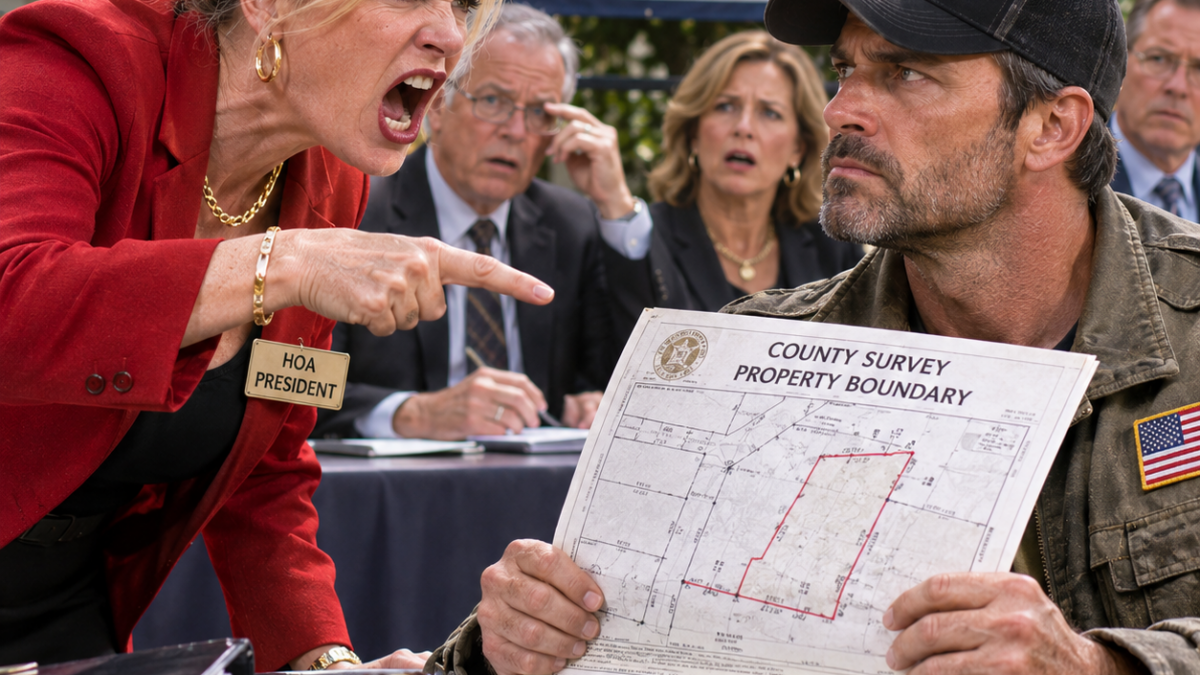
The room went silent.
I looked at her for a long moment.
“I’m not above the rules, Karen.”
I slid the county plat across the table.
“That’s why I brought the ones you can’t rewrite.”
My name is Daniel Rhodes.
I served twelve years in the United States military.
When I left active service, I wasn’t looking for a confrontation.
I wasn’t looking for attention, political arguments, neighborhood disputes, or another person in a position of authority telling me where I could stand.
I wanted quiet.
A modest cabin.
Open land.
A fence that marked the edge of what belonged to me.
And the simple freedom to wake in the morning without having to explain myself to anyone.
That was why I’d bought the property outside Ridgeview.
It wasn’t inside the neighborhood development.
It wasn’t subject to its recorded covenants.
There were no association dues.
No architectural committee.
No board deciding whether the paint on my cabin was acceptable.
I checked all of that before purchasing it.
I paid for a survey.
I reviewed the deed.
I examined the county records.
I wanted to know exactly what I owned.
Then I spent several years away, returning whenever I could, always imagining the day I’d come back for good.
When that day finally arrived, I drove through the rusted gate with my windows down and felt something I hadn’t experienced in years.
Relief.
At least, I did until I reached the eastern fence.
The posts were new.
The concrete was fresh.
And the entire line had shifted inward.
Someone had taken a narrow strip of my property and placed it on the other side of a fence I had never authorized anyone to move.
A white metal sign stood beside the corner post.
PRIVATE COMMUNITY BOUNDARY — HOA OVERSIGHT IN EFFECT.
I stared at those words.
Then at the fence.
Then at the field I’d paid for.
I wasn’t confused.
The survey markers were still visible.
The recorded boundary hadn’t changed.
Someone had simply decided that if they moved enough wood and concrete, I might accept their version of reality.
I photographed everything.
Then walked back to my cabin and found an envelope waiting in the mailbox.
Ridgeview letterhead.
A welcome notice.
A demand that I acknowledge community oversight within thirty days.
And at the bottom, one signature.
Karen Wells — HOA President.
I didn’t know her yet.
But I understood the message.
She hadn’t called to ask about a boundary.
She hadn’t requested permission to enter my property.
She’d simply acted, then informed me that I was expected to comply.
The next morning, her white SUV appeared along my access road.
A woman wearing dark sunglasses stepped out carrying a clipboard.
She studied me, then smiled.
“You must be Mr. Rhodes.”
I nodded.
“And you must be the person who moved my fence.”
The smile tightened.
“I’m Karen Wells. President of the Ridgeview Homeowners Association.”
“Then you’ve got a boundary problem.”
She laughed.
“No, Mr. Rhodes. You have a compliance problem.”
I looked at her.
She pointed toward the sign.
“Your property is adjacent to our community, and our board has determined that certain standards apply.”
“Adjacent doesn’t mean included.”
Her eyes narrowed.
“Communities evolve.”
“Deeds don’t change because you say they do.”
She tilted her head.
“I understand you’ve been away for some time.”
“Yes.”
“Then perhaps you should accept that things have changed.”
I glanced toward the moved fence.
“Not legally.”
Karen took one step closer.
Her voice turned cold.
“I suggest you stop making this difficult. Our association has ways of dealing with owners who refuse to cooperate.”
I looked directly at her.
“I’m going to need everything you’re claiming in writing.”
She smiled.
“Oh, you’ll get it.”
Then she returned to her SUV.
And she kept that promise.
The notices came.
Then the fines.
Then the threats.
Then the accusations about my military service.
Then a special assessment designed to punish me for refusing to acknowledge an authority she couldn’t prove existed.
But the morning I opened my mailbox and found a demand for $3,250—along with a warning that Ridgeview intended to place a lien against my land—I realized Karen wasn’t merely trying to control my property. She was counting on fear to make me surrender something that had never belonged to her.
PART2
I had learned long before meeting Karen Wells that some people confuse a calm voice with an easy target.
In the military, I met men who shouted orders because they understood exactly what responsibility meant.
I also met men who shouted because they were terrified someone might question them.
The difference wasn’t volume.
It was accountability.
Real authority could explain itself.
It had a chain of command, a defined responsibility, and limits.
Karen had a clipboard.
And, apparently, she believed that was enough.
The first time I walked my property after returning home, I hadn’t expected to use any of the habits I’d developed during twelve years of service.
But they’re difficult to turn off.
You notice the small things.
A tire track that wasn’t there before.
A gate that doesn’t close quite the same way.
New soil against old wood.
Fresh concrete where you remember dry earth.
An unfamiliar object placed where it has no reason to be.
The eastern fence bothered me before I’d even reached it.
I’d stood at the edge of the lower field, looking toward the tree line, trying to understand why the view felt wrong.
Then I noticed the alignment.
Three posts were no longer where they belonged.
Farther along, the line drifted inward another foot or two.
The changes were subtle enough that a stranger might never have noticed.
But I’d walked that boundary dozens of times.
I’d paid a surveyor to establish it.
I’d stood with him while he explained the markers.
I’d kept copies of the measurements.
I knew the land.
I crouched beside one of the posts and pressed my fingers against the pale concrete.
Recent work.
Someone had made a deliberate decision to change my fence.
I looked beyond it.
My ground was still there.
Only now, it appeared to belong to somebody else.
I remember saying aloud, “You’ve got to be kidding me.”
The wind moved through the grass.
Nothing answered.
Then I saw Karen’s sign.
White metal.
Black lettering.
Official-looking language.
The kind of sign designed to make people assume that someone with actual authority had approved it.
I walked around it, photographing the installation from several angles.
The sign had been placed inside my recorded boundary.
I knew that before I checked the paperwork.
But knowing something and proving it are different things.
I had enough experience with disputes to understand that.
And I wasn’t about to begin pulling out fence posts simply because someone had decided to put them in the wrong place.
I wanted documentation.
Dates.
Photographs.
A clear comparison against the survey.
And eventually, an explanation from whoever had ordered the work.
At the time, I didn’t realize how much paper I’d collect before the matter was over.
My cabin wasn’t fancy.
It was a single-story building with wooden floors, a stone fireplace, and a covered porch overlooking the lower field.
The kitchen had old cabinets that worked perfectly well.
The table was solid oak.
There were two bedrooms, though I rarely used the second.
And the windows opened toward a stand of trees that turned deep orange every fall.
I’d bought the place because I wanted something permanent.
During my military career, permanence had been a luxury.
Assignments changed.
Schedules changed.
People moved.
Plans dissolved.
You learned to keep your belongings organized and your expectations flexible.
But the cabin wasn’t supposed to be temporary.
I had bought the land while I was still serving.
Every payment represented a step toward a future where I would decide how to spend my mornings.
My buddies sometimes joked that I was becoming an old man before my time.
“You’re going to spend retirement arguing with squirrels,” one of them said.
I laughed.
“Sounds better than arguing with you.”
We all had our ideas about what life after service would look like.
Mine was simple.
Coffee on the porch.
A truck that didn’t need to be parked according to someone else’s schedule.
Room to walk.
And no one treating every ordinary decision like a violation.
I’d never imagined the biggest challenge of returning home would be a woman in sunglasses claiming the right to move my fence.
After Karen’s first visit, I went inside and opened the folder containing my closing documents.
The deed was exactly where I’d left it.
County stamp.
Recorded legal description.
Parcel identification.
Survey reference.
I unfolded the original survey beside it.
Then pulled up the county maps on my laptop.
The property had not changed.
No recorded transfer of the disputed strip.
No amendment placing my land inside Ridgeview.
No new easement giving the HOA control over the fence.
I checked the tax records.
Still my parcel.
Still the same acreage.
Still the same boundary description.
I sat back and looked toward the window.
The moved fence was visible across the field.
Karen’s sign caught the afternoon sunlight.
I tried to imagine an innocent explanation.
Perhaps a contractor had misread a map.
Perhaps the HOA had commissioned a survey that contained an error.
Perhaps someone genuinely believed the community extended farther than the county records showed.
Those possibilities would have been worth discussing.
But Karen hadn’t approached me as someone trying to correct an error.
She’d approached me as someone who expected obedience.
And that bothered me.
Not because I couldn’t tolerate being told no.
Because she was claiming power over land she had no documented right to control.
The first letter arrived three days later.
It was printed on Ridgeview stationery with a little logo in the corner.
A tree.
A winding road.
The words Community Standards and Compliance Office.
I read the opening paragraph.
Notice of Observed Non-Compliance.
I almost laughed.
The letter stated that my fence placement was inconsistent with community boundary alignment.
It instructed me to correct the issue within fourteen days.
It warned that failure to comply could result in penalties.
But there was no survey attached.
No legal description.
No recorded covenant.
No explanation of how Ridgeview had acquired authority over my parcel.
Just a deadline.
I placed the letter beside my deed.
Then photographed the envelope.
The postmark.
The letter itself.
I created a folder on my computer.
Ridgeview HOA.
At the time, I expected it to contain only a few files.
That expectation didn’t last long.
Two days later, a thicker envelope appeared.
Inside was a list of alleged violations.
Improper fence alignment.
Failure to acknowledge community oversight.
Unauthorized signage interference.
I read the third accusation twice.
Unauthorized signage interference.
Apparently, photographing a sign on my own property had somehow become an offense.
Then I reached the bottom of the page.
Administrative review fee: $250.
I stared at it.
An organization that couldn’t prove authority over my land was charging me for its decision to review the authority I disputed.
I sat at the kitchen table with the letter in front of me.
For a moment, I considered calling Karen.
I could already hear the conversation.
She would talk about standards.
I would ask for documentation.
She would claim I was being difficult.
Nothing would be resolved.
So I didn’t call.
Instead, I added the notice to my folder.
Then wrote a brief entry in my notebook.
Date received.
Date printed.
Fee claimed.
Deadline.
Authority cited.
For that last item, I wrote one word.
None.
The third letter accused me of excessive resistance.
The fourth announced a higher administrative charge.
Soon the figures climbed.
Five hundred dollars.
Seven hundred fifty.
Then twelve hundred.
Each notice referenced earlier accusations as though repeating them transformed them into established facts.
Karen’s language became more aggressive.
Mandatory.
Non-negotiable.
Final opportunity.
Intent to proceed.
I read everything.
And the more I read, the less it looked like a genuine effort to resolve a property dispute.
There was no meaningful discussion of the boundary.
No effort to compare surveys.
No invitation to inspect the county plat.
Instead, the letters focused on my refusal to acknowledge Ridgeview’s authority.
Karen seemed to believe that if she accused me of refusing to cooperate often enough, someone would eventually forget that she’d never proved I was required to cooperate in the first place.
That was the pattern.
Create a demand.
Treat the demand as legitimate.
Punish refusal.
Use the punishment as evidence of further wrongdoing.
Then increase the pressure.
It was simple.
And if the recipient became exhausted or frightened enough, it might work.
The first neighbor to speak to me was a man who lived farther down the road.
I didn’t know him well.
He drove an older pickup with a dented tailgate.
One afternoon, he slowed near my driveway.
I was standing by the fence taking measurements.
He rolled down the window.
“You having trouble with Ridgeview?”
I looked toward him.
“You could say that.”
He glanced toward the road behind him.
Then lowered his voice.
“Karen?”
I nodded.
He let out a humorless laugh.
“Yeah.”
I waited.
He looked toward the sign.
“She did something similar to a neighbor last year.”
“What happened?”
The man shifted in his seat.
“Fines. Notices. Threatened to put a lien on his property.”
I felt my stomach tighten.
“Was he in the HOA?”
He hesitated.
“That’s the thing. Nobody seemed sure.”
I looked toward the moved fence.
“Did he challenge it?”
The man shook his head.
“Paid to make it stop.”
He glanced behind him again.
Then said, “Be careful.”
Before I could ask another question, he drove away.
I stood there holding my measuring tape.
For the first time, I wondered whether Karen’s treatment of me was part of something much larger.
By the end of the following week, the pressure had become almost constant.
Another letter arrived.
Then an email.
Then a second email reminding me that the first required a response.
The deadlines were growing shorter.
Fourteen days became seven.
Seven became five.
One letter was mailed after the date it claimed I’d already missed.
I noticed because I’d begun keeping the envelopes.
The postmark showed one date.
Karen’s printed deadline showed another.
I placed them side by side.
Then circled the contradiction.
I checked earlier letters.
Found another.
Then another.
I stared at the growing timeline.
This wasn’t merely inconvenient paperwork.
It was a mechanism for manufacturing non-compliance.
If Karen sent a letter with a deadline that had already expired, she could claim I’d failed to act.
Then she’d use that supposed failure to justify the next penalty.
I made copies.
Scanned every page.
Saved the images in two places.
And started a separate log.
The binder grew thicker.
Karen’s authority didn’t.
When I finally sent my first formal response, I kept it short.
I identified my parcel.
Referenced the recorded deed.
Requested Ridgeview’s governing documents.
Asked for any recorded amendment that purported to place my land under the association.
Requested the survey supporting the fence relocation.
And asked that all future communication be in writing.
I sent the letter by certified mail.
I kept the receipt.
Three days later, Karen replied by email.
Your concerns have been noted. Existing compliance deadlines remain unchanged.
That was all.
No records.
No survey.
No legal basis.
I read the message twice.
Then printed it.
I wasn’t surprised.
But I was disappointed.
An honest mistake becomes easier to resolve when someone is willing to explain how it happened.
Karen wasn’t willing to explain.
She wanted to keep the discussion focused on my refusal.
And that told me the conflict wasn’t really about the fence anymore.
It was about whether I would accept her authority without evidence.
Her next visit came while I was loading equipment into my truck.
I heard gravel crunch behind me.
Then an engine shut off.
I turned.
Karen stood beside her white SUV, sunglasses on, clipboard pressed against her hip.
She didn’t bother with a greeting.
“Mr. Rhodes, I understand you’ve been questioning our authority.”
I closed the tailgate.
“Yes.”
Her expression tightened.
“And referencing your military background.”
“I mentioned my service.”
She took a step closer.
“Well, let me clarify something.”
I waited.
“Your military history doesn’t exempt you from community standards.”
I looked toward the fence.
“I never said it did.”
She frowned.
“You keep bringing it up.”
“Because you’ve been treating my objections as though they’re a personal challenge rather than a request for documentation.”
Her mouth tightened.
“This is a private community matter.”
“Then explain how my land became part of your community.”
She sighed dramatically.
“Mr. Rhodes, we have already discussed this.”
“No, Karen. You’ve told me what you want. That’s different.”
She stared.
Then said something that made me stop thinking of her behavior as mere arrogance.
“You veterans always think—”
She broke off.
For a moment, the unfinished sentence hung between us.
I looked at her.
“Always think what?”
Her eyes narrowed.
“That you deserve special treatment.”
I remained still.
Then answered, “I deserve the same property rights as anyone else.”
She gave a short, contemptuous laugh.
“That’s what they all say.”
I watched her carefully.
She’d crossed from discussing property boundaries into attacking the person challenging her.
It didn’t automatically establish an unlawful discrimination claim.
But it was relevant conduct, and I intended to document it accurately.
“Is that your official position?” I asked.
Her eyebrows rose.
“What?”
“About veterans.”
She stared.
I continued.
“Because you’ve made your opinion pretty clear.”
Karen adjusted her clipboard.
“My position is that you are required to comply.”
“Then put your authority in writing.”
She smiled coldly.
“You’ll be hearing from us.”
I nodded.
“Good.”
She turned away.
And as she walked toward her SUV, I said, “Karen?”
She stopped.
“I’m documenting this conversation.”
Her shoulders stiffened.
Then she glanced back.
“So am I.”
I looked toward the fence.
“Then make sure you write down what you actually said.”
She slammed her door.
The SUV pulled away, scattering gravel behind it.
I stood in the driveway until the dust settled.
Then went inside and added another page to the binder.
I didn’t sleep much that night.
Not because Karen frightened me in the ordinary sense.
I’d dealt with more immediate dangers in my life.
But there was something exhausting about a threat that never seemed to end.
It wasn’t a single confrontation.
It was an envelope in the mailbox.
An email on the computer.
A stranger watching from the road.
A new deadline.
Another demand.
Then the suspicion that tomorrow would bring something else.
When you’re constantly anticipating the next problem, ordinary peace becomes difficult.
I found myself glancing toward the driveway whenever I heard an engine.
Checking the mailbox even when I knew the carrier hadn’t come.
Rereading notices at midnight.
Thinking through conversations when I should have been asleep.
I had returned to the cabin to leave constant vigilance behind.
Karen had brought it to my doorstep.
Around midnight, I made coffee.
Spread the documents across the kitchen table.
And decided to examine everything from the beginning.
The deed first.
Then the survey.
Then the latest county plat.
Then Ridgeview’s governing documents.
I had obtained a copy of the HOA declaration.
It was a thick collection of pages written in the kind of language that makes ordinary people want to close the folder before finishing the first paragraph.
Definitions.
Restrictions.
Assessments.
Common areas.
Administrative responsibilities.
Enforcement procedures.
I read every page that concerned membership and property boundaries.
The declaration described specific lots inside the Ridgeview development.
Mine wasn’t among them.
It described certain common areas.
None extended onto my property.
It listed the procedure for amendments.
There was no recorded amendment adding my land.
I studied the documents for hours.
Then returned to the notice Karen had sent.
Property ownership within proximity to Ridgeview creates obligations to comply with established community standards.
I stared at that sentence.
Proximity.
Not membership.
Not recorded restrictions.
Proximity.
Karen was trying to turn the fact that my land sat near the neighborhood into a justification for controlling it.
I had purchased this property precisely because it was outside those boundaries.
That distinction mattered.
And I was determined to make sure the record reflected it.
The following morning, I drove to the county records office.
I wanted certified copies of the current plat and any relevant recorded instruments.
The clerk was a middle-aged woman with reading glasses hanging from a chain around her neck.
She listened while I identified the parcel.
Then pulled up the records.
I asked whether any annexation, amended covenant, or recorded boundary change appeared to affect my property.
She checked.
Then shook her head.
“Nothing here indicates that.”
I exhaled.
“Could I get copies?”
“Of course.”
She printed the documents.
Stamped what needed certification.
Then placed everything in a folder.
Before I left, she glanced toward the original survey.
“Property dispute?”
“Something like that.”
She smiled faintly.
“Well, recorded documents are a good place to start.”
I almost laughed.
“You have no idea.”
Outside, I stood beside my truck with the folder in my hands.
The courthouse steps were warm beneath the afternoon sun.
People walked past carrying their own paperwork.
Birth certificates.
Property records.
Marriage licenses.
A thousand ordinary matters recorded by a system designed to remember what people might later forget or dispute.
I looked down at my documents.
Karen’s sign hadn’t changed the deed.
Her letters hadn’t moved the county boundary.
Her assessments hadn’t created ownership rights.
Whatever she believed, the recorded facts were still there.
And now I had fresh copies.
That afternoon, a woman walking her dog slowed near my driveway.
She glanced toward the HOA sign.
Then toward me.
“She’s been busy.”
I looked up.
“Karen?”
The woman nodded.
Then immediately looked down the road.
“Don’t tell her I said anything.”
I stepped back so she wouldn’t feel crowded.
“I’m not looking to put anybody in the middle.”
She gave a nervous laugh.
“We’re already in the middle.”
Before I could respond, she continued walking.
I watched her go.
Her words stayed with me.
We’re already in the middle.
Karen hadn’t simply moved my fence.
She had created an atmosphere in which neighbors were afraid to discuss what was happening in their own community.
That bothered me more than I expected.
I had spent years serving in an institution where accountability was supposed to matter.
Now I was looking at a small neighborhood association that seemed to operate by convincing people it was dangerous to disagree.
The older man came three nights later.
I was washing dishes when I heard a knock.
Not aggressive.
Just three careful taps.
I opened the door.
He stood on the porch holding a folded piece of paper.
I’d seen him driving past before.
He wore an old denim jacket and looked uncomfortable.
“Mr. Rhodes?”
“That’s me.”
He glanced toward the road.
“I don’t want my name involved.”
I nodded.
“All right.”
He held out the paper.
“Thought you should see this.”
I unfolded it.
Ridgeview letterhead.
A violation notice.
An administrative fee.
A warning about escalation.
The wording was almost identical to Karen’s letters.
Only the address was different.
I looked up.
“When did you get this?”
“Last year.”
“And what happened?”
He rubbed a hand across his face.
“I paid.”
I waited.
He looked ashamed.
“Couldn’t afford a lawyer. Didn’t want trouble. My wife was sick.”
I felt my expression soften.
“You did what you thought you had to do.”
He nodded.
“She kept sending letters.”
“How much?”
He looked away.
“More than I should’ve paid.”
For a moment, we were quiet.
Then he said, “I heard you weren’t backing down.”
I glanced toward the folder in my hand.
“I’m asking her to prove what she’s claiming.”
He gave a small, bitter laugh.
“That’s more than most of us ever did.”
Then he stepped backward.
“I’ve got to go.”
“Thank you for bringing this.”
He nodded.
And disappeared into the darkness.
I stood on the porch holding his letter.
For the first time, my binder contained evidence of Karen’s conduct toward someone other than me.
And I knew the problem was wider than my property.
The next few days brought more documents.
An envelope appeared in my mailbox without a return address.
Inside were copies of emails Karen had sent to another resident.
The language was familiar.
Failure to cooperate.
Administrative burden.
Potential enforcement.
Then a couple stopped beside my driveway one evening.
They explained that Karen seemed to increase penalties against anyone who questioned her.
“She doesn’t do it to everyone,” the husband said.
His wife nodded.
“Just the people she thinks won’t fight back.”
I looked toward the fence.
The woman lowered her voice.
“Or the ones she thinks nobody will defend.”
I didn’t know what to say.
The pattern was becoming clearer.
But I also understood that the neighbors were frightened.
I wasn’t going to use their stories recklessly.
If I needed them as formal witnesses, they had to decide whether to participate.
I could preserve what they voluntarily provided.
I could listen.
I could encourage them to seek independent advice.
But I couldn’t promise them protection I had no power to guarantee.
So I thanked them.
And kept building the record.
Karen noticed the change.
I knew because the next notice wasn’t about the fence.
It was about me.
Continued resistance to community governance.
Disruptive owner conduct.
Failure to acknowledge established authority.
Then came a new accusation.
Heightened scrutiny warranted due to non-cooperation.
I read that phrase several times.
Heightened scrutiny.
Because I asked for the recorded document establishing jurisdiction.
It was almost absurd.
But I had stopped laughing at the notices.
Their language was too deliberate.
Karen wanted my objections to become the problem.
If she could make the board believe I was a difficult owner, maybe they wouldn’t ask whether she had any authority over me.
That was the weakness in her strategy.
It depended on everyone accepting the first assumption.
That Ridgeview could control my land.
Everything else flowed from that.
But if the assumption failed, so did the fines, the assessments, and the threatened lien.
I highlighted the phrase.
Then filed the notice behind the others.
The certified letter arrived on a Friday.
I signed for it at the post office.
The envelope was thicker than the others.
The return address belonged to Ridgeview’s management office.
I sat in my truck and opened it.
Two pages.
Formal heading.
Heavy black lettering.
NOTICE OF SPECIAL ASSESSMENT — NON-PARTICIPATORY OWNER.
I stared at the title.
Non-participatory owner.
I wasn’t a participating member of Ridgeview because my property didn’t belong to Ridgeview.
Karen had turned that fact into an accusation.
Then I read the amount.
$3,250.
The notice claimed I had created an administrative burden by refusing to cooperate.
It warned of potential lien proceedings.
It referenced a compliance hearing.
And it threatened suspension of community privileges.
I looked out through the windshield.
There was no Ridgeview clubhouse I used.
No community swimming pool.
No shared facilities.
No services provided to my property.
Karen was threatening to suspend privileges I didn’t have.
I read the document a second time.
Then a third.
The fear had begun giving way to something more precise.
Not satisfaction.
Clarity.
Karen wasn’t trying to resolve a boundary disagreement.
She was trying to make resistance expensive enough that I’d stop.
I placed the letter in its envelope.
Then drove home.
That evening, I sat on the porch as the sun dropped behind the trees.
I held the assessment notice in one hand.
The original survey lay on the table beside me.
The difference between them was almost laughable.
One was a recorded document supported by measurements and a professional survey.
The other was a demand signed by a woman who hadn’t produced a single piece of evidence showing my property belonged to her association.
I could have paid the $3,250.
It wouldn’t have ruined me.
But paying would have meant acknowledging a demand I believed had no lawful basis.
And it wouldn’t necessarily have ended anything.
Karen could invent another fee.
Another deadline.
Another reason to pressure me.
That’s when I made a decision.
I would stop treating each notice as an isolated annoyance.
I would address the entire pattern.
The fence.
The sign.
The false claim of jurisdiction.
The fines.
The deadlines.
The threatened lien.
And Karen’s increasingly personal comments about my military background.
If she wanted a formal process, I would give her one.
Only this time, she wouldn’t be the person deciding which documents mattered.
The hearing notice arrived the following Monday.
Wednesday.
Six o’clock.
Ridgeview compliance board.
Mandatory attendance was implied, though the letter provided no convincing explanation of why the association could compel a nonmember to appear.
I read it.
Then called the number on the page.
A woman answered.
“Ridgeview management.”
“Daniel Rhodes. I received a notice for a compliance hearing.”
“Yes, sir.”
“Where is it being held?”
She gave me an address.
Then added, “You should be prepared to discuss your violations.”
I looked toward the binder on my kitchen table.
“I will be prepared.”
For two days, I organized everything.
Not simply because I wanted to win an argument.
Because I knew the easiest way to discredit someone was to make him sound emotional and disorganized.
Karen would have a list of accusations.
I needed a clear response to each one.
I divided the binder into sections.
Property ownership.
Recorded boundary.
HOA declaration.
Correspondence.
Assessment history.
Deadline inconsistencies.
Neighbor-provided documents.
Statements concerning my service.
Legal questions requiring counsel’s review.
I made an index.
Printed copies.
Numbered pages.
Prepared a timeline.
Then checked it all again.
By the night before the hearing, my kitchen table looked like a records office.
I sat back in my chair.
The house was silent.
Outside, wind moved through the trees.
I looked at the first photograph I’d taken.
The fresh concrete.
The fence shifted inward.
Karen’s sign.
It was strange how something so small could expand into something that consumed weeks of your life.
I hadn’t wanted any of this.
I wanted to repair the cabin.
Walk the property.
Sit on the porch.
Maybe plant a few trees.
Instead, I was preparing to defend my right to land I already owned.
I closed the binder.
And went to bed.
The Ridgeview community room looked like a converted garage.
Low ceiling.
Dusty blinds.
Mismatched chairs.
A folding table at the front.
A coffeemaker on a small counter.
There were five seats behind the table.
Karen occupied the center.
Of course she did.
She wore a tailored jacket and a carefully controlled expression.
Four board members sat around her.
An older woman with silver hair.
A man in his sixties.
Two younger members who seemed nervous.
Karen looked up as I entered.
“Mr. Rhodes.”
I nodded.
“Karen.”
Her smile tightened.
“I see you decided to cooperate.”
I held up my binder.
“I came to hear the basis for your claims.”
She frowned.
“That’s what this hearing is for.”
“Good.”
I took a seat.
Karen watched me for another moment.
Then opened her folder.
She began with the fence.
Then the notices.
Then the alleged administrative burden.
Her language was polished.
Community cohesion.
Established governance.
Pattern of resistance.
Refusal to participate in good faith.
Every phrase made me sound like a disruptive resident rather than an owner asking why strangers had moved his fence.
She spoke for ten minutes.
I didn’t interrupt.
Not once.
I took notes.
When she reached the special assessment, she looked directly at me.
“Mr. Rhodes’s continued refusal has forced this association to dedicate considerable resources to enforcement.”
I wrote down her words.
She continued.
“Our board therefore has grounds to proceed with the $3,250 assessment and initiate the necessary steps concerning the outstanding balance.”
I looked up.
“Are you finished?”
Her mouth tightened.
“For now.”
I stood.
Then opened the binder.
I handed the first page to each board member.
The county plat.
Then the recorded deed reference.
Then the Ridgeview boundary description from its own declaration.
The older woman began reading immediately.
I waited until everyone had the documents.
Then said, “My property is outside Ridgeview.”
Karen gave a small laugh.
“That has been disputed.”
“By whom?”
She blinked.
“By the association.”
I pointed toward the county map.
“Where is the recorded amendment placing my parcel inside your boundaries?”
Karen glanced toward another board member.
“We’ve already discussed the community survey.”
“Then I’d like to see it.”
She frowned.
“Our survey was professionally prepared.”
“Where is it?”
Silence.
I continued.
“Who conducted it?”
Karen adjusted her papers.
“We don’t need to debate technical details.”
I looked toward the board.
“The technical details are what determine where the boundary is.”
The older woman lifted her head.
“Mr. Rhodes, this map appears to show your property outside Ridgeview.”
“Yes, ma’am.”
She turned toward Karen.
“Where is the updated map?”
Karen’s smile vanished.
For the next several minutes, the room felt increasingly uncomfortable.
Karen tried to explain that the neighborhood had expanded.
I asked for the recorded document.
She said the board had approved a new interpretation.
I asked for the minutes.
She insisted that community standards applied to adjacent properties.
I asked where the recorded covenants established that obligation.
She accused me of being uncooperative.
I pointed to the documents I’d provided.
Then the older man cleared his throat.
“Karen.”
She turned sharply.
“What?”
He looked at the map.
“Did we actually vote to extend the association boundary?”
Karen stared.
“We discussed it.”
“That’s not what I asked.”
Her jaw tightened.
“We agreed that the eastern properties needed oversight.”
I looked toward him.
He continued.
“Was there a formal vote?”
Karen’s voice rose.
“This is becoming ridiculous.”
The man looked down at the documents.
Then asked the question I’d been waiting to hear.
“Did we have the authority to move his fence?”
Silence.
Karen looked at me.
And I saw something I hadn’t seen before.
Uncertainty.
I opened the next section.
The fines.
The deadlines.
The assessments.
I placed the notices in chronological order.
Then showed the postmarks.
One board member leaned forward.
“This deadline expired before the letter arrived.”
“Yes.”
He frowned.
“How was he supposed to comply?”
I looked toward Karen.
“That’s what I asked.”
She scoffed.
“Administrative timing issues don’t invalidate the underlying violations.”
I nodded.
“Then identify the underlying violation and the authority supporting it.”
She slammed her pen onto the table.
“Mr. Rhodes, you’ve made your position clear!”
I held her gaze.
“And I’m asking you to make yours clear.”
Her face reddened.
“I don’t have to sit here and be interrogated.”
The older woman spoke.
“Karen, he has a right to ask questions about a proposed lien.”
Karen turned toward her.
“We’re supposed to be united.”
The woman looked down at the plat.
“United about what?”
Another silence.
I could almost see the moment the board began realizing that Karen’s confidence had been standing in for evidence.
Then I presented her statements about my military service.
I didn’t exaggerate them.
Didn’t claim they automatically proved a federal violation.
I simply identified what she’d said and provided the relevant correspondence.
Karen looked furious.
“My comments were taken out of context.”
I nodded.
“Then explain the context.”
She folded her arms.
“You repeatedly invoked your military history.”
“Yes.”
“Because you wanted special treatment.”
“No.”
I looked around the table.
“I wanted the same treatment any property owner should receive.”
I lifted the county plat.
“Recognition of my recorded boundary.”
Then the notice.
“A lawful basis for assessments.”
Then Karen’s email.
“And an explanation that didn’t involve personal remarks about my service.”
She sneered.
“Your military background is irrelevant.”
I nodded slowly.
“To the ownership question, the deed and survey are what matter. I agree.”
Karen blinked.
I continued.
“But if your enforcement decisions changed because you resented my background, that’s a separate issue that deserves review.”
Her expression hardened.
“You’re threatening this board with federal action?”
“No.”
I looked directly at her.
“I’m explaining why I’ve preserved what you’ve written.”
One of the younger board members finally spoke.
“I don’t understand why we’re doing this.”
Karen turned.
“Excuse me?”
He looked toward the documents.
“If his land isn’t part of Ridgeview, why are we sending notices?”
She opened her mouth.
He continued.
“And why is there a special assessment?”
Karen’s voice rose.
“Because he refuses to cooperate!”
The younger member shook his head.
“But cooperate with what?”
I stood quietly.
I didn’t need to answer.
Karen had been asked the question by someone on her own board.
And she still couldn’t explain it.
The meeting ended without the punishment she’d promised.
The board requested additional time to review the records.
No vote authorizing a lien occurred.
No immediate enforcement action was approved.
Karen looked furious.
She closed her folder so hard that the table shook.
Then stood.
“This isn’t finished.”
I gathered my documents.
“I know.”
Her eyes narrowed.
“You think you’ve embarrassed me.”
I looked toward the board members gathering their papers.
“No, Karen.”
I closed my binder.
“I think you’ve finally had to answer questions.”
She stared.
I continued.
“And you didn’t like them.”
Then I walked out.
The night air felt cool against my face.
I sat in my truck for several minutes before starting the engine.
My hands were steady.
But my shoulders ached.
It was the kind of fatigue that arrives after holding your attention on one problem for too long.
The hearing hadn’t ended the dispute.
Karen still occupied the president’s chair.
The moved fence was still standing.
The sign still claimed HOA oversight.
And the fines still existed in Ridgeview’s records.
But something had changed.
For the first time, other board members had examined documents instead of relying on Karen’s interpretation.
They had asked questions.
They had hesitated.
And Karen couldn’t undo that.
As I drove home, I thought about the older woman looking at the map.
Her expression when she realized my parcel wasn’t included.
That moment mattered.
Not because she had already decided in my favor.
But because she’d begun looking for proof.
Karen had spent months depending on people not doing that.
The next morning, an email arrived.
It wasn’t from Karen.
The sender was Ridgeview’s board secretary.
The message stated that further assessment activity concerning my property would be paused while the board reviewed the documents.
I read it twice.
Then printed it.
For the first time, Ridgeview had acknowledged uncertainty.
A small thing.
One paragraph.
But I placed it at the front of the correspondence section.
Because the pause mattered.
Karen had been issuing deadlines as though she controlled every hour of the process.
Now the board had stopped the clock.
And she wasn’t the one deciding when it would start again.
I could have left things there.
Waited to see whether the board resolved the dispute.
Maybe received an apology.
Perhaps had the notices withdrawn.
But the fence was still in the wrong place.
And I had begun hearing too many stories from neighbors who’d paid fines simply because they were frightened.
A temporary pause wasn’t enough.
I needed a formal resolution.
So I contacted an attorney.
His office was in a modest building downtown.
No elaborate furniture.
No dramatic wall of law books.
Just a desk, two chairs, and framed qualifications.
He greeted me, then gestured toward the seat opposite him.
“Tell me what happened.”
I placed the binder on his desk.
Then began.
The fence.
The sign.
The letters.
The assessments.
The hearing.
Karen’s statements.
The neighbor complaints.
I spoke slowly.
Allowed him to examine the records.
Answered questions.
When I finished, he leaned back.
“You’ve done a substantial amount of documentation.”
I nodded.
“It seemed necessary.”
He looked toward the survey.
“It was useful.”
For a moment, neither of us spoke.
Then he said, “The first issue is whether the association has any recorded authority over your property.”
I pointed toward the county plat.
“That’s what I’ve been asking.”
He nodded.
“The second is the physical fence relocation.”
I waited.
“And the third concerns the pattern of enforcement and the statements you’ve described.”
I looked toward the table.
“Can we stop them?”
He spoke carefully.
He explained that the property question could be pursued through the appropriate state legal procedures, while any civil-rights concerns would need to be evaluated under the actual requirements of the applicable law.
He didn’t promise that being a veteran automatically turned an HOA dispute into a federal case.
He wanted to examine the facts.
The specific conduct.
Any protected classifications or activities implicated.
The governing documents.
And the available remedies.
I appreciated that.
For weeks, Karen had spoken in absolute declarations.
My attorney spoke in questions that could be answered with evidence.
That felt like a different kind of authority.
We discussed the possibility of a formal demand.
Records requests.
Preserving the correspondence.
Obtaining an independent boundary assessment if needed.
And submitting complaints to agencies with potential jurisdiction.
I told him about the neighbors.
The fine notices.
The way Karen seemed to target people she believed were unlikely to challenge her.
He made notes.
Then asked, “Would any of them be willing to provide statements?”
“Some might.”
He nodded.
“Don’t pressure them. Let them decide.”
I agreed.
He looked at the binder again.
Then said, “Whatever happens next, keep documenting.”
I almost smiled.
“That part I can do.”
I filed complaints through the appropriate channels with counsel’s assistance.
One concerned the property and consumer issues.
Another requested review of whether Karen’s conduct and the association’s enforcement practices raised a cognizable fair-housing or discrimination issue.
I didn’t assume the agencies would accept every theory.
I didn’t expect a letter from Washington to appear the next morning and solve everything.
But I wanted the allegations evaluated outside Karen’s control.
The filings contained the evidence I’d collected.
The recorded deed.
The plat.
Photographs of the fence.
Copies of notices.
The deadlines.
The assessment.
Her written comments.
And the chronology.
Then I waited.
Waiting was harder than I expected.
When I had been collecting documents, I always had something to do.
A letter to scan.
A map to check.
A date to record.
Now much of the matter was in other people’s hands.
I still walked the fence.
Still checked the sign.
Still looked toward the road whenever a white SUV passed.
But the mailbox was quiet.
Karen wasn’t writing as often.
The board had stopped sending new fines.
And the absence of threats felt almost as strange as their arrival had.
I had spent so long reacting to pressure that I didn’t immediately know what to do without it.
One afternoon, I stood on the porch holding my coffee.
The sun warmed the railing.
A bird landed on the fence.
Beyond the field, the trees moved gently in the breeze.
It was the view I’d imagined while serving.
The simple quiet I’d wanted.
But instead of enjoying it, I found myself listening for another vehicle.
I realized then how much the dispute had cost me.
Not only time.
Not only legal expenses.
Peace.
The ability to stand on my own porch without anticipating an argument.
I wanted that back.
And I didn’t intend to surrender the land that was supposed to provide it.
The first unmistakable sign that Karen was losing control came from a neighbor I had never spoken to before.
He stopped his pickup near my mailbox on a Saturday morning.
I was replacing a loose board on the porch.
He rolled down the window.
“Mr. Rhodes?”
I looked up.
“Yes?”
He glanced toward the road.
Then turned back.
“I heard the board paused your fines.”
I set down my hammer.
“That’s what they told me.”
He nodded.
“Good.”
I waited.
He rubbed the steering wheel with one hand.
Then said, “She tried to charge my sister for landscaping violations.”
I frowned.
“Karen?”
“Yeah.”
“What happened?”
“She paid.”
He looked embarrassed.
“Didn’t have the time or money to argue.”
I nodded slowly.
He continued.
“Then Karen came back with another notice.”
My stomach tightened.
“Same kind of thing?”
“Different violation. Same threats.”
I looked toward the fence.
He followed my gaze.
“People are talking now.”
“About what?”
“About how much she’s been collecting.”
I turned back.
He looked serious.
“Some of them want answers.”
I didn’t know whether that would lead anywhere.
But the fact that people were asking was important.
For months, Karen had relied on silence.
Now it was beginning to break.
A week later, the older man who’d brought me his fine notice returned.
This time, he didn’t stand nervously at the edge of my porch.
He walked up the steps.
Knocked.
And waited.
When I opened the door, he held another envelope.
“Found something.”
I invited him inside.
We sat at the kitchen table.
He took out copies of two payments he’d made to Ridgeview.
The amounts were modest individually.
But together they represented money he’d needed for other things.
He looked down.
“My wife was dealing with appointments, and I just wanted them to stop bothering us.”
I nodded.
“Did you ever see a vote authorizing the fees?”
He shook his head.
“Never asked.”
I looked at the papers.
He continued.
“Do you think I can get it back?”
I took a breath.
“I can’t promise that.”
He nodded.
“But I think you should have the assessments reviewed.”
I gave him the contact information for the appropriate local resources and suggested he consider independent legal advice.
He studied the papers for a long moment.
Then said quietly, “I thought paying meant it was over.”
I looked at him.
“Sometimes people count on that.”
He nodded.
Then looked toward the window.
“Not anymore.”
The association’s outside counsel contacted my attorney shortly afterward.
The email was brief.
Formal.
Carefully worded.
Ridgeview acknowledged that enforcement concerning my property would remain suspended pending further review.
It also stated that communication would proceed through counsel.
Karen’s name wasn’t on it.
That absence spoke volumes.
For weeks, she’d treated every notice as an opportunity to remind me she controlled the process.
Now someone else was writing the letters.
Someone who understood that each sentence could be examined later.
I printed the email.
Added it to my binder.
Then went outside.
The HOA sign still stood beside the eastern fence.
I looked at it for a long time.
It had become so familiar that I almost hated admitting how much it bothered me.
A simple metal rectangle.
Four words claiming oversight.
Nothing physically imposing.
Yet it represented everything I’d spent months resisting.
I wanted to pull it out of the ground.
Carry it to Karen’s office.
Drop it on her desk.
And tell her never to put it back.
But I didn’t.
My attorney was handling the demands.
The sign was evidence.
So I photographed it again.
Then walked away.
The next development came through the federal complaint process.
I received an acknowledgment that the fair-housing allegations had been received for review.
It wasn’t a ruling.
It didn’t establish that Karen had violated federal law.
It didn’t mean an investigator had accepted every assertion in my complaint.
But it meant the information was being considered through a process beyond Ridgeview’s own board.
I called my attorney.
He explained what the acknowledgment did and didn’t mean.
I listened carefully.
Then asked, “So they may look into it?”
“Yes.”
“And Karen can’t decide whether they do?”
“No.”
I sat silently.
For months, she had used her position to control the questions.
Who could speak.
What counted as a violation.
Which deadlines mattered.
Whether objections were considered.
Now someone outside the HOA was deciding what deserved examination.
I looked toward the binder on my desk.
“Good.”
When Karen learned about the complaints, her response was almost immediate.
An email arrived late in the afternoon.
You are advised to avoid direct contact with Ridgeview board members outside official communication channels.
I read it.
Then continued.
Further interference may result in additional action.
No explanation.
No legal basis.
Just another warning.
I forwarded it to my attorney.
Then recorded the date.
It was almost remarkable.
Even after the board paused enforcement, Karen still couldn’t resist trying to intimidate me.
But her language had changed.
Gone were the confident declarations that every matter was final and non-negotiable.
Now she spoke in vague suggestions.
Possible action.
Official channels.
Additional consequences.
Words that sounded threatening but avoided committing to anything specific.
I suspected she was beginning to understand that somebody was reading.
And I wasn’t the only one.
I saw her once that week.
Her white SUV slowed near the access road while I was working outside.
For a moment, I thought she would stop.
She didn’t.
The vehicle rolled forward slowly.
Karen looked toward the fence.
Then toward me.
I could see her through the driver’s window.
No sunglasses.
No clipboard raised triumphantly.
Just a tight expression.
I didn’t wave.
Didn’t call out.
Didn’t approach.
I simply returned to my work.
That seemed to irritate her more than an argument would have.
She accelerated away.
I watched the SUV disappear between the trees.
Then picked up my tools.
I was beginning to understand something about Karen.
She needed a response.
The argument was part of the power she believed she possessed.
If I shouted, she could call me aggressive.
If I threatened, she could portray herself as a victim.
If I complied, she could claim victory.
But if I documented and pursued the matter through an independent process, she couldn’t control the outcome as easily.
And that was what seemed to frighten her.
The site visit occurred on a Tuesday.
My attorney called beforehand.
The investigators wanted to review the physical boundary issue and the evidence related to my complaint.
We arranged to meet at the property.
I prepared the binder.
Not because anyone asked me to make a presentation.
But because I’d learned how much easier it was to answer questions when the documents were organized.
Two investigators arrived in an ordinary vehicle.
They introduced themselves.
Explained the scope of the visit.
Then asked me to walk them through the events.
I began at the gate.
Showed them where I’d parked when I returned.
Where I’d first noticed the fence.
Where Karen’s sign had appeared.
The older investigator took notes.
The younger one photographed relevant locations.
They asked where the original boundary had been.
I showed them the survey markers and the recorded map.
They asked whether I’d authorized the fence work.
“No.”
Whether I had signed any new agreement with Ridgeview.
“No.”
Whether I had received notice before the work.
“Not that I ever found.”
Then they asked about Karen.
I described our conversations.
Her comments.
The notices.
The escalating fines.
The threats concerning liens.
I stuck to what I knew.
When something was uncertain, I said so.
I didn’t need to make the story worse than it already was.
The facts were serious enough.
We stopped near the eastern corner.
One investigator looked from the fence to the survey.
Then toward the sign.
“Who installed this?”
“I don’t know who physically installed it.”
“Who claimed responsibility?”
“Karen Wells, acting for Ridgeview.”
He wrote something down.
Then asked whether I had photographs from the day I returned.
I opened the binder.
Showed him.
He studied the images.
Then looked toward the fresh concrete.
“Thank you.”
That was all.
No dramatic declaration.
No promise that Karen would be punished.
They were there to gather information.
I appreciated the restraint.
After months of being told what the truth supposedly was, I was relieved to meet people willing to examine it.
Inside the cabin, I placed the binder on the kitchen table.
They reviewed copies of the correspondence.
The certified-mail receipts.
The escalation timeline.
The relevant governing documents.
The board’s pause notice.
The comments concerning my service.
One investigator paused at the index.
“This is extensive.”
I nodded.
“It needed to be.”
He looked toward the photographs.
“Why did you keep the envelopes?”
“Because the postmarks didn’t match some of the deadlines.”
He studied the examples.
Then turned to his colleague.
They exchanged a look.
The younger investigator made another note.
For the first time in weeks, I felt the enormous weight of defending every detail beginning to shift.
The documents weren’t merely mine anymore.
Someone else was examining them.
As evidence.
Not as another reason to accuse me of being difficult.
When the investigators left, they didn’t tell me whether I would win.
They didn’t promise charges.
They didn’t declare Ridgeview guilty.
They explained that the review would continue and that I might be contacted for additional information.
I understood.
There were procedures.
Questions of jurisdiction.
Different agencies with different powers.
I had no interest in pretending the process was simpler than it was.
When their vehicle disappeared down the road, I stood beside the gate.
The field stretched quietly beyond me.
The fence was still wrong.
The sign still stood.
But for the first time, I felt that the dispute was being examined on terms Karen couldn’t simply rewrite.
That evening, my attorney forwarded an email from Ridgeview’s counsel.
Karen had been removed from direct involvement in communications concerning my property while the board reviewed her conduct.
I read it slowly.
Then again.
I sat down.
For a long time, I simply stared at the screen.
There was no apology.
No announcement.
No declaration that the matter was finished.
But the woman who had arrived at my fence with sunglasses, a clipboard, and absolute confidence was no longer permitted to handle the dispute the way she had before.
I thought about her first words.
Communities evolve.
You’re expected to comply.
Your military history is irrelevant.
I remembered the way she’d laughed when I asked for legal authority.
Now someone had demanded that she account for her own conduct.
And suddenly, she was quiet.
The neighbors noticed.
A woman passing the driveway one morning stopped and smiled.
“Haven’t seen Karen around lately.”
I looked up.
“Neither have I.”
She glanced toward the sign.
“Think it’ll come down?”
“I hope so.”
She nodded.
Then hesitated.
“People are saying the board might review old fines.”
I looked toward her.
“That would be worth asking about.”
She smiled faintly.
“Some of us are finally asking.”
For a moment, I watched her.
Then said, “Good.”
She continued down the road.
And I felt a quiet satisfaction.
Not because everyone had suddenly chosen my side.
But because people were beginning to recognize that they had a right to ask questions.
That mattered.
Much more than they realized.
The community board posted a notice shortly afterward.
It announced an internal review of enforcement practices.
The language was careful.
Procedural reassessment.
Jurisdictional clarification.
Review of documentation.
It didn’t mention Karen directly.
But I knew what had caused it.
The hearings.
The documents.
The complaints.
The neighbors speaking up.
The inability to establish authority over my parcel.
For months, Ridgeview had operated as though the answer to every question was another demand.
Now the board was asking its own questions.
And Karen had lost the advantage of being the only person interpreting the rules.
I still had difficult nights.
Sometimes I woke before dawn, convinced I’d heard a vehicle near the fence.
Other times, I sat at the kitchen table rereading documents I’d already examined dozens of times.
I knew I was safe.
But knowing that didn’t automatically erase the feeling of being watched.
The dispute had consumed more of my life than I wanted to admit.
I’d stopped making plans.
Put off repairs.
Spent evenings looking through records instead of enjoying the cabin.
I sometimes felt angry at myself for allowing Karen to occupy so much of my attention.
Then I reminded myself that defending something important takes effort.
And the fact that I was tired didn’t mean I’d made the wrong decision.
It meant the pressure had been real.
December arrived with cold mornings and early sunsets.
The field turned pale.
The trees stood almost bare.
I began wearing a heavy jacket when I walked the fence.
One morning, I found frost glittering along the top rail.
The sight was beautiful.
For a few minutes, I forgot about everything else.
Then I saw Karen’s sign.
Still standing.
Still claiming authority.
I stared at it.
And felt the old irritation return.
I wanted the matter finished.
I wanted a final answer.
Most of all, I wanted to walk my land without needing to think about her.
I went inside.
Made coffee.
And opened my email.
Nothing.
I closed the laptop.
Then reminded myself that I couldn’t force the process to move according to my impatience.
I had done what I could.
The documents were submitted.
The complaints were pending.
The attorney was involved.
I needed to let the work continue without allowing it to consume every hour.
That was harder than collecting the evidence had been.
On December eighth, I opened my mailbox and found an official envelope.
I recognized the sender immediately.
My hands tightened around it.
For a moment, I stood beside the road, staring at the government seal.
Then I returned to the cabin.
Sat at the kitchen table.
And opened it carefully.
The correspondence addressed the outcome of the federal review and the enforcement concerns that had been raised.
The findings supported significant corrective action concerning Ridgeview’s conduct.
I read the letter slowly.
Then called my attorney to understand precisely what it meant.
He reviewed the wording with me.
The authority of the various agencies.
The practical consequences.
The steps Ridgeview would need to take.
And the distinction between the federal findings and the separate state-law questions about the fence and HOA assessments.
I listened.
Asked questions.
Then looked toward the window.
“So the fines?”
“Ridgeview is withdrawing the disputed enforcement actions.”
“The special assessment?”
“That too.”
“The lien?”
“The association has agreed not to proceed.”
I closed my eyes.
For a moment, I couldn’t speak.
Then asked, “And the boundary?”
My attorney answered carefully.
“The recorded county boundary remains the controlling starting point. Ridgeview has not established a basis to extend its covenants over your parcel.”
I looked toward the field.
The same ground.
The same trees.
The same slope.
For months, Karen had treated the land as though it belonged to her because she could make people afraid.
Now the association was formally correcting the record.
I lowered my head.
And for the first time since returning home, I allowed myself to feel relief without immediately bracing for another threat.
The disputed fines were withdrawn.
The $3,250 special assessment was removed.
The proposed lien did not proceed.
Ridgeview was required to address the improper enforcement issues and clarify the limits of its authority.
Further review of Karen’s conduct continued through the relevant state processes.
My attorney explained that any professional licensing consequences would depend on what state regulators found.
I was satisfied with that.
I didn’t need anyone inventing punishments to make me feel vindicated.
I wanted the actual record corrected.
And I wanted Karen’s conduct examined by people with the authority to do so.
That was happening.
The board issued a notice to residents.
It acknowledged problems with past enforcement practices and announced corrective measures.
The statement was formal.
Restrained.
Written with the obvious involvement of legal counsel.
There was no dramatic apology.
No public confession from Karen.
But the meaning was clear.
Ridgeview was no longer defending the conduct that had brought the matter this far.
I stood on the porch reading the notice.
Then looked toward the sign beside my fence.
For months, it had seemed to mock me.
Now it looked different.
Not powerful.
Not official.
Just a piece of metal installed by people who had mistaken confidence for lawful authority.
The older board member came to see me two days later.
He parked near the gate.
Walked up the driveway.
And stopped at the porch.
He removed his hat.
“Mr. Rhodes.”
I nodded.
“Morning.”
He looked uncomfortable.
Then said, “I wanted to talk.”
I gestured toward the porch.
He didn’t sit.
For a moment, he stared at the railing.
Then spoke.
“We didn’t know how far things had gone.”
I looked at him.
“You had the notices.”
He flinched.
“We relied on Karen.”
I remained silent.
He continued.
“She told us the boundary issue had already been settled.”
I looked toward the field.
“Did anybody ask for the survey?”
He lowered his eyes.
“No.”
“Did anybody check the county records?”
He shook his head.
“No.”
I let the silence remain.
Then he said, “We should have.”
I looked at him.
“Yes.”
He nodded slowly.
I could see the discomfort in his face.
Not the embarrassment of someone being publicly humiliated.
Something heavier.
The recognition that failing to ask questions had consequences for other people.
He looked toward the fence.
“We’re bringing in outside counsel to review the governing documents.”
“Good.”
“And there will be changes.”
I nodded.
“There should be.”
He hesitated.
Then whispered, “I’m sorry.”
For a moment, I wasn’t sure what to say.
I had spent months wanting someone from Ridgeview to acknowledge what had happened.
Now he stood in front of me, hat in his hands, offering the words.
I didn’t feel triumphant.
I felt tired.
But I also understood that an apology could be a beginning.
Not a substitute for corrective action.
Not proof that everything was repaired.
A beginning.
I looked at him.
“Make sure it doesn’t happen to somebody else.”
He nodded.
“We’ll try.”
I held his gaze.
“Do more than try.”
He looked down.
Then answered quietly, “We will.”
The HOA sign disappeared the following week.
I didn’t see anyone remove it.
I walked outside one morning with my coffee and noticed the space near the corner post looked different.
At first, I couldn’t place why.
Then I realized.
The white metal rectangle was gone.
No more HOA Oversight in Effect.
No enforcement warning.
No sign claiming ownership or control.
Just the fence.
The grass.
The slope.
And the empty place where Karen’s authority had once been advertised.
I stood there for several minutes.
Then walked toward the post.
A small mark remained where the sign had been attached.
I touched it.
The wood was rough beneath my fingers.
For some reason, that simple absence affected me more than the official letter.
The first time I’d seen the sign, I felt like someone had entered my home without permission.
Now it was gone.
And the quiet felt different.
The fence itself still needed to be addressed.
Removing a sign wasn’t the same as restoring a boundary.
My attorney continued handling the property questions.
The association could no longer credibly insist that a false fence alignment changed the recorded ownership line.
We worked through the appropriate arrangements for correcting the physical encroachment.
I wasn’t going to pretend the wood had magically moved back simply because the legal claims had collapsed.
That had been the difference between the boundary on paper and the line Karen had constructed.
One was established through recorded property rights.
The other was a physical structure placed in the wrong location.
The work of correcting that structure remained.
But the dispute over who owned the ground had been resolved in my favor.
And that was what mattered most.
Then the resignation notice appeared.
Two paragraphs in the Ridgeview newsletter.
Tucked between a landscaping update and an announcement about an upcoming community meeting.
Karen Wells had resigned as HOA president.
Interim leadership would be handled by Vice President Gerald Pike until elections could be scheduled.
I read the notice twice.
It didn’t describe the months of harassment.
Didn’t mention the special assessment.
Didn’t explain the threatened lien.
Didn’t list the problems found with enforcement.
It simply stated that Karen was no longer president.
I almost laughed.
After months of dramatic letters and urgent warnings, her departure arrived in a newsletter.
No confrontation.
No triumphant speech.
No final attempt to lecture me about community standards.
Just two paragraphs.
And a name that no longer appeared beside the title she’d used to intimidate me.
I saw her SUV once after that.
It moved slowly along the road beyond my property.
I was working near the cabin.
The white vehicle caught my eye.
For a moment, I thought she’d stop.
Perhaps confront me.
Perhaps accuse me of ruining her reputation.
Perhaps tell me that somehow she’d been right all along.
But she didn’t stop.
She drove past.
Her face turned toward the road ahead.
I watched the SUV disappear.
Then returned to work.
For months, Karen had been the loudest presence in my life.
Now she was just another driver passing through.
And I was grateful for that.
Spring brought changes to Ridgeview.
The board scheduled new elections.
Outside legal counsel reviewed the association’s governing documents.
Old enforcement practices were examined.
Residents began requesting records and asking questions at meetings.
Some challenged fines they’d paid.
Others wanted clearer procedures for assessments.
The board became noticeably more careful about claiming powers that weren’t established in its documents.
I attended one meeting.
Not because I wanted a position.
Not because I planned to become president.
I wasn’t even a member.
I went because I wanted to see whether the atmosphere had changed.
The room was the same.
Low ceiling.
Folding chairs.
Dusty blinds.
But the people were different.
Not different faces.
Different behavior.
Residents raised their hands.
Asked where decisions were recorded.
Requested copies of governing documents.
Questioned proposed expenses.
And, for the most part, received actual answers.
One woman asked about the boundary maps.
Gerald Pike stood and explained the review.
Another resident questioned a fee.
The treasurer provided the relevant records.
Nothing dramatic happened.
That was what made it remarkable.
People were discussing ordinary association business without being treated like enemies for asking questions.
I sat near the back.
Listened.
Then quietly left.
Nobody needed me to give a speech.
The change was visible without one.
Outside, I heard footsteps behind me.
It was the older board member.
He stopped a few feet away.
“Mr. Rhodes.”
I turned.
“Evening.”
He looked toward the building.
“Different meeting, isn’t it?”
I nodded.
“Seems that way.”
He smiled faintly.
“We should have been doing this years ago.”
I looked toward the road.
“Yes.”
For a moment, he said nothing.
Then asked, “Have you considered running for a board position?”
I almost laughed.
“My property isn’t part of Ridgeview.”
He smiled.
“I suppose that answers that.”
I nodded.
“But even if it were, I didn’t come home to manage a neighborhood.”
He looked thoughtful.
“Then why did you keep fighting?”
I considered the question.
I could have said it was about the fence.
That would have been true.
I could have said it was about the fines.
Also true.
Or Karen’s comments.
The threatened lien.
The weeks of pressure.
All of it mattered.
But none of those answers felt complete.
I looked toward him.
“Because somebody moved a line that wasn’t theirs to move.”
He nodded slowly.
I continued.
“And when I asked why, they tried to punish me for asking.”
The man lowered his eyes.
For a moment, neither of us spoke.
Then he held out his hand.
I shook it.
And walked away.
The next few months were quieter.
My attorney confirmed the disputed enforcement records concerning my parcel had been corrected.
The proposed lien was no longer a threat.
The special assessment was gone.
The old notices no longer represented an active claim against my property.
Karen’s resignation stood.
Her conduct had been referred for the relevant reviews.
The association’s governing procedures were being revised.
And the property line remained exactly where the recorded documents had always placed it.
There were still practical matters to resolve concerning the fence.
But there was no longer any credible suggestion that Ridgeview’s president could determine the boundary by ordering someone to pour concrete.
That had always been the central point.
My land had never become Ridgeview’s simply because Karen planted a sign.
One morning, I carried the binder to the kitchen table.
It was much thicker than when I’d started.
The first photograph showed the pale concrete around a newly installed fence post.
The next showed the white sign.
Then came the letters.
The administrative fees.
The deadline warnings.
The $3,250 assessment.
The threatened lien.
The certified response.
The county maps.
The meeting documents.
The statements.
The attorney correspondence.
The review notices.
And finally, the corrective records and resignation announcement.
I turned each page slowly.
For a moment, it was difficult to believe how much of my life those papers represented.
Every letter had arrived on a day I wanted to be doing something else.
Every record represented time I couldn’t spend enjoying my property.
Every deadline had intruded on what was supposed to be a peaceful return home.
I thought about how easy it would have been to pay the first fee.
Two hundred fifty dollars.
I could have written the check.
Told myself it wasn’t worth arguing.
Perhaps Karen would have left me alone for a while.
Perhaps she would have demanded more.
I couldn’t know.
But I understood that my initial refusal had forced me to confront something larger than an individual bill.
An entire pattern of people claiming authority while refusing to prove it.
I closed the binder.
Then looked toward the window.
The field was green again.
Sunlight moved across the grass.
A bird landed on the porch railing.
For the first time in months, I didn’t reach for my phone to photograph anything.
I simply watched.
I put the binder in the cabinet.
Not because I wanted to forget.
Because I no longer needed it sitting in front of me every day.
There is a difference between preserving evidence and living inside a conflict.
For months, the two had become almost inseparable.
Now the documents could remain available without controlling my mornings.
I closed the cabinet door.
Then made another cup of coffee.
The old neighbor who’d brought me the first copied notice stopped by one afternoon.
He looked healthier than the last time we’d spoken.
More relaxed.
He walked up the driveway carrying a paper bag.
“Thought you might like this.”
I looked inside.
Fresh peaches.
I smiled.
“What’s the occasion?”
He shrugged.
“My wife insisted.”
I laughed.
“Tell her thank you.”
He nodded.
Then looked toward the eastern fence.
“Looks better without that sign.”
I followed his gaze.
“Sure does.”
For a moment, he stood quietly.
Then said, “I asked about getting those old fines reviewed.”
I turned toward him.
“How’d it go?”
“They’re looking into it.”
I nodded.
“Good.”
He smiled.
“Wouldn’t have done that a year ago.”
I looked toward the bag of peaches.
Then back at him.
“You’re the one who asked.”
He nodded.
“But I didn’t think I could before.”
His voice grew quieter.
“That’s what changed.”
I understood.
For months, Karen had convinced residents that challenging her meant inviting trouble.
Now some of them were discovering that asking for documentation wasn’t rebellion.
It was part of holding people accountable.
He tipped his hat.
“Take care, Mr. Rhodes.”
“You too.”
I watched him drive away.
Then carried the peaches inside.
The following Sunday, I sat on the porch beneath a clear blue sky.
I had finally begun working on the projects I’d postponed.
The loose boards near the steps had been repaired.
The kitchen cabinets were cleaned.
I’d cleared brush near the lower field.
And I’d made plans for the proper restoration of the fence alignment.
Ordinary work.
The kind I’d imagined doing when I returned home.
I looked around the property.
Nothing about it was extravagant.
There were no expensive landscaping features.
No grand entrance.
No impressive monument declaring ownership.
Just a cabin.
Trees.
Grass.
A gravel driveway.
And land that had been surveyed, recorded, purchased, and paid for.
I smiled.
It was enough.
It had always been enough.
Sometimes I still thought about Karen.
Not with the same anger.
More with curiosity.
How did someone become so certain that a title gave them unlimited power?
How did a group of intelligent adults accept a moved boundary without asking for the survey?
How did a community become so afraid of receiving another letter that residents paid fees they didn’t understand?
I couldn’t answer all those questions.
But I had seen enough to recognize the pattern.
Karen didn’t begin by announcing she intended to intimidate people.
She spoke about standards.
Order.
Community pride.
Administrative responsibility.
Words that could describe legitimate work.
Then she used them to avoid explaining the boundaries of her own authority.
When someone questioned her, she called it resistance.
When someone asked for evidence, she called it obstruction.
When someone refused to pay, she increased the penalties.
And when I mentioned my service, she turned it into another reason to portray me as difficult.
She hadn’t needed to shout constantly.
Often, she simply wrote another letter.
Another deadline.
Another official-looking demand.
And counted on the recipient becoming tired before the paperwork ran out.
That was how the pressure worked.
It wasn’t impressive.
But it was effective for a while.
Until people started asking questions together.
I learned something about myself too.
I used to think discipline meant holding your ground no matter what someone said.
And sometimes it does.
But this experience taught me that holding your ground can be quiet.
It can look like preserving an envelope.
Reading a deed carefully.
Asking for a survey.
Keeping a timeline.
Calling an attorney.
Listening to a frightened neighbor without forcing him into a public fight.
Or sitting through a hearing while someone insults you, then opening a binder and asking a question she cannot answer.
I didn’t need to be louder than Karen.
I needed to be more accurate.
And I needed to keep going long enough for the record to matter.
The morning I finally felt the conflict was behind me arrived without ceremony.
No phone call.
No official visitor.
No announcement from the community board.
I woke shortly after sunrise.
Made coffee.
Pulled on my boots.
And walked outside.
The air was cool.
The sky clear.
The field was damp with dew.
I followed the familiar path toward the eastern boundary.
Past the oak trees.
Down the slope.
Across the grass.
For months, I’d walked that route carrying a phone, a notebook, or a measuring tape.
That morning, I carried nothing.
I reached the corner where Karen’s sign had stood.
The grass had begun growing over the disturbed ground.
The post was still marked by the old hardware.
I ran my thumb over the rough wood.
Then looked across the field.
The land was quiet.
No SUV waiting near the road.
No clipboard.
No enforcement notice fluttering against a post.
No unfamiliar voice telling me what I was permitted to do.
Just wind.
Birds.
And the ground beneath my boots.
I stood there for a long time.
Not because I expected someone.
Because I didn’t.
I remembered the day I’d purchased the property.
How I’d stood near that same corner after the surveyor finished his work.
He’d pointed toward the markers.
Explained the recorded line.
Then handed me the documents.
I’d looked over the land and imagined the years ahead.
Quiet mornings.
Long walks.
A little garden.
Maybe a dog someday.
A place where I could stop constantly preparing for the next assignment.
When I finally returned, Karen had tried to make me believe that being away had somehow weakened my right to what I owned.
But absence hadn’t changed the deed.
Neither had her letters.
Neither had her position.
Neither had the fines.
The land had remained mine through every week of the dispute.
What changed was my willingness to accept the pressure without challenging it.
I looked toward the cabin.
The morning sun was reaching the roof.
For the first time in months, I felt no urge to check the mailbox.
I walked back slowly.
The gravel shifted beneath my boots.
Leaves moved overhead.
Somewhere down the road, I heard children laughing.
A neighbor waved from a passing truck.
I waved back.
Not cautiously.
Not wondering whether Karen would interpret the gesture as a conspiracy against her.
Just a wave.
Between neighbors.
Ordinary.
I hadn’t realized how much I’d missed ordinary things.
When I reached the porch, I set down my coffee.
Sat in the old wooden chair.
And looked across the field.
The same view I’d dreamed about during my years of service.
I thought about the binder inside.
The letters.
The investigation.
The board hearings.
The neighbors who’d finally spoken.
The resignation notice.
And I felt something settle inside me.
Not triumph.
Not revenge.
Peace.
I hadn’t set out to bring down an HOA president.
I hadn’t wanted to become the person neighbors approached with stories about fines.
I hadn’t wanted hearings, legal complaints, or government correspondence.
I’d wanted to come home.
But when Karen moved my fence, she assumed I’d surrender the boundary because resisting would be inconvenient.
She was right about one thing.
Resisting was inconvenient.
It cost time.
Energy.
Sleep.
And more peace than I wanted to give.
But she was wrong about what that meant.
Inconvenience didn’t make her right.
And confidence didn’t make her powerful enough to change the law.
My name is Daniel Rhodes.
I served twelve years in the military.
And when I came home, I wanted nothing more than a quiet life on the land I’d bought.
Karen Wells tried to turn that land into a part of Ridgeview by moving a fence, installing a sign, issuing fines, and threatening a lien she couldn’t justify.
She treated my objections as insubordination.
She mocked my service.
She accused me of resisting community standards.
And she counted on the pressure becoming so exhausting that I’d finally agree to her demands.
Instead, I kept the documents.
Compared the boundaries.
Asked for the records.
Presented the evidence.
And followed the process until the association had to acknowledge the limits of its authority.
Karen resigned.
The disputed fines were withdrawn.
The special assessment disappeared.
The lien never moved forward.
The association began reforming its practices.
And the boundary remained where the recorded documents had always established it.
But the most important thing I recovered wasn’t written on any page.
It was the ability to stand on my porch without feeling that someone else was deciding whether I belonged there.
Now the sun is higher.
The coffee in my mug has gone lukewarm.
A breeze moves through the trees.
And somewhere beyond the eastern field, Ridgeview is simply a neighborhood again.
Houses.
Roads.
Families.
People going about their lives.
No longer a symbol of everything I’d spent months fighting.
I stand and take one last look toward the fence.
There is still work to do around the property.
There always will be.
That’s part of owning land.
But I can do that work knowing I don’t have to surrender my rights to someone simply because she speaks with authority.
I think about the day Karen stood beside her SUV, looked at the fence she’d moved, and told me that communities evolve.
She was right about that too.
Communities do evolve.
But not because one woman decides the rules no longer need to be explained.
They evolve when people start holding one another accountable.
When silence stops protecting misconduct.
When an older man asks about money he never should have been pressured to pay.
When a frightened neighbor finally speaks.
When board members stop accepting assumptions in place of records.
And when the person holding the clipboard discovers that the people across the table have the right to ask questions.
I smile.
Then walk back inside.
The binder remains in the cabinet.
The coffee pot is still warm.
The cabin is quiet.
And for the first time since I returned, the quiet doesn’t feel like the moment before another confrontation.
It feels like home.
Karen Wells moved my fence while I was away, declared my land subject to HOA oversight, piled up thousands in unauthorized fines, and threatened to place a lien against property her association had no recorded authority to control. She believed that if she made the consequences frightening enough, even a twelve-year military veteran would eventually give in.
But the day I opened my binder at her compliance hearing, the people she’d spent months intimidating finally began asking the questions she couldn’t answer. Her authority collapsed, the fines were withdrawn, and her resignation followed—not because I shouted louder than she did, but because the evidence outlasted every threat.
And when I stand beside that eastern fence now, I remember what this fight truly taught me.
A bully can move a fence. She can plant a sign. She can send a hundred threatening letters. But she cannot turn somebody else’s land into her own simply by convincing everyone to be afraid of her.
The property was mine before Karen arrived.
It remained mine through every threat.
And when her name finally disappeared from the HOA letterhead, I was still standing on the same ground.
Karen thought she could decide where my rights ended. The county records proved she never had that power—and for the first time in months, I finally had the peace I’d come home to find.








