FULL ENDING :“THEY THREW HER FROM A SPEEDING PICKUP!” I Found a Broken Border Collie 27 Days Later—But What She Was Protecting Beneath the Riverbank Brought Me to My Knees
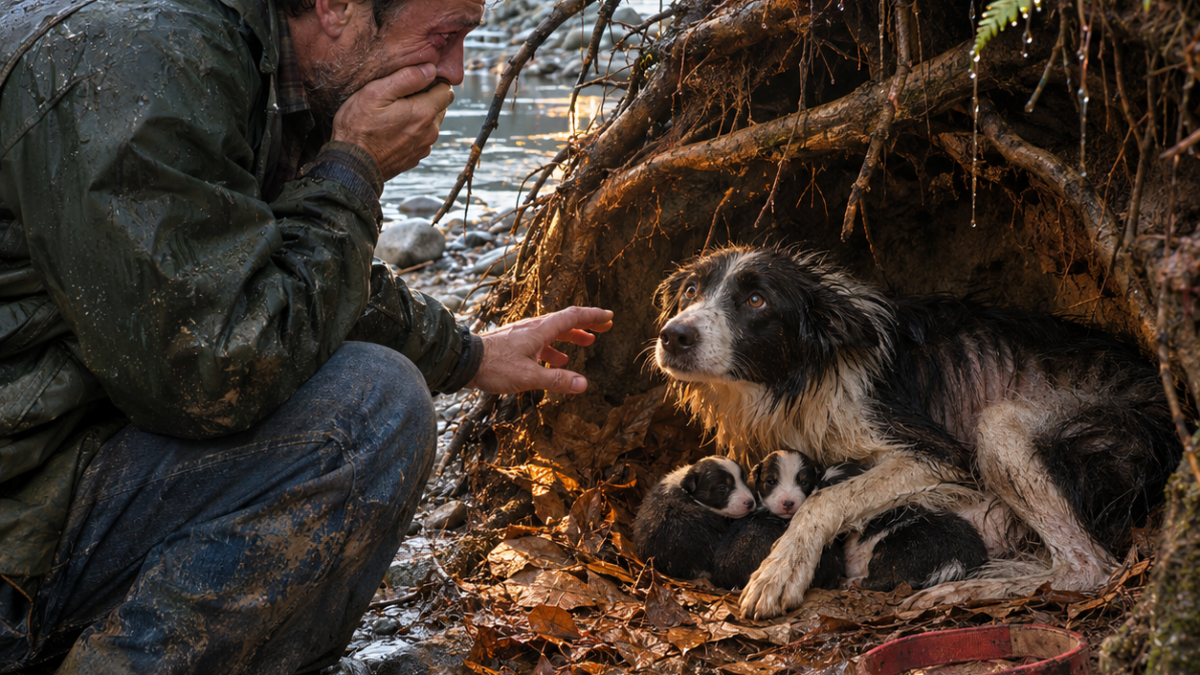
FULL ENDING
At first, I thought it was a bird trapped somewhere beneath the branches.
The sound was thin and irregular.
I stopped and listened.
There it was again.
A tiny, desperate whimper.
Then another.
I carefully followed the sound through the grass.
And found her.
I recognized the Border Collie almost immediately.
Her photograph had appeared in the local newspaper weeks earlier.
The headline described a dog reportedly thrown from a moving pickup truck near the forest road.
Someone had witnessed enough of the incident to alert animal protection authorities, but the injured dog had vanished into the trees before rescuers could reach her.
For twenty-seven days, people had searched.
There had been possible sightings, but no confirmed rescue.
Eventually, I stopped hearing updates.
I assumed she was gone.
Now she was lying ten feet in front of me.
Alive.
And somehow, a mother.
“Oh, sweetheart,” I whispered.
Her ears moved.
I lowered my cane.
“Easy, girl.”
She stared at me.
“I’m not going to hurt you.”
Her lips tightened slightly, not quite a growl, but enough to tell me she was frightened.
I stopped.
There was no point rushing her.
If she tried to escape on that leg, she could make the injury far worse.
And if she fled into the thick woods, I might never find her again.
So I stayed where I was.
The river moved quietly behind us.
Sunlight filtered through the trees.
One puppy shifted against her stomach, searching for a better place to nurse.
She lowered her muzzle and nudged it gently toward her belly.
The movement seemed to cost her everything.
I felt my throat tighten.
A dog who could barely care for herself was still making certain her babies could eat.
Then I noticed the smallest puppy.
It was pressed beneath its mother’s front leg, almost invisible against her black fur.
The puppy made a faint sound.
The mother immediately shifted to protect it.
Pain crossed her face as she moved the injured leg.
She didn’t cry out.
She simply lowered her head over the little one.
I felt tears gathering.
Twenty-seven days.
Whatever she’d survived in those woods, she had survived it while carrying and then caring for these puppies.
I slowly reached for my phone.
I needed professional rescuers.
I needed a veterinarian.
And I needed Margaret.
But when the phone lit up in my hand, the mother dog tried to rise, her injured leg buckled beneath her, and all four puppies began crying at once.
I dropped to my knees in the wet grass.
“Please, girl,” I whispered, holding my hands where she could see them. “Don’t move. Help is coming.”
She stared into my eyes.
Then lowered herself over her babies again.
And I understood that until she believed those puppies were safe, she might never let us save her.
FULL STORY CONTINUATION
I had to make a decision.
Every instinct told me to move closer, wrap her in my jacket, and get her out of the woods.
But she was terrified.
She had been injured by human beings, and now another stranger was standing in front of her, holding something she couldn’t understand.
I couldn’t blame her for expecting the worst.
I laid my cane on the ground.
Then I lowered myself slowly onto the grass, far enough away that she didn’t feel cornered.
“It’s all right,” I whispered. “I’m staying right here.”
Her eyes followed me.
One puppy began squeaking beneath her chest.
She bent her head and nudged it into a warmer position.
I felt my heart twist.
Even now, when every breath seemed painful, her first concern was the little life struggling beside her.
I took out my phone and called the county animal rescue service.
A dispatcher answered.
“County Animal Services. How can I help you?”
“I’ve found the missing Border Collie,” I said.
There was a pause.
“The dog from the pickup truck incident?”
“Yes.”
“Are you certain?”
I looked at her thin face.
The black markings around her eyes.
The white stripe extending down her muzzle.
“I’m looking right at her.”
The dispatcher immediately became more serious.
“Where are you located?”
I described the river access, the trail, and the bend near the willow trees.
Then I said, “She’s badly injured. One hind leg looks broken. She’s severely underweight, and she’s got four puppies with her.”
Silence.
Then the dispatcher repeated, “Four puppies?”
“Yes.”
“Were those mentioned in the missing-animal report?”
“No.”
I looked toward the dog.
“I don’t think anyone knew she was pregnant.”
The dispatcher took down the details and promised to send the rescue team.
“Please don’t attempt to handle her if she’s frightened or injured,” she advised. “Stay nearby if it’s safe, and let the responders know if her condition changes.”
“I understand.”
When the call ended, I dialed Margaret.
She answered immediately.
“James?”
There was concern in her voice.
I’d been married to that woman for thirty-two years, and she knew I almost never called while fishing.
“What’s wrong?”
I swallowed.
“Margaret, I found her.”
“Found who?”
“The Border Collie. The one from the newspaper.”
A pause.
Then she whispered, “Oh, James.”
“She’s alive.”
I looked at the four little bodies pressed against their mother.
“And she has puppies. Four of them.”
Margaret went completely silent.
I could hear the kitchen clock ticking faintly through the phone.
Then she asked, “Is she hurt?”
“Badly.”
My voice broke.
“Margaret, I don’t know how she’s still breathing.”
She took a slow breath.
“Are you with her now?”
“Yes.”
“Stay there.”
“Animal rescue is coming.”
“I’m coming too.”
“You don’t have to—”
“James.”
Her voice changed.
The same voice she’d used when our first home flooded and I insisted I could move the furniture alone.
“I’m bringing blankets, water, and supplies. You stay with that mama dog.”
I closed my eyes.
“Thank you.”
She softened.
“Don’t thank me. Just don’t leave her.”
I looked at the dog beneath the rock.
“I won’t.”
For the next twenty minutes, I sat beside the river and spoke to a dog who had every reason not to trust me.
I told her about Margaret.
About Harold.
About our little house with the fenced yard.
About the way the river looked in spring when the water rose and carried fallen leaves downstream.
I knew she couldn’t understand the words as I did.
But the sound of my voice seemed to help.
At first, she watched me without blinking.
Every time I shifted my weight, her ears moved.
Every time a branch cracked in the distance, her head lifted.
I kept my movements slow.
“Good girl,” I murmured.
“You’re doing so well.”
One of the puppies crawled out from beneath her front leg.
It was tiny.
Black-and-white.
Its eyes were open but still carried that unfocused, sleepy look of a very young puppy.
It made a little squeaking sound and began climbing awkwardly over a clump of grass.
The mother reached toward it.
Her head trembled.
She stretched her neck farther.
Then gently caught the puppy with her mouth and pulled it back against her chest.
I covered my mouth.
She could barely move.
But she wasn’t letting even one baby wander away.
The puppy settled.
The others shifted closer.
And she lowered her head again.
It struck me then that she’d probably done this hundreds of times over the previous weeks.
Drawn them close.
Moved them out of the wind.
Kept them from crawling toward the water.
Fed them when she had barely anything left to give.
I looked at the swollen hind leg.
At the way she protected it from the ground.
At her ribs.
At the exhaustion in her eyes.
And I wondered what those nights had been like.
The cold.
The hunger.
The darkness.
The sounds of wild animals moving through the trees.
How many times had she tried to sleep and been awakened by a crying puppy?
How many times had she wanted to stand but couldn’t bear the pain?
How many times had she looked toward the forest path, waiting for someone who never came?
I couldn’t know.
But I could see what those twenty-seven days had cost her.
She’d given almost everything.
And still, when a puppy cried, she answered.
Margaret arrived carrying more than I could have imagined.
She wore her old green rain jacket and rubber boots, and her arms were full.
A folded blanket.
Two clean towels.
A bottle of water.
A small bag of dog food.
And a large cardboard box she’d lined with soft fabric.
I stood carefully and waved her toward me.
“Slowly.”
She nodded.
The moment she saw the dog, she stopped.
For a second, she didn’t move.
Then her expression changed.
I’ve seen that look only a few times during our thirty-two years together.
Once when we found an injured fawn beside a road.
Once when Harold became seriously ill and we thought we might lose him.
And once when she held our first grandchild.
It was a look made of grief and tenderness, as though her heart was breaking and expanding at the same time.
“Oh, James.”
Her voice trembled.
She looked at the mother dog.
Then the puppies.
“Oh, sweetheart.”
She lowered the supplies onto the grass.
“Look at what she’s done.”
I nodded.
“I know.”
Margaret knelt beside me, keeping a respectful distance.
For several moments, she simply watched.
The puppies moved against their mother’s stomach.
One made a tiny sound.
Another stretched a pink paw against her fur.
The mother’s eyes followed Margaret cautiously.
But she didn’t growl.
Margaret spoke softly.
“Hi, beautiful girl.”
The dog’s ears moved.
“You’ve had a terrible time, haven’t you?”
I looked at my wife.
She wiped her eyes.
“She’s so thin.”
“I know.”
“And her leg…”
“I’ve called for help.”
Margaret nodded.
Then she looked at the box.
“I brought this for the babies.”
I touched her hand.
“Good thinking.”
She gave me a sad smile.
“Someone has to think practically while you’re out here making friends with every animal in the county.”
I laughed weakly.
It felt strange to laugh with so much suffering in front of us.
But Margaret had always known how to bring a little warmth into the worst moments.
She reached into her bag and set the water nearby without approaching the mother.
“Do you think she’ll drink?”
“Maybe. We should let the rescuers decide what’s safest.”
Margaret nodded.
Then she sat beside me.
Together, we waited.
And the mother dog watched us from beneath the rock, her babies tucked against her body.
The rescue vehicle arrived forty-five minutes after my first call.
Two county animal rescue workers stepped onto the trail carrying specialized equipment.
The first was a young woman named Emily.
She had dark hair tucked beneath a cap and the focused, gentle manner of someone accustomed to frightened animals.
Beside her walked David, a broad-shouldered man carrying a folded animal stretcher, gloves, and a small equipment bag.
Emily saw the mother dog and stopped.
“Oh, my God.”
I looked at her.
“Do you recognize her?”
She nodded slowly.
“That’s her.”
Her voice changed.
“That’s the dog from the pickup truck report.”
David looked toward the puppies.
“There are four?”
I nodded.
Emily knelt several yards away.
“We didn’t know she was pregnant.”
Her expression tightened.
“No one mentioned puppies.”
I looked toward the mother.
“She must have delivered after the incident.”
Emily nodded.
“Most likely.”
David studied the dog’s body condition.
“She’s extremely thin. We need to be careful.”
Emily approached slowly.
“Hey, mama.”
The dog lifted her head.
Emily stopped immediately.
“That’s it. Good girl.”
Her voice was soft and steady.
“We’re not going to rush you.”
The mother watched her.
She didn’t bark.
She didn’t lunge.
She simply gathered the puppies closer and stared with exhausted eyes.
Emily lowered herself to the ground.
“I know you’ve had a rough time.”
One puppy squeaked.
The mother’s ears moved.
Emily smiled faintly.
“Those are beautiful babies.”
Margaret began crying quietly beside me.
I reached for her hand.
Emily continued speaking.
“You kept them safe.”
The dog blinked slowly.
“You did your best.”
For a long moment, nothing happened.
Then the mother’s tail moved.
Once.
A tiny movement against the ground.
Emily froze.
I held my breath.
The tail moved again.
Margaret covered her mouth.
“James.”
I nodded.
“I saw it.”
Emily smiled through tears.
“Good girl.”
The dog lowered her head slightly.
Her eyes remained open.
But something in her expression softened.
She wasn’t suddenly unafraid.
She hadn’t forgotten what people had done to her.
Yet for the first time since we found her, she seemed willing to let someone come closer.
Emily examined the puppies first while David prepared the transport equipment.
The mother watched every movement.
The four little bodies were warm against her chest, though all needed veterinary assessment.
Their coats were dirty, but they were more alert than I expected.
They appeared to be several weeks old.
Their eyes were open.
They could wriggle and make tiny attempts to crawl.
And despite everything their mother had endured, they seemed to have been receiving enough care to keep going.
David looked at me.
“It’s remarkable.”
I frowned.
“What is?”
“How much she’s given them.”
He looked toward the mother.
“She’s in terrible condition, but these pups appear significantly better off than she is.”
I stared at her.
Her ribs.
Her injured leg.
Her exhausted eyes.
Then at the puppies.
Four little lives.
Each of them breathing because she’d somehow found the strength to keep nursing and protecting them.
Emily gently lifted the first puppy, keeping the mother calm and letting her see what was happening.
The puppy squeaked.
The mother’s head rose.
“Easy,” Emily whispered.
“Just checking your baby.”
Margaret prepared the box.
One by one, the puppies were moved into the warm blankets nearby.
They protested.
Their little voices rose in thin, frightened cries.
The mother tried to follow.
Pain crossed her face.
She made a low, broken sound.
I felt my chest tighten.
Emily immediately slowed.
“It’s okay, mama.”
She moved the box where the dog could see and smell her babies.
“Right here.”
The mother stared.
The puppies shifted against the towels.
One tiny black-and-white head lifted.
She stretched her neck toward them.
Margaret knelt beside the box.
“They’re safe, sweetheart.”
The dog watched for a long moment.
Then lowered her head.
I felt tears spill down my cheeks.
Even now, with rescuers surrounding her, she wasn’t thinking about herself.
She was searching for her babies.
Moving the mother was harder.
David positioned the stretcher carefully.
Emily supported the dog’s front half while checking how she reacted to movement.
I saw the moment the injured hind leg shifted.
The dog let out a sharp cry.
I flinched.
Margaret turned away.
Emily stopped immediately.
“I’m sorry, sweetheart.”
The mother panted.
Her eyes were wide.
David adjusted the supports.
“We need to immobilize that leg as much as possible.”
Emily nodded.
They worked slowly.
Carefully.
Every movement deliberate.
When the dog was finally settled on the stretcher, her head turned toward the box.
Margaret lifted the puppies just enough for her to see them.
“Here they are.”
The mother watched.
Her breathing was still rapid.
But as she recognized the little bodies tucked together in the blankets, her posture eased.
I noticed the change.
Her head rested against the stretcher.
Her eyes closed briefly.
For the first time since we’d found her, she wasn’t trying to hold herself above the ground.
Someone else was carrying her weight.
I looked at Emily.
“Do you think she knows we’re helping?”
Emily’s eyes were wet.
“I think she can feel that her puppies are near and that no one is hurting them right now.”
I nodded.
It was enough.
We couldn’t undo the last twenty-seven days.
We couldn’t explain why someone had thrown her from a truck.
We couldn’t promise she would recover.
But we could carry her somewhere warm.
We could treat her injuries.
And we could make sure she didn’t have to protect four puppies alone for another night.
I reached down and gently touched her head.
“Rest, girl.”
Her ears moved.
“We’ve got them now.”
I walked beside the stretcher as the rescuers carried her toward the waiting vehicle.
The trail wasn’t long.
On ordinary mornings, I could walk from the river to the parking area in less than fifteen minutes.
That afternoon, it felt endless.
We moved slowly over tree roots and wet ground. David walked backward over the most difficult sections, guiding the stretcher while Emily monitored the injured dog. Margaret carried the box of puppies, holding it close enough that their mother could hear them.
Whenever the puppies made a sound, the dog lifted her head.
“Right here, girl,” Margaret reassured her.
The mother looked toward the box.
Then settled again.
I followed with my cane, feeling every old ache in my legs.
I was fifty-seven.
I’d spent most of my life believing that age made a person more realistic about suffering.
But watching that injured mother being carried through the woods, I felt as helpless as a child.
I wanted to ask Emily whether the dog would live.
I wanted someone to tell me she would run again.
That she’d regain her strength.
That all four puppies would grow up healthy.
But Emily was focused on keeping her patient stable, and I knew better than to demand promises no one could honestly make.
When we reached the vehicle, Margaret carefully passed the box to the rescuers.
The puppies were placed in a secure, warm space close to their mother.
Then the stretcher was loaded.
For a moment, I stood beside the open door.
The dog looked directly at me.
Those frightened brown eyes were the same ones that had followed me beneath the rock.
But now there was something different.
She wasn’t looking over her shoulder.
She wasn’t searching the trees.
She wasn’t trying to push herself over her babies.
She was simply lying there, breathing.
I reached toward her.
This time, when my hand touched her forehead, she didn’t pull away.
“Good girl,” I whispered.
“You’re not alone anymore.”
Emily closed the door gently.
Then the vehicle pulled away.
I stood beside Margaret, watching until it disappeared around the bend.
The river continued moving behind us.
Birds called from the trees.
The morning had become afternoon.
And for the first time in twenty-seven days, that dog was no longer fighting for survival beneath a rock.
She was on her way to people who could help her.
Margaret drove us to the county animal shelter’s veterinary facility.
I barely remember the ride.
I sat in the passenger seat holding my fishing rod, which suddenly looked ridiculous.
I’d gone to the river hoping to catch a trout.
Instead, I’d found a mother who had nearly died keeping her puppies alive.
Margaret glanced toward me.
“You’re awfully quiet.”
I stared through the windshield.
“I keep thinking about her leg.”
“I know.”
“Twenty-seven days, Margaret.”
She nodded.
“She must have been in terrible pain.”
I looked down at my hands.
“How did she do it?”
My wife was quiet for a moment.
Then she said, “Maybe because those puppies needed her.”
I swallowed.
“But she didn’t have any help.”
Margaret reached across and touched my arm.
“She does now.”
I looked at her.
She smiled sadly.
“That’s what matters next.”
I turned toward the window.
We passed a farmhouse, then a small gas station, then the county road leading toward the shelter.
Ordinary life continued around us.
People walked into stores.
Cars stopped at traffic lights.
Someone was mowing a lawn.
It seemed impossible that the world could look so normal while a dog fought for her life only a few miles away.
Margaret drove a little faster.
Neither of us spoke again until we reached the clinic.
Dr. Phillips met the rescue team at the examination-room door.
She was an experienced veterinarian with thirty years of practice behind her, silver hair pulled tightly away from her face, and the kind of calm expression I’d learned to trust.
She listened to Emily’s report while her technicians prepared the treatment area.
“Found beside the river?”
Emily nodded.
“Severely underweight. Suspected fractures. Four nursing puppies, approximately several weeks old.”
Dr. Phillips looked toward the mother dog.
Her expression tightened.
“Let’s get her stabilized.”
The puppies were assessed separately and kept warm nearby.
Their mother received careful examination and urgent treatment for dehydration and shock.
Margaret and I waited outside the room.
I paced.
Then sat.
Then stood again.
Margaret watched me.
“James, sit down.”
“I can’t.”
She gave me a tired smile.
“You haven’t sat still since I met you.”
I almost laughed.
Then I looked toward the closed door.
“She’s going to be okay, right?”
Margaret’s expression softened.
“I don’t know.”
I nodded.
The honesty hurt.
But I needed it.
After what felt like hours, Dr. Phillips came into the waiting area.
Emily followed her.
I stood immediately.
“How is she?”
The veterinarian took a breath.
“She is critically underweight and severely dehydrated. We’re treating those conditions and monitoring her closely.”
My stomach tightened.
“And her leg?”
Dr. Phillips hesitated.
“Imaging confirms two fractures in the injured hind leg.”
Margaret covered her mouth.
“There are also three cracked ribs,” the veterinarian continued.
I closed my eyes.
Two fractures.
Three cracked ribs.
Twenty-seven days in the forest.
Four puppies to feed.
I couldn’t make the numbers fit together.
“How could she have walked?” I whispered.
Dr. Phillips shook her head.
“Probably with great difficulty and considerable pain. We can’t reconstruct everything that happened, but her injuries are serious.”
I looked toward the treatment room.
“She was still nursing them.”
“Yes.”
“Even like that?”
“Yes.”
My throat tightened.
Dr. Phillips continued.
“She’s been using her body’s reserves to produce milk while receiving inadequate nutrition herself. That has taken a tremendous toll.”
Margaret began crying.
I placed my arm around her.
The veterinarian looked at us.
“The puppies appear to be doing surprisingly well considering the conditions. They need continued care and monitoring, but their mother has clearly been feeding and protecting them.”
I stared at the floor.
She had nothing.
Almost nothing.
And somehow, she had continued giving.
Dr. Phillips explained the treatment plan.
The mother’s dehydration and nutritional depletion had to be addressed carefully.
Her injuries would require pain management and surgery.
Her body was weakened enough that every decision needed to account for the additional risks.
The veterinary team would also make sure the puppies continued receiving adequate nutrition and care while their mother recovered.
I listened to every word.
I wanted to understand.
But part of me kept returning to the same image.
The dog lying beneath the rock.
Her injured leg stretched beside her.
Four puppies pressed against her belly.
I finally asked, “Does she have a chance?”
Dr. Phillips looked at me.
“Yes.”
My breath caught.
“But she’s not out of danger,” she added. “We need to see how she responds.”
I nodded.
“I understand.”
She looked toward Emily.
“Have you given her a name?”
Emily shook her head.
“Not yet.”
For a moment, everyone was quiet.
Then Emily said, “I was thinking Hope.”
Margaret looked up.
“Hope?”
Emily nodded.
“Because after everything she’s been through, she’s still here.”
I stared toward the treatment-room door.
Hope.
It was such a small word.
Only four letters.
Yet suddenly, it seemed like the only name that belonged to her.
I swallowed.
“Hope,” I repeated.
Margaret smiled through her tears.
“It’s perfect.”
And from that moment forward, the abandoned Border Collie wasn’t simply the dog from the newspaper.
She was Hope.
A mother.
A survivor.
And a life we were determined to help heal.
The first night was difficult.
Margaret and I went home because the veterinary team needed space to work.
I didn’t want to leave.
I stood outside Hope’s treatment area for nearly twenty minutes, listening to the sounds of the clinic.
Then Emily came over.
“James, you need to get some rest.”
I shook my head.
“What if she gets worse?”
“We’ll call you if there’s important news.”
I looked through the glass.
Hope lay on a padded treatment bed.
Her coat had been gently cleaned.
Her injured leg was supported.
She looked impossibly small beneath the blankets.
“I found her,” I whispered.
Emily waited.
“I don’t want her to think I’ve left her again.”
The young rescuer’s expression softened.
“James, she’s being cared for. There are people here watching over her.”
I nodded.
But I couldn’t move.
Emily stepped closer.
“Come back tomorrow. She’ll need familiar, calm people around her during recovery.”
I looked toward the dog.
Then finally turned away.
Margaret took my hand.
We walked to the car together.
That night, Harold met us at the front door.
Our old Labrador wagged his tail and pushed his head against my leg, expecting attention.
Normally, I would have scratched his ears and asked whether he’d spent the day protecting the couch from imaginary intruders.
But I was too exhausted.
I sat on the floor beside him.
He leaned against me.
Margaret lowered herself onto the couch.
For several minutes, neither of us spoke.
Then she whispered, “James?”
I looked up.
“You okay?”
I shook my head.
She reached for my hand.
“I keep seeing those puppies,” I said.
Her eyes filled.
“Me too.”
“The way they were holding onto her.”
Margaret nodded.
“I know.”
I looked at Harold.
He rested his head on my knee.
And for the first time that day, I began crying without trying to stop.
Hope survived the first night.
Emily called shortly after seven the next morning.
I answered before the second ring.
“Emily?”
“Good morning, James.”
“How is she?”
“Still weak, but stable. She’s responding to the fluids, and we’re continuing treatment.”
I closed my eyes.
“Thank God.”
Emily continued.
“The puppies are being monitored, and they’re doing reasonably well.”
I looked toward Margaret.
She was standing in the kitchen.
I gave her a thumbs-up.
She covered her mouth.
“Can we visit?” I asked.
“Yes, for a short time. We’ll arrange it around her treatment.”
I thanked Emily.
Then I sat down.
My hands were shaking.
Margaret came toward me.
“What did she say?”
“She’s alive.”
My voice broke.
“Still fighting.”
Margaret hugged me.
We stood together in our kitchen for a long time.
Then she pulled back.
“Come on.”
“Where?”
She smiled through her tears.
“We’ve got a girl to visit.”
Hope didn’t recognize us immediately when we entered the treatment area.
Or perhaps she did and was simply too exhausted to respond.
Her eyes were half closed.
Her breathing was steadier than it had been beneath the rock.
The veterinary team had carefully cleaned her coat, revealing the sharp black-and-white markings typical of a Border Collie.
Her face looked less frightening without the mud.
But her thinness was even more obvious.
I could see the outline of every rib.
I stopped beside the bed.
“Hey, sweetheart.”
One ear moved.
I smiled.
“It’s me.”
Her eyes opened slightly.
Then she looked toward Margaret.
My wife leaned closer.
“Hi, Hope.”
The dog’s tail moved.
Just once.
But we both saw it.
Margaret began crying.
“Oh, baby.”
Emily smiled.
“She seems to recognize your voices.”
I reached toward Hope’s head.
The dog watched my hand.
Then allowed me to touch her.
I stroked her ears.
“Good girl.”
She closed her eyes.
I stayed like that for several minutes.
Not asking anything of her.
Not trying to make her stand.
Just letting her feel a gentle hand that wasn’t going to hurt her.
The puppies were nearby in a warm, protected enclosure.
They were still noisy.
Still hungry.
Still determined to crawl over one another.
I watched them for a while.
Then turned toward Hope.
“You did that,” I whispered.
“You kept all four of them alive.”
She didn’t look up.
She simply rested.
For once, someone else was taking care of them.
The days that followed were filled with uncertainty.
Some mornings, Hope seemed a little stronger.
She would lift her head when Emily entered.
She would respond to a familiar voice.
She would accept a few gentle strokes along her neck.
Other mornings, she looked exhausted again.
Her appetite varied.
Her body needed time to recover from the prolonged deprivation.
The fractures required careful management.
And her fear remained close to the surface.
If someone entered too quickly, she flinched.
If a metal tray clattered, her body tightened.
If an unfamiliar person reached toward her, she sometimes tried to pull away.
Dr. Phillips explained that pain and fear could make even a gentle dog defensive.
So we moved slowly.
We let Hope see our hands.
We spoke quietly.
We gave her space when she needed it.
And we never punished her for being afraid.
One afternoon, I sat beside her for nearly an hour.
I didn’t say much.
I simply opened a book and read a few pages aloud.
Hope rested with her head on the blanket.
Occasionally, she opened one eye.
Then closed it again.
Emily walked past and smiled.
“She likes you.”
I looked up.
“How can you tell?”
“She’s relaxed enough to rest when you’re there.”
I looked down at Hope.
For a moment, I remembered the way she’d watched me beneath the rock.
Every muscle tense.
Every movement guarded.
Now she was lying beside me, breathing steadily.
It wasn’t a dramatic transformation.
But it was a beginning.
The puppies grew quickly.
By the end of the first week at the shelter, they were becoming stronger and more curious.
The veterinary team monitored their health and made sure they received appropriate care while Hope recovered.
I loved visiting them.
They were four little bundles of black-and-white energy.
Two boys.
Two girls.
Each with a personality that seemed to grow more obvious every day.
One male puppy was restless and adventurous.
He wriggled toward anything that moved.
Another was calmer and preferred to sleep in a warm pile with his siblings.
One female liked to investigate every corner of the puppy enclosure.
The smallest girl often pressed herself against Hope’s side whenever she had the opportunity.
One morning, Emily suggested we name them.
“It’s getting confusing calling everyone ‘the little black-and-white one,’” she joked.
I laughed.
“They’re all little black-and-white ones.”
Margaret joined us.
She looked at the puppies.
Then at the photographs we’d taken beside the river.
“What about names from where they were found?”
Emily smiled.
“Like what?”
I thought about the water.
The stones.
The willow branches hanging over the bank.
The green plants growing along the sheltered edge.
“River,” I said.
Emily pointed toward the adventurous male.
“That one?”
I nodded.
“Definitely.”
Margaret looked at the calmer boy.
“Stone.”
I smiled.
“Because he sleeps like one?”
She laughed.
“Because he deserves something strong and steady.”
Emily pointed toward one of the females.
“Willow.”
The puppy immediately began investigating Emily’s shoelace.
We laughed.
Then Margaret lifted the smallest girl.
“And Fern.”
I watched her nestle into the towel.
“River, Stone, Willow, and Fern,” I repeated.
Emily smiled.
“Sounds like a whole little forest.”
I looked toward Hope.
She was watching her puppies.
Her eyes were tired.
But her tail moved when we brought the little ones near.
And I realized that those four names represented something important.
They had been born into hardship.
But hardship didn’t have to define the rest of their lives.
Hope’s surgery took place after Dr. Phillips determined she was stable enough to tolerate the procedure.
Her injured hind leg required repair of the two fractures.
The veterinary team used appropriate orthopedic fixation to stabilize the bones.
I understood the basics.
But knowing what would happen didn’t make the waiting easier.
Margaret and I sat in the shelter’s small waiting room.
A clock ticked above the doorway.
Somewhere down the hall, a dog barked.
Another answered.
The ordinary sounds of a veterinary facility continued around us.
I stared at the closed treatment-room door.
Margaret reached for my hand.
“She made it through twenty-seven days in the forest.”
I nodded.
“I know.”
“She got those puppies through it.”
“I know.”
My wife squeezed my fingers.
“Now she’s got doctors helping her.”
I closed my eyes.
“I know.”
But I was frightened.
Because I’d already seen how much this dog could endure.
I didn’t want her to have to endure any more.
When Dr. Phillips finally came into the waiting area, I stood so quickly my cane nearly fell.
“How is she?”
The veterinarian smiled.
“The surgery went as planned.”
I felt the air leave my chest.
Margaret began crying.
Dr. Phillips continued.
“She’ll need time, pain management, and physical rehabilitation, but we’ve stabilized the fractures.”
I nodded.
“Will she walk again?”
“We’re optimistic, provided healing continues as expected.”
I covered my face.
For a moment, I couldn’t speak.
Then I whispered, “Thank you.”
Dr. Phillips placed a hand on my shoulder.
“She has a long recovery ahead.”
I looked toward the treatment area.
“I know.”
“But she’s made it this far.”
I nodded.
“Yes.”
And for the first time, I allowed myself to imagine Hope running through a yard without pain.
The weeks passed.
Hope’s physical recovery came in small victories.
The first morning she lifted her head eagerly when Emily entered.
The first time she ate with real interest.
The first time she stood with assistance and placed cautious weight through her recovering body under veterinary guidance.
The first day she walked a few slow steps without immediately lying down.
Each moment mattered.
Not because it was spectacular.
Because it was something she couldn’t have done beneath the riverbank.
I remember one afternoon when Emily called me into the rehabilitation area.
“James, come see this.”
I entered quietly.
Hope was standing on a nonslip surface with a veterinary rehabilitation technician beside her.
Her movements were controlled and supported.
She looked uncertain.
But she was trying.
Emily smiled.
“Ready, girl?”
Hope took one step.
Then another.
Her injured leg moved stiffly.
She paused.
Looked toward Emily.
Then continued.
I felt tears gathering.
Margaret gripped my arm.
“James.”
“I see.”
Hope reached the end of the short walking area.
Emily praised her gently.
“Good girl.”
The dog turned toward us.
Her tail wagged.
And suddenly, I saw a glimpse of the animal she might have been before someone threw her from that truck.
Not the starving mother beneath the rock.
Not the frightened patient on the treatment table.
A Border Collie.
Curious.
Intelligent.
Determined.
Alive.
But physical healing wasn’t the only challenge.
The first time Hope heard a truck engine outside the shelter, she flattened herself against the floor.
I was sitting beside her enclosure when it happened.
A delivery vehicle pulled into the parking lot.
Its engine rumbled.
A door slammed.
Hope’s head shot up.
Her body went rigid.
Then she tried to move toward the back of the enclosure.
She was still recovering, so the sudden movement frightened me.
“Hope!”
Emily appeared immediately.
“Easy, girl.”
The dog was trembling.
Her ears were pinned back.
Her breathing had quickened.
When another vehicle passed outside, she crouched lower.
I looked at Emily.
“What’s happening?”
She knelt nearby.
“She’s afraid.”
“Of the truck?”
Emily nodded.
I stared toward the window.
The noise had been ordinary.
Nothing threatening.
Just a delivery vehicle arriving with supplies.
But Hope had reacted as though the worst moment of her life was happening again.
I remembered the newspaper report.
A speeding pickup.
A dog thrown onto the road.
The pain.
The forest.
Twenty-seven days.
My chest tightened.
“She remembers.”
Emily was quiet.
“We can’t know exactly how she experiences the memory,” she said gently. “But the sound seems to have become a trigger for fear.”
I looked at the trembling dog.
“So even when the leg heals…”
Emily nodded.
“She may still need help learning that not every vehicle means danger.”
I swallowed.
“How?”
“Slowly. Patiently. Without forcing her.”
I looked down at Hope.
Her eyes were wide.
She was watching the door.
And I realized there were injuries no X-ray could show.
The next time we tried a short walk near the shelter driveway, Hope froze.
Emily had chosen a quiet period with little traffic.
The dog wore a comfortable harness and walked cautiously beside her.
Margaret and I stood nearby.
Everything seemed fine.
Hope sniffed the grass.
Her tail moved.
She stopped to examine a patch of flowers beside the walkway.
For a few minutes, she looked like an ordinary dog enjoying the outdoors.
Then a car approached on the road beyond the shelter.
It wasn’t moving quickly.
The driver wasn’t doing anything dangerous.
But the sound of the engine reached Hope.
She stopped.
Her body stiffened.
Then she lowered herself to the ground.
Emily stopped immediately.
“It’s okay, Hope.”
The dog trembled.
She wouldn’t stand.
She wouldn’t look toward Emily.
Her eyes were fixed on the passing vehicle.
I felt helpless.
Margaret whispered, “Oh, sweetheart.”
Emily kept her voice calm.
“We’re not going to force her.”
For several minutes, she simply stayed beside Hope, allowing the dog space and time to recover.
The car passed.
The road became quiet again.
But Hope continued trembling.
Eventually, she lifted her head.
Emily offered reassurance and a reward when she was ready to engage.
The walk ended there.
Back inside, I sat beside her blanket.
Hope rested her head near my knee.
I stroked her fur.
“It’s over, girl.”
Her eyes closed.
But I knew the truth.
For her, the fear wasn’t entirely over.
And loving her meant accepting that healing would take longer than any of us wanted.
We began helping Hope rebuild her confidence one small step at a time.
Emily worked with the shelter’s animal behavior team to develop a careful plan. There would be no dragging Hope toward traffic, no forcing her into a vehicle, no expecting her to overcome her fear simply because we knew she was safe.
We started with a parked car.
The engine was off.
The doors were open.
Nothing moved.
Margaret and I sat nearby while Emily allowed Hope to approach at her own pace.
At first, the dog refused to come within several yards.
She looked toward the vehicle.
Then away.
Her tail lowered.
Emily didn’t pull on the leash.
She simply waited.
When Hope was calm enough to look at the car without retreating, Emily rewarded her.
Then the session ended.
I stared at her.
“That’s it?”
Emily smiled.
“That’s plenty for today.”
“But she barely went near it.”
“Exactly. She made a choice, stayed calm, and nothing bad happened.”
I looked toward Hope.
She was sniffing the grass again.
Emily continued.
“If we push too far, we risk teaching her that cars are something she can’t escape. We want her to learn that she has control and that she can trust us.”
I nodded.
It made sense.
But it required a kind of patience I was still learning.
I’d spent my life believing that problems needed action.
Fix the fence.
Repair the motor.
Call the mechanic.
Find the missing part.
Hope’s fear wasn’t something I could repair with a tool.
It needed time.
And trust.
So we returned the next day.
And the next.
Some days, she approached a little closer.
Other days, she didn’t.
One morning, a passing truck frightened her badly enough that we ended the session almost immediately.
I felt discouraged.
“Are we going backward?” I asked.
Emily shook her head.
“Recovery isn’t a straight line.”
I looked at Hope.
She was resting beside Margaret’s chair.
“She’s trying so hard.”
Emily smiled softly.
“I know.”
Then she added, “And that’s why we don’t rush her.”
Eventually, Hope became comfortable sitting near the parked vehicle.
Then, after more gradual preparation, she began exploring the open doorway.
We let her sniff.
Step away.
Return.
Choose.
Margaret placed a soft blanket inside.
Hope examined it with great suspicion.
Then looked at us.
I smiled.
“It’s just a blanket, girl.”
She sniffed it again.
A few moments later, she placed one paw inside.
Margaret held her breath.
I did too.
Hope shifted her weight.
Then stepped back onto the ground.
Emily smiled.
“Good girl.”
I looked at Margaret.
She was crying.
I laughed gently.
“Margaret, she only put one paw in the car.”
My wife wiped her eyes.
“I know.”
She looked toward Hope.
“But twenty-seven days ago, she was lying under a rock with four babies and a broken leg.”
My smile faded.
She was right.
For Hope, one paw inside a car was enormous.
It meant approaching something that reminded her of pain.
It meant trusting the people around her.
It meant beginning to understand that not every vehicle was dangerous.
I knelt beside her.
“Take all the time you need, sweetheart.”
She pressed her nose against my hand.
And we continued.
Weeks later, Hope sat comfortably inside a stationary car with Margaret beside her.
The engine was off.
The windows were partly open.
The blanket was beneath her.
And she was accepting treats as though the entire arrangement were perfectly ordinary.
I stood outside the door, smiling.
“Well, look at you.”
Hope lifted her head.
Margaret laughed.
“Don’t distract her.”
“I’m just admiring the progress.”
She looked down at the dog.
“So am I.”
The next stage involved gradually introducing the sound of the engine in controlled conditions.
We started at a level and distance Hope could tolerate.
We watched for signs of distress.
We kept sessions short.
And whenever she became uncomfortable, we adjusted the plan rather than forcing her to endure it.
The first time Hope remained relaxed while the engine ran, Margaret squeezed my hand so hard I nearly dropped the keys.
I looked at her.
She was smiling through tears.
“She’s doing it.”
I nodded.
“She is.”
Hope sat quietly on her blanket.
Her ears moved.
She looked toward the window.
Then back at us.
No trembling.
No desperate attempt to escape.
Just curiosity.
I felt something warm spread through my chest.
She had survived something terrible.
Now she was learning that the world contained ordinary sounds again.
Engines that didn’t mean injury.
Doors that didn’t mean abandonment.
People who approached with open hands and gentle voices.
It wasn’t the past being erased.
It was the future becoming possible.
By the time Hope was ready for short, carefully managed car rides, nearly three months had passed since I found her.
Her fractures had healed sufficiently for gradually increasing activity under veterinary guidance.
Her weight had improved.
Her coat had regained much of its shine.
And her eyes seemed brighter.
One afternoon, Margaret and I drove her along a quiet country road.
The journey was short.
No sudden acceleration.
No crowded highway.
No unnecessary noise.
Hope sat securely in the back with her familiar blanket.
I glanced at the mirror.
She was looking through the window.
Her mouth was slightly open.
Her ears moved in the gentle air.
Margaret turned around.
“James.”
I smiled.
“What?”
“Look at her.”
I checked the mirror again.
Hope’s eyes were bright.
Her posture was relaxed.
She looked like a dog enjoying a ride.
For several seconds, neither of us spoke.
Then Margaret whispered, “Three months ago, she couldn’t even look at a car.”
I nodded.
“I know.”
“She was terrified.”
I swallowed.
“I remember.”
Margaret looked out the windshield.
“And now she’s here.”
I smiled.
“Now she’s here.”
The road curved past a field of tall grass.
Sunlight moved across the dashboard.
Hope watched the trees.
I didn’t know whether dogs experienced happiness the way we did.
But there was no mistaking that she was comfortable.
And after everything she’d endured, comfort felt like a remarkable gift.
Hope’s puppies were changing just as quickly.
River grew into a bold, playful little dog who seemed determined to investigate everything.
Stone remained calmer, often sitting quietly while his brother bounced around him.
Willow was bright and energetic, fascinated by toys and movement.
Fern, the smallest, loved exploring the edges of the play area before returning to check on her siblings.
They were beautiful.
Four healthy young Border Collies with black-and-white coats and more energy than I remembered having at their age.
When Margaret and I visited, they’d rush toward us with wagging tails and clumsy paws.
Margaret would laugh.
“James, they’re going to knock you over.”
I would sit down before they had the chance.
Then all four would climb across my legs.
I loved them.
How could I not?
I’d seen them when they were tiny bodies clinging to a mother who was barely alive.
Now they were playing.
Eating.
Growing.
Learning.
Their mother watched from her resting area, sometimes lifting her head when their play became particularly noisy.
I often wondered what she made of their energy.
Did she remember those nights beside the river?
Did their sounds remind her of trying to keep them warm?
Or was she simply enjoying the present, content to see them healthy?
I couldn’t know.
But I knew that watching them felt like witnessing the answer to everything she’d fought for.
Four lives.
Still here.
And now ready for futures of their own.
The shelter began carefully reviewing adoption applications when the puppies were old enough.
Emily was determined to find suitable homes.
“These aren’t decorations,” she said one afternoon as she sorted paperwork.
I smiled.
“I know.”
“They’re intelligent, active dogs. They need families who understand that.”
Margaret nodded.
“Border Collies can be a lot of work.”
Emily looked toward River, who was attempting to drag a toy twice his size across the play area.
“Exhibit A.”
We laughed.
But the subject mattered.
The puppies deserved more than a roof and a food bowl.
They needed appropriate activity, training, attention, and owners prepared for the responsibilities of a dog that would grow into a highly energetic companion.
Emily reviewed each prospective family’s circumstances and experience.
Margaret and I offered to help where we could.
I thought selecting homes might be the easy part after everything we’d endured.
I was wrong.
Because once the applications were approved, the puppies would begin leaving.
And that meant saying goodbye to four little lives I’d watched grow from the day they were rescued.
River was adopted first.
A young family with two children came to meet him.
The children were excited, but their parents had clearly prepared them.
They approached calmly.
They listened to the shelter staff.
They asked about feeding, training, and exercise.
The younger boy crouched and held out his hand.
River sniffed it.
Then licked his fingers.
The child burst into laughter.
“Oh, Dad, he likes me!”
His father smiled.
“Looks that way.”
River immediately tried to climb into the boy’s lap.
I watched from a few feet away.
Margaret leaned toward me.
“He’s found his people.”
I nodded.
When the adoption was completed, the family promised to keep the shelter updated.
The children waved as River left.
I felt a small ache.
The first puppy was going home.
A real home.
Not a hiding place beneath a riverbank.
Not a temporary enclosure.
A house with a yard and people who were ready to love him.
I looked toward Hope.
She watched River briefly.
Then returned to resting.
I couldn’t know exactly what she understood.
But I knew we’d done something good for her son.
Stone went next.
His new family was an older couple who had recently lost their beloved dog.
They arrived carrying a photograph.
The woman showed it to Emily.
“He was with us for fourteen years.”
Her voice trembled.
“It’s been terribly quiet without him.”
Emily looked at the picture.
“He was beautiful.”
The woman smiled sadly.
“He was.”
Stone approached slowly.
He sniffed her shoes.
Then sat beside her.
She looked down.
For a moment, she couldn’t speak.
Then she reached out and touched his head.
“Oh, sweetheart.”
Her husband knelt beside them.
Stone leaned against his hand.
The man laughed softly.
“I think he’s made his decision.”
The woman began crying.
I turned away for a moment.
I knew what it meant to love an animal who became part of your daily life.
I also knew that another dog could never replace the one you’d lost.
But sometimes a new companion could make room for happiness to return.
Stone left the shelter resting comfortably beside two people who looked as though they’d been waiting a long time to smile again.
Willow’s new owner was a young woman who trained dogs in agility and other enrichment activities.
She was patient, knowledgeable, and delighted by Willow’s energy.
During their first meeting, Willow chased a toy, investigated a small training obstacle, then returned to the woman with her tail wagging.
The young woman laughed.
“Oh, you are going to keep me busy.”
Emily smiled.
“Very busy.”
Willow looked thrilled by the prospect.
When she left for her new home, Margaret stood beside me.
“She’ll have a wonderful life.”
I nodded.
“She will.”
I imagined Willow running across a training field.
Learning new skills.
Using her quick mind and boundless energy.
A puppy who’d begun life beside a wounded mother beneath a rock was now heading toward a future filled with activity and affection.
It was more than I could have hoped for that first morning.
Fern was the last puppy to leave.
The smallest.
The one I’d almost missed when I first looked beneath Hope’s front leg.
Her new owner was a woman named Meadow who lived on a farm.
She had plenty of space, experience caring for active dogs, and a gentle manner that immediately put Fern at ease.
When Meadow arrived, Fern approached cautiously.
She sniffed the woman’s hands.
Then her boots.
Then the hem of her jacket.
Meadow laughed.
“Checking me out, huh?”
Fern wagged her tail.
Meadow knelt.
“Take your time, little one.”
I watched them quietly.
Something about the scene reminded me of the first time I’d approached Hope beside the river.
The careful movements.
The gentle voice.
The willingness to let an animal decide whether to trust.
Fern took another step.
Then sat beside Meadow.
The woman stroked her head.
“There you are.”
Margaret squeezed my hand.
I looked toward her.
Her eyes were wet.
“The last one,” she whispered.
I nodded.
When Fern left, I followed the family to the shelter doorway.
Meadow lifted the puppy into her vehicle.
Fern looked out through the window.
Her little ears moved.
Then the car pulled away.
I watched until it disappeared.
For a moment, the shelter felt strangely quiet.
Four puppies.
Four new homes.
Four lives their mother had fought so desperately to protect.
I took a slow breath.
Then turned back toward Hope.
The day after Fern’s adoption, Margaret and I returned to the shelter.
Hope was resting in a quiet outdoor area, enjoying the sunshine.
Her coat had become thick and glossy again.
Her body had filled out.
Her hind leg had healed, though we still followed the veterinarian’s advice about managing activity.
She looked nothing like the dog I’d found beneath the riverbank.
When she saw us, her ears lifted.
Then she stood.
Her tail began moving.
Margaret smiled.
“Hello, beautiful.”
Hope walked toward her.
She sniffed Margaret’s hand.
Then came to me.
I knelt with some difficulty, setting my cane beside the bench.
“Hey, girl.”
Hope rested her head against my knee.
I stroked her ears.
For a long moment, I couldn’t speak.
The last puppy had gone home.
The mother was recovering.
And there was one question left.
Where would Hope go?
Margaret looked at me.
We didn’t need to discuss it again.
We’d known the answer for weeks.
Perhaps since the moment we found her.
We simply hadn’t said it aloud because Hope had needed time.
Time to heal.
Time to trust.
Time to learn that cars could be safe.
Time to stop living every day as though someone might hurt her.
Now she was ready.
I looked into her brown eyes.
“Hope.”
Her ears moved.
I smiled.
“How would you like to come home with us?”
She tilted her head.
Margaret knelt beside me.
“We’ve got a nice yard.”
I laughed.
“And a lazy old Labrador who’ll probably want to share his favorite blanket.”
Margaret smiled through tears.
“And people who will never make you sleep outside in the cold.”
Hope looked between us.
Then stepped closer.
She sat directly in front of me and placed her head on my lap.
For a moment, I couldn’t move.
I looked at Margaret.
She covered her mouth.
“I think that’s a yes.”
I laughed through my tears.
“Yeah.”
I wrapped my arms gently around Hope.
“I think it is.”
Hope came home the next afternoon.
Margaret had spent the morning preparing.
She placed a soft bed in a quiet corner of our living room, away from the main walkway but close enough that Hope could see us.
She bought a new water bowl.
A comfortable harness.
A few toys.
And a thick blanket for the evenings.
I watched her arranging everything.
“You’re going to spoil that dog.”
Margaret looked at me.
“James, you once drove forty miles because Harold stopped eating his favorite biscuits.”
I frowned.
“He looked unhappy.”
She laughed.
“Exactly.”
I smiled.
Then reached for the car keys.
Hope’s rehabilitation team had helped us plan the transition.
We knew to keep the journey calm and familiar.
We’d use the routines she’d learned.
We’d give her time to settle.
We wouldn’t expect her to behave as though nothing had happened.
When we reached the shelter, Emily was waiting outside.
Hope stood beside her, wearing a clean harness and the same peaceful expression I’d begun recognizing during our visits.
The moment she saw us, her tail wagged.
Margaret stopped.
“Oh, James.”
I smiled.
“She knows we’re here.”
Emily handed me the records and supplies we’d arranged.
Then she knelt beside Hope.
“You’re going to a good place, sweetheart.”
Hope leaned against her.
Emily stroked her head.
For a moment, her voice broke.
“You’ve earned this.”
I looked away.
I’d watched Emily care for Hope through surgery, illness, fear, and rehabilitation.
She’d spent countless hours helping the dog learn to trust again.
Saying goodbye wasn’t easy for her either.
Margaret hugged Emily.
“Thank you for everything.”
Emily shook her head.
“Just keep sending pictures.”
I laughed.
“Margaret will probably send too many.”
My wife smiled.
“That’s impossible.”
We helped Hope into the car.
She stepped onto her familiar blanket.
Looked around.
Then settled.
I checked the mirror.
Her ears were relaxed.
No trembling.
No frantic attempts to escape.
Just a dog preparing for a ride.
Emily stood beside the shelter entrance as we pulled away.
She raised one hand.
Hope looked through the rear window.
I wondered whether she understood that she was leaving the place where she’d learned to feel safe.
Then she lowered her head and rested.
And we drove toward the place where she would spend the rest of her life.
Harold met Hope at the edge of our backyard.
Our Labrador had always been an easygoing dog.
He preferred naps to exercise, snacks to adventure, and comfortable furniture to almost anything else.
I sometimes joked that he’d been born retired.
Still, we introduced the dogs carefully.
Harold approached with his usual slow confidence.
Hope stood beside me.
They sniffed each other.
Harold wagged his tail.
Hope returned the gesture.
Then Harold turned and walked toward his favorite resting spot near the porch.
Hope watched him.
For a moment, she seemed uncertain.
Then she followed.
Margaret laughed.
“Well, that was easy.”
I smiled.
“Harold’s showing her the important parts of the property.”
“Like what?”
“The bed. The water bowl. The best place to watch us cook dinner.”
My wife laughed harder.
Sure enough, Harold settled onto his favorite cushion.
Hope stood beside him.
He looked up.
Then shifted slightly to one side.
She lowered herself onto the edge of the cushion.
I stared.
“Margaret.”
“I see it.”
“Harold doesn’t share that bed.”
She smiled.
“He does now.”
The two dogs rested side by side.
No growling.
No competition.
No drama.
Just a tired mother who had survived the worst month of her life, and an old Labrador who apparently decided she could stay.
I looked at Margaret.
She wiped one eye.
“Welcome home, Hope.”
The first night was difficult.
Hope walked through the house, checking each room.
She sniffed the corners.
The hallway.
The living-room windows.
The back door.
Every sound made her pause.
When a car passed outside, she stopped and looked toward the window.
I could see her body tightening.
I moved closer.
“It’s all right, girl.”
She looked at me.
I didn’t force her to lie down.
I simply sat nearby and let her choose where she wanted to be.
After a while, she approached her bed.
Sniffed it.
Turned around.
Then walked away again.
Margaret came into the living room carrying two mugs of tea.
“Still pacing?”
I nodded.
“She doesn’t know what to make of it.”
My wife sat beside me.
“Imagine what she’s been through.”
I looked toward Hope.
She was standing near the back door.
Her ears moved toward the sound of wind against the trees.
“Maybe she doesn’t believe she can stay,” I whispered.
Margaret looked at me.
“Maybe.”
We sat quietly.
Eventually, Hope came toward us.
She stopped near my feet.
I reached down.
She leaned into my hand.
Then lowered herself onto the rug.
I stroked her ears.
“That’s it.”
She sighed.
For a few minutes, she rested.
Then a noise outside made her lift her head again.
I didn’t blame her.
Twenty-seven days of fear couldn’t be erased by one comfortable room.
So we stayed with her.
Until she was ready to sleep.
The second night was different.
Hope wandered through the house again, but this time she returned to us more quickly.
She drank water.
Ate her evening meal.
Rested beside Harold.
Then followed Margaret into the bedroom.
I was already sitting on the edge of the bed, taking off my shoes.
Hope stopped in the doorway.
Her ears lifted.
Margaret looked down.
“Well, hello there.”
The dog walked toward us.
Then placed one paw against the edge of the mattress.
I laughed.
“Absolutely not.”
Margaret raised an eyebrow.
“James.”
“What?”
“Look at her.”
Hope stared at me.
Her brown eyes were calm.
Her tail moved once.
I sighed.
“Fine.”
Margaret smiled.
“I thought so.”
We helped Hope settle comfortably between us, mindful of her recovering leg.
She turned around slowly.
Then lowered herself onto the blanket.
For several minutes, she remained alert.
I could feel her shifting whenever the house creaked.
Then Harold sighed from his bed on the floor.
Margaret reached across and gently stroked Hope’s neck.
I rested one hand against her back.
And slowly, the dog relaxed.
Her breathing deepened.
Her body stopped trembling.
Her head settled against the pillow.
I lay awake listening.
For the first time since we’d found her beneath the rock, I wasn’t hearing shallow, frightened breaths.
I was hearing a dog sleep peacefully.
Margaret turned toward me in the darkness.
“James?”
“Yeah?”
“Do you remember what I thought when you called me that morning?”
I smiled.
“You thought I’d caught a fish.”
She laughed softly.
“A big one.”
I looked toward Hope.
Her eyes were closed.
Her breathing was slow.
“Instead,” I whispered, “we found something much more important.”
Margaret reached for my hand.
“We found a family.”
I looked at the dog between us.
Then at Harold sleeping nearby.
And I knew she was right.
A year passed.
Hope became part of our ordinary life so completely that I sometimes struggled to remember how quiet the house had been before she arrived.
She developed habits.
Every morning, she followed Margaret into the kitchen and waited patiently while breakfast was prepared.
She liked lying in the patch of sunlight beside the living-room window.
She loved the garden.
She became fascinated by birds, though we were careful to prevent her from chasing anything that might strain her leg.
And she seemed to enjoy Harold’s company more than either of us had expected.
They walked together.
Rested together.
Sometimes slept pressed against each other on the same rug.
Harold remained as lazy as ever.
Hope was more curious.
She liked following me while I worked outside, inspecting every patch of grass and every unfamiliar sound.
Occasionally, a loud vehicle still frightened her.
A heavy truck passing near the house might make her stop and retreat toward us.
But those moments became less frequent.
And when they happened, we gave her time.
No anger.
No impatience.
No expectation that she should simply get over what had happened.
She had already done something extraordinary.
Now she deserved a life in which nobody demanded bravery from her every day.
We continued receiving photographs of the puppies.
River grew into an energetic young dog who adored the two boys in his new family.
They sent pictures of him racing across their yard, carrying toys, and sleeping beneath a blanket while the children watched television.
Stone became the constant companion of the older couple who adopted him.
They told us he had claimed a place at the foot of their bed.
Margaret laughed when she read that message.
“Seems to run in the family.”
I looked toward Hope, who was sleeping on our couch.
“Apparently.”
Willow thrived with her agility-loving owner.
Her intelligence and enthusiasm made training an adventure.
We received a photograph of her proudly standing beside an award ribbon.
I showed it to Hope.
“Look at your daughter.”
Hope sniffed the phone.
Then looked away.
I laughed.
“She’s not impressed.”
Fern became the queen of Meadow’s farm.
She ran through fields, explored safe areas under supervision, and followed her owner around the property.
One photograph showed her standing in the sunshine with her tongue hanging out and her ears lifted.
I stared at it for a long time.
Fern.
The smallest puppy.
The one I’d nearly missed beneath Hope’s front leg.
Now she was healthy, strong, and happy.
Four puppies.
Four homes.
Four futures.
I showed the photographs to Margaret.
She sat beside me.
For a while, neither of us spoke.
Then she whispered, “They’re all safe.”
I nodded.
“They are.”
She looked toward Hope.
“And their mama is safe too.”
I felt my throat tighten.
For the first time, I could remember the riverbank without feeling quite so much fear.
Because I knew how the story continued.
I sometimes return to the place where I found Hope.
The same river.
The same bend beneath the willow trees.
The same broad rock overhanging the bank.
The trail looks ordinary now.
Grass has grown over the marks left by our rescue equipment.
Rain has washed away the disturbed soil.
Leaves collect beneath the branches.
If I hadn’t been there that morning, I might walk past without realizing what had happened.
But I remember.
Every detail.
The thin crying sound.
The black-and-white body beneath the rock.
The swollen hind leg.
The four puppies pressed against their mother’s stomach.
And those brown eyes.
Eyes filled with fear, exhaustion, and a determination I had never seen before.
One afternoon, I brought Hope with me.
Margaret came too.
Harold stayed home, perfectly content to sleep in his favorite spot.
The river moved gently beside us.
Sunlight filtered through the trees.
Hope walked slowly along the bank.
She sniffed the grass.
Explored a few familiar scents.
Then stopped near the rock.
For a moment, I held my breath.
Would she remember?
Would the place frighten her?
She stood quietly.
Her ears moved toward the river.
Then she looked back at me.
I crouched beside her.
“Hey, girl.”
She stepped closer.
I stroked her neck.
“Remember this place?”
Of course, she couldn’t answer.
And I couldn’t know what memories the smells and sounds brought back to her.
But I remembered.
I remembered finding a mother who barely had the strength to protect her own body, yet continued shielding four tiny puppies.
I remembered thinking she might die before the rescuers arrived.
I remembered the way her tail moved when Emily spoke gently to her.
And I remembered the moment she finally rested her head on the stretcher after seeing her babies safely gathered together.
I looked toward Margaret.
She was standing near the water, watching us.
Her eyes were wet.
“James?”
“Yeah?”
“Remember what you said when you called me?”
I smiled.
“That I’d found her?”
She nodded.
“And you sounded so frightened.”
I looked down at Hope.
“I was.”
Margaret came closer.
“You thought she might not survive.”
I swallowed.
“I didn’t know how she could.”
We looked at the dog standing between us.
Her coat was thick again.
Her body strong.
Her eyes bright.
She leaned against my leg and lifted her face toward the sun.
I smiled.
“Look at her now.”
Margaret reached down and stroked her ears.
“Our girl.”
There are still times when I think about whoever threw Hope from that pickup truck.
I wonder what kind of person could look at an animal and decide her life was worth so little.
I wonder whether they knew she was pregnant.
Whether they cared.
Whether they ever thought about what happened after she disappeared into the woods.
I don’t have those answers.
And I won’t pretend I do.
What I know is that someone made a cruel choice.
They left a wounded dog in a place where survival was uncertain.
For twenty-seven days, Hope faced hunger, injury, exposure, and the exhausting responsibility of caring for her puppies.
She could not ask for help.
She could not explain where she was.
She could not carry her babies to a veterinarian.
She could only keep going with whatever strength remained.
Then, one morning, I heard a faint cry beneath the willow branches.
And because I stopped to investigate, her story changed.
I sometimes wonder what would have happened if I’d walked past.
If the river had been louder.
If the puppies had been asleep.
If I’d chosen a different fishing spot.
Those thoughts can become frightening if I let them.
But then I look at Hope sleeping beside Margaret.
I look at Harold resting nearby.
I look at the photographs of River, Stone, Willow, and Fern.
And I remind myself that the important question is no longer what might have happened.
It’s what we do with the lives we’ve been fortunate enough to help.
Hope doesn’t need me to keep telling her how brave she was.
She doesn’t need to earn her place in our home.
She doesn’t need to prove she deserves another meal, another blanket, or another night of safety.
She deserves those things simply because she’s a living creature in our care.
And after everything she endured, I’m grateful that we can give them to her.
Last week, Margaret found me sitting on the porch with Hope’s head resting on my knee.
The sun was setting.
Harold was asleep beside the steps.
Hope watched the birds moving across the yard.
I was stroking the soft fur along her ears.
Margaret came outside carrying two glasses of lemonade.
She handed me one.
“Thinking about the river again?”
I smiled.
“A little.”
She sat beside me.
For a while, we watched the dogs.
Then she said, “You know, I used to think rescue meant finding something broken and fixing it.”
I looked at her.
“And now?”
She thought for a moment.
“Now I think sometimes it means giving someone a place where they don’t have to be afraid anymore.”
I looked toward Hope.
Her eyes were half closed.
Her breathing was slow.
She wasn’t searching for food.
She wasn’t protecting four puppies from the cold.
She wasn’t trying to stand on a broken leg.
She was simply enjoying the evening.
I nodded.
“Yeah.”
Margaret rested her hand against mine.
“I think that’s what she needed most.”
I looked toward the yard.
The grass moved gently in the breeze.
A bird landed on the fence.
Hope lifted her head, watched it briefly, then settled again.
I smiled.
“She looks happy.”
Margaret nodded.
“She does.”
For a moment, I remembered the first time I saw those eyes beneath the rock.
So frightened.
So exhausted.
So desperate to protect the little bodies pressed against her.
Now there was no fear in them.
Only the calm attention of a dog who knew where she belonged.
I’ve lived fifty-seven years.
I’ve seen beautiful sunrises over that river.
I’ve watched deer emerge from the trees in early morning mist.
I’ve seen storms destroy things that took decades to build.
And I’ve watched nature return to places that seemed beyond repair.
But I don’t think I’ve ever witnessed anything quite like what Hope survived.
It wasn’t because she was invincible.
She wasn’t.
Her body nearly failed her.
Her leg was fractured.
Her ribs were injured.
She was starving.
And without medical care, she might not have survived much longer.
What made her extraordinary was that she kept caring for her puppies through conditions that would have overwhelmed almost any creature.
She protected them.
Fed them.
Sheltered them.
Stayed close enough that they could feel her warmth.
When we arrived, she didn’t ask us to save her first.
She watched until we gathered her puppies safely.
Only then did she finally allow herself to rest.
I think about that often.
How easily people overlook suffering when it isn’t visible from the road.
How many frightened animals are hiding where nobody thinks to look.
How much difference one person can make by stopping instead of walking past.
Margaret and I didn’t perform a miracle.
We found a dog in danger, called the people who knew how to help her, and stayed until they arrived.
Emily, David, Dr. Phillips, and the veterinary team did the work of treating her injuries and guiding her recovery.
The families who adopted the puppies gave each one a future.
And Hope gave all of us a reason to remember why that work matters.
Sometimes, when the house is quiet, I look at the photograph Margaret took on the day we brought Hope home.
She’s standing near Harold’s cushion.
Her coat is still a little thin.
Her body looks tired.
But her tail is wagging.
Harold is beside her, wearing the bewildered expression of a dog who has just learned he’ll be sharing his favorite sleeping spot.
I love that photograph.
Not because it’s perfect.
Because it captures the beginning of something we hadn’t planned.
We didn’t wake up that morning intending to adopt another dog.
We didn’t decide that our quiet home needed a Border Collie recovering from terrible injuries.
We didn’t know four little puppies were about to become part of our lives.
But life has a strange way of changing the shape of your heart.
Sometimes you think you’re taking an ordinary walk.
Or going fishing.
Or spending a peaceful morning beside the water.
Then you hear something faint beneath the trees.
You stop.
You look.
And suddenly, everything that mattered five minutes earlier seems smaller.
I went to the river hoping to catch a fish.
I came home carrying a responsibility that would change the rest of my life.
And I’m grateful for it every day.
Tonight, Hope is sleeping between Margaret and me.
Harold is on his cushion beside the bed.
The house is quiet.
Outside, the wind moves softly through the trees.
Sometimes a car passes on the road.
Hope may lift her head.
Listen.
Then settle again.
She’s safe.
Her puppies are safe.
And the world that once seemed filled with danger has become a place where she can sleep without fear.
I reach over and stroke her ears.
She sighs.
Then rests her head against my hand.
I think about the day I first found her.
The river.
The broad rock.
The four little puppies.
And the exhausted mother who watched me as though she had nothing left to give.
I remember how slowly I lowered my cane.
How carefully I spoke.
How frightened I was that she would run.
I remember telling her that I wouldn’t hurt her.
And I remember wondering whether she could ever believe a human being again.
Now she sleeps beside me.
Not because she has forgotten everything that happened.
But because she has experienced something different.
Hands that comfort instead of harm.
Voices that reassure instead of frighten.
A home where food arrives every day.
A warm bed.
A family.
For twenty-seven days, she had to fight for four little lives while her own strength disappeared.
Today, those puppies are grown and loved.
River has two boys who adore him.
Stone has a couple who cannot imagine their home without him.
Willow has a life filled with activity and learning.
Fern runs through the fields of her farm, safe and free.
And their mother finally has the peace she earned.
Sometimes I wonder whether Hope knows how many lives she changed.
Margaret’s.
Mine.
The rescue workers’.
The families who adopted her puppies.
Maybe she doesn’t.
Maybe she only knows that she is warm, loved, and no longer alone.
And perhaps that’s enough.
I turn off the bedside lamp.
Hope shifts closer.
Harold gives a sleepy sigh from the floor.
Margaret reaches across the blanket and takes my hand.
And I think about the difference between the people who abandoned that dog and the people who helped her.
One act of cruelty nearly ended five lives.
But a moment of attention, followed by care, patience, and love, gave all five another chance.
They threw Hope from a speeding pickup truck and left her in the forest, never knowing she was carrying four little lives that would depend entirely on her.
For twenty-seven days, she endured the cold, the hunger, and the pain of a shattered leg—yet every time one of her puppies needed her, she found a little more strength to give.
And when I found her beneath that rock, I thought I was looking at a broken dog who desperately needed saving.
I was.
But I was also looking at a mother who had already done something extraordinary.
Hope had kept her four babies alive until someone finally stopped long enough to see her. And once we did, she never had to fight alone again.








