FULL ENDING :“THE VET GAVE HIM ONE NIGHT… BUT REX HAD OTHER PLANS.” My Dying German Shepherd Crawled Toward an Abandoned Puppy—Five Days Later, Something Happened That Nobody Could Explain
King.
It fit.
For eleven years, the three of us were a family.
Then Ellen got sick.
Ovarian cancer.
People talk about fighting cancer as though effort determines outcome.
Ellen fought.
Hard.
It did not matter.
She d!ed four years before Rex.
That loss turned our house into something I barely recognized.
I stopped cooking proper meals.
Stopped tending the garden.
Stopped answering friends.
Some mornings I stayed in bed long after waking because there was no longer anyone waiting in the kitchen.
Except Rex.
Rex never allowed grief to become a valid excuse for missing breakfast.
At 6:15 every morning, his nose pushed beneath my hand.
If I ignored him, paw.
If I ignored the paw, bark.
If I ignored the bark, eighty pounds of German Shepherd climbed onto my ribs.
I used to tell people Rex saved my life after Ellen d!ed.
They assumed I meant emotionally.
I did.
But I also meant literally.
He forced me to stand up.
Eat.
Walk.
Speak.
Return home.
I could not disappear into grief because a dog still expected me to open the back door.
For four years, Rex and I became the two old men in the green house.
Then one spring, he began slowing down.
At first, I blamed age.
He was nearly thirteen.
The stairs became harder.
He stopped jumping into the truck.
His walks shortened.
Then he lost interest in breakfast.
That frightened me.
Rex had once eaten half a loaf of bread through a plastic bag.
A dog like that does not casually skip food.
Dr. Karen Nelson at Clackamas Veterinary Clinic ran tests.
Cancer.
Aggressive.
Advanced.
Not something surgery could realistically fix without putting an old dog through suffering for very little time.
We tried medication.
Pain control.
Appetite support.
Good days.
Then fewer good days.
By late October, Rex struggled to stand.
One Monday evening, I carried him into the clinic wrapped in Ellen’s old wool blanket.
Dr. Nelson examined him.
Then sat beside me.
“You know where we are.”
I hated how gently she said it.
“Yeah.”
“He’s tired.”
I looked at Rex.
His eyes were still clear.
His body was not.
“When?”
“That’s your decision.”
“No.”
I shook my head.
“You’re the doctor.”
“I can tell you medically.”
She touched Rex’s shoulder.
“If he were mine, Frank, I would not let him struggle much longer.”
I stared at the floor.
“Tomorrow?”
She nodded.
“If you need tonight.”
That was the plan.
One last night.
One goodbye.
I did not know another dog was about to change it.
PART2
The clinic kept Rex overnight because his breathing had become unpredictable and Dr. Nelson wanted him comfortable.
I refused to go home.
Home without Rex felt too much like practice.
So Jennifer, the night veterinary nurse, found me a chair beside his treatment run.
“Stay as long as you want.”
I sat.
Rex lay on his blanket.
Eyes half closed.
Every few minutes I reached through the open kennel door and stroked the fur beneath his ear.
“You remember Ellen?”
His eye moved.
“Course you do.”
I smiled.
“She’d be mad at us.”
His ear flicked.
“You for getting old.”
“And me for pretending I didn’t know this day was coming.”
I talked because silence was worse.
About our first camping trip.
The rabbit he chased through a wedding rehearsal at the park.
The Thanksgiving turkey he stole when Ellen left the kitchen for exactly thirty-eight seconds.
How he used to sleep with one paw touching her side of the bed after she d!ed.
“You’ve done enough.”
I whispered.
“You know that?”
Rex breathed.
Slow.
Thin.
“You kept me here.”
I touched his forehead.
“I’m okay now.”
Lie.
But sometimes we lie to dying animals because they cannot stay simply because we are scared to let them leave.
Around eleven, the clinic received an emergency intake.
I heard the back door.
Voices.
Then Jennifer came through carrying a cardboard box.
Inside was a puppy.
Small.
Gray-brown.
Maybe ten weeks old.
Skinny enough that his hips looked too large for his body.
One eye swollen.
Fur patchy.
He was trembling.
Not the shiver of cold alone.
Fear.
“What happened?”
I asked.
Jennifer’s expression changed.
“Found beside Highway 26.”
“A couple stopped.”
“He was curled near the guardrail.”
“No collar.”
“No chip.”
“Any injuries?”
“Nothing major we can see yet.”
She looked into the box.
“Dehydrated.”
“Underfed.”
“Terrified.”
The puppy did not look at us.
He pushed into the farthest corner of the box as though making himself smaller could make humans disappear.
Jennifer carried him to the treatment run beside Rex.
Normally they would have kept distance.
But the clinic was unusually full that night and the puppy needed quiet observation.
She placed bedding.
Water.
Food.
Then opened the carrier.
The puppy would not come out.
Jennifer waited.
Eventually he crawled into the back corner of the run.
Curled.
His entire body shook.
“What are you calling him?”
I asked.
“Nothing yet.”
I looked at him.
“He looks like a Bailey.”
Jennifer smiled.
“Bailey it is.”
That was how he got his name.
Not from destiny.
Not some poetic reason.
I simply looked at a frightened puppy and thought he looked like a Bailey.
Sometimes life-changing decisions begin that stupidly.
Rex noticed him.
His eyes opened.
Head lifted slightly.
That movement alone took effort.
I placed my hand on his shoulder.
“Easy.”
Rex stared through the open divider.
Bailey noticed.
Pressed harder against the corner.
Jennifer said:
“Maybe we should cover the side.”
Before she could, Rex tried to stand.
His back legs slid.
I reached forward.
“Rex.”
He tried again.
“Buddy, no.”
He ignored me.
For three weeks he had barely crossed a room without assistance.
Now he planted one paw.
Then another.
His body shook.
Dr. Nelson came from the rear office.
“What’s he doing?”
“I don’t know.”
Rex rose.
Not fully straight.
Enough.
Then began walking toward the far side of his run.
Every step looked painful.
His nails dragged slightly.
I stood.
“Rex.”
He kept moving.
Bailey saw him coming and curled even smaller.
Poor little thing had no way to understand.
All he saw was an enormous old Shepherd approaching.
Rex reached the divider.
Jennifer opened the connecting gate only after Dr. Nelson nodded.
I almost stopped them.
“He could scare the puppy.”
Karen said:
“Watch him.”
Rex stepped through.
Bailey trembled.
Rex did not bark.
Did not sniff aggressively.
Did not loom.
He simply turned his large body sideways.
Then lowered himself.
Slowly.
Painfully.
Beside Bailey.
Not facing him.
Protecting the open side.
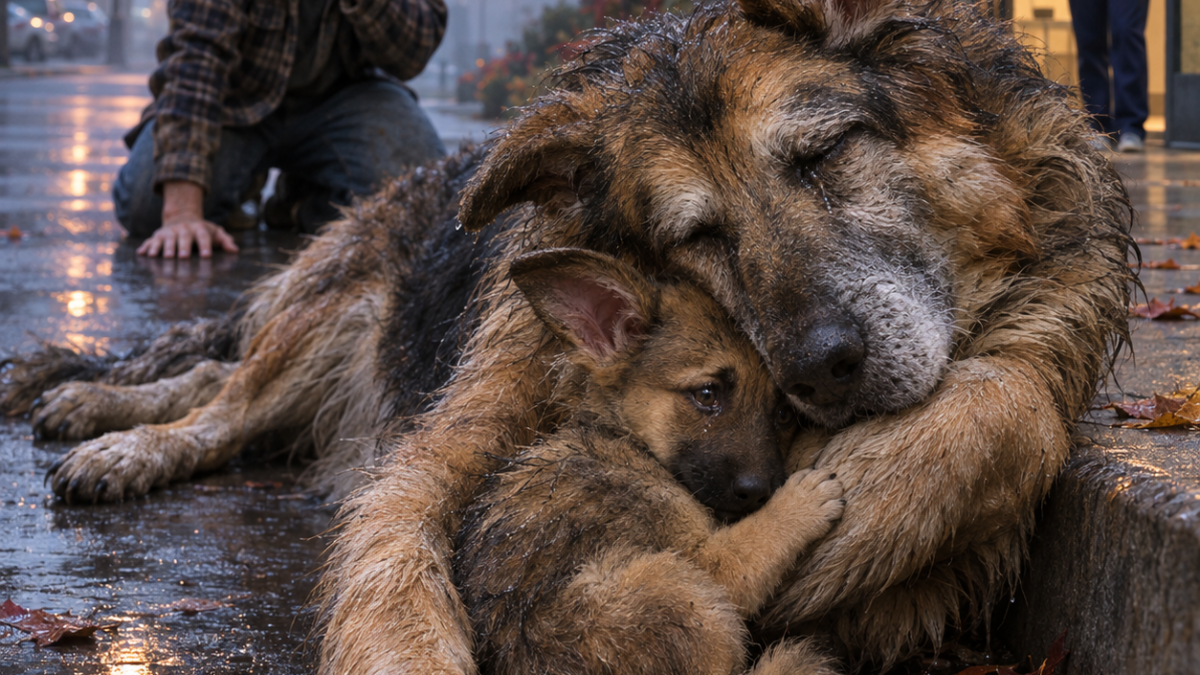
A wall of old black-and-tan fur between the puppy and everything unfamiliar.
For several seconds, nothing happened.
Then Rex turned his head.
Licked Bailey once between the ears.
Bailey flinched.
Rex waited.
Another lick.
Slow.
Gentle.
Again.
Bailey’s shaking continued.
Then gradually—
almost imperceptibly—
slowed.
His little body shifted.
One inch.
Closer.
Another.
Until his shoulder touched Rex’s chest.
Rex stopped licking.
Closed his eyes.
Bailey tucked himself against him.
I sat down because my legs suddenly felt unreliable.
Jennifer covered her mouth.
Dr. Nelson whispered:
“My God.”
That night, for the first time since Bailey had been found, he slept.
And Rex—
who had spent weeks shifting constantly because pain would not let him settle—
slept too.
I did not.
I sat in the metal chair watching them.
At midnight.
One.
Two.
Sometimes Bailey twitched in sleep.
Rex’s head would lift.
Check.
Then lower.
At 3:30, I walked to the vending machine.
Bought terrible coffee.
Returned.
Bailey was lying between Rex’s front legs.
His nose tucked beneath Rex’s chin.
I stared.
“How?”
No one answered.
Maybe there was no mystery.
Old dogs know puppies.
Dogs seek warmth.
Animals bond.
Biology can explain much.
But explanation does not make something less beautiful.
That is a mistake people make.
They believe if love has biology behind it, it becomes ordinary.
So does sunrise.
I still stop to look.
At six the next morning, Jennifer brought food.
Rex had refused meaningful food for almost three weeks.
Chicken.
Prescription diets.
Steak from my house.
Nothing beyond tiny bites.
Jennifer placed a small bowl near him.
“I know you’re not hungry.”
Rex opened his eyes.
Bailey woke.
The puppy sniffed the bowl but did not move.
Rex lifted his head.
Looked at food.
Then at Bailey.
And ate.
One bite.
Jennifer froze.
Another.
Not much.
Three or four mouthfuls.
But food.
“Frank.”
I stood.
“What?”
“He’s eating.”
I came closer.
Rex chewed slowly.
Then used his nose to push the bowl toward Bailey.
The puppy stared.
Sniffed.
Rex licked his head.
Bailey took a bite.
Jennifer started crying.
“I’m getting Dr. Nelson.”
She nearly ran from the room.
I knelt.
“Rex.”
His old eyes met mine.
“What are you doing?”
His tail moved once.
Like the question was stupid.
Dr. Nelson stood beside me ten minutes later.
Rex had finished perhaps a quarter of his portion.
Bailey had eaten the rest.
Karen listened to Rex’s heart.
Checked breathing.
Gums.
Pain.
“He isn’t better.”
I knew.
“This doesn’t change the cancer.”
“I know.”
She sat on the floor.
“But?”
She watched Rex lick Bailey’s ear.
“I don’t know.”
She sounded almost frustrated by it.
“He’s more alert than yesterday.”
“His heart rate is steadier.”
“He ate.”
“He stood.”
I looked at her.
“So we don’t do it.”
Karen’s expression tightened.
“Frank.”
“No.”
“Listen to me.”
“I am.”
“He’s still dying.”
“I know.”
“The question is whether today is the day.”
I looked at Rex.
Then Bailey.
“No.”
She followed my gaze.
Finally nodded.
“Not today.”
Those three words gave us four more mornings.
I went home for two hours.
Showered.
Fed myself.
Stared at Rex’s empty bed.
Then packed his favorite treats.
Chicken.
Ellen’s blanket.
A tennis ball he had not played with in months.
I found myself talking to the empty kitchen.
“Don’t make this cruel.”
I said.
To Rex?
To God?
To myself?
I have no idea.
I did not want extra time merely because I could not let go.
There is a line between love and asking someone to stay for you.
I had spent weeks trying not to cross it.
Now Bailey complicated everything.
Rex was not suddenly healthy.
He was doing something.
Something he apparently believed mattered.
Was that enough?
I asked Karen when I returned.
She answered carefully.
“If his pain stays controlled and he is still engaging voluntarily, I’m comfortable giving him time.”
“And if that changes?”
“We don’t wait because of the puppy.”
I nodded.
“Promise.”
That was the agreement.
No miracle fantasy.
No pretending death had been canceled.
Time.
Only time.
Bailey followed Rex everywhere.
Which, at first, meant approximately six feet.
Rex could not go far.
But Bailey did not care.
If Rex shifted, Bailey shifted.
If Rex drank, Bailey watched.
Then tried.
The first time Bailey properly drank from a bowl, he did it because Rex drank first.
He approached cautiously.
Nose touched water.
He sneezed.
Jennifer laughed.
Bailey retreated.
Rex drank again.
Bailey returned.
Success.
Everything became a lesson.
Food bowls.
Water.
Doorways.
Human voices.
Touch.
Bailey distrusted hands.
If Jennifer reached, he flattened.
If I extended fingers, he backed away.
Rex changed that.
I sat near them.
Placed my hand on Rex’s neck.
Scratched.
Rex relaxed.
Bailey watched.
I did not reach toward him.
Next visit, same.
Third time, Bailey crept forward.
Sniffed my sleeve.
Retreated.
Rex looked at him.
Then at me.
I whispered:
“No hurry.”
On the second evening, Bailey touched my fingers with his nose.
That was all.
It felt enormous.
Rex taught him to walk.
Not formally.
Bailey’s legs were weak from malnutrition.
He would stand.
Take two steps.
Collapse.
Every time, Rex watched.
Once Bailey fell against his shoulder.
Rex pushed his nose underneath the puppy’s chest.
Lifted.
Bailey found his feet.
Tried again.
The staff began stopping in the corridor.
Not crowding.
Watching quietly.
The receptionist.
Technicians.
A delivery driver once stood at the doorway and wiped his eyes.
“Sorry.”
He said.
“No idea why that got me.”
I knew why.
Everyone watching Rex understood what the puppy did not.
The teacher was disappearing.
That gave every ordinary lesson weight.
How to drink.
How to stand.
How to trust.
Rex was spending what little strength remained on a future he would not live to see.
Maybe that is why it felt sacred.
On the second night, I told Rex stories.
Bailey slept against him.
“You remember when Ellen bought you that ridiculous red coat?”
Rex’s ear moved.
“You hated it.”
I laughed.
“You walked like your legs didn’t work.”
Bailey woke briefly.
Looked at me.
“Your friend here was very dramatic.”
Rex sighed.
I chose to interpret this as objection.
“You stole the Christmas ham.”
Tail movement.
“Yes, you did.”
Bailey placed a paw over Rex’s foreleg.
I stopped speaking.
Something in that tiny gesture hurt more than the big moments.
The puppy had begun touching voluntarily.
Not clinging from terror.
Choosing closeness.
I looked at Rex.
“You’re good at this.”
His eyes closed.
I thought about all the years I had called him impossible.
The trash theft.
Mud.
Barking.
Broken screen door.
I had known him as companion.
Not teacher.
Perhaps animals contain roles we never see until someone needs them.
Day three, Rex walked six steps.
Clinic staff counted.
I wish they hadn’t.
Numbers make hope dangerous.
One.
Two.
Three.
His legs shook.
Bailey waddled behind.
Four.
Five.
Six.
Then Rex lowered himself.
Bailey attempted one more and fell onto his nose.
Everyone laughed.
Bailey looked offended.
Rex licked his face.
I laughed too.
Then went to the bathroom and cried.
Because joy and grief had become impossible to separate.
Every improvement in Bailey reminded me there would be someone here after Rex.
Every movement from Rex reminded me time was still leaving.
Dr. Nelson caught me outside.
“You okay?”
“No.”
“Good answer.”
I looked at her.
“How do you do this?”
“What?”
“Watch people lose animals every day.”
Karen leaned against wall.
“You don’t get good at it.”
“You get better at standing beside it.”
That sounded like Rex.
A wall between Bailey and the frightening world.
Maybe that is all any of us can do.
Not remove loss.
Stand beside it.
On day three, Bailey barked.
One tiny bark.
At his own reflection in a stainless-steel cabinet.
He startled himself.
Rex lifted his head.
Bailey barked again.
Rex’s tail thumped.
I laughed.
“There you go.”
Bailey approached the reflection.
Puffed himself up.
Another bark.
Rex looked almost amused.
If dogs can look amused, Rex did.
The puppy had begun to discover personality.
It had been hidden beneath fear.
That realization changed how I saw abandoned animals.
Fear is loud.
Personality waits underneath.
That afternoon, Jennifer brought a small toy.
Blue stuffed elephant.
Bailey sniffed.
No idea.
She squeezed.
Squeak.
Bailey jumped backward.
Rex opened one eye.
Jennifer squeezed again.
Bailey tilted his head.
Approached.
Bit the elephant.
Squeak.
He froze.
Then shook it.
Wildly.
For perhaps ten seconds, Bailey was simply a puppy.
Not abandoned.
Not starved.
Not afraid.
A baby animal murdering a stuffed elephant.
Everyone laughed.
Rex lifted his head higher.
Watched.
I could almost believe he looked proud.
Bailey carried the toy to him.
Dropped it against his paw.
Rex sniffed.
Then pushed it back with his nose.
Bailey pounced.
Game.
Small.
Enough.
That night, Rex ate another little meal.
Then gave Bailey his favorite chicken treat.
I objected.
“That’s yours.”
Rex looked at me.
Bailey ate.
“Traitor.”
Tail moved.
Fine.
I brought more next day.
Rex gave those away too.
I started to understand something.
For months, Rex’s world had been shrinking.
No long walks.
No truck rides.
No stairs.
No appetite.
No tasks.
Illness had taken away every thing through which he recognized himself.
Then Bailey arrived needing everything.
Protection.
Teaching.
Warmth.
Example.
Suddenly Rex had a job.
Not the kind humans assigned.
The kind old dogs sometimes choose.
He had become necessary again.
That did not cure him.
Purpose is not medicine.
But purpose can change how a day feels.
I think it changed Rex’s.
It changed mine.
On day four, the clinic moved them to a larger recovery room because Bailey had started exploring.
Rex remained on a thick bed.
Bailey ventured outward.
Three feet.
Return.
Five feet.
Return.
Doorway.
Freeze.
Rex watched.
Bailey looked back.
Rex lifted his head.
Bailey stepped through.
Then came racing back as though he had crossed an ocean.
He climbed onto Rex.
Rex grunted.
Bailey licked his muzzle.
I said:
“Personal space, kid.”
Bailey ignored.
Rex did too.
That afternoon, a little girl in the waiting room saw them through the glass.
She was maybe seven.
Her mother had brought a cat for vaccines.
The girl asked Jennifer:
“Is that the puppy’s dad?”
Jennifer looked at me.
I looked at Rex.
“No.”
I said.
The girl frowned.
“Then why is he taking care of him?”
I had no clever answer.
“Because Bailey needs him.”
She nodded as if this were obviously sufficient.
Children understand some things faster.
The little girl drew a picture while waiting.
Two dogs.
One very large.
One tiny.
A sun above.
She gave it to me.
“For the daddy dog.”
I did not correct her again.
The drawing stayed taped outside Rex’s room.
Day four evening was harder.
Rex’s breathing became rough.
He did not eat dinner.
Would not stand.
Dr. Nelson adjusted medication.
I sat beside him.
Bailey brought the blue elephant.
Dropped it near Rex’s face.
Rex did not move.
Bailey nudged him.
Again.
Nothing.
Panic entered the puppy’s body.
He began whining.
Rex opened his eyes.
Barely.
Licked Bailey once.
The puppy immediately curled beside him.
I had to turn away.
Karen said quietly:
“Frank.”
“I know.”
“I’m not saying tonight.”
“But we’re close.”
“I know.”
I hated knowing.
Knowledge does not make goodbye easier.
Sometimes ignorance is kinder.
I stayed the entire night.
No chair at distance anymore.
I sat on the floor.
My hand inside Rex’s bed.
Bailey between his front legs.
At midnight, I told him about the mailbox.
“You just walked inside.”
Rex breathed.
“No invitation.”
“You ruined the rug.”
Another breath.
“Ellen loved you immediately.”
My throat closed.
“She’s going to be happy to see you.”
I do not know what I believe happens after death.
I wanted it true.
For him.
For me.
“You tell her I’m still bad at the garden.”
I smiled through tears.
“And that I’m trying.”
Bailey shifted.
I stroked his little back.
“I don’t know what happens with him yet.”
Rex’s eye opened.
I looked down.
“No.”
I laughed softly.
“I know.”
“You’ve already decided.”
That thought had been growing.
If Bailey survived.
If his medical needs were manageable.
If no owner appeared.
If the shelter approved.
Home.
My home.
Rex’s home.
Was that betrayal?
I worried it was.
Then realised something.
Rex had not protected Bailey so Bailey could remain in a clinic forever.
Someone had to carry the lesson forward.
Maybe that someone was me.
At 3:20 a.m., Bailey woke.
Walked toward the water.
Drank alone.
No Rex demonstration.
Then returned.
Rex watched him.
That was the first task Bailey performed independently.
I whispered:
“You see that?”
Rex’s eyes followed.
“He learned.”
Tail moved once.
Tiny.
The fifth morning arrived gray.
Oregon sky.
Rain threatening.
Rex looked different.
Anyone who has sat beside a dying animal knows.
Not because death has a visible color.
Because the body seems to pull inward.
Energy turns away from the room.
Rex’s breathing shallow.
Eyes half-open.
Bailey did not play.
Did not wander.
He sat beside Rex.
One small paw resting on the old dog’s front leg.
I called Dr. Nelson.
She came in early.
Examined Rex.
Then met my eyes.
“Today.”
I nodded.
No argument.
No bargaining.
The time Bailey had given us had been real.
That did not mean we should steal from Rex now.
“What time?”
“When you’re ready.”
“No one is ready.”
She nodded.
“Then when he is.”
We decided to keep him comfortable and wait a little.
Rex did not seem acutely distressed.
Just leaving.
I called nobody.
There was nobody I needed.
Ellen gone.
My sister lived across the country.
Friends knew Rex was ill.
This felt private.
Jennifer worked quietly nearby.
Bailey stayed.
Around four in the morning—technically day six beginning, though in my mind it was still our fifth night together—Rex opened his eyes fully.
4:45.
I remember because the clock glowed over the medication cabinet.
He looked at me.
Not past.
At me.
I leaned forward.
“Hey.”
His eyes moved toward Bailey.
The puppy was sitting now.
Awake.
Rex’s tail moved.
Once.
Stopped.
Then again.
I put my hand on his head.
“You’ve done enough.”
His breathing deepened.
One breath.
Another.
Bailey placed his paw over Rex’s.
I lost whatever remained of my ability to stay composed.
I whispered:
“I’ve got him.”
There.
The sentence.
Maybe the one Rex needed.
Maybe only the one I needed.
“I’ve got him.”
Rex exhaled.
His eyes closed.
The next breath came slower.
Then another.
Then nothing.
I waited.
My hand remained against his head.
Bailey remained perfectly still.
Dr. Nelson checked.
Very gently.
Then looked at me.
I already knew.
I did not cry immediately.
That surprised me.
I had imagined collapsing.
Instead I felt quiet.
I kissed Rex’s forehead.
“Thank you.”
Bailey leaned down.
Placed his head against Rex’s chest.
Exactly where he had slept for five nights listening to that heart.
No whining.
No barking.
He simply lay there.
Waiting for something that would not return.
That was when I cried.
Not loudly.
Tears falling while I sat with both hands useless in my lap.
Jennifer cried.
Dr. Nelson stepped out.
Morning light began appearing through the clinic windows.
Rex had arrived in my life near a mailbox in rain.
He left while dawn turned gray over Oregon.
Thirteen years.
And the final five days had somehow become their own lifetime.
We did not move Rex immediately.
The clinic gave us time.
Bailey slept beside him again.
One final time.
Around seven, the puppy woke.
Licked Rex’s muzzle.
No response.
He tried again.
Then stood.
Looked at me.
I opened my arms.
Bailey hesitated.
Then returned to Rex.
Of course.
I waited.
When staff finally carried Rex away, Bailey panicked.
He cried.
A thin sound.
Scratched at the door.
Ran after the stretcher until Jennifer lifted him.
His entire body fought.
I turned away.
That may have been the worst moment.
Death is abstract to animals.
Absence is not.
Bailey knew the warm body was leaving.
He did not know why.
I took Ellen’s blanket after Rex was moved and placed it beside Bailey.
Rex’s scent remained.
Bailey curled on it.
Would not eat.
The next three days frightened us.
Bailey had been improving.
Now he regressed.
Food refused.
Play stopped.
He wandered clinic halls when allowed.
Sniffing rooms.
Looking.
Every large dog made his ears lift.
Every footstep turned his head.
Jennifer said:
“He’s searching.”
I nodded.
“What do we do?”
“Stay.”
Same answer.
Always.
I visited every day.
At first Bailey ignored me.
He had associated me with Rex, but I was not Rex.
I sat.
Talked.
Placed food.
Read newspapers aloud because silence felt too close to grief.
On the second day after Rex’s death, Bailey sniffed my hand.
Then walked away.
Day three, he ate chicken from fingers.
Day four, he followed me to the door.
Then stopped.
I turned.
He sat.
Looked up.
Rex used to do that.
Not exactly.
But enough to hurt.
I knelt.
“Come here.”
Bailey hesitated.
Then ran.
Straight into my chest.
I wrapped my arms around him.
He trembled.
So did I.
“There you are.”
I whispered.
“You poor little thing.”
He licked my chin.
And in that moment, I knew.
Not because Rex “would have wanted it.”
I could not ask him.
Because Bailey needed home.
And I had one.
Because I needed something too.
And admitting that did not diminish the generosity.
The adoption paperwork took another week.
Legally, Bailey had to complete stray hold.
No one claimed him.
No chip.
No missing reports.
Somebody had abandoned him.
That remained the only likely explanation.
I tried not to imagine who.
Rage does not help the animal in front of you.
On the day the hold expired, I signed.
Bailey Miller.
Ridiculous.
Perfect.
Jennifer cried.
Karen hugged me.
I pretended I had something in my eye.
Before leaving, I went to the room where Rex had spent his last days.
Empty.
Clean.
No blanket.
No bowls.
The little girl’s drawing still taped outside.
Large dog.
Tiny dog.
Sun.
I took it with permission.
It hangs in my hallway now.
Bailey was terrified of the car.
First ride home, he curled on the passenger-side floor.
I did not force him onto seat.
Drove slowly.
Talked.
“You’re going somewhere Rex knew.”
His ears moved.
“The food is decent.”
“Management questionable.”
“Large backyard.”
“No highway.”
At the house, I opened the door.
Bailey would not move.
I remembered Rex.
The way he had first marched inside as a puppy without invitation.
Different dog.
Different beginning.
I sat on porch.
Waited.
Ten minutes.
Bailey placed one paw outside.
Then another.
Sniffed.
Walked.
Entered the house behind me.
The first thing he did was find Rex’s bed.
Still beside fireplace.
I had not moved it.
Bailey sniffed for nearly a minute.
Then curled in the center.
My knees gave out.
I sat on floor.
“Of course.”
He slept there.
I did not.
That night I lay in bed hearing every movement downstairs.
At two, I went to check.
Bailey still in Rex’s bed.
Safe.
Breathing.
I returned upstairs.
At four, checked again.
Same.
By six, he was sitting in kitchen.
Looking at me.
Breakfast.
Good.
Routine had begun.
Bailey’s first months were not easy.
Love does not erase abandonment.
He feared raised voices.
Plastic bags.
Cars passing too close.
Men in heavy boots.
He ate too fast, then vomited.
We used slow feeders.
Small meals.
Patience.
If I moved suddenly while he slept, he woke terrified.
If I left the room, he sometimes followed instantly.
The first time I went to the grocery store, I returned to find him sitting directly behind the front door.
Not destructive.
Just waiting.
I sat beside him.
“I come back.”
He licked my hand.
“I’m going to have to prove that, aren’t I?”
Yes.
Again.
Again.
Again.
I leave.
I return.
Door opens.
Food comes.
Morning follows night.
Trust is repetition.
Rex had taught Bailey in five days that safety could exist.
My job was to make it ordinary.
I never tried to make Bailey into Rex.
People around me sometimes did.
“He has Rex’s eyes.”
“Look how he sleeps like Rex.”
“He’ll be just like him.”
No.
Bailey deserved himself.
Rex hated baths.
Bailey loved water.
Rex ignored fetch unless he felt charitable.
Bailey would chase a ball until my arm stopped working.
Rex hated carrots.
Bailey stole them from garden.
Rex slept by the door.
Bailey preferred my pillow.
Very different dog.
Thank God.
Replacement is unfair to both the dead and the living.
Still, some things felt inherited.
Bailey had a habit of resting one paw on my boot.
Rex did that.
Was it learned during five days?
Coincidence?
I do not know.
I stopped trying to explain every resemblance.
Some connections are allowed to remain mysterious without becoming supernatural.
At six months, Bailey had transformed physically.
Strong legs.
Healthy coat.
Gray with black along his back.
White patch on chest.
His ears never fully decided whether to stand.
One up.
One sideways.
I loved them.
He ran the Oregon trails with me.
At first short walks.
Then longer.
I was older.
He adjusted.
Or pretended to.
Sometimes he sprinted twenty yards then ran back.
Checking.
Rex used to do that when I lagged.
Again.
Maybe dog behavior.
Maybe inheritance through imitation.
Maybe love.
Choose whichever hurts least.
On Rex’s first birthday after his death, I took Bailey to the lake.
Rex’s favorite place.
Not for symbolism.
I needed to go.
I had avoided it.
Bailey pulled toward water.
Splashed immediately.
Rex would have looked offended.
I laughed.
“You are absolutely not him.”
Bailey shook water all over me.
“Yes.”
“Definitely not.”
We sat at the shore.
I brought Rex’s collar in my pocket.
Held it.
Bailey leaned against me.
I cried quietly.
He licked my wrist.
No grand revelation.
Just presence.
Enough.
Dr. Nelson put a photograph on the clinic wall.
Jennifer had taken it on the first morning.
Rex asleep.
Bailey between his paws.
Their bodies curved together.
Underneath, the clinic placed words:
SOMETIMES THE FIRST SAFE PLACE IS ANOTHER HEART.
That was enough.
Visitors asked.
Staff told the story.
Eventually local newspaper called.
I refused at first.
I did not want Rex turned into sentimental content.
Then Jennifer said:
“Frank, maybe someone reading it adopts a scared puppy.”
That changed me.
I agreed.
With conditions.
No claiming Rex “miraculously cured himself.”
He did not.
No pretending Bailey saved him from cancer.
He didn’t.
No saying I postponed euthanasia because I could not let go.
We postponed because Rex’s comfort and engagement changed temporarily.
We monitored.
Then let him go when it was time.
Truth can be beautiful without exaggeration.
The story spread locally.
People sent toys.
Donations to clinic hardship fund.
One woman sent twenty blue elephants.
Bailey destroyed seven.
Jennifer distributed rest.
The clinic started a small foster-support fund called Rex & Bailey Comfort Fund.
For abandoned or injured animals needing temporary care.
I liked that.
Not memorial statue.
Practical help.
Rex would have preferred chicken.
Still.
Bailey turned one.
Then two.
Large.
Strong.
Gentle.
Not because Rex magically programmed him.
Because five days of safety gave him a beginning.
Then months and years built the rest.
I often think that is the real power of kindness.
Not that one act fixes a life.
It gives the next good thing somewhere to stand.
Rex gave Bailey five safe nights.
That was enough foundation for everything I could offer later.
At two, Bailey still sleeps in Rex’s old bed sometimes.
I replaced the cushion.
Washed cover many times.
Rex’s scent is long gone.
So it is not memory through smell.
It is simply Bailey’s bed now.
That matters too.
Things can be inherited and become new.
I kept Rex’s collar above the fireplace.
Not urn.
His ashes are buried beneath Ellen’s old apple tree.
That was my choice.
The tree had barely produced fruit while she was alive.
After she d!ed, it suddenly became ridiculous.
Too many apples.
Ellen would have hated how much meaning I assign to that.
She believed trees were trees.
Dogs were dogs.
Death was death.
She also talked to tomatoes.
Contradictory woman.
I buried Rex beneath the tree because he spent years lying in its shade.
Bailey discovered the spot on his own.
He sometimes naps there.
I do not tell him anything.
He does not need to understand.
One evening, I sat on porch while Bailey slept beneath apple tree.
I thought about the last five days.
I had spent years believing Rex’s final gift to me was keeping me alive after Ellen.
Wrong.
That was one gift.
His final gift came later.
He taught me how to love something new without apologizing to what I lost.
That is harder than people admit.
After Ellen, I felt guilty when I laughed.
After Rex, guilty when Bailey made me happy.
As though joy were evidence that grief had been shallow.
It isn’t.
Grief and new love can occupy the same room.
I learned that while watching an abandoned puppy sleep in a dead dog’s bed.
Bailey helped me with another lesson too.
You cannot ask the living to spend their lives memorializing the dead.
For a while, every time Bailey did something, I compared.
Rex did this.
Rex didn’t do that.
Rex would have—
Then I stopped.
Bailey was not a continuation device.
He was a dog.
He deserved present tense.
So I began saying:
“Bailey loves water.”
“Bailey hates bananas.”
“Bailey sleeps upside down.”
“Bailey is terrible at catching treats.”
His identity grew.
Rex’s memory did not shrink.
That was freeing.
The most emotional moment came when Bailey was about fourteen months old.
I got sick.
Flu.
Nothing serious.
But fever kept me in bed.
Bailey stood in doorway.
Would not leave.
I woke around midnight.
He was lying beside bed.
Head on paws.
Watching.
Rex used to do that with Ellen.
My heart broke.
I reached down.
“Come here.”
Bailey climbed onto bed.
Far too large.
Curled against my legs.
I slept.
In the morning, I understood something.
Care is contagious.
Not in mystical way.
In modeled way.
Rex had shown Bailey closeness during fear.
I had shown Bailey consistency.
Now Bailey showed it back.
That is how love travels.
Behavior.
Experience.
Repetition.
I visit the clinic every few months.
Sometimes because Bailey needs vaccines.
Sometimes just to bring coffee.
Jennifer still works there.
Dr. Nelson too.
Each time Bailey walks past the photograph.
He never stops.
Why would he?
It is a human memorial.
His memories live elsewhere.
Maybe body.
Maybe not.
I stop.
That is enough.
Once, a woman in waiting room asked me:
“Is that your dog in the picture?”
I looked.
Rex and Bailey.
“Yes.”
“Which one?”
I almost laughed.
“Both.”
She looked confused.
So I told the short version.
Old dog.
Abandoned puppy.
Five days.
Then home.
She cried.
I said:
“Please don’t cry.”
Which is ridiculous advice while telling sad story.
She asked:
“Did the puppy understand Rex d!ed?”
“I don’t know.”
“Does he remember him?”
“I don’t know.”
She looked disappointed.
People want certainty.
I do not have it.
Then I added:
“But Rex changed what happened to him.”
That I know.
Bailey slept safely.
Ate.
Trusted.
Then came home with me.
Memory is not the only way a life stays influential.
Sometimes the effect is enough.
I also think about Rex refusing food before Bailey.
People love saying he “found a reason to live.”
Maybe.
But I am careful.
Rex did not choose cancer.
He did not fail to live because he lacked purpose.
Illness was killing him.
Bailey did not cure him.
What Bailey did was give meaning to several final days.
That is extraordinary without pretending love defeats biology.
Love cannot always stop death.
Sometimes it changes the shape of the time before it.
Those five days were shaped beautifully.
The clinic kept a copy of the little girl’s drawing too.
“Daddy dog.”
That wording once made me cry.
Now it makes me smile.
Rex had no puppies as far as I know.
He was neutered young.
Yet in his last days he became something close to a father.
Not biologically.
Functionally.
He gave warmth.
Protection.
Example.
Permission.
Perhaps family is partly whoever teaches your nervous system that sleep can be safe.
By that definition, Rex was Bailey’s first family.
Bailey’s second family is me.
And maybe Ellen.
In photographs.
Stories.
The house she chose.
The garden she planted.
Rex under the apple tree.
Family can include absence too.
As long as absence does not swallow everything living.
I almost let that happen once.
Rex prevented it.
Then Bailey did.
When Bailey turned two, I bought him a new blue elephant.
Same style as clinic toy.
He destroyed it in nine minutes.
I sat on floor holding torn fabric.
“You have no respect for history.”
Bailey brought squeaker.
Dropped in my lap.
Then looked proud.
I laughed until I cried.
Good.
Let history be destroyed sometimes.
Not everything must become sacred.
Rex would have shredded it too if healthy.
Probably.
People ask whether I will ever get another dog after Bailey.
I am seventy now.
I do not know.
One life at a time.
That is enough.
I no longer make promises against future love.
That was grief trying to control pain.
You cannot.
Everything you love becomes vulnerable to loss the moment you love it.
The answer is not to love less.
Rex taught me that twice.
There is still a moment I replay.
4:45.
Rex opening eyes.
Looking at me.
Then Bailey.
Tail.
Once.
Twice.
I said:
“I’ve got him.”
Sometimes I wonder whether that mattered to Rex.
Did he understand?
Probably tone.
Maybe scent.
Maybe nothing.
It mattered to me.
That sentence became a promise.
Not that Bailey would never suffer.
Impossible.
Not that I would be perfect.
Definitely impossible.
It meant:
He will not be alone if I can help it.
That I can keep.
I kept Rex’s old tags.
One says:
REX MILLER
Below, my phone number.
The metal is scratched.
Bailey’s tag hangs from his collar now.
Different shape.
Same number.
When he runs ahead on trails, I sometimes hear it jingling.
For half a second, the sound pulls thirteen years together.
Then Bailey turns around.
One ear up.
One sideways.
Present tense.
I smile.
Last winter, snow came.
Rare enough here to feel special.
Bailey had never seen deep snow.
He stepped outside.
Froze.
Then exploded.
Running.
Leaping.
Diving face-first.
I stood on porch laughing.
Rex had hated snow touching his paws.
Another difference.
Bailey ran circles.
Came back covered in white.
Jumped against me.
Nearly knocked me over.
For a moment, I imagined Rex watching.
Not literally.
Memory.
I could hear my own voice from years before.
“Terrible dog.”
Words I used lovingly.
I said them to Bailey.
“Terrible dog.”
He wagged.
Maybe that is inheritance too.
Not behavior.
Language.
The phrases we carry from one love to another.
They change meaning.
Remain warm.
The clinic called me last month.
A new abandoned puppy had arrived.
Not Bailey’s story.
Different.
Older.
Fearful.
Jennifer asked whether I could foster temporarily.
I said no.
Then looked at Bailey.
He was asleep.
I said:
“For a weekend.”
Jennifer laughed.
“Sure.”
The foster came.
Small hound mix named Penny.
Bailey approached.
Sniffed.
Penny backed away.
Bailey stopped.
Lay down sideways.
Not looming.
Not forcing.
My heart stopped.
Rex.
Not imitation exactly.
Dog manners.
But the picture—
large body making itself safe.
Penny approached ten minutes later.
Curled near Bailey.
I sat on the kitchen floor.
Cried.
Again.
Bailey looked at me like I was embarrassing.
Maybe kindness really does travel in ways no one can fully measure.
Rex to Bailey.
Bailey to Penny.
One safe body teaching another that the world can soften.
Penny was adopted two weeks later.
Not by me.
I behaved.
A young couple.
Good home.
Bailey watched her leave.
Then went to dinner.
Dogs understand transition differently.
I missed her more.
Funny.
Jennifer later said:
“You know Rex started something.”
I corrected:
“Rex was Rex.”
She smiled.
“I know.”
But perhaps she was right.
Not legacy as myth.
Chain reaction.
One old dog comforts puppy.
Puppy survives.
Grows.
Comforts another.
Humans witness.
Change their behavior.
That is enough.
I sometimes stand beneath the apple tree.
Rex’s ashes in soil.
Ellen buried in cemetery because that was what she wanted.
Different places.
Same heart.
Bailey often comes.
Sits.
Then wanders off.
Good.
He does not need to stand vigil at my grief.
I do enough.
On Rex’s second death anniversary, I brought no flowers.
No ceremony.
I took Bailey on morning walk.
Cooked eggs.
Sat porch.
At 4:45 a.m., I had been awake because old men wake at absurd hours.
Bailey was asleep on rug.
I looked at clock.
Remembered.
I whispered:
“Thank you, buddy.”
Bailey opened one eye.
Wrong buddy.
Or maybe not.
I scratched his ear.
We went back to sleep.
That felt healthier than building a shrine around a minute.
I have accepted something I resisted for a long time.
The final night was not Rex’s tragedy.
It was his last act of being himself.
Rex had always positioned his body between me and things he disliked.
Delivery drivers.
Vacuum cleaners.
A suspicious inflatable Santa one Christmas.
When Bailey arrived terrified, Rex did what Rex had always done.
He stood—
or tried to—
between family and fear.
He simply decided Bailey was family before anybody else knew.
That was him.
Not mystical.
Character.
I wish Ellen had seen it.
She would have laughed at me crying.
Then cried harder.
She would have adopted Bailey before paperwork existed.
I can hear her.
“Frank, obviously we’re taking him.”
“We?”
“Yes.”
“Why obviously?”
“Look at him.”
That would have been the argument.
Rex knew my wife well.
Perhaps he made the decision on her behalf.
That thought makes me smile.
Some nights Bailey sleeps beside my bed.
Other nights on Rex’s old bed.
Sometimes sprawled in hallway like a rug.
He snores.
Rex rarely snored.
Bailey sounds like a small chainsaw.
I complain.
Then if he stops, I listen.
That is love after loss.
You become suspicious of silence.
I put a hand on his side.
Breathing.
Okay.
I hate that fear.
I accept it.
Bailey does not know he saved me.
Again.
I am careful with word.
He did not arrive with mission.
He was a puppy surviving.
But caring for him gave my grief somewhere to move.
After Rex d!ed, I could have gone home to empty bowls.
Empty bed.
No footsteps.
Instead, Bailey needed breakfast.
Training.
Vet appointments.
Walks.
Exactly what Rex once forced me to do after Ellen.
Pattern.
Life sometimes does not rescue us with answers.
It gives us responsibility.
At first I resented that idea.
Why should love always mean work?
Because living things require it.
Food.
Medicine.
Cleaning.
Walks.
Patience.
That work becomes scaffolding around grief.
You keep moving because somebody needs you.
Then one day you realize you also want to move.
That happened with Rex after Ellen.
Then with Bailey after Rex.
I have been saved twice by creatures who mostly wanted dinner on schedule.
Humbling.
Bailey is two now.
Strong.
Healthy.
Loud when delivery truck arrives.
Terrified of vacuum.
Loves lakes.
Hates bananas.
Sleeps with the blue-elephant squeaker even though original toy is gone.
He has no idea what the phrase “last night” means.
Good.
Dogs deserve present tense.
Every morning we walk near the forest.
Bailey runs ahead.
Then circles back.
Touches my hand with his nose.
Runs again.
Sometimes sunlight catches his gray coat and I see something that reminds me of Rex.
Not physically.
A look.
Steady.
Then Bailey sees squirrel and becomes idiot.
Good.
He is not old soul carrying Rex’s burden.
He is Bailey.
That is the greatest gift Rex gave him.
A chance to become himself.
The photograph at the clinic remains.
Rex.
Bailey.
Sleeping.
People stop.
Read words.
Some ask.
Jennifer tells story.
I hope she always includes the hard part.
Rex still d!ed.
Bailey still grieved.
There was no miracle where love erased death.
The miracle, if we need that word, was smaller.
A dying dog had enough gentleness left to make a terrified puppy feel safe.
The puppy had enough trust left to accept it.
And I had enough courage left afterward to open my home again.
That is plenty.
I once thought love had to be measured by time.
Forty years with Ellen.
Thirteen with Rex.
Those numbers mattered.
Then Rex loved Bailey for five days.
Five.
That relationship changed Bailey’s entire life.
So now I measure differently.
Not only length.
Impact.
What becomes possible because someone was there?
Because Rex was there, Bailey slept.
Ate.
Walked.
Trusted.
Because Bailey was there, Rex spent his last days protecting instead of merely declining.
Because both were there, I learned goodbye can contain beginning without disrespecting either.
Five days.
Enough.
Would I have liked five more years?
Of course.
Ten.
Another thirteen.
Greed is natural around love.
But we do not choose duration.
Only what we do inside it.
Rex used his final days well.
Better than most of us use decades.
He rested beside someone frightened.
Shared food.
Helped him stand.
Kept watch.
Then left after the puppy no longer had to face the world alone.
That is a good ending.
Painful.
But good.
The night Rex d!ed, I told him:
“I’ve got him.”
I have tried to live worthy of that sentence.
Not perfectly.
Bailey once ate a sofa cushion because I left him too long during a doctor appointment.
I yelled.
He hid.
I regretted it instantly.
Sat on floor.
Waited.
He returned.
We repaired.
Safety is not perfection.
It is what happens after mistakes.
Rex taught him that people can be safe.
I have to keep proving it.
When I someday die—
hopefully not soon—
someone else will need to take Bailey if he is still here.
I have paperwork.
My niece, Sarah, loves him.
We discussed.
No ambiguity.
Loving an animal includes planning for the day you cannot care for it.
Daniel in other stories maybe? No, not relevant.
I learned from loss that assumptions are dangerous.
Bailey will not be abandoned again.
That is another promise to Rex.
Sarah visited last summer.
Bailey adored her.
Immediately.
Disloyal.
She threw ball better than me.
He followed her.
I said:
“Fine.”
“Go live with her.”
Bailey returned to me when she went inside.
Good.
Appropriate loyalty.
Sarah laughed.
“You’re jealous.”
“No.”
“You absolutely are.”
Possibly.
At dinner, she asked about Rex.
She had met him when younger.
Remembered.
“He was huge.”
“He thought so.”
“He liked Aunt Ellen better.”
“Everyone did.”
She smiled.
Then looked at Bailey.
“You think Rex knew you’d keep him?”
I looked.
“No.”
Then reconsidered.
“I think Rex knew I was there.”
Maybe enough.
Animals do not need legal adoption predictions.
They need someone present.
I was.
Presence.
That word returns often.
Jennifer present when Bailey arrived.
Rex present beside him.
Me present when Rex d!ed.
Bailey present when I returned home.
No one solved death.
No one reversed abandonment.
We stayed.
Sometimes that is the entire job.
A few months ago, I found an old voicemail from Ellen.
Accident.
Phone backup.
Her voice.
“Frank, pick up milk.”
Then:
“And tell Rex to stop digging under the fence.”
Normal.
No goodbye.
No wisdom.
I listened twelve times.
Then cried.
Bailey came.
Put head on knee.
I let voicemail play again.
Ellen’s voice.
Rex’s name.
Bailey listening.
Three timelines in one room.
Grief is strange.
I did not feel destroyed.
I felt full.
Painful fullness.
I think that is progress.
The next morning Bailey dug beneath fence.
I stared at hole.
Then laughed so hard I had to sit.
“Seriously?”
He wagged.
Ellen would have enjoyed that.
Some patterns travel without intention.
If you visit my house now, you will see photographs.
Ellen in garden.
Rex at lake.
Bailey covered in mud.
One photo of Rex and Bailey from clinic.
Not the famous sleeping one.
Another Jennifer took.
Rex awake.
Bailey standing badly beside him.
Rex’s nose beneath Bailey’s chest.
Helping him up.
That is my favorite.
Because it shows movement.
Not only protection.
Teaching.
Up.
Try again.
That feels like whole story.
When I am having bad day, I look at it.
Not because I believe every fallen thing can stand.
Some cannot.
Rex eventually couldn’t.
But while strength remains, sometimes a nose under your chest is enough.
Then you try again.
Bailey still falls occasionally.
Not physically often.
Emotionally.
Fireworks.
Loud trucks.
Some man in heavy boots.
Fear returns.
I do not say:
“But you’re safe now.”
Fear does not respond to logic instantly.
I sit.
Let him choose distance.
Wait.
Eventually he comes.
Then I remember Rex beside him.
No barking.
No forcing.
Just body there.
I imitate.
That may be Rex’s clearest inheritance.
Teaching me how to comfort Bailey.
One July Fourth, fireworks started early.
Bailey panicked.
Under table.
Panting.
I sat on floor.
No touching.
He looked at me.
I lay down sideways.
Old man on kitchen floor.
Ridiculous.
Bailey crawled closer.
Pressed against my chest.
I whispered:
“I’m here.”
Exact message Rex had given without words.
Safe enough for now.
We stayed until noise stopped.
I could almost feel old dog beside us.
Again, not ghost.
Method.
Love becoming technique.
People sometimes think tenderness is instinctive.
It can be learned.
Rex knew something I did not that first night.
Do not drag frightened thing toward comfort.
Become the safe place and let it come.
That lesson improved me as much as Bailey.
I was not always patient with Rex.
Important to admit.
I yelled when he destroyed things.
Got frustrated when he pulled leash.
Ignored him when work tired me.
Sometimes chose television over walk.
I regret certain moments.
But love is not proven by flawless history.
It is the total pattern.
I was his person.
He was mine.
We repaired after mistakes.
That is enough.
I try to offer Bailey same grace.
And myself.
Rex’s final five days do not erase the thirteen years before.
But they revealed him.
When body had almost nothing left, he spent it on care.
That tells me something about who he had always been beneath all the stolen turkey and stubbornness.
Maybe character shows most clearly when strength is scarce.
Rex had very little.
He gave it away.
I wish I could tell him Bailey is two.
That he can run.
That he sleeps without fear.
That he once stole an entire carrot.
That he barked at a deer and then hid behind me when deer turned around.
That he made friends with Penny.
That he has learned to trust Sarah.
That he does not remember the highway, or at least it does not own him.
That the little body Rex protected became a strong dog.
I think Rex would approve.
Then steal Bailey’s food.
Probably.
Every year on the night they met, I cook chicken.
One piece for Bailey.
One small portion placed beneath apple tree for a few minutes.
Then I remove it because leaving cooked chicken outside is ridiculous and invites raccoons.
Symbolism with practical limits.
I sit.
Tell Rex update.
Not because I believe he hears.
Because I do.
Bailey usually lies nearby.
Then we go inside.
The first year, I cried whole time.
Second, less.
Third—
we will see.
Grief changes.
Never disappears completely.
That is okay.
I no longer need it to.
There is a line beneath clinic photograph now that I like better than the original.
Jennifer added it after someone asked what the story meant.
It says:
HE COULD NOT GIVE THE PUPPY A LIFETIME. SO HE GAVE HIM THE FIRST SAFE NIGHT.
That is true.
And sometimes first safe night is enough to make next night possible.
Then next.
Until safety becomes ordinary.
Bailey lives inside ordinary now.
That is victory.
I think about the highway sometimes.
The place Bailey was found.
Cold.
Alone.
What if couple had not stopped?
Useless question.
Like asking what if I had never opened door to Rex at mailbox.
Life is full of unchosen forks.
Better to honor the one that happened.
They stopped.
Jennifer carried box.
Rex stood.
Five days.
Then me.
A chain of ordinary decisions.
No prophecy.
Just people and animals responding.
If you ever find something frightened—
dog.
Cat.
Person.
You may not be able to fix the entire life.
Maybe you only have one evening.
One meal.
One ride.
One call.
One safe corner.
Do not underestimate that.
Rex had five days.
Look what five days did.
And if you are grieving an animal and someone tells you:
“Just get another one.”
Ignore them.
You do not “get another one.”
You may, someday, meet somebody else.
Different.
New.
Love may enter again.
It will not erase.
It will not duplicate.
It will expand.
Rex remains mine.
Bailey is mine.
No competition.
Heart is strange architecture.
Rooms can be added.
I once thought loving Bailey after Rex would mean moving on.
I hate that phrase now.
Moving on sounds like leaving something behind.
I moved forward carrying him.
Different.
Rex comes in stories.
Habits.
Methods.
A worn collar.
A place under apple tree.
And the way I sit quietly beside Bailey when he is afraid.
That is carrying.
Bailey does not need to carry Rex consciously.
I do that.
His job is to live.
Run.
Sleep.
Make mess.
Age eventually.
That is enough.
Rex gave him permission.
I intend to protect it.
Tonight Bailey is asleep at my feet while I write this.
He is larger than Rex was at same age.
His one crooked ear occasionally twitches.
Probably dreaming.
Maybe of forest.
Maybe food.
Maybe nothing.
I do not claim he dreams of Rex.
That would be my need, not his truth.
What I know is simpler.
Once, when Bailey was tiny and terrified, he slept five nights listening to an old dog’s heart.
Those were perhaps first nights he ever slept without expecting harm.
Now he sleeps deeply.
Feet twitching.
Belly exposed.
Safe enough not to guard himself.
Whatever memory remains or does not remain, Rex is part of how that became possible.
That is enough for me.
Sometimes at 4:45 in the morning, I wake.
Age.
Bathroom.
Then pass Bailey’s bed.
See chest rise.
Fall.
I remember Rex’s last breath.
For one second, pain.
Then Bailey snores.
Life answers.
I go back to bed.
The final night of Rex’s life was supposed to be about goodbye.
Instead, it became somebody else’s first experience of home.
That is why I can tell the story without only breaking.
Yes, I lost Rex.
Yes, Bailey lost him too.
But Rex did not leave emptiness alone.
He left direction.
Take care of this small thing.
Keep going.
Love again.
I do not know whether he intended any of that.
Dogs do not write wills.
But actions become instructions sometimes.
I listened.
If Rex could give me one final command, I think it would be simple.
Not stay.
Not wait.
Not mourn.
Probably something more practical.
Feed the puppy.
Take the walk.
Open the door.
Live.
So I do.
Every morning.
Bailey and I walk beneath the Oregon pines.
The air smells wet and green.
He runs ahead.
Turns.
Checks me.
I wave.
“Go.”
He runs again.
Sometimes sunlight breaks through the branches.
Gray fur turns silver.
For a heartbeat, I see the frightened ten-week-old puppy hidden beneath the dog he became.
Then he disappears around the bend.
I hear tags.
Paws.
Life.
I follow.
People like to say Rex saved Bailey.
He did.
But not alone.
Bailey eventually saved pieces of me Rex could no longer stay to protect.
Maybe that is how love survives death.
Not by remaining unchanged.
By moving.
One heart.
Then another.
Old dog.
Puppy.
Old man.
Forward.
Rex’s last night was supposed to be an ending.
It was.
But it was also a beginning.
Both can be true.
That is what those five days taught me.
A heart can stop.
Love can continue doing work.
A dog can die.
A puppy can learn to sleep.
An old man can bury his best friend and still open his front door to another frightened animal.
Grief and hope are not enemies.
Sometimes they sleep pressed together in the same kennel.
The last thing Rex ever saw was Bailey beside him.
The last thing I told him was:
“I’ve got him.”
I still do.
And maybe, in the only sense that matters, Rex still has us too.
Not as a ghost.
Not as a story we refuse to release.
As the reason a frightened puppy discovered warmth before fear could become his whole personality.
As the reason I learned that loving someone new is not disloyalty.
As the quiet lesson that your final days can still contain purpose even when they cannot contain a cure.
Rex could not give Bailey thirteen years.
He could not watch him grow.
Could not teach him every lesson.
Could not run beside him through the forest.
He gave what he had.
Five nights.
His body.
His warmth.
His food.
His patience.
His heart beating beneath Bailey’s ear.
And when that heart finally stopped, the puppy had already learned the first thing he needed to survive the world:
Not every larger creature would hurt him.
Some would lie beside him.
Some would make themselves into a wall.
Some would share the last of their strength.
Some would stay.
That was Rex.
My dog.
Ellen’s dog.
Bailey’s first refuge.
And if you ask me what his life meant, I do not need grand words anymore.
He was there when I needed him.
Then, at the very end, he was there when Bailey needed him.
And when he could no longer stay—
he left the two of us with each other.
I cannot imagine a kinder goodbye.








