FULL ENDING :“ROOK? PLEASE TELL ME YOU DIDN’T CARRY THIS ALONE FOR FIVE YEARS!” A Navy SEAL Found His Dead Teammate’s Injured K9 in an Idaho Shelter — The Old Dog Recognized Their Secret Signal, But When Declan Examined His Torn Harness, He Discovered a Clue That Could Destroy Everything He Believed About Ethan’s Final Mission
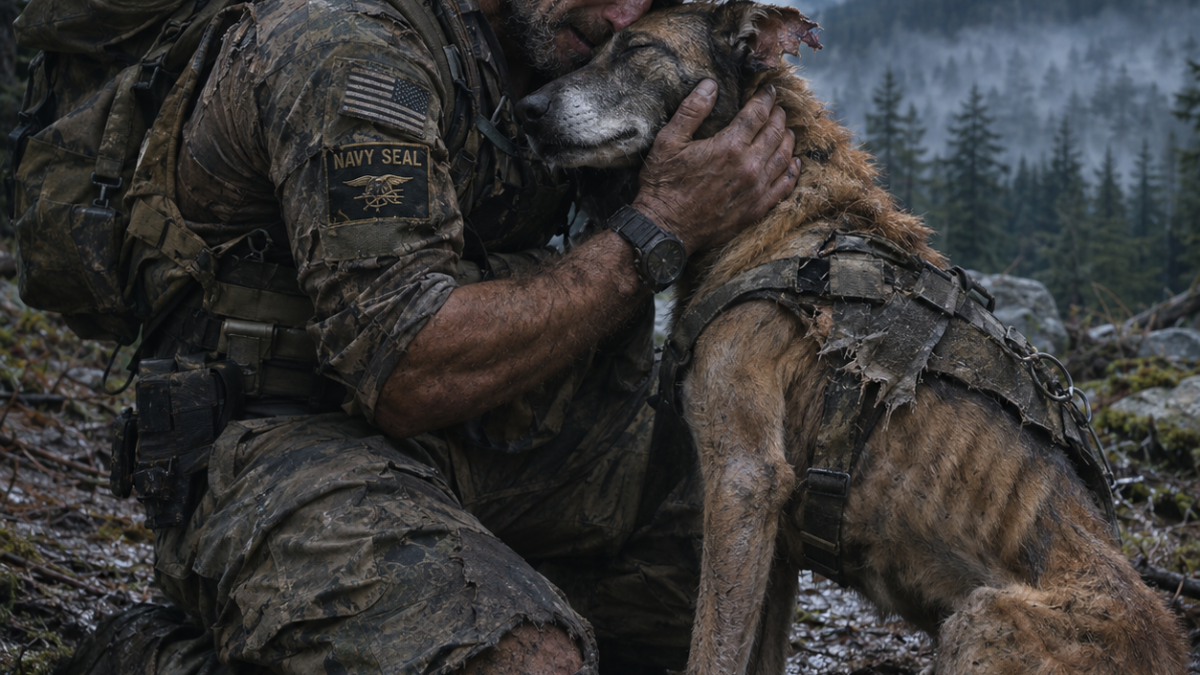
The old dog wasn’t barking.
That was the first thing Declan Shaw noticed.
Every other kennel at Red Creek Animal Rescue echoed with noise.
Dogs jumped against their gates.
A young Labrador spun excitedly in circles.
Somewhere near the entrance, a terrier barked with the conviction that he could personally scare away every visitor.
But the Belgian Malinois in the final kennel remained silent.
He lay near the back wall.
Head resting on his paws.
His body lean but muscular beneath a faded fawn-and-mahogany coat.
Gray had begun spreading around his black muzzle.
His eyes were dark amber.
Watchful.
Tired.
And when Declan stopped outside the kennel, those eyes lifted toward him.
Something inside his chest went cold.
He knew those eyes.
No.
That was impossible.
He forced himself to look away.
Then looked back.
The dog’s right ear stood upright except for a small V-shaped tear along the edge.
Declan remembered that tear.
A training accident years earlier.
Rook had caught his ear on a sharp piece of fencing while pursuing a target, and Ethan had spent three days pretending the injury was more serious than it was because he wanted an excuse to spoil the dog.
Then Declan noticed the left rear leg.
The slight outward turn.
The old stiffness.
His throat closed.
“No.”
The word escaped before he could stop it.
Behind him, Mara Bennett paused.
“Declan?”
He didn’t answer.
He stared at the dog.
Five years.
Five winters.
Five years of believing that loyal animal had disappeared forever in the same storm that killed Ethan Cole.
It couldn’t be him.
The dog would be older now.
Worn down.
And the chances of surviving that mountain were almost nonexistent.
Declan knew what hope could do to a grieving man.
It could turn a familiar sound into a voice.
A stranger into someone lost.
A coincidence into a message.
He’d spent years teaching himself not to believe every reminder meant something.
But then the old Malinois slowly stood.
His rear leg stiffened.
He shifted his weight.
And Declan forgot how to breathe.
“Rook?”
The name was barely audible.
The dog stared.
Declan lowered his left hand.
Two fingers together.
A silent signal.
One he’d helped Ethan develop years earlier when Rook was a young working dog who believed every assignment was a game worth winning.
The Malinois froze.
His ears lifted.
Then, with the quiet precision of an animal responding to something buried deep in his training, he crossed the kennel.
Stopped at Declan’s left side.
And sat.
Exactly where Ethan had trained him to sit.
Mara covered her mouth.
Declan didn’t move.
His hands began trembling.
He had seen combat.
Held wounded teammates.
Survived situations he’d never discuss with strangers.
But now his fingers shook so badly he had to curl them into his palms.
He lowered himself slowly.
His damaged knee protested.
He barely noticed.
“Rook.”
The dog rose.
Approached the gate.
And pressed his forehead against Declan’s hand.
Declan closed his eyes.
The last time he’d touched that dog, Ethan had been alive.
It had been snowing.
Ethan was laughing about the weather.
Rook had been impatient to work.
And nobody knew that before sunrise, one of them would be dead and the other would disappear into the mountains.
Now the animal was here.
Breathing.
Warm.
Real.
Declan pressed his fingers into the old dog’s fur.
“You stubborn old boy.”
His voice broke.
“Where have you been?”
Rook leaned harder against him.
His tail moved once.
Then again.
Declan lowered his forehead toward the gate.
For five years, he hadn’t cried when anyone mentioned Ethan’s name.
Not at the memorial.
Not on the anniversary.
Not when he packed away the last photographs from their service years.
But in a narrow shelter corridor smelling of disinfectant and damp fur, he began sobbing against the head of a dog he’d already mourned.
And when Mara quietly opened the kennel door, Rook stepped forward and rested his entire weight against Declan’s chest.
As though he had finally found someone who understood how long he’d been gone.
PART2
Declan didn’t remember deciding to put his arms around the dog.
One moment he was kneeling beside the open kennel.
The next, both hands were buried in Rook’s thick fur.
He felt the animal breathing against him.
Slowly.
Steadily.
The familiar warmth was almost unbearable.
For years, he’d imagined Rook buried beneath mountain snow.
Or dying alone in some frozen ravine.
Or searching for Ethan until exhaustion finally stopped his heart.
Now the old dog was alive.
And Declan couldn’t stop touching him.
“Easy, buddy.”
His voice shook.
“I’ve got you.”
Rook pressed his black muzzle against Declan’s chest.
Then settled beside his left knee.
The exact position Ethan had taught him.
Declan covered his face.
Because it wasn’t only a dog he’d found.
It was a piece of a life he thought had ended forever.
Mara Bennett stood quietly nearby.
She was forty-three, tall and athletic, with dark brown hair tied low behind her neck and gray-green eyes accustomed to watching the mountains for signs of trouble.
She’d operated Red Creek Animal Rescue for several years after working with wilderness search-and-rescue teams.
She understood injured animals.
Frightened people.
And the value of giving someone a moment without filling it with words.
She had seen visitors cry while surrendering pets.
She had watched families reunite with missing dogs.
But she had never seen a man who looked as unshakable as Declan Shaw collapse into tears merely because an old Malinois recognized his hand.
For a long time, she said nothing.
Then she crouched beside them.
“Declan.”
He looked up.
His face was wet.
She gently asked, “Are you certain?”
He swallowed.
Then glanced toward the torn ear.
“The right ear.”
A pause.
“The rear leg.”
He touched the dog’s shoulder.
“And that signal.”
Mara nodded.
“I saw.”
Declan looked into Rook’s eyes.
“His name is Rook.”
Mara’s expression softened.
“Then we should find out how he got here.”
Declan had only come to the shelter to repair a generator.
Nothing more.
A friend in town had called that morning, explaining that the backup generator had been failing just as another December storm approached.
Thirty-seven animals depended on the shelter having heat and reliable power.
Declan knew engines.
He knew how to replace a fuel line.
Clean a blocked system.
Repair a loose connection.
And he had nothing particularly urgent waiting for him at home.
So he’d driven into town wearing his old brown canvas jacket, navy-blue flannel shirt, worn jeans, and waterproof boots.
He spent nearly two hours kneeling behind the shelter in freezing rain.
The generator had a partially blocked fuel line and a loose battery terminal.
Once repaired, it started properly.
Mara had thanked him.
He’d nodded.
Then made his way through the kennel corridor toward the exit.
That should have been the end of the visit.
Instead, three slow scratches against concrete had made him turn around.
And his entire life had changed.
Mara took him to her office.
Rook followed.
Carefully.
His older joints stiff.
His gait slightly uneven.
But every time Declan stopped, the dog stopped beside his left leg.
When Declan sat, Rook settled near his boot.
As though five years had never passed.
Mara opened the intake record.
“We received him three weeks ago.”
Declan stared.
“From where?”
“A man named Walter Grady.”
The name meant nothing to him.
Mara continued.
“Seventy-four. Retired snowplow driver. He suffered a mild stroke and entered a rehabilitation facility.”
She looked at Rook.
“His daughter couldn’t keep the dog.”
Declan’s stomach tightened.
“So she brought him here.”
Mara nodded.
“He came in under the name Scout.”
Declan looked down.
“Scout.”
Rook’s ears lifted slightly.
The name had evidently become familiar.
Declan felt an unexpected ache.
For years, somebody else had called this dog home.
Somebody had fed him.
Cared for him.
Kept him alive.
And Declan didn’t know whether to feel grateful or devastated that he hadn’t been part of it.
“We scanned his microchip,” Mara said.
Declan looked up.
“And?”
“The registration pointed to an old group called the Central Idaho Wilderness Canine Association.”
He frowned.
“I remember them.”
Mara nodded.
“The organization closed three years ago. Their phone and email no longer work. We requested an archive search.”
Declan took a breath.
“Did the record show a handler?”
“Not yet.”
She studied him.
“That’s why I haven’t been able to confirm his original identity.”
Declan looked toward Rook.
The dog had lowered his head onto Declan’s boot.
For a moment, he remembered Ethan’s voice.
Rook, left.
The dog moving instantly.
Good boy.
Ethan laughing.
Declan swallowed.
“His handler was Ethan Cole.”
Mara went still.
She knew the name.
Everybody connected to mountain search and rescue in that part of Idaho knew it.
Ethan Cole.
Former Navy SEAL.
Volunteer rescue specialist.
Killed in the Granite Crown avalanche five winters earlier.
His dog missing ever since.
Mara slowly sat back.
“Ethan’s Rook?”
Declan nodded.
Her eyes filled.
For a moment, neither spoke.
Then Mara looked toward the animal.
“I knew there was something unusual about him.”
Declan almost laughed.
“That’s one way to describe him.”
She smiled sadly.
Then reached for the foster paperwork.
“You can take him home temporarily while we verify the records.”
Declan looked up.
For a moment, he hesitated.
Because taking Rook home meant opening something he’d spent years keeping closed.
Memories.
Questions.
Guilt.
A kind of grief he had never learned to explain.
Then Rook pressed his muzzle more firmly against Declan’s leg.
Declan looked down.
His throat tightened.
“Get the papers.”
Twenty minutes later, he stood outside beside his old truck.
Freezing rain had begun turning to snow.
Rook approached the passenger door.
He paused.
Sniffed the step.
Then looked toward Declan.
The years showed in the movement.
He wasn’t the restless young animal who once jumped into rescue vehicles as though every mission belonged to him.
He needed time.
Declan opened the door wider.
“Easy.”
He supported Rook as the dog climbed inside.
Then waited until he was settled comfortably.
Rook looked toward him.
His dark amber eyes were familiar.
Declan swallowed.
“Ready to go home?”
The dog lifted one ear.
Then rested his head against the seat.
Declan closed the door.
Walked around the truck.
And stood for a moment in the snow.
His hands were trembling again.
He stared toward the mountains.
Then whispered, “Ethan, what the hell happened to your boy?”
Five years earlier, Declan had been fifty miles from Granite Crown when the call came.
He remembered the exact sound of his phone ringing.
The weather report.
The radio traffic.
The way the man’s voice changed when he said Ethan’s name.
There had been an avalanche.
Search crews were working through the storm.
Communications were unreliable.
Several rescuers were unaccounted for.
Then came the final message.
Ethan Cole had been found.
Dead.
His K9 partner was missing.
Declan remembered driving through the night.
The roads were bad.
Snow covered the windshield faster than the wipers could clear it.
He arrived after the recovery.
The rescue staging area was crowded with exhausted volunteers.
Vehicles.
Radios.
Maps.
People moving with the stunned efficiency of those who knew that something terrible had happened but still had work to finish.
He saw Ethan’s equipment.
His jacket.
A damaged radio.
A bag containing personal belongings.
Then someone told him the official account.
Ethan had left his assigned search corridor.
Moved toward Firewatch 12.
Continued operating in dangerous conditions.
And been killed by a second avalanche.
The report didn’t openly call him careless.
But it allowed the conclusion to settle.
A brave man had pushed too far.
A skilled rescuer had taken one risk too many.
And a dog that trusted him had disappeared.
Declan hated that explanation.
Not because he believed Ethan was incapable of mistakes.
He wasn’t.
Ethan could be stubborn.
Impulsive in small ways.
Too quick to volunteer.
Too willing to make jokes when everybody else was exhausted.
But he knew mountains.
He respected weather.
He understood rescue procedures.
And he loved Rook.
Declan couldn’t imagine him wandering away from his assigned corridor without reason.
Yet the report said otherwise.
The maps supported it.
The official timeline showed him moving away from North Spur.
Declan had read it repeatedly.
Searching for something that explained the decision.
Eventually, he stopped searching.
Not because the questions disappeared.
Because every attempt to answer them ended in the same unbearable place.
Ethan was dead.
Rook was gone.
And nothing Declan did would bring either of them home.
Now Rook was sleeping inside his truck.
Alive.
Older.
And carrying the same small scar Declan remembered from the day Ethan laughed and said the dog was too stubborn to realize he’d been hurt.
Declan gripped the steering wheel.
Then began driving.
His cabin sat fifteen minutes outside Red Creek.
A modest wooden building surrounded by lodgepole pines.
He lived alone.
The rooms were orderly.
Tools arranged neatly.
Firewood stacked evenly.
Boots placed beside the door.
Coffee made at the same hour each morning.
For years, Declan had treated routine as a form of protection.
If everything had a place, perhaps the parts of his life that couldn’t be repaired would remain easier to ignore.
But the moment Rook entered the cabin, the silence changed.
His nails clicked against the wooden floor.
He sniffed the doorway.
The furniture.
The kitchen.
The hallway.
He paused beside the fireplace.
Then circled twice.
And lay down.
Declan stood watching.
For a moment, he felt as though he’d brought a ghost into his house.
Not a frightening one.
Something worse.
A living reminder of everything he’d lost.
He filled a water bowl.
Rook drank.
Then ate the food Mara had provided.
Afterward, the dog settled near the fire.
Declan sat opposite him.
For nearly an hour, neither moved.
There were questions he wanted to ask.
Where had Rook been?
How had he survived?
Had Ethan been alive when the avalanche struck?
Had Rook stayed beside him?
Had he tried to dig him out?
Had he searched for help?
Had he been afraid?
Declan stared into the old dog’s eyes.
Then whispered, “Were you with him?”
Rook rested his muzzle on his paws.
Of course he couldn’t answer.
That was the cruelty of it.
The only living creature who might have witnessed Ethan’s final moments could never explain them.
Near midnight, the wind rose.
Snow struck the windows.
The cabin creaked.
Rook lifted his head.
His ears moved.
Then he stood.
Walked toward the back door.
And stared through the glass.
Declan looked up.
“Rook?”
The dog remained motionless.
His body had become rigid.
His nose lifted slightly.
He seemed to be listening.
Declan approached.
Opened the door.
Cold air rushed inside.
Rook didn’t go out.
He simply stood looking north.
Toward Granite Crown.
Toward the mountains hidden beyond the trees.
Then a low sound escaped his throat.
Not a bark.
Not quite a whine.
Something older.
Sadder.
Declan looked toward the darkness.
For a moment, his heart seemed to stop.
Five years ago, Rook had vanished into those mountains.
Now he was staring toward them as though part of him had never come back.
The following morning, Mara called.
Declan answered immediately.
“We got the archived microchip record.”
He stopped moving.
Across the room, Rook lifted his head.
Mara continued.
“Registered name: Rook.”
Declan closed his eyes.
“Handler: Ethan Cole.”
His throat tightened.
Then she read the final entry.
Missing after Granite Crown incident.
Declan lowered himself into a chair.
For a moment, he couldn’t speak.
It was official.
The dog wasn’t a coincidence.
Wasn’t a product of grief.
Wasn’t an old animal who happened to resemble the one he’d lost.
He was Rook.
Ethan’s Rook.
Alive after five years.
Declan looked toward him.
The dog rose.
Crossed the room.
And sat beside Declan’s left leg.
He placed one scarred hand against Rook’s neck.
Then whispered, “Welcome back, buddy.”
Mara told him they needed to speak with Walter Grady.
The man who had kept Rook alive.
Declan agreed.
But after the call ended, he remained seated for several minutes.
His fingers rested against the dog’s fur.
He thought about Ethan.
Then about the old mountain report.
And for the first time in five years, Declan wondered whether the official story had left something important out.
Not because Rook had somehow returned from the dead.
Because the dog had survived long enough for someone to ask what happened after he disappeared.
And Declan intended to ask.
The Red Creek Rehabilitation Center sat on the western edge of town.
A low building surrounded by pines.
Its windows looked toward a courtyard covered in snow.
Declan arrived the next morning with Rook.
Inside, a nurse guided them toward a sunroom.
Walter Grady was waiting beside the window.
Seventy-four years old.
Broad shoulders.
A windburned face.
Large, rough hands.
Gray hair combed back.
A wooden cane resting against his chair.
A recent stroke had slowed one side of his mouth when he spoke, but his eyes remained sharp.
He looked like a man who had spent a lifetime fighting winter storms with engines, chains, and stubborn determination.
Walter glanced toward the doorway.
Then saw the dog.
His face changed instantly.
“Scout?”
Rook froze.
His ears lifted.
Then, with a burst of energy Declan hadn’t seen at the shelter, the old Malinois hurried across the room.
His rear leg moved stiffly.
His paws clicked against the floor.
He reached Walter.
Pressed his head against the man’s knees.
And began wagging his tail.
Walter’s hands trembled.
He lowered them toward the dog’s neck.
“You old fool.”
His voice broke.
“You found your way back.”
Declan stopped near the doorway.
For a moment, all the questions he’d brought seemed unimportant.
Because Walter wasn’t looking at Rook like an animal he’d kept temporarily.
He was looking at him like family.
Declan waited until Walter could speak.
Then introduced himself.
“Declan Shaw.”
Walter nodded.
“The man from the shelter.”
“Yes.”
He looked toward Rook.
“His original name was Rook.”
Walter’s hand stopped.
He stared.
Declan continued.
“He belonged to Ethan Cole.”
For a moment, Walter looked confused.
Then recognition crossed his face.
“The rescue man.”
Declan swallowed.
“Yes.”
Walter looked down at Rook.
Then whispered, “I’ll be damned.”
They sat together.
Rook remained pressed against Walter’s leg.
Declan didn’t try to call him away.
Whatever had happened over the previous five years, Walter had earned the dog’s trust.
And Declan respected that.
He waited.
Then asked, “How did you find him?”
Walter looked toward the snow outside.
For several seconds, he said nothing.
Then began.
It had been seventeen days after the Granite Crown avalanche.
Walter was working part-time clearing remote service roads.
The winter had been severe.
Snowdrifts blocked access to maintenance areas.
He’d spent hours inside a county plow, keeping isolated routes passable.
One afternoon, near an abandoned equipment shed, he noticed tracks.
Not wolf tracks.
Dog tracks.
He stopped.
Followed them toward the building.
And found a Belgian Malinois curled beneath a shallow overhang.
The animal was barely moving.
Thin.
Dehydrated.
A deep injury along his left rear leg.
Most of his harness had been torn away.
Walter thought he was dead.
Then the dog opened his eyes.
Walter placed food nearby.
The Malinois didn’t approach.
He watched.
Suspicious.
Exhausted.
Walter backed away.
Returned to the truck.
Waited.
Eventually, the animal dragged himself toward the food.
The next morning, Walter returned.
The dog was still there.
The food was gone.
He brought water.
More food.
A blanket.
For three days, he came back.
Until finally, the Malinois allowed him close enough to touch his neck.
Walter wrapped him carefully.
Lifted him into his truck.
And drove to a veterinary clinic.
Declan listened without moving.
He imagined Rook alone beneath the shed.
Seventeen days.
Through freezing temperatures.
Snow.
Wind.
An injured leg.
No handler.
No familiar voice.
Nobody calling him home.
His throat tightened.
“How the hell did he survive?”
Walter shook his head.
“I’ve asked myself that for five years.”
He looked toward the dog.
“Some animals just won’t quit.”
The veterinarian treated Rook.
Scanned his microchip.
The registration led to the wilderness canine association, but the contact information was outdated.
Walter also reported finding the dog.
The report went into a local system.
Meanwhile, Rook remained listed as missing through the neighboring search-and-rescue jurisdiction.
Nobody connected the records.
Walter tried the number.
Received no useful response.
And eventually brought the dog home.
He called him Scout.
A name chosen because the animal never stopped examining the world around him.
Declan listened.
Then asked, “Why didn’t you keep looking?”
Walter’s face tightened.
For a moment, Declan regretted how harshly he’d asked.
The old man stared toward the window.
“I should have.”
His voice was quiet.
“I told myself I’d done what I was supposed to do.”
A pause.
“Took him to the vet.”
“Reported him.”
“Kept him alive.”
He looked toward Rook.
“But I should have kept trying.”
Declan felt something painful move through his chest.
He knew that voice.
He’d used it himself.
I should have.
The words that turn hindsight into punishment.
He took a breath.
“Walter.”
The old man looked up.
“You saved his life.”
Walter shook his head.
“That doesn’t mean I did enough.”
Declan stared.
Then said quietly, “I know how that feels.”
For a moment, neither spoke.
Rook rested his head against Walter’s knee.
Then suddenly lifted it.
His ears moved.
He turned toward the large window.
Snow was falling outside.
He stood.
Walked toward the glass.
And stared north.
Declan went still.
Walter’s expression changed.
Declan noticed immediately.
“You’ve seen him do that before.”
Walter didn’t answer.
Rook remained motionless.
Declan stepped closer.
“Walter?”
The old man looked toward the dog.
Then whispered, “Every winter.”
For a moment, Declan couldn’t breathe.
“What do you mean?”
Walter leaned back.
Then told him something no one else knew.
Four months after he rescued Rook, the dog disappeared from Walter’s property.
Walter thought he’d lost him.
Then found tracks leading north.
He followed in his pickup.
The tracks continued for miles.
Along old service roads.
Through timber.
Toward an abandoned mountain station.
Firewatch 12.
Declan stared.
“Firewatch 12?”
Walter nodded.
“The old emergency shelter.”
He explained that the station had once served as a fire lookout support facility and winter rescue relay point.
By then, it was mostly decommissioned.
The doors were weathered.
The radio equipment obsolete.
The bunks abandoned.
Walter found Rook sitting outside the entrance.
Not sniffing wildly.
Not searching the surrounding woods.
Just sitting.
Waiting.
“For how long?” Declan asked.
“Two hours.”
Declan felt cold.
Walter continued.
“The next autumn, he did it again.”
Another trip north.
Same route.
Same station.
Same position near the door.
After that, Walter improved his fencing to keep the dog safe.
But every winter, when the first serious snow arrived, Rook stood looking north.
Toward Firewatch 12.
As though something there remained unfinished.
Declan looked toward the dog.
For five years, he’d believed Rook was missing.
Now he learned the animal had spent those years returning to a place connected to Ethan’s death.
But why?
The official report had described Ethan leaving his assigned corridor near Granite Crown.
Firewatch 12 wasn’t supposed to be part of his mission.
Declan remembered the maps.
The route.
The questions.
He swallowed.
“Walter, did you ever find anything there?”
The old man hesitated.
Then reached toward a cabinet.
A nurse helped him open a drawer.
Inside was a small plastic bag.
Walter removed it.
Then held it toward Declan.
“Found this on him when the vet treated his leg.”
Declan took the bag.
Inside lay a torn strip of working-harness webbing.
Faded.
Weathered.
Partly frayed.
He recognized the material.
Search-and-rescue-grade nylon.
Then he turned it over.
Two black markings remained.
F12.
Declan stopped breathing.
Firewatch 12.
Written on Ethan’s dog’s harness.
Five years earlier.
Before the avalanche.
He took out his phone.
Photographed the webbing.
Sent the image to Mara Bennett.
She called almost immediately.
“Where did you get that?”
Declan looked toward Walter.
“He kept it.”
“From Rook?”
“Yes.”
Mara was silent.
Then said, “Declan, there’s something wrong.”
His stomach tightened.
“What?”
“Ethan’s assigned search corridor was North Spur.”
“I know.”
“Firewatch 12 wasn’t on it.”
Declan stared toward Rook.
His heart began pounding.
Mara continued.
“I remember the deployment maps.”
A pause.
“He wasn’t supposed to go near that station.”
Declan looked down at the harness.
The two markings.
F12.
Then asked the question that would change everything.
“Then why did Ethan mark it on Rook before he died?”
For the next twenty minutes, Declan remained in Walter Grady’s sunroom.
The old man sat beside the window.
Rook rested near his chair.
Outside, snow drifted past the glass.
Declan turned the harness fragment over and over.
F12.
Two characters.
Nothing more.
Yet they had survived five winters.
Cold.
Water.
Injury.
The tearing of the harness.
And the long journey that ended beneath an abandoned maintenance shed.
Walter watched him.
“Means something, doesn’t it?”
Declan took a breath.
“I don’t know yet.”
He looked toward the dog.
“But I think Ethan knew exactly where he was trying to go.”
Walter’s expression tightened.
“Wasn’t that in the rescue report?”
Declan shook his head.
“No.”
A pause.
“The report said he left his assigned route.”
Walter frowned.
“Without permission?”
“That was the implication.”
Rook lifted his head.
Declan looked at him.
For years, he’d allowed that implication to become the explanation he carried.
Ethan had taken a needless risk.
Rook had followed him.
The mountain had punished them both.
But what if that wasn’t what happened?
What if the missing dog had been carrying evidence nobody thought to look for?
Before leaving, Declan crouched beside Walter.
“Thank you for saving him.”
The old man looked down.
His large hands rested against Rook’s neck.
“I was afraid nobody would ever find out where he came from.”
Declan swallowed.
“You gave him a home.”
Walter’s eyes filled.
“He gave me one too.”
For a moment, Declan couldn’t speak.
Walter continued.
“After my wife died, that house got awfully quiet.”
He smiled sadly.
“Scout filled it up.”
Declan looked toward Rook.
The old dog leaned against Walter.
And suddenly Declan understood something that made his gratitude feel heavier.
Rook hadn’t spent five years merely surviving.
He’d been loved.
By a man who needed him.
A man who had shared food, shelter, ordinary mornings, and lonely winter nights.
Whatever Declan discovered about the past, he would never pretend those years hadn’t mattered.
He gently touched Walter’s shoulder.
“You can see him whenever you want.”
Walter looked up.
“Really?”
Declan nodded.
“Of course.”
The old man’s face softened.
Then Rook stood.
Crossed the sunroom.
And settled beside Declan’s left leg.
Walter laughed through tears.
“Would you look at that?”
Declan looked down.
His throat tightened.
“He remembers both of us.”
That evening, Mara came to Declan’s cabin.
She carried a folder containing old search maps.
Declan placed the harness fragment on his kitchen table.
Rook lay beside the fireplace.
The dog seemed more comfortable than he’d been the previous evening, but whenever the wind rose, his ears still turned toward the north.
Mara spread the maps across the table.
“Granite Crown.”
Declan leaned forward.
She pointed toward a marked corridor.
“North Spur.”
He nodded.
“Ethan’s assigned area.”
Then she moved her finger toward a second location.
“Firewatch 12.”
Declan stared.
The station was several miles away from the route Ethan was expected to follow.
The terrain between them was broken by exposed ridges and avalanche-prone slopes.
“That’s a significant change,” he said.
Mara nodded.
“Especially in that weather.”
He studied the map.
“Why would he do it?”
She shook her head.
“I don’t know.”
For several minutes, they worked through the possible routes.
The ridgelines.
The drainages.
The locations of the missing skiers.
Nothing explained the discrepancy.
Then Mara remembered something.
“There was a dispatcher.”
Declan looked up.
“Who?”
“Lena Ortiz.”
He frowned.
“The emergency communications operator?”
Mara nodded.
“She handled radio traffic that night.”
Declan stared toward the map.
Mara continued.
“She retired afterward.”
“Do you know where she is?”
“Yes.”
“Then I want to speak with her.”
Lena Ortiz lived on the eastern edge of Red Creek.
Her cedar-sided house stood near open pasture, with the Sawtooth foothills rising in the distance.
She was sixty-two.
Small.
Straight-backed.
Her black hair, heavily threaded with silver, was cut into a neat bob.
She wore a burgundy cardigan over a cream blouse.
Her dark brown eyes had the alertness of a woman who’d spent decades listening carefully to voices nobody else could see.
When Declan, Mara, and Rook arrived, she was already standing at the door.
Mara had called ahead.
But Lena clearly wasn’t prepared for the dog.
Her face changed.
“Oh, my God.”
Rook stepped from the truck.
His left rear leg stiffened for two strides.
Then he adjusted.
Lena watched him.
Her hand rose toward her chest.
“That’s Rook?”
Declan nodded.
She swallowed.
“I remember his call sign.”
A pause.
“K9 Rook.”
Then she said something that made Declan’s throat tighten.
“Ethan used to correct anybody who called him just a dog.”
Declan almost smiled.
He remembered that.
Ethan would look offended whenever someone referred to Rook as equipment.
“He’s my partner,” he’d insist.
Sometimes he said it jokingly.
Sometimes not.
And he meant it every time.
Inside, Lena led them to a small dining table.
The room was orderly.
A clock ticked quietly near the wall.
Three sharpened pencils lay beside a yellow notepad.
Even in retirement, Lena seemed incapable of allowing papers to sit crookedly.
Declan placed the harness fragment on the table.
She studied it.
Her expression tightened.
“Where did this come from?”
“Walter Grady kept it after rescuing Rook.”
Lena looked toward the dog.
Then back at the webbing.
Mara leaned forward.
“Lena, was Firewatch 12 used during Ethan’s final mission?”
Lena didn’t answer immediately.
The hesitation was small.
But Declan noticed.
He’d spent most of his adult life listening for the moment when a person was deciding how much to say.
Lena folded her hands.
Then stood.
“There’s something I need to show you.”
She disappeared down the hallway.
When she returned, she carried a worn black notebook.
Its cover had faded.
An elastic band held it closed.
She placed it on the table.
Then sat.
“These aren’t official records.”
Declan frowned.
“What are they?”
“My shift notes.”
She looked toward Mara.
“During complicated incidents, I used to write things down while radio traffic was coming in faster than the computer system could be updated.”
Names.
Times.
Channel changes.
Requests.
Positions.
Weather information.
Small details that could become important thirty seconds later.
Most of the notebooks had been discarded according to routine retention practices.
But Lena had kept a few.
And the one from Granite Crown had remained in her home for five years.
She opened it.
The pages smelled faintly of old paper.
Near the top of one sheet was a date.
December 9.
Declan’s stomach tightened.
The night Ethan died.
Lena moved her finger down the page.
Then stopped.
Beside Ethan’s name were the words:
NORTH SPUR UNSTABLE — CRACKING OBSERVED. REQUESTS F12 APPROACH.
Beneath the notation:
FIELD APPROVED.
For a moment, nobody moved.
Declan stared.
Read it again.
Then a third time.
His heart began pounding.
“Approved?”
Lena nodded.
“I handled the relay.”
He looked toward Mara.
Her face had gone pale.
Then he turned back.
“Ethan requested the route change?”
“Yes.”
“And somebody approved it?”
“Yes.”
He stared toward the page.
For five years, he’d believed Ethan made the decision alone.
That he broke procedure.
Abandoned his assignment.
Now Lena was telling him the move had been authorized.
“Then why isn’t it in the report?” Declan asked.
His voice was sharper than he intended.
Lena lowered her eyes.
“I thought it was.”
He stared.
She continued.
“The electronic incident timeline didn’t show the approval when I later reviewed the summary.”
Mara frowned.
“What did you do?”
“I assumed the radio change had been captured in another system.”
Her voice weakened.
“I should have checked.”
Declan looked at her.
For a moment, he saw something familiar.
The guilt.
The years of replaying a moment.
The belief that if she’d done one thing differently, perhaps the past would make more sense.
He took a breath.
“Lena.”
She looked up.
“You were handling emergency traffic during a major mountain rescue.”
She swallowed.
“That doesn’t change what was missing.”
“No.”
He looked toward the notebook.
“It doesn’t.”
Then he added quietly, “But it doesn’t mean you caused what happened.”
For a moment, her eyes filled.
Lena turned another page.
Near the bottom was a final notation.
4:17 — COLE: SUBJECT LOCATED. RETURNING F12.
Declan froze.
4:17.
Four seventeen in the morning.
He knew the approximate time.
The final radio contact.
The last moment anyone had heard Ethan’s voice.
For years, it had been described in incomplete summaries.
Fragments.
Static.
Uncertainty.
Now a handwritten note suggested Ethan had found someone.
And was returning to Firewatch 12.
Rook suddenly stood.
The old dog’s ears lifted.
He approached the table.
Lena stopped moving.
Rook pressed his nose against the edge.
Then gave a low, restrained whine.
Declan looked down.
“Hey, buddy.”
Rook didn’t move.
His eyes remained fixed toward Lena.
Perhaps it was her voice.
Perhaps the tension in the room.
Perhaps a scent he recognized.
Declan couldn’t know.
But the sight made his chest tighten.
Because Ethan’s name had been spoken aloud.
And Rook had spent five years without the man who answered when he heard it.
Lena lowered her hand.
“That’s the last transmission I personally heard.”
Declan stared toward the notebook.
“What happened after?”
She shook her head.
“Static.”
A pause.
“Then we lost the channel.”
He closed his eyes.
For five years, he’d imagined Ethan moving away from the approved route because he believed he could handle the mountain alone.
Now he had a different picture.
A man recognizing instability.
Requesting a safer approach.
Receiving approval.
Finding someone.
And trying to return.
Mara leaned forward.
“We need the official recordings.”
Lena nodded.
“If they still exist.”
Declan looked up.
“Who can get them?”
Mara considered.
“The sheriff’s office. Possibly state archives. There were multiple agencies involved.”
Declan stared toward Rook.
The dog had returned to his left side.
He gently touched the old animal’s head.
Then whispered, “We’re going to find out, boy.”
Detective Daniel Reyes didn’t look impressed when they brought him the story.
That was a good sign.
He was forty-six.
Compact and solidly built.
Short black hair graying at the temples.
Clean-shaven.
Dark eyes that seemed to give every person the same careful attention.
He wore a charcoal shirt beneath a brown field jacket.
He’d spent years investigating mountain fatalities, missing persons, and accidents in difficult terrain.
He knew how easily grief could turn suspicion into certainty.
And he refused to treat a dramatic coincidence as proof.
They met inside a small conference room at the Fremont County Sheriff’s Office.
Daniel examined the harness fragment.
Read Lena’s notebook.
Reviewed Walter’s statement.
Then looked toward Declan.
“I need to make something clear.”
Declan folded his arms.
“Go ahead.”
“This doesn’t prove anyone deliberately falsified the final report.”
Declan’s jaw tightened.
“I didn’t say that.”
Daniel nodded.
“Good.”
He placed the notebook on the table.
“Because if we’re going to review this, we’re going to separate what we know from what we suspect.”
Declan stared.
For a moment, he felt an old flash of irritation.
The instinct to demand action.
Answers.
Movement.
Then he looked toward Rook, resting beside the wall.
And remembered what it felt like to live for years inside a conclusion that might have been wrong.
He took a breath.
“All right.”
Daniel nodded.
“We start with the records.”
He requested archived dispatch information.
Search-and-rescue reports.
Radio logs.
Weather records.
Interagency communications.
And any backup audio preserved outside the original county incident system.
The process took several days.
Declan hated every minute.
He repaired a railing that didn’t need repairing.
Stacked firewood.
Then restacked it.
Checked the truck.
Cleaned his workshop.
Walked Rook through the snowy woods longer than his injured knee appreciated.
The dog seemed calmer than he’d been on the first night.
He slept near the fireplace.
Accepted food regularly.
Followed Declan from room to room.
But whenever the north wind rose, his ears still lifted.
One afternoon, Declan found him standing beside the back door.
He looked toward the dog.
“Still thinking about the mountain?”
Rook glanced back.
Then returned his gaze to the trees.
Declan lowered himself onto the floor.
His knee ached.
He ignored it.
For a while, they sat together.
Then he whispered, “I was angry at him.”
Rook looked toward him.
Declan swallowed.
“Ethan.”
The dog’s ears lifted.
“I never said it out loud.”
He looked down.
“But I was.”
For five years, he’d replayed the report.
Imagined Ethan ignoring warnings.
Pushing too far.
Taking Rook into unnecessary danger.
Declan had loved his friend.
But part of him had been furious.
Because it seemed so unnecessary.
A man who knew better making a mistake that killed him.
And a loyal dog disappearing because he followed.
Declan pressed his hand against Rook’s neck.
“Maybe I was wrong.”
The dog leaned against him.
Declan closed his eyes.
“God, I hope I was wrong.”
Four days later, Daniel called.
“Declan.”
He stood immediately.
“Yes?”
“Can you come to the office?”
Declan’s stomach tightened.
“What happened?”
“We found something.”
A pause.
“You need to hear it.”
Mara was already waiting when Declan arrived.
Daniel stood beside a computer.
A speaker sat in the middle of the conference table.
Rook settled beside Declan’s chair.
Daniel looked toward them.
“The recording wasn’t in the county archive.”
Declan frowned.
“Where was it?”
“An old Idaho Department of Lands backup system.”
Daniel explained that Firewatch 12 had once served as a communications relay point between different agencies.
Some emergency radio traffic had been captured in a separate system.
Much of the recording was damaged.
Static.
Missing intervals.
Corrupted audio.
But several fragments survived.
Including transmissions from Ethan’s final mission.
Declan stared at the speaker.
For a moment, he couldn’t move.
He hadn’t heard Ethan’s voice in five years.
Not the real voice.
Not a memory.
Not an old video played at the memorial.
A voice recorded on the night he died.
He looked toward Daniel.
The detective waited.
Then asked, “Ready?”
Declan swallowed.
And nodded.
The speaker crackled.
Static filled the room.
Wind.
Radio interference.
Then a voice.
Clear enough to recognize immediately.
Ethan.
“North Spur is loading badly. I’ve got cracking on the upper shelf.”
Declan stopped breathing.
The voice was older than he remembered.
Or perhaps it only sounded that way because it came from the worst night of their lives.
Ethan continued.
“Requesting Firewatch 12 approach.”
Static.
A pause.
Then another voice.
“Cole, Firewatch 12 approved. Proceed and update at shelter.”
The room went silent.
Declan stared at the speaker.
The confirmation was unmistakable.
Ethan hadn’t abandoned his assignment.
He’d reported dangerous conditions and requested a route change.
And that change had been authorized.
Daniel let the recording continue.
The audio jumped forward.
Minutes were missing.
Wind distorted the voices.
Then Ethan returned.
“Two subjects at Twelve. Cold, but ambulatory.”
A pause.
“Third beacon still active upslope. Rook and I are moving.”
Mara lowered her eyes.
Declan remained motionless.
Two people.
Found.
Brought toward shelter.
A third still missing.
And Ethan had gone back.
The speaker hissed.
More static.
Then the last surviving transmission.
Timestamped 4:17 a.m.
Ethan’s voice emerged through the noise.
Breathing hard.
Wind tearing across the microphone.
“I have the third subject. Leg injury. Alive. Returning to Twelve.”
Then—
Nothing.
The speaker went silent.
Daniel stopped the recording.
For several seconds, nobody moved.
Declan’s hand was clenched so tightly his knuckles had turned white.
He looked toward Rook.
The dog remained beside his leg.
Then Declan whispered, “He found him.”
Daniel nodded.
“Yes.”
“He was bringing him back.”
“Yes.”
Declan’s voice broke.
“And the avalanche hit them.”
Daniel lowered his eyes.
“That’s what the available evidence indicates.”
Declan stood.
Walked toward the window.
Outside, snow covered the parking lot.
Cars moved slowly along the road.
Ordinary people going about their lives.
He stared without seeing them.
Five years.
Five years of believing his closest teammate had made a reckless decision.
Five years of wondering why Ethan hadn’t respected the mountain.
Why he’d abandoned a safe route.
Why he’d gone too far.
Now Ethan’s own voice had answered.
He hadn’t ignored the danger.
He’d recognized it.
He’d reported it.
He’d requested a change.
And then he’d gone back because someone was still missing.
Declan pressed his hand against the window frame.
His chest hurt.
He thought about Ethan.
Thirty-nine years old.
Short dark-blond hair.
Hazel eyes.
That infuriating grin.
The man who cracked jokes during storms and made other people laugh when they were frightened.
The man who once told Declan that retiring from the Navy didn’t mean retiring from helping people.
The man who loved Rook like family.
Declan closed his eyes.
Then whispered, “I’m sorry, brother.”
Daniel approached.
“There was a third skier.”
Declan turned.
“What happened to him?”
“He survived.”
Declan froze.
Daniel continued.
“His name is Caleb Morris.”
A pause.
“He lives in Boise.”
Declan stared.
For the first time, the story wasn’t only about a lost man and a lost dog.
There was someone alive because Ethan went back.
Someone who might remember what happened before the mountain came down.
Declan looked at Daniel.
“I want to speak with him.”
Caleb Morris was thirty-five.
He’d been twenty-nine when the avalanche occurred.
An experienced recreational backcountry skier who’d gone into dangerous terrain with two friends and spent the next five years carrying the knowledge that someone died bringing him to safety.
He had short brown hair.
Pale blue eyes.
A narrow scar above his left eyebrow.
And a way of speaking that suggested he’d spent years learning to distinguish what he truly remembered from what his nightmares supplied.
When he entered the meeting room, he saw Rook immediately.
He stopped.
His expression changed.
“Is that him?”
Declan nodded.
Caleb stared.
“The dog?”
“Yes.”
For a moment, Caleb couldn’t breathe.
Then he whispered, “He found me first.”
They sat together.
Rook lay near Declan’s boot.
Caleb kept looking at him.
Not with fear.
With the stunned recognition of someone seeing a part of the worst day of his life walking calmly across the floor.
Finally, Caleb began speaking.
He remembered the weather.
The wind.
The snow.
His injured leg.
The terrible confusion of becoming separated from his friends.
He remembered being frightened that he would die.
Then hearing barking.
Not close at first.
A distant sound through the wind.
Then louder.
He’d called out.
And Rook appeared.
“He came straight toward me,” Caleb whispered.
His eyes filled.
“I thought I was hallucinating.”
He looked at the dog.
“He just kept barking.”
A pause.
“Then he came close enough for me to touch him.”
Caleb swallowed.
“I grabbed his fur.”
Declan stared.
The old Malinois lifted his head.
Caleb continued.
“He stayed.”
Tears ran down his face.
“He stayed until Ethan got there.”
Ethan arrived and assessed Caleb’s condition.
He stabilized the injured leg as best he could.
Helped protect him from the cold.
Then radioed their position.
Caleb remembered the relief.
The strange certainty that everything would be all right because someone competent had finally reached him.
Then the mountain made a sound.
He looked toward Declan.
His face had gone pale.
“I still hear it.”
Declan remained quiet.
Caleb swallowed.
“A crack.”
He looked toward the table.
“Like the whole ridge splitting.”
Ethan looked uphill.
Only once.
Caleb remembered that clearly.
He didn’t scream.
Didn’t panic.
He grabbed Caleb.
Pulled him toward a rock outcrop.
And shoved him into a protected position.
Then everything became white.
Snow.
Noise.
Pressure.
Darkness.
Caleb lost consciousness.
When rescuers found him hours later, he was sheltered in a shallow pocket near the rocks.
Injured.
Cold.
But alive.
Ethan’s body was recovered farther downslope.
Rook was missing.
Caleb learned afterward that the man who’d saved him was dead.
He’d carried that knowledge for five years.
Now he sat across from Declan with tears streaming down his face.
Then he said something Declan would never forget.
“Ethan didn’t die because he was lost.”
Declan stared.
Caleb’s voice broke.
“He was exactly where he meant to be.”
For a moment, Declan couldn’t speak.
Then he looked toward Rook.
The dog was watching them.
Calm.
Alert.
His graying muzzle resting against his paws.
Declan reached toward him.
Rook leaned into his hand.
And Declan finally understood the part of Ethan’s final mission that no report had ever explained properly.
His friend hadn’t died pursuing glory.
Or refusing to obey.
Or trying to prove he was invincible.
He had identified danger.
Found two people.
Gone back for the third.
And tried to bring an injured man down the mountain.
The avalanche had taken his life.
But it hadn’t made his decisions reckless.
That evening, Declan stopped his truck at a turnout overlooking Granite Crown.
The mountains rose dark beneath the winter sky.
Rook sat beside him.
For several minutes, neither moved.
Then Declan spoke.
“I blamed him.”
The words sounded strange inside the cab.
He looked toward the mountain.
“I never said it out loud.”
A pause.
“But I did.”
His eyes filled.
“I thought he left the route.”
He swallowed.
“I thought he pushed too far.”
The old dog turned toward him.
Declan placed one hand against his neck.
“And all that time, he was doing what he was supposed to do.”
He closed his eyes.
Then whispered, “I’m sorry I doubted him.”
Rook pressed his head against Declan’s arm.
For a long moment, Declan cried.
Not because everything was fixed.
Ethan was still gone.
The years could not be returned.
But something had changed.
His grief no longer had to carry the false weight of blaming a man who died saving someone else.
There was still one question.
Why had the official records told a different story?
And who had known enough to correct them?
Declan looked toward Granite Crown.
He knew the mountain hadn’t been waiting five years to confess.
The truth was in the paperwork.
The missing warnings.
The incomplete reports.
The decisions made by people who never stood where Ethan stood.
And if his friend was going to rest beneath the story he actually earned, those records needed to be corrected.
Detective Daniel Reyes began with the avalanche reports.
He didn’t begin by searching for someone to blame.
That mattered to Declan, even if he found the patience difficult.
Daniel had spent much of his career investigating mountain fatalities.
He understood how quickly an accident could become a story about villains and heroes when the evidence was incomplete.
A storm didn’t care about reputations.
A broken radio didn’t care about intentions.
And a mistaken record could survive for years simply because everyone assumed somebody else had verified it.
Daniel wanted to know what happened before Ethan reached Granite Crown.
Not just what the final report said afterward.
Four days later, Declan returned to the sheriff’s office.
Mara was already there.
Rook settled beside his left boot.
The conference table had disappeared beneath maps, weather charts, emails, and archived records.
Daniel entered carrying another folder.
His expression was serious.
“We found the original avalanche warning.”
Declan leaned forward.
“What warning?”
Daniel placed a report on the table.
It was dated December 8.
The day before Ethan died.
The author was Noah Bell.
A county snow-safety technician with nearly fifteen years of experience.
His recommendation was direct.
North Spur: Recommend closure after 1800. Increasing wind loading. Possible slab development.
Declan read it.
Then looked up.
“Six in the evening.”
Daniel nodded.
“The search operation began later that night.”
Mara stared toward the report.
“That route should have been closed.”
Daniel didn’t answer immediately.
Then he turned another page.
“It should have been addressed before anybody was assigned there.”
Noah Bell was fifty-one now.
Lean.
Narrow-faced.
Weathered by years spent assessing mountain conditions.
He had survived an avalanche earlier in his career.
A colleague beside him had suffered a serious pelvic injury.
Since then, Noah had become unusually careful about documenting unstable snow.
He wrote detailed reports.
Recorded observations.
Sent warnings.
And sometimes frustrated people who wanted decisions made faster.
But on December 8, he’d seen something dangerous.
The snowpack was changing.
Wind was loading the upper slopes.
The risk of a slab release was increasing.
He recommended closure.
The report existed.
It had been sent.
And yet the route was still displayed as open when Ethan’s rescue team was assigned to the mountain.
Declan looked toward Daniel.
“Who overruled him?”
The detective shook his head.
“That’s the complication.”
Declan frowned.
“What complication?”
“Nobody issued a simple order saying the warning was wrong.”
Daniel placed an email on the table.
The sender was Darren Pike.
Operations manager at Granite Crown Lodge.
At the time, Darren was forty-seven.
The lodge was preparing for the winter season.
Supply vehicles were delivering heating fuel, food, and maintenance equipment.
The final convoy was still expected that evening.
Darren asked whether physical closure of the service access could be delayed until the trucks finished.
Estimated completion: nine o’clock.
A county employee replied that the barrier could remain open temporarily if conditions didn’t deteriorate significantly.
Declan stared at the exchange.
“So they delayed it.”
Daniel nodded.
“Temporarily.”
Mara looked toward the weather report.
“But conditions were already worsening.”
“Yes.”
The convoy ran late.
It didn’t finish at nine.
It finished closer to eleven.
By then, weather conditions had deteriorated further.
The physical barrier wasn’t installed that night.
And the electronic route-status system used by search and rescue operated separately from the road-management records.
North Spur continued showing:
OPEN.
Declan leaned back.
He remembered the board at the staging area.
The route assignments.
The belief that the necessary safety decisions had already been made.
He’d trusted the system too.
Almost everyone had.
Daniel turned another page.
“This was the second failure.”
The closure recommendation had been emailed to several offices.
Transportation.
Lodge coordination.
County emergency management.
But it wasn’t properly entered into the dispatch mapping system.
One employee believed road operations would update the status after the barrier was installed.
Road operations believed emergency dispatch had already received the warning.
Emergency dispatch saw no closure flag.
Each group assumed the next had handled the critical detail.
No single dramatic order sent Ethan into danger.
Instead, a chain of incomplete communication allowed an increasingly hazardous route to remain officially open.
Declan stared at the maps.
For years, he’d imagined Ethan making one reckless decision.
Now he was looking at a series of smaller decisions made by people who never intended to hurt him.
A delayed barrier.
An unconfirmed message.
An outdated map.
A warning that hadn’t reached the right screen.
Somehow, that frightened him more.
Because it meant a death could become more likely without anybody waking that morning intending to do harm.
Then Daniel placed one final email on the table.
Timestamped 11:48 p.m.
From Noah Bell.
Conditions worsening faster than forecast. Recommend immediate full closure of North Spur and upper Granite access.
Declan read the message.
Then looked up.
“Who acknowledged it?”
Daniel’s expression hardened.
“Nobody we can verify.”
Mara stared.
“No electronic receipt?”
“No.”
“Phone confirmation?”
“None in the available records.”
Declan’s hands tightened.
The warning had existed.
It had been sent.
But there was no evidence it had become an operational instruction.
While people worked in offices assuming somebody else had updated the status, Ethan and Rook were entering the mountains.
Mara looked toward the table.
“I remember the board.”
Declan turned toward her.
She continued.
“It showed North Spur open.”
Her voice trembled.
“I saw it.”
He remained quiet.
She swallowed.
“I was helping stage equipment that night.”
Her eyes filled.
“And I trusted it.”
For a moment, Declan recognized the guilt immediately.
The same guilt Lena carried.
The same guilt Walter had carried when he couldn’t locate Rook’s owner.
The same guilt Declan had carried about Ethan.
He took a breath.
“Mara.”
She looked up.
“You didn’t create the error.”
She stared.
“That doesn’t mean I wasn’t part of the operation.”
“No.”
His voice softened.
“But if we’re going to correct what happened, we need to know who had which information.”
He looked toward the map.
“Not blame everyone who was standing nearby.”
Mara lowered her eyes.
After a moment, she nodded.
The third part of the problem came after Ethan died.
The initial investigation had been conducted amid difficult conditions.
Incomplete radio communications.
Conflicting route information.
A fatal avalanche.
Exhausted personnel.
And records scattered among multiple agencies.
The electronic dispatch system still showed North Spur as Ethan’s assigned route.
His movement toward Firewatch 12 was visible in later location information.
But the approval for that change wasn’t captured in the electronic timeline.
The available system therefore created a misleading sequence.
Assigned to North Spur.
Later located near Firewatch 12.
No recorded authorization explaining the movement.
A county risk administrator named Harold Venn helped prepare the administrative summary.
He had spent decades dealing with liability files, workplace incidents, and municipal insurance issues.
His professional habit was to rely on what he considered verified records.
On its face, that sounded responsible.
But the records he relied on were incomplete.
The final summary included a sentence that had haunted Declan for five years.
“Team deviated from assigned search corridor.”
Eight words.
Eight words that left readers with the impression Ethan had moved without authorization.
Eight words that obscured his correct assessment of the danger.
Eight words that changed how even his closest friend remembered his death.
Declan stared at the page.
For a moment, he couldn’t breathe.
Then he looked toward Daniel.
“He requested a safer route.”
“Yes.”
“It was approved.”
“Yes.”
“He found three missing people.”
“The evidence supports that.”
“And that report made him sound reckless.”
Daniel nodded slowly.
“Yes.”
Declan lowered his head.
Rook pressed closer to his leg.
The old dog’s warmth was the only thing that kept the room from feeling unbearably cold.
Daniel continued.
Months after the avalanche, an internal insurance review discovered Noah’s warning and inconsistencies in the communications records.
The information was attached to a liability file.
But the original rescue narrative wasn’t publicly corrected.
One internal message argued that revising the incident description could create unnecessary liability exposure without changing the fatal outcome.
Declan read that sentence twice.
Then a third time.
He could feel his heartbeat in his throat.
Ethan was dead.
The report remained misleading.
And someone had decided correcting it was too troublesome.
For a moment, anger overwhelmed him.
Not the quick anger he’d felt when the dog was missing.
Something deeper.
Hotter.
He stood.
Walked toward the window.
Then pressed his hands against the frame.
Outside, people moved along the sidewalk.
A woman carried groceries.
A child dragged a sled through the snow.
An ordinary afternoon.
Declan stared.
Then whispered, “He deserved better.”
Daniel remained quiet.
Declan turned.
“He died bringing somebody home.”
His voice broke.
“And the record made him look like a man who ignored orders.”
Mara’s eyes filled.
Rook stood beside Declan.
Then pressed his muzzle against his hand.
Declan swallowed.
“He deserved better.”
Daniel didn’t disagree.
He explained that the new evidence supported a formal correction and administrative review.
The county would need to examine the route-status failure.
The handling of avalanche warnings.
The incomplete communication between agencies.
And the decision not to update the report when contradictory evidence emerged.
The lodge’s role in delaying physical closure would also be reviewed.
But he was careful not to promise criminal charges or claim that one person had deliberately caused Ethan’s death.
The evidence didn’t support a hidden murderer or a sabotage plot.
It supported something more complicated.
And perhaps more important.
A chain of decisions and failures that left rescuers relying on inaccurate information.
Darren Pike agreed to an interview.
He was fifty-two now.
Broad-shouldered.
Heavyset.
His beard streaked with gray.
He had spent years managing ski properties and mountain lodges.
He understood budgets.
Supply schedules.
Operational deadlines.
And the cost of stopping work.
But he hadn’t fully understood what could happen when a delayed closure became an unclosed route.
“I thought the convoy would be finished by nine,” he told Daniel.
His expression was strained.
“I thought we had time.”
Daniel asked whether he’d understood the safety warning.
Darren nodded.
“Yes.”
“Then why request the delay?”
He looked down.
“The trucks were already moving.”
A pause.
“We needed the fuel.”
“Would you make the same decision now?”
For nearly twenty seconds, Darren didn’t answer.
Then he whispered, “No.”
He looked toward the table.
“I thought delaying a barrier was different from ignoring a closure.”
His voice broke.
“I didn’t realize how quickly the conditions were changing.”
Noah Bell was equally troubled by his own role.
He’d written the warning.
Sent the recommendation.
Then sent a stronger one when the weather worsened.
He had followed the reporting procedure he understood.
Yet the warning hadn’t become action.
He told Daniel that he wished he’d called dispatch directly.
Insisted on verbal confirmation.
Made certain somebody changed the route-status board.
“I followed procedure,” Noah said.
Then shook his head.
“That’s what bothers me.”
Declan understood those words.
Every person connected to the disaster seemed to carry a version of them.
Walter should have called more agencies.
Lena should have checked the missing radio approval.
Mara should have questioned the board.
Noah should have called.
And Declan should have believed Ethan knew what he was doing.
But regret alone couldn’t establish responsibility.
That required facts.
Who knew what.
When they knew it.
What duties they had.
What they did.
And what consequences followed.
It was an uncomfortable distinction.
But necessary.
By the end of the investigation, Daniel had identified the central failures.
The avalanche warning was issued.
The physical closure was delayed.
The convoy ran late.
The route-status system remained inaccurate.
The later warning went unacknowledged.
Ethan identified the danger himself and requested permission to change routes.
He received that permission.
He found the missing skiers.
And he died while returning with the final injured person.
Afterward, incomplete electronic records were given more weight than radio communications and eyewitness evidence.
When inconsistencies surfaced, the official account remained unchanged.
Declan listened to the findings without satisfaction.
There was no single villain.
Nobody he could confront and say, You alone took Ethan from us.
The mountain had released.
The snow had buried his friend.
The system had failed to communicate crucial information.
And afterward, human beings had failed to correct the story.
The result was still devastating.
But at last, it was being described accurately.
The county opened a formal administrative review.
Emergency management procedures were examined.
The lodge faced scrutiny concerning the delay.
The post-incident handling of records was referred to the appropriate oversight authorities.
The sheriff’s office supported correcting the historical report.
Declan asked about the wording.
He wanted to see it.
Every line.
Not because he was eager to punish somebody.
Because he had seen what careless wording could do to the memory of a man.
One evening, he drove toward the foothills with Rook beside him.
The snow had stopped.
The sky was clear.
Granite Crown rose in the distance, enormous and indifferent.
Declan pulled into a turnout.
For a while, he simply sat.
Then he looked toward the dog.
“Five years.”
His voice was quiet.
“I spent five years angry at him.”
Rook turned.
Declan gently touched the torn ear.
“I thought he got you killed too.”
His eyes filled.
“And you were out there trying to get back.”
He looked toward the mountain.
“Ethan was trying to save Caleb.”
Then he whispered, “I should have trusted him.”
Rook settled against his leg.
For a long time, Declan didn’t move.
There was one person who deserved to hear the truth before the public correction became official.
Ethan’s sister.
Norah Cole.
Declan hadn’t visited her in five years.
He had told himself the distance was respectful.
That the family needed privacy.
That appearing at her door would only reopen grief.
But the real reason was harder to admit.
Norah had never believed Ethan acted recklessly.
She had questioned the report from the beginning.
And Declan, though unwilling to say so aloud, had partly accepted it.
Seeing her meant admitting that the sister who knew Ethan as a brother had understood something his closest teammate had failed to recognize.
Norah lived in a cedar house less than forty minutes from Red Creek.
Open fields surrounded the property.
The foothills rose beyond the trees.
Declan drove there on a cold afternoon with Rook resting behind him.
The folder containing the revised findings lay on the passenger seat.
As he turned into the driveway, his heart began pounding.
It felt absurd.
He’d faced armed men.
Crossed dangerous terrain.
Made decisions under pressure.
Yet knocking on a grieving sister’s front door frightened him more than almost anything he’d done in years.
Norah opened the door before he reached the porch.
She was forty-four.
Slender.
Shoulder-length chestnut hair.
Hazel eyes almost identical to Ethan’s.
She wore a teal sweater beneath a faded brown coat.
For a moment, Declan couldn’t move.
The resemblance struck him.
Not only in her face.
In the way she stood.
The calm expression.
The slightly raised eyebrow.
The unmistakable family stubbornness.
Then Norah looked past him.
And saw the dog.
Her hand rose slowly toward her mouth.
She stopped breathing.
“No.”
Rook stood beside Declan.
His ears forward.
His graying muzzle lifted.
Norah took one step.
Then stopped.
She seemed afraid that if she moved too quickly, the dog would disappear.
Declan swallowed.
“Norah.”
She looked at him.
“Is that—”
Her voice broke.
He nodded.
“It’s Rook.”
Tears filled her eyes.
For a moment, she couldn’t speak.
Then she slowly extended her hand.
Rook approached.
Sniffed her fingers.
And pressed his muzzle into her palm.
Norah closed her eyes.
A sob escaped her.
“Oh, Rook.”
The dog’s tail moved.
Once.
Then again.
She dropped to her knees.
Wrapped her arms around him.
And began crying.
Declan looked away.
He wanted to give her privacy.
But he couldn’t stop hearing the words.
“Where were you, sweetheart?”
Norah’s voice broke.
“We thought you were gone too.”
Rook leaned against her.
She stroked his old face.
His torn ear.
The gray fur near his eyes.
Then whispered, “Ethan loved you so much.”
Declan pressed his lips together.
For a moment, the porch blurred.
A teenage boy appeared behind Norah.
Liam Cole.
Sixteen now.
Tall and lean.
Unruly dark hair.
Hazel eyes.
He’d been eleven when his uncle died.
Old enough to remember Rook.
Young enough that many of his memories had become fragments.
Photographs.
Stories.
Christmas gifts.
Ethan’s laugh.
A dog that always seemed to be moving.
He stared toward the animal.
“Mom?”
Norah looked up.
Liam swallowed.
“That’s really him?”
Declan nodded.
“Yes.”
The boy stepped forward slowly.
Rook approached.
Sniffed his hand.
Then leaned briefly against him.
Liam’s eyes filled.
“Oh, man.”
For a moment, he looked younger than sixteen.
Like the little boy who once ran across the yard calling for his uncle.
Inside, photographs of Ethan remained on the living-room walls.
One showed him wearing a red search-and-rescue jacket.
Rook sat beside him.
Both looked toward the camera with the same alert impatience.
The dog noticed the activity near the photograph.
He approached the wall.
Lifted his nose.
Then sat beneath the frame.
Norah covered her mouth.
Liam stared.
And Declan felt something break open inside his chest.
The man in the photograph was young.
Alive.
Smiling.
His hand rested against Rook’s neck.
The old dog beneath it was gray now.
His joints stiff.
His pace slower.
But the connection remained.
For a moment, nobody spoke.
Finally, Norah turned toward Declan.
“You didn’t come here only because of Rook.”
He swallowed.
“No.”
Her expression tightened.
“What happened?”
Declan removed the folder.
Then sat across from her.
Rook remained near Ethan’s photograph.
For the first time in five years, Declan told the story of his friend’s final mission correctly.
He began with North Spur.
The unstable snow.
The warning.
The route map that remained open.
Ethan noticing cracks in the upper shelf.
Requesting Firewatch 12.
Receiving approval.
Finding two skiers.
Then going back for Caleb.
Norah listened without interrupting.
Declan described the final transmission.
Four seventeen.
Ethan reporting the injured man alive.
Returning toward the shelter.
Then the avalanche.
When Declan finished, the room was silent.
Norah stared toward the folder.
“So he didn’t leave without permission.”
Declan shook his head.
“No.”
“He wasn’t lost.”
“No.”
She swallowed.
“And he didn’t simply ignore the danger.”
Declan’s eyes filled.
“No.”
Norah looked directly at him.
“I told them that.”
Her voice was quiet.
“I know.”
“For five years.”
Declan lowered his head.
“I know.”
She stared at him.
Then asked the question he’d been dreading.
“Did you believe the report?”
He could have softened the answer.
Said he had doubts.
Said nobody knew enough.
Said the evidence was confusing.
All of those things were partly true.
But he had spent years living behind partial truths.
Not this time.
He took a breath.
“Part of me did.”
Norah’s face changed.
“You blamed him?”
Declan closed his eyes.
“Yes.”
The word hurt.
He continued.
“I thought he pushed too far.”
A pause.
“I thought he let the rescue become personal.”
He looked down.
“I thought maybe he forgot everything we knew about the mountain because he wanted to save one more person.”
Norah stared at him for a long moment.
Then she said something that surprised him.
“That sounds like Ethan.”
Declan looked up.
She smiled faintly through tears.
“Not being reckless.”
A pause.
“Making everyone angry because he refused to leave somebody behind.”
Declan’s throat tightened.
Norah continued.
“He was always doing that.”
She laughed softly.
“When we were kids, he’d be the one who stayed after dark looking for some neighbor’s missing dog.”
Her eyes filled.
“Mom used to say he would bring the whole world home if he thought it needed a place to sleep.”
Declan smiled through tears.
“That sounds like him.”
Norah reached toward the folder.
“Will the county correct the report?”
Declan nodded.
“That’s the plan.”
She looked down.
For a long time, she didn’t speak.
Then her shoulders began shaking.
Liam moved beside her.
She pressed the documents against her chest.
And cried.
Not because she’d finally found permission to love her brother.
She’d never needed that.
But because the official record was finally catching up with the man she’d known all along.
Rook rose from beneath Ethan’s photograph.
Crossed the room.
And placed his head across Norah’s knee.
She wrapped one arm around his neck.
Held him.
And cried harder.
Liam crouched beside them.
His fingers moved toward Rook’s working collar.
Then stopped.
“Mom?”
Norah looked up.
He gently turned the harness fragment Declan had temporarily attached beneath Rook’s collar after the investigators returned it.
The faded letters remained visible.
F12.
Liam stared.
Then said, “I remember that.”
Declan stopped breathing.
“What?”
The boy looked toward him.
“The writing.”
He touched the old webbing.
“Uncle Ethan used to mark Rook’s gear.”
Norah frowned.
“When?”
Liam considered.
“Before mountain calls.”
Declan leaned forward.
“What did he mark?”
Liam looked confused by the intensity in his voice.
“The fallback point.”
A pause.
“He said if teams got separated, everybody needed to know where the dog was supposed to return.”
Declan stared.
Liam continued.
“I watched him do it once.”
He smiled faintly.
“With that black marker he always borrowed from our kitchen drawer.”
For several seconds, nobody moved.
Then Declan looked toward Rook.
The old dog was resting against Norah.
And suddenly the final mystery became clear.
Rook hadn’t been wandering aimlessly toward Firewatch 12.
He hadn’t been following a supernatural instinct.
He hadn’t simply remembered the place because it was associated with Ethan’s death.
It was a fallback point.
A destination Ethan had marked after the route was changed.
A place his dog had been trained to return if they were separated.
For five years, Rook had kept trying to reach it.
Not because he understood what happened to Ethan.
But because training, memory, and loyalty had held on long after the man who gave the command was gone.
Declan felt tears gathering.
He looked at the old dog.
Then whispered, “Good boy.”
Rook lifted his head.
Declan smiled through tears.
“You remembered.”
For a moment, he couldn’t speak.
Then he gently rested his hand against the torn ear.
“Five years, buddy.”
His voice broke.
“Five years.”
Rook leaned into his fingers.
And Declan understood that the strange mark had carried two truths all along.
Ethan’s route had been authorized.
And Rook had never completely stopped following the path his handler taught him.
The county issued its revised findings three weeks later.
Declan received the document on a cold morning near the end of January.
He was standing in his kitchen when Daniel Reyes called.
Rook lay beside the fireplace.
His breathing was slow and steady.
The old dog had begun sleeping more deeply since coming home with Declan.
He no longer paced every night.
No longer seemed compelled to stand at the back door for hours.
But whenever the wind blew from the north, his ears still lifted.
Some memories remained.
Declan understood that.
Daniel’s voice was serious.
“The revised report is ready.”
Declan stopped moving.
For a moment, he couldn’t answer.
Then whispered, “Read it.”
There was a pause.
Papers moved on the other end of the line.
Then Daniel began.
“Ethan Cole’s movement toward Firewatch Station 12 was an authorized route change in response to observed avalanche instability.”
Declan closed his eyes.
Daniel continued.
“His actions were consistent with search-and-rescue procedure, and the available evidence confirms that he was evacuating an injured civilian when the fatal avalanche occurred.”
Declan’s hand tightened around the phone.
For a moment, the kitchen seemed to disappear.
He could hear Ethan’s voice.
The recording.
The wind.
The final message.
I have the third subject. Leg injury. Alive. Returning to Twelve.
His eyes filled.
Then he asked one question.
“The old sentence?”
Daniel understood.
“Removed.”
Declan swallowed.
Team deviated from assigned search corridor.
Eight words.
Gone.
Not erased from memory.
Not forgotten by everyone who’d read them.
But formally corrected.
After five years.
Declan lowered himself into the chair beside the stove.
For several seconds, he stared at the floor.
Then he whispered, “Thank you.”
Daniel was quiet.
Finally, he said, “Ethan deserved an accurate record.”
Declan nodded.
“Yes.”
His voice broke.
“He did.”
After the call, Rook rose.
He walked toward Declan.
Stopped beside his left leg.
And sat.
The familiar position.
The one he’d used when Ethan was alive.
The one he’d taken in the shelter.
The one he’d returned to whenever Declan needed him most.
Declan rested his hand on the dog’s head.
Then whispered, “We did it, buddy.”
Rook looked up.
Declan shook his head.
“No.”
He smiled through tears.
“You did.”
Norah didn’t want a press conference.
She refused interviews.
She didn’t want her brother turned into a dramatic headline or his death reduced to another argument about government mistakes.
The formal review would continue through the appropriate channels.
The county would examine the avalanche-warning failures.
The route-status procedures.
The handling of radio communications.
And the decision not to correct the original narrative when contrary evidence emerged.
Those matters were important.
They might prevent future tragedies.
But Norah wanted something smaller for Ethan.
Something personal.
A chance to stand in the place where her brother had tried to bring everyone home.
And to hear the truth spoken there.
By late January, a small group traveled toward Firewatch Station 12.
The snow was deep.
The roads were difficult.
They used tracked search-and-rescue vehicles to reach the abandoned facility safely.
Declan came with Rook.
Mara Bennett traveled with Norah and Liam.
Walter Grady joined them after receiving medical clearance for the trip.
He wore a thick winter coat and held his wooden cane across his knees.
Lena Ortiz came too.
So did Daniel Reyes.
And Caleb Morris.
The man Ethan had died trying to save.
The journey was quiet.
Declan sat beside Rook.
The old dog watched the mountains through the window.
Granite Crown rose above the trees.
White.
Enormous.
Beautiful.
The same mountain that had taken Ethan’s life.
For years, Declan had hated looking at it.
He’d imagined every ridge as an accusation.
Every storm as a reminder of what he’d lost.
Now he saw something different.
The mountain hadn’t become harmless.
It was still dangerous.
Still indifferent.
Still capable of killing experienced people who did everything they could.
But Declan no longer believed the mountain held proof that his friend had failed.
When Firewatch 12 came into view, Walter leaned forward.
His expression changed.
“That’s it.”
Declan looked toward the station.
Weathered boards.
A sagging roofline.
Old doors.
Snow piled against the walls.
The building seemed almost too ordinary to carry so much pain.
Walter pointed toward the entrance.
“That’s where I found him sitting.”
His voice trembled.
“Both times.”
Declan looked at Rook.
The dog was already standing.
His ears forward.
His body alert.
For a moment, Declan felt the old ache rising.
He rested one hand against the dog’s shoulder.
“Easy, buddy.”
Rook remained still.
Watching.
Waiting.
They stepped into the snow.
The cold air bit into their faces.
Norah stood beside Liam.
Her son held her hand.
Lena carried a folder of the corrected findings.
Daniel had arranged for a simple plaque to be placed near the station entrance.
Nothing elaborate.
No grand monument.
No enormous statue.
Just a small acknowledgment of a life given in service.
The inscription read:
ETHAN COLE
He saw the danger.
He turned toward the people who still needed him.
Norah approached the plaque.
For a moment, she didn’t move.
Then she reached out.
Touched her brother’s name.
And began crying.
Liam stood beside her.
His eyes were wet.
He looked toward the mountains.
Then toward Rook.
“Mom.”
Norah turned.
Liam swallowed.
“Uncle Ethan really saved all three of them.”
She nodded.
“Yes.”
The boy looked toward Caleb.
Then back at the plaque.
“And now everybody knows.”
Norah closed her eyes.
“Yes, sweetheart.”
Her voice broke.
“Now they know.”
Caleb stood several steps away.
His face was pale.
He’d been carrying his own burden for five years.
The memory of being trapped.
The sound of the mountain breaking.
The knowledge that a rescuer had died while bringing him toward safety.
He approached Rook carefully.
Then crouched.
For a moment, he couldn’t speak.
The old dog looked toward him.
Caleb extended one hand.
Rook stepped closer.
Sniffed it.
Then stood quietly while Caleb touched his neck.
The young man began crying.
“You found me once already.”
His voice trembled.
Rook remained still.
Caleb looked toward the plaque.
Then whispered, “I’m sorry I couldn’t bring him back.”
Declan felt his chest tighten.
He approached.
For a moment, he thought about all the times he’d repeated nearly the same words.
To himself.
In the truck.
At Ethan’s memorial.
During lonely nights when the report made no sense.
Then he placed a hand on Caleb’s shoulder.
“He went because you were alive.”
Caleb looked up.
Declan’s eyes filled.
“And because bringing you home mattered.”
The young man swallowed.
A tear rolled down his cheek.
Declan continued.
“You didn’t take his life.”
His voice broke.
“The avalanche did.”
For several seconds, Caleb couldn’t speak.
Then he nodded.
And stood beside Declan while the wind moved through the pines.
Walter approached slowly with his cane.
Rook noticed him immediately.
His tail moved.
The old man smiled.
“Hey, Scout.”
Declan looked toward him.
For a moment, he expected to feel something uncomfortable hearing the other name.
But he didn’t.
Scout belonged to the years Walter had cared for Rook.
Rook belonged to the years Ethan had trained and loved him.
Neither name erased the other.
The dog had been loved twice.
And he’d survived because somebody had stopped beside an abandoned shed when it would have been easier to keep driving.
Walter rubbed his neck.
Then whispered, “You always wanted to come back here.”
Rook leaned into his hand.
The old man swallowed.
“I never knew why.”
Declan looked toward the station.
Then gently said, “Now we do.”
Lena stood nearby holding her old notebook.
The cover had worn thin.
Its pages had carried information she’d assumed was insignificant after the incident file was closed.
She looked toward Ethan’s plaque.
Then whispered, “I wish I’d checked.”
Declan turned.
She stared at the snow.
“The missing approval.”
He took a breath.
“Lena.”
She looked up.
“You kept the note.”
Her eyes filled.
“You remembered the transmission.”
A pause.
“And when it mattered, you told the truth.”
She swallowed.
For several seconds, neither spoke.
Then Declan said something he’d needed to hear himself.
“We can’t go back and make every decision perfectly.”
His voice softened.
“But we can stop pretending the past was something it wasn’t.”
Lena wiped her eyes.
Then nodded.
Mara stood near the station entrance.
She watched the group quietly.
She’d been part of the rescue network five winters earlier.
She’d trusted the route-status board.
Helped stage equipment.
Watched the operation unfold.
Then lived with the knowledge that something in the records never felt quite right.
Now she was standing where Ethan had intended to bring the missing skiers.
She looked toward Declan.
“Do you think this will help?”
He considered.
Then nodded.
“Some.”
She smiled sadly.
“Not enough to bring him back.”
“No.”
Declan looked toward the mountains.
“But enough to tell his story correctly.”
Then Rook began walking.
Slowly.
Carefully.
His old rear leg stiffened slightly.
Declan watched.
The dog moved past the group.
Past Walter.
Past Caleb.
Past Norah and Liam.
Then approached the station entrance.
He stopped.
Looked toward the weathered door.
And sat.
Exactly where Walter remembered finding him years earlier.
Nobody spoke.
Snow gathered lightly across Rook’s tan vest.
The wind moved through the trees.
For a moment, Declan heard nothing except the sound of his own breathing.
Rook remained still.
His ears forward.
His dark amber eyes fixed toward the door.
Declan’s throat tightened.
He remembered the young dog at the search staging area.
Ethan laughing.
Rook impatient to work.
The snow beginning to fall.
None of them knowing how that night would end.
Then he remembered the shelter.
The final kennel.
The torn ear.
The old dog responding to his hand.
Five years separated those moments.
Five years of loss.
Questions.
Silence.
And a loyal animal whose training had carried him back to one place again and again.
Norah began crying.
Liam took her hand.
Walter lowered his head.
Caleb looked toward the snow.
And Declan stayed where he was.
He didn’t call Rook.
Didn’t ask him to move.
Didn’t tug the leash.
If the old dog needed to sit there, Declan would let him.
Thirty seconds passed.
Then another.
The station remained silent.
Perhaps Rook remembered the last place Ethan had directed him to return.
Perhaps he recognized the building.
Perhaps the familiar scent and location triggered a habit learned long ago.
Declan couldn’t know exactly what the dog understood.
He didn’t need to.
The meaning of the moment wasn’t that Rook understood death like a person.
It was that he had kept returning to the place his handler taught him to trust.
And now, for the first time, someone was waiting there who knew the whole story.
After nearly a minute, Rook stood.
He looked once toward the doorway.
Then turned.
He walked past the plaque.
Past Caleb.
Past Walter.
Past Norah and Liam.
And stopped beside Declan’s left leg.
Then sat.
Declan felt his chest tighten.
For a moment, he couldn’t speak.
He remembered the phrase Ethan used at the end of long training days.
When the equipment was packed.
When the radios were switched off.
When the dog had finished working and could finally rest.
Declan crouched despite the pain in his knee.
He placed both hands around Rook’s graying face.
Then whispered, “Clock’s done, buddy.”
The old Malinois looked up.
His tail moved once.
Then again.
Declan’s eyes filled.
He kissed the top of Rook’s head.
And whispered, “You can come home now.”
The group began moving toward the waiting vehicles.
Norah stopped beside Declan.
For a moment, she simply looked at him.
Then she took his hand.
“Thank you.”
His throat tightened.
“I should’ve come sooner.”
She shook her head.
“Maybe.”
The honesty hurt.
Then she smiled sadly.
“But you came.”
Declan nodded.
Norah looked toward Rook.
“And you brought him home too.”
For a moment, Declan couldn’t speak.
Then he whispered, “He brought me back.”
The trip down the mountain was quiet.
Rook settled beside Declan.
For the first time since they’d reached Firewatch 12, the dog’s body seemed completely relaxed.
He rested his muzzle against the seat.
Closed his eyes.
And slept.
Declan watched him.
A dog who had survived a deadly mountain storm.
Spent seventeen days injured and alone.
Found a second home with Walter.
Returned repeatedly to the station his handler marked.
Then somehow found his way into the same shelter where Declan appeared to repair a failing generator.
It would have been easy to call the entire chain of events a miracle.
Declan didn’t know whether it was.
He only knew that a man stopped for a wounded dog.
A woman refused to ignore an uncertain identity.
An old dispatcher kept a notebook.
A detective followed the evidence.
And a grieving family finally received a truthful account of the man they’d lost.
There was extraordinary kindness in that.
And perhaps that was enough.
Back at the cabin, Declan helped Rook out of the truck.
The old dog’s joints were stiff.
His left rear leg needed care.
He was no longer a young working animal built to spend hours crossing dangerous mountain terrain.
Declan understood that.
He arranged continued veterinary care, gentle exercise, and a comfortable routine suited to Rook’s age.
No more missions.
No more searching through freezing darkness.
No more waiting outside abandoned mountain stations.
His working years were over.
Now he deserved warmth.
Food.
Rest.
And someone who would remain beside him.
Declan bought a new orthopedic dog bed and placed it near the fireplace.
He kept Rook’s old collar.
The torn harness fragment was preserved with Ethan’s belongings and the corrected records.
Walter visited whenever his health allowed.
Sometimes he called just to ask how Scout was doing.
Declan always answered.
He sent photographs.
Told him when Rook ate well.
When he slept through the night.
When he decided the sunny spot near the window belonged to him.
And when he stole a glove from beside the door.
Walter laughed at that story.
“He used to do the same thing to me.”
Declan smiled.
“Apparently retirement hasn’t improved his manners.”
Norah and Liam visited too.
They brought photographs.
Stories.
Memories of Ethan.
Sometimes Liam sat on the floor beside Rook and asked what his uncle had been like when he served with Declan.
The questions were difficult.
But Declan answered.
He told the boy about Ethan’s humor.
His stubbornness.
The way he always remembered people’s birthdays.
How he’d volunteer for difficult work and then complain cheerfully about being tired.
He told him about Rook.
How the dog learned quickly.
How Ethan trusted him.
How the two seemed able to understand one another with a glance.
And gradually, Ethan became something different in that house.
Not only a photograph.
Not only a man who died on a mountain.
But someone whose life still belonged to people who loved him.
One evening, Liam asked a question that made Declan stop.
“Do you ever forget what Uncle Ethan sounded like?”
Declan looked toward the fire.
For a moment, he considered.
Then nodded.
“Sometimes.”
Liam’s expression fell.
Declan continued.
“Then something reminds me.”
He smiled faintly.
“A joke.”
“A phrase.”
“The way Rook looks at me when he wants food.”
Liam laughed softly.
Declan looked toward the boy.
“And suddenly I remember him clearly again.”
He took a breath.
“That’s one reason we tell stories.”
Liam nodded.
“So we don’t forget?”
Declan smiled sadly.
“So the people we love get to be more than the day we lost them.”
Winter continued outside.
The mountains remained dangerous.
The weather changed.
The county worked through the consequences of its administrative failures.
New procedures were considered for ensuring avalanche warnings reached dispatch systems.
Route closures required clearer confirmation.
Communications records were reviewed.
The people involved still carried regret.
Some questions remained complicated.
But Ethan’s final mission was no longer described as an unauthorized departure from his assigned corridor.
His name had been corrected in the official account.
And his family no longer had to argue that he acted with the skill and care they knew he possessed.
For Declan, the greatest change happened quietly.
He began visiting town more often.
Sometimes he helped at the shelter.
Sometimes he stopped by the rehabilitation center to see Walter.
Sometimes he had coffee with Mara.
He still liked solitude.
Still preferred practical work to long conversations.
Still walked with a slight limp in cold weather.
But he no longer treated every invitation as something to escape.
He had spent years believing that avoiding people would protect him from losing them.
Rook had taught him otherwise.
Because love wasn’t something that could be made safe by refusing it.
It was something that gave meaning to the years you had, even when you couldn’t control how many remained.
One cold evening, Declan sat beside the fireplace.
Rook lay on the new bed.
His breathing was deep.
Comfortable.
The old dog stretched one paw.
Then settled again.
Declan looked toward the window.
Beyond the pines, Granite Crown stood beneath the stars.
For five years, the mountain had represented guilt.
A report he couldn’t understand.
A friendship he believed had ended through recklessness.
And a loyal dog he thought had died alone.
Now the mountain still brought sadness.
It always would.
Ethan was gone.
No report could change that.
No discovery could bring him back.
But the memory no longer carried an accusation.
It carried the truth.
Ethan saw danger.
He reported it.
He took the approved route.
He found the people who were missing.
And when one remained in danger, he went back.
Declan looked down at Rook.
“You know something, buddy?”
The old dog opened one amber eye.
Declan smiled.
“I used to think bringing you home would make everything hurt again.”
Rook lifted his head.
Declan reached down.
Rubbed his ear.
“But you helped me remember him right.”
His voice softened.
“Not the report.”
“Not the avalanche.”
He swallowed.
“Him.”
Rook stood slowly.
Walked toward the chair.
Then sat beside Declan’s left leg.
The familiar position.
Declan rested his hand on the old dog’s neck.
For a moment, he heard Ethan’s laughter in his memory.
Then the words he’d said so many times during training.
Good boy, Rook.
Declan closed his eyes.
And smiled.
Five years after Ethan Cole died in the Granite Crown avalanche, his missing Belgian Malinois was found alive in a small Idaho shelter. The torn ear and familiar hand signal reunited Rook with Declan Shaw, but the marking on his damaged harness led investigators to Firewatch 12 and the forgotten records of Ethan’s final rescue.
The truth showed that Ethan hadn’t recklessly abandoned his assignment. He recognized an unstable slope, received permission to change routes, rescued two missing skiers, and returned for a third man before the fatal avalanche struck. The report had been shaped by failed communications, incomplete records, and a decision not to correct contradictions when they surfaced.
The mystery didn’t end with a criminal mastermind or some hidden act of sabotage.
It ended with the harder truth that systems can fail through a series of assumptions, that accurate records matter, and that honoring someone who died requires telling the truth even when the truth is uncomfortable.
But for Declan, the most important discovery wasn’t in the radio archive.
It was lying beside his fireplace.
An old dog.
A loyal partner.
A survivor who had been loved by two men and spent years returning to the last place his first handler taught him to go.
Rook had no way to tell Declan what happened on Granite Crown.
He couldn’t explain the missing radio approvals.
Couldn’t correct the report.
Couldn’t describe Ethan’s final moments.
But he carried something the years hadn’t erased.
The torn harness.
The old training.
The instinct to return to Firewatch 12.
And the unmistakable recognition of a man who had once stood beside his handler.
Those small pieces were enough to begin asking the right questions.
And the right questions led to the truth.
Declan used to believe closure meant getting every answer.
Now he understood that some questions would always remain.
He would never know everything Ethan thought when the avalanche released.
Never hear his final private words.
Never know exactly how Rook survived every day of those seventeen days alone in the mountains.
But he no longer needed to fill those unknown spaces with blame.
He knew what the evidence established.
He knew how Ethan lived.
And he knew that loving his friend meant remembering the whole man, not only the moment he died.
On the next anniversary of Ethan’s death, Declan didn’t stay alone in his cabin.
He drove into town.
Visited Norah and Liam.
Brought Rook.
They shared dinner.
Looked at photographs.
Told stories.
Sometimes they laughed.
Sometimes they cried.
And for the first time, nobody had to pretend that speaking Ethan’s name made the evening unbearable.
Because grief could exist beside gratitude.
And remembering someone didn’t have to mean losing them all over again.
That night, when Declan returned home, Rook walked toward the fireplace.
Circled once.
Then lowered himself onto his bed.
Declan removed his canvas jacket.
Set his boots by the door.
And turned off the lights.
Before going to his bedroom, he paused.
Rook lifted his head.
His gray muzzle shone faintly in the firelight.
Declan smiled.
“Good night, old boy.”
The dog’s tail moved once.
Then rested.
Declan watched him for a moment.
And whispered the words that had finally become true.
“Clock’s done, buddy. You’re home.”
For the first time in five years, neither of them was waiting for a man who couldn’t return.
They were carrying his memory into the life that remained.
Ethan Cole never came down from Granite Crown. But five years later, the dog who loved him brought his true story home—and gave his grieving best friend permission to live again.








