FULL ENDING :I Woke From a 20-Day Coma and Asked for My K9 Partner—What I Saw Outside the ICU Made Me Break Down
Ready.
I would say:
“Not today.”
He stared.
“Seriously.”
Stare.
Eventually we developed a new shift.
Walk along the river.
Breakfast.
Coffee on porch.
Nap.
Another walk.
Threaten squirrels.
Inspect mailman.
It was easier for him than for me.
I had spent most of my adult life believing usefulness and purpose were the same thing.
When the badge went into a drawer and the radio stopped talking, silence became uncomfortable.
Rex did not care.
As long as we got up together.
I began learning from him again.
Then, one July night, my heart stopped cooperating.
And for the first time in eleven years, I disappeared from his world without explaining where I was going.
PART2
Emily later told me what happened after the ambulance left.
Rex stood in the road.
Watching the red lights disappear.
She had hold of his collar.
Barely.
“He didn’t fight me,” she said later.
“That would’ve been easier.”
Instead, he simply refused to turn toward the house.
Emily had known us for seven years.
Widow.
Sixty-eight.
Lived two houses down.
Fed Rex pieces of roast chicken despite every instruction I had ever given.
That night she somehow convinced him to go inside.
He paced until dawn.
Front door.
Window.
My bedroom.
Front door again.
Would not sleep.
The hospital was four miles away.
No direct route.
You had to follow Pine Ridge Road, cross the river bridge, turn through the commercial district, then take Memorial Avenue up the hill.
At 5:20 the next morning, Emily opened her front door to take trash out.
Rex slipped past her.
Not bolted.
Left.
Purposefully.
She called after him.
He did not stop.
For twenty minutes she searched the neighborhood.
No Rex.
She called animal control.
Then the police desk.
Then the hospital.
The hospital had not seen him.
At 6:03, an emergency-room nurse named Denise Carter arrived for shift.
She walked toward the main entrance carrying coffee and a bagel.
There, directly in front of the automatic doors, sat Rex.
Not wandering.
Not sniffing.
Sitting.
Straight.
Chest up.
Eyes fixed on the glass.
Denise knew nothing about him.
She stopped.
Rex glanced at her.
Then looked back at the door.
She walked around him.
Rex moved half a step so she could pass.
Then resumed his position.
Five minutes later, security came.
One guard recognized the retired K9 tattoo information on his collar tag.
The tag had my name.
My phone.
Emergency contact.
Emily.
They called.
“The dog is here.”
Emily said:
“Where?”
“Hospital.”
Silence.
Then:
“How?”
Nobody ever answered that question.
Four miles.
A bridge.
Traffic.
Two intersections.
Maybe he followed the ambulance scent initially.
Maybe he knew my car had gone there during previous medical visits.
Maybe dogs understand routes in ways we underestimate.
Maybe he searched.
I do not know.
What I know is where he stopped.
At the central entrance.
The door every visitor used.
The place with the highest chance that I might eventually appear.
Emily arrived carrying leash.
Rex allowed her to clip it.
Then refused to move.
“Come on.”
Nothing.
“Rex.”
He looked at her.
Then door.
Emily pulled gently.
Rex planted.
She tried roast chicken.
He ate.
Then sat again.
Water.
Drank.
Sat.
She told Denise:
“He’s not leaving.”
Hospital administration initially disagreed.
Of course.
It was a hospital.
There were safety policies.
Infection control.
Liability.
People afraid of dogs.
People allergic to dogs.
A retired German Shepherd could not simply establish permanent residence beside an emergency entrance because he had strong feelings.
Security tried walking him to parking lot.
Rex went twenty feet.
Stopped.
Turned back.
They tried again.
Same.
Finally Denise called the ICU.
James Colfax?
Critical.
Unconscious.
Uncertain prognosis.
She looked outside at Rex.
Then made a suggestion.
“Let him stay outside.”
Temporary.
As long as he remained calm.
No obstruction.
No aggression.
No entering clinical areas.
Emily agreed to bring food and collect him at night.
Rex apparently disagreed with that last condition.
On night one, Emily came at 9:00.
Rex stood.
She thought victory.
He walked with her to parking area.
Then stopped.
Would not enter car.
She finally sat beside him for almost an hour.
At 10:30, she went home.
Rex stayed.
A security guard named Anthony placed an old blanket beneath the awning.
Rex ignored it.
He sat.
Eyes on doors.
Day two.
Same.
At 5:50 a.m., Denise arrived.
Rex was already there.
She later said:
“It looked like he’d clocked in before me.”
Food.
Water.
Sitting.
Visitors stepped around him.
Some nervous.
Some curious.
One little girl waved.
Rex’s tail moved once.
Then eyes returned to door.
Around noon, rain started.
Security moved blanket deeper beneath awning.
Rex stayed where he could see through glass.
Anthony finally put a second blanket directly beside him.
Rex lay down only after evening visitor traffic slowed.
Head on paws.
Eyes open.
Day three, hospital staff knew him by name.
“Rex still there?”
“Yep.”
“Has he moved?”
“Bathroom breaks.”
“Then?”
“Back.”
A maintenance worker brought a stainless-steel water bowl.
Denise wrote REX on it in permanent marker.
A cafeteria employee saved plain chicken.
Emily came twice daily.
Rex greeted her.
Then door.
Every interaction had the same ending.
Wait.
I knew none of this.
In the ICU, doctors were trying to keep me alive.
Cardiac event.
Complications.
Respiratory instability.
Medication.
Periods of sedation.
My daughter Claire flew in from Colorado.
She sat by my bed.
Talked.
Held my hand.
I have no memory.
She told me later that my monitors changed when she mentioned Rex.
Maybe coincidence.
Probably coincidence.
Our brains are pattern-seeking machines.
I am careful with stories that turn every medical event into miracle.
Still, she talked about him anyway.
“Your dog’s outside.”
No response.
“He won’t leave.”
Nothing.
“Dad, if you don’t wake up soon, he’s going to start charging parking fees.”
My fingers did not move.
Yet.
Day five, a young resident physician named Dr. Warner walked through the main entrance.
He disliked dogs.
Not cruel.
Uncomfortable.
He saw Rex near the doors.
Stopped.
“Why is that animal still here?”
Denise explained.
Dr. Warner approached.
Too directly.
Rex lifted his head.
The doctor reached toward his collar.
Rex raised his upper lip.
Barely.
No growl.
Just enough tooth to communicate:
Do not touch me.
Dr. Warner stepped back.
“He’s going to bite.”
Denise, who by then understood Rex better than most strangers, said:
“No.”
“He’s telling you to stop.”
“That’s what a warning is.”
“Exactly.”
She called Emily.
Emily arrived.
They moved Rex several feet farther from the doorway and put a barrier marker nearby so people would not approach casually.
Problem solved.
No villain.
No bite.
Communication respected.
That mattered.
Day seven, Rex barked.
Until then, staff had barely heard his voice.
Short bark.
Sharp.
He looked toward the upper floors.
Then again.
Every several minutes.
Denise came outside.
“What is it?”
Rex stared up.
There were dozens of windows.
One belonged to my ICU room.
Nobody knew which from outside.
Rex barked again.
Later that night, according to Claire, my right index finger moved.
Once.
Then again.
The neurologist called it encouraging.
Dr. Warner said there was no reason to connect that to a dog barking outside.
He was right medically.
Still, Denise told me years later:
“I didn’t argue.”
“I just went downstairs and told Rex to keep doing whatever he was doing.”
Day eight.
Day nine.
Rex’s presence began changing the hospital.
Not dramatically.
Human systems adapt around recurring objects.
The guard at night made sure his water was full.
Housekeeping avoided spraying cleaning chemicals near his blanket.
A nurse finishing shift would sit for five minutes before driving home.
Visitors learned to ask:
“Can I pet him?”
Usually yes, if he approached.
Sometimes he didn’t.
People respected it.
He became the dog by the door.
Not mascot.
Not therapy animal.
Just Rex.
Waiting.
Day ten, an elderly patient named Arthur Greene could not sleep.
He was recovering from surgery and had become restless.
His room overlooked part of the entrance.
He saw Rex.
Asked a nurse.
“That dog lives here?”
“No.”
“Then why is he always there?”
She told him.
The next evening Arthur asked to sit in a wheelchair near the lobby.
Hospital staff allowed it briefly.
He sat inside the glass.
Rex outside.
They looked at each other through the door.
Eventually a nurse helped Arthur onto covered patio area.
He sat on a bench.
Rex approached.
Stopped several feet away.
Arthur said:
“You’re waiting, aren’t you?”
Rex tilted his head.
Arthur nodded toward building.
“He must be somebody.”
Tail.
Once.
“You don’t wait like this for a fool.”
Second wag.
Arthur laughed.
“Good.”
From then on, he came down most evenings.
No treats at first.
Just company.
Two old men in different species, both waiting for bodies to heal.
Day eleven, visitors began leaving small things.
Not piles.
Hospital discouraged that.
One tennis ball.
Rex ignored it.
A blanket.
Used at night.
Treats.
Accepted slowly.
One woman brought a note:
FOR THE GOOD BOY WAITING FOR HIS PERSON.
Denise taped it inside security office.
Rex never saw it.
Probably better.
Dogs do not need inspirational stationery.
Day twelve, my fever spiked.
Claire was frightened.
Doctors adjusted treatment.
Rex spent most of that afternoon standing instead of sitting.
Could he know?
No idea.
Perhaps weather.
Perhaps more people passing.
Perhaps nothing.
I resist turning coincidence into certainty.
But Claire said when she walked outside that night, Rex approached her before she called him.
He sniffed her clothes.
Her hands.
Then stared at door.
Claire knelt.
“He’s still here, buddy.”
Rex leaned into her once.
Then resumed post.
Claire cried in parking lot.
Day thirteen.
I began breathing more independently.
Day fourteen.
Sedation reduced.
No meaningful awakening.
Day fifteen.
Denise did something technically inconvenient.
She asked administration whether Rex could enter lobby for one hour.
Not ICU.
Not patient floor.
Lobby.
Medical leadership debated.
Risk assessment.
Vaccination records confirmed through retired K9 file.
Temperament history.
Leash requirement.
Emily or staff escort.
Approved.
One hour.
Rex entered through the same doors he had watched for two weeks.
Denise expected excitement.
Instead, he became more controlled.
Walked slowly.
Head low.
Sniffing almost nothing.
As if he knew noise and chaos did not belong there.
They led him down a hall below the ICU wing.
Then, due to a transfer route, they passed one secured door that connected to the elevator bank used by my floor.
Rex stopped.
Would not continue.
Sat.
Then placed his forehead against the wall beside the doorway.
Denise said his body started shaking.
He made a sound.
Not howl.
Not bark.
A low, broken whine.
She told me later she had heard grieving families make the same kind of sound.
That does not mean Rex cried like a human.
Dogs vocalize under stress.
Still, everyone who heard it understood one thing.
He knew I was somewhere in that building.
And he could not reach me.
Denise sat beside him.
“I know.”
Rex whined.
“I’m sorry.”
She cried.
After ten minutes, he stood.
They took him back outside.
One hour became twenty-three minutes.
Enough.
That evening, Claire sat beside my bed.
“Rex came inside today.”
No response.
“He made half the nursing staff cry.”
My eyelids did not move.
“You’re creating a lot of trouble, Dad.”
Nothing.
“Wake up and deal with your dog.”
Then, according to Claire, my hand tightened slightly around hers.
Not enough to prove awareness.
Enough to keep hope alive.
Day sixteen, I opened my eyes.
Not fully awake.
Confusion.
Lights.
Shapes.
Then nothing.
Day seventeen, again.
This time I followed voice briefly.
Doctors called it progress.
Claire said:
“Dad?”
I looked toward her.
Could not speak.
She cried.
First thing I apparently tried to say sounded like:
“Rex.”
Claire laughed through tears.
“Of course.”
She told me he was outside.
I did not understand fully.
But my heart rate increased enough that the nurse told her to keep me calm.
Day eighteen, medications changed.
I became more consistently awake.
Weak beyond anything I had experienced.
Twenty pounds lighter.
Legs useless.
Voice barely present.
Memory fragmented.
At some point I asked:
“How long?”
Claire said:
“Eighteen days.”
I thought she meant hours.
Then saw her face.
“Rex?”
“Still outside.”
I stared.
“What?”
“He found the hospital.”
I thought medication made me misunderstand.
Claire explained.
Four miles.
Day one.
Door.
Still there.
I turned my face toward window.
Could not see entrance.
I cried.
Quiet.
Weak.
Angry.
“Why didn’t somebody take him home?”
“They tried.”
That sounded exactly like Rex.
I wanted to see him immediately.
Doctors said no.
Not stable enough.
I argued.
My voice was so weak that the argument lacked its usual force.
Physical therapist arrived.
Sat me up.
The room spun.
I nearly passed out.
Reality.
I could not even stand.
Rex had waited eighteen days.
I needed two more.
That felt unbearable.
That night, according to security, Rex did not sleep.
He sat.
Shifted.
Whined.
Around 4:00 a.m., he barked eight times.
Short.
Sharp.
Exactly eight.
People later made much of the number because we had served together eight years.
I do not know.
Maybe another dog barked nearby.
Maybe a truck moved.
Maybe Rex happened to bark eight times.
Stories become prettier when numbers cooperate.
I do know he stopped after eight.
And at six, Denise arrived to find him standing.
Tail higher.
Ears forward.
Not sitting.
Waiting.
Day nineteen, I stood with a walker.
Thirty seconds.
Legs shaking.
Physical therapist smiled like I had climbed Everest.
“Again.”
I hated her.
Did it again.
Rex still outside.
I slept.
Woke.
Stood.
Walked six steps.
Then twelve.
No miracle.
Rehabilitation.
Pain.
Sweat.
Medication.
People helping.
Morning twenty.
The doctors agreed I could leave ICU for a short supervised walk into the adjoining recovery corridor.
Not discharge.
Not home.
Just walking.
Claire stood beside me.
A nurse on other side.
Walker initially.
I refused after several feet.
Stupid.
The physical therapist allowed me one hand along wall with staff ready.
I moved.
Slow.
Every step felt like my body belonged to somebody older than me.
Then we approached the ground-floor connector near lobby.
I did not know Denise had arranged anything.
She had asked security to bring Rex just inside the entrance.
Not up to me.
Just where I might see him.
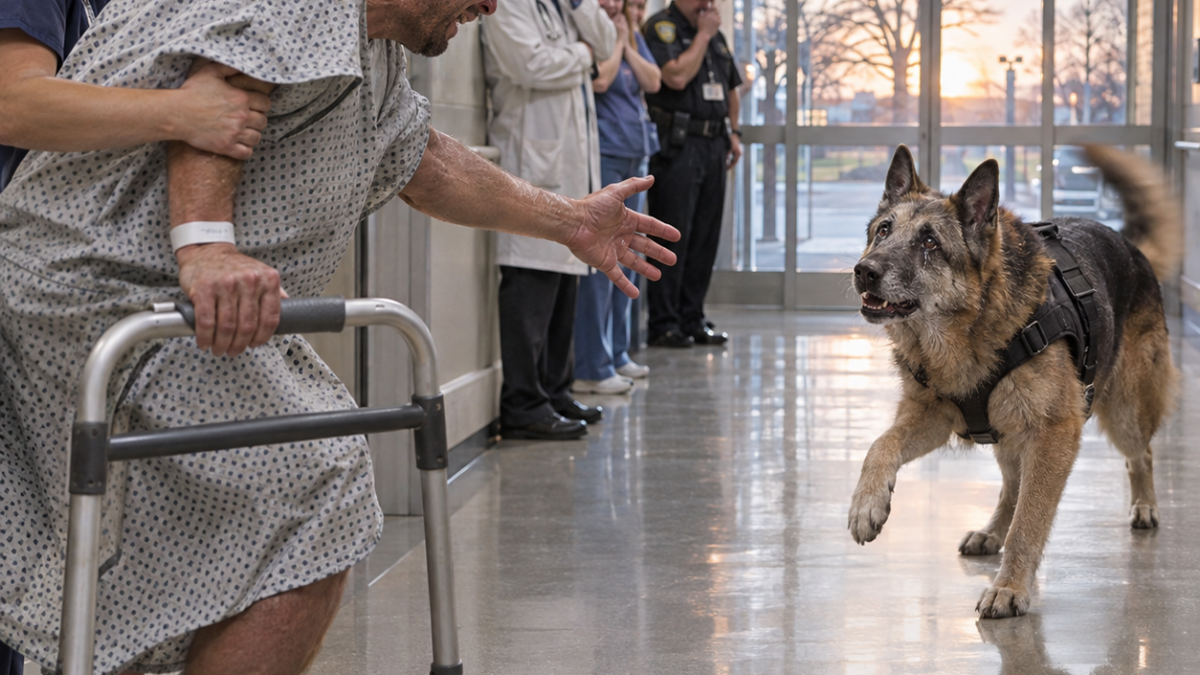
The automatic doors opened.
Rex was standing.
Maybe thirty yards away.
He saw me.
Everything stopped.
That is how memory holds it.
Not literally.
People kept moving.
Monitors kept beeping.
Doors kept opening.
But my world stopped.
Rex did not run.
That surprised everyone.
He froze.
Head high.
Ears forward.
His tail began moving.
Slow.
Then faster.
Faster.
Until his entire back half shook.
I said his name.
“Rex.”
He took one step.
Stopped.
As if waiting for permission.
Working-dog habit.
Even now.
I let go of wall.
Nurse grabbed my elbow.
“Mr. Colfax—”
“I’m fine.”
Lie.
I bent my knees.
It took almost a minute to get down.
My legs trembled violently.
Claire cried.
Denise stood near entrance with both hands over her mouth.
I reached the floor.
Opened my arms.
“Here.”
Rex came.
Not explosive.
Fast walk.
Then trot.
He stopped in front of me.
I took his head between both hands.
His muzzle had more gray than I remembered.
Or perhaps three weeks of fear changed how I saw him.
I put my forehead against his.
He smelled like rain, hospital pavement and Rex.
For twenty days I had been nowhere he could reach.
For twenty days he had refused to accept absence as an answer.
I managed one sentence.
“Here I am.”
Rex licked my nose.
Once.
Then sat beside me.
Shoulder against mine.
Heel position.
Exactly as always.
That broke everybody.
Including me.
We stayed on that floor perhaps five minutes.
It felt like an hour.
I kept one hand on his neck.
Rex kept leaning.
Eventually the therapist said:
“We have to get you back.”
Rex stood with me.
When I rose, he moved automatically to my left side.
Slow.
Matching my pace.
No command.
We walked down the corridor together.
One exhausted old man.
One aging Shepherd.
Still a team.
Administration changed rules for the final three hospital days.
Rex could stay in my room during designated periods after hygiene and safety arrangements.
At night, eventually, he was allowed on a mat beside bed.
The first evening, he lay down.
His head rested across my hand.
I did not sleep much.
Neither did he initially.
Every time I moved, his eyes opened.
I whispered:
“I’m not going anywhere.”
Eventually his breathing deepened.
The dog who had slept outside a hospital entrance for twenty nights finally slept beside me.
Nurses visited.
Security.
Arthur in his wheelchair.
He pointed at me.
“So you’re the guy.”
I smiled.
“Apparently.”
He looked at Rex.
“You picked a stubborn one.”
“I didn’t pick him.”
Rex’s tail moved.
“He picked me.”
Arthur nodded.
“Better.”
Dr. Warner came too.
The doctor Rex had warned away on day five.
He stood at doorway.
Rex looked.
No lip.
No tension.
Dr. Warner said:
“He remembers me?”
“Maybe.”
“I’m not touching him.”
“Good plan if you’re uncomfortable.”
He laughed.
Then:
“I was wrong about one thing.”
“What?”
“I thought he was the problem.”
I shook my head.
“You weren’t wrong to be cautious.”
Dr. Warner considered that.
“Still.”
He tossed a treat gently.
Rex ate.
Diplomatic relations restored.
On discharge day, the corridor filled more than necessary.
Hospital staff claimed coincidence.
Liars.
Denise brought flowers for Claire to carry because I could not.
Anthony from security brought Rex an absurdly large bone.
Dietary malpractice.
Arthur waved from his room window.
A young nurse who had avoided Rex for almost three weeks finally knelt.
“Can I?”
I looked at Rex.
Loose body.
He stepped forward.
She scratched his chest.
“You’re a hero.”
I almost corrected her.
Then didn’t.
Rex licked her hand.
He did not care about titles.
We walked out together.
Very slowly.
Rex matched every step.
Outside, the place he had waited was empty for first time.
Blanket folded.
Water bowl still near security.
I stopped.
Looked at it.
Twenty days.
I could not process.
Denise came beside me.
“He was here every morning.”
I nodded.
“Why didn’t he leave?”
She looked at Rex.
“Why would he?”
That answer stayed.
Claire drove us home.
Halfway, I asked her to stop near river overlook.
Morning sun.
Mountains pale gold.
I got out slowly.
Rex jumped down.
Then remembered my pace and waited.
We sat near guardrail.
I used a cane.
Temporary.
At least I hoped.
Rex sat shoulder to shoulder.
I said:
“You know, I thought retirement meant we were finished.”
He looked.
“I thought all the important things were behind us.”
Tail moved.
“Turns out you’re still a pain in my ass.”
Tail faster.
I put hand on his neck.
“You waited twenty days.”
Rex looked toward river.
“I don’t know how you found me.”
No answer.
“But you did.”
He leaned.
I breathed.
“We still have some road left.”
That phrase would become truer than I knew.
Recovery took months.
Not cinematic.
Cardiac rehab.
Medication.
Walking.
Diet.
Sleep.
Frustration.
Rex became my shadow.
Too much initially.
If I closed bathroom door, he waited outside.
If I stood too quickly, he stood.
If I coughed, ears up.
Hypervigilance.
Makes sense.
I had disappeared once.
He intended to prevent recurrence through supervision.
We worked on it.
Claire joked:
“You’ve created a medical service dog without training.”
No.
Rex was not a service dog.
He was anxious.
Important distinction.
So I helped him learn I could go into another room and return.
Funny.
After years of me training him, now I was rebuilding his trust in my physical existence.
First time I drove alone after hospitalization, Rex panicked when I left without him.
So I stopped doing long departures abruptly.
Short.
Five minutes.
Return.
Ten.
Return.
Twenty.
Eventually normal.
Just like any dog recovering from separation stress.
Old K9s are still dogs.
My own fear mirrored his.
Every chest sensation.
Every skipped heartbeat.
Every night waking at 1:00.
Is it happening again?
We were both waiting for catastrophe.
Eventually routine diluted it.
Morning.
River.
Breakfast.
Medication.
Nap.
Walk.
Home.
Days without disaster accumulate into trust.
For people too.
Six months after the hospitalization, Denise invited us back.
Not as patients.
Hospital fundraiser.
They wanted Rex.
I almost declined.
He was not mascot.
But Denise promised no crowding.
We attended thirty minutes.
Rex walked through main doors beside me.
Stopped.
Looked toward old waiting spot.
Then continued.
No distress.
Inside, staff applauded.
Rex hated applause.
Ears back.
I said:
“Enough.”
They stopped.
Good.
Then Arthur appeared.
Walking now with cane.
Rex recognized him immediately.
Tail.
Arthur sat.
Rex put head on knee.
“Still waiting?”
Arthur asked.
I answered:
“Not anymore.”
A photograph from that day ended up in hospital hallway.
Rex and me sitting beneath sign.
I protested.
Denise ignored me.
Caption only:
WAITING TOGETHER
Could have been worse.
Years passed.
I turned seventy-seven.
Then seventy-eight.
Rex crossed twelve.
His muzzle became white.
Hips stiff.
River walks shortened.
The source story people later heard ends around there—two old soldiers walking each morning.
That is true.
But there was more.
Always more after inspirational ending.
Rex developed arthritis.
Medication helped.
We added rugs.
Ramp into car.
He hated ramp.
Former K9 dignity.
First week, refused.
Second week, used only when nobody watched.
I watched from window secretly.
Never told him.
My cane became permanent.
At first I resented it.
Rex did not.
Dogs do not care about symbols of aging.
He cared whether we walked.
So we did.
Six every morning.
Slower.
Half mile.
Then quarter.
Sometimes only end of street.
Still shift.
Neighbors timed mornings around us.
Mrs. Hayward waved.
Two boys waited for Rex.
Mail carrier carried treats.
Emily still slipped chicken.
“Stop feeding him.”
She looked at me.
“You both nearly died. I’m not taking nutritional advice.”
Impossible woman.
Rex adored her.
One reporter came for follow-up.
I almost refused.
Then agreed if story focused on hospital staff.
He asked:
“What’s the secret of your bond?”
I hated question.
Sounds mystical.
I looked at Rex.
He sat at my feet.
“There’s no secret.”
Reporter waited.
“We never quit on each other.”
I paused.
“Not perfectly.”
“Not dramatically.”
“Just repeatedly.”
Rex lifted his head.
Placed it on my knee.
Reporter’s eyes changed.
He had headline.
Fine.
People romanticized twenty-day wait.
I understood.
It was extraordinary.
But I wanted them to understand what made it possible.
Eight years before those twenty days.
Thousands of repetitions.
I call.
He comes.
He alerts.
I trust.
He searches.
I follow.
He sleeps.
I return.
Partnership is deposits.
Then one day, crisis withdraws everything.
Rex still had enough trust left to wait.
He did not know I would recover.
That matters.
Waiting is easy when outcome guaranteed.
There was none.
He stayed anyway.
Not because dogs understand ICU prognosis.
Because leaving contradicted everything our life had taught him.
My person is here.
So I am here.
Simple.
Powerful.
I often wondered what he thought when doors opened and I did not appear.
Day one.
Day five.
Day ten.
Day fifteen.
Did he experience disappointment?
Likely.
Did he count?
No.
Dogs experience time differently.
The twenty days are meaningful to us.
Rex likely experienced a repeated sequence.
Come.
Wait.
Eat.
Wait.
Sleep.
Wait.
That repetition may be more beautiful.
Not one heroic choice.
Hundreds of small ones.
Stay again.
By thirteen, Rex could no longer climb riverbank trail.
We walked flat path.
One morning he stumbled.
I grabbed his harness.
My own legs nearly failed.
Two old idiots trying to hold each other upright.
I laughed.
Rex looked offended.
“We need younger staff.”
No applicants.
Claire visited more.
She tried convincing me to move closer.
I refused.
Then gradually admitted house was too much.
Rex had yard.
I loved home.
We compromised with home-health support and neighborhood help.
Pride is expensive.
Age eventually teaches delegation.
Rex seemed to accept caregivers before I did.
A nurse named Mia came twice weekly.
First visit Rex watched.
Second, sniffed.
Third, slept while she checked my blood pressure.
If Rex approved, apparently I did too.
One afternoon my heart rhythm acted up.
Not emergency.
But enough that Mia called doctor.
Rex stood.
Body rigid.
Old fear.
I sat on floor despite difficulty.
Put hand on chest.
“Still here.”
He leaned.
Maybe that phrase was for both.
His own health changed next.
At thirteen and a half, kidney values.
Mild.
Then more.
Special diet.
Rex hated it.
Emily smuggled chicken again.
I threatened legal action.
She laughed.
At fourteen, hearing faded.
Hand signals returned.
Our first language.
Funny.
I could lift two fingers and Rex understood.
Come.
Wait.
Down.
But sometimes he ignored.
Retirement privilege.
I loved it.
Perfect obedience had served us.
Imperfection meant he felt safe enough not to care.
One morning I signaled come.
Rex looked.
Then continued sniffing bush.
I laughed.
“Disgrace to unit.”
Tail.
No movement.
Good.
The hospital called on twentieth anniversary? Not literal years—we didn’t have that much. But every July 16, Denise texted.
HOW’S THE DOOR GUARD?
I replied with photo.
Rex sleeping.
Rex eating.
Rex refusing rain.
Year three after hospitalization:
Rex lying upside down.
Denise replied:
HEROISM IS EXHAUSTING.
Correct.
Arthur died two years after we met.
His daughter sent note.
He kept photograph of Rex beside chair.
I sat with that for a long time.
Rex had waited for me.
Arthur had waited with Rex.
People enter stories temporarily and still matter.
Denise retired.
We attended her party outside hospital.
Rex ancient.
She knelt carefully.
He licked her chin.
She cried.
“I spent twenty days sneaking you chicken.”
I looked at her.
“What?”
She froze.
Rex looked innocent.
Conspiracy decades old.
I said:
“That explains why he wouldn’t leave.”
Everyone laughed.
Good.
Rex’s final year was slow.
Not tragic every day.
That is important.
Old age can contain joy.
Sun patches.
Chicken.
Short walks.
Sleeping.
Visitors.
My hand on neck.
His head on knee.
No need for constant drama.
He began waking confused at night.
I sat beside him.
Sometimes he did not seem to know room immediately.
Then smelled me.
Relaxed.
Roles reversed again.
He once found me when I was lost inside unconsciousness.
Now I helped him locate home inside aging brain.
Fair.
Claire worried.
Quality assessments.
Veterinarian.
Pain.
Appetite.
Mobility.
Good days.
Bad days.
I hated conversations.
Necessary.
Rex had trusted me with decisions his whole life.
The last one would be mine too.
I wanted to postpone forever.
Love sometimes wants selfish time.
Responsibility says enough.
One July morning, almost four years after my hospitalization, Rex did not get up for walk.
Six a.m.
Door opened.
I held leash.
Nothing.
He looked from bed.
Tail moved once.
That frightened me.
Food.
Barely.
Water.
A little.
Vet.
Tests.
Advanced cancer.
Spleen.
Liver.
No meaningful treatment at fourteen.
I sat in clinic.
Rex’s head on my shoe.
Again, the world narrowed.
The veterinarian said:
“Days.”
Maybe weeks.
Comfort.
I nodded.
Former cop.
Retired handler.
Man who had faced guns and arrests and cardiac ICU.
Still nothing prepares you for being told your dog is leaving.
We went home.
No special bucket list.
Rex hated unnecessary car rides.
He wanted house.
River maybe once.
Chicken.
Emily.
Claire.
Me.
So that is what he got.
Day two, we went river.
Very slowly.
Sunrise.
Rex walked twenty yards.
Then sat.
I sat beside him on bench.
He leaned shoulder.
We watched water.
I said:
“You waited twenty days for me.”
Rex panted softly.
“I’m not making you wait through this.”
My voice broke.
He looked.
That was promise.
Day three, Denise visited.
Retired.
Drove an hour.
Rex slept mostly.
When she said his name, tail moved.
She sat.
“You remember me?”
Maybe.
She scratched ear.
“I was your union representative at hospital.”
I laughed.
She cried.
Then said:
“You gave everybody there something to believe in.”
I almost objected.
But stopped.
That was her memory.
Let her have it.
Emily came.
Roast chicken.
Naturally.
“Too much.”
I said.
She glared.
“He’s dying, James.”
“Yes.”
“Then stop being police.”
Fair.
Rex ate more that evening than previous two days.
Traitor.
Claire arrived.
Slept in guest room.
Rex moved between us once.
Could barely walk.
Still checking his people.
Enough.
The final morning, he could not stand.
I called veterinarian.
Home visit.
No hospital.
Rex had spent enough time outside one waiting for me.
He deserved home.
We put his bed near porch doors.
Sunrise golden.
Mountains visible.
Similar to roadside morning after discharge.
Claire sat left.
Emily right.
I sat on floor despite knees.
Rex’s head in my lap.
Old position.
Not working heel.
Not alert.
Just tired dog.
I stroked white muzzle.
“You’ve done enough.”
His eyes opened.
I smiled through tears.
“For once, listen to me.”
Tail barely moved.
“No more waiting.”
The veterinarian administered sedative.
Rex relaxed.
His breathing softened.
I whispered:
“My turn.”
Claire squeezed my shoulder.
“I’m staying.”
Those words mattered.
Rex had spent twenty days proving he would stay for me.
The least I could do was stay through his last twenty minutes.
Final medication.
One breath.
Another.
Then silence.
I kept my hand on his head.
Did not move.
I expected some dramatic feeling.
Mostly emptiness.
Then relief that he was not hurting.
Then grief.
All together.
Emily cried openly.
Claire rested forehead on my shoulder.
I whispered:
“Here I am.”
Same words.
Almost.
That was our line.
We buried his collar? No.
I kept it.
Ashes scattered partly by river.
Part at home beneath tree.
The rest Claire kept for me because I was afraid of losing everything when I eventually moved.
Practical grief.
The first morning after, I woke at 5:47.
At six, I opened door.
Habit.
No Rex.
That was when reality hit harder than euthanasia.
The empty routine.
No nails.
No leash pull.
No Shepherd beside cane.
I stood there.
Could not move.
Then Emily walked over.
No chicken.
Just herself.
She said:
“Walk?”
I almost said no.
Then remembered Rex.
We walked.
Slowly.
Same river route.
Not to replace.
To continue.
For weeks, I looked down expecting him.
The human brain stores companionship spatially.
Left side empty.
My hand reached automatically.
Nothing.
Healing is learning new geometry.
The hospital sent card signed by dozens of staff, including people who had not worked there when Rex waited.
His story had become institution memory.
Denise framed copy of old REX water bowl label and gave it to me.
Absurd.
I kept it.
Grief makes archivists of us.
The reporter returned months later.
Asked whether I regretted not getting another dog sooner? I had not gotten one.
He asked:
“What do you miss most?”
Not twenty-day miracle.
Not K9 work.
I answered:
“The sound of him getting up when I got my shoes.”
Simple.
True.
He asked:
“What did Rex teach you?”
I thought.
Everyone expects:
loyalty.
Love.
Never give up.
All true and incomplete.
“He taught me staying isn’t passive.”
Reporter waited.
“People think staying means doing nothing.”
“It doesn’t.”
“Sometimes staying is the work.”
“Waiting outside a door.”
“Sitting beside a hospital bed.”
“Walking slower because the other one is old.”
“Returning tomorrow.”
“Not leaving because it’s inconvenient.”
I looked toward empty rug.
“That dog stayed.”
“And when it became my turn, I did too.”
I eventually moved closer to Claire.
Smaller house.
River farther.
Rex’s collar hangs near door.
Not shrine.
Just there.
Photograph of us on patrol.
Another at hospital fundraiser.
Another old, by river.
Three Rexes.
Same dog.
Work.
Waiting.
Peace.
People who know story call him extraordinary.
He was.
He was also difficult as a young dog.
Stole sandwiches.
Hated baths.
Farted in patrol car.
Once ignored recall because dead raccoon apparently more compelling than eighteen months of training.
We should remember whole dogs.
Not turn them into statues.
Rex would hate statue.
Unless edible.
His twenty-day wait became viral locally years later.
Details stretched.
Some said he slept in snow.
It was July.
Wrong.
Some said he refused food for twenty days.
Absolutely false.
Rex never refused chicken on principle.
Some said he attacked doctors.
No.
One warning lip.
Context.
Truth is strong enough.
A retired K9 independently reached hospital and remained outside for twenty days while his handler was critically ill.
That is already remarkable.
No embellishment needed.
I correct when I can.
Because if you exaggerate animals into myths, you stop seeing them.
Rex was not supernatural.
He was bonded.
Experienced.
Persistent.
Possibly using scent and learned routes.
He had habits.
He had stress.
He waited.
The reality is better because a real dog did it.
The nurses mattered too.
Security.
Emily.
Claire.
Administration willing to adapt.
Veterinarians ensuring vaccination status.
People offering water.
Arthur providing company.
A dog cannot stay twenty days without humans choosing to let him.
Rex’s loyalty created the story.
Human compassion made it survivable.
Again:
no lone hero.
I often think of Denise’s choice.
She could have said policy.
Remove dog.
Instead she asked:
Can we safely make room?
That question changed twenty days.
Good institutions need people capable of applying rules with judgment.
Not breaking safety.
Adapting responsibly.
Rex stayed outside mostly.
Then controlled lobby.
Then room after I woke.
Boundaries and compassion.
Both.
If someone reads his story and decides hospitals should always allow dogs into ICUs, no.
That is not lesson.
Medical environments have reasons for restrictions.
The lesson is humans can sometimes seek safe accommodations when circumstances justify them.
Nuance.
Rex’s story deserves nuance.
Another thing:
Rex did not “sense” every medical change with magical accuracy.
Some coincidences happened.
Barking on day seven.
Movement in fingers.
Standing on day twenty.
People remember patterns.
Maybe he detected changes through staff behavior, Claire’s scent, routines.
Maybe not.
No need to prove mystical connection.
He already did enough.
What matters most is visible.
He came.
He stayed.
I returned.
At seventy-eight, after Rex died, I stopped calling us two old soldiers.
One old soldier left.
Then I realized metaphor had always been slightly wrong.
Rex was not soldier at end.
He was family.
Work introduced us.
Love outlived job.
That is better.
I thought retirement meant stopping fight.
Rex taught me purpose does not require conflict.
Walking beside someone can be purpose.
Waiting can be purpose.
Being present can be enough.
We spent eight years doing things.
Then years simply being.
Those later years were not lesser.
Maybe better.
No suspects.
No danger.
No commands necessary.
Just six a.m.
Open door.
River.
Two aging bodies moving slowly.
Home.
If I could return to that first morning in the ICU corridor, I would not try to kneel so fast.
My physical therapist would appreciate this.
But emotionally?
Nothing different.
I would still say:
“Here I am.”
Because those three words contained everything Rex needed after twenty days.
Not explanation.
Not apology.
Presence.
And if I could speak to Rex outside those doors on day one?
I would say:
“I don’t know how long.”
“I don’t know if I’m coming back.”
“But people will give you water.”
“Emily will bring chicken.”
“Denise will watch.”
“Arthur will sit with you.”
“You are not waiting alone.”
Maybe that would have mattered.
Maybe not.
Dogs do not need speeches.
They need conditions.
He had enough kind people around him.
That comforts me.
I also wish I could tell myself inside ICU:
Someone is outside.
Even if you cannot hear.
Someone has not given up.
Again, sentimental.
But powerful.
Humans survive through medicine and biology, not love alone.
Still, love can make survival worth returning to.
When I opened my eyes, Rex was one of the first reasons I wanted to stand.
Not the cause of recovery.
The reason to work at it.
Difference.
Cardiac rehab asked me to set goals.
Walk fifty feet.
Stairs.
Ten minutes.
I wrote privately:
Walk Rex by river again.
That was the real one.
Months later, I did.
Twenty slow minutes.
He sniffed every bush.
I cried behind sunglasses.
He peed on a tree.
No respect for moment.
Perfect.
That is Rex.
Whenever humans tried making something symbolic, he returned us to being animals.
Eat.
Walk.
Smell.
Sit.
Stay.
Love.
Simple.
His final years gave me chance to repay debt I did not technically owe.
Love is not ledger.
Still.
He waited when I could not come.
I carried him when he could no longer walk.
Symmetry comforts.
The last winter, I sometimes lifted his back end into car.
He hated.
Would glance at me.
“I know.”
Then settle.
No pride issue after.
Trust.
When cancer came, he did not understand prognosis.
I did.
That burden belongs to humans.
Maybe our hardest role.
Animals live present.
We decide when future contains too much pain.
I hated authority.
Used it anyway.
Because staying does not mean forcing someone to stay for you.
That is another lesson.
Sometimes loyalty means release.
Rex never abandoned me.
I did not abandon him when letting him go.
Those can both be true.
Important.
Now, when people say:
“He waited twenty days.”
I say:
“Yes.”
Then usually add:
“And I got to stay with him for years afterward.”
Because twenty days is hook.
Years are gift.
Twenty days of waiting mattered because they led back to ordinary life.
If story ended at hospital door, it would be powerful.
Incomplete.
The real victory was next morning.
And next.
And next.
Until old age.
Rex spent twenty days waiting for one door to open.
After I came through it, we spent the rest of his life opening another door every morning together.
Six o’clock.
Cold.
Rain.
Sun.
Doesn’t matter.
Door.
River.
Home.
Again.
Maybe that is why the empty doorway hurt most after he died.
Ritual had become proof.
We are both here.
Then one morning only one of us was.
But he had already taught me what to do.
Keep going.
Not because forgetting.
Because staying alive is another form of loyalty.
So I walk.
Slower now.
Alone sometimes.
With Claire when she visits.
I still stop near river.
Same bench.
I imagine Rex sitting beside me.
Not literally.
Memory.
Enough.
One morning a German Shepherd passed.
Young.
Strong.
Handler jogging.
The dog looked at me.
For one second, my chest tightened.
Then I smiled.
Not Rex.
Good.
The world should contain more dogs without forcing them to carry ghosts.
I went home.
Touched Rex’s collar.
Made coffee.
Day continued.
That is grief after years.
Not gone.
Integrated.
If a journalist asked me again what secret was, I would answer better now.
There was no secret because loyalty was not magic.
It was practice.
Years of showing up.
Years of learning signals.
Years of knowing that if one entered danger, the other followed until told otherwise.
When I disappeared into a hospital, Rex followed as far as the world allowed.
Then waited at boundary.
That was all he could do.
So he did it completely.
And when he reached his own final boundary, I followed as far as I could.
Then sat.
Held him.
Waited.
That was all I could do.
So I did it completely too.
Maybe that is what partnership means.
Not saving each other from everything.
Impossible.
It means arriving at the edge and refusing to make the other stand there alone.
Rex did that for me.
I did it for him.
Twenty days.
People remember the number.
I remember the look.
Glass doors.
White muzzle.
Tail shaking.
My legs barely working.
His entire body saying what he could not speak.
There you are.
My answer:
“Here I am.”
That was reunion.
Everything else was years of proving it.








