FULL ENDING :“I PROMISED HER I’D NEVER STOP LOOKING!” A Little Girl Waited 55 Days for Her Missing Golden Retriever — On the Day Everyone Else Had Given Up, My Rescue Dog Discovered Something Hidden Where No One Had Thought to Search
I had carried that picture in my truck for fifty-five days.
It was folded inside a clear plastic sleeve, tucked beside the search maps and photographs.
Every morning, before heading into the forest, I saw it.
And every morning, I wondered how much longer I could keep searching without breaking that child’s heart.
Whitlow had disappeared after a road accident near the edge of the forest.
He was a golden retriever with warm brown eyes, a gentle temperament, and the sort of loyalty that made him follow Annabelle from room to room.
He’d been with her since she was little.
She called him her brother, her protector, and her favorite person, depending on the day.
When the accident happened, the family had been overwhelmed by fear and confusion.
Whitlow escaped into the woods.
By the time everyone was safe enough to begin looking, he had vanished.
There were early sightings.
A flash of golden fur near a creek.
Pawprints along a muddy trail.
A possible bark heard by a camper.
But nothing certain.
Days passed.
Then weeks.
The weather grew colder.
Every search became more difficult.
Volunteers returned to work and their own families. Trails turned slick. Stormwater filled narrow channels. The forest seemed to swallow every clue.
Yet Annabelle kept drawing Whitlow.
In one picture, he was running home.
In another, he was sleeping beneath her pink blanket.
In another, she held his paw while stars shone above them.
“She says he’s waiting,” her mother told me one evening.
I didn’t know what to say.
Because deep down, I’d begun wondering whether we were searching for a reunion that might never happen.
Now, on day fifty-five, Dash was pulling so hard that I could barely hold him.
He forced his way through the wet brush, stopping beside a depression hidden beneath moss and branches.
I moved closer.
The ground dropped away suddenly.
A deep hole.
At least thirteen feet.
Its sides were steep, slick with mud, and almost vertical.
I crouched, shining my flashlight downward.
“Easy, boy.”
Dash began whining.
Then I saw a patch of golden fur at the bottom.
I stopped breathing.
Something was curled against the muddy wall.
Too still.
Too thin.
I reached for my radio.
And just as I opened my mouth to call for help, Dash let out a desperate bark, and the golden shape below us moved its tail.
FULL STORY CONTINUATION
It was barely a movement.
A tiny shift against the mud.
So faint that I thought my eyes had invented it.
I froze with the radio pressed against my mouth.
“Whitlow?”
The golden shape didn’t lift its head.
Dash whined again.
And there it was.
A second movement.
The tip of a tail brushing weakly against the ground.
I felt my knees soften.
“Oh, my God.”
For a moment, fourteen years of training seemed to disappear.
I wasn’t thinking like a rescue professional.
I was thinking about an eight-year-old girl who had spent fifty-five nights leaving space on her bed for a dog everyone feared might be gone forever.
Then my instincts returned.
I pressed the radio button.
“Base, this is Whitfield. Possible live canine located at the bottom of a deep pit. Approximately thirteen feet down, steep walls, muddy conditions. Request immediate technical rescue support and veterinary medical response.”
The dispatcher acknowledged the call.
I repeated our coordinates.
Then I knelt at the edge, keeping my weight away from the unstable rim.
“Whitlow!”
A faint sound rose from the darkness.
Not a proper bark.
Not even a whimper I could identify with certainty.
Just a thin, strained breath.
I shone the flashlight down again.
His golden coat was so matted with mud that I could barely distinguish the outline of his body.
His ribs showed beneath the wet fur.
His head lay against one foreleg.
And his left hind leg rested at an angle that made my stomach turn.
He was alive.
But he was in terrible condition.
Dash stood beside me, trembling with excitement.
“Good boy,” I whispered.
I touched his shoulder.
“You found him.”
Dash looked down into the pit.
Then back at me.
His ears were raised.
His breathing was fast.
He seemed to understand that his part of the search was finished and something else had to begin.
I moved several feet away from the edge and secured him safely while I prepared the equipment.
Then I returned to the opening.
“Whitlow, listen to me.”
My voice shook.
“Your girl’s waiting for you.”
I swallowed hard.
“Annabelle’s waiting.”
At the bottom of the pit, the golden retriever made another tiny movement.
I leaned closer, careful not to disturb the ground.
“That’s it, buddy.”
My eyes burned.
“Just stay with us a little longer.”
The rescue team arrived eighteen minutes later.
They came carrying ropes, a compact litter suitable for animal extraction, protective equipment, and additional lighting.
Alison, the medical responder who had worked with our team for seven years, was among them.
She took one look into the pit and went silent.
“Caleb,” she whispered.
“I know.”
She knelt beside me.
“Is he responsive?”
“Barely. Tail movement twice. Some weak breathing and vocalization.”
She shone a light downward.
The beam illuminated Whitlow’s face.
His eyes were partly open.
But he didn’t lift his head.
Alison exhaled.
“That’s a very sick dog.”
I nodded.
We had to move quickly.
But not carelessly.
The walls were steep enough that a person could fall in without warning. Loose mud and wet stones threatened to break away from the edge.
And if Whitlow’s leg was fractured, hauling him out by hand could make the injury worse.
Our team established secure anchors away from the unstable rim and checked the surrounding ground.
One rescuer prepared to descend.
I wanted to be the one.
Of course I did.
I’d carried Annabelle’s drawing for nearly two months. I’d searched every trail I could reach. I’d promised her that I wouldn’t walk away simply because the search had become difficult.
But wanting to be first wasn’t the same as being the right person for the job.
Our technical rescue specialist was better equipped for the descent.
I knew that.
So I stayed above, coordinating the equipment and watching every movement.
The rescuer descended slowly into the pit.
As he reached Whitlow, the dog tried to move.
His head rose an inch.
Then fell again.
“Easy, buddy,” I called.
“Easy.”
The rescuer knelt beside him.
A moment later, his voice came through the radio.
“Canine is alive. Very weak. Possible fracture to left rear limb. Severe wasting. We need a controlled extraction.”
I closed my eyes.
Alive.
After fifty-five days.
The word seemed too enormous to fit inside my chest.
Dash pressed against my leg.
I reached down and stroked his head.
“Your girl is going to get her dog back,” I whispered.
Then I looked toward the pit.
But finding Whitlow was only the first step.
We still had to get him out alive.
The rescuer worked carefully to position the support equipment around Whitlow.
The dog’s body was so thin that every movement required special attention.
He was conscious enough to react to touch but too exhausted to resist.
His breathing was shallow.
His coat was tangled with leaves, dirt, and small twigs.
There was a damp patch of earth near his muzzle, where rainwater had collected in a shallow depression.
I stared at it.
A little puddle.
No more than a few cups of muddy water.
And something inside me understood that it might be the reason Whitlow was still breathing.
The pit had trapped him.
But it had also collected the rain that helped him survive.
The rescue specialist secured the dog in the litter.
We checked the rigging.
Then began lifting.
Slowly.
A few inches at a time.
I watched the narrow opening.
Every second felt impossibly long.
When Whitlow finally rose into the morning light, I saw the full extent of what fifty-five days had done to him.
His once-thick golden coat hung in dirty strands.
His hips protruded sharply.
His stomach had drawn inward.
There were abrasions along his legs.
His hind paw trembled.
And his eyes, those soft brown eyes Annabelle had drawn over and over, looked exhausted beyond anything I could describe.
We lowered the litter onto stable ground.
I dropped to my knees beside him.
“Whitlow?”
His eyelids fluttered.
I placed my hand gently against his chest.
His heartbeat was faint and uneven, but unmistakably there.
Alison moved beside me.
“Let’s assess him.”
She began the emergency checks while another team member contacted the mobile veterinary support unit.
I watched her hands move.
Professional.
Precise.
Familiar.
Then she touched Whitlow’s ribs and stopped for a fraction of a second.
I saw her fingers tremble.
“Alison?”
She looked up.
“He’s severely dehydrated. His body temperature is dangerously low. That left hind leg looks fractured.”
My throat tightened.
“Anything else?”
“We can’t know everything out here. He needs a veterinarian immediately.”
She looked down at the dog.
“But Caleb…”
I waited.
Her voice softened.
“He’s still fighting.”
I looked at Whitlow.
His eyes were half closed.
His body barely moved.
Yet when Dash stepped close enough for him to smell another dog, Whitlow lifted his head a fraction of an inch.
Then his tail moved again.
One tiny movement.
I covered my mouth.
Because suddenly I could see him the way Annabelle remembered him.
Not as a broken animal at the bottom of a pit.
But as a golden retriever who used to run across a backyard, sleep beneath a little girl’s blanket, and follow her wherever she went.
He was still in there.
Somewhere inside that exhausted body, Whitlow was still fighting to come home.
We carried him out of the forest on a stretcher.
The trail was narrow, muddy, and uneven.
Two rescuers walked ahead to clear branches.
Another stayed beside the litter.
Alison monitored Whitlow closely.
I walked near his head.
Dash followed beside me.
Ordinarily, my dog would have been scanning the environment, searching for scents and listening for instructions.
But now he seemed completely focused on the animal we’d found.
Every few steps, he looked toward Whitlow.
His tail moved slowly.
I couldn’t know what Dash understood.
But I knew what he’d done.
He had found a scent no human could detect from the trail.
He’d pulled toward a place we’d nearly passed.
And he’d refused to leave until I looked into the pit.
I reached down and rubbed his ears.
“Good boy.”
He glanced up.
“You found him.”
His tail wagged.
I swallowed.
“You didn’t give up.”
We reached the mobile medical unit shortly after noon.
The sky had brightened.
Sunlight filtered through the clouds and touched the wet road.
I could hear distant traffic.
A volunteer was preparing blankets.
Another was clearing space inside the vehicle.
For fifty-five days, the forest had felt like an enormous locked door.
Now, finally, we were carrying someone out of it.
Someone who had been missing for so long that hope itself had begun to feel dangerous.
I climbed into the back of the vehicle.
Alison joined me.
Dash settled in his secured place near the front.
The driver started the engine.
And I reached for my phone.
There was one number I knew I had to call.
Mrs. Clare.
I stared at the contact name.
For fifty-five days, I’d called her with the same painful message.
No confirmed sighting today.
We’re checking another area tomorrow.
We haven’t found him yet.
I’d heard her trying to remain brave.
I’d heard her voice crack.
I’d heard Annabelle asking in the background whether I’d found her best friend.
Now I had news.
Real news.
But I was frightened.
Because Whitlow was alive, and I still didn’t know whether he would survive the next twenty-four hours.
I took a breath and pressed the call button.
She answered on the second ring.
“Caleb?”
Her voice was tense.
As though she’d learned to fear every unexpected phone call.
“Mrs. Clare.”
I swallowed.
“We found him.”
Silence.
Then a small sound.
“What?”
I pressed my hand against my forehead.
“We found Whitlow.”
Her breathing changed.
“Caleb…”
My voice broke.
“He’s alive.”
For several seconds, I heard nothing but a faint, uneven breath.
Then she whispered, “Alive?”
“Yes.”
“Are you sure?”
I looked down at the golden retriever lying beneath the blanket.
His chest rose slowly.
Then fell.
“I’m looking at him right now.”
She began crying.
I closed my eyes.
“He’s very weak. He needs urgent veterinary care. We’re taking him to the clinic.”
She was trying to speak.
I could hear it.
But the words wouldn’t come.
Finally, she whispered, “Annabelle…”
My chest tightened.
“Is she with you?”
“Yes.”
I hesitated.
Then said, “Tell her we found him. But please explain that he’s very sick and the doctors need to help him.”
A small sob escaped her.
“We’re coming.”
I nodded.
“Dr. Harris’s clinic. I’ll send the details.”
She took a trembling breath.
“Caleb?”
“Yes?”
“Thank you.”
I looked toward Dash.
He was sitting upright, ears forward, watching the road.
I swallowed.
“Thank Dash.”
She began crying again.
“Annabelle wants to bring her drawing.”
My eyes filled.
I reached toward the folder beside me.
The clear plastic sleeve was still there.
Inside was the picture of a little girl and her golden dog standing beneath an enormous yellow sun.
“Tell her I brought it with me,” I whispered.
And then I ended the call before she heard me crying.
Dr. Harris was waiting when we arrived.
He’d been practicing veterinary medicine for more than twenty years, and I’d worked with him on enough animal rescues to recognize the expression on his face when he saw Whitlow.
He didn’t waste time with comforting words.
“Treatment room. Now.”
His technicians brought in a wheeled stretcher.
Alison gave him a concise report while they carefully transferred Whitlow.
“Found at the bottom of a steep pit. Severe dehydration and hypothermia. Suspected fracture of the left hind leg. Unknown duration without adequate food. Weak but responsive.”
Dr. Harris nodded.
“Let’s get his temperature, bloodwork, and imaging started.”
I stepped aside.
For the first time since Dash located the pit, I had nothing useful to do.
No trail to follow.
No equipment to manage.
No search grid to organize.
There was a door between me and the dog we’d spent fifty-five days trying to find.
And all I could do was wait.
Dash lay beside my boots in the hallway.
I crouched next to him.
“Hey.”
His ears lifted.
“You did good today.”
He leaned into my hand.
I rubbed the fur along his neck.
“You did something really good.”
Then I looked toward the treatment-room door.
“I just hope it was enough.”
The minutes passed slowly.
A veterinary technician moved in and out.
Someone carried a container of warmed fluids.
A machine beeped behind the closed door.
I heard Dr. Harris giving instructions, his voice low and focused.
Then the door opened.
He stepped into the hallway.
I stood immediately.
“How is he?”
Dr. Harris removed his glasses.
“Alive. And more stable than when he arrived.”
I let out a breath.
But he wasn’t finished.
“He’s lost close to thirty percent of his expected body weight.”
My stomach tightened.
“He has severe dehydration, some skin infections, and a complex fracture in his left hind leg. His bloodwork also shows that his kidneys are under significant stress.”
I looked toward the room.
“Is he going to make it?”
Dr. Harris hesitated.
It was the hesitation that frightened me.
“Caleb, he’s survived extraordinary circumstances. But that doesn’t mean he’s out of danger.”
I nodded slowly.
“We need to correct the dehydration carefully, monitor his kidney function, treat the infections, and determine the safest timing for surgery.”
I stared at him.
“His leg?”
“The fracture will require surgical repair once he’s stable enough.”
I swallowed.
“Can he handle that?”
“We’re going to do everything medically appropriate to give him the best chance.”
He placed a hand on my shoulder.
“Don’t promise the family a recovery we can’t guarantee yet.”
I nodded.
“I won’t.”
He looked through the glass toward Whitlow.
“His body is exhausted. But his heart is still working hard.”
My throat tightened.
“He fought to stay alive.”
Dr. Harris nodded.
“He certainly did.”
I was standing near the waiting-room window when the Clare family’s car pulled into the parking lot.
Mrs. Clare stepped out before her husband had fully finished parking.
Her face was pale.
She moved quickly toward the clinic entrance, stopping only when she realized her daughter was still climbing out of the back seat.
Annabelle held a folded piece of paper against her chest.
Her father came around the car and took her free hand.
The three of them walked toward the glass doors.
I went outside to meet them.
Annabelle saw me first.
“Mr. Caleb!”
Her voice cracked.
She let go of her father’s hand and hurried toward me.
“Where is he?”
I knelt in front of her.
“Hey, sweetheart.”
Her eyes were huge.
“Mom said you found him.”
I nodded.
“We did.”
“Is he really alive?”
“Yes.”
Her lower lip trembled.
“Can I see him?”
I took a breath.
“He’s very sick, Annabelle. The doctors are helping him right now.”
She stared at me.
For a moment, I saw fear replace hope.
“Is he going to die?”
The question struck me harder than anything else that day.
I wanted to say no.
I wanted to promise her that Whitlow would come running through those doors with his tail wagging.
I wanted to tell her the nightmare was over.
But I’d spent fourteen years learning that frightened families deserved the truth, even when the truth was uncertain.
I looked into her eyes.
“I don’t know yet, sweetheart.”
Tears spilled down her cheeks.
I continued gently.
“But he’s getting the best care we can give him, and he knows he’s not alone anymore.”
She looked down at the paper in her hands.
Then back at me.
“Did he know you were looking?”
My throat tightened.
“I don’t know what he understood.”
I paused.
“But Dash found him. And we brought him here.”
Annabelle’s expression changed.
“Dash?”
I smiled.
“Yeah.”
“Your dog?”
I nodded.
She looked past me.
Dash was sitting calmly beside my truck, supervised by another team member while I spoke with the family.
Annabelle stared at him.
Then she whispered, “He found my best friend.”
I nodded.
“He did.”
She pressed the folded paper against her chest.
“Can I thank him?”
I looked toward her parents.
Mrs. Clare was crying silently.
Her husband nodded.
“Of course,” I said.
Dash knew something was different about Annabelle.
He’d met her several times during the search.
At first, she had been a quiet little girl who stood behind her mother’s legs while adults discussed maps, trails, and possible sightings.
By the second week, she’d begun asking questions.
Did Dash know what Whitlow smelled like?
Could dogs remember a scent after rain?
Would he know if Whitlow was frightened?
Did he understand that Whitlow had a little girl waiting for him?
I answered as carefully as I could.
But I had never seen her approach Dash the way she did that afternoon.
She walked toward him slowly.
Her small hands trembled.
Then she knelt.
“Hi, Dash.”
He wagged his tail.
She reached toward him.
I nodded.
“Go ahead.”
She wrapped her arms around his neck.
And began crying.
Not the loud, frightened crying I’d heard when we discussed the search.
These were quiet, exhausted tears.
The kind that came when a person had carried fear for so long that relief no longer knew how to arrive gently.
“Thank you,” she whispered into his fur.
Dash rested his chin against her shoulder.
She held him tighter.
“Thank you for finding him.”
I turned away for a moment.
My own eyes were burning.
Annabelle continued speaking softly to the dog.
“You found my best friend.”
Her voice broke.
“So now you’re my friend, too.”
Dash licked her cheek.
She let out a startled little laugh through her tears.
Then she pulled back and looked into his eyes.
“Forever.”
I swallowed.
Dash wagged his tail.
And I realized that whatever happened next, this little girl had already found one reason to believe the world could be kind again.
While we waited for the veterinary team, Annabelle sat between her parents holding the drawing she’d brought from home.
It wasn’t the original one she’d given me.
This one was newer.
The paper had been folded several times, and the edges were soft from being handled.
It showed Whitlow sleeping on a blue blanket covered in stars.
Beside him was a little girl with long brown hair.
A speech bubble floated above her head.
I saved your spot.
I stared at it.
Annabelle noticed.
“That’s his blanket.”
I nodded.
“It’s beautiful.”
She looked down.
“I put it on my bed every night.”
Her mother closed her eyes.
Annabelle continued.
“Mom said we could wash it, but I didn’t want to.”
Mrs. Clare’s expression tightened with emotion.
“I know, sweetheart.”
“Because what if he came home and it didn’t smell like him anymore?”
I felt my throat close.
Her father put an arm around her shoulders.
For several moments, no one spoke.
Then Annabelle looked at me.
“Did you bring the other picture?”
I nodded.
I went to my truck and retrieved the clear plastic sleeve.
When I returned, I placed it in her hands.
She looked at the drawing.
The little girl.
The golden dog.
The enormous yellow sun.
Her fingers traced the words at the top.
Please find my best friend.
She looked up.
“You kept it.”
“Every day.”
Her eyes widened.
“Even when it rained?”
I smiled.
“That’s why I put it in plastic.”
She stared at me.
“Even when you went into the forest?”
“Especially then.”
Her lower lip trembled.
“Why?”
I looked toward the treatment-room door.
Then back at her.
“Because I wanted to remember who I was looking for.”
Annabelle frowned.
“Whitlow?”
I nodded.
“But not just a golden retriever who had gone missing.”
I touched the corner of the drawing.
“Your Whitlow.”
Her eyes filled.
“The dog who sleeps on your blanket. The dog who follows you around the house. The dog you love.”
She leaned against her father.
“And the dog who loves me.”
I swallowed.
“Yes.”
For a long moment, she held the picture against her chest.
Then she whispered, “I told everybody he was still out there.”
No one answered.
There was nothing any of us could say that wouldn’t sound smaller than the hope she’d managed to carry.
I first met Annabelle Clare on the third day after the accident.
The family had been driving home along a narrow road bordering the forest when their vehicle was involved in a collision during worsening weather.
In the confusion afterward, a damaged door had opened, and Whitlow had bolted into the trees.
No one had been able to catch him.
By the time the family was safe and organized enough to search, he had disappeared into the thick woods.
The accident had left everyone shaken.
Mrs. Clare had bruising along one shoulder.
Her husband had a minor injury to his hand.
Annabelle was physically unharmed, but the fear of losing Whitlow had overwhelmed her.
When I arrived at their home, she was sitting on the living-room floor beside a dog bed.
The blanket inside it was blue.
There were yellow stars stitched across the fabric.
Her mother introduced us.
“Annabelle, this is Caleb. He’s going to help us look for Whitlow.”
The little girl looked up.
Her eyes were swollen from crying.
“Are you a real rescuer?”
I smiled gently.
“That’s my job.”
“Do you rescue dogs?”
“Sometimes.”
She looked toward Dash, who was waiting quietly beside me.
“Does he know how?”
“He’s very good at finding things.”
Annabelle moved closer.
“Can he find Whitlow?”
I knelt.
“We’re going to try.”
Her expression tightened.
“But can he?”
I took a breath.
“I can’t promise that, sweetheart.”
She looked down.
I continued.
“But we have a plan. We’ll check where Whitlow was last seen. We’ll talk to people nearby. And Dash will help us search.”
She was quiet for a moment.
Then she asked, “Do dogs get scared when they’re lost?”
I felt my chest tighten.
“Sometimes.”
“Does Whitlow know how to find food?”
“He has instincts that may help him.”
“What if it rains?”
“We’ll keep looking.”
“What if he forgets me?”
The question nearly broke me.
I looked into her eyes.
“Annabelle, a dog who loves his family doesn’t forget them because he’s been away for a few days.”
Her lips trembled.
“He sleeps on my bed.”
I nodded.
“He sounds like a very good dog.”
She began crying again.
“He’s my best friend.”
I moved closer and offered her a tissue.
She took it.
Then whispered, “Please bring him home.”
I didn’t make a promise I couldn’t guarantee.
Instead, I said, “I’ll do everything I reasonably can.”
At the time, I thought that would be enough to comfort her.
I had no idea that fifty-five days later, her drawing would still be riding beside me in my truck.
The first week of the search was full of hope.
We had a recent location.
A clear description.
Photographs.
Information about Whitlow’s temperament and routine.
We knew he was a golden retriever, friendly but easily frightened by loud noises.
We knew he’d been wearing a collar.
We knew he loved Annabelle.
And we knew he had disappeared into a forest that stretched far beyond the road where the accident occurred.
We organized search areas.
Checked access trails.
Spoke with residents living near the woodland.
Contacted local animal shelters and veterinary offices.
Placed notices where they would be useful.
And asked people who saw a golden dog not to chase him, because a frightened animal could run farther when approached too aggressively.
On day four, a camper reported seeing a dog near a creek.
We searched for hours.
Nothing.
On day six, someone found golden fur caught on a low branch.
We examined the area.
There were deer tracks.
Dog tracks.
Human footprints.
But no way to confirm whether the fur belonged to Whitlow.
On day nine, a volunteer heard barking near a rocky slope.
We approached carefully.
It turned out to be a dog from a nearby property.
I remember walking back to my truck that evening with my shoulders aching and my boots full of mud.
Dash climbed into his usual place.
I sat behind the wheel.
Then my phone rang.
Mrs. Clare.
“Any news?”
I closed my eyes.
“Nothing confirmed.”
She was quiet.
I could hear Annabelle asking something in the background.
Then Mrs. Clare said, “We’re still hoping.”
I looked toward the forest.
“So are we.”
When the call ended, I stared at the drawing tucked beside my maps.
The sun was bright yellow.
The dog was smiling.
And I wondered how much longer I could keep giving that family the same answer.
By the third week, the weather had turned against us.
Rain made the trails slippery.
Cold nights threatened any animal without reliable shelter.
Streams rose after storms.
Low areas became flooded.
And the forest grew harder to search as fallen leaves covered tracks and scent conditions changed.
Our team had to balance the search with other emergency responsibilities.
We couldn’t spend every hour looking for one missing dog.
There were people who needed help.
Other animals in danger.
Accidents.
Medical calls.
Searches that couldn’t wait.
But whenever I had time, I returned to the forest.
So did Dash.
Sometimes we worked with volunteers.
Sometimes with another trained handler.
Sometimes we searched only a small section before darkness forced us to stop.
Every search ended with the same ritual.
I returned to the truck.
Checked Dash’s paws.
Gave him water.
Updated the map.
And looked at Annabelle’s drawing.
Then I called the Clare family.
I learned to recognize the silence before Mrs. Clare answered.
She was always hoping that this time the call would be different.
I hated disappointing her.
But I hated the thought of simply disappearing even more.
So I kept calling.
And I kept telling the truth.
“We didn’t find him today.”
Then, whenever there was a reasonable next area to check, I told her where we’d search next.
I never promised a miracle.
I promised effort.
On some days, that was the only thing I had left to give.
Day twenty-eight was the first time someone suggested we should stop.
It wasn’t cruel.
It wasn’t careless.
It came from an experienced volunteer who had spent years helping locate missing animals.
We were standing beside a muddy trail, looking at a map.
He pointed toward the unsearched terrain.
“Caleb, look at the size of this area.”
I nodded.
“I know.”
“We’ve covered the most likely routes.”
“Not all of them.”
He sighed.
“It’s been four weeks.”
I looked toward Dash.
He was drinking water beside the truck.
The volunteer lowered his voice.
“I don’t want to be the one to say it, but the odds aren’t good.”
I stared at the map.
I knew he wasn’t wrong.
An animal could survive in the wild under favorable circumstances.
But Whitlow was a domestic dog who had disappeared after a frightening accident, in terrain that was difficult even for trained rescuers.
He could have traveled far beyond the search area.
He could have been injured.
He could have been taken in by someone who didn’t recognize him.
Or he could have died somewhere we’d never find him.
I knew all of that.
But I also knew there were still places we hadn’t checked.
I looked toward the volunteer.
“I’m not asking anyone to ignore safety or abandon other responsibilities.”
He nodded.
“Then what are you asking?”
I folded the map.
“I’m asking us not to confuse a low probability with proof.”
He was quiet.
I continued.
“If we run out of reasonable options, we’ll tell the family.”
I looked toward the forest.
“But we’re not there yet.”
He studied me for a moment.
Then nodded.
“All right.”
We searched another section that afternoon.
We found nothing.
But I went home knowing I hadn’t walked away simply because hope had become uncomfortable.
By day forty, I could tell the search was changing Annabelle.
Mrs. Clare told me her daughter had begun asking questions she didn’t know how to answer.
What if Whitlow couldn’t find water?
What if he was hurt?
What if he came home at night and nobody heard him?
What if he was waiting somewhere and everyone stopped looking?
One afternoon, I visited their home to review a possible sighting.
Annabelle was sitting at the kitchen table drawing.
There were papers everywhere.
Golden dogs.
Green forests.
Blue rivers.
Purple flowers.
Some drawings showed Whitlow running.
Others showed him sleeping.
One showed him standing beside a house with a bright red door.
I sat across from her.
“That’s a lot of pictures.”
She nodded.
“I make one every day.”
I looked at the pile.
“Every day?”
“Yes.”
“Why?”
She studied her crayons.
“Because I don’t want to forget his face.”
My throat tightened.
I looked at Mrs. Clare.
Her eyes filled.
Annabelle continued.
“Mommy says we have pictures of him on the phone.”
I nodded.
“But those are old.”
I leaned closer.
“What do you mean?”
She looked up.
“I want to remember him tomorrow, too.”
I didn’t know what to say.
She reached for a yellow crayon.
Then began coloring Whitlow’s fur.
I watched her small hand move.
Slowly.
Carefully.
As though each line kept something important from slipping away.
After a while, she looked at me.
“Mr. Caleb?”
“Yeah, sweetheart?”
“Do you think he’s lonely?”
I felt my chest ache.
“I don’t know.”
She nodded.
Then whispered, “I am.”
I looked down.
For a moment, I had no words.
Then Dash moved closer and rested his head beside her chair.
Annabelle reached down and stroked his ears.
She smiled faintly.
“Dash misses him too.”
I looked at my dog.
He wagged his tail.
I couldn’t tell her that Dash missed an animal he barely knew.
But I could see that he understood something about comforting a frightened child.
So I let him stay.
Annabelle drew another golden dog.
This time, she added a black-and-tan dog standing beside him.
“That’s Dash,” she explained.
I smiled.
“Looks just like him.”
She nodded.
“He’s helping.”
And then she began drawing a man beside the dogs.
I looked at it.
“Who’s that?”
She didn’t look up.
“You.”
I swallowed.
“Me?”
She nodded.
“Because you haven’t stopped.”
Sitting in the veterinary clinic on the fifty-fifth day, I kept remembering that conversation.
Annabelle drawing three figures beside a forest.
Whitlow.
Dash.
And me.
The little girl who’d given us a place in her picture was now sitting a few feet away, waiting to find out whether her best friend would survive.
I looked toward the treatment-room door.
I had spent so much time searching that I hadn’t allowed myself to imagine what would happen after we found him.
I had pictured calling Mrs. Clare.
I had pictured Annabelle running toward Whitlow.
I had pictured a golden tail wagging beneath a bright afternoon sun.
I had not pictured an operating room.
Kidney problems.
A fractured leg.
A body so thin that touching it felt frightening.
The clinic door opened.
Dr. Harris stepped into the waiting area.
Annabelle immediately stood.
“Is he okay?”
He knelt so they were nearly eye level.
“He’s resting right now.”
She gripped her drawing.
“Is he going to come home?”
The doctor looked toward her parents.
Then back at Annabelle.
“We’re working very hard to help him get stronger. He’s been through a lot, and he needs time.”
Her eyes filled.
“Does his leg hurt?”
“It may, but we’re giving him appropriate medicine to keep him as comfortable as we can.”
She nodded.
“Can he hear me?”
Dr. Harris smiled gently.
“I think he’ll recognize you when he’s ready for a visit.”
Annabelle looked down.
Then whispered, “I have to tell him I didn’t forget.”
Her mother put an arm around her shoulders.
Dr. Harris’s expression softened.
“We’ll make sure you have that chance when it’s safe.”
He stood and turned toward the adults.
“His bloodwork is concerning but not hopeless. We’re treating the dehydration and monitoring his kidney values. He’ll likely need surgery for the fracture once his condition allows it.”
Mr. Clare swallowed.
“Are we talking about days?”
“Possibly. It depends on how he responds.”
Mrs. Clare began crying quietly.
“We’ll do whatever he needs.”
The doctor nodded.
“We’ll discuss each step with you.”
I watched the parents.
They looked exhausted.
Fifty-five days of uncertainty had already taken so much from them.
Now they were being asked to endure another kind of waiting.
But this time, they knew where Whitlow was.
They knew he was receiving care.
And for the first time in nearly two months, hope had a heartbeat they could measure.
The first visit happened that evening.
Dr. Harris allowed the Clare family into Whitlow’s treatment room for a few quiet minutes after his condition had stabilized enough for the visit.
I waited near the doorway.
I didn’t want to intrude.
I’d spent my life helping families reach moments like this, but the reunion itself belonged to them.
Then Mrs. Clare turned toward me.
“Caleb?”
I looked up.
“Come in.”
I shook my head.
“This is your moment.”
She stepped closer.
“No.”
Her eyes filled.
“You’ve been part of every day of this.”
I hesitated.
She reached for my hand.
“You need to be here too.”
So I followed them inside.
Whitlow lay on a padded veterinary bed.
His left hind leg was supported and protected.
An intravenous line delivered fluids.
A monitor displayed his vital signs.
His golden fur had been gently cleaned around the areas where the veterinary team needed access.
Without the mud covering him, he looked even thinner.
His ribs were visible beneath his coat.
The shape of his hips made my chest ache.
And his eyes were closed.
Annabelle stopped just inside the room.
For a moment, she didn’t move.
I watched her face.
She had spent fifty-five days imagining this reunion.
Now the dog she loved was lying in front of her, looking so different from the healthy, playful Whitlow she remembered.
Her father knelt beside her.
“Sweetheart?”
Her lower lip trembled.
“That’s him?”
I swallowed.
Mrs. Clare knelt on her other side.
“Yes, baby.”
Annabelle stared at the bed.
“He’s so skinny.”
Her mother nodded through her tears.
“I know.”
The little girl looked toward Dr. Harris.
“Did he not have food?”
The doctor answered gently.
“He didn’t have enough. But we’re going to help him recover safely.”
Annabelle looked back at Whitlow.
For several seconds, she seemed unable to take another step.
Then she whispered, “He’s still my Whitlow.”
Her father covered his mouth.
She walked toward the bed.
Slowly.
Carefully.
As though one sudden movement might frighten him away.
When she reached his side, she looked toward the veterinarian.
“Can I touch him?”
Dr. Harris nodded.
“Gently. Right here, near his shoulder.”
She placed two fingers against Whitlow’s fur.
Then her whole hand.
“Hi, buddy.”
His ear moved.
Annabelle froze.
“Whitlow?”
His eyes opened slightly.
She leaned closer.
“It’s me.”
His gaze shifted toward her.
And then his tail moved.
Not much.
Just a small movement against the bedding.
But Annabelle saw it.
Her entire face changed.
“Mommy!”
Mrs. Clare began crying.
“He knows you.”
Annabelle smiled through her tears.
“Hi, Whitlow.”
She reached toward his head.
He lifted it.
Only an inch or two.
The effort seemed enormous.
Then he slowly extended his muzzle toward her hand.
His tongue touched her fingers.
Once.
Weakly.
Annabelle didn’t scream.
She didn’t jump.
She didn’t cry harder.
She simply smiled.
A deep, peaceful smile that seemed to come from somewhere words couldn’t reach.
“I knew you’d come home,” she whispered.
I felt my eyes filling.
Then she carefully placed the folded drawing beside his front paws.
“Look.”
Whitlow rested his head again.
Annabelle smoothed the paper.
“I drew you every day.”
Her voice trembled.
“Every single day.”
Mrs. Clare covered her face.
Annabelle continued.
“Because I didn’t want you to think we forgot.”
Then she leaned closer and whispered the words I still hear sometimes when the world feels unbearably cruel.
“Your place in my bed is still there.”
I lowered my head.
For a moment, I couldn’t look at any of them.
Whitlow’s recovery did not happen overnight.
The first several days were frightening.
His dehydration had to be treated carefully.
His kidneys needed monitoring.
His body had been deprived of proper nutrition for weeks, so the veterinary team introduced food gradually according to his medical condition rather than allowing him to eat as much as he wanted immediately.
Dr. Harris explained the risks to the family.
Whitlow needed calories.
But after severe starvation, feeding too aggressively could create dangerous complications.
His body had to relearn how to handle nourishment.
For Annabelle, that was the hardest thing to understand.
She wanted to bring him chicken.
His favorite treats.
A whole bowl of the food he used to love.
“Why can’t he have it?” she asked one afternoon.
Dr. Harris pulled up a chair.
“Because his tummy and the rest of his body have been working very differently while he was lost.”
She frowned.
“Is he hungry?”
“Probably. But we need to help him eat in a way that’s safe.”
Annabelle looked toward Whitlow.
Then nodded seriously.
“Okay.”
She reached into her backpack.
“I brought a book instead.”
I smiled.
“What book?”
She held it up.
It was a story about a dog finding his way home.
“I thought maybe he’d like to hear it.”
Dr. Harris smiled.
“I think a quiet story would be wonderful.”
So Annabelle sat beside the treatment bed and read aloud.
She stumbled over some words.
Started sentences again.
Occasionally stopped to ask her mother what something meant.
But she kept reading.
Whitlow lay with his eyes closed.
Every so often, one ear moved.
And I watched a little girl offer her dog something no veterinarian could prescribe.
The sound of home.
Two days later, Dr. Harris called me early in the morning.
I was at our rescue base, organizing equipment from another search.
“Caleb?”
“Morning, Doc.”
“I wanted you to know Whitlow’s latest results are encouraging.”
I set the equipment down.
“How encouraging?”
“His hydration has improved, and his kidney values are moving in the right direction. We still need to monitor him, but he’s responding to treatment.”
I closed my eyes.
“Thank God.”
Dr. Harris paused.
“We’re also getting a clearer picture of his hind-leg injury.”
I felt my stomach tighten.
“Bad?”
“Complex. He needs surgery, and we’ll be managing his recovery carefully.”
I nodded.
“But you think he’s strong enough?”
“We’re evaluating the timing, and the team believes we can proceed once the remaining concerns are adequately controlled.”
I looked toward the photograph of Annabelle’s drawing on my desk.
“Does the family know?”
“Yes.”
“How are they?”
“Hopeful. Nervous.”
I smiled sadly.
“Sounds about right.”
Dr. Harris was quiet for a moment.
Then he said, “There’s something I want to ask.”
“Go ahead.”
“Do you have any idea how long he was actually in that pit?”
I shook my head, though he couldn’t see me.
“Not exactly.”
“We’re trying to understand the progression of his injuries.”
I thought about the hole.
The steep walls.
The rainwater pooled at the bottom.
The way Whitlow’s body had been curled against the muddy bank.
“No,” I said. “But I think it happened late in the search.”
“Why?”
“Because if he’d been trapped there for all fifty-five days, I don’t see how he could have survived with so little food and water.”
Dr. Harris agreed.
“That seems very unlikely.”
I stared toward the window.
Whitlow had been missing for fifty-five days.
But he hadn’t necessarily spent all fifty-five days in that pit.
Somewhere along the way, he’d traveled through the forest.
Found water.
Found whatever food he could.
Avoided danger.
And then, near the end, he’d fallen into a place he couldn’t escape.
I wondered how close we’d come to him without knowing.
How many times he’d heard a distant engine.
A human voice.
A barking dog.
How many times he’d lifted his head and hoped someone was coming.
I swallowed.
“Doc, he must have been trying to get home the whole time.”
Dr. Harris’s voice softened.
“I think he was trying very hard to survive.”
I looked at Dash sleeping beside my desk.
Sometimes the most extraordinary thing wasn’t what an animal understood.
It was simply how long it kept going.
The surgery took place after Whitlow was stable enough for anesthesia.
I waited with the Clare family.
Annabelle held her drawing in her lap.
Mrs. Clare sat beside her, one arm around her shoulders.
Mr. Clare paced near the window.
None of us spoke much.
We had already used so many words over the previous fifty-five days.
There were no new reassurances left.
Only the hope that Whitlow would come through another difficult stage.
At one point, Annabelle looked at me.
“Mr. Caleb?”
“Yeah, sweetheart?”
“Does Dash ever get scared?”
I smiled faintly.
“Sometimes.”
“Even though he’s a rescue dog?”
“Even rescue dogs can get frightened.”
She looked down at her picture.
“What do you do when he gets scared?”
I thought about it.
“I try to help him feel safe.”
“How?”
“Sometimes I move him away from whatever frightened him. Sometimes I give him time. Sometimes I just stay close.”
Annabelle nodded.
Then she asked, “Do you think Whitlow knows we’re here?”
I looked toward the treatment area.
“I can’t know exactly what he’s thinking.”
She was quiet.
“But I think he’ll recognize the people who love him when he’s awake.”
She smiled a little.
“I hope so.”
I looked at her.
“Annabelle?”
“Yes?”
“You’ve been very brave.”
She frowned.
“No, I haven’t.”
“Why do you say that?”
“Because I cried every day.”
My chest tightened.
I leaned closer.
“Crying doesn’t mean you aren’t brave.”
She looked up.
“Really?”
“Really.”
I thought of the search.
The empty trails.
The sleepless nights.
The frightening call from the forest.
“Sometimes being brave means being afraid and still showing up for someone you love.”
She considered that.
Then she looked toward the doors.
“Like Whitlow?”
I smiled.
“Maybe.”
She hugged her drawing.
“And like Dash?”
I nodded.
“Definitely like Dash.”
The surgery was successful.
Whitlow came through the procedure, and Dr. Harris explained that the team had repaired the damaged leg as planned.
There would be pain management.
Follow-up examinations.
Restricted activity.
Physical rehabilitation.
And continued monitoring of his overall health.
But for the first time since we brought him out of the forest, the future began to look less like a question and more like a road we might actually travel.
Annabelle was so relieved that she started crying before the doctor finished speaking.
Mrs. Clare pulled her close.
Mr. Clare sat down heavily.
I looked toward the ceiling.
For a moment, I remembered kneeling at the edge of the pit.
The smell of wet earth.
The black opening.
The barely moving golden shape.
And Dash whining beside me.
I hadn’t dared imagine this moment.
Now Whitlow had survived the extraction.
The first critical days.
And surgery.
There was still a long recovery ahead.
But he was moving forward.
That evening, I returned to the rescue base.
The rest of the team was waiting.
Some were cleaning equipment.
Others were finishing reports.
Harrison, our most experienced search coordinator, stood when I entered.
“Well?”
I smiled.
“He made it through surgery.”
For a moment, the room was silent.
Then Harrison crossed toward me.
He held out his hand.
I shook it.
But he didn’t let go immediately.
“Caleb,” he said, his voice thick, “I’ve been doing this for twenty years.”
I nodded.
“I know.”
“I thought I’d seen every kind of reunion.”
His eyes were wet.
“But this one…”
He shook his head.
“I don’t think I’ll ever forget it.”
I swallowed.
“Neither will I.”
Another rescuer reached down and scratched Dash behind the ears.
“Here’s the real hero.”
Dash wagged his tail.
Someone brought him a bowl of water.
Someone else found his favorite toy.
The room filled with quiet laughter.
And for the first time in nearly two months, we allowed ourselves to celebrate something without fearing that the next phone call would take it away.
A week later, Dr. Harris asked me to come to the clinic.
I arrived expecting a routine update.
Instead, he invited me into his office and spread several records across the desk.
“I’ve been reviewing the injury and recovery timeline,” he said.
I sat down.
“Anything wrong?”
“No. Whitlow’s progressing.”
I relaxed slightly.
Dr. Harris looked at me.
“Based on the condition of the fracture, the associated swelling, and what we know about the pit, it’s possible he was trapped there for approximately eight or nine days before you found him.”
I stared at him.
“Eight or nine?”
“It’s an estimate, not an exact determination.”
I looked toward the window.
Fifty-five days missing.
Eight or nine days trapped.
That meant Whitlow had spent roughly six weeks moving through the forest before the fall.
Searching.
Surviving.
Possibly trying to return home.
Then something happened.
Maybe he was seeking shelter.
Maybe he was looking for water.
Maybe the edge of the pit gave way beneath him.
We would never know exactly.
But the injury had made escape impossible.
And for more than a week, he had remained at the bottom of a steep hole, unable to climb out.
I remembered the muddy puddle near his muzzle.
“The rainwater,” I whispered.
Dr. Harris nodded.
“It may have been crucial.”
I leaned back.
For a moment, the room seemed to grow smaller.
Eight or nine days.
In darkness.
With a broken leg.
No reliable food.
Only a small amount of water.
I imagined Whitlow lifting his head whenever wind moved through the trees above.
Trying to stand.
Feeling the injured leg give way.
Settling back into the mud.
Waiting.
Not because he knew we were coming.
He couldn’t know that.
But because something in him kept choosing to breathe through another hour.
Then another.
And another.
Until Dash passed close enough to detect him.
I covered my mouth.
“Caleb?” Dr. Harris asked.
I nodded.
“I’m okay.”
But I wasn’t.
Not entirely.
Because the thought of how close we’d come to losing him made the rescue feel even more fragile.
Another storm.
Another cold night.
Another missed search path.
And Annabelle’s drawing might have remained the only place where Whitlow ever came home.
The day Whitlow was finally cleared to go home, Annabelle arrived carrying a new blanket.
It was soft blue fleece with little yellow stars scattered across it.
She’d chosen it herself.
Mrs. Clare told me she’d spent nearly an hour in the store touching different fabrics before deciding which one Whitlow would like best.
I met them outside the clinic.
Annabelle wore a purple jacket, and her hair was tied back with a ribbon.
The moment she saw me, she held up the blanket.
“Mr. Caleb, look!”
I smiled.
“That’s beautiful.”
She pressed it against her cheek.
“It’s really soft.”
“I can tell.”
She looked toward the clinic doors.
“It’s for Whitlow.”
I nodded.
“He’ll love it.”
She grew serious.
“Because I don’t want him to be cold anymore.”
My throat tightened.
I looked at the blanket.
The little yellow stars.
The careful way she held it.
For fifty-five days, she’d imagined her best friend somewhere in the forest.
Cold.
Hungry.
Alone.
Now she was trying to make sure he never felt that way again.
I knelt beside her.
“That’s a very kind thing to give him.”
She looked down.
“Mommy says I can’t make him forget what happened.”
I nodded.
“She’s right.”
Annabelle’s eyes filled.
“But I can help him feel safe.”
I smiled gently.
“Yes.”
She hugged the blanket.
“That’s what I want.”
Whitlow walked out of the clinic slowly.
He used three legs, keeping most of his weight off the recovering hind leg as instructed by the veterinary team.
His coat had been washed and brushed.
His eyes were brighter.
He had regained some weight, although he remained thinner than the strong, healthy dog Annabelle remembered.
He moved carefully.
But he moved on his own.
Dr. Harris accompanied him.
“Slow and steady,” he reminded the family. “No running, no jumping, and no unsupervised exercise while the fracture continues healing.”
Mr. Clare nodded.
“We understand.”
“We’ll review his medication schedule and follow-up appointments again before you leave.”
Mrs. Clare smiled.
“Of course.”
Annabelle stood a few feet away.
She was trembling with excitement.
“Whitlow?”
The golden retriever stopped.
His head lifted.
He looked toward her.
Then his tail began to wag.
Slowly at first.
Then with more enthusiasm.
Annabelle dropped to her knees.
“Hi, baby.”
Whitlow moved toward her.
Not quickly.
Not dramatically.
Just a few careful steps.
When he reached her, he lowered his head into her lap.
Annabelle wrapped her arms around his neck.
And for the first time since the accident, she was holding her best friend outside a hospital room.
She buried her face in his golden fur.
“You’re coming home,” she whispered.
Whitlow rested against her.
“No more forest.”
Her voice broke.
“No more sleeping in the cold.”
Mrs. Clare began crying.
Mr. Clare turned away, wiping his eyes.
I stood beside Dash, trying to keep my own emotions under control.
Annabelle lifted the blue blanket and draped it gently across Whitlow’s back.
“There.”
She smiled through her tears.
“Now you’ll always be warm.”
Whitlow leaned closer.
His eyes closed briefly.
And I realized that for this little girl, the blanket was more than a gift.
It was her way of telling him that the waiting was over.
Dr. Harris reviewed Whitlow’s recovery plan with the family.
There would be a slow return to activity.
Frequent examinations.
Physical rehabilitation.
Careful feeding.
Continued monitoring of his kidney function.
And plenty of rest.
Annabelle listened to every instruction.
She raised her hand when the doctor explained that Whitlow couldn’t climb stairs without help.
“Can I carry him?”
Dr. Harris smiled.
“He’s still pretty big, sweetheart. Your parents should handle anything like that.”
She nodded seriously.
“What about bringing him water?”
“That’s a great job for you.”
She smiled.
“And reading?”
“Even better.”
Mr. Clare laughed.
“I think she’s already planned the next several weeks.”
Annabelle looked at her father.
“Months.”
We all laughed.
Then she looked back at Whitlow.
“I have fifty-five days of stories to tell him.”
My smile faded.
Fifty-five days.
For adults, those weeks had been exhausting.
For an eight-year-old, they had felt endless.
She had gone to school.
Completed homework.
Eaten dinner.
Celebrated small ordinary moments.
All while wondering whether the dog who used to sleep beside her would ever return.
Now she wanted to tell him everything he’d missed.
I watched Whitlow rest his head against her knee.
Something told me he would make an excellent listener.
A month after Whitlow returned home, the Clare family invited Dash and me to dinner.
By then, Whitlow had made encouraging progress.
His leg was healing under veterinary supervision.
He had regained much of his lost weight, and his energy was returning.
His coat had begun looking like the beautiful golden fur Annabelle remembered.
He was still following a carefully managed recovery plan, but his steps were becoming steadier.
And his personality had returned.
Mrs. Clare told me he’d begun carrying one of Annabelle’s socks around the house.
He also stole a dish towel from the kitchen and refused to surrender it until someone offered him his favorite toy.
I laughed when she told me.
“Sounds like he’s feeling better.”
She smiled.
“It certainly does.”
When I arrived that evening, Annabelle was waiting on the porch.
“CALEB!”
I laughed.
“Hey, kiddo!”
She hurried toward Dash.
Then remembered to slow down.
“Hi, Dash.”
My dog wagged his tail.
She knelt beside him and whispered, “Your friend is inside.”
I smiled.
“Is he?”
She nodded.
“Come see.”
The house smelled of roasted chicken and fresh bread.
Mr. Clare was setting plates on the dining table.
Mrs. Clare came from the kitchen carrying a bowl of vegetables.
Whitlow lay on a soft rug near the living-room window.
The moment he heard Dash, he lifted his head.
Then stood.
His tail moved.
Dash approached calmly.
The two dogs sniffed each other.
Whitlow gave a soft, friendly sound.
Dash wagged his tail again.
Annabelle clapped.
“They remember!”
I smiled.
“They seem happy to see each other.”
Whitlow turned toward me.
For a moment, he studied my face.
Then he walked closer and placed his head against my thigh.
I knelt.
“Hey, old friend.”
He leaned into my hand.
“Looking good.”
His tail wagged harder.
I stroked his ears.
“You scared us.”
He rested his muzzle against my knee.
I laughed softly.
“You have no idea.”
Dinner was simple.
And perfect.
Mr. Clare had cooked chicken with potatoes and vegetables.
Mrs. Clare made a salad and warm bread.
Annabelle insisted that Dash and Whitlow have their own comfortable places nearby, although we explained that the dogs wouldn’t be eating from the dinner table.
She accepted that with considerable disappointment.
Halfway through the meal, Mr. Clare looked toward me.
“Caleb, I’ve been meaning to tell you something.”
I set down my fork.
“What’s that?”
He glanced toward Annabelle.
She was talking to her mother about a school project.
Then he lowered his voice.
“For those fifty-five days, I kept thinking I was failing her.”
I looked at him.
He continued.
“Every morning she’d ask whether we’d heard anything.”
His expression tightened.
“Every night she’d leave that space on her bed.”
I nodded.
“I remember.”
He stared at his plate.
“I wanted to fix it.”
His voice broke.
“I wanted to walk into the woods and bring that dog home myself.”
I remained quiet.
He swallowed.
“But I couldn’t.”
I leaned forward.
“You did everything you reasonably could.”
He shook his head.
“Didn’t feel like it.”
I understood.
Rescuers talked about that feeling often.
The desperate need to do something when the outcome was beyond your control.
The fear that resting meant giving up.
The guilt of eating a meal while someone you loved might be hungry.
The belief that if you simply tried harder, somehow the world would become fair.
Mr. Clare looked toward Whitlow.
“People kept telling us to accept the worst.”
I nodded.
“I know.”
“They weren’t trying to be cruel.”
“No.”
“Some of them were worried about Annabelle.”
I looked toward the little girl.
She was laughing at something her mother said.
Mr. Clare continued.
“But we couldn’t stop hoping.”
I took a breath.
“Hope can be painful.”
He nodded.
“Very.”
I looked toward Dash.
Then Whitlow.
“But sometimes it also keeps us paying attention long enough to recognize an opportunity.”
Mr. Clare was quiet.
I continued.
“If we’d stopped checking reasonable search areas, we wouldn’t have reached that part of the forest when Dash picked up his scent.”
He looked at me.
“You didn’t stop.”
I smiled sadly.
“Not while there was still a reasonable place to look.”
He reached across the table and shook my hand.
His grip was firm.
His eyes were wet.
“Thank you for keeping that promise to my daughter.”
I swallowed.
I couldn’t answer immediately.
Then I whispered, “I’m glad I did.”
After dinner, we sat on the back porch.
The sun was beginning to set.
The garden glowed in warm orange light.
Annabelle was playing gently with Whitlow on the grass, following the veterinarian’s instructions about his activity.
Dash lay at my feet, relaxed and content.
Mr. Clare brought lemonade.
Mrs. Clare sat beside me.
For a while, we simply watched the dogs.
Then Annabelle walked toward us.
“Caleb?”
I looked up.
“Yeah?”
She held out a piece of paper.
“I made this for you.”
I took it.
It was another drawing.
This time, there were two dogs.
A golden retriever.
A black-and-tan rescue dog.
And a man wearing a red rescue jacket.
Above them, in large purple letters, she’d written:
THANK YOU FOR NOT GIVING UP.
My eyes filled.
“Annabelle…”
She smiled shyly.
“That’s you.”
I looked at the drawing.
“I can see.”
“And Dash.”
I nodded.
“And Whitlow.”
I smiled.
She pointed to the golden dog.
“He’s smiling now.”
I swallowed.
“Yes, he is.”
She leaned closer.
“I’m going to keep drawing him.”
I looked up.
“Every day?”
She shook her head.
“Not because I’m scared anymore.”
I waited.
“Because now I have new things to remember.”
I couldn’t speak.
She hugged me.
Then ran back toward Whitlow.
I looked down at the drawing.
For fifty-five days, Annabelle had drawn her dog because she feared forgetting him.
Now she was drawing him because they had a future together.
And somehow, that felt like the greatest gift of all.
I returned to the rescue base that night with Dash sleeping beside me in the truck.
The roads were quiet.
The sky had turned dark blue.
I was tired, but it was the kind of tiredness that came after a day filled with something good.
When we reached home, Dash went to his usual place beside my bed.
I sat at my desk.
Annabelle’s original drawing rested in its clear sleeve.
Beside it lay the new one she’d given me.
Thank you for not giving up.
I stared at both pictures.
Then I opened a notebook.
For fourteen years, I’d kept records of searches.
Dates.
Locations.
Conditions.
Team assignments.
Operational decisions.
Outcomes.
I wrote those things because accuracy mattered.
Rescue work required careful documentation.
But that night, I wanted to record something else.
Not just where we found Whitlow.
Or how deep the pit had been.
Or what his medical condition was.
I wanted to remember the people.
Annabelle sitting at the kitchen table drawing another golden dog.
Mrs. Clare answering the phone with fear in her voice.
Mr. Clare standing outside the clinic, afraid to believe his dog had survived.
Dash refusing to leave the edge of the pit.
Alison’s trembling hands.
Dr. Harris explaining that Whitlow’s heart was still fighting.
And the moment Annabelle placed a blue blanket over the dog she’d waited fifty-five days to hold again.
So I began writing.
I wrote about the accident.
The search.
The false leads.
The rain.
The exhaustion.
I wrote about a little girl’s drawing and the way it reminded me that every missing animal was someone else’s beloved companion.
I wrote about Dash’s alert.
The pit.
The extraction.
The clinic.
The recovery.
And the reunion.
When I finished, it was well past midnight.
Dash was asleep.
The house was quiet.
I looked at the pages.
Then I realized something.
This wasn’t merely a rescue report.
It was a story about what happened when people refused to stop caring.
And I wanted to preserve it.
The next morning, I edited the account and shared it with the Clare family.
I asked whether they were comfortable with me submitting a version to our local newspaper.
Mrs. Clare called after reading it.
Her voice was thick with emotion.
“Caleb, I cried through the whole thing.”
I felt embarrassed.
“I’m sorry.”
“Don’t apologize.”
She paused.
“Annabelle wants people to know about Dash.”
I smiled.
“He deserves some recognition.”
“And Whitlow.”
“Of course.”
She was quiet for a moment.
Then said, “Please tell it.”
I nodded.
“I will.”
The newspaper published the story the following week.
I expected a few neighbors to read it.
Perhaps some volunteers.
Maybe people who remembered seeing Whitlow’s missing-dog notices.
Instead, the response surprised me.
Letters began arriving at the rescue base.
Then more letters.
Then emails.
Some came from people who had lost pets.
Others came from families whose animals had been found after long searches.
A few came from rescue workers who understood how difficult it could be to keep searching when the outcome was uncertain.
One woman wrote about her elderly dog, who was receiving veterinary treatment for a serious illness.
She said she’d been struggling to decide what care remained appropriate and that reading Whitlow’s story had encouraged her to have another honest conversation with her veterinarian before making that decision.
Another person wrote about losing his job and feeling as though every door in his life had closed.
He said Annabelle’s determination reminded him that difficult periods weren’t proof that nothing could ever improve.
A retired teacher sent a handmade card addressed to Dash.
A family mailed a small bag of dog treats.
Children sent drawings of golden retrievers.
Some were realistic.
Some were bright yellow shapes with four legs and enormous smiles.
Every one of them made me think of Annabelle.
I kept the letters.
Not because I believed every difficult story would end happily.
Fourteen years of rescue work had taught me otherwise.
I kept them because they showed me how much people needed reminders that their efforts could matter, even when the outcome remained uncertain.
And because one little girl had reminded me of that first.
Three years have passed since the morning Dash found Whitlow at the bottom of that pit.
Annabelle is eleven now.
She’s taller, more confident, and much less shy around the rescue team.
Whitlow is seven.
His golden coat has regained its fullness, and although his injured leg requires care and occasional monitoring, he has returned to a comfortable, active life with the family who never stopped waiting for him.
He still follows Annabelle from room to room.
He waits outside the bathroom when she brushes her teeth.
He lies beneath the kitchen table while she does her homework.
And every evening, when she climbs into bed, he walks toward the same corner where she kept a space for him during the fifty-five days he was missing.
According to Mrs. Clare, he turns around three times before settling down.
Always three.
Then he lies against Annabelle’s blanket, closes his eyes, and sighs as though he’s exactly where he was meant to be.
I still visit them.
Sometimes I bring Dash.
The two dogs greet each other with the relaxed familiarity of old friends.
Then Whitlow returns to Annabelle.
I don’t mind.
I think Dash understands.
He’s never seemed jealous of the attention Whitlow receives.
He simply enjoys having another dog to sniff, walk beside, and occasionally share a comfortable patch of grass with.
Last month, I visited the Clare family on a Sunday afternoon.
Annabelle was sitting on the porch steps with a book.
Whitlow lay beside her, his head resting across her feet.
She looked up when I arrived.
“Caleb!”
I smiled.
“Hey, kiddo.”
She put down her book.
“Want to see something?”
“Sure.”
She hurried inside and returned carrying a small photo album.
She sat beside me and opened it.
The first photograph showed Whitlow before the accident.
He was standing in their old backyard, his coat thick and shining, with a bright red ball in his mouth.
The next showed Annabelle at eight years old, hugging him beneath a tree.
Then came a photograph I recognized immediately.
Whitlow lying in the veterinary clinic.
Thin.
Exhausted.
His leg supported.
Annabelle beside him, touching his ear.
I stared at it.
For a moment, I could almost smell the disinfectant and hear the quiet beeping of the medical equipment.
Annabelle turned the page.
There was Whitlow wearing his first protective bandage after surgery.
Then Whitlow lying on the new blue blanket.
Then Whitlow standing in the garden after his recovery.
And finally, a photograph taken just a few weeks earlier.
A healthy golden retriever stretched across a bed beside an eleven-year-old girl who was laughing so hard she could barely keep her eyes open.
I smiled.
“That’s a pretty good album.”
Annabelle nodded.
“Mom says we should remember all of it.”
I looked at her.
“Even the hard parts?”
She became thoughtful.
Then she nodded again.
“Yeah.”
I waited.
“Because if we forget how bad it was, we might forget how lucky we are that he came home.”
My throat tightened.
I looked toward Whitlow.
He was sleeping peacefully beside us.
“That’s a very good way of looking at it.”
Annabelle smiled.
Then she turned to the last page.
Inside was a photograph of Dash and me standing beside the rescue truck.
Beneath it, she’d written:
DAY 55 — THE DAY THEY BROUGHT HIM HOME.
I stared at the words.
My eyes filled.
Annabelle leaned against my shoulder.
“That’s my favorite day.”
I swallowed.
“Mine too, sweetheart.”
Back at the rescue base, I still keep the letters people sent after Whitlow’s story appeared in the newspaper.
They’re stored in a large box beside my desk.
The corners are worn now.
Some envelopes have faded.
A few drawings have become creased from being unfolded so many times.
But I can’t bring myself to throw any of them away.
On difficult days, I sometimes open the box.
Not every search ends the way Whitlow’s did.
Sometimes we arrive too late.
Sometimes we find evidence that changes a family’s hopes into grief.
Sometimes the terrain defeats us.
Sometimes weather, distance, or missing information makes a rescue impossible.
Those are the days that stay with you.
The days when you wonder whether another hour might have made a difference.
Whether another trail should have been checked.
Whether you missed something.
I know those questions well.
I’ve lived with them for fourteen years.
And I’ve learned that doing your best doesn’t mean you can guarantee the outcome.
But I’ve also learned that effort matters.
Training matters.
Preparation matters.
The willingness to return to a difficult search area matters.
And paying attention when your dog tells you something is wrong can matter more than anything else.
Dash taught me that on day fifty-five.
He didn’t know the search had lasted nearly two months.
He didn’t know how many volunteers had come and gone.
He didn’t know how many people had begun losing hope.
He only knew there was a scent.
A living animal somewhere below him.
Something that required my attention.
And he refused to move until I understood.
Annabelle once asked me whether I believed Whitlow knew we’d eventually find him.
I thought about the question for a long time.
Then I told her the truth.
“I don’t know, sweetheart.”
She looked disappointed.
So I continued.
“But I do know he kept trying to survive.”
I told her about the rainwater in the pit.
About his injuries.
About how desperately his body had fought to keep going.
I told her that survival wasn’t always about being fearless or strong.
Sometimes it was about making it through one more hour.
Then another.
Until help arrived.
She listened quietly.
Then looked at Whitlow.
“He waited.”
I nodded.
“He did.”
She stroked his ear.
“And we looked.”
I felt my throat tighten.
“Yes.”
She smiled.
“That’s why we found each other.”
I looked at her.
For all my years of experience, I couldn’t think of a better way to describe it.
Sometimes I return to the section of forest where we found Whitlow.
The pit was made safe after the rescue, and the surrounding area has changed with the seasons.
New plants have grown.
Rain has washed away the disturbed soil.
Branches have fallen.
Leaves have gathered.
If I hadn’t been there that morning, I might never know what happened in that place.
But I remember.
I remember the cold air.
The wet branches.
Dash pulling against his lead.
The sudden drop in the ground.
The thin shape curled against the muddy wall.
And the faint movement of a golden tail.
It was the smallest sign of life I’d ever been so grateful to see.
That movement changed everything.
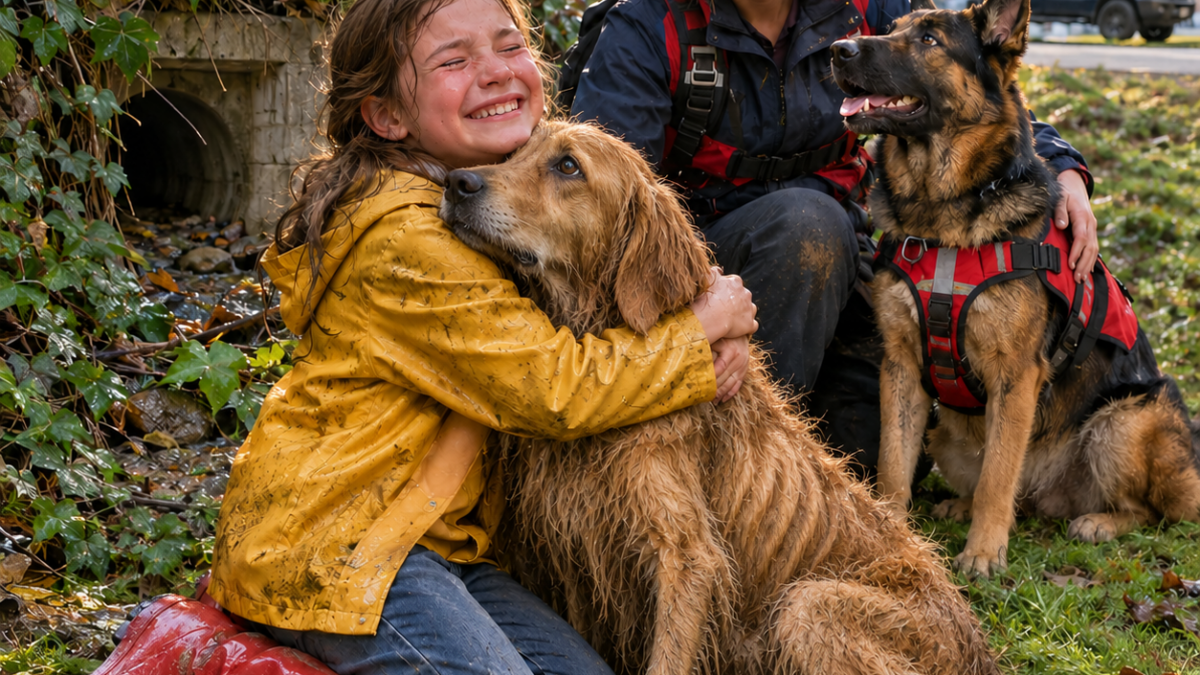
A little girl got her best friend back.
Two parents heard news they’d almost stopped believing was possible.
A severely injured dog received another chance at life.
And a rescue handler who thought he understood everything about hope learned that even after fourteen years, there were still lessons waiting for him.
I don’t believe every missing animal will be found.
I don’t believe determination alone can overcome every injury or every impossible circumstance.
But I believe we owe the living a careful, honest effort whenever there is still a reasonable chance to help them.
And I believe love can give people the strength to continue through uncertainty without pretending that the outcome is guaranteed.
That’s what the Clare family showed me.
That’s what Annabelle’s drawing reminded me.
And that’s what Dash proved when he stopped beside a hole in the ground and refused to leave.
The other night, I received another photograph from Mrs. Clare.
It showed Annabelle asleep beneath her blue blanket.
Whitlow was curled beside her.
His golden muzzle rested on the pillow near her shoulder.
One of her hands was tangled gently in the fur along his neck.
The room was dark except for a small lamp beside the bed.
Everything looked peaceful.
There were no muddy ravines.
No emergency vehicles.
No veterinarians.
No frightened voices over a radio.
Just a little girl and the dog who had finally come home.
Beneath the picture, Mrs. Clare had written:
He’s still sleeping in the spot she saved for him.
I stared at the photograph for a long time.
Then I opened the drawer of my desk and took out Annabelle’s original drawing.
The paper had faded slightly.
The plastic sleeve was scratched.
But the purple words were still clear.
PLEASE FIND MY BEST FRIEND.
I placed the photograph beside it.
Fifty-five days separated those two images.
Fifty-five days of searching.
Fifty-five nights of wondering.
Thousands of steps through wet forest trails.
False leads.
Cold mornings.
A deep pit hidden beneath branches.
A weak heartbeat.
A dog named Dash who refused to move.
And one little girl who kept drawing the friend she wasn’t ready to say goodbye to.
I looked toward Dash.
He was asleep beside my chair.
His paws moved slightly as though he were dreaming of another search.
I reached down and stroked his head.
“Good boy,” I whispered.
He opened one eye.
Then sighed and settled again.
I smiled.
“You found him.”
Outside, the wind moved gently through the trees.
For a moment, I thought about everything that might have gone differently.
We could have taken another trail.
We could have ended the search a day earlier.
Whitlow could have fallen into the pit in a place Dash never reached.
Another storm could have arrived before we did.
There were so many ways the story could have ended in grief.
But it didn’t.
On day fifty-five, the light broke through the clouds.
Dash found a scent.
We followed.
And somewhere at the bottom of a dark hole, a golden retriever who had been missing for nearly two months found the strength to move his tail one more time.
That tiny movement became the beginning of his journey home.
I put the drawing back in its sleeve.
Then I turned off the desk lamp.
As I walked toward the bedroom, Dash rose and followed me.
He settled into his usual place beside the bed.
I looked down at him.
Tomorrow, there would be more work.
More calls.
More families searching for answers.
More difficult decisions.
But tonight, I allowed myself to remember one extraordinary morning.
A dog who survived.
A little girl who never forgot him.
And the partner who led me to the place where hope was still breathing.
For fifty-five days, Annabelle kept a space on her bed for Whitlow, even when the rest of the world began preparing her for goodbye.
On the fifty-fifth day, Dash found the one place no one had thought to look—and that empty space finally had its owner again.
And of all the things I’ve learned in fourteen years of search and rescue, the lesson I carry most closely is this:
Hope isn’t a promise that everything will turn out the way we want. Sometimes, hope is simply the decision to keep looking while there’s still a chance that someone is waiting to be found.








