FULL ENDING :I Mistook the Only Woman Protecting My Daughter for Someone Hurting Her—Then My 6-Year-Old Revealed What Had Been Happening Behind My Back for 11 Months
There was a photograph attached.
Blurry.
Ruby lying on the living-room floor.
Tessa beside her.
Blankets.
No bed.
No explanation.
I changed my flight.
I told nobody.
By 2:15 the following morning, I walked into my Greenwich house and saw the scene with my own eyes.
Ruby asleep on a blanket beside the sofa.
Her cheek pressed against Tessa’s arm.
A worn stuffed rabbit under one hand.
Tessa awake.
Sitting against the couch.
And Doreen in the doorway.
Watching.
I exploded.
“What the hell is this?”
Tessa startled.
Ruby did not wake.
“Mr. Holloway—”
“Get away from her.”
Tessa immediately lifted her hands.
“She had another nightmare.”
“I am paying you to care for my daughter, not let her sleep on a floor like a homeless child.”
Doreen folded her arms.
“I warned you, sir.”
Tessa looked at her.
Then me.
“Ruby cannot sleep upstairs when you’re gone.”
“She has a fifty-thousand-dollar bedroom.”
“She doesn’t need a more expensive bedroom.”
“Then what does she need?”
Tessa looked down at my sleeping child.
“She needs this room.”
I laughed angrily.
“Why?”
“Because Caroline used to read to her here.”
My anger stopped for half a second.
Only half.
Then Doreen said:
“Don’t let an employee tell you how to raise your own daughter.”
And my pride finished what grief had started.
I looked at Tessa.
“You’re fired.”
Her face went pale.
“Mr. Holloway—”
“Pack your things.”
“Please.”
“Now.”
PART2
Bernadette, our cook, appeared at the edge of the hallway in a robe.
“Mr. Holloway, it’s pouring outside.”
“I’ll arrange a car.”
Tessa looked at Ruby.
“Please let me stay until she wakes.”
“No.”
Doreen’s mouth almost smiled.
I noticed it.
Ignored it.
That was mistake number one hundred and something.
Tessa went upstairs.
She returned twenty minutes later with one small suitcase and a backpack.
I was standing near the fireplace.
Ruby was still asleep.
Tessa knelt beside her.
She brushed Ruby’s hair away from her cheek.
Then whispered:
“When she wakes, don’t leave her alone.”
I said nothing.
Tessa looked up at me.
“Even if she doesn’t answer you, she hears everything.”
“I know my daughter.”
The second the sentence left my mouth, I knew it sounded defensive.
Tessa did not challenge me.
She simply said:
“I hope so.”
Then she kissed Ruby’s forehead.
The front door opened.
Cold rain rushed into the foyer.
Tessa stepped through.
Ruby’s eyes opened.
She saw the suitcase.
Saw Tessa.
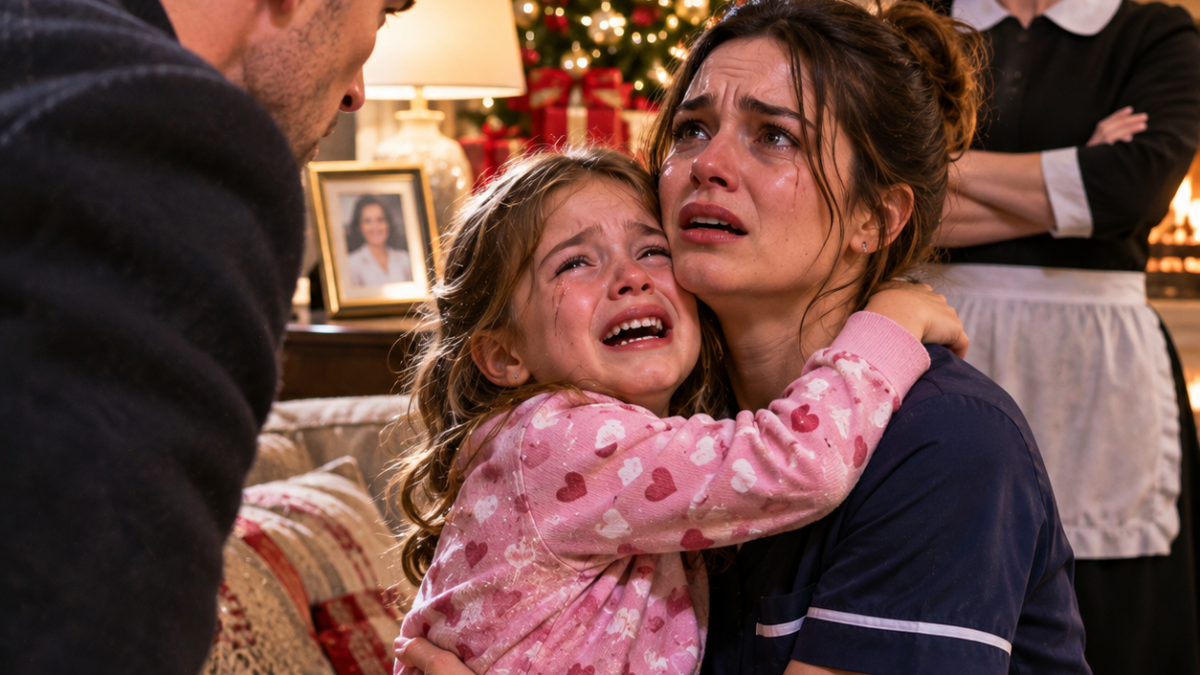
Everything happened at once.
Ruby scrambled up.
Her stuffed rabbit dropped.
She ran barefoot across the marble.
Tessa turned.
Ruby wrapped both arms around her legs.
Tessa almost fell.
“Ruby.”
My daughter buried her face against Tessa’s coat.
I walked toward her.
“Sweetheart.”
Ruby shook her head violently.
“Come here.”
Another shake.
Doreen said:
“Ruby, stop this nonsense.”
My daughter froze.
Then turned.
I will never forget her face.
Fear.
Not grief.
Fear.
Her mouth opened.
For eleven months, I had watched that mouth stay closed.
Then a sound came out.
Raw.
Broken.
Too loud.
“NO!”
Every person in the foyer stopped breathing.
Ruby grabbed Tessa harder.
Then screamed:
“DON’T MAKE HER GO!”
My knees nearly gave out.
“Ruby…”
She was crying so hard the words came in pieces.
“Doreen said… Doreen said if I talk about Mommy… you’ll stop loving me too!”
The rain behind Tessa sounded suddenly enormous.
I looked at Doreen.
Her face had gone completely blank.
“What?”
Ruby pointed at her.
“DON’T SEND TESSA AWAY!”
Then another sentence.
The one that changed everything.
“She’s the only one who lets Mommy stay!”
I stared.
Doreen recovered first.
“Sir, she’s confused.”
Tessa pulled Ruby closer.
“Do not.”
Doreen looked at her.
“What?”
“Do not call her confused.”
I knelt in front of my daughter.
My body felt disconnected.
“Ruby.”
Her breathing was ragged.
“You can talk.”
Stupid thing to say.
Obviously she could.
But eleven months.
Eleven months of silence.
She looked at me.
Then immediately looked down.
As if she had done something wrong.
That broke me.
“Ruby, look at Daddy.”
Slowly.
“You are not in trouble.”
Her lips trembled.
“Did Doreen tell you I would stop loving you if you talked about Mommy?”
Ruby nodded.
“No.”
Doreen stepped forward.
“That is not what I—”
I raised one hand.
“Not one word.”
Something in my voice stopped her.
Ruby whispered:
“She said you get sick when I make you sad.”
The sentence sounded horribly familiar.
Not because Doreen had ever said it to me.
Because I had spent eleven months allowing my child to see me disappear whenever Caroline came up.
I left rooms.
Changed subjects.
Buried myself in work.
I thought I was protecting Ruby from seeing me fall apart.
Perhaps I had taught her grief was dangerous before Doreen ever added words.
“When did she tell you that?”
Ruby pressed herself against Tessa.
“I don’t know.”
“Was it one time?”
A small shake.
No.
My stomach turned.
“How many?”
Ruby held up both hands.
Ten.
Maybe more.
Doreen said:
“Mr. Holloway, you need to understand the context.”
I stood.
“The context can wait.”
Ruby suddenly let go of Tessa.
She ran toward the sofa.
Dropped to her knees.
Reached beneath it.
Doreen moved.
“Ruby, don’t—”
Tessa stepped between them.
Ruby dragged out a thin picture book.
Not a children’s book.
An old photo album.
I recognized it.
Caroline kept family snapshots in it.
I had not seen it since her death.
Ruby flipped through the pages frantically.
Then pulled out one photograph.
She carried it to me.
Her fingers shook.
“Mommy said.”
I took it.
Caroline.
Ruby.
The living room.
My daughter looked about four.
Both were asleep on the floor beside the sofa.
Caroline had one arm around Ruby.
Blankets everywhere.
Books scattered beside them.
It was almost exactly the scene I had walked into an hour earlier.
My throat closed.
I turned the photograph over.
Caroline’s handwriting.
Blue ink.
I knew every curve.
GRANT—IF YOU EVER FIND US DOWN HERE, DON’T CARRY HER UPSTAIRS. WHEN YOU TRAVEL, SHE GETS SCARED IN THAT BIG ROOM. SHE SLEEPS HERE BECAUSE THIS IS WHERE WE READ, WHERE SHE CAN HEAR THE HOUSE, AND WHERE SHE KNOWS SOMEONE WILL FIND HER. COMFORT ISN’T ALWAYS WHERE WE THINK IT SHOULD BE. —C
I read it once.
Then again.
Then I sat down.
Not elegantly.
Just sat on the floor.
The expensive bedroom.
The renovations.
The specialists.
All my solutions.
And my dead wife had understood the problem years before.
Ruby did not need luxury.
She needed familiarity.
She needed not to wake alone.
Tessa had discovered that.
I had fired her for it.
I looked at Ruby.
“Where did you find this?”
“Tessa found the book.”
Tessa said quietly:
“It was in the attic.”
“Why?”
Tessa looked toward Doreen.
Doreen’s face tightened.
“I don’t know.”
Ruby answered.
“Doreen put Mommy away.”
Everything inside me stopped.
“What?”
Doreen shook her head.
“She means the belongings.”
I looked at Ruby.
“What did she put away?”
“Everything.”
The word came out tiny.
“Pictures.”
“Mommy’s pillow.”
“The blue blanket.”
“The story books.”
“She said you told her.”
I turned to Doreen.
“Did I?”
Doreen straightened.
“After Mrs. Holloway died, you told me you couldn’t bear seeing reminders everywhere.”
That was true.
For perhaps three weeks.
I had said:
“I can’t do this.”
Standing in our bedroom surrounded by Caroline.
I had not said throw everything into the attic.
I had not said remove Caroline from Ruby’s life.
“What exactly did I authorize?”
“You said to clear the house.”
“No.”
Doreen blinked.
“You said you needed to breathe.”
“That is not authorization to erase my daughter’s mother.”
“I was trying to help.”
Tessa spoke.
“Then why did you tell Ruby she wasn’t allowed to ask for the photographs?”
Doreen turned.
“You have no idea what this family was like before you arrived.”
Tessa’s voice remained calm.
“I know what Ruby told me.”
“And what was that?”
“That every time she asked for something belonging to Caroline, you told her Mr. Holloway wanted it gone.”
I looked at Ruby.
“Is that true?”
She nodded.
My heart hurt physically.
“What else?”
Ruby whispered:
“She said Mommy made you cry.”
True.
“And that if I keep making you remember, you might go away too.”
I closed my eyes.
Caroline gone.
Me constantly traveling.
To a six-year-old, adults disappear.
Death.
Flights.
Doors.
Work.
Doreen had weaponized the thing Ruby feared most.
Abandonment.
“Why?”
I asked.
Doreen looked offended.
“Why what?”
“Why would you tell a six-year-old her father might leave because she talks about her mother?”
“I did not say it like that.”
“How did you say it?”
“She was inconsolable.”
“So?”
“She needed structure.”
“So you frightened her into silence?”
“She was already silent.”
The room froze.
Doreen realized too late what she had said.
Tessa stared at her.
Bernadette whispered:
“My God.”
I stepped closer.
“What did you mean?”
Doreen swallowed.
“Nothing.”
“No.”
“You said she was already silent.”
Ruby stopped speaking the afternoon Caroline died.
Doreen could not have caused the first silence.
But perhaps she had helped it become permanent.
I looked at Tessa.
“How long have you suspected this?”
“About six weeks.”
“Why didn’t you tell me?”
“I tried.”
That hurt.
“When?”
“The first week Ruby started sleeping downstairs.”
“I emailed you.”
I remembered something.
A message from London.
Ruby’s nighttime behavior seems connected to Caroline’s reading routine. I’d like to discuss restoring some familiar objects.
I replied:
Please coordinate household changes through Doreen. I’m tied up all week.
My stomach dropped.
Tessa continued.
“I asked Doreen for Caroline’s books.”
“She said you prohibited it.”
“I asked about photographs.”
“Same answer.”
“I asked to speak with you.”
“Your assistant said you were unavailable until you returned.”
I knew that too.
Three canceled calls.
All mine.
“Then the anonymous text.”
I looked up.
“What?”
Tessa slowly reached into her backpack.
She removed her phone.
“I started receiving messages too.”
She showed me.
Unknown number.
STOP CONFUSING RUBY.
Another.
YOU ARE PAID TO CARE FOR HER, NOT REPLACE HER MOTHER.
Another.
IF YOU KEEP ENCOURAGING THIS OBSESSION, MR. HOLLOWAY WILL HEAR ABOUT IT.
I read them.
Doreen said:
“Anyone could have sent those.”
Tessa looked at her.
“Yes.”
“They could.”
The front door was still open.
Rain misted onto the marble.
I closed it.
Then I said:
“No one leaves.”
Doreen stiffened.
“You just fired her.”
“I was wrong.”
The words came quickly.
Clear.
I looked at Tessa.
“I was wrong.”
Tessa’s expression did not soften.
Good.
“I accused you without listening.”
“Yes.”
“I fired you in front of Ruby.”
“Yes.”
“I am sorry.”
She looked down at Ruby.
Then back at me.
“I don’t need an apology tonight.”
“Ruby needs you to stop making decisions while angry.”
Fair.
Painfully fair.
I turned toward Doreen.
“Phone.”
She blinked.
“What?”
“Your phone.”
“You cannot demand my private—”
“You used a household employee communication system and apparently knew I was in London before the anonymous message arrived.”
“I did not send it.”
“I didn’t say you did.”
Her face answered more than her mouth.
Bernadette suddenly spoke.
“I saw her taking pictures.”
Everyone turned.
Doreen’s eyes widened.
Bernadette looked frightened but continued.
“Tonight.”
“When?”
“About midnight.”
“She came down.”
“Ruby and Tessa were asleep.”
“She stood over them.”
“She took photos.”
Doreen’s face lost color.
“I was documenting misconduct.”
“To send to me?”
Silence.
Bernadette nodded toward Doreen’s pocket.
“She was typing.”
There it was.
Not proof.
Enough to begin.
Doreen said:
“I was protecting this household.”
“From what?”
“That woman.”
She pointed at Tessa.
“She came into this house five months ago and suddenly Ruby disobeys routines.”
“Ruby sleeps on floors.”
“Ruby drags dead woman’s belongings back out.”
My jaw tightened.
“Dead woman?”
Doreen realized.
Too late.
“Mrs. Holloway.”
“Her name was Caroline.”
“I know.”
“She employed you for nine years.”
“And I cleaned up after her for nine years.”
The bitterness surprised me.
“What does that mean?”
Doreen laughed once.
It sounded ugly.
“She was lovely to everyone, wasn’t she?”
I stared.
“Everyone adored Caroline.”
“Caroline thanked the gardeners.”
“Caroline remembered birthdays.”
“Caroline sat in the kitchen with staff like we were all old friends.”
“Then she left chaos everywhere.”
“Clothes.”
“Books.”
“Toys.”
“She never respected order.”
This was not about grief.
Not entirely.
It was resentment.
Small.
Old.
Accumulated.
Doreen continued:
“After she died, you finally allowed me to make this house function properly.”
“So you removed her.”
“I organized.”
“You lied to Ruby.”
“I protected you.”
“From my daughter?”
“From living inside grief forever.”
Tessa said quietly:
“That wasn’t your decision.”
Doreen snapped:
“And it wasn’t yours.”
“No.”
Tessa agreed.
“It was Grant’s.”
“And Ruby’s.”
That silenced us.
Ruby.
The only person nobody had asked.
I knelt again.
“Sweetheart.”
She looked exhausted.
“Do you want to go upstairs?”
She shook her head.
“Do you want to stay here?”
Nod.
“Do you want Tessa to stay tonight?”
Ruby grabbed Tessa’s hand.
Answer.
I looked at Tessa.
“Please.”
Not employer to employee.
Father asking.
Tessa nodded.
“For Ruby.”
“Thank you.”
Then I turned to Doreen.
“You are suspended effective immediately.”
Her eyes widened.
“Suspended?”
“I’m not going to repeat my mistake and make a final employment decision at three in the morning.”
She seemed almost relieved.
I continued.
“But you will leave the property tonight.”
Relief gone.
“Tomorrow my attorney and household manager will review the messages, security footage, storage records, and your communications.”
“You cannot treat me like a criminal.”
“I’m treating you like an employee accused of deliberately manipulating a child.”
Her face hardened.
“After nine years?”
“After nine years, you should have known better.”
She looked at Ruby.
Ruby moved behind Tessa.
That was the final answer.
Doreen packed a small overnight bag.
A driver took her to a hotel.
I did not care where she went.
Once the door closed, the house felt different.
Not safe yet.
Just honest.
Ruby remained awake.
Eleven months without speaking.
Now words seemed frightening to her.
She would say one.
Then stop.
Watch my face.
As if waiting for punishment.
That was when I understood the real work had only started.
I sat on the rug.
Exactly where I had been furious to find her.
“Can I sit here?”
Ruby nodded.
Tessa sat beside her.
Bernadette made warm milk.
No one mentioned the hour.
Ruby held Caroline’s photograph.
“Daddy?”
The word nearly destroyed me.
I had heard it in my imagination every day for eleven months.
The reality was smaller.
Hoarse.
Perfect.
“Yes.”
“Did Mommy sleep here?”
“Apparently.”
A little smile.
“Tessa said.”
“She was right.”
Ruby looked at my face.
“You’re not mad?”
“At Tessa?”
“At me.”
“No.”
“Because I sleep here?”
“No.”
“What about my room?”
“What about it?”
“You paid lots.”
I laughed despite myself.
“Who told you that?”
“Doreen.”
Of course.
“Ruby, your bedroom is a room.”
“You are my daughter.”
“If you feel safer sleeping here for now, we’ll make this safe.”
Her eyes filled.
“Can Mommy’s books come back?”
“Yes.”
“All?”
I hesitated.
Then corrected.
“Which ones do you want?”
Her expression changed.
Choice.
She pointed toward the attic.
“Tomorrow.”
“Tomorrow.”
“Can the picture stay downstairs?”
“Yes.”
“Can I say Mommy?”
There are sentences that expose every failure a parent has made.
I covered my mouth for a second.
Then:
“Yes.”
“Whenever?”
“Whenever.”
“What if you cry?”
“I might.”
She looked scared.
I added immediately:
“But that is not dangerous.”
“Crying means I love her.”
“It does not mean you did anything wrong.”
Ruby stared.
Then whispered:
“I missed you.”
I reached for her carefully.
She came into my arms.
“I missed you too.”
“No.”
She shook her head against my chest.
“I missed you when you were gone.”
London.
Boston.
Chicago.
Every trip.
Every time grief made me run toward work.
“I know.”
“I’m sorry.”
“Are you going again?”
The question was not about a specific trip.
It was about whether fathers disappear.
I looked over her head at Tessa.
She understood.
I answered carefully.
“I still have to work.”
“But I have been gone too much.”
“I am changing that.”
“Tomorrow?”
“Starting tomorrow.”
Ruby whispered:
“Okay.”
At four-thirty in the morning, my daughter fell asleep on the living-room floor again.
This time with her head on my chest.
Tessa lay on the sofa.
Bernadette had gone back upstairs.
And I remained awake.
Staring at the ceiling.
Thinking about everything money had allowed me to avoid.
I had not been an absent father in the obvious way.
I paid attention to school reports.
I attended appointments when I could.
I knew Ruby’s allergies.
Her teacher’s name.
Her favorite cereal.
I bought birthday gifts myself.
I loved her.
But I had mistaken provision for presence.
The harder she became to reach, the more professionals I hired.
The more helpless I felt in the house, the more meetings I accepted elsewhere.
I thought:
I am building a stable future for her.
Meanwhile she was sleeping downstairs hoping the place where her mother once read stories might make someone stay.
At seven, I canceled the week.
All of it.
My assistant nearly had a heart attack.
“Grant, you have the Hartford closing.”
“Move it.”
“The board dinner.”
“Cancel.”
“Boston?”
“No.”
“How long are you unavailable?”
I looked at Ruby.
“As long as necessary.”
By nine, Dr. Helen Mercer, Ruby’s child psychologist, was sitting in our living room.
Ruby did not speak to her immediately.
That was fine.
Helen listened while I explained.
Tessa explained.
Ruby drew.
Doreen’s name appeared once in block letters.
Then a picture.
A stick figure standing beside boxes.
A smaller figure watching.
“Who is that?”
Helen asked.
Ruby pointed.
Doreen.
“What’s in the boxes?”
Ruby wrote:
MOMMY
Helen looked at me.
I had to turn away.
Ruby had experienced Caroline’s belongings being removed as though her mother herself were being packed away.
Helen did not over-dramatize.
She did not immediately decide Doreen caused everything.
She said:
“Ruby’s mutism began with traumatic bereavement.”
“That matters.”
“What appears to have happened afterward is that she received repeated messages reinforcing the belief that speaking about Caroline would hurt or destabilize her remaining parent.”
I said:
“So she stayed silent.”
“Possibly.”
“Children are adaptive.”
“If silence feels safer, silence becomes functional.”
My stomach twisted.
“How do we change it?”
“Stop making speech the goal.”
“What?”
“For eleven months, every adult has wanted Ruby to talk.”
“That creates pressure.”
“Yesterday she spoke because she was trying to stop another attachment figure from disappearing.”
Tessa.
My chest tightened.
Helen continued:
“Now we need to make sure she understands she does not have to perform speech to keep people.”
That sentence changed how I approached everything.
No celebration every time Ruby spoke.
No:
“Say that again!”
No telling relatives she was “fixed.”
No making her voice into a miracle she had to maintain.
If she wanted to speak, we listened.
If she pointed, we responded.
If she wrote, fine.
Safety first.
Words later.
Tessa tried resigning that afternoon.
I expected it.
She placed an envelope on my desk.
“What’s this?”
“My resignation.”
“No.”
Her eyebrows rose.
“You cannot reject a resignation.”
“Apparently I can’t reject being an idiot either.”
She almost smiled.
Almost.
Then:
“I cannot work in a house where my judgment can be dismissed because another employee sends you a photograph.”
“You’re right.”
“I cannot be Ruby’s emotional anchor while her father is on another continent half the month.”
“You’re right.”
“You cannot hire me to replace you.”
That one landed.
“I know.”
“No.”
She said.
“I don’t think you do.”
I sat.
“Then tell me.”
“You hired me because you wanted Ruby cared for.”
“Yes.”
“But every time she reached for you emotionally, you interpreted it as a problem for someone else to solve.”
I said nothing.
“Nightmares?”
“Therapist.”
“Silence?”
“Specialist.”
“Loneliness?”
“Me.”
“Her memories of Caroline?”
“Doreen decided they were unhealthy and you were too unavailable to notice.”
She was not cruel.
That made it worse.
“I am not her mother.”
“I know.”
“I’m not her father.”
“I know.”
“I can help.”
“But you have to come home.”
I stared at the resignation.
“What would it take for you to stay?”
“Not money.”
“I assumed.”
“Three things.”
“Name them.”
“First, no one overrides decisions involving Ruby without discussing them with you and her treatment team.”
“Done.”
“Second, I communicate with you directly.”
“No filtering through household staff.”
“Done.”
“Third…”
She paused.
“You attend.”
“What?”
“Her life.”
“School meetings.”
“Therapy when asked.”
“Bedtime sometimes.”
“Breakfast.”
“Ordinary things.”
“You stop being the special guest in your own child’s routine.”
I looked down.
“That bad?”
Tessa answered softly.
“Yes.”
I deserved that.
“I agree.”
She picked up the resignation.
Folded it.
Put it back into her bag.
“For thirty days.”
“Probation?”
“For you.”
That time she did smile.
Fair.
The investigation into Doreen moved quickly.
Our security system showed she had taken the anonymous photograph at 12:06 a.m.
The metadata matched.
The anonymous message had been routed through a disposable texting service.
Our IT consultant traced the account setup to Doreen’s home Wi-Fi.
She had sent the photographs.
She had also sent Tessa the threatening messages.
More troubling were the storage records.
After Caroline died, Doreen had instructed movers to place twenty-seven boxes in an off-site storage unit.
I had authorized six.
The rest contained almost everything personal that had belonged to Caroline outside my bedroom.
Photographs.
Books.
Ruby’s baby albums.
Christmas ornaments.
A quilt Caroline’s mother made.
Recorded storybooks.
A wooden jewelry box.
Clothes Ruby remembered.
Even a framed handprint Ruby made in preschool.
I stood inside that storage unit two days later.
Twenty-seven boxes.
Labels.
OLD FAMILY ITEMS.
DONATE LATER.
NOT NEEDED.
I felt sick.
Bernadette came with me.
She stood quietly.
“Did you know?”
“Some.”
“Why didn’t you tell me?”
She looked embarrassed.
“Doreen said you ordered it.”
“And you believed her?”
Bernadette looked at me.
“You were never home, sir.”
That answer hurt because it was not an accusation.
It was logistics.
When the person with authority disappears, other people fill the space.
Doreen filled it.
Not because she was some criminal mastermind.
Because I gave her enormous practical control and almost no oversight during the most vulnerable year of my daughter’s life.
Doreen’s employment ended formally that week.
She demanded a meeting.
Against everyone’s advice, I agreed.
My attorney present.
No Ruby.
No Tessa.
Doreen sat across from me in a conference room.
She looked angry.
Not ashamed.
“Nine years.”
She said.
“I gave your family nine years.”
“And in the ninth, you frightened my daughter.”
“I kept that house running after Caroline died.”
“You did.”
“You disappeared.”
“Yes.”
She seemed surprised by the answer.
I continued.
“I disappeared into work.”
“That is on me.”
“But that does not make what you did acceptable.”
“She needed discipline.”
“She needed grief support.”
“She had grief support.”
“She refused to speak.”
“So you told her speaking about her mother might make me leave?”
“I told her you were suffering.”
“She was six.”
“She had to understand consequences.”
“No.”
I leaned forward.
“She had to understand that the adults around her could handle their own emotions.”
“She was not responsible for managing me.”
Doreen’s jaw tightened.
“Tessa encouraged obsession.”
“Tessa found the only location where Ruby could sleep.”
“On the floor.”
“Where her mother used to sleep with her.”
“You’re romanticizing dysfunction.”
“No.”
“I’m listening.”
Doreen shook her head.
“That girl turned Ruby against me.”
“No.”
“Ruby was afraid of you before Tessa knew why.”
Doreen’s eyes flashed.
“I never touched her.”
“I didn’t say you did.”
“I never hurt that child.”
“You convinced her love was conditional.”
Silence.
“That is harm.”
For the first time, something shifted.
Not remorse exactly.
Recognition.
Doreen looked away.
Then said:
“I thought if she stopped bringing Caroline into everything, the house would settle.”
There it was.
Control.
Order.
A quiet child.
A clean house.
No grief disrupting the furniture.
“Caroline annoyed you.”
I said.
Doreen laughed bitterly.
“She made everything look easy.”
“What does that mean?”
“She could leave a book on the sofa and people called her charming.”
“If I left a cloth out, I was careless.”
“She sat in the kitchen and talked to staff and everyone adored her.”
“Then I had to clean after all of it.”
“You resented her.”
“I worked for her.”
“That isn’t an answer.”
Doreen looked at me.
“Yes.”
“I resented her sometimes.”
Human.
Ugly.
But human.
“When she died, you had control.”
Doreen’s face hardened again.
“I made your home functional.”
“You removed a dead woman’s photographs from her six-year-old daughter.”
“You told the child I wanted them removed.”
“You lied.”
She had no answer.
Her attorney eventually negotiated final wages and benefits we legally owed.
Nothing extra.
No revenge.
No dramatic police arrest because what she had done, while deeply harmful, was primarily an employment and child-welfare issue rather than some cinematic felony.
I did document everything with Ruby’s psychologist and pediatrician.
If Doreen ever sought another position involving direct childcare, I was not going to lie about why she left.
That was consequence enough.
But the more important consequence was simple.
She never again had access to Ruby.
Three weeks after I fired Tessa, then unfired her, my daughter came into my study.
I was working from home.
That alone was new.
She stood in the doorway.
“Daddy?”
I looked up.
No dramatic reaction.
Helen had taught me.
“Yeah?”
Ruby held the photograph of Caroline sleeping beside her on the floor.
“Do you remember this?”
“No.”
She walked closer.
“Mommy did.”
“Apparently.”
Ruby climbed into the chair across from me.
“She said you were in London.”
Of course.
Caroline’s note.
I smiled sadly.
“I was away too much even then.”
Ruby looked at the photograph.
“Mommy said you worked because you loved us.”
“She said that?”
Nod.
“Do you think she was right?”
My six-year-old had no business asking questions that difficult.
“Yes.”
I said.
“But sometimes you can love someone and still make choices that hurt them.”
Ruby considered.
“Like Doreen?”
My chest tightened.
“Yes.”
“Like you?”
Children.
No mercy.
“Yes.”
She looked at me.
“Like me?”
“No.”
Her eyes dropped.
“I stopped talking.”
“That wasn’t something you did to us.”
“That was something that happened because you were hurting.”
“I got mad at Mommy.”
I waited.
“She left.”
There it was.
The six-year-old logic.
“I told her I hated her.”
“When?”
“The morning.”
The morning Caroline died.
I remembered an argument over shoes.
Ruby refused school.
Caroline raised her voice.
Ruby shouted:
“I hate you!”
Normal.
Ordinary.
Then Caroline left.
The crash happened two hours later.
Oh God.
“Ruby.”
I got out of my chair.
Sat on the floor.
She did too.
“Mom did not die because you said that.”
“I know.”
She was crying.
“But what if she heard?”
“She did.”
Ruby sobbed.
I continued.
“And do you know what she knew?”
“What?”
“That six-year-olds say things they don’t mean when they’re angry.”
“How?”
“Because you also told her you hated broccoli.”
A tiny laugh through tears.
“Mom knew you loved her.”
“Absolutely.”
“Even when I was mean?”
“Especially then.”
Ruby leaned into me.
Then she said:
“I wanted to say sorry.”
I held her.
“I know.”
“But she didn’t come back.”
“I know.”
That was the first full conversation I had with my daughter in almost a year.
Not because some therapist found the right trick.
Because we finally reached the guilt beneath the silence.
And because, for the first time, she believed words would not make another person disappear.
Tessa did not become Ruby’s substitute mother.
I made sure of that.
So did Tessa.
She established boundaries.
Days off.
Her own apartment.
Her own life.
Ruby loved her.
But Tessa never allowed Ruby to believe her staying depended on perfect behavior.
Once, when Ruby threw a toy during a meltdown, she immediately panicked.
“Are you leaving?”
Tessa said:
“No.”
“I’m upset about the toy.”
“I’m not disappearing because you had a feeling.”
That became language we all used.
Feelings do not make people disappear.
Arguments do not make people die.
Mistakes do not automatically end love.
Adults are responsible for adult choices.
It sounds obvious.
To Ruby, it had to be rebuilt from zero.
I reduced travel drastically.
Not forever.
I still ran a company.
But I stopped accepting every meeting as if my presence elsewhere proved my worth.
I hired a chief operating officer I should have hired years earlier.
I worked from Greenwich three days a week.
I was home for breakfast more often.
I read bedtime stories badly.
Caroline had voices for characters.
I had one voice.
Ruby complained.
Good.
Normal.
We restored Caroline’s belongings slowly.
Not all at once.
Helen warned against turning the house into a memorial.
Ruby chose what mattered.
The blue blanket returned.
Three photographs downstairs.
Caroline’s favorite books.
The old wooden music box.
Some clothes.
Others remained stored until Ruby was older.
Some we eventually donated together.
Choice changed everything.
The living-room corner remained.
I bought a thick floor mattress.
Not fifty thousand dollars.
Two hundred and forty.
Best money I spent that year.
Bookshelves.
Soft lamp.
Blankets.
We called it the Story Corner.
Some nights Ruby slept upstairs.
Some nights she came down.
At first Tessa stayed with her.
Then me.
Then eventually Ruby could sleep there alone when she wanted.
The point was not making her stop.
The point was letting it become a choice instead of a survival strategy.
Six months after the night she screamed, Ruby was speaking regularly.
Not constantly.
Not magically healed.
She still had silent days.
Caroline’s birthday was hard.
The crash anniversary worse.
But she spoke.
She laughed.
She started correcting my reading.
At school, she gave a presentation about families.
She drew Caroline.
Me.
Tessa.
Bernadette.
Her grandparents.
Our dog, even though we did not own one.
When I asked about that, she said:
“We should.”
Fair.
We eventually adopted a rescue mutt named Oliver.
Terrible decision.
Wonderful dog.
Tessa remained with us another three years.
Then she told me she had been accepted into a graduate program in child psychology.
I was proud.
Ruby was furious.
“You’re leaving?”
The old terror came back instantly.
Tessa handled it better than I would have.
“Yes.”
Ruby started crying.
“But did I do something?”
“No.”
“Are you mad?”
“No.”
“Then why?”
“Because people can love each other and still go do new things.”
Ruby shook her head.
“I hate that.”
“I know.”
Tessa sat with her.
“I am not disappearing.”
“I will call.”
“I will visit.”
“You can be mad at me.”
“That does not cancel love.”
Ruby screamed:
“I don’t want you to go!”
Tessa cried too.
“I know.”
No one silenced Ruby.
No one told her to be grateful.
No one said she was making Tessa feel bad.
She got to be angry.
Then sad.
Then eventually excited for her.
That was progress.
On Tessa’s last night working for us, we slept in the living-room Story Corner.
All three of us.
Ruby in the middle.
Exactly like the night I came home and lost my temper.
At midnight, Ruby whispered:
“Daddy?”
“Yes?”
“Are you glad you fired Tessa?”
Tessa laughed.
I groaned.
“No.”
Ruby giggled.
“You fired the wrong lady.”
“I am aware.”
Tessa said:
“Historically poor management decision.”
“Thank you.”
Ruby laughed harder.
That sound filled the room.
I would have paid every dollar I owned for it eleven months earlier.
Now it came free.
Before Tessa left the next morning, I gave her an envelope.
She looked suspicious.
“If this is a bonus—”
“It is not.”
“It better not be.”
She opened it.
A photograph.
The one of Caroline and Ruby asleep on the floor.
I had made a copy.
On the back, I had written:
YOU LISTENED WHEN I DIDN’T.
THANK YOU FOR BRINGING ME BACK HOME.
—GRANT
Tessa cried.
I pretended I did not.
Ruby saw both.
“Crying is allowed.”
She said.
That rule had become ours.
Years passed.
Ruby grew.
The mutism became something in her history rather than her identity.
At twelve, she asked me to tell her everything about the night Caroline died.
Everything I knew.
We did.
With Helen’s help.
At fourteen, Ruby became furious with Caroline for dying.
That surprised her.
Helen told her anger was allowed too.
At fifteen, Ruby refused to visit the cemetery for an entire year.
Fine.
At sixteen, she asked for Caroline’s jewelry.
We opened the box together.
At seventeen, she wore Caroline’s earrings to prom.
At eighteen, she left for college.
That was the hardest goodbye I had faced since Caroline.
Not because I feared losing her.
Because the house became quiet again.
The difference?
Quiet no longer meant danger.
Ruby called the first night.
“Dad?”
“Yes?”
“You okay?”
I almost said fine.
Old habit.
Then:
“I miss you.”
She laughed.
“Good.”
“Good?”
“Means you love me.”
Apparently my daughter had become my therapist.
Terrifying.
Tessa finished graduate school.
Became a child psychologist specializing in traumatic bereavement.
She stayed part of our lives.
Not nanny.
Family friend.
At Ruby’s college graduation, she sat beside Bernadette.
When Ruby crossed the stage, Tessa cried harder than I did.
Debatable.
Years later, Ruby asked whether I had ever forgiven Doreen.
I had not thought about Doreen in a long time.
That was probably my answer.
“I don’t hate her.”
“Did she ever apologize?”
“Not really.”
“What happened to her?”
“She moved to New Jersey.”
“Worked for another family?”
“Not with children.”
I had been honest when references were requested.
Ruby nodded.
“Do you think she was evil?”
“No.”
That surprised her.
“She hurt me.”
“Yes.”
“She lied.”
“Yes.”
“Then why not?”
I thought carefully.
“Because calling someone evil can make us stop studying what they actually did.”
“She wanted control.”
“She resented your mother.”
“She thought a quiet house was a healthy house.”
“She believed she knew what was best and stopped seeing you as a child with your own needs.”
“Those choices were harmful enough without turning her into a monster.”
Ruby looked down.
“Do you forgive yourself?”
That question was harder.
“I’m working on it.”
“For firing Tessa?”
“For being gone.”
“For not asking why you were sleeping downstairs.”
“For believing money could stand in for me.”
“For letting other adults interpret you instead of learning to understand you myself.”
Ruby reached across the table.
“You came back.”
“I had to be tricked into it.”
“You still came back.”
That was grace.
I did not deserve all of it.
Children sometimes give more than parents earn.
When Ruby was twenty-six, she got engaged.
A young architect named Michael.
Good man.
Quiet.
He loved books.
Caroline would have liked him.
Ruby asked me if we could hold the rehearsal dinner at the house.
“Of course.”
“Downstairs.”
I knew.
The living room.
The Story Corner still existed, though more elegant now.
The old floor mattress gone.
Bookshelves remained.
Caroline’s photograph sat near the lamp.
The night before the wedding, after everyone left, Ruby and I sat on the rug.
Exactly where I had found her at six.
She held the old photograph.
“Mom looked young.”
“She was.”
“So were you.”
“Careful.”
Ruby smiled.
Then she turned the photo over.
Read Caroline’s note again.
Comfort isn’t always where we think it should be.
Ruby touched the words.
“Mom saved me too.”
“Yes.”
“Even after she was gone.”
“Yes.”
Then she looked at me.
“Tessa saved me.”
“Yes.”
“Helen.”
“Yes.”
“You.”
That one caught me.
“I was late.”
“But you came.”
Again.
Grace.
On the wedding morning, Ruby put a photograph of Caroline in her dressing room.
Not at the altar.
Not an empty chair.
She told me:
“Mom doesn’t need a seat.”
“She’s not a guest.”
That sounded exactly like Caroline.
During the father-daughter dance, Ruby leaned close.
“Remember the night I talked?”
“Yes.”
“I don’t remember everything.”
“What do you remember?”
“Tessa’s suitcase.”
“Doreen telling me to stop.”
“You sitting on the floor.”
I waited.
Then:
“And you saying Mommy’s name was allowed.”
I closed my eyes.
“That?”
“Yes.”
“I thought the most important thing was firing Doreen.”
Ruby laughed.
“No.”
“Or finding the photo.”
“No.”
“What then?”
“You believed me.”
The words almost stopped me dancing.
Because at first, I had not.
I had believed the room.
The appearance.
The expensive bedroom.
The employee with seniority.
The anonymous message.
My own anger.
Then Ruby spoke.
And finally I listened.
At the reception, Tessa approached.
Older.
Successful.
Married.
Two children of her own.
She looked at Ruby dancing.
Then me.
“You did okay.”
I laughed.
“After a catastrophic start.”
“Most parenting is recovery.”
“That’s a depressing professional opinion.”
“Accurate.”
We watched Ruby.
“She would have been proud.”
Tessa meant Caroline.
My throat tightened.
“Yes.”
I think she would.
Not because Ruby never struggled.
Because she learned struggle could be spoken.
That sadness could exist without frightening everyone away.
That love survives anger.
That people can leave for reasons that are not abandonment.
That adults can be wrong and repair.
That a luxurious bedroom is not the same thing as safety.
I kept Caroline’s original photograph.
It sits on my desk now.
Not the formal wedding portraits.
Not the magazine photographs from charity events.
That one.
Caroline on the floor.
Ruby curled against her.
Books everywhere.
Both asleep.
Two people I loved in a position I once considered unacceptable for my daughter.
On the back, Caroline’s handwriting.
When I read it now, I always stop at the same line:
Comfort isn’t always where we think it should be.
Caroline meant a place to sleep.
She ended up explaining my entire mistake.
I thought comfort was a renovated room.
Money.
Specialists.
Order.
Silence.
Distance from pain.
Ruby needed a floor.
A familiar corner.
A story.
A hand nearby when she woke.
A father willing to stay in the room when her mother’s name came up.
Simple things.
Hard things.
There is a difference.
When my first granddaughter was born, Ruby named her Caroline as a middle name.
Emma Caroline.
Tessa came to the hospital.
So did Bernadette.
Helen had retired but sent flowers.
I held Emma.
Tiny.
Warm.
Ruby exhausted.
Michael beside her.
For a moment, grief and joy occupied the same room without fighting.
I had spent years believing they were opposites.
They are not.
Ruby looked at me.
“Dad?”
“Yes?”
“You’re crying.”
“I know.”
“Should we call a specialist?”
I laughed so loudly a nurse checked on us.
That was Ruby.
Years earlier, everyone had treated her silence like the problem.
Now she could make jokes about it.
Not because it had been trivial.
Because it no longer controlled her.
When Emma was five, she visited my house and discovered the Story Corner.
“Why are there books down here?”
“Your mom liked them.”
“Did she sleep here?”
“Sometimes.”
“Why?”
I looked toward Ruby.
She smiled.
I answered:
“Because when she was little, this was where she felt safe.”
Emma considered this.
Then threw a blanket on the floor.
“I’m sleeping here.”
Ruby laughed.
“Absolutely not.”
I raised an eyebrow.
Ruby saw it.
“Oh, shut up.”
I laughed.
Some lessons become family jokes once they stop being wounds.
Emma did not sleep there that night.
But we read there.
One of Caroline’s old books.
Ruby sat on one side.
Emma between us.
I read badly.
Still only one character voice.
Emma complained.
Ruby said:
“Your grandma was better.”
“Is Grandma Caroline dead?”
Emma asked.
“Yes.”
“Did she read here?”
“Yes.”
“Can dead people still have books?”
Ruby and I looked at each other.
Then Ruby answered:
“Yes.”
“If the people who love them keep reading.”
That was the moment I knew we had not built a shrine.
We had built continuity.
There is a photograph from that evening.
Three generations on the same floor.
Me.
Ruby.
Emma.
The sofa behind us.
Caroline’s photograph visible on the shelf.
Nobody staged it.
Michael took it from the doorway.
When he sent it later, I stared for a long time.
Then I printed it.
I placed it beside the original.
Caroline and four-year-old Ruby.
Me, adult Ruby, and Emma.
Same corner.
Different years.
Comfort.
Still not where I once thought it should be.
I sometimes wonder what would have happened if I had not received the anonymous text.
Doreen sent it hoping to destroy Tessa.
Instead, it exposed everything.
That does not make what Doreen did good.
Bad choices can produce useful consequences accidentally.
I do not romanticize it.
If I had returned two weeks later, perhaps Ruby would have spoken anyway.
Maybe Tessa would have reached me.
Maybe Helen would have discovered the pattern.
Alternate histories are useless.
The one I live is enough.
I came home.
I made the wrong judgment.
My daughter found her voice at the worst possible moment.
A photograph corrected me.
Then I finally did the work I had been paying everyone else to do.
I became present.
That is the real ending.
Not Doreen being fired.
Not Tessa being vindicated.
Not Ruby speaking.
Because speaking once was not the finish line.
The finish line—if there ever is one—was years later, when Ruby could be angry at me and know I would stay.
When she could say:
“I don’t want to talk.”
And know I would not panic.
When she could miss her mother without checking my face.
When she could love Tessa without believing Tessa was replacing Caroline.
When she could leave for college without fearing separation meant abandonment.
When she could become a mother herself without treating every imperfect moment as evidence she was failing.
Those things took years.
They were worth more than the estate.
More than every building I ever developed.
I spent my career constructing homes for other people.
Ruby taught me a home is not marble.
Not square footage.
Not fifty-thousand-dollar bedrooms.
A home is the place where a frightened child knows she can wake at two in the morning and somebody will still be there.
That night, I came home furious because I found my daughter sleeping on the floor.
I thought the floor was the problem.
It wasn’t.
The problem was that she had spent eleven months believing the adults standing above her could disappear if she said the wrong thing.
So we changed that.
One bedtime at a time.
One photograph at a time.
One hard conversation at a time.
And if you ask me now what I remember most clearly about that night, it is not Ruby’s scream.
It is not Doreen’s face.
Not Tessa standing in the rain.
Not even Caroline’s photograph.
It is what happened about twenty minutes later.
Ruby was exhausted.
Her voice had gone quiet again.
She lay down in the same place beside the sofa.
I sat on the floor next to her.
She took my hand.
Then she whispered:
“Daddy?”
“Yes?”
“Are you leaving?”
I looked at my six-year-old daughter.
At the child who had lost her mother.
At the child I had unintentionally taught to associate love with disappearance.
And for the first time in eleven months, I gave her an answer that required no money, no specialist, no renovation, and no promise I could not keep.
“Not tonight.”
Ruby closed her eyes.
Her hand stayed around my finger.
Then she asked:
“Tomorrow?”
I swallowed.
“I’ll be here tomorrow too.”
Her breathing slowed.
Minutes later, she was asleep.
I stayed on that floor until morning.
My back hurt.
My neck hurt.
At forty-six, marble-adjacent sleeping was not kind.
I did not move.
Because Caroline had been right.
Sometimes a child does not need the room you built for her.
Sometimes she needs to wake up and discover the person she loves kept his word.
And when Ruby opened her eyes at seven-twelve the next morning—
I was still there.








