FULL ENDING :I Had Nowhere to Take Him, and He Had Nowhere Left to Go—But the Old War Dog Reached for the Only Man Who Refused to Walk Away
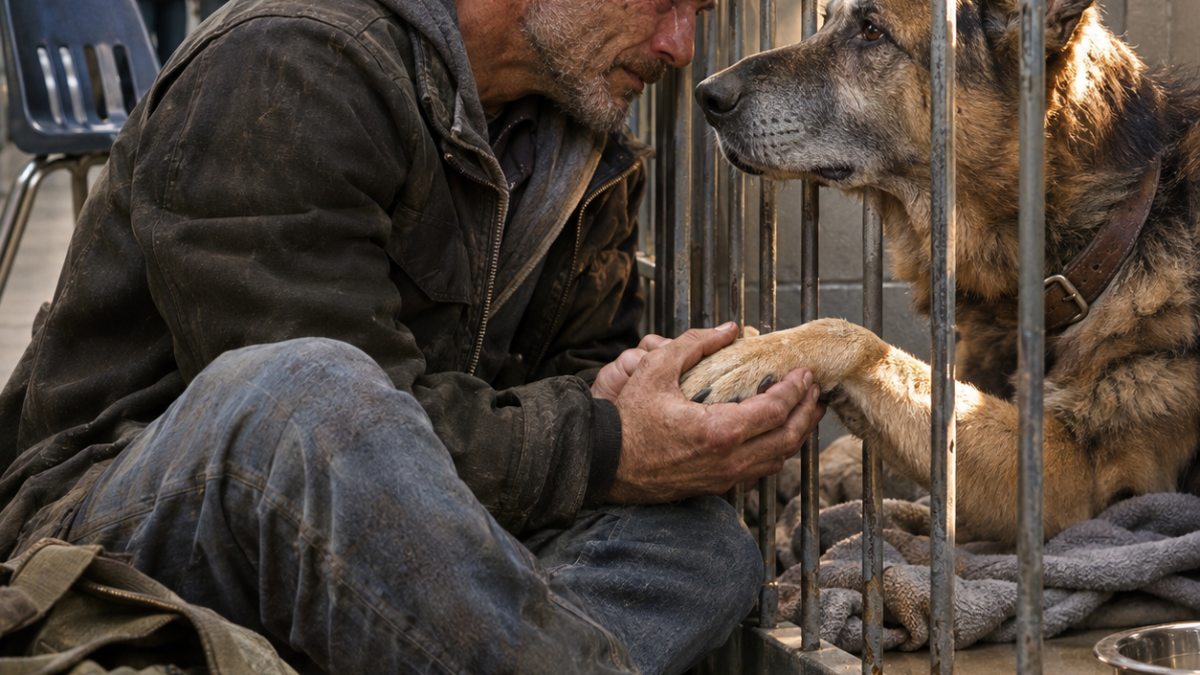
“I’m Marabelle,” she said. “Most people call me Mara. I run this place.”
I nodded.
“Elias Ward.”
She glanced toward Rook.
“He doesn’t do well with strangers.”
“I noticed.”
“He’s been returned before.”
I looked at the dog again.
“Why?”
“Noise. Anxiety. Difficulty adjusting. People expect a retired military dog to be perfectly obedient, grateful, and easy to handle.”
Her expression tightened.
“Rook isn’t any of those things.”
I watched his breathing.
His eyes remained open.
One ear angled toward us.
“He doesn’t have to be.”
Mara studied me.
“You have experience with working dogs?”
“Some.”
“What kind?”
I hesitated.
Then answered.
“Military.”
Her gaze moved toward my weathered coat and worn boots.
“Are you here about the kennel repair?”
“That’s what I came for.”
“Then why are you standing here?”
I looked toward a wooden chair resting against the wall outside the kennel.
“Is that chair being used?”
She frowned.
“No.”
“Mind if I sit?”
She considered me for a moment.
Then shrugged.
“Suit yourself. Just don’t try to touch him.”
I moved the chair several feet from the gate, sat down, and rested my hands on my knees.
Rook watched every movement.
I didn’t speak.
Minutes passed.
Rain struck the shelter roof.
A volunteer walked down the aisle carrying clean towels.
Somewhere outside, a truck started.
Rook slowly lifted his head.
He looked toward the door, then back at me.
I kept still.
Eventually, his shoulders relaxed enough for him to rest his chin against the floor again.
Mara watched from the far end of the aisle.
After twenty minutes, she returned.
“You’ve been sitting here a while.”
I nodded.
“Yep.”
“Are you waiting for him to come over?”
“No.”
“Then what are you doing?”
I looked at the old shepherd.
“Letting him decide whether I’m worth paying attention to.”
Mara was silent.
Then she asked, “And if he decides you’re not?”
I shrugged.
“Then he’s made a decision.”
She looked at me differently.
Not warmly.
Not yet.
But with something resembling curiosity.
Then a volunteer entered carrying a bucket of tools.
A wrench slipped from his hand.
It struck the concrete with a violent metallic clang.
Rook launched to his feet.
His body went rigid.
His lips drew back.
A deep warning growl rolled through the kennel.
The volunteer stumbled backward.
Mara moved toward the gate.
“Rook, easy!”
But the dog wasn’t looking at her.
He was staring at the wrench.
And when I recognized the fear beneath his reaction, I realized the old shepherd and I had more in common than either of us wanted.
FULL STORY CONTINUATION
I didn’t stand.
That was the first thing Mara noticed.
While the volunteer backed away and another dog began barking three kennels down, I remained in the chair with my hands resting loosely on my knees.
Rook stood rigid inside his kennel.
His tail was low.
His ears were sharply forward.
His eyes remained fixed on the wrench lying beside the volunteer’s boot.
People who didn’t know dogs might have mistaken his reaction for aggression.
But there was a difference between an animal preparing to attack and an animal desperately trying to understand whether something dangerous was about to happen.
Rook was frightened.
And everyone around him was moving too quickly.
“Give him space,” I said quietly.
Mara stopped.
The volunteer looked at me.
“What?”
“Just move back a little. Slowly.”
He glanced toward Mara.
She nodded.
The young man stepped away.
I didn’t tell Rook to sit.
Didn’t snap my fingers.
Didn’t use the sharp command voice I had once employed during military training.
The dog had already received enough commands.
I kept my gaze slightly to the side.
“It’s all right, buddy.”
Rook’s ears moved.
His attention shifted briefly toward me.
Then back to the wrench.
I waited.
After nearly a minute, he took one step away from the kennel door.
Then another.
He retreated toward the shaded corner and stood there breathing hard.
Nobody followed.
Nobody tried to prove they were in charge.
Mara watched him settle.
Then she looked at me.
“You handled that differently.”
“Didn’t handle much.”
“You didn’t try to make him obey.”
“He wasn’t refusing an order.”
“What was he doing?”
I looked at the wrench.
“Reacting to something that frightened him.”
Mara folded her arms.
“And you’re certain of that?”
“No. But I know enough not to punish a dog for being scared before I understand why.”
She didn’t answer immediately.
Then she picked up the wrench.
Carefully.
Without letting it strike anything else.
The volunteer apologized.
Mara waved it off.
“Accidents happen.”
Rook remained near the back wall.
I glanced at him.
“Give him a minute.”
Mara nodded.
“Then he gets a minute.”
She walked away.
And for the first time since I’d arrived, I had the feeling that she was beginning to understand why I hadn’t left the chair.
Seven years earlier, I had left the Navy with a duffel bag, some paperwork, and the belief that the hardest part of my life was behind me.
That belief lasted less than a year.
I had spent most of my adult life in a world where responsibility was clearly defined.
You had a role.
A schedule.
A mission.
A team.
When something went wrong, there were procedures to follow and people who knew what needed to happen next.
Civilian life wasn’t like that.
There were bills.
Job applications.
People who said they appreciated my service but didn’t know what to do with a man who struggled to explain his own experience.
I found work.
Lost work.
Found more.
Some jobs ended because the contracts did.
Others ended because I couldn’t settle into the routines.
I had difficulty sleeping.
I disliked crowded rooms.
I sometimes reacted badly to sudden noises.
And when I became overwhelmed, my preferred solution was to leave before anyone could ask questions.
It wasn’t a good solution.
But it became familiar.
I rented rooms.
Stayed with acquaintances.
Spent several weeks in a veteran’s temporary housing program.
Sometimes I slept in my truck when I had one.
Other times, I relied on shelters or borrowed couches.
Eventually, everything I owned fit inside one canvas bag.
People called me resourceful.
Independent.
Tough.
Those words sounded better than the truth.
I had become good at leaving.
And terrible at staying.
If a landlord asked too many questions, I left.
If a supervisor criticized me, I left.
If someone tried to get close enough to notice how frightened I sometimes felt, I left.
Every departure seemed sensible in the moment.
Taken together, they had become seven years without a permanent address.
I wasn’t proud of that.
But I had also stopped imagining anything different.
When I reached Cedar Hollow, I wasn’t looking for a new life.
I was looking for a few hours of work.
A meal.
Maybe enough money to spend another night indoors.
The shelter was simply another stop.
That was what I kept telling myself.
Until I met Rook.
Mara found me behind the kennels shortly before noon.
I was examining a loose gate hinge.
The metal bracket had shifted away from the post, leaving the latch misaligned.
I touched the damaged wood.
“This has been moving for a while.”
Mara looked at it.
“How bad?”
“Depends on whether you want it repaired or whether you want it to fall off and make the decision for you.”
She gave me a look.
“I’d prefer the first option.”
“Good choice.”
I measured the gap.
The hinge was old.
The screws had loosened.
The wooden post had begun absorbing moisture.
“Have you got tools?”
“Some.”
“Replacement hardware?”
“Maybe.”
“Budget?”
She sighed.
“That’s the most offensive question anybody has asked me today.”
I looked at her.
“Must be early.”
She almost smiled.
Then she led me toward a small workshop near the back of the property.
It was an old wooden building with a sloping roof and two windows facing the orchard.
The door stuck halfway open.
Inside were shelves crowded with tools, gardening supplies, paint cans, plumbing fittings, electrical parts, and things that had probably been placed there by somebody who promised to organize them later.
I looked around.
Mara watched my face.
“Don’t say it.”
“Say what?”
“That it’s a mess.”
I considered the room.
“It’s an ambitious storage system.”
She laughed once.
Then seemed surprised she’d done it.
I smiled faintly.
“Got a tape measure?”
She handed me one.
I spent the next two hours repairing the gate.
Not because I thought it would change my circumstances.
Because the hinge needed repairing and I knew how to do it.
Mara worked nearby, balancing invoices at an old desk in the workshop.
Every now and then, she’d ask a question.
“How much more hardware will we need?”
“Depends how long you want the repair to last.”
“Long enough to stop thinking about it.”
“Then we need to replace the rotten section.”
She sighed.
“Of course we do.”
We disagreed about the order of repairs.
I wanted to secure the gate first.
She wanted to deal with a leak that was threatening the storage area.
Neither of us shouted.
Neither walked away.
We compared the risks and decided what could be handled that afternoon.
It was an ordinary conversation.
But by then, ordinary conversations had become strangely difficult for me.
I was accustomed to either taking charge or removing myself.
Mara didn’t invite either.
She expected an explanation.
Then she made her own decision.
I found that irritating.
And, unexpectedly, reassuring.
At lunchtime, Mara placed a sandwich and a mug of coffee on the workshop table.
I looked up.
“What’s this?”
“Lunch.”
“I can see that.”
“Then we’re both making excellent progress.”
I glanced at the sandwich.
“How much do I owe you?”
She stared.
“For a sandwich?”
“Yes.”
“You’ve been repairing my gate for two hours.”
“That’s work.”
“And lunch is lunch.”
I reached into my pocket.
She raised a hand.
“Elias, don’t.”
I stopped.
She studied me.
“You don’t have to turn every kindness into an invoice.”
I looked down.
“That wasn’t what I was doing.”
“Wasn’t it?”
I said nothing.
She took a breath.
“Look, I appreciate the repair. I can pay for the work, and you’re welcome to eat lunch.”
I stared at the mug.
The coffee was dark.
Its surface reflected the workshop window.
Mara pushed it toward me.
“It’s not great coffee.”
I took a sip.
Then looked at her.
“Is this legally allowed to be called coffee?”
She laughed.
A real laugh this time.
“It’s all we’ve got.”
“That’s unfortunate.”
“Drink it anyway.”
I did.
For the first time in weeks, I ate lunch sitting across from someone who didn’t seem interested in extracting my history or evaluating my failures.
She asked about the hinge.
I explained the repair.
Then we talked about the weather.
The orchard.
The shelter.
Nothing personal.
Nothing dangerous.
And somehow, that made it easier to remain.
The property had belonged to Mara’s father.
I learned that gradually.
Not because she sat me down and told me a tragic family story.
Because the place carried evidence of him everywhere.
His handwriting appeared on labels attached to old shelves.
A chipped blue mug sat on the highest shelf in the workshop.
There were penciled measurements along the inside of a cabinet door.
A ledger lay beneath a stack of invoices, filled with notes about repairs and expenses stretching back years.
Mara ran the animal shelter and looked after the adjoining orchard.
Both needed more attention than one person could easily provide.
I could see that immediately.
Fence posts leaned.
Gutters clogged.
A workshop door had begun swelling with moisture.
The drainage near the rear building was inadequate.
Some kennel hardware needed replacing.
And the boiler made a noise that suggested it had developed strong feelings about retirement.
But the place was cared for.
That distinction mattered.
Things were worn because money and time were limited.
Not because Mara didn’t care.
I watched her moving between the kennels and the office.
She checked water bowls.
Answered calls.
Reviewed invoices.
Spoke with volunteers.
Cleaned.
Fixed what she could.
Then returned to the paperwork waiting on her desk.
She rarely complained.
I didn’t mistake that for ease.
One afternoon, I asked her whether she’d considered hiring a permanent maintenance worker.
She looked at me.
“With what money?”
I nodded.
“Fair.”
She glanced toward the orchard.
“People keep telling me to sell the place.”
“Do you want to?”
“No.”
“Then don’t.”
She laughed without humor.
“That’s an expensive answer.”
I looked toward the kennels.
“Sometimes the right answer is.”
She studied me.
Then returned to her figures.
I didn’t realize until later that she had been carrying her own version of the burden I knew so well.
The belief that asking for help meant admitting defeat.
Near closing time, I returned to Kennel Seven.
Rook lay near the back wall.
His head was raised.
I took the wooden chair from beside the door and placed it in the same position as before.
Then I sat.
He watched.
I didn’t offer food.
Didn’t call him.
Didn’t ask him to come forward.
Rain tapped against the roof.
A vehicle passed outside.
Somewhere beyond the kennels, a gate clicked shut.
Rook’s ears moved toward the sound.
Then back toward me.
I had worked with military dogs before.
Enough to understand that the label retired military working dog didn’t tell you everything about the animal standing in front of you.
Some dogs adapted quickly to civilian homes.
Others struggled.
Some needed more exercise than most families expected.
Some had medical needs.
Some disliked unfamiliar environments or people.
And some had learned habits that didn’t disappear simply because their service ended.
Rook appeared to belong to that last group.
But I didn’t know his full history.
So I made myself resist the temptation to explain him.
I didn’t want to turn him into a symbol.
Or imagine that my own experiences gave me some magical ability to understand his.
He was a dog.
An old dog.
One who needed careful treatment.
The fact that I recognized certain behaviors didn’t mean I had earned his trust.
It meant I knew enough to wait.
After about fifteen minutes, Rook stood.
He stretched carefully.
Walked toward the front of the kennel.
Stopped.
Looked at me.
Then took one step closer.
I remained still.
He sniffed the air.
His nose moved toward the gap beneath the gate.
For one moment, I thought he might come all the way forward.
Instead, he turned.
Walked back to the shaded corner.
And lay down.
I nodded.
“Fair enough.”
Mara appeared at the entrance.
“Any progress?”
I looked toward Rook.
“He came closer.”
“How close?”
“Close enough to decide he wanted to go back.”
She smiled faintly.
“That’s Rook.”
I stood.
“Probably had enough for today.”
Mara glanced at the clock.
“You finished the gate?”
“Yes.”
She nodded.
“Thank you.”
I picked up my duffel.
“Take care.”
I began walking toward the exit.
Then she spoke.
“Elias?”
I turned.
“Are you coming back tomorrow?”
I stared at her.
The question shouldn’t have been difficult.
People ask that sort of thing all the time.
But I hadn’t been asked it in a way that felt like an invitation for a long time.
“I hadn’t planned on it.”
She looked toward the workshop.
“There’s another hinge.”
I almost smiled.
“Of course there is.”
“And a blocked drain.”
“Sounds serious.”
“Possibly fatal to the building.”
I considered the road beyond the shelter.
I could leave.
Find another place.
Another temporary job.
Another meal.
That was what I knew how to do.
Then I looked toward Kennel Seven.
Rook was lying near the wall, watching the doorway.
“I could come by in the morning,” I said.
Mara nodded.
“Good.”
I looked at her.
“Just for the repairs.”
“Of course.”
She sounded suspiciously like a woman who didn’t believe me.
That night, I slept beneath the awning of an old storage building a few miles away.
Not because I preferred it.
Because I had nowhere better to go.
The rain had slowed, but the air was cold.
I used my duffel as a pillow and pulled my coat tightly around myself.
Cars passed along the distant road.
I watched their headlights move across the ceiling.
I thought about Rook.
The way he’d reacted to the wrench.
The way he’d looked at my hands.
The way he’d approached the gate, then decided to retreat.
I thought about Mara.
Her tired face.
The invoices.
The damaged buildings.
The chipped blue mug.
Her question.
Are you coming back tomorrow?
I stared into the darkness.
For seven years, leaving had become my easiest answer.
I could explain it as independence.
Experience.
A refusal to burden other people.
But lying beneath that awning, I knew the truth.
I left before anyone could decide they didn’t need me.
That way, I could pretend the choice had been mine.
I closed my eyes.
And for the first time in months, I made a plan for the following morning.
Not a grand plan.
Not a new career.
Just a return trip to the shelter.
There was a drain to clear.
A hinge to replace.
And an old German Shepherd who might tolerate another quiet hour.
That was enough.
I arrived before opening.
Mara stood near the workshop with a mug in one hand and a ring of keys in the other.
She stared at me.
“You’re early.”
“Apparently.”
“You always this cheerful in the morning?”
“Only when the coffee is terrible.”
She handed me the mug.
I took a sip.
Winced.
She smiled.
“I made it stronger.”
“That’s one word for it.”
She laughed.
Then led me toward the repair.
We worked in the damp morning air.
The ground held water from the previous day’s rain.
Wooden doors had swollen in their frames.
The gravel paths were muddy.
A repair that seemed simple on paper required another trip to the hardware store.
Mara checked the budget.
I checked the measurements.
She made the spending decisions.
I handled the repairs.
And neither of us seemed particularly interested in pretending the work would ever be finished.
Around noon, she pointed toward the kennels.
“Rook’s been watching the workshop.”
I looked up.
“Has he?”
She nodded.
“Every time you carry tools past, he follows you with his eyes.”
I shrugged.
“Probably making sure I don’t drop another wrench.”
Mara smiled.
“Possibly.”
Then she became serious.
“He’s been difficult to place.”
I looked toward Kennel Seven.
“I gathered.”
She folded her arms.
“People see the military record and imagine they’re getting a highly trained protector.”
I nodded.
“Then they meet the dog.”
“Exactly.”
She looked tired.
“Some don’t understand why he dislikes certain sounds. Others think they can force him to behave like a younger working dog.”
I listened.
“He’s been returned. Each time makes another transition harder.”
I glanced at her.
“Does he have a medical plan?”
“Yes.”
“Quiet housing?”
“As much as we can provide.”
“And you’re still trying to find him a home?”
She nodded.
“An appropriate one.”
I looked toward the kennel again.
“Good.”
Mara studied me.
“You haven’t asked whether you can adopt him.”
I laughed once.
“I don’t have anywhere to sleep tonight.”
She was quiet.
I continued.
“Wouldn’t be much of a home.”
Her expression softened.
“I didn’t mean—”
“I know.”
I looked away.
For a moment, I regretted saying it so plainly.
Then Mara spoke.
“You can still help him while we figure out what comes next.”
I nodded.
“Yeah.”
It was an answer I could live with.
For now.
The first time Rook accepted water from me, nothing dramatic happened.
Mara had brought a clean bowl to the kennel.
I was standing nearby, holding a repaired latch.
She asked whether I could set the water down while she checked another enclosure.
I waited until Rook moved toward the back.
Then placed the bowl inside the designated area without approaching him.
He watched carefully.
I stepped away.
Several minutes later, he walked forward.
Sniffed the bowl.
Drank.
Then looked at me through the gate.
I nodded.
“Good choice.”
He turned away.
Mara appeared beside me.
“He drank.”
“Yep.”
“You sound disappointed.”
“Should I throw a parade?”
She laughed.
“No.”
“Then we’re fine.”
But I was pleased.
Not because I’d accomplished anything impressive.
Because Rook had made a choice without pressure.
And nobody had punished him for taking his time.
The following day, he came closer to the front of the kennel.
Another day, he remained there while I sat in the chair.
Some days he ignored me entirely.
Once, he moved away as soon as I arrived.
I left him alone.
Mara watched all of it.
Occasionally, she asked what I thought.
I tried to answer honestly.
“I think he needs another minute.”
Or:
“He doesn’t like that noise.”
Or simply:
“I don’t know.”
I learned that last answer was important.
I’d spent years believing I needed to have an answer for everything.
Rook didn’t care whether I sounded confident.
He cared whether I respected his space.
And the more I allowed him to make small decisions, the more willing he seemed to remain near me.
One afternoon, Mara found me working on the shelter’s rear gate.
I was replacing a worn hinge that had begun pulling away from the post.
She stood beside me holding the ledger.
“We need to talk about payment.”
I looked up.
“For the hardware?”
“For your work.”
I tightened the last bolt.
“We can settle it when you’re ready.”
She frowned.
“You’ve said that for days.”
“Because you’ve got bills.”
“So do you.”
I said nothing.
Mara closed the ledger.
“Elias, you’re not doing volunteer work for me indefinitely.”
I straightened.
“I don’t mind.”
“That’s not the point.”
I looked at her.
She continued.
“You have skills. You’re using them. The shelter benefits. You should be paid.”
I wiped my hands on a rag.
“I’ve had lunch.”
She stared.
“Lunch isn’t wages.”
“I know.”
“Do you?”
I looked away.
She softened her voice.
“Why do you keep making it difficult for people to give you something?”
I felt my shoulders tighten.
“I’m not.”
“You are.”
The words landed harder than they should have.
I stared toward the orchard.
Mara waited.
Finally, I said, “I don’t like owing people.”
She nodded slowly.
“I’ve noticed.”
I took a breath.
“When people give you something, they sometimes expect something back.”
“Sometimes.”
“And when you can’t give it—”
I stopped.
Mara didn’t interrupt.
I stared at the rag in my hands.
Then said, “It’s easier to pay your own way.”
She looked toward the damaged gate.
“Elias, I hired you to repair things. You did the work. Paying you isn’t charity.”
I swallowed.
She opened the ledger again.
“We can agree on a rate and keep track of the hours.”
I looked at her.
“Your budget—”
“Is my responsibility.”
I almost smiled.
She continued.
“You can tell me what work is necessary. You can tell me what materials we need. But you don’t get to decide that I’m incapable of paying someone fairly.”
I looked down.
Then nodded.
“Fair enough.”
She smiled slightly.
“Good.”
We agreed on a modest amount for the work.
She recorded it in the ledger.
I wrote down the parts I’d used.
Two entries.
One for labor.
One for materials.
Nothing extraordinary.
But I remember staring at those figures and feeling something I hadn’t expected.
Dignity.
Not because money had appeared.
Because someone had treated my work as valuable without treating me like a charity case.
Near the end of September, Mara asked whether I had somewhere to stay.
We were sitting in the workshop after closing.
Rain moved across the roof.
The old boiler clicked in the adjoining room.
I was drinking coffee from a chipped mug that had probably survived more repairs than most of the building.
“Why?” I asked.
She looked at me.
“Because it’s getting colder.”
“I’ve noticed.”
“Elias.”
I stared into the coffee.
She waited.
Finally, I said, “Nothing permanent.”
She nodded.
“Are you sleeping outside?”
“Sometimes.”
Her face tightened.
I added, “I’ve managed.”
“I didn’t ask whether you’d managed.”
I looked up.
She held my gaze.
“I asked whether you’re sleeping outside.”
I sighed.
“Yes.”
For several seconds, she said nothing.
Then she looked toward the far wall of the workshop.
“There used to be a small room behind the storeroom.”
I frowned.
“Used to be?”
“It’s still there. It’s just full of junk.”
I glanced toward the door.
“What’s wrong with it?”
“Needs cleaning. The window latch sticks. And the lock doesn’t work properly.”
I stared at her.
“Sounds like a challenge.”
She didn’t smile.
“I’m serious.”
“So am I.”
She folded her hands.
“I could offer you a dry place to sleep while you’re working here.”
I felt an immediate urge to refuse.
It rose so quickly that I almost answered before thinking.
Mara saw it.
“Don’t.”
I blinked.
“What?”
“Don’t automatically say no.”
I looked away.
She continued.
“You can look at the room. Decide whether it works. We can put the arrangement in writing.”
I stared toward the doorway.
“And what would you expect in return?”
She took a breath.
“An agreed amount of rent or a clearly defined work arrangement. Whatever we both consider fair and can document.”
I nodded slowly.
“No favors.”
“Not unless we both agree they’re favors.”
I looked at her.
She smiled faintly.
“You don’t owe me your life story, Elias.”
Something tightened in my chest.
She continued.
“You don’t owe me gratitude every morning. And you don’t have to spend your nights in the rain to prove you’re independent.”
I lowered my eyes.
For a long moment, I couldn’t speak.
Then I asked, “Can I see the room?”
Mara nodded.
“Of course.”
The room was small.
Barely larger than a storage closet.
One narrow window.
A wooden floor.
A ceiling with an old water stain near the corner.
There was space for a cot, a chair, and perhaps a little table.
Nothing luxurious.
But it was dry.
The door closed.
The walls were solid.
And the window looked toward the orchard.
I stood in the doorway.
Mara waited behind me.
“Well?”
I examined the latch.
“Window needs work.”
“I know.”
“Door lock too.”
“Yes.”
“Floor seems sound.”
“Good.”
I turned.
“You’d really let me use this?”
She folded her arms.
“If we agree on terms.”
I looked at the room again.
For seven years, every place I’d slept had felt temporary.
A couch.
A shelter bed.
A truck seat.
A borrowed room.
I had become accustomed to keeping my bag packed.
To sleeping lightly.
To knowing that I might need to leave without warning.
This room wasn’t much.
But it had a door.
A window.
A place for my belongings.
And someone willing to write down an agreement instead of making vague promises.
I swallowed.
“I’ll think about it.”
Mara nodded.
“Okay.”
She didn’t pressure me.
Didn’t ask me to decide immediately.
We walked back toward the workshop.
Rook was resting near the front of his kennel.
I stopped beside the gate.
The dog lifted his head.
Watched me.
Then lowered it again.
I looked at him.
“You and me both, buddy.”
Mara smiled faintly.
“What?”
I shook my head.
“Nothing.”
But it wasn’t nothing.
For the first time, I was beginning to understand how difficult it could be to accept safety when you’d spent years expecting it to disappear.
The next morning, I returned before the shelter opened.
My duffel hung from my shoulder.
Mara was standing near the office.
She looked at the bag.
Then at me.
“Decided?”
I nodded.
“If the offer still stands.”
“It does.”
I looked toward the storeroom.
“I’d like to repair the window and lock first.”
“Reasonable.”
“And we’d need to agree on the rent.”
“Already prepared a draft.”
I stared.
She smiled.
“You’re not the only one who makes lists.”
I laughed.
We sat at the workshop table and discussed the arrangement.
How much work I would do.
How payment would be calculated.
What portion would cover use of the room.
What expenses belonged to the shelter.
What decisions remained Mara’s.
And how either of us could end the arrangement with appropriate notice.
It wasn’t romantic.
It wasn’t dramatic.
It was paperwork.
But I had learned that clear agreements often protect relationships better than generous intentions left unexplained.
When we finished, Mara handed me a key.
Plain brass.
Slightly worn.
It opened the small room.
I held it in my palm.
Then looked at her.
“Thank you.”
She nodded.
“You’re welcome.”
I stared at the key.
It seemed heavier than it should have.
Mara noticed.
“Elias?”
I looked up.
“You okay?”
I swallowed.
“Yeah.”
She waited.
Then I admitted something I hadn’t expected to say.
“It’s been a long time since I’ve had a key to somewhere I could stay.”
Her expression softened.
She didn’t pity me.
Didn’t make a speech.
She simply nodded.
“Then let’s make sure the lock works.”
I laughed.
And we went to repair it.
That afternoon, I carried my duffel into the room.
Set it beside the cot.
Opened the window.
Closed it.
Checked the latch.
Then sat down.
The mattress was thin.
The room smelled faintly of wood and old paint.
Outside, wind moved through the orchard.
I listened to the shelter’s ordinary sounds.
A kennel door closing.
A volunteer speaking to a dog.
A vehicle on the county road.
Somewhere nearby, Rook barked once.
Then fell silent.
I sat on the cot for a long time.
There was no reason to be emotional.
I’d slept in better rooms.
Worse rooms.
Places far more comfortable.
Places far more dangerous.
But that evening, I had a key.
An agreement.
A job to return to the following morning.
And a door I could close without wondering whether someone would tell me to leave before sunrise.
I looked at the duffel.
For years, I’d kept everything inside it.
Ready to go.
I unzipped it.
Took out a folded shirt.
Then another.
Placed them on the shelf.
I stopped.
Looked at the empty bag.
And realized I had just done something I hadn’t done in a very long time.
Unpacked.
Rook’s progress remained uneven.
Some mornings, he came toward the kennel door when I arrived.
Other mornings, he stayed at the back.
Sometimes he accepted my presence.
Sometimes he didn’t.
I learned to respect both.
One afternoon, Mara brought a small biscuit.
“He refused it earlier,” she said.
I looked at the treat.
“Maybe he doesn’t want it.”
“He usually likes these.”
“Then maybe he doesn’t want it right now.”
Mara studied the dog.
Rook watched us.
I placed the biscuit where he could investigate it later.
Then stepped away.
He didn’t move.
I returned to the chair.
We sat quietly.
After several minutes, he approached.
Sniffed the biscuit.
Then turned away.
I shrugged.
“His decision.”
Mara smiled.
“You really aren’t going to make him take it.”
“Nope.”
“Most people try harder.”
I looked at her.
“Sometimes trying harder makes things worse.”
She considered that.
Then nodded.
We left the biscuit where it was.
By closing time, it remained untouched.
Rook had spent the afternoon near the front of the kennel anyway.
For me, that mattered more.
One rainy afternoon, a volunteer asked why Mara was allowing me so much time with Rook.
I was standing near the workshop.
The volunteer didn’t realize I could hear her.
“He’s just some homeless guy,” she said quietly. “And the dog is unpredictable.”
I stopped.
Mara answered immediately.
“Elias is a paid worker here, and he’s following the handling guidelines.”
The volunteer hesitated.
“I wasn’t trying to be rude.”
“I know. But we need to be careful about assumptions.”
I stared at the ground.
Mara continued.
“Rook needs consistency, and Elias has been consistent.”
The volunteer lowered her voice.
“But what if he gets attached?”
There was a pause.
Then Mara said, “Attachment isn’t the problem. Pressure is.”
I looked toward Kennel Seven.
Rook was lying near the shaded end.
Mara continued.
“We’ll make decisions based on his welfare and the adoption process. Not on whether somebody has money, an impressive résumé, or a sad story.”
I walked away before they noticed me.
Not because I was offended.
Because I needed a moment.
For years, I’d been reduced to labels.
Veteran.
Unemployed.
Homeless.
Difficult.
Unreliable.
Sometimes people used those words kindly.
Sometimes they didn’t.
But every label seemed to take the place of the person underneath.
Mara had defended my work.
Not my military record.
Not my past.
Not some idea of what a former SEAL should be.
My work.
The things I’d done since arriving.
The repairs.
The routines.
The fact that I kept coming back.
It mattered more than she knew.
By the first week of October, the weather had turned colder.
The orchard leaves had begun changing color.
Rain gathered beneath the workshop door.
The boiler became increasingly unreliable.
And the shelter’s inspection deadline was approaching.
Mara kept a calendar above her desk.
Every morning, she checked it.
Every evening, she checked it again.
The deadline didn’t move.
Neither did the amount of money in the shelter account.
I could see the pressure in the way she held her shoulders.
The way she studied invoices.
The way she sometimes sat staring at the ledger long after the office had closed.
One afternoon, I found her sitting at the workshop table with a calculator.
She looked up.
“Don’t say it.”
I leaned against the doorframe.
“Say what?”
“That I look tired.”
“You look like you’ve been arguing with numbers.”
“I have.”
“Winning?”
She gave me a tired smile.
“Not remotely.”
I sat opposite her.
She turned the ledger toward me.
There were repairs required before the inspection.
Drainage.
A door.
Several kennel latches.
The boiler.
A section of fencing.
None was impossible.
Together, they were expensive.
Mara tapped the page.
“If we don’t get the urgent work finished, the inspection could create problems for the shelter.”
I nodded.
“What have you prioritized?”
She pointed.
I studied the list.
Then shook my head.
“This order doesn’t make sense.”
She looked offended.
“Excuse me?”
“The drainage needs attention before the interior work. Otherwise, the next heavy rain could undo what you’ve paid to repair.”
She frowned.
“The boiler’s more urgent.”
“Depends whether it can be stabilized safely until the proper repair.”
She stared.
We disagreed.
For almost twenty minutes.
Not about who was in charge.
About what needed to happen first.
I explained the mechanical risks.
She explained the available money.
I adjusted the plan.
She adjusted the budget.
Eventually, we agreed on a sequence.
Urgent safety issues first.
Repairs required for inspection.
Then work that could wait.
We wrote it on the back of an envelope because the nearest clean sheet of paper had disappeared beneath a pile of invoices.
When we finished, Mara looked at the list.
“That’s better.”
I nodded.
“It’s workable.”
She stared at me.
“Thank you.”
I shrugged.
“Just a plan.”
She shook her head.
“No. It’s help.”
I looked down.
Then said, “You’re welcome.”
The boiler failed on a cold afternoon.
Not dramatically.
There was no explosion.
No cloud of steam.
It simply stopped working properly, leaving part of the building without reliable heat.
Mara stood in front of it with her arms folded.
“I hate this thing.”
I examined the equipment.
“Understandable.”
“Can you fix it?”
“I can identify what appears wrong, but anything beyond a safe basic check needs the heating contractor.”
She sighed.
“Of course.”
I looked at the old fittings.
A worn hose clamp was contributing to one problem, and several components needed professional attention.
We arranged for the appropriate service.
Meanwhile, I helped move supplies and adjust the use of the heated spaces so the animals could remain comfortable.
Mara handled the calls.
I handled the practical work I could safely do.
Neither of us pretended expertise we didn’t have.
That evening, a volunteer arrived with clean blankets.
Another brought extra bedding.
The contractor confirmed the service schedule.
The situation wasn’t solved immediately.
But it was being managed.
I watched Mara coordinating everyone.
She was competent.
Organized.
Tired.
And stubborn enough to believe she had to carry every responsibility herself.
I recognized the habit because I had spent years doing the same thing.
When the last volunteer left, I found her in the workshop.
She was sitting with her father’s blue mug between both hands.
The mug was empty.
She stared toward the window.
I stopped in the doorway.
“You okay?”
She nodded automatically.
Then caught herself.
“No.”
I waited.
She looked up.
“I’m exhausted.”
I pulled out a chair.
Sat.
Didn’t offer advice.
Didn’t tell her to be strong.
She looked down.
“Sometimes I think I can’t keep doing this.”
I said nothing.
She continued.
“Every time I fix something, something else breaks.”
I nodded.
“The roof. The drainage. The boiler. The gates. Veterinary bills.”
Her voice tightened.
“And everybody keeps telling me selling the property would be sensible.”
I looked toward the orchard.
“Maybe it would be.”
She stared at me.
I continued.
“But sensible isn’t the same as what you want.”
She was quiet.
Then whispered, “I don’t want to sell.”
I nodded.
“Then we make the best plan we can with that decision.”
She looked at me.
“We?”
I hesitated.
The word had come naturally.
Too naturally.
For years, I’d avoided including myself in other people’s futures.
Now I’d said we without thinking.
I looked down.
“If you want help.”
Mara studied me.
Then said quietly, “I do.”
And for a moment, the silence between us felt different.
Not heavy.
Not threatening.
Just two people acknowledging that neither one had to carry everything alone.
As the inspection approached, Rook began spending more time outside his kennel under controlled conditions.
Mara and the shelter staff handled the process carefully.
There were written guidelines.
Quiet spaces.
Limited exposure.
No forced greetings.
No crowds.
No expectation that he should behave like a perfectly trained demonstration dog.
I followed every instruction.
When he wanted distance, I gave it.
When he remained nearby, I stayed calm.
Sometimes we sat outside the gate.
Sometimes he explored the quiet porch.
Once, he walked toward the workshop, sniffed the doorway, and returned to the shaded area without stepping inside.
I didn’t call him back.
Mara watched.
“He seems interested.”
“Maybe.”
“He used to avoid this side of the building.”
I nodded.
“Could be the quieter routine.”
She looked at me.
“Could be you.”
I shook my head.
“Don’t give me too much credit.”
She smiled.
“I’m not.”
I looked toward Rook.
He was watching a leaf move across the gravel.
I couldn’t explain him.
I couldn’t tell Mara exactly what he remembered or wanted.
But he had begun making more choices in our presence.
And those choices suggested he was becoming more comfortable.
That was enough.
One afternoon, Rook came into the workshop while I was sorting tools.
He paused just inside the doorway.
I stopped moving.
Mara stood near the desk.
Neither of us spoke.
Rook looked toward the shelves.
The open window.
The workbench.
Then at me.
He took three careful steps.
Sniffed a folded pair of my gloves resting on the floor.
Then lay down beside them.
I stared.
Mara covered her mouth.
I looked at her.
“Don’t.”
She nodded quickly.
“I didn’t say anything.”
“You’re thinking loudly.”
Her eyes filled.
I looked toward Rook.
He rested his gray muzzle on his paws.
His breathing slowed.
I returned to the workbench.
Picked up a screwdriver.
And continued sorting tools.
For almost an hour, he remained beside my gloves.
Nobody celebrated.
Nobody rushed to photograph him.
Nobody insisted he had been cured.
He’d simply found a place where he felt comfortable enough to rest.
And we let him keep it.
That evening, after he’d returned to his quiet area, Mara stood beside the empty spot on the floor.
She looked at the gloves.
Then at me.
“He’s never done that before.”
I nodded.
“I noticed.”
She swallowed.
“I thought he might never feel comfortable around anyone again.”
I looked toward the kennel building.
“Maybe he just needed enough time.”
Mara smiled sadly.
“Maybe.”
Then she asked, “Do you ever think about adopting him?”
I stared at the gloves.
“Yes.”
It was the first time I’d admitted it aloud.
She waited.
I continued.
“But I don’t think wanting him is the same as being able to give him what he needs.”
Mara nodded.
“No. It isn’t.”
I looked at her.
“And I don’t want him moved into another situation that fails.”
“Neither do I.”
We stood quietly.
Then she said, “There may be a way to explore it carefully.”
I looked up.
“What way?”
“A written trial-care arrangement. Veterinary review. Clear conditions. No pressure.”
My heart began beating faster.
I looked toward the kennel.
“And if he doesn’t adjust?”
“Then we change the plan.”
I swallowed.
Mara continued.
“His welfare comes first.”
I nodded.
“Agreed.”
She studied me.
“Yours matters too, Elias.”
I looked away.
It was easier to hear concern about the dog.
Much harder to accept it about myself.
But Mara didn’t push.
She simply said, “We can discuss the details tomorrow.”
For once, I didn’t feel the need to leave before morning.
I nodded.
“Tomorrow.”
The veterinary appointment took place the following week.
Rook didn’t like the examination room.
The moment we entered, his ears drew back.
He scanned the doorway, the metal equipment, and the unfamiliar people moving beyond the window.
Mara stood beside me.
The veterinarian was patient.
She didn’t insist that Rook submit to everything immediately.
She explained what needed to be assessed and what could wait until he was calmer.
We discussed his old injuries, stiffness, reactions to sound, and the difficulty he’d experienced during previous placements.
I answered questions about the routines I’d observed.
Mara supplied his records.
When Rook became uncomfortable, we gave him space.
At one point, he moved toward the door and stood there.
I looked at Mara.
“He’s had enough.”
The veterinarian considered him.
Then nodded.
“We’ve completed the necessary part for today. We can plan the remaining care around shorter visits.”
Rook walked toward the doorway.
I stepped aside.
He passed without looking at me.
I smiled faintly.
“Fair enough, buddy.”
Outside, he stood beneath a tree, sniffing the autumn air.
Mara joined me.
“He wasn’t easy.”
“No.”
“But he got through it.”
“Yeah.”
She looked toward him.
“So did we.”
I nodded.
The appointment hadn’t produced a miracle.
It had produced information.
A clearer medical plan.
A better understanding of his limitations.
And practical recommendations for keeping him comfortable.
That mattered more.
The trial-care agreement was written at the workshop table.
Mara used her father’s ledger to identify the shelter’s responsibilities and a separate sheet to record the proposed arrangement.
I checked every condition.
Rook would remain under the shelter’s authority during the trial.
His medical needs would be monitored.
He would have access to quiet areas.
His routines would remain predictable.
Neither Mara nor I would force interaction.
If the arrangement caused significant distress or proved unsuitable, we’d reconsider it.
I looked up.
“You’ve thought this through.”
She nodded.
“I’ve had to.”
I studied the last paragraph.
“And if he chooses to stay away from me?”
Mara smiled.
“Then you let him.”
I nodded.
“Good.”
She handed me a pen.
I stared at the paper.
For a moment, the old instinct returned.
Don’t sign.
Don’t commit.
Don’t give anyone a reason to expect you tomorrow.
I looked toward the workshop doorway.
Rook lay near the wall, his gray muzzle resting on his paws.
He wasn’t watching us.
He wasn’t waiting for my decision.
He was simply resting.
I looked back at the agreement.
Then signed.
Mara took the pen.
Signed beneath my name.
And placed the paper in her folder.
“There,” she said.
I looked at her.
“That’s it?”
“For today.”
I nodded.
Then smiled faintly.
“Everything here seems to be for today.”
Mara smiled.
“Tomorrow’s got its own list.”
The arrangement changed very little at first.
That was intentional.
Rook still had his quiet space.
The same feeding routine.
The same veterinarian.
The same people around him.
I spent time nearby.
Sometimes we walked short distances through the orchard.
Sometimes we sat on the porch.
Sometimes he preferred to remain inside.
There were mornings when he approached me immediately.
Others when he looked at me and turned away.
I didn’t take it personally.
For the first time in years, I was learning not to interpret another living creature’s need for space as rejection.
That lesson was harder than it sounds.
I’d spent seven years assuming that if someone became distant, it meant I should disappear before they could push me away.
Rook didn’t behave that way.
He could move away in the morning and return in the afternoon.
He could refuse a treat and still choose to lie beside my chair.
He could dislike a sound without disliking the person who made it.
He could need distance without ending the relationship.
I wished I’d understood those distinctions years earlier.
They might have saved me a great deal of loneliness.
One morning, Mara found my canvas duffel sitting beside the storeroom door.
She stopped.
Looked at it.
Then at me.
“Are you leaving?”
I was tightening a loose screw in the doorframe.
“I had a job inquiry.”
“Where?”
“Out of town.”
She nodded slowly.
“Good opportunity?”
“Maybe.”
“What kind of work?”
“Maintenance.”
“Better pay?”
“Yes.”
She looked toward the duffel.
“And you’ve decided to go?”
I paused.
“I haven’t decided.”
“Then why is your bag packed?”
I stared at her.
For a moment, I couldn’t answer.
The truth was embarrassingly simple.
Because packing was what I did whenever the future became uncertain.
If a job appeared, I packed.
If a relationship grew complicated, I packed.
If someone began depending on me, I packed.
Leaving had become a reflex.
I looked toward the workshop.
Rook lay beside the wall.
He lifted his head when I moved.
Mara followed my gaze.
Then she asked quietly, “Did I ask you to leave?”
“No.”
“Did something happen with your work here?”
“No.”
“Are you unhappy with the arrangement?”
I hesitated.
Then said, “No.”
She studied me.
“Then maybe we should talk before you decide.”
I looked down at my hands.
“I figured the inspection would be finished soon.”
“And?”
“And you wouldn’t need me as much.”
Her expression changed.
“Elias.”
I looked up.
“Did I say that?”
“No.”
“Then why are you deciding what I need without asking me?”
I swallowed.
She moved closer.
“I’m perfectly capable of telling you when an arrangement isn’t working.”
I gave a faint smile.
“I’ve noticed.”
“Good.”
Then her voice softened.
“I didn’t ask you to go.”
I looked toward the road.
For seven years, it had always seemed easier to leave first.
I thought about the job offer.
The better pay.
The possibility of another temporary room in another town.
Then I thought about the workshop.
The orchard.
The old German Shepherd.
The brass key in my pocket.
And Mara standing in front of me, asking me to have an actual conversation instead of disappearing.
I took a breath.
“I assumed I should.”
She nodded.
“Maybe stop assuming.”
I looked at her.
“What do you want me to do?”
“Tell me what you want.”
The question hit me harder than I expected.
For years, I’d been answering what other people needed.
What work was available.
What rooms I could afford.
What responsibilities had to be handled.
But what did I want?
I looked toward Rook.
Then at the workshop.
Finally, I said, “I want to stay.”
Mara’s expression softened.
“Then let’s talk about how.”
We sat at the old table that afternoon.
The brass key lay between us.
Mara opened the ledger.
I placed the distant job offer beside it.
We discussed money.
Work.
The shelter’s needs.
The remaining inspection requirements.
The room I was renting.
Rook’s care.
Nothing was decided by emotion alone.
Mara couldn’t afford to pay me what the distant job offered.
I couldn’t pretend financial security didn’t matter.
We needed a workable arrangement.
So we made one.
A paid maintenance contract covering essential repairs and ongoing property work.
A modest rental agreement for the workshop room.
Clear boundaries around responsibilities.
A schedule that allowed me to continue Rook’s care plan.
And enough flexibility for both of us to reconsider if circumstances changed.
Mara reviewed the figures.
I reviewed the tasks.
We adjusted them until they made sense.
At one point, she looked toward the roof.
“I still think that section needs replacement.”
“Eventually.”
“Soon.”
“When the urgent drainage is handled.”
She frowned.
“You always say that.”
“Because water follows gravity whether your budget likes it or not.”
She sighed.
“Fine.”
I smiled.
We wrote the revised schedule.
Then Mara looked at the key.
“Are you keeping it?”
I stared.
“Apparently.”
She smiled.
“Good.”
I picked it up.
Held it for a moment.
Then placed it back in my pocket.
For the first time, the weight felt familiar rather than frightening.
The final inspection came in late October.
The morning was cold.
The orchard smelled of damp leaves.
Mara wore her green jacket and carried a folder so thick it seemed capable of holding the entire property’s history.
I stood near the workshop with my tools.
Rook rested behind the fence in a quiet area, watching the activity without being expected to participate.
The county inspector arrived with a clipboard.
He examined the areas scheduled for review.
The repaired gates.
The drainage.
The boiler documentation.
The doors.
The kennel hardware.
The records.
Mara answered questions.
I explained the work I’d completed when asked.
Neither of us spoke for the other.
At one point, the inspector suggested a more expensive repair than we’d planned.
Mara looked toward me.
I described the available options and the practical differences.
Then I stopped.
The choice belonged to her.
She asked several questions.
Considered the costs.
And selected the smaller repair that met the stated requirement.
The inspector recorded it.
I nodded.
It wasn’t a dramatic victory.
Nobody cheered.
But I felt something shift.
For years, I’d been accustomed to taking charge whenever I knew the mechanical answer to a problem.
Now I had learned that helping didn’t always mean deciding.
Sometimes it meant explaining the options clearly enough for someone else to choose.
Mara glanced at me as the inspector moved on.
“You’re being unusually quiet.”
“Enjoy it.”
She smiled.
“I’m trying.”
The final review took most of the morning.
By noon, the inspector had finished checking the records.
He made a few notes.
Reviewed the completed work.
Then signed the approval.
Mara stared at the paper.
“That’s it?”
He nodded.
“The required items have been addressed. Keep up with your ongoing maintenance schedule.”
She looked almost suspicious.
“No additional emergency repairs?”
“Not from this inspection.”
He smiled.
“Have a good afternoon.”
Then he left.
Mara stood motionless in the workshop doorway.
I looked at her.
“You okay?”
She stared at the signed page.
Then laughed.
A short, disbelieving laugh.
“It’s done.”
I nodded.
“For now.”
She looked at me.
“You really know how to ruin a moment.”
“Professional skill.”
She laughed again.
Then her eyes filled.
I looked away slightly.
She had fought hard for that shelter.
Not through dramatic speeches.
Through invoices.
Repairs.
Calls.
Schedules.
Difficult decisions.
And the constant determination not to abandon something her father had spent years building.
I knew what that cost.
She pressed the paperwork against her chest.
“Dad would’ve been happy.”
I glanced toward the old blue mug.
“I think so.”
She wiped her eyes.
Then looked at me.
“Thank you.”
I shrugged.
“We did the work.”
She nodded.
“Yes.”
Her smile trembled.
“We did.”
A few days later, we completed the next stage of Rook’s placement.
The veterinary plan had been reviewed.
The trial arrangement had gone well enough to proceed.
The shelter had recorded his routines and needs.
Mara was satisfied that I understood the responsibility.
And, most importantly, Rook had been given time to adjust without pressure.
The adoption paperwork lay on the workshop table.
I sat opposite Mara.
Rook rested near the doorway.
His muzzle was gray.
His movements were still stiff.
He remained watchful.
Nothing about him suggested the years of difficult transitions had vanished.
Mara touched the top page.
“Are you ready?”
I looked at her.
“I think so.”
She smiled.
“That’s not a military answer.”
“I’ve been retired seven years.”
“Apparently some habits remain.”
I looked down at the paperwork.
Then toward Rook.
I remembered the first time I’d seen him.
Kennel Seven.
The handwritten warning.
The metal bowl rattling against concrete.
The way he’d watched me without approaching.
I remembered asking whether the chair was free.
I remembered sitting quietly because I had nowhere else I needed to be.
At least, nowhere that felt worth going.
Now I had a room.
A job.
A key.
A place at the table.
And an old dog who sometimes chose to sleep beside my work gloves.
I looked at Mara.
“I don’t expect him to change overnight.”
“I know.”
“He may never become comfortable with everybody.”
“I know.”
“He’ll need ongoing care.”
“Yes.”
“And some days he may want nothing to do with me.”
Mara smiled.
“Sounds like Rook.”
I laughed softly.
Then picked up the pen.
I signed.
My hand was steady.
Mara watched.
For a moment, she didn’t speak.
Then she took the paper and added it to the folder.
“Congratulations, Elias.”
I looked toward the doorway.
Rook lifted his head.
I smiled.
“Guess you’re stuck with me, buddy.”
He blinked.
Then lowered his muzzle again.
Mara laughed.
“Enthusiastic response.”
“That’s his style.”
That afternoon, Mara hung a green leash beside the workshop door.
It wasn’t fancy.
Just a sturdy leash suitable for an old dog who no longer needed to prove anything.
I stood looking at it.
Mara joined me.
“What?”
I shook my head.
“Nothing.”
She studied my face.
“You’re doing it again.”
“Doing what?”
“Thinking something important and pretending it isn’t.”
I looked toward the leash.
“Been a long time since I had a reason to hang one of those by my door.”
She nodded.
“Now you do.”
I reached out.
Touched the fabric.
Then let my hand fall.
Rook lay beneath the kitchen window in the small room attached to the workshop.
The afternoon sun reached across the floor.
He’d chosen that spot himself.
I walked over and sat nearby.
Not too close.
He raised his head.
Looked at me.
Then stretched and settled again.
For a long time, we remained there.
No commands.
No expectations.
No need to make the moment mean more than it did.
Eventually, Rook moved closer.
Not dramatically.
Just enough that his shoulder rested near my boot.
I looked down.
“Hey, buddy.”
His ears moved.
I rested my hand near him.
He sniffed it.
Then lowered his head.
And I realized something.
For years, I’d believed a home was a place where nothing could hurt you.
That belief had made home seem impossible.
Because there is no place where life can’t hurt.
People leave.
Bodies age.
Animals get sick.
Buildings deteriorate.
Money runs short.
Promises become difficult.
But sitting beside Rook, I began to understand that safety didn’t require a perfect world.
Sometimes it meant a place where you were allowed to be uncertain.
Where someone didn’t punish you for needing space.
Where a mistake didn’t automatically mean you had to leave.
Where people worked through ordinary problems instead of abandoning one another.
I looked toward the green leash.
Then toward the brass key in my pocket.
For the first time, I believed I might have found that kind of place.
Winter arrived gradually.
The orchard lost its leaves.
Frost covered the grass.
Snow began settling along the fence rails.
Rook’s arthritis required attention.
We kept his walks comfortable and followed the veterinarian’s recommendations.
Some mornings, he moved slowly.
Other mornings, he wanted to inspect the yard before breakfast.
He still disliked sudden metallic sounds.
If someone dropped a tool, he sometimes retreated to his quiet area.
Nobody followed.
Nobody scolded him.
Nobody told him he ought to be over it by now.
We simply adjusted.
Over time, he began returning more quickly after those moments.
Not always.
But often enough that I noticed.
Mara noticed too.
One afternoon, she stood beside me watching Rook sleep in a patch of sunlight.
“Do you think he’s happy?”
I considered the question.
“I think he’s comfortable right now.”
She nodded.
“Fair answer.”
I looked toward him.
“He eats. He rests. He chooses where he wants to be. And he doesn’t seem to mind my company.”
Mara smiled.
“High praise.”
“From Rook? Extremely.”
We laughed softly.
Then she looked toward the orchard.
“People keep asking what fixed him.”
I glanced at her.
“What do you tell them?”
“That he wasn’t a machine.”
I smiled.
She continued.
“There wasn’t one broken part we could replace.”
I looked toward the old shepherd.
“No.”
“He needed space.”
“Yeah.”
“Steady care.”
“Yeah.”
“And people willing to respect his limits.”
I nodded.
She looked at me.
“Sounds familiar.”
I didn’t answer immediately.
Then I smiled.
“Maybe.”
The following spring, Mara began planning another season in the orchard.
We sat at the workshop table.
Her father’s ledger lay open between us.
The blue mug had become a pencil holder.
The brass key hung on a shared hook near the door.
And Rook rested beneath the window where he could watch the yard.
Mara reviewed the planting schedule.
I checked the maintenance list.
We disagreed about the roof.
Then the drainage.
Then whether one old gate needed replacing or could survive another season with proper repairs.
Nobody walked away.
We talked.
Adjusted the plan.
Wrote down the next tasks.
Then made coffee.
It was still terrible.
I told her so.
She reminded me that I continued drinking it.
I told her I was building a legal case.
She laughed.
Rook lifted his head, decided the conversation didn’t involve him, and went back to sleep.
I looked around the workshop.
The shelves were cleaner.
The walls had been repaired.
The floor was dry.
The window latch worked.
My tools hung neatly near the workbench.
The room I rented had become more than a place to sleep.
There were books on the shelf now.
Extra shirts in the drawer.
A photograph I’d finally taken out of my duffel.
And a green leash beside the door.
I still worked with my hands.
Mara still ran the shelter and orchard.
Rook was still an older German Shepherd with a complicated history.
None of us had become different people overnight.
But we had stopped making every decision alone.
One afternoon, a visitor arrived at the shelter asking about retired working dogs.
Mara showed him the available information.
I was working near the rear gate when I heard him mention Rook.
“Is that the dog everybody said was too damaged to adopt?”
I looked up.
Mara stood beside the office entrance.
She didn’t seem angry.
But her expression became serious.
“Rook needed a very specific environment.”
The visitor nodded.
“Someone told me a homeless veteran fixed him.”
I stopped working.
Mara glanced toward me.
Then looked back at the visitor.
“That’s not quite what happened.”
He frowned.
“What do you mean?”
She considered her answer.
Then said, “Nobody fixed Rook like a broken machine.”
The visitor listened.
“He was given time, consistent care, and space to make his own choices. A veterinarian helped us understand his medical needs. People learned to respect his limits.”
She smiled faintly.
“And Elias showed up every day.”
The visitor looked toward me.
I lowered my eyes and returned to the gate.
Mara continued.
“That’s what made the difference.”
For a moment, I couldn’t tighten the bolt.
My hands had gone strangely still.
Because I’d spent seven years believing I needed one extraordinary act to prove my life still mattered.
One decisive moment.
One accomplishment large enough to erase everything that had gone wrong.
But Mara was describing something entirely different.
Showing up.
Coming back the next morning.
Repairing a hinge.
Checking a water bowl.
Accepting help.
Making a plan.
Staying.
Ordinary things.
Things that hadn’t seemed important when I first arrived.
Yet somehow, they’d changed everything.
That evening, I sat on the porch with Mara.
Two mugs of coffee rested on the railing.
The orchard stretched beyond us.
The last light of the day moved through the trees.
Rook lay beside my chair.
His muzzle was a little grayer than when I’d first met him.
His breathing was slow.
Comfortable.
Mara looked toward the county road.
“Do you ever think about leaving?”
I considered the question.
“Sometimes.”
She nodded.
“Me too.”
I looked at her.
“Leaving?”
“Selling the place. Starting over somewhere easier.”
I nodded.
We sat quietly.
Then she continued.
“But when I think about what I’d actually want somewhere else, it turns out to be most of what I already have.”
I smiled faintly.
“That’s inconvenient.”
“Very.”
I looked toward the orchard.
“Doesn’t mean it’s easy.”
“No.”
“Or that everything’s fixed.”
“No.”
She took a sip of coffee.
Then grimaced.
“This is awful.”
I laughed.
“Finally. Progress.”
She smiled.
For a while, neither of us spoke.
A car passed on the county road.
The sound faded.
Rook lifted his head, watched the gate for a moment, then settled again.
Mara looked toward him.
“He made his choice.”
I nodded.
“Yeah.”
She turned toward me.
“So can we.”
I looked at her.
Then toward the workshop.
The little room.
The green leash.
The place where my tools hung beside her father’s old ledger.
I thought about the brass key.
How strange it had felt the first time she placed it in my hand.
How certain I’d been that every good thing eventually came with a reason to leave.
I looked down at Rook.
His shoulder rested against my boot.
He wasn’t clinging to me.
He wasn’t afraid I’d disappear if he closed his eyes.
He was simply comfortable.
I reached down and touched his shoulder.
Then looked at Mara.
“I think I’d like to stay.”
She smiled.
“Good.”
No dramatic declaration.
No speech about destiny.
No promise that life would never become difficult again.
Just one word.
Good.
And for once, that was enough.
Months later, Mara placed a photograph of Rook beside the shelter’s adoption desk.
He was lying in a patch of winter sunlight.
His green leash rested near his paws.
His gray muzzle was turned toward the camera.
There was nothing heroic about the picture.
No uniform.
No medals.
No dramatic military backdrop.
Just an old German Shepherd resting comfortably in a place where he felt safe.
Sometimes visitors stopped and asked about him.
Mara would explain that Rook had needed more patience and a quieter environment than his previous placements had provided.
She never described him as perfectly cured.
She didn’t pretend he had become a different dog.
And she never told people that love alone had solved everything.
Because love without practical care wouldn’t have been enough.
Rook needed veterinary attention.
Routine.
Suitable housing.
People who respected his limits.
And a plan that continued beyond one emotional afternoon.
I understood that.
So did Mara.
We had learned it together.
One evening, I came into the workshop carrying a toolbox.
Rook was asleep near the door.
Mara sat at the table reviewing the spring maintenance list.
The blue mug held sharpened pencils.
My brass key hung beside the green leash.
She looked up.
“How’s the fence?”
“Done.”
“The drainage?”
“On tomorrow’s list.”
“The workshop window?”
“Still attached to the building. A major achievement.”
She smiled.
“Anything else?”
I considered the question.
Then placed my tools on the bench.
“Coffee?”
She raised an eyebrow.
“You’re volunteering to drink mine?”
“I’m feeling reckless.”
She laughed.
I filled two mugs.
Placed one beside her ledger.
Then sat across from her.
Rook opened one eye.
Looked at us.
And went back to sleep.
I watched him for a moment.
Then looked toward the workshop door.
Beyond it, the road stretched toward town.
The same road I’d once watched whenever I felt uncomfortable.
The same road that had seemed like the answer to every difficult situation.
For seven years, I’d believed the safest way to live was to keep moving.
Never unpack completely.
Never depend on anyone.
Never stay long enough for something to hurt.
But the road no longer looked like an invitation to disappear.
It was simply a road.
One that led to town.
To the hardware store.
To the veterinarian.
To ordinary errands.
And, when I was finished, back home.
I looked at Mara.
She was studying an invoice with a pencil tucked behind her ear.
The shelter still had bills.
The orchard still needed work.
The roof would eventually need replacing.
Rook would continue growing older.
And there would be difficult days ahead.
Nothing about our lives had become effortless.
But we had something that hadn’t existed when I first arrived.
A way to face those days together without pretending either of us had all the answers.
I took a sip of coffee.
Made a face.
Mara looked up.
“Still terrible?”
“Criminal.”
“Then stop drinking it.”
I smiled.
“No.”
She shook her head.
“Stubborn man.”
I glanced at Rook.
“Stubborn dog.”
She laughed.
And I realized I was laughing too.
Not because the past had disappeared.
Not because every old wound had healed.
But because the present finally contained something worth smiling about.
Late that night, after Mara had gone home and the workshop lights were dimmed, I sat beside Rook.
He was lying on his bed near the window.
I rested my hand on the floor.
He lifted his head.
Sniffed my fingers.
Then shifted closer.
I thought about the first morning we’d met.
His warning growl.
The metal bowl.
The old chair.
Mara asking why I was sitting there.
And my answer.
Letting him decide whether I’m worth paying attention to.
At the time, I hadn’t understood how much that answer revealed about me.
I had arrived believing I was a man with nothing left to offer.
No stable home.
No reliable future.
No reason to expect anyone would want me around.
But Rook hadn’t asked to see my bank account.
He hadn’t asked why I’d left the Navy.
He hadn’t questioned the gaps in my employment history.
He hadn’t needed a speech about courage.
He had needed me to remain calm.
To respect his space.
To come back.
And to keep doing the next useful thing.
Somewhere along the way, Mara had asked the same of me.
Not through commands.
Not through pity.
But through ordinary expectations.
Fix the hinge.
Check the drain.
Come back tomorrow.
Talk before leaving.
Accept payment for honest work.
Ask when you need help.
Those small things had become the foundation of a life I had almost stopped believing was possible.
I looked down at Rook.
His eyes were half-closed.
“You know something, old man?”
His ear moved.
“I think we were both pretty tired of being told what was wrong with us.”
I smiled faintly.
He breathed softly.
“And I think we both needed somebody willing to see what was still right.”
I rested my hand against his shoulder.
He settled.
I sat there a little longer.
Then stood and checked the door.
The green leash hung beside it.
The brass key rested on the shared hook.
My tools were put away.
The room was warm.
Rook was comfortable.
And tomorrow’s repair list waited on the table.
I looked toward the dark orchard.
Then back at the old shepherd.
“Come on, buddy.”
Rook rose carefully.
Stretched.
Then followed me toward the little room attached to the workshop.
I opened the door.
He walked inside.
Turned once.
And settled on his bed near the window.
I hung my coat beside the door.
Placed my boots on the floor.
Then looked at the canvas duffel sitting on the shelf.
For years, that bag had held everything I owned.
I’d kept it packed because I never knew when I’d have to leave.
Now it sat mostly empty.
My clothes were in drawers.
My tools had a place.
My key hung by the door.
And an old German Shepherd slept nearby without worrying that the next morning would bring another unfamiliar handler.
I turned off the light.
For a moment, I stood listening to the quiet.
Seven years earlier, silence had meant loneliness.
When I first arrived at Cedar Hollow, it had meant uncertainty.
Now it meant something different.
A sleeping dog.
A safe room.
A shelter that had survived another season.
A woman in the nearby house who trusted me enough to ask for help and expected me to trust her in return.
And a future made not of grand promises, but of ordinary mornings I intended to be present for.
I looked toward Rook one last time.
“Goodnight, buddy.”
He didn’t lift his head.
Didn’t wag his tail.
Didn’t offer any dramatic sign that he understood.
He simply kept sleeping.
And I smiled.
Because the old military dog nobody wanted had finally found a place where he didn’t have to prove anything.
And the homeless veteran who’d once believed he had nowhere left to belong had found one too.
Not by rescuing the world.
Not by becoming the man he’d once been.
Not by fixing everything that had gone wrong.
But by returning to the same place, day after day, until the word home finally meant something again.
I closed the door gently.
And for the first time in seven years, I wasn’t planning where to go next.
I was planning what needed doing tomorrow.
There was a fence to inspect.
An orchard to tend.
A shelter that needed repairs.
Coffee that remained barely fit for human consumption.
And an old German Shepherd who would be waiting for his breakfast.
It wasn’t the life I’d once imagined.
But it was mine.
And this time, I intended to stay.








