FULL ENDING :I Couldn’t Afford to Bring My Retired K9 Home, So I Raised My Hand to Say Goodbye—What She Did After Six Years Apart Left Veterans in Tears
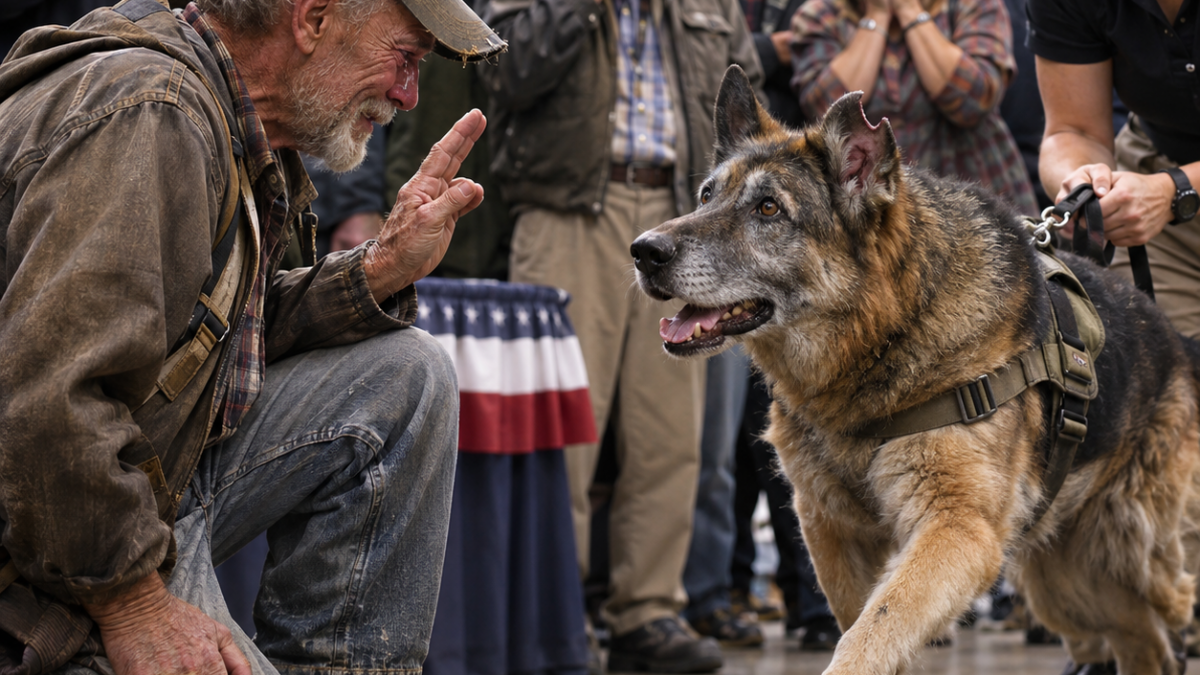
I stared at the screen until my eyes burned.
Her dark sable coat had faded around the muzzle. Her hips looked narrower. The white-gray patch on her chest was brighter.
But her amber eyes were the same.
And so was that torn left ear.
I called the Platte County K9 Center immediately.
A woman named Ruth Hollenbeck confirmed that I was listed in Zara’s old transfer records.
For one beautiful second, I thought that might be enough.
Then she explained the adoption requirements.
Senior veterinary evaluations.
Orthopedic care.
Medication planning.
Legal transfer documents.
Follow-up monitoring.
A required medical transfer package totaling $4,500.
I looked at the three envelopes on my kitchen table.
Gas money.
Groceries.
Emergency cash.
Together, they held about eight hundred dollars.
“I don’t have that kind of money,” I admitted.
Ruth was kind, but honest.
Another applicant, a nonprofit organization from Omaha, already had full funding, trained staff, and veterinary support.
They could provide Zara with everything I couldn’t.
I thanked Ruth and hung up.
Then I sat at that kitchen table for nearly an hour, staring at the photograph of the dog I’d spent six years trying not to miss.
By Friday, I’d sold my father’s watch, an old folding knife, silver cufflinks, and a power saw.
My neighbor Edna Pike had practically forced another two hundred dollars into my pocket.
It still wasn’t enough.
Not even close.
But Saturday morning, I drove to the agricultural exhibition hall anyway.
I told myself I only wanted to see her.
Maybe she’d remember me.
Maybe she wouldn’t.
Maybe all I would get was one final goodbye.
Inside the hall, I met Martin Voss, the official responsible for making sure the retired dogs went to suitable homes.
He reviewed my paperwork and looked at my knee brace.
“Mr. Crane, a previous relationship doesn’t automatically make you the right adopter.”
“I understand.”
“Zara has arthritis. She needs consistent veterinary care, medication, a safe home, and someone physically capable of managing her.”
“I know.”
He studied my financial information.
“And frankly, you don’t have the resources of the other applicant.”
I swallowed.
“No, sir.”
“Then what exactly are you asking us to consider?”
I looked toward the partition where Zara was waiting.
“I’m asking you not to mistake being poor for being careless.”
Martin said nothing.
At noon, they finally brought her out.
An older German Shepherd walked slowly beside a young female handler.
Silver around her muzzle.
A white patch on her chest.
And that little V-shaped tear in her left ear.
My throat closed.
“Zara,” I whispered.
She looked across the room.
Her gaze passed over me.
She didn’t stop.
She didn’t wag her tail.
She didn’t recognize me.
At least, that’s what I thought.
Then Martin announced that the Omaha organization remained the stronger placement option.
I felt the last of my hope collapse.
I stood, ready to accept the decision, but I couldn’t leave without asking one question.
“Sir, before she goes, could I say goodbye?”
Martin hesitated.
“Only if you don’t upset her.”
“I won’t touch her unless she comes to me.”
He studied me for a long moment.
Then nodded.
“One chance.”
I stepped forward.
My damaged knee buckled as I lowered myself toward the floor.
Zara stood ten steps away.
I raised my left hand.
Closed my fingers into a loose fist.
Lifted my thumb.
The signal we’d used years ago when everything around us was dangerous, and I needed her to know one simple thing.
You’re safe here.
Zara’s ears suddenly snapped toward me.
Her whole body went still.
And then I whispered the two words I hadn’t spoken to her in six years.
“Easy, little thunder.”
FULL STORY CONTINUATION
For the first time that morning, Zara looked directly at me.
Not past me.
Not toward the handler standing beside her.
At me.
Her amber eyes fixed on my raised hand, and something changed in the way she held her head.
I knew that look.
I’d seen it a thousand times before.
It was the expression she wore when she was trying to understand something important without being told twice.
I kept my left hand steady.
My shoulder was trembling.
My injured knee burned.
But I didn’t move.
“That’s it, girl,” I whispered. “Take your time.”
The young handler looked down at Zara.
The leash hung loose between them.
Zara took one step.
Then stopped.
My breath caught.
A second step.
She lifted her nose and tested the air.
I wanted to call her name.
I wanted to reach for her.
I wanted to throw my arms around that gray muzzle and hold on until the six missing years stopped hurting.
But I knew better.
Zara had always hated being rushed.
When we worked together, she’d sometimes pause before entering an unfamiliar room, sorting through sounds and scents I couldn’t detect.
I’d learned to trust those pauses.
So I waited.
Just as I had waited beside her in places where patience meant survival.
Zara took another step.
Then three more.
By now, the room had become so quiet I could hear her nails touching the wooden floor.
Click.
Click.
Click.
She was close enough for me to see the silver hairs around her eyes.
Close enough to notice the stiffness in her shoulders.
Close enough to see that time had changed her body without changing the shape of her face.
I lowered my fist slightly.
She sniffed my knuckles.
Then my wrist.
Then the cuff of my worn flannel jacket.
For one unbearable moment, nothing happened.
She simply stood there, breathing against my hand.
I wondered whether I had been wrong.
Perhaps she was only curious.
Perhaps my voice had reminded her of an old command without bringing back the man who’d once given it.
Six years is a long time for a dog.
Longer than I wanted to admit.
Then her nose moved toward my left knee.
She sniffed the brace beneath my jeans.
Her ears shifted.
A low sound came from her throat.
It wasn’t a growl.
It wasn’t a bark.
It was a rough, uncertain whimper.
My eyes filled.
“Zara?”
She stepped closer.
Then she sat down beside my left boot.
Exactly beside my left boot.
The same position she’d taken beside me for four years.
Not in front.
Not behind.
At my left side.
I stared at her.
My hand fell slowly toward the thick fur beneath her jaw.
I touched her with two fingers.
The old greeting.
Zara leaned into my hand.
And I broke.
There isn’t another way to describe it.
I had spent six years telling myself I was fine.
I’d survived the end of my military career.
I’d survived the surgeries.
I’d survived losing my mother.
I’d survived returning to a house where the only sound at night came from the refrigerator and the wind moving through the cornfields.
But when that old German Shepherd pressed her face into my palm, all the grief I’d kept carefully folded away came loose.
“Oh, girl,” I whispered.
My voice cracked.
“Oh, Zara.”
I bent my head toward hers.
“I’m sorry.”
She leaned her shoulder against my leg.
I closed my eyes.
“I’m so sorry I left you.”
Then she lowered her chin onto the toe of my left boot.
I laughed through my tears.
Because I knew exactly what that meant.
She’d done it whenever she thought I’d been standing too long.
Whenever my attention wandered.
Whenever she wanted me to sit down and stay with her.
“All right,” I whispered.
I shifted awkwardly from my kneeling position until I was sitting on the floor.
My bad leg stretched out in front of me.
Zara stayed against my side.
And for the first time in six years, I wasn’t remembering what it felt like to have her there.
I was feeling it.
Her warmth.
Her breathing.
The weight of her shoulder.
The faint smell of old fur, clean kennel bedding, and the outside air.
I rested my hand against her neck.
She closed her eyes.
I didn’t know whether she remembered everything.
I didn’t need her to.
She remembered enough.
To understand why that moment nearly destroyed me, you have to understand what life had been like before Zara disappeared from it.
I was fifty-two when the Navy finally told me I was finished with operational service.
That wasn’t how they said it, of course.
There were medical evaluations, rehabilitation plans, official recommendations, and carefully worded conversations about long-term physical limitations.
Nobody walked into my hospital room and said, “Crane, your life as you know it is over.”
They didn’t have to.
I saw it in the way the doctors studied my knee.
I heard it in their pauses.
I felt it every morning when I tried to stand.
For most of my adult life, I’d measured myself by what I could do.
Run.
Climb.
Swim.
Carry equipment.
Make decisions while exhausted.
Keep moving when every sensible part of my body wanted to stop.
Then an injury took those things away.
Not all at once.
That would have been easier.
Instead, I lost them one painful limitation at a time.
A little less mobility.
A little less strength.
A little less certainty.
Eventually, even walking through a grocery store became something I had to plan around.
Zara was still fit for duty.
That was the cruelest part.
She wasn’t broken.
She wasn’t finished.
She still had work to do.
And the system that had trained us both couldn’t keep a capable working dog beside a man who was no longer cleared to deploy with her.
I understood that.
I hated it.
But I understood.
When they told me she’d be transferred to another program, I signed the paperwork.
The handler who came to collect her was respectful.
He asked about her habits.
Her feeding schedule.
Her response to noise.
Her preferred commands.
I answered everything.
I told him she didn’t like people reaching over the top of her head.
I told him she slept better when she could see the entrance.
I explained that she’d sometimes refuse food after a sudden change in routine.
I told him about the scar on her left ear.
And I told him she liked the left side.
Always the left.
Then the handler took her leash.
Zara looked at me.
Waiting.
I could have crouched beside her.
I could have touched her face.
I could have given her the old safe signal.
Instead, I stood there like a fool.
I told myself it would be easier for her if I didn’t make a scene.
Maybe I was right.
Maybe I wasn’t.
I’ll never know.
But I remember the moment clearly.
She sat beside the new handler, ears upright, watching me as though expecting an explanation.
I turned and walked away.
She didn’t bark.
She didn’t pull.
She didn’t whine.
She just watched.
For years afterward, that silence followed me.
I could remember gunfire.
I could remember the impact that destroyed my knee.
I could remember waking in a hospital.
But none of those memories returned as often as Zara sitting calmly beside another man, waiting for a command I never gave.
After I left the Navy, I returned to Nebraska.
My mother was already getting sick.
She had lived alone in our old family house for years, refusing every suggestion that she move somewhere easier to maintain.
“Your father built half this porch himself,” she’d remind me.
That wasn’t entirely true.
Dad had built about a quarter of it.
The rest had been repaired by neighbors after storms.
But Mom liked the story, and I stopped correcting her.
When I came home, she stood in the kitchen doorway and looked at the brace on my knee.
Then she looked at my face.
“You look tired, Fletcher.”
I smiled.
“Nice to see you too, Mom.”
She pulled me into a hug.
I hadn’t realized how badly I needed one.
For a while, taking care of her gave my days structure.
Medication.
Doctor appointments.
Groceries.
Cleaning.
Meals.
I found work with the county road maintenance crew.
It wasn’t glamorous, but I liked it.
Roads made sense.
A culvert was blocked, so you cleared it.
A sign was damaged, so you replaced it.
A washout needed repair, so you brought the equipment and fixed what you could.
The work didn’t ask me what I’d lost.
It didn’t ask whether I missed the men I’d served with.
And it didn’t ask why I sometimes woke at two in the morning reaching for a leash that wasn’t there.
My supervisor knew my knee limited certain tasks.
He worked around it when possible.
I did my job.
I paid my bills.
I took care of Mom.
And I tried not to think about Zara.
Then Mom died.
Early spring.
The river was high, and the fields were still brown.
For several days after the funeral, I kept expecting to hear her moving around in the kitchen.
Her slippers against the floor.
The kettle.
Her voice complaining about the weather.
Then the silence became permanent.
I left her curtains hanging.
I kept the chipped ceramic rooster on the windowsill.
I couldn’t bring myself to throw away the church bulletins she’d saved.
And I left her favorite chair exactly where she’d placed it.
People told me time would help.
I suppose it did.
But time doesn’t always heal a wound.
Sometimes it just teaches you how to walk around it.
By the time six years had passed since Zara’s transfer, I had become very good at walking around things.
I woke before sunrise.
Worked.
Came home.
Ate dinner alone.
Watched the news.
Went to bed.
And did it again.
The house sat at the end of a dirt road surrounded by cornfields.
In summer, the stalks stood tall and green.
In autumn, they turned brittle and gold.
The wind made them whisper against one another.
I liked that sound.
It filled the silence without asking anything from me.
But some nights, the house felt so empty that I found myself speaking to the old pickup just to hear another voice.
“Come on, girl,” I’d tell it when the engine struggled.
“Don’t embarrass us both.”
That was my life.
Until the radio mentioned retired working dogs.
I hadn’t been looking for Zara.
At least, that’s what I told myself.
The truth was that I’d searched for her more than once over the years.
Usually late at night.
Sometimes after a particularly bad dream.
Sometimes when I found her old leash in the closet.
But the transfers between programs had made it difficult to determine where she was.
I’d never found anything reliable.
Eventually, I stopped.
Not because I stopped caring.
Because I couldn’t keep opening a door that led nowhere.
Then the local radio announced the Platte County K9 Center’s adoption review.
I almost ignored it.
There were hundreds of working dogs.
Thousands, perhaps, if you counted all the different programs and agencies.
The odds that Zara would be among the dogs listed seemed impossible.
But that night, I took down the little tin box from my closet.
Inside was her old black leash.
Folded carefully.
Beside it lay her fabric name patch.
ZARA.
The stitching was worn.
I ran my thumb across the letters.
“Don’t be stupid, Fletcher,” I muttered.
But the next morning, I found my mother’s laptop.
The thing took so long to start that I considered giving it a proper military funeral.
It froze twice before the adoption website loaded.
I scrolled through the profiles.
A black Labrador with cloudy eyes.
A yellow retriever with a gray muzzle.
An older Belgian Malinois whose description claimed he still had high energy.
I smiled at that.
Some dogs never acknowledge retirement.
Then I reached the bottom of the page.
A name appeared before the photograph finished loading.
Zara.
I stared.
Then her face appeared.
Older.
Thinner.
Silver around the eyes.
But unmistakable.
My hand began shaking.
I enlarged the photograph.
There was the small V-shaped scar on her left ear.
She’d gotten it during training years earlier when she caught the edge against a kennel latch.
Nothing heroic.
Just Zara moving faster than she needed to.
She’d looked personally offended by the accident.
I remembered checking the injury while she sat glaring at the latch as though it had deliberately attacked her.
That memory came back so sharply that I laughed.
Then I stopped.
Because the dog in the photograph was alive.
My dog.
The partner I’d said goodbye to without a proper goodbye.
I must have stared at that screen for twenty minutes.
Finally, I stood and went outside.
The morning air was cold.
Mist hung over the fields.
I walked to the edge of the yard and looked toward the distant road.
Somewhere out there, Zara was waiting for someone to decide where she would spend the rest of her life.
I didn’t know whether she’d remember me.
I didn’t know whether I could afford to care for her.
But for the first time in years, I wanted something badly enough to frighten myself.
Ruth Hollenbeck answered when I called the K9 center.
“Platte County K9 Center. This is Ruth.”
“My name is Fletcher Crane. I’m calling about a German Shepherd named Zara.”
There was a pause.
“Yes, Mr. Crane. We’ve had several inquiries about her.”
“I used to be her handler.”
Another pause.
“What kind of handler?”
“Military. Tactical K9 support. Four years.”
Her voice changed.
“Can I have your full name?”
“Fletcher Michael Crane.”
She asked several verification questions.
I answered.
Then she asked me to hold.
While I waited, I stared at the ceramic rooster on the windowsill.
It had one broken tail feather and an expression that suggested it disapproved of the entire world.
Mom had loved that ridiculous thing.
I wondered what she’d say if she were sitting across from me.
Probably that I should stop staring at the phone like a lovesick teenager.
Ruth returned after several minutes.
“Mr. Crane, I found a record identifying you as Zara’s former handler.”
I closed my eyes.
“Thank you.”
“But I need you to understand something.”
My stomach tightened.
“Go ahead.”
“Zara’s age and medical needs make her placement more complicated than a standard adoption.”
She explained the arthritis.
The stiffness in her hips and shoulder.
The need for ongoing veterinary support.
A quiet home.
Predictable routines.
A handler experienced with working dogs.
I knew every habit she described.
When Ruth mentioned Zara’s sensitivity to metallic noise, I told her about the way Zara’s ears used to react when someone dropped tools onto concrete.
Ruth went quiet.
Then she said, “You really did know her.”
I looked toward the tin box.
“Yes, ma’am.”
She continued explaining the review process.
Then came the number.
Four thousand five hundred dollars.
I sat back.
“I’m sorry. How much?”
“Four thousand five hundred.”
She explained the required medical transfer package.
Senior veterinary examination.
Blood work.
Orthopedic evaluation.
Dental review.
Medication transition.
Liability coverage.
Transfer documentation.
A contribution toward the senior canine care fund.
It wasn’t a sale price.
It represented actual costs associated with placing an elderly working dog.
I understood that.
But understanding didn’t make the number smaller.
“I have eight hundred dollars,” I admitted.
Ruth didn’t interrupt.
I stared at the table.
“That’s what I’ve got.”
She was quiet for a moment.
Then she told me about the Omaha nonprofit.
They already had funding.
Experienced staff.
Veterinary support.
A structured environment for retired working dogs.
A good organization.
A genuinely good organization.
That made everything worse.
I wanted someone to blame.
Some rich collector.
Some arrogant fool who wanted a military dog because he thought it would impress his neighbors.
But that wasn’t what I was facing.
The other applicant had a serious plan.
A plan that might be better for Zara than anything I could offer.
Ruth said I was still welcome to attend the review.
My history with Zara mattered.
But it wouldn’t automatically determine placement.
I thanked her.
Then I hung up.
For a long time, I stared at the three cash envelopes on my table.
One for fuel.
One for groceries.
One for emergencies.
I counted everything twice.
There was less than eight hundred dollars in cash.
A little more in the truck.
Some coins in a jar.
It wasn’t enough.
I opened the tin box again.
This time, I didn’t take out Zara’s leash.
I took out my father’s old wristwatch.
A folding knife.
A pair of silver cufflinks.
Things I had kept because the people who owned them were gone.
I laid them on the table.
I knew what I was about to do.
And I hated it.
The pawn shop owner was named Lyle.
He was a heavy man with tired eyes and the patient expression of someone accustomed to telling people that their valuables weren’t worth what they hoped.
He examined my father’s watch.
“Nice piece,” he said.
I nodded.
“Sentimental?”
“Very.”
He looked up.
“You sure you want to sell it?”
I stared at the scratched face.
Dad had given it to me when I left home.
I’d worn it through training.
Through deployments.
Through years I barely knew how to explain.
Then I’d put it away after he died.
“I need the money.”
Lyle nodded.
He didn’t ask why.
For that, I was grateful.
He examined the knife and cufflinks.
Then the power saw I’d brought from the shed.
He made an offer.
Less than I wanted.
More than I expected.
I accepted.
When I walked back outside, the envelope in my pocket felt heavier.
But the loss did too.
I sat in the truck for a while.
Then I drove to the grocery store.
I found myself standing in the pet-food aisle.
Senior dog food.
Joint-support formulas.
Chicken and rice.
Salmon.
I picked up one bag, read the label, and put it back.
Then I picked up another.
Eventually, I realized I was shopping for a dog I didn’t own.
A dog I might never bring home.
I left without buying anything.
When I reached my house, Edna Pike was waiting on the porch.
She held a covered baking dish.
Her expression told me immediately that she knew something.
Edna was sixty-seven, lived half a mile down the road, and had known me since I was young enough to believe I could teach a barn cat to fetch.
She also believed that most problems could be improved with butter, common sense, or a well-delivered insult.
Sometimes all three.
“You sold your saw,” she announced.
I climbed out of the truck.
“Hello to you too, Edna.”
“Don’t change the subject.”
“I haven’t started a subject.”
“You sold your saw.”
I sighed.
“Apparently.”
“Why?”
“Needed the money.”
“For what?”
“Something personal.”
She narrowed her eyes.
“Medical?”
“No.”
“Taxes?”
“No.”
“Woman?”
I gave her a tired look.
She shrugged.
“At our age, miracles and disasters tend to use the same front door.”
Despite myself, I almost smiled.
She held out the dish.
“Apple cobbler.”
“Thank you.”
“Now tell me what’s wrong.”
I looked at her.
“Edna—”
“Fletcher Michael Crane, I’ve known you since you were a boy. Don’t start pretending you’re mysterious.”
I could have walked inside.
Could have thanked her for the cobbler.
Could have shut the door.
But something about standing there with my father’s watch gone and Zara’s photograph waiting on the laptop made me too tired to lie.
So I told her.
Not everything.
Not the details of our missions.
But enough.
Zara.
The transfer.
The six missing years.
The adoption listing.
The medical costs.
The Omaha organization.
And the fact that I was planning to attend the review even though I knew I couldn’t afford to take her home.
Edna listened without interrupting.
When I finished, she stared toward the cornfields.
Then she said, “Well, that’s inconvenient.”
I blinked.
“Inconvenient?”
“Yes. I was planning to mind my own business this week.”
I shook my head.
“Edna, I don’t need—”
“Don’t finish that sentence.”
I stopped.
She stepped closer.
“When a man’s truck gets stuck in the mud, he calls half the county for help. But when his heart gets stuck, suddenly it’s private property.”
I looked away.
She softened.
“Fletcher, you need to go Saturday.”
“I’m going.”
“And you need to let them know what that dog means to you.”
“I intend to.”
She studied me.
Then she asked the question I’d been avoiding.
“What if she doesn’t remember?”
I swallowed.
“That would be hard.”
“Yes,” Edna said.
No false reassurance.
No promise that everything would work out.
Just honesty.
Then she continued.
“But staying here and wondering forever would be harder.”
I looked toward the house.
She reached into her cardigan pocket.
Before I understood what she was doing, she pushed an envelope into my hand.
“Two hundred dollars.”
I stared.
“Edna, no.”
“Church bake sale.”
“Then give it back to the church.”
“I am the church on Tuesdays.”
I almost laughed.
“I’m not taking your money.”
She shoved the envelope into my jacket pocket.
“Too late.”
“Edna.”
“If you give it back, I’ll tell everyone you’re stealing from elderly women.”
“You’re impossible.”
“That’s why I’ve survived this long.”
I looked at the envelope.
Then at her.
“Thank you.”
She patted my arm.
“Go get your girl, Fletcher.”
I swallowed.
“I’ll try.”
Saturday morning came cold and gray.
I barely slept.
My knee ached before I even got out of bed.
I sat on the edge of the mattress, tightening the brace and staring at my work boots.
The money was in one envelope.
The documents Ruth had requested were in a folder.
Proof of employment.
Proof of address.
Pictures of my fenced yard.
Contact information for the Platte River Veterinary Clinic.
A note from my supervisor confirming that I could come home during midday breaks when necessary.
I’d made every preparation I could think of.
Still, the thing I feared most couldn’t be addressed with paperwork.
What if Zara looked at me and saw a stranger?
I stood.
Walked to the closet.
Opened the tin box.
The old leash lay inside.
Beside it was her name patch.
I picked up the patch.
Held it for a moment.
Then slipped it into my jacket pocket.
“Let’s see what happens,” I told the empty house.
The drive to the agricultural exhibition hall took longer than usual.
Not because of traffic.
Because I kept stopping myself from turning around.
Every mile brought me closer to the possibility of losing Zara again.
That was the trouble with hope.
Once you allowed it into your life, it made everything more dangerous.
At the exhibition hall, I parked beside a row of pickups.
Families were arriving.
Older couples.
Veterans.
Volunteers.
People carrying folders and coffee.
I sat behind the steering wheel until my knee began aching from the position.
Then I got out.
The hall smelled of straw, damp jackets, coffee, and the unmistakable scent of dogs.
For a moment, I stood just inside the entrance.
Then a woman approached.
Silver hair.
Reading glasses hanging from a cord.
A quilted vest bearing the K9 center logo.
“Mr. Crane?”
“Yes, ma’am.”
“Ruth Hollenbeck.”
We shook hands.
She looked at my folder.
“You brought the paperwork?”
“Yes.”
She opened it.
Read through the documents.
Studied the photographs of my yard.
Then looked at me again.
“You took this seriously.”
“I said I would.”
“I know.”
She closed the folder.
“Come with me. I’d like you to meet Martin.”
Martin Voss looked like a man who trusted paper more than people.
I don’t say that as an insult.
I’ve known men like him.
Some were excellent officers.
Others were unbearable.
Martin was somewhere in the middle.
He wore a black windbreaker with the K9 center logo and carried a clipboard covered in notes.
His handshake was firm.
His expression was guarded.
“Mr. Crane.”
“Sir.”
“Ruth verified your name in Zara’s old records.”
“Yes.”
“That matters.”
I nodded.
“But I want to be clear. It doesn’t automatically make you the best placement.”
“I understand.”
He studied my knee.
“Can you manage a large dog safely?”
“Most days.”
His pen moved.
I could practically hear the concern being recorded.
I added, “She’s eleven years old. She doesn’t need long runs anymore. She needs quiet walks, a stable routine, and a home where she can rest.”
Martin looked up.
“Her arthritis requires ongoing management.”
“I know.”
“And a sudden increase in veterinary expenses?”
I swallowed.
“I’d need a plan.”
He waited.
I continued.
“I’ve spoken with Dr. Malloy at the Platte River Veterinary Clinic. Edna Pike can help if I’m delayed. My yard is fenced. I can come home at lunch.”
Martin studied me.
Then he asked, “And the money?”
I looked directly at him.
“I don’t have the full amount.”
He nodded.
“Then we have a problem.”
“Yes.”
He looked down at the file.
“I’ve seen emotional adoptions go badly, Mr. Crane. Good intentions aren’t enough when a dog gets sick.”
I felt heat rise in my neck.
Not because he was wrong.
Because he was right.
And sometimes the truth hurts most when it comes from someone you wish would stop saying it.
He continued.
“Zara’s care can’t depend entirely on sentiment.”
I took a breath.
“I’m not asking you to ignore her needs.”
“Then what are you asking?”
I looked toward the area where the retired dogs were being held.
“I’m asking you not to mistake poor for careless.”
For a moment, Martin stopped writing.
Ruth glanced at me.
Then Martin said, “We’ll consider everything.”
I nodded.
That was all I could ask.
But I walked away knowing the decision would not be easy.
A young volunteer nearly collided with me ten minutes later.
She wore a mustard-colored hoodie beneath a denim jacket and had a camera bouncing against her chest.
A stack of programs slid from her arms.
I caught one before it reached the floor.
“Oh, thank goodness,” she said.
She looked at me.
“Nice reflexes.”
“Old habit.”
She smiled.
“I’m Chloe Marsh. Photographer, volunteer, and apparently a danger to organized events.”
I handed her the program.
“Fletcher Crane.”
Her expression changed.
“Oh. You’re Zara’s former handler.”
I hesitated.
“Yes.”
She looked toward the dog area.
“That’s a big day.”
I nodded.
“Could be.”
She studied me for a moment.
Then she said, “I hope it goes well.”
“Thank you.”
She hurried away.
Two steps later, her shoe caught an electrical cable.
She stumbled.
Recovered.
And turned bright red.
“That,” she announced, “will not appear in the official event photographs.”
I laughed.
A real laugh.
It surprised me.
It had been a long time since one came so easily.
Before the review began, Ruth took me into a small office.
Martin was there.
A phone sat in the middle of the desk.
“Mr. Crane,” Ruth said, “we’ve arranged a verification call.”
“With whom?”
“Caleb Raines.”
I stared.
“Doc Raines?”
“Yes.”
I hadn’t heard that name in years.
Caleb had served as a Navy corpsman near our unit.
A good man.
Dry sense of humor.
The kind of person who could treat an injury while insulting your intelligence and somehow make you feel better.
Ruth pressed the speaker button.
A gravelly voice answered.
“This is Caleb Raines.”
“Mr. Raines, thank you for speaking with us. Fletcher Crane is here.”
There was a pause.
Then the voice changed.
“Well, I’ll be damned. Crane, you’re still alive?”
I looked at the phone.
“Most mornings.”
“Good. Navy standards haven’t collapsed completely.”
I laughed.
Ruth smiled faintly.
Then she asked whether Caleb could confirm my relationship with Zara.
“Absolutely,” he said.
He explained that I’d been Zara’s handler for four years.
Daily training.
Operational work.
Care.
Recovery.
Signals.
Routine.
Martin asked whether the relationship had been strictly professional.
Caleb gave a dry laugh.
“Son, you ever worked beside a dog who knows you’re scared before you do?”
Martin didn’t answer.
Caleb continued.
“Zara knew Crane. And Crane knew Zara. They could read one another without much noise.”
My throat tightened.
He spoke about the injury.
The transfer.
The fact that Zara had remained fit for duty.
Then he said something I hadn’t expected.
“Fletcher didn’t abandon that dog.”
I turned toward the wall.
I didn’t want anyone seeing my face.
Caleb continued.
“He got hurt. She was still needed. That’s how the system worked.”
Silence settled over the office.
Then Caleb said, “Crane, you listening?”
“Yes.”
“You go into that review standing straight.”
I stared at the phone.
“Doc—”
“You hear me?”
“Yes.”
“Dogs don’t care how much money you’ve got in your pocket. People do. Don’t make their job easier by acting like you’re already beaten.”
I closed my eyes.
“Understood.”
“Good.”
The call ended.
For a long moment, nobody spoke.
Then Ruth quietly closed her folder.
“Shall we?”
I nodded.
“Let’s do it.”
The review began at ten.
Ruth stood at the front of the hall and explained how the process worked.
These weren’t ordinary pets coming from ordinary homes.
They were retired working dogs.
Some had served in military programs.
Others had worked in specialized support roles.
Many carried habits formed through years of training.
Some needed experienced handlers.
Some needed quiet homes.
Some had medical conditions requiring regular care.
The purpose of the event wasn’t to create emotional scenes.
It was to find suitable placements.
I respected that.
Even while I wished desperately that the rules could somehow become easier.
A black Labrador appeared first.
Then a yellow retriever.
Then an older Malinois who looked offended by the entire proceedings.
People smiled.
Volunteers answered questions.
Medical histories were explained.
I listened.
But my attention kept drifting toward the side door.
I knew Zara was somewhere behind it.
And every minute felt like an hour.
Near the front sat an elderly veteran wearing a black Vietnam cap.
His name, I learned later, was Dawson Fike.
He had a carved wooden cane with the image of a running dog near the handle.
He watched the proceedings without speaking.
Now and then, his thumb moved over the carving.
I noticed because I was looking for anything that might distract me from the waiting.
At the opposite side of the room stood a man in a charcoal blazer.
He carried a black leather folder.
A small silver paw-print pin gleamed on his lapel.
Preston Cole.
The representative from the Omaha nonprofit.
The man whose organization could give Zara the care I couldn’t afford.
I wanted to dislike him.
I really did.
But the moment I heard him speak, that became difficult.
He asked sensible questions.
Medication.
Transition stress.
Veterinary support.
Noise tolerance.
He listened carefully.
He treated the dogs as living beings rather than useful possessions.
When our eyes met, he nodded respectfully.
I nodded back.
That was all.
Two men who wanted what they believed was best for the same dog.
Neither of us had come to hurt her.
Which made everything harder.
At noon, Ruth announced the final dog.
“Because of her age and sensitivity to stress, we’ve kept her in a quiet room until now.”
My hands closed around the edge of my chair.
She looked toward the side entrance.
“This is Zara.”
The door opened.
A young female handler stepped through.
Beside her walked an older German Shepherd.
I forgot how to breathe.
Zara’s coat was darker than I’d expected, though silver had gathered around her muzzle and cheeks.
Her hips looked narrower.
She moved carefully.
Not weakly.
Not helplessly.
Just with the deliberate pace of an animal who had learned that her joints no longer tolerated unnecessary movement.
Her ears were still upright.
Her eyes still amber.
And the small V-shaped tear remained on the edge of her left ear.
I felt tears rise.
Six years.
Six years of wondering.
Six years of reaching for a leash that wasn’t there.
Six years of looking at an empty space beside my left boot.
And now she was walking across a wooden floor twenty feet away.
Alive.
Older.
Real.
I wanted to stand.
My knee wouldn’t cooperate.
Then she looked toward me.
For one heartbeat, I thought she’d recognized me.
But her gaze moved on.
She sat beside her handler.
Calm.
Professional.
Waiting.
The disappointment hit so sharply I almost bent forward.
Maybe I’d been foolish.
Maybe six years had erased everything.
Maybe Zara had moved on because she’d needed to.
And maybe I was the only one still living in the past.
Ruth began explaining her medical needs.
Arthritis in both hips.
Stiffness in the left shoulder.
A preference for quiet surroundings.
Sensitivity to metallic noise.
Difficulty adjusting to sudden changes in routine.
I knew all of it.
But I also knew there were things the file couldn’t explain.
Things learned through thousands of small moments.
Where she preferred to sleep.
How she reacted to storms.
Why she liked her food bowl positioned away from doorways.
The way she lowered her chin onto my left boot when she wanted me to sit.
Those details lived in me.
Not because I was a better person than anyone else in that room.
Because I’d been there.
I’d spent years learning them.
And she had spent years teaching me.
Preston Cole presented his organization’s plan first.
It was excellent.
I hated how excellent it was.
A quiet transition suite.
Veterinary support.
Experienced staff.
Controlled introductions.
Emergency medical funding.
A plan to allow Zara to rest before considering whether she could participate in any supportive activities with veterans.
And if she couldn’t?
She would remain in their care.
No punishment.
No forced work.
Just a safe retirement.
I sat listening with my hands folded.
Every point made sense.
Every answer demonstrated preparation.
I couldn’t compete with it.
When Preston finished, several people nodded approvingly.
Martin looked satisfied.
Ruth seemed moved.
Then she turned toward me.
“Mr. Crane, would you like to speak?”
I stood slowly.
My knee protested.
I gripped the chair for balance.
The room grew quiet.
I looked at Preston.
Then at Ruth.
Then at Martin.
Finally, I looked toward Zara.
“I don’t have a facility,” I began.
My voice sounded rough.
“I don’t have a staff. I don’t have a veterinary partner available twice a week.”
I paused.
“I’ve got an old house at the end of a dirt road. A fenced yard. A steady job fixing county roads. And a neighbor who threatens people with cobbler.”
A few people laughed.
I smiled faintly.
Then I continued.
“I’m not here to tell you I can offer more than Mr. Cole’s organization.”
I looked directly at Preston.
“On paper, I can’t.”
He lowered his eyes.
I turned toward Martin.
“You’re right to worry about Zara’s medical needs.”
He listened.
“You’re right to ask whether I can afford an emergency veterinary bill. You’re right to ask about my knee.”
I swallowed.
“I don’t resent any of that.”
Then I looked toward Zara.
“She worked beside me for four years.”
My throat tightened.
“She did everything we asked. Crossed water. Moved through mud. Slept on hard ground. Worked in weather that made grown men question their choices.”
I paused.
“And when I got hurt, she kept working because that was what she was supposed to do.”
Zara’s ears shifted slightly.
I kept going.
“I’m not asking for another working dog.”
My voice broke.
“I’m asking for the chance to give an old friend a place where nobody needs her to prove she’s useful anymore.”
The room was silent.
“A place where she can sleep when she’s tired.”
I looked at Martin.
“A place where she can take her time getting up.”
Then I looked at Zara.
“A place where she can choose where to lie down.”
My eyes burned.
“And if you decide another home is better, I’ll accept it.”
I swallowed.
“Because what’s best for Zara matters more than what hurts me least.”
Then I sat down.
My hands were trembling.
I kept them folded in my lap.
For several seconds, nobody spoke.
Then Martin looked at the paperwork.
“Mr. Crane, we appreciate your history with Zara.”
I nodded.
“But at this stage, the Omaha organization remains the stronger formal placement.”
There it was.
The answer I’d expected.
The answer I’d spent three days trying to prepare myself to hear.
I looked at Preston.
He wasn’t smiling.
I looked at Ruth.
Her expression was kind, but serious.
Then I looked at Zara.
She sat quietly beside the handler.
Waiting.
And something inside me settled.
I couldn’t change the facts.
I couldn’t invent money.
I couldn’t make my knee stronger.
I couldn’t turn my old house into a professional care facility.
But I could ask for one thing.
One last thing.
“Sir?”
Martin looked up.
“Yes?”
“Before she leaves, would you let me greet her?”
He hesitated.
“That could cause agitation.”
“I won’t crowd her.”
I reached into my pocket.
My fingers closed around the old name patch.
“I just want to give her the safe signal we used to use.”
Martin studied me.
I continued.
“If she doesn’t respond, I’ll step back.”
He looked at Ruth.
Then at the handler.
Finally, he nodded.
“One time.”
I swallowed.
“Thank you.”
And I walked toward the open space in front of Zara.
The old signal hadn’t been designed to make a dog perform.
It wasn’t a dramatic command.
It was something Zara and I had developed through repetition.
A small gesture that meant we weren’t moving yet.
That she could settle.
That I was with her.
A loose fist.
Thumb raised.
No urgency.
No pressure.
Just safety.
I stopped about ten steps away.
The handler kept Zara’s leash loose.
I lowered myself carefully.
My bad knee flared with pain.
I shifted my weight.
Rested one hand against the floor.
Then raised the other.
The old signal.
For a moment, Zara did nothing.
Then her ears moved.
I whispered, “Easy.”
Her head lifted.
“Easy, little thunder.”
She froze.
Not completely.
Not like an animal in a movie suddenly recognizing a long-lost owner from a mile away.
It was subtler.
Her weight shifted.
Her nose lifted.
Her eyes focused.
Then she took one step.
I stopped breathing.
Another step.
Then a pause.
She was working it out.
I could see that.
The dog I remembered had always been careful.
Always deliberate when something mattered.
I kept my hand still.
She moved closer.
Sniffed my knuckles.
My wrist.
My jacket.
Then my knee.
She made that low, broken sound.
And sat beside my left boot.
The entire room seemed to hold its breath.
I touched the underside of her jaw.
Her eyes softened.
Then she leaned against my leg.
And everything I’d spent six years trying not to feel came pouring out.
I don’t know how long I sat on that floor before I noticed the people around us again.
Later, someone told me it was about seven minutes.
Seven minutes.
It felt like a lifetime.
Zara stayed pressed against my side.
I stroked her neck.
Sometimes I spoke to her.
Sometimes I couldn’t.
I remember whispering her name.
I remember apologizing.
I remember telling her she was a good girl.
And I remember feeling the warmth of her body against me.
The ordinary warmth of a living dog.
It sounds like such a small thing.
But when you’ve spent six years touching an old leash instead of the animal who wore it, that warmth becomes almost impossible to describe.
The young handler gave a gentle recall cue.
“Zara.”
Her ears moved.
She didn’t stand.
The handler tried again.
Zara shifted slightly.
Then leaned more firmly against me.
I looked toward the handler.
“I’m sorry.”
She shook her head.
Her eyes were wet.
“Don’t be.”
I lowered my gaze.
Zara rested her chin near my boot.
From the front row, someone moved.
The old Vietnam veteran stood slowly, leaning on his carved cane.
Dawson Fike.
He looked at Martin.
Then at Ruth.
Then at Zara.
“The dog has given her testimony,” he said.
A few people laughed softly.
But nobody dismissed what he’d said.
Because everyone could see it.
Zara wasn’t pulling away.
She wasn’t showing the frantic excitement of a young dog.
She wasn’t leaping or barking.
She was simply sitting beside me.
Exactly where she’d always sat.
And for reasons I couldn’t explain without crying again, that quiet choice meant more than any dramatic reunion could have.
I looked at her.
Older.
Silver.
Stiff.
Still beautiful.
Still Zara.
I rested my forehead close to hers.
“You remembered,” I whispered.
She breathed against my cheek.
And for the first time in six years, I stopped wondering whether the last thing she’d remembered about me was my back disappearing through a doorway.
A shadow fell across the floor.
I looked up.
Preston Cole stood a few feet away.
His leather folder hung at his side.
He looked at Zara.
Then at me.
Then toward Ruth and Martin.
“My organization is withdrawing its application for Zara,” he said.
I stared at him.
Martin straightened.
“Preston, you don’t need to make that decision immediately.”
“I know.”
“Your organization has the strongest formal care plan.”
“I know that too.”
Preston crouched carefully, leaving Zara plenty of space.
She looked at him.
He offered his hand.
She sniffed it politely.
Then she turned back toward me.
Preston smiled sadly.
“I think she’s made her preference fairly clear.”
I swallowed.
“Sir, I don’t want you to—”
He raised a hand.
“Let me explain.”
I nodded.
He looked toward the crowd.
“My father was an Army medic.”
His voice softened.
“When he came home, he struggled. There were nights when none of us knew how to reach him.”
I listened.
“Then a therapy dog named Henry came into his life.”
Preston smiled faintly.
“Old yellow dog. Terrible breath. One ear looked like folded laundry.”
A few people laughed.
“He stayed with my father through nights the rest of us couldn’t understand.”
Preston looked at Zara.
“That’s why I helped build our program.”
He paused.
“Because I know how much these dogs can mean.”
Then he looked directly at me.
“But Zara isn’t simply a program candidate.”
My throat tightened.
“She’s a retired dog with a history, preferences, and people she remembers.”
He glanced at her.
“And after seeing this, I don’t think our organization needs to compete for her placement.”
I stared.
“You’re sure?”
He nodded.
“Our program needs dogs who can adjust to new people and new routines. Zara has shown us something important about where she feels comfortable.”
I looked down at her.
She had settled against my leg.
Preston continued.
“That doesn’t solve the medical questions.”
I nodded.
“I know.”
“But it changes what we’re trying to accomplish.”
He stood.
“I’d rather help her retire somewhere she’s comfortable than insist she enter our facility simply because we can afford it.”
I swallowed hard.
“Thank you.”
He shook his head.
“Don’t thank me yet. We still need a responsible care plan.”
I looked toward Martin.
His expression remained serious.
And I knew the hard part wasn’t over.
Martin stepped forward.
“I respect the emotional significance of this reunion.”
I nodded.
“But we are not going to complete a transfer based solely on what happened in this room.”
The familiar shame returned.
I looked down at the envelope in my pocket.
He continued.
“Zara’s medical package remains necessary. Her ongoing care remains necessary. The legal review remains necessary.”
“I understand.”
“Her arthritis isn’t going to disappear because she’s happy to see you.”
“I know.”
“And your knee isn’t going to improve simply because you want to care for her.”
I lowered my eyes.
He was right.
Again.
That was the hardest thing about Martin.
He kept saying things that were true.
I reached into my jacket.
Pulled out the envelope.
Held it toward Ruth.
“This is what I have.”
She looked at it.
I swallowed.
“It’s not enough. I know that.”
Nobody spoke.
I continued.
“But it’s yours if it’ll help Zara, regardless of where she goes.”
Ruth’s expression changed.
I looked at her.
“If you decide I can’t take her home, use it for her care.”
My voice broke.
“I just want her looked after.”
Zara shifted beside me.
Her shoulder pressed against my leg.
I looked down.
“It’s all right, girl.”
But it wasn’t.
Not yet.
I could feel the old loss opening beneath my feet.
I had found her.
She remembered me.
She wanted to stay beside me.
And I still might have to leave without her.
For a moment, I wished I’d never come.
Because now I knew what I would be losing.
Not a memory.
Not a photograph.
Her.
Again.
Then a wooden cane struck the floor.
Once.
Sharp enough to make everyone turn.
Dawson Fike stepped forward.
He took out an old leather wallet.
Opened it.
Counted several folded bills.
And placed them beside the donation jar.
“I had a dog in Vietnam,” he said.
The room quieted.
I looked up.
Dawson rested both hands on his cane.
“Not an official working dog. Just a stray who started following our unit.”
His voice was rough.
“We called him Bishop.”
He smiled faintly.
“Ugly little thing. Smart, though.”
Nobody interrupted.
“One night, he warned us something was wrong. Saved three men.”
Dawson looked down.
“I came home.”
His voice tightened.
“Bishop didn’t.”
I stared at him.
He rubbed his thumb across the carving on his cane.
“I’ve carried that for a long time.”
Then he looked at Martin.
“I can’t go back for Bishop.”
He nodded toward Zara.
“But maybe I can help this old girl finish her road.”
My eyes filled.
“Sir—”
Dawson shook his head.
“No speeches, son.”
He looked at the money.
“Just use it properly.”
Then he walked back toward his chair.
I stared after him.
For the second time that day, I found myself unable to speak.
Before Martin could respond, a familiar voice rang from the back of the hall.
“Don’t you dare close that folder yet, Martin Voss!”
I turned.
Edna Pike was marching toward us.
Her red-brown scarf bounced against her coat.
A canvas bag hung over one arm.
Behind her came a teenage boy carrying two pie boxes and looking deeply concerned about his life choices.
“Edna?”
She ignored me.
Walked straight to the front table.
Pulled another envelope from her bag.
And placed it beside Dawson’s money.
“Church bake sale,” she announced.
Ruth stared.
“Mrs. Pike?”
“Pie raffle. Emergency cobbler fund. A few donations from people with more sense than Fletcher.”
I closed my eyes.
“Edna.”
She pointed at me.
“Don’t start.”
The teenage boy shifted the pie boxes.
Edna turned sharply.
“Keep those level!”
He straightened.
“Yes, ma’am.”
She looked back at Martin.
“I live half a mile from Fletcher.”
Martin blinked.
“Yes?”
“He has a fenced yard. His mother trusted me with a spare key. I can check on Zara when he’s working.”
I tried again.
“Edna—”
“Fletcher, I have known you since you were a boy who thought barn cats could be trained like soldiers. Please stop interrupting me.”
A few people laughed.
She continued.
“He’s stubborn. He forgets to ask for help. And he thinks suffering quietly is some kind of personality achievement.”
I stared at the floor.
“But he takes care of what matters.”
Her voice softened.
“I watched him care for his mother for years.”
I looked up.
Edna’s eyes were wet.
“I watched him come home from work exhausted and still sit with her until she fell asleep.”
She turned toward Martin.
“You want to know whether he’ll take care of that dog?”
Martin said nothing.
Edna pointed toward me.
“He will.”
Then she added, “But he won’t have to do it alone.”
The words hit me harder than I expected.
Because I’d spent so many years believing that needing help was the same as being unable to do my duty.
Edna looked at me.
“This isn’t just your problem, Fletcher.”
I lowered my eyes.
“It’s Zara’s life,” she continued. “If we’re all so moved by what’s happened, let’s stop admiring the sadness and start figuring out how to help her.”
For a moment, the room was completely silent.
Then Chloe Marsh looked down at her phone.
“Oh,” she whispered.
Ruth turned.
“What?”
Chloe stared at the screen.
“Oh, wow.”
Martin frowned.
“Chloe?”
She looked up.
“I posted the reunion video on the local community page.”
My stomach tightened.
“You did what?”
She looked apologetic.
“Just the part where Zara recognized you. I didn’t use your name in the caption. I said a retired K9 had recognized her former handler and needed a senior-care sponsorship.”
I stared.
“Why?”
“Because people should know.”
Her phone vibrated.
Then again.
Then several times in quick succession.
She looked down.
“People are asking how to help.”
Ruth’s office phone began ringing.
Then Martin’s.
A volunteer hurried toward the table.
“Someone from the local feed store is on the line.”
Another phone rang.
The room suddenly became busy.
Not chaotic.
Purposeful.
People moved toward the donation table.
Ruth began writing numbers.
Martin answered a call.
Chloe spoke rapidly with a volunteer about how to direct people to the center’s official sponsorship process.
And I sat on the floor with Zara beside me, watching strangers begin doing something I hadn’t known how to ask for.
They were building a plan.
The next half hour passed in a blur.
I remember pieces.
Ruth answering the phone.
Someone bringing another legal pad.
The teenage boy with the pies being told to stop standing in front of the donation jar.
Dawson sitting quietly with both hands resting on his cane.
Preston speaking into his phone near the far wall.
And Zara.
Always Zara.
She stayed close.
When someone approached, she lifted her head.
When the room became noisy, her ears moved.
But she remained against my leg.
I stroked her neck and tried to understand what was happening.
Martin ended a phone call.
He looked toward Ruth.
“Dr. Malloy is offering the first year of wellness examinations.”
I stared.
“What?”
Martin looked at me.
“The veterinarian you contacted.”
I nodded slowly.
“He’s also discussing reduced-cost blood work through the senior canine fund.”
My mouth went dry.
“Why?”
Martin gave me a look I couldn’t quite read.
“Apparently he saw the video.”
Ruth wrote something down.
Then Preston returned.
“Our organization will cover Zara’s initial orthopedic assessment and medication transition.”
I looked at him.
“Sir, you don’t have to do that.”
He nodded.
“I know.”
“But your organization was supposed to—”
He interrupted gently.
“Mr. Crane, helping retired working dogs is what our organization exists to do.”
I swallowed.
He continued.
“We can help Zara without placing her in our facility.”
I stared at him.
He smiled.
“Seems like the right use of our resources.”
I had no answer.
Then another volunteer approached.
“The feed store owner says he’ll donate six months of senior dog food.”
Ruth nodded and wrote it down.
A local carpenter offered to build a ramp for my porch at cost.
Other people pledged money toward the medical package through the center.
Chloe’s phone kept vibrating.
I watched Ruth add the figures.
Then subtract.
Then add again.
I was afraid to hope.
Every time someone announced another contribution, I felt the same strange mixture of gratitude and fear.
What if the money still wasn’t enough?
What if the donations weren’t confirmed?
What if Martin found another reason the placement couldn’t proceed?
What if all this kindness created expectations nobody could actually fulfill?
I didn’t want Zara to become the center of a spectacle that ended with everyone feeling good for an afternoon and nobody responsible for her care afterward.
That was why Martin mattered.
As much as I disliked hearing his questions, I needed him to keep asking them.
Because Zara couldn’t live on applause.
She needed food.
Medication.
Veterinary care.
A safe home.
And a plan that would still exist after the crowd went home.
Finally, Ruth looked toward Martin.
“We have confirmed commitments for the medical transfer package.”
My heart stopped.
Martin studied the figures.
He checked several notes.
Then he looked at the phone messages.
“Some contributions still need to be documented.”
Ruth nodded.
“They’re being documented.”
He glanced at Preston.
“Your organization’s commitment?”
“In writing within the hour.”
“Veterinary support?”
“Dr. Malloy’s office is preparing confirmation.”
Martin looked toward Edna.
“And secondary care?”
Edna folded her arms.
“I told you. I’m available.”
He sighed.
“I need more than verbal reassurance.”
“Then give me a form.”
A few people laughed.
Martin looked at the paperwork again.
Then he turned toward me.
“Mr. Crane.”
I looked up.
“Yes, sir.”
“There are conditions.”
I felt my pulse hammer.
“I understand.”
“A veterinary examination within ten days of placement.”
“Yes.”
“Monthly reports from Dr. Malloy during the first three months.”
“Yes.”
“A six-month follow-up agreement.”
“Yes.”
“A home inspection before release.”
“Yes.”
“Your porch ramp must be installed within thirty days.”
“Yes.”
“Zara will not participate in public demonstrations, organized support sessions, or similar activities without approval from the center during the transition.”
I looked at him.
“Sir, I don’t want her doing any of that.”
Martin studied me.
I continued.
“She’s retired.”
He nodded.
“That’s the point.”
I swallowed.
He glanced toward Edna.
“Mrs. Pike will be listed as secondary local support.”
Edna straightened.
“Excellent. Put me down as queen of emergency cobbler and canine supervision.”
Martin stared at her.
“Our forms don’t have that box.”
“Then your forms lack imagination.”
The room laughed.
Even Martin’s mouth twitched.
Then Ruth turned toward me.
“Fletcher.”
I looked at her.
She had stopped calling me Mr. Crane.
“This isn’t charity replacing responsibility.”
I nodded.
“I know.”
“Your eight hundred dollars will go toward the transfer fund.”
“Yes, ma’am.”
“You will attend every appointment.”
“Yes.”
“And if Zara’s needs become more than you can manage, you will tell us.”
I looked down at Zara.
Her eyes were half-closed.
Not sleeping.
Just resting.
For the first time since entering the hall, she looked comfortable.
I stroked the side of her neck.
Then looked back at Ruth.
“I will.”
She studied me.
“Promise?”
My throat tightened.
“Yes, ma’am.”
Martin closed his clipboard.
Then he said the words I had barely dared imagine hearing.
“Pending completion of the documented requirements, we can approve Zara’s placement with you.”
I stared.
“What?”
Ruth smiled.
“Fletcher, we’re going to finish the paperwork.”
I looked from her to Martin.
Then to Preston.
Then Edna.
Then Dawson.
Then Chloe.
Finally, I looked down at Zara.
My hand was trembling so badly I could barely touch her.
“Girl,” I whispered.
My voice broke.
“I think you’re coming home.”
I had spent years in places where people shouted orders because they needed everyone to move quickly.
The exhibition hall that afternoon was the opposite.
Nobody hurried.
Martin checked every document.
Ruth confirmed the sponsorships.
Preston submitted his organization’s commitment.
Dr. Malloy’s office confirmed the veterinary arrangements.
The volunteers recorded donations.
Edna signed the secondary support paperwork while complaining that the form asked too many questions.
The process took time.
I was grateful for that.
For once, I didn’t want anyone making a rushed decision on my behalf.
I wanted Zara protected.
Properly.
Permanently.
I wanted every person in that room to know exactly what we were agreeing to.
I had spent six years regretting one set of transfer papers.
I wasn’t going to sign another set without understanding every line.
Martin explained the follow-up schedule.
I asked questions.
Ruth reviewed Zara’s medical information.
Preston discussed the initial orthopedic assessment.
Edna wanted to know whether she needed special instructions for giving medication.
The young handler told us Zara sometimes took longer to settle after a change in environment.
I listened carefully.
Then I asked about her food bowl.
The handler looked surprised.
“What about it?”
“She still like it away from the door?”
The young woman smiled.
“Yes.”
I nodded.
“Thought so.”
Zara had always been particular about that.
Years earlier, after moving between staging areas, she’d refused dinner.
I tried everything.
Different food.
A quieter spot.
More time.
Nothing worked.
Then I moved her bowl a few feet away from the entrance so she could watch the doorway while eating.
She finished every bite.
Afterward, she looked at me as though I should have known better from the beginning.
I smiled at the memory.
Then I looked down at the old dog beside me.
Some things hadn’t changed.
When the last form was completed, Ruth approached us holding a black leash.
The young handler stood beside her.
Zara rose slowly.
Her back legs were stiff.
I instinctively reached toward her, but stopped.
She didn’t need me to grab her.
She needed time.
She stood.
Shook herself gently.
Then looked at me.
I smiled.
“There she is.”
The handler stroked her shoulder.
“You be good, old girl.”
Zara accepted the touch.
Then turned toward me.
Ruth held out the leash.
For a moment, she didn’t release it.
She held one end.
I held the other.
The black strap hung between us.
Six years earlier, I’d stood in a room watching another person take Zara’s leash away.
Now I was standing in a different room, receiving it back.
My hand shook.
Ruth noticed.
She smiled gently.
“Take her home carefully.”
I swallowed.
“I will.”
She let go.
Zara stepped forward.
Her shoulder touched my leg.
And for the first time in six years, I walked toward a door with her beside me.
Not away from her.
With her.
The room stood quietly as we passed.
Dawson touched the brim of his cap.
I nodded.
Preston smiled.
Chloe lowered her camera.
Edna wiped her eyes and immediately blamed the straw.
I wanted to thank everyone.
I tried.
But the words kept breaking apart.
Ruth placed a hand on my arm.
“You’ve said enough today, Fletcher.”
I looked at her.
She nodded toward Zara.
“Go home.”
So I did.
Outside, the afternoon sun had turned the Nebraska fields gold.
The air smelled of dry leaves and distant river mud.
Zara stood beside me at the bottom of the hall’s ramp.
She lifted her head.
Sniffed the wind.
Looked toward the parking lot.
I watched her carefully.
She was older than the dog I’d remembered.
That was clear in every movement.
Her hips were stiff.
Her steps were measured.
The silver around her muzzle made her look almost dignified.
But when she turned toward me, the old expression was still there.
Watchful.
Patient.
And just a little opinionated.
I smiled.
“You ready?”
She blinked.
“Fair enough.”
We walked toward my pickup.
I opened the back door.
Inside, I’d placed my mother’s old plaid blanket across the seat.
Blue and brown.
Worn thin in places.
I’d brought it that morning without knowing whether I’d need it.
Now I smoothed it carefully.
Zara sniffed the truck.
The tire.
The step.
The door.
The blanket.
Then she looked at me.
“Need a hand?” I asked.
Her ears moved backward.
I laughed.
“Right. Insulting question.”
I supported her gently as she climbed into the backseat.
She moved carefully.
Turned in a slow circle.
Tested the blanket.
Then lay down with a long sigh.
I closed the door.
For a moment, I stood beside the truck looking through the window.
Zara stared back.
I thought about the day I’d left her at the transfer facility.
The empty passenger seat.
The drive home.
The silence.
I rested my hand against the glass.
“Not this time,” I whispered.
Then I walked around to the driver’s side.
Opened the door.
And climbed in.
The pickup took three attempts to start.
I stared at the dashboard.
“Don’t you dare embarrass me today.”
The engine coughed.
Caught.
Settled into a rough idle.
From the backseat came a soft huff.
I glanced in the mirror.
“I wasn’t talking to you.”
Zara blinked.
I laughed.
And drove home.
Halfway down the county road, I realized I was crying.
Not hard.
Not uncontrollably.
Just a few tears that kept appearing despite my best efforts.
I wiped them away with the back of my hand.
Then looked in the mirror.
Zara lay on the blanket.
Her muzzle rested near the window.
She was watching the world pass.
Cornfields.
Fence posts.
Farmhouses.
Open sky.
The same ordinary scenery I’d driven through for years.
But that afternoon, everything looked different.
Not because the landscape had changed.
Because I wasn’t alone in it.
I slowed near a gas station.
I needed water and a bowl.
Ruth had sent some food and medical information home with us, but I wanted a few supplies for the trip.
I parked where I could keep the truck in view.
Then went inside.
The young cashier watched me choose a stainless-steel bowl and a small bag of senior dog treats.
When I approached the counter, she glanced outside.
Then looked at me.
“Wait.”
I stopped.
“What?”
“Are you the man from the dog video?”
I stared.
“Depends what the video says.”
She grinned.
“The retired military dog who recognized her old handler.”
I sighed.
“Apparently.”
She leaned toward the window.
“Is that her?”
I nodded.
“Zara.”
The cashier looked outside again.
“Oh, my gosh.”
Zara sat in the backseat, watching us through the glass.
The girl smiled.
“She’s beautiful.”
I looked toward the truck.
“Yes.”
The cashier rang up my purchases.
Then poured a cup of black coffee and placed it beside the bag.
“That’s on me.”
I shook my head.
“No, thank you.”
She smiled.
“Please.”
“I can pay.”
“I know.”
She looked toward Zara.
“Consider it a welcome-home gift.”
My throat tightened.
I stared at the coffee.
Then nodded.
“Thank you.”
She smiled.
“Tell her she’s a good girl.”
I looked toward the truck.
“She already knows.”
The cashier laughed.
I carried the supplies outside.
Zara lifted her head when I opened the door.
“People are making a fuss over you,” I told her.
She blinked.
“Don’t let it go to your head.”
Her tail tapped the blanket once.
I laughed.
Then got back behind the wheel.
By the time we turned onto my dirt road, the sun was dropping behind the cornfields.
The house appeared at the far end.
Low roof.
Weathered porch.
Blue curtains in the kitchen window.
A rusted cattle gate leaning slightly beside the road.
It looked exactly as it had when I left that morning.
And yet, as I pulled into the driveway, I realized it would never feel exactly the same again.
I parked beside the porch.
Turned off the engine.
Then sat quietly for a moment.
Zara lifted her head.
I looked at her in the rearview mirror.
“We’re here.”
The words seemed almost too simple.
I climbed out.
Opened her door.
She looked around.
Then carefully stepped down with my help.
Her paws touched the dirt.
She stood still.
The wind moved through the corn.
Somewhere in the distance, a tractor engine rattled.
Zara lifted her nose.
Sniffed.
Then began examining the yard.
The porch steps.
The fence.
The gate.
The bare patch beneath the kitchen window where Mom used to grow marigolds.
I let the leash hang loose.
She moved slowly.
In widening circles.
Taking her time.
Once, she stopped and looked back toward the road.
My heart tightened.
For a moment, I wondered whether she expected someone to call her back.
I didn’t pull.
Didn’t urge her toward the house.
I waited.
Eventually, she turned toward me.
Then climbed the porch steps.
Carefully.
One at a time.
I opened the door.
She paused at the threshold.
Sniffed the wood.
Looked inside.
Then looked at me.
I smiled.
“Go ahead, girl.”
She stepped into the house.
Her nails clicked against the floorboards.
The sound moved through the hallway.
Into the kitchen.
Past the living room.
Into spaces that hadn’t heard another animal’s footsteps in six years.
I stood near the doorway and watched.
Zara inspected everything.
The kitchen table.
The old braided rug.
The hallway.
The fireplace.
The chair beside the window.
The refrigerator.
She stopped near the ceramic rooster.
Sniffed it.
Then looked at me.
I laughed.
“Don’t ask. Mom liked him.”
Zara turned away.
Apparently, she had no opinion about ceramic poultry.
Or perhaps she was being polite.
I set her water bowl in the kitchen.
Away from the door.
With a clear line of sight toward the entrance.
She walked over.
Looked at the bowl.
Looked at me.
Then drank.
I stood there listening.
The sound of her tongue moving through water.
Such a small sound.
But I hadn’t heard it in that house for years.
I turned away before the tears came again.
Then I opened the storage closet and found an old dog bed Edna had left there.
The tag was still attached.
I placed it beside the fireplace.
“Prime real estate,” I told Zara.
She walked over.
Sniffed it.
Circled it once.
Then walked away.
She lay down beside my armchair instead.
I stared at her.
Then laughed.
“Of course.”
Her tail tapped the floor.
Once.
Like she’d delivered a verdict.
That first evening, I heated soup for myself.
Zara ate a measured portion of the food Ruth had sent.
I reviewed her medication instructions again.
Then set the veterinary paperwork beside the phone.
I had appointments to keep.
A ramp to arrange.
Follow-up reports to provide.
And a responsibility that extended far beyond the happiness of bringing her home.
I understood that.
I welcomed it.
For years, I’d felt like my life had become an endless series of things I could no longer do.
Now I had something worth organizing my days around again.
Not a mission.
Not a deployment.
Not a chance to prove I was still useful.
Just caring for an old dog.
Making sure she ate.
Helping her move safely.
Keeping her comfortable.
Letting her rest.
It didn’t sound like much.
But it felt like everything.
A tractor started somewhere across the fields.
The engine rumbled faintly through the house.
Zara’s head came up.
Her ears sharpened.
Her body grew still.
I recognized the reaction.
Old habits.
Old training.
The nervous system remembering things long after the world had changed.
I didn’t rush toward her.
Didn’t make a fuss.
I leaned back in my chair.
“Tractor,” I said calmly.
She looked at me.
“Half a mile east. Bad muffler. Worse opinions.”
Her ears moved.
The engine faded.
She lowered her head again.
Not completely.
Not immediately.
But enough.
I watched her.
And something important settled in me.
Coming home wasn’t the same as being healed.
Zara wasn’t suddenly young again.
Her arthritis hadn’t disappeared.
Her years of work hadn’t vanished.
The transfer.
The changing handlers.
The different facilities.
All of it had happened.
And I wasn’t suddenly the man I’d been six years earlier.
My knee still hurt.
My mother was still gone.
My military career was still over.
Neither of us could return to the life we’d once shared.
But we could build something different.
Something quieter.
Something that didn’t require either of us to pretend.
After dark, I went to the hallway closet.
I opened the tin box.
For years, that box had felt like a punishment.
Every time I lifted the lid, I remembered what I’d lost.
The leash.
The name patch.
The life I couldn’t return to.
That night, I carried the box into the living room.
Zara watched from beside my chair.
I sat down slowly.
Opened the lid.
Took out the old leash.
Placed it on the table.
Then lifted the fabric patch.
“Remember this?”
Zara’s ears moved.
I smiled.
“Yeah.”
I rubbed my thumb over the faded letters.
“Kept it all this time.”
My voice became rough.
“Didn’t know what else to do with how much I missed you.”
The words surprised me.
I’d never said them aloud.
Not to Edna.
Not to Doc Raines.
Not even to myself.
But Zara looked at me with those old amber eyes, and suddenly the truth didn’t seem dangerous anymore.
I had missed her.
Every day.
Not always in some dramatic way.
Sometimes I missed her when I opened the truck door.
Sometimes when I walked past an empty patch of floor.
Sometimes when I woke from a dream.
Sometimes when I saw another man walking his dog along the county road.
And sometimes I missed her so quietly that I didn’t recognize the feeling until it had already settled over the room.
I placed the old name patch beside the new leash.
Past and present.
Not erased.
Not repaired.
Just together.
Zara stood slowly.
She walked across the living room.
Stopped beside my chair.
Turned in a careful circle.
Then lowered herself against my left boot.
I looked down.
She rested her chin near my foot.
The old place.
The chosen place.
I felt tears rise again.
“Oh, girl.”
I reached down and stroked her shoulder.
“You have no idea how much I needed this.”
She breathed softly.
Outside, the wind moved through the cornfields.
The old house creaked.
The refrigerator hummed.
And for the first time in years, the silence didn’t feel empty.
It felt peaceful.
The next morning, I woke at five-thirty.
Habit.
My knee ached.
The house was dark.
For one terrible second, I thought the previous day had been a dream.
I lay still.
Then I heard a soft movement beside the bed.
A collar.
Toenails.
Breathing.
I turned.
Zara lay on the floor near the doorway.
Her head was raised.
She was watching me.
I stared at her.
Then laughed softly.
“Morning, little thunder.”
Her tail moved.
Once.
I sat on the edge of the bed.
Waited for my knee to settle.
Then stood.
Zara rose carefully.
We walked to the kitchen together.
Slowly.
Both of us stiff.
Both of us older than we wanted to admit.
I made coffee.
Set out her breakfast.
Placed the bowl where she could see the door.
She ate.
I watched.
And suddenly I realized something that almost made me cry again.
I had spent six years waking up feeling like something important was missing.
That morning, something was there.
Not everything.
My mother wasn’t coming back.
My knee wasn’t going to become what it had been.
The years we’d lost were gone.
But Zara was drinking water in my kitchen.
And that was enough to make the morning feel different.
Edna arrived shortly after eight.
She knocked once.
Then opened the door without waiting.
“Fletcher?”
“In the kitchen.”
She entered carrying another covered dish.
Zara lifted her head.
Edna stopped.
For a moment, the woman who could talk through a thunderstorm without pausing seemed to lose every word she’d ever known.
“Oh,” she whispered.
Zara watched her.
Edna set the dish on the counter.
Then crouched carefully.
“Hello, beautiful.”
Zara sniffed her offered hand.
Edna smiled.
“Well, aren’t you something.”
I leaned against the counter.
“She’s always been something.”
Edna looked up.
Her eyes were wet.
“You look different.”
I frowned.
“Worse?”
She laughed.
“No, you fool.”
She stood.
“You look like you’ve finally come home too.”
I looked toward Zara.
She had returned to her bowl.
I swallowed.
“Maybe I have.”
Edna opened the dish.
Apple cobbler.
Of course.
She started talking about the ramp.
The carpenter.
The veterinary appointments.
The schedule we’d need if my workday ran late.
She had already written everything down.
I stared at the list.
“Edna, you don’t have to organize my entire life.”
She looked at me.
“Apparently somebody does.”
I laughed.
She smiled.
Then she placed a hand on my arm.
“Seriously, Fletcher. Ask for help when you need it.”
I looked down.
“I will.”
She raised an eyebrow.
“I mean it.”
“So do I.”
She studied me for a moment.
Then nodded.
“Good.”
Zara walked over.
Sat beside my left boot.
Edna watched the movement.
Her expression softened.
“Six years,” she whispered.
I nodded.
“Six years.”
She looked at me.
“And she still chose you.”
I swallowed.
“Yeah.”
Then I reached down and rested my hand against Zara’s neck.
“She did.”
In the weeks that followed, life settled into a new rhythm.
Not a perfect one.
A real one.
Zara had medical appointments.
Dr. Malloy examined her hips and shoulder.
We reviewed her medications and discussed safe activity.
The carpenter installed a ramp beside the porch steps.
Edna helped when my work schedule became difficult.
Martin called regularly.
I answered every time.
Even when he sounded like a tax auditor with a headache.
Ruth checked in.
Preston’s organization followed through on its sponsorship.
Chloe sent me photographs from the adoption review.
One showed me sitting on the floor with Zara leaning against my leg.
Another showed Ruth handing me the leash.
In a third, Zara stood beside my truck in the afternoon sunlight.
Her muzzle silver.
Her left ear upright.
Her eyes calm.
I framed that last one.
Not because I needed proof she’d come home.
But because I wanted to remember the day I stopped walking away from her.
Some days were difficult.
Her arthritis bothered her after cold nights.
My knee hurt when the weather changed.
Sometimes she startled at unfamiliar sounds.
Sometimes I woke from dreams that had nothing to do with Nebraska.
But now, when I sat awake in the dark, there was a familiar sound beside my chair.
Breathing.
Slow.
Steady.
Real.
And sometimes, when I sat too long staring into the fireplace, Zara would get up.
Walk over.
And place her chin on my left boot.
I would look down.
She would look up.
And I’d know what she wanted.
“All right, girl.”
I’d shift carefully in the chair.
“I’m listening.”
I don’t know what Zara remembered from our years together.
I don’t know whether she thought about the day we were separated.
I don’t know whether dogs carry absence the way humans do.
But I know she recognized something that Saturday.
My voice.
My scent.
The signal.
The old place beside my boot.
And I know she chose to stay there.
That was enough.
One evening, several weeks after she came home, I sat on the porch watching the sunset.
The cornfields had been harvested.
The earth lay open beneath the fading sky.
Zara rested beside my chair on an old blanket.
Her eyes were half-closed.
The wind moved gently through the yard.
I held the fabric name patch in my hand.
I’d been thinking about the day I signed her transfer paperwork.
For years, I’d replayed that moment.
The room.
The new handler.
The leash.
The way Zara watched me.
I’d blamed myself for walking away.
Maybe some part of me always would.
But sitting there beside her, I understood something I hadn’t understood six years earlier.
I hadn’t left because I stopped loving her.
I left because my injury ended our working partnership, and the system required her to continue without me.
That didn’t make the loss painless.
It didn’t make the memory disappear.
But it was the truth.
And the truth was less cruel than the story I’d been telling myself.
I looked down at Zara.
“You know something, girl?”
Her ear moved.
“I spent six years thinking I failed you.”
She opened one eye.
I smiled sadly.
“Maybe I did some things wrong.”
I paused.
“But I never stopped loving you.”
Zara shifted.
Then rested her head against my boot.
I laughed softly.
“Yeah. I know.”
The sunset deepened.
I watched the light disappear behind the fields.
For the first time, I didn’t feel the need to fill the quiet with apologies.
I simply sat beside her.
An old man.
An old dog.
Two bodies that had carried too much for too long.
And a little house at the end of a dirt road.
The road outside my house doesn’t lead anywhere important.
At least, that’s what people say.
It runs between cornfields, passes an old cattle gate, crosses a gravel stretch, and ends at my porch.
For years, I thought that road suited me.
A dead end.
A place for things that were finished.
A place where nobody expected much.
But the evening Zara came home, I began seeing it differently.
A road doesn’t have to continue forever to lead somewhere worth reaching.
Sometimes the place at the end is exactly where someone needs to be.
I had spent much of my life believing usefulness was the same as worth.
I was useful when I could run.
Useful when I could carry equipment.
Useful when I could complete a mission.
Then my knee failed, and I felt as though the best part of my life had ended.
Zara had spent years being useful too.
She had worked.
Trained.
Obeyed.
Protected.
And when she grew old, people began talking about where she could still serve.
Preston’s organization meant well.
Martin’s concerns were responsible.
Ruth wanted her safe.
But somewhere in that exhibition hall, when Zara sat beside my left boot, I finally understood what I wanted for both of us.
A life where neither one had to prove anything anymore.
I didn’t need Zara to protect me.
I didn’t need her to work.
I didn’t need her to be young.
And she didn’t need me to be the man I’d once been.
We were enough as we were.
Old.
Stubborn.
A little damaged.
Still capable of caring for one another.
That night, before going inside, I lifted my left hand.
Loose fist.
Thumb raised.
The old signal.
Zara opened her eyes.
Her ears moved.
I smiled.
“Safe place, girl.”
She looked at me.
Then lowered her head again.
I rested my hand on her shoulder.
“This time,” I whispered, “we stay.”
Her tail struck the porch boards once.
A quiet little sound.
Nothing dramatic.
Nothing that would impress the people who only understood life through numbers and official documents.
But I heard it.
And I understood.
For six years, I had carried an empty leash and a name patch because I didn’t know what else to do with the love that had nowhere to go.
Now the leash hung beside my front door.
The name patch rested near my chair.
And Zara slept close enough that I could hear her breathing.
I still had eight hundred dollars’ worth of worry in my head sometimes.
I still had bills.
I still had a knee that argued with me every morning.
And I still missed my mother.
None of that had vanished.
But I no longer woke in a house that felt entirely empty.
I woke to the sound of Zara shifting on the floor.
I made coffee while she waited for breakfast.
I opened the door and watched her sniff the morning air.
I learned to slow down.
To accept help.
To measure a good day not by how much work I accomplished, but by whether the two of us were comfortable when evening came.
And every time Zara came over and settled beside my left boot, I felt the same quiet gratitude.
Not because she’d forgotten the past.
Not because the years we’d lost could somehow be returned.
But because after everything that had happened, she had found her way back to me.
And I had finally found my way back to a life I wanted to live.
Outside, the dirt road ended at my house.
Inside, an old German Shepherd slept peacefully beside a man who had spent six years believing he’d lost her forever.
I looked down at her one last time before turning off the lamp.
“Goodnight, little thunder.”
Her left ear twitched.
I smiled.
Then I whispered the promise I should have given her on the day we were separated.
“You don’t have to wait for me anymore, Zara.”
I rested my hand against her warm fur.
“I’m right here.”
And this time, when the house fell quiet, neither of us was alone.








