FULL ENDING :Her Owners Abandoned Her at the Shelter Because She Was No Longer Beautiful Enough for Their New Apartment — The Starving Dog Kept Staring at the Door Until a Broken Veteran Knelt Beside Her and Whispered, “You’re Not Being Left Behind Again.”
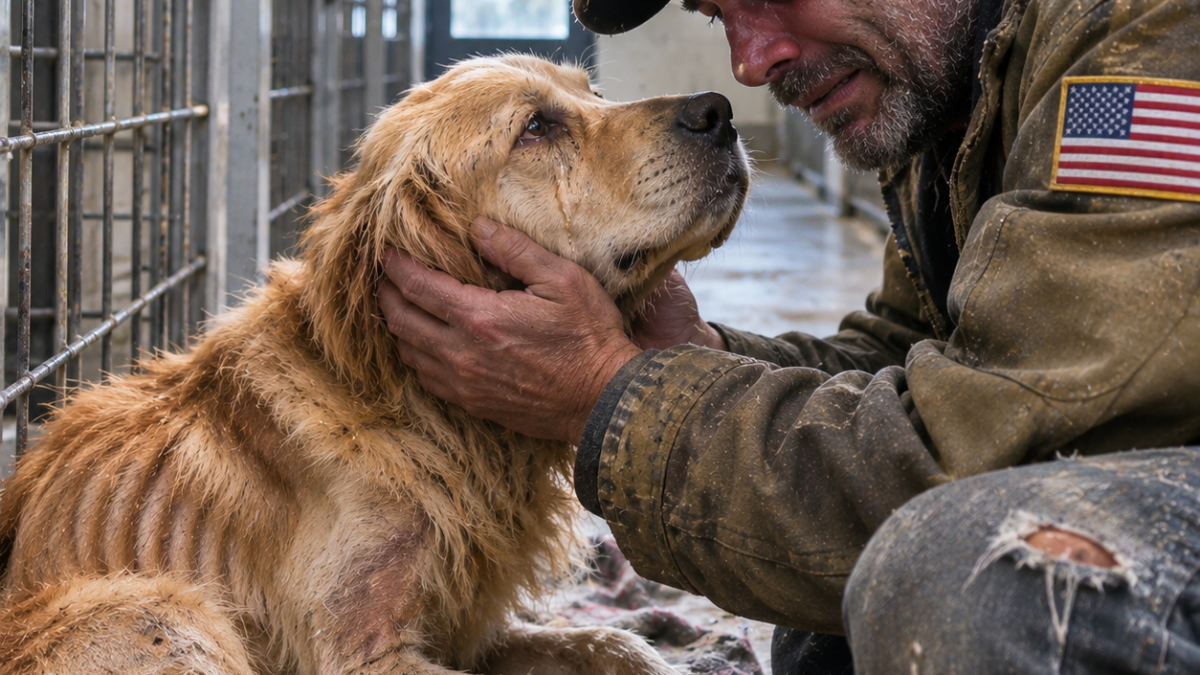
Not a little.
Her entire body trembled.
I looked down at her.
Then back at the man.
“Excuse me?”
He slapped the leash onto the counter.
“You heard me.”
His voice rose.
“We’re moving into a new luxury apartment. Everything is modern. White furniture. Clean floors. No stupid dog smell.”
His wife sighed.
“And she’s embarrassing.”
I stared.
The woman continued, “She’s too thin, always nervous, and she looks terrible in photographs.”
For a moment, I thought I’d misunderstood.
“You’re surrendering her because she doesn’t look good in photographs?”
She shrugged.
“She doesn’t fit the lifestyle we’re building.”
The dog flinched when the man shifted his weight.
It was such a small movement that he didn’t appear to notice.
But I did.
Her front paws spread slightly.
Her shoulders tightened.
Her eyes dropped to the floor.
I had seen frightened dogs before.
Dogs who expected a raised hand to mean pain.
Dogs who feared loud voices.
Dogs who had learned that making themselves small was the safest response to human anger.
This dog looked like she was trying to disappear while still standing between the people she’d trusted.
I took a slow breath.
“How old is she?”
The man rolled his eyes.
“Five? Six? Who cares?”
I looked toward the woman.
“Do you have her veterinary records?”
“No.”
“Vaccination history?”
The man shrugged.
“Probably somewhere.”
“What’s her name?”
Silence.
The question hung between us.
The woman glanced toward her husband.
He looked annoyed.
“What difference does that make?”
My stomach tightened.
“You’ve owned her for years, and you can’t tell me her name?”
He leaned toward the counter.
“Look, lady. We didn’t come here for an interrogation.”
His wife added, “We just want to leave her and go.”
I looked at the dog.
She hadn’t moved.
Her eyes remained fixed on the man’s shoes.
As though she believed that if she stood quietly enough, he’d eventually reach down and tell her she was coming home.
I swallowed.
“Our shelter is at capacity, and we need to document every surrender properly.”
The man gave a cold laugh.
“Then we’ll leave her outside.”
My hand stopped moving.
He continued.
“Or on the road. Someone will pick her up.”
I stared directly at him.
“No.”
His expression hardened.
“What?”
“You are not going to threaten to abandon a starving animal beside a highway.”
He leaned closer.
“It’s our dog.”
I glanced toward her protruding ribs.
“Then she was your responsibility.”
His face turned red.
The woman stepped forward.
“You’re being incredibly judgmental.”
I looked at her.
“Your dog is visibly malnourished.”
“She refuses to eat sometimes.”
“Has a veterinarian examined her?”
Neither answered.
I reached for the phone.
The man laughed.
“What are you doing?”
“Contacting animal protection services.”
His smile disappeared.
“That’s ridiculous.”
I kept my voice steady.
“I’m requesting assistance documenting her condition and your statements about abandoning her.”
He slammed his palm against the counter.
“YOU CAN’T THREATEN US!”
The dog dropped to the floor.
Not because he struck her.
He didn’t.
But the sound of his hand hitting the counter sent her scrambling backward.
Her legs folded.
She pressed herself against the wall.
Her body shook so violently that her collar rattled.
And that was when I saw her eyes.
Wide.
Amber-colored.
Filled with an exhaustion that seemed much older than the dog herself.
I moved around the counter.
Slowly.
Carefully.
Then crouched several feet away.
“Hey, sweetheart.”
She watched me.
I extended one hand, palm up.
“You’re okay.”
Behind me, the man was still arguing.
But I barely heard him.
Because the dog was looking at my hand as though she couldn’t understand why somebody was offering it without demanding anything first.
Her nose moved.
Once.
Then again.
She leaned forward.
Barely an inch.
And touched my fingers.
Her nose was cool and dry.
I felt tears gathering.
“That’s it, beautiful.”
Her eyes lifted toward mine.
I swallowed.
“You don’t have to be afraid of me.”
Then the man snapped, “Are we done here?”
I stood.
Looked directly at him.
And said the words that changed the direction of that afternoon.
“No. We’re not done until somebody takes responsibility for what happened to her.”
The woman went pale.
The man demanded to know whether I had called the authorities.
I told him I had.
For several seconds, neither spoke.
Then his anger returned.
They argued that surrendering the dog was their right.
I explained that the shelter would document the surrender and that the threatened roadside abandonment and the dog’s visible condition warranted an animal welfare assessment.
The couple exchanged looks.
Then the woman tightened her grip on her handbag.
“We’re leaving.”
Her husband stared at me.
“You’ll regret making this difficult.”
I said nothing.
He turned.
Walked toward the entrance.
His wife followed.
Neither crouched beside the dog.
Neither said goodbye.
Neither offered a final touch.
And when the front door slammed shut, the German Shorthaired Pointer lifted her head.
For one terrible moment, she stared toward the glass.
Waiting.
Then she lowered her muzzle to the floor.
As though even hope had become too exhausting.
I knelt beside her.
“Sweetheart.”
Her eyes moved toward me.
I gently rested my hand against her neck.
“They’ve gone.”
My voice broke.
“But you’re not going to be left alone.”
PART2
Her body trembled beneath my fingers.
Not dramatically.
Not in a way that invited attention.
The shaking seemed to come from somewhere deep inside her, as though fear had become a habit her muscles no longer knew how to release.
I sat on the lobby floor.
The telephone on the counter remained off the hook for a moment.
A printer hummed in the office.
Somewhere down the kennel hallway, a dog began barking.
Ordinary shelter noises.
The sounds I’d heard thousands of times.
But the trembling Pointer beside me made the whole room feel different.
I could still hear the couple’s words.
She doesn’t match our apartment.
As if she were an old sofa.
A scratched table.
A painting that no longer worked with the furniture.
I stared at the sharp outline of her ribs.
Then whispered, “How did they let you get like this?”
She offered no answer.
Only a cautious glance.
Her breathing remained quick and shallow.
I shifted closer.
She immediately tightened.
I stopped moving.
“Okay.”
I softened my voice.
“We’ll go slowly.”
And for the next several minutes, I did nothing except sit near her.
No sudden touch.
No demand that she stand.
No cheerful insistence that everything was wonderful now.
Because everything wasn’t wonderful.
Not yet.
She was frightened.
Hungry.
Exhausted.
And the only home she had known had just disappeared through a door without looking back.
My name is Evelyn Parker.
I was forty-one years old that afternoon, and I’d worked at Cedar Valley Animal Rescue in Oregon for nearly fourteen years.
I knew what abandonment looked like.
Sometimes it was a cardboard box beside a dumpster.
Sometimes an elderly dog tied outside a closed building overnight.
Sometimes a frightened cat left at the emergency entrance because the person who loved it had no money for medical care.
Not every surrender was cruel.
I knew that too.
I’d met families forced to move into temporary housing.
Elderly owners entering assisted living.
People facing illness.
People who loved their animals but couldn’t safely provide for them anymore.
Those cases were painful, but they were different.
The people usually cried.
Asked questions.
Brought favorite blankets.
Wanted to know where their animals would go.
The couple who brought this dog hadn’t asked a single question about her future.
They only wanted her gone.
The office door opened.
Jonas Reed stepped into the lobby.
He was fifty-three, broad through the shoulders, with salt-and-pepper hair, gentle blue eyes, and a calm voice that had carried us through more emergencies than I could count.
He’d managed the shelter for nearly two decades.
He was the kind of man who never raised his voice when a frightened animal needed help.
But he could become very firm when somebody mistreated one.
He looked toward the empty front entrance.
Then at the dog.
His expression changed.
“Evelyn?”
I looked up.
“She was surrendered.”
Jonas crouched beside me.
His eyes moved across her body.
The ribs.
The hip bones.
The sunken flanks.
The dull coat.
“Good Lord.”
I swallowed.
“The owners said she didn’t fit their new apartment.”
Jonas looked at me.
Then back at the dog.
I continued.
“They threatened to leave her along the highway.”
His jaw tightened.
“Did you call animal protection?”
“Yes.”
“Good.”
He stood.
“Let’s get her assessed.”
I hesitated.
“Jonas, we’re full.”
He looked toward me.
“We’ll make a safe space.”
I swallowed.
“But—”
“Evelyn.”
His voice softened.
“She’s here.”
He looked down at the trembling animal.
“And she’s not going back outside.”
We moved her carefully to an examination room.
She didn’t resist.
That frightened me more than if she’d snapped.
Most frightened dogs still tried to protect themselves.
They pulled away.
Struggled.
Growled.
Searched for an escape.
This dog simply allowed us to move her.
Her body felt shockingly light for her size.
As though she no longer expected her own needs to matter.
I supported her while Jonas prepared the examination table.
He had training in animal care and shelter assessment, but we also arranged for veterinary evaluation to assess the seriousness of her condition.
He gently checked the obvious areas of concern.
Her eyes.
Ears.
Mouth.
Hydration.
Skin.
Then his hand moved along her side.
He stopped.
“Evelyn.”
I looked up.
“Come here.”
I placed my fingers against the dog’s ribs.
And felt them.
Every one.
The bones were prominent beneath her skin.
Her spine formed a raised line along her back.
Her muscles had wasted away.
I looked toward Jonas.
My throat tightened.
“She hasn’t been eating enough.”
He nodded slowly.
“For a long time, by the look of her.”
I looked down.
Her coat lacked the healthy sheen I’d expect from a well-cared-for Pointer.
The skin near her eyes appeared irritated.
Her body showed signs of prolonged deprivation.
The exact medical causes still needed evaluation, but nothing about her appearance suggested a healthy dog whose owners had simply changed apartments.
“She needs a veterinarian,” Jonas said.
“I know.”
“And carefully managed nutrition.”
I nodded.
He looked at the dog.
“After prolonged starvation, feeding too much too quickly can cause serious complications.”
I swallowed.
“So we do it properly.”
“Exactly.”
I rested one hand gently on her head.
Her eyes closed.
Not with obvious happiness.
Not yet.
It looked more like exhaustion.
As though she had finally reached a place where nobody expected her to keep standing.
For a moment, I felt tears gathering.
Then Jonas asked, “Did they give you her name?”
I shook my head.
“Nothing.”
“Medical records?”
“No.”
“Age?”
“They guessed.”
His expression darkened.
I looked toward the dog.
Her eyelids fluttered.
Then opened again.
Those eyes.
Warm amber.
Like autumn light shining through trees.
I took a breath.
“Amber.”
Jonas looked up.
“What?”
“I want to call her Amber.”
He glanced toward the Pointer.
Then smiled sadly.
“Because of her eyes?”
I nodded.
“Like a little ember that hasn’t gone out.”
Jonas looked at the dog for a long moment.
Then said, “Let’s make sure it gets a chance to burn brighter.”
When the animal protection officers arrived, we provided our account of the surrender.
They documented what we’d observed.
Recorded the couple’s statements as accurately as possible.
Photographed Amber’s condition.
And explained the next steps for assessing possible neglect.
I knew investigations could take time.
The law differed by jurisdiction.
The facts would need to be verified.
And I wasn’t going to pretend an allegation automatically meant a conviction.
But I was relieved that Amber’s condition would not simply be ignored.
After the officers left, Jonas and I moved her into our quiet recovery room.
It was a small space behind the main kennel corridor.
Soft lighting.
Thick blankets.
A comfortable green cushion.
Enough distance from the busiest areas of the shelter to reduce noise and stress.
Amber approached the cushion cautiously.
Sniffed it.
Circled once.
Then curled into the smallest shape she could manage.
Her muzzle disappeared beneath her tail.
Her ears remained alert.
Even when her eyes closed, she seemed to be listening for the next frightening sound.
I sat on the floor a few feet away.
“You can sleep.”
She didn’t move.
I leaned against the wall.
“Nobody’s going to shout at you.”
For a while, the room remained quiet.
Then I added, “I’ll stay.”
An hour passed.
Then another.
The clinic confirmed that Amber would need careful veterinary-supervised recovery.
We followed the prescribed treatment and feeding plan.
By evening, she was resting.
But every time footsteps sounded in the hallway, her ears lifted.
Whenever a door closed, she tensed.
As though she expected someone to return and tell her she didn’t belong.
Jonas appeared in the doorway.
“Evelyn.”
I looked up.
“You should go home.”
I glanced toward Amber.
She was sleeping lightly.
“I’ll leave in a minute.”
He studied me.
“You said that two hours ago.”
I almost smiled.
He entered.
Placed a bottle of water beside me.
Then glanced toward the dog.
“She’ll be cared for.”
“I know.”
He crouched.
“Then why are you still here?”
I looked toward Amber.
For a moment, I couldn’t answer.
Then whispered, “Because when she wakes up, I don’t want her to think she’s been abandoned again.”
Jonas remained quiet.
Then he pulled a chair toward the wall.
Sat.
And said, “Then I suppose we’ll keep her company.”
We didn’t talk much.
The shelter settled.
The louder dogs grew quieter.
The rain began tapping against the windows.
Amber’s breathing slowly deepened.
At some point, she stretched one front leg.
Then the other.
A small movement.
But the first sign that her body was relaxing.
I watched with tears in my eyes.
And Jonas quietly smiled.
The next morning, pale sunlight entered through the recovery room window.
I was still sitting beside the wall.
My back ached.
One leg had fallen asleep.
Jonas had finally gone home after arranging overnight coverage.
Amber lay on her green cushion.
For a moment, she remained motionless.
Then she opened her eyes.
Lifted her head.
And looked toward me.
Something changed in her expression.
Not a dramatic transformation.
A moment of surprise.
As though she hadn’t expected me to still be there.
I smiled.
“Good morning, Amber.”
She stared.
I held out my hand.
Slowly.
She sniffed it.
Then lifted her tail.
Just a little.
One uncertain movement.
Barely enough to notice.
But it was the first time.
My throat closed.
“Oh, sweetheart.”
I smiled through tears.
“There’s my girl.”
That tiny movement became the beginning of everything.
Not a miracle cure.
Not an instant recovery.
But the first small sign that somewhere inside the frightened, skeletal dog, something was beginning to trust that tomorrow might be different.
The first week was harder than I expected.
Amber didn’t suddenly become playful because somebody had given her a soft bed.
She didn’t wake up one morning and decide that humans were wonderful.
Most mornings, she remained curled against the far side of her cushion, watching the doorway as though she were waiting for the next person to tell her she had to leave.
When I entered, she lifted her head.
Sometimes her tail moved.
Sometimes it didn’t.
But her eyes always followed me.
Her veterinary team developed a cautious nutritional rehabilitation plan.
Small portions.
Careful monitoring.
Gradual adjustments.
Bloodwork and follow-up assessments as needed.
We resisted the impulse to give her a large bowl of food and celebrate when she finished it.
After prolonged deprivation, recovery had to be managed carefully.
Her body needed time.
So did her mind.
The first time I offered food from my hand, she stared at it for nearly a minute.
A small portion of the meal prescribed for her.
Nothing remarkable.
Yet Amber looked from the food to my face and back again.
I kept my hand steady.
“It’s yours.”
She sniffed.
Hesitated.
Then took it.
So gently I barely felt her mouth touch my fingers.
I smiled.
“Good girl.”
She chewed slowly.
Then looked up again.
As though waiting for someone to explain whether she’d done something wrong.
I offered the next portion.
She ate it.
And when I removed my hand, she didn’t flinch.
By the end of that week, she was willing to eat while I sat nearby.
It sounds like a small victory.
In an animal shelter, it was enormous.
Because Amber wasn’t simply learning that food would arrive.
She was learning that she didn’t have to be frightened while receiving it.
I began keeping a notebook.
Not only about her health.
The medical details were documented properly by the staff.
My notebook was about moments.
Little things that might otherwise disappear beneath the routines of a busy shelter.
Monday: Accepted food with me sitting beside her.
Tuesday: Relaxed enough to stretch both hind legs.
Wednesday: Watched another dog pass the doorway without trembling.
Thursday: Tail moved when I spoke.
Friday: Fell asleep while I was reading.
At the bottom of Friday’s page, I wrote:
She is still scared. But she is trying.
Then I closed the notebook.
And cried.
The second week, Amber began following me.
Not closely.
Not confidently.
She kept a cautious distance.
If I crossed the recovery room to open the window, she stood.
If I moved toward the cabinet, she took a few steps.
If I sat on the floor, she settled several feet away.
But she followed.
Sometimes I pretended not to notice.
I would move slowly around the room while she watched.
Then stop.
Wait.
Allow her to decide whether to come closer.
One afternoon, I sat beside the window sorting clean towels.
Amber rose from her cushion.
Crossed the room.
And stopped near my shoes.
I glanced up.
“Hi, sweetheart.”
She lowered her head.
Sniffed my sleeve.
Then sat beside me.
My hands stopped.
For a moment, I didn’t dare move.
Then I gently returned to folding the towels.
Amber stayed.
Her shoulder almost touched my knee.
And I felt something warm rise in my chest.
Not pride.
Not exactly.
Gratitude.
Because this frightened animal was choosing to be near me.
After everything she’d experienced, she was still willing to try.
By the third week, she had begun lying beside me when I read.
I’d bring a newspaper or a book into the recovery room.
Sit on the floor.
And read quietly.
Sometimes I read aloud.
Not because I thought Amber understood the news.
Because a calm, familiar voice seemed to help her settle.
She would watch me for a while.
Then lower her head.
Occasionally she’d sigh.
A long, deep sound.
As though she’d spent the entire day carrying worries too large for her body.
One evening, Jonas found us that way.
I sat against the wall with a book in my lap.
Amber lay beside me.
Her head rested near my ankle.
He stopped in the doorway.
Then smiled.
“Would you look at that.”
I glanced up.
“What?”
He nodded toward the dog.
“She looks comfortable.”
I smiled.
“She’s getting better.”
Jonas crouched.
Amber lifted her head.
Her body tightened slightly.
He stopped moving.
Then looked toward me.
“Still not sure about me, huh?”
I smiled sadly.
“Not yet.”
He nodded.
“That’s all right.”
Then he sat down several feet away.
And waited.
Amber watched him.
Her ears moved.
For a while, she remained beside my leg.
Then she lowered her head again.
Jonas smiled.
“Progress.”
I looked toward him.
“She’s not even touching you.”
“I know.”
He nodded.
“But she’s resting while I’m here.”
I looked down at Amber.
He was right.
Three weeks earlier, she would have pressed herself against the far wall when an unfamiliar person entered.
Now she was allowing Jonas to share the room.
It wasn’t trust yet.
But it was the beginning of tolerance.
And tolerance could become trust if nobody tried to rush it.
The other volunteers struggled.
Not because they were careless.
They loved animals.
Most were patient.
Some had years of experience.
But Amber remained frightened by unfamiliar people.
When a volunteer approached too quickly, she’d retreat.
If somebody spoke loudly near the doorway, she’d tremble.
A sudden gesture could send her scrambling toward the safety of her cushion.
We adjusted how people interacted with her.
Quiet voices.
Slow movements.
Plenty of space.
No crowding.
No forced greetings.
Nobody trying to prove they were special by making the frightened dog accept a touch.
One volunteer, Rachel, came to me after Amber hid during a scheduled visit.
Rachel was twenty-four and had been helping at the shelter since college.
She was kind.
Energetic.
And accustomed to dogs racing toward her with wagging tails.
Now she looked devastated.
“She doesn’t like me.”
I glanced through the window.
Amber was curled near her green cushion.
“Rachel.”
She looked up.
“She’s not judging you.”
Rachel frowned.
“She runs away every time I come in.”
I nodded.
“Because she’s frightened.”
“Of me?”
“Of what she doesn’t understand.”
I took a breath.
“Her fear isn’t an insult.”
Rachel looked toward the dog.
For a moment, she was silent.
Then whispered, “So what do I do?”
I smiled gently.
“Give her room.”
The next time Rachel visited, she didn’t approach Amber.
She sat in a chair near the doorway.
Opened a book.
And read quietly.
Amber watched her.
Then lowered her head.
It took several visits before she remained fully relaxed.
But eventually, she could rest while Rachel was in the room.
Rachel was delighted.
She didn’t reach for Amber.
Didn’t celebrate loudly.
She simply smiled at me.
And whispered, “She’s sleeping.”
I nodded.
“She is.”
Her recovery continued in little stages.
The coat began showing more shine.
Her weight improved.
Muscle slowly returned to her body.
She stood with less effort.
Walked more comfortably.
And began showing curiosity about the world beyond the recovery room.
Dr. Harrison, the veterinarian working with our shelter, reviewed her progress and helped guide the plan for activity and training.
We weren’t going to rush her into long walks because she finally looked stronger.
Her body needed gradual conditioning.
And her confidence needed the same careful approach.
One morning, I took her into a quiet fenced exercise yard.
The air was cool.
Sunlight touched the grass.
Birds moved through the trees beyond the fence.
Amber stepped outside.
Then stopped.
For several seconds, she seemed uncertain what to do.
I waited.
She lowered her nose.
Sniffed the ground.
Moved one cautious step.
Then another.
Suddenly, a sparrow fluttered from a nearby bush.
Amber’s ears lifted.
Her whole body changed.
Her head rose.
Her shoulders straightened.
For one beautiful moment, I saw the German Shorthaired Pointer she might have been before prolonged neglect stole her strength.
Alert.
Curious.
Alive.
The bird disappeared.
Amber stood watching.
Then looked back at me.
I smiled.
“Did you see that?”
Her tail moved.
Not the tiny motion I’d celebrated during the first morning.
A fuller wag.
Almost excited.
I laughed.
“Oh, sweetheart.”
My eyes filled.
“There’s a whole world out here.”
She didn’t run that day.
Not yet.
But she explored.
Sniffed.
Watched birds.
Stood in the sunlight.
And when we returned inside, she walked beside me without lowering her head.
That evening, I wrote in the notebook:
Amber remembered she was allowed to be a dog.
As the weeks passed, word about her spread.
People heard about the skeletal Pointer whose owners had surrendered her because she didn’t match their apartment.
A few wanted updates.
Some offered donations for her care.
Others asked whether she would eventually be available for adoption.
Jonas reminded everyone that her recovery came first.
She wasn’t ready to be photographed with strangers.
Wasn’t ready to become somebody’s social-media story.
She needed stability.
And time.
I thought about the couple occasionally.
Their polished shoes.
The cream-colored jacket.
The way the man slapped the leash onto the counter.
The way the dog dropped when he struck the desk.
I wondered whether they ever thought about her.
Whether they noticed the absence of her food bowl.
Whether their luxury apartment truly felt more beautiful without the animal who had once depended on them.
I didn’t know.
And after a while, I stopped wondering.
Because Amber didn’t need me to spend every day angry at people who had already abandoned her.
She needed me to help her learn that the rest of the world wasn’t like them.
The animal welfare investigation remained open for some time.
We provided the requested medical records and observations.
The officers documented the concerns.
The legal process would determine what, if any, consequences followed.
I didn’t receive some dramatic announcement that justice had been achieved overnight.
But I knew Amber was no longer in that home.
For now, that was the most important change in her life.
When Dr. Harrison finally considered Amber healthy enough for adoption planning, Jonas called me into his office.
He sat behind a desk covered in folders.
The shelter’s capacity board hung on the wall.
Almost every space was occupied.
He looked tired.
“Evelyn.”
I sat down.
“What’s wrong?”
He smiled faintly.
“Nothing’s wrong.”
I frowned.
“That’s unusual.”
He leaned back.
“Amber’s ready for the next stage.”
My stomach tightened.
I knew what he meant.
Adoption.
A permanent home.
A family.
Everything we’d been working toward.
Yet the thought of Amber leaving the shelter frightened me.
Not because I didn’t want her happy.
Because I knew how easily trust could be damaged.
And I’d spent weeks watching her build it one cautious step at a time.
Jonas noticed my expression.
“You’re worried.”
I nodded.
“She trusts me.”
“I know.”
“And barely anybody else.”
He folded his hands.
“Then we find someone who understands that.”
I looked down.
“I can’t adopt her.”
Jonas nodded.
“I know about your apartment.”
My apartment was small.
A second-floor unit with limited outdoor space.
My work schedule included long shelter shifts.
I couldn’t assume that because I loved Amber, my home would automatically meet her exercise and enrichment needs.
Jonas understood.
He wasn’t going to pressure me into an adoption simply because I had become attached.
But he also wasn’t going to place her with the first person who offered.
“We’ll take our time,” he said.
I looked up.
“As long as it takes?”
He smiled gently.
“As long as she needs to find the right match.”
I swallowed.
Then nodded.
We began by reviewing applications.
Some people were interested because they loved the breed.
Others because they’d seen her photographs.
A few spoke about her rescue story as though owning a survivor would make them part of something extraordinary.
I tried not to judge too quickly.
But I wanted people who understood her future mattered more than the drama of her past.
The first couple arrived on a Saturday.
They were young.
Friendly.
Well-dressed.
They had a comfortable home and seemed excited about adopting a German Shorthaired Pointer.
They’d seen Amber’s picture online.
The woman’s face brightened when she entered.
“Oh, she’s beautiful!”
Amber stood near the back of the room.
The couple moved closer.
I gently asked them to slow down.
They stopped.
Amber stared.
Her body tightened.
The man crouched.
Held out his hand.
Amber backed away.
The woman tried speaking in an excited, cheerful voice.
“Hi, sweet girl!”
Amber flinched.
Then retreated behind her cushion.
The couple looked confused.
We explained her history.
Her fear.
Her slow recovery.
The need for patient introductions.
They listened.
But I could see disappointment growing.
They’d imagined a dog who would run toward them.
Lick their hands.
Wag her tail.
Perhaps play immediately.
They hadn’t imagined sitting quietly for an hour while the dog remained uncertain whether they were safe.
After the visit, the woman smiled awkwardly.
“We’ll think about it.”
I nodded.
“Of course.”
They left.
And I knew they probably wouldn’t return.
I went back into the recovery room.
Amber sat near her cushion.
Watching the doorway.
I crouched.
“Hey, girl.”
She approached me.
Rested her head against my hand.
I smiled sadly.
“It’s okay.”
Her tail moved.
I looked toward the door.
Then whispered, “They weren’t your people.”
The second visitor was an older woman named Helen.
She had recently lost her dog.
She wore a soft blue cardigan.
Her silver hair was neatly pinned behind her head.
And when I explained Amber’s fears, she nodded without interrupting.
“I understand.”
She sat on the floor.
Not too close.
Then waited.
Amber watched her.
For several minutes, nothing happened.
Helen didn’t move.
Didn’t call her.
Didn’t offer treats to lure her closer.
She simply sat with her hands resting in her lap.
Eventually, Amber stood.
Took one step.
Stopped.
Looked toward me.
Then returned her attention to Helen.
Another step.
A pause.
Then one more.
It was the first time she’d voluntarily approached a potential adopter.
My eyes filled.
Helen remained still.
Amber sniffed the air near her hand.
Then retreated.
But she didn’t run.
Didn’t shake.
Didn’t hide.
It was a genuine moment of progress.
I smiled toward Helen.
“She doesn’t usually do that.”
The older woman looked delighted.
“I feel honored.”
We spent time discussing what Amber would need.
Her activity level as her physical recovery continued.
Long-term veterinary care.
Training.
Mental stimulation.
A stable routine.
Helen’s home was small, with no private yard.
That alone didn’t automatically make a home unsuitable for a dog, but after reviewing her mobility, daily schedule, and the particular exercise needs Amber was expected to have as she grew stronger, we concluded that she couldn’t reliably provide the activity plan this dog required.
The decision hurt.
Helen looked disappointed.
So did I.
But she understood.
Before leaving, she turned toward Amber.
“You keep getting better, sweetheart.”
Amber watched quietly.
Helen smiled.
“And I hope somebody very patient comes for you.”
After she left, I sat in Jonas’s office.
He handed me a cup of coffee.
I stared at it.
“Maybe we’re asking too much.”
He considered.
“What do you mean?”
I looked toward the hallway.
“What if nobody wants to wait?”
Jonas didn’t answer immediately.
Then he said, “Somebody will.”
I gave a tired laugh.
“You sound awfully certain.”
He smiled.
“I’ve been doing this a long time.”
I looked down.
He continued.
“The right person may not be the person who falls in love with her photograph.”
A pause.
“It may be someone who understands that love doesn’t always greet you at the door with a wagging tail.”
I stared toward the cup.
Then slowly nodded.
The third visitor came on a rainy Tuesday.
I remember the weather because the rain struck the roof so hard that I expected Amber to retreat to her cushion.
But she was calm that morning.
She lay beside the window, watching droplets slide across the glass.
Her body looked healthier.
Her eyes brighter.
Her coat had regained much of its shine.
Then the front bell rang.
A man stood in the lobby.
Tall.
Broad-shouldered.
Perhaps forty-three.
He wore a faded olive-green jacket, dark jeans, and heavy work boots.
His hands were calloused.
His short brown hair was threaded with gray near the temples.
A neatly trimmed beard framed a face that looked as though it had spent years outdoors.
But what I noticed most was his manner.
He didn’t seem impatient.
Didn’t look around as though assessing whether the shelter met his standards.
He simply stood near the counter until I approached.
“Can I help you?”
He nodded.
“My name’s Gabriel.”
His voice was deep.
Quiet.
A little rough.
“I called about the Pointer.”
I felt my stomach tighten.
“Amber?”
He nodded.
“I saw her story.”
I waited.
He looked toward the hallway.
Then said, “You mentioned she’s afraid of people.”
“Yes.”
He took a breath.
“I understand fear.”
For a moment, I didn’t know what to say.
Then he added, “More than I’d like to.”
I invited him into the meeting room.
Explained Amber’s history.
The neglect concerns.
Her recovery.
Her sensitivity to loud voices and sudden movement.
Her need for patience.
Gabriel listened carefully.
He asked practical questions.
About her feeding schedule.
Her veterinary needs.
Her exercise plan.
Her reactions to other dogs.
Her comfort around unfamiliar visitors.
He didn’t interrupt.
Didn’t ask whether she would become normal.
Didn’t tell me he’d have her obedience fixed in a week.
Instead, he asked, “What helps her feel safe?”
I looked at him.
For a moment, I couldn’t answer.
Because nobody else had asked the question quite that way.
They wanted to know what Amber could do.
Whether she was friendly.
Whether she would play.
Whether she would adapt quickly.
Gabriel wanted to know what she needed.
I swallowed.
“Time.”
He nodded.
“Okay.”
“Space.”
Another nod.
“A predictable routine.”
He considered.
“And someone who won’t rush her.”
I smiled faintly.
“Exactly.”
When we entered Amber’s room, she immediately lifted her head.
Gabriel stopped near the doorway.
He didn’t approach her.
Didn’t extend his hand.
Didn’t try to make eye contact.
Instead, he looked toward me.
“Is it all right if I sit?”
I nodded.
“Of course.”
He lowered himself slowly onto the floor.
Then turned slightly away from Amber.
Giving her room.
I sat nearby.
For several seconds, nobody spoke.
Amber watched him.
Her ears moved.
But she didn’t hide.
Gabriel remained still.
Then he began speaking.
Not directly to her.
To me.
“I used to have a Labrador.”
I looked toward him.
He smiled faintly.
“Big old yellow fellow.”
A pause.
“His name was Cooper.”
Gabriel had served in the military.
He didn’t describe every detail.
Didn’t turn his service into a dramatic performance.
He simply said that when he returned to civilian life, things had been difficult.
Some nights, he struggled to sleep.
Certain sounds made him tense.
Crowded places exhausted him.
He found himself withdrawing from people he cared about.
For a long time, he couldn’t explain what was happening.
Then Cooper entered his life.
“He didn’t fix everything,” Gabriel said quietly.
I listened.
“He didn’t make the hard days disappear.”
His expression softened.
“But he gave me a reason to get up.”
He looked toward the floor.
“A reason to leave the house.”
“A reason to keep a routine.”
He smiled sadly.
“And somebody who didn’t ask me to explain every time I was having a bad day.”
Amber stood.
I noticed immediately.
But Gabriel didn’t turn toward her.
He continued.
“Cooper liked mornings.”
A small smile crossed his face.
“Didn’t matter how late I’d gone to bed.”
He shook his head.
“Six-thirty, he was ready.”
I almost laughed.
“He sounds persistent.”
“He was a tyrant.”
Gabriel smiled.
“A very kind tyrant.”
Amber took one step toward him.
Then stopped.
Her nose lifted.
She sniffed the air.
Gabriel remained still.
He continued speaking.
“He passed away last year.”
His voice changed.
For a moment, he struggled.
Then whispered, “Thirteen years old.”
I looked toward him.
“I’m sorry.”
He nodded.
“Thank you.”
Amber moved closer.
A second step.
Then a third.
Her body remained cautious.
But she wasn’t trembling.
Gabriel continued.
“For a while, I couldn’t imagine bringing another dog home.”
I swallowed.
He looked down at his hands.
“Felt like I’d be replacing him.”
His voice softened.
“But then I realized something.”
I waited.
“Cooper wouldn’t need me to stay alone just because he was gone.”
Amber reached Gabriel’s shoulder.
She lowered her nose.
Sniffed his jacket.
He didn’t turn.
Didn’t reach for her.
He remained quiet.
Allowing her to investigate.
Then Amber did something I’d never seen her do with a stranger.
She sat beside him.
So close their shoulders nearly touched.
My breath caught.
I looked toward Gabriel.
His eyes remained lowered.
For a moment, he didn’t seem to realize what had happened.
Then he felt her beside him.
He stopped speaking.
His hands remained still.
His breathing changed.
Slowly.
Carefully.
He turned his head.
Amber looked up.
Their eyes met.
Neither moved.
Gabriel’s expression softened.
“Hello, Amber.”
His voice was barely above a whisper.
She remained beside him.
He swallowed.
“My name’s Gabriel.”
Her ears lifted.
He smiled sadly.
“I hear you’ve had a rough time.”
For several seconds, she watched him.
Then she lowered her head.
And rested it gently against his knee.
I covered my mouth.
My eyes filled so quickly that I couldn’t see clearly.
Gabriel stared down.
He didn’t move.
A tear rolled along his cheek.
Then another.
Finally, he looked toward me.
His voice broke.
“Is this okay?”
I nodded through tears.
“Yes.”
He looked back at Amber.
His hands trembled slightly.
Then he whispered, “I won’t rush you, sweetheart.”
Amber closed her eyes.
He continued.
“I know what it’s like to be scared. I can wait as long as you need.”
For several minutes, nobody spoke.
The rain moved across the roof.
A dog barked faintly in another part of the shelter.
Gabriel sat on the floor with Amber’s head resting against his knee.
And I knew I’d just witnessed something extraordinary.
Not a magical cure.
Not proof that two wounded beings would instantly heal one another.
Something quieter.
The beginning of trust between a man who understood the need for patience and a dog who was finally learning that human closeness could be safe.
After Gabriel left that afternoon, I remained in Amber’s room.
She stood beside the door.
Watching.
Not shaking.
Not hiding.
Just watching the place where he’d disappeared.
I crouched beside her.
“Well, sweetheart.”
Her ears moved.
I smiled through tears.
“That was different.”
She looked toward me.
Then sniffed the air near the doorway once more.
I gently touched her shoulder.
“He said he’d come back.”
Her tail moved.
Just a little.
I didn’t know whether she understood anything about a future visit.
But I did know she’d responded to Gabriel in a way she hadn’t responded to anybody outside our small circle of trusted caregivers.
And for the first time since we began the adoption search, I wasn’t afraid that we’d never find the right person.
Gabriel returned the next morning.
He arrived carrying a paperback book and a small thermos of coffee.
No expensive dog treats.
No toys intended to win Amber’s affection.
No attempt to overwhelm her with attention.
He simply asked whether she was available for a quiet visit.
I smiled.
“She is.”
He entered the room.
Sat in the same place.
Opened his book.
And began reading quietly.
Amber watched from her green cushion.
For several minutes, she didn’t move.
Then she stood.
Crossed the room.
And settled a few feet away.
Gabriel kept reading.
He didn’t call her.
Didn’t ask her to come closer.
Didn’t make a celebration out of her choosing to share his space.
But I noticed the small smile that crossed his face when she rested her head against her paws.
He returned the following day.
And the day after that.
Sometimes it rained.
Sometimes the sun came through the windows.
Sometimes he’d just finished a long day of work and looked exhausted.
But whenever we had a scheduled visit, he arrived.
He sat quietly with Amber.
Read.
Talked.
Or simply remained nearby.
By the end of the first week, she no longer retreated when he entered.
Her ears lifted.
Her eyes followed him.
And once, when he was late because of traffic, she stood near the doorway at the time he usually arrived.
I noticed.
Jonas noticed too.
He looked toward me.
“Waiting for somebody?”
I smiled.
“Looks like it.”
Two weeks after that first meeting, Gabriel sat on the floor reading.
Amber approached.
Sniffed his sleeve.
Then turned and settled beside him.
He lowered the book.
For a moment, his hand remained suspended above his knee.
He looked toward me.
I nodded.
“Let her decide.”
He remained still.
Amber moved closer.
Then rested her head in his lap.
Gabriel closed his eyes.
His face tightened.
And I realized he was trying not to cry.
“Gabriel?”
He nodded.
“I’m okay.”
His voice broke.
I waited.
Then he whispered, “Cooper used to do this.”
I looked toward Amber.
Her eyes were half-closed.
Gabriel gently rested his hand near her shoulder, allowing her to remain comfortable.
For a long moment, he simply watched her.
Then said, “I didn’t think I’d ever feel this again.”
My throat tightened.
I knew what he meant.
Not the same dog.
Not the same years.
Not the same memories.
But the quiet wonder of another creature choosing to trust him.
As the visits continued, Gabriel completed the shelter’s adoption process.
We reviewed his home.
His experience.
His schedule.
His ability to meet Amber’s physical and behavioral needs.
He lived outside town in a modest house with a securely fenced yard.
He worked in a hands-on trade and had arranged his routine so Amber could have consistent care.
He understood the breed’s need for exercise and mental stimulation.
He also understood that recovery would not follow a perfect timetable.
Some days might be easier.
Others harder.
A sudden noise might frighten her.
An unfamiliar visitor might need to remain at a distance.
And she might take months to become comfortable in a new environment.
Gabriel listened.
Asked questions.
Then said, “That’s all right.”
Jonas studied him.
“You sound very certain.”
Gabriel smiled faintly.
“I’m certain I want to give her the chance.”
During the third week, something happened that none of us expected so soon.
I was standing near the recovery room when Gabriel arrived.
Amber was resting on her cushion.
The door opened.
She lifted her head.
Saw him.
And wagged her tail.
Not the cautious little movement she’d offered me on her first morning.
A real wag.
Her hips shifted.
Her ears lifted.
She stood and took several eager steps toward him.
Then gave one short bark.
Bright.
Almost joyful.
Gabriel stopped.
His mouth opened.
For a moment, he looked stunned.
Then he laughed.
“Oh, sweetheart.”
Amber moved closer.
Her tail continued wagging.
He crouched carefully.
She sniffed his hand.
Then pressed her head against his chest.
Gabriel wrapped one arm gently around her.
And began crying.
I stood in the doorway with tears streaming down my face.
Jonas appeared behind me.
He watched silently.
Then whispered, “There she is.”
I nodded.
Amber looked different.
Not because her past had vanished.
Not because she was suddenly fearless.
But because for that moment, she wasn’t expecting something bad to happen.
She was happy somebody had come back.
The days that followed brought more small victories.
Amber explored the fenced yard with Gabriel nearby.
At first, she remained close to the doorway.
Then she began sniffing the grass.
Following scents.
Watching birds.
Her Pointer instincts emerged more clearly as her confidence grew.
She stood tall.
Head raised.
Nose working.
Tail extending behind her.
The dog who’d once crouched beneath the shelter counter now moved through the yard with cautious curiosity.
Gabriel never rushed her.
Sometimes she became uncertain.
Then they’d stop.
Wait.
Try something easier.
He celebrated her progress quietly.
A relaxed walk.
A comfortable greeting.
A few minutes of play.
A restful afternoon.
He seemed to understand that confidence wasn’t something he could demand.
It was something Amber had to build through repeated safe experiences.
One afternoon, I watched them from the window.
Gabriel stood beside a tree.
Amber moved through the grass several yards away.
She suddenly paused.
Raised one front paw.
And pointed toward a bird hidden near the fence.
Her whole body became still.
Elegant.
Balanced.
Focused.
I gasped.
“Jonas.”
He came beside me.
“What?”
I pointed.
“Look.”
For a moment, neither of us spoke.
Then he smiled.
“There she is.”
I remembered the trembling skeletal dog in the lobby.
Her head lowered.
Tail tucked.
Ribs protruding.
Trying to disappear between two people who didn’t want her.
Now I was looking at a strong German Shorthaired Pointer doing something natural.
Something that seemed to make every part of her come alive.
And I felt a joy so deep that it hurt.
Gabriel noticed us watching.
He smiled.
Amber lowered her paw.
Looked toward him.
Then trotted over.
Her tail moved.
He gently rubbed her ears.
“Good girl.”
She leaned against him.
And I knew she was ready.
Not for every challenge the world might bring.
Not for an instant life without fear.
But ready to leave the shelter with someone who would keep giving her the same patience and kindness he’d shown from the beginning.
The adoption day arrived on a clear morning.
Sunlight filled the lobby.
The shelter was busy.
Dogs barked.
Phones rang.
Volunteers carried supplies.
But the little room where Amber had spent so much of her recovery felt unusually quiet.
I stood beside her green cushion.
The one she’d curled onto during her first evening.
The one she’d hidden behind when frightened.
The one she’d gradually learned to leave whenever somebody kind entered the room.
Now it rested empty.
Amber stood beside me.
Her body strong.
Her coat shining.
Her amber eyes bright.
Gabriel arrived carrying a soft blue collar.
He held it in his hands.
Then looked toward me.
“Thought she might like something new.”
I smiled.
“It’s beautiful.”
He crouched.
Amber approached immediately.
Her tail wagged.
Gabriel gently fitted the collar.
Then checked that it sat comfortably.
He looked at her.
“Well, Amber.”
His voice softened.
“Ready?”
She pressed her nose against his hand.
I tried to smile.
But tears were already running down my cheeks.
Gabriel looked toward me.
“You okay?”
I laughed through tears.
“Ask me again in five minutes.”
He smiled.
Then stood.
For a moment, we faced one another.
I wanted to tell him everything.
How frightened she’d been.
How she barely moved on her first night.
How the tiny wag of her tail had made me cry.
How I’d sat on the floor worrying that she would never trust another person.
But Gabriel already knew most of it.
He’d listened.
He’d watched.
He’d waited.
And he’d shown up.
Again and again.
I looked toward Amber.
“Sweetheart.”
She turned.
I crouched.
Her nose touched my cheek.
I laughed softly.
Then held her for a moment.
Not too tightly.
Just long enough to feel her breathing.
Her warmth.
The strong body that had once been dangerously thin.
I pressed my forehead gently against hers.
“You did it.”
My voice broke.
“You found somebody.”
Her tail moved.
I smiled through tears.
“Somebody who sees you.”
Gabriel waited.
He didn’t interrupt the goodbye.
He understood that loving an animal sometimes meant allowing the person who helped rescue it to grieve the moment it left.
Finally, I stood.
Wiped my face.
And nodded.
“Okay.”
Gabriel reached for Amber’s leash.
The dog walked beside him toward the front door.
For a moment, I remembered her arrival.
The same lobby.
The same counter.
The same glass entrance.
Only the people had changed.
And so had the dog.
At the doorway, Amber stopped.
She turned.
Looked back toward me.
Her ears lifted.
For a second, my heart tightened.
I almost called her back.
Almost stepped forward.
Almost convinced myself she needed one more day.
But then Gabriel waited beside her.
Calm.
Patient.
Not pulling.
Not rushing.
And Amber looked up at him.
Her tail rose.
She took a step.
Then another.
And walked outside.
I stood beside the door.
Watched them cross the parking lot.
Amber moved confidently beside Gabriel.
Her blue collar caught the sunlight.
He opened the car door.
Helped her settle safely inside.
Then looked back toward me.
He raised one hand.
I raised mine.
And they drove away.
For several seconds, I remained at the entrance.
Then the door closed.
The familiar shelter noises returned.
Phones.
Barking.
Footsteps.
Somebody asking where the cleaning supplies had been moved.
The world continued.
But I couldn’t.
I looked toward the spot where Amber had stood between her former owners.
Then toward the empty parking space where Gabriel’s car had been.
And began crying.
Jonas came beside me.
He didn’t say that I shouldn’t be sad.
Didn’t tell me another dog needed help.
Didn’t ask me to stop.
He simply stood there.
Then said quietly, “You found her the right home.”
I wiped my face.
“I know.”
He nodded.
“Doesn’t always make goodbye easy.”
I shook my head.
“No.”
For a moment, we watched the road.
Then I whispered, “She looked happy.”
Jonas smiled.
“She did.”
The first photograph arrived that evening.
Gabriel sent it from his living room.
Amber lay on a large dog bed near the sofa.
Her blue collar was visible against her shiny coat.
A water bowl stood nearby.
Sunlight entered through the window.
She wasn’t trembling.
Wasn’t hiding.
Wasn’t curled tightly into herself.
She was stretched out comfortably.
One front leg extended.
Her head resting against the cushion.
The message beneath the photograph read:
She ate dinner, explored the house, and is now sleeping like she owns the place.
I laughed through tears.
Then saved the picture.
The next week, Gabriel sent photographs of Amber walking through his fenced yard.
Sniffing the grass.
Standing beneath the trees.
Watching birds.
He wrote that she was still cautious around unfamiliar visitors, but she had begun learning the household routine.
They worked on calm introductions.
Short walks.
Gentle play.
And plenty of rest.
He didn’t describe every fearful moment as a setback.
He understood progress wasn’t a straight line.
Two weeks later, he sent a photograph of Amber swimming in a lake.
She wore a properly fitted flotation aid while Gabriel supervised her first outings.
Her head was raised.
Her ears laid back.
Water rippled around her.
The message read:
Turns out she likes swimming more than I do.
I laughed aloud.
Then showed Jonas.
He smiled.
“Look at that girl.”
A month later, the photograph showed Amber sleeping on Gabriel’s sofa.
Her head rested beside his thigh.
One paw stretched across his lap.
Gabriel’s hand lay against her shoulder.
It was an ordinary photograph.
Nothing dramatic.
No spectacular background.
No rescue scene.
Just a man and a dog resting together.
And I stared at it longer than any of the others.
Because that was what we’d wanted for Amber all along.
Not applause.
Not admiration.
A peaceful life.
Gabriel continued sending updates.
Amber gained healthy weight.
Her coat shone.
She learned to play with toys.
Enjoyed walks.
And gradually became more comfortable with the people Gabriel introduced to her patiently.
She still had moments of fear.
Especially around unexpected loud voices or abrupt movements.
But she could recover more easily.
She no longer spent entire days hiding.
And when Gabriel came home, she waited near the door.
Tail wagging.
Sometimes barking once.
A bright, happy sound.
As though saying the thing she’d once been afraid to hope.
You came back.
One evening, Gabriel called me.
I was finishing paperwork.
Jonas had already gone home.
The shelter was quiet.
I answered.
“Gabriel?”
“Hey, Evelyn.”
He sounded happy.
I smiled.
“How’s our girl?”
He laughed.
“Currently trying to convince me she’s never been fed.”
I laughed too.
“Typical Pointer.”
Then his voice softened.
“Actually, I wanted to thank you.”
I leaned back.
“For what?”
“For waiting with her.”
My throat tightened.
He continued.
“I know you probably had a hundred other things to do.”
I looked toward the empty recovery room.
Then whispered, “She needed somebody.”
Gabriel was quiet.
Then said, “So did I.”
For a moment, I couldn’t speak.
He continued.
“After Cooper died, the house got very quiet.”
His voice changed.
“I’d come home from work.”
“Turn on the lights.”
“Make dinner.”
“And just sit there.”
I listened.
He swallowed.
“I didn’t realize how much I’d stopped looking forward to going home.”
My eyes filled.
Then he laughed softly.
“Now Amber meets me at the door.”
A pause.
“And if I’m five minutes late, she acts like I’ve been missing for a month.”
I smiled through tears.
Gabriel continued.
“I’m not saying she fixed everything.”
His voice was steady.
“She didn’t.”
“But caring for her has made my days better.”
A pause.
“And I think she’s happier too.”
I looked toward the photograph on my desk.
Amber resting on his sofa.
Her body relaxed.
Her eyes soft.
I whispered, “That’s what matters.”
Gabriel was quiet.
Then said, “I never would’ve found her if you hadn’t stayed beside her when she was frightened.”
I closed my eyes.
For a moment, I remembered that first night.
The green cushion.
The dim light.
The rain.
Her ears moving at every sound.
I swallowed.
“I’m glad I did.”
Several months after Amber’s adoption, a small package arrived at the shelter.
It was addressed to me.
From Gabriel.
Inside was a handmade bracelet.
A simple braided band woven around a small piece of material from Amber’s original collar, safely preserved after it had been replaced.
There was a folded note.
I opened it.
Gabriel’s handwriting was careful.
Evelyn,
I wanted you to have something that reminds you of the dog you refused to give up on.
Amber is doing wonderfully. She runs through the fields, swims at the lake, and sleeps on the sofa as though she has lived here forever.
Sometimes she still gets frightened. When that happens, I sit with her and wait.
You taught me that kindness doesn’t need to hurry.
Thank you for helping save her life.
And thank you for helping both of us find a home worth coming back to.
At the bottom, he’d written:
“Whoever saves one life helps save an entire world. Thank you for saving ours.”
I read the note twice.
Then a third time.
My eyes filled.
I turned the bracelet over in my fingers.
A small object.
Simple.
Almost ordinary.
But to me, it held the memory of a skeletal dog crouched on a shelter floor, shaking because the people who brought her there no longer wanted her.
I put the bracelet around my wrist.
Then walked toward Amber’s old recovery room.
The green cushion had been washed and moved into another quiet space.
A frightened rescue dog was resting there now.
A young mixed-breed animal who’d arrived that morning.
He watched me from the far side of the room.
His eyes were wide.
His body tense.
I crouched near the doorway.
Didn’t approach.
Didn’t call him.
Just sat.
For a moment, I thought about Amber.
Her first tail movement.
The cautious steps toward my hand.
The way she’d rested beside me while I read.
Then Gabriel sitting on the floor with his back partly turned, telling us about Cooper.
Amber approaching.
Sniffing his shoulder.
Settling beside him.
Choosing.
Trusting.
The young dog watched me.
I smiled gently.
“Hey, sweetheart.”
He didn’t move.
I rested my hands in my lap.
“That’s okay.”
The dog lowered his head slightly.
Then lifted it again.
I waited.
People sometimes imagine animal rescue as one beautiful moment.
A frightened creature lifted from danger.
A dramatic reunion.
A happy adoption photograph.
Those moments matter.
But most of the work happens between them.
In examination rooms.
During cautious feedings.
While cleaning bedding.
Sitting quietly on floors.
Waiting through fear.
Helping an animal discover that a raised hand doesn’t always mean pain.
That food will arrive again tomorrow.
That a person can leave the room and still return.
Amber taught me all of those things.
She also taught me that rescue isn’t always about being the person an animal loves most.
Sometimes the greatest gift is helping it become ready to love someone else.
I loved Amber.
I’ll never pretend otherwise.
Part of me wanted to keep her.
To be the person who saw her through every season.
Who watched her run.
Who welcomed her home.
But Gabriel offered something she needed.
A stable home.
A patient companion.
A future beyond the shelter.
And because I’d promised her that things would become different, I had to let that future begin.
I still receive photographs every week.
Amber beside the lake.
Amber in the yard.
Amber asleep on the sofa.
Amber watching Gabriel prepare breakfast with the solemn attention of a dog who believes breakfast may be the most important event in human history.
Sometimes she looks directly into the camera.
Her amber eyes bright.
Her ears relaxed.
Her body strong.
I smile every time.
I think about the couple occasionally.
The man shouting that she didn’t fit the apartment.
The woman complaining about photographs.
How easily they’d dismissed a living creature who depended on them.
Then I look at the pictures Gabriel sends.
And I think about what they failed to see.
The elegant Pointer hiding beneath the thin, dull coat.
The curious animal who wanted to explore grass and lakes.
The loyal companion who could learn to greet someone with joy.
The heart that remained capable of trust even after every reason to trust had been taken away.
They saw an inconvenience.
Gabriel saw a dog worth waiting for.
And that difference changed her life.
I don’t know exactly how Amber remembers the past.
I can’t claim she understands abandonment the way a person does.
I can’t know what she thinks when Gabriel walks through the door.
But I can see what has changed.
She eats.
Plays.
Explores.
Rests.
Approaches people she knows.
And carries herself with a confidence that was absent when she first arrived.
Those things are real.
And they are enough.
The little bracelet Gabriel sent remains on my wrist.
Sometimes I touch it when work becomes difficult.
When a frightened animal refuses food.
When another surrender arrives.
When somebody tells me a dog is too old, too nervous, too much trouble, or too damaged to love.
I remember Amber.
And I remember Gabriel.
The man who sat on the floor and waited.
A couple brought a starving German Shorthaired Pointer into my shelter and told me she no longer matched their luxury apartment. They threatened to abandon her if we refused to take her, then walked away without even telling us her name. I called animal protection services, helped her receive veterinary care, and named her Amber because her golden eyes reminded me of an ember still glowing beneath the ashes.
For weeks, she trembled when strangers approached, hid from sudden movements, and trusted almost nobody. Then Gabriel, a military veteran grieving the loss of his Labrador Cooper, came to meet her. He didn’t reach for her or demand affection—he sat quietly and promised to wait. And for the first time, Amber chose to rest beside a stranger.
A few weeks later, she greeted Gabriel with a wagging tail.
Then a bark.
Then the quiet confidence of a dog who finally believed someone would return.
The day she left our shelter, I cried.
But I watched her walk beside him with her head raised and her tail moving.
And I knew the tears were worth it.
Yesterday, Gabriel sent another photograph.
Amber was lying in a field of tall grass.
Sunlight touched her liver-and-white coat.
Her ears were lifted.
Her eyes looked bright.
Behind her stood a lake.
And near the edge of the photograph, Gabriel’s boots were visible.
He’d written:
She wouldn’t stop running until I sat down. Then she came back and rested beside me. I think she just likes knowing we’re together.
I laughed.
Then cried.
Then saved the photograph with all the others.
This morning, I opened the doors of Cedar Valley Animal Rescue as usual.
The hallways were busy.
The phones rang.
Dogs barked.
Volunteers carried food and clean bedding.
Jonas was already preparing the day’s paperwork.
Another frightened animal had arrived overnight.
Another life needed patience.
I looked down at the bracelet.
Then toward the quiet recovery room.
And smiled.
I don’t believe every animal’s future will look exactly like Amber’s.
Some recover slowly.
Some need lifelong support.
Some never become comfortable with every stranger or every unfamiliar situation.
Love doesn’t erase everything they’ve experienced.
But a good home can offer security.
A predictable life.
Care.
And the freedom to become more than the frightened animal somebody once brought through our doors.
When I think about Amber, I no longer picture her trembling between the couple who didn’t want her.
I picture a sunny field.
A blue collar.
A man sitting peacefully in the grass.
And a beautiful German Shorthaired Pointer running back to him because she wants to be close.
Not because she’s terrified he’ll disappear.
But because he has shown her, day after day, that she can trust him to be there.
The couple who abandoned Amber said she didn’t belong in their beautiful new apartment. They were right about only one thing: she didn’t belong with them anymore. She belonged with someone who would see her worth even when she was frightened, hungry, and unable to offer anything in return.
Gabriel didn’t rescue her by demanding that she love him.
He rescued her by giving her time to decide that she could.
And Amber gave him something equally precious.
The chance to open his heart to another companion without replacing the one he’d lost.
I still remember the first morning Amber woke up in our shelter.
She lifted her head.
Saw me sitting nearby.
And seemed surprised that I hadn’t disappeared.
Then she moved her tail.
Just once.
A tiny, uncertain motion.
At the time, I thought it was the most beautiful thing I’d ever seen.
Now I know something even more beautiful.
The photographs of her running freely.
The way she greets Gabriel.
The quiet comfort they share.
And the life that has unfolded because somebody was willing to sit still long enough for a frightened dog to take one step forward.
Amber was abandoned because somebody decided she wasn’t beautiful enough for their home. But the man who finally became her family never asked her to be beautiful, brave, or easy to love—he simply sat beside her and waited until she understood that this time, nobody was going to leave.








