FULL ENDING :“HE WENT TO MY HUSBAND’S GRAVE WITHOUT ME—AND FOR 22 DAYS, HE REFUSED TO COME HOME.” My Dog Lay on the Dirt Where Christopher Was Buried Until His Body Nearly Gave Up
FULL ENDING
Roux did not move.
For twenty minutes, my husband simply sat there.
No treats.
No baby voice.
No reaching through the bars.
Finally Roux stood.
Walked forward.
Pressed his shoulder against the gate.
Christopher looked at me.
“I think we’ve been hired.”
We took him home that afternoon.
Within six months, Roux followed Christopher everywhere.
Garage.
Garden.
Mailbox.
Bathroom, if Christopher forgot to close the door quickly enough.
At night, Roux slept on the rug beside his side of the bed.
When Christopher read, Roux put his head on Christopher’s foot.
When Christopher worked in the yard, Roux carried one of his gloves around like sacred property.
And when Christopher got sick, Roux knew before I was ready to admit anything had changed.
My husband had pancreatic cancer.
By the time doctors found it, they talked to us in months instead of years.
Roux began sleeping against Christopher’s chair before the diagnosis.
When treatment weakened him, Roux shortened his own walks.
When Christopher stopped being able to climb the stairs easily, Roux stopped going upstairs too.
And during Christopher’s final week at home, Roux barely left the bedroom.
The morning my husband died, Roux was lying beside the bed.
Christopher’s breathing had grown shallow sometime before dawn.
I held his hand.
Roux had his head on Christopher’s chest.
The room became quieter.
Then too quiet.
I remember saying:
“Chris?”
As though he had simply fallen asleep at the wrong moment.
Roux lifted his head.
Sniffed Christopher’s face.
Then whined.
One sound.
Low.
Broken.
He put his head back on Christopher’s chest.
And stayed there until the hospice nurse came.
PART2
They had to move Roux before the funeral home staff could take Christopher.
I will never forget that.
Two grown men stood beside the bed while Roux refused to move.
Not growling.
Not threatening.
Just leaning his full body weight against the mattress.
I knelt.
Put both hands around his face.
“Roux.”
His eyes would not leave Christopher.
“They need to take him.”
His body began shaking.
I whispered:
“I know.”
That was all I could say.
I know.
Eventually, Roux let me guide him into the hallway.
The bedroom door closed.
He sat outside it for six hours.
Even after the room was empty.
I did not take Roux to the funeral.
People told me animals did not belong there.
I listened.
I regret it.
Not because I believe he needed to understand burial the way humans do.
But because he had watched Christopher disappear from the bedroom.
Then I came home smelling like flowers and wet earth.
Roux searched the house.
Every room.
Closets.
Garage.
Back porch.
Then went to the front door.
At 5:40 the next evening, he waited again.
The first time I took him to Christopher’s grave was three weeks later.
I had not planned to.
I simply put him in the car because I could not stand leaving him home while I went.
The cemetery was fifteen minutes away.
Roux had never been there.
I parked.
Opened the door.
He jumped out.
Then something happened I still cannot explain neatly.
He did not wander.
Did not sniff random stones.
He pulled forward.
Not violently.
Purposefully.
We followed the paved path.
Then the gravel lane.
Then across grass.
I assumed he was tracking me.
Perhaps he smelled the flowers I had brought before.
Perhaps Christopher’s scent lingered somehow on my clothes or the things buried with him.
I do not know.
I will not turn grief into magic simply because mystery is beautiful.
But Roux walked almost directly to Christopher’s grave.
He stopped.
Sniffed the earth.
Circled once.
Then lay down.
Right over it.
I sat beside him.
For forty minutes neither of us moved.
That became Sunday.
Every Sunday.
Coffee for me.
Water for Roux.
Ten in the morning.
We drove to the cemetery.
Roux went ahead.
Christopher’s grave.
Then home.
At first, Roux would stay as long as I did.
After several months, something shifted.
I would stand.
“Come on.”
He would remain.
I waited.
Eventually he came.
Always.
Until the Tuesday he didn’t.
It was almost ten months after Christopher died.
October.
Cold mornings.
Pale sunlight.
Leaves beginning to collect against the curb.
I woke at 6:15.
Roux’s bed beside the living-room sofa was empty.
I assumed he was outside.
I had installed a dog door years before, and our fenced backyard was secure.
I made coffee.
Called:
“Roux?”
Nothing.
I went outside.
Empty yard.
Gate closed.
I checked behind the shed.
Under the porch.
Nothing.
My heart began beating harder.
Roux had never wandered since Christopher died.
Before, yes.
Occasionally he followed rabbits too enthusiastically.
But after?
He stayed close enough that I sometimes tripped over him.
I called neighbors.
Walked the block.
Then drove.
Shelter.
Nearby park.
Christopher’s old workshop.
Nothing.
At 8:20, while sitting at a stoplight, I knew.
Cemetery.
I do not know why I had not gone there first.
Maybe I did not want to be right.
I saw Roux from the entrance.
A black-and-tan shape against the pale grass.
Christopher’s grave.
My breath left me.
I parked crookedly.
Ran farther than my sixty-eight-year-old knees appreciated.
“Roux!”
His ears moved.
That was all.
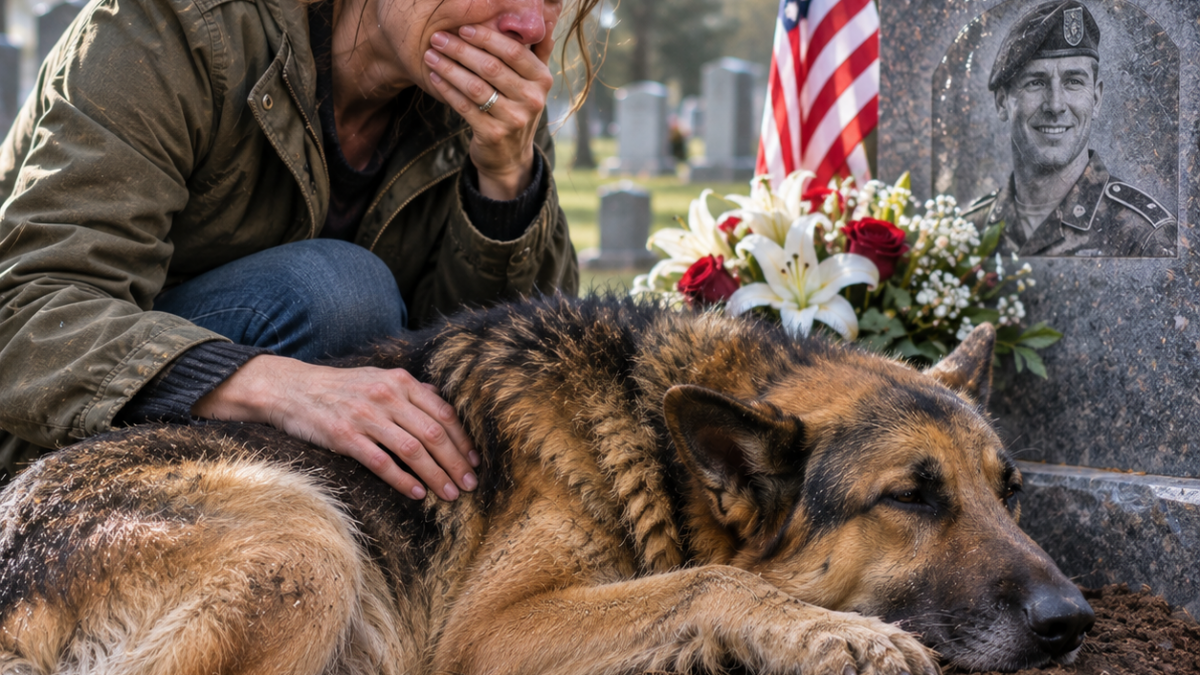
He was lying directly across the grave.
Full length.
Chest pressed against the earth.
Muzzle against the engraved stone.
I dropped beside him.
“Oh, baby.”
I touched his back.
Cold fur.
Wet from dew.
“How did you get here?”
The cemetery was nearly four miles from our house.
Busy roads.
Intersections.
Rail line.
Roux had somehow left through a section of fencing where a storm-loosened board had shifted overnight.
Then walked to Christopher.
Alone.
“Come on.”
I clipped his leash.
“Let’s go home.”
Roux did not rise.
I tugged gently.
Nothing.
“Roux.”
I stood.
Encouraged.
Treat from my pocket.
Nothing.
Then I pulled a little harder.
Roux made a sound I had never heard.
Not a bark.
Not a growl exactly.
A deep, broken moan.
I released the leash instantly.
His head stayed against Christopher’s name.
And I understood the sound.
No.
Not anger.
Not aggression.
No.
I sat down beside him.
“Okay.”
My voice broke.
“Okay.”
I stayed until noon.
Then one.
Two.
Roux did not move except to reposition his head.
I brought water from the car.
He refused.
At four, wind picked up.
I put my coat over part of him.
At five, the cemetery caretaker approached.
“Ma’am, we close at six.”
“I know.”
He looked at Roux.
“That your dog?”
“Yes.”
“Can’t get him to move?”
“No.”
The man crouched.
Held out a hand.
Roux ignored him.
“Want help lifting him?”
Roux weighed nearly eighty pounds.
“Yes.”
We tried.
Roux went rigid.
Then panicked.
Not biting.
Thrashing enough that I stopped immediately.
“No.”
I said.
“No.”
The caretaker backed away.
“We can call animal control.”
“Not yet.”
I hated the idea.
That felt like betrayal.
So I stayed until darkness.
At 7:15, despite the cemetery officially being closed, the caretaker let me remain.
At 9:00, he brought a thermos.
At 10:30, I was shaking from cold.
Roux still would not leave.
I finally whispered:
“I have to go home.”
His ears moved.
My heart broke.
“I’ll come back.”
I placed Christopher’s old wool blanket beside him.
Then walked away.
Every step felt wrong.
I looked back repeatedly.
Roux remained on the grave.
Watching me.
But he did not follow.
For the first time since Christopher died, I went home without him.
The house became unbearable.
Christopher gone.
Now Roux.
His bowl on the kitchen floor.
His leash missing from the hook because it was still attached to him.
I did not sleep.
At five in the morning, I returned.
Roux had not moved far.
The blanket was beneath him.
Water untouched.
I brought chicken.
His favorite.
He sniffed.
Turned away.
“Please.”
Nothing.
I sat.
The second day became the third.
Then fourth.
I began bringing a folding chair.
A thermos.
Blankets.
Food he refused.
Water he barely touched.
Visitors noticed.
Some took photographs.
I asked them not to.
Most respected that.
One woman brought Roux a biscuit.
He ignored it.
She began crying.
“I lost my husband too.”
She sat beside me for half an hour.
We never exchanged names.
Grief recognizes grief without introduction.
On day five, I called Dr. Martin Hughes, Roux’s veterinarian.
“He won’t come home.”
“What do you mean?”
I explained.
Silence.
Then:
“Catherine, he has to eat.”
“I know.”
“How much water?”
“Almost none.”
“That’s dangerous.”
“I know.”
“We should bring him in.”
“He won’t let anyone move him.”
Martin paused.
“Then I’ll come.”
He did.
At Christopher’s grave, Martin examined Roux as much as possible.
Gums.
Heart.
Hydration.
Weight.
His expression worried me.
“He’s dehydrated.”
“I know.”
“We need to intervene.”
“Can we give him fluids here?”
“For a day?”
He looked at me.
“This isn’t sustainable.”
“What if forcing him makes it worse?”
“What if not forcing him kills him?”
That sentence stayed.
We gave subcutaneous fluids that afternoon.
Roux tolerated Martin because he knew him.
He still refused food.
Martin suggested medication.
Appetite support.
Anti-anxiety treatment.
I agreed.
Minimal effect.
Roux remained.
By day seven, local people knew.
Not because I wanted them to.
Small towns and neighborhoods have their own nervous systems.
Someone posted online.
DOG REFUSES TO LEAVE OWNER’S GRAVE
The wording was wrong.
Christopher had been his person.
But I was still his owner legally.
The story spread.
People came.
I hated that.
Some treated Roux like a spectacle.
One teenager tried to touch him for a video.
I shouted so loudly the cemetery caretaker escorted him out.
After that, the cemetery put up a small rope barrier and asked visitors to respect our space.
Flowers appeared near Christopher’s grave.
For Roux.
Notes.
COME HOME, BOY.
HE WOULD WANT YOU TO LIVE.
That sentence angered me.
How could they know?
Then I realized I had been saying the same thing to myself for ten months.
Christopher would want you to live.
Easy sentence.
Harder practice.
Day eight.
Rain.
Roux remained.
I built a temporary canopy with help from the caretaker.
Blankets underneath.
The ground became muddy.
Roux still preferred the exposed earth immediately beside Christopher’s headstone.
I moved him onto the blanket while he slept.
He woke.
Crawled back.
Day nine.
He ate three bites of boiled chicken.
I cried like he had won a marathon.
Then nothing else.
Day ten.
Martin weighed him using a portable scale.
Roux had lost almost ten pounds.
“Catherine.”
“I know.”
“This cannot continue.”
I looked at Roux.
“What do I do?”
Martin’s voice softened.
“Love him enough to make a decision he cannot make for himself.”
I hated him for saying it.
Not because it was cruel.
Because it sounded like hospice.
I had heard similar words about Christopher.
Comfort.
Choice.
Intervention.
When the person you love cannot carry the decision anymore, you carry it.
I was not ready.
Day eleven, I called animal welfare services.
I hung up before anyone answered.
Called again.
Hung up again.
Third time, a woman answered.
“County Animal Response, this is Elizabeth.”
I started crying.
“I need help with my dog.”
She waited.
Patiently.
“He won’t leave my husband’s grave.”
Silence.
Then her voice changed.
Not skeptical.
Gentle.
“How long?”
“Eleven days.”
“Oh.”
One syllable.
Human.
Not procedure.
I explained.
She asked medical questions.
Water.
Food.
Veterinarian.
Behavior.
Then:
“Would you like someone to come today?”
I looked at Roux.
His head against the stone.
“No.”
I whispered.
“Not yet.”
“That’s okay.”
She gave me her direct number.
“Call me when you’re ready.”
Ready.
I would never be ready.
On day twelve, I brought one of Christopher’s shirts.
Blue cotton.
Old.
It had lived inside a sealed plastic storage bag because I could not bear washing it.
I hated myself for opening the bag.
As though scent were a finite inheritance.
I placed the shirt near Roux.
He raised his head immediately.
Sniffed.
His eyes changed.
For a second, he looked toward the path.
My heart jumped.
“Come on.”
I whispered.
“Let’s take it home.”
Roux lowered his head onto the shirt.
And stayed.
I cried until my throat hurt.
Day thirteen.
Day fourteen.
Two weeks.
People stopped counting aloud around me.
I did not.
Every sunrise became a number.
Day fifteen.
Roux drank half a bowl of water.
No food.
Day sixteen.
He stood to urinate, stumbled, then lay back down.
My panic became constant.
I called Elizabeth.
“Come.”
Elizabeth arrived with another animal behavior specialist and Martin.
She was fifty-something.
Short gray hair.
Weatherproof coat.
Calm eyes.
She sat fifteen feet from Roux.
Did not approach.
For forty minutes, she simply watched.
Then she sat beside me.
“I worked with military dogs.”
She said.
“Police dogs.”
“Search-and-rescue dogs.”
“Dogs who lost handlers.”
I swallowed.
“Have you seen this?”
“Yes.”
“What is it?”
“Grief.”
“That simple?”
“No.”
She looked at Roux.
“But that true.”
“Does he want to die?”
The question came out before I could stop it.
Elizabeth did not give me poetry.
“I don’t know whether dogs conceptualize death the way we do.”
Good answer.
“But he has stopped responding adequately to his own physical needs.”
“That can become fatal regardless of intent.”
My chest tightened.
“Can you take him?”
“Yes.”
“Will he hate me?”
Elizabeth looked at me.
“He may be distressed.”
“That’s not what I asked.”
She sighed.
“No.”
“I don’t think he will hate you.”
Then:
“And even if he did for a while, keeping him alive would still be your job.”
That broke me.
Because love is not always being understood.
Sometimes it is becoming the villain in someone’s immediate story so they survive long enough to understand later.
But when Elizabeth tried approaching with equipment, Roux panicked.
He still had strength then.
Enough to resist.
We stopped.
Not safe.
She said sedation might eventually be necessary.
The word made me sick.
I imagined Christopher sedated during his final hours.
I said no.
Not yet.
Again.
Always not yet.
Day seventeen.
Roux’s eyes looked duller.
Day eighteen.
He stopped standing unless I helped.
Day nineteen.
He vomited water.
Martin said his body was deteriorating.
“Catherine, we are out of time.”
I knew.
Still, I asked for one more day.
Love can become selfish when goodbye is near.
I knew that from Christopher too.
Day twenty.
I slept at the cemetery.
Caretaker pretended not to notice regulations.
I lay on a sleeping bag beside Roux.
Cold.
My hand on his back.
At two in the morning, I whispered:
“I miss him too.”
Roux’s breathing remained shallow.
“I know you think I don’t understand.”
Nothing.
“I do.”
I started crying.
“But he left me with you.”
That sentence had never occurred to me before.
Christopher had not literally assigned Roux to me.
But in the last week of his life, he had said something.
We were in the bedroom.
Roux beside him.
Christopher looked at me.
Then Roux.
“You two take care of each other.”
At the time I thought it was sweet.
Simple.
Now it felt like instruction.
“You’re supposed to take care of me.”
I whispered.
“And I’m supposed to take care of you.”
Roux’s ear moved.
“Lying here until you die is not taking care of me.”
My voice broke.
“And letting you do it isn’t taking care of you.”
I kissed his head.
“We’re going home.”
He did not move.
But I had finally decided.
Day twenty-one, we planned the rescue.
Elizabeth coordinated with Martin and a specialty rehabilitation center two counties away.
Not a psychiatric hospital for dogs, as some online posts later called it.
A veterinary rehabilitation facility experienced with severe stress, shutdown behavior, working dogs, and complicated grief-related decline.
The plan was gentle sedation.
Medical stabilization.
Then behavioral recovery.
I signed papers with hands that shook.
That night, I almost canceled.
I sat beside Christopher’s grave.
“Tell me I’m doing the right thing.”
Wind moved through dry leaves.
No answer.
The dead rarely provide the clarity we demand from them.
I had to decide.
Day twenty-two.
Roux could barely lift his head.
That was what finally removed the last of my hesitation.
Elizabeth knelt several feet away.
Martin prepared medication.
I sat directly in front of Roux.
“Look at me.”
His eyes moved toward mine.
“Hi.”
I put Christopher’s shirt beneath his chin.
“It’s me.”
His breathing was slow.
“I’m going to take you somewhere safe.”
My throat closed.
“And you’re going to hate me.”
Elizabeth whispered:
“He won’t.”
I shook my head.
“I might hate me.”
Then I stroked Roux’s face.
“Chris is not here.”
The first time I had said that directly to him.
“He’s not under the dirt.”
My tears fell on Roux’s muzzle.
“I know it smells like him.”
“I know this is where we put his body.”
“But Christopher is not coming back through this ground.”
I barely recognized my own voice.
“And if you die here, I will lose both of you.”
Roux blinked.
I pressed my forehead against his.
“I cannot bury you beside him because I was too afraid to make you leave.”
Martin administered the sedative carefully.
Roux barely reacted.
His eyelids grew heavy.
For the first time in twenty-two days, his entire body relaxed.
Not guarding.
Not waiting.
Not resisting.
Rest.
I sobbed.
When Elizabeth and another responder lifted him onto the stretcher, I walked beside them.
Roux did not wake.
At the cemetery gate, I looked back at Christopher’s grave.
Then whispered:
“I’m taking him home.”
Not yet.
But eventually.
That became my promise.
Roux spent his first three days at the rehabilitation center mostly receiving medical care.
Dehydration.
Weight loss.
Weakness.
Digestive problems.
Pressure irritation from lying in one position too long.
Nothing catastrophic individually.
Together, dangerous.
Dr. Benjamin Turner oversaw the facility.
Late fifties.
Tall.
Quiet.
I expected him to talk about behavior plans.
Instead, during our first meeting, he said:
“Catherine, before we discuss Roux, how are you?”
I stared.
“My dog almost starved himself on a grave.”
“Yes.”
“How do you think?”
“Fair.”
I liked him slightly more.
Then he said:
“We need to remove one idea immediately.”
“What?”
“This is not disobedience.”
“I know.”
“Good.”
“Then second.”
He folded his hands.
“Do not measure his recovery by whether he becomes the dog he was before Christopher died.”
That hurt.
“Why?”
“Because he isn’t.”
My eyes filled.
“Neither are you.”
Silence.
“We’re not trying to erase the loss.”
He continued.
“We’re trying to help him live with it.”
I looked through the observation window.
Roux lay in the corner.
Back to the room.
Exactly as he had at the cemetery, except there was no grave.
No Christopher.
Only a wall.
I visited every day.
First week, Roux did not acknowledge me.
That nearly destroyed me.
I entered.
Sat.
Said his name.
Nothing.
His ears sometimes moved.
He did not turn.
I brought chicken.
Nothing.
Christopher’s shirt.
His nose twitched.
No movement.
At home, I cried into Roux’s empty bed.
I had saved his body.
Maybe lost his trust.
Dr. Turner said:
“Keep coming.”
“What if he doesn’t want me?”
“Keep coming.”
“What do I do?”
“Exist in the room.”
That was all.
So I did.
I read aloud.
At first random books.
Then Christopher’s books.
He loved history.
Biographies.
Mysteries.
One ridiculous series about a retired detective who solved murders in tiny English villages where, statistically, nobody should have remained alive.
I read them.
Roux lay facing the wall.
I read anyway.
Some days twenty minutes.
Some days two hours.
I stopped trying to coax him.
No:
Come on, boy.
No:
Look at me.
Just words.
Christopher’s kinds of words.
The cadence Roux had heard for years from beside his chair.
At home, I began therapy.
Dr. Turner recommended it so firmly I suspected he would refuse Roux treatment unless I complied.
My therapist, Anna Reyes, asked:
“Why did you let Roux stay twenty-two days?”
The question felt accusatory.
“He was grieving.”
“So were you.”
I stared.
“What does that mean?”
Anna waited.
I hated therapists.
Eventually I said:
“Because I understood.”
There.
“I wanted to lie down there too.”
Silence.
“I didn’t.”
I added quickly.
“I never planned to.”
“I know.”
“But when Roux refused to leave…”
My eyes filled.
“Part of me thought he was doing what I wanted.”
Anna leaned forward.
“Which was?”
“Stop.”
The word barely came.
“Stop waking up.”
“Stop making coffee for one.”
“Stop finding Christopher’s things.”
“Stop pretending time moving forward was normal.”
I covered my face.
“Roux was brave enough to refuse.”
Anna did not call it bravery.
Good.
She said:
“And then you became brave enough to make him leave.”
That was different.
Weeks passed.
Roux gained weight slowly.
Medical numbers improved.
Behavior did not.
He walked when staff guided him.
Ate small meals.
Slept.
Returned to the corner.
No interest in toys.
Minimal response to dogs.
Minimal response to me.
I started fearing this was permanent.
Dr. Turner repeated:
“Do not rush grief.”
I wanted to throw something.
One morning during the sixth week, a young kennel technician named Maya entered with Roux’s breakfast.
She sneezed.
Loudly.
Roux lifted his head.
Maya froze.
Then sneezed again.
Roux looked at her.
She laughed.
“Apparently allergies are therapeutic.”
That tiny moment became news.
Roux noticed something.
The world.
Not Christopher.
Not me.
Something.
That mattered.
Next came food.
He began eating more consistently.
Then sniffing the hallway.
Then watching other dogs through the glass.
Small movements.
Progress so ordinary nobody outside the center would understand why I cried.
At home, I packed some of Christopher’s clothes.
Not all.
Three boxes.
It took four hours.
I kept the blue shirt.
His reading glasses.
Wedding ring.
One sweater.
Anna asked how I felt.
“Like I killed him again.”
Then another feeling.
Lighter.
I hated that too.
Grief makes relief feel like betrayal.
Anna taught me otherwise.
Making room for life does not evict the dead.
That sentence helped.
At the end of the second month, Roux finally looked at me.
Not because I called him.
I was reading.
Christopher’s favorite mystery.
I laughed at a line.
A real laugh.
Unexpected.
Roux turned.
His eyes met mine.
I stopped.
Dr. Turner, watching through the window, later told me I almost ruined the moment by reacting too quickly.
I did not call Roux.
Did not reach.
Just smiled.
“Hi.”
Roux watched for maybe five seconds.
Then looked away.
I cried for two hours afterward.
Two weeks later, he moved closer.
Not to me.
To Christopher’s shirt lying near my chair.
He sniffed.
Paused.
Then lay down beside it.
I kept reading.
Near the end of month three, the moment came.
I had brought the blue shirt again.
Christopher had worn it almost every Saturday.
Faded cotton.
Pocket slightly torn.
I placed it beside my feet.
Roux had been resting in his corner.
Halfway through the chapter, I heard nails on the floor.
I did not look immediately.
One step.
Then another.
Roux stopped six feet away.
I kept reading though every word blurred.
He came closer.
Sniffed the shirt.
Then my shoe.
I stopped.
Roux lifted his head.
Looked at me.
His eyes were not the eyes he had before Christopher died.
Dr. Turner had warned me.
He was right.
Something had changed.
A quietness.
An age that had nothing to do with years.
I whispered:
“Hi, baby.”
Roux sat.
His tail moved.
Barely.
One small sweep against the floor.
I covered my mouth.
“Good boy.”
Another tail movement.
Then Roux leaned forward and rested his chin on my knee.
I broke.
Not loudly.
I put one hand on his head.
He stayed.
For fifteen minutes.
That was the first time I believed he might come home.
He did not come home immediately.
Recovery is cruel that way.
One good day does not cancel bad ones.
The next morning, Roux ignored me again.
I panicked.
Dr. Turner said:
“Recovery is not a staircase.”
“Then what is it?”
“Usually a drunk person trying to find the staircase.”
I laughed despite myself.
I kept visiting.
Good days.
Bad.
Eventually more good.
We began walking outside together.
Short.
A fenced garden.
Roux sniffed grass.
First time, perhaps, in months he behaved like a dog rather than a mourner.
A squirrel crossed the fence.
Roux watched.
Did not chase.
I whispered:
“You’re getting old.”
His ear moved.
At four months, Dr. Turner said:
“Start preparing your house.”
My heart jumped.
“He’s coming home?”
“Soon.”
I cried.
“Catherine.”
“What?”
“We need a cemetery plan.”
Everything inside me tightened.
“No.”
“You cannot avoid the cemetery forever.”
“Why take him back?”
“Because avoiding it may turn it into something larger.”
“He almost died there.”
“Yes.”
“That is exactly why return has to be intentional.”
I hated this.
Again.
Roux came home in early February.
Snow.
Christopher had been gone fourteen months.
The moment I opened our front door, Roux stopped.
He sniffed.
The house smelled different.
I had cleaned.
Packed things.
Moved Christopher’s chair six feet toward the window.
For a second I thought I had made a terrible mistake.
Then Roux walked inside.
Slowly.
Living room.
Kitchen.
Hall.
Bedroom.
He stopped beside Christopher’s side of the bed.
Sniffed.
Then walked back downstairs.
His old rug remained near the sofa.
Roux circled twice.
Lay down.
I sat on the floor beside him.
No dramatic reunion.
No sudden restoration.
Just home.
That was more beautiful.
The first night, I woke at 2:00 a.m.
Roux was not on the rug.
Panic.
Then I found him beside the front door.
Sitting.
Waiting.
5:40 behavior had become midnight.
I sat beside him.
“He’s not coming.”
Roux looked at me.
I cried.
Then said it again.
“Christopher is not coming home.”
The sentence was for both of us.
Roux eventually lay down.
I slept on the floor beside him.
We built new routines.
Morning walk.
Breakfast.
Coffee.
Window.
Afternoon rest.
I stopped expecting the old Roux.
Sometimes he played.
Briefly.
Sometimes not.
He became quieter.
More observant.
He liked sitting in sunlight.
He stopped waiting at 5:40 after several months.
The first evening he slept through that time, I noticed immediately.
I looked at the clock.
Then at Roux.
My chest hurt.
Progress can feel exactly like another loss.
Because when routines of grief disappear, part of you fears the person is disappearing too.
Christopher was not.
Memory does not need ritual every day to remain real.
I learned slowly.
We waited six months before returning to the cemetery.
Sunday.
The old day.
I packed water.
Christopher’s blue shirt stayed home.
Dr. Turner advised that.
We drove.
Roux recognized the road.
His body stiffened.
I almost turned around.
Then remembered:
Intentional.
Not forced.
I parked near the entrance.
Opened the door.
Roux jumped out.
He stood.
Looked toward the graves.
Then at me.
I let the leash remain loose.
“Your choice.”
Roux walked.
Slowly.
Same path.
Gravel.
Grass.
Christopher’s grave.
The moment he saw the stone, he stopped.
My body went cold.
“No.”
I whispered before I could stop myself.
Roux moved forward.
He reached the grave.
Sniffed.
Then sat.
Not lay down.
Sat.
Head high.
I stood beside him.
We stayed ten minutes.
Exactly.
I did not decide the time.
Roux did.
He stood.
Turned.
Walked toward the car.
I remained frozen.
He looked back.
Waiting for me.
I started crying.
Then followed.
That was the first Sunday we went home together.
After that, cemetery visits became different.
Not every week.
Once or twice a month.
Roux sat.
I spoke to Christopher.
Sometimes silently.
Sometimes aloud.
Then Roux turned.
Home.
Always home.
A year later, something happened I never expected.
I laughed without guilt.
A real, loud laugh.
Roux stole an entire roast chicken from the kitchen counter.
At eleven years old.
After everything.
I found him in the living room with one leg of the chicken hanging from his mouth.
“Roux!”
He froze.
Christopher used to say guilty dogs only look guilty because humans make guilty faces.
Roux looked extremely guilty.
I started laughing.
Could not stop.
I sat on the floor.
Roux cautiously approached.
Chicken abandoned.
I wrapped my arms around him.
“Chris would be furious.”
Then I laughed harder.
That night I realized grief had changed.
Not ended.
Changed.
Christopher could exist inside a funny story without destroying me.
That felt like grace.
People told me I should adopt another dog.
“For Roux.”
I asked Dr. Turner.
He said:
“Does Roux want another dog?”
“How would I know?”
“Exactly.”
We did not.
He seemed content.
So was I.
Two wounded creatures had finally built a household that could breathe again.
We did not need to fill every empty room.
Roux turned twelve.
Then thirteen.
His hips stiffened.
Veterinarian recommended medication.
Rugs over hardwood.
A ramp for the back steps.
I did everything.
Sometimes I caught myself overreacting to every quiet day.
If he skipped breakfast, my heart raced.
If he slept longer, I imagined another grave.
Trauma does that.
Martin reminded me:
“Old dogs sleep.”
“I know.”
“Do you?”
Not always.
When Roux was thirteen, we attended a grief support group.
For people.
Not dogs.
I brought him because the facilitator allowed therapy animals and calm pets.
Roux had never been certified.
But he possessed a PhD in sitting quietly beside sadness.
A man named Paul had lost his wife.
During his first meeting, he said nothing.
Roux walked over.
Sat beside him.
Paul put one hand on Roux’s head.
Then started crying.
Afterward he asked:
“What does he know?”
I answered:
“Enough.”
Roux began attending occasionally.
Not as therapy.
Just Roux.
That was sufficient.
At fourteen, his hearing declined.
Christopher’s name no longer made his ears move from across the room.
I had to say it closer.
Sometimes I wondered whether that hurt.
Then realized memories do not live only in ears.
Roux still walked directly to Christopher’s grave when we visited.
Body memory.
Scent.
Routine.
Love.
Whatever combination.
He knew.
At fifteen, Roux developed kidney disease.
Slowly progressive.
Martin explained diet.
Medication.
Fluids.
Monitoring.
I sat in the examination room gripping Roux’s leash.
“How long?”
“Catherine.”
“How long?”
“Could be months.”
“Could be longer.”
“Depends.”
I hated depends.
Christopher’s doctors used that word too.
My hands began shaking.
Martin knelt in front of me.
“This is not Christopher.”
I looked at him.
“I know.”
“Do you?”
I started crying.
“No.”
He nodded.
“Okay.”
Sometimes the kindest thing a person can do is not require you to be reasonable immediately.
Roux did well for almost a year.
Good days.
Slow walks.
Porch.
Cemetery.
Chicken stolen only with assistance because he could no longer reach the counter.
I may have left pieces near the edge.
No proof exists.
One Sunday, Roux did something unusual at Christopher’s grave.
He lay down.
My heart stopped.
“No.”
I dropped beside him.
“Roux.”
He looked at me.
Calm.
Not the old emptiness.
Not refusal.
Just tired.
I waited.
Five minutes.
Then ten.
I reached for the leash.
Roux stood.
Slowly.
Turned toward the car.
I almost collapsed with relief.
That was when I understood the difference.
Years earlier, he had lain there because he could not imagine leaving.
Now he could rest beside Christopher and still choose home.
That was healing.
Not forgetting.
Choice.
Roux turned sixteen in April.
I made him a small hamburger.
No onions.
Martin would have objected to the salt.
I ignored him.
Christopher’s photograph sat on the kitchen counter.
I placed Roux’s plate down.
“Happy birthday.”
Roux ate slowly.
Then looked toward me.
I imagined Christopher saying:
“Sixteen? That dog owes rent.”
I laughed.
Then cried.
Both.
Always both.
That summer, Roux declined.
Not dramatically.
Age arrived like dusk.
Longer naps.
Less appetite.
Difficulty standing.
I stopped going upstairs at night.
We slept in the living room.
Me on the sofa.
Roux on his old rug.
Sometimes I woke and reached down.
His body there.
Warm.
Enough.
One September morning, Roux could not stand.
His front legs worked.
Back legs did not.
He looked confused.
Tried again.
Failed.
My whole body went cold.
I called Martin.
He came to the house.
Examination.
Kidneys worse.
Arthritis severe.
Neurological weakness.
“Can you fix it?”
I knew the answer before asking.
Martin sat beside me.
“No.”
I stared at Roux.
“Pain?”
“Some.”
“Can we control it?”
“For a little while.”
“How little?”
He did not answer directly.
I hated him for that.
Then understood.
No one knew.
That night, I placed Christopher’s blue shirt beside Roux.
The same shirt from the cemetery.
Roux sniffed it.
Then rested his head on it.
I sat beside him.
Sixteen years old.
Fourteen with us.
I stroked the bent ear.
“You remember him?”
Roux’s eyes moved toward me.
“Of course you do.”
I cried.
“You scared me.”
His breathing was slow.
“Twenty-two days.”
“You almost made me bury you right there.”
I leaned closer.
“Do you know how angry I was?”
Tears fell.
“No.”
“I wasn’t angry.”
“That would’ve been easier.”
I pressed my forehead against his.
“You were the only one who missed him the way I did.”
Roux’s tail moved once.
“And then you stayed for me.”
There it was.
The truth.
Roux had lain on Christopher’s grave for twenty-two days.
But he had come home and stayed years.
Not because grief disappeared.
Because life still contained someone worth returning with.
Me.
That realization broke me open.
“Thank you.”
I whispered.
“For coming back.”
The next morning, Roux refused food.
Then water.
I knew.
This time I did not wait twenty-two days.
That mattered.
I called Martin.
Then Dr. Turner, though he had retired.
I needed to hear his voice.
“Benjamin.”
“Catherine?”
“He’s ready.”
Silence.
Then:
“Are you?”
“No.”
“Good.”
I almost laughed.
“What?”
“You never have to be ready.”
“You only have to listen.”
The same lesson.
Again.
I listened.
I asked Martin to come in the afternoon.
Before then, I took Roux to the cemetery.
One final time.
Amanda—my niece, who had become close after Christopher died—drove because I was shaking too hard.
We brought a blanket.
Roux could barely walk, so I used a wagon.
At Christopher’s grave, I lifted him with help.
Placed him on the blanket.
Roux raised his head.
Sniffed the air.
Then looked at the stone.
I sat beside him.
For thirty minutes, we stayed.
I talked.
About everything.
Christopher’s terrible coffee.
The roast chicken.
The twenty-two days.
The time Roux chased a squirrel into a hedge and emerged wearing Christmas lights.
Our first shelter visit.
The final morning with Christopher.
Then I said:
“He’s not here.”
My voice shook.
“But he’s yours anyway.”
Roux closed his eyes.
I put my hand on his back.
“And you’re mine.”
We sat.
Then, after a while, Roux lifted his head.
Looked toward the car.
My heart stopped.
Even now.
Even at the end.
He was ready to go home.
I laughed through tears.
“All right.”
“Home.”
Martin arrived at four.
I put Roux on his rug.
Christopher’s blue shirt beneath his head.
His old collar stayed on.
I sat on the floor.
Martin explained.
I stopped him.
“I know.”
He nodded.
Roux looked at me.
I put both hands around his face.
“Listen.”
His cloudy eyes stayed on mine.
“You do not have to wait for him anymore.”
My voice broke.
“You do not have to wait for me either.”
Roux breathed.
“You stayed.”
I kissed his forehead.
“You stayed when you didn’t want this world.”
“You stayed until I could live in it again.”
I could barely speak.
“So now I’m staying with you.”
Martin gave the first medication.
Roux relaxed.
His head became heavier in my hands.
I pressed my forehead to his.
“Christopher is not in the ground.”
I whispered.
“And you are not leaving me.”
“You’re just going where I cannot follow yet.”
Tears soaked his fur.
His breathing slowed.
One breath.
Another.
Then a final soft exhale.
Stillness.
I waited.
Because seventeen years of instinct told me Roux would breathe again.
He didn’t.
Martin touched my shoulder.
“He’s gone.”
I shook my head.
“No.”
Then remembered the lesson.
Not gone.
Changed.
I bent over Roux.
Held him.
And for the first time since Christopher died, the house contained no one else breathing.
That silence was unbearable.
I stayed on the floor until after dark.
Amanda brought food.
I did not eat.
She removed Roux’s water bowl.
I made her put it back.
Not yet.
Some endings need to happen gradually.
I had Roux cremated.
For three weeks, his ashes sat in a wooden box on my mantel beside Christopher’s photograph.
Then I knew what I wanted.
Not his grave.
Not exactly.
I returned to the cemetery.
With permission from the cemetery, I placed a small portion of Roux’s ashes beneath the soil beside Christopher’s marker.
Not enough to pretend they shared a burial.
Just enough.
The rest I kept.
For me.
That mattered.
Roux had loved Christopher.
But he had come home for me.
He belonged to both chapters.
I added a small engraving beneath Christopher’s name.
Not on the official headstone face.
A small memorial plaque beside it.
ROUX
FAITHFUL IN GRIEF
FAITHFUL IN LIFE
HE ALWAYS CAME HOME
I sat beside the plaque.
Cried.
Then laughed.
“He’d hate that.”
Christopher hated sentimental wording.
I could hear him.
Too many words.
Roux would not care.
Perfect.
The following Sunday, I woke automatically at the old time.
For years, Sunday meant cemetery with Roux.
I almost stayed home.
Then went.
Alone.
That was harder than the funeral.
I parked.
Walked.
No leash in my hand.
No black-and-tan body ahead.
No bent ear visible over the grass.
At Christopher’s grave, I sat.
The ground looked ordinary.
That is one of grief’s insults.
Places holding enormous meaning look like dirt to everyone else.
I touched the small Roux plaque.
Then said:
“Well.”
Silence.
“What am I supposed to do now?”
No answer.
Of course.
I sat ten minutes.
Then stood.
For one second, I waited instinctively for Roux to rise beside me.
Nothing.
I started crying.
Then walked toward the car.
Alone.
But moving.
That mattered.
Months passed.
I stopped going to the cemetery every Sunday.
At first, guilt.
Then relief.
Then guilt about relief.
Anna helped.
“You are not abandoning them by living.”
I knew.
Eventually believed.
I donated Roux’s remaining food to the shelter where Christopher and I had adopted him.
The director found his original intake card.
ROUX — MALE SHEPHERD MIX — APPROX. 18 MONTHS — RETURNED TWICE — SEPARATION ANXIETY — REQUIRES PATIENT HOME
I laughed.
Patient home.
Christopher had been patient.
Roux had been patient.
Eventually I learned too.
I framed the card.
Not because it described him accurately.
Because it showed how little anyone knew about the dog he would become.
A kennel card cannot predict loyalty.
Neither can a first impression.
Neither can grief predict whether you will survive it.
The shelter asked if I wanted to foster.
I said no.
Then six months later, yes.
Not a permanent adoption.
I was seventy-five.
I did not want a young dog likely to outlive me without a plan.
So I fostered seniors.
Dogs nobody wanted because they were ten, twelve, fourteen.
Some stayed two weeks.
Some months.
One little beagle named Otis snored like a chainsaw and stole tissues.
Another, Daisy, had arthritis and liked sleeping under my kitchen table.
I loved them.
Then let them go to carefully chosen homes.
Every departure hurt.
That was okay.
Roux had taught me loss was not proof that attachment was a mistake.
One foster, an old shepherd named Sam, refused to sleep anywhere except Roux’s rug.
I had kept it folded in a closet.
The first night, Sam scratched at the closet door.
I opened it.
He pulled the rug out with his teeth.
Lay down.
I sat on the floor and cried.
Sam looked concerned.
Then went back to sleep.
Christopher would have laughed.
Years later, I stopped fostering physically but volunteered at the shelter.
I sat with dogs who had shut down.
I read.
Same way I had read to Roux.
People asked why.
I said:
“Because sometimes being present is enough until they decide the world is safe again.”
That was Roux’s legacy.
Not the grave.
The staying.
Elizabeth, the animal welfare officer who helped lift Roux on day twenty-two, visited once.
We had coffee.
She asked:
“Do you regret waiting?”
Hard question.
“Yes.”
Then:
“No.”
She waited.
“I regret that his body suffered.”
“I don’t regret understanding why I hesitated.”
Elizabeth nodded.
“That’s different.”
“I was grieving too.”
“Yes.”
“I thought forcing him away from Christopher was cruel.”
“You learned.”
“I did.”
I looked toward Roux’s photograph.
“Love can be cruel when it refuses to intervene.”
Elizabeth smiled sadly.
“And cruel when it intervenes.”
“Exactly.”
There is no perfect love.
Only the best decision available while your heart is breaking.
Dr. Turner died several years after Roux.
His wife sent me a note because he had kept a photograph of Roux in his office.
That stunned me.
Apparently Roux had become one of the cases he discussed in lectures about grief, attachment, and recovery.
Not as a miracle.
As a warning and a lesson.
Animals grieve.
Bodies still require care.
Recovery means adaptation, not restoration.
His wife wrote:
Ben always said Roux taught him that returning home is sometimes a behavior before it becomes an emotion.
I read that sentence repeatedly.
Returning home is sometimes a behavior before it becomes an emotion.
That had been true for me too.
After Christopher died, I kept going home before home felt like somewhere I wanted to be.
After Roux came back, he slept on his rug before he truly reentered life.
We practiced living before living felt natural.
That was recovery.
I am eighty-one now.
Christopher has been gone thirteen years.
Roux six.
I still visit the cemetery.
Not weekly.
Birthdays.
Anniversaries.
Sometimes random Tuesdays.
I bring coffee.
Sit.
Talk.
Then leave.
Every time I leave, I think about Roux turning toward the car after those first ten-minute visits.
His way of saying:
Enough for today.
Home.
I use that rule now.
Remember.
Feel.
Stay as long as needed.
Then go home.
People say time heals.
I no longer argue.
Mostly because the sentence is too simple to deserve much energy.
Time did not heal Christopher’s death.
It changed my relationship with the wound.
Same with Roux.
The pain is not gone.
It no longer bleeds every day.
That is different.
What healed me most was not time.
It was responsibility.
Christopher needed me until he didn’t.
Roux needed me.
Then I needed Roux.
Then frightened shelter dogs needed someone to sit quietly.
A grieving neighbor needed coffee.
A widower named Paul from support group needed somebody to answer the phone at midnight one January.
Life kept handing me reasons to remain.
Not grand reasons.
Small.
Those are usually stronger.
One Tuesday morning, many years after Roux’s twenty-two days, I went to Christopher’s grave alone.
Autumn.
Same pale sunlight.
Same kind of day.
For a moment, I could see Roux there exactly as before.
Body over the earth.
Muzzle against the stone.
Eyes empty.
I closed mine.
Then remembered another image.
Roux years later.
Sitting beside the same grave.
Head up.
Ten minutes.
Then turning toward me.
Ready.
That is the image I choose now.
Not the dog who refused to leave.
The dog who learned he could.
Because Roux’s story is not really about dying of grief.
He almost did.
That is true.
But the ending was not the cemetery.
The ending was coming home.
Eating again.
Sleeping on the rug.
Stealing chicken.
Walking beside me.
Growing old.
Returning to Christopher’s grave without surrendering himself to it.
Then eventually leaving the cemetery with me every single time.
That matters.
People romanticize devotion until it becomes destruction.
Roux taught me loyalty is not proving you can die beside someone.
It is carrying love forward after they are gone.
That is much harder.
Sometimes people ask whether I think Roux stayed at the grave because he believed Christopher was physically there.
Maybe.
Scent.
Association.
Routine.
Dogs understand the world differently.
I do not claim to know.
But I know what changed.
At first, Roux treated the grave as a destination.
Eventually, he treated it as a place we visited.
That transition saved him.
And me.
The old silver tag from Roux’s collar is in my nightstand.
It reads:
ROUX
CATHERINE & CHRISTOPHER BELL
I had added my name years after Christopher died.
Originally it said only Christopher’s phone number.
I remember feeling guilty changing it.
As though I were stealing Roux from a dead man.
Then I realized Christopher had already said:
You two take care of each other.
My name belonged there.
Not instead.
Beside.
That is how love works after loss.
Not replacement.
Addition.
If there is something after this life, I hope Christopher meets Roux first.
He had to wait longer.
I imagine Roux running.
Bent ear.
Young again.
Christopher kneeling.
That ridiculous laugh he had when Roux knocked him backward.
Then eventually, maybe years later by whatever clock exists there, I arrive.
Christopher will probably say:
“Took you long enough.”
And Roux—
if dogs remember anything beyond this world—
will look at me.
Then choose.
For one horrible second, some selfish part of me imagines him staying beside Christopher.
Then I laugh at myself.
Roux never learned love by replacing one person with another.
He loved both.
He would run between us.
Exactly as he did in life.
Keeping the family together.
Until then, I remain here.
That is my job.
Not forever.
For now.
There is tea in the kitchen.
A volunteer shift on Thursdays.
A neighbor who needs rides to physical therapy.
A rosebush Christopher planted that refuses to die despite my terrible gardening.
Life.
Small.
Persistent.
Enough.
The most important thing Roux ever taught me happened not during those twenty-two days, but after.
For months, I thought his loyalty was proven by refusing to leave Christopher.
I was wrong.
His loyalty became greater when he finally did leave.
Because leaving the grave did not mean leaving Christopher.
Eating did not mean forgetting.
Coming home did not mean betrayal.
Playing again did not make the mourning false.
And eventually, loving me fully did not reduce what Christopher had been to him.
That lesson saved me.
I had believed the same terrible equation.
If I laughed, Christopher mattered less.
If I packed his clothes, our marriage shrank.
If I changed the bedroom, I was moving him out.
If I stopped visiting the cemetery every week, I was abandoning him.
Roux showed me otherwise.
Memory is not a fragile flame that dies when you turn toward life.
It travels.
With you.
Sometimes slowly.
Sometimes limping.
Sometimes on four old legs.
But it travels.
When Roux first came home from rehabilitation, he would sometimes stop halfway between the front door and Christopher’s chair.
Stand there.
Look.
Then continue.
At the time, it broke my heart.
Now I think he was doing something profound.
Checking.
Remembering.
Choosing.
The past was there.
So was the kitchen.
So was breakfast.
So was me.
Eventually he walked toward what was still alive.
Again.
Again.
Again.
Until doing so became natural.
That is what I try to do too.
If anyone reading this has lost someone and feels guilty for surviving them, I cannot tell you not to hurt.
That would insult what you loved.
I cannot promise time will fix it.
I cannot tell you grief follows stages cleanly.
It doesn’t.
I can tell you what a black-and-tan dog with one bent ear taught me.
You are allowed to sit beside the grave.
You are allowed to stay a while.
You are allowed to miss them so badly that home feels wrong.
But when your body is starving, when your world has narrowed to one patch of earth, when love has become a reason not to live—
someone who loves you may have to take your hand.
Or your leash.
And say:
Enough for today.
Home.
Roux resisted that lesson for twenty-two days.
So did I for much longer.
Eventually we both learned.
Home was not the place where Christopher still physically existed.
Home became the place where the love he left behind continued doing work.
In Roux.
In me.
In the shelter.
In every old dog I sat beside.
In every Sunday I chose to return from the cemetery instead of staying inside memory forever.
That was Christopher’s afterlife in our house.
Not ghosts.
Consequences of love.
I used to think Roux guided me to Christopher’s grave every Sunday.
Maybe he did.
Now I think he was guiding me somewhere else all along.
Toward grief.
Through it.
And eventually back.
The cemetery was only part of the route.
Home was always the destination.
On Roux’s final day, when he looked toward the car from Christopher’s grave, I did not understand the gift immediately.
Now I do.
He had spent twenty-two days once saying:
I will not leave him.
Years later, old and dying, he looked toward me and said something different.
Not in words.
But clearly enough.
We can go now.
That is the sentence I carry.
Not goodbye.
Not forget.
We can go now.
Christopher died holding my hand.
Roux died with my hands around his face.
I lost both.
I survived both.
Not because I loved either one less than I thought.
Because eventually I understood that surviving love is part of loving too.
Someone has to remain to remember.
Someone has to tell the stories.
Someone has to feed the next frightened dog.
Someone has to go home.
So yes, there was a Tuesday morning when Roux disappeared.
I found him stretched over my husband’s grave.
He refused to leave for twenty-two days.
He stopped eating.
Stopped drinking enough.
Stopped choosing himself.
I nearly lost him because I was too heartbroken to separate devotion from self-destruction.
Then people helped me.
Elizabeth.
Martin.
Dr. Turner.
Strangers at the cemetery.
Books.
Time.
And eventually Roux himself.
He came back.
Not the same.
Neither was I.
But back.
He slept again on the rug.
Waited at the door less.
Ate.
Walked.
Stole food.
Aged.
Loved.
Visited Christopher.
Then turned toward home.
Every time.
Until the final one.
And even then, he came home with me first.
That is why I refuse to tell his story as a tragedy.
It contains tragedy.
Of course.
But tragedy is not the same thing as an ending.
Roux’s ending was sixteen years old on his rug, Christopher’s shirt beneath his head, my voice in his ears, no fear, no cold cemetery ground, no waiting.
Loved.
Home.
And when I eventually leave this world, I hope somebody remembers to put Roux’s silver tag beside my photograph.
Not because I believe objects travel anywhere.
Because whoever finds it should know.
There was once a dog who loved my husband so deeply that he lay on his grave for twenty-two days.
And there was once a widow who loved that dog enough to make him leave.
For years I thought those were opposing acts.
They were not.
Both were love.
One said:
I cannot leave you.
The other said:
I cannot let you die here.
Between those two sentences, Roux and I learned everything we needed to know about grief.
And together, slowly, painfully, faithfully—
we went home.








