FULL ENDING :“HE WAS FINALLY FREE… SO WHY WAS HE STILL WAITING?” I Rescued a German Shepherd Chained to a Tree for Eight Years—But His First Reaction Was Something I Never Expected
Then:
“Since I was nine.”
I sat straighter.
“What?”
“The chain.”
She whispered.
“He’s been on that chain since I was nine years old.”
I looked at the age on her caller information.
Seventeen.
Eight years.
“Are you sure it’s the same dog?”
“I know him.”
“How?”
“My family lives behind that property.”
She swallowed.
“I’ve been feeding him through the fence.”
That changed the call.
Not because feeding automatically proved neglect.
Because now I had a witness with history.
“What does he look like?”
“Big mixed breed.”
“Brown and black.”
“White patch on his chest.”
“His name might be Bear, but the man hardly ever calls him anything.”
“How long is the chain?”
“Maybe six feet.”
“Shelter?”
“Broken wooden box.”
“Water?”
“Sometimes.”
“Food?”
“Sometimes.”
Then her voice dropped.
“And the collar is hurting him.”
“How do you know?”
“I can see blood.”
That was enough for an inspection.
I met Emilie two hours later at the end of a gravel road.
She was small.
Rain jacket.
Long brown hair pulled back.
School backpack still in her mother’s car.
She had clearly come directly from class.
Her mother stood nearby, worried.
“Are we going to get in trouble?”
She asked.
“No.”
I said.
“Not for reporting.”
Emilie pointed toward a line of trees.
“The backyard is through there.”
I could hear barking.
One bark.
Low.
Then silence.
Emilie looked at me.
“He doesn’t bark much anymore.”
That sentence bothered me more than barking would have.
“What does he do?”
“Waits.”
“For what?”
She looked toward the fence.
“I don’t know.”
The property owner allowed inspection after a short conversation that became increasingly defensive.
“He’s got water.”
“He’s alive.”
“He likes being outside.”
“He doesn’t like people.”
“He bites.”
Every sentence familiar.
I asked:
“How old is he?”
“Ten, maybe.”
“How long have you had him?”
“Years.”
“Always tethered?”
“He gets off sometimes.”
“When?”
No answer.
I walked around the house.
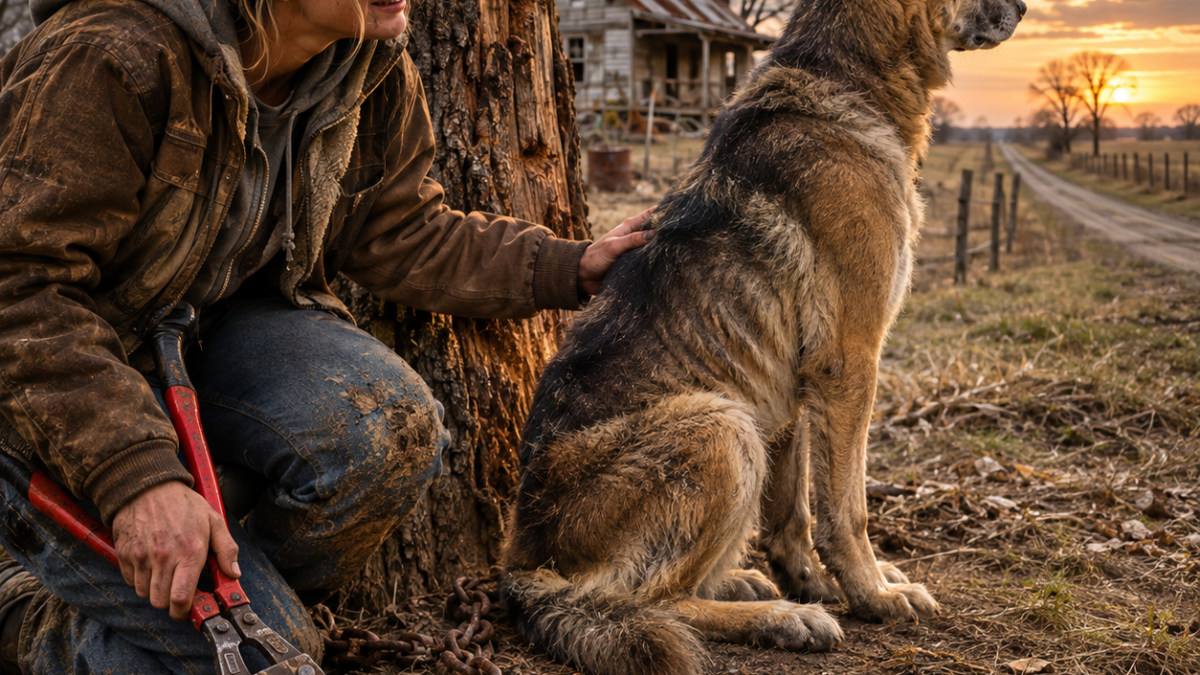
Then I saw the tree.
Oak.
Large.
Weathered.
Bare earth beneath it where nothing had grown because paws had traced the same radius for years.
And inside that dirt circle sat the dog.
He did not bark.
He did not stand.
He looked at me.
Heavy shepherd-mix head.
Dark face.
Brown coat faded from sun.
Hip bones visible.
One ear torn along the edge.
Chain from collar to tree.
The metal had worn a polished groove into the bark.
Around his neck—
I stopped.
The collar was not sitting on him.
It was inside him.
Skin had grown around parts of it.
Matted fur.
Old dried blood.
Fresh irritation.
Swelling.
I felt something cold move through my stomach.
Emilie had not exaggerated.
If anything, she had not described enough.
Oakley watched.
No wag.
No growl.
Nothing.
Just eyes.
Eyes that looked exhausted long before his body did.
I crouched outside the chain’s radius.
“Hey.”
His gaze followed.
“Hi, sweetheart.”
One ear moved.
Behind me, the owner said:
“Don’t get close.”
I ignored him.
“How long has that collar looked like this?”
“I don’t know.”
“You don’t know?”
“He doesn’t let me mess with him.”
Emilie made a sound behind me.
Angry.
I turned slightly.
She was crying.
Oakley looked at her.
And for the first time, his tail moved.
Barely.
One slow sweep through dirt.
I looked from him to Emilie.
She whispered:
“Hi, buddy.”
Another tail movement.
That was when I understood.
For eight years, someone had been coming.
Not the person who owned him.
The girl behind the fence.
PART2
The case moved quickly after that.
Photographs.
Veterinary consultation.
Supervisor.
Probable-cause documentation.
Temporary seizure authority.
The owner argued.
Then became angry.
Then said he didn’t care.
That last reaction somehow hurt worst.
“Take the damn dog, then.”
Eight years.
And that was goodbye.
Not a hand on Oakley’s head.
Not his name.
Nothing.
I had brought heavy bolt cutters.
I had cut chains before.
Dogs tied behind vacant houses.
Pit bulls tethered with logging chain.
A hound abandoned after an eviction.
You learn technique.
Position the jaws.
Keep your body clear.
Control the loose end.
Have backup.
Simple.
But when I crouched beside Oakley’s chain that April afternoon, my hands shook.
He had finally stood.
Slowly.
His back legs stiff.
The chain rattled.
At the sound, he lowered his head automatically.
I froze.
“Okay.”
He watched me.
“I’m not going to pull.”
His eyes followed the bolt cutters.
Emilie stood outside the yard because legally I could not involve her in the removal.
She was crying silently.
I spoke because she had told me that was what she had done for years.
Talking.
Any words.
Softly.
“Hey, you.”
Oakley’s ear turned.
“Hello.”
I positioned the cutter around a link far from his neck.
“I’m here for you.”
He looked directly at me.
I pressed.
Metal resisted.
Again.
The cutters bit deeper.
Then—
SNAP.
The sound was enormous.
At least it felt enormous.
The severed chain fell into dirt.
For the first time in eight years and four months, nothing connected Oakley to that tree.
I stood.
Stepped backward.
I expected movement.
Any direction.
Run.
Bolt.
Panic.
Circle beyond the old radius.
Something.
Oakley looked at the broken chain.
Then at me.
One front paw moved.
His body crossed the invisible line where the chain had always stopped him.
He paused.
Took another step.
I held my breath.
He came directly toward me.
Then stopped.
Sat.
Slowly.
At my feet.
As though even freedom required a command.
I lowered myself to one knee.
“It’s okay.”
Oakley’s head moved forward.
I thought he might sniff my hand.
Instead, he lowered his entire heavy head onto my thighs.
Just placed it there.
The weight.
I still remember.
Warm.
Solid.
Trusting in a way he had absolutely no logical reason to trust.
I put one hand behind his ear.
And started crying before I realized I was crying.
Not pretty tears.
My nose ran.
My breathing broke.
I buried my fingers in his filthy coat.
“You’re okay.”
I kept saying.
“You’re okay.”
It was not true yet.
But maybe promises sometimes begin before they become facts.
Oakley closed his eyes.
He did not run.
Did not explore.
He simply leaned harder.
Eight years attached to six feet of earth.
And the first thing he did with unlimited distance was choose contact.
That destroyed me.
The ride back to our office was quiet.
Oakley lay across the rear bench of my county pickup on several blankets.
Normally seized dogs were transported in secured crates.
His neck made that complicated.
We used a harness system and protective barrier.
Every few minutes I checked the mirror.
He was awake initially.
Watching the road.
Then his head dropped.
His eyes closed.
His body softened.
By the time we reached the highway, Oakley was asleep.
Deeply.
I pulled into a parking area.
Called Margaret Chambers.
My mentor.
Fifty-one years old.
Twenty-two years in animal cruelty investigation.
The kind of woman who could testify in court without raising her voice and somehow make negligent owners wish the earth would swallow them.
She answered.
“Jessica?”
I tried to speak.
Nothing.
“Jess?”
I looked in the mirror.
Oakley sleeping.
Broken chain in an evidence bag on the passenger floor.
My hands started shaking again.
Margaret waited.
I cried for nine minutes.
I know because the call record later showed 12:41 total and I barely spoke for the first nine.
She did not interrupt.
No:
Calm down.
No:
It’s okay.
No advice.
She stayed.
Eventually I said:
“He didn’t run.”
Margaret was silent.
“I cut it.”
My voice broke.
“And he could’ve gone anywhere.”
“He just came over.”
“He sat down.”
I covered my face.
“He put his head in my lap.”
Margaret exhaled slowly.
“Jessica.”
“Yeah?”
“Some dogs spend their entire lives waiting for one person.”
I looked at Oakley.
“You were that person today.”
I shook my head even though she couldn’t see.
“No.”
“There was a girl.”
“Emilie.”
“She kept him alive.”
“Then maybe he waited for two.”
That made me cry again.
Margaret continued:
“Bring him in.”
“We’ll handle the medical.”
Then, softer:
“And after that, take him home.”
I laughed through tears.
“I’m not adopting a seizure dog.”
“Of course not.”
She said.
“You’ve known him forty minutes.”
“Exactly.”
“You’ll last a month.”
“Margaret.”
“Drive safely.”
She hung up.
I hated her confidence.
Oakley’s neck was worse than we thought.
Dr. Sarah Patel examined him under sedation.
The collar had been on so long that tissue had grown around portions of it.
Infection.
Scar tissue.
Pressure damage.
Embedded metal.
Removing it required surgery.
Sarah stood beside me after imaging.
“This has been painful for a long time.”
“How painful?”
She hesitated.
“Significant.”
I hated vague medical language when I already knew what it meant.
“Would a person tolerate it?”
“Not willingly.”
I looked through the treatment-room window.
Oakley sedated.
Still.
“Then how did he?”
Sarah shook her head.
“Animals survive what they’re forced to survive.”
Not inspirational.
Not beautiful.
True.
The collar came off in pieces.
We kept it as evidence.
Heavy leather stiff with age.
Rusting buckle.
Part of the inner surface stained dark.
I could barely look at it.
Margaret did.
For a long time.
Then said:
“Put it in the case locker.”
I nodded.
She looked at me.
“Don’t turn suffering into an object you torture yourself with.”
That was one of her lessons too.
Document.
Prosecute.
Remember enough to improve.
Do not worship pain.
Oakley spent three weeks recovering in our contracted veterinary facility and then our office kennel wing.
He became everybody’s dog.
Not because he was exuberant.
He wasn’t.
He was quiet.
Almost painfully polite.
He never rushed food.
Never barked for attention.
Never pulled.
When someone entered his run, he stepped back.
Waited.
As if eight years had taught him the safest way to exist was to need nothing.
That bothered me.
I wanted him demanding.
Barking.
Stealing.
Being inconvenient.
But healing does not perform on schedule.
So every day after work, I sat beside his kennel.
I read.
At first from actual books.
Then I forgot one.
So I read inspection schedules.
“Tuesday, county vaccination clinic, eight thirty…”
Oakley’s ears lifted.
“Wednesday, staff meeting…”
Tail.
Next day, evidence intake form.
Then a bread label from my lunch.
“Enriched wheat flour, water, yeast…”
Margaret walked past.
Stopped.
“What are you reading him?”
“Bread.”
She stared.
“He likes it.”
Oakley watched me.
Margaret shook her head.
“Both of you need professional help.”
Then she brought him a blanket.
His ears responded to voices.
That fascinated me.
For years, Emilie had talked over the fence.
She later told me she read homework aloud.
Complained about school.
Told him about boys.
Teachers.
Her parents.
Everything.
Oakley had lived in a tiny physical radius but had still received pieces of a teenager’s world through sound.
Maybe that mattered.
Maybe her voice kept human contact from becoming only anger.
When I read, he would close his eyes.
Not sleep immediately.
Listen.
Then rest.
Words became safety.
The first time he barked at me, I celebrated.
He was two weeks post-surgery.
I had a chicken treat.
Held it too long while talking to Sarah.
Oakley barked once.
Sharp.
Demanding.
Everyone turned.
I looked at him.
“Did you just complain?”
He barked again.
I laughed.
“There you are.”
Sarah smiled.
“Careful what you wish for.”
I gave him chicken.
Good behavior?
Questionable.
Emotional milestone?
Absolutely.
The first toy confused him.
Rubber ball.
I rolled it.
Oakley watched.
Ball stopped.
He looked at me.
I rolled again.
Nothing.
I tossed gently.
The ball bounced.
Oakley flinched.
I stopped.
Too much.
Several days later, I left a soft stuffed fox in his room.
No squeaker.
The next morning, fox had moved.
From door to bed.
No witness.
I smiled all day.
Grass was stranger.
During medical recovery, we kept exercise controlled.
The first time he entered our fenced yard without tether, Oakley stayed near the wall.
I unclipped leash.
“Go ahead.”
Nothing.
He looked at me.
I walked to center.
He followed.
I moved away.
He followed.
I realized.
Distance.
He did not know what to do with it.
His whole life had been a circle around a tree.
Freedom is not automatically understood simply because restriction disappears.
So I sat in grass.
Oakley sat beside me.
That was day one.
Day two, five feet away.
Day four, ten.
Week two, he walked perimeter alone.
One morning a butterfly crossed.
Oakley followed three steps.
Stopped.
Then five.
I nearly applauded.
Did not.
He deserved normal.
Running took months.
Not because his legs were incapable once strength returned.
Because running away from me seemed unimaginable to him.
I would throw a treat.
He walked.
Throw farther.
Walk.
Then Emilie visited.
Everything changed.
She entered through the office lobby.
Oakley was in the yard with me.
I saw her before he did.
Seventeen.
Nervous.
Holding a bag of homemade dog biscuits.
“Can I?”
She asked.
“Of course.”
I opened gate.
Oakley looked.
Froze.
His ears lifted so high they almost touched.
Emilie whispered:
“Hi, buddy.”
Oakley launched.
Not walked.
Ran.
Full speed.
I had never seen him run.
He covered the yard in seconds.
Emilie dropped the bag.
Oakley stopped directly in front of her.
Sat.
Then placed his head against her legs.
Emilie folded around him.
Crying.
“Oh my God.”
Oakley pressed closer.
I turned away.
Margaret, beside me, wiped her eyes.
I looked.
She said:
“Allergies.”
“Sure.”
Emilie knelt.
Oakley placed his head in her lap.
Exactly like he had with me.
She laughed through tears.
“He remembers.”
“Of course.”
I said.
But what I meant was:
How could he forget?
For years, her voice crossed that fence.
Food appeared.
Water appeared.
A child’s hand when safe.
She had been the only evidence that people could come without hurting or ignoring.
Emilie looked at me.
“I used to tell him I’d get him out.”
My throat tightened.
“You did.”
“No.”
She shook her head.
“You did.”
“No.”
I pointed between us.
“We both did.”
She hugged Oakley again.
That was closer to truth.
Rescue stories love one hero.
Life rarely works that way.
Emilie visited weekly afterward.
Oakley knew the sound of her mother’s car.
Before door opened, he stood.
Tail.
Eventually bark.
Then run.
Every time, sit.
Head in lap.
His ritual.
I began understanding it.
Not submission.
Not trained behavior.
Connection.
A dog who had spent years unable to approach anyone chose closeness whenever someone safe returned.
The legal case continued.
Slow.
Frustrating.
Court dates.
Veterinary evidence.
Photographs.
Witness statements.
Prior calls.
Defense arguments.
Did the owner intentionally cause injury?
Did he understand collar was embedded?
Was food adequate?
What constituted shelter under county ordinance?
Animal law is often uglier in court than in rescue posts.
Oakley’s suffering looked obvious.
Proving every element still required work.
I learned quickly that outrage is not evidence.
So I became meticulous.
Dates.
Measurements.
Medical records.
Chain length.
Weather exposure.
Photos.
Emilie’s testimony.
Everything.
Margaret reviewed my file.
Red pen everywhere.
“Again.”
I hated her.
Then improved.
Because Oakley deserved competence, not emotion alone.
I still had not adopted him.
Technically.
Margaret reminded me constantly.
“So where’s he going?”
“Placement team will decide.”
“Sure.”
“We have applications.”
“Sure.”
“One family has three acres.”
“Wonderful.”
“Retired couple.”
“Lovely.”
“Margaret.”
She smiled.
“What?”
“You’re annoying.”
“Twenty-two years’ experience.”
Then an approved adopter came for meet-and-greet.
Good people.
Kind.
Fenced yard.
References excellent.
Oakley met them.
Accepted treats.
Let them pet.
Polite.
Then they walked him around yard.
Oakley kept looking back at me.
Every few steps.
Checking.
I told myself that was temporary attachment.
Normal.
The woman knelt.
Oakley stood beside her.
Then turned.
Walked back to me.
Sat on my feet.
Head in lap.
I stopped breathing.
The couple looked at each other.
Then the man smiled.
“I think we’re interviewing for a job that’s already filled.”
I tried to protest.
“No, he’s just used to me.”
The woman touched my arm.
“Jessica.”
I looked at her.
“You’re his person.”
Simple.
I hated them for being right.
They adopted another dog from us the following week.
That night I called Margaret.
“I have a problem.”
“You finally admitting it?”
“Shut up.”
She laughed.
“What happened?”
I told her.
Silence.
Then:
“Take your dog home.”
“My house is small.”
“He lived around a tree.”
I closed my eyes.
“I work long shifts.”
“He sleeps eighteen hours.”
“Expense.”
“You already buy him toys.”
“I bought one.”
“Jessica.”
I looked at stuffed fox now missing one ear because Oakley had finally learned toys were destructible.
“I can’t let him go.”
Margaret softened.
“Then don’t.”
Oakley came home with me on a Friday.
No ceremony.
One bed.
Two bowls.
A leash.
Stuffed fox.
Medication.
His file.
My terror.
I opened front door.
Oakley stopped.
Threshold.
New.
I entered.
“Come on.”
He followed.
Living room.
Kitchen.
Bedroom.
Back door.
He inspected everything cautiously.
Then returned to me.
Sat.
Head on thigh.
I laughed.
“This is going to be your whole personality, isn’t it?”
Tail.
I showed him bed.
He stood beside it.
Did not climb in.
I patted.
Nothing.
That night, I slept on couch.
Oakley slept on floor beside me.
Around 3 a.m., I woke.
His head rested against couch cushion near my hand.
I moved my fingers onto his forehead.
He sighed.
The next morning, I found him standing at back door.
I opened.
Small fenced yard.
Sun.
Oakley stepped out.
No chain.
No leash.
I stayed inside doorway.
He walked ten feet.
Turned.
Checked.
I was still there.
Twenty feet.
Turned.
Still there.
He reached far fence.
Turned.
His body stiffened for half a second.
I lifted my hand.
“I’m here.”
Oakley ran toward me.
Not because afraid exactly.
Because checking had found answer.
He reached me.
Then spun unexpectedly.
Ran back into yard.
A circle.
A full circle.
No six-foot limit.
Another.
Faster.
I laughed.
“Go!”
Oakley ran.
His back legs stretched.
Ears flattened from speed.
He almost tripped turning.
Recovered.
Ran again.
I sat on step crying.
He was eleven years old and running like a puppy who had just discovered legs.
Eventually he exhausted himself.
Came to me.
Sat.
Head in lap.
Of course.
I scratched ears.
“You can go anywhere.”
He closed eyes.
“And you keep coming back.”
That became our life.
Oakley struggled with rain.
Not fear exactly.
Rain had meant eight years with nowhere dry enough.
His old shelter had leaked.
When storms came at my house, he stood at back door but refused outside.
Fine.
We adjusted.
Short bathroom trip.
Towel.
Warm bed.
The first thunderstorm, he paced.
I sat on floor.
Read aloud.
Bread label again, for tradition.
He lay beside me.
Eventually slept.
He disliked chains.
Any metal rattle.
One day I dropped a leash with chain segment.
Oakley flattened.
I froze.
“Sorry.”
I sat.
Waited.
He approached slowly.
Sniffed leash.
Then left.
We never used chain collars.
No need.
Over months, random metal sounds became ordinary.
Keys.
Gate.
Tools.
His body stopped bracing every time.
Healing often looks like absence of reaction.
Hard to photograph.
Massive to witness.
Beds took longer.
I bought two.
One orthopedic.
One soft.
Oakley slept beside them.
Fine.
Then one afternoon I came home and found him asleep halfway on orthopedic bed.
Front half.
Back half floor.
Progress.
Next week entire dog.
I took photo.
Sent Margaret.
She replied:
BREAKING NEWS: DOG USES BED
I wrote:
THIS IS IMPORTANT
She replied:
I KNOW ❤️
Margaret pretended hardness.
Nobody believed her.
Oakley discovered balls.
Emilie helped.
She tossed one gently.
Oakley watched.
She ran after it herself.
He followed.
She picked it up.
Tossed.
Oakley chased her, not ball.
Third try, he grabbed it.
Then refused to release.
We laughed.
No formal fetch.
Just play.
Better.
Within months, my house filled with balls.
Tennis.
Rubber.
Rope.
One squeaky pig he hated.
Stuffed fox replacement.
Oakley became obsessed with yellow tennis balls.
Unlimited quantity, within reason.
I kept a basket.
He emptied it daily.
Did not play with all.
Apparently inventory inspection.
He also learned stealing.
A triumph.
First stolen item:
Sock.
I found Oakley in hallway holding it.
He froze.
I almost corrected.
Then remembered dog who had once tried to need nothing.
I laughed instead.
“What have you got?”
Tail wag.
He ran.
I chased.
Oakley ran faster.
Sock hanging.
For ten minutes we played.
Eventually trade.
Treat for sock.
I sat on floor afterward.
Ridiculously emotional.
Bad behavior can be beautiful when it means safety.
Food changed too.
Oakley initially waited.
I had not taught wait.
Old life perhaps.
Maybe he had learned that food only came if permission or person allowed.
I placed bowl.
He looked at me.
“Go ahead.”
He ate.
After months, I would put bowl down and he started before I finished standing.
Rude.
Perfect.
He gained healthy weight.
Coat improved.
Scars remained.
Neck worst.
Hair never fully regrew where collar had cut.
A pale ring.
People asked.
“What happened?”
I sometimes answered.
Sometimes not.
Oakley did not need to become a public exhibit of cruelty.
He was more than his scar.
The court case ended almost a year later.
There were penalties.
Restrictions on future animal ownership.
Financial consequences.
Not enough for my emotions.
Probably nothing would have been.
Margaret said:
“The court isn’t built to make your heart feel balanced.”
She was right.
I went home.
Oakley greeted me.
Ball.
Tail.
Head in lap.
The legal outcome mattered.
But he did not know.
His justice was ordinary life.
Emilie graduated high school.
We attended.
Oakley not allowed in ceremony.
He waited at home.
Afterward Emilie came wearing cap and gown.
Oakley went insane.
Ran.
Barked.
Sat.
Head in lap.
She knelt in white dress.
Dog hair everywhere.
Her mother complained.
Nobody cared.
Emilie placed graduation cap on Oakley’s head.
He looked offended.
Photo remains one of my favorites.
Girl who fed chained dog at nine.
Now eighteen.
Dog free beside her.
Time.
Emilie went to college two hours away.
She worried.
“He’ll think I left.”
“He won’t.”
“How do you know?”
I didn’t.
But I believed routine we had built was stronger now.
She visited monthly.
Oakley remembered every time.
Same ritual.
Sit.
Head.
No punishment for absence.
That was another kind of healing.
People could leave.
Then return.
One semester she missed two months.
Exams.
Work.
When she finally visited, Oakley was sleeping.
She entered quietly.
Said:
“Hi, buddy.”
His eyes opened.
He stood faster than his old joints should have allowed.
Ran.
Sat.
Head in lap.
Emilie cried.
“I thought he’d forget.”
I said:
“He waited eight years.”
“Two months isn’t impressive.”
She laughed.
Oakley aged.
Of course.
Eleven became twelve.
Then thirteen.
Running slowed.
Balls still important.
Head-in-lap ritual never changed.
When I came home, he waited by door.
Not chained.
Not because he had to.
He chose.
Difference enormous.
I would enter.
Oakley sit.
I sit on floor.
Head.
Every evening.
Some people might see similar image to tree.
Dog waiting.
But emotional world completely different.
At tree, waiting had no certainty.
At home, waiting contained expectation.
I return.
That is security.
He developed arthritis.
We added rugs.
Ramp to car.
Medication.
Emilie joked he had better healthcare than she did.
Possibly.
Oakley hated ramp.
Tried jumping.
Failed once.
Accepted ramp thereafter.
Dignity is flexible when joints hurt.
At thirteen, we returned to old property.
Not because I thought it would be therapeutic.
I generally distrust forcing animals to revisit trauma for human symbolism.
We had legal reason nearby, and road passed close.
I considered avoiding.
Then curiosity.
I parked at public roadside, far away.
Oakley was in back seat.
Window cracked.
The tree visible.
He looked.
Or maybe looked at field.
I do not know what he remembered.
No dramatic reaction.
No shaking.
No bark.
He sniffed air.
Then put head down.
I drove away.
That was perfect.
The tree no longer mattered enough to own him.
The property later changed hands.
Tree remained.
Chain gone.
Evidence case closed.
Sometimes I imagine new owners wondering about worn circle in bark.
Maybe disappeared over years.
Trees heal differently.
Oakley’s neck scar softened.
Not vanished.
He let me touch.
At first, he flinched if fingers went beneath chin.
By year two, leaned into scratches.
I was careful.
Never forced.
One evening he placed his chin in my hand.
Full weight.
Trust around the place hurt most.
That made me cry more than chain cutting.
No one saw.
Good.
Margaret retired.
We held awful office party.
Sheet cake.
Speeches.
She pretended not to cry.
Oakley attended briefly.
He loved her.
Maybe because she always smelled like treats.
Margaret sat.
Oakley put head on lap.
She stroked scarred neck.
Looked at me.
“This one wrecked you.”
“Completely.”
“Good.”
“Why good?”
She smiled.
“You needed it.”
Maybe.
After retirement, Margaret called weekly.
Mostly about Oakley.
“How’s my dog?”
“Your dog?”
“I supervised your emotional breakdown.”
“That does not create ownership.”
“Legal precedent uncertain.”
Oakley listened to speakerphone.
Sometimes tail moved at voice.
I stayed in animal investigation.
Eight months became years.
Oakley influenced everything.
When I encountered a chained dog, I still enforced law.
But I also paid attention to person behind fence.
Neighbor kid.
Mail carrier.
Anyone who might know history.
Emilie taught me witnesses can be children adults ignore.
Oakley taught me duration matters.
One snapshot cannot explain eight years.
Investigations need timelines.
We started community tethering outreach.
Fencing support.
Dog houses.
Low-cost collars.
Education.
Enforcement when necessary.
People sometimes mocked.
“Why help owners who don’t deserve dogs?”
Because dog deserves improvement now.
Accountability and assistance can coexist.
Not every chain case is Oakley’s.
Some owners lack resources, not care.
Some need law.
Some need fence.
Some need both.
Oakley made me less simplistic.
One case involved older man using chain because fence collapsed and he had no money.
Dog healthy.
Loved.
We helped repair fence.
Chain removed.
No charges.
Different story.
Important.
Justice requires context.
Another case looked similar but was severe neglect.
Charges.
Removal.
Also correct.
Same visual.
Different facts.
Oakley taught me not to confuse emotional resemblance with evidence.
His story became known locally despite my attempts.
A newspaper wrote feature.
Headline too dramatic.
DOG CHAINED EIGHT YEARS FINALLY FREE
People donated.
Good.
But strangers started asking to meet him.
No.
Oakley was not therapy exhibit.
We allowed Emilie.
Margaret.
Friends.
Normal visitors.
He had earned private life.
A documentary producer called.
Declined.
They wanted recreation at tree.
Absolutely not.
Oakley did not need to perform trauma for cameras.
Freedom includes not being useful.
That became one of my strongest beliefs.
Rescued animals do not owe us inspiration.
Oakley did not owe gratitude.
Obedience.
Affection.
He gave them anyway.
But if he had bitten me after chain cut?
Still deserved rescue.
If he had never put head in lap?
Still deserved rescue.
His sweetness did not make suffering more unjust.
Suffering was unjust regardless.
Important.
People love stories where abused animal remains gentle because it reassures us.
Look how forgiving.
But animals may be fearful.
Reactive.
Complicated.
They still deserve humane care.
Oakley happened to be gentle.
That was his personality, not moral reward.
I never wanted people using him as standard other traumatized animals had to meet.
At fourteen, Oakley developed a heart murmur.
Mild.
We monitored.
At fifteen, kidneys changed.
Again monitoring.
He still ate.
Still wanted walks.
Still demanded balls with less running.
He would carry ball to yard.
Lie down.
Chew.
Fine.
Games evolve.
Emilie finished college.
She came with diploma.
Oakley old.
Could not run as before.
He stood.
Tail wild.
She sat.
Head in lap.
Same.
She whispered:
“You waited.”
Oakley closed eyes.
I walked to kitchen because apparently onions.
No onions.
Just crying.
Emilie became a veterinary technician.
I claimed Oakley influenced career.
She rolled eyes.
“Maybe.”
Her first job at clinic where Oakley received care.
Full circle perhaps too neat.
Still true.
She helped trim his nails.
Oakley tolerated because Emilie.
At sixteen, his vision faded.
Hearing too.
Head-in-lap ritual adapted.
He no longer always heard door.
I would enter.
Tap floor gently.
Oakley lift head.
Smell.
Then stand.
Slow.
Sit.
I lowered myself because he could not bend comfortably.
Head.
Always.
Even when world dimmed, touch remained.
One winter evening, I sat beside him.
Snow not common where we lived, but cold rain.
Oakley asleep.
His paw over my wrist.
I thought of original story’s final line.
So many chains left to cut.
By then I understood chains were not all metal.
Fear.
Neglect.
Ignorance.
Poverty.
Bad law.
Trauma.
Human grief.
Some could be cut instantly.
Others loosened link by link.
Oakley’s physical chain took seconds.
His emotional chain took years.
Maybe never fully gone.
But light enough for him to run.
Enough.
His final decline came at sixteen.
Almost seventeen.
Extraordinary age for a large dog.
One morning he did not want breakfast.
Alarm.
Emilie came.
Vet exam.
Ultrasound.
Cancer.
Advanced.
No useful surgery.
Comfort.
I listened professionally.
Then stopped being professional.
Emilie held my hand.
Role reversal.
We brought Oakley home.
Of course.
He had spent enough life outside where someone else decided his comfort.
His final days belonged to him.
Chicken.
Soft beds.
Yard sun.
No medication schedule beyond comfort.
Balls nearby.
Margaret visited.
She sat.
Oakley smelled.
Tail.
Head in lap.
Margaret cried openly.
No allergy claim.
“Hey, old man.”
She stroked him.
“You did good.”
Emilie came every day.
One afternoon, Oakley could barely stand.
She sat on floor.
He crawled enough to place head on her legs.
Same girl.
Different ages.
I took one photograph only after asking her.
It remains private.
I will never post.
Some memories belong to people inside them.
The last morning, Oakley looked at me and did not try to stand.
I knew.
That recognition is a terrible privilege.
I called our vet.
Home visit.
I opened back door.
Oakley had loved lying in sun.
We carried bed outside beneath a maple tree.
Not oak.
I did not want symbolism forced.
Just shade he liked.
Emilie sat one side.
I sat other.
Margaret came.
Three women.
One old dog.
I had kept one cut link from the original chain after case closed.
Not whole chain.
Evidence disposition allowed one cleaned section eventually.
It sat in desk drawer.
I thought about bringing it outside.
Didn’t.
No.
Oakley’s final moment did not belong to chain.
It belonged to home.
The veterinarian gave sedative.
Oakley relaxed.
His breathing slowed.
I put my hand under head.
He shifted.
Then, with what little strength remained, moved until his head rested across my thighs.
Exactly.
The first day.
I lost it.
Not quietly.
I bent over him.
“You remember?”
Of course, I don’t know if he did.
I did.
“That was all you wanted, wasn’t it?”
My tears fell into his fur.
“Someone to stay.”
Emilie touched his shoulder.
Margaret looked away.
I whispered:
“I’m staying.”
The veterinarian administered final medication when we were ready.
Oakley’s breath softened.
One.
Another.
His head became heavier.
Warm.
Then still.
I did not move.
For a long time.
Eight years and four months under a tree.
Then almost eight more years with me.
That arithmetic mattered.
Not because it erased.
Nothing erases.
But light had nearly equaled darkness.
Love had almost caught up.
Maybe it never does completely.
Still.
We gave it a good run.
After he died, I could not enter house for an hour.
Everything inside was Oakley.
Two beds.
Ball basket.
Water bowl.
Hair.
Scratch marks near door.
I sat outside where his final bed had been.
Emilie beside me.
She said:
“Do you remember when I first called?”
“Yes.”
“I thought no one was coming.”
I looked at her.
“I’m sorry.”
She shook head.
“You came.”
Not fast enough.
My mind said.
But Margaret had taught me about alternate timelines.
Do the work you can with facts you have.
Then improve system.
No self-punishment as substitute for action.
We created a youth-reporting program partly because of Emilie.
Schools.
Online forms.
How to document animal concerns safely.
Do not trespass.
Do not confront.
Report.
Repeat if conditions worsen.
Children see things adults miss because they live in neighborhoods differently.
Oakley’s rescue had started with a nine-year-old girl throwing food over a fence.
We honored that.
Emilie spoke at first training.
She told officers:
“Please don’t assume kids are exaggerating because we’re kids.”
Room went silent.
Good.
Necessary.
Margaret and I developed mentorship module for new investigators.
Oakley’s case included.
Not emotional montage.
Actual file.
What evidence established neglect.
What prior visits missed.
How embedded collar progressed.
How witness history changed case.
How legal seizure authority was obtained.
How medical documentation supported prosecution.
Oakley became teacher without having to perform.
That I approved.
His photograph appears once.
Not chained.
Not injured.
Running in field.
Yellow ball.
That is how trainees meet him.
Then file.
Correct order.
Life before suffering, when possible.
I kept his collar after death.
The soft one he wore at home.
Blue.
Name tag.
OAKLEY
JESSICA HALE
The original embedded collar remained archived until legal retention ended, then destroyed.
Good.
I did not want it.
Pain did not deserve relic status.
Blue collar did.
It meant home.
One chain link remains in my drawer.
I considered throwing away.
Still there.
Not because I need remember suffering.
Because it reminds me one thing.
Chains look permanent until they aren’t.
Metal can hold for eight years.
Then one tool.
One legal order.
One person.
Snap.
That part still matters.
But if you ask me what Oakley taught me, it wasn’t that bolt cutters save dogs.
Too simple.
He taught me freedom is more than absence of restraint.
A dog can be physically unchained and still wait for permission to cross a room.
To eat.
To run.
To play.
To sleep deeply.
Freedom must reach nervous system.
That takes time.
Safety repeated until body believes.
First week home, Oakley checked whether I was still there.
Final year, he slept while I left for work.
That transformation is rescue.
Not first photograph.
Ordinary trust.
He also taught me staying is an action.
People think rescue means arriving.
Sometimes.
But animals with long histories need people who return.
Next morning.
Next vet appointment.
Next setback.
Next year.
Oakley had seen people pass.
Cars.
Neighbors.
Seasons.
Emilie came.
Then I came.
Most important part was that we kept coming.
After Oakley, whenever I removed a chained dog, I resisted promise:
Everything will be okay.
I said instead:
I’m here now.
Then tried to be there tomorrow.
More honest.
Some dogs I investigated were adopted elsewhere.
Some rehabilitated.
Some had harder outcomes.
Not every story Oakley.
I do not impose his ending.
But I carry his lesson.
Do not assume what animal wants after freedom.
Some run.
Some hide.
Some bite.
Some freeze.
Oakley sat.
All responses can make sense.
Give space.
Choice.
Time.
A new investigator once asked me:
“Why didn’t he run?”
I answered too quickly.
“Because he wanted me.”
Then corrected.
“I don’t actually know.”
Maybe legs hurt.
Maybe habit.
Maybe fear.
Maybe social contact.
Maybe all.
We should not turn animals into symbols so completely we erase biology.
But the head in my lap—
that was choice as far as I could tell.
He sought contact.
Whatever else he felt.
That truth enough.
His story often gets retold as:
“The dog waited eight years for Jessica.”
Not exactly.
Oakley did not know I existed.
He waited for conditions to change.
Emilie waited for an adult to act.
I happened to be investigator whose path crossed at right moment.
That makes me responsible, not destined.
Important difference.
Destiny makes systems irrelevant.
Responsibility demands better systems.
We improved follow-up flags for repeated complaints at same address.
One call may be misunderstanding.
Four calls over years need pattern review.
Oakley helped change that internally.
No magic.
Policy.
Sometimes best memorial is boring administrative reform.
The girl who fed him became veterinary technician.
The rookie investigator became senior investigator.
Margaret retired.
Oakley grew old.
The tree remained somewhere.
Life moved.
That is how stories continue after dramatic rescue.
No permanent climax.
Just Tuesday.
Wednesday.
Years.
I moved to a larger house after Oakley died.
Not because of him.
Mostly.
Backyard bigger.
For months, empty.
Margaret asked:
“When are you getting another dog?”
I glared.
She laughed.
“Not replacement.”
“I know.”
“Just asking.”
I waited a year.
Then fostered.
A brindle mutt named June.
Terrified of men.
Loved laundry.
Completely different.
I did not compare.
Mostly.
June eventually adopted by family.
Then another foster.
And another.
I kept working.
Oakley had not taught me every dog was mine.
He taught me I could stay without possessing.
Eventually one dog stayed.
Small brown hound mix named Pepper.
Ten.
Senior.
She does not put her head in my lap.
She sits with butt against my foot.
Her language.
Fine.
I love her differently.
Correctly.
Emilie still visits.
Now married.
She has a son.
The first time she brought him to my house, he was four.
He saw Oakley’s photograph.
“Who’s that?”
Emilie sat.
“That was my friend.”
Not dog.
Friend.
She told simple version.
“He lived outside and needed help.”
“Did you help him?”
“Yes.”
Her son smiled.
“Good.”
That was enough.
She keeps one photo in her home.
Graduation.
Cap on Oakley’s head.
Her son thinks Oakley attended college.
Maybe let him.
Every April 3, I notice date.
I do not hold ceremony.
Sometimes text Emilie.
Thinking about him.
She responds:
Me too.
Margaret sends chain emoji then heart.
Awful.
I still smile.
One April 3, I drove past old road.
Did not stop.
Tree maybe gone.
I didn’t look closely.
No need.
Oakley not there.
Hasn’t been for years.
The important geography changed.
When I teach new officers now, I talk about compassion fatigue.
Oakley broke me open early.
Margaret helped make sure I didn’t stay broken.
She told me after rescue:
“You’re going to see worse.”
I hated that.
She was right.
Then:
“If you stop feeling, leave.”
“But if you feel everything at full volume every time, you’ll leave too.”
“So learn where to put it.”
It took years.
Oakley helped.
I put grief into systems.
Reports.
Training.
Better investigations.
And sometimes tears in truck.
Both allowed.
I tell rookies crying is not failure.
But crying cannot replace documentation.
Love cannot replace probable cause.
Outrage cannot replace evidence.
If you want to help animals legally, do paperwork well.
Oakley’s case taught that too.
A life may depend on a sentence being precise.
The bolt cutters I used eventually broke.
Years later.
Handle cracked.
Maintenance retired them.
I almost kept.
Didn’t.
Tools are tools.
Lesson remains.
What I did keep is blue collar.
Oakley running photo.
One chain link.
Emilie’s first handwritten statement copy, with permission and redacted for training.
And memory of weight.
His head in my lap.
That is physical memory.
My thighs remember warmth when mind recalls.
Strange.
Sometimes Pepper does rest chin on my knee briefly.
For a second, Oakley arrives.
Not ghost.
Association.
I stroke Pepper.
Stay present.
She deserves not to be turned into memory vehicle.
Then moment passes.
I think the most misunderstood line in Oakley’s story is:
“What he wanted wasn’t freedom. He wanted someone who stayed.”
Beautiful.
But incomplete.
He deserved both.
Freedom without relationship can be frightening.
Relationship without freedom becomes captivity.
Oakley eventually had both.
He could run to far end of field.
He could choose bed.
He could ignore me.
He could come back.
He chose contact because choice existed.
That is love.
Not tether.
Not dependency.
Freedom plus return.
The first day after chain cut, he stayed because perhaps he did not know how to leave.
Years later, he stayed because home.
Those are not same.
That distinction matters most.
When I came home from work, Oakley waited at door.
Critics could say:
Still waiting.
Still dependent.
But then I would open door.
He could run into yard.
Sometimes he did.
Sometimes brought ball.
Sometimes ignored me for water.
Then eventually sat.
Head in lap.
A ritual freely chosen.
The chain no longer decided radius.
That made all difference.
At his final moment, head in my lap again.
People like circles in stories.
Beginning echoed ending.
True.
But middle is where meaning formed.
Thousands of ordinary choices between two head-in-lap moments.
Meals.
Walks.
Vet visits.
Rain.
Balls.
Emilie.
Socks.
Beds.
Arthritis.
Court.
Home.
Without middle, symbolism is empty.
Oakley did not wait eight years “for me.”
He endured eight years until people finally created another possibility.
Emilie kept hope practical.
She fed.
Reported.
Called.
I arrived with legal authority.
Sarah healed neck.
Margaret guided.
Staff cared.
Community changed.
Oakley adapted.
Rescue was network.
I was one node.
Good.
Hero stories should not hide teamwork.
Still, I accept one thing Margaret said.
For the moment chain broke, I was Oakley’s person.
He needed one stable body in chaotic transition.
I stayed.
Then kept staying.
So perhaps she was right enough.
Don’t tell her.
She is seventy now.
Still bossy.
Calls Oakley “our boy.”
I allow.
A few months ago, Margaret asked over coffee:
“If you could go back to that day, what would you tell yourself?”
I thought.
Young Jessica.
Eight months experience.
Shaking hands.
Bolt cutters.
I answered:
“Don’t expect him to run.”
Margaret smiled.
“Why?”
“Because rescue isn’t us deciding what freedom should look like.”
She nodded.
“What else?”
I thought longer.
“Bring tissues.”
She laughed.
If I could tell Oakley something before chain broke?
Not:
Run.
Not:
You’re free.
Those are human concepts.
I would say what I actually said.
“I’m here for you.”
And then prove it.
That is perhaps the only rescue promise worth making.
Not forever.
We cannot promise forever.
Life ends.
Jobs change.
People fail.
But:
I’m here now.
Then tomorrow, if possible.
Again.
Again.
Until trust becomes expectation.
Until expectation becomes home.
Oakley waited eight years.
I wish he hadn’t had to.
His patience is not beautiful because suffering is beautiful.
It isn’t.
What is beautiful is that waiting did not destroy his ability to connect.
He still had somewhere inside him that knew the weight of a human hand could mean comfort.
Emilie probably protected that part.
I believe that.
Her scraps were food.
Her voice may have been equally important.
She told me once what she said through fence when nine.
“I’m sorry.”
Every day.
Then at eleven:
“I’m going to get you out.”
At thirteen:
“I don’t know how.”
At fifteen:
“I haven’t forgotten.”
At seventeen:
“I’m calling again.”
That is staying too.
A child stayed before adult system did.
Never forget that.
Oakley’s story belongs to Emilie as much as me.
Maybe more.
I cut chain.
She kept him alive long enough for there to be chain to cut.
When Oakley saw her again, that run showed me something.
The dog who supposedly did not know freedom understood exactly where he wanted to go when the right person appeared.
He ran to relationship.
Then stopped.
Sat.
Head.
That was Oakley.
Always choosing closeness after being denied it.
I sometimes wonder about owner.
Anger faded into something less satisfying.
Accountability mattered.
But hatred consumes energy without improving next dog.
I focus systems.
Education.
Enforcement.
Prevention.
Mr. D became case file.
Oakley became life.
Better allocation.
His scarred neck appears in old photographs.
I used to look first.
Eventually I saw eyes.
Then ball.
Then Emilie.
Then grass.
That shift is healing for humans too.
At first trauma dominates image.
Later, person—or dog—expands beyond wound.
Oakley became bigger than scar.
So did my memory.
Today, when I open my office drawer, chain link sometimes catches light.
Small rust spot remains.
I touch.
Close drawer.
Then go work.
There are still chains.
Literal.
Metaphorical.
But I do not believe I personally must cut all.
Burnout loves messiah fantasies.
No.
We work team.
Case by case.
Dog by dog.
Child caller by caller.
Enough.
Oakley slept beside me on his last night.
His breathing regular.
Paw over hand.
Source story ends there, with him alive and me remembering that someone finally came.
In the truest version of his life, that feeling lasted for years before goodbye.
Maybe that is why his story still carries me.
Not because one rescue day was dramatic.
Because after eight years of waiting, he got years in which waiting meant something different.
Waiting for dinner.
Waiting for ball.
Waiting for Emilie.
Waiting for me to come home.
Ordinary waiting.
Safe waiting.
The kind where the door opens because it always does.
That is what I wish for every chained dog I see.
Not merely that someone cuts metal.
That afterward there is a door that opens.
A bowl.
A bed.
A person returning.
A place where the animal can eventually stop monitoring whether abandonment is about to happen.
Freedom is not one moment.
It is a pattern.
Oakley taught me that no manual could.
No lecture.
No training.
No statute.
He taught through weight of his head.
A dog who could finally leave and instead leaned in.
Some people hear this story and say:
“He forgave humans.”
I don’t know.
Forgiveness is human word.
Maybe he simply responded to safety.
Enough.
We do not need to make him morally superior.
He trusted Emilie.
Then me.
Then others.
Evidence accumulated.
His nervous system updated.
That is beautiful without mysticism.
He also taught me courage is not always running.
Sometimes it is staying alive inside terrible conditions until change comes.
But we must be careful with that lesson.
Never use survivors’ endurance to excuse delay.
Oakley should not have needed courage for eight years.
Our job is to make courage unnecessary sooner.
That is the ethical lesson.
If you see chained dog, don’t trespass with bolt cutters.
Call authorities.
Document safely.
Learn local laws.
Follow up.
If a child reports, listen.
If condition worsens, report again.
Oakley got free because persistence met authority and evidence.
Not vigilante fantasy.
That matters.
And if you are the person who eventually arrives?
Bring calm.
Do not assume gratitude.
Do not demand affection.
Cut what can be cut.
Then step back.
Let animal decide first movement.
Oakley chose me.
Another dog may choose distance.
Both deserve respect.
I was lucky.
My first major cruelty case gave me a dog who placed his head in my lap.
That could have taught me ego.
Instead, Margaret made sure it taught responsibility.
“Don’t make it about being chosen.”
She told me later.
“Make it about being worthy of choice.”
I wrote that down.
Still use.
Oakley chose my lap once.
My job afterward was to give him reasons to keep choosing home.
That is all.
When people ask why I kept him, I sometimes say:
“He wouldn’t leave.”
Funny.
But not complete.
Truth:
I couldn’t imagine sending him into another uncertainty after he had finally attached.
Could another good home have worked?
Probably.
Maybe wonderfully.
But when approved adopters saw what I refused to admit, they stepped aside with grace.
Oakley and I had become each other’s routine.
Sometimes foster fails are not failure.
They’re information.
My small house was enough.
Two beds eventually.
Illegal number of balls according to Margaret.
A girl visiting weekly.
A yard.
Car rides.
Vet.
Rain.
Sun.
Years.
Home did not require acreage.
Only safety and commitment.
At eleven, Oakley ran like three.
At sixteen, he walked like sixteen.
Both beautiful.
We allowed age.
No viral miracle about eternal youth.
His body carried history.
He slowed.
That was not loss of rescue.
Aging is privilege neglected animals are often denied.
Oakley got old.
I celebrate that.
He got arthritis.
Cloudy eyes.
Gray muzzle.
Bad breath.
Occasional accidents.
Expensive labs.
All ordinary.
Wonderful.
Give me ordinary over dramatic survival any day.
Oakley’s greatest victory was not when chain snapped.
It was when he became old enough to need a ramp.
Because it meant time had passed safely.
Years.
No chain.
No embedded collar.
Just old dog annoyed at accessibility equipment.
Perfect.
The final photograph I keep on desk shows Oakley asleep upside down on sofa.
One paw over nose.
Tennis ball beneath shoulder.
No scar visible from angle.
If you did not know history, you would see old dog sleeping.
Exactly.
That is how he deserves to be seen.
On the back I wrote:
APRIL 3 OPENED THE DOOR. THE REST OF HIS LIFE TAUGHT HIM HE COULD STAY OR GO.
Maybe too sentimental.
Margaret approved, so probably worse than I think.
Still.
True.
Oakley had waited eight years for something.
Not specifically me.
Not specifically bolt cutters.
He had waited for conditions to change enough that his world could become larger than a six-foot circle.
When that happened, he did not use new world to disappear.
He used it to build connection.
With me.
With Emilie.
With Margaret.
With everyone safe enough.
That was his choice.
And I stayed.
Not perfectly.
I worked late.
Made mistakes.
Lost patience once when he stole entire roast.
Apologized.
Took him to vets he disliked.
Made him use ramp.
Left for shifts.
Returned.
Staying is not sitting beside someone every second.
It is reliability across absence.
Oakley learned that.
So did I.
He waited at door because he knew I returned.
I went to work because I knew he would be there.
Mutual trust.
Nothing like chain.
Everything like love.
If I could reduce Oakley’s whole life with me to one image, it would still be that first moment.
Cut chain in dirt.
My hands shaking.
Metal falling.
Dog stepping beyond radius.
Sitting.
Head in lap.
But now I understand it differently.
At twenty-seven, I thought he was thanking me.
Now I think that interpretation flattered me.
Maybe he was asking.
Are you safe?
Are you staying?
My answer was not what I said that day.
My answer was the next eight years.
Yes.
Yes, Oakley.
I stayed.








