FULL ENDING :“HE CARRIED PEOPLE OUT OF DISASTER… NOW I HAVE TO CARRY HIM.” My Beloved Rescue Dog Rocky Lost the Use of His Back Legs — But Every Evening at the Park, He Showed Me Something I Will Never Forget
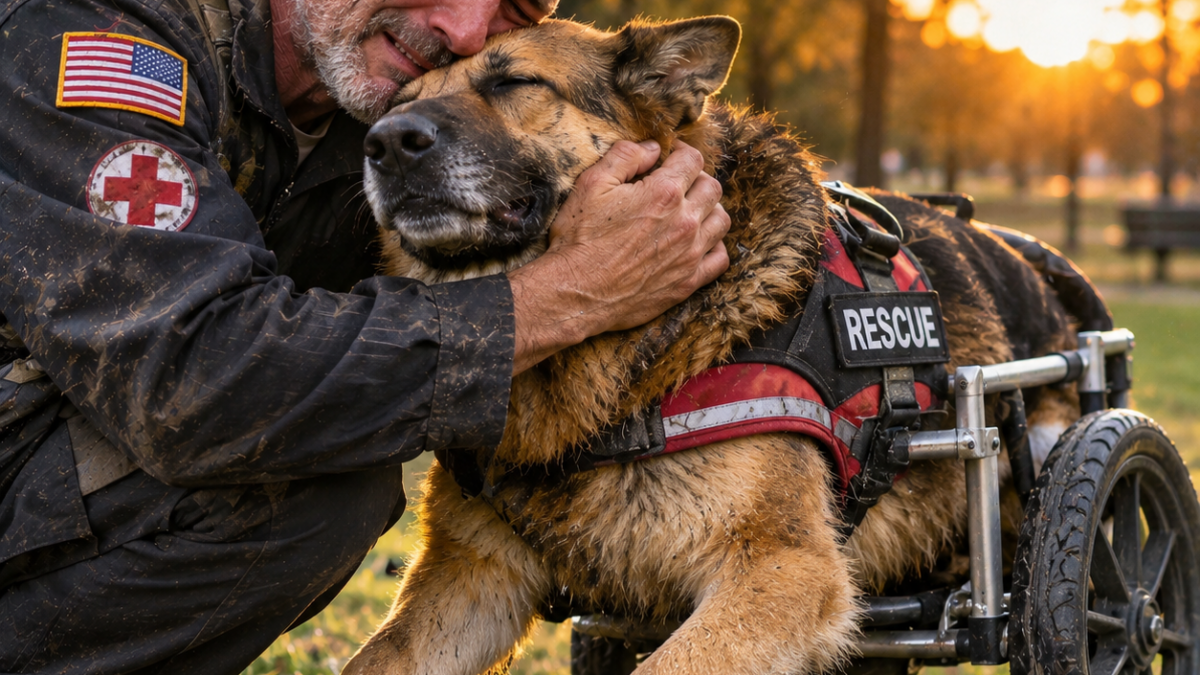
Few seemed to think about what happened when the dog who had spent his life saving others became old enough to need saving himself.
I met Rocky during the loneliest year of my life.
Catherine, my wife, had died after an illness that seemed to steal our future one ordinary day at a time.
We had been married for decades.
She loved wild roses, rainy Sunday mornings, and taking long walks through the neighborhood park.
After her death, I stopped going there.
I stopped doing most things.
Our house became a museum of everything I’d lost.
Her coffee mug remained in the kitchen cabinet.
Her gardening gloves hung beside the back door.
Sometimes I woke at three in the morning and reached toward her side of the bed before remembering she wasn’t there.
I was alive, but I had forgotten how to live.
Then I met Rocky.
He was already an old dog, his golden-brown muzzle beginning to turn gray, and his movements were slower than the stories of his rescue career suggested.
When I sat beside him, he didn’t bark or demand attention.
He simply walked over, placed his head on my knees, and stayed.
That was all.
And somehow, it was enough to make me cry for the first time in months.
I brought him home.
For nine years, he gave me mornings worth waking up for, evenings worth coming home to, and a reason to keep walking toward tomorrow.
We went to the park nearly every day.
He loved the wind moving through the trees, the sound of birds settling into the branches, and the wooden bench beside the walking path.
Sometimes he would sit perfectly still, lift his nose toward the breeze, and close his eyes as though the whole world had become something beautiful.
I used to laugh.
“You’ve got it figured out, haven’t you, old man?”
He’d answer with a slow wag of his tail.
Then, one winter morning, he couldn’t stand.
He tried.
I watched his front legs brace against the floor while his hindquarters refused to rise.
He looked back at me, confused.
My heart sank.
At the veterinary clinic, I learned that Rocky’s age and worsening mobility problems had finally reached a point where walking independently was no longer realistic.
There were things we could do to keep him comfortable.
But no treatment could make him young again.
I brought him home and placed his favorite cushion beside the living room window.
For several days, he lay there watching the front door.
At sunset, he’d lift his head.
His ears would twitch.
And he’d look toward the leash hanging beside Catherine’s old coat.
That was when I realized the worst part of his illness wasn’t simply that he couldn’t walk.
It was that the dog who had spent his life exploring the world was beginning to lose it.
And one evening, when he pressed his nose against my hand and stared toward the door again, I understood exactly what he was asking.
I bent down, rested my forehead against his, and whispered, “Alright, Rocky. We’re going.”
Then I reached beneath his weakening body, gathered him against my chest, and lifted.
FULL STORY CONTINUATION
Rocky made a soft sound as I brought him against me.
I stopped immediately.
“Easy, boy. I’ve got you.”
He shifted his head, searching for a comfortable position, and rested his chin near my collarbone.
I stood motionless in the hallway.
His weight pressed against my arms. I could feel the effort in my lower back and the trembling beginning in my knees.
For one terrible moment, I wondered whether I’d made a promise my aging body couldn’t keep.
Then Rocky lifted his muzzle.
He smelled the evening air coming through the open front door.
His nose moved.
And his tail gave another small wag.
I looked down at him.
“Well,” I whispered, “I guess that settles it.”
I stepped onto the porch.
The neighborhood looked exactly as it always had.
A bicycle lay in the grass across the street. Someone was watering flowers. A car passed slowly, its tires making a soft sound against the pavement.
But Rocky looked at everything as though he were seeing it again after a long absence.
His ears moved toward the sound of the car.
His nose lifted when he caught the scent of freshly cut grass.
He turned his head toward a robin singing from the maple tree near our driveway.
For three weeks, those sounds had reached him through the living room window.
Now he was surrounded by them.
I adjusted my grip and began walking.
Our park was only three blocks away.
I’d made that walk thousands of times.
With Catherine.
Then alone.
Then with Rocky trotting beside me, his leash hanging loosely from my hand.
I knew every cracked section of sidewalk, every leaning fence, every flower bed where someone had planted something new.
But I’d never traveled those three blocks with seventy pounds of elderly dog resting against my chest.
By the first corner, my arms were burning.
I stopped beside a wooden fence and leaned carefully against it.
Rocky looked up.
“Don’t give me that look,” I told him between breaths. “You’re heavier than you used to be.”
His tail moved.
I laughed.
The sound surprised me.
I’d spent the previous weeks crying in the veterinary clinic, worrying about medications, and struggling to help him move comfortably around the house.
I hadn’t laughed much.
Now, halfway to the park, with my back aching and Rocky’s muddy old nose resting against my shoulder, I found myself smiling.
“You’re enjoying this, aren’t you?”
He lifted his muzzle toward the wind.
I took that as an answer.
When we reached the park gate, I had to stop again.
My arms felt weak.
For a moment, I was frightened I might not make it to our bench.
But the bench was close.
Just beyond the large oak tree, near the path where the evening sunlight came through the leaves.
I adjusted Rocky’s weight and walked the final stretch.
Then I sat carefully, lowering him onto the blanket I’d draped across the wooden seat before lifting him from the car-free path beside it.
He settled against my thigh.
I kept one arm around his body so he would feel secure.
For several seconds, he did nothing.
Then he lifted his nose.
The wind moved through the trees.
A few birds called from the branches overhead.
Somewhere beyond the playground, a child laughed.
Rocky closed his eyes.
Not from exhaustion.
Not in the helpless way he had been closing them on his cushion at home.
He seemed to be listening.
Breathing.
Taking in every sound and scent.
I watched him.
And I understood that I hadn’t simply carried a dog to a park.
I’d returned a small piece of his world.
“You’re here, old boy,” I whispered.
His tail tapped the blanket once.
I rested my hand on his head.
“Just like I promised.”
We sat until the sky turned orange.
I didn’t look at my watch.
I didn’t worry about dinner.
I didn’t think about the dishes waiting in the sink or the laundry I hadn’t folded.
For that one evening, I wanted Rocky to have everything he loved about being alive.
The breeze.
The trees.
The distant voices.
The warmth of my hand.
And the familiar bench where we’d spent so many evenings together.
When the light began fading, I lifted him again.
He settled against me more easily this time.
The walk home was slow.
I stopped twice.
My back hurt when I finally stepped through the front door.
But after I placed Rocky on his cushion, he looked toward me with bright, peaceful eyes.
Then he rested his chin on his paws and fell asleep.
I sat on the floor beside him.
I was exhausted.
My shirt was covered in dog hair.
My arms were trembling.
But I felt happier than I had since the morning he lost the ability to walk.
Because I knew something now.
Rocky’s legs might have failed him.
But his desire to experience the world hadn’t.
And I had no intention of letting that desire disappear simply because carrying him was difficult.
That night, I woke at three seventeen.
I know the exact time because I glanced at the clock beside my bed.
For nine years, Rocky had been the reason I woke at that hour.
Not every night.
But often enough that it had become part of our routine.
Sometimes he needed to go outside.
Sometimes he heard a noise.
And sometimes he seemed to know I was lying awake thinking about Catherine.
He would appear beside my bed, his nails clicking softly against the floor.
Then he’d rest his head on the mattress.
If I didn’t move, he’d nudge my hand.
And eventually, I’d sit up.
“Alright, old man.”
He’d wag his tail.
I would scratch behind his ears, and the world would feel a little less empty.
But now there were no footsteps.
No nails against the hallway floor.
Rocky couldn’t come to me anymore.
I lay there listening to the silence.
Then I got up.
The living room was dark except for the streetlight filtering through the curtains.
Rocky was asleep on his cushion.
I sat beside him.
His breathing was slow and even.
I rested my hand gently against his shoulder.
“Couldn’t sleep,” I whispered.
He opened one eye.
Then closed it again.
I smiled sadly.
“Guess I’m the one coming to you now.”
I sat there for a long time.
His warm body was close enough that I could feel the rise and fall of his breathing beneath my hand.
And suddenly, I remembered the first night he spent in this house.
Nine years earlier.
The night neither of us knew how much we needed the other.
After Catherine died, I stopped teaching.
Technically, I retired.
That was what the paperwork said.
After thirty-four years in the classroom, people thought I deserved a rest.
My colleagues organized a farewell lunch.
A few former students wrote letters.
The school principal gave me a framed photograph of the building where I’d spent most of my working life.
People shook my hand.
They told me to enjoy retirement.
They asked about travel plans.
I smiled and thanked them.
Then I came home to a house where every room reminded me that my wife was gone.
Catherine had been the person who made ordinary days feel important.
She didn’t need expensive vacations.
She loved early morning coffee, wild roses, old books, and the sound of rain against the kitchen windows.
She could spend an entire afternoon in the garden without noticing the time.
When I complained about weeds, she laughed.
“Michael, some things are only weeds because nobody has taken the time to appreciate them.”
I used to shake my head.
“You’d defend a thistle if it grew in the right place.”
She’d grin.
“Of course I would.”
We had been married long enough to understand each other’s silences.
If I came home from school exhausted, she knew whether I needed conversation or quiet.
If she had a difficult day, I knew when to make tea and sit beside her.
Sometimes we didn’t say much at all.
We didn’t need to.
Our love had settled into hundreds of small gestures.
Her cup beside mine in the morning.
My hand resting against her back when we crossed a street.
Her voice calling from the garden.
The way she’d fall asleep with a book open against her chest.
Then came the illness.
At first, we believed we would get through it.
There were appointments.
Treatments.
Periods when she seemed stronger.
Days when we allowed ourselves to make plans.
Then the difficult days became more frequent.
Our conversations changed.
We began talking about medication schedules instead of summer vacations.
About test results instead of which roses to plant.
About whether she could manage the stairs.
I tried to stay cheerful.
Catherine saw through me.
One evening, she took my hand and said, “Michael, you don’t have to pretend you’re not frightened.”
I looked at her.
“I don’t want you worrying about me.”
She smiled sadly.
“I know.”
Then she squeezed my hand.
“But we’ve spent our lives telling each other the truth. Let’s not stop now.”
I cried that night.
She held me.
Even though she was the one who was ill, she still found a way to comfort me.
When she died, the silence that followed seemed impossible to bear.
I returned from the funeral and stood in our bedroom looking at the clothes hanging neatly in her closet.
Her slippers were beside the bed.
Her reading glasses rested on the nightstand.
A bookmark remained halfway through a novel she would never finish.
I sat on the edge of the mattress.
And I realized that nothing in my thirty-four years of teaching had prepared me for coming home to a life without her.
People visited at first.
Neighbors brought meals.
Former colleagues called.
Friends invited me to lunch.
I appreciated their kindness.
But eventually, everyone returned to their own routines.
That was natural.
Their lives continued.
Mine seemed to have stopped.
I stopped going to the park because every path reminded me of Catherine.
I stopped tending the roses because I couldn’t bear to touch the plants she’d loved.
Sometimes I spent entire afternoons sitting in her armchair, watching sunlight move across the floor.
At night, I wandered from room to room.
There were hours when the loneliness felt so heavy that I wondered whether anything meaningful remained for me.
I wasn’t planning a future.
I was simply enduring one day after another.
Then a former colleague told me about a retired rescue dog who needed a home.
“His name’s Rocky,” she said.
I shook my head.
“I don’t want a dog.”
She smiled.
“You used to talk about getting one with Catherine.”
That hurt.
Because she was right.
Catherine had wanted a dog for years.
We kept postponing it.
When work slowed down.
When we traveled less.
When retirement came.
There was always another reason to wait.
Now retirement had arrived.
And Catherine hadn’t lived to see it.
“I can’t take care of a dog,” I said.
My colleague looked at me.
“Are you sure?”
I nodded.
“I can barely take care of myself.”
She didn’t argue.
She simply gave me the contact information for the rescue organization handling Rocky’s retirement placement.
I placed the paper on the kitchen table.
For three days, I ignored it.
Then, one rainy afternoon, I picked it up.
I don’t know why.
Maybe because the house was unbearably quiet.
Maybe because I’d spent another morning staring at Catherine’s empty chair.
Or maybe because, somewhere beneath the grief, I remembered how much she had wanted a dog.
I called.
Rocky was lying on a thick mat when I first saw him.
He was old.
There was no hiding that.
His muzzle had turned gray, and his movements were deliberate.
He had the sturdy body of a dog who had spent years working hard, but his joints were stiff and his eyes carried the calm watchfulness of an animal accustomed to paying attention.
A volunteer explained that he’d retired after a long search-and-rescue career.
He had worked with trained handlers in dangerous conditions and participated in numerous operations.
His record credited him with helping find seventeen people who were brought out alive.
Seventeen.
I looked at the dog.
He looked back.
It was difficult to connect the quiet animal in front of me with the stories in the folder the volunteer handed over.
There were photographs of him wearing a rescue harness.
Newspaper clippings.
Letters from families.
Certificates recognizing his service.
One photograph showed him standing beside a rescue team after a difficult operation, his fur muddy and his ears standing attentively.
In another, he was resting beside a handler, looking exhausted but alert.
I studied the images.
“You mean this dog helped save seventeen people?”
The volunteer nodded.
“That’s what his records show.”
I looked at Rocky.
He lowered his head onto his paws.
I smiled faintly.
“He doesn’t look very impressed with himself.”
The volunteer laughed.
“He’s never been particularly interested in compliments.”
I crouched beside the mat.
Rocky lifted his eyes.
“Hello, old boy.”
His ears moved.
I held out my hand.
He sniffed it.
Then, without hesitation, he stood, walked toward me, and placed his head on my knees.
I stopped breathing.
It was such a simple gesture.
No excitement.
No barking.
No dramatic display of affection.
Just the quiet weight of his head against me.
I rested one trembling hand behind his ear.
And suddenly, I began crying.
I’d spent months keeping my grief contained.
I’d smiled when people asked how I was doing.
I’d said I was managing.
I’d told friends that time was helping.
But I wasn’t managing.
I was lonely.
I missed Catherine so badly that some days the pain felt physical.
And this old dog, who had never met me before, stood patiently with his head in my lap while I cried.
He didn’t move away.
He didn’t ask anything of me.
He simply stayed.
The volunteer turned aside, giving us privacy.
I looked down at Rocky.
His eyes were gentle.
His breathing was warm against my hand.
I whispered, “You don’t know me.”
He shifted closer.
I laughed through my tears.
“No, I guess that doesn’t matter to you.”
I stroked his gray muzzle.
“I’m not much company these days.”
His tail moved.
I looked at the volunteer.
Then back at Rocky.
And for the first time in months, I felt myself wanting something.
Not because it would bring Catherine back.
Not because it would erase the grief.
But because there was a living creature in front of me who needed a home.
And perhaps I needed someone to come home to.
I took a breath.
“What would I need to do to adopt him?”
The first week was awkward.
Rocky didn’t know my house.
I didn’t know his habits.
He followed me from room to room, not demanding attention, simply wanting to know where I was.
When I went into the kitchen, he lay near the doorway.
When I sat in the living room, he settled beside my chair.
When I climbed the stairs, he waited below until I returned.
At night, he slept on a cushion beside my bedroom door.
The first morning, I woke to find him staring at me.
His tail moved.
I stared back.
“What?”
He continued watching.
I sat up.
“Breakfast?”
His ears lifted.
I laughed.
“Alright. I suppose that’s something we should do.”
I got out of bed.
It was the first morning in months when I hadn’t spent twenty minutes trying to find a reason to stand up.
Rocky needed breakfast.
He needed water.
He needed a walk.
And because he needed those things, I got dressed.
I opened the curtains.
I made coffee.
I stepped outside.
At first, the walks were short.
Just around the block.
Then a little farther.
Rocky wasn’t young, but he still loved being outdoors.
He investigated every tree.
He stopped beside fences.
He lifted his nose whenever the wind changed direction.
Sometimes he’d freeze completely, ears raised, as though some distant scent had brought back a memory from his working days.
I found myself talking to him.
“Find something interesting?”
He’d sniff again.
“Probably somebody’s lunch.”
His tail would move.
I began looking forward to those walks.
And one afternoon, without planning it, I turned toward the park.
Catherine’s park.
The place I’d avoided since her death.
We approached the entrance.
I stopped.
The old wooden bench was visible beneath the trees.
My chest tightened.
I remembered Catherine sitting there with a paper cup of coffee, laughing because a squirrel had stolen a piece of her sandwich.
I remembered walking beside her in autumn when the leaves were bright red and gold.
I remembered our final visit, when she was already weak and needed to rest after only a short distance.
I couldn’t move.
Rocky looked up at me.
Then he gently pulled toward the path.
I stared at him.
“Not today, buddy.”
He stopped.
Waited.
Then stepped toward the park again.
I almost turned around.
But he looked so hopeful.
So certain that we should keep going.
And I realized something.
If I refused to enter that park forever, I’d be losing it twice.
Once when Catherine died.
And again through my own fear of remembering her.
So I followed Rocky.
We walked beneath the trees.
He stopped to sniff the grass.
He listened to birds overhead.
And when we reached the wooden bench, he sat beside it.
I stared.
Then I sat down.
For a long time, I didn’t speak.
Rocky settled near my feet.
The breeze moved through the branches.
And I began crying.
I cried for Catherine.
For the years we’d shared.
For the plans we’d never finish.
For the strange loneliness of being alive in a world that continued moving when the person you loved was gone.
Rocky rested his head against my knee.
I placed my hand on him.
“Catherine used to love this place,” I whispered.
He remained still.
“She would have loved you, too.”
His tail moved gently.
I laughed through my tears.
“She would have spoiled you rotten.”
And that afternoon, for the first time since Catherine’s death, I sat in the park without feeling that I’d betrayed her by being there without her.
Rocky didn’t replace my wife.
Nothing could.
But he helped me return to the places where her memory lived.
And slowly, those places began to hold something other than pain.
They began holding new memories, too.
For nine years, Rocky and I built a life out of ordinary things.
Morning walks.
Shared breakfasts.
Afternoons in the garden.
Evenings on our favorite park bench.
There were no great adventures in the way people usually understand the word.
We didn’t travel across the country.
We didn’t win competitions.
We didn’t become famous.
Most days, we simply kept each other company.
But after losing Catherine, I had learned that ordinary days could be the greatest gift a person received.
Rocky woke me early.
He never understood weekends.
Saturday morning meant the same thing as Tuesday morning.
When it was time for breakfast, he expected breakfast.
When it was time for our walk, he expected me to find my shoes.
If I lingered over the newspaper, he stood beside the front door and looked at me with such unmistakable disappointment that I usually surrendered.
“Alright, alright,” I’d tell him. “You win.”
He’d wag his tail.
I often wondered how many frightened families had once watched that same tail move when Rocky found someone they loved.
His rescue record had come home with him in a folder.
I kept it in a drawer beside Catherine’s old recipe books.
Sometimes, on rainy afternoons, I’d take it out and read through the stories.
One newspaper clipping described a search after a building collapse. Rocky and his handler had worked through a difficult section of debris before the team located survivors.
Another mentioned a missing person found after hours of searching dangerous terrain.
There were accounts of flood operations and searches in places where visibility was poor and every minute mattered.
The details varied.
But the photographs always showed the same dog.
Attentive.
Focused.
Determined.
One article included a photograph of Rocky resting after an operation, his tongue hanging out and his coat covered in dirt.
Beneath it was a caption crediting him with helping rescuers locate people who otherwise might not have been found in time.
I remember sitting at the kitchen table with that photograph in my hand.
Rocky was lying near the fireplace.
I looked from the article to the dog.
“Seventeen people,” I said.
He lifted his head.
I smiled.
“That’s quite a career.”
He blinked.
“Most of us are lucky if we make that much difference once.”
He lowered his head again.
I laughed.
“Not impressed, huh?”
That was Rocky.
His past seemed to matter far more to other people than to him.
He didn’t ask to be admired.
He didn’t behave as though he was owed anything for his service.
He wanted a comfortable place to sleep, regular meals, a chance to explore the park, and someone willing to scratch behind his ears.
I found that deeply humbling.
For thirty-four years, I’d measured my work through grades, report cards, lessons, and whether students improved.
I’d worried about whether I had taught enough.
Whether I had reached the children who needed help most.
Whether I’d made a difference.
Rocky didn’t seem burdened by any such questions.
He had worked.
He had helped.
And when the work ended, he continued living.
There was a lesson in that.
It took me a while to understand it.
About two years after I adopted him, a former student recognized me in the park.
She was a grown woman by then, pushing a stroller along the path.
“Mr. Michael?”
I looked up.
She smiled.
“You probably don’t remember me.”
I stared at her for a moment.
Then I recognized her eyes.
“Emily?”
She laughed.
“Yes!”
I stood.
“Well, would you look at that.”
She had been in my class years earlier.
A quiet little girl who loved reading but struggled with mathematics.
I remembered helping her after school while she worked through multiplication tables with tears in her eyes.
Now she was standing in front of me with a baby of her own.
She introduced her son.
We talked about her life.
Her work.
Her family.
She asked about Catherine, and I told her gently that she’d passed away.
Emily’s face softened.
“I’m so sorry.”
I nodded.
“Thank you.”
Then she looked down at Rocky.
“And who’s this handsome fellow?”
I smiled.
“Rocky.”
He stood slowly and wagged his tail.
She crouched.
“Hello, Rocky.”
I told her about his rescue career.
Her eyes widened.
“Seventeen people?”
I nodded.
“That’s what his records say.”
She looked at him with amazement.
“And now he gets to relax with you?”
I laughed.
“More or less. Although he’s still very demanding about his walks.”
Rocky sniffed her hand.
Emily smiled.
Then she looked up at me.
“Mr. Michael, do you know something?”
“What?”
“You were my favorite teacher.”
I felt my face grow warm.
“Well, that’s kind of you.”
She shook her head.
“No, I mean it.”
She looked toward her stroller.
“When I was little, I hated math because I thought being bad at it meant I was stupid.”
I remembered.
She continued.
“You used to tell me that struggling with something didn’t mean I couldn’t learn it. You always stayed after school until I understood.”
I smiled sadly.
“I was only doing my job.”
She shook her head.
“It mattered to me.”
For a moment, I couldn’t speak.
She continued.
“I still remember what you said before our final exam.”
I laughed.
“Oh, I don’t know if I remember that.”
She smiled.
“You said, ‘Bravery isn’t knowing every answer. It’s being willing to try the next problem.’”
I felt my eyes filling.
“I said that?”
She nodded.
“I’ve repeated it to myself a hundred times.”
We stood quietly.
Then Emily hugged me.
When she walked away, I sat back on the bench.
Rocky rested his head against my knee.
I looked down at him.
“Well, old boy.”
His tail moved.
“Maybe we both did some good after all.”
He closed his eyes.
And I thought about how strange life could be.
A retired teacher who believed his useful years were over.
A retired rescue dog whose working days had ended.
Both of us sitting in the same park, learning that the value of a life wasn’t measured only by what we could still accomplish.
Sometimes it was enough to be present.
To listen.
To care.
To remain beside someone when they needed company.
Rocky had taught me that without a single word.
As he grew older, our walks became slower.
At first, the changes were small.
He stopped running toward the park gate.
He took longer to climb the porch steps.
Sometimes he rested halfway through a walk, sitting beneath a tree while I waited beside him.
I didn’t mind.
I had nowhere urgent to be.
Retirement had given me one thing I’d lacked during my teaching years.
Time.
And I was happy to spend it with him.
“Take your time, buddy,” I’d say.
He’d sniff the air.
Then rise and continue.
Eventually, I noticed him hesitating before standing.
His hind legs seemed stiff.
He sometimes slipped on the polished kitchen floor.
I placed rugs along the hallway.
I moved his food and water bowls to make them easier to reach.
I began helping him into the car rather than expecting him to jump.
At first, Rocky seemed embarrassed by the assistance.
He would look at me, then toward the car seat, as though he couldn’t understand why his body no longer obeyed him.
I rested a hand against his chest.
“It’s alright, old man.”
He looked away.
“You’ve done plenty of lifting in your life. Let somebody help you for a change.”
His tail moved.
I smiled.
“That’s what I thought.”
Our veterinarian examined him regularly.
There were medications, exercises, and changes to his routine intended to manage his discomfort and support his mobility.
We did what we could.
Some days were better than others.
On good mornings, Rocky walked slowly but happily beside me.
On difficult mornings, he struggled to rise.
I learned to watch his face.
I noticed when he was tired.
I noticed when he needed a rest.
I learned that he didn’t have to cry out to tell me something was uncomfortable.
Sometimes discomfort appeared in the way he shifted his weight.
Sometimes in the way he hesitated before moving.
Sometimes in the tired look that replaced his usual interest in the front door.
I began adjusting our lives around what he could manage.
Shorter walks.
More rest.
Soft bedding.
Gentle help.
I never resented it.
For years, Rocky had adjusted himself to my grief.
He’d waited beside my chair when I wasn’t ready to go outside.
He’d settled quietly when I needed to cry.
He’d followed me through the house when I couldn’t bear being alone.
Now it was my turn to learn his needs.
And I wanted to do it well.
The morning he could no longer stand began like any other.
I woke early.
The kitchen was quiet.
Rain tapped gently against the windows.
I made coffee, then went into the living room.
Rocky was lying on his cushion.
“Morning, buddy.”
His tail moved.
I smiled.
“Ready for breakfast?”
He lifted his head.
Then he tried to stand.
His front legs pushed against the floor.
His hindquarters remained still.
He tried again.
I watched his body tense.
Then he slipped sideways and lay down.
For a moment, I couldn’t understand what had happened.
“Rocky?”
He looked at me.
His expression was confused.
I knelt beside him.
“Come on, boy. Easy.”
I supported him carefully.
He tried to put weight through his back legs.
They didn’t hold him.
My heart began pounding.
I helped him settle on the cushion again.
Then I reached for the phone.
The veterinarian’s office arranged to see us as soon as possible.
I drove there with Rocky resting on a thick blanket in the back seat.
Every few minutes, I glanced in the rearview mirror.
He lay quietly.
When I spoke, his ears moved.
“Almost there, buddy.”
I swallowed.
“You’re going to be alright.”
I wanted that to be true.
I wanted the veterinarian to give him an injection, prescribe another medicine, or tell me that a little rest would restore his strength.
I wanted someone to explain that this was temporary.
But deep down, I was frightened.
Because Rocky was old.
Very old.
And I’d begun to understand that there were changes even the best medical care couldn’t reverse.
The veterinarian examined him carefully.
She assessed his mobility, pain, general condition, and the progression of the problems we’d been monitoring.
Then she sat beside me.
“Michael.”
I looked up.
Her expression was gentle.
“I think we need to talk about what life is going to look like for Rocky from here.”
I felt my throat tighten.
“Is he going to walk again?”
She paused.
“I don’t think we should expect him to regain independent mobility the way he had it before.”
I stared at her.
She continued.
“We can discuss supportive care, comfort measures, assistance with movement, and ways to help him enjoy the things that still matter to him.”
I looked toward Rocky.
He was lying on the examination mat.
His eyes followed us.
I swallowed.
“He saved seventeen people.”
The words came out before I could stop them.
The veterinarian looked at me.
“I know.”
“He worked for twelve years.”
She nodded.
“He’s had an extraordinary life.”
I looked at my old dog.
His golden-brown muzzle was almost entirely gray now.
His ears drooped.
He watched me with the same patient eyes I’d seen when we first met.
I began crying.
“Please don’t tell me there’s nothing left we can do.”
The veterinarian moved her chair closer.
“Michael, there are still ways to care for him.”
I looked up.
“But we also need to be honest about his comfort. Rocky’s needs have changed, and our decisions should be based on how he’s feeling, not on how hard it is for us to imagine losing him.”
I wiped my face.
She spoke gently about assessing his quality of life.
Was he comfortable with appropriate treatment?
Was he eating?
Did he still show interest in familiar people and activities?
Could we help him with his daily needs without causing unnecessary distress?
Were there more good moments than bad?
I listened carefully.
For years, I’d thought that loving Rocky meant making sure he had everything.
Now I understood that love might also mean accepting limits I couldn’t change.
I looked at him.
He lifted his head.
His tail moved slowly against the mat.
I swallowed.
“He still wants to go outside.”
The veterinarian smiled slightly.
“Then let’s find ways to give him that safely, as long as he remains comfortable.”
I nodded.
We discussed how to support his body, move him without causing pain, and recognize when an outing might be too tiring.
There were options.
Not cures.
But ways to help.
I took notes.
I asked questions.
And when I left the clinic, I had something more useful than false reassurance.
I had a plan.
The first few days at home were difficult.
Rocky didn’t understand why he couldn’t rise.
He would hear a delivery truck and lift his head, preparing to investigate.
Then he would try to stand.
His body wouldn’t cooperate.
He’d settle again with a tired sigh.
I rearranged the living room.
I moved his cushion where he could see both the front door and the garden through the window.
I placed his water close enough that he didn’t have to strain.
I learned to help him change position and attend to his daily needs.
I followed the veterinarian’s instructions for comfort and hygiene.
I checked him throughout the day.
Sometimes he seemed content to rest.
Other times, he watched the doorway so intently that I could hardly bear it.
The worst part came at sunset.
For nine years, that had been our time.
The hour when the light grew soft.
The hour when the birds began settling into the trees.
The hour when Rocky stood beside the front door and looked at me until I reached for his leash.
Now the hour came, and he couldn’t stand.
I tried opening the window.
He lifted his nose toward the breeze.
I brought him fresh grass from the garden.
He sniffed it.
I sat beside him and played recordings of birds.
He listened.
But none of it was the same.
One evening, I found him staring at the leash hanging beside Catherine’s old coat.
I followed his gaze.
The leash was faded from years of use.
The handle had become soft where my fingers had held it.
I took it down.
Rocky’s ears lifted.
My heart broke.
“Oh, buddy.”
He looked toward the door.
Then at me.
He tried to shift his body.
His hind legs remained still.
I sat on the floor beside him.
For a long time, I simply rested my hand against his head.
I thought about Catherine.
The way she’d loved our walks.
The way Rocky had brought me back to the park after she died.
I thought about the bench beneath the trees.
The evening sunlight.
The birds.
The way Rocky lifted his nose toward the wind and closed his eyes.
Then I looked at the dog who had given me nine years of companionship.
He had spent twelve years searching for strangers who couldn’t find their way home.
He had spent nine years helping a lonely man remember how to live.
And now he couldn’t even reach the front porch.
I felt anger rise inside me.
Not at Rocky.
Not at the veterinarian.
At the unfairness of it.
At the way age quietly takes things from the creatures we love.
At the fact that a dog who had given so much could no longer do something as simple as walk to the park.
I rested my forehead against his.
“I’m sorry, old boy.”
His breathing warmed my cheek.
“I can’t make your legs work again.”
My voice broke.
“I wish I could.”
He shifted his head and pressed his nose against my hand.
I closed my eyes.
Then I remembered the promise Catherine and I had made to each other when she was ill.
We couldn’t control everything that happened.
But we could decide how much love we brought to the days we were given.
I opened my eyes.
I looked at Rocky.
Then I looked at the door.
And I made my decision.
“If you can’t walk to the park,” I whispered, “I’ll carry you.”
His ears moved.
I smiled through tears.
“I mean it.”
I stroked his gray muzzle.
“You’ve spent your whole life showing up for other people. I’m not going to let your world become this living room just because your legs are tired.”
His tail moved.
I laughed softly.
“That’s right.”
I kissed the top of his head.
“We’re going back to our bench.”
After that first evening, I began preparing for our outings with the seriousness of a man organizing an expedition.
I checked the weather.
I made sure Rocky was comfortable.
I followed the veterinarian’s guidance about handling him and limiting activity.
I brought a blanket.
I carried water.
I chose the shortest route.
Some evenings, when he was particularly tired, we spent only a little time outside.
Other evenings, he seemed alert and eager, and we stayed long enough to watch the sun disappear behind the trees.
I learned how to lift him more comfortably.
I learned where to pause.
I learned which parts of the sidewalk were easiest to navigate.
Sometimes I used a low wagon with padded support to make the journey less strenuous, then lifted him into my arms for the short distance to our bench.
But Rocky always knew when we were going somewhere.
The moment I picked up his familiar leash, his ears rose.
When I opened the door, his nose began moving.
And when we reached the park, he seemed to become a little more alive.
He didn’t need to run.
He didn’t need to chase squirrels.
He didn’t need to prove he was still the dog who had once searched dangerous places for missing people.
He simply wanted to be there.
And I wanted to give him that.
One evening, a little girl stopped beside our bench.
She was walking with her father and a young dog who seemed to have more energy than sense.
The puppy bounced excitedly at the end of the leash.
The girl looked at Rocky.
“Why are you holding your dog?”
I smiled.
“His legs don’t work very well anymore.”
She frowned.
“Is he sick?”
“He’s very old.”
She looked at Rocky carefully.
“Does he get sad?”
I thought about that.
“Sometimes he seems frustrated because he can’t do everything he used to.”
She nodded solemnly.
Then she asked, “Does he still like the park?”
I smiled.
“Very much.”
She looked at Rocky.
His eyes were half closed.
The breeze moved through his fur.
His tail rested against the blanket.
The little girl smiled.
“He looks happy.”
I felt my throat tighten.
“Yes,” I whispered. “I think he is.”
She looked at me.
“Can I pet him?”
I checked Rocky’s expression and invited her to approach gently.
She stroked the top of his head.
“Hi, old dog.”
Rocky’s tail moved.
The girl laughed.
“He likes me!”
I smiled.
“He’s always liked kind people.”
She patted him once more.
Then her father called her back.
As they walked away, the puppy barked enthusiastically at a squirrel.
The little girl laughed.
Rocky lifted his head.
His ears moved toward the sound.
For a moment, I saw something of the dog he’d been years earlier.
Alert.
Interested.
Alive to every movement around him.
I rested my hand against his shoulder.
“Remember being that young?”
He looked up.
I laughed.
“Me neither.”
Then we sat together watching the puppy disappear around the path.
It was a small moment.
But I carried it home.
Because I was learning that even as Rocky’s world became more limited, there were still new things for him to experience.
A child’s gentle hand.
The sound of another dog.
The smell of fresh grass after rain.
A breeze he’d never felt on exactly that evening.
Age hadn’t taken everything.
And I wanted to notice what remained.
As the weeks passed, Rocky’s strength continued to fade.
I noticed it in small things.
He slept longer.
He took less interest in food on some mornings.
The effort of changing position sometimes exhausted him.
His eyes remained bright when I spoke to him, but there were days when even lifting his head seemed difficult.
I kept in close contact with the veterinarian.
We adjusted his comfort care as needed and watched for signs that his suffering might outweigh the pleasures he still enjoyed.
I was determined not to confuse my need to keep him with what was best for him.
That was the hardest part of loving an aging animal.
There are things no amount of devotion can fix.
You can provide warmth.
You can make sure the bedding is soft.
You can offer gentle hands, familiar voices, and relief from discomfort.
You can adapt your home and your days.
But you cannot bargain with time.
I knew that.
I’d learned it with Catherine.
And now I was learning it again with Rocky.
One evening, after returning from the park, I sat beside his cushion and brushed his fur.
His coat had grown thinner in places.
The gray around his muzzle was nearly white.
But when the brush moved gently along his shoulder, he closed his eyes.
I smiled.
“Still like that, huh?”
His tail shifted.
I kept brushing.
I thought about the first time I’d done this.
He’d been lying on the living room floor, shedding enough hair to cover the carpet.
I’d complained loudly.
“Rocky, I could make another dog out of what you’re leaving behind.”
He’d wagged his tail.
I’d laughed.
Now I would have welcomed a hundred more years of dog hair on the floor if it meant he could stay.
I stopped brushing.
My eyes filled.
Rocky opened one eye.
I wiped my face.
“Don’t worry, buddy.”
He watched me.
“I’m alright.”
It wasn’t entirely true.
But I was trying.
I placed the brush aside and rested my hand against his head.
“Remember the first day we went to Catherine’s park?”
His ears moved.
“You dragged me right through the gate.”
I smiled.
“I was so angry with you.”
His tail shifted again.
“Not really angry.”
I leaned closer.
“Just scared.”
I looked toward the photograph of Catherine on the mantel.
“I thought if I went there without her, it would mean I was leaving her behind.”
Rocky rested his chin on his paws.
I stroked his ear.
“But you knew better, didn’t you?”
He closed his eyes.
“You showed me I could keep loving her and still have a life.”
I swallowed.
“And now I suppose you’re teaching me the same thing again.”
The last evening we went to the park together was quiet.
There was nothing dramatic about it.
No storm.
No emergency.
No sign that the day would become a memory I’d revisit for the rest of my life.
Rocky had rested comfortably through most of the afternoon.
When the sunlight began turning gold, he lifted his head toward the front door.
I looked at him.
“Want to go out, old man?”
His tail moved once.
I smiled.
“Alright.”
I prepared his blanket and made sure he was comfortable before helping him outside.
The air was cool.
A light breeze moved through the neighborhood.
The sky was clear except for a few thin clouds.
We traveled slowly to the park.
When I lifted Rocky onto our bench, he settled against me with a deep, tired sigh.
I wrapped one arm around him.
For a while, we simply sat.
The trees moved gently overhead.
Birds called from the branches.
A few people walked along the path.
Rocky watched them with quiet interest.
Then he lifted his nose toward the wind.
I smiled.
“There it is.”
He closed his eyes.
That was his favorite part.
The moment when he stopped trying to move and simply listened to the world.
I leaned back against the bench.
The sun warmed my face.
I thought about Catherine.
About the day we first found this place.
We had been walking after dinner when she spotted the bench beneath the trees.
She stopped and pointed.
“Michael, look.”
I followed her gaze.
“What?”
“That little spot.”
I laughed.
“It’s a bench.”
She gave me the familiar look she reserved for moments when I was being unnecessarily practical.
“I know it’s a bench.”
“Then what am I supposed to be looking at?”
She took my hand.
“The way the light falls through those branches.”
I looked again.
The sun was setting.
Golden light filtered through the leaves, making the grass beneath the oak tree glow.
Catherine smiled.
“It’s beautiful.”
I nodded.
“Yeah.”
She sat down.
I sat beside her.
And from that evening forward, it became our place.
Years later, Rocky would bring me back to the same bench.
Then, when his legs failed, I would carry him there.
Now I sat with him resting against me, watching the same golden light Catherine had loved.
I looked down.
Rocky was breathing slowly.
His ears moved when a bird called.
I stroked his head.
“You know, buddy, I think Catherine would have been proud of you.”
His tail moved faintly.
I smiled through tears.
“She never got to meet you.”
I looked toward the trees.
“But she would have loved you.”
My voice broke.
“She always said I needed somebody to make me leave the house.”
I laughed softly.
“You certainly managed that.”
Rocky rested his chin against my arm.
I leaned closer.
“Thank you.”
He looked up.
I held his gaze.
“Thank you for all the mornings.”
His eyes softened.
“For the walks.”
I swallowed.
“For the nights when I couldn’t sleep.”
I brushed my fingers along his gray muzzle.
“For reminding me that I could still love something after losing her.”
The wind moved through the trees.
I looked toward the setting sun.
“And thank you for letting me take care of you.”
Rocky closed his eyes again.
We stayed until the light began fading.
Then I brought him home.
I settled him on his favorite cushion, gave him the care he needed, and sat beside him while he rested.
Before going to bed, I leaned down and kissed his head.
“Goodnight, old boy.”
His tail moved faintly.
I smiled.
“See you in the morning.”
I didn’t know it would be our last goodnight.
Rocky died on a quiet Sunday morning.
The sun was just beginning to rise.
I woke early, as I usually did, and went into the living room.
He was resting on his favorite cushion beside the window.
The curtains were partly open.
Soft golden light touched the edge of his gray muzzle.
At first, I thought he was sleeping.
I walked toward him.
“Morning, buddy.”
He didn’t lift his head.
I knelt beside him.
His breathing was faint.
Very slow.
I touched his shoulder.
“Rocky?”
His eyes opened slightly.
He looked toward me.
And something in that look made my heart stop.
I knew.
I don’t know how.
Maybe it was the way his body had become so still.
Maybe it was the quietness in his eyes.
Maybe it was simply the knowledge that had been growing inside me for weeks.
But I knew we were very close to goodbye.
I sat on the floor beside him.
I rested one hand gently against his head.
“Hey, old man.”
His breathing remained slow.
I leaned closer.
“I’m here.”
He didn’t move.
I felt tears gathering.
I wanted to call the veterinarian.
I wanted to ask whether there was something more I should do.
But Rocky was calm, and there was no frantic struggle or obvious distress in that moment.
I stayed beside him, watching carefully, ready to seek help if he became uncomfortable.
He rested his head beneath my palm.
I began talking.
I don’t remember deciding to speak.
The words simply came.
I told him about the park.
About the first day he’d taken me through the gate when I was afraid to return there.
About the squirrels he’d watched from our bench.
About the little girl who called him an old dog and made him wag his tail.
I told him about our mornings.
The coffee.
The walks.
The times he’d stood beside the front door and refused to let me spend another afternoon alone in the house.
I told him about the night he first rested his head on my knees.
How lonely I’d been.
How much I’d missed Catherine.
How I had gone to meet him believing I didn’t have enough love left to give anyone.
My voice broke.
“You were wrong about one thing, buddy.”
I smiled through tears.
“I thought I was bringing you home because you needed somebody.”
I stroked his head.
“But I was the one who needed rescuing.”
His chest rose slowly.
Then fell.
I leaned closer.
“You saved seventeen people before you met me.”
I wiped my eyes.
“And then you saved one more.”
I looked toward Catherine’s photograph.
“You never met her, Rocky.”
My throat tightened.
“But you helped me remember her without feeling like I was drowning.”
I rested my forehead gently against his.
“I don’t know how to thank you for that.”
The room was quiet.
The clock ticked above the mantel.
A bird began singing outside.
Rocky’s breathing grew softer.
I kept my hand against his head.
“You don’t have to fight anymore, old boy.”
My tears fell onto the blanket.
“You’ve done enough.”
I swallowed.
“More than enough.”
His eyes closed.
I stroked his ear.
“I love you.”
Then, quietly, almost imperceptibly, he took his final breath.
And did not take another.
For several seconds, I remained completely still.
My hand rested against his head.
The sunlight moved slowly across the floor.
Somewhere outside, a car passed.
A bird called again.
The world continued exactly as it had the morning before.
But my Rocky was gone.
I whispered his name.
Once.
Then again.
“Rocky?”
There was no answer.
I leaned down and kissed the top of his head.
And I began to cry.
I cannot tell you how long I sat beside him.
An hour.
Perhaps longer.
Time seemed to lose its meaning.
I rested my hand against his fur and remembered the warmth of his body.
I remembered the way he’d looked at me when I picked up his leash.
The way he settled against my shoulder during our final outings.
The way he’d closed his eyes when the wind moved through the trees.
I cried until my throat ached.
But even through the grief, something else was present.
Gratitude.
A deep, almost painful gratitude.
Because I’d had him.
Nine years.
Nine years with a dog who had spent the previous part of his extraordinary life helping other people survive.
Nine years of walks and quiet evenings.
Nine years of being needed.
Nine years of waking up to the sound of his breathing and knowing I wasn’t alone.
I thought about the woman I’d lost before Rocky came into my life.
Catherine.
And the man I had become after her death.
A man who barely opened his curtains.
A man who stopped going to the park.
A man who had forgotten how to find joy in ordinary things.
Rocky had never tried to replace Catherine.
He couldn’t have.
But he had sat beside me while I learned how to live with her absence.
And when his own body began failing, he gave me one final opportunity to return the love he’d offered so freely.
I was grateful for every difficult walk.
Every aching muscle.
Every evening when I carried his weight against my chest.
I was grateful I hadn’t allowed his final weeks to become nothing but waiting for the end.
He had felt the wind.
He had heard the birds.
He had watched children playing.
He had sat beneath the trees.
And on his final evening, he’d rested beside me in the park where our friendship had grown.
I looked down at him.
His face was peaceful.
I brushed my fingers across his gray muzzle.
“Thank you, Rocky.”
My voice broke.
“Thank you for staying with me as long as you could.”
Then I sat quietly with him until I was ready to make the necessary arrangements.
The next day, I buried Rocky beneath the old oak tree behind our garden.
It was the tree Catherine had loved most.
In summer, its branches cast a wide circle of shade across the grass.
In autumn, its leaves turned golden before falling around the roots.
And in spring, wildflowers appeared along the fence nearby.
Catherine used to sit beneath that tree with a book.
Sometimes she’d fall asleep in the afternoon sunlight.
I’d look out from the kitchen window and see her resting there, her face peaceful, one hand lying open against the grass.
When Rocky came into my life, he quickly discovered the same spot.
On warm days, he’d stretch out beneath the branches.
Sometimes I’d find him sleeping beside Catherine’s old garden chair.
It always made me smile.
The two creatures who had brought the most love into my life had chosen the same place to rest.
So when the time came to say goodbye, I knew where I wanted Rocky to be.
I made the arrangements carefully and chose a place beneath the oak, where it was permitted and where the ground was suitable.
Then I brought out my shovel.
I dug slowly.
At my age, the work was difficult.
My shoulders ached.
My back protested.
Several times, I had to stop and catch my breath.
But I wanted to do it myself.
Not because anyone expected me to.
Because for nine years, Rocky had given me things I could never repay.
This was one last act of care.
Each time the shovel entered the ground, I remembered something.
Our first walk.
His head resting on my knees.
The morning he dragged me toward Catherine’s park.
The way he watched the front door when his legs stopped working.
The warmth of his breathing against my ear as I carried him down the sidewalk.
At one point, I leaned against the shovel and began crying.
I looked toward the house.
Through the living room window, I could see his empty cushion.
For the first time in nine years, there would be no dog waiting when I opened the door.
No tail moving against the floor.
No patient eyes following me toward the kitchen.
I wiped my face.
Then I continued.
When everything was ready, I said goodbye.
I spoke to Rocky as though he were resting beside me on our park bench.
I thanked him for his service.
For the seventeen people he’d helped save.
For all the strangers whose families had received another chance because he kept searching.
And then I thanked him for me.
For the lonely retired teacher who had walked into a rescue center believing his best days were over.
For the man who had forgotten how to smile after losing Catherine.
For every ordinary morning Rocky had turned into a reason to get out of bed.
I told him I loved him.
Then I laid him to rest.
When the work was finished, I planted a small wild rosebush above him.
Catherine had always loved wild roses.
She said they were beautiful because they grew without asking anyone’s permission.
I remembered her laughing as she showed me a cluster of blossoms beside a country road.
“Look, Michael. Nobody planted those, and they’re still beautiful.”
I smiled through my tears as I pressed the soil around the little rosebush.
“Here’s one for you, Catherine.”
Then I looked down.
“And one for Rocky.”
I remained beneath the oak until the afternoon light began fading.
The garden was quiet.
A breeze moved through the leaves.
I placed my hand gently against the soil.
And I thought, not for the first time, about how strange love could be.
Catherine had never met Rocky.
Rocky had never known the woman whose loss brought him into my life.
Yet the two of them had become inseparable parts of my story.
She had taught me how to love deeply.
He had taught me how to keep loving after goodbye.
I looked at the wild rosebush.
“Take care of each other,” I whispered.
Then I stood and walked back into the house.
That evening, I did something I hadn’t expected.
I went to the park.
Alone.
The sun was beginning to set when I looked toward Rocky’s empty cushion.
His leash still hung beside Catherine’s old coat.
For a moment, I stood completely motionless.
I could almost hear him.
The familiar movement of his paws.
The quiet sound he made when he was ready for a walk.
The way his tail brushed against the hallway wall.
My chest tightened.
I looked at the door.
Then I reached for my jacket.
I didn’t take the leash.
I simply stepped outside and began walking.
The first few steps were unbearable.
For nine years, Rocky had been beside me.
When he could walk, he stayed close to my leg.
When his legs failed, I carried him.
I had become accustomed to his weight.
His warmth.
His breathing near my ear.
Now my arms were empty.
The sidewalk seemed too wide.
The evening seemed too quiet.
At the first corner, I nearly turned back.
I didn’t know why I was doing this to myself.
The park would still be there tomorrow.
I could go when I felt stronger.
I could wait until the memory of carrying Rocky wasn’t quite so painful.
But then I remembered the first time Rocky had led me through the park gate after Catherine died.
I had wanted to turn around that day, too.
He hadn’t forced me.
He had simply waited.
And when I was ready, he took another step.
So I did the same.
I walked to the next corner.
Then the next.
Eventually, I reached the park.
The familiar gate stood open.
The walking path stretched beneath the trees.
Children played in the distance.
A few people moved along the sidewalk with dogs.
Everything was painfully ordinary.
I walked toward our bench.
It was empty.
Of course it was.
There was no golden-brown dog resting against the wood.
No familiar gray muzzle lifting toward the wind.
No tail moving gently beneath my hand.
I sat down.
Exactly where I always sat.
Then I placed my hand on the empty space beside me.
The wood was cold.
I looked toward the trees.
The sunlight was turning gold.
For a while, I couldn’t stop crying.
I missed the physical weight of Rocky beside me.
The way he’d lean against my leg.
The sound of his breathing.
The small, contented sigh he’d make when we settled into our favorite place.
I missed everything.
Then the wind rose.
Gently at first.
It moved through the branches overhead.
The leaves whispered against one another.
A bird began singing from somewhere near the oak tree.
I closed my eyes.
And for one brief moment, the park felt almost exactly as it had when Rocky was beside me.
The same breeze.
The same birds.
The same warmth from the setting sun.
I couldn’t see him.
I couldn’t touch him.
I knew he wasn’t physically there.
But the love we’d shared had filled that place so completely that sitting there brought back a sense of his presence.
Not in a frightening way.
In a peaceful one.
I rested my hand against the bench.
“Hey, Rocky,” I whispered.
My voice trembled.
“Made it.”
I looked toward the trees.
“Didn’t think I could do this without you.”
A tear slipped down my cheek.
“But here I am.”
The wind moved again.
I smiled through my grief.
“You’d like it tonight.”
I took a breath.
“The birds are out. The air’s cool. There’s a little dog chasing something over by the playground.”
I laughed softly.
“Probably a squirrel. You never could understand why they wouldn’t come say hello.”
My smile faded.
I looked at the empty space beside me.
“Thank you, old boy.”
My throat tightened.
“For the park.”
I swallowed.
“For all those evenings.”
I wiped my face.
“For coming into my life when I thought there was nothing left worth living for.”
I leaned forward.
“And for teaching me that getting older doesn’t mean we stop deserving joy.”
The sun moved lower.
I watched the light change.
Then I whispered the promise that would guide the rest of my life.
“You never gave up on me, Rocky.”
My voice broke.
“And I’m not going to give up now.”
I sat until the sky turned violet.
Then I went home.
That was the beginning of my new ritual.
Every evening, when the sun began to set, I put on my jacket and walked to the park.
At first, it hurt almost too much to bear.
I would see another dog walking beside its owner and feel the tears rise.
I’d hear nails clicking against the path and turn my head before remembering Rocky wasn’t there.
Sometimes I reached toward the empty space beside me on the bench without thinking.
The absence was constant.
But I kept going.
Because I had promised him that his world would never shrink to the walls of our home.
And now that he was gone, I understood that I couldn’t allow my own world to shrink to those walls, either.
Rocky had spent nine years helping me return to life after Catherine died.
I wanted to honor him by continuing to live it.
Some evenings, I spoke to him quietly.
Other evenings, I simply watched the sunset.
Sometimes I brought a book.
Sometimes I sat with my hands folded and listened to the birds.
The pain didn’t disappear.
I don’t think it ever will completely.
But it changed.
At first, remembering Rocky felt like reopening a wound.
Every memory made me cry.
The first walk.
The first night.
His head on my knees.
His tail moving when I lifted him toward the door.
Then, slowly, the memories began to bring something else.
Warmth.
Gratitude.
A quiet smile.
I could think about him without feeling only the moment I’d lost him.
I could remember the years we’d shared.
The ridiculous things he did.
The mornings he demanded breakfast before I was ready to wake.
The way he stopped to sniff the same tree every single day.
The time he frightened himself by barking at his own reflection in the garden window.
The afternoon he decided that Catherine’s old gardening gloves belonged on his cushion.
I began laughing at those memories.
Sometimes while sitting alone on the bench.
Sometimes while washing dishes.
Sometimes in the middle of the night.
And I realized that Rocky hadn’t left me only with grief.
He’d left me with nine years of things worth remembering.
One evening, several weeks after his death, I saw the little girl who had once stopped to pet him.
She was walking through the park with her father and the same energetic young dog.
The puppy was a little bigger now.
Still enthusiastic.
Still convinced every moving leaf required immediate investigation.
The girl saw me sitting on the bench.
She waved.
I smiled and waved back.
Then she looked toward the empty space beside me.
Her expression changed.
She approached slowly.
“Where’s the old dog?”
I felt my chest tighten.
I looked at her father.
He gave me a gentle, apologetic smile.
I turned back toward the girl.
“Rocky died a little while ago, sweetheart.”
She stared at me.
“Oh.”
I nodded.
“He was very old.”
She looked at the bench.
Then at me.
“Are you sad?”
I smiled sadly.
“Yes.”
She considered that.
Then she asked, “Do you still love him?”
My eyes filled.
“Very much.”
She looked thoughtful.
Then she said something so simple that I couldn’t answer immediately.
“Then maybe that’s why you still come here.”
I stared at her.
She looked toward the trees.
“He liked this place, right?”
I nodded.
“Yes.”
She smiled.
“So you can remember him.”
I swallowed.
“That’s exactly right.”
She looked down at her puppy.
Then back at me.
“Can my dog say hello?”
I laughed through tears.
“I’d like that.”
She guided the puppy toward me.
He sniffed my shoes.
Then pressed his nose against my hand.
I stroked his soft fur.
He wagged his tail enthusiastically.
For a moment, the feeling was almost unbearable.
The warmth of a dog’s head beneath my hand.
The quiet comfort of another living creature accepting affection without question.
I thought about Rocky.
About the first time he’d rested his head on my knees.
About everything that began with that simple gesture.
I looked at the little girl.
“What’s his name?”
She told me.
I smiled.
“Well, he’s a fine fellow.”
The puppy wagged his tail as though he understood.
The girl laughed.
Then she and her father continued along the path.
I watched them disappear between the trees.
And I understood something that had taken me a lifetime to learn.
Loving again doesn’t erase the ones we’ve lost.
It doesn’t replace them.
It doesn’t diminish what they meant.
It simply means the love they gave us is still alive enough to move through us and reach someone else.
Rocky had taught me that when he came into my life after Catherine died.
Now, even after his own death, he was teaching it to me again.
I still visit the oak tree behind my garden.
The wild rosebush has grown.
Its branches spread a little farther each season.
When the first flowers appeared, I sat beside it and cried.
They were small blossoms, delicate and beautiful.
Exactly the kind Catherine would have loved.
I thought of her.
Then Rocky.
I smiled.
For years, I had feared that losing someone meant losing every part of life that had belonged to them.
Now I understood that memories could become something we carried forward.
Catherine lived in the roses.
In the books on our shelves.
In the way I still notice the evening light filtering through the leaves.
Rocky lived in my walks.
In the bench beneath the trees.
In the smile I feel whenever I see an old dog taking its time on the sidewalk.
They are gone.
I know that.
But neither one has stopped shaping the way I live.
I still teach, in a small way.
Not in a classroom.
Not with chalkboards or report cards.
But when a child asks about Rocky, I tell them his story.
I tell them about the dog who helped save seventeen people.
About his years of searching.
About the day he retired.
And about the lonely teacher who adopted him without understanding that he was the one who needed rescuing.
I tell them how Rocky lost the ability to walk.
How I carried him to the park.
How he lifted his nose toward the breeze and closed his eyes.
And how even at the end of his life, when his body could no longer do the things it once had, he still found happiness in the smallest moments.
I don’t tell those stories to make people sad.
I tell them because I want people to understand something.
Old age doesn’t make a life less valuable.
Weakness doesn’t erase dignity.
And a creature who has spent years giving love still deserves to receive it when giving becomes difficult.
Rocky was no longer saving people from collapsed buildings when I carried him to the park.
He wasn’t finding missing children.
He wasn’t working beside rescue teams.
He was simply an elderly dog who wanted to feel the evening breeze.
And he was every bit as deserving of love then as he had been during his greatest days of service.
My name is Michael.
I taught children for thirty-four years.
I spent most of my adult life explaining lessons, assigning homework, and trying to help young people find the courage to face things they didn’t yet understand.
But the greatest lesson of my life came from a dog who never spoke a single word.
Rocky taught me that love isn’t only a feeling.
It’s what we choose to do.
It’s getting out of bed when someone depends on us.
It’s walking beside them when the road is difficult.
It’s sitting quietly when there are no words capable of making the pain disappear.
And sometimes, it’s lifting seventy pounds of tired, aging dog into our arms because he still wants to feel the wind.
For twelve years, Rocky helped rescuers find people who were lost.
For nine years, he helped me find myself.
And during his final weeks, when his legs could no longer carry him, I had the privilege of carrying him.
I used to think that was the greatest gift I gave him.
Now I understand it was one of the greatest gifts he gave me.
He allowed me to love him in the simplest, most difficult, most meaningful way I knew.
By showing up.
Every day.
Until the end.
Tonight, when the sun begins to set, I’ll put on my jacket and walk to our park.
I’ll sit on the old wooden bench beneath the trees.
I’ll rest my hand on the space where Rocky used to lie.
And when the breeze rises and the birds begin singing, I’ll close my eyes and remember the warmth of his body against mine.
I won’t pretend he’s physically there.
I won’t pretend that death hasn’t taken someone I loved.
But I will remember that love doesn’t disappear simply because we can no longer reach out and touch the one who gave it to us.
It remains in our habits.
Our memories.
Our choices.
The kindness we offer.
The promises we keep.
And the courage to continue living after goodbye.
Then I’ll look toward the setting sun, smile through whatever tears come, and whisper the same words I say every evening.
“Thank you, Rocky.”
Thank you for the seventeen lives you helped save.
Thank you for the nine years you spent beside me.
Thank you for bringing me back to the park when I couldn’t bear to go there alone.
And thank you for teaching me that even when our bodies grow tired, our capacity to give and receive love can remain extraordinary.
He spent his working life finding people who couldn’t make it home, and when his own legs finally failed, I made sure he never lost the world he loved.
But the promise didn’t end when Rocky took his final breath—because every evening I return to our bench, I carry forward the love that once carried me.








