FULL ENDING :“GET OUT, YOU FILTHY CONSTRUCTION PEOPLE!” My Daughter-in-Law Slapped My 73-Year-Old Wife in Front of 60 Christmas Guests — I Quietly Let Her Finish, Then Asked Her Father One Question That Changed the Entire Evening
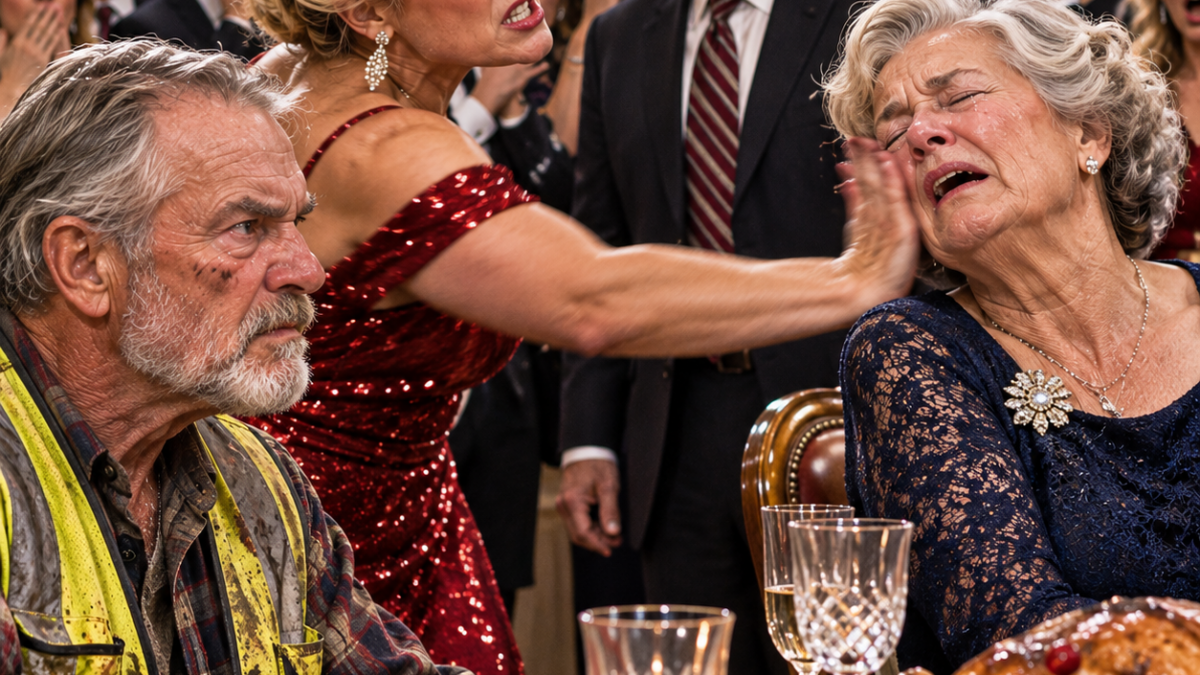
Her champagne flute trembled slightly.
“Both of you. You’re ruining my Christmas party.”
Sixty guests stared.
Nobody moved.
The jazz band had stopped playing.
A woman near the fireplace covered her mouth.
One of the servers stood motionless beside a tray of drinks.
I could hear my own breathing.
Then I turned toward my son.
“Wilder.”
He stood beside the Christmas tree.
Thirty-eight years old.
Tall.
Handsome.
Wearing an Italian suit that probably cost more than my first pickup truck.
He had my eyes.
His mother’s careful hands.
And for a moment, I saw the little boy who used to fall asleep on my shoulders when I walked him around construction sites.
“Your mother is bleeding,” I said.
Wilder looked at Thelma.
His eyes dropped to the floor.
Then he whispered, “Cosima’s right.”
Something inside me went completely still.
“What?”
He swallowed.
“You and Mom don’t understand how these events work.”
I stared at him.
He continued, still refusing to meet my eyes.
“No matter how much money you make, you’ll always be construction people.”
There it was.
The sentence that ended twenty-eight years of excusing my son’s arrogance.
Not because I was ashamed of construction work.
I had built my entire life around it.
But because the boy Thelma and I had raised had just watched his mother be assaulted and decided that the people who hurt her deserved his loyalty more than she did.
I didn’t shout.
Didn’t threaten anyone.
I walked toward Thelma.
Knelt carefully beside the broken glasses.
And gathered the larger pieces.
A sharp edge caught my palm.
Blood appeared across my skin.
Thelma immediately reached for me.
“Cruz, your hand.”
I looked up.
She was worried about me.
Even now.
Even with blood running down her own face.
I felt my throat tighten.
“I’m all right, sweetheart.”
I took out my handkerchief.
Pressed it gently against her cheek.
Then looked into her eyes.
“Can you walk?”
She nodded.
I helped her toward a chair away from the broken glass.
Behind us, Cosima laughed.
“Look at him. Playing the victim.”
Her father, Cyrus Whitfield, raised his glass.
“At least they finally know when to leave.”
I slowly turned my head.
Cyrus was fifty-eight.
A man who liked expensive Scotch, expensive watches, and reminding people about the Whitfield family name.
He had inherited Whitfield Construction and spent years turning a once-respected business into a maze of debt.
His wife Faye stood beside him wearing family pearls.
Neither seemed particularly disturbed by what had happened to Thelma.
I looked toward the mansion’s towering Christmas tree.
The windows.
The imported marble.
The crystal chandeliers.
The custom woodwork.
Every expensive surface in that house had a story.
A supplier.
A contractor.
A drawing.
An invoice.
My signature.
What Cyrus and his family didn’t understand was that their supposed family estate had never belonged to them.
They leased it through a corporate arrangement controlled by a company I owned.
And for the previous three months, I’d been reviewing more than their overdue obligations.
I’d been reviewing the financial pressure they were placing on my son.
The emails.
The trust documents.
The debts.
The private plans Cosima had made for Wilder’s inheritance.
I had been hoping to confront the situation carefully after Christmas.
Now that possibility was gone.
Cosima had struck my wife.
Wilder had defended her.
And sixty people had watched.
I reached into my jacket.
Removed a small phone.
Opened one contact.
Then spoke three words.
“Execute Christmas protocol.”
I ended the call.
Cosima smirked.
“What’s that supposed to mean?”
I didn’t answer.
Eight seconds passed.
Then twelve.
The saxophonist began playing again.
A few guests laughed nervously.
Cyrus lifted his drink.
And suddenly—
The four-meter Christmas tree went black.
Ten thousand holiday lights vanished.
The chandeliers died.
The music stopped.
Darkness swept across the mansion.
Someone screamed.
Emergency lighting came on seconds later, bathing the extravagant rooms in stark white light.
The atmosphere changed instantly.
No longer warm.
No longer glamorous.
Now the mansion resembled a building being prepared for emergency closure.
I stood beside Thelma.
She squeezed my hand.
“What did you do?” she whispered.
I looked toward our son.
Wilder stared at the ceiling.
Then toward the control panels.
His face was pale.
“Dad?”
I didn’t answer.
Because the next voice wasn’t mine.
It belonged to Lyle Ramsey, the property manager who had worked for me for twelve years.
He stepped forward holding a microphone.
“Ladies and gentlemen, the private event has been terminated by the property’s management. Staff will assist with an orderly departure. Please follow the illuminated exits.”
Cyrus slammed his glass onto the table.
“Who authorized this?”
Lyle looked directly at him.
“The property owner.”
Cyrus laughed furiously.
“I AM THE PROPERTY OWNER!”
Lyle remained calm.
“No, Mr. Whitfield.”
The room went silent.
He continued.
“The mansion is owned by Cruz Property Holdings. Your company has occupied it under a lease arrangement.”
Every guest seemed to turn toward Cyrus.
Then Cosima.
Then Wilder.
And finally me.
I took Thelma’s arm.
“Come on, sweetheart.”
Wilder stepped forward.
“Dad, wait!”
I looked at him for the first time since he’d defended the woman who struck his mother.
Then I said quietly, “Your mother needs a doctor.”
He opened his mouth.
Nothing came out.
I guided Thelma toward the entrance.
Behind us, Cosima began shouting at Lyle.
Cyrus demanded to see documents.
Faye clutched her pearls.
And sixty guests slowly began realizing that the people who had been dismissed as worthless construction workers possessed more authority over that mansion than the family hosting the party.
But as I opened the passenger door of our battered Honda, I wasn’t thinking about the chandeliers.
Or the lease.
Or the millions of dollars.
I was looking at the blood on my wife’s coat.
And I knew that whatever happened next, the greatest consequence of that evening would not be financial.
It would be the moment our son discovered that there are some betrayals money cannot repair.
PART2
Thelma settled into the passenger seat.
I adjusted the belt carefully so it didn’t rub against her injured cheek.
She winced.
I felt a fresh surge of anger.
“I’m sorry,” I whispered.
She looked at me.
“For what?”
I stared toward the mansion.
“For bringing you here.”
Her expression softened.
“Cruz.”
I swallowed.
“I should have known.”
She reached for my hand.
“Don’t.”
Her voice was quiet but firm.
“You didn’t make that girl hit me.”
I looked down.
She continued.
“And you didn’t make Wilder say those things.”
I closed my eyes.
She squeezed my fingers.
“Those were their choices.”
For a moment, I couldn’t answer.
Then I kissed her forehead.
Closed her door.
And walked around the car.
Behind us, guests were leaving beneath the harsh emergency lights.
Lyle and the staff were directing them toward the exits.
I made sure the exterior gates remained open for people to leave safely.
Nobody was going to be trapped inside that property.
Not because I lacked the authority to enforce my rights.
Because frightened guests, some elderly and some unfamiliar with the building, deserved to leave without unnecessary danger.
My wife’s safety mattered more than staging a dramatic spectacle.
I started the Honda.
And drove toward the hospital.
My name is Cruz Vernon.
Most people in the construction industry know me professionally as Cruz.
I’m seventy-five years old.
I have been married to Thelma for fifty years.
And I made more money than I ever imagined possible by doing something people like Cosima Whitfield considered beneath them.
I built things.
At first, with my hands.
Then with teams of workers.
Then with companies.
Eventually, with investments and properties.
But I never stopped believing that honest work was something to respect.
That belief came from my father.
He worked construction until his knees no longer allowed him to climb a ladder.
His clothes were always dusty.
His hands were permanently scarred.
And every Friday, he returned home exhausted.
But he paid his bills.
Kept his promises.
And never treated another man as inferior because of his job.
When I was seventeen, he took me to a construction site before sunrise.
He handed me a shovel.
Then pointed toward a trench.
“Start there.”
I stared.
“That’s it?”
He smiled.
“That’s plenty.”
By lunchtime, my back ached.
My hands were blistered.
And I was beginning to understand why the men who worked beside my father rarely wasted energy complaining.
At the end of the day, he looked at my hands.
Then said, “You worked.”
I nodded.
He smiled.
“Good.”
I never forgot it.
When I met Thelma, I owned almost nothing.
An old truck.
A small savings account.
Two good work boots.
And a toolbox my father had given me.
Thelma was twenty-three.
Beautiful.
Intelligent.
Practical.
She could look at a problem and see the simple solution I’d been ignoring.
I fell in love with her because she laughed easily.
And because she never confused ambition with arrogance.
When we married, our first apartment was so small that the dining table touched the refrigerator.
We couldn’t afford expensive furniture.
The heating system rattled.
The bathroom tap leaked.
And our Christmas tree came from a discount lot three days before the holiday.
But Thelma made it beautiful.
She hung handmade decorations.
Baked a cake.
Placed two candles on the table.
Then looked around and smiled.
“Perfect.”
I laughed.
“Perfect?”
She took my hand.
“We’re here together.”
Then she kissed me.
“What else do we need?”
Fifty years later, I could still hear those words.
And standing in the hospital that Christmas Eve, I understood them better than ever.
Our early years were hard.
I worked long days.
Sometimes sixteen hours.
Thelma packed my lunch before sunrise and waited up when projects ran late.
She kept our accounts.
Tracked expenses.
Found ways to stretch money.
When I started my first small contracting business, she was the one who insisted we separate business spending from personal expenses.
I thought she was being overly cautious.
She looked at me and said, “Cruz, you can build anything you want, but numbers don’t care how confident you sound.”
I laughed.
Then listened.
It became one of the best decisions of my life.
The first successful commercial project was a modest retail building.
Nothing impressive by the standards of wealthy developers.
But it was ours.
I remember driving Thelma past it after completion.
She looked out the passenger window.
Then smiled.
“You did it.”
I shook my head.
“We did.”
She squeezed my hand.
For a while, we sat quietly.
Then she asked whether we could afford dinner somewhere nicer than usual.
I laughed.
“Probably.”
So we went to a small Italian restaurant.
Ordered pasta.
Shared dessert.
And celebrated as though we’d just built a skyscraper.
In some ways, that little building meant more than anything I owned afterward.
It proved our work could become something lasting.
Over the decades, the projects grew.
Small commercial buildings.
Office properties.
Warehouses.
Mixed-use developments.
Land acquisitions.
Renovations.
Investments.
Some succeeded.
Others taught expensive lessons.
I made mistakes.
Lost money.
Trusted the wrong people.
Had to rebuild after deals went badly.
But I learned to examine documents.
Understand financing.
Treat contracts seriously.
And avoid making important decisions simply because somebody smiled and promised extraordinary returns.
Eventually, my portfolio included twenty-eight commercial properties.
Its estimated value reached approximately $120 million.
I knew that number sounded enormous.
It was.
But it had taken decades of work and risk.
And much of the value was tied to real estate assets, business obligations, financing, and long-term arrangements—not a giant pile of cash sitting in a checking account.
I had never forgotten how difficult the beginning had been.
Thelma hadn’t either.
We still drove an old Honda Civic.
People sometimes laughed about that.
The car was a 2009 model.
Not glamorous.
Not particularly quiet.
The seats had softened from years of use.
But it started reliably.
We liked it.
And neither of us felt the need to prove our worth through a vehicle.
Thelma still wore her old wool coat.
I still preferred my canvas gardening jacket.
We lived comfortably.
Privately.
And perhaps too quietly.
Because as Wilder grew older, he began assuming that simplicity meant weakness.
Wilder was our only son.
Thelma had a difficult pregnancy.
When he was born, I held him in my arms and felt a kind of fear I had never experienced.
Not fear for myself.
Fear that I might fail him.
I wanted him to have opportunities I hadn’t.
Good schools.
A safe home.
A childhood without worrying whether we could pay the rent.
Thelma felt the same.
So we worked.
Saved.
Invested.
And raised him with every advantage we could reasonably provide.
But somewhere along the way, he absorbed a lesson neither of us intended to teach.
He began to believe that wealth was most important when other people could see it.
As a boy, Wilder loved visiting construction sites.
He wore a small hard hat.
Asked endless questions.
Pointed at cranes.
I taught him how to read basic drawings.
How foundations supported buildings.
Why safety procedures mattered.
Why the people pouring concrete were just as necessary as those signing contracts.
Sometimes he’d follow me around for hours.
Then go home and tell Thelma he’d built an entire shopping center.
She’d laugh.
“Oh, did you?”
He’d nod proudly.
“Dad helped.”
I used to treasure those days.
I thought he was learning what the business meant.
Perhaps he was.
But by the time he reached adulthood, something had changed.
Wilder became increasingly interested in luxury.
Designer clothes.
Expensive restaurants.
High-end cars.
Private clubs.
He liked being introduced as the son of a successful real estate developer.
At first, I didn’t object.
Young people often experiment with identity.
And he had a right to enjoy things he’d earned.
But eventually, his spending began reflecting a troubling belief.
He treated status as though it were proof of character.
When I questioned his expenses, he’d smile.
“Dad, appearances matter.”
I’d nod.
“Sometimes.”
Then add, “But appearances won’t pay a lender.”
He’d laugh.
“You’re old-fashioned.”
Perhaps I was.
But I’d survived enough financial cycles to know that debt doesn’t disappear because a man wears a good suit.
When Wilder met Cosima Whitfield, I hoped marriage would help him mature.
She was thirty-four.
Beautiful.
Confident.
From a family that presented itself as old money.
Her father, Cyrus, spoke constantly about the Whitfield legacy.
He had inherited Whitfield Construction from his father.
The business once had a respectable reputation.
But over the years, it had become increasingly dependent on borrowed money.
I knew more about its finances than Cyrus suspected.
That wasn’t because I was spying on every competitor.
It was because the real estate industry is interconnected.
Lenders.
Contractors.
Property records.
Development projects.
Debt.
Eventually, people who have worked in the same market for decades learn which businesses are strong and which merely look strong.
Cyrus was very good at looking strong.
I wasn’t convinced the company beneath the image was healthy.
Thelma didn’t like the way Cosima treated service workers.
That was the first warning.
We attended a restaurant dinner shortly after Wilder introduced her.
A server accidentally brought the wrong drink.
Cosima sighed loudly.
Then made a remark about incompetence.
The server apologized.
I expected Cosima to accept it.
Instead, she continued criticizing him.
Thelma stepped in.
“It’s all right, sweetheart.”
She smiled toward the server.
“Easy mistake.”
Cosima looked at my wife as though she’d said something embarrassing.
Later, in the car, Thelma was quiet.
I asked what was wrong.
She looked toward the road.
“That girl enjoys making people feel small.”
I sighed.
“She’s young.”
Thelma turned toward me.
“Cruz.”
I looked at her.
“Being young doesn’t make cruelty attractive.”
I should have listened more carefully.
After the wedding, the distance between us grew.
Wilder visited less often.
His conversations became shorter.
He began referring to our modest habits as embarrassing.
Once, he suggested I should replace the Honda.
I laughed.
“Why?”
He looked uncomfortable.
“Dad, you can afford something better.”
I smiled.
“It works.”
He sighed.
“People notice.”
I looked at him.
“Let them.”
He shook his head.
“You don’t understand.”
I remember staring at him.
Because I did understand.
More than he realized.
I knew exactly how wealth could attract attention.
How people could mistake expensive clothes for competence.
How easy it was to build a lifestyle that depended on impressing strangers.
And how quickly that lifestyle could collapse when the financing stopped.
I simply didn’t want to live that way.
The mansion in Sandy Springs became part of the problem.
I’d acquired the land through Cruz Property Holdings.
Years earlier, I’d overseen the design and construction of the residence as part of my investment portfolio.
Its features were extraordinary.
A curved driveway.
High ceilings.
Imported Italian marble.
Custom millwork.
Floor-to-ceiling windows.
Crystal chandeliers.
A grand staircase.
Expansive entertaining spaces.
At the time, I expected it to become a high-value leased property.
Through a corporate arrangement, Whitfield Construction became its tenant.
The lease served the financial purposes of both parties under the terms negotiated at the time.
Cyrus liked presenting the house as his family’s estate.
I didn’t care what language he used at dinner parties.
As long as the obligations were met and nobody was being deceived in a legally significant way.
But over time, he seemed to forget that leasing a mansion wasn’t the same as owning it.
And Cosima certainly behaved as though the place belonged to her by birthright.
Eight years after I’d approved the building’s plans, Thelma and I received an invitation to Wilder and Cosima’s Christmas celebration.
It was going to be enormous.
Sixty guests.
Music.
Catering.
Decorations.
The kind of party wealthy families host when they want every photograph to demonstrate how successful they are.
Thelma was excited.
Not about the mansion.
She had seen plenty of elegant buildings.
She was excited because we’d be spending Christmas with our son.
She selected a small velvet box.
Inside was a gift she’d chosen personally for Cosima.
We also brought homemade cake and hand-painted ornaments collected over our years of marriage.
Thelma carefully wrapped everything.
I watched her.
Then asked, “Are you sure they’ll appreciate those?”
She looked up.
“Of course.”
I hesitated.
She smiled.
“Christmas isn’t about the price tag.”
I nodded.
I wanted her to be right.
On the evening of December twenty-fourth, we drove through the rain toward Sandy Springs.
The weather was cold.
The roads reflected holiday lights.
The Honda hummed steadily.
Thelma sat beside me holding the gift box.
She wore her familiar coat.
I wore my gardening jacket.
We looked like exactly what we were.
An older married couple arriving with homemade gifts.
We weren’t trying to impress anybody.
We wanted to see our son.
The guard at the entrance checked our invitation.
Derek Monroe.
Young.
Perhaps twenty-five.
He looked at the Honda.
Then at the invitation.
Then back toward us.
For a moment, I saw suspicion cross his face.
He apparently expected guests in more expensive vehicles.
“Name, please?”
“Cruz Vernon.”
He checked the list.
“And your guest?”
“My wife, Thelma.”
He looked at the invitation again.
Then opened the gate.
“Enjoy the evening.”
I smiled.
“Thank you.”
We drove toward the house.
Thelma touched my hand.
“Cruz.”
I looked toward her.
“Yes?”
“The lights.”
I smiled.
She pointed toward the roofline.
“Exactly where you drew them.”
I laughed softly.
“Good electricians.”
She smiled.
“Good plans.”
The driveway curved toward the entrance.
A Mercedes stood near the steps.
A Tesla was parked beside it.
I pulled our old Honda into an available space.
For a moment, I looked toward the mansion.
The windows.
The columns.
The stonework.
It was a beautiful building.
And I was proud of the people who had helped construct it.
But I didn’t feel any need to announce my connection.
I wasn’t there as the owner.
I was there as Wilder’s father.
And Thelma was there as his mother.
That should have been enough.
Inside, the party was already underway.
A huge Christmas tree stood in the living room.
Silver and gold ornaments glittered beneath the lights.
The jazz band played near the fireplace.
Servers carried drinks.
Guests spoke in clusters.
The scent of cinnamon and mulled wine filled the air.
Thelma smiled.
“Beautiful.”
I nodded.
Then saw Wilder.
He stood near the tree.
Tall.
Elegant.
Holding champagne.
For a moment, my heart warmed.
There was my son.
The boy Thelma and I had loved for thirty-eight years.
But when he noticed us, his expression changed.
His eyes moved toward my jacket.
Then the homemade cake.
Then Thelma’s old coat.
He looked down at his shoes.
And pretended not to see us.
I felt a small ache.
But said nothing.
Perhaps he was distracted.
Perhaps he hadn’t recognized us immediately.
Perhaps I was imagining things.
Parents can become extraordinarily skilled at finding harmless explanations for their children’s hurtful behavior.
I was no exception.
Then Cyrus approached.
He held an expensive glass of Scotch.
“Cruz.”
His voice was polite but cool.
“Good of you to make it.”
I smiled.
“Thank you for having us.”
He looked toward my coat.
Then the cake.
“Long drive from wherever it is you live?”
I could hear the insult beneath the question.
But I wasn’t interested in competing.
“Not far.”
He nodded vaguely.
Then turned away.
Faye appeared.
Her pearls gleamed.
She looked toward Thelma’s gifts.
“Oh.”
Her smile was thin.
“How quaint.”
Thelma smiled.
“We brought something homemade.”
Faye glanced toward a nearby guest.
“Charming.”
I looked at my wife.
She didn’t seem bothered.
Or perhaps she was choosing not to show it.
Then Cosima approached.
Her silk dress shimmered.
A diamond bracelet caught the light.
She held a champagne flute with the practiced confidence of someone who expected every room to revolve around her.
Thelma stepped forward.
“Cosima.”
She smiled warmly.
“Merry Christmas, dear.”
Cosima looked at her.
Then at the gift.
Thelma held out the velvet box.
“We brought you something small.”
For a moment, I thought Cosima might accept it.
Instead, her mouth twisted.
“Seriously?”
Thelma’s smile faltered.
“It’s a Christmas gift.”
Cosima laughed.
A sharp, contemptuous sound.
“People like you never learn.”
The conversations nearby began fading.
Thelma looked confused.
“I’m sorry?”
Cosima raised her voice.
“Wrapping cheap gifts doesn’t make you belong here.”
I felt my stomach tighten.
Thelma took a breath.
“Cosima, we only wanted—”
The slap came before she could finish.
I have replayed that moment more times than I care to admit.
The sudden movement.
Cosima’s hand.
The diamond rings.
Thelma’s head turning.
Her glasses falling.
The blood.
The silence.
And Wilder.
My son.
Standing nearby.
Watching.
Then choosing the woman who struck his mother.
For months before that Christmas Eve, I had been worried about Wilder.
Not merely because of his expensive tastes.
I’d learned through a lawful private investigation and financial review that Cosima had been discussing ways to gain control of assets connected to his discretionary family trust.
The documents raised serious concerns.
I hadn’t wanted to believe the worst.
I’d planned to speak with Wilder.
Carefully.
Privately.
After the holidays.
I hoped he might listen.
I hoped he’d recognize the danger.
Perhaps reconsider the financial arrangements.
But when he looked at his bleeding mother and said Cosima was right, I realized that whatever influence she possessed, my son was still responsible for his own choices.
And that evening he had made one I could no longer ignore.
The hospital was quiet when we arrived.
Not empty.
Emergency departments are rarely empty, even on Christmas Eve.
But quieter than the mansion.
There were nurses moving between rooms.
Patients waiting.
The hum of equipment.
The smell of antiseptic.
A television playing softly in a corner.
Thelma sat beside me while we waited for an examination.
She kept touching the bandage I’d pressed gently against her cheek.
I wanted to ask whether she was frightened.
Instead, I reached for her hand.
She squeezed mine.
For a moment, neither of us spoke.
Then she whispered, “Cruz.”
I turned.
“Yes?”
“Don’t let this make you hard.”
I stared at her.
She looked exhausted.
Her cheek was swollen.
There was dried blood on her coat.
And she was worried about what anger might do to me.
I felt tears gathering.
“I don’t know how you can say that right now.”
She smiled sadly.
“Because I know you.”
Then she squeezed my hand again.
“We’ve spent fifty years building a life.”
Her voice softened.
“Don’t let one terrible evening turn it into something ugly.”
I lowered my head.
And cried.
Dr. Helena Garrett examined Thelma carefully.
She was a physician with calm eyes and a professional manner that immediately reassured my wife.
She asked what had happened.
Thelma answered without exaggeration.
“My daughter-in-law struck me across the face.”
Dr. Garrett paused.
Then asked whether Thelma had lost consciousness.
“No.”
“Any dizziness?”
“A little.”
“Headache?”
“Yes.”
The doctor checked her carefully, examined the swelling near her jaw and ear, and assessed the cut along her cheek.
The injury required three stitches.
Watching the doctor close that wound was one of the most difficult moments of my life.
Thelma had raised our son.
Held him when he was frightened.
Stayed awake when he was sick.
Given him more love than any child could reasonably expect.
And now I was watching a physician repair an injury inflicted by the woman he had married.
A forensic nurse named Andrea Hayes helped document the injuries with Thelma’s consent.
Photographs were taken.
The examination findings were recorded.
The history of the incident was documented.
Thelma described the diamond rings Cosima had been wearing and the way the blow had landed.
I wanted every detail preserved accurately.
Not because medical records could guarantee a conviction.
Not because I wanted an excuse to boast about sending somebody to prison.
But because Cosima had already shown how easily she could transform cruelty into an accusation against her victim.
I had spent decades watching people deny responsibility when contracts went wrong.
The most dangerous disputes were often the ones where nobody had preserved evidence.
I wasn’t going to let that happen to Thelma.
When Dr. Garrett finished, she explained the necessary care and warning signs.
Thelma listened carefully.
Then asked whether the stitches would leave a scar.
The doctor answered honestly.
There might be a mark.
It was too early to know how visible it would remain.
Thelma nodded.
“Thank you.”
Her voice was steady.
I sat beside her.
For a moment, I stared at the white bandage against her cheek.
I remembered the face beneath it.
Young and laughing in our first apartment.
Flushed after working in the garden.
Smiling across our Christmas dinner table.
Softly illuminated by the lamps beside our bed.
I had kissed that cheek thousands of times.
And the thought of someone striking it made my hands tremble.
In the corridor, I called Brent Reyes.
My attorney.
He’d worked with me for years.
Reviewed acquisitions.
Handled complex commercial matters.
Advised on the family trust.
And occasionally told me when an idea was too risky to pursue.
He answered despite the holiday.
“Cruz?”
“Brent.”
He heard my voice.
“What happened?”
I explained.
The slap.
The injury.
Wilder’s response.
The events at the mansion.
And the medical documentation.
Brent listened.
Then asked whether Thelma was safe.
“Yes.”
“Good.”
He advised us to preserve the medical records, identify witnesses, secure any lawfully available surveillance footage, and consider making a police report.
Then we discussed the property arrangements and family trust.
I wanted everything reviewed.
But Brent was careful.
He reminded me that even when I controlled a company or served as trustee, there were contracts, fiduciary duties, notice requirements, and legal procedures that could not simply be ignored.
I understood.
I didn’t want decisions that would collapse in court because I had acted carelessly.
I wanted consequences that would withstand scrutiny.
The next call went to the professional who managed my investment accounts.
We reviewed which arrangements were personal gifts or discretionary financial support and which involved existing legal obligations.
I instructed him to stop initiating new voluntary support for Wilder and Cosima without my express approval.
Existing debts and accounts would have to be handled according to their terms.
I wasn’t going to empty accounts that legally belonged to someone else.
Nor could I erase an adult’s property rights simply because I was his father.
But I could stop financing a lifestyle through arrangements that remained under my control.
And I could review every guarantee, authorized-user privilege, trust distribution, and property occupancy arrangement through the appropriate legal processes.
That was enough to begin.
The final call was to the investigator who had been reviewing the Whitfield family’s finances and Cosima’s plans.
I asked him to update the lawful financial research.
Property records.
Commercial debt.
Relevant public filings.
The documents concerning the trust.
And any information indicating that Cyrus or Cosima had misrepresented their assets or financial position.
The investigator agreed.
I ended the call.
Then went back to Thelma.
She was sitting on the examination bed.
Her feet barely touched the floor.
When she saw me, she smiled faintly.
“Have you finished making calls?”
“For tonight.”
She raised one eyebrow.
“Cruz.”
I smiled sadly.
“Yes?”
“Promise me one thing.”
I approached.
“What?”
She took my hand.
“Don’t confuse protecting me with punishing everyone who ever hurt us.”
For a moment, I couldn’t speak.
Then I kissed her forehead.
“I’ll try.”
She shook her head.
“Do better than try.”
Despite everything, I laughed.
There was my wife.
Injured.
Exhausted.
Still telling me when I needed to be a better man.
We reached home late that night.
Our house in Buckhead was quiet.
The Christmas lights were on.
A small tree stood beside the fireplace.
Thelma had decorated it herself.
Handmade ornaments hung beside newer ones.
One was a crooked wooden star Wilder had painted when he was six.
I stopped beside it.
For a moment, I couldn’t breathe.
The boy who made that star had once climbed into his mother’s lap whenever thunderstorms frightened him.
The man who stood beneath the mansion’s chandelier had watched her bleed and refused to help.
I couldn’t reconcile them.
Not yet.
At eleven, Wilder called.
His name appeared on my phone.
I looked at it.
Then answered.
“Dad!”
His voice was frantic.
“What did you do?”
I remained quiet.
“My cards aren’t working.”
He took a breath.
“I can’t access the apartment.”
I closed my eyes.
The apartment he referred to was one of the properties connected to arrangements my companies managed.
The access situation required clarification, and I had already instructed that nobody be unlawfully locked out of a residence.
Whatever Wilder had encountered with his cards or property access, it needed to be handled properly.
But my son’s first concern wasn’t his mother’s injury.
It was money.
Access.
Comfort.
He continued.
“Dad, I tried to pay for a hotel.”
I listened.
“The card declined.”
I took a breath.
“Wilder.”
He stopped.
“Have you asked how your mother is?”
Silence.
For several seconds, I heard only his breathing.
Then he said, “Is she okay?”
My eyes filled.
“She needed stitches.”
He made a small sound.
I continued.
“She has swelling and bruising.”
Another pause.
“Her glasses are broken.”
Wilder whispered, “Dad—”
I closed my eyes.
“Your mother is seventy-three.”
He said nothing.
“She spent tonight in an emergency department because your wife hit her.”
His breathing became uneven.
Then he whispered, “Cosima didn’t mean—”
“Stop.”
The word came out harder than I intended.
I took a breath.
“Do not finish that sentence unless you’re prepared to tell the truth.”
Silence.
Then Wilder said, “Dad, please. Can we talk tomorrow?”
I looked toward the Christmas tree.
“Through Brent.”
He sounded stunned.
“Your lawyer?”
“Yes.”
“Dad, we’re family.”
I closed my eyes.
“That was true when your mother was bleeding on the floor.”
He didn’t answer.
I ended the call.
Christmas morning brought another betrayal.
I was sitting in my study with coffee when my tablet showed a social-media notification.
Cosima had posted a video.
She sat before a small Christmas tree.
Her eyes were red.
Her voice trembled.
She claimed she’d been frightened during the family gathering.
That Thelma had behaved aggressively.
That she had felt threatened.
That she’d only tried to protect herself.
I watched.
Once.
Then again.
I knew what had happened.
Sixty people had been present.
Thelma had approached with a gift.
Cosima had struck her.
Yet now my daughter-in-law was presenting herself as the victim.
The video spread rapidly.
Within hours, it had attracted millions of views.
People commented.
Argued.
Took sides.
Some believed Cosima.
Others questioned her story.
Then I saw Wilder’s public statement.
He was supporting his wife.
He wrote about standing against family violence.
Without acknowledging the woman who had actually been injured.
His mother.
I sat staring at the screen.
For a moment, something inside me went cold.
Wilder hadn’t merely failed to intervene.
He was continuing to defend the assault after he’d learned Thelma needed medical treatment.
I looked toward the photograph on my desk.
Wilder as a child.
Standing beside me at a construction site.
Holding a yellow hard hat.
Smiling.
I thought about deleting the photograph.
Then stopped.
The boy in that picture had existed.
His mother had loved him.
So had I.
I wasn’t going to erase our memories simply because the man he’d become was making terrible choices.
But neither was I going to allow those memories to excuse him.
I accessed the mansion’s surveillance system through my authorized administrator account.
The cameras covered the common areas.
I reviewed the footage from Christmas Eve.
Camera three showed Thelma approaching Cosima.
The velvet box.
The smile.
The insult.
Then the slap.
Another camera showed the expression on Cosima’s face.
The movement was unmistakable.
Thelma had not lunged at her.
Had not struck her.
Had not acted in a way that matched Cosima’s public narrative.
I watched my wife’s glasses hit the floor.
Then stopped the recording.
My hands were trembling.
I saved the relevant footage securely and arranged for preservation of the original files, timestamps, and access records.
I wasn’t going to let the only copy become part of a social-media argument.
This was evidence.
It needed to be handled responsibly.
Brent reviewed the footage.
He also reviewed the medical documentation and witness information.
We discussed how to address Cosima’s public accusations without unnecessarily exposing Thelma’s private medical details.
Thelma made the decision herself.
She agreed that the relevant evidence could be provided to law enforcement and used through appropriate legal channels.
She wasn’t interested in becoming a celebrity.
She didn’t want strangers arguing over photographs of her injured face.
She wanted the truth recognized.
And she wanted to feel safe.
I respected that.
The police report proceeded.
Investigators reviewed the available materials.
Witnesses could provide statements.
The medical records documented the injury.
The surveillance footage preserved the central incident.
Whether criminal charges would be filed and what legal consequences might follow would depend on the authorities and the evidence.
I understood that my wealth couldn’t determine the result.
Nor should it.
I wanted Cosima held accountable through the law.
Not through a performance of power.
The public narrative began changing when the existence of the video evidence became known through the proper process.
Cosima’s account faced serious questions.
The people who had witnessed the slap began speaking more openly.
One guest described Thelma approaching peacefully with a gift.
Another remembered hearing Cosima insult her.
Others confirmed that Wilder had remained silent rather than helping his mother.
Some people who initially defended Cosima withdrew their comments.
Others doubled down.
That’s how public controversies work.
But the evidence didn’t depend on everyone changing their minds.
I had learned long ago that truth and popularity weren’t the same thing.
On December twenty-sixth, I met Brent.
His office overlooked downtown Atlanta.
The city stretched beneath the windows.
I stood for a moment looking toward buildings I’d helped develop.
Then sat across from him.
He opened the Cruz Family Discretionary Trust documents.
“We need to discuss Wilder’s position,” he said.
I nodded.
“Go ahead.”
Brent explained that Wilder’s interests were subject to the trust’s actual terms.
He was a discretionary beneficiary.
That didn’t mean he owned the trust assets outright.
Nor did it mean Cosima automatically acquired an interest in those assets merely because she had married him.
But the trust also didn’t give me permission to disregard my duties as trustee.
Any decision regarding distributions, suspension, or removal had to comply with the governing documents and applicable law.
Brent reviewed the provisions carefully.
Then explained the steps available under the trust structure.
I listened.
Asked questions.
And considered the consequences.
For years, I’d thought about eventually providing Wilder with considerable wealth.
Not because he was entitled to it.
Because he was my son.
I wanted him secure.
Wanted his future protected.
But I’d never intended to create a fund that could be manipulated by people planning to exploit him—or used to shield him indefinitely from the consequences of his choices.
“What can we do?” I asked.
Brent looked toward the documents.
“We can stop discretionary distributions as permitted, review the beneficiary provisions, and determine whether the trust’s amendment or other powers allow further changes.”
I nodded.
“Then do that carefully.”
He studied me.
“Cruz, this may be painful.”
I looked down.
“It already is.”
Then I added, “But protecting the assets isn’t the same as hating my son.”
Brent’s expression softened.
“No.”
I took a breath.
“And if I make a change, I want it to be legally sound.”
He nodded.
“That’s how we’ll proceed.”
By the afternoon, Wilder’s financial position was becoming more complicated.
The support he had taken for granted was no longer assured.
Some privileges had been terminated.
Others were under review.
Accounts that belonged to the trust remained governed by the trust rather than his personal wishes.
The lavish lifestyle he and Cosima had presented to the world was proving far more dependent on other people’s money than their social circle understood.
Wilder called repeatedly.
I didn’t answer directly.
Brent managed the necessary communications.
Thelma needed peace.
And I wasn’t ready to speak with a son who still seemed more frightened of losing financial comfort than of losing his mother’s trust.
Cosima and Cyrus responded with lawyers.
That didn’t surprise me.
Their family had built an image around power.
Influence.
Old money.
Important connections.
They were accustomed to making problems disappear through pressure.
But this time, they were dealing with documents they couldn’t simply rewrite.
The trust’s governing terms.
The property records.
The lease.
The outstanding debt.
And the evidence concerning Thelma’s injury.
They couldn’t resolve all of that by calling me a retired construction worker.
The meeting took place in my attorney’s conference room.
Cyrus arrived wearing an expensive suit.
Cosima sat beside Wilder.
Faye followed.
Their attorney, Gerald Pritchard, carried a leather briefcase.
He spoke with the confidence of a man expecting intimidation to work.
Brent sat beside me.
I had brought only a small folder.
I didn’t need a dramatic display.
The relevant documents already existed.
Gerald opened with a demand.
He claimed that Cosima had rights connected to Wilder’s expected trust distributions.
That the marriage had created financial expectations.
That any attempt to remove or suspend support would be challenged.
Then he demanded an enormous settlement.
Fifty million dollars.
I almost laughed.
Not because the threat was harmless.
Litigation can become expensive and exhausting.
But because Gerald was speaking about trust assets as though they were money sitting in Wilder’s personal checking account.
They weren’t.
Brent remained calm.
He asked Gerald to identify the legal basis for the demand.
Then he reviewed the trust structure.
The distinction between ownership and discretionary benefit.
The actual rights Wilder possessed.
The authority granted to the trustee.
And the limits imposed by the governing documents.
Gerald began flipping through the pages.
His confident expression changed.
Cosima leaned forward.
“What are you saying?”
Brent answered.
“Your husband does not own these assets outright.”
She stared.
“But he’s the heir.”
I looked at her.
Then said quietly, “That word doesn’t mean what you seem to think it means.”
Her face reddened.
Gerald continued reading.
For a moment, nobody spoke.
Then he closed the folder.
The conversation shifted.
No longer demands about fifty million dollars.
Now questions.
Legal positions.
Potential proceedings.
The actual terms of the documents.
For the first time, the Whitfields were having to deal with what was written rather than what they wanted to believe.
Cosima turned toward Wilder.
“You told me the money was yours.”
My son looked pale.
“I thought—”
She interrupted.
“You thought?”
Wilder stared at the table.
And in that moment, I understood how much of their marriage had been built around an expectation.
Not simply love.
Not simply companionship.
But access to wealth.
I felt a terrible sadness.
Because my son had spent years trying to impress people who valued his inheritance more than the man himself.
And now that inheritance was no longer guaranteed, their respect seemed to be disappearing with it.
Cyrus leaned forward.
“You can’t just take away what was promised.”
I looked at him.
“Cyrus, you know the difference between a promise and a legally enforceable right.”
His expression hardened.
I continued.
“And you know the difference between leased property and owned property.”
For the first time, he looked genuinely uncomfortable.
Brent opened another folder.
The Whitfield obligations.
The commercial financing.
The mortgage documents.
The debt acquired through a lawful transaction months earlier.
Cyrus stared at the papers.
Then looked toward me.
His face changed.
“You.”
I remained quiet.
He looked down again.
“Cruz Property Holdings?”
I nodded.
Cyrus swallowed.
The room was silent.
Then I spoke.
“Your family has been calling me a worthless construction worker.”
I looked toward the documents.
“Perhaps you should have paid more attention to what construction workers can build.”
The debt was substantial.
Approximately fifteen million dollars in face-value obligations, acquired through negotiated transactions for less than that amount.
There were underlying properties.
Security interests.
Repayment schedules.
Contractual obligations.
I didn’t magically own Cyrus’s company merely because I’d purchased debt.
But I now controlled creditor rights that could have serious consequences if the relevant defaults remained unresolved.
And Cyrus’s business was in trouble.
Deep trouble.
That was becoming impossible to hide.
For months, the Whitfields had presented their lifestyle as evidence of enduring wealth.
The mansion.
The expensive clothes.
The parties.
The cars.
The jewelry.
But underneath the image were leveraged properties and a business struggling to support its obligations.
I knew that because I’d reviewed the records.
The public property information.
The financing documentation.
And the business relationships connected to the debt.
Cyrus had mistaken my quiet manner for ignorance.
Cosima had mistaken my old jacket for poverty.
And Wilder had mistaken my generosity for something he could never lose.
All three assumptions were proving expensive.
Gerald requested time to review the financial documents.
Brent agreed to a proper process.
I wasn’t interested in turning a commercial dispute into a public shouting match.
There were employees.
Lenders.
Suppliers.
And other stakeholders whose interests needed to be considered.
I wanted the obligations handled lawfully.
And I wanted the assault on Thelma addressed separately, through the appropriate authorities.
The Whitfields had spent years treating wealth as permission to control people.
I intended to demonstrate something different.
Money gives a person options.
It doesn’t make that person exempt from rules.
When the meeting ended, Wilder remained seated.
Cosima rose angrily.
Cyrus spoke quietly with Gerald.
Faye gathered her belongings.
For a moment, I thought Wilder might leave with them.
Instead, he looked toward me.
“Dad?”
I stopped near the door.
He swallowed.
“How’s Mom?”
The question came two days too late.
But I answered.
“She has three stitches.”
His eyes filled.
I continued.
“She’s in pain.”
He lowered his head.
“I’m sorry.”
I stared at him.
For a moment, I wanted those words to be enough.
Then I remembered Thelma standing in our bedroom.
Carefully touching the bandage on her cheek.
Asking whether the scar would remain.
I looked at Wilder.
“If you want to apologize to your mother, you need to understand what you’re apologizing for.”
He nodded.
I took a breath.
“Not the embarrassment.”
A pause.
“Not the financial consequences.”
Another.
“The fact that you watched someone hurt her and decided your position at that party mattered more than her safety.”
Tears ran down his face.
I continued.
“You don’t repair that with one sentence.”
Then I walked out.
The weeks following Christmas were painful.
Not because I doubted the need to protect Thelma.
I didn’t.
But because I began discovering how much of our family’s life had become tangled with financial expectations.
Wilder had grown accustomed to discretionary support.
Cosima had made plans around money that wasn’t hers.
Cyrus had relied on increasingly precarious financing.
And Faye seemed more concerned about how everything looked than why the problems existed.
There were negotiations.
Legal letters.
Financial reviews.
Requests for extensions.
Disputes about obligations.
The lease governing the mansion also had to be handled through its proper legal process, rather than through the assumption that switching off a Christmas party somehow extinguished every contractual right.
The immediate event had been terminated.
The longer-term occupancy and debt issues required documentation, notice, and lawful resolution.
I accepted that.
I’d spent decades insisting people honor contracts.
I wasn’t going to abandon that principle because the people on the other side had insulted me.
Thelma recovered gradually.
Her stitches were removed.
The swelling diminished.
But a faint mark remained along her cheek.
She didn’t speak about it often.
Sometimes I caught her looking at herself in the mirror.
Her fingers would rise toward the scar.
Then drop.
One morning, I found her sitting by the bedroom window.
She held a small velvet box in her hands.
The Christmas gift she’d intended for Cosima.
I sat beside her.
“Sweetheart?”
She looked toward me.
“I keep thinking about that night.”
I took her hand.
She swallowed.
“I spent so long trying to make Wilder happy.”
My throat tightened.
“I know.”
“When he was little, I thought if we loved him enough, he’d always understand how to love other people.”
She looked down.
Tears filled her eyes.
“Where did we go wrong?”
For a moment, I couldn’t answer.
Because I had asked myself the same question every night since Christmas.
I thought about the schools we’d chosen.
The opportunities we’d provided.
The times we’d given Wilder money when he should have found another solution.
The cars.
The trips.
The lifestyle.
The way I sometimes let him avoid a difficult consequence because I didn’t want him to feel the fear I’d experienced growing up.
I had wanted to give him security.
Perhaps too often, I’d given him insulation from reality.
But none of that excused what he did.
I looked at Thelma.
“We made mistakes.”
She nodded slowly.
Then I continued.
“But he made choices too.”
Her eyes filled.
“He’s thirty-eight.”
I squeezed her hand.
“We can’t keep pretending he’s a child who doesn’t understand right from wrong.”
Thelma began crying.
I held her.
And for a long time, we sat beside the window grieving the son we’d hoped would become a better man.
Cosima’s legal troubles continued.
The surveillance footage and medical evidence were examined through the appropriate processes.
Her public claims came under scrutiny.
The people who witnessed the incident were questioned.
The issue wasn’t resolved by one dramatic photograph or a single angry statement from me.
It took time.
But the central facts were difficult to deny.
Thelma had been struck.
She’d required medical treatment.
And the available footage contradicted the version Cosima presented to millions of viewers.
Whatever legal resolution eventually followed, the incident permanently damaged Cosima’s credibility.
That was a consequence she couldn’t simply erase with another polished video.
Cyrus’s financial position also deteriorated.
The debts didn’t vanish.
The lenders and creditors required payment according to the terms of their agreements.
The assets securing those obligations had to be evaluated.
Some arrangements were renegotiated.
Others moved toward enforcement.
The family’s lavish presentation became harder to maintain as the underlying financial problems were exposed.
Cyrus had spent years acting as though the Whitfield name was a substitute for a healthy balance sheet.
It wasn’t.
I knew that better than most people.
Because I’d spent decades building wealth the slow way.
Through assets.
Cash flow.
Careful borrowing.
And obligations I expected to repay.
Not through convincing strangers that appearances could substitute for financial strength.
The mansion eventually ceased to be the Whitfields’ glittering social headquarters.
The property dispute was resolved through the required legal and contractual procedures.
I didn’t stand on the lawn watching Cyrus carry boxes.
I didn’t organize a public humiliation.
I had no desire to turn his financial collapse into entertainment.
I’d seen too many construction businesses fail.
Too many employees lose work because an owner made irresponsible decisions.
I knew the human consequences.
So the creditor negotiations remained professional.
The company’s problems were addressed on their merits.
And I returned my attention to the life Thelma and I had built.
Wilder’s marriage began unraveling too.
At first, Cosima blamed me.
Then Cyrus.
Then lawyers.
Then the economy.
Anyone except herself.
Wilder tried defending her.
Again.
But without the expectation of a large trust distribution, the relationship became increasingly strained.
The emails my investigator had uncovered before Christmas suggested Cosima had viewed Wilder’s wealth as something she could gain access to and eventually control.
Now the promised financial future was uncertain.
And the affection she’d once displayed was disappearing.
Wilder eventually confronted those facts.
I learned about the argument indirectly.
I didn’t ask for every detail.
It wasn’t my marriage.
But I understood that the man who’d called his parents worthless construction people was discovering something painful.
He had spent years trying to earn the approval of people who valued him for the money they believed he could provide.
And when that money stopped appearing certain, their loyalty changed.
One afternoon, several months after Christmas, Wilder called Brent.
Not to demand money.
Not to threaten a lawsuit.
He asked whether Thelma would be willing to receive a letter.
Brent spoke with us.
Thelma sat quietly while he explained.
Then she asked, “Does he want something?”
Brent shook his head.
“He hasn’t made a financial request.”
My wife looked toward me.
Her expression was uncertain.
I took her hand.
“You don’t have to read it.”
She looked down.
For a long moment, she said nothing.
Then whispered, “He’s still my son.”
I nodded.
“I know.”
She closed her eyes.
“Let him send it.”
The letter arrived three days later.
Handwritten.
Four pages.
Thelma sat at the kitchen table holding the envelope.
For a while, she couldn’t open it.
I waited.
Then she carefully removed the pages.
She began reading.
Her expression changed.
At first, she looked guarded.
Then sad.
Then her eyes filled.
She handed the pages to me.
I read them slowly.
Wilder wrote about the Christmas party.
He didn’t call Cosima’s actions a misunderstanding.
Didn’t suggest Thelma had provoked the slap.
Didn’t blame me for the consequences.
He acknowledged that his mother had approached peacefully with a gift.
That Cosima struck her.
That he witnessed it.
And that he chose to defend his wife because he was afraid of losing the life he’d built around her family’s approval.
He wrote:
I saw you bleeding, Mom.
And I looked away.
There is no excuse for that.
My throat tightened.
I continued.
I wanted Cosima’s family to believe I belonged with them.
So I treated the two people who had loved me longest as though they were beneath me.
Then:
Dad taught me how to build things.
You taught me how to love people.
And that night, I failed both of you.
Thelma began crying.
I put down the pages.
She looked toward me.
“Cruz.”
I moved beside her.
She pressed the letter against her chest.
“He remembers.”
Her voice broke.
“He finally remembers what happened.”
I held her.
For a long time, we cried together.
But when she pulled back, she said something that told me she was stronger than I had ever understood.
“I want to believe him.”
I nodded.
Then she added, “But I need to see it.”
I squeezed her hand.
“So do I.”
We didn’t invite Wilder to move home.
Didn’t restore his access to the trust.
Didn’t offer another luxury apartment.
We told him that if he wanted to rebuild a relationship, it would have to happen slowly.
He would need to accept responsibility.
Respect our boundaries.
And demonstrate through his conduct that he no longer treated love as something guaranteed regardless of how he behaved.
To his credit, he didn’t argue.
He wrote back.
I understand.
Then he asked whether he could call his mother once a month.
Thelma considered.
Eventually, she agreed.
The first conversation was awkward.
I sat nearby while Thelma held the phone.
Wilder asked about her health.
She told him the scar was healing.
He went quiet.
Then asked whether she still experienced pain.
“Sometimes.”
His voice broke.
“I’m sorry, Mom.”
Thelma closed her eyes.
“I know you are, Wilder.”
A pause.
“But I need you to understand that what hurt most wasn’t the slap.”
He remained silent.
She continued.
“It was you looking away.”
I watched tears run down her cheeks.
Then she whispered, “I needed my son.”
Wilder began crying.
And this time, he didn’t try to defend himself.
The calls continued.
Not every day.
Not whenever Wilder needed something.
Once a month.
Sometimes he spoke with me too.
At first, the conversations were short.
Work.
Health.
Ordinary things.
He had found employment outside the family property companies.
A position that required regular hours, accountability, and a salary he could support himself on.
It wasn’t glamorous.
He no longer had the privileges he’d treated as permanent.
But he worked.
Paid his bills.
And began discovering that earning a living without somebody else’s financial support wasn’t a humiliation.
It was responsibility.
Months passed.
Then more.
There were good conversations.
And difficult ones.
Sometimes Wilder sounded defensive.
Sometimes Thelma cried afterward.
There were occasions when I wondered whether we should end contact.
But we kept the boundaries clear.
No financial pressure.
No rewriting Christmas Eve.
No pretending trust had automatically returned.
And gradually, Wilder began asking questions that weren’t about money.
How was Thelma’s garden?
Had I finished repairing the old wooden gate?
Was the Honda still running?
Had we visited the little Italian restaurant where we’d celebrated our first major construction contract?
Sometimes I almost laughed.
Because he was finally asking about the life we’d always had.
The one he’d spent years treating as embarrassing.
One Sunday, he asked whether we would meet him for coffee.
Thelma looked toward me.
I could see the uncertainty in her face.
I took her hand.
“You decide.”
She considered.
Then nodded.
“All right.”
We chose a small café.
Nothing expensive.
No private dining room.
No chandeliers.
Just tables, ordinary chairs, and the smell of fresh coffee.
Wilder arrived early.
When we entered, he stood immediately.
His eyes went to Thelma’s cheek.
Then he looked away.
Not in contempt.
In shame.
“Mom.”
She nodded.
“Wilder.”
He approached slowly.
“May I hug you?”
Thelma’s eyes filled.
For a moment, she didn’t answer.
Then she opened her arms.
Wilder began crying before he reached her.
I watched them embrace.
My son.
My wife.
The woman he’d failed to protect.
For a moment, I felt the old anger rise.
I remembered the marble floor.
The broken glasses.
Cosima’s laughter.
Wilder’s whisper.
She’s right.
Then I looked at the man standing before us.
He wasn’t wearing an expensive suit.
He wasn’t trying to impress anybody.
He was crying in his mother’s arms.
And I understood that although the past couldn’t be undone, the future didn’t have to repeat it.
We sat together.
Ordered coffee.
Talked.
At first, awkwardly.
Then more naturally.
Wilder asked about the company.
I answered.
But I didn’t discuss trust distributions or inheritance.
Those were separate matters.
I wanted to know whether we could speak as father and son without money entering the conversation.
For nearly an hour, we did.
He told me about his work.
The mistakes he was learning to correct.
The people who had helped him.
How different it felt to be judged by his actual contribution rather than his family name.
I listened.
And sometimes, I recognized the boy who used to follow me around construction sites.
Curious.
Thoughtful.
Eager to learn.
Before we left, Wilder looked toward Thelma.
“Mom, I’ve been thinking about your Christmas ornaments.”
She smiled sadly.
“The ones we brought?”
He nodded.
“I remember the box.”
My wife looked down.
“I still have some of them.”
Wilder swallowed.
“I’d like to see them sometime.”
Thelma’s eyes filled.
He continued.
“Not because they’re valuable.”
A pause.
“Because they’re yours.”
For a moment, none of us spoke.
Then Thelma smiled.
“I’d like that.”
The following Christmas, we didn’t attend a lavish party.
There was no mansion.
No sixty-person guest list.
No jazz band.
No expensive champagne.
Thelma and I hosted a small dinner at home.
A few close friends came.
We baked a cake.
Hung our old ornaments.
Played music quietly.
And sat together beneath a modest Christmas tree.
Wilder joined us for dessert.
He brought flowers for Thelma.
And something else.
A small wooden box.
He placed it on the table.
Then looked toward me.
“Dad.”
I opened it.
Inside was my father’s old carpenter’s pencil.
Worn.
Short.
The lettering nearly faded.
I’d lost it years earlier while helping Wilder organize some old workshop materials.
He had kept it.
Now he’d cleaned the little wooden box and placed the pencil inside.
A simple gift.
No expensive watch.
No luxury accessory.
Just a carpenter’s pencil.
I stared at it.
For a moment, I couldn’t speak.
Wilder swallowed.
“I remembered you telling me Grandpa used it.”
I nodded.
“He did.”
My eyes filled.
My father had carried that pencil through countless working days.
He’d marked lumber with it.
Made notes on scraps of wood.
And once handed it to me when I was young, telling me that every good project began with careful measurements.
I touched the pencil.
Then looked at my son.
“Thank you.”
His eyes filled.
For a moment, we simply looked at one another.
And I realized that the gift meant more to me than anything he could have purchased in an expensive store.
Because he’d finally understood what mattered.
Thelma brought out the homemade cake.
She set it on the table.
Then placed a knife beside it.
Wilder stood immediately.
“Mom, let me.”
She smiled.
“You want to cut it?”
He nodded.
“Sure.”
She handed him the knife.
And for a moment, I watched my son carefully serving cake to his mother and our guests.
A small act.
An ordinary one.
But the memory of another Christmas came rushing back.
The party.
The velvet box.
The slap.
The shattered glasses.
The terrible silence.
Now there was a different silence.
Peaceful.
Comfortable.
The kind that exists when people no longer need to prove who matters most.
I wish I could say everything was fixed.
It wasn’t.
Thelma still had a faint scar.
The legal and financial disputes had left lasting consequences.
Our relationship with Wilder remained different from what it had been before.
And some parts of trust, once broken, may never return completely.
But we were no longer pretending that cruelty could be excused by wealth.
Or marriage.
Or social standing.
We had learned to speak honestly.
To set boundaries.
To stop treating generosity as an entitlement.
And to recognize that an apology matters most when it’s followed by changed behavior.
I never regretted protecting Thelma.
Not once.
I regretted that I’d ignored warning signs.
That I’d hoped Wilder would mature simply because he grew older.
That I’d allowed financial privileges to continue even when his conduct worried me.
That I’d been too cautious about confronting Cosima’s plans when the early evidence emerged.
But I didn’t regret making it clear that my wife’s safety and dignity mattered more than any business arrangement.
Cosima once believed my canvas jacket proved I was unimportant.
Cyrus believed his inherited company made him superior to people who worked with their hands.
Faye assumed Thelma’s old coat meant we weren’t worth knowing.
And Wilder believed his wife’s wealthy family could give him something his parents never had.
Status.
Prestige.
The approval of people who performed importance.
But that Christmas, all their assumptions collapsed.
Not because money made me a better person.
Because money had blinded them to the kind of people they were becoming.
I had built properties worth millions.
Purchased land.
Financed projects.
Managed contracts.
Negotiated with lenders.
And acquired assets that required years of planning.
But the most valuable thing in my life remained the woman who sat beside me in an old Honda Civic.
The woman who loved me before I owned my first commercial building.
Who packed my lunches.
Balanced our accounts.
Held me through failures.
And never once suggested that I needed an expensive suit to deserve respect.
On Christmas Eve, my daughter-in-law slapped my seventy-three-year-old wife in front of sixty guests, and my son defended her because he was ashamed of the parents who had worked in construction. He had no idea that I owned the mansion, controlled the financial support he’d taken for granted, and had already uncovered troubling plans involving his inheritance and his father-in-law’s deeply indebted business.
The party ended, the evidence of the assault was preserved, the Whitfield family’s financial claims were challenged, and Wilder discovered that his expected trust benefits were not the fortune he believed he owned. But the greatest consequence wasn’t the money he lost—it was realizing how completely he’d betrayed the two people who had loved him before he had anything to offer.
I didn’t give him his old life back.
I didn’t pretend the slap had been harmless.
And I didn’t tell Thelma she needed to forgive him simply because he was our son.
We allowed him the opportunity to demonstrate change.
Slowly.
Without promises of wealth.
Without guaranteed reconciliation.
And without sacrificing the dignity he had once ignored.
A few days after that quiet Christmas dinner, Thelma and I went for a drive.
The Honda started on the first turn of the key.
She laughed.
“Still going.”
I smiled.
“Of course.”
She looked toward me.
“Cruz, one day we’re going to have to replace this car.”
I laughed.
“I suppose.”
She raised an eyebrow.
“Promise?”
I grinned.
“When it stops working.”
She shook her head.
“Stubborn man.”
I reached for her hand.
“Fifty years and you’re only just discovering that?”
She laughed.
And the sound filled the car.
The same laughter I’d fallen in love with when we were young and had almost nothing.
We drove past one of my earliest commercial buildings.
The place where our business had begun to grow.
I slowed slightly.
Thelma looked toward it.
“Remember our dinner?”
I smiled.
“The Italian restaurant?”
She nodded.
“You ordered the cheapest thing on the menu.”
I laughed.
“So did you.”
She squeezed my hand.
“Because we were afraid to spend the money.”
I nodded.
Then she looked through the window.
“Funny.”
“What?”
“We worked so hard to build a comfortable life.”
I glanced toward her.
She smiled.
“And the best parts were always the simple ones.”
I felt tears gathering.
“Yes, sweetheart.”
I took a breath.
“They were.”
When we reached home, I helped Thelma from the car.
She took my arm.
We walked slowly toward the front door.
The evening air was cool.
Our garden lights glowed beside the path.
Inside, the little Christmas tree stood near the window.
The handmade ornaments were still hanging.
I opened the door for my wife.
She stepped inside.
Then turned toward me.
“Cruz?”
“Yes?”
“Do you think Wilder is really changing?”
I considered the question.
For a moment, I thought about the young man he’d been.
The arrogant husband.
The frightened son.
The letter.
The ordinary job.
The coffee shop.
The carpenter’s pencil.
Then I answered.
“I think he’s learning.”
She smiled sadly.
“Is that enough?”
I looked toward our home.
Then back at the woman I’d loved for fifty years.
“For today,” I said, “it’s a beginning.”
She nodded.
And together, we went inside.
My daughter-in-law thought one slap would remind my wife that she didn’t belong among wealthy people. Instead, that Christmas exposed a family built on appearances, a fortune that wasn’t theirs to claim, and a son who had forgotten the meaning of respect.
But the lesson I carried away wasn’t about making the chandeliers go dark.
It was about what happened when the lights came back on.
The legal documents still mattered.
The property records still mattered.
The money still mattered.
But none of those things could replace the fifty years of love represented by the woman sitting beside me.
I could rebuild a business.
Buy another building.
Replace an expensive piece of furniture.
Recover from a financial mistake.
But there was only one Thelma.
And when Cosima struck her, my responsibility wasn’t to prove how wealthy I was.
It was to protect the person who had stayed beside me through every difficult year.
I still wear my canvas jacket.
Thelma still prefers her old wool coat.
And the Honda remains in our driveway.
Not because we need to live that way.
Because we like the people we are when nobody is watching.
I spent most of my life learning that buildings are only as strong as their foundations.
That Christmas taught me the same thing about families.
A mansion full of marble, chandeliers, and wealthy guests can look magnificent.
But if the people inside believe cruelty is acceptable and loyalty can be purchased, the foundation is already failing.
Cosima saw two old construction workers carrying homemade gifts and thought they were beneath her. She never imagined that the man helping his bleeding wife off the marble floor had built the mansion, owned the land, and held the financial documents her entire family feared most.
And my son?
He finally began learning the lesson I’d tried to teach him since he was little.
It doesn’t matter how expensive the house is, how impressive your title sounds, or how much money you expect to inherit. If you cannot treat the people who love you with dignity, you haven’t built anything worth keeping.








