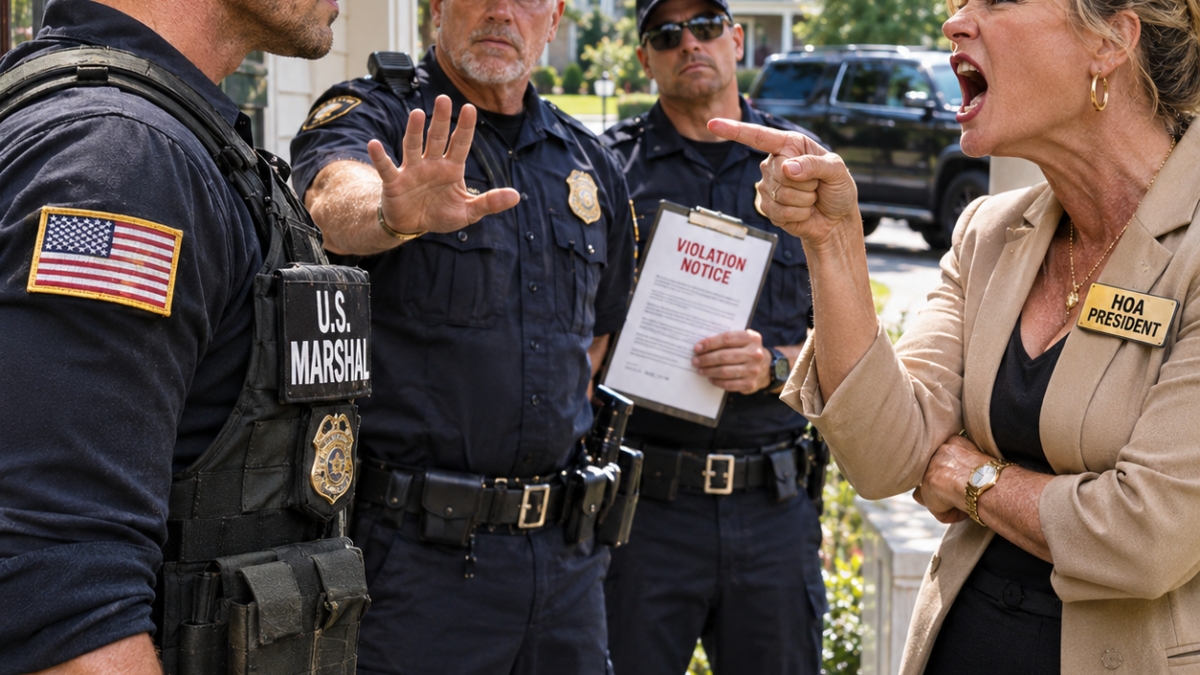
FULL ENDING :“GET OFF YOUR PORCH, YOU ARROGANT FEDERAL CLOWN!” HOA Karen Sent Fake Police to My House—She Had No Idea the U.S. Marshal She Tried to Destroy Would Expose Her Entire Operation
Underneath were the words:
HHO POLICE
I frowned.
I’d never heard of any such agency.
I opened the door partway.
“Can I help you?”
The man stepped forward immediately.
“Property inspection. We’ve received multiple complaints.”
“Who are you?”
He pointed to the plastic badge on his chest.
“Hamilton Hills Police Enforcement.”
I stared at it.
“That’s not a law enforcement agency.”
His expression hardened.
“Sir, you’re required to cooperate.”
The woman beside him raised a clipboard.
“Unauthorized equipment storage. Excessive vehicle noise. Potential community safety violations.”
I looked past them.
A blonde woman in an expensive cardigan was approaching from the sidewalk.
Karen Whitmore.
I’d met her once, briefly, when she stopped by to complain about the color of my mailbox.
Now she smiled like a woman arriving to collect a debt.
“Good morning, Mr. Walker.”
I folded my arms.
“Karen.”
She walked up the steps without waiting to be invited.
“I see my officers have explained the situation.”
“Your officers?”
Her smile widened.
“The Hamilton Hills Owners Association recently approved its own enforcement division.”
I looked at the badges again.
“You created a police department?”
Karen tilted her head.
“We established an authorized compliance unit.”
“Authorized by whom?”
“The association.”
“Which association?”
Her smile vanished for a fraction of a second.
Then she lifted her chin.
“I am the president.”
I looked directly at her.
“Karen, I’m a Deputy U.S. Marshal. Those badges don’t give these people police powers, and an HOA cannot simply invent a law enforcement agency.”
She stepped closer.
“Then you should understand how important following rules is.”
I held her gaze.
“I understand the difference between an actual government agency and people pretending to be one.”
Her face tightened.
The man in uniform moved toward my doorway.
I raised one hand.
“Stop right there.”
He froze.
“You don’t have permission to enter my house.”
Karen laughed.
“Oh, Daniel. Don’t be dramatic.”
I looked at her.
“Step off my porch.”
Her smile returned.
“You’ve got forty-eight hours to remove that trailer.”
“No.”
She blinked.
“What did you say?”
“I said no.”
Her expression changed.
She wasn’t accustomed to hearing it.
Then she leaned close enough that I could smell her perfume.
“You think that badge makes you untouchable?”
I said nothing.
Her voice dropped.
“I’m going to teach you a lesson about who really controls Hamilton Hills.”
She turned.
Her fake officers followed.
And as they walked toward the street, Karen called back over her shoulder.
“Your first citation will be delivered Monday. After that, things become much more unpleasant.”
I watched them climb into the black SUV.
The engine started.
They drove away.
I stood on my porch, staring after them.
I’d seen extortion schemes before.
I’d seen people impersonate officials.
I’d seen intimidation campaigns.
But something about Karen’s confidence bothered me.
She wasn’t behaving like a woman afraid of being caught.
She was behaving like a woman who believed she’d already made arrangements to ensure nobody would stop her.
Three days later, the first yellow citation appeared on my front door.
Two days after that, my neighbors stopped speaking to me.
And before the following week ended, my own agency was investigating me for misconduct.
I thought Karen’s biggest weapon was her fake police force. I was wrong. Her real weapon was the ability to make an entire community believe a lie—and by the time I understood how far she’d gone, she had already convinced my supervisors that I was the dangerous man who needed to be stopped.
PART2
I grew up believing that a badge meant responsibility, not privilege.
My father was a mechanic.
My mother worked at a public library.
Neither had money or influential friends.
They raised me in a house where bills were paid on time, promises mattered, and you were expected to admit when you’d done something wrong.
When I decided to enter law enforcement, my father shook my hand.
Then he said, “Daniel, don’t ever become the kind of man who thinks wearing a badge makes him better than anybody else.”
I remembered that.
Through training.
Through dangerous assignments.
Through long nights when the work seemed endless.
I remembered it when frightened people needed help.
And I remembered it when powerful people attempted to use their positions to escape accountability.
Authority has limits.
Real authority does, anyway.
Karen Whitmore seemed to believe the opposite.
She thought authority existed wherever enough frightened people agreed to obey.
I learned more about her during my first few weeks in Hamilton Hills.
She owned one of the larger houses near the entrance.
Perfectly trimmed hedges.
Freshly painted shutters.
A circular driveway.
An expensive black SUV that seemed to appear wherever a neighborhood dispute occurred.
Karen was the kind of woman who noticed everything.
A trash can left out too long.
A mailbox that didn’t match the house.
A fence that needed painting.
A vehicle she considered unattractive.
She introduced herself to new residents before most neighbors even learned their names.
At first, I’d assumed she was simply overenthusiastic.
Some people enjoy organizing things.
Some genuinely care about how their communities look.
But Karen didn’t seem interested in helping neighbors.
She was interested in controlling them.
I’d noticed that during our first conversation.
She approached while I was unloading boxes from my Jeep.
“Mr. Walker?”
I turned.
“Daniel.”
She smiled.
“Karen Whitmore. Community revitalization committee.”
I shook her hand.
“Nice to meet you.”
Her eyes moved toward the trailer.
“Is that staying?”
I glanced at it.
“Sometimes. Depends on work.”
She frowned.
“It’s rather industrial.”
I smiled politely.
“It’s enclosed and parked on my property.”
She looked toward the driveway.
“We prefer a more harmonious appearance.”
I nodded.
“Good to know.”
Her smile tightened.
“And your mailbox?”
I glanced toward it.
“What about it?”
“It’s black.”
“Yes.”
“Most of the others are white.”
I looked up and down the street.
There were black mailboxes.
White mailboxes.
A green one three houses away.
I turned back.
“I think it’ll be fine.”
Karen stared at me for a moment.
Then smiled.
“We’ll see.”
I should have recognized the warning.
Instead, I returned to unloading boxes.
After the fake officers visited, I began researching the supposed association.
The old Hamilton Hills organization had existed years earlier.
It had held meetings.
Collected modest dues.
Organized neighborhood cleanups.
But the records I could locate showed it had become inactive roughly seven years before I purchased my home.
The last president had moved away.
Attendance had declined.
The community had gradually stopped operating through the association.
There was no obvious record of the new authority Karen claimed.
No legitimate election documents available to homeowners.
No established enforcement agency.
No basis for treating her volunteers as sworn officers.
I wanted to verify everything before making accusations.
So I gathered what I could.
Old neighborhood notices.
Publicly available organizational records.
Property documents.
And copies of the material Karen had distributed.
The more I looked, the less legitimate her operation appeared.
But she was moving faster than I was.
Monday morning, I found a yellow paper taped to my front door.
Large black letters announced:
NOTICE OF COMMUNITY VIOLATION
Underneath:
Unauthorized equipment storage.
Penalty: $375.
Mandatory compliance within forty-eight hours.
At the bottom was Karen’s signature.
Karen Whitmore — Interim President
I read it twice.
There was no meaningful explanation of lawful authority.
No established procedure identifying where I could contest the allegation.
No credible documentation showing that the new association possessed the power it claimed.
Just an official-looking form and a deadline.
I photographed it.
Then placed it with my other records.
I didn’t pay.
I didn’t remove the trailer.
And I didn’t call Karen.
Two days later, another citation appeared.
This one accused me of excessive noise because I’d started my Jeep early in the morning.
The next complained about lawn edging.
Then came a notice claiming the American flag on my porch constituted aggressive signage.
I stared at that one for a long time.
My flag had been hanging in the same place since I moved in.
It wasn’t damaged.
It wasn’t blocking anything.
It was simply an American flag.
Apparently, that was now enough to make me a public nuisance.
I photographed every notice.
Filed copies.
And began maintaining a written record.
I thought the evidence would be more than sufficient if this ever became a formal dispute.
I underestimated how far Karen was prepared to go.
The first real warning came from my neighbors.
Bill and Maryanne lived across the street.
They were retired.
Friendly.
The kind of couple who waved whenever I walked outside.
When I moved in, Maryanne brought banana bread.
Bill helped me identify a leaking outdoor faucet.
They’d made me feel welcome.
Then one morning, I stepped onto the porch and saw Maryanne watering her flowers.
I waved.
“Morning!”
She looked up.
Her expression changed.
Then she turned and went inside.
I frowned.
Perhaps she hadn’t heard.
The next day, Bill was getting his mail.
“Hey, Bill.”
He looked toward me.
Then lowered his gaze and hurried back into the house.
I stood on the sidewalk.
Confused.
By Friday, three homes displayed laminated signs.
WE SUPPORT HAMILTON HILLS SAFETY ENFORCEMENT
The signs were identical.
Same lettering.
Same colors.
Same cheap plastic stakes.
Karen’s campaign was growing.
And somehow, I had become its enemy.
I approached a neighbor named Frank.
He was a retired Navy veteran who lived near the end of the street.
We’d spoken several times about military history and the difficulty of adjusting to quieter routines after years of demanding work.
I thought he would understand why the so-called HOA police troubled me.
I knocked.
He opened the door a few inches.
“Frank.”
He looked uncomfortable.
“Walker.”
“Can I ask you something?”
He glanced toward the street.
Then said, “You shouldn’t be here.”
I frowned.
“Why?”
“Karen says you’ve been threatening people.”
I stared.
“What?”
He looked at me.
“She says you’re using your federal position to intimidate residents.”
For a moment, I couldn’t speak.
Then I said, “Frank, I’m the one receiving bogus citations.”
He shook his head.
“That’s not what we’ve been told.”
“By whom?”
He didn’t answer.
I softened my voice.
“Frank, those people in uniforms aren’t police officers.”
He looked frightened.
“Listen, I don’t want trouble.”
Then he closed the door.
I stood there.
Staring at the wood.
I’ve had people disagree with me.
I’ve had suspects lie about me.
I’ve faced hostile witnesses.
But I’d never expected a quiet neighborhood to turn against me so quickly because one woman with a clipboard told them I was dangerous.
The following week, the black SUV appeared.
It parked just beyond my driveway.
Dark windows.
Engine idling.
A large Hamilton Hills enforcement emblem fixed to the side.
Sometimes someone sat inside.
Sometimes the vehicle remained empty.
It was there in the morning.
At night.
On weekends.
If I walked outside, the driver sometimes started the engine.
If I approached, the SUV moved.
It wasn’t subtle.
It was meant to be noticed.
One evening, I found another citation on my door.
I looked toward the SUV.
The driver was watching.
I held up the paper.
Then pointed toward the camera mounted above my porch.
The SUV drove away.
It returned the next night.
I reported the situation through the appropriate channels.
I documented the fake badges.
The citations.
The vehicle.
The suspected intimidation.
I also contacted local authorities about the possibility of criminal impersonation and related misconduct.
I was careful to separate my role as a resident from my official responsibilities.
I wasn’t conducting a personal federal investigation.
I wasn’t using my position to threaten neighbors.
I wanted the matter handled lawfully.
But Karen had already begun building a different version of events.
One in which I was the aggressor.
One in which her volunteers were frightened citizens.
One in which the U.S. Marshal living on Willow Creek Lane was unstable, confrontational, and abusing his authority.
Then the complaints reached my workplace.
My supervisor was Agent Roads.
A serious man.
Not especially warm.
But experienced.
We’d worked together long enough that I believed he knew my character.
When the first complaint arrived, I assumed he would ask me about it.
Instead, I received a formal notice directing me to report for an interview.
I stared at the message.
Allegations of intimidation and misconduct.
My stomach tightened.
I read it again.
Then called Roads.
“Sir, there’s a misunderstanding.”
He sounded tired.
“Walker, come in tomorrow.”
“It’s connected to the neighborhood issue I reported.”
“I know.”
“Those people are impersonating officers.”
He paused.
“We’ll discuss it through the proper process.”
The call ended.
I sat staring at my phone.
For the first time, I felt genuinely worried.
Karen wasn’t simply collecting fake fines anymore.
She was attacking my career.
The interview room had no windows.
Two chairs.
A table.
A recorder.
An internal affairs investigator sat across from me.
She introduced herself.
Then opened a folder.
“Agent Walker, we’ve received several complaints.”
I nodded.
“I’ve been expecting this.”
She looked up.
“Have you?”
“Yes.”
I explained Karen’s activities.
The inactive HOA.
The fake enforcement jackets.
The citations.
The black SUV.
The neighbors who had suddenly stopped speaking to me.
The investigator listened.
Then asked, “Do you have documentation?”
“Yes.”
I told her about the photographs and reports I’d submitted.
She examined the information available to her.
Then frowned.
“We’re having difficulty locating some of the correspondence you described.”
I stared.
“What do you mean?”
“The messages aren’t appearing where we’d expect them.”
I felt cold.
“I sent them.”
She nodded.
“Then we’ll need to verify that.”
I leaned forward.
“Are you suggesting I invented them?”
“I’m saying we’re evaluating what we can independently confirm.”
I swallowed.
She continued.
“Meanwhile, the complaints include allegations that you’ve threatened residents and improperly invoked your position.”
I shook my head.
“That’s false.”
“We’ll investigate.”
I felt my hands tightening.
“I have no reason to threaten anyone.”
She looked toward the folder.
“Some of the complainants say otherwise.”
I stared.
Karen had found people willing to sign statements.
Whether they believed the accusations or had been pressured to cooperate, I didn’t know.
But the consequences were real.
Pending review, I was placed on conditional administrative leave.
I had to surrender my duty credentials and equipment under the applicable procedures.
My assignments were suspended.
I left the building without the badge I’d carried for years.
I remember looking down at the empty place on my belt.
Such a small absence.
Yet it felt enormous.
I had spent two decades building a career.
I understood the importance of reviewing allegations against officers.
I knew accountability mattered.
But it was devastating to realize that Karen’s accusations had become serious enough to interrupt my work.
I went home.
The black SUV was waiting near my driveway.
The driver watched as I parked.
For a moment, I wanted to walk over and demand answers.
Instead, I went inside.
Locked the door.
And sat in the kitchen.
My coffee had gone cold.
My phone vibrated.
Unknown number.
A short message appeared.
Stop pushing.
Then another.
You’re not untouchable.
I stared at the screen.
And finally understood how deliberate this had become.
Karen wanted me frightened.
Isolated.
Discredited.
And she wasn’t going to stop until I submitted.
That night, I searched for the Hamilton Hills enforcement website.
The page was gone.
I tried the telephone number printed on the citations.
Disconnected.
I checked for updated public organizational filings.
Nothing that established the authority Karen claimed.
The operation seemed to vanish whenever someone examined it closely.
Yet the intimidation continued.
Paper citations.
Uniformed volunteers.
Threatening notices.
The black SUV.
Residents signing statements.
Money being collected.
I spread everything I’d saved across my kitchen table.
Photographs.
Copies.
Dates.
Screenshots.
Messages.
And I realized I needed more than my own testimony.
I needed another resident willing to speak.
Someone who had been inside Karen’s operation.
Someone who could explain how the neighborhood had been convinced that a private committee possessed powers it never had.
Then I thought about Tamara.
Tamara lived three houses away.
She’d brought cookies when I moved in.
She was friendly and talkative.
Her porch used to be filled with flowers and wind chimes.
Lately, I hadn’t seen her.
The flowers were gone.
The curtains remained closed.
Her car was always parked outside.
And the house looked strangely abandoned even though I knew someone was living there.
One cold evening, I walked past her property.
Her porch light was on.
I hesitated.
Then approached.
I knocked.
For several seconds, nothing happened.
Then the door opened a few inches.
Tamara looked out.
Her face was pale.
She glanced toward the street.
“Daniel?”
I nodded.
“Hi.”
She looked frightened.
Then whispered, “I was hoping you’d come.”
I stared.
“What?”
She opened the door wider.
“Quickly.”
I stepped inside.
She shut the door.
Locked it.
Then led me into the living room.
The curtains were drawn.
A thick folder lay on the coffee table.
Tamara pointed toward it.
“I kept everything.”
I looked down.
On the cover were the words:
HAMILTON HILLS — ORIGINAL BYLAWS AND RECORDS
My heart began pounding.
“Tamara.”
She sat.
Then whispered, “Karen has been lying to everyone.”
I opened the folder.
Inside were old newsletters.
Minutes from meetings.
Voting records.
Documents showing how the original association had operated.
And material confirming that the association had ceased functioning years before Karen claimed to revive it.
I turned another page.
No legitimate record of her supposed election.
No documented authorization for an enforcement division.
No valid transfer of police powers.
I looked up.
“Where did you get all this?”
Tamara’s eyes filled.
“I used to help with neighborhood communications.”
I waited.
“Before everything fell apart.”
She began crying.
“Karen came to me almost a year ago.”
I leaned forward.
“What did she want?”
“To restart the community organization.”
She laughed bitterly.
“At first, she talked about potlucks, cleanup days, neighborhood newsletters.”
I nodded.
“Then?”
Tamara wiped her face.
“She started talking about enforcement.”
My stomach tightened.
“She wanted uniforms.”
I waited.
“Badges.”
Tamara’s voice broke.
“And she wanted residents signing complaints against people who wouldn’t cooperate.”
I stared at her.
“She asked you?”
Tamara nodded.
“I refused.”
“What happened?”
Her lips trembled.
“She threatened me.”
I felt my jaw tighten.
“She said if I didn’t support the program, she’d make sure I regretted it.”
Tamara looked toward the window.
“And then the notices started.”
I leaned forward.
“What notices?”
“Violations. Fines. Threats about my property.”
She began crying harder.
“I didn’t know what to do.”
I sat quietly.
Then asked, “Why are you telling me now?”
She looked into my eyes.
“Because you’re the first person who said no and didn’t disappear.”
For a moment, I couldn’t speak.
Then she reached across the table.
“I’ll testify.”
I stared.
She nodded.
“Whatever you need. I’ll tell the truth.”
And for the first time since Karen appeared on my porch, I felt something shift.
I was no longer the only person willing to challenge her.
The next morning, I contacted Detective Lee Alvarez.
I’d worked with him during a multiagency assignment several years earlier.
He was methodical.
Skeptical.
The kind of investigator who cared more about evidence than somebody’s title.
We arranged to meet at the precinct.
I brought copies of everything.
Tamara’s records.
The citations.
Photographs.
Screenshots.
Documentation of the suspicious SUV.
Alvarez spread the material across his desk.
For several minutes, he said nothing.
Then he looked up.
“Walker.”
I waited.
“This is worse than a neighborhood dispute.”
I nodded.
“I know.”
He examined the photographs of the uniforms.
“Where did they get these?”
“That’s one of the things I need you to determine.”
He looked at the vehicle information.
Then began checking official records through authorized channels.
I watched his expression grow serious.
Eventually, he leaned back.
“The vehicle is connected to a private security company based in Jacksonville.”
I felt cold.
“What company?”
He gave me the registered information.
We reviewed what could be verified.
Its South Carolina authorization was questionable.
The supposed community police unit had no lawful status as a police department.
The business arrangements needed further examination.
Alvarez looked toward Tamara’s documents.
“Whoever created this setup wanted it to look official.”
I nodded.
“Exactly.”
He continued.
“Uniforms. Badges. Vehicles. Citations.”
I pointed toward one photograph.
“And frightened residents.”
Alvarez looked at me.
“Can your witness provide a formal statement?”
“Yes.”
He nodded.
“Then we have a place to start.”
Tamara gave her statement.
She was frightened.
Her hands trembled while she described the threats.
But she didn’t retreat.
She brought records.
Copies of communications.
Names of people Karen had approached.
Details of the fake enforcement structure.
And information about the meetings Karen claimed had authorized her actions.
Alvarez listened carefully.
Then began following the evidence.
As additional residents were interviewed, more complaints emerged.
People who had paid fines.
Homeowners threatened with escalating penalties.
Residents who had been told they could lose their homes if they didn’t cooperate.
Some had suspected the operation was fraudulent.
Others had believed the uniforms were genuine.
A few admitted they’d signed statements because they feared becoming Karen’s next target.
The story was bigger than my trailer.
Bigger than my house.
Karen had created a system where fear generated obedience.
And obedience generated money.
Then came the mandatory internal review.
I arrived at my regional office wearing a clean shirt.
No badge.
No duty weapon.
Just my documents and the uncomfortable knowledge that the woman who had started everything might be allowed to speak against me.
Conference Room B was cold.
A long table stood beneath fluorescent lights.
My supervisor, Roads, waited near the back.
The lead investigator was a woman named Darden.
She gestured toward the chair opposite the panel.
“Agent Walker, please sit.”
I did.
She reviewed the allegations.
Threats.
Harassment.
Misuse of official status.
Improper conduct toward civilians.
I listened.
Then spoke.
“These complaints are part of a coordinated effort to discredit me after I challenged an unauthorized neighborhood enforcement operation.”
Darden looked toward me.
“Can you substantiate that?”
I placed the folder on the table.
“Yes.”
I showed the records.
The original HOA documents.
The notices.
The evidence collected independently.
And the status of the local investigation.
Darden listened.
Roads remained quiet.
For the first time, the discussion seemed to be moving away from the accusations and toward the facts behind them.
Then the conference room door opened.
Karen Whitmore walked in.
She wore a navy-blue pantsuit.
Perfectly styled blonde hair.
Expensive heels.
A leather briefcase.
She smiled at the panel.
“Good morning.”
I stared.
Karen looked toward me.
Then smiled even more broadly.
“Agent Walker.”
I didn’t answer.
Darden introduced her as a community witness who had submitted information.
Karen sat opposite me.
Opened her briefcase.
And began removing documents.
Neatly arranged citations.
Photographs.
Meeting notes.
Statements.
Everything designed to look organized and credible.
She spoke smoothly.
“I represent the Hamilton Hills community oversight initiative.”
I watched her.
She continued.
“Our residents have been concerned about Agent Walker’s behavior.”
Darden listened.
Karen described me as confrontational.
Uncooperative.
Intimidating.
A man who believed federal employment placed him above neighborhood standards.
Every sentence was polished.
Rehearsed.
Delivered with just enough concern to sound reasonable.
Then she looked at me.
“It’s unfortunate that someone entrusted with federal authority has treated his own neighbors this way.”
I felt my hands tighten.
Darden turned toward me.
“Agent Walker?”
I took a breath.
“May I respond?”
She nodded.
I opened Tamara’s folder.
“First, the alleged enforcement organization has not established the powers it claims.”
Karen smiled.
I continued.
“Second, the people wearing police-style uniforms are not sworn officers.”
Her smile tightened.
“Third, the property citations were issued under disputed authority and are connected to an operation local investigators are examining.”
Karen interrupted.
“That is a gross misrepresentation.”
I looked at her.
“Then provide the lawful basis for your authority.”
She stared.
I continued.
“The actual records. The valid votes. The governing documents. The legal authorization for the enforcement program.”
Karen folded her hands.
“I have substantial community support.”
I nodded.
“Support isn’t the same as legal authority.”
Darden raised a hand.
“Both parties will have an opportunity to submit documentation.”
Karen sat back.
Then smiled.
“As I’m sure everyone understands, my family has considerable experience with federal matters.”
I looked toward her.
There it was.
The beginning of another threat.
She continued.
“My brother is Judge Landon Whitmore.”
Roads shifted slightly.
Darden remained composed.
Karen smiled at me.
“I’m sure we can resolve this without unnecessary embarrassment.”
For a moment, the room was silent.
I looked directly at her.
“Karen, your brother’s position doesn’t make your citations legitimate.”
Her face hardened.
I continued.
“And it doesn’t turn private security employees into police officers.”
Darden intervened before the exchange went further.
But the message was clear.
Karen wanted everyone in the room to understand that she had powerful connections.
And she expected those connections to matter more than the evidence.
I left the meeting shaken.
Not because Karen had won.
The review was still ongoing.
But because I’d seen how confidently she used the name of a federal judge as a threat.
I wondered how many neighbors had submitted to her for the same reason.
How many had paid fines because they believed she could influence judges.
How many had remained silent because they feared consequences they didn’t fully understand.
That evening, I received a flyer under my door.
HAMILTON HILLS COMMUNITY FORUM
Attendance strongly encouraged.
Community Recreation Center.
7:00 p.m.
At the bottom was Karen’s name.
I read it twice.
She was holding a meeting.
And judging by the timing, she intended to use it to reinforce her authority before the investigation gathered enough momentum to stop her.
I called Alvarez.
“Karen’s holding a community forum.”
He listened.
I continued.
“Tomorrow night.”
He asked for the details.
I told him.
Then said, “I think she’s going to make an example of me.”
Alvarez paused.
“Don’t turn it into a confrontation.”
“I won’t.”
“Bring your documentation. Follow the law. Let us handle anything requiring police action.”
I agreed.
I wasn’t going to arrest anybody.
I was on administrative leave.
I had no intention of creating another allegation Karen could use.
But I was going to attend.
And I was going to make sure my neighbors heard the truth.
The next evening, I arrived at the recreation center shortly before seven.
The parking lot was crowded.
Cars lined the street.
Through the windows, I could see rows of folding chairs.
A cheap podium stood at the front.
Behind it hung a large banner.
ORDER. SAFETY. PRIDE IN OUR NEIGHBORHOOD.
I paused outside.
I could feel the tension in my shoulders.
I’d spent years handling difficult situations.
But walking into a room full of neighbors who had been told I was dangerous felt different.
These were people I’d wanted to live beside peacefully.
People whose children rode bicycles past my driveway.
People who once waved when I took out the trash.
Now some looked away when I entered.
Others whispered.
A few watched openly.
I found a seat near the back.
Tamara was already inside.
She looked toward me.
We exchanged a small nod.
Then Karen stepped up to the microphone.
She wore a dark blazer.
Her fake officers stood near the walls.
One held a camera.
The other watched the room.
Karen smiled warmly.
“Good evening, everyone.”
A few people applauded.
“Thank you for supporting our community safety initiative.”
I remained still.
She spoke about protecting property values.
Maintaining order.
Preserving neighborhood standards.
Keeping families safe.
All the words sounded reasonable.
That was part of the danger.
She wrapped intimidation in language that made disagreement seem irresponsible.
Then her eyes found me.
“Unfortunately,” she continued, “not everyone in our community has embraced these important values.”
The room grew quiet.
She looked directly at me.
“Some residents believe their professional status places them above the rules.”
A few heads turned.
Karen continued.
“We’ve documented repeated violations and threatening conduct by one particular homeowner.”
I felt my jaw tighten.
She paused.
Then said, “Mr. Daniel Walker.”
Dozens of eyes turned toward me.
I stood slowly.
Karen smiled.
“Mr. Walker, perhaps you’d like to explain why you’ve refused to cooperate with legitimate community enforcement.”
I took a breath.
“Yes.”
Her smile faltered.
I stepped into the aisle.
“Actually, I would.”
Karen watched as I walked toward the front.
One of the fake officers moved closer.
I stopped.
“I’m not here to threaten anyone.”
I looked around the room.
“I’m here because a number of people have been receiving citations and paying fines to an organization whose claimed authority has not been substantiated.”
Karen laughed.
“That’s absurd.”
I turned toward her.
“Then this should be simple.”
I placed a folder on the front table.
“Show everyone the documents establishing your authority.”
She stared.
“The community elected me.”
I nodded.
“Then show the election records.”
She folded her arms.
“We have minutes.”
“Show them.”
The room grew quiet.
Karen’s face reddened.
I continued.
“Show the governing documents that allow your enforcement team to issue these penalties.”
She looked toward the fake officers.
“And explain why your volunteers are wearing badges and uniforms that make them appear to be police.”
A murmur moved through the audience.
Someone raised a hand.
Karen ignored it.
I continued.
“The old Hamilton Hills association became inactive years ago.”
I opened the folder.
“These are copies of its original records.”
I looked toward Tamara.
She stood.
Her hands trembled.
But her voice was steady.
“Those records are authentic.”
Karen spun toward her.
“Tamara, sit down.”
Tamara didn’t.
“I kept them.”
The room fell silent.
She continued.
“I worked with the old association. Karen never obtained the approval she claims.”
Karen’s face hardened.
“That’s not true.”
Tamara looked around the room.
“She threatened me when I refused to support her enforcement program.”
A gasp came from the front row.
Karen grabbed the microphone.
“This is becoming a personal attack!”
I stepped back.
“Then let people ask questions.”
For a moment, nobody moved.
Then Bill stood.
The retired neighbor who had stopped waving at me.
He looked toward Karen.
“You told us the city authorized the fines.”
Karen opened her mouth.
Bill continued.
“Did they?”
She hesitated.
Maryanne stood beside him.
“We paid four hundred dollars last month.”
Her voice shook.
“Where did that money go?”
Another homeowner stood.
“You told me my house could be taken if I didn’t comply.”
Then another.
“You sent those officers to my driveway.”
A woman near the aisle began crying.
“My husband was terrified.”
Karen looked around.
Her expression changed.
For the first time, she seemed to realize that the people she’d frightened were beginning to compare their experiences.
And that frightened people talking to one another were far more dangerous to her than frightened people sitting alone inside their houses.
Karen tried to regain control.
“Everyone, please.”
Nobody listened.
She raised her voice.
“These accusations are being stirred up by Mr. Walker!”
I looked toward her.
“Then answer the questions.”
She pointed at me.
“You have no right to challenge this committee.”
I kept my voice calm.
“Residents have the right to ask where their money went.”
Karen’s face twisted.
“You’re under federal investigation!”
The room went quiet again.
I felt every eye turn toward me.
Karen smiled triumphantly.
“Yes, everyone. Agent Walker has been suspended because of his behavior.”
I looked at her.
For a moment, the humiliation burned.
She was using the damage she’d caused as proof that she was right.
I took a breath.
“I’m on administrative leave while complaints are reviewed.”
She laughed.
“Exactly.”
I continued.
“Which is why I am not acting here in any official law enforcement capacity.”
I looked around the room.
“I’m speaking as a homeowner.”
Karen’s smile faded.
“And as a homeowner, I’m asking the same questions all of you have the right to ask.”
Tamara stepped forward.
“She’s lying about the votes.”
Bill raised his hand.
“What happened to the fines?”
Maryanne asked whether anyone had receipts.
A man in the second row demanded to know why a private security company was pretending to enforce government rules.
The room erupted.
And Karen’s carefully manufactured authority began collapsing in front of her.
Then the recreation center doors opened.
Detective Alvarez entered with other officers.
The room fell quiet.
Karen turned.
For an instant, she looked relieved.
As though she’d finally found a real police officer who would restore her control.
“Detective,” she began, “thank goodness.”
Alvarez approached calmly.
“Ms. Whitmore.”
She pointed toward me.
“This man has disrupted a private meeting.”
Alvarez looked at the evidence gathered at the front.
Then toward Karen.
“We need to speak with you about the operation you’ve been running.”
Her smile disappeared.
“What?”
He continued.
“There are questions concerning the collection of funds, the use of law enforcement-style identification, and the authority claimed by your organization.”
Karen laughed.
“This is ridiculous.”
Alvarez remained calm.
“We’ve received formal statements.”
Her eyes moved toward Tamara.
Then Bill.
Then Maryanne.
Her expression hardened.
“Who filed them?”
Alvarez didn’t answer that question.
Instead, he explained the next steps under the investigation.
Karen glanced toward the exits.
One of her uniformed volunteers had already slipped out of the room.
The other remained near the wall.
His face was pale.
Karen stepped backward.
“You don’t know who my brother is.”
Alvarez held her gaze.
“Your brother isn’t relevant to whether these activities were lawful.”
Her mouth fell open.
For the first time, she had no immediate answer.
The officers escorted Karen from the front of the room.
As they moved toward the exit, she began protesting.
She accused residents of betraying her.
Called the investigation politically motivated.
Insisted the neighborhood needed her.
But nobody rushed to defend her.
The people who had once stood silently while she issued threats now watched her leave.
Some looked relieved.
Some angry.
Some ashamed.
I didn’t feel triumphant.
Not yet.
I watched the officers escort her outside, knowing that an investigation still had to proceed.
Evidence had to be evaluated.
Allegations proven.
Any charges handled through the proper process.
But one thing had changed.
Karen’s uniformed volunteers were no longer standing at the front of the room pretending they represented unquestionable authority.
And the neighbors were finally speaking openly.
For several moments, nobody moved.
Then Maryanne began crying.
Bill put an arm around her.
A homeowner near the back stood.
“I paid those fines because I thought I’d lose my house.”
Another shook his head.
“I thought I was the only one.”
Tamara wiped her eyes.
I looked around the room.
Dozens of people.
People who had been isolated by fear.
Karen hadn’t needed to convince everyone that she was right.
She’d only needed to convince each person that they would stand alone if they challenged her.
Now they were discovering they hadn’t been alone at all.
A neighbor approached me.
He was the man who’d refused to speak when I first tried warning people.
His face was red.
“Walker.”
I turned.
He swallowed.
“I owe you an apology.”
I waited.
“I believed her.”
I nodded slowly.
He looked toward the floor.
“I signed one of those complaints.”
For a moment, I felt anger rise.
Then he continued.
“She told me you’d threatened people.”
I looked at him.
“Did you ever see me threaten anyone?”
He shook his head.
“No.”
“Then why did you sign?”
His eyes filled.
“Because I was afraid she’d come after me next.”
I stared at him.
For a long moment, neither of us spoke.
Then I said, “Tell the investigators exactly what happened.”
He nodded.
“I will.”
And I believed him.
Tamara came to stand beside me.
Her hands were still trembling.
“You did it.”
I shook my head.
“We did.”
She looked toward the door.
“I thought she would destroy my life if I told anyone.”
I turned toward her.
“You were brave.”
She laughed weakly.
“I was terrified.”
I nodded.
“Most people are when they have to stand up to someone who’s been threatening them.”
Her eyes filled.
She looked around the room.
For the first time in weeks, people were talking to her.
Asking questions.
Thanking her for keeping the records.
The same woman who had hidden behind closed curtains was now standing in the middle of the community center, surrounded by neighbors who wanted to hear what she knew.
I felt something loosen in my chest.
Perhaps Hamilton Hills could become the place I’d hoped it would be.
But my own situation wasn’t resolved yet.
My badge was still gone.
My career was still on hold.
And Karen’s connections remained a concern.
The investigation moved forward.
Alvarez and the appropriate agencies followed the records.
The private security company’s activities came under scrutiny.
The supposed citations were reviewed.
Residents provided receipts and statements.
The money collected under the enforcement program became a central issue.
Karen’s claims of authority were compared against the records.
And the contradictions grew impossible to ignore.
The private company was shut down as its unlawful activities were addressed.
The neighborhood enforcement operation ended.
The officers stopped appearing at homes.
The SUV disappeared.
The yellow citations stopped arriving.
For the first time in months, I could open my front door without wondering whether a stranger in a fake uniform would be standing there.
My agency’s internal review continued separately.
I met with investigators.
Provided evidence.
Answered questions.
Explained the chronology.
I understood why the process mattered.
Complaints against federal law enforcement officers could not simply be ignored because the accused officer insisted he was innocent.
But the accumulating evidence increasingly supported my account.
The false allegations.
The coercion.
The suspicious neighborhood campaign.
And the connection between Karen’s actions and the complaints made against me.
Then, two weeks after the community meeting, Roads asked me to come to his office.
I arrived wearing a plain shirt.
My hands were cold.
For a moment, I felt as nervous as I had on my first day in federal service.
Roads stood when I entered.
That alone surprised me.
“Walker.”
“Sir.”
He gestured toward the chair.
“Sit.”
I did.
He placed an envelope on the desk.
Then looked at me.
“The review has concluded.”
My heart began pounding.
I waited.
He continued.
“The allegations against you were not substantiated.”
For a moment, I couldn’t speak.
Then he added, “You’re being cleared to return to duty.”
I stared at him.
I had imagined this moment for weeks.
But now that it had arrived, I didn’t know what to say.
Roads pushed the envelope toward me.
Inside was the official notification.
My eyes moved across the page.
Then filled.
I swallowed.
“Thank you, sir.”
Roads nodded.
“We should have understood the context sooner.”
I looked up.
He continued.
“We have procedures for a reason. But the information available to us was manipulated.”
For a moment, I sat quietly.
Then said, “I understand.”
He looked toward me.
“Welcome back, Walker.”
I stood.
And shook his hand.
When my badge was returned, I held it for a long moment.
The familiar weight.
The familiar shape.
The symbol of a responsibility I’d spent nearly twenty years trying to honor.
I thought about my father.
His warning.
Don’t ever become the kind of man who thinks wearing a badge makes him better than anybody else.
Karen had tried to use the appearance of authority to control people.
I’d nearly lost my career because I challenged that.
Now the badge was back.
But the experience had changed the way I thought about the community I’d moved into.
I no longer wanted simply to live somewhere quiet.
I wanted to live among people who understood the importance of asking questions.
Because quiet streets mean nothing when everyone is too frightened to speak.
Karen remained under investigation.
Financial records and witness statements raised serious concerns about fraud and the impersonation of authority.
Her connection to the private security company was examined.
The role of anyone who knowingly assisted the operation was also scrutinized.
Her brother’s name surfaced again.
Judge Landon Whitmore.
The man she’d repeatedly invoked whenever someone questioned her.
Publicly, he eventually stepped away from his position for personal reasons.
I didn’t know everything that happened behind closed doors.
And I refused to pretend I did.
Whatever his connection to Karen’s activities, I wanted the evidence to determine responsibility.
Not rumors.
Not assumptions.
Not my anger.
I’d spent months suffering because Karen convinced people to accept accusations without proper verification.
I wasn’t going to make the same mistake.
Hamilton Hills changed.
Slowly.
At first, neighbors seemed embarrassed to talk about what had happened.
Some avoided the subject.
Others were furious.
There were difficult conversations about the money collected.
The signed complaints.
The threats.
The people who had supported Karen.
And the people who had remained silent.
But eventually, residents began discussing what kind of community organization they actually wanted.
Some preferred not to have an association at all.
Others wanted a legitimate neighborhood group to handle shared projects.
Meetings were held.
Records reviewed.
Procedures discussed.
Residents were allowed to question proposals.
And the community began working toward a lawful association with clear limits on its authority.
No fake police.
No invented enforcement powers.
No private intimidation squads.
No woman declaring herself president because she’d gathered enough people afraid to challenge her.
Tamara agreed to serve as communications chair during the reorganization.
I smiled when she told me.
“Really?”
She laughed.
“I know.”
“After everything?”
She nodded.
“Someone needs to make sure people actually get the meeting notices.”
I laughed.
“That would be a good start.”
She smiled.
“And I want the records available to everyone.”
I looked at her.
“That’s an even better start.”
Bill and Maryanne came to my house one Saturday morning.
Maryanne carried banana bread.
Bill held a toolbox.
I opened the door.
For a moment, we all stood awkwardly.
Then Maryanne smiled.
“Daniel.”
I smiled back.
“Good morning.”
She held out the bread.
“I thought you might like some.”
My throat tightened.
“Thank you.”
Bill looked toward the driveway.
“I noticed you were working on the edging.”
I laughed.
“Apparently, it’s a neighborhood crisis.”
He chuckled.
Then looked embarrassed.
“I was hoping I could help.”
I stepped aside.
“Come on in.”
We drank coffee.
Talked.
Eventually, Maryanne looked down at her hands.
“Daniel, we’re sorry.”
I waited.
She continued.
“We shouldn’t have listened to Karen without asking you.”
Bill nodded.
“We got scared.”
I looked toward them.
“I know.”
Maryanne’s eyes filled.
“We thought if we disagreed with her, she’d come after us too.”
I swallowed.
I remembered the curtains closing.
The sudden silence.
The feeling of becoming a stranger in my own neighborhood.
It had hurt.
More than I wanted to admit.
But I also understood how Karen had exploited fear.
I looked at them.
“Next time somebody claims to have authority over your property, ask for the documents.”
Bill nodded.
“We will.”
I smiled faintly.
“And if somebody tells you your neighbor is dangerous, maybe speak to the neighbor before signing a complaint.”
Maryanne began crying.
“I’m sorry.”
I nodded.
“I know.”
Then I reached for the banana bread.
And we shared breakfast.
One evening, I found Frank standing near my mailbox.
He looked uncomfortable.
“Walker.”
I turned.
“Frank.”
He shifted his weight.
“I heard you got your badge back.”
I nodded.
“Yes.”
He looked toward the street.
“Good.”
For a moment, neither of us spoke.
Then he said, “I was wrong.”
I waited.
“I should have listened.”
I nodded.
He looked down.
“When Karen came around collecting statements, she told us you’d threatened people.”
I looked at him.
“And you believed her?”
He sighed.
“I wanted to believe the person acting like she was in charge knew what she was doing.”
I thought about that.
Then said, “A uniform doesn’t make someone right.”
Frank nodded.
“Neither does a title.”
I smiled faintly.
“Exactly.”
He held out his hand.
I shook it.
And for the first time in months, the neighborhood felt a little less divided.
The black SUV never returned.
The fake badges disappeared.
The signs supporting Karen’s enforcement team came down one by one.
Some residents threw them away immediately.
Others left them standing for a few days, perhaps embarrassed to admit how thoroughly they’d been deceived.
Then even those disappeared.
The street began looking ordinary again.
Children rode scooters.
Dogs barked behind fences.
Neighbors argued about watering schedules and fallen leaves.
Someone hosted a barbecue.
Someone else organized a neighborhood cleanup.
Tamara put flowerpots back on her porch.
Her wind chimes returned.
And when I walked past, she waved.
Every time.
One Saturday afternoon, I was repairing a loose board on my porch when a car pulled into the driveway.
Alvarez stepped out.
He wore jeans and a plain shirt.
No uniform.
No official business.
He carried a bag of sandwiches.
I raised an eyebrow.
“What’s this?”
He smiled.
“Lunch.”
I laughed.
“You investigating my porch now?”
He looked at the board.
“Looks suspicious.”
I shook my head.
He came up the steps.
We sat outside eating.
For a while, we talked about ordinary things.
Work.
The weather.
A local football game.
Then Alvarez looked toward the street.
“Quiet now.”
I nodded.
“Finally.”
He took another bite.
Then said, “You know, Walker, a lot of people would’ve backed off.”
I looked at him.
“Maybe.”
He continued.
“After the complaints. The leave. The threats.”
I thought about those nights.
The black SUV.
The unknown messages.
My empty holster.
The way neighbors stopped waving.
I looked toward the house.
“I almost did.”
Alvarez turned.
“Really?”
I nodded.
“There were nights when I thought about selling the place.”
He was quiet.
I continued.
“Packing everything. Finding another neighborhood. Letting Karen have her little kingdom.”
I looked toward the street.
“But then I thought about the people who couldn’t just leave.”
Tamara.
Bill.
Maryanne.
The homeowners who had paid fines.
The people threatened with losing their homes.
I swallowed.
“Someone had to challenge it.”
Alvarez nodded.
Then smiled.
“And you found witnesses.”
I looked toward Tamara’s house.
“Yes.”
He followed my gaze.
“That’s what made the difference.”
I thought about that conversation for a long time.
At first, I’d imagined myself fighting Karen alone.
A U.S. Marshal standing against a fraudulent HOA president.
It sounded dramatic.
And in a way, it was.
But the real turning point hadn’t been my badge.
It hadn’t been the community meeting.
It hadn’t even been Alvarez walking through the doors with legitimate officers.
It had been Tamara opening her door.
A frightened woman who had hidden behind curtains for weeks.
She’d kept the records.
She’d refused to sign false statements.
And when the time came, she’d chosen to speak.
Her courage gave other residents permission to speak.
Then Bill asked about the fines.
Maryanne asked where the money had gone.
Other homeowners admitted they had been threatened.
And suddenly, Karen’s greatest weapon was gone.
The belief that everyone else was obeying willingly.
A few months after the investigation began, Hamilton Hills held its first properly organized community meeting.
This one was different.
No enforcement uniforms.
No fake badges.
No threatening citations.
No mandatory attendance notices.
The agenda had been distributed in advance.
Residents could examine the proposed rules.
Ask questions.
Express concerns.
And vote through the applicable procedures.
I attended.
Not because I wanted to become president.
I didn’t.
I’d had enough of neighborhood politics to last a lifetime.
I went because I wanted to see whether the community had learned anything.
Tamara stood at the front.
She looked nervous.
Then smiled.
“Thank you for coming.”
People listened.
She explained the agenda.
The recordkeeping requirements.
The need for transparency.
The limits of any new association’s role.
Then someone asked a difficult question.
Tamara didn’t become angry.
She didn’t threaten a fine.
She simply answered.
And when she didn’t know something, she said she’d check the records.
I sat near the back.
For a moment, I smiled.
It wasn’t dramatic.
Nobody shouted.
Nobody slammed documents onto a podium.
Nobody wore a plastic badge.
It was just a room full of neighbors discussing their community.
Exactly the way it should have been.
After the meeting, Tamara approached me.
“Well?”
I smiled.
“Well what?”
She laughed.
“Was it boring enough for you?”
I looked toward the folding chairs.
“Beautifully boring.”
She laughed harder.
I continued.
“No fake police. No threats. No woman declaring herself queen of the neighborhood.”
Tamara grinned.
“I’ll put that in the minutes.”
I laughed.
Then she grew serious.
“Daniel.”
I looked at her.
“Thank you.”
I shook my head.
“You’re the one who brought the records.”
She smiled.
“We both did something.”
I nodded.
“That’s true.”
Then she said, “I almost threw that folder away.”
My stomach tightened.
“What?”
She nodded.
“Months ago. I was so frightened I thought getting rid of it might make everything easier.”
I stared at her.
“What stopped you?”
Tamara looked toward the meeting room.
“I kept thinking somebody might need to know what really happened.”
My throat tightened.
I looked at her.
“I’m glad you kept it.”
She nodded.
“So am I.”
There were still consequences from Karen’s operation.
Some residents had paid money they might not recover quickly.
Others were frightened of participating in community decisions.
Trust had been damaged.
And rebuilding it required more than removing one woman.
People needed records.
Clear communication.
The ability to disagree without punishment.
And confidence that official-looking claims would be checked before anyone acted on them.
The neighborhood didn’t become perfect.
No neighborhood does.
People still argued.
Someone complained about a fence.
Someone else disliked a neighbor’s landscaping.
But those disagreements no longer came with threats from a fictional police force.
And that mattered.
One afternoon, I stood in the driveway washing my Jeep.
The equipment trailer was parked beside it.
The same trailer Karen had tried to remove.
Its paint was clean.
The tires properly maintained.
The hitch secured.
Nothing extraordinary.
Just equipment stored on my property.
Bill walked past.
He glanced at it.
Then smiled.
“Karen would hate that thing.”
I laughed.
“She certainly did.”
He shook his head.
“Hard to believe all this started with a trailer.”
I turned off the hose.
“No.”
Bill looked surprised.
“What?”
I leaned against the Jeep.
“It didn’t start with the trailer.”
He frowned.
“Then what?”
I looked toward the street.
“It started when people stopped asking whether Karen had the right to do what she was doing.”
Bill was quiet.
Then nodded slowly.
“Yeah.”
I looked toward the houses.
“The trailer was just the excuse.”
Late one evening, I sat on the porch with a cup of coffee.
The sky was dark.
Warm lights glowed in the windows across the street.
Someone was grilling ribs two houses away.
Children were riding scooters near the end of the block.
A dog barked.
Then another answered.
Ordinary sounds.
Beautiful sounds.
The sounds of a neighborhood living without fear.
I thought about the morning Karen appeared.
Her smug smile.
The two fake officers.
The cheap badges.
The demand that I surrender my right to question her.
I remembered her voice.
You will cooperate one way or another.
Then I thought about the weeks that followed.
The citations.
The rumors.
The black SUV.
The loss of my badge.
The suspicion in my supervisor’s eyes.
The neighbors who avoided me.
The night Tamara opened her door.
The folder.
The investigation.
The community meeting.
Karen being escorted away while the people she’d frightened began speaking for themselves.
For a long time, I sat quietly.
Then I looked down at the badge resting on the small table beside my coffee.
I’d carried it for nearly twenty years.
It had taken training.
Discipline.
Hard work.
And accountability to earn the authority it represented.
Karen had tried to imitate that authority with uniforms, badges, and threats.
She’d mistaken the appearance of power for the right to exercise it.
And for a while, she’d succeeded in convincing people.
But eventually, the evidence mattered.
The witnesses mattered.
And the truth mattered.
Sometimes people ask whether I regret confronting Karen.
I think about that.
Because the cost was real.
My career was interrupted.
My reputation damaged.
My peace destroyed for weeks.
I became isolated in a neighborhood I’d moved into hoping to feel at home.
There were nights when I doubted myself.
When I wondered whether I should have ignored the citations.
Removed the trailer.
Paid a few hundred dollars.
And let Karen continue.
Maybe my life would have been easier.
For a while.
But someone else would have become her next target.
A retired couple.
A single mother.
A homeowner without the time or resources to challenge her.
Someone who might have paid money they couldn’t afford because a woman in an expensive cardigan claimed she could take their house.
I couldn’t accept that.
Not because I was a U.S. Marshal.
Because I was a neighbor.
And because watching someone misuse authority without challenge would have meant forgetting everything my father taught me.
I still see Tamara sometimes.
She tends her flowers.
Talks to neighbors.
Sends out meeting notices.
She’s more confident now.
But she hasn’t become arrogant.
She understands how easily fear can silence people.
And she understands how important it is to make sure everyone has access to the same information.
Bill and Maryanne still bring banana bread.
Frank waves from his porch.
Alvarez stops by occasionally.
And when someone new moves into Hamilton Hills, the neighbors generally welcome them without announcing a list of invented offenses.
I like that.
I like knowing that people can disagree and remain neighbors.
That rules can be questioned.
That documents can be examined.
And that nobody has to bow to a clipboard simply because the person holding it speaks loudly.
A year after Karen first appeared at my door, I woke on a quiet Saturday morning.
The coffee was brewing.
Sunlight came through the kitchen window.
I was wearing sweatpants.
Almost exactly like the morning everything began.
Then someone knocked.
Three gentle taps.
I looked toward the door.
For a moment, an old memory passed through me.
The pounding.
The uniforms.
Karen’s voice.
Then I opened it.
Tamara stood on the porch carrying a small basket.
“Morning, Daniel.”
I smiled.
“Good morning.”
She held up the basket.
“Fresh muffins.”
I laughed.
“What’s the violation?”
She grinned.
“Excessive deliciousness.”
I shook my head.
“Severe offense.”
She laughed.
Then looked toward the driveway.
“Trailer still there?”
“Still there.”
“Flag?”
I pointed toward the porch.
“Still flying.”
She smiled.
“Good.”
I invited her in for coffee.
And as we sat at the kitchen table talking about ordinary things, I realized how far the neighborhood had come.
The fear was gone.
The fake police were gone.
Karen’s threats no longer controlled our lives.
My badge had been returned.
And the community was finally learning to protect itself through honest participation instead of blind obedience.
I never received a medal for what happened in Hamilton Hills.
I didn’t expect one.
There were no dramatic speeches.
No parade.
No plaque with my name engraved on it.
The real reward was much quieter.
A neighborhood where people could walk outside without being afraid of invented fines.
A frightened woman who found her voice.
Homeowners who learned to ask questions.
A legitimate investigation that separated facts from manufactured accusations.
And the knowledge that Karen Whitmore’s carefully constructed operation had finally been exposed.
She’d tried to build a kingdom out of fear.
Uniforms.
Fake badges.
Official-looking citations.
Threatening letters.
Political connections.
And neighbors who believed resistance was too dangerous.
But she made one mistake.
She believed silence meant consent.
She believed fear meant loyalty.
And she believed that if she could ruin one man’s reputation, everyone else would fall into line.
Instead, her campaign gave the neighborhood a reason to discover how much stronger people become when they stop being afraid to speak together.
My name is Daniel Walker.
I’m a Deputy U.S. Marshal.
I moved to Hamilton Hills hoping for a quiet life.
I found an unauthorized enforcement operation, a self-appointed HOA president, and a community that had forgotten how to challenge someone who claimed to speak for everyone.
Karen tried to destroy my career.
She turned neighbors against me.
Sent fake police to my house.
And used every connection she could claim to make herself seem untouchable.
But she couldn’t erase the old records Tamara had preserved.
She couldn’t explain away the money residents had paid.
And she couldn’t silence an entire room once its homeowners realized they had all been frightened by the same lies.
Karen Whitmore stood on my porch and told me that even a U.S. Marshal had to obey her. She had fake officers, a fraudulent enforcement operation, frightened neighbors, and connections she believed would protect her. But when the residents finally saw the evidence, her authority disappeared—and the people she’d terrorized watched real law enforcement escort her out of their community meeting.
I got my badge back. My neighbors got their peace back. And Hamilton Hills got something more important than another set of rules: a community that finally understood the difference between authority and intimidation.
That night, as I stood on my porch looking at the American flag moving gently in the breeze, I remembered the first thing Karen said when I refused her demands.
You don’t make the rules here.
She’d been right about one thing.
I didn’t.
Neither did she.
And that was the lesson she’d spent so much time trying to make everyone forget.
No one gets to invent authority simply because other people are afraid to challenge it. And sometimes the most powerful thing a person can say to someone who has built an empire on fear is a single, unwavering word.
No. I still see Tamara sometimes.
She tends her flowers.
Talks to neighbors.
Sends out meeting notices.
She’s more confident now.
But she hasn’t become arrogant.
She understands how easily fear can silence people.
And she understands how important it is to make sure everyone has access to the same information.
Bill and Maryanne still bring banana bread.
Frank waves from his porch.
Alvarez stops by occasionally.
And when someone new moves into Hamilton Hills, the neighbors generally welcome them without announcing a list of invented offenses.
I like that.
I like knowing that people can disagree and remain neighbors.
That rules can be questioned.
That documents can be examined.
And that nobody has to bow to a clipboard simply because the person holding it speaks loudly.
A year after Karen first appeared at my door, I woke on a quiet Saturday morning.
The coffee was brewing.
Sunlight came through the kitchen window.
I was wearing sweatpants.
Almost exactly like the morning everything began.
Then someone knocked.
Three gentle taps.
I looked toward the door.
For a moment, an old memory passed through me.
The pounding.
The uniforms.
Karen’s voice.
Then I opened it.
Tamara stood on the porch carrying a small basket.
“Morning, Daniel.”
I smiled.
“Good morning.”
She held up the basket.
“Fresh muffins.”
I laughed.
“What’s the violation?”
She grinned.
“Excessive deliciousness.”
I shook my head.
“Severe offense.”
She laughed.
Then looked toward the driveway.
“Trailer still there?”
“Still there.”
“Flag?”
I pointed toward the porch.
“Still flying.”
She smiled.
“Good.”
I invited her in for coffee.
And as we sat at the kitchen table talking about ordinary things, I realized how far the neighborhood had come.
The fear was gone.
The fake police were gone.
Karen’s threats no longer controlled our lives.
My badge had been returned.
And the community was finally learning to protect itself through honest participation instead of blind obedience.
I never received a medal for what happened in Hamilton Hills.
I didn’t expect one.
There were no dramatic speeches.
No parade.
No plaque with my name engraved on it.
The real reward was much quieter.
A neighborhood where people could walk outside without being afraid of invented fines.
A frightened woman who found her voice.
Homeowners who learned to ask questions.
A legitimate investigation that separated facts from manufactured accusations.
And the knowledge that Karen Whitmore’s carefully constructed operation had finally been exposed.
She’d tried to build a kingdom out of fear.
Uniforms.
Fake badges.
Official-looking citations.
Threatening letters.
Political connections.
And neighbors who believed resistance was too dangerous.
But she made one mistake.
She believed silence meant consent.
She believed fear meant loyalty.
And she believed








