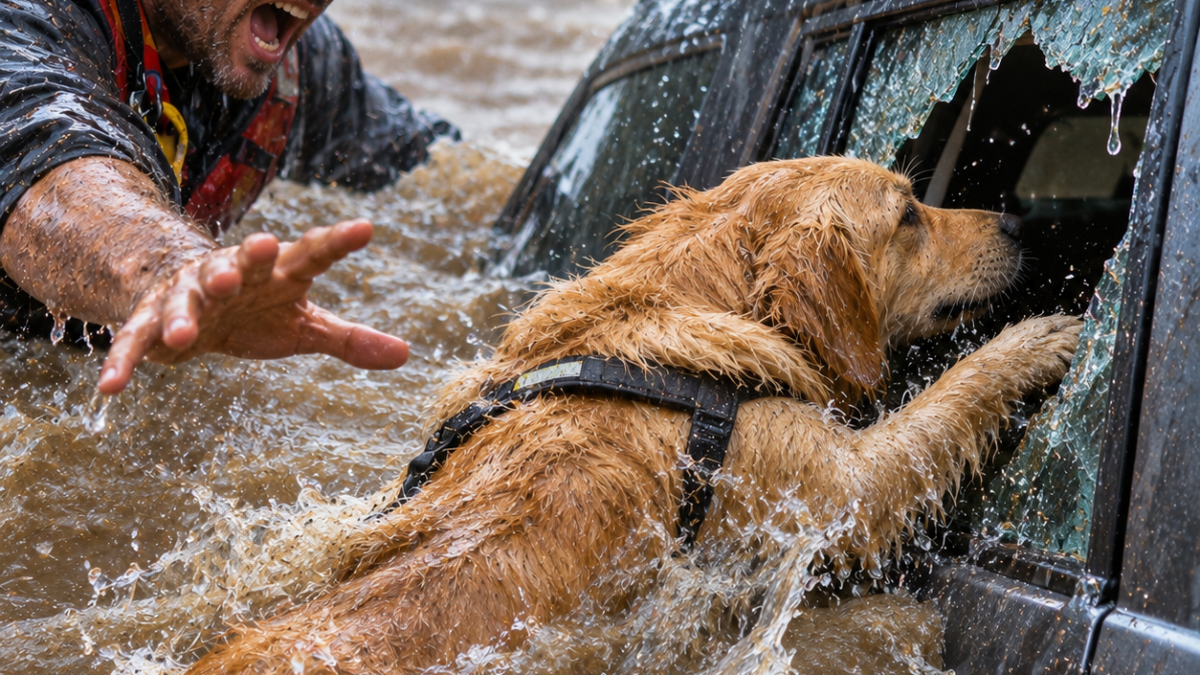
FULL ENDING :“COME ON, BOY! THE CAR IS GOING UNDER!” I screamed as a terrified Golden Retriever fought against the freezing floodwater, slipped from my grasp, and swam straight back through the shattered window of a sinking SUV, even though another thirty seconds inside could cost him his life.
I heard them.
I understood every word.
But I couldn’t move.
Because the dog had been inches from safety.
I’d reached through the shattered rear window.
He’d come toward my hand.
For one beautiful moment, I’d believed he understood I was trying to save him.
Then he’d looked behind him.
And gone back.
Not toward the road.
Not toward the people calling from the bank.
Back into the darkness of a vehicle that was sinking.
I stared through the broken glass.
The current pushed against my legs.
Rain struck my face.
My hands were numb.
Then something golden moved inside the car.
The dog.
He surfaced between the front seats.
His head appeared just above the rising water.
And he began barking.
Not at me.
Toward the driver’s seat.
I followed his gaze.
At first, I saw nothing but muddy water and the dark shape of the steering wheel.
Then my flashlight caught something pale.
A face.
A woman’s face.
Her head hung sideways against the seat.
Dark hair floated around her cheeks.
Her eyes were closed.
And the water had reached her chin.
My stomach dropped.
“Oh, God.”
There was someone inside.
The dog hadn’t been refusing rescue because he didn’t understand.
He’d been trying to lead me to the person he wouldn’t leave behind.
I looked toward the bank.
“THERE’S A WOMAN IN THE DRIVER’S SEAT!”
My voice disappeared into the storm.
I shouted again.
“WE’VE GOT A SECOND VICTIM!”
Daniel, our youngest volunteer, raised his arm to show he’d heard.
The team immediately began adjusting the rescue equipment.
I turned back toward the vehicle.
The woman hadn’t moved.
The dog was struggling to keep his head above water.
His front paws pressed against the center console.
His mouth opened.
A weak bark escaped.
Then another.
I knew what he wanted.
And I knew how little time we had.
“I’m coming, boy.”
I pulled a breath into my burning lungs.
“I’m coming for her.”
Then I went under.
The water closed over my head.
Everything became brown.
Cold.
Chaotic.
My flashlight beam reached barely an arm’s length before disappearing into the mud.
I felt along the side of the SUV.
Found the front door.
Tried the handle.
It wouldn’t open.
I pulled again.
Nothing.
Whether the door was jammed by the impact, the water pressure, or damaged hardware didn’t matter.
It wasn’t opening.
I surfaced.
Dragged in air.
Looked toward the windshield.
A web of cracks stretched across the glass.
The vehicle had struck something when the current carried it from the road.
I had a tool in my rescue vest.
But breaking laminated glass underwater was difficult, unpredictable work, especially in a current strong enough to move an entire SUV.
I signaled toward the team.
They were bringing additional equipment.
The vehicle shifted.
Metal scraped against rock.
Then the front end dropped several inches.
Inside, the dog barked again.
I saw the woman’s mouth.
The water was almost touching it.
There wasn’t enough time to wait for conditions to become ideal.
With Daniel and the others working to secure the vehicle and establish a safer extraction route, I moved toward the damaged front opening.
My hands shook.
The water burned against my skin.
I followed the rescue leader’s signals and helped open a passage large enough to reach the driver.
When I entered, the water was inches from the ceiling.
The woman was still breathing.
Barely.
Her seat belt held her against the seat.
I reached for the release.
Pressed.
Nothing.
I tried again.
The mechanism wouldn’t let go.
“Come on!”
My voice was swallowed by the water.
The dog swam toward me.
His golden muzzle pressed against the woman’s shoulder.
He made a sound I would hear in my dreams for years afterward.
A low, exhausted whine.
I looked into his dark brown eyes.
Then toward the woman.
“I KNOW, BOY!”
I reached for the emergency belt cutter attached to my vest.
“I’m not leaving her!”
The blade caught the strap.
I pulled.
The material resisted.
I worked again.
The belt fibers finally began to separate.
Then the restraint gave way.
The woman slumped forward.
I caught her.
The SUV shifted beneath us.
Water rushed through the damaged opening.
Outside, someone shouted my name.
I pulled the woman toward the exit.
The dog struggled beside us.
But he couldn’t help support her weight.
He was exhausted.
I pushed her toward the waiting hands.
Daniel reached us.
Together, we guided her out of the vehicle and toward the rescue line.
Then the dog disappeared from my view.
For one terrible second, I thought I’d lost him.
I turned.
Saw him through the broken window.
Still inside.
Watching the woman being moved toward shore.
“BARNEY!”
I didn’t know his name yet.
But I would learn it soon enough.
At that moment, all I could do was call, “BOY! IT’S YOUR TURN!”
He remained beside the submerged seat.
The current pulled at his body.
His movements slowed.
I reached toward him.
And whispered the only words I could think of.
“She’s safe now, buddy. You did your job. Please let me save you.”
PART2
My name is Oliver Graham.
I was sixty-three years old the morning I met Barney.
For twenty-seven years, I’d worked as a firefighter, responding to house fires, vehicle collisions, floods, and the terrible accidents that turn ordinary days into the worst days of somebody’s life.
I’d seen courage.
Fear.
Desperation.
And the strange, quiet bravery people sometimes discover when someone they love is in danger.
But I’d never seen anything quite like that eight-year-old Golden Retriever.
Not before.
And not since.
When I retired, people congratulated me.
They shook my hand.
Organized a dinner.
Presented me with a plaque.
Told me I’d earned the right to rest.
And I smiled.
Thanked them.
Tried to enjoy the attention.
But the truth was that retirement frightened me.
More than I wanted to admit.
For nearly three decades, my days had been structured around helping.
Somebody called.
We answered.
A fire started.
We responded.
A car crashed.
We brought equipment and did everything possible to bring people home.
The work was difficult.
Sometimes heartbreaking.
But it gave each day a purpose.
I understood where I belonged.
I knew what was expected of me.
Then the calls stopped.
Or rather, they continued without me.
I lived alone in a modest house near the edge of town.
My wife and I had once imagined growing old there together.
Sitting on the back porch.
Traveling.
Working in the garden.
Inviting friends over for Sunday dinner.
But life hadn’t followed the plan we’d made.
Our marriage ended years earlier, without the dramatic cruelty people expect from stories about divorce.
We simply grew apart.
Then stopped knowing how to reach each other.
There were mistakes on both sides.
Regrets.
Things neither of us knew how to repair.
By the time retirement arrived, I had become accustomed to living alone.
But becoming accustomed to something isn’t the same as finding peace in it.
I kept the house clean.
Cut the grass.
Repaired whatever needed fixing.
Made coffee every morning.
Then wondered what I was supposed to do with the rest of the day.
Sometimes I visited the old firehouse.
The younger firefighters were friendly.
They still called me Captain even though I wasn’t anybody’s captain anymore.
They asked for advice.
Told stories.
Invited me to sit with them.
But after an hour, I could feel the difference.
They had work waiting.
Reports.
Training.
Calls.
Shifts.
Lives moving forward.
I had a quiet house.
And more hours than I knew how to fill.
That was why I started volunteering with the county’s emergency response organization.
Not full-time.
Not as a substitute for younger professionals.
I understood my age and the need to work within my current abilities.
But I could still help.
Maintain equipment.
Train new volunteers.
Coordinate supplies.
Support operations during storms.
And occasionally respond when the team needed experienced assistance.
It gave me somewhere to go.
A reason to get up.
And the comfort of knowing that the skills I’d spent decades learning hadn’t become useless just because I received a retirement certificate.
Daniel Price was one of our youngest volunteers.
Twenty-six.
Tall.
Sandy hair.
An earnest face that always seemed slightly anxious whenever he thought he might make a mistake.
He reminded me of myself at that age.
Quick to volunteer.
Eager to help.
Still learning that courage and judgment had to work together.
I liked him.
He was the kind of young man who listened.
And when he didn’t understand something, he asked.
I’d rather work beside someone who admitted uncertainty than someone who pretended to know everything.
That morning, heavy rain had overwhelmed the lower roads near Mill Creek.
The water rose quickly.
A drainage channel overflowed.
Several intersections became dangerous.
Emergency crews began responding to stranded drivers and reports of vehicles caught by the current.
Our volunteer team was assisting under the direction of the local incident command.
I was helping prepare equipment when a call came over the radio.
A dark SUV had been swept from the roadway into a flooded channel.
A dog was visible inside.
There might be a person too.
The caller couldn’t tell.
We moved toward the reported location.
Rain struck the windshield.
Water covered sections of the road.
Emergency vehicles blocked access to the most dangerous area.
When we reached the staging point, I could hear the current.
A deep, powerful roar.
The kind of sound that makes you understand how little control a person has over moving water.
The SUV was partly submerged near the far side of the channel.
Its rear window had been damaged.
The front end was lower than the back.
And inside, a Golden Retriever was moving frantically.
At first, we couldn’t see the driver.
The windshield was cracked.
Water distorted everything.
The dog appeared near the rear window, his head above the waterline.
His paws scrabbled against the seats.
Then he vanished toward the front.
One of the responders pointed.
“Dog’s still alive!”
I watched.
The animal reappeared.
He was golden.
Broad-headed.
Soaked through.
His mouth open as he struggled to breathe.
Then he turned toward something hidden deeper inside the vehicle.
And I felt the first cold certainty that he wasn’t alone.
I didn’t rush into the water without coordination.
Fast-moving floodwater is deadly, even for experienced rescuers.
Vehicles can shift.
Debris can strike.
Currents can trap someone against an obstacle in seconds.
We assessed the conditions, secured a rescue plan, and established support from shore.
But the water continued rising.
The vehicle was becoming less stable.
And the dog was still refusing every apparent opportunity to move toward the opening.
When I reached the accessible side of the SUV, I could see him clearly.
His face was exhausted.
His ears lay flat.
His movements were slowing.
I extended an arm toward the broken rear window.
“Come on, boy!”
He looked at me.
Swam closer.
For one moment, his body turned toward the opening.
I thought he would come.
Then he looked back toward the front.
And vanished.
I shouted.
Reached again.
Tried to coax him toward safety.
He returned briefly.
Then turned away.
The third time, he swam so close that I could almost touch his collar.
His eyes met mine.
Then he glanced toward the front seat again.
Only then did I understand.
He wasn’t simply too frightened to leave.
He was showing us where somebody else needed help.
When I finally saw the woman’s face beneath the rising water, every second became important.
The rest of the rescue blurred into flashes.
Cold.
Mud.
A jammed door.
The broken windshield.
The seat belt.
The woman’s pale face.
The dog’s desperate movements.
Daniel reaching toward us.
The rescue line.
And the terrible knowledge that the vehicle could shift or disappear beneath the surface at any moment.
By the time we got the woman into the hands of the waiting medical team, I was exhausted.
My shoulders ached.
My hands were numb.
My lungs burned.
I felt every one of my sixty-three years.
But the dog remained in the vehicle.
And I couldn’t bear the thought of leaving him after he’d refused to abandon her.
I returned toward the broken opening with the team maintaining the rescue support.
The Golden Retriever was nearly spent.
He had found a small remaining pocket of air beside the rear seat.
His paws moved weakly.
His head hung low.
I called to him.
“Come on, boy.”
He lifted his eyes.
The woman was already being moved toward shore.
I pointed.
“She’s out.”
He looked in that direction.
Then back toward me.
I reached carefully for his collar.
This time, he didn’t swim away.
He allowed me to support him as we guided him through the opening.
The current fought us.
Water pulled at my legs.
The dog was heavy with exhaustion.
But Daniel and the shore team were ready.
We moved toward them together.
Slowly.
Carefully.
Until the rescuers could help bring us onto safer ground.
The moment my knees touched the bank, my strength seemed to disappear.
I sank down.
My hands shook.
My breathing came in hard, uneven bursts.
The Golden Retriever stood beside me.
His coat was dark with mud.
Water streamed from his belly.
His legs trembled.
For a moment, I thought he’d collapse.
Instead, he shook himself.
Spraying muddy water across my jacket.
Then took one uncertain step closer.
Another.
And sat against my side.
His head rose.
He looked at me.
Then leaned his entire weight against my shoulder.
I wrapped one arm around his neck.
For a long moment, neither of us moved.
He was trembling.
So was I.
I could feel his breathing.
Warm against my coat.
And all at once, something inside me broke.
I began crying.
Not loudly.
Just tears running down my face while a muddy Golden Retriever rested against a retired firefighter who had spent years pretending he no longer needed to be needed.
Daniel approached.
He carried an emergency blanket.
“Captain?”
I looked up.
“Yeah?”
“You okay?”
I laughed weakly.
“Ask me tomorrow.”
He knelt beside the dog.
“Good boy.”
The Retriever lifted his head.
Daniel wrapped the blanket around him.
Then looked toward the collar.
“Barney.”
I frowned.
“What?”
He smiled.
“That’s his name.”
I looked down.
A small tag hung from the collar.
Mud covered the metal.
But the letters remained readable.
BARNEY.
I swallowed.
“Barney.”
The dog lifted one ear.
For the first time since we’d reached the bank, his tail moved.
Just once.
I smiled through tears.
“Well, hello, Barney.”
Then I rested my forehead against his.
“You did good, buddy.”
The ambulance stood nearby.
Medical personnel were caring for the woman.
Her condition was serious.
She had been submerged in freezing floodwater and suffered injuries during the accident.
I couldn’t know whether she would survive.
Not yet.
But she was receiving care.
And Barney was alive.
For the moment, that was enough.
When the ambulance departed, Barney tried standing.
His eyes followed the vehicle.
He took one step.
Then stopped.
His legs trembled.
I held him gently.
“Easy.”
He looked toward the road.
I followed his gaze.
Then whispered, “She’s going where they can help her.”
He lowered his head.
I didn’t know what he understood.
But I knew he’d spent the entire rescue trying to remain close to her.
And now, for the first time, he had to let someone else take care of the person he loved.
Barney was taken to a veterinary clinic while Sarah was transported to the hospital.
I didn’t know her name yet.
To me, she was still the woman from the driver’s seat.
The woman whose face had hovered inches above rising floodwater.
The woman who would have disappeared beneath the surface if the vehicle had sunk a little sooner.
I watched the ambulance vanish beyond the emergency vehicles.
Then looked toward the veterinary transport.
Barney stood beside a responder.
His coat was dripping.
His eyes followed the road.
Even exhausted, he seemed reluctant to go anywhere that didn’t lead toward his owner.
I crouched.
“Hey, buddy.”
He looked at me.
I gently rubbed his wet ears.
“She’s getting help.”
He pressed his nose against my hand.
My throat tightened.
“I promise, we’re going to find out how she’s doing.”
When the vehicles departed, the channel seemed impossibly loud.
The current continued rushing past.
Branches floated through the muddy water.
The SUV remained partly submerged, surrounded by the recovery personnel who would handle the next phase once it was safe.
There was nothing more for me to do there.
But I couldn’t make myself leave.
I stood staring toward the place where Barney had first appeared.
The broken rear window.
The dark front seat.
The water.
All those seconds when I’d thought the dog was simply confused.
He hadn’t been confused.
He’d been trying to get us to look where he was looking.
Daniel stood beside me.
For a while, he didn’t speak.
Then he said, “Captain?”
I looked toward him.
“Yeah?”
“I thought he was going to drown.”
I nodded.
“So did I.”
Daniel swallowed.
“He kept going back.”
I stared toward the vehicle.
“Yeah.”
He looked at me.
“Why would he do that?”
I considered.
I could have explained that dogs form powerful attachments to familiar people.
That frightened animals sometimes behave in ways that look irrational to strangers.
That we couldn’t know exactly what Barney understood about the danger.
All of that was true.
But I had watched him return toward the driver’s seat repeatedly.
He hadn’t settled until the woman was out.
And I knew there was something extraordinary in that persistence.
I looked toward Daniel.
“Because she was still in there.”
He lowered his eyes.
Then nodded.
On the way home, I couldn’t stop thinking about Barney.
I remembered him swimming toward my hand.
Turning back.
His eyes fixed on me.
The way he’d positioned himself near the woman’s head.
Then the moment he finally allowed me to help him out.
I replayed it again and again.
Not because I regretted the rescue.
Because I was trying to understand how an exhausted animal had made me see something I’d almost missed.
For twenty-seven years, I’d entered dangerous places because somebody needed help.
I’d pulled people from wrecked vehicles.
Carried children through smoke.
Helped frightened strangers cross flooded streets.
And stood beside families during moments when there was nothing useful left to say.
I’d always understood the job as a responsibility.
You trained.
Prepared.
Worked as a team.
Did the best you could.
Sometimes the outcome was good.
Sometimes it wasn’t.
But you kept going.
After retirement, I’d begun wondering whether that part of my life was finished.
Whether I’d become someone who used to be useful.
Someone who could only tell stories about rescues younger men and women were now performing.
Then Barney appeared.
A frightened dog in a sinking vehicle.
And reminded me why I’d begun the work in the first place.
Not for medals.
Not for applause.
Not because I enjoyed danger.
Because sometimes somebody needs another person to notice that they aren’t safe.
And do something.
When I finally reached home, it was almost dark.
Rain continued tapping against the windows.
The house smelled faintly of coffee and wood polish.
My boots left muddy marks near the door.
I removed my soaked jacket.
Showered.
Changed clothes.
And stood in the kitchen staring at a container of leftover soup.
I wasn’t hungry.
I hadn’t eaten properly since morning.
But food seemed irrelevant.
I sat at the table.
The house was silent.
No barking.
No radio traffic.
No Daniel asking whether I needed help.
No sounds of rushing water.
Just the hum of the refrigerator.
And my own breathing.
I thought about Barney resting his head against my shoulder.
Then I began crying again.
It surprised me.
I’d seen worse emergencies.
I’d experienced losses that stayed with me for years.
Yet this rescue had reached something I’d kept hidden since retirement.
The belief that my best days were behind me.
That my usefulness belonged to the past.
That the world would continue just fine without me.
Barney hadn’t cared how old I was.
He hadn’t cared whether I still wore a firefighter’s uniform.
He had needed help.
And he’d kept trying to make me understand.
I looked toward the empty chair across from me.
For years, I’d pretended I liked eating alone.
Now the silence felt particularly sharp.
I whispered, “You stubborn dog.”
Then smiled through tears.
At eight that evening, Daniel called.
I answered immediately.
“Any news?”
He paused.
“About the woman?”
“Yes.”
“She’s at the hospital.”
I sat straighter.
“Alive?”
“Yes.”
My eyes closed.
Thank God.
Daniel continued.
“Still receiving care. They haven’t shared much.”
I nodded.
“That’s okay.”
Then I asked, “Barney?”
“He’s at the veterinary clinic.”
“How’s he doing?”
“Cold and exhausted, but stable when I last checked.”
For a moment, I couldn’t speak.
Then whispered, “Good.”
Daniel was quiet.
Then he said, “Captain?”
“Yeah?”
“I keep thinking about what happened.”
I looked toward the dark window.
“So do I.”
He swallowed.
“I’ve never seen a dog do that.”
I nodded.
“Neither have I.”
A pause.
“And I’ve seen a few things.”
That night, I lay awake for hours.
Every time I closed my eyes, I saw the water.
The woman’s face.
The dog swimming beside her.
The broken window.
I remembered how quickly the water rose.
How little time remained.
And how easily the outcome could have been different.
At three in the morning, I sat upright.
My heart pounding.
For a moment, I could almost hear the roar of the channel.
I looked toward the dark bedroom.
Then whispered, “They’re alive.”
I said it again.
“Both of them.”
I needed to hear the words.
Needed to remind myself that the rescue was over.
The woman had reached the hospital.
Barney was safe.
Nobody was still waiting inside that vehicle.
But the images didn’t disappear.
I thought about the dog’s refusal to leave.
How many times he’d turned back.
How he remained close to the woman when the water reached her face.
Then I thought about my own life.
The calls I’d ignored after retirement.
The invitations I’d declined.
The people I’d avoided because I didn’t want them to see how lonely I’d become.
I’d spent years keeping myself at a distance from anyone who might need me.
Barney had done the opposite.
When the person he loved was in danger, he wouldn’t leave.
And somehow that simple truth made me question almost everything I’d been telling myself about why living alone was easier.
The next morning, I called the hospital.
I explained that I’d been part of the rescue team.
Asked whether there was any appropriate update available.
The staff couldn’t share private medical details without authorization.
I understood.
I’d worked alongside hospitals for decades.
Privacy mattered.
I left my contact information and asked them to pass along my message if the patient wanted to speak with me.
Then I called the veterinary clinic.
A woman named Dr. Emily Foster answered.
She was in her late forties, with dark hair pulled into a loose bun and a calm manner that reminded me of the experienced paramedics I’d worked beside.
When I explained who I was, her voice softened.
“Oh, you’re one of the rescuers.”
I nodded.
“Yes, ma’am.”
“Barney’s doing much better.”
My shoulders relaxed.
She explained that the dog had been evaluated after the cold-water exposure and exhaustion.
He was recovering with supportive care and monitoring.
He also had a preexisting limp that would need follow-up.
I remembered his movements in the water.
The way he fought to keep himself afloat.
My throat tightened.
“Can I see him?”
She paused.
“We’ll need to confirm the appropriate arrangements, but I’ll see what can be done.”
I thanked her.
Then sat with the phone in my hands.
That afternoon, I received a message.
The woman’s name was Sarah Whitfield.
She was forty-two.
Her condition had stabilized enough that the medical team expected her to survive, though she had significant injuries requiring treatment and recovery.
She had a concussion.
Several fractured ribs.
Hypothermia.
And the kind of exhaustion that follows a terrifying accident.
For several seconds, I couldn’t speak.
I stared at the message.
Then whispered, “Sarah.”
A name.
Not just a victim.
Not just the woman in the car.
A person with a life.
A home.
People who cared about her.
And a Golden Retriever who had nearly drowned trying to stay beside her.
Two days later, Sarah asked to see me.
The hospital contacted me with her permission.
I didn’t hesitate.
I put on a clean shirt.
Shaved.
Found my car keys.
Then stood in the hallway wondering why I suddenly felt nervous.
I’d met hundreds of people after emergencies.
Shaken hands.
Accepted thanks.
Listened to stories.
But Sarah was different.
Not because I knew her.
Because I’d met her dog before I ever heard her voice.
And I couldn’t stop wondering whether she knew what Barney had done.
The hospital smelled of disinfectant and fresh coffee.
Nurses moved through the corridor.
A cart rattled past.
Somewhere, a television played softly behind a closed door.
I found Sarah’s room.
Knocked.
A quiet voice answered.
“Come in.”
She sat upright in bed.
Her dark brown hair fell loosely around her shoulders.
There was bruising near her temple.
Her movements were careful.
A hospital gown hung beneath a soft blue blanket.
She looked pale.
Tired.
But alive.
For a moment, I stood in the doorway.
Then she looked up.
And her eyes filled.
“Mr. Graham?”
I nodded.
“Oliver is fine.”
She pressed one hand against her mouth.
For several seconds, she couldn’t speak.
Then whispered, “You’re the man who pulled me out.”
I swallowed.
“I was part of the team.”
Her eyes filled.
“Thank you.”
I stepped closer.
“You’re welcome.”
For a moment, we sat quietly.
I wanted to say something reassuring.
Something ordinary.
But Sarah looked at me with such intensity that I realized she had a different question.
She swallowed.
“Barney?”
My throat tightened.
“He’s alive.”
Her eyes closed.
Tears ran down her cheeks.
I continued.
“He’s receiving veterinary care. I spoke with the clinic.”
She began crying harder.
“Oh, thank God.”
I pulled out a chair.
Sat beside the bed.
Sarah wiped her face.
Then asked, “Did he get out?”
I nodded.
“Yes.”
“Did he swim out with you?”
I hesitated.
She noticed immediately.
Her expression changed.
“What happened?”
I took a breath.
“Sarah, he wouldn’t leave while you were inside.”
She stared.
I continued.
“Every time we tried to bring him toward safety, he turned back.”
Her hand rose toward her mouth.
“He went back to me?”
I nodded.
“Again and again.”
For several seconds, Sarah didn’t move.
Then she covered her face and began sobbing.
I sat quietly.
Let her cry.
After a while, she whispered, “That’s Barney.”
Her voice broke.
“He’s always been like that.”
I looked toward her.
She wiped her face.
“Not the flood.”
She shook her head.
“I never imagined anything like this.”
A pause.
“But he never leaves when I’m upset.”
She told me about the day she adopted him.
Seven years earlier.
He’d been about one year old.
A lively Golden Retriever in a rescue shelter, full of energy and desperate for attention.
Several potential adopters had passed him over.
Too energetic.
Too difficult.
Too much dog for the quiet lives they wanted.
Sarah had recently gone through a divorce.
She was raising a daughter.
Working.
Trying to keep the household together while adjusting to a future she hadn’t expected.
She’d visited the shelter because her daughter wanted a dog.
But the moment she saw Barney, something changed.
“He was jumping around like a fool,” she said through a small smile.
I laughed.
“Sounds familiar.”
Sarah nodded.
“Everybody kept telling me how much work he’d be.”
She looked down.
“And he was.”
Her smile softened.
“He chewed shoes.”
“Destroyed a cushion.”
“Stole food from the counter.”
“Dug holes in the yard.”
I laughed.
“Sounds like a full-time job.”
“It was.”
She looked toward the window.
“But he made the house feel alive again.”
Sarah’s daughter, Emma, was nineteen now and attending college.
She had grown up with Barney.
He had slept beside her bed during thunderstorms.
Waited near the front door when she came home from school.
And followed Sarah around the house so faithfully that Emma joked he was her mother’s furry shadow.
After Emma left for college, Barney became Sarah’s daily companion.
He was there when she came home.
When she cooked.
When she watched television.
When she sat alone after difficult days.
“He knows when I’m upset,” Sarah whispered.
I listened.
“Sometimes I don’t even realize I’m having a hard day until he comes over and rests his head on my lap.”
Her eyes filled.
“Then I start crying.”
I nodded.
I understood more than I wanted to admit.
Sarah looked toward me.
“The day of the accident, I was taking him to the veterinarian.”
I frowned.
“Because of his limp?”
She nodded.
“He’d been favoring one leg.”
Her voice trembled.
“I was worried.”
She looked down.
“Then the rain got worse.”
She remembered driving along the lower road.
The water rising near the shoulder.
Trying to decide whether to turn around.
Then a sudden surge swept across the roadway.
The vehicle lost traction.
She tried steering.
Something struck the underside.
The SUV moved sideways.
Then toward the channel.
“I remember hitting my head,” she whispered.
I sat still.
“Then everything got dark.”
She looked at me.
“I remember water.”
A pause.
“And Barney barking.”
Her eyes filled.
“That’s all.”
She stared toward the blanket.
Then asked, “Was he scared?”
My throat tightened.
I thought about the dog’s eyes.
His exhausted swimming.
The way he kept returning toward the front.
I wasn’t going to pretend I could read every emotion in his mind.
But I could tell her what I’d seen.
“Yes.”
Sarah closed her eyes.
“He was frightened.”
I swallowed.
“But he kept trying to get our attention.”
Her hand tightened against the blanket.
Then she whispered, “He saved me.”
I looked at her.
For a moment, I couldn’t answer.
Because I knew the rescue team had performed the physical extraction.
We’d worked together.
Used equipment.
Responded to the emergency.
But if Barney hadn’t repeatedly returned toward the front seat, I couldn’t be certain we’d have recognized how urgently the driver needed help.
So I nodded.
“He helped us find you.”
Sarah began crying.
And I reached for the box of tissues beside her bed.
After a while, she asked something that surprised me.
“Are you okay?”
I looked up.
“Me?”
She nodded.
“You were in that water too.”
I almost laughed.
For twenty-seven years, I’d been the man asking other people whether they were all right.
The one carrying blankets.
Offering reassurance.
Calling family members.
Making sure somebody had a ride home.
Now the woman I’d helped rescue was looking at me with genuine concern.
I swallowed.
“A little sore.”
She smiled faintly.
“That’s not what I meant.”
For a moment, I couldn’t speak.
Then I looked toward the window.
And answered honestly.
“I’m still thinking about it.”
Sarah nodded.
“Me too.”
We sat quietly for several minutes.
Neither tried to make the other feel better with easy explanations.
The accident had been frightening.
We both understood that.
But Sarah was alive.
Barney was alive.
And somewhere beyond the hospital walls, the floodwater was finally beginning to recede.
Before I left, Sarah reached for my hand.
“Oliver.”
I looked toward her.
“Yes?”
“Would you come visit once I’m home?”
I hesitated.
She smiled weakly.
“Barney will want to thank you.”
My eyes filled.
Then I nodded.
“I’d like that.”
When I left Sarah’s hospital room, I sat in my car for nearly twenty minutes.
The engine remained off.
My hands rested on the steering wheel.
I could hear her voice.
Would you come visit once I’m home?
It wasn’t an extraordinary invitation.
Just a woman asking the man who helped rescue her to visit the dog they both cared about.
But it meant more to me than she could have known.
For years, I’d become comfortable being the person who appeared in an emergency and disappeared afterward.
You responded.
You helped.
You handed the situation to the next professional.
Then you moved on.
That was how the job worked.
But retirement had made every ending feel final.
A conversation ended.
A visitor left.
The house went quiet again.
Now Sarah was asking me to come back.
And for some reason, the possibility of being expected somewhere made my throat tighten.
The following afternoon, Dr. Foster arranged for me to see Barney at the veterinary clinic with Sarah’s permission.
I arrived carrying nothing.
No flowers.
No gifts.
I hadn’t known whether dogs appreciated visitors who arrived with presents.
But I stopped at the front desk to ask whether there was anything appropriate I could bring.
The receptionist smiled.
“First, let’s see whether he remembers you.”
Dr. Foster led me toward a quiet examination room.
Barney lay on a blanket near the wall.
His golden coat had been cleaned.
A few darker patches of fur remained where mud had settled deeply.
His eyes looked brighter.
He was still tired.
And one leg appeared stiff when he shifted position.
But he was recovering.
I stopped in the doorway.
“Hey, buddy.”
Barney lifted his head.
For a moment, he stared.
Then his ears rose.
His tail began moving.
Slowly at first.
Then faster.
He stood.
Took two careful steps.
And approached me.
I crouched.
“Easy, big guy.”
He pressed his muzzle against my chest.
Then leaned into me.
The same movement he’d made on the muddy riverbank.
For one second, the clinic disappeared.
I was back in the rain.
Kneeling beside the current.
My arms wrapped around an exhausted dog.
Only this time, he was warm.
Safe.
And his breathing was steady.
I rested one hand against his shoulder.
“Hello, hero.”
His tail thumped against the floor.
Dr. Foster smiled.
“He seems pleased to see you.”
I laughed through tears.
“That’s an understatement.”
She explained that Barney’s recovery was going well.
The limp had prompted the veterinary visit Sarah was originally driving toward, and his orthopedic concerns would need continued assessment and management.
The flood had added exhaustion and cold exposure, but he was improving.
I listened carefully.
Not because I planned to become responsible for his medical care.
Because I wanted to know that the dog who’d nearly drowned was going to have many more years of ordinary life if health and good fortune allowed.
After the examination, I sat on a chair while Barney rested at my feet.
Dr. Foster stepped outside to finish paperwork.
For a few minutes, it was just us.
I looked down at him.
“Your mom’s doing better.”
He lifted his head.
I smiled.
“She’s worried about you.”
His tail moved.
I continued.
“She says you’re a lot of trouble.”
He blinked.
“Apparently, you’ve been destroying furniture since you were a puppy.”
His ears lifted.
I laughed.
“I won’t tell anybody.”
For a while, we sat quietly.
Then Barney laid his head across my boot.
I looked toward the window.
Sunlight had begun pushing through the clouds.
The weather was improving.
The worst of the flood had passed.
And I felt something change inside me.
Not a sudden transformation.
Not a revelation that erased the loneliness I’d carried for years.
Simply a little less emptiness.
As though a door I’d kept closed had begun opening.
Sarah’s daughter, Emma, arrived at the hospital while her mother was recovering.
She’d traveled home from college as soon as she learned what happened.
I met her briefly during a second visit.
She was nineteen, with long dark hair, brown eyes, and the anxious energy of a young woman trying very hard not to show how frightened she had been.
When I entered, she stood immediately.
“Mr. Graham?”
I nodded.
“Oliver.”
She crossed the room.
Then hugged me.
So suddenly that I almost lost my balance.
“Thank you.”
Her voice broke.
I gently returned the embrace.
“You’re welcome.”
She stepped back.
Wiped her face.
Then began speaking quickly.
“Mom told me about Barney.”
She swallowed.
“How he kept going back.”
I nodded.
Emma looked down.
For a moment, she couldn’t speak.
Then whispered, “I thought I’d lost both of them.”
My throat tightened.
I glanced toward Sarah.
She lay against the pillows, watching her daughter with tears in her eyes.
Emma continued.
“I was in class when they called.”
She shook her head.
“I couldn’t understand what they were saying.”
A pause.
“They kept saying there’d been an accident.”
Her voice broke.
“And I just kept asking where Barney was.”
Sarah reached for her daughter’s hand.
Emma took it.
For a moment, they looked at one another.
Then Sarah whispered, “We’re still here.”
Emma began crying.
I looked away.
Not because I was uncomfortable.
Because I understood that some moments belonged to families.
And standing quietly nearby was sometimes the most respectful thing a person could do.
After a while, Emma sat beside me.
She smiled through tears.
“Barney was supposed to be my dog.”
I laughed.
“Was he?”
She nodded.
“I begged Mom for months.”
Sarah raised an eyebrow.
“Years.”
Emma smiled.
“Fine. Years.”
She looked toward me.
“We went to the shelter, and he was this giant, ridiculous puppy who wouldn’t stop jumping.”
I nodded.
“Sounds about right.”
Emma laughed.
“Everybody said he had too much energy.”
A pause.
“But he looked at Mom like he’d been waiting for her.”
I glanced toward Sarah.
She smiled.
Emma continued.
“Once we brought him home, he decided Mom was his person.”
She shook her head.
“I tried.”
“You did?”
“I bribed him with treats.”
Sarah laughed.
“She did.”
Emma smiled.
“But if Mom left the room, he’d follow her.”
Her expression softened.
“And when things were hard after the divorce, he always knew.”
Sarah looked toward the window.
For a moment, the room became quiet.
Then Emma said, “He used to sit outside Mom’s bedroom whenever she cried.”
I swallowed.
She continued.
“Sometimes I’d wake up and hear her talking to him.”
Her voice broke.
“Like he was the only one she didn’t have to pretend for.”
Sarah lowered her head.
Emma reached for her mother’s hand again.
I sat quietly.
And suddenly I understood why Barney had refused to leave the sinking SUV.
Not in any magical sense.
I didn’t imagine he understood the full consequences of the flood.
But his whole life had been built around staying close to this woman.
Following her.
Watching her.
Seeking her out when something seemed wrong.
When the car filled with water, that attachment hadn’t disappeared.
He had returned toward the person he knew.
Again and again.
And his persistence had helped us recognize where she was trapped.
Emma turned toward me.
“Can I ask you something?”
I nodded.
“Sure.”
“Was he brave?”
I looked at her.
Then considered the question.
Bravery is a human word.
We use it for people who understand danger and choose to act anyway.
A dog’s behavior comes from attachment, instinct, experience, and training in ways we can’t always interpret.
But I remembered Barney fighting the water.
Swimming back.
Remaining beside Sarah.
And finally allowing us to bring him toward shore.
I took a breath.
“He was frightened.”
Emma’s expression softened.
I continued.
“But he kept trying to stay with her.”
Her eyes filled.
“And he helped us find her.”
I smiled gently.
“If that’s not something worth being proud of, I don’t know what is.”
Emma began crying again.
She leaned toward Sarah.
Her mother held her.
For several seconds, nobody spoke.
Then Sarah looked at me.
“Thank you for telling us.”
I nodded.
“It was the truth.”
By the end of the second week, Sarah had returned home with support for her recovery.
Barney joined her after the veterinary team determined that he could safely continue his care at home.
Emma remained for a while to help.
I received a photograph the day the dog returned.
Sarah sat on the sofa.
A blanket covered her legs.
Barney lay beside her with his head resting gently near her knee.
Emma had taken the picture.
Underneath, she wrote:
They’re finally home together.
I stared at the screen.
Then sat down at my kitchen table.
For a moment, I felt tears gathering.
Because that was what every rescue was supposed to be about.
Not the drama.
Not the dangerous moment.
Not the photographs of people in wet uniforms.
Home.
Getting someone back to the people and places that mattered.
Three weeks after the flood, Sarah invited me to lunch.
It was a bright Saturday morning.
The rain had stopped.
The roads were clear.
I bought a new blue ball at a pet store on the way.
A simple toy.
Nothing extraordinary.
But I wanted to bring something for Barney.
Sarah lived in a modest house with a white porch railing and a small fenced backyard.
Flowers grew near the front steps.
A wind chime hung beside the door.
The house looked welcoming.
Lived in.
The kind of place where you could imagine somebody making coffee in the morning and talking to a dog while waiting for the kettle.
I parked near the curb.
Walked up the path.
And knocked.
Before Sarah answered, I heard barking.
Loud.
Excited.
Then the sound of claws against a wooden floor.
Somebody called, “Barney! Easy!”
I laughed.
The door opened.
And there he was.
His coat shone.
Golden.
Clean.
Healthy.
His eyes were bright.
His tail moved so violently that his entire back end seemed to wiggle.
For a moment, he stared.
Then he surged forward.
“Whoa, buddy!”
I crouched quickly, bracing myself.
Barney pressed against me.
His nose moved over my jacket.
His tail struck the doorframe.
Then he lifted his head and began licking my face.
I laughed so hard I almost fell backward.
“Okay! Okay!”
Sarah laughed from the doorway.
“Barney, let him breathe!”
I wrapped my arms around his neck.
“Hello, hero.”
His tail continued moving.
I rubbed his ears.
“You remember me?”
He pushed his face against my shoulder.
I smiled through tears.
“Yeah.”
My voice softened.
“I remember you too.”
Sarah stood nearby.
She looked healthier.
Still a little pale.
Still moving carefully because of her healing ribs.
But her eyes were bright.
And when she smiled, I could see the relief she’d been carrying since coming home.
I stood.
She stepped forward.
Then hugged me.
Carefully.
“Thank you for coming.”
I nodded.
“Wouldn’t have missed it.”
Inside, the house smelled of roasted chicken and fresh bread.
Photographs lined the hallway.
Sarah with Emma at graduation.
Emma as a little girl holding a puppy.
A younger Barney sitting beside a Christmas tree wearing a ridiculous red bow.
I stopped at that one.
Sarah noticed.
“That was his first Christmas with us.”
I smiled.
“He looks thrilled.”
She laughed.
“He ate half the wrapping paper.”
I shook my head.
“Sounds like a professional.”
We ate lunch in the backyard.
The air was warm.
Birds moved through the trees.
A light breeze carried the scent of cut grass.
Barney lay beneath the table.
At first, he positioned himself near Sarah’s feet.
Then gradually moved toward me.
After a while, he rested his head on my knee.
I looked down.
There it was again.
The familiar weight.
The warmth.
The quiet trust.
Sarah smiled.
“He doesn’t usually do that with visitors.”
I gently rubbed his head.
“Maybe he remembers the water.”
She considered.
“Maybe.”
Then she looked toward her dog.
“Or maybe he knows you helped us.”
I nodded.
I didn’t know what Barney remembered.
But I knew he was comfortable beside me.
And that was enough.
We talked for hours.
About the flood.
About Sarah’s work.
About Emma.
About Barney.
About the ridiculous things dogs do when they believe the entire household exists to accommodate their preferences.
Sarah told me how Barney once stole an entire loaf of bread from the kitchen counter and carried it into the backyard.
I laughed.
“Did he eat it?”
“Not immediately.”
She shook her head.
“He buried it.”
I stared.
“The whole loaf?”
She nodded.
“Still in the bag.”
I burst out laughing.
Sarah smiled.
“Two days later, he dug it up and presented it to Emma like a gift.”
I shook my head.
“That’s generous.”
“Very.”
After lunch, Sarah grew quiet.
She watched Barney sleeping.
Then said, “You know, he almost didn’t come home with us.”
I looked toward her.
“What happened?”
She smiled sadly.
“When we first met him at the shelter, a volunteer warned us he was a lot of work.”
I nodded.
“That sounds reasonable for a young Retriever.”
“It was.”
She looked toward the garden.
“He jumped.”
“Barked.”
“Chewed everything.”
“And he couldn’t sit still for more than a few seconds.”
She laughed softly.
“Emma loved him immediately.”
I smiled.
“And you?”
Sarah considered.
“I was afraid.”
I looked toward her.
She continued.
“The divorce had just finished.”
Her voice softened.
“I was trying to figure out how to keep everything together.”
Work.
Bills.
School.
A child who was hurting because her parents no longer lived in the same house.
Sarah had been exhausted.
The idea of adopting a high-energy dog seemed ridiculous.
Yet when she looked at Barney, something about him felt familiar.
“He looked like he didn’t know where he belonged.”
She smiled sadly.
“I knew that feeling.”
I remained quiet.
She continued.
“He was bouncing around the kennel like he was trying to convince everybody he was worth taking home.”
Her eyes filled.
“Emma kept laughing.”
Sarah swallowed.
“And I thought maybe we all needed something to laugh about.”
So they brought him home.
He was difficult.
Of course he was.
He chewed shoes.
Pulled on the leash.
Jumped onto furniture.
And seemed incapable of understanding why human beings required sleep.
But he also made Emma laugh.
Got Sarah outside for walks.
Filled the quiet rooms with movement.
And became part of their lives.
“After Emma left for college,” Sarah said, “I worried the house would feel empty.”
I nodded.
“I know something about that.”
She looked toward me.
I glanced down at Barney.
“He’s good company.”
Sarah smiled.
“The best.”
For a moment, we sat quietly.
Then Sarah asked, “What’s retirement been like for you?”
I hesitated.
It was an ordinary question.
But I hadn’t answered it honestly in a long time.
Usually, I said it was good.
Peaceful.
Relaxing.
Plenty of time for hobbies.
All the things people expected a retired man to appreciate.
Instead, I looked toward the yard.
And took a breath.
“Lonelier than I expected.”
Sarah didn’t interrupt.
I continued.
“Twenty-seven years in the fire service.”
A pause.
“Then one day, I was done.”
I laughed weakly.
“They gave me a plaque and told me to enjoy my free time.”
Sarah smiled gently.
“And?”
I looked down.
“I didn’t know what to do with it.”
Barney shifted against my leg.
I rested one hand on his head.
For a while, I watched him breathe.
Then I continued.
“I kept thinking I ought to be happy.”
“Plenty of people would love to retire.”
“Sleep in.”
“Travel.”
“Do nothing.”
I shook my head.
“But when you’ve spent most of your adult life answering calls, a silent phone can feel strange.”
Sarah nodded.
I swallowed.
“Sometimes I wake up before dawn and forget there isn’t anywhere I have to be.”
She looked toward me.
“Is that why you volunteer?”
I nodded.
“Partly.”
Then I smiled sadly.
“Mostly because I still want to help.”
Sarah remained quiet.
After a moment, she said, “That’s not something you have to retire from.”
I looked up.
Her expression was gentle.
“You might be done working full-time as a firefighter.”
A pause.
“But you don’t stop being somebody who cares.”
For a moment, I couldn’t speak.
Barney lifted his head.
Looked toward Sarah.
Then toward me.
And rested his muzzle on my knee again.
I smiled through tears.
“Apparently, he agrees.”
Sarah laughed.
“Barney has strong opinions.”
We stayed outside until the sun began lowering behind the trees.
At one point, Emma called from college.
Sarah put the phone on speaker.
Her daughter immediately asked, “Is Oliver there?”
I laughed.
“Apparently, I’m famous.”
Emma’s voice brightened.
“Hi, Oliver!”
“Hello, Emma.”
“Did Barney get his gift?”
I reached into my bag.
“Not yet.”
Sarah looked toward me.
“You brought him something?”
I smiled.
“A little something.”
I pulled out the bright blue ball.
Barney lifted his head.
His ears rose.
For a moment, he stared.
Then he stood so quickly that the chair beside me shifted.
Sarah burst out laughing.
“Oh, he knows.”
I held up the ball.
“What’s this, buddy?”
His tail became a blur.
I gently tossed it across the grass.
Barney hurried after it.
His limp was being managed, so we kept the game easy and brief.
He retrieved the ball.
Turned.
And brought it back.
Not to Sarah.
To me.
I laughed.
“Good boy!”
He dropped it beside my shoe.
Then stared expectantly.
Sarah covered her mouth.
Emma laughed through the phone.
“Mom! He picked Oliver!”
I smiled.
For a moment, I felt something I hadn’t felt in years.
Not the pride of accomplishing a difficult rescue.
Not the relief of hearing an emergency was over.
Something simpler.
Joy.
Uncomplicated.
Ordinary.
A dog bringing me a ball because he wanted me to throw it again.
When I finally stood to leave, Barney followed me toward the gate.
Sarah walked beside us.
The evening air had cooled.
I turned toward her.
“Thank you for lunch.”
She smiled.
“Thank you for coming.”
I looked down.
Barney stood near my boots.
The blue ball rested beside his paws.
I crouched.
“Hey, buddy.”
He pushed his nose against my hand.
I rubbed his ears.
Then whispered, “You take care of your mom.”
His tail moved.
I smiled.
“You hear me?”
He looked toward Sarah.
Then back at me.
I laughed softly.
“Of course you do.”
For a moment, I remembered the flood.
The rising water.
The darkness.
The dog’s exhausted movements.
The way he’d returned toward the driver’s seat when he could have come toward safety.
I gently touched his forehead.
“You’re a good boy, Barney.”
My voice broke.
“The best.”
He licked my hand.
Once.
Then settled beside Sarah.
And I knew he was exactly where he belonged.
I drove home that evening feeling different.
The roads were dry.
The sun had dropped behind the trees.
A few porch lights glowed along the neighborhood streets.
Nothing extraordinary had happened.
I’d eaten lunch.
Talked with a woman whose life I’d helped save.
Played with her dog.
And gone home.
Yet the emptiness that usually followed me through the front door felt quieter.
I placed my keys on the kitchen counter.
Took off my jacket.
Then stopped.
Normally, this was the moment I disliked most.
The moment the house greeted me with silence.
I would turn on the television.
Make something to eat.
Pretend I was enjoying the peace.
But that evening, I stood thinking about Barney.
The excited barking behind Sarah’s front door.
His tail wagging.
The way he brought the ball back.
The way he rested his head against my knee.
And I smiled.
For nearly thirty years, I’d measured purpose in emergencies.
The harder the rescue, the greater the sense that my work mattered.
But Barney had reminded me of something.
Sometimes purpose is quiet.
Sometimes it looks like visiting someone after they’re safe.
Sitting in a garden.
Listening.
Remembering that the people we help continue living after the ambulances leave.
And that those ordinary days are the reason the emergency work matters.
The next morning, I called Daniel.
He answered on the second ring.
“Captain?”
“Morning, kid.”
He laughed.
“You know I’m not a kid.”
“Not yet thirty. You’re a kid.”
“Fair enough.”
I smiled.
Then asked, “How’s the training schedule?”
He sounded surprised.
“Busy.”
“Need somebody to help with the new volunteers?”
A pause.
“Are you offering?”
I looked toward the window.
“Yes.”
His voice brightened.
“Absolutely.”
I began helping more regularly with volunteer training and community preparedness sessions.
Not by returning to risky frontline work beyond my current capabilities.
I knew my limits.
But twenty-seven years of experience still had value.
I could teach new volunteers how to communicate clearly.
How to recognize hazards.
Why rushing toward danger without a plan can create more victims.
How to coordinate resources.
And why listening sometimes matters as much as acting.
The first time I stood before a group of young volunteers after the flood, I was nervous.
That surprised me.
I’d spoken to crews for years.
Led training.
Given instructions.
Explained difficult decisions.
But this felt different.
I wasn’t the captain anymore.
Just a retired man sharing what he knew.
Daniel introduced me.
Then stepped aside.
I looked around.
There were twelve volunteers.
Some barely out of college.
Others in their thirties and forties.
A few looked anxious.
Several had notebooks open.
I took a breath.
Then said, “The most important lesson I can give you isn’t how to be fearless.”
The room grew quiet.
“Fear can tell you something is dangerous.”
I looked toward the equipment beside the wall.
“Your job is to recognize that danger and work with your team.”
A pause.
“Not pretend it doesn’t exist.”
We talked about communication.
Planning.
The value of saying when you’re uncertain.
How to listen when another responder sees something you’ve missed.
Then one volunteer asked whether I had an example.
I thought about Barney.
And smiled.
“I do.”
I told them the story.
Not as a lesson about heroic rescue techniques.
Not as encouragement to enter dangerous water recklessly.
I emphasized the coordinated response and the importance of proper training.
But I also told them about the dog.
The Golden Retriever who kept returning toward the front seat.
How I’d initially focused on getting him through the broken rear window.
How his behavior made me look more closely.
And how the team recognized the driver in danger.
For several minutes, nobody interrupted.
Then a young woman raised her hand.
“Did the dog survive?”
I smiled.
“Yes.”
The room seemed to relax.
“And the driver?”
“She’s home.”
A pause.
“With him.”
Daniel sat near the back.
He was smiling.
Afterward, he approached.
“You did good, Captain.”
I laughed.
“Don’t start.”
He grinned.
“Seriously.”
I looked toward the empty room.
For a moment, I felt a quiet satisfaction.
Not because I’d impressed anybody.
Because I’d been useful.
And I hadn’t needed to risk my life to do it.
The months that followed were better.
Not perfect.
There were still lonely evenings.
Still mornings when I woke too early.
Still days when I missed the structure of full-time service.
But I began filling those days differently.
Training.
Volunteering.
Helping neighbors.
Visiting Sarah and Barney.
And sometimes allowing people to help me.
That last part was harder than I expected.
Sarah invited me over for lunch again.
Then once more.
Eventually, the visits became part of our routine.
About once a month, I’d drive to her house.
Sometimes I brought food.
Sometimes she cooked.
Sometimes we simply sat in the backyard with lemonade while Barney rested between our chairs.
Emma came home during college breaks.
She liked teasing me about being Barney’s second-favorite person.
“Mom’s first,” she’d say.
I’d nod.
“Obviously.”
“Then you.”
I looked toward the dog.
“What about you?”
Emma sighed dramatically.
“Apparently, I’m the backup human.”
Sarah laughed.
And Barney, entirely unconcerned by our debate, continued sleeping.
One afternoon, Sarah asked whether I wanted to join her and Emma for a small family barbecue.
My first instinct was to refuse.
I didn’t want to impose.
They had their own lives.
Their own traditions.
I was the man who helped pull Sarah from a flooded vehicle.
Not a relative.
Not someone who needed to be included in everything.
But then Sarah looked toward me.
“Oliver.”
I glanced up.
“We’d like you to come.”
I hesitated.
She smiled gently.
“You’re allowed to accept an invitation.”
I laughed.
“Is that a rule?”
“It is at this house.”
I went.
And I had a wonderful time.
Emma burned the first batch of hamburgers.
Sarah insisted she hadn’t.
Barney attempted to investigate the food table.
I spent fifteen minutes repairing a loose hinge on the backyard gate because I couldn’t resist.
At one point, Sarah stood beside me.
“You know you don’t have to fix something every time you come over.”
I looked toward the hinge.
“I noticed it was loose.”
She smiled.
“I’m aware.”
I tightened the final screw.
“There.”
She laughed.
“Happy?”
I considered.
Then smiled.
“Actually, yes.”
The truth was that helping had always been the easiest way for me to feel welcome.
If I could repair something, carry something, or solve a problem, I knew what my role was.
Sitting in a chair while other people enjoyed my company was harder.
It required believing I was worth having around even when I wasn’t useful.
Sarah seemed to understand that.
And Barney certainly didn’t care whether I repaired the gate.
He cared whether I remembered the blue ball.
One evening, after dinner, Sarah and I sat on the back porch.
Emma had gone inside.
Barney lay beside my chair.
The sky was turning orange.
I looked toward the dog.
Then said, “I think he changed something in me.”
Sarah smiled.
“He has a habit of doing that.”
I nodded.
“For years, I thought retirement meant the important part was over.”
She looked toward me.
“And now?”
I considered.
“Now I think I was wrong.”
Barney lifted his head.
I gently rubbed his ears.
“I used to wake up at three in the morning and feel like the world had moved on without me.”
Sarah remained quiet.
I swallowed.
“After the flood, I still wake up sometimes.”
A pause.
“But I don’t feel quite so empty.”
Her expression softened.
“Why?”
I looked toward Barney.
Then smiled.
“Because I remember him coming back into that car.”
For a moment, Sarah said nothing.
Then she whispered, “He was trying to stay with me.”
I nodded.
“Yes.”
She looked toward the fading sunlight.
“And you listened.”
My throat tightened.
I considered her words.
Then said, “We listened.”
Sarah looked at me.
I continued.
“Daniel.”
“The team.”
“Everyone working to get you both out.”
I smiled sadly.
“Barney helped us understand where you were.”
Sarah reached for my hand.
For a moment, she simply held it.
Then said, “I’m glad you were there.”
I looked down.
“So am I.”
Later that summer, the county emergency response organization held a community appreciation gathering.
Daniel asked me to attend.
I almost refused.
I’d never particularly enjoyed ceremonies.
People making speeches.
Photographs.
Applause.
The way difficult events become simplified into stories that make everybody feel good.
Real rescues are rarely simple.
They’re frightening.
Confusing.
Messy.
And depend on teams of people doing work that doesn’t always appear in photographs.
But Daniel insisted the gathering wasn’t about making a spectacle.
It was about thanking volunteers and helping residents understand the importance of emergency preparedness.
Sarah and Barney were invited too.
With appropriate arrangements, they attended.
And when Barney entered the park beside Sarah, he seemed much more interested in the grass than in the people who remembered his rescue.
I stood near the picnic tables when Emma arrived.
“Oliver!”
I turned.
She smiled.
“Guess who’s here?”
Before I could answer, Barney appeared.
His tail wagging.
The familiar blue ball clutched proudly in his mouth.
I burst out laughing.
“You brought that?”
Emma nodded.
“He carried it all the way from the car.”
Barney approached.
Dropped it beside my shoes.
Then stared.
I looked toward Sarah.
She shook her head.
“Apparently, he has an agenda.”
We played briefly in a quiet area suitable for his leg.
Then I sat beside Sarah while the volunteers gathered.
Daniel gave a short speech.
He thanked the emergency workers.
The medical teams.
The people who assisted residents during the flood.
Then he mentioned Sarah and Barney.
Sarah looked uncomfortable.
She didn’t like attention either.
Barney seemed entirely indifferent.
He lay beside her, watching an insect move through the grass.
Daniel smiled toward them.
“Sometimes the most important signal isn’t the loudest one.”
The crowd grew quiet.
He continued.
“During the flood, a dog kept returning to the driver’s seat of a submerged vehicle.”
A pause.
“His behavior helped rescuers recognize that someone was still trapped inside.”
He looked toward me.
“And the team responded.”
There was applause.
Sarah wiped her eyes.
I looked down.
Barney rolled onto his side.
Apparently, public recognition was less interesting than a comfortable patch of grass.
I laughed softly.
Afterward, several people approached.
They thanked us.
Asked questions.
Wanted to know how Barney was doing.
Sarah spoke warmly about his recovery.
I emphasized the work of the rescue and medical teams.
And when somebody asked whether Barney was a hero, I looked toward him.
He was resting beside Emma.
The blue ball lay between his paws.
I smiled.
“He’s a very good dog.”
That evening, Sarah and I returned to her backyard with lemonade.
Emma had gone to visit a friend.
Barney lay between our chairs.
The summer air was warm.
Cicadas hummed in the trees.
For a while, we sat quietly.
Then Sarah asked, “Do you ever miss the firehouse?”
I smiled sadly.
“Every day.”
She nodded.
“But not the way you did before?”
I considered.
“No.”
A pause.
“Not the same way.”
I looked toward the garden.
“I used to think I had to be on a fire truck to matter.”
Sarah remained quiet.
I continued.
“Now I know there are other ways to be useful.”
A pause.
“And other reasons to get out of bed.”
Barney shifted against my shoe.
I smiled.
“Some of them have four legs.”
Sarah laughed.
The years I’d spent in the fire service still mattered.
I’d never stop being proud of them.
The men and women I’d worked beside.
The lives we’d helped save.
The calls that had tested us.
The ordinary moments between emergencies.
Those memories were part of me.
But they weren’t the entirety of my life.
Not anymore.
I still wake before sunrise sometimes.
Old habits are difficult to change.
When that happens, I make coffee.
Look through the window.
Listen to the morning.
And think about Barney.
Sometimes I remember him struggling in the flood.
But more often now, I picture him standing in Sarah’s backyard with his blue ball.
Tail wagging.
Eyes bright.
Waiting for somebody to throw it.
That’s the memory I prefer.
Not because the rescue was unimportant.
Because it led to that moment.
A dog alive.
Healthy.
Loved.
Playing in the sunshine.
I visit Sarah and Barney regularly.
We sit in the garden.
Drink lemonade.
Talk about our lives.
And sometimes, Barney rests his head against my knees exactly as he did on the riverbank.
Only now his body is relaxed.
His breathing peaceful.
His golden fur warm beneath my hands.
Whenever that happens, I think about the strange lesson he taught me.
For twenty-seven years, I believed rescuers were the people who saved.
And in a practical sense, that’s true.
We train.
Prepare.
Respond.
Work together.
And do everything possible to bring people out of danger.
But Barney reminded me that the people and animals we help can change us too.
They can show us why the work matters long after the emergency ends.
They can remind us that a life doesn’t become less valuable because its owner has grown older, become lonely, or stopped wearing a uniform.
A Golden Retriever named Barney refused to leave a car sinking in floodwater because his owner, forty-two-year-old Sarah Whitfield, was still trapped behind the steering wheel. I was sixty-three, a retired firefighter volunteering with the local rescue team, and I watched him return toward her again and again until we realized someone was hidden inside the vehicle.
Our team rescued Sarah, then brought Barney to safety. She survived her injuries, and he recovered from the cold and exhaustion. Weeks later, when I visited their home, Barney greeted me with the joy of an old friend—and what began as a terrifying rescue grew into a friendship that helped me rediscover purpose after retirement.
Barney never knew that I’d been struggling with the silence of my house.
He didn’t know about the mornings when I woke feeling unnecessary.
Or the way I’d sometimes sat alone wondering whether all my meaningful work was behind me.
He only knew the woman he loved was in danger.
And he kept trying to stay beside her.
After the flood, he didn’t offer me advice about retirement.
He didn’t explain what it meant to be useful.
He didn’t tell me to reconnect with people or teach young volunteers.
He simply greeted me at the door.
Brought me his favorite ball.
And rested his head against my knees.
Those ordinary moments helped me remember that I was still capable of building a meaningful life.
Not only through emergencies.
But through friendship.
Presence.
And the simple act of showing up.
Last Sunday, I visited Sarah again.
The weather was beautiful.
Emma had come home from college for the weekend.
We ate lunch outside.
Talked.
Laughed.
And watched Barney chase his blue ball across the grass.
At one point, he stopped near the fence.
Turned.
And looked toward me.
I raised my hand.
“Come here, buddy.”
He trotted across the yard.
Dropped the ball.
Then rested his golden head against my leg.
I gently rubbed his ears.
“Still taking care of everybody, aren’t you?”
His tail moved.
Sarah smiled from the porch.
“He certainly thinks so.”
I looked into Barney’s eyes.
Then whispered, “Thank you.”
Of course, he couldn’t know everything those words meant.
I wasn’t thanking him for becoming a rescuer.
Or for understanding my life.
I was thanking him for the reminder he’d given me.
That devotion can be quiet.
That love can survive frightening moments.
And that sometimes, just when a person believes their most important days are behind them, another living creature shows them there’s still a future worth looking forward to.
I’m Oliver Graham.
A retired firefighter.
A man who spent twenty-seven years responding when people needed help.
For a long time after retirement, I thought that was the whole story of my life.
Then I met an eight-year-old Golden Retriever in the worst flood I’d seen in years.
He refused to leave the woman he loved.
And in helping bring them both home, I found my own way back to the world I’d started withdrawing from.
The day Barney swam back into that sinking car, he wasn’t trying to teach anybody a lesson—he was staying close to Sarah. But his determination helped us find her, and the friendship that followed reminded me that saving lives isn’t only about pulling somebody out of danger. Sometimes it’s about being there afterward, when the water is gone, the sun has returned, and somebody finally has the chance to live.
That evening, as I rose to leave Sarah’s garden, Barney followed me to the gate.
He pressed his nose against my hand.
I knelt.
Held his face gently.
And smiled.
“Good boy, Barney.”
His tail moved.
“The very best.”
He licked my fingers once.
Then returned to Sarah.
I watched him settle beside her chair.
Safe.
Loved.
Home.
And as I drove back toward my own house, I realized that for the first time in years, I wasn’t dreading the quiet waiting for me there.
Tomorrow, I had a volunteer training session.
Next week, lunch with Sarah and Emma.
And Barney would certainly be waiting near the door with his blue ball.
I went into the flood that day believing I was the one who had to save Barney. But he was the one who showed me where Sarah was trapped—and together, they reminded me that even after twenty-seven years of rescuing others, there was still a life of my own worth returning to.








