FULL ENDING :“18 MINUTES LEFT… AND HE WAS STILL WAITING FOR HIS HANDLER!” The Shelter Had Marked This German Shepherd for Euthanasia—Until He Gave Me One K9 Signal That Changed Everything
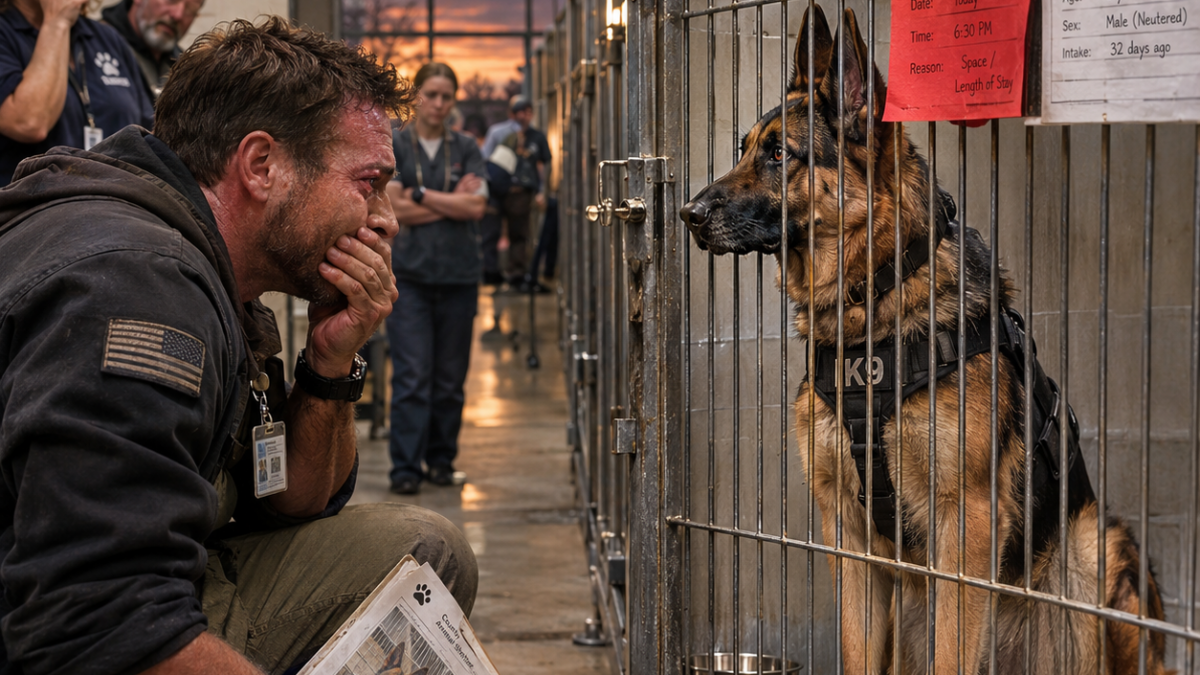
I had not gone to the county shelter looking for a dog.
That matters.
My last service dog, Magnus, had died fourteen months earlier.
German Shepherd.
Black saddle.
Heavy head.
Seven years as my partner after I left active police work and moved into K9 training.
Magnus had been the sort of dog people described as “serious.”
Which meant he did not waste energy pretending to like everyone.
He liked me.
Tolerated Frank, my neighbor.
Loved boiled chicken.
Hated baths.
And believed squirrels were an unsolved criminal conspiracy.
Cancer took him at eleven.
I had been with dying working dogs before.
Handlers’ dogs.
Department dogs.
Dogs injured in service.
Nothing prepared me for Magnus.
The day the veterinarian told me there was nothing left to treat, Magnus rested his head on my boot as though I needed reassuring.
I hated him for that for approximately five seconds.
Then I sat on the clinic floor and cried into his neck.
Afterward, I put his collar in the desk drawer.
I stopped training privately.
Stopped attending demonstrations.
Stopped going to the lake trail we had walked every morning.
Friends told me to get another dog.
That sentence made me angry.
You do not replace partnership.
You build another relationship or you don’t.
For fourteen months, I didn’t.
Then my friend Ellen called.
She ran volunteer enrichment at the county shelter.
“I need your eyes on something.”
“No.”
“You haven’t even heard.”
“I know your voice.”
“James.”
“No dogs.”
“I’m not asking you to adopt.”
“That means you’re absolutely asking me to adopt.”
She sighed.
“There’s a Shepherd.”
I nearly hung up.
Then she said:
“He’s scheduled for behavioral euthanasia tonight.”
That stopped me.
“What happened?”
“Three bites.”
“Severity?”
“Two level-two, one level-three.”
“Context?”
“Complicated.”
Everything important hides inside that word.
Complicated.
I looked at Magnus’s collar drawer.
Closed.
“What time?”
“Six-thirty.”
“What time is it?”
“Five forty-seven.”
I grabbed my coat.
The shelter smelled exactly the way shelters always smell late in the day.
Disinfectant.
Wet dog.
Laundry.
Stress.
Food bowls.
Too many lives inside concrete rooms.
Ellen met me near reception.
She did not hug me.
Smart woman.
“This way.”
We walked past runs.
Barking followed us.
Some dogs jumped at doors.
Some retreated.
One old hound slept through everything.
At the far end, separate from the adoption kennels, was a quieter corridor.
Behavior hold.
Medical hold.
Dogs requiring limited handling.
The German Shepherd was in the last run.
Before I saw him, I saw the card.
Red.
Large black letters.
REX — DO NOT REHOME
Underneath:
BITE HISTORY — HANDLER CAUTION
Then in handwriting:
EUTH. 18:30
I checked my watch.
6:08.
Twenty-two minutes.
I looked inside.
Large male Shepherd.
Maybe eighty-five pounds.
Dark sable.
Muscular but lean.
Five or six years old.
He stood at the back of the kennel.
Not pacing.
Not lunging.
Standing.
Weight forward.
Ears fixed.
Eyes on me.
A low growl vibrated in his chest.
Ellen whispered:
“That’s what he does.”
I did not answer.
I watched.
The growl changed when a kennel worker passed behind me.
Higher.
Then lower.
His eyes flicked to the worker.
Back to me.
Assessment.
Not frenzy.
The worker reached toward the latch of another run.
Rex’s body shifted.
Forward.
Prepared.
Then relaxed when the worker moved away.
“Who handled him before?”
Ellen handed me file.
“Owner surrendered three weeks ago.”
“Owner?”
“Brother of original handler.”
I looked up.
“Original handler?”
She nodded.
“K9 background suspected.”
“Suspected?”
“We don’t have full records.”
The file said the dog had lived with a former private security contractor named Daniel Mercer.
Daniel died unexpectedly.
Heart attack.
Rex went temporarily to Daniel’s younger brother.
The brother described him as “impossible.”
Would not eat unless told.
Would not enter rooms freely.
Guarded doorways.
Growled when grabbed by collar.
First bite occurred when brother tried dragging him into a crate.
Second when a neighbor attempted to hug him around the neck.
Third at shelter intake, when a worker reached over his shoulders while another person pulled his leash.
Three bites.
Three labels.
One deadline.
I closed the file.
“What commands have they tried?”
“Sit.”
“Stay.”
“Down.”
“What language?”
Ellen frowned.
“English.”
“Verbal only?”
“I think.”
“You think?”
“James, we’re a county shelter, not a K9 unit.”
I looked at Rex.
6:11.
“Get me a chair.”
PART2
I placed the metal chair six feet from his kennel.
Not directly centered.
Slight angle.
Less confrontational.
Then I sat.
Knees relaxed.
Feet flat.
Hands open on my thighs.
Palms visible.
Samuel Driscoll’s voice returned from forty years earlier.
Let him see you have nothing to hide.
Rex growled.
I breathed slowly.
Did not stare directly into his eyes.
Did not look away completely.
Working dogs notice avoidance too.
Balance.
At 6:12, the corridor became quiet.
Dinner distribution had pulled staff away.
Ellen stayed near the end.
I could feel her watching.
Rex’s chest moved.
In.
Out.
Growl.
Pause.
Growl.
I said nothing for almost a minute.
Then:
“Hello, soldier.”
His ears changed.
Barely.
Forward.
Not because he understood soldier.
Because tone changed.
I had spent decades speaking to dogs who were waiting for structure.
Low.
Clear.
No pleading.
No baby talk.
No challenge.
“Good.”
His growl softened.
“I’ve seen what you can do.”
One ear twitched.
“You’ve shown everyone you’ve still got teeth.”
No movement.
“That part’s established.”
I heard Ellen make a tiny nervous sound behind me.
I continued.
“Now I’m going to talk.”
Rex watched every breath.
I spoke about Magnus.
Not because Rex understood the story.
Because I needed my voice to become honest.
Dogs know fake calm.
So I stopped performing.
“I had one like you.”
Rex’s head shifted.
“Bigger ego.”
His growl lowered.
“He worked seven years.”
I looked at the floor between us.
“Then one day he stopped eating.”
My throat tightened.
“Cancer.”
The word did not matter.
The feeling did.
“I told him what to do his whole life.”
I smiled without humor.
“Sit.”
“Down.”
“Search.”
“Leave it.”
“Here.”
“Then at the end there wasn’t a command I could give that fixed anything.”
Rex’s mouth closed.
The growl stopped.
Not completely.
A tiny vibration remained.
But silence entered.
I kept speaking.
“When he was gone, everyone told me to get another dog.”
Rex blinked.
“I didn’t.”
I glanced up.
“You know why?”
Obviously no answer.
“Because sometimes when your job disappears, you don’t know where to put yourself.”
Rex’s posture changed.
Not much.
His rear end lowered half an inch.
Then back up.
I felt my pulse quicken.
Do not rush.
I continued.
“Maybe that’s what happened to you.”
Ears forward.
“Maybe somebody took away the one man you knew how to read.”
A slow breath.
“And everybody after him kept shouting words.”
I lowered my voice.
“But nobody asked what language you speak.”
At 6:19, Rex sat.
Not casually.
Not because he was tired.
He folded into position with precision.
Hindquarters square.
Front legs straight.
Chest high.
Head forward.
Eyes on me.
Ready position.
I had seen it thousands of times.
The posture of a working dog waiting for direction.
My heart slammed once against my ribs.
Ellen whispered:
“Oh my God.”
I lifted my right hand slowly.
Palm down.
Fingers together.
An old handler signal.
“Wait.”
Rex froze.
Not fear.
Focus.
I held two seconds.
Lowered the hand.
“Down.”
Instant.
Chest to floor.
Front paws extended.
Head up.
Perfect.
Too perfect for coincidence.
I had to fight tears.
Not yet.
I needed to stay useful.
“Good.”
Rex’s ears flicked.
“Good boy.”
His tail moved once against concrete.
One tap.
Then still.
I stood.
Slowly.
Rex remained down.
I stepped closer.
One foot.
Stopped.
Another.
No growl.
At the kennel, I placed my hand against the chain-link.
Did not push fingers through.
Rex looked at my hand.
Then at me.
He crawled forward.
Still low.
Five inches.
Ten.
His nose touched the wire.
He sniffed my knuckles through metal.
Then his tongue touched the exact place where my index finger rested.
One lick.
Quick.
I closed my eyes.
Magnus used to do that when I waited outside training runs.
Same spot.
Same deliberate contact.
Something behind my ribs broke open.
I looked at my watch.
6:23.
Seven minutes.
I turned.
Walked toward the office.
Not running.
Never run away from a keyed-up working dog if you can help it.
But fast.
Very fast.
The shelter director, Diane Morales, sat behind a desk.
Tired face.
Reading glasses.
Stack of forms.
I said:
“Put a hold on him.”
She looked up.
“James—”
“I know the bite history.”
“The veterinarian’s already on the way.”
“Put a hold on him.”
She exhaled.
“You saw the red card.”
“Yes.”
“We’ve had three incidents.”
“I read them.”
“One staff member needed sutures.”
“I know.”
Her face hardened slightly.
“This isn’t an adoption-floor dog.”
“I didn’t say he was.”
I leaned forward.
“He’s trained.”
“We know he knows sit.”
“No.”
“You don’t understand.”
I kept my voice controlled.
“He’s not pet-trained.”
“He’s working-dog trained.”
“Patterned.”
“Handler-dependent.”
“Probably positional cues and release commands.”
Diane looked at Ellen.
Ellen had followed me.
“He did exactly what James asked.”
Diane looked back.
“So?”
“So the bites may be contextual.”
I said.
“That doesn’t make them imaginary.”
“No.”
“And it doesn’t guarantee he’s safe.”
“No.”
“Then what are you asking?”
“Time.”
“How much?”
“As much as your policy allows.”
She looked at clock.
6:24.
“Six minutes.”
“Start with six.”
Diane closed her eyes.
Then reached for phone.
“Call Dr. Patel.”
She told reception.
“Tell him we’re placing a temporary behavioral hold pending qualified assessment.”
Not adoption.
Not miracle pardon.
A hold.
That was enough.
For tonight.
Diane looked at me.
“You’re signing as evaluator.”
“I will.”
“And if you take him offsite, you assume liability.”
“I know.”
“James.”
Her voice softened.
“If you’re wrong—”
“I know.”
I looked toward corridor.
“But if I’m right, we almost killed a dog because nobody recognized his job.”
The veterinarian arrived at 6:31.
Seven people suddenly had opinions.
Policy.
Insurance.
Public safety.
Liability.
Previous bites.
Training credentials.
Alternative placements.
No one was wrong to worry.
That matters.
People love stories where bureaucracy is evil and the hero alone sees truth.
Reality is messier.
A powerful dog with bite history can hurt someone badly.
Intent does not erase injury.
Training does not guarantee safety.
Past service does not make risk imaginary.
So we did what should have been done earlier.
We assessed.
I did not take Rex home that night.
I wanted to.
Emotion is not a plan.
Instead, Dr. Patel examined him under controlled handling.
I demonstrated known cues from outside the kennel first.
Hand signals.
Verbal commands.
Heel position.
Place.
Release.
Wait.
Leave.
Rex knew all of them.
Some better than others.
Most striking was threshold behavior.
I opened the kennel.
Stepped back.
Rex did not leave.
Door wide.
Nothing.
I stepped through the threshold first.
Then said:
“Here.”
He came.
Stopped at my left leg.
Sat.
Ellen covered her mouth.
Diane stared.
The shelter behavior specialist, Paul Nguyen, said quietly:
“He’s waiting for permission.”
Exactly.
For three weeks, people had interpreted immobility as stubbornness.
Refusal.
Shutdown.
Then forced him physically.
A dog taught never to cross without release had been dragged through doorways.
A dog trained to respond to handler posture had strangers looming over him.
A dog conditioned for controlled restraint had hands grabbing his collar.
His bites still mattered.
But suddenly they had context.
Context changes treatment.
Not history.
Treatment.
We reconstructed Daniel Mercer’s life over the next forty-eight hours.
Private security.
Former military police.
Contract canine work.
No police department record because Rex had never belonged to a municipal K9 unit.
He was privately trained.
Records from a training company confirmed it.
Rex’s original name was not Rex.
It was Axel.
That hit me harder than expected.
Axel.
Five years old.
Advanced obedience.
Tracking foundations.
Property search.
Controlled protection work in earlier years, later retired from bite work after Daniel left security.
His last two years had been primarily companion and demonstration work.
Daniel died at fifty-one.
No will provision for Axel.
His brother took the dog out of obligation.
Did not know commands.
Did not know release cues.
Could not understand why Axel waited at doors.
Why he would stare at a food bowl until given permission.
Why he became frantic when physically forced.
The brother had called him “creepy.”
Then “aggressive.”
Then “dangerous.”
Axel went to shelter.
New name.
New handlers.
More confusion.
Three bites.
Red card.
6:30.
A life translated badly.
Diane sat across from me Friday morning.
“Can you take him?”
The question sounded simple.
It wasn’t.
I had not had a dog in fourteen months.
My house still had Magnus’s old hook by the door.
His water bowl remained in the garage because I could not throw it away.
I said:
“I can foster under behavioral contract.”
Diane nodded.
“Not adopt?”
“Not yet.”
Good trainers know not to confuse a dramatic moment with a complete relationship.
Axel obeyed me because I gave familiar signals.
That did not mean he trusted me fully.
It did not mean we belonged to each other.
Trust needed time.
So did I.
I brought him home Saturday.
Not in a dramatic sunset.
In my old Ford pickup at 10:40 in the morning.
Axel rode secured in a travel crate.
Quiet.
Watching.
At home, I parked.
Opened rear.
He stood.
Waited.
I clipped leash.
Stepped back.
“Out.”
He exited.
Then immediately moved to heel.
Left side.
Shoulder near my knee.
I walked toward gate.
Axel followed.
I opened.
He stopped.
Would not cross.
I had forgotten.
Threshold.
I stepped through.
“Here.”
He crossed.
Sat.
I looked down.
“Buddy.”
His ears lifted.
“You’re going to wear me out.”
Tail moved once.
My house had a small fenced yard.
Magnus had loved it.
His old tennis-ball marks still scarred the fence where he used to drop toys and stare at me until I threw them.
Axel entered.
He did not explore freely.
He tracked me.
Every step.
I walked left.
He moved left.
Stopped.
He stopped.
Turned.
He turned.
Not affection.
Pattern.
He was waiting to know what his job was.
I unhooked leash.
He stayed.
“Free.”
Nothing.
I tried an old release cue.
“Break.”
Axel took two steps.
Then returned to heel.
I tried:
“Okay.”
Nothing.
“Go on.”
Nothing.
Finally I sat in a patio chair.
Axel sat beside my left knee.
I stared at yard.
He stared forward.
Ten minutes.
Fifteen.
Then a squirrel ran along fence.
Axel’s ears snapped.
Head turned.
Body leaned.
Then he looked at me.
Permission.
I almost laughed.
“Go.”
Axel launched.
Full speed.
Squirrel escaped.
Of course.
Axel reached fence.
Stopped.
Turned.
Ran back.
Sat at heel.
I laughed.
First real laugh in months.
“Terrible hunter.”
His mouth opened.
Tongue out.
Not exactly a smile.
But close enough.
Feeding was stranger.
I put dinner down.
Axel sat.
Waited.
I walked away.
He stayed.
Five minutes.
Ten.
I realized.
Release.
“Eat.”
He ate instantly.
Fast but controlled.
Finished.
Returned to me.
Sat.
My chest hurt.
Daniel’s voice was still living inside this dog’s body.
I wondered how long Axel had waited beside bowls in his brother’s house.
How many times people had called him strange.
How often he had been hungry because nobody knew the word.
I whispered:
“You don’t have to ask forever.”
Axel tilted his head.
Of course he did not understand.
Not yet.
The first night, I gave him a bed in my bedroom doorway.
He stood beside it.
I said:
“Place.”
He lay down instantly.
Two hours later, I woke.
Axel still in same position.
Head up.
Watching hallway.
Guarding.
I sat.
“Sleep.”
Nothing.
I turned off lamp.
Minutes later, I heard his breathing deepen.
At 3:10 a.m., I woke again.
Axel had not moved.
Something about that frightened me.
A dog so disciplined he did not know whether he was allowed to reposition.
I got out of bed.
Walked to him.
“Come.”
He stood.
I moved bed three feet.
“Place.”
He lay down.
Then looked at me.
I felt stupid.
What was I doing?
Replacing one command structure with another.
That would keep him manageable.
It would not make him free.
There had to be more.
I called Paul at the shelter.
“He doesn’t do anything unless told.”
“Working dog.”
“I know.”
“Give decompression time.”
“I know.”
“You sound annoyed.”
“At myself.”
“Good.”
“Why good?”
“Means you’re paying attention.”
I hated competent people.
We built freedom slowly.
At meals, I began delaying the cue.
Then using a release.
Eventually I put food down and said nothing.
Axel sat.
Waited.
First day fifteen minutes.
I gave in.
“Eat.”
Second day ten.
Third day eight.
Then one morning, I put the bowl down, stepped away, and began making coffee.
Axel stared at bowl.
Then at me.
I ignored.
Three minutes.
He looked at bowl.
One step forward.
Stopped.
Looked at me.
I still ignored.
He lowered his head.
Ate.
No command.
I froze with coffee mug halfway to my mouth.
Do not make big deal.
Let choice remain normal.
Inside, I wanted to cheer.
Afterward Axel approached.
Sat.
I scratched his neck.
“Good.”
Then stopped myself.
No.
Not good because he ate without permission.
Good because he was Axel.
Not performance.
I scratched again.
“Morning, buddy.”
Better.
Thresholds took longer.
At first he would not leave the bedroom unless I went first.
So I opened door.
Walked away.
He remained.
I sat downstairs reading.
Fifteen minutes later, nails clicked on wood.
Axel stood at top of stairs.
Looking down.
No cue.
I kept reading.
One paw.
Step.
Pause.
Another.
Eventually he reached bottom.
Came to me.
Sat.
I touched his head.
Nothing else.
Next day, faster.
Within two weeks, he crossed doors without waiting.
Mostly.
That made me strangely emotional.
A dog walking through a doorway should not make a grown man cry.
It did.
But the hardest thing was touch.
Axel accepted touch if expected.
Head.
Shoulders.
Chest.
He tolerated grooming.
Vet handling with structure.
But spontaneous affection confused him.
If I hugged him, his body stiffened.
So I stopped hugging.
I waited.
Weeks.
One evening I sat on floor sorting Magnus’s old equipment.
I should have done it years earlier.
Leashes.
Harness.
Collars.
A cracked tennis ball.
Magnus’s favorite tug.
Axel stood across room.
Watching.
I picked up Magnus’s collar.
Leather worn.
Brass nameplate.
Suddenly I was back in the clinic.
Magnus’s head on my boot.
The impossible last command.
I cried.
Quietly.
Not dramatic.
Just tears.
Axel approached.
I wiped my face.
“Sorry.”
He stopped.
Then did something he had never done.
He leaned his shoulder against mine.
Not commanded.
Not trained.
Just contact.
I put one hand on his chest.
He stayed.
After a minute, his head lowered onto my shoulder.
My breath left.
I did not wrap both arms around him.
Not yet.
I simply sat.
Magnus’s collar in one hand.
Axel’s weight against the other side.
Grief and beginning occupying same room.
That night I moved Magnus’s collar from the drawer to the wall.
Not replaced.
Displayed.
There was space beside it.
I did not fill it.
Not yet.
Week three, tennis ball.
I found one in garage.
New.
Yellow.
Axel watched.
I bounced it once.
His eyes tracked.
“Want it?”
No movement.
I threw.
Ball rolled across grass.
Axel looked at me.
Then ball.
Then me.
I shrugged.
“No command.”
He stood.
Trotted.
Reached ball.
Sniffed.
Picked it up.
Returned.
Dropped at my feet.
Sat.
Of course.
Retrieval became work.
I picked ball.
Did not throw.
Instead tossed sideways unpredictably.
Axel hesitated.
Then chased.
Came back faster.
Third throw, tail up.
Fourth, he overshot.
Slid in grass.
Rolled.
He stood looking surprised.
I laughed.
“Again?”
He barked.
One sharp bark.
First I had heard at home.
I threw.
Axel ran.
That was the moment.
Not the kennel.
Not the command.
Not the adoption hold.
The run.
Because for the first time, he was doing something useless.
No security purpose.
No obedience score.
No command value.
Just ball.
Just dog.
When he returned, I knelt.
Forgot my caution.
Wrapped arms around his neck.
Axel stiffened for half a second.
Then exhaled.
Leaned into me.
I cried.
Properly this time.
Into his fur.
“Good boy.”
Then corrected:
“No.”
I laughed through tears.
“Just boy.”
Diane called weekly.
“How’s your dangerous dog?”
Sarcasm.
“He stole my sock.”
“Euthanasia immediately.”
“He ignored a down command because squirrel.”
“Clearly deteriorating.”
“He ate without permission.”
“Monster.”
Humor helped.
Still, we remained careful.
Axel underwent formal reassessment.
Muzzle conditioning.
Trigger work around collar grabbing.
Controlled greetings.
No children initially.
No strangers hugging.
No assumptions.
The goal was not to prove he would never bite.
No honest person can promise that about any dog.
The goal was to understand his thresholds and prevent failure.
His bite history remained part of his file.
Context did not erase consequences.
But after months without incidents and clear progress, the shelter legally transferred permanent ownership to me.
That day Diane handed paperwork.
“Congratulations.”
I looked at form.
Name:
AXEL.
Owner:
JAMES COLFAX.
My throat tightened.
“Thanks.”
Diane smiled.
“You going to cry?”
“No.”
“You’re already crying.”
“Dust.”
“In my office?”
“Terrible ventilation.”
She let me have dignity.
Mostly.
I brought the old red kennel card home.
Diane offered it.
I almost refused.
Then took it.
DO NOT REHOME — EUTHANASIA AT 18:30
I framed it.
Not because I hated shelter.
I didn’t.
They had been making a safety decision with limited resources and incomplete history.
I framed it because labels need humility.
Dangerous.
Unadoptable.
Working.
Broken.
Good.
Bad.
These words freeze a moving thing.
Axel had bitten.
Axel was also trainable.
Axel was frightened by disorder.
Axel was capable of play.
Axel loved tennis balls.
Axel stole socks.
All true.
A label is rarely whole truth.
Months became a year.
Axel changed.
Not into a normal pet in some simplistic way.
He remained structured.
Loved routine.
Liked walking on my left.
Still automatically sat when I stopped at curbs.
Still checked me before entering unfamiliar doors.
But he also developed opinions.
He hated rain.
This surprised me.
A German Shepherd afraid of no man, defeated by drizzle.
If raining, he stood at back door.
Looked outside.
Then at me.
“No.”
I would say.
“Bathroom.”
He sighed dramatically.
I swear.
Then walked out like a prisoner.
Magnus had loved rain.
Different dog.
Important.
Axel discovered couches.
At first, he would not climb.
Furniture apparently forbidden in previous life.
I invited.
“Up.”
He jumped.
Sat stiffly.
No.
I patted cushion.
“Relax.”
He lay in sphinx position.
Still too formal.
Two months later, I came home from grocery store.
Axel was upside down on couch.
Four legs in air.
Head hanging over edge.
I stopped in doorway.
He opened one eye.
Did not move.
I laughed.
“Look at you.”
His tail thumped.
Freedom sometimes looks ridiculous.
He discovered counter surfing later.
Not ideal.
First offense:
Half turkey sandwich missing.
Axel sitting nearby.
Innocent.
Mustard on nose.
I stared.
He looked away.
“Did Daniel teach you that?”
No response.
“Magnus would be ashamed.”
Axel licked mustard.
Maybe not.
I corrected behavior.
Still secretly delighted.
A dog making bad choices is, in moderation, a dog making choices.
That distinction mattered more to me than clean counters.
Our morning walks became routine.
Lake trail.
The one I had avoided since Magnus.
First morning with Axel, I almost turned around at entrance.
Magnus everywhere.
Tree where he once chased raccoon.
Bench where we rested after his arthritis worsened.
Path.
Water.
Grief remembers geography.
Axel stood beside me.
Waiting.
I looked down.
“Come on.”
We walked.
Slow.
Halfway, a squirrel crossed.
Axel’s ears rose.
He looked at me.
Old habit.
Permission.
I kept walking.
“Your decision.”
He stared at squirrel.
Then at me.
Chose path.
Two months later he chose squirrel.
Leash stopped him.
I laughed so hard another walker looked at me like I was mad.
Axel returned.
I scratched ears.
“Terrible discipline.”
Best possible complaint.
People sometimes asked whether Axel replaced Magnus.
No.
That question misunderstands love.
A second book does not replace first book.
A new friend does not erase old friend.
Magnus taught me partnership.
Axel taught me recovery.
Magnus knew me before grief.
Axel knew me inside it.
Different chapters.
Same life.
On the first anniversary of Axel’s shelter deadline, I looked at clock.
6:12.
He was sleeping on rug.
6:19.
He rolled over.
6:24.
He brought tennis ball.
6:30.
The minute he had once been scheduled to die.
Axel barked because I had not thrown ball quickly enough.
I stood there holding it.
Tears came.
He barked again.
I threw.
He ran.
That was how we marked anniversary.
Not candle.
Not ceremony.
Ball.
At 6:30, Axel was busy being inconvenient.
Perfect.
I called Ellen later.
“You remember tonight?”
She did.
“Of course.”
“He barked at me at 6:30.”
She laughed.
“Ungrateful.”
“Exactly.”
Then silence.
She said softly:
“I’m glad you came.”
I looked at Axel asleep.
“So am I.”
Year two.
Axel no longer waited for commands to eat.
Sometimes began before bowl reached floor.
Rude.
Excellent.
He slept wherever he wanted.
Sometimes bed.
Usually doorway still, but because he liked view.
Not because told.
He crossed thresholds first occasionally.
Once shoved past me at back door because rabbit.
I nearly applauded.
Did not.
Training standards remain.
He barked at mail carrier.
Stole one glove.
Ignored “come” while investigating deer scent.
All tiny failures.
All proof he was no longer a machine waiting to be activated.
One afternoon Paul visited.
The behavior specialist who helped reassess him.
Axel greeted cautiously.
Then accepted ball.
Paul watched him wander yard.
“He looks different.”
“He’s heavier.”
“Not weight.”
“I know.”
Paul smiled.
“Eyes.”
Yes.
At shelter, Axel’s eyes tracked every movement for threat and instruction.
Now they wandered.
Bird.
Tree.
Me.
Ball.
Cloud.
Nothing.
Attention no longer had to be survival tool.
The strangest healing happened around food.
Daniel’s training had been strict.
Axel waited.
Always.
Over time, I taught release.
Then autonomy.
One evening I left dinner on stand and went upstairs for phone.
When I returned, bowl empty.
Axel asleep.
No guilt.
I stood over him.
“You ate without me.”
He opened one eye.
Tail thump.
I laughed.
“Good.”
Then:
“Actually, don’t get ideas.”
The balance.
Freedom with boundaries.
That became our whole life.
I began volunteering with shelter.
Not because I wanted to become savior.
Because Axel’s case exposed gap.
Working dogs sometimes arrive in civilian systems misunderstood.
Retired police K9s.
Private security dogs.
Sport dogs.
High-drive shepherds.
Dogs with cue histories staff cannot recognize.
Not all are safe for general adoption.
Some are dangerous.
Some have serious behavioral pathology.
But some are simply speaking a dialect nobody on shift understands.
We built a small network.
Trainers.
Handlers.
Behavior veterinarians.
Placement groups.
Assessment before final decisions when time and safety allowed.
Axel did not save every dog.
Nothing does.
But his case changed a process.
That mattered.
The first dog we assessed after him was Belgian Malinois named Rook.
I almost regretted volunteering immediately.
Rook climbed walls.
Actually.
He ricocheted from kennel fencing like caffeine had become sentient.
Shelter labelled “unmanageable.”
We discovered he had been trained in sport obedience.
Needed work.
Structure.
And a home that knew what a Malinois was.
Not elderly couple wanting calm companion.
Placement found.
Months later, photo arrived.
Rook biting tug with trainer.
Happy.
I showed Axel.
He sniffed phone.
Unimpressed.
Mentorship has limits.
Another dog did not have good outcome.
Important to say.
Severe unpredictable aggression.
Neurological concerns.
Multiple unprovoked bites.
After full evaluation, euthanasia remained humane choice.
I sat with him at end.
That case destroyed any fantasy that understanding always rescues.
It doesn’t.
Compassion sometimes means safety and ending suffering.
Axel’s story was not proof every red card is wrong.
It was proof every red card deserves as much context as responsibly possible.
That is different.
Axel aged.
Six.
Seven.
Gray around muzzle.
Still powerful.
Then eight.
Slight stiffness.
We shortened walks.
He developed habit of stopping at lake bench.
Magnus’s bench.
First time Axel chose it, I laughed.
“Of course.”
We sat.
He leaned against leg.
Water moved.
Ducks.
Wind.
I thought about two dogs who never met.
Both Shepherds.
Both different.
Both somehow sitting with me at once.
Memory does that.
At nine, Axel’s hearing softened slightly.
Hand signals became more important.
Funny.
The signals that first connected us became our language again.
Open palm.
Down.
Come.
Wait.
He watched hands.
But now sometimes ignored them.
Not confusion.
Choice.
I would signal.
Axel would look.
Then continue sniffing.
I pretended annoyance.
Inside, joy.
There was once a time obedience kept him trapped.
Now he knew relationship could survive imperfection.
At ten, he stole a roast chicken leg from table.
I caught him halfway.
“Leave it.”
Axel froze.
Old training returned instantly.
Dropped.
Looked at me.
I picked chicken.
Then thought.
Broke off safe piece.
Gave.
He ate.
Some crimes deserve plea deals.
At eleven, veterinarian found arthritis.
Medication.
Rugs.
Ramp into truck.
Axel hated ramp first.
He looked at me as though insulted.
Then used when no alternative.
I knew that look.
Magnus had given same.
Working dogs retain pride.
Old men too.
One rainy morning, Axel refused walk.
I put leash.
Opened door.
Rain heavy.
Axel stepped backward.
“Really?”
He sat.
I laughed.
“Dangerous dog.”
Tail thump.
“Three bite history.”
Tail.
“Euthanasia scheduled.”
He yawned.
“Defeated by weather.”
He walked to couch.
I followed.
No walk.
Some commands become requests with age.
The framed red card hung in my office.
Visitors asked.
I told story carefully.
Not:
Shelter almost murdered innocent dog.
That would be unfair.
I said:
“They saw bite history.”
“I saw pattern.”
“Both mattered.”
Then pointed at words.
“The lesson is not ignore danger.”
“The lesson is look again when you can.”
Axel usually slept beneath desk while I spoke.
Best evidence.
Daniel Mercer’s brother eventually contacted me.
His name was Stephen.
He had seen article about shelter K9 assessment program.
He came to house.
Nervous.
Axel stood behind gate.
Stephen cried before entering.
“I failed him.”
I did not answer immediately.
He had.
But shame alone teaches little.
“You didn’t understand him.”
“I should have.”
“Maybe.”
He wiped face.
“He bit me.”
“Where?”
Stephen showed scar on forearm.
“I grabbed him after he wouldn’t get in car.”
Context.
Injury still real.
“I was angry.”
He looked at Axel.
“I thought Daniel had ruined him.”
I opened gate.
Kept leash.
Axel approached.
Sniffed Stephen.
No dramatic recognition.
Maybe scent memory.
Maybe not.
He sat.
Stephen knelt, but I stopped him.
“Stand.”
He obeyed.
No looming.
Axel sniffed hand.
Then walked away.
Stephen cried harder.
“I’m sorry.”
I said:
“Say it for yourself.”
He looked at me.
“Dogs don’t need our confession speeches.”
“He needs us to behave better.”
Stephen nodded.
He donated to assessment program later.
Quietly.
That mattered more than guilt.
At twelve, Axel slept more.
Ball throws became three.
Then two.
Sometimes he carried ball without wanting throw.
Just object.
I sat in yard.
He lay beside me.
One afternoon he placed ball on my shoe.
Exactly like third week.
Memory hit.
The first chase.
First useless task.
First tears.
I picked up ball.
“Again?”
Axel looked.
Tail moved.
I threw short.
He trotted.
Returned.
Slow.
Dropped.
Then rested head on my knee.
That was our last real fetch.
I did not know then.
Good.
If we knew every last time, life would become unbearable.
At thirteen, kidney values changed.
Then heart.
Not severe initially.
Monitoring.
I had been through aging dog before.
Magnus.
Knowledge helps medically.
Not emotionally.
I started watching Axel sleep.
Counting breaths.
Hating myself.
He would wake.
Look at me.
As if saying:
Stop.
Live now.
Dogs are better at that.
One morning we walked lake.
Very slow.
Reached bench.
Axel sat.
Then lay.
I joined.
Sun on water.
He placed head against boot.
Magnus’s old position.
I looked down.
“You guys coordinate this?”
No answer.
I stroked ears.
“You know they almost killed you.”
I rarely said that aloud.
Axel closed eyes.
“You know I almost didn’t come.”
That was true too.
Ellen called.
I could have said no.
I almost did.
“I was tired.”
My throat tightened.
“Not physically.”
Axel breathed.
“I didn’t want another dog because another dog meant another goodbye.”
There.
Cowardice dressed as grief management.
I scratched his chest.
“Then you showed up with eighteen minutes left.”
Tail moved.
“Terrible timing.”
His final decline came fast.
One week eating.
Next less.
Veterinarian found aggressive cancer.
Spleen and liver involvement.
Too advanced.
Options focused comfort.
The room blurred.
Not again.
Always again.
That is the deal.
Love any living thing long enough and eventually you face it.
I sat on clinic floor.
Axel stood unsteadily.
Then moved into heel position.
Left shoulder against my knee.
Even now.
I laughed and cried.
“You don’t have to work.”
He leaned harder.
We had ten good days.
Chicken.
No dietary rules.
Short yard time.
Sun.
Couch.
Lake once.
I carried ramp.
Axel walked to bench.
We sat.
No commands.
I did not say sit.
He did anyway.
Habit or choice.
Did not matter.
On final morning, he would not stand.
I called mobile vet.
Ellen came.
Diane too.
Paul.
Not crowd.
Family of his second life.
Axel lay on his bed in living room.
Magnus’s collar on wall.
Red shelter card in office.
Tennis ball beside him.
I sat on floor.
Hands open.
Palms up.
The same position as 6:12 years before.
That detail nearly broke me.
Axel watched.
His eyes cloudy.
Still tracking my breathing.
I whispered:
“Hello, soldier.”
His ears moved.
Ellen cried quietly.
I said:
“You remember?”
Of course no answer.
“You were very dramatic.”
Diane laughed through tears.
“That dog?”
“You gave him a red card.”
“He earned paperwork.”
Axel’s tail moved once.
Good.
Humor.
Necessary.
The veterinarian gave first medication.
Axel relaxed.
For perhaps first time in his life, no need to hold readiness.
I placed hand on his chest.
“Wait.”
The word came automatically.
Then I stopped.
No.
Wrong final command.
I shook my head.
“You don’t have to wait anymore.”
My voice broke.
Axel’s eyes stayed on mine.
I leaned closer.
“Free.”
That was one of the release words we had built together.
Not Daniel’s.
Ours.
“Free, Axel.”
His breathing slowed.
I cried openly.
“You spent too much of your life waiting for permission.”
“Not this.”
“Go.”
One breath.
Another.
Then still.
My hand remained.
No heart.
No command could fix it.
Just like Magnus.
But I understood something now.
The purpose of training was never to prevent death.
It was to create language while life existed.
We had spoken.
That was enough.
Ellen sat beside me.
Nobody rushed.
Eventually I said:
“He ignored me yesterday.”
She laughed.
“What?”
“Called him in.”
“He looked.”
“Went back to sniffing.”
I smiled.
“Best thing he ever did.”
Ellen cried harder.
Because she understood.
Axel’s greatest success was not perfect obedience.
It was becoming secure enough to disobey without believing love would disappear.
I had him cremated.
Placed urn beneath Magnus’s collar for several months.
Then one day I moved both collars side by side.
Magnus.
Axel.
No ranking.
No replacement.
Two lives.
I hung Axel’s collar next to red shelter card.
Underneath I added a small brass plate.
Not inspirational quote.
Just one word.
FREE.
The assessment program expanded.
We named nothing after Axel because I hated memorial branding while grief fresh.
Eventually shelter staff unofficially called protocol “Axel review.”
High-drive dogs.
Working breed histories.
Complex bite context.
Specialized evaluation when possible.
Again—
not pardon.
Review.
Sometimes outcomes changed.
Sometimes not.
But fewer dogs were judged through a language mismatch.
That was enough legacy.
Years later, a young handler asked me:
“How did you know Axel wasn’t dangerous?”
I corrected immediately.
“I didn’t.”
He frowned.
“But you saved him.”
“I knew he was communicating.”
“That’s different.”
He waited.
“A dog can be dangerous and understandable.”
“Understanding does not equal harmless.”
“Axel had bitten.”
“People were right to respect that.”
“What I recognized was pattern.”
“Training.”
“Context.”
“Then we assessed.”
The handler nodded.
“So it wasn’t instinct?”
“No.”
“Experience.”
“Evidence.”
“And a little luck.”
Stories make heroes look certain.
I was not.
At 6:24, I was asking for more time.
Not claiming prophecy.
That distinction matters.
Still, I think about his eyes.
The first evening.
Not wild.
Measuring.
Everyone had called it distrust.
I knew assessment.
He was asking:
Do you know what comes next?
For weeks nobody did.
Then I sat.
Hands open.
Used one signal.
And Axel answered.
Ready.
Maybe that was all he needed initially.
Not love.
Not rescue.
Translation.
Love came later.
With tennis balls.
Stolen turkey.
Rain refusal.
Couch naps.
Ignored commands.
Old age.
That is important.
The kennel moment saved his life.
It did not create relationship.
Relationship came through ordinary days.
Those are always more important.
I kept the metal chair.
Ridiculous.
Shelter was replacing furniture.
Ellen asked if I wanted it.
I said no.
Then took it.
It sits in garage.
Plain chair.
No meaning to anyone else.
To me, it marks eighteen minutes.
The amount of time between a label and another possibility.
I do not romanticize deadlines.
Shelters face impossible decisions.
Limited kennels.
Public safety.
Resources.
Staff burnout.
Dogs with serious histories.
Sometimes there is no perfect answer.
Axel’s story is not accusation.
It is reminder.
When possible—
sit.
Observe.
Ask.
What happened before bite?
What was dog trained to do?
What signals is he reading?
What are we missing?
Sometimes answer changes nothing.
Sometimes it changes everything.
When I walk lake now, alone, I still pause at bench.
Magnus.
Axel.
Two ghosts only because memory makes them so.
I do not believe they are literally running around me.
I do not need that.
Their effect remains.
My pace changed.
My work changed.
My house changed.
That is enough afterlife for me.
A squirrel crossed trail last week.
I laughed.
Because I imagined Axel looking at me.
Waiting.
Then not waiting.
Running.
That image is my favorite.
Not perfect heel.
Not down command at 6:19.
Axel chasing a squirrel because for once he did not need permission to be stupid.
Freedom sometimes looks like bad obedience.
His original red card is fading.
Ink.
Paper.
I could replace it.
I won’t.
Let time work.
The words once looked absolute.
DO NOT REHOME.
EUTHANASIA AT 18:30.
They were not absolute.
They were a decision based on what was known then.
New information arrived.
Decision changed.
That is how systems should work when they can.
Not because emotion wins.
Because evidence can revise judgment.
Underneath the card, the brass plate remains sharp.
FREE.
One word.
Better than the card.
Not because Axel became free of commands.
He loved commands.
Structure calmed him.
Work made sense.
Freedom did not mean absence of rules.
It meant he no longer believed a mistake would cost belonging.
He could eat without release.
Cross door first.
Ignore recall occasionally.
Sleep upside down.
Steal sandwich.
Be old.
Be sick.
Be loved.
That was freedom.
Sometimes I tell people the shelter called him Rex.
I called him Axel because it was his real name.
But near the end, names mattered less.
I called him:
Buddy.
Soldier.
Idiot.
Old man.
Thief.
Good boy.
Just boy.
All true.
The most important command I ever gave him was not sit.
Down.
Heel.
Wait.
Come.
It was the one I spoke at the end.
Free.
Not because I released him into death.
Because that word described what we had spent years building.
He entered my life waiting for somebody to tell him what to do.
He left it knowing he was allowed to choose.
That is the whole story.
At 6:12 p.m., I sat outside a kennel with open hands.
At 6:19, a condemned German Shepherd sat upright and told me, in the only language he had left, that he was still listening.
At 6:24, I asked six more minutes.
Then another night.
Then an assessment.
Then a foster.
Then a home.
Then years.
That is how life changed.
Not one miracle.
A series of extensions.
Six minutes.
One day.
Three weeks.
Two years.
Many more.
Until time finally became something neither of us could extend.
If you ask me whether I saved Axel, I will say something that annoys people.
Partly.
Ellen made the call.
Diane made the hold.
Paul assessed.
Dr. Patel treated.
Daniel, before dying, had given Axel a language.
I recognized it.
Axel responded.
Then he did the hardest work himself.
He learned that the language could change.
That a hand signal could become a game.
That a doorway could become a choice.
That food could be eaten because he was hungry, not because permission arrived.
That a man could love him even when he ignored a command.
That being useful was not the same as being worthy.
That last lesson took me just as long.
After Magnus died, I thought I had lost my purpose too.
Trainer without dog.
Old cop without unit.
Man with empty house.
Then Axel arrived looking for a handler.
For a while, I believed I was rescuing him by giving structure.
Eventually I understood he was teaching me the same thing.
Purpose can change without disappearing.
I did not need Magnus back.
Axel did not need Daniel recreated.
We needed a new language.
We built one.
The last photograph I have of Axel was taken three weeks before he died.
He is on the couch.
Upside down.
One back leg against cushion.
Mouth open.
Zero dignity.
A tennis ball beside his head.
If you saw it without story, you would never guess.
That is exactly why I love it.
Not condemned dog.
Not dangerous dog.
Not working dog.
Not rescue dog.
Just Axel.
Sleeping badly.
Safe.
That is what I want remembered.
Not the red card alone.
The couch after it.
Not the bite file alone.
The squirrel.
The stolen sandwich.
The rain refusal.
The first meal eaten without permission.
The first doorway crossed ahead of me.
The first ignored command.
Those were not failures.
They were signs that the dog everyone believed needed stronger control had finally learned something much harder.
He did not need a general.
He needed a partner.
And eventually—
he learned he could be one too.
If I could return to that corridor at 6:12, I would change only one thing.
I would not call him soldier.
Not because it was wrong.
Because I know better now.
I would sit.
Hands open.
And say:
“Hello, Axel.”
“You don’t have to prove anything.”
“I’m listening.”
Then I would wait.
Because that was what saved him.
Not dominance.
Not command.
Not being stronger.
One person willing to sit still long enough to notice that beneath the growl, beneath the file, beneath the three bite reports, beneath the red card and the deadline—
a dog was still trying to communicate.
And when I finally spoke back in a language he understood, he did not lunge.
He did not attack.
He did not become the monster everyone feared.
He simply sat.
Straight.
Ready.
Waiting.
And then, years later, after he had learned to eat when hungry, sleep where he wanted, chase squirrels without checking my face and steal food like a completely ordinary dog—
he finally stopped waiting for permission to live.
That was the real rescue.
Everything else was paperwork.








