For twenty-eight months, the military told me there was no reliable evidence my husband was coming home, my daughters slowly stopped asking when Daddy would walk through the gate, and nearly everyone around us learned to speak about James in the careful past tense people use when hope has become uncomfortable. Everyone except Corporal—our aging Golden Retriever—who dragged himself to the front gate every single morning for 854 days, sat facing the road until evening, and refused to accept what trained officers, official reports, and eventually even I had begun to fear was true.
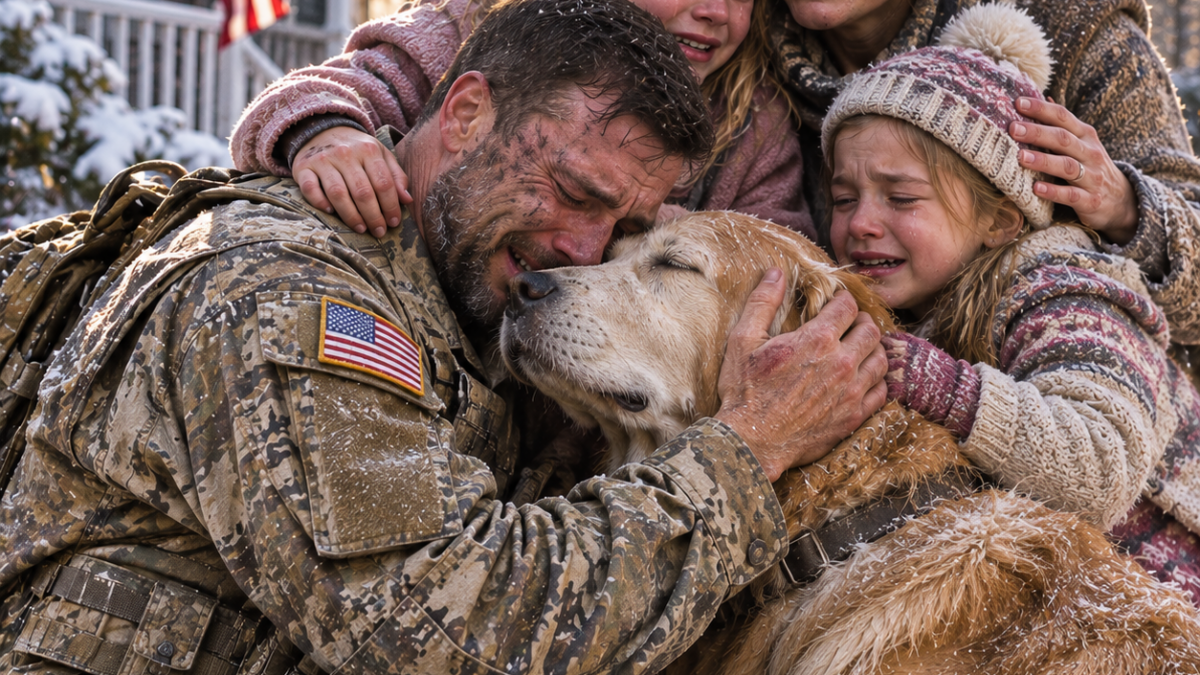
For twenty-eight months, the military told me there was no reliable evidence my husband was coming home, my daughters slowly stopped asking when Daddy would walk through the gate, and nearly everyone around us learned to speak about James in the careful past tense people use when hope has become uncomfortable.
Everyone except Corporal—our aging Golden Retriever—who dragged himself to the front gate every single morning for 854 days, sat facing the road until evening, and refused to accept what trained officers, official reports, and eventually even I had begun to fear was true.
Then, on a freezing February afternoon, the gate that had not opened since the day James disappeared creaked behind me, Corporal lifted his gray muzzle from the rug, and before I could understand the thin, limping man standing in our garden, our old dog made a sound so broken and joyful that I knew my husband was alive.
My name is Sarah Mercer.
Before James disappeared, I believed waiting was passive.
Something you did in airports.
Doctors’ offices.
School pickup lines.
I did not understand that waiting could become a full-time occupation.
A ritual.
A wound.
A form of loyalty so exhausting that it changed the shape of a family.
James had walked through our gate 854 days earlier in uniform, carrying the same battered deployment bag he had used for years.
Emily had been eight.
Chloe five.
Corporal had been younger then, too.
Golden muzzle.
Strong hips.
Tail like a feather duster destroying everything within three feet whenever James came home.
The morning James left, Corporal followed him to the gate.
James crouched.
Held his face in both hands.
“You look after my girls.”
Then he tapped the dog’s chest.
“And I’ll come back for you.”
Corporal licked his chin.
James laughed.
I remember thinking it was just something people said to dogs.
A promise without legal weight.
Then James disappeared.
The calls stopped.
The emails stopped.
Officials came.
They said his unit had lost contact during an operation.
They said searches were continuing.
They said there were possibilities.
Later, the words changed.
No confirmed location.
No reliable intelligence.
No timetable.
Then, eventually:
“You need to prepare your family for the possibility that Sergeant James Mercer may not return.”
I learned to hear that sentence without collapsing.
Corporal never did.
Every morning at 6:30, he walked to the gate.
Every evening, I went outside and brought him back in.
Until day 854.
That day, he came back by himself.
Because James had finally come through the gate.
FULL STORY CONTINUATION
The gate creaked at 2:17 in the afternoon.
I know the exact time because the digital clock on the microwave was directly in front of me.
2:17.
February.
Cold enough that frost still clung to the shaded part of the back lawn despite the afternoon sun.
I was reorganizing the kitchen cupboards because there are only so many ways a woman can keep herself busy when both children are at school and the house has become too quiet.
Tea bags.
Flour.
Canned tomatoes.
Three jars of peanut butter because apparently I had forgotten buying the previous two.
Normal things.
Then:
Creeeeeeak.
I stopped.
The glass jar in my hand remained halfway between shelf and counter.
That gate had a particular sound.
James used to complain about it.
Every spring he promised to fix the hinge.
Every summer he forgot.
The squeak became part of the house.
Then James left.
And after he disappeared, I stopped using the gate.
There was another entrance from the driveway.
Easier.
Less painful.
No one came through the old front gate anymore.
For 854 days, it had opened only when I occasionally cleaned around it or when Corporal pushed his nose between the bars.
That afternoon, I heard it move.
I thought:
Wind.
Then footsteps.
Slow.
Uneven.
One step.
Pause.
Another.
Something dragging lightly.
I put down the jar.
My heartbeat changed.
Not hope.
Hope had hurt me too many times.
First came fear.
A stranger.
A delivery.
One of the military liaison officers.
Bad news.
More paperwork.
Another official visit where someone sat on my sofa and used James’s name gently.
I walked to the window.
And saw a man standing in the garden.
He was thin.
That was the first thing.
So thin his uniform seemed several sizes too large.
The shoulders sagged.
The trousers hung wrong around his hips.
He carried weight differently, favoring his left leg.
A faded duffel sat beside him on the grass.
One edge dark with frost.
There was a scar along his temple.
Pink.
Long.
New.
His hair was shorter than I remembered.
His face narrower.
Cheekbones sharper.
Eyes deeper.
My mind catalogued details because the larger truth was too impossible to process.
Man.
Uniform.
Scar.
Bag.
Limp.
Then he raised his right hand.
Not high.
Just shoulder level.
A small wave.
Two fingers slightly separated.
James had waved at me that way for seventeen years.
Driving past the kitchen window.
Crossing parking lots.
Standing across crowded school gyms.
Whenever he saw me before I saw him.
A tiny movement that meant:
There you are.
The jar slipped from my hand.
It hit the counter.
Rolled.
Did not break.
I grabbed the windowsill.
My knees stopped working.
James.
No.
My brain rejected it.
James was missing.
James was likely dead.
James was a name on paperwork.
James was a photograph beside my bed.
James was a voice recording I had stopped playing because hearing him say, “Love you, Sare,” left me unable to function.
The man outside raised his hand again.
Then smiled.
Barely.
The left corner of his mouth moved first.
Exactly like James.
I stopped breathing.
Behind me, Corporal was asleep beside the fireplace.
He had become an old dog during James’s absence.
That fact hurt almost as much as watching the girls grow.
Eleven years old now.
White spreading across his muzzle.
Arthritis in both hips.
Hearing less reliable.
He no longer launched himself up when the mailman arrived.
He no longer chased squirrels beyond the flower beds.
But every morning at 6:30, Corporal still walked to the gate.
Even after rain.
Even in snow.
Even when his joints hurt.
At first, I thought it was routine.
James had always returned through that gate.
Maybe Corporal expected him because dogs understand patterns.
After three months, I started trying to stop him.
“Come on, buddy.”
“Inside.”
He would look at me.
Then turn back toward the road.
Six months.
One year.
Five hundred days.
The girls stopped counting.
I did not.
Corporal did.
Not in numbers.
In mornings.
854 mornings.
That afternoon, Corporal had fallen asleep after lunch on the rug.
I never called him.
Never moved.
Never said James’s name.
But when James’s boot touched the stone threshold inside the gate, Corporal’s head lifted.
Immediately.
His eyes opened.
His nostrils widened.
His entire body became still.
I turned from the window.
“Corporal?”
He did not look at me.
His ears rose.
The dog who sometimes slept through the doorbell had heard something I hadn’t.
Or smelled something.
Or recognized some rhythm in those footsteps that twenty-eight months had not erased.
He stood.
Too quickly.
His rear legs slipped.
He caught himself.
Then he made a sound.
I had never heard it before.
Not a bark.
Not a whine.
Not the high-pitched excitement he used when Emily came home from camp.
It began low.
Deep in his chest.
A trembling moan that rose until it almost sounded human.
My skin went cold.
Corporal staggered toward the front door.
Then faster.
He hit it with his shoulder.
The metal letter slot rattled.
“Corporal!”
He backed up.
Hit it again.
Once.
Twice.
Scratched at the wood.
Cried.
The sound outside changed.
James heard him.
I saw his face through the narrow window beside the door.
Whatever control he had been holding disappeared.
His mouth opened.
His eyes closed.
His shoulders folded.
I unlocked the door.
Corporal exploded past me.
There is no better word.
For months he had moved like an old dog.
Careful.
Slow.
Measured.
Suddenly he was young again.
He ran down the path so fast his feet slipped on the frost.
His ears flattened against his head.
His golden body stretched forward.
James opened his arms.
Corporal hit him.
Hard.
James took one step backward.
His weak leg gave.
He fell to both knees in the grass.
The duffel toppled beside him.
Corporal climbed onto him.
Not gracefully.
Front paws against James’s shoulders.
Face everywhere.
Neck.
Chin.
Ear.
Scar.
Hands.
The dog made that sound again.
Deeper.
Broken.
Twenty-eight months coming out of one animal at once.
James buried his face in Corporal’s fur.
His hands gripped the dog’s sides.
I saw his shoulders shaking.
Then I realized he was crying.
James did not cry easily.
He had cried when Emily was born.
At his mother’s funeral.
Once when we thought Chloe might need heart surgery and then learned she didn’t.
Now he cried into Corporal’s neck like a child.
“Hey.”
His voice broke.
“Hey, buddy.”
Corporal licked his face.
James laughed once.
The sound collapsed into another sob.
“I came back.”
Corporal pressed harder against him.
“I came back.”
The dog cried louder.
I stood in the doorway.
Unable to move.
They had found each other before I had found my legs.
Then James looked up.
At me.
“Sarah.”
My name.
One word.
His voice was rougher.
Lower.
But his.
I ran.
Bare feet.
I did not remember taking my slippers off or never putting shoes on.
The frost cut against my feet.
Mud soaked the knees of my jeans when I dropped beside him.
I touched his face.
I did not hug him immediately.
That surprises me.
I needed proof.
Skin.
Scar.
Cold cheek.
His beard rough beneath my fingers.
His eyes.
The tiny brown mark near his left eyebrow that I had kissed a thousand times.
“You’re alive.”
I said.
James closed his eyes.
“Yes.”
“No.”
I shook my head violently.
“No.”
He looked confused.
“You can’t just say yes.”
“Sarah…”
“They told me…”
My voice disappeared.
James reached for me.
I pulled back.
Not because I did not want him.
Because my body was trying to catch up to reality.
“They told me you probably weren’t coming home.”
His eyes filled.
“I know.”
“You know?”
“I know.”
“James, they…”
“I know.”
Something inside me snapped.
I hit his chest once.
Not hard.
Then again.
“Eight hundred fifty-four days.”
“I know.”
“You know?”
My fists closed around his uniform.
“You know how many times someone came into this house and told me they had nothing?”
“I’m sorry.”
“You know how many mornings he waited?”
I pointed at Corporal.
James looked down.
The old dog had pressed himself across James’s legs as if physically preventing another disappearance.
James cried again.
“I know.”
That did it.
I collapsed into him.
Arms around his neck.
Face against his shoulder.
His body felt wrong.
Too thin.
Bones where there had been muscle.
But his arms closed around me.
One hand at the back of my head.
One against my spine.
James.
Alive.
Warm.
Here.
Corporal pushed his head between us.
Because apparently twenty-eight months had not improved his sense of personal space.
I laughed.
Then cried harder.
James laughed too.
And for several minutes, the three of us remained kneeling in frozen grass.
Neighbors started coming outside.
Of course they did.
Mrs. McGregor from across the street was first.
She had seen almost everything that happened on our road for twenty years.
Curtains never completely closed.
Eyes like radar.
She stepped onto her porch.
Saw James.
Stopped.
Her hand went to her mouth.
“Oh my God.”
Mr. Patel next door came out.
Then Rachel from number twelve.
Someone whispered:
“James?”
Mrs. McGregor had her phone in her hand.
Later, she apologized.
“I wasn’t thinking.”
She said.
“I just knew somebody had to save that moment.”
Her photograph became famous later.
I hated that at first.
Then loved it.
James kneeling.
Corporal practically wrapped around him.
My hand over my mouth.
The front door open behind us.
Warm light spilling onto the cold path.
A military bag on its side.
Mud on my jeans.
No pose.
No flags.
No speeches.
Just a family realizing the dead man wasn’t dead.
Years later, Mrs. McGregor said:
“People needed to know what hope looked like.”
At the time, I only wanted people to stop staring.
I finally got James inside.
Corporal refused to let him walk alone.
He kept pressing against James’s leg.
This caused problems because James was already limping.
“Buddy.”
James laughed weakly.
“You’re going to finish what somebody else started.”
Corporal wagged.
That sound.
The laugh.
I froze.
I had forgotten the exact shape of James’s laugh.
Not consciously.
But hearing it in the kitchen exposed the missing space.
I had recordings.
Videos.
None captured the living vibration of it from ten feet away.
I turned toward the sink because suddenly I could not breathe.
James saw.
“Sarah.”
“I’m fine.”
He stared.
We both knew I wasn’t.
Neither was he.
That was the first honest thing about our reunion.
Love had come home.
Nothing else had magically repaired itself.
I made tea because I did not know what else to do.
The mug I chose was his.
I had not used it in 854 days.
Dark blue.
Small chip in the handle.
WORLD’S OKAYEST DAD
Emily had bought it at a school fair.
I kept it at the back of the cupboard.
Unable to throw it away.
Unable to use it.
I put it on the counter.
James touched it.
His fingers shook.
“She kept it?”
“Of course.”
His mouth tightened.
Then:
“How are the girls?”
That question.
I had known it was coming.
“They’re at school.”
His face changed.
“School.”
“Yes.”
“What time?”
“Emily gets out at three fifteen.”
“Chloe at three.”
He looked toward the clock.
2:31.
He swallowed.
“They don’t know?”
“No.”
“You didn’t call?”
“You appeared in my garden fourteen minutes ago.”
A tiny smile.
“Right.”
Then:
“Don’t tell them.”
I stared.
“What?”
“I want…”
He stopped.
Looked uncertain.
“I want them to see me.”
“That might be too much.”
His smile vanished.
“Do they…”
He could not finish.
Remember me?
Love me?
Want me?
I knew.
“Emily remembers everything.”
“And Chloe?”
I hesitated.
That hesitation cut him.
“Sarah.”
“She remembers you.”
Mostly.
I could not say the last word.
James looked at the table.
Corporal rested his head on James’s knee.
James put his hand there.
“She was five.”
“Yes.”
He nodded.
As though five explained everything.
It didn’t make it hurt less.
At 2:56, I called the school.
I told them there had been a family emergency.
True.
I asked if the girls could be brought home on their usual bus.
I almost drove to get them.
James said no.
“Let them come through the door.”
So we waited.
James sat on the sofa.
Corporal glued to his side.
I sat across from them.
Could not stop looking.
Every minute revealed another change.
Scar on his temple.
A faint mark along his wrist.
His right hand occasionally trembling.
The way he shifted before standing.
One leg injured.
A stiffness when someone moved unexpectedly behind him.
At 3:09, a delivery truck backfired outside.
James dropped instinctively.
Not to the floor.
But low enough.
His body moving before thought.
Corporal shot upright.
I went still.
James looked at me.
Embarrassed.
“Sorry.”
“For what?”
He said nothing.
There would be many moments like that.
I did not know yet.
At 3:22, we heard the school bus.
Corporal lifted his head.
James stopped breathing.
The bus door opened outside.
Emily first.
Backpack.
Longer hair than when James left.
Nearly as tall as me.
She was eleven now.
Eleven.
James had last hugged an eight-year-old child who still slept with stuffed animals arranged by rank.
Chloe jumped down behind her.
Eight.
Missing one front tooth.
Pink coat.
They walked toward the house arguing about something.
Normal.
Then Emily saw the open gate.
She stopped.
For 854 days, the gate had been closed.
She looked toward the house.
Then through the front window.
James stood.
Too fast.
His bad leg almost failed.
I reached for him.
He steadied himself.
Emily’s backpack slipped from her shoulder.
She stared through the glass.
No expression at first.
The front door opened.
I don’t remember who opened it.
Maybe me.
Maybe James.
Emily stood at the bottom of the path.
“Dad?”
James’s face broke.
“Em.”
She ran.
Exactly like Corporal.
No hesitation.
Eleven-year-old legs.
School shoes slipping on wet grass.
James stepped outside.
Emily hit him around the waist.
He groaned softly from the impact but held on.
“Dad.”
She screamed it this time.
“Dad!”
He kissed the top of her head.
Again.
Again.
“Look at you.”
“You’re so big.”
She pulled back.
Hit his chest.
Just like I had.
“You left.”
James froze.
Emily sobbed.
“You left and you didn’t call.”
James fell to his knees.
“I’m sorry.”
“Why didn’t you call?”
“I couldn’t.”
“You could’ve sent something.”
“I couldn’t.”
“Everybody said you were dead!”
“I know.”
“I hated them.”
She cried.
“I hated Mom when she said we had to stop asking.”
I closed my eyes.
That was new information.
Children keep secret accusations.
James looked at me.
I whispered:
“We’ll talk later.”
He held Emily.
She buried her face against him.
Then we heard a smaller voice.
“Mom?”
Chloe.
Still at the gate.
Not moving.
James looked at her.
Everything else vanished.
“Chloe.”
She tilted her head.
The way children do when matching a face to an old photograph.
James smiled.
“Hey, bug.”
That nickname.
Chloe’s eyes widened.
He used to call her bug.
Ladybug.
Buglet.
Bug.
But she did not run.
She listened.
James said:
“It’s Daddy.”
Chloe stared.
Then whispered:
“You sound different.”
James almost collapsed.
“Yeah.”
His voice shook.
“I probably do.”
She stepped forward.
Slow.
Five feet.
Three.
Then:
“Say it.”
“What?”
“The bedtime thing.”
James looked confused.
Chloe’s lip trembled.
“The thing you used to say.”
I knew.
James knew too.
Every night before deployment, when James tucked the girls in, he said:
Moon up, stars bright, Mercer girls sleep tight.
Ridiculous.
His invention.
James swallowed.
Then said:
“Moon up.”
Chloe’s eyes filled.
“Stars bright.”
Her backpack dropped.
“Mercer girls sleep tight.”
Chloe ran.
James caught her.
Or tried.
Emily helped.
The four of them went down in a pile.
Corporal joined.
Because obviously.
I stood on the porch watching my daughters reclaim their father in pieces.
Voice.
Nickname.
Hands.
A stupid bedtime rhyme.
That was how people return after twenty-eight months.
Not all at once.
Detail by detail.
That first evening was chaos.
Neighbors brought food.
I asked them to stop.
Then apologized.
The military liaison officer came after James contacted his command.
He looked almost as shocked as I felt.
There had been coordination around James’s return, but his request for minimal advance family notification had been honored because of medical and security considerations.
I was furious about that.
Later.
Not then.
Then there were calls.
Thomas, James’s brother.
His father.
My parents.
People screaming.
Crying.
Asking questions.
James eventually put his phone face-down.
“I can’t.”
I took it.
“Then don’t.”
The girls would not leave the room.
Emily sat pressed against his left side.
Chloe against his right.
Corporal across his feet.
James looked trapped.
Happy.
Terrified.
At eight, Chloe fell asleep leaning against him.
At eight fifteen, Emily did too.
James stared at them.
His eyes filled.
“I missed this.”
I sat opposite.
“They’re different.”
“I know.”
“No.”
I whispered.
“You don’t.”
He looked at me.
“I don’t either sometimes.”
That hurt him.
It was also true.
Kids do not pause while a father is missing.
Emily had braces now.
She hated math.
Loved drawing.
Had stopped believing in Santa.
Chloe could ride a bicycle.
Read chapter books.
Hated peas.
Had a best friend named Sophie whom James had never met.
There were twenty-eight months of facts inside his daughters he did not own.
Yet.
Later, after we carried them upstairs, James stood in the hallway.
Emily’s room.
Posters.
Books.
The stuffed rabbit she once took everywhere sitting abandoned on a shelf.
James touched it.
“Bunny.”
“She hasn’t called him that in two years.”
James removed his hand.
Chloe’s room had changed from pink to pale green.
Her preschool drawings gone.
A certificate from third grade on the wall.
James stared.
Then walked into our bedroom.
His side of the closet remained mostly empty.
I had put some of his clothes into storage after fourteen months.
Not thrown away.
I couldn’t.
But I could not keep opening the closet and seeing shirts waiting for a man people told me would never use them.
James opened the door.
Stopped.
“Where are my things?”
Not accusation.
Shock.
I felt guilt anyway.
“In boxes.”
His face changed.
“I’m sorry.”
“I didn’t know what to do.”
“Sarah.”
“I kept them for a year.”
“I kept everything exactly where it was.”
“I couldn’t breathe in here.”
He closed the closet.
“Sarah.”
I began crying.
“Everyone told me to move things.”
“The girls kept asking why your boots were still downstairs.”
“I thought if I moved them, it meant I believed you were dead.”
“Then I hated myself because part of me did believe it.”
James crossed the room.
He reached for me.
I stepped back.
Again.
He froze.
Our eyes met.
There it was.
The part nobody puts in reunion photographs.
The husband you prayed for can return as someone your nervous system no longer knows how to live beside.
I loved him.
I was afraid to touch him.
Not because he had hurt me.
Because losing him again felt possible the moment I admitted he was real.
James lowered his hands.
“Okay.”
That word saved me.
Not:
Come here.
Not:
I’m your husband.
Just:
Okay.
He sat on the edge of the bed.
Corporal lay beside him.
I stood across the room.
Eventually I sat too.
Not touching.
Two people who had spent 854 days surviving different worlds.
That night James could not sleep.
Neither could I.
At 1:17 a.m., I heard him in the hallway.
I found him sitting on the kitchen floor.
Back against the cabinets.
Corporal beside him.
“James?”
He lifted one hand.
Not now.
I stopped.
His breathing was too fast.
His face pale.
Eyes fixed on the back door.
I sat ten feet away.
Not closer.
“Do you need me to call someone?”
He shook his head.
“Do you need space?”
Nod.
So I stayed.
That was the strange compromise.
Space without absence.
For twenty minutes, I said nothing.
Corporal put his chin on James’s thigh.
Eventually James’s breathing slowed.
He whispered:
“Sorry.”
“Stop apologizing.”
“I scared you.”
“No.”
“You did.”
He was right.
I hated that he knew.
I said:
“I’m learning.”
“So am I.”
Then:
“Sometimes rooms get small.”
I waited.
“Even big ones.”
I understood enough not to ask why.
Not yet.
He looked at Corporal.
“He used to do this before?”
“What?”
“Know.”
I smiled through tears.
“He knew every time I cried quietly.”
“Sat outside the bathroom door.”
“He slept by your boots for six months.”
James looked at me.
“What?”
I told him.
About the mornings.
The gate.
Day after day.
Snow.
Rain.
Heat.
Corporal waiting.
James covered his face.
“Don’t.”
“Why?”
“I can’t.”
“You need to know.”
“No.”
His shoulders shook.
“I thought about him.”
“Where?”
He stopped.
That was the first time I saw fear close the door inside him.
I did not push.
The story came in fragments over months.
Not that night.
Not the next week.
James had been captured in the early days of the operation after his group became separated.
He never gave me operational details.
I never asked for things he could not or should not tell.
He described places by sensation.
A room with no window.
A building where he could hear vehicles outside but never see the road.
A period where he stopped knowing what day it was.
Different locations.
Different people.
Periods of isolation.
Injury.
Illness.
Then movement again.
What kept him oriented?
He said:
“Your birthdays.”
“What?”
“Dates.”
“Our anniversary.”
“Emily’s birthday.”
“Chloe’s.”
“Christmas.”
He would count roughly from one memory to another.
He did not always know if the dates were correct.
They were anchors.
“And Corporal?”
I asked one night months later.
James smiled.
“In the worst place, I imagined the gate.”
My throat closed.
“What?”
“I imagined him sitting there.”
“I knew he would.”
“You couldn’t know.”
“I did.”
James looked embarrassed.
“I thought:
That stupid dog is probably ruining his hips waiting for me.”
I laughed through tears.
James continued:
“So if he was waiting, I had to keep trying to get back.”
That became one of the few things he could say easily.
Not the fear.
Not what people had done.
The dog.
He could talk about Corporal.
Sometimes animals provide a language when human language is too expensive.
The next morning after James returned, Corporal did something none of us noticed at first.
At 6:30, I woke automatically.
My body had been trained by 854 mornings.
I looked toward the bedroom door.
Usually I would hear Corporal rise.
Nails on the hallway floor.
Then the front room.
Then sit by the gate.
Silence.
I got up.
James was asleep on the sofa.
He had not been comfortable in bed.
Too soft, he said later.
Too enclosed.
Corporal lay beside him.
Head resting on James’s thigh.
Deep asleep.
I looked at the clock.
6:34.
For the first time in 855 mornings, Corporal had not gone to the gate.
He no longer needed to.
I stood in the doorway with a cup of tea and cried so quietly that neither woke.
That remains one of the most beautiful things I have ever seen.
Not the running reunion.
Not the photograph.
An old dog sleeping past his appointment with hope.
Because hope had finally come inside.
James’s medical recovery continued.
He had spent several weeks in military medical care before being cleared to return home.
The scar on his temple was only the visible part.
His leg needed rehabilitation.
His weight was low.
He tired easily.
His right hand sometimes trembled.
Certain foods upset his stomach.
He hated being asked whether he was hungry.
Then we learned why.
Questions that sounded ordinary to us sometimes carried histories he did not want.
So we adapted.
Food stayed available.
No pressure.
We stopped saying:
“You need to eat.”
Instead:
“There’s soup.”
“There’s toast.”
“Dinner is on the stove.”
Choice mattered.
I began learning that recovery was not filling him back into the shape he had before.
It was discovering the shape he had now.
The girls had their own recovery.
Emily became angry.
People expected joy.
She had joy.
But also rage.
At school, classmates asked:
“Was your dad a prisoner?”
“Did bad people hurt him?”
“Was he on TV?”
Emily stopped eating lunch in the cafeteria.
One afternoon she screamed at James:
“You’re the reason everybody looks at me!”
Then immediately ran upstairs and locked herself in the bathroom.
James stood in the hallway.
Devastated.
I said:
“Don’t follow yet.”
“I need to—”
“No.”
“Give her five minutes.”
He looked at me.
This was the part where he had to trust the parent I had become without him.
Five minutes later, I knocked.
Emily opened.
James sat on the floor outside her door.
He did not explain.
Did not defend.
He said:
“I’m sorry my coming home made your life harder.”
Emily cried.
“I wanted you home.”
“I know.”
“Then why am I mad?”
James answered:
“Because those things can happen together.”
That came from therapy.
I knew because our therapist had said the same thing to him.
Emily crawled into his arms.
Family repair was rarely elegant.
Chloe’s pain was quieter.
That frightened me more.
She was happy with James.
Almost too happy.
Always touching him.
Following him.
Checking rooms.
If James went outside, Chloe appeared at the window.
If he drove to an appointment, she asked exactly when he would return.
One evening, he went to the pharmacy.
Twenty minutes.
Chloe began crying at minute twenty-one.
“Where is he?”
“He’s coming.”
“How do you know?”
“He said.”
“He said before.”
Silence.
There it was.
James heard from the doorway.
He had returned without us noticing.
Chloe saw him.
Ran.
He crouched despite his leg.
She hit him around the neck.
James looked at me over her shoulder.
Eyes wet.
That night, he began writing his plans on a whiteboard in the kitchen.
PT – 10:00.
HOME – 11:30.
Walk with Corporal – 3:00.
Pharmacy – 4:15. HOME 4:45.
Not because he owed us surveillance.
Because predictability was medicine for an eight-year-old whose father had disappeared once after promising to return.
For months, whenever he came home, he crossed out the item himself.
HOME.
Chloe checked.
Eventually she stopped.
We left the whiteboard up anyway.
Corporal changed too.
The first week, he refused to let James out of sight.
Bathroom door?
Corporal outside.
Shower?
Corporal on the mat.
Physical therapy?
If allowed, he went.
If not, he waited by the front window.
At night, he slept beside whichever place James chose.
When James started having nightmares, Corporal often woke before I did.
The dog would stand.
Put his muzzle against James’s chest.
Sometimes lick his hand until James surfaced.
One night James woke fighting.
Not us.
Something inside the dream.
Corporal climbed partly onto him.
James grabbed the dog’s fur.
Not hard.
Just enough.
“Corporal.”
He breathed.
The dog pressed his entire body against him.
James returned.
Slowly.
I watched from three feet away.
There are times when love knows not to touch first.
Corporal always seemed to know.
The public attention arrived because of Mrs. McGregor’s photograph.
She sent it to her sister.
Her sister showed a friend.
Someone knew a local reporter.
Within twenty-four hours, people were calling.
Military family reunion.
Missing serviceman returns after twenty-eight months.
Dog waits 854 days.
The photograph traveled.
National outlets requested interviews.
We said no.
Mostly.
James eventually gave one short statement because he hoped ending speculation would protect the girls.
He stood in our garden.
Same gate behind him.
Corporal beside his leg.
He said:
“I am grateful to be home.”
“I am grateful to everyone who searched, everyone who cared for my family, and everyone who gave them hope when I could not.”
Then a reporter asked:
“Is it true your dog waited at this gate every day?”
James looked down.
Corporal stared up at him.
James’s voice broke.
“My wife tells me yes.”
“Why do you think he did that?”
James took a long time answering.
Finally:
“Because somebody forgot to explain to him that hope has deadlines.”
That line went everywhere.
He hated that.
I loved it.
Because it was true.
Then people began arriving at the gate.
Cards.
Flowers.
Dog treats.
Flags.
One woman drove two hours to leave a stuffed Golden Retriever.
A school sent 854 paper hearts.
It was kind.
And overwhelming.
James stopped going into the front garden.
I put up a sign.
THANK YOU FOR YOUR KINDNESS. OUR FAMILY NEEDS QUIET. PLEASE DO NOT KNOCK.
Most respected it.
Some didn’t.
Mrs. McGregor became our unofficial security detail.
An eighty-something-year-old woman with curtains and binoculars is more effective than people realize.
James’s first trip to the supermarket nearly ended badly.
He had been home six weeks.
He wanted cereal.
That was all.
“I’ll go.”
I said.
“No.”
“James.”
“I need to.”
So we went together.
Halfway down aisle nine, a pallet dropped near the stockroom.
Loud crack.
James froze.
His shopping basket fell.
Boxes spilled.
His back hit the shelf.
His face went blank.
I said his name.
Nothing.
People looked.
A child started crying.
I remembered the instructions.
Do not crowd.
Give orientation.
“You’re at Greenway Market.”
“I’m Sarah.”
“It’s Thursday.”
“We’re safe.”
James’s eyes moved.
He found me.
Then the floor.
He breathed.
A store employee came.
“Should I call—”
“No.”
James said.
His first word.
Then:
“Please.”
The employee backed away.
We sat in the car afterward.
James stared through the windshield.
“I can’t buy cereal.”
“Yes, you can.”
“No.”
“Today was bad.”
“That doesn’t mean forever.”
He turned toward me.
“I used to do harder things.”
I wanted to say:
You still can.
Instead:
“I know.”
Sometimes encouragement feels like accusation when someone is grieving their old self.
James whispered:
“I don’t know who I am if I can’t be him.”
I touched his hand.
He let me.
“You don’t have to know today.”
Therapy became part of our family.
Individual for James.
Individual for me.
Family sessions.
Sometimes couples sessions.
I had resented therapy initially because some irrational part of me thought:
I waited twenty-eight months.
Shouldn’t love be enough?
No.
Love got us to the room.
It did not give us all the tools needed inside it.
I had my own damage.
Anger at James for not coming home sooner.
Absurd.
But real.
Anger at the military.
At people who told me to “accept.”
At friends who stopped inviting us because grief made dinner uncomfortable.
At myself for sometimes imagining a life without him.
I had looked at houses online once.
Smaller homes.
Closer to my mother.
Not because I was ready to move.
Because planning a future felt less frightening than admitting I might not have one.
When James came home, guilt swallowed me.
In therapy, I finally told him.
“I looked at houses.”
He stared.
Then:
“Okay.”
“No.”
“I was planning without you.”
“You had to.”
“I feel like I betrayed you.”
James shook his head.
“Sarah.”
“You were raising our children.”
“You were allowed to survive.”
I cried.
Then said:
“So were you.”
That sentence sat between us.
He nodded.
Maybe that was the beginning of us becoming husband and wife again instead of two survivors occupying the same marriage.
Corporal had no therapist.
He had routines.
Food.
Walks.
James.
That seemed enough.
But aging continued.
He had given us 854 mornings.
Time had charged him for them.
His hips hurt.
His eyesight clouded.
He slept more.
One afternoon, James saw him hesitate before the back steps.
Without a word, James sat on the step.
Corporal looked at him.
James patted the ground.
“Take your time.”
Corporal climbed.
One step.
Pause.
Another.
James waited.
That image undid me.
For years, Corporal had waited for James.
Now James waited for Corporal.
Love reversing direction.
We built a ramp.
James designed it.
Of course.
He spent hours measuring slope.
I said:
“It is for one elderly dog.”
James said:
“Physics remains applicable.”
Emily rolled her eyes.
He smiled.
That alone made the project worth it.
When the ramp was finished, Corporal stared suspiciously.
James stood beside it.
“Come on.”
Corporal used the stairs.
James looked insulted.
The next day, Corporal used the ramp.
James took a photograph.
Sent it to everyone.
ENGINEERING VALIDATED.
That was the first joke he sent to the family group chat after returning.
I saved the screenshot.
The first Christmas after James came home was difficult.
People expected magic.
We had magic in February.
Christmas was work.
Thomas came.
My parents.
James’s father.
Too many people.
Too many questions.
Too many eyes checking whether James was okay.
He lasted until dinner.
Then disappeared.
I found him in the garage.
Corporal beside him.
Cold air.
James sitting on a workbench.
“I ruined Christmas.”
“No.”
“I walked out.”
“You walked into the garage.”
“Not exactly international scandal.”
He smiled faintly.
I sat.
Inside, people laughed.
James listened.
“I missed two Christmases.”
“Yes.”
“Emily stopped believing in Santa while I was gone.”
“Yes.”
“Chloe lost three teeth.”
“Yes.”
“I don’t know where we keep the wrapping paper anymore.”
“That is because I moved it five times.”
He laughed.
Then cried.
“I thought coming home meant getting it back.”
There it was.
The impossible expectation.
I took his hand.
“You didn’t get it back.”
He looked at me.
“We don’t get those years back.”
I continued.
“We get this one.”
He looked toward the house.
Lights.
Children.
Family.
Corporal leaning against his leg.
“This one.”
James repeated.
We went inside when he was ready.
At dinner, Chloe stood on her chair.
“I have something.”
She held a piece of paper.
A drawing.
Gate.
House.
Dog.
Stick figure in uniform.
The sky full of stars.
Across the top:
DADDY CAME BACK BECAUSE CORPORAL WAITED.
James covered his mouth.
Chloe said:
“I know that’s not scientifically true.”
Everyone laughed.
She had learned the phrase from Emily.
“But I think it helped.”
James took the picture.
“It did.”
He looked at Corporal.
The dog was under the table hoping for turkey.
Heroism had priorities.
Spring came.
James gained weight.
Not all.
Enough.
His limp decreased.
Some scars became less angry.
He started driving again.
The first solo trip was terrifying for both of us.
He went to physical therapy.
Ten minutes away.
I stood at the window.
Just like Chloe had.
When his car returned, I realized I had been holding my breath.
James came inside.
Looked at me.
“You watched?”
“No.”
“You’re terrible at lying.”
“So are you.”
He smiled.
Then put his keys on the hook.
Home.
Another ordinary victory.
Emily’s middle school held a military appreciation assembly.
They asked James to attend.
He refused.
Then Emily told him:
“If you don’t come, everybody will think you’re ashamed.”
James looked shocked.
“I’m not ashamed.”
“Then come.”
There are arguments only children can win.
James attended.
He sat in the second row.
No speech.
No standing ovation requested.
Then the principal mentioned him anyway.
Everyone clapped.
James’s face tightened.
I thought he might leave.
Corporal was not there.
Emily reached across the aisle.
Held his hand.
James stayed.
Later, he said:
“She did for me what Corporal usually does.”
“What?”
“Kept me in the room.”
That was the kind of progress nobody photographed.
We returned to normal life in uneven pieces.
James fixed the gate hinge.
Finally.
That offended me.
“Twenty years.”
I said.
“You vanish for twenty-eight months and suddenly the hinge gets repaired?”
“It squeaked.”
“It was supposed to squeak.”
He looked confused.
“That was how I heard you.”
His expression changed.
He put the old hinge back.
Not completely.
Just enough that the gate still gave one small creak.
That became our compromise.
Every time it opened afterward, I heard:
Alive.
Home.
Here.
Corporal continued to visit the gate sometimes.
Not every morning.
Never at 6:30 with the same solemn routine.
Now he went because James went.
James would stand there with coffee.
Corporal beside him.
Sometimes they did nothing for twenty minutes.
I once asked:
“What are you looking at?”
James said:
“Road.”
“Why?”
He smiled.
“Because we can.”
I stopped asking.
The government investigation into James’s disappearance and captivity continued in places mostly outside our lives.
There were debriefings.
Appointments.
Calls.
Documents.
James sometimes returned from them pale and silent.
I learned not to ask:
“How was it?”
Instead:
“Do you want company?”
Sometimes yes.
Sometimes no.
One day he returned and sat on the porch steps.
Corporal beside him.
I brought tea.
James said:
“They asked what I thought about when I believed I might not get out.”
I waited.
“I told them the gate.”
My throat tightened.
“I imagined the gate?”
“Yes.”
“And Corporal.”
“Yes.”
“And you.”
I smiled sadly.
“After the dog?”
He looked horrified.
“No.”
I laughed.
He did too.
Then serious:
“I imagined you standing in the kitchen.”
“The girls on the stairs.”
“Corporal at the gate.”
“Always the same picture.”
“Why?”
“Because it was ordinary.”
He swallowed.
“When everything else was…”
He stopped.
I put my hand over his.
He continued:
“I didn’t fantasize about vacations.”
“Or medals.”
“Or revenge.”
“I wanted one ordinary morning.”
That changed how I saw my life.
All the ordinary mornings I had resented.
Lunch boxes.
Dog hair.
Laundry.
James leaving coffee rings.
Children arguing.
They were not interruptions to life.
They were life.
On the first anniversary of James’s return, Mrs. McGregor brought over the original photograph.
Printed.
Framed.
I almost refused.
James took it.
Studied it.
His thin body.
Corporal.
Me.
“Do I look that bad?”
“Yes.”
Mrs. McGregor said.
James laughed.
She had no filter.
Good.
Then she said:
“You look alive.”
James stopped.
“Yes.”
She touched the frame.
“My husband died twelve years ago.”
“I’d give anything for one photograph where I looked that shocked to see him again.”
Silence.
James handed the photograph to me.
We hung it in the hallway.
Not because it was beautiful.
Because it was true.
Under it, Emily placed a small card.
DAY 854.
That was all.
Years moved.
Not quickly.
But they moved.
James eventually returned to limited work.
Not the same role.
Different.
He struggled with that.
Identity is stubborn.
He had spent adulthood understanding himself through service.
Now he had to build another version.
He began mentoring younger service members recovering from injuries and difficult transitions.
At first, he hated the word mentoring.
“Sounds like I’m eighty.”
“You’re forty-one.”
“Exactly.”
“Ancient.”
He threw a cushion at me.
Corporal tried to retrieve it.
Family life.
James discovered he could talk to young men about things he still struggled to tell me.
I was not offended.
Mostly.
Some experiences require people who already know the vocabulary.
He would return from a session lighter.
That was enough.
One soldier visited our house once.
He sat on the porch.
Corporal walked over.
Put his head on the man’s knee.
The soldier froze.
Then began crying.
James said nothing.
Neither did I.
Corporal remained.
Afterward the soldier whispered:
“Does he always do that?”
James smiled.
“Only when necessary.”
Corporal’s hearing worsened.
He stopped reacting to the doorbell.
James found this hilarious because Corporal had spent years treating every visitor as a national security event.
“Retired.”
James said.
Corporal slept.
His eyes grew cloudy.
Veterinarian said age.
Nothing catastrophic.
Arthritis medication.
Shorter walks.
Soft bed.
More rugs so he would not slip.
The house began adapting around him.
Like it had adapted around James.
Ramps.
Nightlights.
Predictable routes.
Different bodies.
Same principle:
Love makes room.
One evening, Emily, now thirteen, asked:
“Did Corporal really know Dad would come home?”
I was cooking.
James at the table.
Corporal sleeping nearby.
I said:
“I don’t know.”
Emily looked disappointed.
James answered:
“He knew I was his person.”
“What does that mean?”
“He didn’t understand military reports.”
“Or captivity.”
“Or probability.”
James looked at the old dog.
“He knew I left through that gate.”
“And I hadn’t come back through it.”
“So he waited.”
Emily thought.
“Wasn’t that painful?”
James smiled sadly.
“Probably.”
“Then why is that good?”
Good question.
I dried my hands.
“Waiting isn’t always good.”
“Sometimes people have to stop.”
“Sometimes hope can hurt.”
Emily frowned.
“But Corporal didn’t stop.”
“No.”
James said.
“And I’m grateful.”
Then he added:
“But if I had never come home, I would’ve wanted him to eventually enjoy the garden without waiting for me.”
That mattered.
We did not want the girls learning suffering was proof of love.
Corporal’s waiting was moving because it was his choice.
Not a moral requirement.
Love should not become a prison.
James knew that more than anyone.
Chloe asked a different question.
“Did Dad think about Corporal every day?”
James said:
“Almost.”
“Not us?”
We all laughed.
James pulled her close.
“Yes, you.”
“Mom.”
“Emily.”
“Corporal.”
“In that order?”
He looked at me.
“I refuse to answer on legal advice.”
Chloe giggled.
Those jokes mattered.
The story of James’s absence began belonging to the family without swallowing the family.
The second anniversary came.
No reporters.
No event.
We made pancakes.
Corporal got one.
James said one pancake was too much for an old dog.
Then gave him half of his second.
Hypocrisy.
At 2:17, I noticed the clock.
James noticed me noticing.
He crossed the kitchen.
Put his arms around me.
No words.
The gate creaked outside in the wind.
I closed my eyes.
This time, the sound did not hurt.
Not much.
That afternoon James found me in the laundry room crying.
“What’s wrong?”
“Nothing.”
He waited.
“I lost you.”
I said.
He sat.
“I know.”
“No.”
“I mean…”
I tried to explain.
“When you came back, everyone acted like the loss was over.”
“But I lost you for twenty-eight months.”
“I lost those years.”
“I lost the husband who left.”
“You came home.”
“I love you.”
“But I never got him back.”
James looked down.
That truth could have sounded cruel.
He understood.
“I didn’t get you back either.”
I stared.
“What?”
“You changed.”
“You had to.”
“You became harder.”
“More capable.”
“Less willing to let me fix everything.”
“You lock the doors twice now.”
“You sleep on the side closer to the hallway.”
“You make backup plans.”
He smiled sadly.
“I came home expecting my wife.”
“I found Sarah after 854 days.”
My eyes filled.
“Do you hate that?”
“No.”
“Do you hate me?”
“No.”
He took my hand.
“I miss who we were.”
“So do I.”
“Do you want her back?”
He thought.
“No.”
That surprised me.
“Why?”
“Because she hadn’t survived this yet.”
I cried.
James pulled me close.
“We don’t get the old us.”
He whispered.
“We get this one.”
Same lesson as Christmas.
This one.
Our marriage became deeper after we stopped trying to recreate it.
We had date nights again.
Bad ones at first.
Too much silence.
Then better.
We learned topics that were safe.
Then learned we did not always need safety.
James told me when he was frightened.
I told him when I was angry.
We fought.
That was progress.
For months after his return, I had been afraid conflict might break him or send him away.
Then one night we argued about a leaking pipe.
Actually argued.
James shouted:
“I said I’ll fix it Saturday!”
I shouted:
“You’ve said that for three Saturdays!”
Silence.
Then we both started laughing.
Why?
Because it was ordinary.
A stupid marital fight.
No disappearance.
No captivity.
No trauma.
A pipe.
Afterward James kissed me.
“This feels weirdly healthy.”
“Fix the pipe.”
He did.
Corporal aged beside us.
By twelve and a half, his walks were short.
Gate to corner.
Back.
Sometimes only garden.
James never pulled.
Never rushed.
He had spent months relearning his own pace.
He gave Corporal the same dignity.
On cold mornings, he warmed the dog’s blanket in the dryer.
Denied it when caught.
“You warmed the dog’s blanket.”
“No.”
“It is hot.”
“Dryer malfunction.”
James, former soldier, terrible liar.
One night, Corporal woke crying.
James heard first.
We found the dog struggling to stand.
His back legs would not cooperate.
Panic hit me.
James remained calm.
Vet emergency clinic.
We carried Corporal together.
James’s face during the drive looked like the face I had worn through twenty-eight months.
Fear of another disappearance.
The veterinarian examined him.
Arthritis flare.
Possible nerve compression.
Medication.
Rest.
Not the end.
James sagged against the wall.
I held his hand.
Corporal came home the next day.
James slept on the floor beside him for three nights.
I joined the third.
At two in the morning, the four of us—James, me, Corporal, and Chloe who had wandered in after a nightmare—were sleeping on blankets in the living room.
Emily photographed us.
Blackmail material.
Corporal improved.
Not young again.
Enough.
He walked.
Slow.
The first time he returned voluntarily to the gate after that episode, James followed.
Corporal sat.
James sat beside him on the ground.
I watched through the window.
Two old soldiers in different uniforms.
One human.
One golden.
Neither actually old enough to deserve the title in my mind.
But time did not care.
They remained for fifteen minutes.
Then Corporal stood.
Turned toward the house.
James smiled.
“He chose home.”
That sentence became precious.
For 854 days, the gate had meant waiting.
Now Corporal could walk there and choose to return inside.
Hope had changed shape.
The girls became teenagers.
Terrifying.
Emily learned to drive.
James nearly died again in the passenger seat during her first lesson.
Not medically.
Emotionally.
“Brake.”
“I am braking.”
“More.”
“Dad!”
“Tree.”
“It’s fifty feet away.”
“Trees travel.”
I laughed so hard from the back seat I cried.
Corporal no longer rode much.
He preferred home.
James would return after driving lessons and sit beside him.
“You had the right idea.”
The dog slept.
Chloe, once unable to remember James’s voice, became the child most similar to him.
Same stubbornness.
Same eyebrows when angry.
Same need to repair things without reading instructions.
At fourteen, she found the old military bag in the attic.
The one James had carried through the gate.
She brought it downstairs.
James went pale.
I saw immediately.
“Put it back.”
He said.
Chloe froze.
“Sorry.”
“No.”
James softened.
“It’s okay.”
He sat.
Touched the bag.
The fabric was worn.
One corner damaged.
Chloe asked:
“Did you have this when you were gone?”
James nodded.
“Some of the time.”
“What was inside?”
“Things.”
She waited.
James smiled.
“You hate vague answers.”
“Yes.”
“Your letters.”
Chloe stared.
“What?”
“Not all.”
“Some.”
“Pictures.”
“A drawing Emily made.”
“A picture of Corporal.”
James looked at the dog sleeping nearby.
“The one where he had the tennis ball in his mouth.”
I remembered.
I had packed it.
Chloe touched the bag.
“Did it help?”
“Yes.”
That was enough.
She carried it back upstairs gently.
Not a relic.
A witness.
Eventually James told me more.
Never everything.
I stopped believing everything was owed to me simply because I was his wife.
Some memories belonged to the part of him that survived by keeping them contained.
He told me what he could.
Cold.
Hunger.
Uncertainty.
A man held nearby who sang under his breath at night until one day he didn’t.
That sentence haunted me.
James could not tell me what happened.
He stared at the floor.
I touched his knee.
He said:
“Sometimes the worst part wasn’t pain.”
“What was?”
“Not knowing if anybody knew I was alive.”
I thought about Corporal at the gate.
James continued:
“I kept thinking:
Someone is still waiting.”
“That mattered.”
I whispered:
“Yes.”
Years later, people would romanticize Corporal’s waiting.
I understood why.
854 mornings.
Beautiful story.
But the truth was messier.
There were mornings Corporal came inside soaked.
Mornings he limped.
Mornings I cried because his waiting made moving forward impossible.
Once, around day 600, I yelled at him.
“Stop!”
I dragged him away from the gate.
“You have to stop!”
Corporal looked at me.
Confused.
I dropped the leash.
Fell to my knees.
Apologized to a dog.
“I’m sorry.”
“I just can’t do this every day.”
Corporal licked my face.
Then sat beside me instead of the gate.
That day, we waited together.
I never told James until years after he came home.
He cried.
Not because I yelled.
Because I had waited too.
Even when I thought I had stopped.
The military had eventually offered us support around the possibility of death.
Not a declaration.
But preparation.
Paperwork.
Counseling.
Financial planning.
Words like presumed.
Likelihood.
Closure.
I hated closure.
A door closes.
Grief doesn’t.
I told one counselor:
“I don’t want closure.”
She said:
“Then don’t use the word.”
That helped.
When James returned, I wrote her a letter.
He came home.
She replied:
I am glad you did not let anyone force you into a word that didn’t fit.
I kept that note.
Corporal became a quiet symbol beyond our family.
People mailed stories of their own dogs.
Animals who waited by windows.
Who slept near hospital beds.
Who recognized someone after years.
One letter came from a woman whose husband never returned from war decades earlier.
Her dog had waited too.
Eventually died.
She wrote:
I used to feel foolish for letting him wait. Your story helped me understand the waiting was his way of loving my husband when there was nothing else he could do.
James read it three times.
Then went outside.
Sat with Corporal.
I watched from the kitchen.
He put one arm around the dog.
No words.
At thirteen, Corporal lost most of his hearing.
We learned hand signals.
James invented unnecessary ones.
Dinner.
Walk.
Come.
Stay.
And one special signal.
James would place his hand flat against his own chest.
Corporal learned:
Me.
Then James would point toward Corporal.
You.
Then bring both hands together.
No official dog-training meaning.
Their meaning.
Together.
The first time Corporal seemed to understand, his tail moved.
James cried.
He blamed dust.
Outside.
In February.
Dust.
Corporal’s eyesight worsened.
James began leaving small lamps on at night.
Moved furniture less.
Put textured rugs near doorways.
Again:
The house adapting.
Nobody called it sacrifice.
It was simply what love required.
I thought of 854 mornings.
Corporal had adapted his life around absence.
Now we adapted ours around his age.
Fair trade.
James became more comfortable speaking publicly about survival, but he almost never discussed Corporal’s waiting without emotion.
At one event for military families, a boy asked:
“Did you know your dog was waiting?”
James thought.
“I hoped.”
“How?”
“I knew him.”
The boy said:
“What if he had stopped?”
James smiled.
“I would’ve loved him anyway.”
That answer mattered.
Then:
“But I’m glad he didn’t.”
Our family eventually visited the place where James had been medically treated before returning home.
Not where he was held.
That remained elsewhere.
But the rehabilitation facility.
James showed the girls a room similar to where he stayed.
Emily asked:
“Why didn’t you tell us you were coming?”
James looked at me.
We had discussed it.
“I was afraid.”
Emily stared.
“Of us?”
“Yes.”
That shocked her.
James continued:
“I was afraid you might not know me.”
“Or you might be angry.”
“I was afraid your mom might have…”
He stopped.
I finished.
“Built another life.”
James nodded.
“I knew I had no right to expect everything to be frozen.”
Emily said:
“But you came anyway.”
“Yes.”
“Why?”
James smiled.
“Corporal.”
We all laughed.
But it was partly true.
“I wanted to walk through the gate.”
He said.
“I needed to see what was still there.”
I took his hand.
“Everything wasn’t still there.”
“No.”
He squeezed.
“But enough was.”
That phrase stayed with me.
Enough was.
Not everything.
Enough.
Enough memory.
Enough love.
Enough anger.
Enough willingness.
Enough to build from.
At fourteen, Corporal slept almost twenty hours a day.
He still woke when James entered the room.
Even when he could not hear the door, he seemed to sense him.
Vibration.
Scent.
Something.
James would sit.
Corporal’s tail would move.
Slow.
A tiny sweep.
That was greeting now.
No sprint.
No garden collision.
No crying sound.
Love had become quieter.
Not smaller.
One cold morning, I woke at 6:30.
Old habit.
Even years later, my body sometimes remembered.
I walked downstairs.
James was already awake.
Sitting beside the fireplace.
Corporal asleep with his head on James’s foot.
The room was blue with dawn.
I made tea.
James looked up.
“Remember?”
“Yes.”
“Same time.”
I sat.
For a while we watched Corporal sleep.
James said:
“I don’t know how he did it.”
“What?”
“Every morning.”
I looked at him.
“Maybe dogs don’t think about forever.”
“What do they think about?”
“Today.”
“You weren’t here today.”
“So he checked tomorrow.”
James smiled sadly.
“Then the next.”
“Yes.”
“Eight hundred fifty-four tomorrows.”
“Yes.”
He rubbed Corporal’s ear.
“That’s a lot of faith.”
I said:
“Or stubbornness.”
“Same family.”
True.
Mrs. McGregor died when she was ninety-one.
Before she died, she gave us the phone that had taken the reunion photograph.
Not because we needed the phone.
Because the original high-resolution image was still on it.
Her daughter said:
“Mom wanted you to have the first copy.”
I opened it.
There we were.
James.
Corporal.
Me.
The open gate.
I zoomed in.
Something I had never noticed.
Corporal’s back paw was off the ground.
Mid-movement.
He had not yet settled.
The photograph captured him still trying to get closer to James even though he was already pressed against him.
I cried.
Of course.
There was no distance small enough after 854 days.
James eventually stopped having nightmares every week.
Then every month.
They never disappeared completely.
Some wounds do not need to disappear to stop ruling the house.
When he had one, he no longer apologized.
He would wake.
Sit.
Breathe.
Sometimes wake me.
Sometimes not.
Corporal, if awake, remained nearby.
When the dog became too old to climb the stairs, James moved a bed downstairs several nights a week.
I objected.
“You have a perfectly good bed.”
“So does Corporal.”
“You are sleeping in the living room because the dog can’t use stairs.”
“Yes.”
“You are ridiculous.”
James smiled.
“So was he.”
Fair.
One night I joined them.
James on the sofa.
Corporal below.
I took the other couch.
At 3:00 a.m., I woke.
James’s hand hung over the edge.
Corporal’s paw rested beneath it.
Not touching exactly.
Almost.
I took a photograph.
Never posted it.
Some moments should remain small.
It is still my favorite picture.
Not the famous reunion.
That one.
A hand.
A paw.
Night.
Both asleep.
No waiting left between them.
At fifteen, Corporal could no longer walk to the gate every day.
But on James’s return anniversary, he surprised us.
February afternoon.
Cold.
Same pale light.
James opened the front door.
Corporal stood.
Slow.
We assumed he needed outside.
Instead, he walked down the path.
Toward the gate.
James followed.
I followed.
The girls, now teenagers, came behind.
Corporal reached the stone threshold.
Stopped.
Looked at the road.
Then at James.
His cloudy eyes found him.
James crouched.
Painfully.
Corporal touched his nose to James’s cheek.
James whispered:
“You got me.”
The dog’s tail moved.
Once.
Then he turned.
Walked back toward the house.
We followed.
No one spoke.
That felt like a ceremony.
Not of waiting.
Of completion.
People often ask me whether Corporal “knew” James would return.
I still do not know.
I do not believe dogs understand missing-person status.
Military intelligence.
Captivity.
Official probability.
I think Corporal understood something simpler.
James left.
James belonged to him.
The gate was where James left.
So the gate was where Corporal looked.
Again.
Again.
Again.
There is beauty in that simplicity.
But there is also a lesson.
Hope does not have to be certain to be practiced.
That is what Corporal taught me.
Not that you should wait forever for every impossible thing.
Not that professionals are wrong.
Not that reality bends if you believe hard enough.
James could have not returned.
We know that.
We live with gratitude precisely because we know the other ending was possible.
What Corporal taught me was that hope is an action.
A dog does not sit at a gate because he has calculated odds.
He sits because love still points in that direction.
One morning.
Then another.
That was all.
James once asked me:
“When did you stop believing?”
I answered honestly.
“I don’t know.”
“Did you?”
“Yes.”
He nodded.
It hurt him.
I continued:
“Then I believed again.”
“When?”
“Randomly.”
“Some mornings I thought you were alive.”
“Some nights I knew you weren’t.”
“Sometimes both in one hour.”
James took my hand.
“I’m sorry.”
“No.”
I said.
“You don’t apologize for what captivity did to me.”
“And I don’t apologize for what waiting did to you.”
We had learned that language.
Shared pain without shared blame.
It saved us.
The girls eventually grew up.
Emily went to university.
James cried in the parking lot after we dropped her off.
He claimed allergies.
Chloe learned to play guitar badly.
James attended every performance.
He had missed too much.
But he learned not to turn presence into panic.
At first, he wanted every dinner.
Every event.
Every trip.
Then therapy helped.
You cannot recover lost time by consuming all future time.
You can only be present when present.
That became another family lesson.
Corporal became our reminder.
He did not demand James spend every second beside him.
After the reunion intensity faded, he slept.
A lot.
He accepted that James could leave and return.
That was perhaps his greatest recovery.
The first time James left on an overnight trip years later, Corporal waited by the front door for an hour.
Then went to bed.
James returned the next afternoon.
Corporal greeted him.
No panic.
No 854-day vigil.
The dog had relearned something we all needed:
Leaving does not always mean gone.
For Chloe, that lesson took longer.
When she left for college, James hugged her.
She whispered:
“You’ll still be here when I come back?”
James went still.
She was eighteen.
Still the five-year-old whose father disappeared.
He said:
“Yes.”
Then corrected:
“I plan to be.”
Chloe smiled through tears.
Better.
No absolute promises.
No false certainty.
Only intention.
She left.
James stood at the gate watching her car disappear.
Corporal wasn’t there that year.
Too old to walk that far.
But his lesson was.
Today, when I tell this story, Corporal is very old.
His muzzle is almost completely white.
His eyes clouded.
His hearing poor.
He walks slowly.
Every step deliberate.
He no longer runs.
He does not need to.
James is older too.
The scar remains.
His limp appears when he is tired.
There are nights his sleep still breaks.
There are dates that make him quiet.
There are pieces of those twenty-eight months he has never told me.
Maybe never will.
And that is okay.
Healing did not mean turning James back into the man who left.
It meant loving the man who returned.
Every morning, James wakes before me.
He comes downstairs.
Corporal sleeps in his bed near the sofa.
James kneels or sits beside him.
Sometimes the dog is already awake.
Sometimes James puts one hand gently against his side until Corporal’s eyes open.
Then:
“Morning, buddy.”
Tail.
Slow.
Steady.
James makes coffee.
I make tea.
The house wakes.
No one goes to the gate to wait anymore.
One morning, I asked James something I had been afraid to ask for years.
“If Corporal hadn’t waited…”
He looked at me.
“What?”
“Would you have made it?”
He understood the question was not literal.
Could a dog’s waiting physically keep a captive man alive?
No.
But James thought.
Then said:
“There were days I believed nothing about home was real anymore.”
My chest tightened.
“I would picture him at the gate.”
“And you.”
“And the girls.”
“But Corporal was easiest.”
“Why?”
“Because he wouldn’t understand why I was gone.”
James smiled.
“He’d just be annoyed.”
I laughed.
Then James became serious.
“I thought if I died, he’d keep waiting.”
“That bothered me.”
“So sometimes I told myself:
Get home so the stupid dog can stop.”
I started crying.
James did too.
Corporal slept through the entire conversation.
That was perfect.
He had already done his part.
The gate still creaks.
James refuses to fix it now.
If oil touches that hinge, I may divorce him.
Every February, frost covers the garden.
Sometimes I stand at the kitchen window at 2:17.
Not every year.
Enough.
I remember the thin man.
The raised hand.
The bag.
The scar.
Then the golden blur crossing the lawn.
The sound Corporal made.
I wish I could describe it better.
People have asked.
Was he howling?
Crying?
Whining?
No word fits.
It was what happens when an animal has held one question inside his body for 854 days and suddenly receives the answer.
James once said:
“If dogs could talk, what do you think he’d have said?”
I answered immediately:
“I told you so.”
James laughed.
Then:
“No.”
“What?”
“I think he’d have said:
What took you so long?”
Better.
But sometimes, late at night, I think Corporal did not need words at all.
His body said everything.
The run.
The leap.
The licking.
The shaking.
The refusal to move away.
And then, the next morning, the sleep.
That was the final sentence.
He no longer waited.
There is a tendency to call stories like ours miracles.
I understand.
A man missing twenty-eight months returns.
A dog waits 854 days.
A photograph captures the reunion.
Miracle.
But that word can make difficult things look cleaner than they were.
James came home traumatized.
Our daughters had wounds.
Our marriage had to be rebuilt.
His body had changed.
Time was gone.
Corporal had aged while waiting.
Nothing erased that.
So I prefer another word.
Mercy.
Not perfect.
Not complete.
Mercy does not give back the lost years.
It gives you something after them.
A doorway.
A voice.
An old dog finally sleeping.
A father hearing his daughter say “Papa” again.
A wife learning the stranger in her garden is still the man she loves, even if both of them have changed.
Mercy does not make the past fair.
It makes a future possible.
One afternoon, years after James came home, a reporter contacted us for an anniversary piece.
I declined.
She asked:
“Can I at least ask what happened to Corporal?”
I wrote back:
He went home.
She thought I meant he died.
I clarified:
No. He is alive. I mean he stopped waiting at the gate. James came home, so Corporal did too.
She did not use the quote.
Probably too confusing.
I loved it.
Because that is exactly what happened.
For 854 days, Corporal’s body lived inside our house.
But some part of him remained at the gate.
The day James returned, that part came inside.
The same happened to me.
I had lived.
Fed children.
Paid bills.
Went to school meetings.
Answered phone calls.
Cut the grass.
Celebrated birthdays.
But some part of me remained frozen at the moment James disappeared.
Waiting for information.
Waiting for certainty.
Waiting for permission to either hope or grieve.
When he returned, I did not instantly become whole.
But I became movable again.
That was enough.
One evening, after the girls had left home and our house had grown quiet again, James and I sat by the fireplace.
Corporal between us.
Very old.
His breathing slow.
James touched the white fur along his muzzle.
“He waited longer than anybody should.”
I said:
“So did we.”
James looked at me.
“Do you regret it?”
“What?”
“Waiting.”
I thought about the question.
There were things I regretted.
Years shaped around absence.
Moments with the girls I barely remembered because I was watching my phone.
Friendships lost.
Fear.
But waiting itself?
“No.”
I said.
“What about you?”
“Coming back?”
He asked.
“Yes.”
James looked offended.
“No.”
I smiled.
“Good answer.”
He squeezed my hand.
Corporal sighed.
Then James said:
“I used to think the promise I made him was stupid.”
“What promise?”
“That morning.”
I remembered.
I’ll come back for you.
James continued:
“I didn’t know whether I could keep it.”
“You did.”
“Eventually.”
“That’s still keeping it.”
He shook his head.
“No.”
“Promises aren’t made true only by outcomes.”
I waited.
James looked at Corporal.
“I kept trying.”
“So did he.”
That was enough for me.
The girls tease us now because every family story eventually becomes a Corporal story.
Emily:
“Remember my tenth birthday?”
James:
“Was that the year Corporal stole the cake?”
Chloe:
“Remember when I broke my wrist?”
Me:
“Corporal slept outside your room.”
They roll their eyes.
But they love it.
Their childhood has one golden thread running through it.
A dog who guarded the house while their father was gone.
Waited at the gate.
Then became the bridge that helped him back into the family when he returned.
When Corporal became too old to climb onto the sofa, James placed a mattress beside it.
Then began sitting on the floor.
I said:
“You own furniture.”
James answered:
“He can’t reach it.”
I stopped arguing.
Sometimes love looks ridiculous from across the room.
Up close, it makes perfect sense.
We still have the famous photograph.
It hangs near the gate now.
Not inside.
James built a small covered frame beside the entrance.
Under it, one line:
DAY 854 — HE CAME HOME.
Nothing about heroism.
Nothing about the military.
Nothing about miracles.
Just:
He came home.
Because that was the entire story to Corporal.
Visitors sometimes stand there.
Read.
Then look at the old Golden Retriever sleeping inside.
Children ask:
“Is that the dog?”
“Yes.”
“Did he really wait every day?”
“Yes.”
“Why?”
I never know how to answer in language simple enough.
James does.
He says:
“Because I was his person.”
Children accept that immediately.
Adults want more explanation.
Dogs rarely do.
If you are waiting for someone as you read this, I cannot promise you Corporal’s ending.
That would be cruel.
Not every missing person walks back through the gate.
Not every illness turns around.
Not every relationship returns.
Hope is not a contract with the universe.
Corporal did not earn James’s survival by waiting hard enough.
James returned because of circumstances far beyond a dog’s understanding.
But Corporal’s waiting still mattered.
It mattered to me.
To the girls.
And, somehow, to James in the darkest places, because he imagined it.
Hope did not control the outcome.
It gave us a way to remain human until the outcome arrived.
That is different.
And maybe more useful.
854 mornings.
854 times an old dog chose the gate.
On morning 855, he chose the sofa.
James was there.
That is the detail that still takes my breath away.
Not the run.
Not the photograph.
Not even James saying my name.
The sleep.
Corporal finally sleeping deeply enough that his paws stopped twitching.
No more dreaming of footsteps.
No more listening for hinges.
No more watching an empty road.
His person was home.
Years later, I asked James:
“What was the first thing you noticed when you walked through the gate?”
I expected:
The house.
Me.
The garden.
He said:
“It smelled the same.”
I laughed.
“What?”
“Cold grass.”
“Wood smoke.”
“Your laundry detergent.”
Then:
“And I heard Corporal hit the door.”
His eyes filled.
“I knew then.”
“Knew what?”
“That I was actually home.”
I took his hand.
He looked at me.
“Not when I saw the house.”
“Not when I saw you?”
He smiled.
“Sorry.”
“Rude.”
“Seeing you felt impossible.”
“But hearing that dog lose his mind?”
“That was familiar.”
We laughed.
Corporal slept between us.
One morning not long ago, James woke before sunrise.
He found Corporal standing near the hallway.
Old legs trembling.
The dog seemed confused.
James crouched.
“Hey.”
Corporal looked toward the front door.
Then toward James.
For one terrible second, James thought the old habit had returned.
The gate.
Waiting.
Then Corporal walked to him.
Pressed his head against James’s chest.
James sat on the floor.
Held him.
I found them there.
No words.
I sat too.
The three of us stayed until daylight.
There are moments in life when nothing needs fixing.
Only witnessing.
Corporal’s world is smaller now.
Kitchen.
Living room.
Garden on good days.
James.
Me.
Occasional visits from the girls.
He no longer knows every sound.
Sometimes he stares toward places where nothing is happening.
Age does that.
But James’s scent still reaches him.
James’s hand still finds him.
And when James says his name close enough for him to hear, Corporal’s tail still moves.
Maybe that is the final mercy.
Not forever.
Recognition.
The military once told me James probably would not return.
They were not cruel.
They were trying to prepare me for reality.
They had information I did not.
Experience.
Statistics.
Responsibility.
Corporal had none of those.
He had a gate.
A road.
A memory.
And love.
I spent years thinking those two kinds of knowledge were enemies.
Now I don’t.
You can listen to reality and still leave room inside yourself for hope.
You can prepare for grief and still watch the road.
Human beings live inside contradictions all the time.
Corporal simply did it without embarrassment.
I learned something else from him.
Hope is not a feeling.
Feelings fail.
I did not feel hopeful every day.
Some days I hated hope.
Some days hope felt like cruelty.
Corporal did not wake every morning sparkling with optimism.
He was an old dog with sore hips.
He simply went to the gate.
Action first.
Feeling irrelevant.
Maybe that is why he lasted.
When James has difficult mornings now, he goes outside.
Not far.
To the gate.
Corporal usually remains inside because walking that distance is harder.
James rests one hand on the wooden post.
Looks down the road.
I know he is remembering another version of himself walking toward us.
Thin.
Scarred.
Terrified.
He stands there until whatever he needs passes.
Then he comes back in.
Corporal lifts his head.
Tail.
James says:
“Still here.”
Sometimes I don’t know which one he is telling.
The dog.
Me.
Himself.
Maybe all three.
And if someday someone asks me what love looked like in our house during those twenty-eight months, I will not show them James’s uniform.
Or our wedding photograph.
Or military letters.
I will show them the rug near the fireplace.
The worn path from that rug to the front gate.
The place where Corporal’s paws crossed the floor every morning.
That path faded years ago.
But I still see it.
854 days.
People hear that number and imagine one enormous act of loyalty.
It wasn’t.
It was 854 small decisions.
Get up.
Walk.
Sit.
Look.
Wait.
Go inside.
Sleep.
Repeat.
That is how most love works.
Not one grand gesture.
Thousands of ordinary repetitions.
James and I had to learn that after he returned.
Marriage did not heal in one reunion embrace.
It healed in:
Appointments.
Apologies.
School mornings.
Quiet nights.
Arguments over pipes.
Holding hands in grocery stores.
Whiteboards.
Dog ramps.
Tea.
Again.
Again.
Again.
The same way Corporal waited.
One day at a time.
If I could return to the woman standing at the kitchen window on day 854, I would not tell her:
Everything will be perfect now.
It wasn’t.
I would not say:
You got your old life back.
I didn’t.
I would say:
Open the door.
Let Corporal run.
Then run too.
Do not be afraid of how thin James is.
Do not be afraid when you don’t recognize every part of him.
Do not be ashamed when anger comes after joy.
Do not expect the girls to react cleanly.
Do not expect yourself to.
He is alive.
Start there.
Not finish.
Start.
Because that was what James’s return really was.
Not an ending.
A beginning we had never expected to receive.
A damaged beginning.
A grateful one.
A painful one.
Still a beginning.
Corporal understood that before any of us.
He did not ask where James had been.
He did not stare at the scar and wonder what it meant.
He did not demand explanation for 854 mornings.
He did not punish him for missing birthdays.
He did not ask whether James was still the same man.
He smelled him.
Recognized him.
Ran.
That was all.
Sometimes I envy that simplicity.
Human love needs more work.
But recognition comes first.
There you are.
We can work from there.
Today, James sits in his chair beside the fireplace.
Corporal lies at his feet.
The dog is almost entirely white around the face now.
James’s hand rests on his back.
The scar on James’s temple has faded to a pale line.
Emily visits when work allows.
Chloe calls too often and claims not enough.
The old gate still creaks.
And some evenings, when the sun drops low enough to turn the garden gold, I stand in the kitchen doorway and look at them.
A man who was told he might never come home.
A dog who never accepted the memo.
Both old now.
Both slower.
Both here.
Nothing about our life is perfect.
Thank God.
Perfect things are fragile.
Ours has been broken and repaired enough times to know how to bend.
James sometimes catches me staring.
“What?”
“Nothing.”
“You’re doing the face.”
“What face?”
“The anniversary face.”
“I don’t have an anniversary face.”
“You do.”
He smiles.
Corporal’s tail moves because James is smiling.
I say:
“I was just thinking.”
“Dangerous.”
“About day 854.”
James’s smile softens.
“Me too.”
Then he looks down.
“You know what I remember most?”
“What?”
“His sound.”
“So do I.”
“I thought he was hurt.”
“He was.”
James looks at me.
“Yeah.”
“He was.”
For twenty-eight months, Corporal had carried an absence no one could explain to him.
When James came through that gate, it all came out.
Pain.
Joy.
Relief.
Love.
One sound.
I think that is why the photograph moved so many people.
Not because James was military.
Not because Corporal was beautiful.
Not because reunions make good headlines.
Because everyone is waiting for something.
An answer.
A person.
A diagnosis.
An apology.
A child.
A second chance.
And somewhere inside us is the fear that the gate will never open.
Corporal’s story lets people imagine, for one moment, that maybe it will.
That is powerful.
But I always want to add:
When the gate opens, life may not look like you imagined.
James did not come back untouched.
Neither did we.
Hope got him to the door.
Love had to learn what to do afterward.
And we did.
Imperfectly.
Patiently.
Sometimes badly.
We learned.
One evening recently, I saw James kneeling beside Corporal’s bed.
The dog was sleeping.
James touched the white fur above his eyes.
“Hey, buddy.”
Corporal woke.
His cloudy eyes found James.
His tail moved once.
James whispered:
“I told you I’d come back.”
My heart broke.
Not because it was sad.
Because twenty-eight months collapsed inside one sentence.
Corporal lifted his head.
James pressed his forehead against the dog’s.
For several seconds they stayed that way.
Then Corporal sighed.
Put his head down.
Went back to sleep.
Promise acknowledged.
No further discussion required.
I stood in the doorway.
James looked up.
He knew I had heard.
Neither of us spoke.
There are some moments words only make smaller.
If I have learned anything from Corporal, it is this:
Hope is not believing nothing bad will happen.
Bad things happened.
Hope is not refusing reality.
Reality nearly destroyed us.
Hope is not a guarantee that the person you love returns.
No one can give that.
Hope is waking up when the world has given you no new reason to believe and still choosing one small act that says:
I have not closed the door yet.
For Corporal, that act was walking to the gate.
For me, sometimes it was answering the phone.
For Emily, keeping one photograph of James beside her bed.
For Chloe, remembering a bedtime rhyme even after she began forgetting his voice.
For James, surviving one more day in a place where he did not know whether anyone still knew he existed.
Maybe all of us were waiting in different ways.
Corporal was simply the only one honest enough to do it in public.
854 mornings.
Then one afternoon.
A creaking gate.
Uneven footsteps.
A thin man raising his hand.
An old dog remembering how to run.
And afterward—
No gate.
No vigil.
Just Corporal asleep beside James on the sofa.
That is still the image I return to.
Not hope straining toward the future.
Hope finally allowed to rest.
Someday Corporal will not be here.
We know.
We do not talk about it often.
We do not need to.
James once said:
“I owe him twenty-eight months.”
I corrected him.
“No.”
“You don’t owe him years.”
“You owe him today.”
James nodded.
So that is what they do.
Today.
A slow walk.
A warm blanket.
A hand on golden fur.
A nap.
Maybe tomorrow too.
But today first.
Corporal taught us that as well.
And when his breathing deepens at James’s feet, when his old paws finally lie still, when he no longer dreams toward the road, I sometimes think about the promise James made the morning he left.
I’ll come back for you.
He did.
Late.
Changed.
Scarred.
But he did.
And Corporal kept his side too.
I’ll be here.
No words.
No ceremony.
854 mornings of proof.
That is why, after everything, I no longer tell people that Corporal “never gave up.”
It sounds heroic.
Too large.
I tell them something simpler.
He kept showing up.
So did James.
Eventually.
So did I.
So did the girls.
And somehow, between all those imperfect arrivals, we became a family again.
Not the family we had been.
A different one.
A family with scars.
A family that checked clocks.
A family that understood departures differently.
A family that no longer took ordinary mornings for granted.
This morning, James made coffee.
I made tea.
The girls called.
Corporal slept past breakfast.
At 9:12, he opened his eyes.
James touched his head.
“Morning.”
Tail.
I stood at the window.
The gate was closed.
The road empty.
No one waiting.
No one missing.
Just frost on the grass.
A quiet house.
A tired old dog.
And the man he waited for sitting exactly where he belonged.
For years, I thought hope meant looking down an empty road and believing someone might appear.
Corporal taught me something better.
Sometimes hope is what you do after they finally do.
You open the door.
You let them in.
You make room for who they have become.
And when the night comes, you stay close enough that they never have to wonder whether anyone is still waiting.
Because after 854 mornings, Corporal had earned something better than hope.
He had earned rest.
And James had finally come home to give it to him.








