For Nearly Two Years, a Family Refused to Stop Looking for Their Missing Golden Retriever—Then One Morning, a Shelter Scanner Beeped
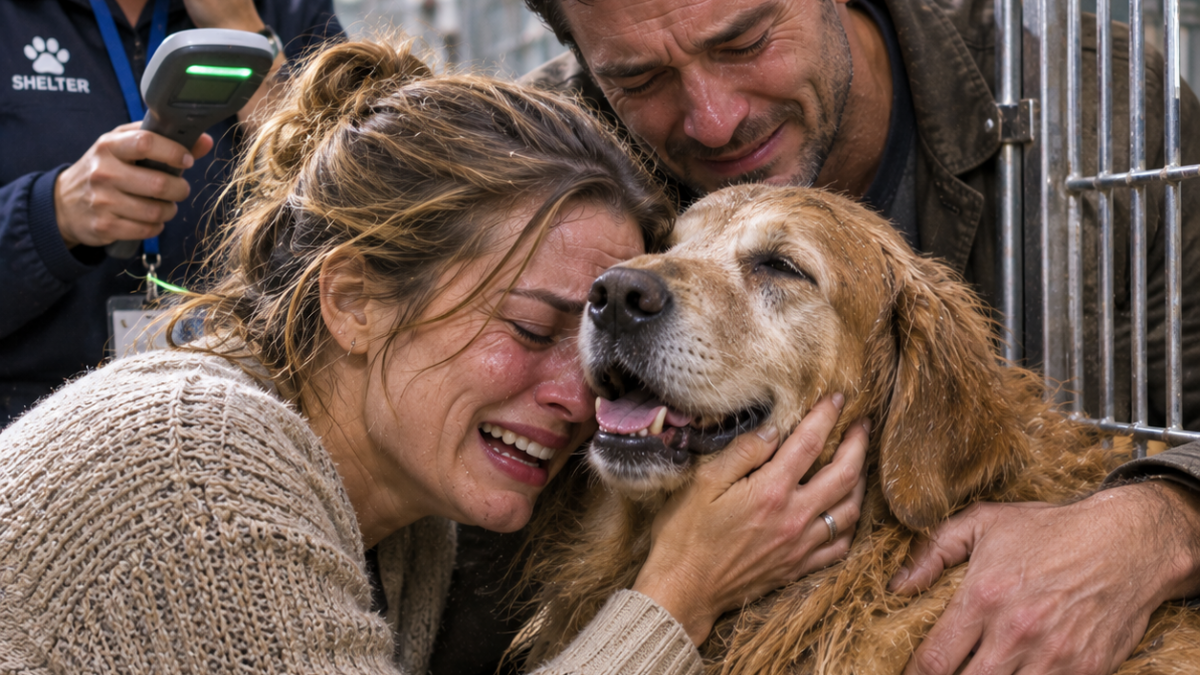
For Nearly Two Years, a Family Refused to Stop Looking for Their Missing Golden Retriever—Then One Morning, a Shelter Scanner Beeped
For almost two years, Claire and Thomas Harrison kept Bailey’s missing-dog report active long after strangers told them to accept that their golden retriever was probably never coming home, updating phone numbers, calling shelters across state lines, and keeping one photograph of him beside the front door as though hope itself needed a place to wait.
Then, during an ordinary morning intake at a shelter in Ohio, volunteer Jessica Hale passed a microchip scanner over a tired stray for the second time, heard one faint electronic beep, and watched a name appear on the screen that she remembered from a disappearance hundreds of miles away in Virginia.
Hours later, when Claire whispered “Bailey?” from the far end of the shelter hallway, the exhausted dog who had barely lifted his head since arriving suddenly broke into a desperate run—and everyone watching understood that two years of distance had not erased the sound of home.
My name is Jessica Hale.
I had volunteered at the Oak Ridge Animal Shelter long enough to stop believing every reunion story would have a happy ending.
That sounds cynical.
It wasn’t.
It was experience.
For every lost dog returned through a microchip, there were dozens without identification.
For every owner who answered on the first ring, there were disconnected numbers.
Old registrations.
Wrong addresses.
People who had moved.
People who never updated the chip.
And sometimes people who simply said:
“We don’t want him anymore.”
Those were the calls I hated most.
So after a few years, I learned to keep my expectations disciplined.
Scan.
Document.
Search databases.
Call.
Try again.
Move to the next animal.
You could care deeply without imagining miracles every morning.
At least that was what I told myself.
Then Bailey came in.
It was a Tuesday.
Cold rain overnight had left the parking lot shining beneath gray morning light.
A county road worker found him walking beside a drainage ditch about twelve miles outside town.
No collar.
No tags.
Mud dried along his belly.
Burrs tangled behind both ears.
He was too thin for a golden retriever.
Not skeletal.
But the kind of thin that tells you meals have been uncertain for a long time.
His paws were rough.
One pad split.
There was a small healing wound near his shoulder.
And exhaustion—
that was the first thing everyone noticed.
He didn’t behave like a dog excited to be rescued.
He behaved like a dog who had run out of energy for being afraid.
He walked into intake because we asked.
Stopped where we stopped.
Drank water slowly.
Then lay down on the concrete and put his head between his front paws.
One of the technicians said:
“Old guy?”
I crouched.
Looked at his teeth.
“Not that old.”
Maybe six.
Seven at most.
His muzzle looked older because of dirt and fatigue.
“Golden mix?”
“Could be purebred.”
He had that broad retriever head.
Feathering around the legs, though badly tangled.
Dark honey-colored coat.
A slight bend at the tip of his tail.
Something about him made me pause.
Not recognition.
Not yet.
Familiarity.
As though I had seen his face somewhere before.
I passed the microchip scanner over his shoulders.
Nothing.
Down the back.
Nothing.
Across the chest.
No signal.
Standard practice said scan again from a different angle.
Chips migrate.
Scanners miss.
Animals move.
I reset the device.
Slow pass.
Neck.
Shoulder.
Then—
beep.
I froze.
The number appeared.
I entered it into the registry.
The computer loaded.
And suddenly I was no longer looking at an anonymous stray from rural Ohio.
I was looking at a name I remembered.
BAILEY HARRISON.
My hand went cold on the mouse.
I read the registration twice.
Owner:
Claire Harrison.
Secondary contact:
Thomas Harrison.
Address:
Fernbrook, Virginia.
Status:
MISSING.
Date reported:
nearly two years earlier.
I whispered:
“Oh my God.”
Another volunteer approached.
“What?”
I pointed at the screen.
She leaned closer.
Then:
“No way.”
But I knew that report.
Everyone who had worked intake long enough knew some cases that refused to disappear.
Bailey was one of them.
PART2
FULL STORY CONTINUATION
The Harrison family had not simply filed one missing-dog report and moved on.
The record showed a history.
Updated phone number.
Updated temporary address.
Another contact number.
Notes sent to shelters.
Photographs.
A message asking any facility that scanned a golden retriever matching Bailey’s description to call at any hour.
They had kept the record alive.
Again.
Again.
Again.
Almost two years.
The original disappearance had happened during severe flooding near Fernbrook.
Several roads had gone underwater.
Homes evacuated.
Families placed temporarily in motels.
According to the notes, the Harrisons had been staying at an emergency motel with Bailey when a violent storm moved through.
A side gate in the temporary pet area had not latched properly.
Thunder.
Wind.
Confusion.
Somebody opened a door.
Bailey got out.
By the time Thomas reached the parking lot, he was gone.
The family searched until after midnight.
Then sunrise.
Then the following day.
They drove every road.
Called animal control.
Shelters.
Veterinary clinics.
Posted flyers.
Knocked on doors.
Search groups.
Social media.
Trail cameras.
Nothing.
Floodwater had disrupted everything.
Roads closed.
Animals displaced.
People leaving town.
Someone reported seeing a golden retriever nearly twenty miles away.
They searched there.
Another sighting in another county.
Nothing.
Weeks became months.
People slowly stopped helping.
But the Harrisons didn’t close the report.
That detail mattered to me.
Most people eventually remove listings.
Not always because they stop loving the animal.
Sometimes because leaving the report open hurts too much.
The Harrisons left Bailey’s open.
I stared at his file.
Then toward the kennel room.
The tired dog lay where we had left him.
Head down.
Eyes half closed.
Almost two years.
Virginia to Ohio.
No one knew how.
Yet.
Maybe we never would.
But the chip number did not lie.
I walked quickly toward our manager’s office.
“Karen.”
She looked up.
“What happened?”
“You need to call somebody.”
Karen looked at the registry.
Then at me.
“Confirmed?”
“Chip number matches.”
“Scan again.”
I had already done it.
We did it together anyway.
Beep.
Same number.
Karen exhaled.
“All right.”
She picked up the shelter phone.
The primary number rang once.
Twice.
A woman answered.
“Hello?”
Karen used the calm shelter voice.
“Is this Claire Harrison?”
“Yes.”
“My name is Karen. I’m calling from Oak Ridge Animal Shelter in Ohio.”
Pause.
“Okay.”
“We have a golden retriever here who came in this morning.”
Silence.
Karen looked at me.
“We scanned a microchip.”
No sound from the other end.
“The number is registered to a dog named Bailey.”
Still silence.
Then breathing.
Sharp.
Broken.
Karen continued carefully.
“We believe we may have found your dog.”
The first sob was small.
Almost swallowed.
Then another.
Claire tried speaking.
Nothing came.
Karen gave her time.
Finally:
“Are you sure?”
“We need to verify identifying details with you.”
“Oh God.”
The crying became deeper.
Not screaming.
The kind that comes from somewhere lower than speech.
A sound built over hundreds of nights.
Karen asked:
“Can you tell me something about Bailey that wouldn’t necessarily appear in a public missing poster?”
Claire answered immediately.
“He has a scar above his left eye.”
I looked toward the kennel.
Yes.
Faint.
Almost hidden under fur.
“Anything else?”
“A small patch of white under his chest.”
Yes.
“His tail.”
Claire cried harder.
“The very end curves slightly to the right.”
I had noticed that too.
No doubt remained.
Karen looked at me.
I nodded.
She mouthed:
It’s him.
Then from the phone we heard Claire shout into another room.
“Thomas!”
Her voice cracked.
“Thomas!”
Footsteps.
A man’s voice:
“What?”
“Come here.”
“What happened?”
Then words I will never forget.
“They found him.”
Silence.
“Who?”
Claire sobbed.
“Bailey.”
The man said nothing.
Then the phone picked up the sound of someone else crying.
Claire returned to the line.
“Where are you?”
Karen repeated the address.
“Ohio?”
“Yes.”
“How far?”
“From Fernbrook, several hours.”
“We’re coming.”
“Mrs. Harrison—”
“We’re coming now.”
“We should talk about Bailey’s condition first.”
That slowed her.
“What condition?”
“He’s stable.”
I was glad Karen began there.
“He’s tired, underweight, and has some minor injuries we’re evaluating.”
“Can he walk?”
“Yes.”
“Is he in pain?”
“We’re assessing him.”
“Is he afraid?”
Karen looked at me.
I answered quietly enough for her to repeat.
“He mostly seems exhausted.”
Claire inhaled.
Then:
“Please don’t let him think nobody’s coming.”
That sentence landed hard.
Karen said:
“We won’t.”
I should have gone home at one.
My volunteer shift ended then.
I stayed.
At two, Bailey was still resting.
We had bathed only the worst dirt from him because we didn’t want to overwhelm him.
Veterinary staff checked his paws.
No major infection.
Mild dehydration.
Weight loss.
A few older scars.
No immediately life-threatening condition.
Whatever had happened during those nearly two years, Bailey had somehow survived.
That fascinated everyone.
Where had he slept?
Who fed him?
Had someone taken him in temporarily?
Had he traveled gradually?
Was he moved by a person?
Escaped again?
No answers.
Dogs cannot explain distance.
Sometimes their bodies tell pieces.
Not the route.
Bailey ate a small meal.
Slowly.
Then drank.
Afterward he rested.
I opened his kennel and sat beside him.
Not too close at first.
He looked at me.
I held out my hand.
He sniffed.
Then lowered his head.
I scratched behind one ear.
His eyes closed.
“Your people are coming.”
His ear moved.
“Do you remember them?”
No response.
“Stupid question.”
I kept scratching.
“They remember you.”
That much I knew.
After a while, Bailey shifted.
Then, without ceremony, placed his head across my thighs.
Heavy.
Warm.
I stopped moving.
There is a particular kind of trust that arrives when an exhausted animal decides your body is safe enough to sleep against.
Bailey exhaled.
Long.
His whole face softened.
Later, someone asked what he looked like in that moment.
I said:
“Tired.”
Not happy.
Not hopeful.
Not miraculous.
Just tired.
Like a dog who had spent nearly two years solving tomorrow every single day.
Food.
Water.
Weather.
Roads.
Strangers.
And finally, for one afternoon, he did not need to solve anything.
So he slept.
Meanwhile, Claire and Thomas were driving.
They later told me the first hour passed almost without conversation.
Claire kept saying:
“It’s him.”
Then:
“What if he doesn’t remember us?”
Thomas answered:
“He will.”
“How do you know?”
“I don’t.”
Then silence.
Their car still contained an old leash.
Not Bailey’s original.
A replacement they had bought during the first month he was missing because Claire said they would need one when they found him.
Two years later, that leash was still in the trunk.
Hope can look irrational from the outside.
Inside, it is often simply a refusal to close one door before you have proof you must.
Their daughter, Emma, was away at college.
Bailey had been her dog as much as anyone’s.
She was seventeen when he disappeared.
Nineteen now.
Claire called her from the road.
Emma did not answer the first time.
Class.
Second call.
She picked up.
“Mom?”
Claire couldn’t say the sentence.
Thomas took the phone.
“Em.”
“What?”
“They found Bailey.”
Silence.
Then:
“No.”
“Yes.”
“No, Dad.”
“His chip.”
Emma started crying.
“Where?”
“Ohio.”
“I’m coming.”
“You’re six hours in the other direction.”
“I don’t care.”
“Stay where you are.”
“Dad.”
“We’ll video call.”
She argued.
Of course.
Eventually agreed only because her father promised she would see Bailey the second they reached him.
That family had spent nearly two years learning not to trust good news until they could touch it.
I understood.
At the shelter, word spread.
Staff who had never seen the original missing report heard the story.
People found excuses to walk past Bailey’s kennel.
One technician whispered:
“Two years?”
“Yes.”
“That’s insane.”
I corrected her gently.
“Nearly.”
As if the missing few weeks mattered.
Maybe to the Harrisons they did.
When every day had been counted, details mattered.
The sun had started shifting west when someone at reception called:
“They’re here.”
I stood.
Bailey lifted his head.
Nothing else.
The blue car entered the lot.
It stopped crookedly across two spaces.
The passenger door opened before the engine shut off.
Claire stepped out.
Mid-fifties.
Brown coat.
No purse.
No phone in her hand.
Just moving.
Thomas came from the driver’s side.
He shut the door and stood still for half a second.
Neither ran.
That surprised me.
Later I understood.
Running required certainty.
They had lived too long with disappointment.
They approached like people walking toward something fragile enough to disappear if they moved too fast.
Karen met them at the entrance.
Paperwork could wait.
Verification already complete.
She said:
“Before you go in, I want you to know he’s tired.”
Claire nodded rapidly.
“Okay.”
“He may react differently than you expect.”
“I know.”
“Let him choose the pace.”
“I will.”
Thomas had not spoken.
His hands shook.
Karen opened the inner door.
Several staff members gathered quietly along the hall.
Nobody wanted to miss the moment.
I stayed near the far end.
Not because I wanted a better view.
Because Bailey’s family deserved the space.
His kennel door was opened.
Bailey walked into the hallway.
Slow.
Head low.
He looked toward us.
Then toward the entrance.
Claire stepped forward.
One step.
She whispered:
“Bailey?”
The dog froze.
Every muscle.
Head lifted.
Ears forward.
No tail movement yet.
Claire covered her mouth.
“Bailey.”
Again.
Something changed.
Recognition is difficult to describe because it happens faster than language.
One second, Bailey was a tired stray in an unfamiliar building.
The next, he was somebody’s dog.
His tail moved.
Once.
Then violently.
His entire body came alive.
He started forward.
Walk.
Trot.
Then run.
Staff moved aside.
Claire dropped to her knees.
Bailey reached her so hard he nearly knocked her backward.
A sound came out of him I had never heard during intake.
Not barking.
Not whining.
Something between crying and howling.
High.
Broken.
Wild.
Claire wrapped both arms around him.
“Baby.”
She sobbed.
“Oh my God, Bailey.”
He licked her face.
Her hair.
Her chin.
Then Thomas dropped beside them.
He buried his face against Bailey’s neck.
No attempt to remain composed.
None.
“Hey, buddy.”
Bailey turned.
Licked him.
Then Claire again.
Then Thomas.
As if confirming both.
Here.
Here.
Still here.
His whole body trembled.
Tail hitting the floor.
Feet sliding.
Noise echoing down the hallway.
Somebody behind me started crying.
Then another.
One staff member turned toward the wall.
Karen covered her mouth.
I had worked in shelters long enough to see happy reunions.
This was different.
Maybe because everyone knew how long the waiting had been.
Two years is enough time for hope to become embarrassing.
Enough time for friends to stop asking.
Enough time for relatives to say:
“Maybe you need closure.”
Enough time to wonder whether continuing to search is kindness or self-punishment.
Yet there they were.
Claire.
Thomas.
Bailey.
No closure.
Reunion.
Bailey refused to move away from them.
We brought water.
He ignored it.
Food.
Nothing.
He pressed against Claire.
Then leaned into Thomas.
Back to Claire.
Whenever one shifted, Bailey moved too.
His body seemed afraid distance might become permanent again.
Claire whispered:
“You’re okay.”
Again.
“We’re not leaving.”
Bailey’s eyes closed for half a second.
Then opened.
Watching.
Thomas ran his hand along Bailey’s back.
“You got skinny.”
He laughed through tears.
“You look terrible.”
Claire laughed too.
“Thomas.”
“What?”
“He does.”
She kissed Bailey’s head.
“We’ll fix it.”
That sounded like family.
Not:
Poor thing.
Not:
What happened to you?
We’ll fix it.
Future tense.
They called Emma on video.
Claire held the phone.
“Look.”
The screen showed a young woman already crying.
“Bailey?”
The dog heard her voice.
His head snapped toward the phone.
Emma made a sound somewhere between laughing and sobbing.
“He knows me.”
Bailey stepped closer.
Sniffed the speaker.
Then licked the screen.
Everyone laughed.
Emma cried harder.
“That’s disgusting.”
Thomas said:
“You asked for it.”
“Bring him home.”
“We are.”
“Tonight.”
“Yes.”
“Promise?”
Claire looked at Bailey.
“Yes.”
This time the family could make that promise.
The shelter’s paperwork was technically reclamation paperwork, not adoption.
Bailey had an owner.
Had always had owners.
Those signatures felt important anyway.
Thomas signed first.
His hand shook so badly the first signature looked like someone else’s name.
Claire signed below.
Bailey leaned against her leg through the entire process.
We provided copies of veterinary findings.
Food recommendations.
Follow-up instructions.
Contact information.
Everything practical.
Because miracles still need medication schedules.
Then Claire looked down the hallway.
Found me.
I had been trying very hard to remain invisible.
She stood.
Bailey immediately rose with her.
She walked toward me.
I said:
“Hi.”
Brilliant.
Claire opened her mouth.
No words.
Then she hugged me.
Hard.
I froze for half a second.
Then hugged back.
She pulled away.
“Thank you.”
I shook my head.
“The road crew brought him in.”
“They told me you scanned him.”
“That’s standard.”
“Twice.”
I smiled weakly.
“Also standard.”
Claire looked at me.
Her eyes were swollen.
“It wasn’t standard for us.”
That stopped me.
Thomas joined.
He shook my hand.
Then used both hands around mine.
“You don’t understand.”
Maybe I didn’t.
“We called so many places.”
His voice broke.
“So many people.”
Claire whispered:
“After a while, they stopped remembering his name.”
She touched Bailey.
“You didn’t.”
I swallowed.
“I remembered the case.”
“That was enough.”
I couldn’t answer.
So I nodded.
Then stepped away because I was about to lose whatever composure I had left.
Before they left, I asked one question.
“Do you know how he could have gotten here?”
Thomas shook his head.
“No idea.”
“Anyone contact you over the years?”
“A few possible sightings.”
Claire sighed.
“None confirmed.”
One was in West Virginia.
Another Pennsylvania.
One report near Kentucky.
Impossible to know whether any had actually been Bailey.
Maybe he traveled gradually northwest.
Maybe someone found him, kept him, then he became loose again.
Maybe rides.
Maybe roads.
We would never reconstruct two years from scars and mud.
I realized we did not need to.
Bailey’s journey mattered.
But the destination mattered more.
They brought him to the car.
Bailey stopped at the open rear door.
Claire climbed in first.
Sat.
Patted the seat.
“Come on.”
Bailey put one paw up.
Then another.
Thomas helped gently.
Once inside, Bailey immediately lay across Claire’s lap.
Huge golden head.
Same way he had rested on mine hours earlier.
Except now there was something different.
Not merely exhaustion.
Recognition.
Claire stroked behind his ears.
Thomas stood outside.
He looked toward the shelter.
Then up at the sky.
Exhaled.
“I forgot what it felt like to breathe normally.”
I heard him.
Didn’t say anything.
They drove east.
Ohio disappearing behind them.
Claire sat in the back.
Bailey’s head on her thighs.
Thomas drove.
For the first thirty minutes, Claire kept touching him.
His ear.
Face.
Shoulder.
As if he might vanish if her hand stopped making contact.
Bailey stayed awake.
Then finally his breathing deepened.
Eyes closed.
Whole body loosened.
Claire later said that was the moment the reunion felt real.
Not the running.
Not the crying.
The sleep.
Because Bailey had always been a deep sleeper at home.
Back before everything.
He would collapse in the hallway and snore.
After they found him, she had expected some grand sign.
Instead, her dog fell asleep on her lap.
And she realized:
He trusts this again.
The drive to Virginia took much longer than normal.
They stopped frequently.
Water.
Short walks.
Bailey tired easily.
At one rest area, he refused to get back into the car until Claire climbed in first.
So she did.
Every time.
No one rushed him.
Two years of unknown experiences earned patience.
Emma drove home from college overnight.
She arrived before them.
At 2:14 in the morning, the Harrison driveway lights turned on.
Thomas parked.
Emma was already outside in pajamas and a winter coat.
Claire opened the rear door.
Bailey lifted his head.
Emma whispered:
“Hey.”
He stared.
Then jumped down faster than anyone expected.
His legs nearly gave way.
Thomas reached for him.
Bailey recovered.
Ran three steps.
Emma dropped.
He reached her.
Another explosion of sound.
Whining.
Crying.
Tail.
Licking.
Emma buried her face into his neck.
“I’m sorry.”
She kept saying it.
“I’m sorry.”
Claire finally knelt beside her.
“For what?”
“I wasn’t there.”
“You were seventeen.”
“I stopped putting flyers up.”
“You searched for a year.”
“I stopped.”
Claire touched her daughter’s hair.
“Emma.”
Bailey licked Emma’s cheek.
Claire smiled through tears.
“I think he forgives you.”
Emma laughed.
“I don’t.”
Thomas said:
“Then learn from the dog.”
That became a family line.
The house had changed in Bailey’s absence.
New sofa.
Different rug.
Emma’s room partly converted after college.
But his old bed remained in the basement.
Claire had packed it away after the first year.
Could not throw it out.
Thomas carried it upstairs.
Set it in the living room.
Bailey sniffed.
Then walked past.
Everyone laughed.
Two years of longing.
Dog ignored the sentimental relic.
He slept beside Claire’s side of the bed instead.
Of course.
The first few weeks home were not magically easy.
Bailey startled at storms.
That made sense considering the night he disappeared.
Thunder caused him to pace.
Gates made him nervous.
If someone opened an exterior door, Bailey rushed toward Claire rather than outside.
He did not like being alone.
At all.
The first time Thomas and Claire both stepped outside for five minutes, Bailey scratched the inside door.
So they changed things.
Slow separation training.
Veterinary follow-up.
Behavior consultant.
Predictable routine.
No forcing.
They wanted love to fix everything immediately.
Love helped.
Time did the rest.
Bailey gained weight.
Slowly.
His coat improved.
The split paw healed.
He slept more.
Then played.
The first toy he picked up was an old tennis ball Thomas found beneath a cabinet.
No one knew how it had survived two years.
Bailey sniffed it.
Picked it up.
Thomas sat on the floor.
“Remember?”
He tossed it gently.
Bailey stared at him.
No fetch.
Claire laughed.
“Two years made him smarter.”
Maybe.
One month after the reunion, Claire sent the shelter a photograph.
Bailey asleep on the sofa.
On his back.
Four paws in the air.
Caption:
I think he finally believes he isn’t going anywhere.
We printed it.
Pinned it in the staff room.
Not because shelters need inspiration posters.
Because some cases deserve visible endings.
The microchip scanner became almost sacred for a week.
New volunteers joked about it.
“Magic wand.”
I corrected them.
“Equipment.”
Magic would have found Bailey two years earlier.
A microchip is practical.
Simple technology.
Useful only if implanted.
Registered.
Updated.
Scanned.
And rescanned when needed.
Claire later told me that maintaining Bailey’s registration had felt pointless some days.
Every time they moved temporary addresses, she updated it.
Changed numbers.
Added Emma.
Added Thomas.
She almost stopped once.
A friend asked:
“Why keep doing that?”
Claire answered:
“Because what if?”
That “what if” eventually rang in an Ohio shelter.
I thought about that often.
Hope is not always emotional.
Sometimes hope is administrative.
Keeping a phone number current.
Leaving a missing report active.
Calling one more shelter.
Scanning an animal twice.
Small boring actions.
Nothing cinematic.
Until the day they matter.
The Harrisons visited Oak Ridge the following spring.
Bailey came too.
Healthy.
Heavy.
Golden coat shining.
I barely recognized him.
He recognized the building.
At least his behavior changed when they entered.
He stayed close to Claire.
No panic.
But watchful.
Then he saw me.
I crouched.
“Hey, stranger.”
Bailey approached.
Sniffed me.
Tail wag.
Then he put his head in my lap.
Just like the intake day.
Claire cried instantly.
“Seriously?”
I laughed.
“He remembers everybody.”
Thomas said:
“Traitor.”
Bailey moved to him afterward.
Fair.
They brought a framed photograph for the shelter.
Bailey between Claire and Thomas in front of their house.
Emma crouched beside him.
Underneath, a small note:
Thank you for checking twice.
Karen put it near the scanner station.
I protested.
“This is emotional blackmail for volunteers.”
“Correct.”
She left it.
The story spread locally.
Then farther.
A missing golden retriever found almost two years later.
Microchip reunion.
People wanted to know what Bailey had done in between.
I understood curiosity.
We all wanted answers.
But the story was not made more meaningful by inventing them.
No one knew.
Maybe kind strangers fed him.
Maybe shelters missed him.
Maybe he moved with someone for months.
Maybe he survived outdoors.
Probably some combination.
His body proved hardship.
His health proved he had also found food somewhere.
That ambiguity bothered people.
They wanted a full adventure.
Life often gives only beginning and ending.
The middle belongs to silence.
Claire once said:
“I used to imagine terrible things.”
Every night Bailey was gone.
Roads.
Cold.
Hunger.
Injury.
Then she imagined kind things to survive the terrible ones.
A farmer feeding him.
A child putting food outside.
Someone letting him sleep in a barn.
Maybe some of those happened.
She never learned.
After Bailey came home, she decided she no longer needed the route.
“I have the part that matters.”
She put her hand on his head.
“He came back.”
Thomas handled grief differently during the missing years.
Claire searched outward.
Thomas searched inward.
He replayed the motel gate.
Why didn’t I check the latch?
Why didn’t I use two leashes?
Why didn’t I bring Bailey inside sooner?
He blamed himself.
For nearly two years.
Even after everyone explained the storm.
Evacuation.
Confusion.
The faulty gate.
Accidents happen.
He still thought:
I was responsible.
When Bailey came home, Thomas cried against his neck and whispered:
“I’m sorry.”
Again and again.
Bailey licked his face.
No judgment.
No need to resolve responsibility.
Dogs sometimes offer mercy because they are not interested in the courtroom we build inside ourselves.
Thomas slowly learned to accept that.
Emma carried different guilt.
She had stopped searching publicly after about fourteen months.
Not loving.
Searching.
She stopped posting.
Stopped calling shelters every week.
College began.
Life moved.
She felt ashamed that life had moved.
The reunion made that guilt surface.
Claire told her:
“Hope does not require you to suffer every day.”
Emma disagreed.
For months.
Eventually Bailey helped without meaning to.
He did not treat her like someone who had quit.
He slept outside her room when she visited.
Stole her socks.
Waited near the window when her car arrived.
Dogs do not demand ceremonial consistency.
They respond to presence.
Emma forgave herself slowly.
Bailey developed one strange habit after returning.
Whenever the family packed suitcases, he sat directly in front of the door.
No barking.
Just blocked it.
At first, Claire laughed.
Then cried.
Travel had become connected to disappearance.
So they retrained the meaning.
Suitcase out.
Treats.
Walk.
Suitcase stays.
Door opens.
Door closes.
People return.
Eventually Bailey stopped blocking.
Mostly.
Sometimes he still did.
Old memories do not always need full erasure.
Accommodation is not failure.
Storms were harder.
The first major thunderstorm after Bailey’s return hit Fernbrook in summer.
Lightning.
Heavy rain.
Bailey began panting.
Pacing.
Claire found him trying to push behind the bathroom door.
She sat on the floor.
Not dragging him out.
Just there.
Thomas brought blankets.
Emma called on video.
Bailey eventually lay against Claire.
Thunder continued.
He shook.
But stayed.
The storm passed.
No gate.
No loss.
Next storm easier.
Not easy.
Easier.
Healing often works in comparative adjectives.
The shelter changed too.
Bailey became the reason our team strengthened microchip protocol.
Not because we had been careless before.
Because his case proved how much repetition matters.
Every stray scanned on arrival.
Again after settling if initial scan negative.
Different scanner when appropriate.
Full-body sweep.
Check foreign registries if necessary.
Verify old contact information.
Document everything.
One tiny chip.
One family.
Two years.
No one wanted to be the person who missed the beep.
Months later, a different dog arrived.
Small terrier.
No chip found first pass.
A new volunteer said:
“Probably none.”
I smiled.
“Again.”
Second scan.
Beep.
Owner found that afternoon.
Missing three weeks.
The volunteer stared at me.
“Bailey rule?”
“Bailey rule.”
It stuck.
Claire eventually spoke at a community pet preparedness event.
Flood evacuation.
Microchipping.
Updated registration.
Photographs.
Copies of vaccination records.
Secure carriers.
Backup leashes.
She never framed herself as an expert.
She framed herself as someone who learned painfully.
“Disasters are confusing.”
She told the audience.
“You think you’ll remember everything.”
“You won’t.”
“Prepare when you’re calm.”
Then she held up Bailey’s tag.
“If you microchip your pet, update it.”
She paused.
“Even when you think it no longer matters.”
People listened.
Thomas rarely spoke publicly.
When he did, he said one thing:
“Never let embarrassment stop you from continuing a search.”
People had made him feel foolish.
Two months.
Six months.
A year.
“Still looking?”
That tone.
Not malicious.
Tired.
As if grief has an expiration date polite people should respect.
He kept going.
Then Bailey came home.
Thomas did not use that outcome to judge families whose pets never return.
He knew how lucky they were.
He only said:
“If continuing helps you, continue.”
Good advice.
Bailey turned eight.
Approximate, based on original records.
The family threw a birthday party.
Ridiculous.
Golden retriever in a paper bow tie.
Dog-safe cake.
Emma home.
Claire sent me a photo.
I replied:
He looks offended.
She wrote:
He ate the entire cake.
Fair.
At nine, Bailey developed arthritis.
Normal.
The unknown years had probably been hard on his joints.
Supplements.
Medication.
Shorter walks.
He remained happy.
At ten, he went gray around the face.
Claire hated it.
Thomas said:
“He already looked gray when they found him.”
“Dust.”
“Still.”
Not helpful.
Every year on the date of Bailey’s return, Claire drove him somewhere quiet.
Not the shelter.
Not a dramatic ritual.
A park.
A lake.
A trail.
Then home.
She called it:
“Gotcha Back Day.”
Emma thought the name was terrible.
It remained.
Families need stupid names for serious gratitude.
One year, they came back to Ohio.
Not because Bailey needed to.
Because Claire wanted to see the road where he was found.
We met the county worker who had spotted him near the drainage ditch.
His name was Harold.
He was embarrassed by the attention.
“I just picked up a dog.”
Claire hugged him.
He went completely rigid.
Then hugged back.
“You didn’t just pick him up.”
Harold shrugged.
“He looked lost.”
That sentence stayed with me.
Lost dogs often look ordinary.
Dirty.
Tired.
Walking.
The miracle depends on someone deciding ordinary still matters.
Harold stopped.
We scanned.
Claire answered.
Chain of small decisions.
Home.
Harold showed us the place.
Shoulder beside a county road.
Nothing special.
No clue how Bailey arrived there.
Bailey sniffed grass.
Then looked toward Claire.
She held his leash.
“You ready?”
He walked back to the car.
No nostalgia.
Dogs are efficient.
The Harrisons never discovered who cared for Bailey along the way.
But one interesting detail appeared months after the reunion.
A woman in western Pennsylvania saw the news article.
She contacted Claire.
Said she had fed a stray golden retriever behind her grocery store about a year earlier.
Photograph blurry.
Could be Bailey.
Scar not visible.
Tail impossible to confirm.
Claire studied it.
Thomas too.
Maybe.
They thanked her anyway.
Because whether it was Bailey or not, some lost dog had eaten because she noticed.
That was enough.
Other possible sightings came later after publicity.
Most impossible to verify.
The family eventually stopped investigating.
Claire said:
“I don’t want his life to become a detective case.”
Bailey was home.
That was his present.
The unknown past could remain unknown.
I loved that decision.
Shelter work teaches you that some animals arrive with histories we cannot access.
No records.
No explanations.
Sometimes people become so focused on guessing trauma that they accidentally trap the animal inside a story that may not even be accurate.
Bailey needed care for what he showed now.
Fatigue.
Fear of storms.
Separation anxiety.
Physical recovery.
We did not need to invent villains or adventures.
He was enough without mythology.
Years later, Emma married.
Bailey attended the outdoor ceremony.
Old.
Gray.
Walking slowly.
He wore a small blue bow tie.
When Emma walked down the aisle, Bailey stood beside Thomas.
Tail moving.
Claire later told me that moment nearly destroyed everyone emotionally.
Because Emma had once believed Bailey would never come home to see her graduate college.
He had.
Then he lived long enough to see her married.
Extra time carries weight when you once thought you had none.
During the reception, Bailey stole part of a dinner roll.
Perfect.
No heroic symbolism.
Just old dog behavior.
Emma laughed.
“Two years on the road and you learned nothing.”
Bailey ate it.
No remorse.
The family eventually moved from the house where Bailey originally grew up.
That transition worried Claire.
Would moving again confuse him?
They prepared.
Took Bailey to the new house repeatedly before moving.
Fed him there.
Walked the yard.
Brought his bed.
Same blankets.
On moving day, Bailey entered.
Sniffed every room.
Then lay in the kitchen.
Done.
Home had stopped being an address.
It was people.
That was comforting for all of them.
I visited once.
Years after the reunion.
Bailey approached slowly.
Age.
He sniffed.
Then tail wag.
Head against my knee.
Claire smiled.
“He still remembers.”
Maybe.
Scent memory in dogs can be remarkable.
Maybe he remembered the shelter.
My voice.
Maybe I simply smelled familiar enough.
I scratched behind his ear.
“Still tired?”
Claire laughed.
“He’s been tired for years.”
Bailey leaned harder.
Good.
At dinner, Thomas asked me something.
“Did you really recognize his file before the computer loaded?”
“No.”
He looked surprised.
“I thought you remembered him.”
“I remembered the case when I saw the name.”
“Oh.”
“Why?”
He smiled.
“The story Claire tells makes it sound like you knew immediately.”
I laughed.
“Never trust family mythology.”
Claire shouted from kitchen:
“I heard that.”
Good.
Then I told them something I had never said.
“When the scanner beeped, I almost assumed it was just a routine registration.”
Claire looked at me.
“What made you react?”
“The missing status.”
Then the date.
Two years.
Then Fernbrook.
I remembered because of how often their updates appeared.
“You kept the file alive.”
I looked at them.
“You were part of the reunion long before Bailey reached Ohio.”
Claire’s eyes filled.
Thomas looked down.
That mattered to them.
Because during those years, searching had felt useless.
It wasn’t.
The information waited until Bailey reached someone who could connect it.
Bailey’s final years were soft.
That is what Claire says.
Soft.
Beds everywhere.
Short walks.
Sun patches.
Thomas cooking chicken.
Emma visiting.
Grandchildren eventually.
Bailey tolerated toddlers with the patience of an old golden retriever who had already seen enough chaos.
He learned to position himself beneath high chairs.
Strategic wisdom.
He died at almost thirteen.
At home.
No emergency.
His body simply reached the point where comfort could no longer be maintained well enough.
The veterinarian came.
Claire called me the day before.
I had not spoken to her in months.
When I saw her name, I knew.
“Jessica.”
“Hi.”
Long silence.
“It’s time.”
I sat down.
“How is he?”
“Tired.”
The same word.
The first day at Oak Ridge.
The last day at home.
Tired.
Claire cried.
“I don’t know how to do this after getting him back.”
There was nothing intelligent to say.
So:
“You gave him years.”
“I know.”
“That doesn’t make this easier.”
“No.”
“You don’t have to make it easier.”
She breathed.
Then:
“I keep thinking about that hallway.”
“I do too.”
“He ran.”
“Yes.”
“I can still hear him.”
“So can I.”
Bailey spent his last morning between Claire and Thomas.
Emma arrived.
Grandchildren came earlier to say goodbye, then left with their father.
Quiet house.
No storm.
No gates.
No roads.
Claire sat on the floor.
Bailey’s head in her lap.
Thomas’s hand on his back.
Emma near his paws.
The veterinarian administered sedation.
Bailey relaxed.
Claire whispered:
“You found us.”
Technically, they had found him.
But I understood what she meant.
Bailey exhaled.
Then rested.
For good.
Afterward, Claire sent me one message.
He left from home this time.
I cried at my kitchen table.
Because that sentence contained the entire story.
First disappearance:
Storm.
Gate.
Chaos.
No goodbye.
Two years uncertainty.
Final departure:
Home.
Hands on fur.
Names spoken.
No searching afterward.
They knew where he was.
They knew he had been loved.
There is mercy in certainty, even when certainty hurts.
The family kept his collar.
Microchip tag.
A photograph from the reunion.
Not the dramatic hallway photo.
Someone had taken one afterward.
Bailey lying across Claire’s lap in the car.
Eyes closed.
Thomas visible in the mirror.
That’s the one they framed.
Sleep.
Safety.
Homeward.
At Oak Ridge, we learned Bailey had died because Claire called personally.
Karen had retired.
Several original volunteers gone.
New staff knew the Bailey story through the photograph by the scanner.
Thank you for checking twice.
We added a small note beneath it.
Not:
RIP HERO DOG.
Nothing dramatic.
Just:
Bailey made it home and had many good years.
That was the ending shelter workers needed.
The photograph still teaches volunteers.
Not because every microchip scan leads to a two-year reunion.
Most don’t.
Because routine matters precisely when you cannot know which routine action will matter enormously to someone else.
A scanner pass.
A database search.
One phone call.
These tasks feel small.
Bailey taught us that small does not mean unimportant.
I later became intake coordinator.
No longer just volunteer.
Partly because of Bailey.
Not because one emotional day magically changed my career.
But the case reminded me why systems matter.
Good rescue work is compassion organized into repeatable habits.
Scan every animal.
Verify.
Document.
Call again.
Update.
Follow through.
Emotion makes people care.
Procedure gets dogs home.
I trained dozens of volunteers.
Every time someone rushed the scan, I said:
“Slow.”
If they passed only once:
“Again.”
Eventually somebody always asked:
“Is this because of Bailey?”
“Yes.”
Then:
“Who is Bailey?”
I pointed to the photograph.
Story passed forward.
One volunteer cried the first time she heard it.
Another said:
“That could never happen now with social media.”
I disagreed.
Animals still disappear.
Storms.
Accidents.
Open gates.
Cars.
Moves.
Human mistakes.
Technology helps.
Does not remove chaos.
What changes outcomes is preparation plus persistence plus luck.
Bailey had all three.
Eventually.
Claire and Thomas continued supporting search groups after Bailey’s death.
Not financially in some enormous foundation way.
Practical.
Printing lost-pet flyers.
Loaning humane traps.
Sharing missing notices.
Helping older people update microchip registrations.
Claire said:
“I spent two years wishing strangers would care about one dog they didn’t know.”
“So now I can care about theirs.”
That made sense.
Emma became obsessive about identification on her own dogs.
Collar tags.
Microchips.
Backup contacts.
Photographs from every angle.
Thomas joked:
“If her dog sneezes, three databases get updated.”
Maybe.
Trauma changes preparation.
Not always badly.
Years after Bailey died, Claire received a call from a woman whose dog had been missing seven months.
“Should I stop?”
Claire did not tell her to keep searching forever.
That would be cruel.
She said:
“You get to decide what hope costs you.”
Then:
“If leaving the report open costs nothing, leave it open.”
The woman did.
Her dog was found three months later.
Not every story repeats.
That one did.
Claire called me afterward.
“Guess what?”
I laughed.
“Another Bailey?”
“No.”
“Good.”
Every dog should have its own name.
I sometimes wonder what Bailey experienced during those two years.
Less than I used to.
Age reduces appetite for unanswered questions.
Maybe he slept under porches.
Maybe followed railroad lines.
Maybe someone called him a different name.
Maybe he was loved temporarily and lost again.
Maybe he spent long stretches alone.
We cannot know.
His scars told hardship.
His willingness to trust told that not every human encounter had been terrible.
That’s enough.
If I imagine anything, I imagine ordinary kindnesses.
A gas station employee leaving water.
Someone throwing him part of a sandwich.
A farmer allowing him in a shed.
A child calling to him from a porch.
Not because I know those happened.
Because survival for two years probably required more than Bailey alone.
Most long journeys are held together by small kindnesses nobody records.
Maybe his was too.
But the one kindness we can prove came from his family before he ever disappeared.
They microchipped him.
Then kept the information updated.
Simple.
Responsible.
Boring.
Two years later, the chip still carried home inside it.
That thought still moves me.
A tiny capsule under skin.
No battery.
No GPS.
Just an identification number.
Waiting.
Bailey traveled hundreds of miles.
The chip waited too.
When finally asked:
Who is this dog?
It answered.
The morning he arrived, Bailey looked anonymous.
That is worth remembering.
No collar.
No tag.
Dirty coat.
Tired eyes.
If you judged only appearance:
Stray.
But identity remained invisible beneath the skin.
Family.
Name.
History.
People praying.
That is why scanning matters.
That is why assumptions are dangerous.
Every unidentified animal may still belong to a story already in progress.
Claire once told me the hardest part of Bailey being missing was strangers gradually talking about him in past tense.
“You loved him so much.”
Not:
Love.
Loved.
“It made me furious.”
She said.
“I would correct them.”
“He’s my dog.”
Present tense.
Even after two years.
Then one day the shelter called and present tense was true in a way she could touch again.
Words matter.
Thomas handled the reunion photograph differently.
For months, he could not look at images from the shelter without crying.
Then he put one on his desk.
Not to remember Bailey.
Bailey was downstairs every day.
To remember that certainty can change quickly.
He had spent two years sure the story ended badly.
He was wrong.
After that, whenever life presented uncertainty, he tried to leave a little room for outcomes he couldn’t see.
Not blind optimism.
Room.
Bailey gave him that.
The family still grieved when Bailey died.
Deeply.
The reunion did not make loss easier.
It made loss fuller.
They had been given extra years they once thought impossible.
Gratitude and grief arrived together.
That is often the price of getting something back.
You know exactly what it meant to lose it once.
So every ordinary day becomes more precious.
And the final goodbye hurts with both endings inside it.
Claire said something at Bailey’s memorial gathering that I remember.
Small group.
Family.
No public event.
She said:
“When Bailey disappeared, I thought the miracle would be finding him.”
Then looked at Thomas.
Emma.
Photographs.
“The miracle was what came after we found him.”
Years.
Meals.
Walks.
Storms survived.
Wedding.
Grandchildren.
Gray muzzle.
Old age.
Time.
She was right.
Reunion was one day.
Life was the gift.
That changed how I thought about shelter work.
We celebrate the adoption photograph.
The reclamation.
The car ride home.
But that’s only a doorway.
The real success is months later when nobody posts anything because the dog is simply sleeping on the couch.
Ordinary enough to disappear from public attention.
That’s the goal.
Not permanent inspiration.
Home.
Bailey achieved that beautifully.
For most of his remaining years, no strangers knew what he was doing.
Good.
He did not owe us updates.
He owed nobody symbolism.
He lived.
I still remember the sound of the scanner.
Tiny.
Electronic.
Almost boring.
Beep.
That was it.
No siren.
No music.
No dramatic announcement.
A sound shelter workers hear every day.
But for Claire and Thomas Harrison, that sound crossed almost two years of grief.
For Emma, it reopened a future she had stopped imagining.
For Bailey, it turned an Ohio kennel from a temporary stop into the last place he would ever have to wait for home.
That is why I never dismiss routine sounds anymore.
Sometimes answers arrive quietly.
The day Bailey left Oak Ridge, Claire sat in the back seat.
His head across her lap.
She stroked his ears.
Thomas drove.
The car disappeared from our parking lot.
I stood outside longer than necessary.
Karen came beside me.
“You okay?”
“No.”
She smiled.
“Good day?”
“Terrible.”
She laughed.
I was emotionally destroyed.
Worth it.
Then we went back inside.
Another dog had arrived.
Brown hound mix.
No collar.
Of course.
Work continued.
I picked up the scanner.
That may be my favorite part of the story.
Not because Bailey was replaceable.
He wasn’t.
Because rescue does not stop after one miracle.
Another animal enters.
Another number.
Another family.
Another unknown.
You do the routine again.
Maybe nothing happens.
Maybe everything does.
Your job is not to know which.
Your job is to scan.
Years later, after Bailey died, I received a Christmas card from the Harrisons.
No dog in the photograph.
Claire.
Thomas.
Emma.
Emma’s husband.
Two children.
On the back, Claire wrote:
We still miss him every day, but because of Oak Ridge we got to miss him after many more years of loving him at home.
I kept that card.
Still have it.
Because it says something important about rescue.
We cannot make love permanent.
We can sometimes return time that seemed lost.
And time is enough.
If Bailey’s family had stopped updating the chip, maybe we still would have found them through old records.
Maybe.
If Harold had kept driving, maybe somebody else would have stopped.
Maybe.
If I had accepted the first negative scan, maybe another technician would have tried later.
Maybe.
Stories are full of maybe.
We only know what happened.
Harold stopped.
Bailey entered Oak Ridge.
I scanned twice.
The chip beeped.
The registration remained current.
Claire answered.
Thomas drove.
Bailey remembered.
That is enough.
People sometimes call that a miracle.
I understand why.
But I think miracles often contain more human maintenance than we acknowledge.
A chip implanted years earlier.
A family refusing to deactivate a report.
A road worker stopping.
A shelter following protocol.
A phone still connected.
Luck held those pieces together.
But people placed the pieces.
That is hopeful to me.
It means we cannot control every ending.
We can still prepare for the possibility of a good one.
When I train new volunteers now, I tell them:
“Never assume a tired stray has nowhere to belong.”
Then I show them Bailey.
Not the reunion video.
The intake photograph.
Dirty.
Thin.
Head down.
I ask:
“What do you see?”
They say:
Golden retriever.
Stray.
Older dog.
Tired.
I say:
“You are also looking at a husband and wife in Virginia who have been waiting nearly two years.”
They understand.
Identity is larger than what enters the kennel.
That lesson makes better shelter workers.
Maybe better people.
I never saw the exact moment Bailey first crossed back into Virginia.
Claire told me about it.
They passed the state line.
Thomas said:
“Welcome home.”
Claire looked down.
Bailey was asleep.
She laughed.
Perfect.
No dramatic recognition of geography.
Home was not Virginia to him.
Home was the hands touching his ears.
The voices he remembered.
The people he refused to leave at the shelter.
That is probably better than any state line.
The night they reached Fernbrook, Bailey slept beside Claire’s bed.
Not in his old bed.
Not alone.
She woke several times.
Each time, reached down.
Fur.
Still there.
Thomas did the same from the other side.
Ridiculous.
Necessary.
By morning, Bailey was snoring.
Claire later said she lay awake listening.
After two years of imagining where he slept, hearing him snore in her house sounded like music.
The following morning, Bailey stood at the back door.
Claire panicked.
“What if he runs?”
Thomas clipped on two leashes.
Bailey stepped into the yard.
Sniffed.
Walked.
Then turned back toward the door.
Claire cried.
Bailey wanted breakfast.
Life began again.
That is where I would end the story if I could choose only one image.
Not the shelter hallway.
Not the tears.
Not the video call.
The morning after.
Bailey outside.
Free to move.
Then voluntarily turning toward home.
Because reunion is not complete when someone recognizes you.
It becomes complete when they begin trusting that home will still be there after they step outside.
Bailey did.
Eventually.
Almost two years before that morning, a storm had opened one gate and changed everything.
Nearly two years later, one tiny electronic beep changed it again.
That symmetry feels unfairly simple.
Life rarely gives us such neat shapes.
But sometimes it does.
A gate opened.
A dog disappeared.
A scanner beeped.
A family drove through the night.
A dog ran down a hallway.
Then slept.
Claire once asked me:
“Do you think he knew we’d never stopped looking?”
I said:
“No.”
She looked disappointed.
Then I added:
“But I think he knew when you arrived.”
She smiled.
That was enough.
We do not need animals to understand our whole devotion.
Sometimes recognition in one hallway is plenty.
Bailey could not know about the posters.
The calls.
The updated phone numbers.
Emma crying at college.
Thomas driving back roads.
Claire refreshing shelter pages at two in the morning.
He could not know how many people said:
“I’m sorry.”
As if death had been confirmed.
But when Claire said his name, none of that needed explanation.
Voice.
Scent.
Face.
Body.
Home.
Recognition did the translation.
That moment still makes me cry when I remember it.
Bailey frozen.
Ears lifting.
Then the run.
Because for one instant you could watch the distance between lost and found disappear physically.
Thirty feet of shelter hallway.
Two years of separation inside it.
Then gone.
I am older now.
Many more animals have passed through Oak Ridge.
Some reunions.
Some adoptions.
Some losses.
I do not remember every name.
No one could.
But Bailey remains.
Not because his story was the most dramatic.
Because it reminds me that persistence can sit quietly for a very long time before it gets an answer.
The Harrisons did not know whether leaving that report open mattered.
It mattered.
I did not know whether scanning twice mattered.
It mattered.
Harold did not know whether stopping beside a tired dog mattered.
It mattered.
None of us saw the whole chain when we acted.
That’s usually how kindness works.
You do your piece without proof of the ending.
If there is one thing Bailey taught me, it is that hope does not always look brave.
Sometimes hope looks repetitive.
Another call.
Another flyer.
Another database update.
Another scanner pass.
Another day refusing to say:
It’s over.
That kind of hope can feel boring.
Even foolish.
Until the phone rings.
And sometimes the phone does not ring.
I know that too.
For every Bailey, another family never gets the answer they deserve.
I would never use his story to tell people that persistence guarantees reunion.
It doesn’t.
Life is not that fair.
Bailey’s story means something different.
It means when you still have a practical way to leave the door open, leave it open.
Because occasionally, after months or years of silence, someone walks through.
The Harrisons had nearly two years stolen from them.
Nothing could return those exact years.
Bailey came home older.
Thinner.
Changed.
They were changed too.
But love did not require anyone to be the version they had been before.
They met again as they were.
Then built forward.
That is what reunion really is.
Not restoration.
Continuation.
Bailey’s life after Ohio mattered more than the mystery before it.
He gained weight.
Slept.
Ate dinner rolls he shouldn’t.
Saw Emma married.
Met children.
Moved houses.
Grew old.
Died at home.
That is a whole life.
Not a missing-dog story anymore.
That is what I am proudest of.
The word missing eventually stopped being the word nearest his name.
He became Bailey again.
And on difficult shelter days, when the kennels are full and the phones won’t stop and every animal seems to carry another story we cannot fix, I sometimes look at the framed photograph beside the scanner.
Claire.
Thomas.
Emma.
Bailey.
Under it:
Thank you for checking twice.
Then I remember the first morning.
Mud.
Tired eyes.
One silent dog lying on concrete.
A scanner passing once.
Nothing.
Then again.
Beep.
And I remember that life-changing moments do not always announce themselves with sirens or shouting.
Sometimes they arrive as one tiny electronic sound in the middle of an ordinary shelter morning.
A sound quiet enough to miss.
A sound strong enough to cross two years.
A sound that meant a family hundreds of miles away was about to hear the words they had stopped allowing themselves to imagine:
“We found Bailey.”
And hours later, when Claire whispered his name and Bailey ran toward her as if no time had passed at all, I understood something I have carried into every shift since:
Sometimes hope does not need a miracle. Sometimes it only needs someone to keep the record open, someone else to stop for a tired dog, and one person who remembers to scan twice.








