For Eight Years, He Lived Chained to One Tree—When I Cut Him Free, He Didn’t Run. He Put His Head in My Lap
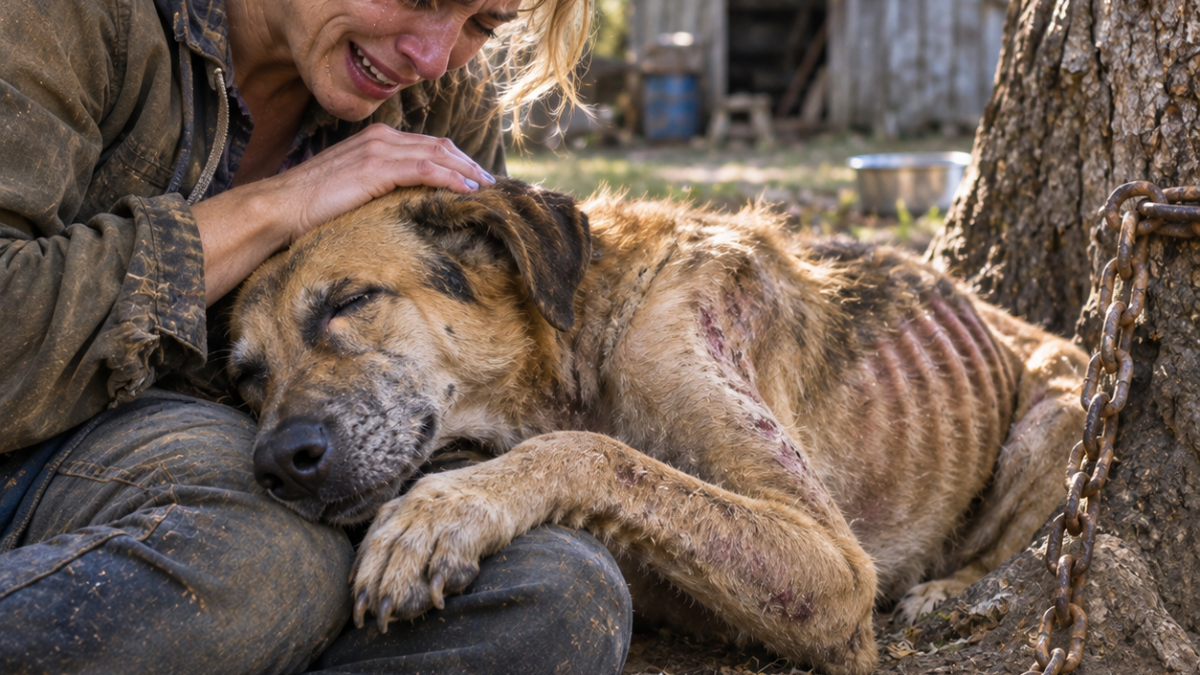
For Eight Years, He Lived Chained to One Tree—When I Cut Him Free, He Didn’t Run. He Put His Head in My Lap
For eight years, Oakley had known almost nothing beyond one tree, one length of chain, and the narrow circle of dirt his paws had worn into the ground, so when I finally cut the last metal link I expected him to run as far and as fast as his tired body could carry him.
Instead, the old dog took two uncertain steps toward me, slowly sat at my feet as though he still needed permission to exist outside that circle, and rested his head in my lap while I broke down crying beside the severed chain.
What I did not know then was that Oakley had not survived all those years because he was waiting for freedom—he had survived because a girl named Émilie had spent years slipping food over the fence and teaching him that somewhere in the world, at least one human being might still come back.
My name is Jessica Hale.
I was twenty-nine years old when I met Oakley.
I had been working in animal welfare enforcement for eight months.
Eight months is long enough to learn that suffering rarely looks dramatic from a distance.
Most of the time, it looks ordinary.
A backyard.
A leaning fence.
A dented water bowl.
A doghouse with a roof that no longer keeps rain out.
A chain disappearing into dead grass.
People imagine rescue work as a series of heroic moments.
You arrive.
You confront someone terrible.
You save the animal.
Everyone claps.
That is not what it is.
Most days are paperwork.
Photographs.
Veterinary reports.
Warnings.
Court dates.
Follow-up visits.
Conversations with people who insist:
“He’s fine.”
“He likes being outside.”
“He’s always lived like this.”
“He doesn’t need more.”
Then you look at the animal.
Sometimes the animal tells the truth before anyone else does.
Oakley did.
The first complaint came from a teenage girl.
She did not give her full name.
Only Émilie.
She sounded maybe sixteen.
Her voice shook.
“There’s a dog behind the old Miller property.”
“How long has he been there?”
Pause.
“Forever.”
“Can you tell me what forever means?”
Another pause.
“Since I was little.”
That got my attention.
I wrote down the address.
“Does he have food?”
“Sometimes.”
“Water?”
“Sometimes.”
“Shelter?”
“A broken doghouse.”
“Is he injured?”
“I don’t know.”
She lowered her voice.
“But his collar looks wrong.”
“What do you mean?”
“It’s too tight.”
I stopped writing.
“How long have you been seeing him?”
“Years.”
“Have you talked to the owner?”
“No.”
“Why not?”
“My mom says not to.”
“Does the dog know you?”
Silence.
Then quietly:
“Yes.”
“How?”
“I give him food.”
That sentence stayed with me.
Not:
I pet him.
Not:
I play with him.
Food.
“What kind?”
“Whatever I can bring.”
“Does the owner know?”
“No.”
“Okay.”
I promised we would investigate.
Before hanging up, Émilie said:
“Please don’t forget him.”
I told her:
“I won’t.”
At the time, I had no idea what that promise was about to cost me emotionally.
PART2
FULL STORY CONTINUATION
The property sat outside town where the paved road narrowed into gravel.
An old farmhouse.
Detached garage.
Collapsed shed.
Rusting equipment.
No livestock.
No children outside.
No sign that anyone cared what the yard looked like.
I parked near the road and waited for my partner officer, Dean, to arrive.
We followed procedure.
Document first.
Assess.
Contact owner.
No dramatic entrance.
No assumptions.
Then I saw the tree.
Large cottonwood behind the house.
And beneath it:
A dog.
At first, he looked like part of the dirt.
Brown.
Gray.
Still.
Then his head lifted.
German Shepherd mix, maybe.
Large frame.
Thin body.
A face that should have looked old but instead looked exhausted beyond age.
He did not bark.
Did not stand.
Just watched.
The chain ran from a heavy collar to the tree.
Not a long chain.
Maybe twelve feet.
Enough for him to reach the doghouse.
A bowl.
A patch of ground where grass no longer grew.
Dean whispered:
“Jesus.”
I had seen neglected dogs.
Dogs frightened of hands.
Dogs whose whole bodies flinched when someone raised a voice.
Still, something about this one made me stop.
Maybe because he didn’t react at all.
Animals in danger often do something.
Pull away.
Bark.
Growl.
Hide.
This dog watched us the way someone watches weather.
Something happening around him.
Not for him.
I moved slowly.
“Hey, buddy.”
His ears shifted.
One barely.
I crouched outside the radius of the chain.
“Hi.”
Nothing.
“My name is Jessica.”
Dean glanced at me.
I talked to animals constantly.
He had stopped commenting.
“You don’t know me.”
The dog blinked.
“That’s okay.”
I saw the collar clearly then.
Old leather.
Too tight.
Hair matted around it.
Skin irritated beneath.
Enough that I felt my stomach turn.
Not because I had never seen anything like it.
Because I could imagine the years.
A puppy grows.
Collar doesn’t.
Nobody adjusts it.
Nobody notices.
Or nobody cares enough to notice.
Dean took photographs.
I checked the water.
Almost empty.
Dirty.
Food bowl?
Nothing but dried residue.
Doghouse?
Damaged.
Little protection from wind.
It was early April.
Cold nights still common.
I heard a door open behind us.
A man came out.
Mid-sixties maybe.
Thin.
Work jacket.
His expression immediately hardened.
“What are you doing?”
I stood.
“Animal welfare enforcement. Are you the owner?”
“Depends.”
“Of the dog.”
He looked at Oakley.
“Yeah.”
“What’s his name?”
Long pause.
“Dog.”
I thought I’d misheard.
“What do you call him?”
“Whatever.”
Dean shifted beside me.
I kept my voice neutral.
“How old is he?”
The man shrugged.
“Eight or nine.”
“Has he been tethered here that whole time?”
Another shrug.
“He’s a yard dog.”
“Does he come inside?”
“No.”
“Why is the collar so tight?”
“It isn’t.”
I looked at him.
Then the dog.
Then back.
“We need to have a veterinarian assess him.”
The man became angry.
“He’s mine.”
“Yes.”
“That means you can’t take him.”
Ownership law is more complicated than people think.
Owning an animal does not always mean unrestricted authority to keep it under any conditions.
But arguing law in a yard rarely improves the animal’s situation.
So I explained calmly what we had documented.
The owner—I’ll call him Mr. D.—alternated between denial and irritation.
The dog was fine.
The dog ate.
The dog had survived winters.
The dog didn’t like being inside.
The collar had always fit.
Émilie, wherever she was, had told the truth.
And Mr. D. made the mistake people often make when neglect has become normal to them.
He assumed survival proved adequate care.
Eventually, after consultation with supervisors and the veterinary team, we had grounds to remove the dog for immediate evaluation while the case proceeded.
That was when I went to my truck.
And brought back the bolt cutters.
I had used them before.
Chains around abandoned kennels.
Wire fencing.
Locks during lawful seizures.
Metal is metal.
You position the jaws.
Use leverage.
Cut.
Simple.
That afternoon, my hands shook.
The dog still had not stood.
I approached slowly.
“Hey, you.”
His eyes followed me.
“I’m going to touch this.”
Nothing.
Dean held the secondary lead ready.
I slipped it gently around the dog’s neck below the damaged collar where possible.
The dog flinched.
Only once.
Then stopped.
That hurt in a different way.
Sometimes an animal that never resists is not calm.
Sometimes resistance stopped working a long time ago.
I talked constantly.
Soft voice.
Nonsense.
“You’re okay.”
“We’re going slowly.”
“Nobody’s rushing you.”
“I’ve got you.”
When I placed the bolt cutter around the chain link, the dog’s eyes stayed on me.
There was no understanding of tools.
No concept of liberation.
Just attention.
The handles came together.
Metal resisted.
Then snapped.
The sound echoed across the yard.
Too loud.
I expected the dog to jump.
He didn’t.
The broken chain fell.
For the first time in eight years—if the owner’s timeline was accurate—nothing physically connected him to the tree.
I stood back.
Space.
Freedom.
He could run.
The yard was open toward the field.
Dean positioned safely but gave him room.
The dog stood.
Slowly.
His legs looked uncertain.
He took one step.
Then another.
Toward me.
Not away.
He sat at my boots.
I froze.
Then he leaned.
His forehead touched my knee.
Slowly, as if testing whether I would allow it, he lowered his head into my lap.
I had crouched without realizing it.
The weight of him settled across my thighs.
Warm.
Heavy.
Trusting.
And I broke.
I started crying before I even understood I was crying.
Not delicate tears.
My whole chest tightened.
I placed one hand against the side of his face.
“You’re okay.”
My voice cracked.
“You’re okay now.”
He closed his eyes.
That was the first time I touched him without feeling him tense.
Behind me, Dean walked away several steps.
Giving me privacy.
The owner muttered something.
I don’t remember what.
All I remember is the dog.
The chain beside us.
His head in my lap.
Eight years.
And once he could finally leave, the first thing he wanted was contact.
We loaded him into my pickup because the transport van was delayed.
He hesitated at the open door.
Not fear exactly.
Confusion.
The height.
The interior.
Maybe he had never been in a vehicle.
I placed a blanket across the back seat.
“Come on.”
He looked at me.
I lifted carefully.
He weighed less than he should have.
Once inside, he curled into the corner.
I climbed behind the wheel.
For the first several miles, I kept checking the mirror.
He watched the window.
Trees.
Road signs.
Passing cars.
His whole world moving.
I wondered what an animal understands when life changes that quickly.
Probably not:
I have been rescued.
More likely:
Everything is different and I don’t know why.
Ten minutes later, his head lowered.
Then rested on the blanket.
He fell asleep.
Not deeply at first.
Every turn woke him.
Then slowly, his breathing changed.
Longer.
Heavier.
As if he had finally decided that while the vehicle moved, he did not need to remain alert.
That was when I called Margaret Chambers.
My mentor.
Fifty-one years old.
Twenty-two years in animal protection and cruelty investigations.
Margaret had seen everything I thought I was learning to handle.
Hoarding cases.
Abandonment.
Dogfighting investigations.
Animals found after disasters.
She had an ability I envied.
She could care deeply without letting every case tear her apart.
At least that was what I believed then.
She answered.
“Jessica?”
I opened my mouth.
Nothing came.
“Jess?”
I tried again.
Still nothing.
The first sob came so hard I had to pull onto the shoulder.
Oakley stirred behind me.
I put the truck in park.
Then cried.
Margaret did not ask:
What happened?
She stayed silent.
Nine minutes.
I know because later I saw the call duration.
For nine minutes, she listened to me breathe badly and cry like someone had opened a valve.
Finally I said:
“There was this dog.”
Margaret waited.
“Eight years.”
My voice disappeared again.
“He’s in the truck.”
Still she waited.
“I cut the chain.”
Pause.
“And he didn’t run.”
Another sob.
“He came to me.”
Margaret exhaled.
Then said:
“Jessica.”
“Yeah?”
“Some dogs spend their whole lives waiting for one person.”
I closed my eyes.
“And today, you were that person.”
I looked in the mirror.
The dog had lifted his head.
Watching me.
Margaret continued:
“Now bring him home.”
I laughed through the tears.
“To the office?”
“You know what I mean.”
At the time, I didn’t.
Not fully.
The veterinary examination was worse than I expected.
But not hopeless.
That distinction mattered.
Underweight.
Dehydration.
Parasites.
Joint stiffness.
Skin problems.
Old untreated injuries that had healed imperfectly.
And the collar.
The veterinarian, Dr. Patel, examined his neck.
Her face became very still.
“We’ll need to remove this under sedation.”
“How bad?”
“Bad.”
She looked at me.
“But treatable.”
I held onto those words.
Treatable.
Oakley did not have a name yet.
The paperwork listed him as:
Adult male shepherd mix.
I hated it.
On the drive back from the clinic, I passed Oakley Street.
The sign flashed by.
I looked into the mirror.
“Oakley.”
The dog lifted his head.
I smiled despite myself.
“Okay.”
“That’s you.”
No tail wag.
Nothing dramatic.
But he kept looking at me.
Oakley.
It stayed.
The procedure happened the next morning.
Dr. Patel removed the old collar carefully while he was sedated.
Cleaned and treated the damaged tissue.
She said healing would take time.
I asked:
“How much pain was he in?”
She hesitated.
“A lot.”
“For how long?”
“Impossible to know.”
Then she said something that stayed with me.
“Animals adapt to pain humans would immediately identify as intolerable.”
I looked through the kennel window.
Oakley sleeping.
“That doesn’t mean it hurts them less.”
“No.”
It meant they had no choice.
For the first three weeks, Oakley remained under veterinary and agency care while the legal process moved forward.
Our office had a recovery area.
Not luxurious.
Clean.
Warm.
Quiet.
Better than a tree.
I visited every day.
At first, I told myself it was because I was assigned to his case.
Then I started visiting on my days off.
Harder to explain professionally.
The first afternoon, I sat beside his kennel.
He watched me.
I had no idea what to say.
So I read.
Incident reports.
He listened.
Next day:
Staff schedule.
Third day:
The ingredients on a loaf of bread someone had left in the break room.
“Enriched wheat flour.”
Oakley’s ears lifted.
“Water.”
He blinked.
“Yeast.”
Tail moved once.
I laughed.
“You like yeast?”
Tail again.
By the end of the week, I could read anything and he would settle.
My voice seemed to matter more than the words.
That realization nearly broke me again.
For years, many of the sounds around him had probably been commands.
Shouting.
Vehicles.
Weather.
Chain against bark.
Now a person sat beside him and read nonsense because silence felt too empty.
Oakley listened as though every word was worth keeping.
People changed around him.
Dean was usually sarcastic about everything.
He stopped talking loudly near Oakley.
One of our senior officers, Briggs, a man who had worked serious cases for fifteen years and considered emotion a medical condition, brought cooked chicken.
He pretended it was leftovers.
Nobody believed him.
Receptionist Carla started saving cardboard tubes because Oakley liked carrying them.
Dr. Patel visited even when she didn’t need to.
Oakley did not perform affection dramatically.
He was quiet.
He would walk toward you.
Sit.
Lean.
That was his language.
He leaned against people as though checking whether they would stay solid.
Nobody wanted to move when he did.
His first soft bed caused a problem.
We placed it inside his recovery enclosure.
Oakley stood outside.
Would not step onto it.
Treat.
Nothing.
Food bowl.
Nothing.
We tried demonstrating.
Ridiculous.
Eventually, I sat on the bed myself.
“See?”
Oakley watched.
I patted it.
“Not dangerous.”
He took one step.
Then another.
Front paws on cushion.
Paused.
Then slowly lowered himself.
His expression changed.
The tension in his face softened.
He circled once.
Lay down.
Then immediately stood.
As if softness felt suspicious.
Tried again.
By the third night, he slept there.
Curled tightly at first.
Weeks later, stretched across the entire thing like he owned the building.
Progress is sometimes an animal learning he does not need to conserve space.
The legal case against Mr. D. moved slowly.
People asked me:
“Is he going to jail?”
I always answered:
“The case is ongoing.”
Because my job was not to promise punishment.
My job was evidence.
Photographs.
Veterinary findings.
Witness statements.
Records.
Émilie.
We finally met her properly during the investigation.
She was seventeen.
Long dark hair.
Oversized green jacket.
Nervous.
Her mother came with her.
When I mentioned the food, Émilie looked terrified.
“Am I in trouble?”
“No.”
“You weren’t supposed to go onto the property?”
“I never did.”
“How did you feed him?”
“Over the fence.”
“What?”
She looked embarrassed.
“Sandwiches.”
“Dog food when I could.”
“Chicken.”
“Leftovers.”
“Since when?”
She looked toward her mother.
“Maybe nine?”
I stopped writing.
Eight years.
“You were nine years old?”
She nodded.
“He was smaller then.”
Her mother wiped her eyes.
“She would come home crying.”
Émilie looked down.
“I thought somebody would help eventually.”
“Did you tell adults?”
“Yes.”
“Who?”
“Different people.”
Some thought it wasn’t serious.
Some said:
“He belongs to someone.”
Some said:
“Don’t interfere.”
She kept feeding him.
For eight years.
A child had done what adults repeatedly found reasons not to do.
I felt ashamed on behalf of people I had never met.
Then I asked:
“Would you like to see him when he’s ready?”
Her eyes filled immediately.
“Can I?”
“Yes.”
She covered her mouth.
I knew then that Oakley’s story did not begin with me.
I had only arrived at the point where the chain finally broke.
Émilie had helped keep hope alive long enough for me to get there.
Three weeks after his rescue, the question of placement came up.
A foster home had been identified.
Experienced.
Quiet.
No other dogs.
Perfect on paper.
I hated it.
That was the first sign.
Margaret noticed.
We were standing outside the recovery room.
“You look miserable.”
“I’m fine.”
“That’s always convincing.”
“The foster is good.”
“Yes.”
“She’s experienced.”
“Yes.”
“Fenced yard.”
“Yes.”
“Then good.”
Margaret smiled.
“You hate her.”
“No.”
“You have never met her and you hate her.”
“I don’t hate anyone.”
“You want the dog.”
I looked at Oakley through the glass.
He was sleeping.
“You told me not to make cases personal.”
“I told you not to let personal feelings compromise evidence.”
“Different?”
“Very.”
“I can’t adopt every animal.”
“No.”
“But this one?”
Margaret waited.
I whispered:
“I think he’s mine.”
She smiled.
“No.”
“What?”
“I think you’re his.”
I rolled my eyes.
“That’s sentimental nonsense.”
“Correct.”
Pause.
“Still true.”
I took Oakley home after the legal authorization allowed his placement with me under the conditions of the case.
My house was small.
Two bedrooms.
Tiny yard opening to a larger fenced field shared by neighboring properties.
No other animals.
I bought everything.
Bed.
Bowls.
Harness.
Toys.
Blankets.
Treats.
Then half of it terrified him.
The stairs?
Suspicious.
Television?
Disturbing.
Washing machine?
Enemy.
Ceiling fan?
Possibly supernatural.
He stood in the doorway of my living room for ten full minutes the first evening.
I did not pull him.
No coaxing beyond:
“You can come in.”
Eventually one paw crossed.
Then another.
He sniffed the sofa.
Coffee table.
Rug.
Window.
He discovered his reflection in the dark television screen and growled once.
I laughed.
He looked at me.
“You’re growling at yourself.”
He stopped.
Good judgment.
The first night, I expected him to sleep on the dog bed beside mine.
He refused to enter the bedroom.
Doorway again.
Threshold.
He lay in the hall.
I left the bedroom door open.
Around two in the morning, I woke.
Oakley stood beside the bed.
Silent.
I reached down.
He lowered his head into my palm.
Then lay on the floor.
No dramatic leap onto the mattress.
No instant transformation.
Just enough trust to sleep nearby.
That was more than enough.
His first walk without a tether was strange.
He wore a harness and leash.
Every time the leash became slightly taut, he froze.
Not pulled back.
Froze.
As if pressure meant:
Stop.
I loosened it.
“Come on.”
He followed.
We moved five feet.
Ten.
Twenty.
Then a hundred.
He kept looking behind us.
For the tree?
I don’t know.
Maybe he simply checked surroundings.
I stopped turning every behavior into tragedy.
Oakley deserved to become a dog, not a symbol.
That was another thing Margaret taught me.
“Don’t rescue him forever.”
“What does that mean?”
“Eventually he has to stop being the chained dog in your head.”
I hated that.
Then understood.
If every treat became:
Poor Oakley never had this.
Every bed:
Poor Oakley never slept here.
Every run:
Poor Oakley never knew freedom.
Then his past would still own every new experience.
He needed joy that wasn’t always measured against suffering.
So we started simply living.
He loved tennis balls.
Not immediately.
First he watched one roll past.
Then sniffed.
Then picked it up.
Dropped it.
The next day, he picked it up again.
A week later:
Obsessed.
He never learned fetch correctly.
I threw.
He ran.
Picked up the ball.
Then lay down somewhere else.
“You’re supposed to bring it back.”
Oakley stared.
“That’s literally the activity.”
Nothing.
I walked to him.
He moved three feet farther.
Game invented.
Fine.
He discovered the field behind my house in May.
Warm afternoon.
I used a long training line the first time for safety.
Oakley stood at the edge of the grass.
Open space.
No tree within reach.
No dirt circle.
He looked at me.
Then ran.
Not fast at first.
Uncertain.
Then faster.
His legs stretched.
Ears back.
Tail out.
He made one enormous loop.
Then another.
I started laughing.
He ran past me.
Turned.
Ran back.
For eight years, his world had been measured in feet.
Now he ran until he was tired because nothing stopped him.
I cried.
Of course.
But I tried not to make the moment about sadness.
“Go!”
He ran again.
That night he slept on his bed with all four legs in the air.
Complete trust.
Complete exhaustion.
Émilie’s visit happened the next month.
I planned it carefully.
No surprise crowd.
Just her.
Her mother.
Margaret came because Émilie had become comfortable with her during the case.
Oakley was in the field.
I saw Émilie before he did.
She stopped beside the gate.
Hands trembling.
“Oh my God.”
Oakley was heavier.
Coat cleaner.
Neck healing.
Moving differently.
She whispered his old nickname.
Not Oakley.
“Buddy.”
His head snapped toward her.
Everything stopped.
Then Oakley ran.
Straight across the field.
Émilie dropped to her knees.
He reached her.
Did not jump.
He sat.
Exactly as he had beside me under the cottonwood.
Then slowly placed his head into her lap.
Émilie made a sound I will never forget.
Half sob.
Half laugh.
She wrapped both arms around his neck carefully.
“You remember me.”
Oakley closed his eyes.
I turned away.
Margaret was wiping her face.
I pointed.
“You’re crying.”
“No.”
“You absolutely are.”
“Allergies.”
“In June?”
“Severe.”
I laughed while crying.
Émilie’s mother stood beside me.
“She saved lunch every day.”
“What?”
“At school.”
“She’d bring half home.”
I looked at her.
“For him?”
She nodded.
“Sometimes she told me she wasn’t hungry.”
Émilie had been feeding Oakley with food she herself was supposed to eat.
A child.
For years.
I walked over.
Knelt beside her.
“Émilie.”
She looked up.
“You kept him alive.”
Her face crumpled.
“I didn’t do enough.”
“Yes.”
I said it firmly.
“You did.”
“I should have—”
“You were a child.”
I touched her shoulder.
“You did more than many adults.”
Oakley leaned harder into her.
She cried into his fur.
That afternoon, she stayed three hours.
Before leaving, she asked:
“Can I come again?”
I smiled.
“Every week if your mom is okay with it.”
Her mother said:
“Please.”
And that became another ritual.
Oakley waited at the front window on Saturdays.
Émilie usually came around two.
At one-thirty, he began checking.
One-forty-five:
Window.
Door.
Window.
When her mother’s car turned onto the street, his entire body changed.
Tail.
Ears.
Movement.
He would wait until I opened the door.
Then straight to Émilie.
Sit.
Head.
Lap.
Every time.
Maybe that was simply how Oakley showed attachment.
Maybe he learned it because for years humans existed mostly above him and the safest contact was leaning.
I didn’t need to know.
It was his thing.
And Émilie loved it.
She began helping with his training.
Basic commands.
Walking.
Confidence exercises.
Oakley learned:
Sit.
Down.
Wait.
Come.
Touch.
Place.
His favorite?
Touch.
Nose to hand.
Of course.
Contact.
He could have ignored us.
Avoided hands forever.
Instead, he sought them.
That humbled me.
People love describing abused animals as endlessly forgiving.
I don’t.
Forgiveness is a human concept.
Oakley was not making a moral decision to absolve humanity.
He was responding to what happened now.
Now:
Food.
Safety.
Soft voices.
Predictable hands.
Warmth.
Play.
He taught me that trust does not always require understanding the entire past.
Sometimes it begins with enough good experiences in the present.
Not everything healed quickly.
Chains frightened him.
The first time I dropped his leash near a metal gate and it rattled, Oakley collapsed to the ground.
My heart broke.
I knelt.
Did not touch immediately.
Waited.
Then quietly:
“You’re okay.”
He looked at me.
I moved the chain farther away.
No force.
No:
Face your fear.
We worked with Dr. Patel and a behavior consultant.
Controlled exposure.
Distance.
Choice.
Rewards.
Weeks.
Months.
Eventually, Oakley could walk past a chain lying on the ground.
Then hear one move.
Then stand near a metal lead.
He never loved the sound.
He didn’t need to.
Healing does not require turning every trigger into something pleasant.
Sometimes neutral is victory.
Men shouting frightened him too.
Understandable.
So we were careful.
One day, two neighbors argued across the street.
Voices rose.
Oakley ran to the bedroom.
I followed.
He was behind the bed.
I sat on the floor.
Did not pull him out.
“I’m here.”
After five minutes, his head appeared.
Then shoulders.
He came over.
Sat.
Head in my lap.
The old gesture.
I stroked his ears.
“You don’t have to be brave.”
That sentence surprised me.
Rescue culture loves brave animals.
Brave survivor.
Brave dog.
Brave comeback.
Oakley had spent eight years surviving.
He had earned the right to be afraid sometimes.
So had Émilie.
So had I.
The case against Mr. D. eventually resolved.
I won’t turn the legal outcome into the emotional climax.
Oakley had already won the thing that mattered to him.
He was not returning to the tree.
The court imposed consequences based on the evidence and applicable animal-welfare law.
Ownership rights were permanently transferred away from Mr. D.
Restitution and restrictions followed.
People asked if I felt satisfied.
Partly.
But court could not return eight years.
Punishment cannot manufacture childhood.
It cannot make an old collar loose in the past.
It can stop repetition.
That matters.
But the real work was ahead.
Building a life large enough that eight years were no longer the only thing defining Oakley.
His first winter indoors was almost funny.
Snow came.
Oakley stood at the door.
I opened it.
He walked out.
One paw into snow.
Stopped.
Looked at me.
“It’s snow.”
He put another paw down.
Then jumped backward.
I laughed.
“You lived outside for eight winters.”
He stared as though accusing me of inventing weather.
Then, suddenly, he ran into the yard.
Snow everywhere.
He shoved his nose beneath it.
Snorted.
Jumped.
Ran circles.
Came inside covered in white.
Then walked directly onto my couch.
“Absolutely not.”
He curled into a ball.
I looked at him.
The couch lost.
I bought him two beds.
Why two?
No reason.
He used one.
Then the couch.
Then my bedroom floor.
Then eventually my bed.
That transition happened one thunderstorm night.
Oakley hated storms.
Not rain.
Thunder.
The first loud crack woke me.
Then I felt movement.
Oakley stood beside the mattress.
I lifted the blanket.
“Come on.”
He hesitated.
Then climbed up.
Heavy.
Awkward.
He turned four circles.
Lay down with his back pressed against mine.
By morning, his head was on my pillow.
I woke staring into one brown eye.
“Boundaries.”
Tail thumped.
“Terrible boundaries.”
He stayed.
The next night:
Bed.
Apparently permanent policy.
Émilie graduated high school.
Oakley attended outside the venue afterward because animals were not permitted inside.
She came running toward him in her cap and gown.
He recognized her before I called.
Sat.
Head in lap.
Of course.
People took photographs.
Émilie held his face.
“You made it.”
I knew she wasn’t talking only to him.
She had struggled too.
Family problems.
Anxiety.
The burden of years spent worrying about an animal she could not save alone.
Oakley had become part of her healing too.
Not because he fixed her.
Because she finally got to see that the kindness she gave as a child had mattered.
That matters more than people realize.
Children often perform acts of compassion with no proof they changed anything.
Émilie got proof.
He was standing beside her.
Healthy.
Tail wagging.
Alive.
She went to college nearby.
Animal science.
No surprise.
Her first semester, she called me.
“I think I want to be a veterinarian.”
I laughed.
“Dr. Patel is going to take credit.”
“She already did.”
Oakley barked in the background because he heard Émilie’s voice through the speaker.
“Tell him I’ll visit Saturday.”
I looked at him.
“You hear that?”
Tail.
“He understands more than you.”
Probably.
My own career changed because of Oakley.
Not dramatically.
I did not become famous.
No book tour.
No television rescue empire.
Thank God.
But I became better.
Before Oakley, I saw cruelty cases mostly as problems to solve.
Document.
Remove.
Treat.
Prosecute.
After Oakley, I paid more attention to what came after.
Rescue is the first day.
Recovery is everything afterward.
An animal can be physically free and still live inside the old boundary mentally.
Handlers.
Fosters.
Adopters.
They needed support too.
I worked with Margaret to improve post-seizure behavior assessments.
Quiet decompression periods.
Foster education.
Veterinary follow-ups.
Training on fear responses.
Less:
“He’s safe, so why is he still afraid?”
More:
“Of course he’s afraid. Let’s give him time.”
Oakley changed our office culture in small ways.
That made me proud.
Margaret retired three years later.
At her retirement lunch, she gave me her old field notebook.
Inside the cover she’d written:
THE FIRST RESCUE IS THE ANIMAL. THE SECOND IS THE PERSON WHO THINKS THEY HAVE TO SAVE EVERYONE ALONE.
I stared.
“Is this about me?”
She smiled.
“Mostly.”
“I hate you.”
“I know.”
Then she hugged me.
Oakley waited beside us.
Margaret crouched.
“Take care of her.”
Oakley leaned against her.
“Traitor,” I said.
Oakley aged.
That sentence still feels unfair.
When I adopted him, he was already about eight.
Maybe eight years, four months based on records and Émilie’s memory.
The first year, he seemed younger every month.
Muscle returned.
Coat thickened.
Eyes brighter.
He ran like a dog half his age.
People at the park guessed:
“Three?”
I always smiled.
“Closer to ten.”
They stared.
Good.
I liked shocking them.
Today, when I tell the story, I sometimes accidentally say:
“Oakley is three.”
Because that is how he lived after rescue.
Not biologically.
Emotionally, maybe.
Curious.
Playful.
Discovering things other dogs learned as puppies.
Sprinklers.
Car rides.
Beds.
Beach sand.
Dog-friendly ice cream.
Automatic doors.
One hilarious encounter with a Roomba.
His second life began late.
He did not care.
Dogs are good at now.
The first time we took him to a lake, he walked straight into the water.
No hesitation.
Then realized it became deeper.
Backed up.
Looked offended.
Émilie laughed.
“Try again.”
He did.
Eventually swam.
Badly.
Splashing everywhere.
When he reached shore, he shook water directly onto me.
I screamed.
Émilie laughed harder.
Oakley ran.
That evening, he slept twelve straight hours.
I watched his chest rise and fall.
And thought:
This.
This is what rescue is supposed to become.
Not endless remembrance of suffering.
A tired old dog after a good day.
There were people who wanted to meet Oakley because they heard his story.
I became protective.
He was not a public exhibit.
Not:
Come see the chained dog.
If visitors met him, they met Oakley.
Dog who stole socks.
Dog who disliked cucumbers.
Dog who slept with one paw over his nose.
Dog who waited for Émilie on Saturdays.
His suffering did not give strangers permanent access to him.
That became important to me.
Victims do not owe audiences their pain.
Animals either.
His neck healed.
Hair grew back.
The scar remained beneath the fur.
You had to know where to feel.
Sometimes I touched it gently.
Oakley never reacted.
Years later, I realized I had stopped checking.
The scar had not disappeared.
It simply stopped being the first thing I thought about when my hands touched his neck.
That was healing for me too.
One April 3rd, Émilie arrived carrying a small package.
Anniversary.
Five years since rescue.
Inside was the broken chain link.
I stared.
“Where did you get this?”
“Dean.”
I called him immediately.
“You kept it?”
He laughed.
“Evidence retention ended.”
“You could’ve thrown it away.”
“Thought you might want it.”
I didn’t.
At first.
The metal looked smaller than memory.
Rusty.
Ordinary.
Something so ordinary had defined a life.
Émilie asked:
“What should we do with it?”
I looked at Oakley.
He was asleep on the rug.
Then:
“Not frame it.”
“Agreed.”
“Not keep it in a box.”
“Okay.”
We took it to a local metal artist.
She incorporated it into a small garden hook shaped like a leaf.
Not a memorial.
Useful thing.
It hangs beside my back door.
Sometimes Oakley’s leash rested there.
The chain became something that held nothing captive.
I liked that.
Émilie once asked:
“Do you think he knew I was helping?”
“Yes.”
“How?”
“He ran to you.”
She smiled.
“I mean back then.”
I thought.
“He knew food appeared when you came.”
“He knew your voice.”
“He probably knew your smell.”
“Did he know I loved him?”
That was harder.
I looked at her.
“I think animals understand consistency better than explanations.”
She nodded slowly.
“You came back.”
“Again and again.”
“If that isn’t one version of love, I don’t know what is.”
She cried.
Oakley, sensing emotion or maybe snacks, came over.
Sat.
Head in her lap.
Some rituals never changed.
Oakley was eleven when arthritis became more noticeable.
Not severe.
Just stiffness.
Dr. Patel prescribed medication.
We adjusted walks.
Added rugs over slippery floors.
Small ramp beside my bed because I refused to let him jump.
Émilie teased:
“You built him stairs?”
“Ramp.”
“Of course.”
“He has joints.”
“You’re becoming that dog mom.”
“I work animal enforcement.”
“That isn’t a denial.”
No.
It wasn’t.
At twelve, Oakley could still run.
Short bursts.
Especially when Émilie arrived.
She was in veterinary school by then.
White coat sometimes still in her car.
Oakley did not understand degrees.
He understood:
Émilie.
She would kneel.
He would approach more slowly now.
Sit.
Head.
Lap.
Every time.
She once whispered:
“This is how I’ll remember him.”
I heard.
Said nothing.
I knew what she meant.
Age had entered the room.
No one wanted to name it yet.
The hardest part of rescuing an older dog is the arithmetic.
You know from the beginning you may not get enough years.
But enough is a dangerous word.
Eight years chained.
Would four years of freedom be enough?
Six?
Three?
No number can balance another number.
That is not how life works.
We stopped counting what Oakley was owed.
We counted what he had.
Today.
Food.
Warm house.
Field.
Émilie.
Me.
Tomorrow if lucky.
That was enough because it was real.
Oakley’s hearing faded first.
Not completely.
He stopped waking when I opened the refrigerator.
Historic tragedy.
Then vision dimmed slightly at night.
We used lights.
Routines.
Touch signals.
He adapted.
Dogs do.
At thirteen, he still insisted on waiting by the door when I came home.
Sometimes sleeping instead of standing.
I would enter.
He would wake.
Push himself upright.
Sit near my legs.
Head against my knees.
The gesture became slower.
Heavier.
More precious because I knew it would not happen forever.
Margaret visited one afternoon.
Retired.
Gray hair now.
She sat on my porch with Oakley at her feet.
“Remember when you called me crying?”
“No.”
“Liar.”
“I was professional.”
“For nine minutes?”
“Emotional processing.”
She laughed.
Then looked at Oakley.
“You did good.”
I said:
“He did.”
Margaret looked at me.
“Both.”
I hated compliments.
Still do.
But I accepted that one.
Mr. D. never returned to our lives.
That was important.
No dramatic confrontation.
No redemption scene.
No demand for Oakley back.
Legal orders held.
The case became closed.
Good.
Oakley’s future did not need his past constantly returning for narrative tension.
Real rescue is often beautiful precisely because eventually the person who caused harm becomes irrelevant.
I wanted that for Oakley.
He got it.
The field behind my house changed ownership.
The new owner considered building.
I panicked.
Not about my property value.
Oakley’s field.
Ridiculous.
I called.
Explained.
The owner turned out to like dogs.
He agreed to maintain a smaller fenced section adjacent to my yard for several years.
I paid part of the fencing cost.
Oakley kept his running space.
He barely ran by then.
Still.
It mattered to me.
Maybe more than him.
One evening, I found him standing beside the fence.
Looking toward nothing specific.
Sunset.
Warm.
I sat beside him.
“You waited a long time.”
His ear shifted.
“You know that?”
Nothing.
“Eight years.”
He leaned against me.
“Then you got me.”
He looked up.
“Questionable prize.”
Tail moved.
“Rude.”
I scratched his neck.
“I’m glad you waited.”
Then I immediately hated the sentence.
He should never have had to.
So I corrected myself.
“I’m glad you survived.”
Better.
Oakley lived to fourteen.
Maybe older.
No one knew his exact birthday.
Émilie chose April 3rd as his birthday after the rescue.
“That’s his real life.”
I liked that.
The last year was slower.
More sleep.
Shorter walks.
More good days than bad.
Until eventually the balance began changing.
Dr. Patel had retired by then, but one of her former associates cared for him.
We watched.
Pain.
Appetite.
Mobility.
Interest.
Dignity.
The worst part of loving an animal is eventually being trusted with decisions they cannot explain in words.
I had spent years promising:
I will stay.
That promise included the end.
His final morning was in October.
Cool.
Sunlight across the living room.
Oakley had not eaten breakfast.
He tried to stand.
Could not without help.
Then looked at me.
Not suffering dramatically.
Tired.
I knew.
Émilie was home from veterinary school rotations that week.
I called.
She answered on the first ring.
“Is it time?”
I started crying.
“Yes.”
She arrived forty minutes later.
Oakley heard—or sensed—her before she reached the room.
His tail moved against the bed.
Émilie dropped beside him.
“Hi, Buddy.”
He lifted his head.
Slowly.
Placed it in her lap.
Of course.
She broke.
So did I.
We had spent years knowing this would happen.
Knowing does nothing useful when it arrives.
The veterinarian came to the house.
Oakley stayed on his bed.
No clinic.
No stress.
Émilie on one side.
Me on the other.
Margaret arrived too.
Older.
Quiet.
She sat near his feet.
I kept one hand on Oakley’s chest.
Émilie stroked his face.
I whispered:
“You did good.”
His eyes remained on me.
I thought about the tree.
The broken chain.
The first ride.
Bread labels.
Beds.
Field.
Snow.
Émilie in her graduation gown.
All of it.
Then I said the thing I had promised from the first day without knowing it.
“I’m staying.”
Oakley exhaled.
His body softened.
And he was gone.
I cried harder than I had in the pickup fourteen years earlier.
Or six.
Depending how you count his second life.
Numbers became meaningless.
Émilie stayed beside him.
Margaret held my shoulder.
Nobody told me:
At least you gave him good years.
I hated that sentence.
Good years do not make goodbye easy.
They make grief worth having.
Different.
That night, the house was silent.
His two beds.
Bowls.
Tennis balls.
The ramp beside my bed.
I sat on the floor where he usually rested his head in my lap.
Nothing happened.
Of course.
I cried.
Then slept.
The next morning, I woke automatically and looked toward the door.
No Oakley.
That was grief.
Not dramatic.
Habit reaching for someone who is no longer there.
Émilie came Saturday anyway.
Same time.
Two o’clock.
She stood on the porch.
Neither of us knew what to do.
For years, Oakley had been the reason.
Then she held up coffee.
“I didn’t know if I should come.”
I opened the door.
“You should.”
We sat.
Talked about him.
Then about school.
Then about life.
That was when I realized Oakley had built another thing without knowing.
Family.
Émilie had stopped being the girl who fed a chained dog.
She was part of my life.
I was part of hers.
Margaret too.
Dean.
Dr. Patel.
One dog had connected people across years.
That remained after he was gone.
Émilie became a veterinarian.
Of course.
At her graduation, she wore a small silver charm inside her gown.
A dog tag.
Oakley’s.
She had asked permission.
I gave it.
After the ceremony, she hugged me.
“He should be here.”
“He is not.”
I refused the easy phrase.
He’s here in spirit.
Maybe.
I don’t know.
“But he got you here.”
She cried.
“Yes.”
That was enough truth.
I continued working.
More chains.
More neglected yards.
More scared animals.
I never promised each one:
I will keep you.
I couldn’t.
But I promised:
I will see you.
That was something Oakley taught me.
Neglect thrives partly because people stop seeing.
A chained dog becomes background.
A bowl becomes scenery.
A body becomes:
That’s just where the dog stays.
The first rescue act is noticing the animal as an individual again.
Oakley.
Not:
Dog.
Someone.
Whenever I cut a chain now, I remember April 3rd.
The sound.
Metal snapping.
The pause afterward.
Freedom arriving without fanfare.
I never expect the dog to react like Oakley.
Some run.
Some freeze.
Some panic.
Some bite because freedom is frightening when every human contact has taught fear.
Some simply stand.
Every response is allowed.
Oakley sitting at my feet was not proof he was more grateful or better than other survivors.
It was simply Oakley.
His choice.
His language.
His moment.
That is why it mattered.
People tell his story as:
THE DOG WHO WAITED EIGHT YEARS FOR ONE PERSON.
Beautiful.
Not quite accurate.
He waited for many people.
Émilie came first.
Then me.
Then Margaret.
Then Dr. Patel.
Then Dean.
Then every person who treated him gently.
Maybe the lesson was never that one special person saves you.
Maybe it was that enough people can choose not to walk away.
One after another.
Until a life changes.
I like that version better.
Because it means rescue does not require being extraordinary.
Émilie was nine when she began.
She had sandwiches.
I had bolt cutters and legal authority.
Margaret had experience.
Dr. Patel had medicine.
Everybody brought what they had.
Oakley brought survival.
Together, that was enough.
I kept the leaf-shaped garden hook made from the old chain.
It still hangs beside my back door.
No leash now.
Sometimes a jacket.
Sometimes nothing.
Visitors rarely know what it is.
Good.
It does not need to perform.
The chain had enough attention in Oakley’s first life.
His second life deserves the better memories.
I keep one photograph on my desk.
Not the tree.
Not his damaged collar.
Not the rescue.
Oakley in the field.
Mouth open.
Ears back.
Running.
Émilie in the distance.
She is seventeen in the photograph.
He looks three.
He was closer to nine.
But joy made him look young.
That is how I remember him.
Moving.
Years later, I asked Margaret whether she really believed what she told me on the phone.
“Which part?”
“Some dogs spend their whole lives waiting for one person.”
She laughed.
“That was very dramatic.”
“I knew it.”
“You were crying.”
“So you lied?”
“No.”
She looked at me.
“I think some animals wait for one safe moment.”
Pause.
“And sometimes a person happens to be standing there when it comes.”
I liked that better.
Less destiny.
More responsibility.
If you happen to be the person standing there, do something.
Émilie and I return to the old property only once.
Years after Oakley’s death.
The house had different owners.
The tree remained.
No chain.
Grass grew across the circle where the dirt once was.
You could barely see where Oakley had lived.
Émilie stood beside me.
“Is this it?”
“Yes.”
She touched the bark.
“I thought it would look…”
“Bigger?”
“Worse.”
Memory does that.
Compresses years into one terrible landscape.
The yard looked ordinary.
Birds.
Wind.
Grass.
I was glad.
The ground had healed even if it knew nothing about healing.
Émilie asked:
“Do you ever feel guilty that we couldn’t get him out sooner?”
“Yes.”
She looked at me.
“Me too.”
“You were a child.”
“I know.”
“Say it like you believe it.”
She sighed.
“I was a child.”
“Again.”
“Jessica.”
“Again.”
“I was a child.”
“Good.”
Then she looked at me.
“You weren’t working here yet.”
“Fair.”
We stood quietly.
Guilt likes impossible timelines.
It asks you to have arrived before you knew.
To know before evidence existed.
To save before you had authority.
You can learn from delay without claiming responsibility for time you did not control.
That was hard for both of us.
Before leaving, Émilie placed nothing at the tree.
No flowers.
No plaque.
No collar.
I liked that.
Oakley did not belong there anymore.
We got into the car.
Drove away.
No ceremony.
Exactly right.
My career eventually reached twenty-two years.
Same number Margaret had when I called her.
That realization terrified me.
A new officer named Kayla joined our unit.
Eight months in.
One evening, she called.
Crying.
I smiled through my own concern.
History.
I listened.
Seven minutes.
Then:
“There was this dog.”
I closed my eyes.
Of course.
I let her talk.
When she finally stopped:
“I don’t know if I can do this job.”
I said:
“You don’t have to decide tonight.”
“What do I do?”
“Go home.”
“That’s it?”
“Eat something.”
“Sleep.”
“Call me tomorrow.”
She sniffed.
“What if I keep thinking about him?”
“You will.”
Silence.
“Does that ever stop?”
“No.”
I thought of Oakley.
Then:
“But it changes.”
“How?”
“You learn that caring deeply is not evidence you’re too weak for the job.”
“It’s evidence you need good boundaries and people you can call.”
She laughed weakly.
“Like you?”
“Unfortunately.”
That was Margaret’s legacy traveling through me.
Oakley too.
Love transmits itself through behavior.
Not magic.
Practice.
I have another dog now.
Not because Oakley was replaced.
Never.
A rescue named June.
Small.
Completely different.
Terrier mix.
Fifteen pounds of criminal energy.
She steals socks.
Barks at delivery trucks.
Refuses to sleep anywhere except the center of my bed.
Oakley would have found her exhausting.
Maybe.
When I adopted June, Émilie asked:
“Was it hard?”
“Yes.”
“Did you feel guilty?”
“A little.”
“Why?”
“Habit.”
Then I laughed.
“Grief likes acting like the heart has one assigned parking space.”
Émilie rolled her eyes.
“Very poetic.”
“I’m old now.”
“Apparently.”
June bit my shoelace.
Some things continue.
Sometimes June sits at my feet.
Never rests her head in my lap.
Not her style.
She climbs directly into it without asking.
Different dog.
That makes me happy.
Oakley’s gesture remains his.
No replacement.
No imitation required.
I used to think the most important moment of Oakley’s life was when the chain broke.
I don’t anymore.
The chain breaking mattered.
Obviously.
But freedom is not one event.
Freedom was the first soft bed.
First full bowl without competition.
First night indoors.
First run.
First snowstorm from the safe side of a window.
First time Émilie walked through my gate and he recognized her.
First Saturday he waited because he knew someone he loved was coming back.
First time he slept so deeply that his paws moved in dreams.
First time he became annoyed because dinner was ten minutes late.
That one especially.
An animal complaining about ordinary inconvenience is a beautiful sign.
It means survival no longer occupies every thought.
By the end, Oakley expected things.
Breakfast.
Walk.
Émilie on Saturday.
My car to turn into the driveway.
Bed.
Touch.
Love.
Some people would call that spoiled.
Good.
He spent eight years expecting almost nothing.
He deserved to become unreasonable about tennis balls.
The greatest mistake we make when telling rescue stories is ending them at rescue.
Chain cut.
Door opened.
Dog saved.
No.
That is the beginning.
The interesting part is what happens when safety becomes routine enough to stop feeling extraordinary.
When an animal starts behaving badly in harmless ways.
Steals food.
Refuses rain.
Wakes you early.
Occupies the couch.
That is when you know the story has changed.
They are no longer surviving your kindness.
They are living inside it.
Oakley got there.
That is what matters.
The day I cut his chain, I thought freedom was the gift.
Years later, I understood why he did not run.
Not because freedom meant nothing.
Because freedom without safety is only distance.
Oakley did not know where to go.
He knew one thing.
A person had approached softly.
Spoken gently.
Removed pain instead of causing it.
So he came closer.
Sat.
And touched me.
That was not weakness.
It was one of the bravest acts I ever witnessed.
After eight years of reasons not to trust humans, he tried again.
Émilie did something similar.
For years, adults had taught her that caring too much was inconvenient.
Don’t interfere.
Don’t go near the property.
It’s not your dog.
She kept trying.
Not recklessly.
Quietly.
Food over a fence.
A phone call.
One more attempt.
She was brave too.
Oakley survived because his courage met hers before it met mine.
That is part of the story I never leave out.
When people praise me for “saving Oakley,” I usually correct them.
“I cut the chain.”
That is true.
Émilie kept returning.
Dr. Patel healed his body.
Margaret kept me from drowning emotionally.
Our office protected him through the legal process.
Oakley did the hardest part.
He lived.
Every day.
Eight years.
Then chose to trust again.
No one person owns that victory.
April 3rd remains on my calendar.
Not as rescue anniversary anymore.
Émilie calls it:
Oakley Day.
We do nothing dramatic.
Usually coffee.
Sometimes visit a shelter.
One year we funded orthopedic beds for older dogs.
Another year we paid adoption fees for seniors.
No social-media campaign.
No giant photo.
Just something useful.
Oakley liked useful things.
Food.
Beds.
People who came back.
The year Émilie became a licensed veterinarian, she came to my house on April 3rd wearing her clinic badge.
She placed it on the table.
DR. ÉMILIE LAURENT.
I stared.
“You did it.”
She cried.
Then laughed.
“You sound surprised.”
“I remember you at seventeen.”
“I remember you crying in the truck.”
“Margaret told you?”
“She tells everyone.”
Traitor.
Then Émilie touched the garden hook beside the door.
“I wouldn’t be doing this without him.”
Maybe.
Maybe she would have found another path.
But Oakley gave direction to compassion that already existed.
I said:
“He’d be proud.”
She looked at me.
“Dogs aren’t proud.”
“Fine.”
“He’d want snacks.”
“Exactly.”
We laughed.
That evening, June climbed into Émilie’s lap without permission.
Émilie looked offended.
“Oakley had manners.”
“No.”
“He sat first.”
“True.”
June stole a cracker.
Different dog.
Again.
Life keeps making the point until you learn it.
I am older now than Margaret was when I first called her.
My hands still shake sometimes when I use bolt cutters.
Not fear of the tool.
Memory.
Metal.
Oakley.
The moment before the link broke.
I no longer try to stop the shaking.
Hands can shake and still work.
That is another thing rescue taught me.
Courage is not steady hands.
It is finishing the cut.
If I could go back to that morning beneath the cottonwood, I would not tell my younger self:
Don’t cry.
Be professional.
Stay detached.
I would say:
Remember this.
Not only the suffering.
Remember what he does next.
Because the chain is going to fall.
And the dog who has every reason to run from humans is going to walk toward you.
You’re going to think he is thanking you.
Maybe he is.
Maybe not.
What matters is that he is taking a risk.
Do not waste it.
Stay.
So I stayed.
Through surgery.
Recovery.
Bad dreams.
Fear of chains.
First bed.
First snow.
Émilie’s visits.
Arthritis.
Old age.
The final morning.
I stayed.
And Oakley stayed with me as long as he could.
That became our promise without words.
Not forever.
No living thing gets forever.
Just:
I will be here while we’re here.
Maybe that is the most honest kind of love.
People still send me stories about dogs tied outside.
Sometimes they ask:
“What should I do?”
My answer is not:
Cut the chain yourself.
Do not trespass.
Do not put yourself or an animal at risk.
Document safely.
Contact the proper animal-control or welfare authorities.
Follow up.
Report again if needed.
Be persistent.
Because compassion without process can sometimes make things worse.
Émilie did the right thing when she finally reached people who could act lawfully.
And I am grateful she kept trying until someone listened.
There are still chains in the world.
Literal ones.
Invisible ones.
Fear.
Habituation.
Shame.
People become used to suffering they see every day.
That may be the most dangerous chain of all.
Oakley taught me to notice.
Not stare once and say:
Poor dog.
Notice enough to act.
Enough to come back.
Enough to ask:
Has anything changed?
That is what Émilie did.
That is what saved him long before my bolt cutters arrived.
When I think about Oakley now, I rarely see the tree first.
I see the field.
That matters.
He is running.
Gray muzzle later.
Ears back.
Émilie calling his name.
He turns.
Runs toward her.
Then me.
No chain.
No circle.
No fence in his mind.
Just distance he is allowed to choose.
That is the memory I protect.
But sometimes I return to the first moment.
April 3rd.
Cold air.
Rusty link.
My hands shaking.
The metal snaps.
I wait for Oakley to run.
Instead, he walks toward me.
One step.
Two.
Then sits.
His head lowers onto my knees.
I touch him.
He closes his eyes.
For a few seconds, neither of us moves.
Eight years behind him.
An entire life ahead, though neither of us knows how long it will be.
I cry.
He stays.
That was the beginning.
I used to tell people Oakley had waited eight years for someone to set him free.
I don’t say that anymore.
Freedom was only part of what he needed.
He needed someone to notice when the water bowl was empty.
Someone to care that his collar hurt.
Someone to say his name.
Someone to return tomorrow.
Then again.
Then again.
Émilie had been doing that in the only way a child could.
When I arrived, I simply became another person who stayed.
That is why Oakley did not run after the chain broke.
I believe he had spent enough of his life alone.
What he wanted most in that moment was not distance from the tree.
It was closeness to someone safe.
So he sat at my feet.
Placed his head in my lap.
And trusted me with the one thing eight years had somehow failed to destroy.
His willingness to try again.
Oakley is gone now.
But every time I enter a yard and see an animal watching from the end of a tether, I remember the weight of his head against my knees.
Every time a young officer calls after a difficult case, I remember Margaret staying silent for nine minutes.
Every time Émilie sends me a photograph from her veterinary clinic, I remember a nine-year-old girl carrying half a sandwich toward a fence.
Every time June steals my sock, I remember that a rescued animal’s greatest victory may eventually be becoming ordinary enough to annoy you.
Oakley is everywhere in the work.
Not because he became a legend.
Because he changed how I stay.
That is what he taught me.
Rescue is not swooping in.
It is staying after the dramatic part is over.
Showing up when the animal is afraid.
Showing up when recovery is slow.
Showing up when trust reverses.
Showing up when the court date is frustrating.
Showing up on Saturday because a girl who loved him at nine is now seventeen and needs to see that her kindness mattered.
Showing up when the dog is old.
Showing up at the end.
Staying is harder than arriving.
Oakley knew that long before I did.
He had been waiting his entire life for someone to prove it.
On that first day, when the final link broke, Oakley could have run.
No one would have blamed him.
Instead, he came closer.
And years later, when his body finally became too tired to keep going, I sat beside him with my hand on his chest and understood that the promise had finally come full circle.
He had stayed when freedom first arrived because he needed someone.
I stayed when goodbye arrived because he needed someone again.
That was our whole story.
Not chain and rescue.
Not victim and savior.
Just two living beings who met beneath a tree and decided, slowly, to trust what happened next.
The last words I said to Oakley were simple.
“I’m staying.”
The first promise I made under that tree had been almost the same.
“You’re okay now.”
I didn’t know whether it was true yet.
I made it true one day at a time.
Warm meals.
Vet visits.
Walks.
Beds.
Fields.
Émilie.
Saturday afternoons.
Old age.
Goodbye.
That is how you turn rescue into a life.
Not one heroic act.
Thousands of ordinary ones.
And if Oakley could have understood every word I ever read beside his recovery kennel—the reports, schedules, bread labels, all that ridiculous nonsense—I hope he understood this one thing most clearly:
He was never a burden we endured.
Never a case number.
Never merely the dog from the chain.
He became Oakley.
Loved.
Expected.
Waited for.
Missed.
A dog whose life became larger than the place where we found him.
For eight years, a chain told Oakley how far he was allowed to go.
On April 3rd, that chain finally fell.
But the moment I remember most is not the metal hitting the dirt.
It is what happened afterward.
Oakley looked at the open yard.
Then looked at me.
And chose to come closer.
He sat beside my legs.
Lowered his head into my lap.
And stayed.
For most of his life, the world had taught Oakley that people leave animals tied behind them. In the years we had together afterward, my only job was to teach him something different—that some people come back, some people keep their promises, and sometimes freedom is not running away at all. Sometimes freedom is finally knowing you are safe enough to stay.








