For 22 Mornings, the K9 Puppy Waited Outside My Door—On the 23rd, I Finally Understood What My Fallen Partner Had Been Trying to Teach Me
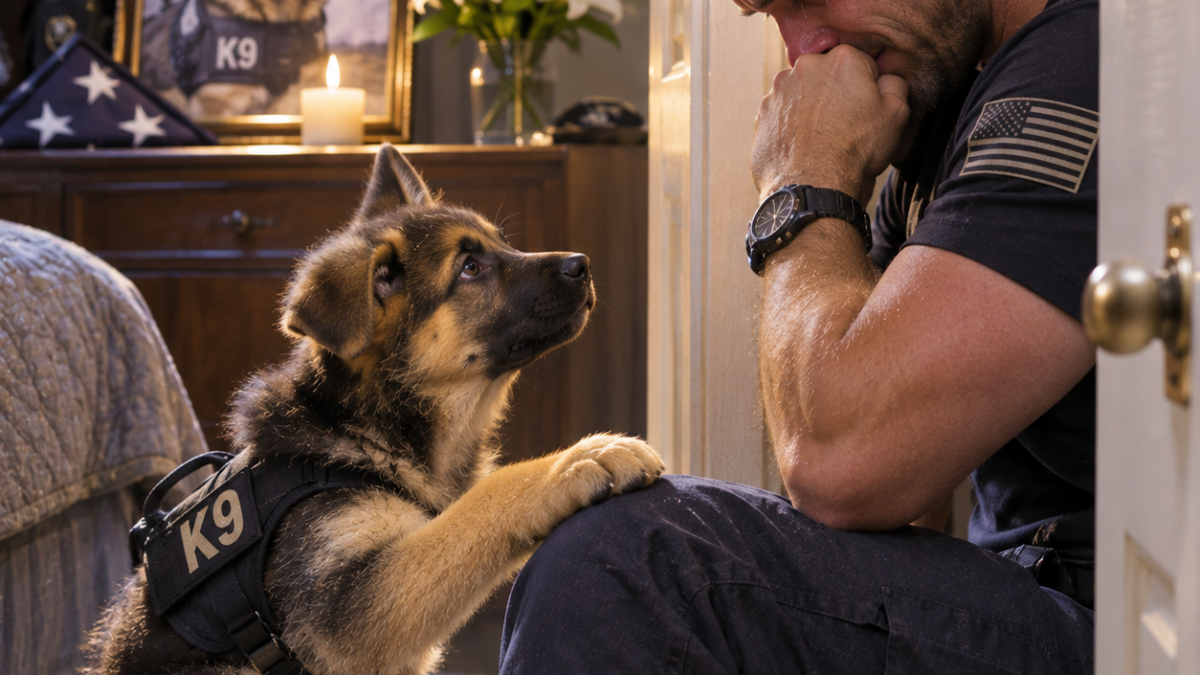
For 22 Mornings, the K9 Puppy Waited Outside My Door—On the 23rd, I Finally Understood What My Fallen Partner Had Been Trying to Teach Me
For twenty-two mornings after my K9 partner Rex died during a special operation, a German Shepherd puppy named Bronx came to my bedroom door before sunrise, scratched twice, gave one soft bark, and waited for a man who had already decided he would never love another dog.
Every morning I lay inches away on the other side, listening to his tiny breaths while grief convinced me that opening the door would somehow mean betraying the partner who had spent eight years protecting my life.
On the twenty-third morning, Bronx placed one trembling paw on my foot, and I finally understood that Rex had not left me a reason to close my heart—he had spent eight years teaching me how to open it again.
My name is Nathan Wright.
For eight years, my partner’s name was Rex.
Not my coworker.
Not my equipment.
Not “the department dog.”
My partner.
A seventy-six-pound German Shepherd with dark sable fur, one slightly bent ear, and the unnerving habit of staring directly at me whenever I was pretending to be fine.
Rex knew every version of me.
The rookie officer trying too hard to impress senior cops.
The man who stayed awake after his first fatal crash because every time he closed his eyes he saw twisted metal.
The officer who laughed too loudly after dangerous calls because the alternative was admitting his hands were still shaking.
The divorced man sitting alone in a silent kitchen at two in the morning.
The partner who occasionally lost patience.
The friend who sometimes needed forgiveness without knowing how to ask for it.
Rex saw all of it.
And he never cared whether I looked strong.
He cared whether I opened the back door on time.
Whether his bowl was full.
Whether the leash meant work.
Whether I said the words he loved more than any others.
“Let’s go.”
People who have never worked beside a K9 sometimes think the relationship is built around commands.
Sit.
Stay.
Track.
Search.
Release.
Those commands matter.
But they are not the relationship.
The relationship lives in thousands of smaller moments.
Rex’s nails clicking across the kitchen tile before dawn.
His head resting against my knee after a fourteen-hour shift.
The way he would spin once inside the cruiser when he realized we were headed somewhere interesting.
The weight of him against my leg during crowded scenes.
The look he gave me before entering a dark building.
That look always said the same thing.
You coming?
Of course I was.
For eight years, if Rex went through a door, I went through it too.
Then came the night I couldn’t follow him back out.
I don’t tell the details often.
Not because I have forgotten them.
Because I remember too much.
It was a special operation supporting a tactical team.
Bad information.
Bad timing.
One decision made by a desperate man inside a building where nobody should have been forced to make decisions at all.
Rex did exactly what he had been trained to do.
Exactly what I asked.
He protected people.
He protected me.
When it ended, I knelt beside him on cold concrete with my hands pressed against his body while someone kept telling me the emergency veterinary team was coming.
I knew before they said it.
Rex knew too.
His eyes stayed on mine.
That was the worst part.
Not fear.
There wasn’t fear in them.
There was trust.
Still.
After everything.
I kept saying his name.
“Rex.”
Again.
“Rex.”
As if the right tone could make eight years stronger than death.
His breathing slowed.
I pressed my forehead against his.
Then he was gone.
And something inside me went with him.
PART2
FULL STORY CONTINUATION
The department held a memorial.
Honor guard.
Flags.
Photographs.
Officers standing in rows.
People told me Rex had been brave.
That he had saved lives.
That he had served with honor.
All true.
None of it helped.
Because after everyone went home, there was still an empty place beside my couch.
His bowl.
His leash.
His hair in the back seat of my cruiser.
A tennis ball beneath the kitchen cabinet that I couldn’t bring myself to pick up.
The house became unbearable after dark.
Silence has weight when you are used to another living creature breathing nearby.
The first night, I slept on the couch because the bedroom felt too far from everything that reminded me of him.
The second night, I barely slept.
The third morning, Captain Morrison arrived at my house.
No warning.
No uniform cap.
Just his jacket and a cardboard pet carrier.
I opened the door.
“What is that?”
“Morning to you too.”
“Morrison.”
He set the carrier down.
Something moved inside.
I stared.
“No.”
He sighed.
“Nathan.”
“No.”
“I haven’t said anything.”
“You brought a dog.”
“A puppy.”
“That is worse.”
He opened the carrier.
A tiny German Shepherd stumbled out.
Too-big paws.
Dark ears that had not decided whether they wanted to stand.
Bright eyes.
The puppy looked around my living room as though he had just inherited the entire property.
Then he spotted my boot.
Walked straight over.
And grabbed the shoelace.
I stared down at him.
Morrison almost smiled.
“Bronx.”
“No.”
“That’s his name.”
“I don’t care what his name is.”
The puppy pulled harder.
I bent down, removed the lace from his mouth, and pointed at Morrison.
“Take him back.”
“I can’t.”
“Then find someone else.”
“Nathan.”
“I said no.”
Morrison’s voice softened.
“I know what you said.”
“Apparently not.”
He looked toward the framed photograph of Rex on my bookshelf.
Then back at me.
“This isn’t Rex.”
“I know.”
“He isn’t supposed to be.”
“Then why is he here?”
“Because he needs somebody.”
“So do a thousand dogs.”
“He’s department-bred.”
“Then give him to another handler.”
“We can.”
“Good.”
Morrison hesitated.
That made me suspicious.
“What?”
“He’s had trouble.”
“He’s ten weeks old.”
“Eleven.”
“Whatever.”
“He was returned by his first placement.”
“Why?”
“Too sensitive.”
I looked at the puppy.
Bronx had released my lace and was now trying to drag one of my slippers across the floor.
Morrison continued.
“He startles at shouting.”
“Great police dog.”
“He’s young.”
“He’s wrong for the job.”
“Maybe.”
“Then why bring him to me?”
“Because you’re the best trainer we have.”
I laughed once.
It sounded ugly.
“I couldn’t keep Rex alive.”
Morrison’s face changed.
There are sentences people wish they could physically take out of the air.
That was one.
“Nathan.”
“Don’t.”
“You did not kill Rex.”
“I sent him.”
“You worked him.”
“I gave the command.”
“He did his job.”
“So did I.”
“Yes.”
Morrison stepped closer.
“And both of you knew the risks.”
I looked away.
The puppy had found Rex’s old tennis ball.
I hadn’t seen it since the night after the memorial.
Bronx nudged it with his nose.
Then looked at me.
Something in my chest tightened.
“No.”
I walked over, took the ball, and placed it on a high shelf.
Bronx sat beneath it.
Waiting.
Morrison watched.
“Just three days.”
“No.”
“Three.”
“You said placement.”
“I lied.”
“Get out.”
“Keep him until Friday.”
“I don’t want him.”
“I know.”
“I won’t train him.”
“Fine.”
“I won’t bond with him.”
“Fine.”
“I’m serious.”
“So am I.”
Morrison moved toward the door.
“Captain.”
He opened it.
“You forgot your dog.”
“No.”
Then he left.
I stood there in disbelief.
Bronx walked over.
Sat on my foot.
And looked up.
“Don’t.”
His tail moved once.
“You are temporary.”
Another tail movement.
“Three days.”
He tilted his head.
“Don’t make this difficult.”
He bit my shoelace again.
The first night, Bronx cried.
Not barked.
Cried.
That thin, piercing puppy whine that somehow travels through walls.
I put his crate in the living room.
Blanket.
Water.
A stuffed toy Morrison had brought.
At 11:00 p.m., crying.
At midnight, crying.
At 1:17, quiet.
At 2:08, crying again.
By three in the morning, I was sitting on the floor beside the crate.
“You’re fine.”
Bronx pressed his nose between the bars.
“You’re safe.”
He whined.
I slid my fingers through.
His small head immediately settled into my palm.
Warm.
Soft.
Trusting.
And suddenly I wasn’t sitting beside Bronx.
I was twenty-seven again.
Rex was twelve weeks old.
First night in my apartment.
Same ridiculous ears.
Same uncertainty.
Rex had cried too.
I had forgotten that.
For years, my memory of Rex began with competence.
Confidence.
Power.
I had erased the puppy.
The clumsy animal who tripped over his own feet.
Chewed a patrol glove.
Peeled wallpaper from my hallway.
Stole half a roast from the kitchen counter and spent two days regretting it.
Bronx’s little head pressed against my hand.
I saw all of that.
And it terrified me.
I pulled my hand away.
He lifted his head.
Confused.
“Sorry.”
I stood.
“I can’t.”
Bronx cried again.
I went to my bedroom.
Closed the door.
And hated myself for the relief I felt when I couldn’t hear him as clearly.
Friday arrived.
Morrison called.
“How’s Bronx?”
“Alive.”
“That good?”
“Come get him.”
Silence.
“Nathan.”
“You said three days.”
“I said keep him until Friday.”
“It’s Friday.”
“You’re right.”
I waited.
Then Morrison said:
“I can’t get there until Monday.”
“You are a terrible human being.”
“Probably.”
“I’m bringing him to the station.”
“No kennel room this weekend.”
“You planned this.”
“I cannot prove or deny that.”
I nearly hung up.
Bronx walked into the kitchen carrying one of my socks.
He looked proud.
I pointed.
“Drop it.”
He did.
Immediately.
I froze.
I had never taught him that command.
Not formally.
Maybe someone at the training facility had.
I picked up the sock.
Bronx sat.
His eyes stayed on me.
Focused.
Waiting for the next instruction.
My trainer brain woke up before grief could stop it.
“Down.”
He lowered his front half, then became confused and sat again.
“Almost.”
I caught myself.
Bronx’s tail moved.
I turned away.
“No training.”
His tail kept moving.
Monday came.
Morrison did not.
Tuesday.
Still no Morrison.
Wednesday morning I called.
“You abandoned a police dog at my house.”
“He is technically still in assessment.”
“Assessment by whom?”
“You.”
“I did not agree.”
“You haven’t returned him.”
“I’ve been busy.”
“With what?”
Silence.
Morrison laughed.
“You trained him.”
“No.”
“Nathan.”
“One command.”
“Which?”
“Down.”
“How is he?”
“Bad.”
“How bad?”
“He anticipates.”
“That sounds terrible.”
“He bites the leash.”
“Tragic.”
“His heel position wanders.”
“He’s eleven weeks old.”
“Twelve now.”
“You know his birthday?”
I stopped.
Morrison stopped too.
Then softly:
“I’ll call next week.”
He hung up before I could answer.
Bronx stayed.
I never officially said yes.
He simply remained long enough for no to become dishonest.
But I kept a wall between us.
I trained him.
Fed him.
Took him outside.
Worked basic obedience.
Introduced environmental sounds.
Made sure he was socialized properly.
Professional.
Correct.
Detached.
That was the word I used.
Detached.
I did not let him sleep in my bedroom.
Did not allow him on the couch.
Did not buy him ridiculous toys.
Did not talk to him while cooking.
Did not tell him about my day.
Those had been Rex things.
I thought protecting them protected Rex.
Bronx did not understand my rules.
He tried anyway.
The first morning it happened, I thought it was coincidence.
Half an hour before sunrise.
Scratching.
Two small scrapes against my bedroom door.
Then one soft bark.
Not the sharp alarm bark I was teaching him.
A little sound.
Almost polite.
Then silence.
I opened my eyes.
Listened.
Nothing.
Eventually, I got up.
When I opened the door, Bronx was lying there.
He lifted his head.
Tail tapped once.
I stepped over him.
“Outside.”
He followed.
The next morning:
Scratch.
Scratch.
Soft bark.
Silence.
Again.
Third morning.
Same.
Fourth.
Same.
By the seventh, I knew it was a routine.
He came half an hour before dawn.
Two scratches.
One bark.
Then waited.
I had not taught him that.
And that was the problem.
Because Rex used to do something similar.
Not identical.
Rex would come to the bedroom doorway after night shifts.
Tap his paw once against the frame.
Then sit.
If I ignored him, his tail would begin hitting the wall.
Thump.
Thump.
Thump.
Eventually I would say:
“Fine. I’m awake.”
Rex would run for the front door.
Bronx never knew Rex.
Could not.
Yet each morning, there he was.
Waiting.
The first few days, I opened the door.
Then I stopped.
It started after a nightmare.
Rex.
Concrete.
The final operation.
Same scene.
Again.
Again.
I woke sweating.
Heart racing.
Then heard:
Scratch.
Scratch.
Soft bark.
Bronx.
Something in me panicked.
Not because the dog was dangerous.
Because he wasn’t.
Because if I opened that door, I knew exactly what would happen.
He would enter.
Look at me.
Trust me.
And eventually I would love him.
Then someday, one way or another, I would lose him.
Every dog dies.
Every partnership ends.
Every attachment creates an eventual wound.
Grief had turned that truth into a threat.
So I stayed in bed.
Bronx waited.
At 6:15, he finally wandered away.
The next morning, he returned.
Scratch.
Scratch.
Bark.
Wait.
I did not open.
Again the next day.
And the next.
Morrison visited after the tenth morning.
Bronx greeted him like a missile.
Morrison crouched.
“Look at you.”
Bronx climbed halfway into his lap.
I stood by the kitchen counter.
“He’s getting too attached.”
Morrison looked up.
“To you?”
“To everyone.”
“That is called socialization.”
“You know what I mean.”
“No.”
“He waits outside my door.”
Morrison smiled.
“Good.”
“No.”
“Nathan.”
“I don’t like it.”
Bronx brought him a toy.
Morrison threw it.
“He likes you.”
“That isn’t the problem.”
“What is?”
I stared at him.
He knew.
Of course he knew.
He stopped smiling.
“Nathan.”
“No.”
“You can say his name.”
“I say Rex’s name.”
“I mean what happened.”
“I know what happened.”
“You’re acting like loving Bronx would betray him.”
I looked away.
Morrison continued.
“Rex isn’t keeping score.”
“Don’t.”
“You think he’d be jealous?”
“I said don’t.”
“He spent eight years teaching you partnership.”
My jaw tightened.
“And now you’re using him as an excuse to avoid it.”
That hit.
I turned.
“You can leave.”
Morrison stood.
“Nathan.”
“Get out.”
He walked to the door.
Then stopped.
“Bronx won’t wait forever.”
I looked at him.
“Dogs are resilient.”
“So are people.”
Then he left.
I hated him for three days.
Because he was right about one thing.
I was using Rex.
Not intentionally.
But grief can borrow the voice of loyalty.
It tells you moving forward means leaving someone behind.
So you stand still and call it devotion.
The twelfth morning:
Two scratches.
Bark.
Wait.
I stared at the ceiling.
I remembered Rex’s first successful track.
Rainy night.
Missing six-year-old boy.
He had wandered from a campground.
Rex was eighteen months old.
Still inexperienced.
He found the boy curled beneath a fallen tree.
When I reached them, Rex was lying beside him.
The child had one fist tangled in Rex’s fur.
Rex looked at me as if he’d done nothing remarkable.
That was the first time I understood what he could become.
The thirteenth morning:
Scratch.
Scratch.
Bark.
I remembered Rex visiting schools.
Children touching his ears.
His absolute patience.
The fourteenth:
I remembered the time he refused to leave the cruiser because I had forgotten his reward toy.
He stared at me.
I stared at him.
Ten minutes.
He won.
The fifteenth:
I remembered him sleeping beside my couch after my divorce.
No training.
No work.
Just there.
The sixteenth:
I remembered the night an officer was badly injured and I came home covered in another man’s blood.
Rex sniffed my uniform.
Then climbed onto the couch despite knowing he wasn’t allowed.
Pressed his whole body against mine.
I never corrected him.
The seventeenth:
I remembered his gray muzzle beginning.
The first sign that eight years was not forever.
The eighteenth:
I remembered his final look.
That one nearly broke me.
Bronx changed while I was trapped in memory.
His ears rose.
Mostly.
One still tipped at the top when he was tired.
His paws remained too large.
His coordination improved.
He learned sit.
Down.
Stay.
Come.
Heel.
Place.
Drop.
Leave it.
He loved tug games.
Hated rain.
Fascinated by ceiling fans.
Terrified of the vacuum for exactly three days, then decided it needed to be herded.
He stole ice cubes.
He sneezed when excited.
He slept upside down.
None of those things belonged to Rex.
Slowly, without permission, Bronx became impossible to compare.
That should have made it easier.
Instead, it made the danger more obvious.
He was becoming himself.
Which meant I was beginning to know him.
On the nineteenth morning, I stood on the other side of the door.
Hand on the knob.
Bronx scratched twice.
Barked.
Then sat.
I could hear his breathing.
Fast puppy breaths.
I nearly opened.
Then I saw Rex’s collar hanging from the dresser mirror.
Black leather.
Brass tag.
My hand dropped.
I returned to bed.
Bronx remained outside for almost forty minutes.
No whining.
No scratching again.
Just waiting.
That somehow hurt worse.
The twentieth morning, he did the same.
The twenty-first was the worst.
I woke before the scratches.
Lay there watching the light under the door.
Then:
Scratch.
Scratch.
Bark.
Silence.
I got up.
Walked across the bedroom.
Placed my hand on the knob.
Bronx shifted outside.
His collar tag touched the floor.
Tiny metal sound.
I whispered:
“Go away.”
He stayed.
“Bronx.”
Nothing.
“Go lie down.”
He stayed.
My forehead rested against the door.
“I can’t do this.”
Of course he did not answer.
Dogs don’t give speeches.
Sometimes that is why we tell them things we cannot tell people.
“I loved him.”
My throat closed.
“I loved him so much.”
Bronx breathed under the door.
“And if I let you…”
I couldn’t finish.
Because saying it aloud made the fear childish and enormous at the same time.
If I love you, I can lose you.
That was the equation.
The only one grief allowed.
I stepped back.
Returned to bed.
Bronx waited.
Then eventually left.
I hated myself.
The twenty-second night, I did not sleep.
I sat on the edge of my bed.
No lights.
Rex’s collar in my hands.
I traced the worn leather.
Eight years.
I thought about his first day.
Before he was Rex the K9.
Before commendations.
Before searches.
Before tactical calls.
Before gray muzzle.
A puppy.
He chewed my shoelace too.
I had forgotten until Bronx arrived.
Rex had been afraid of stairs.
The first week, I carried him.
He once barked at a statue for six straight minutes.
He destroyed a pillow.
He got carsick in my cruiser.
He learned.
We learned.
Partnership had not arrived complete.
We built it.
Morning after morning.
Shift after shift.
Failure.
Correction.
Trust.
Then I remembered his final eyes.
For twenty-two days, I had interpreted them as goodbye.
That night, for the first time, I remembered something else.
There had been no accusation there.
Rex was not asking:
Why did you send me?
He wasn’t telling me:
Never do this again.
His eyes had been calm.
Trusting.
Grateful.
The same look he gave me when a shift ended and I unclipped his harness.
We did it.
Eight years.
We did it.
And suddenly I realized how badly I had misunderstood grief.
Opening my heart to Bronx would not mean Rex mattered less.
Rex was the reason I knew what partnership could become.
The reason I knew how to train this frightened puppy.
How to recognize focus.
How to reward courage.
How to read the smallest change in posture.
Rex had not left a hole because love failed.
The hole existed because love had succeeded so completely.
I looked at the collar.
Then whispered:
“What am I supposed to do now, buddy?”
Silence.
Of course.
Then I laughed softly.
Because if Rex could have answered, I already knew.
He would probably stare at the bedroom door.
You going?
The twenty-third morning, I woke before Bronx.
4:52 a.m.
Dark.
Cold.
I stood beside the door.
Waited.
At 5:07, soft footsteps approached.
Then:
Scratch.
Scratch.
One gentle bark.
Silence.
My hand rested on the knob.
For twenty-two mornings, that knob had felt like a boundary between safety and loss.
That morning, it felt like a door.
Nothing more.
I opened it.
Bronx sat there.
Exactly where he always sat.
Little body trembling slightly in the cool hallway.
Dark eyes on mine.
He did not jump.
Did not rush me.
Did not bark again.
He simply looked.
I crouched.
“Hey.”
His ears shifted.
“You waited.”
His tail touched the floor once.
Then, slowly, Bronx lifted his right paw.
Placed it on my foot.
Something in me broke open.
I dropped to my knees.
Pulled him against my chest.
He stiffened for half a second.
Then melted into me.
I buried my face in his fur.
And cried.
Not the silent kind I had been doing at night.
Ugly crying.
Shoulders shaking.
Breath catching.
Twenty-two days of grief.
Eight years of memory.
One dead partner.
One living puppy.
Bronx licked my cheek.
Then my nose.
Then tried to chew my ear.
I laughed while crying.
First laugh since Rex died that didn’t feel stolen.
“You idiot.”
His tail exploded.
Whole body moving.
He climbed into my lap.
I held him tighter.
“I’m sorry.”
He licked me again.
“You don’t know what I’m saying.”
Tail.
“Probably better.”
I sat there until the hallway grew lighter.
That morning, I did two things I had not done since Rex died.
I made breakfast.
For myself.
Not coffee.
Actual food.
Eggs.
Toast.
And I prepared Bronx’s bowl before he had to remind me.
We sat on the living-room floor.
I ate.
He ate.
Halfway through, Bronx looked up with food stuck to his nose.
I laughed.
“Professional.”
He returned to eating.
When we finished, I carried the bowls to the kitchen.
Then looked at him.
He sat automatically.
Focused.
Waiting.
There are phrases that become sacred because of repetition.
I had not said this one since Rex died.
I thought I would never say it again.
“Okay, Bronx.”
His ears lifted.
“Let’s work.”
The tail started.
Not wagging.
Violently beating the floor.
His whole body twisted.
He knew.
Maybe not the words.
The energy.
The invitation.
Team.
I clipped on his leash.
Opened the front door.
Cold morning air entered.
For one second, I saw Rex beside me.
Not literally.
Memory.
Warm.
Then Bronx pulled toward the steps.
“Easy.”
He looked back.
I smiled.
“Yeah.”
I stepped outside.
“I’m coming.”
Morrison arrived at the training field that afternoon.
He saw us before I saw him.
Bronx was working place commands on elevated platforms.
Not perfectly.
He anticipated release twice.
Tried to chase a leaf.
Puppy.
Morrison leaned against the fence.
I noticed.
“You.”
“Me.”
“You planned this.”
“What?”
“All of it.”
“I have no idea what you’re talking about.”
“You abandoned him at my house.”
“I strategically delayed reassignment.”
“You lied.”
“Leadership technique.”
I almost smiled.
He looked at Bronx.
Then me.
“Keeping him?”
I looked toward the dog.
Bronx sat on the platform.
One ear tipped sideways.
Waiting.
“Yes.”
Morrison nodded.
Nothing triumphant.
Just:
“Good.”
Then he turned away.
“Captain.”
He stopped.
“Thank you.”
He looked back.
“For what?”
“You know.”
Morrison’s expression softened.
“Rex would’ve hated him.”
I stared.
Then realized he was joking.
“He would’ve stolen Rex’s toys.”
“Exactly.”
I laughed.
Morrison walked away.
That was the first day I understood that remembering Rex could include laughter again.
Training Bronx was not a miracle.
It was work.
Lots of work.
The sentimental version of the story would have him become perfect because love healed me.
No.
Bronx was a menace.
At four months, he stole a sandwich from an instructor’s hand.
At five months, he became obsessed with traffic cones.
At six, he developed selective hearing whenever squirrels appeared.
He failed his first building-search assessment because a mop bucket scared him.
I stood in the training facility staring at him.
“You are supposed to be brave.”
Bronx barked.
The mop bucket remained undefeated.
We worked.
Slow exposure.
Reward.
Confidence.
A week later, he walked past it.
Two weeks later, he ignored it.
A month later, he knocked one over and looked offended that it moved.
Progress.
Not transformation.
That helped me too.
Healing was not one morning at the door.
That morning was permission to begin.
The actual healing happened during ordinary repetition.
Feed.
Walk.
Train.
Fail.
Try again.
Sleep.
Wake.
Scratch.
Scratch.
Bark.
Open.
Bronx became fascinated with my uniform.
The first time I put on full duty gear after leave, he followed me room to room.
Vest.
Belt.
Boots.
Radio.
His energy changed.
Working-dog recognition.
When I picked up the training harness, he sneezed three times.
Excitement.
I crouched.
“This belonged to Rex.”
Bronx sniffed it.
I had cleaned it.
Still, maybe some scent remained.
Maybe not.
He looked at me.
No supernatural recognition.
No sign from beyond.
Just a young dog waiting for instruction.
I appreciated that.
He did not need to carry Rex.
I did.
And I was learning how.
My first patrol without Rex had happened before Bronx was ready.
Human partner.
Normal cruiser.
No dog in back.
I hated every second.
I kept glancing toward the rear compartment.
Empty.
Muscle memory.
At one stop, I reached for a leash that wasn’t there.
My partner, Jacobs, saw.
Said nothing.
After shift, he handed me coffee.
“You good?”
“No.”
“Okay.”
That was all.
Good coworkers know when not to demand improvement.
Months passed.
Bronx grew.
The too-large paws became proportional.
His dark saddle deepened.
Both ears eventually stood.
Mostly.
When exhausted, the right one still softened at the tip.
I loved that.
Would not admit it publicly.
He developed an extraordinary nose.
Not Rex’s style.
Rex tracked with almost frightening intensity.
Head low.
Direct.
Bronx worked differently.
More air scent.
More checking.
At first, I corrected him too much.
Trainer Collins finally stopped me.
“You’re asking him to be Rex.”
“No.”
“Yes.”
“He’s inefficient.”
“He’s accurate.”
I watched Bronx circle.
Then commit to the correct route.
Collins said:
“Different dog.”
Those two words landed beyond training.
Different dog.
Of course.
I had spent months saying Bronx was not replacing Rex.
Then unconsciously measured every skill against him.
Different dog.
Different partner.
Different relationship.
That evening, I scratched Bronx behind the ears.
“You’re weird.”
Tail.
“But apparently effective.”
He sneezed.
“Don’t get arrogant.”
Too late.
His certification day came eleven months after Rex died.
Search.
Obedience.
Control.
Environmental stability.
Scenario work.
I had barely slept.
Ridiculous.
I had taken tactical exams with less anxiety.
Bronx passed the first phase.
Then second.
During the final scenario, he hesitated at a dark stairwell.
Old fear.
Not mop bucket.
Something about confined descending spaces.
My heart tightened.
Evaluator said:
“Handler.”
I crouched.
Bronx looked at me.
I did not pull.
Did not command sharply.
Just:
“Bronx.”
His eyes met mine.
“I’m with you.”
A sentence I used to say to Rex.
Not as command.
Promise.
Bronx stepped forward.
One stair.
Then another.
Then committed.
He found the decoy.
Indicated correctly.
Passed.
When the evaluator handed me the certification paperwork, I stared at it.
K9 BRONX — HANDLER: OFFICER NATHAN WRIGHT
My eyes blurred.
Collins pretended not to notice.
Morrison did not.
He hugged me.
Which was deeply inappropriate for captain behavior.
I allowed it anyway.
Our first official patrol together began before dawn.
Bronx in the cruiser.
New harness.
New badge number.
I adjusted the rear-view mirror.
He sat behind the barrier, vibrating with anticipation.
“You ready?”
Bark.
“That’s not an answer.”
Bark.
I smiled.
“Fine.”
We pulled out.
For the first mile, I felt guilty.
There.
I admit it.
Not grief.
Guilt.
The cruiser had been Rex’s.
The job had been Rex’s.
The radio chatter.
The equipment.
The roads.
How could all of it continue?
Then Bronx sneezed and smashed his nose against the window because he saw a bird.
I laughed.
The guilt loosened.
Rex had never cared about birds.
Different dog.
Our first call requiring Bronx was not dramatic.
A burglary suspect ran from a garage.
We conducted a track.
Bronx followed through two yards.
Lost scent near an alley.
Reacquired.
Found the man hiding behind a dumpster.
Nobody hurt.
No heroic music.
Just competent work.
Afterward, I gave Bronx his reward toy.
He pranced around the cruiser like he had solved international crime.
I radioed clear.
Then sat beside him for a moment.
“You did good.”
He pushed the toy into my stomach.
“Okay.”
Again.
“Very professional.”
He shoved it harder.
I played tug.
That night, I took Rex’s old photograph from the bookshelf.
Placed Bronx’s certification photo beside it.
Not replacing.
Beside.
That small word mattered.
People began asking whether Bronx reminded me of Rex.
At first, the question annoyed me.
Later, I understood what they meant.
Sometimes.
Not in appearance as much as people expected.
Not in work style.
But in moments.
A head against my knee.
Waiting outside a room.
The absolute trust before entering somewhere unfamiliar.
Once, during a thunderstorm, Bronx lay across my feet.
Rex had done that.
Memory arrived gently.
No knife.
Just warmth.
That was when I realized grief had changed shape.
It still existed.
It always would.
But it no longer demanded that every memory hurt.
Some memories came home quietly.
Sat beside me.
Stayed.
I kept Rex’s collar.
Still do.
It hangs near the photographs.
Bronx sniffed it occasionally when he was young.
Eventually it became furniture.
One day, around Bronx’s first birthday, I found him sleeping beneath it.
I stood there.
Watched.
No mystical interpretation.
Dogs sleep where they sleep.
Still, something about the image softened me.
I took a photograph.
Never posted it.
Some moments don’t need an audience.
Captain Morrison asked me once:
“How did you get over Rex?”
We were standing outside headquarters after shift.
Bronx drinking water from a portable bowl.
I looked at Morrison.
“I didn’t.”
He waited.
“I don’t think that’s how it works.”
“What works?”
“Grief.”
I watched Bronx finish drinking.
“Rex is still there.”
I touched my chest without meaning to.
“Not like a ghost.”
“Everything he taught me.”
“How to read a dog.”
“How to trust.”
“How to work.”
“How to get back in the cruiser after a terrible call.”
“How to sit quietly when somebody doesn’t need fixing.”
Morrison nodded.
“And Bronx?”
I smiled.
“Bronx gets the benefit of Rex teaching me first.”
Morrison looked toward him.
“That’s a decent legacy.”
“Yes.”
Then Bronx knocked the water bowl over.
Morrison laughed.
“Beautiful legacy.”
“Shut up.”
The twenty-three mornings remained our private ritual.
Even after Bronx began patrol.
Before dawn.
Two scratches.
One bark.
I opened the door.
Eventually I stopped closing it fully.
Bronx still performed the routine.
Door partly open?
Scratch against frame.
Soft bark.
Wait.
I would sit on the floor.
Rub his head.
“Morning, buddy.”
Then coffee.
Food.
Work.
Some mornings I wondered why he still waited instead of simply pushing inside.
Maybe training.
Maybe habit.
Maybe because dogs are better at rituals than humans.
Ritual tells the nervous system:
We are still here.
We know what comes next.
That became important to both of us.
On the anniversary of Rex’s death, I took Bronx to the memorial.
Early.
Before anyone else.
Rex’s plaque stood near the training grounds.
Name.
Badge number.
Years of service.
Bronx sniffed the base.
Then tried to pee on the bush beside it.
I pulled him away.
“Absolutely not.”
He looked offended.
I laughed.
Then cried immediately afterward.
Grief is ridiculous.
I knelt.
Touched Rex’s name.
“I brought the kid.”
Bronx sat.
For once, perfectly still.
I continued quietly.
“He’s good.”
Pause.
“Different.”
Bronx looked at me.
“Very annoying.”
Tail.
“I think you’d like him.”
That sentence broke something loose.
I cried.
Bronx leaned against me.
Not replacing Rex.
Not carrying a message.
Just Bronx.
There.
That was enough.
I used to believe moving forward meant moving away.
It doesn’t.
You can carry something and still move.
That’s the trick.
For twenty-two mornings, I thought opening the door meant closing a chapter.
But grief isn’t a book.
Rex did not need an ending for Bronx to have a beginning.
They could exist in the same story.
Just not the same role.
Bronx turned one.
Morrison brought a cake from a dog bakery.
Ridiculous.
Bone-shaped.
Blue frosting.
I stared.
“You bought my dog a birthday cake.”
“Department morale.”
“You wrote his name on it.”
“Professional courtesy.”
Bronx ate half too fast.
Spent the next hour lying on the floor regretting his choices.
I looked at Morrison.
“Great leadership.”
“You let him eat it.”
“Get out.”
Bronx recovered.
Of course.
Youth.
He developed his own reputation.
Rex had been known for steadiness.
Bronx became known for persistence.
If he lost scent, he worked.
And worked.
And worked.
Once during a missing-person search, we spent nearly four hours in rough terrain.
Older man with dementia.
Cold night.
Bronx found a glove.
Then trail.
Then the man sitting near a drainage culvert.
Hypothermic but alive.
Paramedics moved in.
I crouched beside Bronx.
His tongue hanging out.
Mud across his chest.
“You did it.”
He leaned against me.
For a second, I remembered the six-year-old Rex found years earlier.
Two dogs.
Two lives.
Same human beside them.
Not replacement.
Continuation.
That word finally felt right.
A reporter covering the rescue asked:
“Is Bronx related to your former K9?”
“No.”
“He seems to have big shoes to fill.”
I hated that sentence.
“No.”
She looked surprised.
“He has his own shoes.”
Then I realized dogs do not wear shoes.
The reporter smiled.
I did too.
The quote ran anyway.
Morrison mocked me for months.
The public sometimes treats K9s like machines.
Perfect courage.
Perfect obedience.
Not true.
They have fears.
Preferences.
Bad days.
Bronx once refused to walk past a Halloween animatronic skeleton outside a store.
I, a certified K9 officer, spent four minutes negotiating with a dog because a plastic skeleton moved its jaw.
A child watched.
Judged both of us.
Rex would never have cared.
Bronx eventually approached.
Sniffed it.
Then barked once as though announcing victory.
Different dog.
I loved him for it.
That was when the sentence became easy.
I loved Bronx.
At first, saying it internally triggered guilt.
Then sadness.
Then nothing except truth.
Love does not have a fixed capacity.
Rex did not occupy a seat Bronx needed.
That had been my mistake.
He occupied his own place.
Permanent.
Bronx built another.
Different shape.
Different memories.
Different sounds at night.
Different ridiculous habits.
There was room.
There had always been room.
Grief just convinced me there wasn’t.
One night, about eighteen months after Rex died, I woke from the old nightmare.
Less frequent by then.
Still happened.
Concrete.
Rex.
My hands.
His eyes.
I sat up.
Breathing hard.
Before I could orient myself:
Scratch.
Scratch.
Soft bark.
I looked at the door.
It was open three inches.
Bronx could have entered.
He waited anyway.
I got up.
Opened it fully.
He sat.
“Come here.”
He walked in.
Jumped onto the bed.
Not allowed.
I didn’t care.
He curled against my legs.
I lay down.
Hand in his fur.
My heart slowed.
And for the first time after that nightmare, I did not replay the end.
I remembered the beginning.
Rex as a puppy.
Shoelace.
Stairs.
First track.
First successful search.
Eight years.
Not one night.
That was Bronx’s final gift to me, though he never knew it.
He helped my memory stop ending at Rex’s death.
People sometimes ask whether dogs understand grief.
I don’t know.
I’m not a scientist.
I know behavior.
I know Bronx knew when I was different.
He knew when my breathing changed.
When my body became tense.
When I sat too long without moving.
Maybe he responded to scent.
Posture.
Routine.
Maybe none of that matters.
Compassion doesn’t become less meaningful because biology explains part of it.
Humans work the same way.
We notice.
We respond.
Dogs simply do it without making speeches.
I eventually began helping train new handlers.
Not because I wanted to become the department grief expert.
Absolutely not.
But younger officers asked about Rex.
Then Bronx.
One handler lost his K9 to cancer.
He called me.
“I can’t do another dog.”
I recognized the sentence.
I said:
“Then don’t.”
He went quiet.
“What?”
“Not now.”
“But everyone says getting another partner will help.”
“Maybe.”
I remembered Morrison dumping Bronx in my living room.
“Maybe not.”
“What did you do?”
“I was terrible company for twenty-two days.”
He laughed despite himself.
Then:
“How did you know when you were ready?”
“I didn’t.”
“What changed?”
“I opened a door.”
He probably thought metaphor.
I let him.
Six months later, he took another K9.
Sent me a photograph.
No caption.
I understood.
Bronx continued the morning ritual through adulthood.
Two scratches.
One bark.
Wait.
On days off.
Work days.
Holidays.
Even after I started dating someone seriously.
Her name was Emily.
Veterinary nurse.
Patient enough to understand that entering a relationship with a K9 handler meant there were technically three of us.
The first night she stayed over, Bronx performed the routine at 5:03.
Scratch.
Scratch.
Bark.
Emily sat up.
“What is that?”
“Bronx.”
“Why doesn’t he just come in?”
I smiled.
“Long story.”
She opened the door.
Bronx stared at her.
Then around her toward me.
I laughed.
“Apparently you’re not authorized.”
Emily moved aside.
He entered.
Sat beside the bed.
She looked at me.
“You’re both weird.”
Correct.
I eventually told her the whole story.
Rex.
The operation.
Bronx.
Twenty-two mornings.
The twenty-third.
Emily listened.
Then asked:
“Do you think Bronx was waiting for you to love him?”
I thought.
“No.”
“What then?”
“I think he was waiting because waiting was what he did.”
Dogs do not build dramatic narratives around patience.
Humans do.
Bronx probably wanted breakfast.
Outside.
Company.
But meaning does not require intention.
His waiting gave me time.
Sometimes that’s enough.
Years later, Bronx began developing gray around his muzzle.
I hated it.
The first hairs appeared near his chin.
I noticed during a morning scratch.
“Absolutely not.”
He sneezed.
“You are not allowed.”
More gray followed.
Time does not negotiate.
That was the second lesson grief tried to teach me.
Loving again did not remove loss.
It guaranteed another version someday.
But this time, I understood something I hadn’t with Rex.
The eventual ending did not invalidate the years before it.
If fear of loss had won, I would have missed Bronx’s entire life.
Every search.
Every morning.
Every stupid ceiling-fan obsession.
Every person he found.
Every child he allowed to touch his ears.
Every night his head rested on my foot.
I could see the gray and still be grateful.
That was growth.
Painful.
Real.
Rex had taught me courage during danger.
Bronx taught me courage before love.
Different lessons.
Both needed.
When Bronx retired, he stayed with me.
Of course.
No ceremony could persuade him otherwise.
The department gave him a plaque.
Morrison, already retired, came back.
Bronx was older.
Still strong.
Slower.
Morrison crouched.
“Well, kid.”
Bronx sniffed him.
Then searched his pockets for treats.
Morrison laughed.
“Some things never change.”
I looked at the plaque.
Years of service.
Again.
Time looping.
Not repeating.
Different.
After retirement, Bronx still woke before dawn.
Two scratches.
One bark.
Wait.
No patrol.
No cruiser.
No work.
He simply wanted morning.
I opened the door every time.
His final years were quiet.
Walks.
Backyard.
Visits from Emily.
Children in the neighborhood who knew him as “Officer Bronx.”
Ridiculous.
He deserved it.
Sometimes I took him to the training field.
He watched younger dogs work.
Alert.
Interested.
Then tired.
One afternoon, a young German Shepherd barked badly during obedience.
Bronx looked at me.
I swear the expression was judgment.
“You were worse.”
He looked away.
Liar.
I had once promised myself I would never love another dog because I could not survive losing one again.
That promise was made by a grieving man who believed survival meant avoiding pain.
Bronx taught me something better.
Survival means allowing joy even when pain remains possible.
Especially then.
When Bronx eventually died years later, it hurt.
Of course it did.
I will not turn that into a cheap surprise ending.
He grew old.
His body slowed.
We had time.
More than Rex and I received.
On his final morning, he could no longer make it to my bedroom door.
I woke anyway.
Before dawn.
Something felt wrong.
Maybe habit.
Maybe love.
I found him on his bed in the living room.
Eyes open.
Breathing slowly.
I sat beside him.
“Hey, buddy.”
His tail moved once.
Very small.
I placed my hand on his head.
He leaned into it.
Same trust.
Different dog.
Different goodbye.
Emily came.
Our veterinarian helped us at home.
No fluorescent clinic.
No panic.
No concrete.
Just morning light.
My hand in his fur.
I whispered:
“Good boy.”
Then:
“Thank you for waiting.”
Bronx died with his head in my lap.
And yes.
I broke again.
But not the same way.
Because grief was no longer proof that love had been a mistake.
Grief was the receipt.
The price of years I would never trade.
Afterward, my house became quiet.
Again.
Painfully familiar.
I removed his bowl after a week.
Not because I wanted him gone.
Because I had learned I did not need objects frozen in place to prove love.
I kept his collar.
Placed it beside Rex’s.
Two collars.
Two photographs.
Two partners.
Neither replacing the other.
Morrison called.
Older voice.
“How are you?”
“Terrible.”
“Good.”
I laughed through tears.
“What?”
“You’re not closing the door this time.”
He was right.
I grieved.
I ate.
I saw people.
I went outside.
I told stories about Bronx.
I cried.
I laughed.
I did not mistake pain for instruction.
That was his legacy.
Months later, the department asked whether I would foster another young K9 prospect.
Emily watched my face.
I looked toward the collars.
Rex.
Bronx.
Then laughed.
“What breed?”
The captain smiled.
“German Shepherd.”
“Of course.”
“Trouble with confidence.”
I shook my head.
“Apparently I have a type.”
The puppy arrived Saturday.
Small.
Big feet.
Impossible ears.
He walked into my living room.
Ignored the shoelaces.
Stole a dish towel.
I laughed.
“Different dog.”
Emily smiled.
“Different dog.”
I did not know whether he would become my partner.
Maybe not.
That wasn’t the point.
The door was open.
That is the part of my story people misunderstand.
Bronx did not teach me to replace Rex.
Rex did not somehow send Bronx.
I don’t know how the universe works.
I know what happened inside one house for twenty-three mornings.
A grieving man closed a door.
A puppy waited.
The man mistook grief for loyalty.
The dog kept returning.
Eventually, the man realized that love does not demand permanent emptiness as proof that the first love mattered.
Then he opened the door.
That was all.
And everything.
If I close my eyes now, I can still hear them.
Rex’s tail against the wall.
Thump.
Thump.
Thump.
Bronx’s paws against the bedroom door.
Scratch.
Scratch.
Then one small bark.
Two different sounds.
Same lesson.
You coming?
For years, I thought courage meant entering dangerous places.
Running toward gunfire.
Following a dog into darkness.
Standing beside people on their worst nights.
Those things require courage.
But the hardest courageous thing I ever did happened in a quiet hallway before sunrise.
I turned a doorknob.
Rex gave me eight years.
Bronx gave me many more.
Neither one belonged to me forever.
Nothing does.
That does not make love foolish.
It makes time valuable.
I wish I had understood that when I sat beside Rex on the concrete.
Maybe I couldn’t have.
Some lessons require surviving the question first.
Captain Morrison once told me I was the best handler he knew.
He was wrong.
Rex trained me.
Then Bronx finished the job.
Rex taught me what partnership could become when trust was built every day.
Bronx taught me that losing it once did not mean I had to reject it forever.
Together, they gave me something no certification ever could.
The ability to understand that grief and gratitude can occupy the same heart.
You do not have to evict one to make room for the other.
I still wake before dawn sometimes.
Old habit.
The house quiet.
No scratches.
No bark.
For a moment, I miss both of them so much it physically hurts.
Then I make coffee.
Open the back door.
Morning air comes in.
And I remember the twenty-third morning.
Bronx sitting there.
Shivering slightly.
Waiting.
One paw on my foot.
The instant I understood he wasn’t asking me to forget.
He was asking me to live.
There are endings that close doors.
There are endings that teach you how to open the next one.
Rex’s death felt like the first kind.
Bronx turned it into the second.
Not by replacing him.
Not by healing me overnight.
By waiting.
Morning after morning.
Until I was ready to understand that keeping Rex in my heart did not require keeping everything else outside it.
If Rex could have seen me on that twenty-third morning, kneeling in the hallway with Bronx wrapped against my chest, I don’t think he would have felt replaced.
He would probably have been impatient.
Probably standing near the front door.
Probably looking at me with that old expression.
Enough crying.
We have work.
And maybe that is why, after all these years, whenever I think about both dogs, I no longer remember only how they died.
I remember how they lived.
Rex racing toward the cruiser.
Bronx destroying my shoelaces.
Two partners.
Two beginnings.
Two endings.
One life made larger because I was lucky enough to love them both.
For twenty-two mornings, Bronx waited outside a closed door while I convinced myself that grief was the only way to remain loyal to Rex.
On the twenty-third, I finally opened it.
Bronx placed one paw on my foot.
I knelt.
Held him.
Cried.
And discovered the truth I had been too afraid to see:
Opening my heart to another dog did not mean I had finally let Rex go.
It meant Rex had taught me well enough to love again.
And every morning after that, whenever I heard two scratches and one soft bark, I opened the door.
Not because the pain was gone.
Not because Rex mattered less.
But because Bronx had waited long enough for me to understand what my first partner had been trying to teach me for eight years:
Love does not survive by closing the door after loss. It survives because, somehow, when the next frightened heart comes looking for us, we find the courage to open it again.








