“DON’T WAIT HERE ANY LONGER, OLD BOY… PLEASE!” Everyone Passed the Gray Dog Who Refused to Leave His Abandoned Home — Until a 76-Year-Old Widow Looked Into His Eyes and Realized He Was Slowly Giving Up on Life
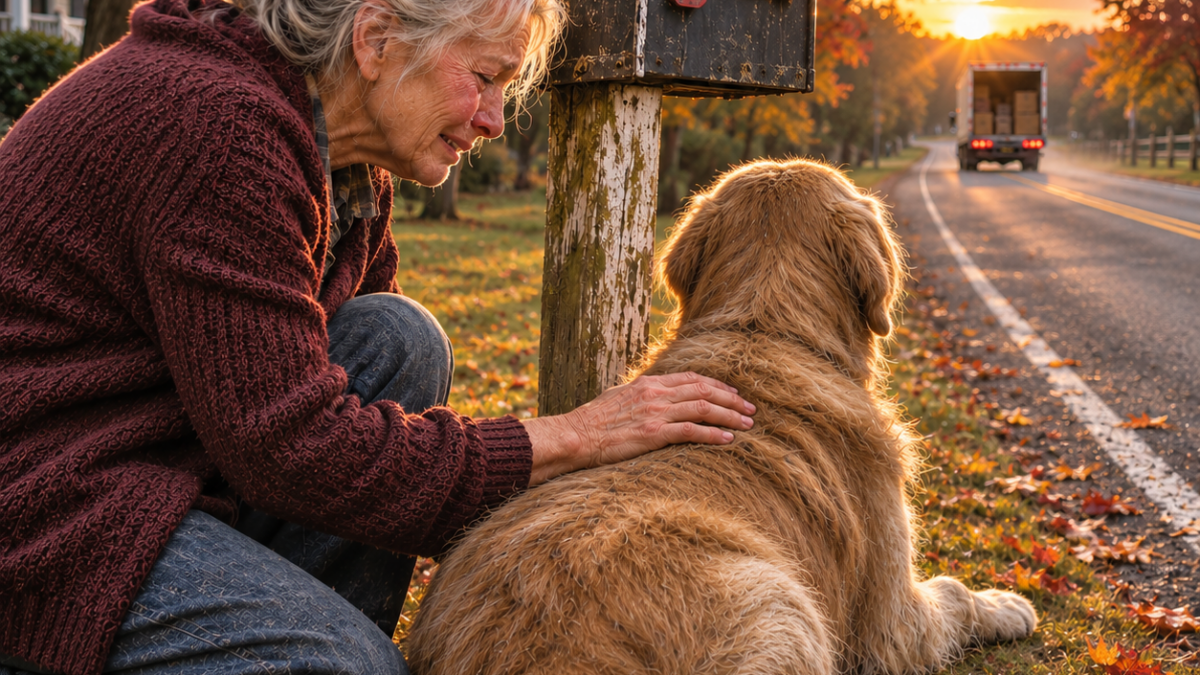
“THEY TOOK EVERYTHING BUT THE DOG!” An Abandoned Old Dog Waited Beside the Road for His Family—Until a 76-Year-Old Widow Recognized the Heartbreak in His Eyes
“THEY’RE NOT COMING BACK, BOY!” a passing stranger called, but the old gray dog wouldn’t move from beside the mailbox, even after the last truck carrying his family’s belongings had disappeared down the road.
For days, Rocky sat in the same spot, staring toward the bend where his owners had vanished, refusing to understand that the people he’d loved had taken their furniture, their clothes, and every possession they considered valuable—but had left him behind.
And when rescue worker Michael finally brought the heartbroken dog to safety, he discovered that saving Rocky from the roadside would be much easier than convincing him there was still a reason to live.
The first thing Michael noticed was the silence.
The house was empty.
The windows were dark.
The porch had been swept clean.
Even the old flowerpots were gone.
Nothing remained to suggest that a family had once lived there, except a weathered mailbox at the end of the driveway and a large gray dog sitting beside it.
Rocky.
That was the name Michael would come to know.
But on that first afternoon, he was simply an abandoned dog who refused to leave the place where his world had disappeared.
Michael parked his rescue vehicle along the shoulder.
The dog lifted his head.
For one brief moment, his tail moved.
Then he looked past the vehicle, toward the road.
Waiting.
Michael stepped out slowly.
“Hey, buddy.”
The dog didn’t bark.
Didn’t growl.
Didn’t approach.
He simply stared beyond Michael’s shoulder.
A car passed.
Rocky’s ears rose.
He stood.
For a second, his entire body seemed to come alive.
But the car continued without slowing.
Rocky’s tail stopped.
His ears lowered.
And he sat beside the mailbox again.
Michael felt something tighten in his chest.
He had worked with abandoned animals for years. He had seen frightened dogs hiding beneath abandoned buildings, hungry puppies searching through garbage, and elderly pets surrendered when their owners no longer wanted the responsibility.
But there was something different about this one.
Rocky wasn’t searching for food.
He wasn’t wandering through the neighborhood looking for shelter.
He had apparently chosen one place and decided to remain there.
His eyes stayed fixed on the same direction.
The direction where his family had gone.
Michael crouched several feet away.
“Come on, big guy. Let’s get you somewhere safe.”
Rocky looked at him.
His eyes were tired.
His muzzle was beginning to gray.
There was dirt along his coat and a weariness in his movements that made him seem older than his years.
Michael offered him some food.
Rocky sniffed it.
Then turned back toward the road.
“It’s okay,” Michael whispered.
The dog lowered himself to the ground.
His head rested on his paws.
And he waited.
Michael sat beside him.
Minutes passed.
A breeze moved through the grass.
Somewhere behind the empty house, a bird called.
Then a distant engine became audible.
Rocky’s head shot up.
He stood so quickly that his tired legs almost betrayed him.
The vehicle appeared around the bend.
For one beautiful, terrible second, hope seemed to return to his face.
But it wasn’t his family’s truck.
It was a delivery van.
It passed.
Rocky watched until it disappeared.
Then slowly returned to the mailbox.
Michael closed his eyes.
“Oh, buddy.”
He understood then that this dog wasn’t refusing help because he didn’t need it.
He was refusing to move because he believed leaving might mean missing the moment his family came back.
And Michael couldn’t explain that they might never return.
Eventually, with patience and gentle encouragement, he guided Rocky into the rescue vehicle.
The dog didn’t fight.
He simply climbed inside with the exhausted obedience of an animal who had no strength left to protest.
But even after Michael secured him safely, Rocky turned toward the window.
He watched the mailbox.
The empty house.
The stretch of road.
And as the vehicle pulled away, he pressed his nose toward the glass.
Michael looked at him through the mirror.
“I’m sorry, Rocky.”
The dog’s eyes followed the disappearing roadside.
Michael swallowed.
“I wish I could tell you where they went.”
At the shelter, Rocky would receive warmth, regular meals, veterinary attention, and a soft bed.
But none of those things could answer the question that seemed written across his tired face.
Why didn’t they take me?
And weeks later, when a hopeful family came to adopt him, Michael would discover just how deeply that unanswered question had wounded him.
Because Rocky didn’t destroy their furniture.
He didn’t bark all night.
He didn’t become aggressive.
He did something that broke their hearts.
He sat beside their front door, waiting for the family that had abandoned him, as though the rest of his life couldn’t begin until they returned.
FULL STORY CONTINUATION
The first night at the shelter, Rocky barely moved.
Michael had prepared a quiet individual room for him, away from the busiest parts of the building.
There was a clean, soft bed against one wall, a bowl of fresh water, a carefully measured meal, and a window overlooking a small courtyard.
The room was warm.
The floor was clean.
No traffic rushed past.
No unfamiliar people shouted from moving vehicles.
Nobody was asking the gray dog to defend himself against the world.
For the first time since his family had disappeared, he had a secure place to rest.
But Rocky didn’t seem to understand what he had been given.
He walked inside slowly.
Sniffed the bedding.
Looked toward the water.
Then turned around.
His eyes found the door.
And he sat.
Michael remained nearby.
“It’s all right, buddy.”
Rocky didn’t move.
“You’re safe now.”
The dog lowered his head.
For a moment, Michael thought he might finally lie down.
Instead, Rocky leaned forward, listening.
Footsteps passed in the hallway.
His ears rose.
The footsteps faded.
Rocky’s ears lowered again.
Michael watched him.
Then looked at the untouched food.
He had hoped that once the dog was warm and safe, hunger would overcome his fear.
But Rocky showed little interest in eating.
It wasn’t unusual for a stressed dog to lose his appetite temporarily.
Still, Michael knew that prolonged refusal could become dangerous.
The veterinary assessment would help rule out physical illness or pain, while the shelter team monitored his intake and behavior.
He made a note.
Then sat down beside Rocky.
Neither moved for several minutes.
Finally, Michael whispered, “You can rest here.”
Rocky looked toward him.
His eyes were gentle.
Then he returned his attention to the door.
Michael had been working with rescued animals long enough to understand that physical safety and emotional recovery were not the same thing.
You could remove a dog from the roadside.
Give him clean water.
Feed him.
Treat his injuries.
Provide a warm bed.
And still discover that something inside him remained trapped in the place where his world had changed.
Rocky had no visible injury requiring emergency treatment, but his withdrawal concerned Michael.
The rescue team arranged appropriate veterinary care, made sure he was physically stable, and began watching him closely.
They didn’t force interaction.
They offered food.
Kept his routines predictable.
Gave him quiet opportunities to explore.
And let him decide how close he wanted people to come.
Michael visited several times that first evening.
Each time, Rocky was in nearly the same position.
Facing the door.
Waiting.
When Michael spoke, the dog acknowledged him with a glance or a small movement of the ears.
But his attention kept returning to the hallway.
Sometimes Rocky stood when someone approached.
Sometimes he took two steps toward the door.
Then the person passed.
And he lay down again.
By the end of the evening, Michael felt an ache that had nothing to do with the physical effort of rescue work.
He could handle a frightened dog barking at him.
A nervous dog hiding behind furniture.
An animal who needed time to trust a human hand.
But watching Rocky wait for people who had deliberately left him was something else entirely.
The following morning, Michael found him in the same place.
Rocky had eaten a little overnight, but not enough to satisfy the staff.
His water bowl showed that he had been drinking.
That was reassuring.
Still, he appeared uninterested in the ordinary comforts around him.
Michael entered quietly.
“Morning, Rocky.”
The dog raised his head.
His tail made a small movement against the floor.
Michael smiled.
“There you are.”
He set down a fresh meal.
Rocky sniffed it.
Then looked toward the door.
Michael sat beside him.
“You know, most of our dogs are pretty excited about breakfast.”
Rocky blinked.
“Not you, huh?”
He didn’t expect an answer.
Talking helped Michael remain patient.
It gave the dog a predictable sound to associate with someone who would keep returning.
He waited.
Rocky finally lowered his head toward the bowl.
A few mouthfuls.
Then he stopped.
Michael didn’t pressure him.
“That’s something.”
He quietly recorded what Rocky had eaten.
Then stayed a while longer.
Outside, the shelter day was beginning.
Volunteers arrived.
Kennels were cleaned.
Food was prepared.
Dogs were taken out according to their care plans.
Adoption appointments were checked.
Telephones rang.
People came and went.
A busy shelter has its own rhythm.
Even the quietest dog usually begins noticing it.
Some become excited when they hear footsteps.
Others recognize feeding times.
A few learn that the sound of a leash means they are going outside.
But Rocky remained apart from that rhythm.
He watched.
He listened.
Then returned to waiting.
Michael offered him a gentle walk.
Rocky followed politely into the courtyard.
The fresh air seemed to interest him briefly.
He sniffed the ground.
Looked toward the trees.
Then walked toward the gate.
There he stopped.
His head lifted.
His ears turned toward the road beyond the shelter.
Michael waited.
Rocky remained perfectly still.
A car passed somewhere outside.
He watched the direction of the sound.
Then slowly lowered his head.
Michael felt his heart sink.
Even here, surrounded by unfamiliar buildings and new smells, Rocky was searching for the same thing.
A familiar vehicle.
A familiar voice.
Someone coming back.
During the first week, Michael spent time learning Rocky’s small habits.
The dog preferred lying where he could see the doorway.
He accepted gentle touch but rarely sought attention.
He showed little interest in toys.
He didn’t appear frightened of the staff.
He simply seemed distracted from everything happening around him.
When Michael entered, Rocky would sometimes lift his head.
He might even move his tail.
But the response faded quickly.
It was as though his attention belonged to a place none of them could reach.
One afternoon, Michael sat near the window while Rocky rested on his bed.
A coworker stopped beside the doorway.
“How’s he doing?”
Michael looked toward the dog.
“He’s eating a little better.”
“That’s good.”
“Yes.”
His coworker studied Rocky.
“Still watching the door?”
Michael nodded.
“Every day.”
She sighed.
“Poor boy.”
For a moment, neither spoke.
Then Michael said, “I keep thinking about that mailbox.”
His coworker looked at him.
“He was sitting beside it when I found him. Every car that passed, he stood up.”
He looked toward Rocky.
“He kept expecting someone.”
The coworker nodded sadly.
“Some dogs have a hard time after losing their family.”
Michael swallowed.
“He has everything he needs here to be physically safe.”
He paused.
“But he hasn’t accepted that the waiting can stop.”
There were moments when Rocky seemed closer to them.
Sometimes he took food directly from Michael.
Sometimes he followed him a few steps.
Once, Michael was sitting on the floor reading care notes when Rocky stood, walked over, and sniffed his sleeve.
Michael kept still.
“Hey, buddy.”
Rocky lowered his head.
For a brief moment, his nose rested against Michael’s hand.
Then he turned back toward the door.
Michael didn’t try to stop him.
He simply remained where he was.
Those small interactions mattered.
They suggested that Rocky wasn’t completely closed to human contact.
He still recognized gentleness.
Still accepted comfort.
Still had the ability to form connections.
But he wasn’t ready to trust that those connections would remain.
The first month passed slowly.
Rocky’s appetite improved.
His coat began looking healthier.
With consistent care and an appropriate routine, he regained some physical steadiness.
He became more familiar with the shelter’s sounds.
He recognized Michael’s voice.
Sometimes, when Michael entered, Rocky lifted his head and gently wagged his tail.
It wasn’t the explosive excitement of a young dog rushing toward a favorite person.
It was small.
Subtle.
But Michael celebrated it quietly.
“Good morning, Rocky.”
A tail movement.
“That’s my boy.”
Another.
And occasionally a slow walk toward him.
Michael never demanded more.
He understood that the dog’s progress couldn’t be measured by whether he behaved like every other animal.
Rocky had lost something important.
His behavior suggested that the loss still affected him.
The goal wasn’t to force him to forget.
It was to help him feel safe enough to engage with the present.
One afternoon, Michael entered Rocky’s room carrying a different type of food.
He set it down.
Rocky sniffed it.
Then began eating.
Michael smiled.
“Well, that’s a good sign.”
The dog finished a little more than usual.
When he looked up, Michael was still there.
Rocky hesitated.
Then took two steps closer.
Michael remained seated.
The dog stood beside him for a moment.
Then lowered himself to the floor.
Not facing the door.
Not exactly.
His body was turned halfway toward Michael.
It was such a small change that someone unfamiliar with Rocky might have missed it.
Michael didn’t.
He smiled.
Then quietly returned to his paperwork.
For nearly twenty minutes, they shared the room without anything dramatic happening.
No attempt to make Rocky play.
No coaxing.
No commands.
Just a man sitting near a dog who had begun allowing himself a little companionship.
Yet the next day, Rocky was back beside the door.
Head on his paws.
Eyes open.
Watching.
Michael felt the familiar disappointment rise.
Then stopped himself.
Recovery wasn’t a straight line.
One comfortable afternoon didn’t erase weeks of distress.
And Rocky wasn’t failing because he returned to an old habit.
He was simply moving at his own pace.
Michael sat beside him.
“That’s okay.”
Rocky looked up.
“You don’t have to be better today.”
The dog lowered his head again.
Michael opened a book and remained there for a while.
Two months after Rocky arrived, a young couple visited the shelter.
They had seen his photograph.
His gray coat.
His gentle eyes.
The way he sat quietly with his head tilted slightly toward the camera.
They lived in a large house with a fenced yard.
They wanted a dog.
And Rocky’s story had moved them.
When Michael introduced them, they approached carefully.
Rocky accepted their attention.
He allowed them to stroke his shoulders.
He walked beside them during the meet-and-greet.
He didn’t become aggressive.
Didn’t panic.
Didn’t try to escape.
The couple seemed delighted.
“He’s so gentle,” the woman said.
Michael nodded.
“He is.”
The man crouched beside Rocky.
“Hey, buddy.”
Rocky sniffed his hand.
Then looked toward the shelter entrance.
Michael noticed.
He always noticed.
The woman smiled.
“We have so much room for him.”
She described the backyard.
The dog bed they’d buy.
The walks they planned to take.
The man spoke about weekends at the park.
Everything sounded thoughtful.
They seemed kind.
They understood that Rocky was still emotionally unsettled, and Michael explained his history and the possibility that he would need considerable patience.
They said they were willing.
Michael wanted to believe this could be the beginning of a new chapter.
So, after the shelter’s adoption process was completed, Rocky went home with them.
That evening, Michael found himself glancing toward Rocky’s empty room.
The bedding had been removed for cleaning.
The water bowl was gone.
The little window still overlooked the courtyard.
The room felt strangely large without the gray dog sitting beside the door.
Michael stood there for a moment.
Then smiled.
“He’s got a home.”
He said the words aloud.
As though hearing them might make them feel real.
He imagined Rocky lying on a soft bed in the couple’s living room.
Perhaps exploring the yard.
Perhaps beginning to trust the people who had chosen him.
He knew there might be difficulties.
But he hoped that the quiet stability of a home would help Rocky settle.
He wanted this adoption to work.
More than almost anything.
Three days later, the phone rang.
Michael recognized the couple’s number.
He answered.
“Hello?”
The woman’s voice sounded strained.
“Michael?”
“Yes.”
“I’m sorry.”
His stomach tightened.
“What’s happened?”
She took a breath.
“It’s Rocky.”
Michael sat down.
“Is he all right?”
“He’s not hurt.”
He exhaled.
“But he won’t settle.”
Michael closed his eyes.
The woman continued.
“He sits in front of our door all day.”
For a moment, Michael couldn’t speak.
She swallowed.
“We’ve tried everything.”
I can only imagine how painful that call was for her.
She had welcomed a dog she wanted to love.
Prepared a home.
Offered comfort.
And now she felt that nothing she did could reach him.
“He won’t play,” she said.
“He barely pays attention to us.”
Her voice broke.
“He just watches the door.”
Michael stared at the wall.
He knew that image too well.
Rocky at the mailbox.
Rocky at the shelter door.
Rocky waiting for someone who had already left.
“Have you been able to get him outside?”
“A little.”
“He eats?”
“Yes, but not much.”
She began crying.
“He’s such a sweet dog, Michael. He doesn’t do anything wrong.”
Her voice trembled.
“He just seems so sad.”
Michael closed his eyes.
The woman continued.
“I don’t think we’re helping him.”
He listened.
Then quietly said, “I’ll come get him.”
When Michael arrived, the couple looked exhausted.
Not angry.
Not cruel.
Simply heartbroken.
They led him into the house.
And there was Rocky.
Sitting beside the front door.
Head lifted.
Eyes fixed on the narrow strip of light beneath it.
Michael stopped.
For a moment, the sight took his breath away.
A new home.
A new family.
A soft bed.
A backyard.
Everything the couple could provide.
And Rocky was still waiting.
The woman knelt beside him.
“Rocky?”
He looked at her.
She stroked his shoulder.
Then stepped back.
The dog returned his gaze to the door.
Michael crouched.
“Hey, buddy.”
Rocky turned.
His tail moved slightly.
Michael smiled sadly.
“There you are.”
He offered the leash.
Rocky accepted it without resistance.
The woman began crying.
“I’m sorry.”
Michael looked up.
“You don’t need to apologize.”
She wiped her face.
“I thought we could make him happy.”
Michael studied Rocky.
Then said gently, “You gave him a safe place. That mattered.”
The man stood nearby, looking disappointed.
“We really tried.”
“I know.”
Michael meant it.
He could see they had.
But wanting to help an animal didn’t always mean the match was right.
And Rocky seemed unable to settle into their home at that point in his recovery.
Michael drove him back to the shelter.
Rocky rode quietly.
Occasionally he looked toward the window.
When they arrived, he walked through the familiar hallway.
Past the reception desk.
Past the other rooms.
Then into the space he’d occupied before.
The staff had prepared it again.
His bed.
His water.
His familiar bedding.
Rocky sniffed.
Turned once.
Then lay down.
Facing the door.
Michael stood there, holding the leash.
For a moment, he wanted to cry.
Two months of work.
Small improvements.
Hope.
A family willing to love him.
And now Rocky was back in the shelter, waiting as though nothing had changed.
Michael knelt.
“I’m sorry, boy.”
Rocky looked at him.
Michael stroked his head.
“I thought maybe you’d be ready.”
The dog lowered his head.
Michael remained there for a long time.
The shelter didn’t treat Rocky as a failure.
The couple hadn’t failed either.
Some placements simply don’t work.
The important thing was that Rocky had returned safely and that everyone could learn from what happened.
Michael reviewed the transition.
The dog’s appetite.
His behavior.
The way he remained near the door.
He spoke with his coworkers.
They considered how best to support Rocky and what kind of home might eventually suit him.
The first adoption had shown something important.
Rocky could tolerate a new environment.
He accepted gentle people.
But he appeared deeply unsettled when expected to settle into a new family quickly.
He needed patience.
Perhaps more time.
Perhaps a different approach.
Michael didn’t know.
But he wasn’t ready to stop trying.
A month later, another couple came to meet him.
They were older.
Quiet.
Patient.
They had previously lost a beloved dog and understood how painful that absence could be.
They wanted a companion.
Not a playful puppy.
Not a dog who needed to run for hours.
A gentle animal who could share their home and daily routines.
Rocky seemed like a possibility.
They met him slowly.
Talked with Michael at length.
Asked about his behavior.
The failed adoption.
His attachment to doors and windows.
His appetite.
His comfort with walks.
Michael told them everything.
He didn’t want anyone adopting Rocky under the impression that affection alone would produce an immediate transformation.
The couple listened carefully.
They said they could be patient.
They had a peaceful home.
Time.
Experience with dogs.
And the willingness to accept Rocky’s quiet nature.
Michael hoped the gentler environment might suit him.
After the adoption arrangements, Rocky left again.
For the first two days, the updates were cautiously positive.
The couple had prepared a soft bed.
They fed him regularly.
Took him on walks at a comfortable pace.
Rocky accepted attention.
He ate.
He rested.
But he still spent long periods near the door.
Michael hoped that would gradually change.
On the fourth day, the woman called.
Her voice was sad.
“He’s still waiting.”
Michael closed his eyes.
“Tell me.”
She sighed.
“He watches the street.”
Her voice broke.
“We sit with him.”
I can imagine the room she described.
A comfortable home.
A warm chair.
A dog bed.
Food and water nearby.
And Rocky positioned where he could watch the road.
She continued.
“We’ve tried talking to him. Sitting beside him. Taking gentle walks.”
Michael listened.
“He doesn’t resist.”
She paused.
“But he doesn’t seem to want to be here.”
Michael felt a heavy ache in his chest.
“Is he eating?”
“Yes.”
“Resting?”
“A little.”
The woman began crying.
“We want him to be happy.”
Michael swallowed.
“So do I.”
After a week, they asked whether Rocky could return.
The woman sounded ashamed.
Michael reassured her that the important thing was finding a sustainable arrangement that met Rocky’s needs.
When he arrived, the couple had his belongings ready.
The bed.
Food.
A blanket they’d bought for him.
Rocky was sitting near the door.
Again.
The woman stroked his head.
“We’re sorry, sweetheart.”
Her husband stood beside her.
Neither wanted to say goodbye.
But they had reached the difficult conclusion that the placement wasn’t working.
Michael crouched beside Rocky.
“Ready, buddy?”
The dog looked at him.
His tail moved.
Then he stood.
As Michael led him toward the car, the woman whispered, “We tried to give him everything.”
Michael turned back.
“You gave him kindness.”
Tears ran down her face.
“That wasn’t enough.”
Michael looked at Rocky.
He wished he had an answer.
But he didn’t.
That night, Rocky returned to the shelter for the second time.
Michael walked him into the familiar room.
The dog sniffed his bedding.
Then lay down.
Head on his paws.
Eyes toward the door.
Michael stood in the doorway.
And suddenly, he felt exhausted.
Not angry with Rocky.
Never that.
Angry at the people who had driven away from the mailbox.
The people who had taken their belongings.
Their furniture.
Their boxes.
Their photographs.
Their possessions.
And left a living creature behind.
A dog who had trusted them so completely that even months later, he still seemed to expect them to return.
Michael entered the room.
Closed the door gently behind him.
Then sat on the floor.
“Rocky.”
The dog lifted his head.
Michael swallowed.
“I don’t know how to explain this to you.”
Rocky watched him.
“You didn’t do anything wrong.”
His voice cracked.
“Whatever happened out there, it wasn’t because you weren’t good enough.”
Rocky lowered his head again.
Michael moved a little closer.
“I’m not going to give up on you.”
He paused.
“You can stay here as long as you need.”
For a moment, nothing happened.
Then Rocky stood.
Michael remained still.
The dog took one step toward him.
Then another.
And slowly, almost cautiously, lowered his head into Michael’s lap.
Michael stopped breathing.
Rocky didn’t pull away.
Didn’t return immediately to the door.
He simply rested there.
A heavy gray head against Michael’s knees.
Michael placed one hand gently on his fur.
“Oh, buddy.”
His eyes filled.
For the first time since rescuing Rocky, he felt the dog wasn’t simply accepting attention.
He was seeking it.
The moment lasted only a little while.
But Michael never forgot it.
Because something had changed.
Rocky was still waiting.
But he was no longer waiting entirely alone.
The following morning, Michael told his coworker what had happened.
They were standing near the shelter’s small courtyard when he mentioned it.
“Rocky put his head in my lap last night.”
She looked up.
“Really?”
Michael nodded.
“Stayed there.”
Her expression softened.
“That’s wonderful.”
He smiled faintly.
“I know it sounds like a small thing.”
“It isn’t.”
Michael looked toward Rocky’s room.
“I’ve been trying so hard to help him move forward.”
His coworker waited.
“Maybe I’ve been thinking about it the wrong way.”
“What do you mean?”
Michael leaned against the wall.
“Every time I see him at the door, I want him to stop waiting.”
He paused.
“But what if he can’t stop just because we want him to?”
She nodded slowly.
Michael continued.
“What if he needs someone who doesn’t mind sitting beside him while he’s still afraid?”
For a moment, neither spoke.
Then his coworker said, “Maybe that’s what he was telling you last night.”
Michael smiled sadly.
“Maybe.”
That afternoon, he went back to Rocky’s room.
He didn’t bring a new toy.
Didn’t offer elaborate encouragement.
Didn’t try to make him leave his bed.
He simply entered, sat down, and opened a book.
Rocky raised his head.
Looked at him.
Then lowered his head again.
Michael began reading quietly.
Not because he thought Rocky understood the words.
Because a steady human voice could make the room feel less empty.
He read for fifteen minutes.
Then twenty.
Rocky remained relaxed.
Eventually, the dog stood, crossed the room, and settled closer to him.
Michael continued reading.
He didn’t praise him excitedly.
Didn’t reach toward him too quickly.
He let Rocky choose the distance.
And when the dog rested his head near Michael’s knee, Michael smiled.
For a moment, the room no longer felt like a place where a dog was waiting to be rescued.
It felt like somewhere two living creatures could simply sit together.
Over the next several days, Michael adjusted his expectations.
Rocky still watched the doorway.
He still seemed especially attentive when unfamiliar footsteps approached.
But Michael stopped treating every glance toward the entrance as a setback.
He focused on the other things Rocky was doing.
Eating.
Resting.
Accepting comfort.
Responding to familiar voices.
Choosing to spend time beside someone.
Those were meaningful signs.
Rocky’s old family remained absent.
That fact hadn’t changed.
But his days contained moments of safety now.
Moments when he wasn’t scanning the road.
Moments when he allowed himself to relax.
And Michael began to believe those moments might eventually grow.
It was around that time that Margaret Wilson arrived.
She was seventy-six years old.
A widow.
A woman who lived alone in a small house filled with books, photographs, and memories.
Her husband had died six years earlier.
Her children lived far away.
They loved her, and she loved them, but distance had changed the rhythm of her days.
There were no children running through her hallways.
No husband calling from the kitchen.
No familiar footsteps coming down the stairs in the morning.
Just Margaret.
And the quiet.
She had lived with that quiet for years.
Sometimes she appreciated it.
Sometimes she found comfort in being able to read without interruption, water her flowers, or drink tea beside the window.
But there were evenings when the silence felt too large for the house.
And there were mornings when she woke expecting, for one brief impossible moment, to hear her husband’s voice.
Then she remembered.
He was gone.
And the house was still.
Before his death, Margaret and her husband had shared a gentle, ordinary life.
He liked working in the garden.
She liked reading.
He teased her about the number of books she owned.
She teased him about the number of gardening tools in the shed.
Some evenings, he brought fresh flowers inside.
She arranged them in a vase.
Then sat beside him near the window while he described what needed planting next.
Their life hadn’t been glamorous.
They didn’t need it to be.
They had each other.
Their familiar routines.
Their small house.
And the comfort of knowing that when one of them entered a room, the other would usually be there.
After he died, Margaret kept the house much as it had been.
The books remained.
The photographs stayed on the shelves.
The garden continued blooming.
But her husband no longer came through the back door with dirt on his shoes.
And every spring, when the flowers returned, she felt both gratitude and grief.
Six years is a long time to miss someone.
Long enough to learn how to manage the bills.
To cook for one.
To attend appointments alone.
To explain to people that you’re doing fine even on days when fine isn’t quite the right word.
Long enough for others to assume the hardest part must be over.
But grief doesn’t measure itself in years.
Margaret could have a wonderful afternoon with friends and still return home to a quiet kitchen that hurt.
She could laugh on the telephone with her children and still feel the ache of hanging up.
She could enjoy a beautiful morning and wish her husband were sitting beside her to see it.
She had learned to live.
But she hadn’t stopped missing him.
And somewhere inside, she wanted companionship.
Not someone to replace the man she’d loved.
No one could.
Just another living presence.
Someone who would notice when she entered a room.
Someone to share the quiet.
She had considered adopting a cat.
A small, independent animal seemed sensible.
A creature who might enjoy sitting near her while she read.
Someone who wouldn’t require the same physical activity as a large dog.
Margaret was realistic about her age.
She was seventy-six.
She moved more slowly than she once had.
Her knees sometimes ached.
And she wanted to make a responsible decision.
She wasn’t looking for a pet simply to fill an empty chair.
She wanted an animal she could care for properly.
So she visited the shelter.
Michael greeted her near reception.
“Good afternoon.”
Margaret smiled.
“Hello.”
“Can I help you?”
“I hope so.”
She looked a little embarrassed.
“I was thinking about adopting a cat.”
Michael smiled.
“We can certainly help you meet some.”
Margaret nodded.
“Something quiet.”
He led her down the hallway.
She moved slowly, looking into the rooms as they passed.
There were dogs of different ages and sizes.
A few watched them excitedly.
One barked.
Another lay sleeping.
Margaret smiled at the animals as she passed.
Then she stopped.
Michael turned.
“Everything all right?”
She didn’t answer immediately.
Her eyes were fixed on a door.
Beyond it, a large gray dog lay on a soft bed beside a window.
His head rested on his paws.
His eyes were open.
And he was staring outside.
Margaret moved closer.
“Who’s that?”
Michael followed her gaze.
“That’s Rocky.”
She looked at him.
“Rocky?”
He nodded.
“He’s been here for several months.”
Margaret stared through the window.
The dog’s coat was gray.
His muzzle had begun to whiten.
He looked gentle.
Quiet.
Older.
But it was his expression that held her.
There was something about the way he watched the world beyond the glass.
As though he were searching for a familiar shape in a landscape that no longer contained it.
Margaret felt a small ache in her chest.
She knew that look.
She had seen something like it in her own reflection.
On mornings when she opened her eyes and remembered the empty side of the bed.
On afternoons when she heard a car in the driveway and briefly imagined it might be her husband returning.
On evenings when the house settled around her and she realized there would be no second pair of footsteps.
She looked toward Michael.
“What’s his story?”
Michael took a breath.
“His family moved away and left him beside the road.”
Margaret’s face changed.
“They left him?”
He nodded.
“He stayed near the mailbox, waiting.”
Her eyes filled.
“For how long?”
Michael explained what he knew about the rescue and the months that followed.
How Rocky had struggled to adjust.
How he’d spent so much time watching doors.
How two adoption attempts hadn’t worked.
And how he was slowly beginning to accept comfort.
Margaret listened without interrupting.
When Michael finished, she looked through the window again.
Rocky hadn’t moved.
His eyes remained fixed outside.
Margaret whispered, “Poor boy.”
Michael expected her to continue toward the cats.
Instead, she asked, “May I go in?”
He hesitated only long enough to make sure the visit could be arranged appropriately.
Then nodded.
“Of course.”
He opened the door.
Margaret stepped inside slowly.
Rocky lifted his head.
He looked at her.
Then returned his gaze to the window.
Margaret didn’t seem offended.
She didn’t call his name repeatedly.
Didn’t clap her hands.
Didn’t bend over him, expecting an immediate greeting.
She simply looked around.
Then carefully lowered herself to the floor beside him.
Michael moved closer in case she needed help.
But she waved gently.
“I’m all right.”
She settled with her back against the wall.
Rocky watched her for a moment.
Then lowered his head again.
Margaret looked toward the window.
And remained quiet.
Ten minutes passed.
Nothing happened.
No excited tail wag.
No sudden burst of affection.
Rocky didn’t approach her.
Margaret didn’t try to make him.
She sat beside him, looking toward the same small courtyard.
Occasionally a leaf moved across the pavement.
A bird landed near the fence.
A volunteer passed in the distance.
Margaret watched quietly.
So did Rocky.
Michael stood near the doorway, uncertain what to do.
Finally, he asked softly, “Would you like to meet some of the cats?”
Margaret turned toward him.
“In a little while.”
He nodded.
Then stepped back.
She returned her gaze to the window.
For several more minutes, the woman and the dog sat side by side.
Two strangers.
Neither demanding anything.
Neither pretending to be happier than they were.
Just sharing a quiet room.
When Margaret finally stood, Michael offered his hand.
She accepted it.
“Thank you.”
He smiled.
“Of course.”
They stepped into the hallway.
Michael looked toward Rocky.
“He’s a very loyal dog.”
Margaret nodded.
“I can see that.”
“It’s been difficult for him.”
She looked at Michael.
“I imagine.”
He hesitated.
“Most visitors want him to come over immediately. They want him to show that he’s happy to meet them.”
Margaret smiled sadly.
“But he isn’t ready.”
“Not always.”
She looked through the window again.
Rocky remained in the same position.
Then she said quietly, “Sometimes people need someone to sit beside them without trying to make the sadness disappear.”
Michael looked at her.
For a moment, he didn’t know what to say.
Then Margaret smiled.
“I think I’ll come back tomorrow.”
She did meet a few cats before leaving.
They were lovely animals.
One rubbed affectionately against her hand.
Another watched her from a high shelf.
A third curled up in a warm bed and seemed entirely content.
Margaret liked them.
She could imagine one sleeping beside her chair.
But her thoughts kept returning to the gray dog in the quiet room.
Rocky.
The one who had watched the window.
The one who hadn’t asked her for anything.
The one who seemed to understand what it meant to wait for someone who might never return.
When she reached home that evening, she made tea.
Carried it into the living room.
And sat beside the window with a book.
The house was quiet.
Outside, the garden moved in the wind.
She opened the book.
Read the same paragraph three times.
Then closed it.
For some reason, she kept remembering Rocky’s eyes.
The next afternoon, Margaret returned to the shelter.
Michael looked surprised.
“Mrs. Wilson.”
She smiled.
“Hello, Michael.”
“Back to see the cats?”
She shook her head.
“Actually, I brought a book.”
He looked at the worn hardcover in her hands.
“A book?”
She nodded.
“I wondered whether Rocky might mind a little company.”
Michael smiled.
“I don’t think he’d mind.”
He led her to the room.
Rocky was near the window.
As usual.
Margaret stepped inside.
“Hello, Rocky.”
The dog lifted his head.
Then watched her quietly.
She settled near him.
Opened the book.
And began reading aloud.
It wasn’t a dramatic story.
There were no dogs being rescued.
No sad endings.
No heroic adventures.
It was a gentle book about gardens, seasons, and flowers.
Margaret read about spring soil warming beneath the sun.
About roses opening after rain.
About a quiet house surrounded by trees.
Her voice was soft.
Steady.
Unhurried.
She read as though she had all afternoon.
Rocky remained beside the window.
For several minutes, nothing changed.
Then his ears relaxed.
His head lowered.
His breathing became slower and deeper.
Margaret continued reading.
She didn’t stop to praise him.
Didn’t turn every few seconds to see whether she was succeeding.
She simply allowed her voice to fill the room.
Outside, a bird called.
Inside, a woman read.
And an abandoned gray dog rested more comfortably than he had during many previous visits.
Michael watched from the doorway.
He had seen Rocky accept human contact before.
He had watched him rest near staff members.
But there was something different about Margaret’s patience.
She didn’t seem to be measuring his progress.
She wasn’t waiting for a wagging tail to reward her kindness.
She behaved as though sitting beside him was enough.
And Rocky seemed to find comfort in that.
When Margaret finished the chapter, she closed the book.
For a moment, she looked toward him.
His eyes were closed.
His head rested on his paws.
She smiled.
“Good night, Rocky.”
Then she stood.
Michael helped her to her feet.
They left quietly.
Rocky didn’t follow.
He remained resting.
Michael looked back.
And felt a small, unfamiliar sense of hope.
Margaret returned the next day.
And the next.
Always around the same time.
Always carrying a book.
Sometimes she read aloud.
Sometimes she sat in silence.
Sometimes she looked toward the window while Rocky rested beside her.
She didn’t try to make him forget the mailbox.
Didn’t insist he stop watching the door.
Didn’t tell him he had to become playful or affectionate to deserve attention.
She treated him as though his presence alone mattered.
And gradually, Rocky began noticing hers.
At first, the changes were almost invisible.
He lifted his head when she entered.
Sometimes his ears moved toward her voice.
Occasionally his tail made a slow, uncertain sweep against the floor.
Margaret smiled when she noticed.
But she didn’t become excited.
She simply greeted him.
“Hello, Rocky.”
Then sat down.
Opened her book.
And began reading.
One afternoon, she arrived later than usual.
A medical appointment had delayed her.
When she reached the shelter, Michael was waiting near reception.
“Mrs. Wilson.”
She looked concerned.
“I’m sorry I’m late.”
He smiled.
“You don’t need to apologize.”
She adjusted the book beneath her arm.
“I hope he hasn’t been waiting.”
Michael hesitated.
Then smiled.
“Well, he did lift his head when he heard someone coming down the hallway.”
Margaret looked toward Rocky’s room.
“Did he?”
“He’s been doing that more often.”
Her eyes softened.
“Then I’d better not keep him waiting any longer.”
When she entered, Rocky raised his head.
His tail moved.
Just a little.
Margaret smiled.
“Hello, sweetheart.”
She lowered herself beside him.
Rocky remained still for a moment.
Then shifted closer.
Not much.
Only a few inches.
Margaret noticed.
But she didn’t comment.
She opened her book.
And began reading.
After several minutes, Rocky moved again.
His body settled beside her leg.
He lowered his head near her knee.
Margaret continued reading.
Her voice remained steady.
But Michael, watching quietly from the hallway, could see tears gathering in her eyes.
Days passed.
Then weeks.
Rocky began waiting for Margaret’s visits in a different way from the waiting that had consumed him beside the road.
He still looked toward the entrance.
But when he heard her familiar footsteps, his attention shifted.
Sometimes he stood.
Sometimes he moved toward her.
Sometimes he simply raised his head and watched until she sat down.
The change wasn’t sudden.
It wasn’t a magical transformation.
It was a relationship growing through repetition.
A woman who arrived.
Sat.
Read.
And returned the following day.
Again.
And again.
And again.
There was no demand attached to her presence.
Rocky didn’t have to perform affection.
He didn’t have to pretend he was ready.
She simply kept coming back.
One afternoon, Margaret sat beside him reading a chapter about an old garden.
The story described flowers growing around a stone wall and the way sunlight entered the garden in late afternoon.
Her voice moved slowly through the words.
Rocky rested nearby.
Then, without warning, he stood.
Margaret paused only briefly.
He took a step toward her.
Then another.
And gently lowered his head onto her lap.
Margaret stopped breathing.
Michael, who had been passing the doorway, froze.
Rocky’s head rested against her knees.
His eyes were half closed.
His body relaxed.
For a moment, Margaret looked down at him.
Then tears began slipping down her face.
She didn’t move away.
Didn’t reach for him suddenly.
She simply placed one hand against the top of his head.
And continued reading.
Her voice trembled at first.
Then steadied.
Rocky remained there.
Listening.
Resting.
Allowing someone to be close.
When Margaret finished, she kept her hand on his head.
For several minutes, neither moved.
Then Michael stepped quietly into the room.
Margaret looked up.
Her eyes were wet.
“He came to me.”
Michael nodded.
“I saw.”
She looked down at Rocky.
The dog remained settled against her.
“I didn’t ask him to.”
Michael smiled.
“No.”
Margaret stroked the gray fur gently.
“I think that’s why it means so much.”
Michael felt his own eyes filling.
He remembered the night Rocky had first rested his head in his lap.
The way he’d understood then that the dog needed time.
Now he was watching Rocky offer the same trust to someone else.
Someone who had no intention of rushing him.
And Michael began to wonder whether this was the person Rocky had been waiting to meet.
Margaret stayed longer that afternoon.
When she finally prepared to leave, Rocky lifted his head.
He looked at her.
She smiled.
“I’ll come back tomorrow.”
He watched as she stood.
For a moment, he remained where he was.
Then he took a few steps toward the door.
Michael noticed.
Margaret turned.
“Goodbye, Rocky.”
His tail moved.
She smiled.
Then left.
Rocky stood near the doorway for a few seconds.
But unlike the old days, he didn’t remain there for hours afterward.
He returned to his bed.
Lay down.
And rested.
Michael watched him.
Then smiled.
Because something inside Rocky seemed to be changing.
Not the memory of his former family.
Not the fact that he’d been abandoned.
But perhaps his expectations of what might happen next.
Someone who came to see him had started coming back.
And he was beginning to believe it.
A few weeks later, Margaret asked Michael whether they could talk.
He invited her to sit in the small office near reception.
She placed her book on the desk.
For a moment, she looked nervous.
Michael smiled.
“Everything okay?”
Margaret nodded.
“Yes.”
Then she took a breath.
“I want to take Rocky home.”
Michael remained still.
He had imagined hearing those words.
Hoped for them.
But now that Margaret had said them, he felt the familiar caution return.
Rocky had already been through two unsuccessful adoptions.
Two families had wanted to love him.
Two families had struggled with his withdrawal.
And twice, he’d returned to the shelter.
Michael didn’t want that to happen again.
He folded his hands.
“Margaret, you know he’s had a difficult time adjusting.”
She nodded.
“I know.”
“And he may continue watching the door.”
“I know.”
“He might not be affectionate in the way you expect.”
She smiled.
“Michael, I haven’t asked him to be.”
He looked at her.
Margaret continued quietly.
“I don’t want to take him home because I think I can make him forget.”
Her voice softened.
“I want to take him home because he deserves somewhere safe to remember.”
Michael felt something tighten in his chest.
She looked toward the hallway.
“If he still wants to sit beside the door, I’ll sit nearby.”
She paused.
“If he needs quiet, we’ll have quiet.”
Her eyes filled.
“And if someday he feels ready to look toward something else, I’ll be there too.”
Michael remained silent.
Margaret took a breath.
“I know what it feels like to wait for someone who isn’t coming back.”
She lowered her eyes.
“My husband has been gone six years.”
Michael’s expression softened.
She continued.
“I still turn my head sometimes when I hear footsteps.”
Her voice trembled.
“Still expect to hear him call from the garden.”
For a moment, she couldn’t continue.
Then she smiled sadly.
“I’ve learned how to live with the absence.”
She looked toward Rocky’s room.
“But it doesn’t mean the absence disappears.”
Michael swallowed.
Margaret continued.
“I won’t ask Rocky to forget his family.”
She paused.
“I’ll just give him a home where he doesn’t have to be alone while he remembers.”
Michael reviewed the practical arrangements carefully.
Margaret’s home.
Her daily routine.
Her ability to care for a large dog.
The support available if she needed help.
Rocky’s feeding, exercise, and veterinary needs.
They discussed realistic expectations and the importance of allowing the dog to settle gradually.
Margaret listened.
Asked questions.
Considered each responsibility.
She wasn’t making an impulsive decision.
She had been visiting Rocky for weeks.
She knew he was quiet.
That he watched doors.
That he might need considerable patience.
And she wanted him anyway.
Not because she had seen the best possible version of him.
Because she’d met the dog he actually was.
Michael felt a cautious hope.
This time, the relationship hadn’t begun with a photograph and a dream of the perfect pet.
It had begun with ten quiet minutes on the floor.
Then a book.
Then repeated visits.
Then a gray head resting in Margaret’s lap.
Rocky had already begun choosing her company.
Perhaps that would make the difference.
The day Rocky left with Margaret, the shelter was busy.
A volunteer was walking a nervous terrier.
A telephone rang near reception.
Two staff members were preparing food.
Somewhere down the hall, a young dog barked excitedly.
Michael brought Rocky into the lobby.
The gray dog walked calmly beside him.
Margaret stood near the entrance holding his leash and a small bag of belongings.
She smiled when she saw him.
“Hello, Rocky.”
His ears lifted.
Then his tail moved.
Michael felt his throat tighten.
Rocky walked toward Margaret.
Sniffed her hand.
And stood beside her.
Nothing dramatic.
No frantic barking.
No leap into her arms.
Just a familiar greeting between a dog and a woman who had spent weeks learning how to sit beside one another.
Margaret stroked his head.
“Are you ready to come with me?”
Rocky looked toward the entrance.
Michael watched him carefully.
Would he become fixated on the road again?
Would he resist leaving?
Would the shelter feel safer than another unfamiliar home?
But Rocky followed Margaret when she stepped forward.
Michael helped with the final arrangements.
Then crouched beside the dog.
“Be good, buddy.”
Rocky looked at him.
Michael stroked the gray fur along his neck.
“And don’t worry.”
His voice softened.
“I’ll come visit.”
Margaret smiled.
“Of course you will.”
Then she led Rocky toward the door.
Michael watched them leave.
And silently hoped this time would be different.
Margaret’s house was small.
Not cramped.
Not neglected.
Just a modest place filled with the things she loved.
Bookshelves lined the walls.
Photographs rested on tables.
There were knitted blankets folded over chairs.
A vase of fresh flowers stood near the window.
The rooms smelled faintly of tea and old paper.
The garden outside contained flowers her husband had planted years earlier.
A narrow path led toward a small gate.
It wasn’t the largest house Rocky had visited.
It didn’t have elaborate amenities.
There were no expensive dog toys waiting in every corner.
But it was warm.
Quiet.
Predictable.
And Margaret was there.
On his first day, Rocky inspected the rooms slowly.
He sniffed the furniture.
Looked toward the windows.
Paused beside a bookshelf.
Then returned to the front door.
Margaret watched him.
She had expected it.
Of course she had.
He sat beside the door.
Raised his head.
And stared toward the street.
Margaret’s heart ached.
She remembered Michael describing the mailbox.
The empty house.
The trucks driving away.
She pictured Rocky sitting beside a road, waiting for people who had left him behind.
Then she looked at the dog in her hallway.
He was still waiting.
Only the location had changed.
Margaret didn’t scold him.
Didn’t pull him away.
Didn’t insist he come into the living room.
She simply brought her chair closer to the window, where they could safely watch the outside world together.
Then she opened her book.
And began reading.
The first evening was quiet.
Rocky ate some dinner.
Drank water.
Explored the garden under Margaret’s supervision.
Then returned to the door.
She brought her tea into the living room.
Sat where he could see her.
And read aloud.
The words filled the warm house.
A gentle story about an old garden and the changing seasons.
Rocky remained near the entrance.
But after a while, his ears relaxed.
His breathing slowed.
Margaret kept reading.
When she finished the chapter, she closed the book.
Looked toward him.
And said softly, “Good night, Rocky.”
He raised his head.
For a moment, their eyes met.
Then she went to bed.
That night, Margaret left his comfortable resting place prepared in the room where he seemed most at ease.
She didn’t force him to sleep beside her.
Didn’t insist he occupy the bed she’d chosen.
She wanted him to feel free to settle safely.
When she woke during the night, she listened.
The house was quiet.
Then she heard the soft movement of paws.
Rocky shifting.
Walking a little.
Settling again.
For a moment, she remembered the years when her husband would get up during the night for a glass of water.
The familiar footsteps.
The quiet kitchen.
The sound of a cabinet opening.
Her eyes filled.
Then she heard Rocky move again.
And the silence didn’t feel quite so empty.
The next morning, Rocky was near the door.
He had eaten his breakfast.
He had been outside.
But now he was sitting with his eyes directed toward the street.
Margaret carried her tea into the room.
“Good morning, sweetheart.”
Rocky lifted his head.
She smiled.
“It’s a beautiful day.”
He looked toward the window again.
Margaret sat nearby.
Opened her book.
And began reading.
She didn’t tell him to move.
Didn’t try to distract him every time he looked outside.
She simply remained present.
Eventually, Rocky shifted.
His head turned toward her voice.
For a moment, he watched her.
Then he returned his gaze to the street.
Margaret continued reading.
She had all the patience in the world for a dog who had forgotten how to stop waiting.
Days passed.
Then a week.
Rocky settled into a routine.
He ate.
Drank.
Went outside.
Rested.
And watched the door.
But Margaret noticed small changes.
At first, he could sit there for a long time without looking back.
Then one morning, after several minutes, he turned toward her.
She smiled.
“Hello.”
He watched her.
Then lowered his head.
Another day, he stood and walked toward her chair.
Sniffed her slippers.
Then returned to the doorway.
Margaret smiled to herself.
She didn’t announce progress.
Didn’t count the minutes he spent looking away from the road.
She simply made room for him.
And let the changes happen.
At night, she often spoke to him while preparing dinner.
“Your supper’s almost ready.”
Rocky sometimes lifted his head.
“Don’t get too excited. Mine isn’t anything special either.”
She laughed softly.
He watched her from the doorway.
Sometimes he walked into the kitchen.
Sometimes he returned to his usual place.
But he was learning the sounds of her life.
The kettle.
The cupboard.
The scrape of her chair.
The rustle of book pages.
The steady movement of a woman who was almost always where she said she’d be.
Margaret began noticing his sounds too.
The soft click of nails against the floor.
His breathing when he rested.
The movement of his collar.
A quiet sigh when he settled into his bed.
For six years, she’d lived alone with memories.
Now there was another heartbeat in the house.
Another life whose ordinary needs gave shape to the day.
And she found herself looking forward to mornings in a way she hadn’t for a long time.
Michael visited when he could.
The first time, Margaret opened the door with Rocky standing a few feet behind her.
Michael smiled.
“Hey, buddy.”
Rocky’s tail moved.
He approached.
Accepted a pat.
Then turned toward Margaret.
Michael noticed immediately.
He looked at her.
Margaret smiled.
“He’s settling.”
Michael nodded.
“I can see that.”
She invited him inside.
They sat in the living room.
Rocky rested near the door.
Margaret didn’t apologize for it.
Michael didn’t seem disappointed.
They simply talked.
About Rocky’s appetite.
His walks.
His sleep.
His growing familiarity with the house.
Michael watched the gray dog for a while.
Then said, “He looks comfortable.”
Margaret nodded.
“He is, sometimes.”
She glanced toward Rocky.
“And sometimes he still watches the street.”
Michael sighed.
“I expected that.”
Margaret smiled gently.
“So did I.”
The second month brought more small changes.
Rocky began following Margaret into the garden.
At first, he stayed close to the house.
He walked slowly along the path.
Sniffed the grass.
Looked toward the gate.
Then returned inside.
Margaret didn’t force long walks.
She let him explore at a pace suitable for his age and comfort.
On pleasant afternoons, she sat outdoors with a book.
Rocky sometimes lay near her chair.
The sun warmed his gray coat.
A breeze moved through the flowers.
Margaret read aloud.
And Rocky rested.
Not beside a mailbox.
Not in an empty driveway.
Not waiting in the rain.
On clean grass.
Near a person who had chosen to sit with him.
One afternoon, Margaret looked up from her book and saw Rocky watching her.
Not the gate.
Not the road.
Her.
She smiled.
“Hello, old friend.”
His tail moved.
She laughed softly.
“You’ve been keeping an eye on me?”
Rocky stood.
Walked toward her.
Then settled beside her chair.
Margaret lowered her hand.
He placed his head beneath it.
Her throat tightened.
For a moment, she didn’t move.
Then she stroked his fur gently.
“Oh, Rocky.”
She looked toward the garden.
Her husband had once planted those flowers.
She could still picture him kneeling in the soil, laughing because she kept asking whether he’d planted too many.
Now she sat beside them with a gray dog who had also lost someone.
And for the first time, the memories didn’t feel quite so lonely.
Autumn arrived.
The mornings grew cooler.
Leaves began turning gold.
Margaret started wearing a sweater when she sat by the window.
Rocky became familiar with the sound of the kettle and the rustle of her slippers.
He still sometimes watched the door.
But not for as long.
He began turning toward Margaret more often.
Following her movements.
Choosing to lie beside her chair.
Sometimes, when she stood to get another cup of tea, he lifted his head and watched where she went.
Then relaxed when she returned.
Margaret understood that trust was growing.
Not because Rocky had forgotten his old family.
She had no way of knowing what he remembered.
But his behavior showed that he was beginning to rely on the life in front of him.
And that mattered.
One cool autumn morning, Margaret sat in her favorite chair.
A cup of tea rested beside her.
Her book lay open in her lap.
Sunlight entered through the window.
Rocky woke on his bed.
Stretched.
Then looked toward the front door.
For a moment, he remained still.
Margaret watched without speaking.
Then Rocky turned.
He looked at her.
She smiled.
“Good morning.”
He stood.
Walked slowly across the room.
And settled at her feet.
Then he lifted his head and placed it on her knees.
Margaret’s breath caught.
For a moment, she could barely move.
Then she set one hand on his head.
“Hello, sweetheart.”
Rocky closed his eyes.
She began crying quietly.
Because for the first time since he’d come to live with her, he had woken, looked toward the place where he’d always waited, and chosen to come to her instead.
It was such a small moment.
No one photographed it.
No one applauded.
There was no dramatic music.
Just a woman in a chair.
A gray dog at her feet.
And a decision so quiet it might have gone unnoticed by anyone who didn’t know what it meant.
Margaret stroked his head.
Then continued reading.
After that morning, Rocky began spending more time near Margaret.
He still looked out the window occasionally.
Sometimes he watched a passing vehicle.
Sometimes he raised his head when footsteps approached.
But he no longer seemed consumed by the possibility that his old family might appear.
He ate his meals.
Rested comfortably.
Explored the garden.
Followed Margaret through the house.
And increasingly chose to sit beside her.
Margaret noticed.
Of course she did.
But she didn’t announce that he’d been cured of heartbreak.
She understood too well that loss isn’t something a person or animal simply forgets.
Her husband had been gone six years.
She could still remember the sound of his laugh.
Still miss his hand resting against hers.
Still look toward the garden and think of him.
But she had learned to live alongside those memories.
Perhaps Rocky was learning something similar.
Not that the past hadn’t mattered.
But that the present could matter too.
One evening, the sunset filled Margaret’s bedroom with golden light.
She had been reading in bed.
Rocky usually rested on his own bedding nearby.
But that night, he approached the bed and paused.
Margaret looked up.
“Rocky?”
His ears moved.
She smiled.
“Would you like to come up?”
He hesitated.
Then, when invited, climbed carefully onto the bed.
Margaret set her book aside.
The mattress shifted beneath his weight.
Rocky moved toward her.
Turned once.
Then settled beside her with his head near the pillow.
Margaret stared at him.
For a moment, she couldn’t speak.
Then she began crying.
Not loudly.
Just quiet tears slipping down her cheeks.
She placed a hand against his back.
“You’re home, Rocky.”
His breathing slowed.
“You’re home.”
The room was warm.
The evening light soft.
There was no road to watch.
No mailbox.
No empty driveway.
Just a bed.
A woman.
And a gray dog who had finally chosen to rest beside someone who loved him.
Margaret remained awake for a long time.
Rocky slept.
She could hear his steady breathing.
The house was quiet.
But it no longer felt empty.
For years, she’d gone to bed with no sound beside her.
No familiar movement.
No one sharing the room.
Now Rocky rested near her.
She stroked his fur once.
Then closed her eyes.
And whispered the words she’d spent so long longing to hear in her own life.
“I’m here.”
When Michael visited again, he noticed the difference almost immediately.
Rocky came toward the door when Margaret opened it.
His tail moved.
He greeted Michael politely.
Then returned to Margaret’s side.
Michael smiled.
“Look at you.”
Rocky rested near her chair.
Margaret laughed softly.
“He’s become quite good at following me around.”
Michael looked toward the dog.
“Has he?”
She nodded.
“If I go into the kitchen, he comes to see what I’m doing.”
She smiled.
“If I sit down with a book, he usually settles nearby.”
Michael felt his eyes fill.
He remembered finding Rocky beside the road.
The way he stood for passing cars.
The emptiness in his movements.
The two unsuccessful adoptions.
The returned dog lying beside the shelter door.
Now Rocky was watching Margaret.
Waiting for her to return from the kitchen.
Resting because she was nearby.
Michael swallowed.
“Margaret.”
She looked up.
“Yes?”
“I think you’ve done something wonderful.”
She smiled.
“I’ve enjoyed his company.”
Michael shook his head.
“No.”
His voice broke.
“I mean it.”
He looked toward Rocky.
“I didn’t know whether he’d ever settle into a home.”
Margaret’s expression softened.
Michael continued.
“And now look at him.”
Rocky had closed his eyes.
His head rested near her feet.
Michael whispered, “You’ve done a miracle.”
Margaret shook her head.
“No, Michael.”
She stroked Rocky gently.
“I just sat beside him.”
Michael looked at her.
She continued.
“He was the one who found his way.”
Her voice grew softer.
“I only wanted him to know there was somewhere safe to be while he did.”
Winter arrived quietly.
Cold winds moved through the neighborhood.
The garden rested beneath pale skies.
Some mornings, frost covered the grass.
Then snow began falling.
Margaret watched it from her favorite chair.
Rocky rested at her feet.
She held a book in one hand and a cup of tea in the other.
The house was warm.
A blanket lay across her knees.
Outside, snowflakes drifted past the window.
There had been a time when a scene like that made Margaret unbearably lonely.
The quiet rooms.
The empty chair.
The absence of her husband’s voice.
She could remember winters when he brought firewood inside, stamping snow from his boots.
She could remember the way he complained about the cold while refusing to wear the scarf she’d knitted him.
Sometimes the memories still made her cry.
They probably always would.
But now, when she looked down, Rocky was there.
His gray head resting against her slippers.
His eyes closed.
His breathing slow and peaceful.
She smiled.
Then began reading aloud.
It was a book about friendship.
Nothing dramatic.
Just a gentle story about people who found comfort in ordinary kindness.
Margaret read for several minutes.
Then paused.
Rocky lifted his head.
He looked at her.
She smiled.
“Did I stop too soon?”
His tail moved against the floor.
Margaret laughed.
“All right, sweetheart.”
She continued reading.
After another page, Rocky stood.
Moved closer.
And lowered his head onto her knees.
Margaret stopped.
For a moment, she looked at him.
Then she closed the book.
Placed both hands gently around his neck.
And leaned forward as far as she comfortably could.
“Oh, Rocky.”
Her voice trembled.
“I think I was waiting for you too.”
The dog remained still.
She stroked his head.
“I just didn’t know it.”
There was no way to know precisely what Rocky remembered about the family that had left him.
Dogs don’t tell us their stories in words.
We understand them through behavior, routines, responses, and the relationships they form.
But Michael could see that Rocky’s life had changed.
The dog who once sat motionless beside doors was now engaging with his surroundings.
He showed affection.
He followed Margaret.
He rested comfortably.
He responded when she spoke.
And when she left a room, he no longer remained frozen in a long, anxious vigil.
He waited for her return.
But it was a different kind of waiting.
A brief expectation woven into a familiar routine.
Margaret went to the kitchen.
Margaret came back.
She stepped into the garden.
Then returned through the door.
Day after day, Rocky experienced the same simple truth.
The person who cared for him kept coming back.
In spring, the flowers began opening.
Small green shoots appeared in the garden.
The weather grew warmer.
Margaret started spending more time outside.
One morning, she stood near the front door holding Rocky’s leash.
“Would you like a walk?”
The dog lifted his head.
His tail moved.
She smiled.
“Come on, then.”
Rocky approached.
Margaret attached the leash.
Then opened the door.
For a moment, the dog looked toward the street.
Michael had told her how he once spent hours staring down a road.
How he waited beside a mailbox after the last truck had gone.
Margaret remembered those words.
But Rocky didn’t sit down.
He stepped forward.
Sniffed the morning air.
Then walked beside her.
His head was raised.
His tail moved gently.
The garden smelled of damp earth and new flowers.
Birds called overhead.
Margaret smiled as she walked.
She moved slowly.
Rocky matched her pace.
They passed the flowerbeds.
The little gate.
The patch of grass where morning sunlight rested.
And Rocky kept walking.
Not pulling toward an imagined vehicle.
Not trying to return to the door.
Just walking beside the woman who had brought him home.
Margaret stopped beside a flowering bush.
She looked down at him.
“Beautiful morning, isn’t it?”
Rocky sniffed the ground.
She laughed.
“I suppose you’re more interested in that.”
They continued.
A quiet walk.
A few minutes outdoors.
Nothing remarkable to a stranger.
But Margaret remembered the first day she’d met him.
The gray dog lying beside a window.
His eyes fixed on something far away.
And now he was beside her.
Exploring.
Sniffing.
Living.
She felt tears gather.
But she kept walking.
Rocky looked up briefly.
Then returned to investigating the grass.
Margaret smiled.
“That’s right, sweetheart.”
She stroked his head.
“There’s still so much to see.”
Michael continued visiting about once a month.
Each visit brought another reminder of the changes in Rocky.
He sometimes found the dog resting beside Margaret’s chair.
Sometimes following her through the garden.
Sometimes waiting near the door when her footsteps approached.
But Rocky wasn’t waiting for the vanished family anymore in the way Michael had witnessed beside the roadside.
He was participating in the life around him.
Margaret had become a familiar, trusted person.
And the little house had become his home.
One afternoon, Michael sat with Margaret in the garden.
Rocky lay nearby, enjoying the warmth.
Michael looked toward him.
“Do you remember when he first arrived?”
Margaret nodded.
“He wouldn’t look at anything but the window.”
Michael smiled sadly.
“That’s right.”
They sat quietly.
Then Margaret said, “I was frightened at first.”
Michael turned.
“Of what?”
“That I wouldn’t be enough.”
His expression softened.
She looked toward Rocky.
“I knew about the other families. I knew how much they’d tried.”
She paused.
“And I wondered whether I was foolish to believe I could help.”
Michael waited.
Margaret continued.
“But then I realized I didn’t have to make him happy all at once.”
She smiled.
“I just had to give him a reason to feel safe today.”
Michael nodded slowly.
Then she added, “And tomorrow.”
She looked toward him.
“And the day after that.”
Rocky stood and walked toward Margaret.
He gently placed his head against her knee.
She smiled.
“Hello, sweetheart.”
Michael watched as she stroked him.
There was no urgency in the movement.
No effort to demand affection or prove how much progress he’d made.
Just a familiar gesture.
Rocky leaned into her hand.
Michael felt a lump rise in his throat.
For months, he’d wondered whether Rocky would ever be able to stop waiting for the past.
Now he understood that the answer hadn’t required someone to erase the dog’s memories.
It had required a new relationship strong enough to give him something meaningful in the present.
Margaret’s life changed too.
She still missed her husband.
She still looked at his photographs.
Still remembered the flowers he’d planted.
Still sometimes cried when a familiar song played on the radio.
Rocky didn’t replace him.
No animal could replace a person she’d spent a lifetime loving.
But Rocky made the house feel alive again.
There were meals to prepare.
Walks to enjoy.
A dog to greet in the morning.
A familiar gray face beside her chair.
When she opened a book, Rocky often settled nearby.
When she walked into the garden, he followed.
When she came home after being out for a short while, his tail moved to welcome her.
Margaret smiled more often.
She began planning her days around pleasant routines instead of simply filling empty hours.
She told her children about Rocky during telephone calls.
Described his gentle nature.
His quiet companionship.
The way he sometimes rested with his head in her lap.
And whenever she spoke about him, her voice grew warmer.
There was something beautiful about how little either of them demanded.
Margaret didn’t need Rocky to behave like a puppy.
She didn’t expect him to become endlessly playful.
She didn’t need him to forget the family that had abandoned him.
And Rocky didn’t require Margaret to stop grieving for her husband.
They could be quiet together.
They could sit near a window without speaking.
They could share a room while Margaret read and Rocky slept.
Their companionship wasn’t built around repairing one another completely.
It was built around being present.
And that was enough.
One late afternoon, the sun turned the living room golden.
Margaret sat in her chair.
Rocky rested beside her.
The book in her lap had been open to the same page for several minutes.
She was watching the light move across the floor.
Outside, the garden was calm.
The flowers swayed gently.
Somewhere in the neighborhood, a car passed.
Rocky’s ears moved.
Margaret noticed.
For a brief moment, she remembered the old story.
The mailbox.
The empty house.
The road where Rocky had waited after his family disappeared.
Then Rocky lifted his head.
He looked toward the window.
Paused.
And turned back to Margaret.
She smiled.
“Hello, my boy.”
He stood.
Walked toward her.
And placed his head on her lap.
Margaret rested her hand against his fur.
For several moments, she simply held him.
Then whispered, “You’re home.”
His eyes closed.
She smiled through tears.
“And so am I.”
Today, Rocky lives with Margaret in her little house filled with books.
He has a soft place to sleep.
Regular meals.
A garden to explore.
A familiar voice to hear each morning.
And someone who notices whether he’s comfortable, hungry, tired, or simply in the mood for company.
He no longer spends his days sitting beside the door waiting for the family that disappeared.
Sometimes he watches the street.
Sometimes he listens when a car passes.
But those moments no longer define his life.
He turns toward Margaret.
Follows her into the kitchen.
Rests beside her chair.
And walks with her through the garden.
When Michael visits, he sees a dog who has found stability and affection.
Not a dog who has forgotten everything that happened.
But a dog whose present finally offers comfort.
Margaret has changed too.
The woman who once woke every morning to a house that felt painfully empty now wakes to the soft sounds of Rocky moving nearby.
She still remembers her husband.
Still loves him.
Still misses him.
But she also has a new companion.
Someone to read to.
Someone to greet.
Someone whose happiness has become part of her own.
The books are still stacked beside her chair.
The garden still blooms.
The photographs of her husband still stand on the shelves.
None of those things needed to disappear for Rocky to belong there.
He was welcomed into the life she already had.
And together, they made that life less lonely.
I often think about the day Michael found Rocky beside the road.
The empty house.
The abandoned mailbox.
The trucks that had carried everything away.
The gray dog who stayed behind, watching the direction where his family had vanished.
I think about how many cars he must have watched.
How often he might have raised his head at the sound of an engine.
How confusing it must have been to find that the familiar people he expected were no longer there.
Then I think about the shelter.
The warm room.
The clean bed.
The food Rocky struggled to eat.
The two families who tried to give him a home but couldn’t reach him in the way he needed.
And Michael sitting on the floor, promising not to give up.
For a long time, Rocky’s story seemed to be about waiting.
Waiting beside a mailbox.
Waiting behind a shelter door.
Waiting in two unfamiliar houses.
Waiting for people who never returned.
But that wasn’t where his story ended.
The ending began with a woman who didn’t ask him to stop waiting.
A seventy-six-year-old widow carrying a book.
A woman who understood that grief doesn’t disappear simply because someone else thinks enough time has passed.
She walked into Rocky’s room.
Sat beside him.
Looked through the same window.
And stayed.
Then she returned.
The next day.
And the next.
She read about gardens and flowers.
Sat quietly when he didn’t want attention.
Smiled when he moved closer.
And never made him earn her affection by becoming a different dog.
Eventually, Rocky placed his head on her lap.
Then began choosing to sit beside her.
And one morning, instead of remaining fixed on the door, he walked toward the person who was already there.
That was his turning point.
Not a dramatic rescue from a burning building.
Not an extraordinary journey.
A quiet decision to trust again.
Michael had once wondered whether Rocky would ever stop waiting.
Margaret gave him an answer he hadn’t expected.
Rocky didn’t need someone to stand at the door and convince him the past no longer mattered.
He needed someone who would stay long enough for the present to become meaningful.
And that person turned out to be a lonely widow who had walked into the shelter looking for a cat.
Rocky’s family took everything when they moved away—every box, every piece of furniture, every possession they wanted to keep. But they left their faithful gray dog beside the road, and he waited near the mailbox as though loving them enough might somehow bring them back.
Michael rescued him, but even a warm shelter, regular meals, and two loving adoptive families couldn’t immediately ease the loss Rocky carried. He kept returning to the door, watching for people who had disappeared, until seventy-six-year-old Margaret Wilson sat beside him with a book and offered something he hadn’t known he could trust again: someone who kept coming back.
She didn’t demand that he become happy overnight.
She didn’t expect gratitude.
She didn’t try to replace everything he’d lost.
She simply offered him a place beside her.
And slowly, Rocky chose it.
There is one image of them that says more than anything else.
Margaret in her armchair.
A book open across her lap.
Sunlight warming the room.
And Rocky resting at her feet with his head against her knees.
No mailbox.
No empty house.
No abandoned road.
Just a woman who had lost her husband and a dog who had lost his family, sharing the quiet life they built together.
Sometimes Margaret bends down, wraps her arms gently around Rocky’s neck, and whispers, “I was waiting for you too.”
And Rocky looks up at her.
Not toward the street.
Not toward a passing car.
Toward the person who is sitting right there.
They took everything but the dog, believing they could leave him behind and continue their lives without him. What they never knew was that the loyal heart they abandoned would one day become the very thing that made a lonely widow’s house feel like home again.
And Rocky, who once watched every passing car hoping someone would come back, now closes his eyes beside Margaret, knowing the person he loves is already home.
Because the home he finally found wasn’t the one he’d waited outside for months. It was the one where someone opened the door, welcomed him exactly as he was, and chose to stay.








