At eighty-two years old, George Harrison lost the use of his right hand in the middle of a quiet Friday drive, tried to call for help, and realized with terrifying clarity that no sound coming from his mouth resembled words while his car slowly drifted toward an oak tree on Bay Shore Drive.
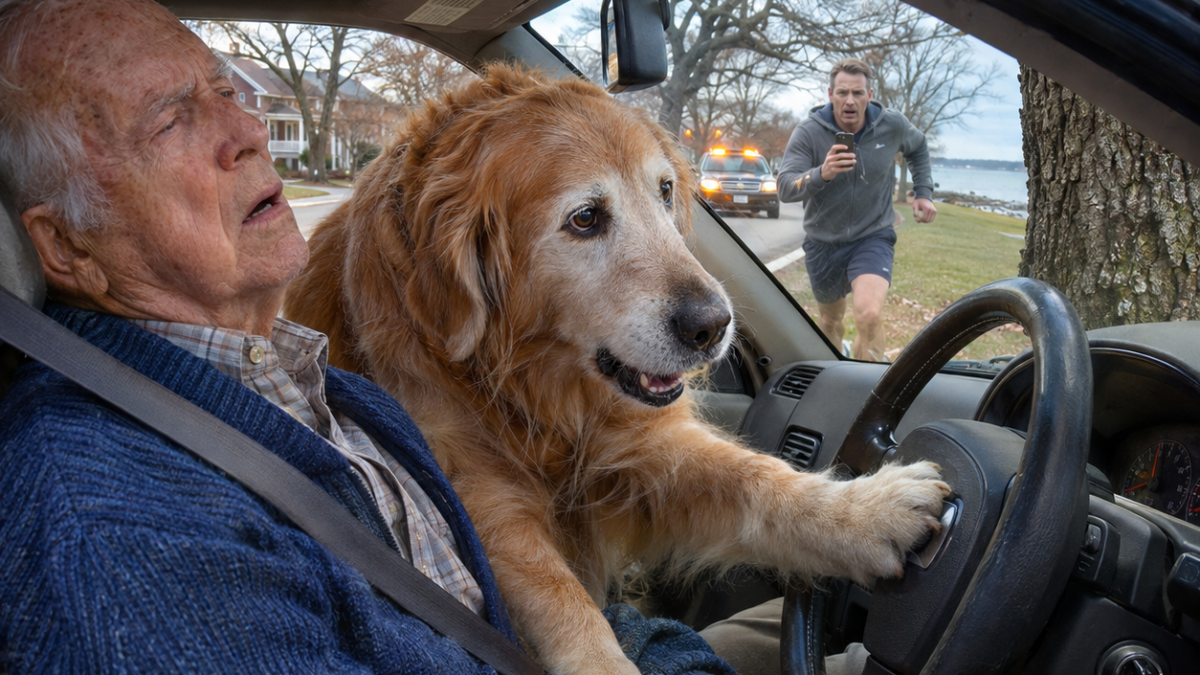
At eighty-two years old, George Harrison lost the use of his right hand in the middle of a quiet Friday drive, tried to call for help, and realized with terrifying clarity that no sound coming from his mouth resembled words while his car slowly drifted toward an oak tree on Bay Shore Drive.
In the back seat, his eleven-year-old Golden Retriever, Charlie, watched the man who had been his whole world slump sideways behind the wheel, broke the one rule George had enforced for eleven years, climbed into the front seat, and struck the horn twenty-eight times in two minutes with his paw until somebody finally stopped.
When George woke three hours later in a Virginia Beach hospital, he could barely move his right fingers—but Charlie was curled beside him on a narrow chair with one paw resting over his hand, and the moment George’s fingers twitched beneath it, the old dog’s tail moved once as if to say, I heard you when nobody else did.
George Harrison had spent most of his life designing buildings that were supposed to survive people.
Schools.
Libraries.
Municipal offices.
Apartment complexes.
Structures meant to remain standing long after the hands that drew them were gone.
Retirement had taught him that human lives were built differently.
They became smaller.
Quieter.
More dependent on rituals.
Every Friday at ten in the morning, George made tea in the same cream-colored ceramic mug his wife had given him forty years earlier.
At eleven, he unfolded the local newspaper.
At exactly two, he picked up his keys.
Charlie knew what that meant.
The old Golden Retriever would rise from his bed slowly now, stretch his stiff back legs, and follow George toward the garage.
Mount Trashmore Park.
Same walk.
Same bench.
Same argument about whether Charlie was too old to chase squirrels.
For eleven years, one rule never changed.
“You stay in the back, Charlie.”
George always pointed.
“Safest place.”
Charlie always obeyed.
Until one Friday in October when George’s right hand suddenly went numb.
He looked down.
Tried to move his fingers.
Nothing.
He tried to say Charlie’s name.
Only a broken sound escaped.
His vision darkened.
His foot slipped from the pedal.
The car rolled toward an oak tree.
And in the back seat, Charlie stood.
For the first time in eleven years, the old dog ignored George’s rule.
He climbed forward.
Put one paw on the steering wheel.
And pressed the horn.
FULL STORY CONTINUATION
The first blast was short.
Weak.
Almost accidental.
Charlie jerked at the sound.
For eleven years, the horn had belonged to George.
A quick tap when somebody sat too long at a green light.
A sharper one when a truck drifted into their lane.
Once, years earlier, George had leaned on it by mistake while reaching for a dropped map, and Charlie had barked indignantly from the rear seat as though the noise were a personal insult.
But now George wasn’t moving.
His head had dropped toward his left shoulder.
His right hand rested uselessly beside the gear selector.
His eyes were partly open, but they did not focus on Charlie.
Charlie barked.
Once.
Then again.
No answer.
The old dog pushed his body farther between the front seats.
His hind legs remained awkwardly on the rear floorboard.
His front paws landed between George’s legs.
The car had nearly stopped after the right tire climbed the curb.
The front bumper pressed lightly against the thick oak tree.
The engine remained running.
Charlie leaned toward George.
Licked his cheek.
George heard him.
Somewhere inside the frightening fog spreading through his brain, George knew Charlie was there.
He wanted to say:
Good boy.
He wanted to say:
Stay back.
He wanted to say anything.
His mouth would not obey.
Charlie pawed at him.
Then looked through the windshield.
Nothing.
Bay Shore Drive was quiet.
Large properties.
Old trees.
Wide lawns.
Few people outside at that hour.
Charlie returned to the wheel.
His paw landed near the center.
Honk.
He jumped again.
Then pressed it another time.
Honk.
A third.
A fourth.
A fifth.
No one came.
George’s vision faded around the edges.
The October sky beyond the windshield became a small pale circle.
He heard the horn.
Again.
Again.
Again.
The sound seemed absurdly distant.
He remembered thinking:
Charlie, stop.
Then realizing almost immediately:
No.
Don’t stop.
George had known Charlie since the dog could fit underneath one arm.
He hadn’t planned to get a Golden Retriever.
That was the family’s joke.
George planned buildings.
Planned vacations.
Planned retirement investments.
Planned grocery lists with categories.
His oldest son, Thomas, once claimed his father could turn breakfast into a three-phase engineering project.
Charlie had not been planned.
Eleven years earlier, George had gone with a friend to “look” at a litter.
That was the first mistake.
The second mistake was sitting on the floor.
Five puppies ran toward everyone else.
One golden puppy remained behind.
Not shy.
Observant.
He watched George.
George watched him.
“Don’t.”
George told the puppy.
The puppy walked forward.
Placed both front paws on George’s knee.
Then chewed the lace on his shoe.
“That one.”
His friend said.
“No.”
George answered.
Ten minutes later, George was signing paperwork.
Charlie grew into every room.
Under the breakfast table.
Beside George’s drafting desk.
Across doorways in exactly the wrong position.
He developed a habit of carrying one of George’s socks from the laundry room into the living room and then appearing deeply offended when accused.
He loved water.
Hated vacuum cleaners.
Trusted mail carriers.
Distrusted plastic lawn decorations.
And from the first day he rode in George’s car, George established one rule.
Back seat.
Always.
He bought a proper restraint.
Installed protective covers.
Checked them constantly.
“You are not riding up front.”
Charlie would stare at him.
“Airbags.”
George would continue.
“You don’t understand airbags.”
Charlie would put his nose against the window.
“Exactly.”
For eleven years, Charlie obeyed.
Until George needed him not to.
The horn sounded a sixth time.
Then seven.
Eight.
Charlie began finding a rhythm.
Press.
Lift paw.
Press.
Lift.
His breathing quickened.
His claws slipped twice across the wheel.
He repositioned.
Pressed again.
If anyone had been watching from outside, it might have looked almost comical.
A large elderly Golden Retriever half standing across the center console, repeatedly hitting a car horn.
Nobody was watching.
Not yet.
At the house across the street, Margaret Sullivan was asleep in her recliner.
Eighty-seven years old.
Hearing aid on the side table because she hated wearing it during naps.
Two houses farther down, a landscaping crew had finished forty minutes earlier.
The mail had already been delivered.
No children were playing outside.
Bay Shore Drive had become the worst possible kind of quiet.
Charlie pressed again.
Ten.
Eleven.
Twelve.
The sound echoed down the street.
Nothing.
He looked at George.
Licked his chin.
Whined.
Then returned to the horn.
George was still conscious.
Barely.
Later, he would remember fragments.
Charlie’s fur brushing his arm.
The horn.
Sunlight.
A branch moving outside the windshield.
His own terror.
But the clearest thought George remembered was not about dying.
It was about Thomas.
His son had called that morning.
Atlanta.
Christmas.
“I’ll come up for a week this year.”
Thomas had said.
“Not three days.”
“A full week.”
George had answered:
“You say that now.”
“I bought the ticket.”
“Refundable?”
“Dad.”
George smiled.
He had already begun thinking about where Thomas would sleep even though the guest room had been ready for fifteen years.
He wanted to see his son at Christmas.
He wanted one more morning at Mount Trashmore.
One more argument with Charlie over the ducks.
One more cup of tea in that old mug.
Dying, George discovered, was not one grand regret.
It was a thousand ordinary things you suddenly realized you still wanted.
His mouth would not work.
He tried moving his left hand.
His fingers responded faintly.
Not enough.
Charlie pressed the horn again.
At two minutes, the old dog had struck it twenty-eight times.
Twenty-eight.
Nobody at the scene counted in real time.
The number came later from a home security camera farther down the street whose microphone had captured the sequence.
Twenty-eight horn blasts over roughly two minutes.
Then a pause.
Charlie had not given up.
He had gone back to George.
Pawed at his chest.
Barked.
Returned to the wheel.
The horn sounded again several minutes later, less rhythmically now.
The dog was tiring.
His hips were arthritic.
Climbing forward had cost him.
But he did not return to the back seat.
He would not leave George.
Emily Parker almost did not take Bay Shore Drive that afternoon.
She normally stayed at work until five.
Her nine-year-old son, Nathan, had developed a fever at school.
The nurse called at 1:22.
By the time Emily arranged to leave, Nathan’s father had already picked him up.
Emily decided to stop at home briefly before going to the pharmacy.
One small change.
A different route.
A few minutes earlier than usual.
She heard the horn before she saw the car.
At first, she frowned.
One horn.
Then another.
“Seriously?”
She muttered.
She assumed somebody was waiting impatiently in a driveway.
Then the sound came again.
Same location.
Same strange rhythm.
She slowed.
That was when she saw the blue sedan.
Front wheel over the curb.
Bumper against an oak tree.
Engine apparently running.
No obvious major collision.
Then movement behind the windshield.
Golden fur.
Emily’s foot moved from accelerator to brake.
“What the…”
Charlie raised his paw.
Pressed the horn.
Emily stopped her car.
For one second, she sat there trying to understand.
A dog.
The dog was pressing the horn.
Then she saw George.
His head slumped sideways.
She was out of her vehicle before she consciously decided to move.
“Sir!”
Emily ran to the driver’s door.
Locked.
Charlie barked at her.
Not aggressively.
Urgently.
“It’s okay!”
She didn’t know whether she was speaking to the dog or herself.
She tried the passenger door.
Unlocked.
Charlie backed away enough for her to open it.
The old dog immediately moved toward George again.
Emily climbed halfway across the seat.
“Sir?”
She touched his shoulder.
His eyes moved.
Good.
“Can you hear me?”
George tried to answer.
A broken sound.
His mouth pulled strangely on one side.
Emily had taken workplace first-aid training three months earlier.
She remembered an acronym.
Face.
Arms.
Speech.
Time.
The face.
The speech.
She looked at George’s right arm.
“Can you lift both hands?”
George’s left fingers moved.
Right did not.
Emily’s stomach turned.
“Stroke.”
She whispered.
Then she called 911.
“Possible stroke.”
She told the dispatcher.
“Elderly male.”
“Conscious but unable to speak normally.”
“One-sided weakness.”
“Address…”
Charlie kept moving between Emily and George.
He put one paw on George’s thigh.
Whined.
Emily touched his shoulder.
“You did good.”
The dog looked directly at her.
His breathing was fast.
“You did really good.”
She could hear sirens less than five minutes later.
Charlie heard them too.
His ears lifted.
He stood closer to George.
Not relieved yet.
Not until someone actually took over.
The paramedics moved quickly.
Blood pressure.
Oxygen.
Neurological assessment.
Last-known-well estimate.
George could not give them all the information they needed.
Emily found his wallet.
Medical card.
Emergency contact.
Thomas Harrison.
Atlanta number.
There was also a medical-alert card listing diabetes? No—the source says stroke; we can keep general medications. She handed it to the paramedic.
Charlie tried following when they moved George onto the stretcher.
“Easy.”
A firefighter caught his harness.
Charlie pulled.
Not violently.
Desperately.
George heard him.
His left hand moved from beneath the blanket.
The fingers barely lifted.
“Ch…”
It was the closest thing to Charlie’s name he could produce.
The dog surged forward.
The paramedic crouched.
“That’s his dog?”
Emily nodded.
“Charlie.”
The paramedic looked at George.
Then Charlie.
“We need to transport now.”
Emily said:
“I can take the dog.”
Charlie looked at her.
Then at George.
He refused.
Every time the stretcher moved, he moved.
The responders exchanged glances.
Under normal circumstances, animals did not simply ride in emergency ambulances.
There were policies.
Practical problems.
Safety.
But situations sometimes create temporary solutions.
Another responder contacted the hospital and arranged for Charlie to be transported separately but immediately, with Emily accompanying him until Thomas or another responsible person could arrive.
George saw Charlie led toward the second vehicle.
Panic appeared in his eyes.
Emily leaned close.
“George.”
She had found his name.
“Charlie is coming.”
“He’s coming with us.”
George’s left hand relaxed.
That mattered.
Thomas answered the emergency call on the second ring.
“Hello?”
“This is Virginia Beach Emergency Medical Services.”
There is no good way for a son to hear that sentence.
Thomas stood from his desk so quickly his chair rolled backward into the wall.
“What happened?”
“Your father is conscious and being transported to Sentara Virginia Beach General Hospital with suspected stroke symptoms.”
Thomas stopped hearing parts of the explanation.
Conscious.
Stroke.
Hospital.
Father.
He asked:
“Is he alone?”
A pause.
“The woman who found him is with his dog.”
“Charlie?”
“Yes.”
Thomas put one hand against his forehead.
Of course Charlie.
“I’m in Atlanta.”
He said.
“I’m coming.”
At the hospital, time became clinical.
George entered imaging.
Neurology.
Stroke protocol.
Doctors determined he had suffered an ischemic stroke.
Rapid recognition mattered.
Rapid transport mattered.
The relatively low-speed drift into the tree had caused no serious collision injury.
Most importantly, he had been found soon enough for doctors to begin appropriate treatment within the critical window.
There are no guarantees with strokes.
Doctors explained that repeatedly.
But timing changes possibilities.
Charlie had changed the timing.
Emily sat in the waiting area with the old Golden Retriever.
She was supposed to be buying fever medicine for her son.
Nathan was home safely with his father.
She had called.
Explained.
Her husband said:
“Stay.”
So she stayed.
Charlie would not lie down at first.
He paced from the hospital entrance to Emily.
Back.
Entrance.
Emily found a paper cup and brought him water.
He drank a little.
Then returned to the doors.
“George isn’t coming through there yet.”
She said.
Charlie stared at her.
“Right.”
“You don’t believe me.”
Eventually, exhaustion won.
Charlie lowered himself beside Emily’s chair.
But he kept his head up.
Waiting.
A nurse came out almost three hours later.
“Who is with Mr. Harrison?”
Emily stood.
“I found him.”
“His son is flying in.”
“And Charlie?”
The nurse looked down.
Charlie was already standing.
“There he is.”
Emily said.
The nurse smiled despite herself.
“Doctor says he’s awake.”
Emily exhaled.
“How bad?”
“He has deficits.”
“But he’s responsive.”
“Speech is affected.”
“Right-side weakness.”
“They’re optimistic he can recover meaningful function with rehabilitation.”
Emily covered her mouth.
Charlie looked between them.
Then the nurse did something Emily remembered for the rest of her life.
She crouched in front of Charlie.
“Your guy is awake.”
The dog’s tail moved.
One sweep.
The nurse looked at Emily.
“I think he understood.”
Emily whispered:
“I think he’s understood everything.”
The hospital made an exception.
Not immediately.
Not casually.
But once George was stabilized, someone arranged for Charlie to see him briefly.
He was old.
Calm.
Vaccination information could be confirmed through George’s veterinary office.
Thomas had authorized it by phone.
The nurse led Charlie into the room.
George lay beneath a white blanket.
Monitors.
IV.
His face looked older than it had that morning.
The moment Charlie saw him, the dog stopped.
No rushing.
No barking.
He stared.
George turned his head slowly.
His eyes found Charlie.
His left hand moved.
Charlie walked forward.
Placed his chin on the mattress.
George tried speaking.
“Ch…”
Charlie’s tail moved.
George’s eyes filled.
The nurse pulled a narrow chair beside the bed.
Charlie climbed awkwardly enough that two people helped him.
He curled as much as an eighty-pound Golden Retriever can curl.
Then placed one paw over George’s left wrist.
George’s fingers moved beneath it.
Tail.
One gentle thump against the chair.
George cried.
So did Emily.
The nurse pretended to check a monitor.
Thomas arrived after midnight.
He had taken the first flight he could find.
He came into the room carrying a backpack and the expression of a man who had spent six hours bargaining with every possible version of the future.
George was asleep.
Charlie was awake.
The dog lifted his head.
Thomas stopped.
“Hey, old man.”
Charlie stood slowly.
Walked toward him.
Thomas dropped to his knees.
Charlie pushed into his chest.
Thomas buried his face in the dog’s neck.
“You saved him.”
His voice broke.
“You saved Dad.”
Charlie licked his ear.
Thomas laughed through tears.
“That disgusting habit hasn’t changed.”
George opened his eyes ten minutes later.
Thomas stood.
“Dad.”
George stared at him.
Recognition.
Relief.
Then frustration.
He tried to speak.
The words would not come properly.
Thomas moved closer.
“Don’t.”
George frowned.
“Don’t what?”
Thomas smiled.
“Don’t try to give me instructions.”
“This may be the only chance I get in my entire life.”
George’s mouth moved.
A rough sound.
Thomas leaned closer.
George managed:
“Christmas.”
Thomas broke.
“Yeah.”
He took his father’s left hand.
“I’m still coming for Christmas.”
George shook his head slightly.
“Now.”
Thomas cried harder.
“I’m here now.”
Charlie rested his head against both their hands.
The first twenty-four hours were frightening.
Nobody knew how much function would return.
George understood far more than he could express.
That made frustration worse.
His mind formed sentences.
His mouth gave him fragments.
His right hand would not behave.
He stared at it as if it belonged to someone else.
When the physical therapist asked him to squeeze, almost nothing happened.
George turned his face away.
Thomas saw.
“Dad.”
George closed his eyes.
“You designed buildings.”
Thomas said.
George opened one eye.
“That means you’re familiar with repairs.”
The corner of George’s mouth moved.
Thomas smiled.
“Exactly.”
“Rehab.”
“Annoying people telling you what to do.”
“Perfect retirement activity.”
George managed one rough word.
“Idiot.”
Thomas laughed.
“Speech is coming back already.”
Charlie stayed with Thomas near the hospital.
Not in George’s room constantly.
That was impossible.
But every allowed visit changed George.
Nurses noticed.
Therapists noticed.
The old man worked harder when Charlie was present.
“Raise your hand.”
The occupational therapist said.
George stared at his right fingers.
Nothing.
Charlie sat beside the bed.
George looked at him.
His fingers moved.
Barely.
The therapist smiled.
“There.”
George tried again.
Another tiny movement.
Charlie’s tail thumped.
“Again.”
The therapist said.
George did.
Weeks later, George would joke that Charlie was the most expensive rehabilitation consultant he had never hired.
But in those early days, there was nothing funny about the work.
A button.
A spoon.
Standing.
Three steps.
Five.
A sentence.
Each ordinary thing became a mountain.
On day four, Emily visited.
She brought flowers.
Then apologized because flowers seemed inadequate.
George smiled.
His speech had improved enough for short phrases.
“You stopped.”
Emily nodded.
“Charlie made that difficult not to.”
George looked at the dog.
“He always…”
He paused, searching.
“…persistent.”
Emily laughed.
“He honked twenty-eight times.”
George stared.
“What?”
“We found out because one of your neighbors had a security camera with audio.”
Thomas held up his phone.
“Twenty-eight.”
George looked at Charlie.
The dog yawned.
George whispered:
“Twenty-eight?”
Tail.
One thump.
Emily wiped her eyes.
“He didn’t stop.”
George’s face folded.
He looked toward the window.
For several seconds, nobody spoke.
Then he said:
“Good boy.”
Charlie got up.
Walked to the bed.
Pressed his head against George’s chest.
The local news heard about the story.
George hated that immediately.
Thomas loved watching him complain.
“They want an interview.”
“No.”
“They want Charlie.”
“Fine.”
Thomas laughed.
“You’re surrendering media representation to the dog?”
“Better face.”
He was right.
Charlie became briefly famous.
GOLDEN RETRIEVER SOUNDS HORN TO SAVE OWNER.
Neighbors who had slept through the horn felt guilty.
Margaret Sullivan arrived at the hospital carrying cookies and apologized three times for removing her hearing aids before naps.
George told her:
“You’re eighty-seven.”
“Sleep.”
She cried anyway.
The point was never that everyone else had failed.
The point was that Charlie had not.
At rehabilitation, George struggled most with independence.
He hated asking.
Hated waiting.
Hated being watched while he walked.
Architects, he told Thomas, were supposed to design handrails, not depend on them.
Thomas answered:
“Then appreciate your own profession.”
George disliked that.
Charlie liked rehab because people had treats.
George began walking with a cane.
Right foot.
Cane.
Step.
Pause.
Charlie learned immediately not to pull.
He adjusted his pace to George’s.
A dog who once strained forward on walks now moved half a step beside him.
If George stopped, Charlie stopped.
If George stumbled, Charlie turned.
Nobody trained him to do it.
He simply changed.
That hurt Thomas more than he admitted.
Watching an old dog become careful around an old man was like seeing time physically.
One night, Thomas found George awake at 2:30.
Rehab facility quiet.
Charlie sleeping on a mat.
George stared at his right hand.
“Can’t sleep?”
George shook his head.
Thomas sat.
After a long silence, George said:
“Afraid.”
Thomas had almost never heard his father say that word.
“Of what?”
George looked at Charlie.
“Next time.”
Thomas understood.
“What if there’s another stroke?”
George nodded.
“What if you’re alone?”
Another nod.
Thomas took a breath.
“We change things.”
George frowned.
“What?”
“Medical alert.”
“Phone watch.”
“Check-ins.”
“I can come up more.”
George shook his head immediately.
“No.”
“Dad.”
“Your life.”
“My life includes you.”
George looked angry.
Which meant he was scared.
Thomas continued:
“You’re not moving to Atlanta tomorrow.”
“I know you’d hate it.”
“But we’re not pretending nothing happened.”
George’s eyes filled.
Thomas said:
“And Charlie can’t be your entire emergency plan.”
Charlie opened one eye.
Thomas looked down.
“No offense.”
Charlie closed it.
George agreed to changes reluctantly.
A smartwatch with emergency features.
A medical alert device.
Medication review.
Regular appointments.
Neighbors with contact information.
Thomas called every evening.
George complained every evening.
That meant he answered.
Progress.
The hardest day in rehabilitation came when George could not sign his name.
The therapist placed a pen in his right hand.
George had spent his career drawing lines precise enough to become buildings.
For decades his hand had translated imagination into paper.
Now the pen shook.
He tried:
G.
The line slipped.
He stopped.
Tried again.
Nothing looked like his name.
He dropped the pen.
“Enough.”
The therapist said:
“We can try tomorrow.”
“No.”
George turned away.
Charlie was lying near the table.
The pen had rolled onto the floor.
Charlie stood.
Picked it up carefully between his teeth.
Carried it to George.
Thomas covered his mouth.
The therapist looked away.
George stared at the pen in Charlie’s mouth.
“You…”
His voice shook.
“…pushy.”
Charlie placed it against George’s knee.
George laughed.
Then cried.
Then picked it up with his left hand and placed it back into his right.
The G was ugly.
The e worse.
The final letters almost unreadable.
But the paper said:
George Harrison.
Thomas framed that page later.
George told him that was ridiculous.
It still hung in Thomas’s house.
Charlie had bad days too.
Eleven is old for a large Golden Retriever.
His hips stiffened.
The hospital and rehab schedule exhausted him.
Some mornings he stood slowly.
George noticed.
That changed something.
For weeks, everyone had treated George as fragile.
Now he watched Charlie struggle to rise.
“Easy.”
George said.
He bent carefully.
His right hand, still weak, rested against Charlie’s shoulder.
“Take your time.”
Charlie stood.
George smiled.
“Me too.”
From then on, rehab became something they did together.
George practiced walking.
Charlie practiced getting up.
George strengthened his hand.
Charlie learned to use a small ramp into Thomas’s rental car.
George rested after therapy.
Charlie slept beside him.
Two old bodies refusing to quit.
By November, George could walk short distances with a cane.
Speech remained slightly slower.
His right hand had regained enough function to hold a mug with both hands.
That mattered more than he expected.
One morning Thomas brought the old ceramic tea mug from Bay Shore Drive.
George stared.
“You went through my kitchen?”
“You’re welcome.”
The mug had a thin crack near the handle from decades of use.
George ran his thumb across it.
His wife had given it to him forty years earlier.
Thomas watched.
“You want tea?”
George nodded.
Thomas made it badly.
Too weak.
George took one sip.
Frowned.
“Terrible.”
Thomas laughed.
“Good.”
“What?”
“You’re definitely recovering.”
Charlie lay beside the chair.
George lowered one hand.
Touched his head.
The room went quiet.
Tea.
Dog.
Son.
For a moment, George felt his life returning not as something grand, but as a collection of small familiar objects.
He had never been so grateful for ordinary things.
Christmas approached.
Thomas canceled his original holiday plan.
George protested.
“You said full week.”
Thomas replied.
“Now I’m giving you two.”
“Unnecessary.”
“Nonrefundable.”
“You said ticket was—”
“I lied.”
George smiled.
Charlie wagged.
Thomas pointed.
“Two against one.”
Doctors eventually approved George to return home with support.
December.
Nearly two months after the stroke.
Cold morning.
Clear sky.
George stood outside the rehabilitation center wearing a navy coat.
Cane in left hand.
Right hand tucked into a glove.
Charlie waited with Thomas.
The dog wore a red collar.
No ridiculous vest.
George had refused.
He walked toward the car slowly.
Each step deliberate.
Charlie waited.
No pulling.
When George reached the door, Thomas opened the rear passenger side.
Habit.
Charlie moved toward it.
George stopped.
“Wait.”
Thomas looked at him.
George pointed toward the front passenger seat.
“Charlie.”
The dog stared.
“Front.”
Charlie did not move.
Eleven years.
Back seat.
Safest place.
George smiled.
“Come on.”
“You earned it.”
Charlie looked at Thomas.
Thomas laughed.
“Permission granted.”
Charlie climbed slowly into the front passenger seat with help.
Turned once.
Sat.
Then looked enormously pleased with himself.
George lowered himself behind the wheel.
Not driving alone yet.
Thomas would follow directly behind.
Doctors had cleared only a cautious short drive under specific conditions.
George placed both hands on the wheel.
His right hand still weaker.
But there.
Charlie rested one paw on George’s knee.
George looked at him.
“No horn.”
Charlie stared.
George laughed.
“Unless necessary.”
They drove toward Mount Trashmore.
Same route.
Different men.
Different dog.
George went slowly.
Ten minutes into the drive, his throat tightened.
He passed the oak tree.
The one on Bay Shore Drive.
A shallow scar remained in the bark.
Nothing dramatic.
A place where his car had stopped.
George pulled over safely.
Thomas stopped behind him.
He came forward.
“You okay?”
George looked at the tree.
Then at Charlie.
The dog was watching him.
George reached over.
Placed his hand on Charlie’s head.
“I remember.”
Thomas leaned against the door.
“So do I.”
George shook his head.
“You weren’t there.”
“No.”
“But I got the call.”
He looked at his father.
“I remember enough.”
George swallowed.
Then whispered:
“I thought I was done.”
Thomas’s eyes filled.
“You weren’t.”
George looked at Charlie.
“No.”
At Mount Trashmore, the trees had lost most of their leaves.
The October gold was gone.
Branches stood dark against a clean blue sky.
George parked.
Charlie waited until the door opened.
They moved slowly.
George with cane.
Charlie with old hips.
Neither complained.
The trail they once finished in twenty minutes took nearly an hour.
That was fine.
Time had changed value.
Before the stroke, George measured walks in distance.
Afterward, he measured them in being there.
At their old bench, he sat.
Charlie lowered himself beside him.
George breathed cold air.
Watched children.
Runners.
A young couple pushing a stroller.
Normal life.
He felt tears come.
He did not stop them.
Charlie put his head on George’s knee.
George stroked him with his right hand.
Slow.
Not strong.
Enough.
“Twenty-eight.”
He whispered.
Charlie looked up.
“Twenty-eight times.”
Tail.
George laughed.
“You couldn’t do thirty?”
Charlie yawned.
“Lazy.”
Thomas stayed several yards away.
He photographed them without asking.
George would later complain.
Then request a printed copy.
The picture showed:
An eighty-two-year-old man on a park bench.
Cane beside him.
Golden Retriever at his feet.
Nothing heroic.
Nothing dramatic.
If you did not know the story, you would never understand what you were seeing.
Thomas liked that.
Because love rarely looks dramatic from the outside.
Most days it looks like repetition.
Feeding.
Walking.
Waiting.
Calling.
Sitting beside someone.
Remembering medication.
Opening doors.
Moving at another person’s pace.
Charlie had loved George quietly for eleven years before anybody noticed.
The twenty-eight horn blasts only made the quiet love audible.
George’s recovery continued into winter.
He improved.
Not magically.
Some words still came slower.
His handwriting never returned exactly to what it had been.
His right hand tired.
He used a cane outdoors longer than he wanted.
But he walked.
Talked.
Lived at home.
Made tea.
Read newspapers.
Argued with Thomas.
And every Friday afternoon, weather permitting, George and Charlie returned to the park.
They stopped pretending two o’clock had to be exact.
That was another change.
George had spent most of his life believing routines created safety.
Then one Friday his body broke the routine completely.
Charlie taught him something.
Rules matter.
Until love requires something else.
The front seat became Charlie’s place.
Not always.
George still used proper restraint.
Still cared about safety.
But whenever Thomas drove them, Charlie sat beside George.
Sometimes his paw rested on George’s leg.
The first time Thomas saw it, he said:
“You’ve spoiled him.”
George answered:
“He has tenure.”
Fair.
Emily became part of their lives too.
George invited her to lunch after Christmas.
She arrived with Nathan.
The nine-year-old who had accidentally caused his mother to leave work early that day.
George looked at him.
“So technically you saved me.”
Nathan’s eyes widened.
“I did?”
Emily laughed.
“Do not encourage him.”
George explained:
“If you hadn’t gotten sick—”
“Dad.”
Thomas interrupted.
“No butterfly-effect guilt at lunch.”
George frowned.
“I am expressing gratitude.”
Nathan looked at Charlie.
“I think the dog did it.”
Everyone laughed.
Correct answer.
Emily brought a copy of the security-camera recording.
George watched once.
Only once.
Blue sedan.
Still street.
Charlie moving forward.
Horn.
Horn.
Horn.
Again.
Again.
Twenty-eight in that first frantic sequence.
George watched without speaking.
When it ended, Thomas expected him to cry.
Instead, George looked at Charlie.
The dog was asleep.
George whispered:
“I didn’t know.”
Emily asked:
“What?”
“How hard he tried.”
Her eyes filled.
“He didn’t stop.”
George nodded.
“No.”
“He didn’t.”
That night, after everyone left, George sat beside Charlie’s bed.
The dog woke.
George said:
“I heard you.”
Charlie blinked.
George touched the gray fur around his face.
“I couldn’t answer.”
“But I heard you.”
Charlie put his paw over George’s shoe.
There were moments after the stroke when George became angry at his age.
Not sad.
Angry.
Eighty-two felt like an accusation.
His body no longer obeyed automatically.
People spoke more slowly to him even when his hearing was fine.
Cashiers called him “young man” in the patronizing way people sometimes do with old people.
He hated it.
Then Charlie would struggle to stand.
And George would wait.
Never rush him.
One afternoon, George realized the hypocrisy.
He had infinite patience for Charlie’s aging.
Almost none for his own.
He sat beside the dog.
“You have gray hair.”
Charlie wagged.
“So do I.”
No reaction.
“You need help into the car.”
Charlie sighed.
“So do I sometimes.”
Tail.
George nodded.
“Fine.”
“We’re old.”
Charlie closed his eyes.
Negotiation complete.
Thomas worried about Charlie’s age.
He did not tell George initially.
That was a mistake.
George saw the veterinary receipt on the kitchen counter.
“Why did you take Charlie in?”
“Routine.”
“Thomas.”
“Arthritis check.”
George stared.
“Anything else?”
“No.”
Truth.
Charlie was old.
But stable.
Heart good.
Bloodwork reasonable for age.
Joints stiff.
The veterinarian recommended weight management, supplements, pain control as needed, shorter walks.
George relaxed.
Then became angry.
“You didn’t tell me.”
“I didn’t want you worrying.”
George’s expression hardened.
“That sentence is for children.”
Thomas apologized.
George forgave him.
But said:
“Don’t protect me from my own life.”
That became another rule.
A better one.
Spring came.
Charlie turned twelve.
George bought him a ridiculous dog cake.
Thomas filmed.
Charlie ate half before anyone sang.
No dignity.
George laughed harder than he had in months.
The video later became one of his favorites.
Not the horn.
Not the hospital.
Cake.
Because Charlie deserved to be remembered as more than the dog who saved a life.
He was also the dog who stole socks.
Snored.
Hated baths.
Loved mud.
Barked at pumpkins.
And once ate part of a birthday candle because George wasn’t quick enough.
Heroism is one moment.
Love is everything around it.
George received letters after the news story circulated.
People wrote about their dogs.
A Labrador who woke a family during a fire.
A terrier who alerted during seizures.
A mutt who stayed beside an injured hiker.
George read them all.
He answered some.
One letter came from a thirteen-year-old girl whose Golden Retriever had recently died.
She wrote:
I don’t want another dog because I don’t want to lose another one.
George kept that letter for two weeks before answering.
He wrote slowly with his recovering right hand.
His handwriting still uneven.
I understand.
Then:
Charlie is old. I know I will not have him forever. That frightens me more now than it did before he saved me. But if someone offered to erase eleven years of loving him so that I would never someday grieve him, I would say no before they finished asking.
He paused.
Then added:
The pain at the end is not proof the love was a mistake. It is proof something valuable was there.
Thomas read the letter.
Said nothing.
Just put one hand on his father’s shoulder.
That summer, George no longer needed the cane indoors.
Outdoors, he carried it.
Mostly because Thomas complained if he didn’t.
Charlie continued at his slower pace.
They walked fewer miles.
Stopped more often.
George discovered benches he had ignored for years.
People.
Birds.
Clouds.
He had spent his architectural career thinking in destinations.
Entrance.
Exit.
Load path.
Circulation.
After the stroke, George learned the importance of the middle.
The stopping places.
One Friday at Mount Trashmore, a toddler saw Charlie and shouted:
“Big puppy!”
George looked at the twelve-year-old Golden Retriever.
“Did you hear that?”
Charlie wagged.
“Fraud.”
The child’s mother asked if they could pet him.
George said yes.
Charlie leaned into the tiny hands.
The mother noticed the gray muzzle.
“How old?”
“Twelve.”
“Oh.”
She said softly.
George knew that tone.
The arithmetic people do when hearing an old dog’s age.
He hated it.
So he added:
“He still thinks he’s four.”
Charlie attempted to steal the child’s cracker.
Evidence.
George sometimes wondered whether Charlie knew he had saved him.
Probably not in the human sense.
Dogs do not build monuments to their own decisions.
They act.
Then eat dinner.
George envied that.
People had congratulated Charlie.
Awarded him certificates.
A local animal organization gave him a small medal.
Charlie attempted to chew the ribbon.
Perfect.
George framed the medal.
Charlie cared about chicken.
The horn remained different after that day.
The first time George accidentally pressed it months later, Charlie snapped awake.
Body tense.
George noticed immediately.
“Easy.”
He said.
Charlie looked at him.
George put one hand on the dog.
“I’m okay.”
Charlie remained alert for another minute.
Then relaxed.
Memory.
George understood.
He too reacted differently to certain sounds.
Ambulance sirens.
Hospital announcements.
The abrupt numbness of a hand that had simply fallen asleep.
Every small sensation asked:
Again?
Recovery was not only learning to walk.
It was learning not every ordinary moment was the beginning of disaster.
George and Charlie learned together.
Thomas eventually returned to Atlanta.
He hated leaving.
George hated that he hated leaving.
At the airport, Thomas said:
“I can move.”
“No.”
“I work remotely.”
“No.”
“Dad.”
“You have a life.”
“You’re in it.”
“I know.”
George smiled.
“That’s why you should keep it.”
They compromised.
Thomas visited monthly.
Called nightly.
George wore his medical alert device.
Emily and Margaret had emergency keys.
The system was imperfect.
Life is.
Enough.
After Thomas left, George sat in the quiet house.
For the first time since the stroke, truly alone except Charlie.
He felt fear.
Not huge.
Persistent.
He looked at the phone.
The alert device.
The medication box.
Then Charlie.
The dog was asleep.
George said:
“We can do this.”
Charlie did not wake.
George laughed.
“Excellent morale.”
He made tea.
Same mug.
Sat by the window.
Life continued.
Friday at two came.
George picked up his keys.
Charlie stood.
Slowly.
George watched him stretch.
“You ready?”
Tail.
They went.
At the car, Charlie moved automatically toward the back door.
George opened the passenger door.
Charlie stopped.
Looked at him.
“Front.”
The dog climbed in.
George smiled.
Some rules change permanently.
By the next October, one full year had passed.
The oak tree still stood.
The security camera had been replaced.
Margaret was still taking naps without hearing aids.
Emily’s son was healthy.
Thomas had kept his Christmas promise and several more.
George’s handwriting improved.
Speech almost normal except when tired.
Charlie’s muzzle was whiter.
One Friday, George stopped beside the oak.
Not because he was frightened.
Because he wanted to.
He got out.
Charlie followed.
George placed one hand against the bark.
There was a shallow mark from the bumper.
He looked at Charlie.
“If we’d been going faster…”
No need to finish.
Charlie sniffed a leaf.
George smiled.
Right.
Dogs do not worship alternate endings.
George removed his hand from the tree.
“Let’s go.”
At the park, autumn had returned.
Leaves.
Cool sun.
Same path.
George and Charlie walked.
Halfway around, George’s right hand began to feel tired.
Not numb.
Tired.
He stopped.
Breathed.
Checked.
Everything okay.
Charlie stopped too.
Looked at him.
George smiled.
“Not today.”
Charlie stepped closer.
George rested his hand on the dog’s head.
“Not today.”
They continued.
At eighty-three, George had become less interested in pretending he was not afraid of losing things.
He was afraid Charlie would die someday.
Afraid of another stroke.
Afraid of losing independence.
Afraid Thomas would worry too much.
Afraid his memory might fail.
Fear did not mean he stopped living.
Maybe that was the biggest thing Charlie had taught him.
Courage is not a lack of fear.
Charlie had been terrified in the car.
His barking.
Panting.
Frantic paw.
Twenty-eight horn blasts.
Nothing about that looked calm.
But fear had not stopped him.
He did the next useful thing.
Then another.
Then another.
George began approaching aging the same way.
Today.
Tea.
Medication.
Walk.
Call Thomas.
Feed Charlie.
Next useful thing.
Enough.
Emily once asked him during lunch:
“Do you ever think about why Charlie knew to press the horn?”
“All the time.”
“Did you train him?”
“Never.”
“Had he done it before?”
“Never.”
“So how?”
George looked at Charlie sleeping under the table.
“I don’t know.”
“He saw me use it?”
“Maybe.”
“He learned sound gets attention?”
“Maybe.”
“Dogs are better observers than people think.”
“Probably.”
Then George smiled.
“I don’t need to know.”
Emily looked surprised.
“Architect saying that?”
“I retired.”
They laughed.
Some things did not need blueprints.
The official story remained:
An eighty-two-year-old man suffered a stroke.
An eleven-year-old Golden Retriever repeatedly activated the car horn.
A passerby stopped.
Emergency services arrived.
Treatment began quickly.
George survived with meaningful recovery.
All true.
But official language misses things.
It misses Charlie’s paw slipping on the wheel.
The old dog turning back to lick George’s face between horn blasts.
Emily almost driving past.
Thomas hearing the phrase “suspected stroke” at his desk in Atlanta.
George trying to sign his name.
Charlie carrying the pen back.
Two old bodies learning how to move slowly together.
The front seat.
The park.
The tea mug.
Love lives in details records do not capture.
Years before the stroke, George used to joke that Charlie followed him because George controlled the food.
Afterward, he stopped making that joke.
Not because it wasn’t funny.
Because he knew better.
Charlie had followed him before breakfast.
After dinner.
Into rain.
Out of sleep.
Toward doors.
Away from parks.
Through aging.
And when George became suddenly unreachable despite sitting less than three feet away, Charlie did not understand medicine.
He understood one fact.
George was wrong.
Something needed to happen.
So Charlie made noise until the world answered.
People called Charlie a hero.
George called him:
“My friend.”
That meant more.
Hero was a story strangers told.
Friend was eleven years of mornings.
One December evening, Thomas asked his father what he wanted for Christmas.
George said:
“Nothing.”
Thomas groaned.
“Unacceptable.”
“I have what I need.”
“You sound ninety.”
“I’m eighty-three.”
“Close enough.”
George thought.
Then:
“Photograph.”
“What?”
“The park one.”
“You already have it.”
“Bigger.”
Thomas smiled.
“Done.”
The enlarged photograph eventually hung above George’s desk.
George on bench.
Charlie beside him.
Cane.
Bare trees.
Ordinary.
Under the frame, Thomas added a small plaque without asking.
TWENTY-EIGHT TIMES.
George complained.
Then never removed it.
Charlie would sometimes sit beneath that photograph.
George once took a picture.
Photo of dog beneath photo of dog.
Thomas called it art.
George called it evidence his son had too much free time.
One morning, George woke before Charlie.
That had become more common.
He walked into the kitchen slowly.
Made tea.
Then realized the house was too quiet.
Old fear struck.
He went immediately to Charlie’s bed.
The dog was asleep.
Deeply.
Chest rising.
George put one hand against him.
Charlie opened one eye.
George laughed in relief.
“Sorry.”
Charlie sighed.
George sat on the floor.
His knees protested.
He did not care.
For several minutes, he stroked Charlie’s fur.
“I know.”
He whispered.
“I know this doesn’t last forever.”
Charlie put his head in George’s lap.
George looked toward the window.
“But not today.”
Tail.
One thump.
Not today.
That became enough.
George did not know how many more Fridays they would have.
Nobody does.
That is what makes rituals sacred.
Not repetition alone.
Their eventual end.
Two o’clock.
Keys.
Charlie rising.
Car.
Front seat now.
Park.
Slow walk.
Bench.
Home.
Tea.
Each Friday appeared ordinary while it happened.
George understood now that ordinary days are the ones people beg to have back.
So he stopped rushing them.
At Mount Trashmore, people sometimes recognized Charlie.
“Is that the horn dog?”
George disliked the phrase.
Charlie loved strangers.
One boy asked:
“Did he really press it twenty-eight times?”
George smiled.
“Yes.”
“Why didn’t he stop?”
George looked down.
Charlie looked back.
The answer felt enormous.
Then simple.
“Because I hadn’t answered yet.”
The boy accepted that.
Children often understand loyalty better when adults stop overexplaining it.
George thought about that sentence afterward.
Because I hadn’t answered yet.
Charlie had barked.
No answer.
Licked him.
No answer.
Horn.
No answer.
Again.
Again.
Again.
He kept calling.
Somewhere, George realized, that was what love often was.
Not one dramatic act.
Repeated invitations.
Repeated care.
Repeated attempts to reach someone.
Thomas calling every evening even when George complained.
Emily stopping.
Rehab therapists saying again.
George helping Charlie up.
Charlie waiting when George walked slowly.
Again.
Again.
Again.
Twenty-eight horn blasts were unusual.
The principle was not.
Love is persistent.
A reporter once asked George what he remembered from the stroke.
He said:
“Not much.”
Then paused.
“The horn.”
“What about it?”
“I remember wishing Charlie would stop.”
The reporter laughed.
George did not.
“Then I remember realizing I needed him to keep going.”
The reporter became quiet.
George looked at Charlie.
“Sometimes the person who loves you has to ignore what you’ve taught them.”
That became the quote everyone used.
George regretted saying something quotable.
Thomas printed it on a mug.
George threatened disinheritance.
The old ceramic mug remained his favorite.
Of course.
Some objects are not replaced by better ones.
The handle eventually became too cracked to trust.
Thomas suggested retiring it.
George refused.
Then one morning the crack widened.
George stared.
For forty years that mug had survived.
He felt unexpectedly devastated.
Charlie watched from beneath the table.
George sighed.
“Everything ages.”
Charlie wagged.
George had the mug repaired by a ceramic artist.
The repair line remained visible.
He liked it better afterward.
Thomas said:
“That is aggressively symbolic.”
George told him to leave.
The repaired mug, George realized, was exactly like his right hand.
Not the same as before.
Still useful.
Still his.
Scars are sometimes simply evidence that the object continued.
As Charlie aged, George built ramps.
Technically Thomas built them.
George designed.
Of course.
The dog ramp into the car had a slope George calculated unnecessarily precisely.
Thomas said:
“It’s for a dog.”
George answered:
“Gravity does not care.”
Charlie used it.
Engineering validated.
One Friday, Charlie stopped halfway up the ramp.
George waited.
“Take your time.”
Charlie looked at him.
Then climbed.
George touched his shoulder.
There was so much tenderness in that small moment that Emily, who happened to be visiting, looked away.
She remembered the frantic dog standing over a horn.
This was the same love.
Just quieter.
That is the thing about heroic stories.
We choose the loudest second.
The fire.
The rescue.
The horn.
But love is rarely loud for very long.
Afterward it becomes:
Medication.
Ramps.
Slow walks.
Water bowls.
Phone calls.
Waiting.
George eventually understood that Charlie did not save his life on one October afternoon.
Charlie had been saving small pieces of it for eleven years.
Getting him outside.
Making him walk.
Making an empty house less empty.
Giving him someone to talk to when Thomas lived hundreds of miles away.
Forcing routine after retirement.
Providing a warm body beside his chair.
The horn simply made visible what the dog had always been doing.
Keeping George connected to the world.
And George saved Charlie too.
Not dramatically.
Food.
Vet bills.
A back seat for eleven years.
Then a front seat.
A warm bed.
Hands in golden fur.
Someone saying his name every day.
Rescue moves both directions more often than we admit.
If George had been asked before the stroke what mattered most about Charlie, he might have said companionship.
Afterward, he would have answered differently.
“Presence.”
Companionship sounds optional.
Presence is not.
Charlie was there.
That was everything.
The story people told ended two months after the stroke.
George comes home.
Charlie sits in the front.
They return to Mount Trashmore.
Beautiful.
Clean.
But George knew life continued after beautiful endings.
Recovery continued.
Aging continued.
Fear continued.
So did love.
A proper ending was not George becoming young again.
Or Charlie becoming immortal.
It was two old friends receiving more time.
And using it.
On a cold Friday morning, more than a year after the stroke, George made his tea.
Ten o’clock.
Read the paper at eleven.
At 1:58, Charlie lifted his head before George touched the keys.
George smiled.
“You still know.”
Charlie stood.
Slow.
Stretch.
Shake.
George put on his coat.
Picked up the leash.
At the garage, he opened the passenger door.
Charlie climbed the ramp.
Sat.
George got behind the wheel.
Checked both hands.
Right hand strong enough.
Left hand ready.
Phone connected.
Medical alert charged.
Seat belts.
Responsible.
Charlie put one paw lightly on his knee.
George looked at it.
Then at the steering wheel.
“You know.”
He said.
“If this goes badly again…”
Charlie looked up.
George smiled.
“Same plan.”
Tail.
The car started.
They drove through Virginia Beach.
Past the oak tree.
Past Emily’s street.
Toward the park.
The sky was bright blue.
Most leaves gone.
George drove slowly.
Not because he was afraid.
Because he had nowhere more important to be.
Charlie looked out the window.
Golden ears lifting slightly in the air vent.
At a red light, George rested his hand against the dog’s neck.
Charlie leaned into it.
No sirens.
No hospital.
No cameras.
No applause.
Only Friday.
Only them.
That was enough.
At the park, George sat on their bench.
Charlie lay beside him.
A breeze moved through bare branches.
Somewhere across the path, a child laughed.
A runner passed.
A squirrel tested Charlie’s retirement discipline.
Charlie watched.
Did not chase.
Mostly because standing quickly had become inconvenient.
George laughed.
“Getting wise?”
Charlie looked at him.
“No.”
“Just old.”
Same.
George leaned back.
Closed his eyes.
For a moment he heard the horn again.
Twenty-eight times.
He remembered the darkness closing around his vision.
His mouth refusing words.
Charlie’s fur.
Then he opened his eyes.
Sun.
Park.
Dog.
Life.
He put one hand on Charlie’s head.
“I couldn’t tell you.”
He said softly.
Charlie’s ear twitched.
“That day.”
“I couldn’t say anything.”
George swallowed.
“But I was trying.”
Charlie raised his head.
George smiled through wet eyes.
“I was trying to say your name.”
The dog stood slowly.
Moved closer.
Placed his chin on George’s knee.
George bent down.
Pressed his forehead against Charlie’s.
“Thank you.”
No dramatic response.
No bark.
No miracle.
Just the slow sweep of an old golden tail through fallen leaves.
Once.
Twice.
George laughed.
“That all?”
Another sweep.
Good enough.
People sometimes imagine an animal saves a human because instinct instructs it to.
Maybe.
Maybe Charlie simply knew the horn made noise.
Maybe he had watched George press it hundreds of times.
Maybe panic led him forward.
Maybe the paw placement was accidental at first.
Then the sound gave him a new strategy.
All reasonable.
George never needed a more magical explanation.
Love does not become smaller when biology helps explain it.
Charlie noticed.
Charlie acted.
Charlie persisted.
That was miraculous enough.
Twenty-eight horn blasts.
Two minutes of desperate noise.
One woman who stopped.
One ambulance.
One hospital team.
One long rehabilitation.
One front passenger seat.
And a collection of Fridays George had once nearly lost forever.
People called Charlie extraordinary.
George disagreed only with one part.
Charlie was extraordinary.
But the love wasn’t.
Not to Charlie.
To Charlie, loving George was ordinary.
Of course he stayed.
Of course he tried.
Of course he made noise.
His person was in trouble.
What else would he do?
That simplicity broke George’s heart more than any award ever could.
If you asked George what saved his life, he would not say the dog alone.
He was an architect.
Precise.
He respected systems.
Emily stopped.
The dispatcher recognized urgency.
Paramedics moved quickly.
Doctors acted.
Therapists pushed.
Thomas came.
Neighbors helped.
Technology mattered.
Medicine mattered.
Timing mattered.
But if Charlie had not made enough noise for Emily to look twice, none of the rest could begin when it did.
So George always returned to the same sentence:
“The first person who called for help couldn’t speak.”
Then he would look at Charlie.
“So he used a paw.”
Charlie never pressed the horn again.
Not once.
Even when George parked too long at the grocery store.
Even when someone stopped at a green light.
The job had been specific.
One afternoon.
One emergency.
Done.
George liked that.
The horn belonged to Charlie only when George needed it most.
Later in life, when Thomas worried excessively, George would tell him:
“Don’t waste the day rehearsing loss.”
Thomas accused him of stealing the line from somewhere.
George said:
“No.”
He had learned it from Charlie.
Not in words.
In behavior.
Charlie did not spend the next year afraid every car ride would end at the oak tree.
He got back in.
Sat up front.
Looked out the window.
Went to the park.
A dog understands what many humans spend years trying to learn.
Survival is not useful if you refuse afterward to live.
So George lived.
Carefully.
Imperfectly.
Gratefully.
He drank tea from a repaired mug.
Called his son.
Accepted help when he had to.
Complained when he felt obligated.
Walked slowly.
Designed an unnecessary dog ramp.
Sat beneath autumn trees.
And every Friday, if weather and health allowed, Charlie went with him.
Sometimes beside him.
Sometimes slightly behind.
Never very far.
One afternoon, while the two of them rested at Mount Trashmore, a woman on the bench across from them recognized Charlie.
She smiled.
“Is that the dog?”
George knew immediately.
“Depends.”
“The horn?”
George sighed.
Charlie wagged at her.
Traitor.
“Yes.”
She put one hand over her heart.
“He saved you.”
George looked down at his old friend.
Charlie’s muzzle almost white now.
Eyes still warm.
George thought about eleven years before the stroke.
All the breakfasts.
Walks.
Empty evenings.
The months after retirement when days had felt too long.
The phone calls with Thomas after which the house became too quiet.
Charlie always there.
Then he thought about the stroke.
The hospital.
Rehab.
The front seat.
Every Friday afterward.
“He did.”
George said.
Then corrected himself.
“He does.”
The woman smiled.
George did not explain.
He did not need to.
Because sometimes saving a life is twenty-eight desperate horn blasts in two minutes.
And sometimes saving a life is waking up beside someone every morning so they have a reason to get out of bed.
Sometimes it is staying close while they learn to walk again.
Sometimes it is slowing your own steps because theirs have become unsteady.
Sometimes it is simply being there long enough for an ordinary Friday to feel worth reaching.
Charlie had done all of those things.
George once spent his career designing buildings to withstand wind, rain, years, weight, and the unpredictable movement of human beings inside them.
But at eighty-two, he learned something no engineering manual had ever taught him.
The strongest structures in a life are rarely made of concrete or steel.
Sometimes they have four paws.
Golden fur.
A gray muzzle.
And a heart too stubborn to stop calling for help.
That October afternoon, George could not speak.
His hand would not move.
His car had left the road.
For a few terrifying minutes, the entire world became unreachable.
Except for Charlie.
Charlie climbed forward.
Broke the rule.
Pressed the horn.
Again.
Again.
Again.
Twenty-eight times in two minutes.
Until somebody heard.
Until somebody came.
Until George got another Christmas with Thomas.
Another cup of tea.
Another spring.
Another autumn.
Another Friday.
Another walk.
Another chance to sit beside his old dog beneath the trees and understand what he had nearly lost.
And whenever George remembered that afternoon, he never thought first about the stroke.
He thought about the sound.
The horn.
Persistent.
Awkward.
Almost ridiculous.
The sound of an eleven-year-old Golden Retriever refusing to accept silence as an answer.
George would reach down.
Charlie would place his paw on the old man’s knee.
And George would smile.
Because he finally knew what those twenty-eight horn blasts had been saying.
Not:
Somebody help.
Not only that.
Something simpler.
Something deeper.
Something Charlie had been saying in a hundred quiet ways for eleven years.
You are still here.
I am still here.
And I am not leaving you alone.








