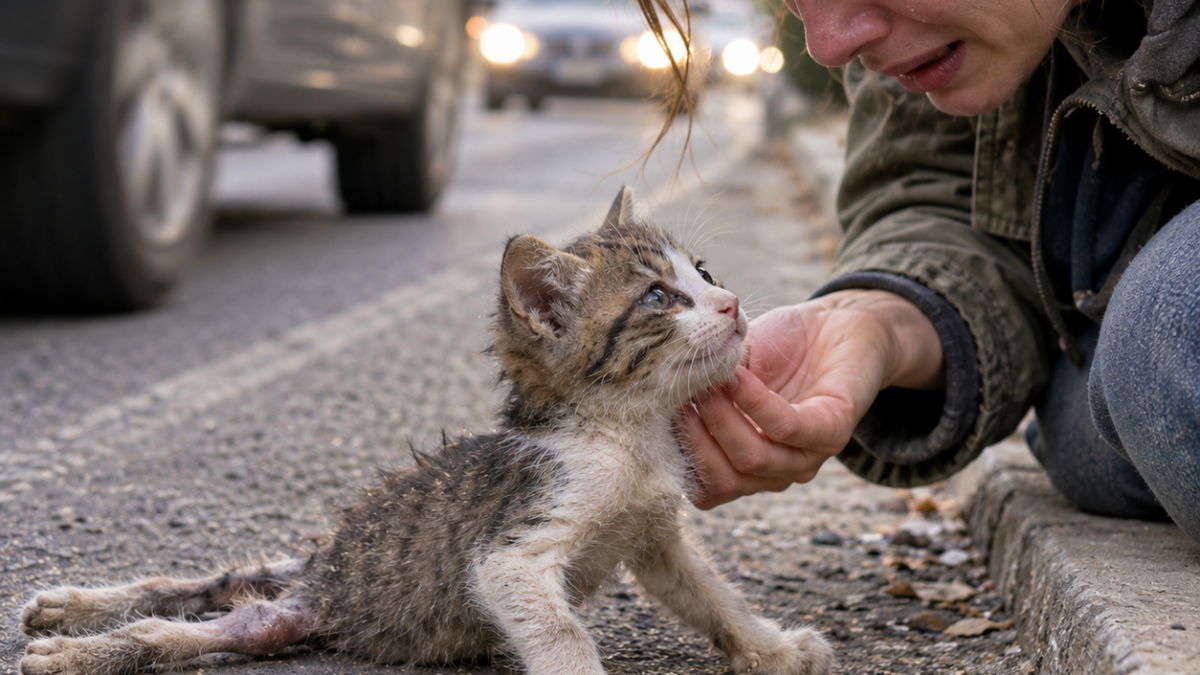
A Paralyzed Kitten Dragged His Tiny Body Along a Busy Road While Cars Passed Inches Away — Nobody Stopped for Him Until One Person Discovered What Was Really Wrong.
FULL STORY CONTINUATION
I didn’t move my hand.
I was afraid that if I shifted even slightly, I would lose the tiny sensation beneath my fingertips. Wasim lay on his towel, looking as ordinary and innocent as any kitten resting after a long day. His front paws were tucked near his chest. His little face was relaxed.
Nothing about him suggested that something important had just happened.
But I had felt it.
A twitch.
Not a step. Not a kick. Not proof that he would walk.
Just a tiny movement from a paw that had seemed almost completely unresponsive for weeks.
“Wasim?”
Of course, he didn’t answer.
I gently touched his paw again.
For a moment, I thought I felt another faint response, but I couldn’t be certain.
I didn’t want to turn hope into something it wasn’t.
That had become one of the hardest lessons of caring for him.
When you love a helpless animal, you begin searching for signs everywhere. A slightly different position. A little less stiffness. A movement you think you noticed while changing a towel.
You want every small difference to mean that everything is finally getting better.
But wanting something doesn’t make it true.
I had to remind myself of that every day.
Still, I looked at his tiny paw and felt something inside me loosen.
For weeks, there had been almost nothing.
Now there was something.
And with Wasim, something mattered.
I stroked the fur between his ears.
“That was good, sweetheart,” I whispered. “That was really good.”
He blinked at me.
Then he rested his chin against the towel, apparently satisfied that the serious conversation was over.
I laughed quietly.
It was the first time in days that the sound didn’t feel forced.
I wanted to celebrate. I wanted to imagine him walking across the floor, his tail lifted proudly behind him.
But I knew better than to promise him a future I couldn’t guarantee.
For now, I simply let him rest.
And when it was time for his next meal, I picked up the soft harness that had become such an ordinary part of our lives.
That harness had once made me unbearably sad.
The first time I saw him wearing it, I couldn’t stop looking at the difference between what he needed and what healthy kittens his age could do without thinking.
A healthy kitten might tumble into a food bowl, scramble back onto all four paws, and continue eating as though nothing had happened.
Wasim couldn’t do that.
If his hips weren’t supported, his body couldn’t remain in the position he needed.
His front legs could hold some of his weight, but his hindquarters offered little help.
So we supported him.
We made sure his little body was comfortable.
We positioned his food where he could reach it.
And we waited while he ate.
At first, those meals had felt like another reminder of what had been taken from him.
Now, I was beginning to see them differently.
They were moments when Wasim could simply be a kitten.
He didn’t spend his meals thinking about paralysis or wondering whether he would ever run.
He wanted food.
He wanted to be comfortable while he ate.
And when his belly was full, he wanted to rest.
His world was much smaller than ours, but the things that mattered inside it were real.
Warmth.
Food.
Clean bedding.
A gentle touch.
A familiar pair of hands.
I started measuring our days by those things instead of by the distance between where he was and where I wished he could be.
It wasn’t easy.
There were mornings when I would lift him from his bedding and feel the same worry settle into my chest.
I would glance at his hind legs, hoping to see that something had changed overnight.
Often, nothing had.
They still lay behind him.
They still needed careful positioning.
And he still couldn’t move the way a kitten should.
Yet he would look up at me with those small, trusting eyes, completely unaware that I had spent so much time worrying about a future he couldn’t imagine.
I began to understand that he wasn’t asking me to predict his life.
He was asking me to help him live the day in front of us.
So that was what I tried to do.
The daily care was far more demanding than I had understood when I first carried Wasim away from the street.
People sometimes imagine rescue as one extraordinary moment.
Someone sees an animal in trouble, reaches down, carries it to safety, and the terrible part of the story is over.
I wish it worked that way.
With Wasim, the rescue was only the first decision.
Everything afterward required another one.
The decision to stay patient when there was no visible progress.
The decision to remain gentle when the same task had to be repeated yet again.
The decision to treat his body with care even when we were frightened by how little it could do.
His bladder care was especially important.
Because he couldn’t empty it normally, the caregivers had to assist him each day according to the veterinary instructions.
There was nothing glamorous about it.
There was no sudden dramatic moment that made the work easier.
It simply had to be done.
I remember looking at his small body and feeling overwhelmed by how many things healthy animals take for granted.
A kitten who can move freely doesn’t have to understand how his bladder works.
He doesn’t have to know the difference between a leg that responds and one that doesn’t.
He doesn’t know what it means to need someone else to position him before he eats.
Wasim had to live with those limitations, even though he was far too young to understand them.
And the people around him had to make sure those limitations didn’t become a reason for him to suffer.
Some days, he tolerated the care quietly.
Other days, he shifted his front paws, trying to make himself more comfortable.
I learned to watch him carefully.
A small movement of his head might tell me that his towel needed adjusting.
A change in how he held his shoulders might mean that he was tired of a particular position.
I couldn’t ask him what he needed.
I had to pay attention.
There were moments when I worried that we were asking too much of him.
Not because his care was unnecessary.
Because he was so little.
I would look at him after his medicine or while he rested following a massage, and the unfairness of it would strike me all over again.
Two months old.
That was all.
He had barely begun his life, and already his body required more assistance than many animals need in years.
I sometimes wondered what those first weeks on the street had been like.
Had someone cared for him before he was found?
Had he once slept beside his mother?
Had there been a moment when his back legs worked?
I didn’t know.
And I refused to fill those unanswered questions with an invented history just because a heartbreaking story might make his suffering easier to explain.
What I knew was enough.
He had been found alone beside a busy street.
He had been dragging himself forward using his front paws.
Both hind legs were paralyzed.
And he needed help.
Those were the facts.
They were already painful.
He didn’t need an even more tragic past to deserve kindness.
The weeks passed slowly.
At least, that was how they felt to me.
To Wasim, each day was probably made up of simple moments: waking up, being fed, receiving care, resting, and discovering that the hands around him continued to return.
But for those of us watching his condition, time stretched differently.
Every week brought the same questions.
Was there more movement?
Was the stiffness changing?
Could he support himself any better?
Was he becoming more comfortable?
Sometimes, the answer was no.
Sometimes, we couldn’t tell.
And sometimes, the smallest improvement was enough to carry us through another difficult day.
His hind legs remained limp for a long time.
There were massages when I could gently touch and move his paws without seeing anything that resembled a voluntary response.
I would feel his tiny bones beneath the fur and wonder how something so small could make a person feel so helpless.
I wanted to fix him.
That was the truth I had to confront.
I wanted to reach into his little body and restore whatever wasn’t working.
I wanted to place him on the floor and watch him take a step.
I wanted to hear his paws moving across the room.
I wanted him to discover the ridiculous joy of chasing a toy that was never going to outrun him.
But none of those wishes changed what his nerves and muscles were doing.
Love couldn’t force his legs to recover.
It could only make sure he wasn’t alone while we gave him every appropriate chance.
There is a difficult kind of patience that comes with caring for an injured animal.
It’s different from waiting for a package or counting the days until a holiday.
You don’t know what you’re waiting for.
You don’t know whether the outcome you want is possible.
You only know that the animal in front of you still needs you today.
I remember one particularly quiet afternoon when Wasim had finished eating and was resting on a folded towel.
His little front paws were stretched out in front of him.
His hind legs lay behind him in their familiar position.
I sat beside him and watched his breathing.
He looked peaceful.
And suddenly, I realized that I had been so focused on his legs that I hadn’t spent enough time simply seeing him.
Not as a medical case.
Not as a problem to solve.
As Wasim.
A tiny kitten who liked being warm.
Who enjoyed being fed.
Who was slowly becoming familiar with the people caring for him.
Who could still experience comfort despite the things his body couldn’t do.
I reached down and touched the top of his head.
“You’re a good boy,” I whispered.
He settled a little more deeply into the towel.
And for that moment, I stopped asking his legs to do anything.
The first time I noticed that Wasim seemed able to pass a little urine on his own, I hardly knew what to think.
It wasn’t a complete recovery.
He still needed help.
He still needed careful monitoring.
And because he couldn’t control everything reliably, protective diapers became another part of his daily care.
But it was a change.
An important one.
After so many days of helping with every basic function, seeing even a little independence meant something.
I had to be careful not to exaggerate it.
A small improvement in bladder function didn’t mean he could walk.
It didn’t mean the paralysis had disappeared.
It didn’t mean we could stop assisting him or forget the medical instructions we had been following.
But it suggested that his condition wasn’t entirely unchanged.
I watched him afterward, trying to decide whether I should allow myself to feel happy.
Then I realized how strange that question was.
Of course I could be happy.
I didn’t have to pretend a small improvement was a miracle in order to celebrate it.
I could simply be grateful that one part of his difficult life had become a little easier.
“Look at you,” I told him softly.
He was far more interested in being comfortable than in receiving praise.
That was another thing I loved about him.
He didn’t know he was supposed to impress anyone.
He wasn’t performing bravery.
He wasn’t trying to become an inspirational story.
He was just living.
When something became easier, he accepted it.
When he needed help, he received it.
When he was tired, he rested.
I sometimes wished I could approach uncertainty the same way.
Instead, I kept worrying.
Would the improvement continue?
Would it stop?
Would we have to manage his bladder this way for the rest of his life?
Would his legs ever support him?
The questions came quickly, one after another.
But Wasim was lying comfortably in front of me.
So I picked up a clean towel, prepared what he needed, and returned my attention to the present.
Whatever tomorrow brought, today he had made a little progress.
And that was enough.
Changing his diapers became one of the most unexpectedly emotional parts of caring for him.
Not because the task itself was extraordinary.
Because of how he gradually responded to it.
At the beginning, every necessary adjustment reminded me of his vulnerability.
I had to be careful with the position of his hips.
I had to make sure nothing was pulling against his little legs.
I had to protect his skin and keep him clean and dry.
He was completely dependent on that care.
There was something heartbreaking about seeing such a tiny animal require a diaper before he had even experienced the freedom of running.
But over time, the routine changed.
Or perhaps I changed.
I stopped looking at the diaper as a symbol of everything that was wrong.
I started seeing it as one more way to keep him comfortable.
It meant he didn’t have to remain wet.
It helped protect his bedding.
It was part of the attention he deserved.
And eventually, Wasim seemed to recognize the familiar rhythm of being cared for.
He would rest on his towel while I gently adjusted him.
Sometimes his front paws moved against the fabric.
Sometimes he turned his head as though checking what I was doing.
I would speak to him in the same calm voice.
“Almost finished, sweetheart.”
Then I would make sure everything was comfortable.
And one day, while I was adjusting his diaper, I heard a sound so soft that I almost missed it.
A low vibration.
I looked at his face.
He wasn’t crying.
He wasn’t struggling.
He was purring.
For a moment, I couldn’t do anything except stare.
I had heard kittens purr before.
Of course I had.
But I had never expected the sound to affect me that way.
This little animal, whose body had endured so much difficulty, was lying in my hands and purring during a routine that had once seemed so sad.
I leaned closer.
The sound continued.
A tiny, steady rumble.
“Wasim,” I whispered.
He blinked.
I felt my eyes begin to sting.
I couldn’t know exactly what he was feeling. Cats can purr for different reasons, including when they need comfort.
But his relaxed body, the gentle sound, and the way he remained settled in my hands made me hope that he was beginning to associate our care with safety.
That mattered more to me than I could explain.
Because when I found him, he had been struggling alone.
Now, even though his legs still didn’t work normally, he was surrounded by people who noticed his needs.
People who would help him eat.
People who would keep him clean.
People who would support him when he couldn’t support himself.
And perhaps, in the small language of a kitten, that was beginning to mean something.
I thought often about the road.
Not because I wanted to relive the worst moment of his life.
Because the memory changed as I got to know him.
In the beginning, whenever I pictured Wasim beside the traffic, I saw only helplessness.
The dragging legs.
The trembling front paws.
The dust clinging to his fur.
The frightening possibility that a passing vehicle might reach him before help did.
But as the months passed, the memory became more complicated.
I began to see determination in it, too.
Not the grand, heroic kind people like to put into stories.
Just the simple determination of a living creature trying to move.
He had used the part of his body that still responded.
He had pulled himself forward.
He had kept going until someone reached him.
That didn’t mean he had chosen to be brave.
It didn’t mean he understood the danger or had some extraordinary plan.
But it did mean that, even in terrible circumstances, he was still trying to live.
I found that thought both comforting and devastating.
Because there was something so unfair about making a two-month-old kitten work that hard just to move a few inches.
Sometimes, while he slept, I would look at his little front paws.
They were the paws that had dragged him along the road.
The paws that had carried far more weight than they were meant to carry alone.
The paws that had trembled from the effort.
Now they rested on clean bedding.
I would gently smooth the fur above them.
“You don’t have to do that anymore,” I whispered once.
I knew the words were not entirely true.
Wasim still relied heavily on his front legs to move.
His condition hadn’t vanished because he was safe.
But at least he no longer had to struggle along a busy road without anyone watching over him.
That difference mattered.
Safety didn’t erase his paralysis.
It didn’t make every day easy.
But it gave him something he hadn’t had when I first saw him.
The chance to struggle without being abandoned to the struggle.
One of the hardest things about watching Wasim recover was learning how to recognize progress that didn’t look impressive.
We live in a world that loves dramatic before-and-after moments.
A sick animal is found.
A rescue takes place.
Treatment begins.
Then, in the final scene, the animal runs across a sunny field.
Everyone cries.
The story ends.
I used to love those stories.
I still do.
But Wasim taught me that recovery doesn’t always produce a perfect final scene.
Sometimes, the animal doesn’t run.
Sometimes, the legs remain weak.
Sometimes, a diaper is still necessary.
Sometimes, the most important change is that the animal no longer spends every moment struggling against its own body.
For Wasim, the improvements came gradually.
The first signs of movement in his back paws were small.
His legs began responding more to touch.
When we gently handled them during his care, there were moments when we could see or feel a response that hadn’t been there before.
I remember looking closely, trying to decide whether the movement was stronger than the last one.
I didn’t always trust my own memory.
So I learned to pay attention without forcing every observation into a conclusion.
Some days, the response was noticeable.
Other days, it was faint.
We continued the massages.
We continued the prescribed care.
We continued helping him with his bladder and supporting his body while he ate.
And we allowed the changes to happen at their own pace.
Wasim had no idea how carefully we were watching.
That was probably a good thing.
He didn’t have to carry our expectations.
He didn’t have to understand why a movement that seemed insignificant to him could make an adult sit silently beside him with tears in their eyes.
He just needed to be comfortable.
So whenever I found myself becoming too anxious, I returned to that simple responsibility.
Was he clean?
Was he warm?
Had he eaten?
Was his body positioned safely?
Was he resting comfortably?
Those questions had answers.
And answering them helped me stay useful.
Months after I first found Wasim, I noticed something during one of his meals that made me stop what I was doing.
He had finished eating.
Usually, we supported his hips carefully because his hind legs couldn’t hold him in a stable position.
But this time, as the support shifted, Wasim remained upright for a few extra seconds.
It wasn’t graceful.
It wasn’t a proper walk.
It wasn’t even a position he could maintain for very long.
But he was holding himself differently.
I watched without immediately moving him.
His little body wavered.
His front legs took much of the effort.
His hindquarters were still weak.
Then he began to lose his balance, and I gently supported him again.
“Wasim…”
My voice caught.
I looked at him, then at the harness, then back at his little legs.
Had that really happened?
Had he held himself upright longer than before?
I had been with him through enough difficult days to know that I shouldn’t treat a few seconds as the end of his paralysis.
But I also knew what those seconds meant.
For a kitten who had once been unable to support his hindquarters at all, they were not nothing.
They were evidence of change.
I placed him comfortably on his towel and sat beside him.
I wanted to laugh.
I wanted to cry.
I wanted to tell everyone that he had done something wonderful.
Instead, I stroked his head.
“Good job, little guy.”
He looked completely unimpressed by the importance of the moment.
Then he settled down to rest.
I laughed through the tears that had finally escaped.
Perhaps that was the right response.
He hadn’t asked for a celebration.
He had simply done what his body allowed him to do.
And I had been lucky enough to witness it.
There is a particular kind of sadness that comes from watching an animal grow while some part of its body remains limited.
When I first found Wasim, he was so tiny that I could almost imagine his condition as something separate from his future.
He was a baby.
Surely there was time.
Surely his body might surprise us.
But as he grew, I had to face a more difficult truth.
His life was moving forward whether or not his legs recovered completely.
He was getting older.
He was becoming more comfortable with his surroundings.
He was developing his own little habits and preferences.
And still, he couldn’t walk normally.
At times, that hurt.
I would watch him shift his weight, trying to arrange his body into a comfortable position, and feel a sudden wave of grief for the ordinary movements he had never been able to enjoy.
I imagined the first clumsy leap he might have made if his hind legs had worked.
I imagined him chasing something across the floor.
I imagined him climbing into a warm place and curling up after exhausting himself with play.
Then I would look back at the real kitten in front of me.
The one resting peacefully on his towel.
And I would remind myself that his life was not an inferior version of the life I had imagined.
It was his life.
He deserved care and happiness within it.
It would have been unfair to spend every day mourning a version of Wasim that might never exist while overlooking the Wasim who was right there.
That didn’t mean giving up on treatment.
It meant learning to separate hope from expectation.
I could hope for more movement.
I could hope for better control of his bladder.
I could hope that one day he might support himself more easily.
But I couldn’t make those hopes the conditions for loving him.
He didn’t have to walk to be worth the work.
He didn’t have to improve every week.
He didn’t have to become an extraordinary recovery story.
He had already survived long enough to be found.
Now he deserved the chance to live with dignity, whatever his physical abilities became.
The massages were among the quietest moments of our days.
There was no grand medical drama in the way we performed them.
Just careful hands.
Gentle movements.
Attention to his comfort.
And the awareness that his little body needed more help than most.
I would prepare a warm, soft place for him to lie.
Then I would settle him carefully, making sure his hips and back legs were supported.
His fur had become much cleaner and softer than it had been beside the road.
Sometimes, while smoothing a hand along his body, I would remember how dusty and matted he had been when we first met.
The difference was remarkable.
Not because grooming had changed his paralysis.
Because cleanliness and comfort had become ordinary parts of his life.
The road had covered him in dust.
Care had given him a place where he could rest without that dirt clinging to him.
I would begin the gentle massage, watching how he responded.
At first, I had concentrated almost entirely on his legs.
I searched for movement.
I checked how his muscles felt.
I noticed whether his paws seemed stiff or relaxed.
But as time passed, I started watching his face, too.
Was he comfortable?
Was he tense?
Did he seem ready for a break?
His body could not tell me everything through his hind legs, but the rest of him still communicated.
And increasingly, one of the things he communicated was contentment.
Sometimes the purring began almost as soon as he settled onto the towel.
A soft rumble would rise from his chest.
I would smile before I even realized I was doing it.
“There’s my little engine,” I murmured.
He kept purring.
I would gently continue the massage, careful not to confuse his relaxed behavior with evidence that every part of his body was healing.
Comfort and neurological recovery were different things.
Both mattered.
And sometimes, when the movements in his legs were barely noticeable, the fact that he seemed relaxed during care was the most reassuring part of the day.
It told me that our efforts weren’t only about chasing a medical outcome.
They were also about making his life more pleasant right now.
That realization stayed with me.
I began to understand that caring for Wasim required two kinds of strength.
The first was physical.
There were things that simply had to be done.
His bedding had to be changed.
His bladder needed assistance.
His diapers needed attention.
His meals required support.
His body needed careful handling.
His medication and other treatment had to follow the veterinary plan.
Those tasks demanded consistency.
But the second kind of strength was emotional.
It was the ability to look at a struggling animal and resist the temptation to become overwhelmed by everything you couldn’t fix.
Some mornings, I would feel strong.
I would greet Wasim, prepare his care, notice a small improvement, and feel grateful that he was safe.
Other mornings, I would see his limp legs and feel the same helpless sadness I had felt at the clinic.
I wondered whether he would ever experience the effortless movement other kittens enjoyed.
I wondered whether he would always need someone to help him with basic bodily functions.
I worried about his comfort.
I worried about whether the progress would last.
And beneath all those questions was a quieter fear.
What if this was as much as he could recover?
I didn’t like admitting that possibility.
It felt as though acknowledging it might somehow diminish our efforts.
But eventually I understood that acceptance wasn’t the same as surrender.
If Wasim never walked normally, he would still need kindness.
If he continued improving, he would need kindness.
If his condition remained complicated, he would need kindness.
There was no version of his future in which the right thing to do was to stop seeing him as a living creature worthy of care.
That thought steadied me.
I couldn’t control the entire outcome.
I could control how gently I picked him up.
How carefully I listened to the veterinarian.
How patiently I helped him eat.
How attentively I watched for signs of discomfort.
How consistently I returned when he needed me.
And whenever the future became too frightening to imagine, I returned to those things.
The first time I heard Wasim purr while wrapped in a warm towel, I felt a kind of relief that was difficult to put into words.
It was after one of his care routines.
He had been cleaned and settled comfortably, and I had wrapped him loosely in the soft fabric to keep him warm.
His little face rested near the edge of the towel.
For a few moments, he was quiet.
Then the purring began.
I placed my hand lightly against him.
The vibration was unmistakable.
It was such a small sound.
Yet it seemed to fill the entire room.
I remembered him dragging himself along the road.
I remembered the way his front paws had trembled.
I remembered the clinic examination and the terrible realization that both his back legs were paralyzed.
I remembered the first difficult attempts to help him with his bladder.
The stiffness.
The uncertainty.
The weeks when I had searched his legs for a response and found almost nothing.
And now this little kitten was resting in a warm towel, making a sound I desperately hoped meant that he felt safe.
I leaned closer.
“Are you comfortable, sweetheart?”
His eyes were partly closed.
The purring continued.
I didn’t need him to answer.
For the first time, I could imagine that his memories of human hands might be changing.
When we met, my hands had lifted him from a dangerous place.
At the clinic, hands had examined his body and performed procedures he couldn’t understand.
During treatment, hands had supported him, repositioned him, and helped him with tasks he couldn’t do alone.
Now those same kinds of hands were also associated with warmth, gentle strokes, and rest.
Perhaps he was learning that being picked up didn’t always mean something uncomfortable was about to happen.
Perhaps he was learning that there would be food when he needed it.
That someone would notice when his bedding needed changing.
That he could close his eyes without having to keep pulling himself forward.
I couldn’t know precisely what he understood.
But I could see his growing comfort.
And it was enough to make me sit beside him for a long time, listening to that gentle rumble.
As Wasim grew stronger in certain ways, he also became more resourceful.
His hind legs still weren’t functioning normally.
That remained the truth.
But he was learning how to shift his weight and position himself with less struggle.
His front legs, which had once trembled from dragging him across the roadside, now helped him move within a safer environment.
He still needed support.
He still became tired.
He still couldn’t move like a healthy kitten.
But his movements sometimes looked a little less desperate.
That difference was difficult to explain to someone who hadn’t seen him at the beginning.
If you met Wasim later in his recovery, you might notice only that he couldn’t walk properly.
You might see his weak hind legs and the careful way he had to be handled.
You might wonder why the people around him became emotional over a movement that lasted only a few seconds.
But I remembered the road.
I remembered when he couldn’t keep his hindquarters supported at all.
I remembered the weeks when touching his paws produced almost no response.
So when he adjusted his weight a little more effectively, I noticed.
When he remained upright briefly after eating, I noticed.
When his legs responded more clearly to gentle touch, I noticed.
And when he purred during a diaper change, I noticed that, too.
The world might not have considered those moments extraordinary.
To us, they marked the distance between the helpless kitten we had found and the kitten he was becoming.
I never wanted to exaggerate his progress.
But I didn’t want to overlook it, either.
There is a difference between pretending an animal has recovered and recognizing that its quality of life is improving.
Wasim reminded me of that every day.
Sometimes, the most painful part of his story wasn’t what had happened to him.
It was what almost hadn’t happened.
I kept thinking about how easily someone could have missed him.
He had been so small.
The street had been busy.
He couldn’t move quickly.
He couldn’t run toward safety if a vehicle approached.
He couldn’t even get out of the way the way a healthy kitten might.
All the strength in his front legs had been devoted to pulling the rest of his body across the ground.
He hadn’t been able to make himself more visible.
He hadn’t been able to ask for help in words.
He had simply been there.
A tiny life in a dangerous place.
And someone had to notice.
That thought made me uncomfortable in a way I couldn’t easily explain.
Not because I believed every passerby had seen him and deliberately ignored him.
I had no way of knowing that.
But because it reminded me how vulnerable suffering can be when it is quiet.
We often imagine emergencies as loud.
We imagine cries, movement, obvious panic.
Wasim’s emergency was small and almost silent.
His legs trailed behind him.
His front paws shook.
He kept moving because there was nothing else he could do.
I wondered how many other animals were struggling somewhere without making enough noise to attract attention.
The thought was painful.
But I tried not to let it become a burden Wasim had to carry.
His story wasn’t proof that the whole world was cruel.
It was proof that being noticed could change what happened next.
He had been found.
He had been taken to a clinic.
He had received treatment.
He had been given care through weeks when progress was uncertain.
And now, instead of struggling alone on the pavement, he was growing in a place where someone paid attention to the smallest changes in his body.
The contrast was enormous.
There were still difficult days.
Even as his condition improved, Wasim remained a kitten with serious physical limitations.
His back legs could respond more than they once had, but they didn’t suddenly become strong, coordinated limbs.
He couldn’t race across the room.
He couldn’t jump.
He couldn’t walk normally.
And he still needed assistance with bladder care.
Sometimes, the diapers required extra attention.
Sometimes, a position that had seemed comfortable needed adjusting.
Sometimes, his legs were stiffer than I wanted them to be.
Sometimes, I watched him try to move and felt that familiar ache in my chest.
I wanted so badly to see his little body respond the way a healthy kitten’s body would.
But he didn’t know what I expected.
He simply did what he could.
So I learned not to let my disappointment become the atmosphere around him.
When I picked him up, I spoke gently.
When he needed his care routine, I approached it calmly.
When he had finished eating, I made sure he could rest.
When he showed a small improvement, I was grateful.
And when there was no improvement, I tried to be just as kind.
That last part mattered most.
It is easy to feel patient when you can see progress.
It is harder when the weeks seem to repeat themselves.
But Wasim’s need for care didn’t become less important because a particular massage hadn’t produced a new response.
He was still hungry when it was time to eat.
He still needed a clean diaper.
He still needed help with his bladder.
He still deserved warmth and comfort.
I reminded myself of those simple truths whenever anxiety threatened to turn his recovery into a race.
There was no finish line I could promise him.
There was only the life he was living, one day at a time.
One evening, after his care was finished, I sat beside him and watched him settle into his bedding.
His front paws moved against the towel.
His hind legs lay behind him.
He adjusted himself, shifting his weight until he seemed comfortable.
It was a small, ordinary scene.
Nothing dramatic happened.
No sudden step.
No miraculous recovery.
No veterinarian rushing into the room with life-changing news.
Just Wasim finding a comfortable position.
Then he began to purr.
I smiled.
I had become familiar with that sound, but it still moved me.
Perhaps because it represented something I hadn’t known how badly I wanted when I first found him.
I had wanted him to survive.
I had wanted his legs to heal.
I had wanted him to walk.
But beneath all those wishes, there had been another one.
I wanted him to feel safe.
I wanted him to have moments when his body wasn’t only a source of difficulty.
I wanted him to enjoy being touched.
To rest without fear.
To experience the simple comfort every young animal deserves.
And now, as he lay purring on his towel, I could see that at least some of those things were becoming part of his life.
I reached down and gently stroked his head.
“You’re doing okay, aren’t you?”
He continued purring.
I didn’t know whether his hind legs would ever become strong enough for normal walking.
I didn’t know whether he would always need help with his bladder.
I couldn’t promise an uncomplicated future.
But I could promise something much smaller and much more real.
I could keep showing up for the care he needed.
And at that moment, I understood that this promise was more useful to Wasim than any dramatic prediction about his recovery.
I still think about the day I found him.
Sometimes, the memory comes back unexpectedly while I’m helping him eat.
Sometimes, I remember it during his massage, when one of his back paws makes a faint movement beneath my fingers.
Sometimes, it returns when I’m adjusting his diaper and he starts purring before I’ve even finished.
I see that dusty stretch of road.
The traffic.
The little body moving so slowly.
The hind legs dragging behind him.
And I remember how I felt when I realized he couldn’t run away from danger.
At first, I thought the most important thing I could do was get him off the street.
And in that moment, it was.
But the months that followed taught me that rescue isn’t always a single brave act.
Sometimes, rescue is helping a kitten empty his bladder on a day when you’re tired.
Sometimes, it’s making sure the harness is positioned correctly so he can eat comfortably.
Sometimes, it’s another gentle massage even though yesterday’s massage didn’t seem to change anything.
Sometimes, it’s cleaning a diaper.
Replacing a towel.
Remembering medication.
Watching for signs of improvement without forcing them to appear.
Sometimes, it’s accepting that the animal you love may always need more care than others.
And continuing anyway.
Wasim had taught me something important about hope.
Hope didn’t always arrive as a dramatic breakthrough.
Sometimes, it was a back paw twitching after weeks of stillness.
Sometimes, it was a little urine passed without assistance.
Sometimes, it was a few extra seconds spent upright after a meal.
And sometimes, it was the quiet sound of a kitten purring while someone gently cared for him.
These things didn’t erase his paralysis.
They didn’t mean all the difficult days were behind us.
But they made his life better.
And they reminded us that his story wasn’t defined only by the things his body couldn’t do.
As the months went by, I began to notice a change in myself whenever I looked at Wasim.
In the beginning, the first thing I saw was his injury.
I couldn’t help it.
His dragging legs frightened me.
The paralysis devastated me.
The need for bladder assistance felt unbearably unfair.
I saw all the things he couldn’t do and immediately imagined all the things he might never experience.
But slowly, my attention shifted.
I began noticing the particular way he relaxed when wrapped in a warm towel.
The soft sound of his purr.
The determination with which he used his front paws.
The way he settled after eating.
The small movements that appeared in his hind legs.
The moments when he seemed comfortable enough to rest without concern.
I still saw his disability.
Of course I did.
It was part of the care he needed.
But it was no longer the only thing I saw.
I saw a kitten growing older in a safe place.
I saw an animal learning that people would respond to his needs.
I saw a small body finding new ways to manage movement.
I saw progress that was real, even when it wasn’t complete.
Most importantly, I saw Wasim.
Not the tragic image of a kitten beside a road.
Not a problem that needed a perfect solution.
Not a story whose value depended on a miraculous ending.
Just Wasim.
A little cat whose life had become difficult far too early, but whose days could still contain comfort, affection, and moments of happiness.
That was when I realized how much I had changed.
I no longer needed every day to deliver a new milestone.
Some days, it was enough to see him resting peacefully.
Some days, it was enough to know he had eaten well and received the care he needed.
And some days, when he purred beneath my hand, it was more than enough.
I once thought the saddest part of Wasim’s story was that he couldn’t use his back legs.
Now I think the saddest part was how close he had come to facing that condition entirely alone.
Paralysis was a terrible challenge for such a small kitten.
But paralysis beside a busy street, without food, shelter, or someone to help with his most basic needs, was something even more frightening.
He had no way to protect himself.
No way to move quickly.
No way to care for his bladder properly.
And no way to explain what was happening to him.
His survival depended on someone recognizing that a tiny struggling creature mattered.
I’m grateful that someone did.
I’m grateful that he reached the clinic.
I’m grateful for the veterinary team that examined him and the caregivers who continued helping him when his progress was slow.
I’m grateful for the medication, the vitamin B12 injections, the careful massages, the harness, the clean bedding, and every little task that made his days more manageable.
And I’m grateful that his body began showing some response after those long weeks of uncertainty.
But if I had to choose one memory that explains why Wasim’s story stays with me, it wouldn’t be the first twitch of his paw.
It wouldn’t even be those precious seconds when he managed to remain upright.
It would be an ordinary moment during his daily care.
I would be gently adjusting his diaper.
He would be lying on a soft towel, warm and relaxed.
His hind legs would still need assistance.
His body would still carry the limitations we had been working with for months.
And then he would begin to purr.
That tiny sound would remind me that comfort had become possible for him.
Not because everything had been fixed.
But because he was no longer facing everything alone.
Wasim’s recovery remained incomplete.
His hind legs had begun responding more to touch, and he could shift his weight and remain upright a little longer than before.
He was moving with less struggle.
He had started passing some urine independently, although he still needed assistance and protective diapers.
Those improvements mattered.
But he still couldn’t walk normally.
I won’t pretend otherwise.
I won’t turn his story into a miraculous cure that never happened.
His future still required careful attention, patience, and appropriate care.
Yet the little kitten I watched resting comfortably was not the same helpless creature I had first seen dragging himself along the roadside.
He had grown.
He had made small but meaningful gains.
And perhaps most beautifully, he had learned to relax in the hands of the people caring for him.
Sometimes, when I held him, I thought about how different his world must feel now.
The street had been hard and dangerous.
His bedding was soft.
The road had been filled with passing traffic.
His resting place was quiet.
His body had once been covered in dust.
Now he could be kept clean and warm.
And when he needed help with something he couldn’t do himself, someone was there to provide it.
I couldn’t explain any of that to him.
I couldn’t tell him how close he had been to danger or how many people had worked to give him a better chance.
He didn’t need to understand.
He only needed to experience the difference.
I gently placed him on his warm towel and watched him settle.
His front paws shifted.
His back legs rested behind him.
Then his eyes softened, and the familiar purring began.
I put my hand beside his little body.
For a moment, I remembered the road so clearly that my chest tightened.
The trembling paws.
The dusty fur.
The tiny kitten dragging himself forward because he had no other way to move.
And then I looked at him now.
Safe.
Warm.
Cared for.
Still unable to walk normally, but no longer alone.
I stroked his head.
“You’ve come a long way, little one,” I whispered.
Wasim continued purring.
He didn’t know how much those small sounds meant to me.
He didn’t know that I had spent weeks hoping to feel the slightest movement in his paws.
He didn’t know how frightened I had been when his legs seemed to grow stiffer.
He didn’t know that a few seconds of standing upright had nearly brought me to tears.
And he didn’t know that, from the first moment I lifted him off the street, I had been terrified of losing him to circumstances he was too small to understand.
All he knew, perhaps, was that the hands touching him were gentle.
That his body was warm.
That he could rest.
I stayed beside him until he settled more deeply into the towel.
For once, I didn’t look at his hind legs and wonder how much more they might recover.
I didn’t measure the seconds he could remain upright.
I didn’t think about the next appointment, the next massage, or the next small sign we would be watching for.
I simply listened to him purr.
Because the kitten who had once dragged himself along a dangerous road was finally experiencing something every living creature deserves.
Not perfect health.
Not a life without difficulty.
But the comfort of knowing, in whatever way his little heart could understand, that when he needed help, someone would be there.
And for Wasim, that was already a beautiful beginning.








