A Dog Was Slowly Freezing to Death at the Bottom of an Abandoned Well—Then He Held Me Like He Had Been Waiting His Whole Life for Someone to Come. I Thought Saving Him Was the End of His Suffering… Until the Vet Showed Me What Was Hidden Beneath His Fur.
A Dog Was Slowly Freezing to Death at the Bottom of an Abandoned Well—Then He Held Me Like He Had Been Waiting His Whole Life for Someone to Come. I Thought Saving Him Was the End of His Suffering… Until the Vet Showed Me What Was Hidden Beneath His Fur.
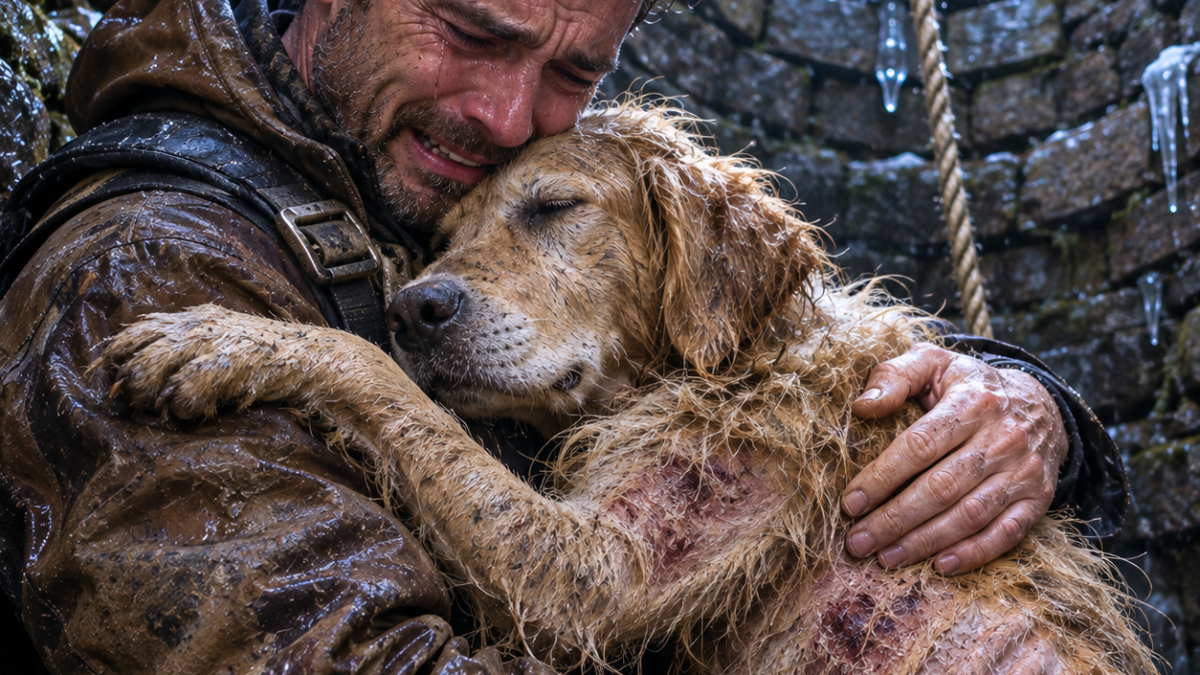
At the bottom of a fifty-two-foot abandoned well, in water cold enough to steal strength from a body within minutes, a starving dog was standing on one tiny stone with only his nose and eyes above the darkness. When I finally reached him, I expected panic, snapping teeth, anything—but instead he pressed his freezing body against my chest, wrapped both front legs around me, and made a sound so broken that I started crying before we ever reached the surface. Hours later, a veterinarian would show me the old scars beneath his wet fur and tell me the truth that hurt even more than the well: this dog had been fighting to survive long before he fell into it.
My name is Lucas Bennett.
I have worked rescue for almost twelve years.
I’ve crawled beneath overturned cars.
Climbed unstable roofs.
Pulled frightened people out of flooded basements.
Spent nights searching woods for missing hikers while freezing rain worked through every layer of clothing.
I thought I understood fear.
Then I heard a dog crying from sixteen meters underground.
It happened on an overcast Thursday at the old Murphy farm.
The property had been abandoned for years.
Once it had been a dairy operation—red barn, feed shed, weathered farmhouse, several acres of field slowly being reclaimed by weeds.
By the time we arrived, only the barn and part of the farmhouse remained standing.
Everything else leaned toward collapse.
The call came from a woman named Margaret Ford.
She lived about half a mile down the road.
Mrs. Ford was seventy and walked every morning, regardless of weather.
That day she had been passing the Murphy property when she heard something.
At first, she thought it was a bird.
Then she heard it again.
A whimper.
Very faint.
She followed the sound through waist-high weeds until she reached an old stone well almost hidden beneath vines and rotten boards.
The cover had partially collapsed.
She leaned over.
Heard the sound again.
Then called emergency services.
When Henry Jacobs and I arrived, she was standing twenty feet from the well with both hands clasped against her chest.
“Please.”
Those were the first words she said.
“There’s something alive down there.”
Henry approached the opening.
“Animal?”
“I think a dog.”
I crouched beside the well.
Darkness.
Absolute darkness.
I dropped a flashlight beam into it.
The circle of light vanished downward.
Stone walls.
Moss.
Water.
Nothing else.
Then—
A sound.
Soft.
Thin.
Almost swallowed by the shaft.
A dog whining.
Mrs. Ford covered her mouth.
“There.”
I leaned farther.
“Hey!”
Silence.
“Buddy!”
A splash.
Then another whimper.
Henry looked at the depth gauge.
“Fifty-two feet.”
My stomach tightened.
The well was narrow.
Old stone.
Unknown stability.
The water at the bottom was deep enough that we couldn’t simply lower a catch pole and hope for the best.
Then the flashlight found him.
A flash of pale fur.
Two eyes reflecting light.
The dog was standing—or trying to stand—on a small ledge or stone barely above the water.
Most of his body was submerged.
Only his chest, head and part of his back remained visible.
He was shaking so violently that the water around him trembled.
“Jesus.”
Henry whispered it beside me.
Mrs. Ford began crying.
“Can you get him?”
I looked at Henry.
He looked at me.
We both knew the risks.
Old wells kill rescuers.
Loose stone.
Bad air.
Cold water.
Limited space.
A panicked animal.
One mistake could put two lives at the bottom instead of one.
Henry said quietly:
“We need the tripod.”
“I know.”
“Harness.”
“I know.”
“Lucas.”
I looked at him.
“He’s been down there a long time.”
“I know.”
Another whimper floated upward.
That sound decided everything.
I clipped into the rescue harness.
Mrs. Ford stared at me.
“You’re going down?”
“Yes.”
Her eyes filled.
“Please bring him back.”
I looked into the black circle at my feet.
Then at her.
“I’ll do everything I can.”
PART2
We set the tripod over the well.
Henry checked every connection twice.
Then a third time.
“Radio?”
“Working.”
“Secondary line?”
“Secure.”
“Thermal blanket ready?”
“Ready.”
He looked at me.
“Do not become sentimental down there.”
I almost smiled.
“Good advice.”
“I mean it.”
He pointed toward the shaft.
“If the masonry starts moving, you’re coming up.”
“Yes.”
“If your oxygen alarm goes, you’re coming up.”
“Yes.”
“If that dog panics and you cannot control him—”
“I know.”
Henry grabbed my shoulder.
“You don’t save anybody by becoming the second casualty.”
I nodded.
Then I stepped over the edge.
The light disappeared quickly.
At ten feet, the air changed.
Cooler.
Wet.
The walls were close enough that my shoulders occasionally brushed stone.
At twenty feet, daylight became a small gray circle above me.
At thirty, the smell of stagnant water and earth grew stronger.
I could hear the dog now.
Not constantly.
Every few seconds.
A weak whine.
Then silence.
Then another.
I kept talking.
“I’m coming.”
My voice echoed strangely.
“Hang on, buddy.”
The whining stopped.
Maybe he heard me.
Maybe not.
“Just stay there.”
Forty feet.
My gloves brushed wet moss.
Small pieces of mortar crumbled beneath my fingertips.
“Henry.”
“Copy.”
“Wall’s deteriorated on the east side.”
“Copy. Slow.”
I continued.
Then my boots touched water.
The cold went through them immediately.
Even with protective gear, I felt it.
The flashlight beam swept across the bottom.
And there he was.
The dog looked larger than I’d expected.
Golden-brown coat, though the color was almost impossible to see beneath mud.
Maybe a retriever mix.
Maybe something else.
His ribs showed.
His fur clung tightly to his body.
He had found a stone projection just large enough to keep his front feet from sliding completely beneath the water.
His back legs were still submerged.
His head hung low.
When my boots disturbed the water, he tried to lift himself.
Failed.
Then looked at me.
I’ve tried to describe that look many times.
Fear was there.
Of course.
But not aggression.
Not even surprise.
It was something closer to exhaustion so complete that fear no longer had energy.
His eyes seemed to ask only one thing.
Are you real?
I crouched as far as the harness allowed.
“Hey.”
The dog’s ears moved.
“It’s okay.”
He stared.
“No one’s going to hurt you.”
The irony of saying that to an animal covered in old scars wouldn’t hit me until later.
At that moment, I was focused only on getting him out.
I extended one gloved hand.
He flinched.
Stopped.
Then leaned forward enough to sniff.
His nose touched my fingers.
For half a second, nothing happened.
Then the dog moved.
Not away.
Toward me.
He stepped off the stone.
His back legs disappeared.
I caught him under the chest.
“Got you.”
The dog panicked for one second.
His claws hit my vest.
Then something changed.
He wrapped both front legs around my torso.
Not literally hugging the way a human would.
But close enough.
His paws hooked over my shoulders.
His face buried itself against my neck.
And he made a sound.
I will never forget it.
Low.
Broken.
Half whine.
Half sigh.
Like a creature that had been holding something inside for far too long and finally believed it could stop.
My eyes filled instantly.
“Yeah.”
I put one arm around him.
“I’m here.”
He pushed closer.
“I’ve got you.”
The dog trembled against me so violently that my own body began shaking with him.
“Henry.”
My voice cracked over the radio.
“I have him.”
“Condition?”
“Bad.”
“Responsive?”
“Yes.”
“Can you secure him?”
I looked at the dog.
His front legs tightened around me.
I laughed through tears.
“I don’t think he’s planning to let go.”
Henry’s voice softened.
“Copy.”
I secured the animal sling around his body as carefully as I could.
He whimpered when I touched his ribs.
Too thin.
Far too thin.
I could feel every one of them.
“Sorry.”
His head stayed against my chest.
“Almost done.”
Water reached my thighs.
Cold climbed upward.
My hands were beginning to stiffen.
I checked the sling.
“Ready to raise.”
Henry answered.
“Slow lift.”
The line tightened.
The dog felt the movement.
He panicked again.
His paws gripped my shoulders.
“Hey.”
I pressed my cheek against the top of his wet head.
“Look at me.”
He didn’t.
So I kept talking.
“I’m not leaving you.”
We began rising.
“You hear me?”
The darkness slid past us.
“We’re going together.”
His body trembled.
“I’m not letting go.”
At thirty feet, a stone dropped from the wall.
It struck the water below.
I froze.
“Henry.”
“I heard it.”
The rope stopped.
For several seconds, nothing moved.
Then another tiny piece of mortar fell.
The dog’s breathing became faster.
“Easy.”
I could feel his heart pounding against my chest.
“Easy.”
Henry asked:
“Wall stable?”
“As stable as anything in here.”
“Can you continue?”
I looked upward.
A small circle of daylight.
Then downward.
Black water.
The dog’s paws remained around me.
“Yes.”
We continued.
Twenty feet.
The dog lifted his face.
For the first time, he could probably see daylight.
His eyes widened.
Then he looked at me.
I swear something changed in them.
At the bottom, he’d looked resigned.
Now—
Hope.
Tiny.
Fragile.
But there.
Ten feet.
Mrs. Ford’s voice echoed down.
“Oh my God.”
Then she began crying.
“That’s him.”
The opening grew brighter.
Hands appeared.
Henry.
Another responder.
They reached down.
“Got the dog.”
His paws tightened around me.
“No.”
I felt his panic.
“It’s okay.”
He tried to climb higher onto my chest.
Henry stopped.
“Bring both.”
We came over the edge together.
The instant my knees touched ground, I knelt.
The dog remained against me.
Mrs. Ford was openly sobbing now.
“Oh, sweetheart.”
Someone wrapped a blanket around the dog.
Then another.
I tried to transfer him onto a stretcher.
He whimpered.
His front legs tightened.
“All right.”
I sat on the wet grass.
“Okay.”
I pulled the blanket around both of us.
“You don’t have to move yet.”
He buried his face against my chest.
And for several minutes, none of us forced him.
The drive to the veterinary clinic took twenty-eight minutes.
I remember because every minute felt too long.
The sun was already dropping by the time we arrived.
I sat in the back of the rescue vehicle holding the dog.
He had stopped shaking quite as violently, but his body was still dangerously cold.
Every time I shifted, he opened his eyes.
Checking.
Making sure I hadn’t disappeared.
“I’m here.”
His eyes closed.
“Still here.”
I didn’t even know his name.
Didn’t know if he had one.
Yet he trusted those words.
At the clinic, Dr. Rachel Williams met us at the door.
She was in her fifties, with twenty-five years in emergency veterinary medicine and the kind of calm expression that makes frightened people breathe easier.
“Bring him.”
I tried to place the dog on the stretcher.
He clung to me.
His paws scrambled against my jacket.
“It’s okay.”
I bent closer.
“I have to let them help you.”
He pushed his face into my chest.
Dr. Williams watched.
Then said softly:
“Walk with us.”
So I did.
I stayed beside the stretcher until they reached the treatment room.
Only then did a technician carefully separate his paws from my jacket.
His eyes stayed on me until the door closed.
I stood in the hallway.
Suddenly empty-handed.
That felt worse than expected.
Dr. Williams examined him immediately.
Hypothermia.
Severe exhaustion.
Dehydration.
Possible aspiration of contaminated water.
But then she noticed something else.
His weight.
She ran both hands carefully along his ribs.
Her face changed.
“How long was he down there?”
“We don’t know.”
“Could be a day. Maybe longer.”
She shook her head.
“This isn’t from the well.”
“What?”
“He’s severely underweight.”
I looked at his body.
Without wet fur, it was obvious.
Every rib.
Hip bones.
Shoulder blades.
“This didn’t happen in one day.”
She lifted part of his coat.
Dull.
Patchy.
Skin irritated in places.
“This dog was neglected long before he fell.”
I felt something cold that had nothing to do with the well.
“Can you save him?”
Dr. Williams looked at me.
“We’re going to try.”
I nodded.
Then stepped back.
The door closed.
I sat in the waiting room wearing wet clothes.
Mud dried on my boots.
My hands wouldn’t stop shaking even though the building was warm.
Henry sat beside me and handed me coffee.
“You look terrible.”
“So do you.”
“I’m naturally handsome.”
I smiled faintly.
For a while, neither of us spoke.
Then Henry said:
“Twenty years.”
“What?”
“I’ve been doing rescue work twenty years.”
I looked at him.
He stared at his coffee.
“I’ve seen people hesitate.”
“Okay.”
“I’ve hesitated.”
I knew where he was going.
“You didn’t today.”
“He was a dog.”
Henry looked at me.
“So?”
I said nothing.
He continued.
“You heard him.”
“Yes.”
“And went.”
“I wasn’t going to leave him.”
Henry smiled.
“That is exactly why you’re good at this.”
I shook my head.
“I just did my job.”
“No.”
His voice softened.
“You listened.”
That sentence stayed with me.
Because Mrs. Ford had listened too.
A faint sound from a forgotten property.
She could have kept walking.
Could have assumed it was wind.
A fox.
A bird.
Instead, she listened.
Then called.
Maybe rescue is often just a chain of people who refuse to ignore one small sound.
An hour later, Dr. Williams came out.
I stood so fast I almost spilled the coffee.
“He’s alive.”
My knees nearly weakened.
She smiled.
“He’s stronger than he looks.”
“Really?”
“Yes.”
“He’s still hypothermic, but his temperature is improving. We’ve started fluids. He has some respiratory irritation, but we’re monitoring.”
I breathed.
“Can I see him?”
“In a minute.”
Then her expression changed.
“What?”
“No microchip.”
I waited.
“No collar marks that suggest he wore one recently.”
My stomach tightened.
“We’re checking missing-animal reports, but at this point…”
She paused.
“We don’t know who he belongs to.”
That shouldn’t have hurt as much as it did.
Yet it did.
Somewhere in my mind, I had expected a family.
Someone frantic.
Someone waiting for a call.
Someone who would arrive crying and take him home.
Instead, the dog who had fought alone in freezing darkness might have nobody.
“Can I see him?”
Dr. Williams nodded.
He lay beneath a warming lamp on a large padded bed.
Clean blankets.
IV line.
His fur had been partially dried.
He looked smaller now.
Without mud and darkness, there was no dramatic rescue image.
Just a tired dog.
I knelt.
“Hey.”
Nothing.
I placed my hand near his nose.
His eyes opened.
Slowly.
Heavy.
Then they focused on me.
The same eyes from the bottom of the well.
Only now there was light around them.
“It’s me.”
His nose moved.
Then his tongue touched my fingers.
One weak lick.
That was all.
But I cried.
I wasn’t embarrassed.
I had held it together underground.
Held it together during transport.
Held it together while Dr. Williams talked.
That one tiny lick finished me.
I lowered my forehead to the edge of the bed.
“Yeah.”
My voice broke.
“I remember you too.”
His eyes closed.
I stayed.
I stayed until midnight.
Then one.
Then two.
A technician finally said:
“Lucas, you should go home.”
“I know.”
“You’re still wearing wet socks.”
“I know.”
“The dog will be here tomorrow.”
I looked at him.
That sentence frightened me irrationally.
He’ll be here tomorrow.
Would he?
The technician seemed to understand.
“He’s stable.”
I nodded.
Then the dog opened his eyes again.
I stood.
“Okay.”
I touched his head.
“I have to leave for a little while.”
His eyes followed me.
“But I’ll come back.”
I left.
Then sat in my truck for ten minutes crying before I could drive.
The next morning, I returned before work.
He was still there.
Still alive.
His temperature had normalized.
He’d eaten a few bites of food.
When I entered, his tail moved.
Barely.
One slow thump against the bedding.
Then another.
I smiled.
“Was that for me?”
The tail moved again.
That was the beginning.
For the next week, every free hour I had belonged to him.
I visited before shifts.
After shifts.
On lunch breaks.
He improved slowly.
At first, eating tired him.
Then he finished half a bowl.
Then a full one.
His first attempt to stand lasted four seconds.
His legs trembled.
He collapsed.
I caught him.
“Easy.”
He looked embarrassed.
Dogs can look embarrassed.
I don’t care what anyone says.
“You’ve got time.”
Two days later, he took three steps.
The technician clapped.
The dog looked startled.
Then his tail wagged.
Faster now.
Not the weak movement from the first morning.
A real wag.
I laughed.
“There he is.”
We needed to call him something.
The staff had listed him as WELL DOG — MALE.
I hated it.
That reduced his entire existence to the worst place he’d been found.
One evening, I sat beside him.
“What do you think?”
He looked at me.
“You need a name.”
His ears lifted.
“Lucky?”
Nothing.
“Buddy?”
One tail movement.
“That’s every third dog in America.”
He sighed.
I laughed.
Then I thought about the bottom of the well.
His eyes.
How he’d kept making that tiny sound.
How, despite everything, some part of him had continued believing somebody might hear.
“Hope.”
His head tilted.
I smiled.
“Hope.”
The tail moved.
“Because that’s what you did.”
I scratched his head.
“You kept hoping.”
He pushed his muzzle against my hand.
“And somehow…”
My throat tightened.
“You made me hope too.”
From then on, he was Hope.
About a week after the rescue, Dr. Williams asked me to step into her office.
I knew immediately something was wrong.
“Is Hope okay?”
“Yes.”
“Then what?”
She closed the door.
“We did additional imaging.”
I sat.
She opened several records.
“There are old injuries.”
My chest tightened.
“What kind?”
“Healed rib fractures.”
I stared.
“More than one.”
She continued carefully.
“Scarring across the back and flank. An old injury near one hind leg that healed without proper treatment.”
My hands curled.
“What are you saying?”
Dr. Williams paused.
Then:
“Lucas, I can’t tell you exactly what happened.”
I nodded.
“But this dog has experienced prolonged neglect.”
My jaw tightened.
“And possibly rough treatment before that.”
I looked through the glass toward Hope’s room.
He was sleeping.
One paw twitching slightly.
“What kind of person…”
Dr. Williams stopped me gently.
“We don’t know.”
I breathed hard.
“I don’t want you constructing a story we can’t prove.”
She was right.
I hated that she was right.
“So what do we know?”
“We know he was underweight before the fall.”
“Yes.”
“We know some injuries are old.”
“Yes.”
“We know there’s no current owner identification.”
I stared toward him.
She continued.
“And we know that whatever his history was…”
Her voice softened.
“He still trusts people.”
That was the part that hurt most.
He still trusted us.
After everything.
That evening, I sat on the floor beside Hope’s bed.
He rested his chin on my leg.
I ran one hand over his head.
“I’m sorry.”
He looked up.
“I don’t know what happened to you.”
His tail moved.
“I don’t know who hurt you.”
Another slow movement.
“I don’t know who didn’t feed you.”
My voice broke.
He pushed his nose into my palm.
“And I don’t know why you still trust me.”
Hope stood.
His legs were stronger now.
He took two steps.
Then leaned against my chest.
I wrapped both arms around him.
And made the decision before I said it aloud.
The next morning, I found Dr. Williams.
“I want him.”
She smiled immediately.
“You want him?”
“I want to adopt him.”
Her smile widened.
“I was hoping you’d say that.”
I stared.
“You knew?”
“Lucas.”
She pointed through the window.
“That dog hears your truck.”
“What?”
“Every day.”
I looked toward Hope.
“When your engine pulls into the parking lot, he stands.”
My eyes filled.
“Seriously?”
“Seriously.”
She smiled.
“I think he already made the decision.”
There were procedures.
Waiting periods.
Missing-animal checks.
Shelter notifications.
Nobody came forward with credible ownership.
Part of me was relieved.
Another part wasn’t.
Because if someone had loved Hope once, maybe there would’ve been an explanation that didn’t involve suffering.
But nobody appeared.
So I prepared my house.
I had never owned a dog as an adult.
I overdid everything.
Largest bed in the store.
Three leashes.
Two bowls.
Six toys.
Food recommended by Dr. Williams.
Blankets.
Treats.
A ridiculous stuffed duck.
Henry came over and stared at the pile.
“You’re adopting one dog.”
“Yes.”
“Not a wolf pack.”
“I know.”
“Why do you have twelve tennis balls?”
“They were discounted.”
Henry shook his head.
“You’re going to be unbearable.”
The day I brought Hope home, I barely slept.
I arrived at the clinic early.
Dr. Williams met me at the entrance.
“He’s ready.”
Then Hope appeared.
He had gained weight.
Not enough.
But some.
His coat had begun recovering.
There were hints of gold beneath the dullness.
He saw me.
Stopped.
Then his tail began moving.
Faster.
Faster.
His entire body started swaying.
“Hey.”
He walked toward me.
No fear.
No hesitation.
He sat directly on my feet.
I laughed.
“You ready?”
His tail hit the floor.
“Ready to go home?”
Faster.
A technician handed me the leash.
I looked at Hope.
“Let’s go.”
We walked through the clinic doors together.
The sun was bright.
For one second, Hope stopped.
Lifted his face.
Closed his eyes.
I wondered how long it had been since sunlight felt safe.
Then he looked at me.
We went home.
The first thing Hope did inside my house was inspect everything.
Living room.
Kitchen.
Hallway.
Bedroom.
Bathroom.
Back to kitchen.
Then garage.
He sniffed every corner as if conducting a safety audit.
I followed.
“You approve?”
No response.
He found the giant dog bed.
Circled it once.
Twice.
Then lay down.
His whole body sank into the cushion.
For several seconds, he remained alert.
Then he exhaled.
A long, deep sigh.
His eyes closed.
I sat on the floor beside him.
And thought:
Home.
Maybe he didn’t know the word yet.
But his body did.
The first few weeks weren’t perfect.
Hope startled at sudden sounds.
If I dropped something, he flinched.
If a broom handle moved too quickly, he sometimes left the room.
He hated closed doors.
That one was obvious.
If I shut the bathroom door, he scratched gently from the outside until I opened it.
At night, he refused to sleep in the expensive dog bed I’d bought for my bedroom.
Instead, he lay beside the bed.
Right against it.
His body pressed against the frame.
The first few mornings, I almost stepped on him.
“There’s a bed literally three feet away.”
Hope wagged.
“You know how much that thing cost?”
He rested his chin on my shoe.
“Fine.”
Eventually, I moved the dog bed beside my bed.
That solved everything.
Food was harder.
Hope ate too fast.
Not because he was greedy.
Because some part of him believed food might disappear.
Dr. Williams taught me to slow him down.
Small portions.
Routine.
Consistency.
He gradually learned.
Breakfast would come tomorrow.
Dinner would come tonight.
There would always be water.
Nobody would take the bowl.
Nobody would punish him for eating.
Safety entered his body one routine at a time.
One night, about a month after the adoption, I woke at 2:17 a.m.
Hope was whining.
I sat up.
“Hope?”
He was asleep.
His legs moved.
His breathing fast.
Dreaming.
Then he made a sound.
The same sound I’d heard from the bottom of the well.
My chest broke.
I got onto the floor.
“Hey.”
His eyes snapped open.
He scrambled backward.
Then saw me.
Everything stopped.
“It’s me.”
Hope stared.
I extended one hand.
“You’re home.”
He slowly moved forward.
Placed his head against my chest.
I held him.
“You’re not down there.”
His body relaxed.
“Not anymore.”
That became something I told him often.
Maybe I was telling myself too.
I hadn’t told anyone this at the time, but the months before Hope arrived had been difficult for me too.
Nothing dramatic.
No great tragedy.
That almost made it harder to explain.
I had spent years moving from emergency to emergency.
Helping other people.
Going home.
Sleeping.
Returning.
My marriage had ended years earlier.
No children.
My parents lived several states away.
Most of my friendships existed through work.
I told myself I liked being alone.
Maybe I did.
But somewhere along the way, quiet had stopped feeling peaceful.
It had started feeling empty.
I would return home after a twelve-hour shift and leave the television on simply because human voices made the rooms feel less hollow.
I didn’t call that loneliness.
Men my age are skilled at renaming emotions.
Tired.
Busy.
Independent.
Anything but lonely.
Then Hope came.
Suddenly there was someone waiting at the door.
Someone who cared if I came home.
Someone who heard my truck.
Someone who followed me from room to room as if I might vanish if he stopped watching.
I thought I had rescued him from a well.
It took months to understand he had found me in one too.
Mine simply didn’t have stone walls.
Mrs. Ford became part of our lives.
The woman who first heard Hope’s cries called the clinic repeatedly during his recovery.
When she learned I was adopting him, she cried.
The first time she visited my house, Hope stared at her for several seconds.
Mrs. Ford knelt.
“Do you remember me?”
Hope approached.
Sniffed her hand.
Then leaned into her.
Mrs. Ford covered her face.
“I heard you.”
Her voice broke.
“I almost kept walking.”
I looked at her.
She stroked Hope’s head.
“It was so faint.”
“What made you stop?”
She shook her head.
“I don’t know.”
She looked at me.
“I just thought…”
Her eyes filled.
“What if something is calling because nobody else has heard?”
Hope licked her hand.
She laughed through tears.
From then on, Mrs. Ford brought him biscuits every time she visited.
Too many.
I complained.
She ignored me.
Hope loved her.
Hope also became the unofficial mascot of our rescue team.
It started accidentally.
One morning I needed to stop by headquarters while taking him to a vet appointment.
Henry saw him.
“Bring him in.”
“He’s a dog.”
“I noticed.”
Within ten minutes, Hope had six firefighters sitting on the floor.
Within twenty, someone had given him part of a breakfast sandwich despite my objections.
Within thirty, a photograph of Hope wearing a rescue helmet sideways had appeared in the break room.
Eventually, with approval, he began visiting more regularly.
He had a calming effect on people.
Especially children.
Especially people who had just been through something frightening.
Maybe they recognized another survivor.
Six months after the well, Hope was almost unrecognizable.
Healthy weight.
Strong legs.
Bright eyes.
Golden coat.
He ran in my backyard.
Chased tennis balls.
Ignored the expensive stuffed duck.
Loved cardboard boxes for reasons nobody understood.
Every morning, his tail started beating the moment my eyes opened.
I began saying the same thing.
“Morning, Hope.”
He would stretch.
Walk over.
Put his front paws on the mattress.
Lick my face.
“Absolutely disgusting.”
His tail moved faster.
“Do it again.”
He did.
Then I decided to return to the Murphy farm.
I wasn’t sure why.
Maybe closure.
Maybe curiosity.
Maybe I wanted to prove to myself that the place no longer had power.
The old well had been secured after the rescue.
A heavy wooden and metal cover was installed.
Warning markers surrounded it.
Mrs. Ford came too.
Henry refused initially.
Then showed up anyway.
“Somebody has to keep you sentimental idiots out of trouble.”
Hope jumped from the truck.
He was happy.
Tail up.
Then we walked toward the field.
At about fifty yards, he slowed.
I noticed immediately.
“You okay?”
Hope stared ahead.
The old stone well.
His tail stopped.
Mrs. Ford’s eyes filled.
“We don’t have to go closer.”
I crouched.
Hope looked at me.
“We can leave.”
He looked toward the well again.
Then started walking.
Slowly.
One step.
Another.
I followed.
When we reached the old stones, Hope stopped.
The cover was solid.
Safe.
I stood beside him.
“You remember this place?”
He stared.
I couldn’t know.
Maybe dogs remember scent.
Place.
Fear.
Maybe Hope remembered nothing consciously.
Then he approached the edge.
Sniffed.
Looked down toward the sealed opening.
His body became still.
I waited.
Hope turned.
Walked directly to me.
Sat on my feet.
And placed his head against my knee.
Exactly the way he’d pressed himself against me when I lifted him from the water.
My eyes filled.
“Oh.”
I knelt.
Hope leaned into me.
I wrapped my arms around him.
“You did it.”
He licked my ear.
I laughed through tears.
“You survived.”
He wagged.
Mrs. Ford was crying behind me.
Henry looked toward the field with suspicious intensity.
Then I whispered the thing I had finally understood.
“And you saved me too.”
Hope had no fear of the well that day.
Or maybe he did.
Courage isn’t the absence of fear.
Sometimes it’s standing beside the place that once almost killed you and realizing it no longer owns the ending.
That well was where Hope nearly died.
But it wasn’t where his story ended.
It was where someone heard him.
Where someone went down.
Where he came back into sunlight.
Where a different life began.
A place can contain terror without becoming your identity.
I learned that from a dog.
A year passed.
Hope became stronger.
Then two.
He learned to swim again.
That surprised me most.
The first time we went near a lake, I expected him to refuse.
He stood at the edge.
Watched the water.
Then looked at me.
I stepped in.
Only ankle deep.
“Your choice.”
Hope stood still.
I went a little farther.
He followed.
Slowly.
When the water touched his chest, he stopped.
I turned.
“That’s enough.”
I started back.
Then heard a splash.
Hope swam past me.
Not far.
Ten feet.
Turned around.
Came back.
Climbed onto shore.
Shook water over my entire body.
I shouted.
He ran in circles.
Pure joy.
I laughed harder than I had in years.
Water no longer meant a well.
That mattered.
Hope never lost certain habits.
He always checked doors.
Always slept where he could see me.
Always approached frightened people gently.
He hated raised voices.
If Henry and I argued about anything, Hope would physically stand between us.
Henry eventually began whispering insults.
“Your cooking is terrible.”
I whispered back.
“Your coffee violates human rights.”
Hope watched suspiciously.
We laughed.
One winter evening, Mrs. Ford sat beside my fireplace with Hope’s head on her lap.
She was seventy-three by then.
She ran her fingers through his coat.
“You know what scares me?”
“What?”
“If I hadn’t heard him.”
I didn’t answer.
She looked down.
“What if I had worn headphones that morning?”
I understood.
“What if I’d taken another road?”
“Margaret.”
She looked up.
“We can do that forever.”
“I know.”
“What matters is you heard him.”
She nodded.
“And called.”
She looked toward Hope.
“Sometimes I think that was the most important thing I’ve ever done.”
I smiled.
“Maybe.”
Hope sighed.
Mrs. Ford laughed.
“He agrees.”
Dr. Williams stayed in our lives too.
Every yearly checkup began the same way.
She would look at Hope.
Then at me.
Then say:
“This is not the same dog.”
I always answered:
“No.”
At his third-year appointment, she pulled up the original intake photograph.
I hadn’t seen it in a long time.
Hope on the clinic bed.
Wet.
Thin.
Eyes hollow.
I stared.
Then looked at the dog beside me.
Muscular.
Bright coat.
Tail moving.
Dr. Williams said quietly:
“Sometimes we forget.”
I nodded.
“Maybe that’s good.”
“Sometimes.”
She looked at Hope.
“But remembering also tells us how far someone came.”
I touched his head.
He leaned against my leg.
“How old do you think he is?”
“Hard to know.”
She examined his teeth.
“Maybe seven now.”
Seven.
I hated that number.
It suddenly placed an invisible limit somewhere ahead.
Dogs do that to us.
They teach us to love something with an expiration date we cannot negotiate.
I pushed the thought away.
Years moved.
Hope’s golden muzzle slowly turned white.
He remained the first thing I saw most mornings.
Eventually, he stopped jumping onto the bed.
Then stopped climbing stairs easily.
I bought ramps.
Henry mocked me.
Then built a better one.
“Mine has traction.”
“Show-off.”
“Safety professional.”
Hope used Henry’s ramp.
I never heard the end of it.
On Hope’s tenth birthday—or what we guessed was his tenth—Mrs. Ford organized a party.
I told her dogs do not understand birthdays.
She told me I didn’t understand joy.
Hope wore a ridiculous blue bandanna.
The rescue station brought him a cake made for dogs.
Henry gave a speech.
“Ten years ago—”
“Three years ago,” I corrected.
“I’m improvising.”
Hope barked.
Everyone laughed.
Then Henry became serious.
“This dog once survived fifty-two feet of darkness.”
The room quieted.
“He survived cold.”
Hope watched him.
“Neglect.”
My throat tightened.
“And whatever came before we knew him.”
Henry looked toward me.
“Then he became part of this team.”
He smiled.
“But mostly he became Lucas’s boss.”
Everyone laughed.
I didn’t.
Not immediately.
Because Hope was looking at me.
And for one second, I could see the dog at the bottom of the well.
Still there beneath the healthy body.
Not trapped.
Just remembered.
Hope grew old with dignity.
Slower.
Whiter.
Still stubborn.
Still followed me into the kitchen.
Still waited outside the bathroom if I closed the door.
Still slept beside my bed.
By then, I had started sleeping with one hand hanging over the edge.
Hope rested his head beneath it.
Every night.
My last thought before sleep was often the feel of his fur.
The day eventually came when Dr. Williams called me into her office again.
Hope was twelve, maybe thirteen.
His kidneys were failing.
His hips hurt.
Medication helped.
Then helped less.
Dr. Williams spoke gently.
“We can manage symptoms for a while.”
I stared at my hands.
“How long?”
“I don’t know.”
I hated those words.
“You’ll know when his bad days outnumber the good ones.”
I looked through the glass.
Hope was lying on the floor.
Watching the door.
Waiting for me.
I whispered:
“He survived everything.”
Dr. Williams nodded.
“Yes.”
“This feels unfair.”
“Yes.”
I appreciated that she didn’t try to make death beautiful.
We had several good months.
I gave Hope everything.
More rides.
More time in the sun.
Too many treats.
Mrs. Ford visited.
Henry came over constantly while pretending he had errands nearby.
One afternoon, we returned to the Murphy farm.
One last time.
Hope moved slowly.
I helped him from the truck.
The well remained covered.
We walked toward it.
Hope stopped at the same place.
Then looked at me.
I crouched.
“You remember.”
His tail moved.
Once.
We reached the well.
Hope sniffed the stones.
Then turned away.
No fear.
No drama.
He walked to the grass.
Lay down in sunlight.
I sat beside him.
Mrs. Ford sat on the other side.
Henry stood behind us.
For almost an hour, nobody said much.
Then I whispered:
“Not a bad life, huh?”
Hope placed one paw on my boot.
I laughed.
“No.”
My eyes filled.
“Not bad at all.”
His final morning came quietly.
That was almost worse.
No emergency.
No accident.
No dramatic rescue.
Hope simply could not stand.
I woke and found him lying beside the bed.
His eyes were open.
His tail moved once when he saw me.
“Morning.”
I sat on the floor.
Hope rested his head on my leg.
I knew.
Anyone who has loved an animal knows.
There’s a look.
Not suffering exactly.
Tired.
A request made without language.
I called Dr. Williams.
She came to the house.
So did Henry.
Mrs. Ford arrived twenty minutes later.
I almost told everyone not to come.
Then I remembered Hope’s entire life after the well had been about discovering he wasn’t alone.
So we stayed.
All of us.
Hope lay on his favorite blanket in the backyard.
Sunlight moved across the grass.
Mrs. Ford kissed his head.
“You were so loud that day.”
She laughed through tears.
“I almost didn’t hear you.”
Hope’s eyes moved toward her.
Henry crouched.
“You were the best recruit I ever had.”
His voice broke.
He immediately looked annoyed with himself.
Then Dr. Williams gave me time.
I lay beside Hope.
My face against his.
The same way his face had pressed against me at the bottom of the well.
“Hey.”
His eyes opened.
“Remember me?”
His tail moved once.
That destroyed me.
I laughed and sobbed at the same time.
“I came for you.”
Hope breathed.
“And you came for me.”
I put one arm around his body.
“You don’t have to fight anymore.”
My voice broke.
The sentence hurt because fighting was the first thing I had ever known about him.
He survived hunger.
Neglect.
Old injuries.
A sixteen-meter fall.
Freezing water.
He had fought his entire life.
Now I wanted to give him permission to stop.
“I’m here.”
His breathing slowed.
“I told you I wouldn’t leave.”
I kissed his head.
“And I’m not leaving now.”
Hope’s eyes remained on mine.
Dr. Williams did what had to be done.
I felt his body relax.
Not fall.
Relax.
His final breath came quietly.
Then nothing.
I held him for a very long time.
Nobody hurried me.
Afterward, I went inside.
The house sounded wrong.
No nails on the floor.
No collar.
No breathing beside my chair.
His water bowl remained near the kitchen.
I stood looking at it.
Then sat on the floor.
The grief was physical.
I understood suddenly why people sometimes say they hear dead pets.
Because your body learns them.
Every silence becomes an expectation.
Every doorway feels incomplete.
That night, I slept with one hand hanging from the side of the bed.
Nothing rested beneath it.
I cried until morning.
Weeks later, Henry came over carrying a wooden box.
“What is that?”
He placed it on the table.
Inside was Hope’s old rescue harness.
The one we’d used in the well.
We had kept it at the station.
Someone had cleaned it.
Mounted beside it was a small brass plate.
HOPE
FOUND IN DARKNESS — BROUGHT LIGHT HOME
I couldn’t speak.
Henry looked away.
“Guys at the station made it.”
I touched the worn strap.
The exact strap that had held Hope against me as we climbed toward daylight.
“Thank you.”
Henry nodded.
Then his own eyes filled.
“He was a damn good dog.”
“Yes.”
Mrs. Ford planted a tree near the old Murphy well.
Not directly beside it.
Far enough away that the roots would have room.
A young maple.
We placed a small marker.
No heroic paragraph.
No dramatic quote.
Just:
HOPE
HE KEPT CALLING UNTIL SOMEONE HEARD
I liked that.
Because that was the beginning.
A small sound in darkness.
One woman heard.
Then I did.
Then Hope changed all of us.
People sometimes tell me:
“You saved Hope.”
I always correct them.
I pulled him out of a well.
Dr. Williams saved his body.
Mrs. Ford saved him by stopping to listen.
Henry saved me from making dangerous mistakes underground.
The clinic staff taught him safety.
Maybe all of us saved pieces.
But Hope saved things too.
He saved a part of me I had stopped admitting was lonely.
He saved Mrs. Ford from believing one small choice couldn’t matter.
He gave frightened children at our station something gentle to hold.
He taught a whole rescue team that suffering does not automatically destroy trust.
And most importantly, he showed me that surviving something terrible does not mean it owns everything that follows.
I still visit the well sometimes.
The cover remains.
The old farm has changed.
Weeds.
Trees.
One day, somebody will probably develop the property.
Maybe the well will be filled permanently.
That’s okay.
The darkness has done enough.
Whenever I stand there, I can still hear my own voice echoing downward.
I’m coming.
I remember Hope looking up.
I remember his paws on my shoulders.
I remember the first moment daylight touched his face.
That is the moment I choose to keep.
Not the cold water.
Not the scars.
Not the hunger.
Daylight.
Hope spent part of his life being failed by people.
We never learned exactly who.
That used to haunt me.
I wanted names.
Answers.
Consequences.
Eventually, I realized knowing the person responsible would not change the most important part of Hope’s story.
Whoever failed him did not get the final chapter.
Love did.
Food did.
Safety did.
Sunlight did.
Tennis balls did.
Mrs. Ford’s forbidden biscuits did.
Henry’s terrible jokes did.
My backyard did.
Home did.
The old scars never disappeared completely.
If you knew where to look, you could feel them beneath Hope’s coat.
But over the years, nobody meeting him for the first time saw scars.
They saw a golden dog running toward them.
Tail moving.
Eyes bright.
Maybe that is what healing really is.
Not pretending the scars aren’t there.
Living so fully that they are no longer the first thing anyone sees.
I used to think rescue meant going into dangerous places and bringing something out.
Now I think it’s more complicated.
Sometimes rescue happens after the rope.
After the ambulance.
After the clinic.
It happens in repetition.
Breakfast appearing every morning.
A hand that never strikes.
A door that opens again.
A person returning when they promised.
A dog slowly learning that sleep is safe.
A human slowly learning the same thing.
The first night Hope slept in my house, he woke three times to check whether I was there.
The last night of his life, I stayed awake checking whether he was still breathing.
Between those two nights were years.
Good years.
Enough years to turn fear into routine.
A stranger into family.
A rescue into a life.
That is the part people forget when they tell survival stories.
The dramatic moment gets attention.
The rope.
The well.
The freezing water.
But the real miracle came afterward.
Morning after morning.
If Mrs. Ford had worn headphones that day, Hope might have died.
If she had assumed the sound was nothing, he might have died.
If Henry and I had decided the well was too dangerous before assessing it properly, he might have died.
If Hope had stopped whining—
I don’t like finishing that sentence.
Because he didn’t.
Even exhausted.
Even freezing.
Even after a life that had apparently taught him people could fail him.
He kept calling.
That matters to me.
Hope didn’t know whether anybody was listening.
He called anyway.
He didn’t know whether the darkness had an opening.
He looked up anyway.
He didn’t know whether the hands coming toward him would hurt or save.
He trusted one more time anyway.
That may be the bravest thing I’ve ever witnessed.
Not surviving the fall.
Trusting after everything that came before it.
Years after his death, people at the station still talk about him.
New hires see his photograph.
They ask.
“Who’s the dog?”
Henry, older now and still incapable of making drinkable coffee, usually answers:
“That was Hope.”
Then he tells the story.
Sometimes I’m there.
Usually I leave before the end.
Not because it hurts too much.
Because I know the ending.
The dog survives.
Gets adopted.
Becomes loved.
Grows old.
Dies surrounded by people who refuse to let him face darkness alone.
There are worse endings.
There are almost none better.
One rainy morning, years after Hope died, I found myself standing near the rescue station garage.
Water ran from the roof.
For a second, beneath the sound of rain, I thought I heard a dog whining.
I froze.
Then realized it was a hinge on the storage door.
I laughed.
Then cried.
Grief can be ridiculous like that.
The smallest sound opens an entire life.
I looked toward the old photograph hanging on the station wall.
Hope wearing a helmet sideways.
Tongue out.
Tail blurred.
I whispered:
“I heard you.”
That was how everything began.
And maybe how love continues after someone is gone.
We keep hearing them.
Not literally.
In habits.
Places.
Words.
In who we become because they were here.
At fifty-two feet underground, Hope had almost nothing left.
No food.
No warmth.
No family we could find.
No guarantee anyone even knew the well existed.
All he had was a voice.
A weak one.
He used it.
Mrs. Ford heard.
She called.
I descended.
Hope looked at me.
Then made one final choice.
He trusted me.
People sometimes say I gave Hope his name.
That’s not really true.
He gave it to himself long before I arrived.
Every whimper from that darkness was hope.
Every attempt to keep his nose above freezing water was hope.
Every minute he stayed on that tiny stone was hope.
The moment he sniffed my hand instead of biting it was hope.
The way he clung to me was hope.
The first weak lick at the clinic.
The first tail wag.
The first step.
The first night he slept without shaking.
The first time he swam again.
All of it.
Hope.
And when I took him back to the old well six months after the rescue, I thought I was helping him confront the place where he almost died.
I understand now that Hope didn’t need the lesson.
I did.
He looked down.
Turned away.
Sat at my feet.
Put his head on my knee.
That was all.
He wasn’t telling me he had forgotten.
He was showing me the past no longer decided where he belonged.
His life was behind him in one direction.
Home was in the other.
He chose home.
That is what I remember when life feels dark now.
Not some vague promise that everything will always work out.
It won’t.
I have been a rescuer too long to believe that.
Sometimes we arrive too late.
Sometimes bodies are too tired.
Sometimes terrible things do not become beautiful.
But as long as there is a voice—
As long as somebody hears—
As long as somebody is willing to descend—
There is a chance.
That chance is hope.
Not certainty.
Hope.
Hope lived years after that well.
Years.
He knew warm beds.
Full bowls.
Sunlight.
Car rides.
A backyard.
Friends.
Children.
Mrs. Ford.
Henry.
Dr. Williams.
Me.
He learned that hands could heal.
That doors could open.
That water could become play.
That night could end in morning.
That a person could leave for work and still come home.
He learned home.
And when his body finally grew tired, he didn’t die fifty-two feet underground with cold water around him.
He died in sunlight.
On his blanket.
With Mrs. Ford beside him.
Henry crying while pretending not to.
Dr. Williams speaking softly.
And my arms around him.
The same arms that had held him in the well.
Only this time, I wasn’t pulling him away from death.
I was making sure he didn’t have to meet it alone.
That is Hope’s ending.
Not the well.
Not the scars.
Not whoever failed him.
The ending was love.
A very ordinary love.
Breakfast.
Walks.
Toys.
Sleep.
Growing old.
Someone saying good morning.
Someone saying good night.
Someone keeping a promise made in the darkest place either of us had ever been.
I’m here.
I’m not leaving you.
I kept that promise for the rest of his life.
And somehow, Hope kept one for me too.
He reminded me that even when you’re sixteen meters down, freezing, exhausted, and convinced nobody can hear—
you call anyway.
Because sometimes somebody does hear.
Sometimes somebody stops.
Sometimes somebody ties on a rope.
Sometimes somebody comes down into the darkness.
And sometimes, if you can hold on just a little longer, the next thing you feel is not cold water.
It is arms around you.
The next thing you see is not stone.
It is daylight.
And the place where you thought your story would end becomes only the place where your new life began.
Hope survived the well.
But the well never became Hope’s story.
Love did.








