𝗙𝗨𝗟𝗟 𝗦𝗧𝗢𝗥𝗬:“YOU SHOULD HAVE D!ED IN THAT WATER, MR. CARTER—YOUR DOG IS THE ONLY REASON YOU’RE BREATHING RIGHT NOW!” the doctor told me when I opened my eyes in a hospital bed, my head wrapped in bandages, my ribs aching with every breath, and my memory ending with the terrifying sensation of black lake water closing over my face. I kept asking where Kaiser was, but nobody would answer
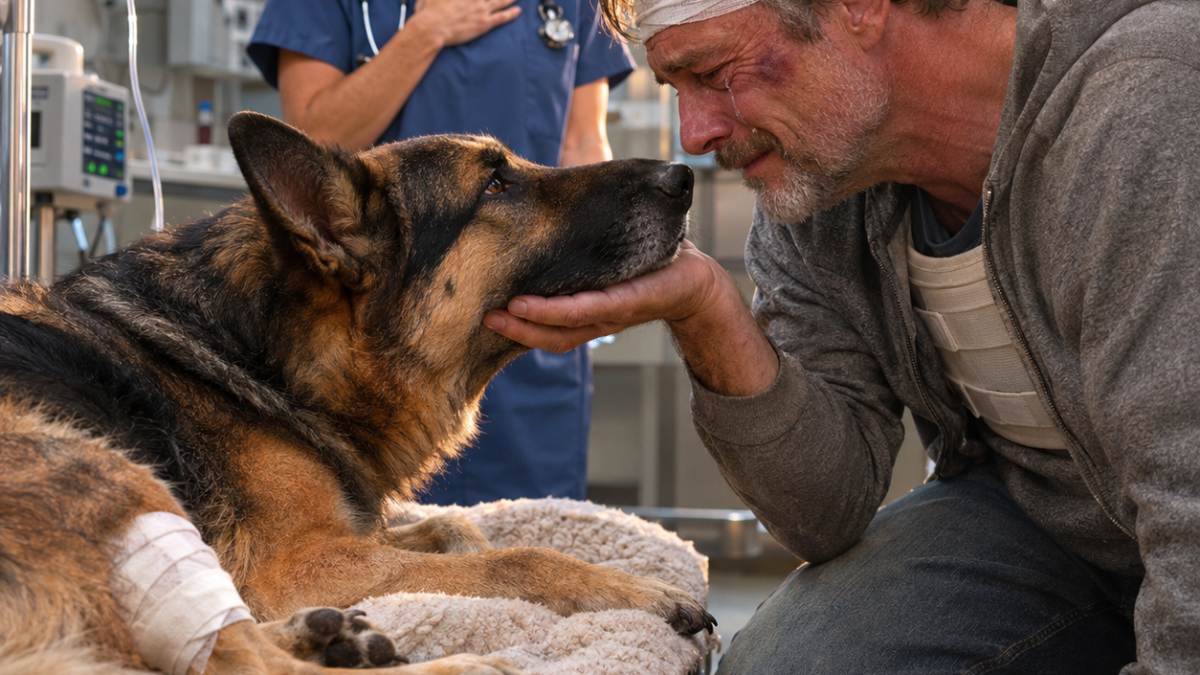
The one creature on earth who never let me face a difficult day alone.
I looked at the doctor.
“Did he drown?”
My voice broke.
“Please.”
The doctor leaned forward.
“Kaiser survived the rescue.”
I closed my eyes.
A sound escaped my throat.
Half a sob.
Half a breath.
Then I looked up.
“Where is he?”
“He was taken for emergency veterinary treatment.”
I stared.
“Why?”
The doctor was silent.
My stomach tightened.
“WHY?”
He glanced toward the nurse.
Then back at me.
“Your dog sustained a serious injury while helping get you out of the water.”
I felt the room tilt.
“No.”
“Mr. Carter—”
“No, he was fine.”
Even as I said it, I knew I didn’t remember enough to be certain.
I remembered Kaiser running beside me that morning.
His tail moving.
His familiar excitement when he recognized we were going to the lake.
I remembered his paws on the ground.
His eager eyes.
The way he’d looked at me when I picked up my fishing equipment.
And now a stranger was telling me he’d been injured saving my life.
I stared at the doctor.
“Is he going to die?”
He took a slow breath.
“I don’t have an update from the veterinary team yet. But we’re arranging for you to receive one.”
I looked away.
The monitor continued beeping.
I was alive.
Apparently, against considerable odds.
But all I could think about was Kaiser.
My dog had gone into the water for me.
And I hadn’t been conscious enough to protect him.
I spent the next five days in the hospital.
My head was bandaged.
My ribs hurt every time I breathed.
Walking from the bed to the bathroom felt like crossing a mountain.
But none of the pain frightened me as much as the thought of Kaiser lying somewhere without me.
Rachel helped keep track of the veterinary updates while I recovered.
She assured me the doctors were doing everything they could.
She told me Kaiser had survived his first operation.
She told me his condition was stable enough for continued treatment.
But she also warned me that his shoulder injury was severe.
I didn’t want to hear the word severe.
I wanted to hear that he was coming home.
I wanted to hear his claws clicking on the floor outside my hospital room.
I wanted him to push his head beneath my hand the way he always did when he wanted attention.
Instead, every morning began with the same question.
“How’s Kaiser?”
And every night ended with the same fear.
What if I never see him again?
By the fifth day, the hospital discharged me with instructions to rest, recover, and avoid pushing myself too hard.
I barely listened.
Rachel helped me into her car.
“Where do you want to go first?” she asked.
I looked at her.
She already knew.
“The veterinary hospital.”
She nodded.
“Okay.”
As we drove, I pressed my hand against my aching ribs and stared out the window.
I was afraid of what I’d find.
Afraid of seeing Kaiser in pain.
Afraid that he’d look at me and wonder why I’d left him alone.
But nothing could have prepared me for the moment Rachel opened the clinic door.
Or for the sight of my dog lying almost motionless behind the bars of his recovery enclosure.
PART2
FULL STORY CONTINUATION
The veterinary hospital was quieter than I expected.
I’d imagined barking.
Phones ringing.
People moving quickly between examination rooms.
Instead, the hallway seemed painfully still.
Maybe the building wasn’t really that quiet.
Maybe it was simply that every sound had become distant the moment I realized Kaiser was somewhere inside.
Rachel walked beside me.
I was moving slowly because of my ribs.
Every step pulled at the bruising along my chest.
The bandage around my head felt tight.
My legs were weak.
But I kept walking.
A veterinary technician approached us.
“Mr. Carter?”
I nodded.
“I’m here for Kaiser.”
Her expression softened.
“We’ve been expecting you.”
I looked past her.
“Where is he?”
She gestured toward the recovery area.
“Right this way.”
I followed her.
And then I saw him.
My Kaiser.
The dog who used to charge toward the front door every time he heard my truck pull into the driveway.
The dog who could turn an ordinary walk into an adventure.
The dog who loved the lake more than almost any place on earth.
He was lying on his side in a large recovery enclosure.
His right shoulder was heavily bandaged.
Medical tubing and monitoring equipment surrounded him.
His eyes were half closed.
The fur around the injured area had been clipped for treatment.
And the powerful body I knew so well looked terribly vulnerable.
I stopped.
Rachel touched my arm.
I couldn’t speak.
I couldn’t even take another step.
All I could do was stare.
For years, Kaiser had been the strong one.
When I came home exhausted from carpentry work, he greeted me like I was the most important person in the world.
When I was lonely, he sat beside me.
When I couldn’t sleep, he rested his head against my knee.
And when I went fishing, he acted as though the whole trip had been arranged entirely for his happiness.
Now he was lying in a hospital enclosure because he’d gone into dangerous water for me.
I felt something inside my chest twist.
Not the injured ribs.
Something deeper.
Something no pain medication could touch.
“Kaiser?”
My voice came out as a whisper.
His ears moved.
I froze.
“Kaiser?”
This time, one eye opened.
Then the other.
He lifted his head.
Slowly.
So slowly that I could see the effort it cost him.
His gaze searched the room.
Found me.
And his tail began to move.
Just a tiny movement against the bedding.
Then another.
The same tail that used to wag so hard his whole body shook.
Now barely strong enough to lift itself.
But it was moving.
Because he recognized me.
I made a sound I didn’t know I was capable of making.
Then I knelt beside him.
The pain in my ribs flared.
I didn’t care.
“Hey, buddy.”
My voice broke.
“Hey, my beautiful boy.”
I placed my hands where he could reach them safely through the enclosure.
Kaiser moved his muzzle closer.
His breathing changed.
He stretched his neck toward me.
And with what seemed like an enormous effort, he touched my fingers with his tongue.
Once.
Then again.
I bowed my head.
Tears fell onto the floor.
“Oh, Kaiser.”
He licked my hand once more.
Then sighed.
A long, exhausted sigh.
He lowered his head onto his paws and looked at me.
I knew I was imagining words he couldn’t speak.
But if he could have said anything in that moment, I believe it would have been simple.
You’re back.
That’s all I needed to know.
I don’t know how long I stayed on my knees.
Rachel stood quietly behind me.
The technician gave us space.
Kaiser watched me through half-closed eyes, occasionally moving his tail when I spoke.
I kept telling him the same things.
“I’m here.”
“I’m sorry.”
“You’re such a good boy.”
“I didn’t know you were hurt.”
“I would have come sooner if I could.”
Every time I said his name, one ear moved.
And every time it did, I cried harder.
There are moments when guilt doesn’t come from something you deliberately did wrong.
It comes from realizing that someone you love suffered while you were unable to help.
I knew Kaiser had chosen to follow me into the water.
I knew I hadn’t asked him to risk his life.
But that didn’t stop the terrible thought running through my head.
He was hurt because he came after me.
I pressed my forehead gently against my hand near the enclosure.
“I’m so sorry, buddy.”
Kaiser reached his muzzle toward me again.
His tongue brushed my fingers.
I closed my eyes.
He wasn’t interested in my guilt.
He was interested in the fact that I was there.
And somehow, that made everything hurt more.
Dr. Harris entered the room a few minutes later.
He was a middle-aged veterinarian with tired eyes and a quiet voice.
He looked at Kaiser first.
Then at me.
“Mr. Carter?”
I stood slowly, using the edge of a chair for support.
“Yes.”
“I’m Dr. Harris. I’ve been involved in Kaiser’s surgical care.”
I swallowed.
“Thank you for saving him.”
His expression softened.
“We’re doing everything we can.”
The words frightened me.
I looked toward Kaiser.
“What does that mean?”
Dr. Harris gestured toward a consultation room nearby.
“Can we talk for a few minutes?”
I didn’t want to leave Kaiser.
Not even for a moment.
But Rachel stepped closer.
“I’ll stay here with him.”
I looked at her.
She nodded.
“Go. Find out what he needs.”
I glanced toward my dog.
His eyes followed me.
“I’ll be right back,” I whispered.
Then I followed Dr. Harris into the next room.
He placed the medical images on a screen.
I didn’t understand most of what I was looking at.
There were structures.
Shadows.
Areas he’d highlighted.
He pointed toward Kaiser’s right shoulder.
“The injury is very serious.”
I felt my stomach tighten.
He continued.
“The trauma involved major damage to the supraspinatus tendon and the biceps tendon, along with partial displacement of the shoulder joint.”
I stared at the screen.
“You mean he dislocated it?”
“Not a complete dislocation. He has a shoulder subluxation, along with significant soft-tissue damage.”
I looked down.
“So what happens?”
“We’ve performed the first operation to address the initial injury and stabilize the situation.”
I nodded quickly.
“And then?”
Dr. Harris took a breath.
“We anticipate two additional surgical procedures, depending on how he responds and what we find during continued treatment.”
The room seemed to grow colder.
“Two more?”
“Yes.”
I rubbed my forehead.
“He already had one.”
“I know.”
I looked toward the closed door.
Kaiser was in the next room.
Lying on his bedding.
His tail barely moving.
And this man was telling me he might need to endure two more operations.
I swallowed.
“Will he be okay afterward?”
Dr. Harris didn’t answer immediately.
Then he said, “I want to be realistic about his long-term function.”
I felt my chest tighten.
“What does that mean?”
“It means that even with surgery and rehabilitation, we don’t expect his shoulder to return completely to its previous condition.”
I stared.
Kaiser had always been strong.
He ran.
Jumped.
Climbed over fallen logs.
And swam as though the water belonged to him.
I couldn’t imagine him being anything else.
Dr. Harris continued.
“With treatment, we hope he can regain comfortable walking and some controlled activity.”
I nodded.
“What about running?”
“Possibly limited running, depending on recovery.”
I swallowed.
“And swimming?”
The veterinarian’s expression changed.
It was subtle.
But I saw it.
He looked at the images again.
Then back at me.
“Mr. Carter, I would not recommend returning Kaiser to swimming. His shoulder is unlikely to tolerate the demands safely.”
I sat down.
The words seemed to pass through me without meaning anything.
No swimming.
For Kaiser.
The dog who lived for the lake.
The dog who could hardly wait for me to open the truck door when he smelled the water.
I stared at Dr. Harris.
“Never?”
He took a careful breath.
“Based on the injuries we’re treating, our expectation is that swimming will not be a safe recreational activity for him.”
I looked toward the wall.
For several seconds, I couldn’t speak.
Then I whispered, “He went into the water for me.”
Dr. Harris’s expression softened.
“I understand.”
“He loved swimming.”
I swallowed.
“More than almost anything.”
The veterinarian was quiet.
I bent forward.
And began crying.
Dr. Harris didn’t interrupt me.
He let me sit there with my face in my hands until I could breathe again.
Then he pulled his chair closer.
“Mr. Carter, I want you to understand something.”
I looked up.
“Kaiser’s life isn’t over because he may not swim again.”
I swallowed.
He continued.
“His recovery will require a great deal of work. Some activities may never be safe for him. But that doesn’t mean he can’t have a good quality of life.”
I stared at the medical images.
“How do I know he won’t be miserable?”
“We’ll watch his pain, mobility, and ability to enjoy normal daily activities. We’ll adjust his rehabilitation around what his body can tolerate.”
I looked toward the door.
“He doesn’t understand why he can’t run.”
“Not yet.”
“He doesn’t understand why his shoulder hurts.”
Dr. Harris nodded.
“No.”
My voice broke.
“And he doesn’t understand why the lake hurt him when it was always his favorite place.”
The veterinarian was quiet.
Then he said, “He understands something else.”
I looked up.
“He recognized you.”
I swallowed.
“I saw that.”
“His entire response changed when you entered the room.”
My eyes burned.
Dr. Harris continued.
“He knows your voice. Your smell. He knows you’re someone familiar and safe.”
I looked down.
“That’s not enough to fix his shoulder.”
“No,” he said gently. “It isn’t.”
He paused.
“But it’s important for the recovery he still has ahead.”
I thought about Kaiser licking my fingers.
His weak tail.
The way he’d looked at me.
Dr. Harris leaned forward.
“Your dog needs medical treatment, rehabilitation, and consistent care.”
I nodded.
“And he needs you.”
Those words nearly broke me again.
Because I’d spent five days lying in a hospital bed thinking about everything Kaiser had given up for me.
Now someone was telling me that my presence might be one of the things that helped him survive what came next.
I wiped my eyes.
“Then I’m not going anywhere.”
The financial discussion came afterward.
Dr. Harris explained that treatment would involve additional procedures, medication, follow-up examinations, and months of rehabilitation.
I listened carefully.
Then asked, “How much?”
He hesitated.
“It’s going to be expensive.”
“I understand.”
“We’re talking about a total treatment cost in the five-figure range.”
I stared at him.
Five figures.
I was a carpenter.
I built cabinets, repaired framing, installed doors, and took whatever legitimate construction work I could find.
Some months were good.
Others were difficult.
My savings weren’t enormous.
I’d never had the kind of financial security that made an unexpected medical bill feel manageable.
I had a mortgage.
Utilities.
Insurance.
Truck expenses.
Work equipment.
And now hospital bills of my own.
I thought about the number.
Then looked toward the room where Kaiser was recovering.
“How soon do you need a decision about the next procedure?”
Dr. Harris began explaining the proposed schedule and treatment options.
I listened.
Asked questions.
Made sure I understood the risks and what the team hoped to achieve.
Then I said, “Do what’s medically necessary.”
He stuD!ED me.
“Mr. Carter, I want you to think carefully about the financial commitment.”
“I am.”
“It’s substantial.”
I nodded.
“I know.”
I looked down at my hands.
They were rough from years of carpentry work.
A little scarred.
A little calloused.
The hands I used to earn my living.
Then I looked back at him.
“Doctor, that dog went into a lake when I couldn’t get out.”
My voice shook.
“He didn’t know whether he’d come back.”
Dr. Harris said nothing.
“He didn’t stop to ask whether I could afford to repay him.”
I swallowed.
“So tell me what gives him the best reasonable chance at a comfortable life.”
The veterinarian nodded.
And for the first time since entering the consultation room, I felt I had something useful to do.
I couldn’t undo the accident.
Couldn’t take away the damage.
Couldn’t give Kaiser his old shoulder back.
But I could make decisions about his care.
I could show up.
And I could find a way to pay for the treatment.
I just didn’t know yet how much it would cost the rest of my life.
Rachel was still beside Kaiser when I returned.
She was sitting in a chair near his enclosure, speaking softly.
He had his eyes half closed.
But when he heard my footsteps, his ears lifted.
I smiled through tears.
“Hey, buddy.”
His tail moved.
Rachel looked up.
“Well?”
I sat slowly beside her.
For a moment, I couldn’t answer.
She watched my face.
Then her expression changed.
“Oh, no.”
I shook my head.
“He’s going to live.”
She exhaled.
“Thank God.”
I stared toward Kaiser.
“But his shoulder…”
I swallowed.
“He’s going to need more surgery.”
Rachel leaned closer.
“How much?”
“Two more procedures are expected.”
She was quiet.
“And the rehabilitation?”
“Months.”
I looked down.
“They don’t think he’ll ever swim again.”
Rachel closed her eyes.
She knew what the lake had meant to us.
She’d seen Kaiser leap with excitement whenever I packed my fishing gear.
She’d watched him stand beside the truck, tail wagging, unable to understand why I took so long to load the cooler.
And now I was telling her that the activity he loved most might be gone forever.
She reached for my hand.
“I’m sorry.”
I nodded.
Then looked toward Kaiser.
He was watching me.
His bandaged shoulder rested carefully against the bedding.
I leaned closer.
“I’m going to take care of you, buddy.”
His ears moved.
I swallowed.
“Whatever it takes.”
Rachel squeezed my hand.
And for a while, neither of us said anything.
We simply sat beside the dog who’d brought me home from the water.
That evening, after Rachel drove me back, my house felt wrong.
I opened the door.
No barking.
No footsteps racing across the floor.
No body pressing against my legs.
No tail striking the furniture because Kaiser was too excited to hold still.
I stood in the doorway.
The silence hit me so hard that I had to lean against the frame.
His water bowl sat beside the kitchen wall.
His leash hung from the hook near the front door.
His bed was in the corner of the living room.
The same bed where he’d slept the night before our trip to the lake.
I walked toward it.
The blanket was still folded the way I’d left it.
I sat on the floor.
For years, Kaiser had been there when I came home.
If I’d had a hard day, he knew.
If I was angry, he followed me until I stopped pretending I wasn’t.
If I was lonely, he settled beside me as though the matter had been decided.
Now his bed was empty.
I rested one hand against the blanket.
And suddenly I remembered the morning of the accident.
Kaiser waiting near the door.
His ears raised.
The little impatient sound he made when I picked up the fishing rods.
I had laughed.
“Give me a minute, buddy.”
He’d wagged his tail.
I remembered the sunlight outside.
The ordinary expectation of a peaceful day.
A trip to the lake.
A little fishing.
Kaiser swimming while I watched from the bank.
Then something went wrong.
The accident happened so quickly that my memories were fragmented.
Cold water.
A sudden struggle.
Pain.
My head going under.
The terrible sensation of not having enough air.
And then Kaiser.
The dog who should have stayed safe on shore.
The dog who went after me instead.
I pressed my forehead against the empty bed.
“I’m sorry.”
The house gave me no answer.
For the first time, I understood what it felt like to be rescued and still be terrified that you were losing the one who had saved you.
The next several weeks were the hardest of my life.
I was recovering from my own injuries while trying to understand Kaiser’s treatment schedule.
My ribs ached when I climbed stairs.
My head throbbed after long days.
I moved slowly.
Sometimes getting dressed felt like a task that demanded every bit of strength I had.
But I spent as much time as the veterinary team allowed beside Kaiser.
When he was still hospitalized, I visited.
When he was stable enough to come home between stages of treatment, I prepared the house for him.
I moved furniture to create clear walking space.
Placed his bedding where he could rest comfortably.
Kept the floors safe for his restricted mobility.
And followed Dr. Harris’s instructions about protecting the injured shoulder.
The first night Kaiser came home, I barely slept.
He lay on his bed.
I lay on a blanket beside him.
Every time he shifted, I opened my eyes.
Every time he sighed, I checked whether he was comfortable.
I knew I couldn’t make every second pain-free.
But I wanted him to know he wasn’t alone.
At around two in the morning, he lifted his head.
I sat up.
“What is it, buddy?”
He looked at me.
I leaned closer.
“Need anything?”
His nose moved toward my hand.
He touched my fingers.
Then rested his head again.
I sat there for a long time.
I realized he hadn’t asked me to solve anything.
He’d simply checked that I was still beside him.
I stroked his fur.
“Yeah,” I whispered.
“I’m here.”
Recovery isn’t dramatic most of the time.
That’s something people don’t tell you.
In stories, there’s usually one turning point.
One morning when the injured animal suddenly stands.
One triumphant walk.
One moment when everyone cries and the suffering is over.
Real rehabilitation doesn’t work that way.
It happens in small pieces.
Days that feel almost identical.
Medication schedules.
Rest.
Careful examinations.
A little more movement.
Then fatigue.
Then another appointment.
Then a day when the animal seems uncomfortable and you’re terrified you’ve done something wrong.
Kaiser had setbacks.
There were mornings when he didn’t want to move much.
Days when his shoulder seemed particularly tender.
Times when I wondered whether we were making progress at all.
Dr. Harris reminded me that healing wasn’t a straight line.
He reviewed the medical plan, adjusted care when needed, and made sure I understood which activities were safe.
The additional surgeries were difficult.
Each one meant another period of careful monitoring.
Another stage of recovery.
Another time I had to leave Kaiser in the hands of the veterinary team and wait for news.
I hated those waits.
I hated seeing the clinic number appear on my phone because I never knew whether the next call would bring relief or another complication.
But the operations were completed.
And slowly, Kaiser’s shoulder began stabilizing enough for the longer rehabilitation work.
He still wasn’t the dog he’d been before the lake.
But he was here.
And that became the fact I returned to whenever the fear felt unbearable.
I began talking to him more than I ever had before.
It sounds strange, but there were days when Kaiser was the only creature I wanted to speak to.
I would sit beside his bed after work and tell him about my day.
The customer who couldn’t decide whether she wanted oak or maple cabinets.
The doorframe that turned out to be crooked.
The rain that had delayed a job.
The man at the hardware store who argued with me over the price of screws.
Kaiser listened.
He always listened.
Sometimes his ears moved.
Sometimes he closed his eyes.
Sometimes he rested his muzzle on my foot.
And on the hardest nights, I told him things I’d never said aloud to another living soul.
About my childhood.
About the years I’d spent believing I had to handle every problem by myself.
About how difficult it was for me to trust people enough to ask for help.
I told him how lonely my life had been before he came into it.
Not every day.
Not every hour.
But enough that I had learned to expect empty rooms and quiet evenings.
Then Kaiser had arrived.
And suddenly there was a dog waiting for me at the door.
A dog who didn’t care whether I’d earned enough money that week.
A dog who didn’t care if I was tired or frustrated.
A dog who believed a walk around the block was an adventure simply because we were doing it together.
I looked at him one night.
“You know something?”
His ears moved.
“I thought I was the one taking care of you.”
He lifted his eyes.
I smiled sadly.
“Turns out you were taking care of me too.”
One evening, I sat on the floor beside his bed with a book in my hands.
I wasn’t really reading it.
I’d been staring at the same page for nearly ten minutes.
The house was quiet.
Rain tapped against the windows.
Kaiser was resting beside me.
Then I heard movement.
I looked down.
He was shifting his front paws.
At first, I thought he was trying to find a more comfortable position.
Then he began pushing himself upward.
My heart started pounding.
“Kaiser?”
He paused.
His legs trembled.
I put the book down.
“Easy, buddy.”
He continued.
The effort was visible.
He was following the movement patterns we’d been practicing under veterinary guidance, but this was the first time he’d initiated such a determined attempt at home.
His injured shoulder made everything difficult.
His muscles were weak.
And I could see how much concentration it took him simply to distribute his weight.
I moved close enough to support him safely if he needed help, following the instructions we’d been given.
“Take your time.”
He lifted his chest.
Then his hindquarters.
For a moment, he wavered.
My stomach tightened.
“Careful.”
And then he was standing.
All four paws on the floor.
Unsteady.
Trembling.
But standing.
I stared at him.
“Kaiser.”
His ears lifted.
He looked directly at me.
And there was something in his expression I hadn’t seen since before the accident.
Not just recognition.
Not just relief.
A kind of alertness.
As though he was surprised and pleased to discover that his body could still do something familiar.
I laughed.
Then began crying.
“Oh, buddy.”
He wagged his tail.
Just once.
Then again.
I pressed a hand over my mouth.
“You did it.”
He remained standing for a few moments before carefully settling back down.
I knelt beside him.
“Good boy.”
My voice broke.
“Such a good boy.”
I buried my face gently against the side of his neck, avoiding his injured shoulder.
Kaiser sighed.
And I cried harder than I had in weeks.
Because he had stood up.
Not forever.
Not without limitations.
But for a few precious seconds, Kaiser had stood on his own feet again.
And it felt like the beginning of something I’d been afraid to hope for.
I called Rachel afterward.
She answered with immediate concern.
“What’s wrong?”
I laughed through tears.
“Nothing.”
A pause.
“Are you crying?”
“Yes.”
“What happened?”
“Kaiser stood up.”
Silence.
Then, “What?”
“He stood.”
My voice broke.
“He got up on all four legs.”
Rachel inhaled sharply.
“Oh, my God.”
I looked toward his bed.
He was resting again, watching me with sleepy eyes.
“I didn’t think I’d ever be that happy about a dog standing in my living room.”
Rachel laughed through her own tears.
“I’m happy too.”
I sat on the floor.
For several seconds, neither of us spoke.
Then Rachel said, “You know this doesn’t mean he’ll be running tomorrow.”
“I know.”
“And you still have to follow the rehabilitation plan.”
“I know.”
She paused.
“But it’s wonderful.”
I looked at Kaiser.
His tail moved.
“Yeah.”
I smiled.
“It really is.”
The bills continued arriving.
That was the part of recovery that didn’t care how grateful I felt.
Veterinary surgery.
Medication.
Follow-up appointments.
Physical rehabilitation.
Specialized treatment.
Every invoice represented another part of Kaiser’s recovery.
I kept them in a folder on the kitchen table.
At first, I tried not to look at the total.
Then one evening I sat down with a calculator.
I added the charges.
Compared them with my savings.
Looked at my income.
Then stared at the numbers.
I wasn’t going to make it through the entire treatment plan on savings alone.
I knew that.
The question was what I was willing to change.
I looked toward the driveway.
My vehicle was parked outside.
It had been reliable transportation.
Nothing fancy.
But something I could sell.
Then I looked toward the fishing equipment in the garage.
The rods.
The tackle boxes.
The gear I’d collected over the years.
Some of it had been expensive.
Some had sentimental value.
And all of it reminded me of the lake.
I walked into the living room.
Kaiser was sleeping.
His injured shoulder rested against the bedding.
I stood there.
Then looked back toward the garage.
For years, I’d thought fishing was one of the things that made me happiest.
But suddenly it seemed very easy to decide what mattered more.
The equipment could go.
The car could go.
The money could be earned again.
Kaiser couldn’t be replaced.
Selling the car hurt less than I expected.
I cleaned it.
Took photographs.
Met a buyer.
Signed the paperwork.
Then watched someone else drive away.
For a moment, I felt strange.
I’d worked hard to buy that vehicle.
It represented independence.
Years of labor.
A little security.
But when I walked back inside, Kaiser lifted his head.
His tail moved.
And I knew exactly why I’d done it.
The fishing equipment was harder.
I opened the tackle boxes one by one.
Some lures reminded me of trips with friends.
Some rods had traveled with me for years.
There were reels I’d repaired myself.
A weathered case with scratches from countless mornings beside the water.
And the last fishing rod Kaiser had watched me carry toward the lake.
I held it for a long time.
Then placed it with the others.
I wasn’t going back to that lake.
Not now.
Maybe not ever.
The thought hurt.
But leaving the equipment in the garage wouldn’t change what had happened.
I sold what I could.
Used the money toward Kaiser’s treatment.
And began looking for additional work.
My schedule became almost impossible.
I took extra carpentry jobs.
Early starts on construction sites.
Long hours installing framing, doors, and cabinets.
Then additional shifts at a warehouse when work was available.
Some weeks, I moved between jobs so often that I barely knew what day it was.
I would come home after a short night of sleep, wash the dust from my hands, and take Kaiser to his next rehabilitation appointment.
There were days when I had blisters on my palms.
Aching shoulders.
A headache that wouldn’t go away.
Days when I felt as though my body had become nothing more than a machine for getting through the next obligation.
But when I entered the house, Kaiser always knew.
His ears lifted.
His tail moved.
And despite everything he’d endured, he still acted as though my return was the best part of his day.
That was what kept me going.
Not the money.
Not the invoices.
Not the thought that somebody might someday call me a good dog owner.
Just that look.
The moment he realized I was home.
One night, after barely three hours of sleep, I sat beside Kaiser and wondered whether I was strong enough to keep doing it.
My hands were covered in small cuts and blisters.
My back ached.
I had worked a construction shift and then several hours at the warehouse.
There was another rehabilitation appointment the next afternoon.
Another bill on the table.
Another payment coming due.
I looked toward Kaiser.
He was resting on his bed.
His shoulder was healing slowly, but he still tired easily.
I watched him breathe.
Then whispered something I’d been ashamed to admit even to myself.
“What if I can’t do this?”
His ears moved.
I lowered my head.
“What if I’m not enough?”
The room was quiet.
I rubbed my face.
“I know you’re getting better.”
My voice broke.
“But what if you never get to do the things you love again?”
I looked toward the old leash on the wall.
“What if all this work still leaves you unhappy?”
Tears slipped down my face.
I felt guilty even asking.
Not because Kaiser wasn’t worth the effort.
He was.
There was never any question about that.
I was afraid of failing him.
Afraid that I could work myself into exhaustion, spend every dollar I had, and still be unable to give him the life he deserved.
I bent forward.
“I don’t know how much longer I can keep going like this.”
For a moment, nothing happened.
Then I felt movement beside my knee.
Kaiser lifted his head.
Slowly.
Carefully.
He shifted closer.
Then rested his muzzle on my lap.
Exactly the way he had done before the accident whenever he sensed I was upset.
I stopped breathing.
His injured body was still.
His eyes were half closed.
He didn’t seem concerned about the bills.
Or the vehicles I’d sold.
Or the number of jobs I was working.
He had simply noticed that I was hurting.
And he’d come closer.
I placed my hand on his head.
“Oh, buddy.”
My voice broke.
“You’re the one who’s supposed to be resting.”
He sighed.
I stroked his ears.
And suddenly I understood something I’d been too exhausted to see.
Kaiser didn’t need his old life reproduced perfectly.
He needed a life where he could be comfortable, safe, loved, and able to enjoy whatever his body would allow.
I couldn’t give him back the shoulder he’d had before the lake.
But I could help him discover what was still possible.
I bent down and kissed the top of his head.
“We’re going to figure it out.”
His tail moved.
I smiled through tears.
“Together.”
Kaiser’s rehabilitation became the center of our lives.
Not in a dramatic way.
There were no cheering crowds.
No cameras waiting outside the clinic.
No miraculous transformation that made everything normal again.
There were appointments.
Carefully measured exercises.
Rest periods.
Follow-up examinations.
And constant adjustments based on how his shoulder responded.
Dr. Harris worked with the rehabilitation team to develop a program suited to Kaiser’s injuries.
Some days involved gentle, controlled movement.
Others focused on strengthening the muscles that could help support his damaged shoulder.
There were sessions in shallow therapeutic water, where he could walk with appropriate assistance without being asked to swim.
That distinction mattered.
Dr. Harris had been clear that recreational swimming wasn’t a safe goal.
The controlled water-based therapy was something entirely different.
It was supervised.
Carefully limited.
And designed to support movement without placing unnecessary strain on the injured joint.
The first time I watched Kaiser enter the rehabilitation pool, my stomach twisted.
Water.
After everything that had happened, even seeing him near it frightened me.
He paused at the edge.
Looked toward the therapist.
Then toward me.
I knelt beside the area where I could safely encourage him.
“It’s okay, buddy.”
His ears moved.
I swallowed.
“You don’t have to be brave for me.”
The therapist guided him carefully.
Kaiser took a hesitant step.
Then another.
The water reached only the controlled depth the team had selected.
He wasn’t swimming.
He wasn’t struggling to stay afloat.
He was walking.
Slowly.
With support.
One careful movement at a time.
I watched his injured leg.
The way he placed his paw.
The effort it took to shift his weight.
The therapist spoke quietly.
“Good, Kaiser.”
He looked toward her.
Then toward me.
His tail moved.
I felt tears sting my eyes.
I never thought I’d be so grateful to see a dog take three slow steps through shallow water.
But those steps meant something.
They meant he was learning how to use his body again.
And for the first time, I began allowing myself to imagine a future beyond the clinic.
Kaiser hated some of the exercises.
I won’t pretend otherwise.
He was a dog.
Not a saint.
There were days when he looked at the rehabilitation therapist as though she’d personally invented suffering.
Sometimes he’d sigh so loudly that everyone in the room laughed.
Other times he’d turn his head toward me with an expression that seemed to ask why I’d brought him to another appointment when he could have been home sleeping.
I would crouch beside him.
“Don’t look at me like that.”
His ears moved.
“You’re the one who decided to be a hero.”
The therapist would smile.
Kaiser would sigh again.
And we’d continue.
Those moments of humor helped more than I can explain.
For weeks, everything had been frightening.
Every appointment seemed connected to pain.
Every medical update made me brace myself for bad news.
But gradually, Kaiser began showing pieces of the personality I remembered.
The stubbornness.
The curiosity.
The way he’d tilt his head when I spoke.
The impatient little sound he made when he thought I was taking too long to bring his dinner.
I treasured those moments.
Not because they meant he was completely healed.
But because they reminded me he was still Kaiser.
The injury had changed what his body could do.
It hadn’t taken away the dog I loved.
The first walks were almost painfully short.
Five minutes.
Sometimes less, depending on how he was doing and what the rehabilitation team recommended.
We began inside and around the house.
I moved slowly beside him.
Partly because he needed a careful pace.
Partly because my own injuries were still reminding me of the accident.
He would walk a short distance.
Stop.
Sniff something.
Look at me.
Then take another few steps.
There were days when we barely made it beyond the front door.
But I learned to stop comparing every walk with the miles we’d once covered.
Before the lake, Kaiser had been able to run ahead and return to me with his tail wagging, as though the entire world were an exciting discovery.
Now, he sometimes needed a rest after crossing the yard.
At first, that contrast broke my heart.
Then Dr. Harris reminded me to evaluate the dog standing in front of me.
Not the dog I’d known before the injury.
Not the dog I wished he could still be.
The dog who was recovering now.
Was he comfortable?
Was he interested in his surroundings?
Did he look forward to the outing?
Was he recovering appropriately afterward?
Those were the questions that mattered.
And slowly, the answers began becoming more encouraging.
The first time Kaiser walked to the end of the driveway, I nearly cried.
It was a warm morning.
The sun had just risen.
There was dew on the grass.
I held his leash loosely, matching his slow pace.
He stopped halfway.
Looked toward the road.
Then down at a patch of grass near the mailbox.
He sniffed it with great concentration.
As though no dog had ever investigated such an important mystery.
I laughed.
“You remember that spot?”
He continued sniffing.
Before the accident, he used to stop there every single morning.
I’d always been impatient.
“Come on, Kaiser.”
“We’ve got things to do.”
But now I stood quietly while he took his time.
I wanted him to smell every blade of grass.
Investigate every fallen leaf.
Listen to every bird.
Because the fact that he was standing in the morning sunlight seemed extraordinary.
Eventually, he raised his head.
Looked toward the street.
Then at me.
His tail moved.
“Ready?”
He took another step.
Then another.
We reached the mailbox.
I stopped.
Kaiser looked up.
I crouched carefully and touched his neck.
“Look at you.”
He panted lightly.
I smiled.
“All the way to the road.”
It wasn’t a long distance.
Maybe a few dozen yards.
But it was farther than he’d walked on his own since the accident.
I looked toward the house.
Then back at him.
“We did it.”
Kaiser wagged his tail.
And for the first time in months, I felt a small part of my old life return.
As his strength improved, our walks became longer.
From the house to the garden.
From the garden to the end of the street.
Then a little farther.
Eventually, with veterinary approval and the necessary precautions, we returned to the neighborhood park.
The first time we arrived, Kaiser stopped near the entrance.
I wondered whether he remembered it.
There was the same gravel path.
The same benches.
The same trees casting shade across the grass.
The same place where he’d once become so excited about a squirrel that I’d nearly lost hold of his leash.
I looked down.
“Remember this?”
His ears lifted.
He sniffed the air.
Then took a step forward.
His tail moved.
I laughed softly.
“Yeah.”
I looked toward the trail.
“I think you do.”
We walked slowly.
Other dogs passed us.
Some were running.
Some were playing fetch.
One large dog bounded across the grass with a tennis ball in its mouth.
Kaiser watched.
For a moment, I felt that familiar ache.
He used to run like that.
He used to leap across open fields as though his legs would never get tired.
Now he walked beside me with a slight limp.
I looked down.
His ears were forward.
His nose was busy exploring.
And his tail was moving.
He wasn’t standing there mourning the distance he could no longer cover.
He was enjoying the park.
I stopped.
And understood something.
The sadness was mine.
Not necessarily his.
I was the one comparing every movement with the past.
Kaiser was busy smelling a tree.
I laughed quietly.
“Okay, buddy.”
He looked up.
I smiled.
“You’re right.”
Then we continued walking.
The first time Kaiser ran again happened so unexpectedly that it frightened me.
We were at the park on a clear afternoon.
His recovery had progressed enough for the rehabilitation team to allow carefully controlled increases in activity.
I was watching him closely, as always.
We’d been walking along a familiar path when something caught his attention.
Maybe a bird moving in the grass.
Maybe a sudden breeze carrying an interesting scent.
I never knew.
One moment, Kaiser was walking.
The next, he increased his pace.
His ears tilted backward.
His body stretched forward.
And he began running.
Not fast.
Not the effortless sprint I remembered.
But unmistakably running.
“Kaiser!”
My heart jumped.
“Easy, buddy!”
He continued several strides.
I moved with him as carefully as I could, frightened that he’d overdo it.
“Slow down!”
But he’d already covered a short stretch of the path.
Perhaps twenty yards.
Then he stopped.
Turned.
And looked toward me.
His tail began wagging so hard that his entire body seemed to sway.
I stood motionless.
He was panting.
His ears were raised.
And his expression looked so much like the Kaiser I’d known before the accident that I felt my knees weaken.
He’d run.
My dog had run.
Not because anyone had demanded it.
Not because a therapist had asked him to complete another exercise.
But because, for a few seconds, he’d felt like moving faster and his recovering body had allowed it.
I walked toward him.
He wagged harder.
I crouched in the middle of the path.
And started laughing.
Then crying.
Then laughing again.
“Kaiser.”
My voice broke.
“You ran.”
He pressed his nose toward me.
I stroked his neck.
“You beautiful, stubborn dog.”
People walked past.
A woman slowed.
“Is everything okay?”
I looked up, tears running down my face.
I probably looked ridiculous.
A grown man crouched on a park path, laughing and crying while holding his dog’s leash.
I nodded.
“Yeah.”
I swallowed.
“Everything’s okay.”
She smiled politely and continued walking.
I looked back at Kaiser.
He was watching me.
His tail still moving.
I pressed my forehead gently against his.
“I thought I’d never see that again.”
He licked my cheek.
I closed my eyes.
“Thank you.”
The next day, I told Dr. Harris what happened.
I expected him to scold me for allowing Kaiser to move too quickly.
Instead, he asked a series of questions.
How far had he run?
Had he shown discomfort afterward?
Was there any increased limping?
How had he behaved that evening?
What did his mobility look like the following morning?
I answered as carefully as I could.
Then Dr. Harris examined him.
He explained that a few steps of faster movement didn’t mean Kaiser was ready to return to unrestricted activity.
We still had to protect his shoulder.
Still had to follow the plan.
Still had to recognize the limits that might remain permanently.
I nodded.
“I understand.”
He looked toward Kaiser.
“But I’m glad he’s showing interest in moving and exploring.”
I smiled.
“Me too.”
Dr. Harris stuD!ED my face.
“You look different.”
I frowned.
“What do you mean?”
“You’re not staring at his injured shoulder every second.”
I looked down.
He was right.
For months, I’d watched Kaiser’s leg as though the entire future depended on every movement.
Now, for the first time, I’d begun noticing his happiness before I noticed his limp.
I smiled faintly.
“I guess I’m finally seeing the whole dog again.”
Dr. Harris nodded.
“That’s important.”
But swimming remained out of reach.
No amount of progress changed that.
Kaiser could walk.
He could enjoy carefully managed outdoor activity.
He could even run short distances when his condition allowed.
But his shoulder wasn’t the same.
And Dr. Harris continued advising against recreational swimming.
At first, I struggled to accept it.
Every time I saw a lake in a photograph, my chest tightened.
Every time someone mentioned fishing, I remembered the accident.
And whenever rainwater gathered in the low places beside the road, I found myself watching Kaiser to see whether he’d turn toward it.
He usually didn’t.
He had other things on his mind.
But I couldn’t let go of what we’d lost.
Fishing had been part of my life for years.
I loved early mornings beside the water.
The quiet.
The mist lifting from the surface.
The patience of waiting for a bite.
And the familiar sight of Kaiser swimming nearby.
He’d never cared whether I caught anything.
As far as he was concerned, a fishing trip was simply a long day spent outside with me.
Now the fishing equipment was gone.
The old routine was gone.
And the lake where I’d nearly D!ED had become a place I couldn’t imagine visiting again.
I didn’t want to see it.
Didn’t want to smell the water.
Didn’t want to stand on the bank and remember what Kaiser had sacrificed.
But one evening, while sitting beside him in the backyard, I realized how unfair my thinking had become.
I’d been measuring our future by one activity we’d lost.
Meanwhile, Kaiser was lying in the grass, watching butterflies move through the garden.
He looked perfectly content.
I stuD!ED him.
“Maybe we don’t need the lake.”
His ears moved.
I smiled faintly.
“Maybe we need something else.”
He lifted his head.
I looked toward the hills beyond town.
“Something we can still do together.”
We started exploring walking trails.
Short ones at first.
Level paths through open fields.
Shaded routes where we could stop whenever Kaiser needed a break.
Then, as his strength and veterinary guidance allowed, longer outings through hills and wooded areas.
I discovered places I’d never bothered visiting when fishing had occupied so much of my free time.
Fields that turned gold in late summer.
Forest paths covered with fallen leaves.
Little overlooks where you could see miles of countryside.
Quiet spots where the only sounds were birds and the wind moving through the trees.
Kaiser loved them.
He loved the new smells.
The unfamiliar trails.
The chance to walk beside me and investigate the world at his own pace.
I learned to carry everything we needed.
Water.
Appropriate supplies.
A small kit for the unexpected.
And the patience to turn around when he’d had enough.
That last part was the most important.
Before the accident, I sometimes treated distance as the measure of a good outing.
How far did we hike?
How long were we out?
How much ground did we cover?
Now I learned to measure differently.
Had Kaiser enjoyed himself?
Was he comfortable?
Did he return home relaxed?
Had we spent a good day together?
Sometimes we traveled only a short distance and sat beneath a tree for half an hour.
Kaiser would rest his head on my shoe.
I would watch the sunlight moving through the branches.
And it felt like enough.
More than enough.
I stopped fishing.
Not because the lake had taken every good memory from me.
It hadn’t.
I still remembered the beautiful mornings.
The laughter.
The sunlight.
Kaiser splashing through the shallows in the years before the accident.
Those memories remained.
But I no longer wanted our happiness to depend on returning to the water.
So I let that chapter close.
And began another.
I bought an old van.
It wasn’t impressive.
The paint was faded.
The seats were worn.
One door needed work.
The interior looked as though it hadn’t been cleaned thoroughly in years.
But I saw possibility in it.
I spent evenings repairing it.
Fixing what I could myself.
Cleaning.
Building simple storage.
Making the interior comfortable enough for short trips.
I arranged a secure, suitable place for Kaiser to ride safely while we traveled.
Then I stepped back and looked at the finished result.
It wasn’t a luxury camper.
It was a practical old van that could take us to places we hadn’t seen before.
I turned toward Kaiser.
“What do you think?”
He stood nearby with his tail moving.
I smiled.
“Looks like we’re going on an adventure.”
Our first trip was simple.
Nothing ambitious.
Just a short drive beyond town to a quiet area with walking trails and open views.
I parked the van.
Opened the door.
Helped Kaiser out carefully.
Then stood beside him while he sniffed the air.
He looked toward the trees.
Then at me.
His tail began wagging.
I laughed.
“Yeah, buddy.”
I reached for his leash.
“It’s all yours.”
We walked slowly along the path.
Stopped whenever he wanted to investigate something.
Rested beneath a broad tree.
Then returned to the van before he became overly tired.
That evening, I sat outside with a cup of coffee.
Kaiser rested beside my chair.
The sky darkened.
Stars began appearing.
For the first time in years, I felt the kind of peace I’d once associated only with the lake.
I looked toward my dog.
“Pretty good, huh?”
His ears moved.
I smiled.
“You don’t miss the fishing rods, do you?”
He sighed.
I laughed.
“Didn’t think so.”
Then I leaned back and looked at the stars.
We had survived something terrible.
Not without scars.
Not without losses.
But we were still together.
And the world was larger than the one place we’d lost.
Our trips gradually became more adventurous.
We visited mountain roads where the air was cool even in summer.
Quiet valleys.
Wooded trails.
Open meadows.
Small towns where the people at gas stations smiled when they saw Kaiser waiting beside me.
There were rivers and lakes along the way, too.
We admired them from safe places on shore.
I never asked Kaiser to swim.
I didn’t need to.
Sometimes we’d sit beside the water and watch the light change.
Sometimes he’d lie down and close his eyes.
Sometimes he’d turn toward me when I began talking.
I told him stories.
About my childhood.
About jobs I’d worked.
About places I’d always wanted to visit.
And sometimes about the lake.
The one where everything had changed.
I didn’t speak about it often.
But on the nights when the stars were bright and the world felt quiet, I would rest my hand on Kaiser’s back and say, “I’m still here because of you.”
He usually sighed.
Then settled closer.
I knew he didn’t understand every word.
But he understood my voice.
He understood being close.
And I was beginning to believe that was enough.
One evening, we stopped on a hillside overlooking a wide valley.
The sun was beginning to set.
Golden light spread across the grass.
A cool breeze moved through the trees.
I parked the van near a designated resting area and helped Kaiser settle beside me.
He’d enjoyed a gentle walk that afternoon.
Now he was tired.
His shoulder was always a little more sensitive after a long day, so I made sure he was comfortable.
I sat on a folding chair.
Kaiser lay beside my feet.
For a while, we watched the sunset without speaking.
Then I heard someone approaching.
“Excuse me?”
I looked up.
A woman stood a short distance away.
She appeared hesitant.
“I’m sorry to bother you.”
I smiled.
“That’s okay.”
She looked toward Kaiser.
Then at the van.
Her expression changed.
“Are you Mr. Carter?”
I nodded.
“Yes.”
She pressed a hand against her chest.
“Oh, my goodness.”
I frowned slightly.
“Do we know each other?”
She shook her head.
“No. But I read about you.”
I looked toward Kaiser.
She continued.
“The man whose dog saved him from the lake.”
My throat tightened.
“Oh.”
Her eyes filled.
“Is that Kaiser?”
I nodded.
“He is.”
She crouched a respectful distance away.
“Hi, handsome.”
Kaiser lifted his head.
His tail moved.
She smiled.
“I can’t believe I’m meeting you.”
I laughed softly.
“He doesn’t know he’s famous.”
She looked at me.
“How is he doing now?”
I glanced toward his shoulder.
For a moment, I remembered the first conversation with Dr. Harris.
The torn tendons.
The subluxation.
The additional surgeries.
The warning that Kaiser would never fully recover.
Then I looked at the dog resting comfortably beside me.
“He’s happy.”
The woman smiled.
“Really?”
I nodded.
“He still has a slight limp. His shoulder bothers him sometimes, especially when he’s tired or the weather turns cold.”
I stroked his neck.
“And he can’t swim anymore.”
Her expression softened.
“But he walks. He plays. He enjoys being outside.”
I smiled.
“And he’s discovered that traveling in an old van means new places to sniff.”
She laughed.
Kaiser wagged his tail.
The woman watched him for a moment.
Then said, “You know, your story helped people in my community.”
I looked at her.
“How?”
She hesitated.
“People started paying more attention to their animals.”
I listened.
“A woman I know adopted an older shelter dog after hearing about Kaiser.”
My eyes filled.
“She said your story reminded her that a dog doesn’t have to be young or perfectly healthy to deserve love.”
I looked down at Kaiser.
He was resting his muzzle against my shoe.
The woman continued.
“And a few people began volunteering at the local shelter.”
I swallowed.
I hadn’t expected any of that.
When people first learned about the rescue, I was still struggling to pay Kaiser’s veterinary bills.
I wasn’t thinking about inspiring anyone.
I was thinking about the next surgery.
The next rehabilitation appointment.
The next morning when I’d have to get up after too little sleep.
But now a stranger was standing beside us on a hillside, telling me that our experience had encouraged others to care for animals who needed help.
I looked toward Kaiser.
His ears moved at the sound of our voices.
“He saved me,” I said quietly.
The woman nodded.
“I know.”
I smiled faintly.
“But not just at the lake.”
She looked at me.
I continued.
“He saves me a little every day.”
For a moment, neither of us spoke.
Then I looked toward the sunset.
“Before Kaiser, I spent a lot of my life thinking strength meant not needing anyone.”
My voice softened.
“He taught me something different.”
The woman smiled.
“What?”
I stroked Kaiser’s fur.
“That being loved isn’t something you have to earn by never getting hurt.”
My throat tightened.
“And that taking care of somebody doesn’t always mean making everything perfect again.”
I looked down.
“Sometimes it means staying when things can never be exactly the way they were.”
The woman wiped her eyes.
Then smiled.
“I’m glad you two found another way to be happy.”
I looked toward the valley.
“So am I.”
Kaiser is seven years old now.
He still limps slightly.
Not all the time.
Mostly when he’s tired.
Or after a day with more activity than usual.
Cold weather sometimes makes his shoulder uncomfortable, and I pay close attention to how he’s moving.
He doesn’t jump over high barriers anymore.
He doesn’t race recklessly across fields.
And sometimes, when a squirrel darts through the grass, I can see the old excitement flash through him before he remembers that his body has limits.
But he’s happy.
I don’t say that because I want the story to have a comforting ending.
I say it because I live with him.
I see how he greets the morning.
How he nudges my hand when he wants me to wake up.
How he turns in an excited circle when he sees his leash.
How he walks toward the van whenever I begin packing for a trip.
How he settles beside me when we’re sitting beneath the stars.
And how, on quiet evenings, he still rests his head on my knee as though the world makes more sense when we’re close together.
Those are the things I look for now.
Not whether he can run as fast as he once did.
Not whether he can swim across a lake.
Not whether his shoulder will ever be exactly as it was.
I look at the life he’s living.
The comfort he has.
The things he still enjoys.
And the way his tail begins wagging when I say, “Ready for another adventure?”
Every time, I see the answer.
My life changed, too.
I’m still a carpenter.
I still work hard.
Some months are easier than others.
There are bills to pay, repairs to make, and days when I come home exhausted.
But I no longer believe I have to fill every hour with work to prove I’m strong.
I learned that lesson the hard way.
Through hospital rooms.
Veterinary appointments.
Unpaid invoices.
Long nights.
And the sight of my dog struggling to stand on a shoulder he’d injured saving me.
I learned that strength can look like asking for help.
Like listening to medical advice even when you desperately want a different answer.
Like accepting that a loved one may never return to exactly the way they were.
Like changing your plans instead of demanding that the world become what it used to be.
And sometimes strength looks like sitting beside an injured dog for hours, not knowing whether the next day will be better, but deciding you’ll be there when it comes.
Kaiser taught me all of that.
Not with words.
But by being himself.
Last month, we visited another lake.
Not the one where the accident happened.
I still haven’t returned to that place.
Maybe someday I will.
Maybe I won’t.
I’ve stopped believing I need to force myself to stand on the same shore in order to prove that I’ve recovered.
This was a different lake.
Small.
Quiet.
Surrounded by willow trees.
The water was clear, with a deep blue-green color where the shoreline fell away.
There was a narrow stretch of sand near the bank and a walking path that followed the edge.
We arrived in the late afternoon.
The light was soft.
The air was warm.
I parked the van and helped Kaiser out.
He stood beside me for a moment, looking around.
Then he began sniffing the grass.
I smiled.
“New place, buddy.”
His tail moved.
We walked slowly toward the shore.
There were no crowds.
No boats nearby.
Just the gentle sound of water moving against the sand.
I found a comfortable place to sit.
Kaiser settled beside me.
For a long time, we watched the lake.
I wasn’t frightened at first.
It felt peaceful.
The water looked almost motionless.
A few birds moved through the willows.
Farther out, sunlight glittered across the surface.
I rested a hand on Kaiser’s back.
“Beautiful, huh?”
He sighed.
I smiled.
“Yeah.”
Then he stood.
My heart immediately began beating faster.
He took a step toward the water.
“Kaiser?”
His ears lifted.
He continued forward.
I stood.
“Easy, buddy.”
For one terrible moment, the old memories came rushing back.
Cold water.
My lungs burning.
The darkness beneath the surface.
The knowledge that Kaiser had gone after me and come out injured.
I felt the fear return so suddenly that my hands began shaking.
“Kaiser, no.”
He stopped.
His front paws were on the damp sand near the water’s edge.
He wasn’t trying to swim.
He wasn’t running into the lake.
He was simply standing there, looking at the ripples.
I walked toward him.
“Hey.”
He turned.
His eyes found mine.
And the fear inside me began to loosen.
I realized I’d been looking at the water through the memory of the accident.
Kaiser was just standing on a beach.
Feeling the cool sand beneath his paws.
Listening to the movement of the lake.
He wasn’t asking me to repeat what had happened.
He wasn’t trying to prove anything.
He was simply there.
Alive.
Beside me.
I crouched carefully.
“It’s okay.”
My voice trembled.
“You’re okay.”
He stepped toward me.
His tail moved.
I reached out and rested my hand against his neck.
Then I began crying.
Not the desperate tears I’d shed at the veterinary hospital.
Not the frightened tears from the nights when I didn’t know whether he would recover.
Something quieter.
Gratitude.
Relief.
The overwhelming realization that we’d made it this far.
I wrapped my arms gently around Kaiser, careful of his shoulder.
He leaned into me.
Then rested his head against my chest.
For a moment, I couldn’t speak.
I held him.
Felt his breathing.
The warmth of his body.
The small movement of his tail.
And I remembered the day I opened my eyes in the hospital.
The doctor telling me I shouldn’t have survived.
My desperate questions about Kaiser.
Rachel’s frightened expression.
The first time I saw his bandaged shoulder.
The surgeon explaining that he might never swim again.
I remembered selling my car.
Packing away the fishing rods.
Working extra shifts.
Sitting beside his bed with three hours of sleep and blistered hands, wondering whether I was strong enough to keep going.
And I remembered Kaiser lifting his head and placing it on my knee.
The same simple gesture he’d always used to comfort me.
I pressed my cheek against his fur.
“Thank you.”
My voice broke.
“Thank you for coming after me.”
He sighed.
I closed my eyes.
“I wish you hadn’t gotten hurt.”
For a moment, I held him a little closer.
“But I’m so glad you’re here.”
His head rested against my chest.
I took a trembling breath.
“I’ll be grateful for the rest of my life.”
The lake moved quietly behind us.
Kaiser remained still.
Then he gave one of those long, satisfied sighs dogs make when they’re completely comfortable.
And something inside me finally settled.
I’d spent so much time thinking about what the lake had taken.
Kaiser’s ability to swim.
The strength he’d once had in his shoulder.
The effortless way he used to run.
The fishing trips we’d shared.
The life that had seemed so simple before the accident.
Those losses were real.
I would never pretend otherwise.
But sitting there with his head against my chest, I finally understood that the accident hadn’t taken everything.
It hadn’t taken his curiosity.
His affection.
His stubborn personality.
His excitement whenever I picked up the leash.
His pleasure in a quiet walk.
Or the way he still knew when I needed him beside me.
Most importantly, it hadn’t taken our time together.
And that time was becoming more precious to me than anything we’d lost.
I looked toward the water.
For years, I’d believed the most beautiful memory I would ever have of Kaiser involved watching him swim beneath the summer sun.
Now I knew better.
One of the most beautiful memories of my life would be this moment.
A quiet afternoon.
A different lake.
An older dog with a slight limp resting against me on the sand.
And the simple fact that we were both still breathing.
Eventually, Kaiser lifted his head.
He looked toward the path.
Then back at me.
I smiled through the last of my tears.
“Ready to go?”
His ears moved.
I stood slowly.
He wagged his tail.
I brushed the sand from my jeans and reached for his leash.
We walked away from the water together.
Not quickly.
Not far.
Just along the path beneath the willows.
Kaiser stopped to investigate something in the grass.
I waited.
Then he found another interesting smell a few feet farther along.
I laughed.
“Come on, buddy.”
He looked at me.
I smiled.
“Actually, take your time.”
He returned to his investigation.
I watched him.
Seven years old.
A damaged shoulder.
A few limitations that would probably remain for the rest of his life.
And still utterly fascinated by the world.
That was Kaiser.
Not a tragedy.
Not a symbol of suffering.
Not simply the dog who’d once saved a drowning man.
He was my best friend.
A living, breathing animal who loved ordinary things.
Food.
Walks.
Soft places to sleep.
Interesting smells.
And being close to the person he trusted.
I realized that the greatest way I could honor what he’d done wasn’t by spending the rest of my life mourning his old abilities.
It was by making the life he still had as comfortable and joyful as possible.
That night, we returned to the van.
I prepared a simple meal.
Made sure Kaiser had everything he needed.
Then settled beside him while the evening sky darkened.
Stars began appearing above the trees.
The air was cool.
Somewhere nearby, insects were singing.
Kaiser lay on his bedding with his head resting on his paws.
I looked up at the stars.
“Remember when we used to go fishing?”
His ear moved.
I smiled.
“You always thought you were in charge.”
He sighed.
“Maybe you were.”
I leaned back.
“We’ve seen some pretty good places since then.”
The mountains.
The hills.
The forest trails.
The quiet valleys.
The sunrises.
The long evenings sitting beneath open skies.
I thought about the old van parked behind us.
The life I’d rebuilt around what Kaiser could still enjoy.
And the person I’d become along the way.
I no longer believed that being strong meant never needing anyone.
Kaiser had saved my life.
Dr. Harris and his team had helped save Kaiser’s.
Rachel had helped when I couldn’t manage everything alone.
And I had spent months learning to accept help without seeing it as failure.
I looked toward my dog.
“Guess we both had a lot to learn.”
His ears moved.
I laughed quietly.
“Yeah.”
Then I reached over and stroked his neck.
“I’m glad we learned it together.”
People still ask me whether I wish the accident had never happened.
The answer is easy.
Of course I do.
I’d give almost anything to erase Kaiser’s pain.
To give him back a perfectly healthy shoulder.
To let him run and swim without the limitations he carries today.
I would never choose his suffering simply because it taught me something valuable.
But I can’t change the past.
I can’t go back to that morning at the lake and make a different decision.
I can’t undo the moment the water closed over me.
And I can’t make Kaiser forget the injury his body endured.
What I can do is love him in the life we have now.
I can follow the care he needs.
Let him rest when he’s tired.
Find safe places for us to explore.
Pay attention when he seems uncomfortable.
Celebrate the little moments that once seemed too ordinary to notice.
And be there when he wakes up in the morning and pushes his nose against my hand.
That’s what I have.
And it’s more than enough.
Sometimes, just before sunrise, Kaiser wakes before I do.
I feel his nose against my fingers.
Then again.
A gentle nudge.
An impatient little sound.
I open my eyes.
He’s standing beside the bed, tail moving.
Waiting.
I smile.
“Morning, buddy.”
He looks toward the door.
Then back at me.
I laugh.
“Yeah, yeah. I know.”
I get up.
We begin another day.
Sometimes we go for a short walk.
Sometimes we visit a trail.
Sometimes we stay home because his shoulder needs rest.
And sometimes we take the van somewhere new.
There is no perfect version of our life.
There never was.
There is only the life we continue building together.
One morning.
One walk.
One adventure.
One quiet evening beneath the stars.
I used to think the greatest gift Kaiser ever gave me was the moment he pulled me toward safety in that dark water.
And that gift was immeasurable.
But now, after the surgeries, the rehabilitation, the sacrifices, and the years we’ve spent finding our way forward, I know he gave me something else.
He taught me how to live after being saved.
How to accept that the future might look different from the one I imagined.
How to stop measuring happiness only by what I could no longer do.
And how to recognize love in the quietest moments.
A dog resting beside my feet.
A tail wagging when I come home.
A warm head against my knee.
A familiar presence in a room that would otherwise feel empty.
The doctor was right about one thing.
I shouldn’t have survived that lake.
Without Kaiser, I might never have opened my eyes in the hospital.
I might never have seen another sunrise.
Never walked another trail.
Never watched the stars from the doorway of an old van.
And I might never have learned just how deeply one animal could love another living being.
But the veterinary surgeon was right, too.
Kaiser’s shoulder never returned to what it had been.
He never became the fearless swimmer I’d once known.
The injury left a permanent mark on his body.
And every time I see that slight limp, I remember what the rescue cost him.
I won’t pretend that doesn’t hurt.
It always will.
But then Kaiser looks up at me.
His eyes brighten.
His tail begins moving.
And I remember that his life is not defined by the worst thing that happened to him.
Neither is mine.
My dog saved me from drowning in a lake, and the injury he suffered changed his life forever. I couldn’t give him back everything he lost, so I spent the years afterward helping him discover everything he still had.
We don’t swim together anymore.
We don’t spend our weekends fishing at the old lake.
But we still walk beneath the trees.
We still travel.
We still sit beside quiet water and watch the sunlight move across it.
And on clear nights, we still lie beneath the stars while I tell him stories he may not understand but always seems happy to hear.
Kaiser rests his head on my knee.
I run my hand through his fur.
And every time, I think the same thing.
He gave me a second chance at life. The least I can do is spend that life making sure he never faces his own pain alone.
We are still here.
Still together.
Still finding new places to go.
And for as long as we have each other, I know exactly what matters.
The greatest gift Kaiser gave me wasn’t merely another breath when I was drowning. It was the chance to spend all the breaths that followed loving the dog who refused to leave me behind.








