𝗙𝗨𝗟𝗟 𝗦𝗧𝗢𝗥𝗬:“YOU CAN EAT LEFTOVERS, DOROTHY! TONIGHT’S DINNER IS FOR MY PARENTS!” My Daughter-in-Law Set Five Plates on My Son’s Table After I Spent Two Days Preparing a Feast — I Was About to Walk Away, Until I Noticed Something Beside the Empty Sixth Chair
𝗙𝗨𝗟𝗟 𝗦𝗧𝗢𝗥𝗬
When Owen’s father walked out on us, my son was only nine years old. I remember watching him stand beside the living room window, waiting for a car that never came back.
I promised myself that day that my boy would never feel abandoned again.
I worked overtime, skipped vacations, wore the same winter coat for years, and eventually paid off my modest little house.
I did everything I could to make Owen’s life easier.
When he married Christa six years ago, I welcomed her with genuine affection.
I paid bills when money got tight. I helped with their vacations. I bought groceries without being asked to repay me.
Every month, I transferred $550 to help with Maya’s expenses.
I even paid Owen’s car insurance and both their phone bills.
I never thought of it as buying their love.
But standing in that dining room, staring at five carefully arranged plates, I began to wonder what they thought my love was worth.
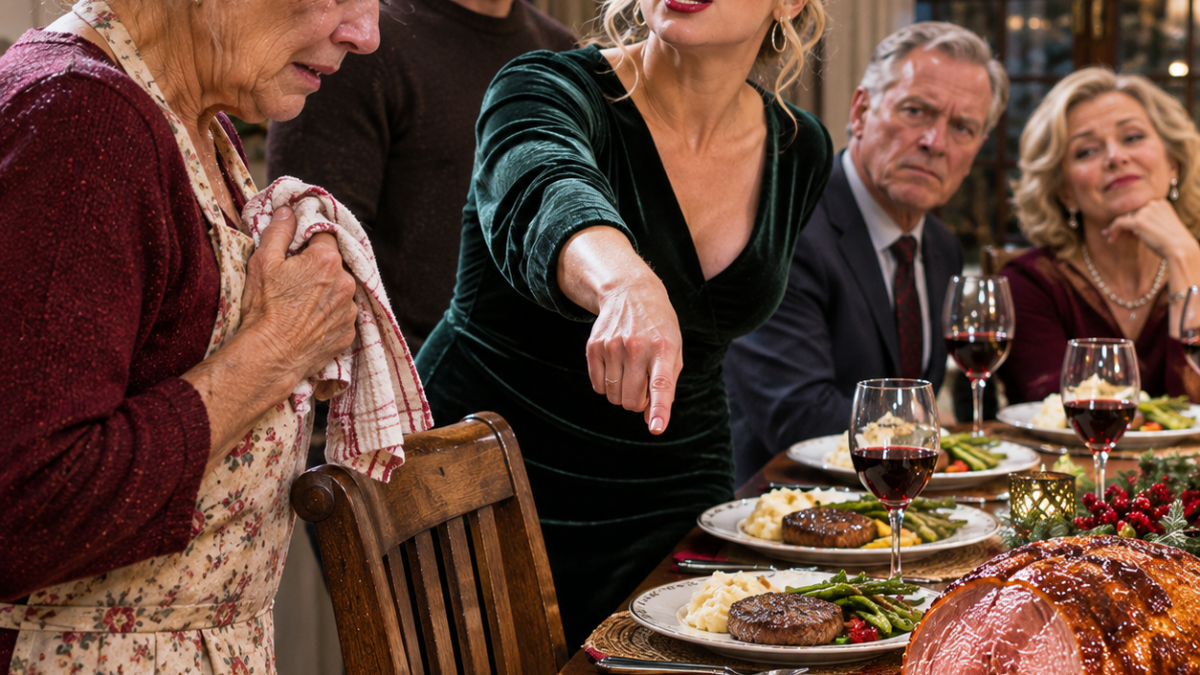
“Christa, honey,” I said softly, “should I bring another place setting?”
She barely glanced at me.
“Oh, Dorothy, you won’t need one.”
I smiled uncertainly.
“I’m sorry?”
She gestured toward the refrigerator.
“There are leftovers in there. You can eat those. Tonight’s dinner is really for my parents.”
I waited for her to laugh.
She didn’t.
“You want me to eat leftovers,” I repeated slowly, “while everyone else eats the dinner I cooked?”
Christa sighed as though I were an unreasonable child.
“My parents came a long way, Dorothy. We’re trying to make tonight special for them. Please don’t make this awkward.”
I turned toward Owen.
He was standing near the kitchen doorway, his hands hanging uselessly at his sides.
“Owen?”
He looked at me.
For one brief second, I saw something in his expression that resembled shame.
Then he lowered his eyes.
He said nothing.
That silence hurt more than anything Christa had said.
I walked to the refrigerator and opened it.
Inside were a few half-empty takeout containers, leftover pasta, and a small package of cheese.
I stared at them.
Then I looked toward my beautiful glazed ham, still warm inside its roasting pan.
Something inside me went very still.
For years, I had convinced myself that being a good mother meant absorbing every small humiliation without complaint.
I had smiled when they forgot to invite me to celebrations.
I had made excuses when they called only to ask for help.
I had even apologized when my generosity somehow became inconvenient.
But this was different.
I wasn’t being asked to contribute to dinner.
I was being told that after contributing dinner, I didn’t deserve to eat it.
I closed the refrigerator.
“Alright,” I said quietly. “Now I understand.”
Christa smiled, apparently satisfied.
“Thank you for being reasonable.”
She turned away.
I reached for the roasting pan, wrapped a thick kitchen towel around its handles, and lifted the twelve-pound ham off the counter.
Then I walked toward the front door.
Nobody stopped me.
Not until I was already outside.
I carried the ham to my car, settled it carefully into the passenger seat, and fastened the seat belt around the pan.
My hands were trembling.
Not from anger anymore.
From the realization that I had finally reached a point I couldn’t explain away.
I started the engine.
Before I reached the end of their street, my phone began buzzing.
Owen had sent a message.
I pulled over, looked at the screen, and read the words that finally told me exactly what my son was worried about.
FULL STORY CONTINUATION
Mom, where did you go? Christa’s parents are waiting for the ham.
I read the message once.
Then I read it again.
There was no Are you okay?
No I’m sorry.
Not even Mom, I should have said something.
Just a question about the ham.
I sat in the driver’s seat with both hands resting on the steering wheel, watching a family walk past my car on the sidewalk. A little boy was holding his father’s hand. His mother carried a paper bag from a bakery, and the three of them were laughing about something I couldn’t hear.
I wondered when I had become so grateful for scraps of affection that I no longer noticed when I was being treated poorly.
My phone buzzed again.
Mom? Please answer. We have guests.
I looked at the ham beside me.
The ridiculous thing was that I had worried about ruining their evening.
Even after Christa told me I wasn’t welcome at the table, some deeply ingrained part of me had wanted to apologize for leaving. I could almost hear myself saying that I misunderstood, that I was being too sensitive, that I should have stayed and eaten whatever was in the refrigerator.
I had spent most of my adult life finding ways to make other people’s discomfort disappear.
But there was one question I couldn’t get past.
Why was everyone else’s comfort more important than mine?
I typed a short reply.
I took the food I prepared. I won’t be staying for dinner.
I stared at the screen before pressing send.
Part of me expected an immediate phone call. I imagined Owen realizing what had happened, rushing outside, apologizing, and asking me to come back.
Instead, three dots appeared beneath my message.
Then they disappeared.
A minute passed.
His reply finally came.
You could have told us before you left.
I closed my eyes.
He still didn’t understand.
Or perhaps he understood perfectly well and simply didn’t want to deal with it.
I put the phone facedown in the cup holder and drove home.
The forty-minute trip felt longer than usual.
Every familiar street seemed to bring back another memory I had spent years dismissing.
I remembered the summer Owen called because he and Christa wanted to take Maya on vacation.
They had found a beautiful cottage near a lake, but the rental was more expensive than they had planned.
“It’s $1,900, Mom,” Owen had said, sounding embarrassed. “We probably shouldn’t do it.”
I knew how much he wanted Maya to have a wonderful summer. I remembered all the vacations I couldn’t afford when he was little.
So I paid for the cottage.
I still had the photographs Owen sent afterward.
Maya splashing in the shallow water. Christa relaxing on the porch. Owen grilling hamburgers beneath a bright blue sky.
They looked happy.
I had smiled at those photographs for weeks.
What I didn’t have was a single picture of myself with them, because I hadn’t been invited.
At the time, I told myself that young families needed their own space.
I thought about the birthdays.
The grocery trips.
The emergency payments that somehow became regular arrangements.
When Owen was twenty-two and struggling to establish himself, I offered to cover his phone bill until he got on his feet.
Twenty-two.
He was now a grown married man with a daughter of his own, and I was still paying it.
When Christa joined the family, her phone line was added to my account because it was supposedly more convenient.
I never challenged it.
Later, I helped with Owen’s car insurance.
Then came the monthly payments for Maya.
Five hundred and fifty dollars.
Every single month.
I adored that little girl. She had Owen’s dark eyes and the same crooked smile he wore as a child. She loved animals, colored pencils, and stories about the time her father tried to build a treehouse from scrap lumber.
If I could have given her the moon, I probably would have tried.
But as I drove, a thought occurred to me that made my stomach tighten.
I had never actually asked how the $550 was being spent.
Owen had said it would help with Maya’s expenses, and I believed him.
I hadn’t demanded receipts. I hadn’t asked whether the arrangement was still necessary. I hadn’t even considered stopping.
I had simply transferred the money and trusted that doing so was part of being a good grandmother.
By the time I pulled into my driveway, the sadness had changed into something colder and clearer.
I wasn’t angry because I had spent money.
I was angry because the people receiving it apparently believed that my generosity relieved them of any obligation to treat me with ordinary respect.
I carried the ham inside.
My house was quiet.
The old wall clock in the kitchen ticked steadily above the doorway. Sunlight slanted through the curtains, falling across the table where Owen used to do his homework.
I set the roasting pan on the counter.
For a moment, I stood there without moving.
This little house had held nearly every important chapter of my life.
I bought it when Owen was young. I painted the kitchen cabinets myself because I couldn’t afford to replace them. I repaired the porch steps one summer with the help of a neighbor. I planted the roses along the front walkway after finally paying off the mortgage.
There had been hard years here.
But no one had ever made me feel like an unwelcome guest in my own home.
I turned on the oven and put the ham inside to keep it warm.
Then I made myself a small plate of scalloped potatoes.
I sat at the kitchen table.
For the first time that afternoon, I began to cry.
Not loudly.
Not dramatically.
Just the exhausted, quiet crying of someone who had spent too many years swallowing disappointments.
I cried because I remembered the little boy who used to run toward me when I came home from work.
I cried because I remembered the teenager who once told me I was the strongest person he knew.
And I cried because that same boy had grown into a man who couldn’t bring himself to say, “Mom deserves a plate.”
Eventually, I wiped my face.
I ate a few bites of potatoes.
Then I carried my plate to the sink and looked around the kitchen.
Nothing had changed.
The curtains were still yellow. The clock still ticked. The roses still moved gently outside the window.
But something in me had.
I had spent years asking what more I could do for my family.
That evening, I asked a different question.
What did I need to do for myself?
I went into the small room I used as an office and opened my laptop.
My retirement account was not enormous. It was the result of decades of careful saving, steady work, and a thousand ordinary sacrifices.
I had enough to live comfortably if I remained sensible.
I wasn’t wealthy.
I was secure because I had learned to make a little go a long way.
And yet, even after retiring, I had continued treating Owen’s household expenses as though they were my responsibility.
I opened my bank statements.
The numbers were painfully familiar.
Five hundred and fifty dollars every month.
Two hundred and seventy-five dollars for the phone account covering Owen and Christa.
Owen’s vehicle insurance, paid through a policy I had maintained for him.
Occasional groceries.
Birthday parties.
School supplies.
Holiday gifts.
Extra money when something unexpected happened.
I began adding the recurring payments.
The total startled me.
Then I calculated what those payments represented over a year.
I leaned back in my chair.
I wasn’t supporting two adults temporarily through a crisis.
I was quietly subsidizing the ordinary expenses of an established household.
A household in which I apparently didn’t qualify for a seat at Sunday dinner.
I closed the statements.
For several minutes, I simply sat there.
Then I made three decisions.
The first concerned the phone bills.
I contacted our mobile provider to find out how Owen and Christa could assume responsibility for their own lines.
I did not ask for their service to be disconnected.
I didn’t want them to lose access to their phones or face an unexpected emergency.
The representative explained the process for transferring billing responsibility and how much notice would be needed.
I wrote everything down.
Then I arranged for the transition and prepared to inform them.
The second decision concerned Owen’s car insurance.
I called my insurance representative and explained that I no longer wanted to maintain coverage for a vehicle belonging to my adult son.
We reviewed the renewal date.
I made sure the existing coverage would remain in place long enough for Owen to secure his own policy.
I had no intention of leaving him uninsured.
I wanted him to become responsible.
There was a difference.
The third decision was the hardest.
I opened my banking app and found the automatic monthly transfer marked Maya’s Expenses.
My finger hovered over the screen.
For a moment, I pictured my granddaughter’s face.
I saw her sitting at my kitchen table with crayons scattered around her, telling me she wanted to become a veterinarian because animals needed somebody who would never give up on them.
I imagined her asking why Grandma had stopped helping.
My chest tightened.
Then I reminded myself that loving Maya and financially supporting her parents were not the same thing.
I would still buy her school supplies.
I would still help with things she genuinely needed.
I would still take her for ice cream, remember her birthday, and listen to every story she wanted to tell me.
But if Owen and Christa needed $550 every month, they could explain why.
And they could ask respectfully rather than simply assume it belonged to them.
I canceled the recurring transfer.
A confirmation appeared.
That was all.
No dramatic music.
No grand declaration.
Just a small message on a screen informing me that a payment would no longer be sent automatically.
Yet I sat staring at it for a long time.
I felt frightened.
I felt guilty.
I felt like I had done something terrible.
Then, slowly, I felt relieved.
For the first time in years, I had made a financial decision without first asking myself whether Owen and Christa would approve.
I closed the laptop.
My phone was still buzzing in the other room.
I didn’t answer it that night.
Instead, I sliced a small portion of the ham, wrapped the rest carefully, and placed it in the refrigerator.
The irony wasn’t lost on me.
I was eating leftovers from the meal I had prepared.
But I was eating them at my own table.
And that made all the difference.
The next morning, I woke earlier than usual.
For a few seconds, before I remembered what had happened, I felt normal.
Then Sunday came rushing back.
Christa’s impatient expression.
The five plates.
Owen’s silence.
My ham buckled into the passenger seat.
I reached for my phone.
There were six messages.
Three from Owen.
Two from Christa.
One missed call from a number I didn’t recognize.
I opened Owen’s messages first.
The first asked whether I had gotten home safely.
The second said the dinner had been embarrassing.
The third bothered me most.
Mom, I don’t understand why you had to make such a big deal out of it.
I stared at those words.
A big deal.
Apparently, wanting to eat the food I had cooked at the same table as my own son qualified as making a big deal.
Christa’s messages were shorter.
I don’t know why you took the ham when everyone was expecting it.
Then:
My parents were very confused. You could have handled this differently.
I set my phone down.
My first instinct was to write a long explanation.
I wanted to remind her that I had been invited to prepare dinner.
I wanted to describe how I felt standing beside the refrigerator while everyone else’s plates waited on the table.
I wanted her to understand that I wasn’t upset because her parents were important.
I was upset because I apparently wasn’t.
But something stopped me.
I had spent years explaining my feelings to people who listened only long enough to decide whether those feelings inconvenienced them.
I was tired of writing essays to justify ordinary dignity.
So I answered once.
I came because Owen invited me to prepare dinner for the family. I was not told that I wouldn’t be joining you. I left because I was hurt, and I needed to go home.
I sent it to Owen.
I didn’t mention the financial arrangements yet.
There was no reason to turn the conversation into a threat or bargain.
The decisions I’d made weren’t conditions.
I wasn’t offering to restore the money if they apologized.
I was making changes I should have made long before that Sunday.
My phone remained quiet for most of the morning.
I spent the day doing ordinary things.
I watered my plants.
I washed the kitchen floor.
I cut portions of the ham and stored them in containers for the coming week.
But no matter what I did, my thoughts kept returning to Owen.
I remembered teaching him to tie his shoes.
I remembered sitting beside him through a terrible stomach virus when he was seven.
I remembered the night his father left.
That memory had never faded.
Owen stood in the hallway wearing blue pajamas, holding a stuffed bear by one arm.
“Is Daddy coming back?” he asked.
I didn’t know how to answer.
His father had walked out after months of arguments and mounting bills. He had left a short note on the kitchen counter and a silence that seemed to fill every room.
I knelt in front of Owen.
“I don’t know, sweetheart.”
He looked frightened.
“Are you going to leave, too?”
I pulled him into my arms.
“No,” I whispered. “I’m not going anywhere.”
I meant it.
For years, that promise became the center of my life.
I worked hard because he needed security.
I stayed strong because he needed reassurance.
I hid my fear because I didn’t want him to inherit it.
When other children went on school trips we couldn’t afford, I found extra shifts.
When his bicycle broke, I repaired it before buying myself new shoes.
When he wanted to attend college, I helped wherever I could.
I never regretted those sacrifices.
But somewhere between raising a frightened little boy and helping a grown man build his own household, I had confused love with making sure he never experienced discomfort.
I had been so determined not to abandon him that I had forgotten he was supposed to learn how to stand without me holding him up.
That realization was almost as painful as the dinner.
Because Owen hadn’t become dependent on my help entirely by himself.
I had made it easy.
I had offered before he asked.
I had solved problems before he needed to solve them.
And then I had quietly resented being taken for granted.
I could acknowledge my part without accepting the way I’d been treated.
Both things were true.
I loved my son.
And my son had hurt me.
The first real phone call came three days after the dinner.
I was folding towels in the living room when Owen’s name appeared on my screen.
I answered.
“Hello, sweetheart.”
“Mom?”
His voice sounded strained.
“Yes?”
“Did you change something with our phone account?”
I sat down.
“Yes, Owen.”
There was a pause.
“Christa got a notice about transferring the lines.”
“That’s right.”
“Why?”
“Because you and Christa need to take over your own phone bills.”
He didn’t respond immediately.
Then he said, “Mom, that’s going to cost us about $275 a month.”
“I know.”
“Two hundred and seventy-five dollars,” he repeated, as though the number should frighten me.
“I’ve been paying it, Owen. I know exactly how much it costs.”
He gave a frustrated sigh.
“We weren’t expecting another bill.”
“I understand that. That’s why I arranged advance notice instead of shutting anything off.”
“Christa says this is coming out of nowhere.”
I looked at the stack of towels beside me.
“Does she?”
“Yes.”
“Did she tell you why she thinks I should keep paying?”
“Mom, come on.”
“No, sweetheart. I’m asking a serious question.”
He was silent.
I continued.
“You both work. You have your own household. I started helping when you needed it, but nobody ever discussed when that help would end.”
“It’s just how we’ve always done things.”
“I know.”
“And now you want to change everything?”
“Yes.”
The answer came more easily than I expected.
He exhaled.
“Christa also mentioned the insurance.”
“I’ve already spoken with my representative. Your coverage will continue until the renewal date. You’ll need to arrange your own policy before then.”
“Mom, insurance is expensive.”
“So was paying yours all these years.”
I heard him shift the phone.
He sounded genuinely confused.
That was the strangest part.
I didn’t think Owen had spent every month deliberately plotting to take advantage of me.
I think he had simply become accustomed to a world in which certain bills disappeared because his mother paid them.
He no longer saw the money leaving my account.
He saw only the inconvenience of having to spend his own.
Then he asked the question I had been expecting.
“Is this because of Sunday?”
I looked toward the family photographs on my mantel.
Owen at his high school graduation.
Owen holding newborn Maya.
The three of them smiling in front of their Christmas tree.
“Sunday made me think about a lot of things,” I answered.
“Christa says she’s sorry it got awkward.”
I felt my jaw tighten.
“Awkward?”
“She didn’t mean to upset you.”
“Did she mean to tell me to eat leftovers?”
“Mom—”
“Because that’s what she did.”
He sighed.
“She was trying to make a special evening for her parents.”
“And I was trying to make a special evening for all of you.”
“I know.”
“Do you?”
He didn’t answer.
I waited.
Finally, I asked, “Owen, when Christa told me I didn’t need a place setting, why didn’t you say something?”
Silence.
“Owen?”
“I didn’t want everyone fighting.”
I stared at the floor.
“So you thought the easiest solution was for me to be humiliated quietly?”
“That’s not fair.”
“Then explain what’s fair about it.”
He said nothing.
I felt tears gathering, but I refused to let them change what I needed to say.
“I didn’t need you to yell at your wife. I didn’t need you to embarrass her parents. I needed you to look at me and say, ‘Mom is eating with us.’”
“I know,” he whispered.
“You could have pulled out a chair.”
“I know.”
“You could have brought another plate.”
“I know, Mom.”
His voice cracked slightly.
For a moment, I wanted to comfort him.
I wanted to tell him it was alright.
That was my habit.
Whenever Owen felt guilty or unhappy, I rushed to make the feeling disappear.
But guilt wasn’t always something a mother needed to rescue her child from.
Sometimes it was the beginning of understanding.
So I let the silence remain.
After a while, he asked, “What about the monthly money for Maya?”
My heart sank.
There it was.
I had hoped he might ask about how I was feeling before raising the subject.
But he had already moved on to the next payment.
“I’ve stopped the automatic transfer,” I said.
“What?”
“The $550.”
“Mom, that’s for Maya.”
“I know what we called it.”
“What does that mean?”
“It means I love Maya, and I will always care about her. But I need to understand why two working adults still require a fixed monthly payment from a retired woman.”
He sounded hurt.
“You think we’re taking advantage of you?”
“I think we’ve all become comfortable with an arrangement that isn’t healthy anymore.”
“That’s a pretty harsh thing to say.”
“Perhaps.”
“Christa is going to be furious.”
I closed my eyes.
There was a time when that sentence would have terrified me.
Christa is going to be furious.
For six years, the possibility of upsetting Christa had influenced almost everything I did.
I worried about choosing the wrong birthday gift.
I worried about visiting at inconvenient times.
I worried about making suggestions regarding Maya, even when Christa had asked for my opinion.
I worried that an argument might cost me time with my granddaughter.
Now my son was telling me that his wife’s anger should determine whether I continued paying their bills.
“I can’t control how Christa feels,” I answered. “But I can control my finances.”
He was quiet.
Then he said something that hurt more than I expected.
“Mom, you’ve always handled these things.”
I looked down at my hands.
“Yes, Owen,” I said. “I have.”
I let the words settle.
“And now you’re old enough to handle them yourself.”
He didn’t argue after that.
We ended the call a few minutes later.
He promised to review the insurance information.
I promised to send him the details.
Neither of us mentioned Sunday again.
But when I hung up, I knew the conversation hadn’t resolved anything.
Owen understood that the payments were ending.
He still hadn’t fully understood why.
The following week was uncomfortable.
Christa didn’t call me directly.
Instead, Owen sent short messages asking practical questions.
Could the phone transfer happen a few weeks later?
Would the insurance company send a reminder before the policy expired?
Was I certain about the $550?
I answered each question calmly.
I gave him the information he needed.
I didn’t apologize for the changes.
I didn’t offer to pay one more month just because he sounded worried.
The guilt came in waves.
Some mornings, I woke convinced I was doing the right thing.
Other mornings, I wondered whether I was being selfish.
I had never been particularly good at putting myself first.
Retirement had been supposed to be the time when I finally rested.
Instead, I found myself worrying about whether my grown son could afford a phone bill.
One afternoon, I spread my household budget across the kitchen table.
I looked at what I spent on groceries, utilities, insurance, home maintenance, and medical expenses.
Then I looked at my savings.
For years, I had thought of those savings as something available to my family whenever a problem appeared.
But what if I became ill?
What if my roof needed replacing?
What if I needed someone to help me in my own home one day?
Who would pay those bills?
I wasn’t trying to imagine disasters.
I was recognizing that my future mattered, too.
I remembered a conversation I’d had with Owen several months earlier.
I’d mentioned that my washing machine was making a strange grinding noise.
He had laughed and told me appliances never lasted as long as they used to.
Then he’d asked whether I could help cover part of Maya’s birthday party.
I had said yes.
I hadn’t replaced the washing machine.
Looking back, it wasn’t his request alone that troubled me.
It was how automatically I’d prioritized it.
My household needed care.
My retirement needed protection.
I needed to stop behaving as though every dollar I saved belonged to someone else.
That evening, I sat in the living room and watched the sunlight fade across the carpet.
I thought about Sunday again.
Christa had said her parents were important guests.
I didn’t begrudge Gerald and Elaine a special dinner.
They were Maya’s grandparents, too.
They deserved kindness.
But why had there been room for both of them and none for me?
I could never remember treating Christa’s parents as competition.
When Gerald retired, I sent him a card.
When Elaine had surgery, I brought over a casserole.
At Maya’s birthday parties, I always made sure they had comfortable chairs.
I had wanted Maya to grow up surrounded by adults who cared about her.
Somehow, that simple hope had turned into a hierarchy in which certain people belonged and others were expected to contribute from the sidelines.
I wondered whether Gerald and Elaine knew what had happened.
Perhaps they assumed I had already eaten.
Perhaps they thought I couldn’t stay.
Perhaps Christa had told them something else.
I couldn’t know.
But there was one thing I knew for certain.
Owen had witnessed the entire exchange.
And he had allowed it.
I changed my locks the following Friday.
It wasn’t a dramatic decision.
It was something I’d considered for a long time.
Years earlier, I’d given Owen a spare key so he could check on the house if I traveled or became ill.
Eventually, Christa had ended up with a copy.
At first, that seemed practical.
But over time, she began letting herself in without calling.
Sometimes she dropped off Maya’s things.
Sometimes she borrowed something from the kitchen.
Once, I came home from grocery shopping to find her standing in my living room searching through a cabinet for a serving dish she’d lent me.
She acted as though entering my home was no different from opening a cupboard in her own.
I never challenged her.
I didn’t want to seem unfriendly.
Now I realized how strange that had become.
I had spent decades paying for this house.
It was the one place where I should have been able to decide who entered and when.
So I hired a locksmith.
He replaced the front-door lock, checked the back entrance, and handed me the new keys.
When he left, I stood on the porch holding them.
They felt surprisingly heavy.
I had not barred Owen from my life.
I had not declared war on his wife.
I had simply reclaimed the right to open my own door.
Later, I sent Owen a message.
I’ve updated the locks at my house. The old spare keys won’t work anymore. Please call before coming over.
He replied with a single word.
Okay.
I wasn’t sure whether he told Christa.
I didn’t ask.
Several days later, I was working in the front garden when I heard a vehicle pull into my driveway.
It was a beautiful afternoon.
The roses were blooming, and I’d been trimming the dead leaves away from the bushes along the porch.
I recognized Christa’s white SUV immediately.
She parked, climbed out, and slammed the door harder than necessary.
I straightened slowly.
She didn’t see me at first.
Instead, she walked directly to my front door.
I watched her reach into her purse.
She removed a key.
Then she pushed it into the lock.
It wouldn’t turn.
She tried again.
Nothing.
She stepped back, examined the key, and tried a third time.
Then she spotted me beside the roses.
“You changed your locks!”
It wasn’t a question.
I removed one gardening glove.
“Yes, Christa. I did.”
She stared at me.
“Without telling us?”
“I told Owen that the spare keys wouldn’t work anymore.”
“Well, he didn’t tell me!”
“Then that’s something you should discuss with him.”
Her expression hardened.
“Are you serious right now?”
“Quite serious.”
She looked at the door, then back at me.
“Why would you do something like that?”
“Because it’s my home, and I no longer want people entering without calling first.”
She gave a short, disbelieving laugh.
“People? I’m your daughter-in-law.”
“Yes.”
“And I’m supposed to stand outside and knock like a stranger?”
I studied her face.
That was the strange thing about Christa.
She seemed offended by boundaries she had never considered extending to me.
“You’re welcome to knock,” I said. “I’ll be happy to answer when I’m home and available.”
Her eyes narrowed.
“This is unbelievable.”
I could feel my heart pounding.
A few weeks earlier, I might have rushed to explain.
I might have told her she was still welcome, that I wasn’t angry, that I hoped we could move past everything.
But I had already explained myself enough.
So I waited.
Christa crossed her arms.
“Owen told me what you’ve done with our bills.”
I nodded.
“I assumed he would.”
“You’re making us pay for both phone lines.”
“Yes.”
“And the car insurance.”
“At the next renewal date, yes.”
“And you’ve stopped the money for Maya.”
“Yes, Christa.”
Her face flushed.
“Are you seriously going to take financial support away from your own family because one dinner didn’t go exactly the way you wanted?”
I looked at her for several seconds.
The question was so revealing that I almost didn’t know where to begin.
“One dinner?” I repeated.
She threw up her hands.
“Yes, Dorothy. One dinner. You’re acting like we committed some horrible crime.”
“I haven’t accused you of committing a crime.”
“Then why are you punishing us?”
“I’m not punishing you.”
“You’re taking away money we depend on.”
“I’m ending financial arrangements that should have been discussed years ago.”
She shook her head.
“That’s convenient.”
I felt a flash of anger.
Convenient.
For years, I had rearranged my budget to make their lives more convenient.
Now, because I wanted to manage my own retirement, I was being accused of selfishness.
I folded my gardening gloves together.
“Christa, I spent two days preparing that dinner. I bought the food, cooked everything, and drove forty minutes to bring it to your house.”
She looked away.
“I know what happened.”
“Then you know you told me to eat leftovers while everyone else enjoyed the meal I prepared.”
“My parents were important guests!”
I nodded slowly.
“Yes,” I said. “And I was family.”
She opened her mouth.
For once, she didn’t seem to know what to say.
I continued.
“I didn’t ask for special treatment. I didn’t expect anyone to praise me for making dinner. I just expected a place at the table.”
“You’re making this sound worse than it was.”
“Was it better than I remember?”
She frowned.
“What?”
“Did you invite me to sit down?”
She didn’t answer.
“Did you offer me a plate?”
Silence.
“Did you tell your parents that I had cooked the entire meal but wasn’t going to be eating with them?”
“Dorothy, please.”
“Then tell me what I’ve misunderstood.”
Her lips tightened.
I could see her searching for a defense.
Finally, she said, “I just wanted one nice dinner for my parents. Why couldn’t you understand that?”
“Because your parents having a nice dinner never required humiliating me.”
She looked toward the street.
For a moment, I almost felt sorry for her.
Then she turned back.
“Fine. If this is about us not spending enough time with you, we can talk about it. But cutting off our financial help isn’t going to make Owen and me visit more often.”
The words struck me harder than she probably intended.
I stared at her.
She seemed to believe that spending time with me was something she and Owen provided in exchange for money.
As though my financial support purchased access to my own family.
I thought about every birthday card I’d signed.
Every check.
Every grocery bag.
Every occasion when I’d told myself that things would improve if I was just a little more helpful.
And suddenly, I saw the trap I had built for myself.
I had been so afraid of losing my family that I had accepted almost anything in exchange for the possibility of being included.
Christa was telling me, plainly, that the money didn’t even guarantee that.
I felt something settle inside me.
“Then perhaps it’s time we all learned to live differently,” I said.
She blinked.
“What is that supposed to mean?”
“It means I love my family, Christa. But I don’t have to finance your household to prove it.”
Her face went still.
“Wow.”
I waited.
“That’s really what you’re going with?”
“It’s what I believe.”
She shook her head.
“I don’t even know what to say to you anymore.”
“Then maybe we should stop talking for today.”
She looked genuinely shocked.
For years, I had been the person who kept conversations going until everyone else was comfortable.
Now I was ending one.
I picked up my gardening basket.
“I’m going inside,” I said. “I hope you have a pleasant afternoon.”
I walked past her toward the porch.
She remained beside her SUV.
“Dorothy!”
I stopped but didn’t turn around.
“What about Maya?”
My hand tightened around the basket handle.
I faced her.
“What about her?”
“You’re just going to forget about your granddaughter?”
I felt the sting immediately.
“No,” I answered firmly. “I will never forget Maya.”
“Well, your money helps pay for things she needs.”
“Then you and Owen can tell me what those needs are. I’m happy to help Maya directly when I choose to. What I’m not going to do is continue an automatic monthly payment without any conversation about whether it’s necessary.”
Christa scoffed.
“You want us to ask your permission every time we buy something for our daughter?”
“No. I want you to understand that your daughter’s ordinary living expenses are primarily your responsibility.”
She stared at me.
“I can’t believe you’re saying this.”
“I know.”
I said it gently.
Because in a way, I understood her surprise.
For six years, Christa had known a version of me who rarely said no.
She had never had to imagine another.
I opened my front door with my new key.
Then I turned back once more.
“Christa?”
She looked up.
“I love Maya. Nothing between us is going to change that.”
Her expression softened for the briefest moment.
Then she looked away.
I went inside.
I closed the door quietly.
And for the first time since Owen married her, I didn’t stand on the other side wondering how quickly I needed to apologize.
I knew there would be consequences.
I knew they might be angry for a long time.
But I also knew I couldn’t return to the way things had been.
Not without losing something in myself that I was finally beginning to recover.
For the next several days, I kept expecting the other shoe to drop.
Every time my phone rang, my stomach tightened.
I imagined Owen calling to accuse me of destroying his marriage.
I imagined Christa telling me I was no longer welcome at their home.
Worst of all, I imagined someone telling Maya that Grandma didn’t want to help her anymore.
That possibility frightened me more than any unpaid bill.
Maya was only eight years old. She didn’t understand insurance premiums or automatic bank transfers. She knew I kept extra strawberry ice cream in my freezer, that I never forgot her birthday, and that she could call me whenever she wanted to talk about the animals she hoped to rescue someday.
I didn’t want adult disagreements to poison that relationship.
So when Owen called the following Saturday and asked whether Maya could spend a few hours with me, I said yes immediately.
His voice sounded guarded.
“Christa wasn’t sure you’d want to.”
I stood beside my kitchen sink, looking out at the roses.
“Why wouldn’t I want to see my granddaughter?”
“Well, after everything that’s happened—”
“Owen,” I interrupted gently, “my relationship with Maya is not a bill I’m canceling.”
He went quiet.
Then he said, “Okay, Mom. I’ll bring her by around ten.”
When his car pulled into the driveway, I was waiting on the porch.
Maya jumped out before he had fully finished parking.
“Grandma!”
She ran toward me with her arms spread wide.
I bent down and hugged her.
For one beautiful moment, none of the tension mattered.
She smelled like strawberry shampoo, and her little ponytail brushed my cheek as she squeezed me.
“I missed you,” she whispered.
“I missed you, too, sweetheart.”
Owen stood near the car, looking uncomfortable.
“She’s got her jacket in the back,” he said.
“I’ll get it.”
He shook his head.
“I’ve got it, Mom.”
It was such a small thing.
But I noticed.
Usually, Owen handed me Maya’s belongings and assumed I would manage everything from there.
This time, he collected her jacket, water bottle, and small backpack himself.
He carried them to the porch.
Then he looked at me.
“Thanks for having her.”
I nodded.
“She’s always welcome.”
He hesitated.
“Mom, about Christa—”
“Not right now,” I said softly.
His eyes moved toward Maya, who was already examining the roses.
I lowered my voice.
“We can talk another time.”
He nodded and left.
Maya and I spent the morning baking cookies.
She insisted on measuring the chocolate chips, although she ate enough of them that I had to add more.
Later, we sat at the kitchen table decorating a small cardboard birdhouse she’d brought from school.
She painted the roof blue and covered the sides with bright yellow flowers.
After a while, she grew quiet.
“Grandma?”
“Yes, baby?”
“Were you mad at Mommy?”
My paintbrush stopped.
Children notice more than adults realize.
I put the brush down.
“Why do you ask?”
“Because you left dinner.”
I looked at her.
There was no accusation in her expression.
Only confusion.
“I was upset that day,” I admitted.
She considered this.
“Because you didn’t eat?”
I felt my throat tighten.
“Yes, sweetheart. That was part of it.”
She looked down at her birdhouse.
“I wanted you to sit by me.”
I reached across the table and touched her hand.
“I would have liked that very much.”
She frowned.
“Did I do something wrong?”
The question broke my heart.
“Oh, Maya. No.”
I moved my chair closer.
“You didn’t do anything wrong. Sometimes grown-ups hurt each other’s feelings, and they have to work out how to make things better. That doesn’t mean anybody stops loving you.”
She studied my face.
“Do you still love Mommy?”
I took a breath.
“I care about your mommy. We’re having a disagreement right now, but that’s something the grown-ups will handle.”
“And Daddy?”
“Of course I love Daddy.”
She seemed relieved.
“And me?”
I smiled.
“Sweetheart, there isn’t anything in this world that could make me stop loving you.”
She leaned against me.
“Good. Because I made you something.”
From her backpack, she pulled a folded piece of construction paper.
It was a drawing of a house surrounded by flowers.
There were two figures standing near the door.
One had gray hair.
The other had an enormous pink bow.
Across the top, in uneven purple letters, she’d written:
Grandma and Me.
I held the paper very carefully.
“It’s beautiful,” I whispered.
Maya grinned.
“That’s your house. I made the roses extra big.”
I laughed through the tears gathering in my eyes.
“I noticed.”
That afternoon, after Owen picked her up, I placed the drawing on my refrigerator.
Then I sat at the kitchen table for a long time.
I had been so afraid that ending the payments would destroy my relationship with Maya.
But the little girl hadn’t asked about money.
She hadn’t asked whether I was paying for anything.
She had wanted to paint a birdhouse and eat cookies with her grandmother.
Perhaps love could be simpler than I’d allowed myself to believe.
Perhaps I had been complicating it with things that had nothing to do with affection.
Still, the relief didn’t erase the problem with Owen.
If anything, seeing Maya made the distance between my son and me feel more painful.
He had brought her to my house, thanked me, and left without asking for money.
That was progress.
But he still hadn’t apologized for what happened at dinner.
And I didn’t know whether he ever would.
Three weeks after Christa’s visit to my garden, Owen appeared at my house alone.
It was late afternoon.
Rain had fallen earlier, leaving the driveway damp and the leaves shining beneath the clearing sky.
I was in the kitchen washing dishes when I heard a knock.
I glanced through the window.
Owen stood on the porch with his shoulders hunched, holding a small envelope.
He looked exhausted.
There were dark circles beneath his eyes, and his shirt was wrinkled as though he’d been wearing it all day.
I dried my hands and opened the door.
“Hello, sweetheart.”
“Hi, Mom.”
He didn’t move toward me.
For a moment, we simply looked at each other.
Then he glanced at the envelope.
“Can I come in?”
“Of course.”
I stepped aside.
He entered slowly, almost cautiously, as though he wasn’t sure whether the house still belonged to the same mother he’d always known.
I led him into the kitchen.
“Would you like coffee?”
He shook his head.
“No, thanks.”
“Tea?”
“I’m okay.”
He sat at the table.
I took the chair opposite him.
The envelope rested between his hands.
Finally, he looked up.
“Mom, there’s something I should have told you years ago.”
My stomach tightened.
“What is it?”
He swallowed.
“I’ve been thinking about everything you said. About the money. About how we’ve treated you.”
I waited.
He placed the envelope on the table and pushed it toward me.
“I don’t think I can explain it without showing you.”
I looked at his face.
He wasn’t angry.
That worried me more than if he had been.
I opened the envelope.
Inside were several folded sheets of paper.
The first was a household budget.
At the top, in Owen’s handwriting, were the words:
Monthly Expenses and Family Support.
I recognized the numbers immediately.
Phone service.
Car insurance.
Monthly help from Mom.
Five hundred and fifty dollars for Maya.
Then came a list of additional payments.
Vacation rental.
Groceries.
Birthday expenses.
Occasional household purchases.
I turned the page.
There were columns showing their monthly income, regular expenses, and what remained after the bills were paid.
At first, I didn’t understand what I was looking at.
Then I noticed a handwritten sentence near the bottom.
We can cover the household bills without Mom’s payments if we adjust our spending.
I looked up.
“Owen?”
He rubbed his hands together.
“I made that budget over a year ago.”
I stared at him.
“Over a year?”
He nodded.
“Christa and I were talking about our expenses. I wanted to figure out where our money was going.”
I looked at the paper again.
“Then why didn’t you tell me?”
He lowered his eyes.
“Because I didn’t want things to change.”
The kitchen seemed to grow very quiet.
I waited for him to explain.
“We weren’t swimming in money,” he said. “We still had bills. We still had months when things felt tight. But we weren’t in the kind of trouble you probably thought we were.”
I held the paper in both hands.
“What about the $550?”
He looked miserable.
“Mom—”
“What about the money you told me was for Maya?”
He leaned forward.
“It helped with household expenses.”
“What household expenses?”
“Groceries. Utilities. Sometimes things for Maya. Sometimes other bills.”
I stared at him.
“You said it was for Maya.”
“I know.”
“You told me it would help with her school expenses and everything she needed.”
“It did help with those things.”
“But not only those things.”
He shook his head.
“No.”
I looked back at the budget.
There was nothing on the page suggesting a secret bank account or some elaborate scheme.
There was no hidden fortune.
No gambling debt.
No mysterious person taking money behind my back.
The truth was ordinary.
And perhaps that was why it hurt so much.
Owen and Christa had accepted my help long after they knew they could manage without it.
They hadn’t stolen anything.
I had given the money willingly.
But they had allowed me to believe that their need was greater than it really was.
And they had become comfortable letting a retired woman absorb expenses they were capable of paying themselves.
I placed the paper on the table.
“Why?”
Owen pressed his palms against his knees.
“At first, we really needed help.”
“I remember.”
“When Maya was little, things were hard. Childcare was expensive. We had bills coming from everywhere.”
“I know, sweetheart.”
“And you offered.”
“Yes.”
“It made such a difference.”
I waited.
“Then things improved,” he continued. “We were earning more. Some expenses went down. But we got used to having the extra money.”
I felt a dull ache spreading through my chest.
“Did you ever think about giving it up?”
He nodded.
“More than once.”
“Then why didn’t you?”
He looked at the refrigerator.
Maya’s drawing was still attached to the door with a small flower-shaped magnet.
“Because every time I thought about it, I told myself you wanted to help.”
I looked at him.
“I did want to help.”
“I know.”
“That doesn’t mean I wanted to be taken for granted.”
His face tightened.
“I know that now.”
I shook my head.
“Owen, you knew enough to write this budget a year ago.”
He didn’t answer.
“You knew you could pay your own bills.”
“Yes.”
“And you continued letting me pay them.”
His voice became very quiet.
“Yes.”
I looked at the papers again.
There were several notations in the margins.
A question mark beside the phone expense.
A line beside the insurance amount.
A note about reducing entertainment spending.
Another note about keeping a better emergency fund.
The budget showed that Owen had understood their situation.
He simply hadn’t acted.
I turned to the last page.
It wasn’t a spreadsheet.
It was a handwritten letter.
The date at the top was from several months before the Sunday dinner.
Mom,
I’ve been meaning to talk to you about the money you’ve been giving us.
I stopped reading.
My eyes filled.
Owen looked away.
“I wrote that, but I never gave it to you.”
I continued.
I know you’ve done more than anyone could reasonably expect. I know you’ve been paying things that Christa and I should be handling ourselves. Sometimes I feel guilty about it, but then another bill comes due, and it’s easier to keep everything the way it is.
I don’t know how to tell you that we’ve become dependent on your generosity even when we don’t absolutely need it. I think part of me is afraid that if I tell you we can manage, I’ll have to admit how long I let you carry us.
I put the letter down.
For several moments, neither of us spoke.
Finally, I whispered, “You wrote this months ago?”
“Yes.”
“And you never sent it?”
“No.”
“Why bring it now?”
Owen’s eyes filled.
“Because after Sunday, I couldn’t keep pretending I didn’t understand what was happening.”
I stared at him.
He took a shaky breath.
“And because there’s something else.”
I felt my stomach turn.
“What?”
He wiped his palms against his jeans.
“I saw the dinner table before you arrived.”
I waited.
He looked directly at me.
“I saw there were only five places set.”
The words seemed to hang between us.
“You noticed?”
“Yes.”
“Before I got there?”
He nodded.
I could hardly speak.
“Then why didn’t you put out another plate?”
His eyes filled with tears.
“Because Christa said she wanted to keep dinner focused on her parents, and I didn’t want to start an argument.”
I stared at my son.
For weeks, I had told myself that perhaps he had been surprised.
Perhaps he hadn’t realized there was no place for me until Christa spoke.
Perhaps he’d simply frozen in an awkward moment.
But that wasn’t what happened.
He had known.
Before I walked through the door carrying that heavy roasting pan, Owen had seen the table.
He had counted the plates.
He had understood that his mother was not included.
And he had let me arrive anyway.
I felt as though something deep inside me had cracked.
“You knew,” I whispered.
He nodded.
“And you let me cook that entire meal.”
“Mom, I’m so sorry.”
“You called me on Wednesday.”
His face crumpled.
“I know.”
“You asked me to prepare dinner.”
“Yes.”
“And you knew I wouldn’t be sitting down to eat it?”
He shook his head quickly.
“I didn’t know for sure until Sunday. I thought maybe we’d add another chair. I thought Christa might change her mind.”
I stared at him.
“But you didn’t ask her to.”
“No.”
“You didn’t tell me.”
“No.”
“And when she said I could eat leftovers, you stood there.”
He covered his face with one hand.
“I know.”
I looked toward the kitchen window.
Outside, the roses moved gently in the breeze.
I remembered Owen at nine years old, standing beside that same window, waiting for his father.
I had spent so much of my life trying to protect that little boy.
Now I was sitting across from the man he’d become, listening to him admit that he’d knowingly allowed me to be humiliated because defending me would have made his evening uncomfortable.
It was a difficult truth.
Not because he was evil.
Because he wasn’t.
Owen could be kind and thoughtful.
He loved his daughter.
He worked hard.
He remembered my birthday.
He had helped me carry groceries, repaired things around the house, and sat beside me when I was sick.
But he had also learned to avoid difficult conversations by letting someone else bear the consequences.
And too often, that someone had been me.
I folded the letter carefully.
“Owen, do you understand what hurts the most?”
He shook his head.
“It’s not the money.”
“I know.”
“It’s not even the leftovers.”
His eyes met mine.
“It’s that you knew I was being treated badly, and you decided it was easier to let it happen.”
A tear slipped down his cheek.
“I was a coward, Mom.”
I looked at him for a long time.
“I don’t enjoy hearing you call yourself that.”
“It’s true.”
“You made a cowardly choice,” I said. “That doesn’t mean you have to keep making them.”
He began crying.
Not loudly.
He sat with his elbows on his knees, trying to control himself.
I had seen Owen cry only a handful of times as an adult.
My instinct was immediate.
I wanted to move beside him.
I wanted to put my arms around him and tell him everything was forgiven.
But I stayed where I was.
Not because I wanted him to suffer.
Because I needed him to understand that tears were not the same as accountability.
After a while, he looked up.
“I don’t expect you to just forget everything.”
“Good,” I said gently. “Because I can’t.”
He nodded.
“I’ve been trying to figure out how to make it right.”
I glanced at the papers.
“Start by being honest.”
He wiped his face.
“I am.”
“Then tell me something.”
“Anything.”
“Does Christa know you made this budget?”
“Yes.”
“Does she know you’ve understood for a long time that you could cover these expenses yourselves?”
He hesitated.
“She knows we can manage without your money. We talked about it when you stopped the payments.”
I felt another small stab of pain.
“Then why did she come here accusing me of abandoning my family?”
Owen looked ashamed.
“Because she was angry.”
“About what?”
“About losing money we’d gotten used to having.”
I leaned back.
There it was.
Not a dramatic secret.
Just the truth, spoken without excuses.
“She was angry because things were changing,” he continued. “And instead of telling her we should have changed them ourselves, I let her blame you.”
I looked down.
“Owen, I need you to understand something.”
He listened.
“I am not asking you to choose between your wife and your mother.”
“I know.”
“I don’t want you fighting with Christa on my behalf every day. I don’t want to control your marriage. I don’t want you telling her she’s a terrible person just because I’m hurt.”
He nodded slowly.
“But I do expect you to take responsibility for your own decisions.”
“I will.”
“And when someone treats me like I don’t matter, I expect you not to pretend you didn’t notice.”
He swallowed.
“You’re right.”
I looked at him.
“I hope you mean that.”
“I do.”
For the first time since he arrived, his shoulders seemed to relax slightly.
Then he reached for the envelope.
“There’s one more thing.”
I looked at him cautiously.
“What?”
He removed a smaller folded paper.
It was a simple plan he’d written for himself.
At the top were the words:
Things I Need to Handle.
Underneath, he’d listed the phone transfer, car insurance, household budget, and a commitment to stop requesting routine financial assistance from me.
There was also a note about discussing discretionary spending with Christa.
I read it carefully.
“You don’t need my permission to manage your own household,” I said.
“I know.”
“Then why show me?”
“Because I want you to know I’m taking it seriously.”
I looked at his face.
He wasn’t asking me to restore anything.
He wasn’t asking for an emergency loan.
He wasn’t even asking me to forgive him immediately.
He was showing me that he’d finally begun to understand what responsibility looked like.
That mattered.
But it didn’t erase what had happened.
I placed the paper beside the letter.
“I’m glad you’re making a plan.”
He nodded.
“I know it doesn’t fix everything.”
“No,” I said. “It doesn’t.”
We sat quietly for a while.
Then he asked the question I had been dreading.
“Do you still want me in your life?”
My heart broke a little.
“Owen.”
He looked at me.
“You are my son,” I said. “Nothing about that has changed.”
His lips trembled.
“But our relationship has to change.”
He nodded.
“I understand.”
“I don’t want you coming here because you need me to write a check. I don’t want you visiting because you’re afraid I’ll stop helping. And I don’t want you feeling obligated to spend time with me just because I’ve done things for you.”
A tear rolled down his cheek.
“I want you here because you want to be here.”
“I do, Mom.”
“Then show me.”
He nodded.
“I will.”
I looked at the envelope again.
For years, I had believed that Owen’s dependence on me was proof of how important I remained in his life.
Now I understood that dependence and love weren’t the same thing.
He could need my money without appreciating me.
And he could love me deeply while still making choices that hurt me.
Those truths were difficult to reconcile.
But they were honest.
I stood up and began gathering the papers.
Owen looked worried.
“Are you upset with me?”
“Yes,” I answered.
He lowered his eyes.
“Are you glad I told you?”
I thought carefully.
“Yes.”
He looked up.
“Both things can be true?”
I gave him a sad smile.
“Most important things in life are more complicated than we want them to be.”
He stood.
For a moment, he looked like he wanted to hug me but wasn’t sure he had the right.
I stepped forward.
He wrapped his arms around me.
I held him tightly.
He was still my boy.
But he was also a grown man.
And I was finally learning that loving him didn’t require protecting him from the consequences of his choices.
When he pulled away, his eyes were red.
“I’m sorry, Mom.”
“I know.”
“I mean it.”
“I believe you.”
He took a breath.
“Do you think we’ll be okay?”
I looked at him.
“I think we can be,” I answered. “But we won’t get there by pretending nothing happened.”
He nodded.
Then he left.
I watched his car disappear down the street.
The envelope remained on my kitchen table.
For a long time, I sat beside it.
I had spent weeks imagining some terrible hidden truth.
What I discovered was quieter.
My son had known more than he’d admitted.
He had accepted more than he’d needed.
He had watched me carry responsibilities that belonged to him.
And he had remained silent when standing up for me would have required confronting his wife.
That was the family secret.
Not a mysterious crime or an elaborate plot.
A long pattern of avoidance, dependency, and comfortable dishonesty.
The kind of secret that can exist in a perfectly ordinary family for years because everyone has learned not to ask uncomfortable questions.
I touched the envelope.
Then I looked at Maya’s drawing on the refrigerator.
I wasn’t ready to forgive everything.
But for the first time, I felt that we were finally talking about the real problem.
The next several weeks were not easy.
I wish I could say that Owen’s confession changed everything overnight.
That Christa suddenly understood my feelings.
That my son became a completely different man.
That every phone call was warm and every family gathering peaceful.
Real life doesn’t work that way.
People can recognize their mistakes in one conversation and still need months to change the habits that created them.
Owen had spent years relying on me.
Christa had spent years expecting me to accommodate whatever arrangement suited her household.
And I had spent years avoiding conflict.
None of those patterns disappeared because we finally named them.
But small things began to change.
Owen completed the phone transfer.
He sent me a message confirming that he and Christa were taking over their own billing.
There was no complaint about the cost.
No request for me to cover another month.
Just a simple sentence.
It’s taken care of, Mom. Thank you for giving us time to switch.
I read the message twice.
Then I replied:
You’re welcome. I’m glad you handled it.
A few days later, he called about the insurance.
“I got a quote,” he said.
“That’s good.”
“It’s more than I expected.”
I smiled to myself.
“Insurance usually is.”
He laughed.
It was a small, tired laugh.
“Yeah. I guess I never realized how much you were paying.”
“No,” I said. “I don’t think you did.”
He went quiet.
Then he said, “I’m sorry about that, too.”
I looked out the window.
“Thank you.”
He arranged his own coverage before mine ended.
The change was completed without drama.
That alone felt remarkable.
For years, financial conversations with Owen had followed a familiar pattern.
He described a problem.
I worried about the problem.
Then I found a way to pay for it.
Now he was solving problems himself.
And although it was strange to watch him struggle with expenses I’d previously absorbed, I knew that was part of what needed to happen.
My son had to experience the ordinary weight of his own household.
He couldn’t build confidence while I continued carrying it for him.
There were still difficult moments.
One evening, Owen called because their car needed repairs.
I felt the old reflex immediately.
“How much?” I almost asked.
The words were right there.
Instead, I said, “I’m sorry. That sounds frustrating.”
“It is,” he admitted.
“Have you figured out what you’re going to do?”
“We’re getting a second estimate.”
“That sounds sensible.”
He paused.
I knew he could hear the difference.
A year earlier, I would have offered money before he finished explaining.
Now I was letting him think.
Finally, he said, “Thanks, Mom.”
“For what?”
“Listening.”
When the call ended, I felt strangely proud of both of us.
I had listened without taking over.
He had talked to me without expecting a rescue.
It was a new kind of conversation.
One I wished we’d learned to have years earlier.
Christa remained silent.
At first, I told myself I didn’t care.
That wasn’t entirely true.
Her words in the garden had wounded me.
I kept remembering the way she’d said that cutting off the money wouldn’t make them visit more often.
It was the kind of sentence that revealed more than the speaker intended.
I wondered whether she regretted it.
I wondered whether she even remembered saying it.
But I didn’t contact her.
For once, I allowed someone else to decide whether they wanted to repair the damage.
I wasn’t going to chase an apology.
I had done that too many times.
About a month after Owen brought me the envelope, I received a message from Christa.
Dorothy, I know things have been difficult. Can we talk?
I stared at the screen.
My first reaction was suspicion.
Was another bill due?
Had something happened with the phone account?
Was she going to ask me to restart the monthly transfer?
Then I realized how sad it was that those were the first questions that came to mind when my daughter-in-law wanted to speak with me.
I took a few minutes before answering.
Yes. We can talk. You can come by Saturday afternoon if you’d like.
Her reply came quickly.
Thank you.
On Saturday, I was sitting in the living room when I heard a knock.
A real knock.
Not the sound of someone trying an old key.
I stood and opened the door.
Christa was on the porch.
She looked nervous.
Her hair was pulled back, and she wore jeans and a simple sweater.
There was no angry expression.
No crossed arms.
No dramatic entrance.
“Hi, Dorothy.”
“Hello, Christa.”
She glanced past me.
“Is this still a good time?”
“Yes.”
I stepped aside.
She entered carefully.
That small gesture nearly brought tears to my eyes.
For years, she’d moved through my house as though it were an extension of her own.
Now she waited to be invited.
We sat in the kitchen.
I offered coffee.
This time, she accepted.
I placed a mug in front of her and sat down.
For a while, neither of us spoke.
Then Christa took a breath.
“I owe you an apology.”
I looked at her.
She stared into her coffee.
“Not just for the dinner.”
I waited.
She continued.
“For the way I’ve been treating you.”
Her voice was quieter than I’d ever heard it.
“I’ve been thinking about what you said in the garden. About not having to pay our bills to prove you love us.”
I folded my hands.
“I’m glad you’ve been thinking about it.”
She nodded.
“I was angry.”
“I know.”
“And when I came here, I wanted you to feel bad enough to change your mind.”
The honesty surprised me.
Christa looked up.
“I thought if I reminded you how much we depended on the money, you’d start the payments again.”
I felt a familiar ache.
“Why did you think that?”
“Because that’s what usually happened.”
I looked at her.
She swallowed.
“Whenever something came up, you helped. Whenever we were short, you offered. Whenever things got complicated, you found a way to make them easier.”
“Yes.”
“And I got used to it.”
She looked down.
“I know that sounds awful.”
“It sounds honest.”
She nodded slowly.
“I didn’t think of it as taking advantage of you. I told myself you liked helping.”
“I did like helping.”
“I know.”
“But you stopped seeing it as help.”
She looked at me.
“Yes.”
We sat quietly.
Then I asked, “Can I tell you what hurt me most about Sunday?”
She nodded.
“I wasn’t expecting a thank-you speech. I wasn’t expecting flowers or gifts. I didn’t even care whether you liked the ham.”
A faint, embarrassed smile crossed her face.
“It was delicious, by the way.”
I almost laughed.
Then she looked ashamed.
“Sorry. That was a terrible thing to say right now.”
“It was an excellent ham,” I said.
For the first time, we both smiled.
The moment passed quickly.
I continued.
“I just wanted to be included. Owen invited me to cook. I thought that meant I was coming to dinner with my family.”
Christa’s eyes filled.
“I know.”
“Did you realize how humiliating it was to point me toward the refrigerator?”
She nodded.
“I do now.”
“Did you realize then?”
She thought for a moment.
“I knew you might be hurt,” she admitted. “I just didn’t want to deal with it.”
I looked at her.
She continued.
“My parents were visiting, and I’d been stressed about everything. I wanted the evening to be perfect. I had this picture in my head of how dinner was supposed to go.”
I listened.
“And when you asked about a plate, I acted like you were interfering with my plans instead of realizing you were the person who’d made the meal possible.”
She wiped her eyes.
“I was selfish.”
I took a breath.
“Christa, your parents being important doesn’t make anyone else unimportant.”
“I know.”
“And I wasn’t asking to replace them.”
“I understand.”
“I wanted to sit beside my granddaughter and have dinner.”
She nodded.
“I’m sorry.”
For a moment, the kitchen was completely silent.
Then she said something I hadn’t expected.
“My parents asked about you afterward.”
I looked up.
“What did you tell them?”
She looked ashamed.
“I said you’d gone home because you weren’t feeling well.”
I closed my eyes.
The lie wasn’t shocking.
But it hurt.
“Why?”
“Because I was embarrassed.”
“About what?”
She swallowed.
“Because I knew how it would sound if I told them the truth.”
I opened my eyes.
She was crying now.
“They’ve always been kind to you,” she continued. “And I knew they’d wonder why I didn’t make room for you.”
I sat back.
“So you knew it was wrong.”
“Yes.”
The answer came quietly.
I studied her.
For years, I’d imagined that if Christa ever apologized, I would feel instantly better.
But hearing her admit the truth didn’t erase the memory.
It simply confirmed that my pain had been real.
She reached for a tissue.
“I don’t know why I behaved like that.”
I looked at her.
“I think you do.”
She stopped.
I continued gently.
“You were used to me making things easy for you. And somewhere along the way, you stopped considering how things felt from my side.”
She nodded.
“Yes.”
“That doesn’t mean you’re a terrible person, Christa.”
She looked up.
“But it does mean you have to decide whether you want to keep behaving that way.”
Her expression tightened.
“I don’t.”
I believed she meant it.
Whether she could maintain the change was another question.
She looked at the refrigerator.
Maya’s drawing was still there.
“She’s been talking about you a lot.”
I smiled.
“I enjoyed having her over.”
“She loves coming here.”
“I love having her.”
Christa took a breath.
“I want you to know we’re not going to keep Maya away because of the money.”
My eyes filled immediately.
I looked down before she could see.
“Thank you.”
She hesitated.
“I shouldn’t even have to say that, should I?”
“No,” I answered softly. “You shouldn’t.”
She nodded.
“I know.”
We sat together for a few more minutes.
Then Christa asked, “Do you hate me?”
I looked at her.
“No.”
She exhaled.
“Are you still angry?”
“Sometimes.”
She nodded slowly.
“That’s fair.”
I took a sip of coffee.
“I don’t expect us to become best friends overnight, Christa. But I would like us to treat each other with kindness.”
“I’d like that, too.”
“And I need you to understand that the financial arrangements aren’t coming back.”
She looked at me.
“I know.”
“Even if we get along better.”
“I understand.”
I studied her expression.
She wasn’t smiling.
But she wasn’t arguing.
For the first time, it seemed possible that she was listening without calculating what she might gain.
“I want a relationship with you,” I said. “But I want it to be a real one.”
She nodded.
“So do I.”
When she stood to leave, I walked her to the door.
She paused on the porch.
“Dorothy?”
“Yes?”
“Thank you for talking to me.”
I smiled faintly.
“Thank you for coming.”
She hesitated.
Then she stepped forward and hugged me.
It was awkward.
We weren’t accustomed to hugging each other without some holiday or birthday providing a reason.
But it was sincere.
At least, I believed it was.
When she drove away, I stood on the porch for a while.
I didn’t feel that everything had been fixed.
I didn’t feel triumphant.
I felt tired.
But I also felt hopeful.
There was a difference between forgiving someone and pretending they hadn’t hurt you.
I was beginning to learn how to do the first without doing the second.
Over the following months, Owen and Christa slowly adjusted to paying their own expenses.
There were moments when I could hear the strain in Owen’s voice.
He and Christa were looking more carefully at what they spent.
They postponed a weekend trip.
They reduced some unnecessary purchases.
They began planning around their actual income instead of assuming my monthly payments would always be there.
I knew it wasn’t effortless.
I also knew it was necessary.
One Sunday, Owen called while I was organizing a closet.
“Mom, can I ask you something?”
I felt the familiar tension.
“Of course.”
“Did you ever get resentful about helping us?”
I sat down.
The question surprised me.
“Sometimes,” I admitted.
He was quiet.
“Why didn’t you say anything?”
I looked at the boxes beside me.
“Because I was afraid you’d think I didn’t love you.”
He sighed.
“Mom.”
“I know how that sounds.”
“No,” he said. “I think I understand.”
I waited.
He continued.
“I think I got used to you always saying yes. And because you never complained, I convinced myself it was okay.”
I looked toward the window.
“That was part of the problem.”
“Why did you keep doing it?”
I considered the question.
“Because when you were little, I couldn’t always give you what you wanted. There were years when I had to say no to almost everything.”
He was quiet.
“And when I finally had enough money to help you, it felt good to say yes.”
I smiled sadly.
“I suppose I never learned when to stop.”
Owen exhaled.
“You didn’t have to keep making up for those years, Mom.”
I felt tears rise.
“I know that now.”
He paused.
“You gave me a good childhood.”
I closed my eyes.
There were years when I had doubted that.
Years when I worried he would remember only what we couldn’t afford.
But Owen continued.
“I remember how hard you worked. I remember you coming home tired and still helping me with homework. I remember you sitting through every terrible school play I was in.”
I laughed softly.
“You weren’t terrible.”
“Mom, I forgot half my lines in fifth grade.”
“You were nervous.”
“I was terrible.”
We both laughed.
Then his voice grew serious.
“I never thought you owed me anything.”
I wiped my eyes.
“I know you didn’t always think that.”
He sighed.
“But I acted like you did.”
“Yes,” I said. “Sometimes you did.”
He was quiet for a moment.
“I’m sorry.”
“I know, sweetheart.”
This time, the apology felt different.
Not because it was more dramatic.
Because it was attached to understanding.
Owen was beginning to see our relationship from my side.
And I was beginning to see that I had taught him some unhealthy lessons through my willingness to sacrifice without limits.
We both had things to change.
As the months passed, my life began to expand in ways I hadn’t expected.
At first, the extra money simply remained in my account.
I didn’t rush out to buy anything extravagant.
That wasn’t who I was.
I had spent too many years making careful decisions to suddenly become reckless.
But I did replace the washing machine that had been grinding through every load for months.
When the deliverymen installed the new one, I stood in the laundry room and watched the first cycle begin.
It was such an ordinary thing.
A washing machine.
Nothing glamorous.
Yet I felt almost embarrassed by how happy it made me.
For years, I had convinced myself that my own needs could wait.
There was always another family expense.
Another birthday.
Another bill.
Another reason to postpone something for myself.
Now I was learning that caring for my home wasn’t selfish.
Neither was caring for my health.
I scheduled a medical appointment I’d been putting off.
I bought a better pair of walking shoes.
I had the porch steps checked before winter.
Small things.
Ordinary things.
But they represented a change in the way I thought about my own life.
I also began spending more time with people outside my immediate family.
There were women in my neighborhood I’d known for years but rarely visited because I was always busy helping Owen or watching Maya.
I started meeting them for coffee.
I joined a local gardening group.
I volunteered occasionally at the community center.
I hadn’t realized how much of my identity had become wrapped around being needed.
Once I stopped treating every request from Owen’s household as an emergency, I discovered that I had time for things I enjoyed.
And I discovered something else.
People could enjoy my company without expecting anything from me.
One afternoon, after a gardening meeting, I sat on my porch with a cup of tea and watched the roses sway in the breeze.
My phone rang.
It was Owen.
“Hey, Mom.”
“Hello, sweetheart.”
“What are you doing?”
“Enjoying a little sunshine.”
“Sounds nice.”
I smiled.
“What can I do for you?”
He hesitated.
“Nothing, actually.”
I blinked.
“Nothing?”
He laughed.
“No. I just wanted to see how you’re doing.”
I sat very still.
“I’m doing well.”
“Good.”
He told me about work.
He mentioned that Maya had started reading a new series of books.
He complained lightly about a traffic problem near their house.
We talked for nearly twenty minutes.
He didn’t ask for money.
He didn’t mention a bill.
He didn’t need anything fixed.
When we hung up, I sat with the phone in my hand.
It was such a small conversation.
But I treasured it.
For the first time in a long while, my son had called simply because he wanted to hear my voice.
I realized then how much I had missed being his mother without also being his financial safety net.
One Friday afternoon, Owen came by with Maya.
He had called first.
That mattered to me.
He stood on the porch holding a bag from the grocery store.
“What’s this?” I asked.
“Dinner.”
I laughed.
“Dinner?”
“Yeah. I thought we could eat together.”
I peered inside.
There were ingredients for spaghetti.
“You’re cooking?”
He grinned.
“Don’t sound so surprised.”
“I’m not surprised.”
“Mom.”
“Alright,” I admitted. “I’m a little surprised.”
He laughed.
Maya pushed past him.
“Grandma, Daddy says he’s making the sauce himself!”
I looked at Owen.
“Should I be worried?”
“Probably.”
We spent the evening in my kitchen.
Owen cooked.
Maya helped set the table.
I offered advice only when he asked.
At one point, he struggled to open a jar of tomato sauce.
I watched him wrestle with the lid.
The old me would have taken the jar immediately.
Instead, I waited.
He finally got it open.
Maya cheered.
He bowed dramatically.
I laughed so hard that my eyes watered.
Later, we sat down to eat.
The spaghetti was slightly overcooked.
The sauce needed more seasoning.
But I don’t think I’ve ever enjoyed a meal more.
We talked about ordinary things.
School.
Work.
My garden.
Maya’s latest drawings.
There was no tension about money.
No one asked me to solve a problem.
No one treated my presence as an inconvenience.
After dinner, Owen insisted on washing the dishes.
“Go sit down, Mom.”
I hesitated.
He smiled.
“I’ve got this.”
I stood in the doorway for a moment.
Then I went into the living room.
Maya climbed onto the couch beside me.
“Grandma?”
“Yes?”
“Daddy said you’re the best cook in the whole world.”
I smiled.
“He’s very kind.”
She lowered her voice.
“But I think his spaghetti was a little mushy.”
I laughed.
“Don’t tell him.”
She giggled.
“I won’t.”
From the kitchen, Owen called, “I can hear both of you!”
Maya burst into laughter.
I wrapped an arm around her.
And for a moment, the house felt exactly as I had always hoped it would.
Not because everything was perfect.
Because we were together without anyone having to purchase the moment.
My relationship with Christa improved more slowly.
There were still awkward conversations.
Sometimes she sounded defensive when money came up.
Sometimes I noticed the old impatience in her voice.
And sometimes I caught myself preparing to apologize for things that didn’t require an apology.
We were learning.
One afternoon, Christa called to ask whether I could watch Maya the following Wednesday.
I checked my calendar.
“I have a gardening meeting that afternoon,” I told her.
There was a pause.
“Oh.”
I felt the familiar pressure.
In the past, I would have immediately offered to cancel my plans.
Instead, I waited.
Christa asked, “Would you be free afterward?”
“Yes. I should be home around four.”
“That might work.”
I smiled.
“Let me know.”
She hesitated.
Then said, “Actually, Dorothy, don’t change your plans. Owen and I can figure it out.”
I stood quietly with the phone against my ear.
It was such a simple sentence.
But it meant something.
“Thank you, Christa.”
“Of course.”
We arranged another day for Maya to visit.
Nobody became angry.
Nobody accused me of being selfish.
Nobody suggested that a good grandmother should always be available.
It was a small success.
But relationships often change through small successes repeated over time.
A few weeks later, Christa came by to pick Maya up.
She knocked.
I answered.
“Come in.”
She smiled.
“Thanks.”
Maya was in the living room finishing a drawing.
Christa stood beside the kitchen counter.
“Your roses look beautiful.”
“Thank you.”
She looked toward the window.
“I’ve been thinking about planting some near our porch.”
I smiled.
“They’re lovely, but they need more care than people think.”
She laughed softly.
“That sounds familiar.”
I looked at her.
For a moment, there was an awkward silence.
Then she said, “Dorothy, can I ask you something?”
“Of course.”
“Do you think we’ll ever be comfortable around each other again?”
I considered the question.
“I think we’re getting there.”
She nodded.
“I hope so.”
I looked at her carefully.
“Christa, I don’t need us to pretend we’re the same kind of people. We have different personalities. We see things differently. That’s alright.”
She listened.
“But I do need us to respect each other.”
“I know.”
“And I want Maya to grow up seeing the adults in her life treat one another well.”
Her eyes softened.
“Me, too.”
I smiled.
“Then we have something important in common.”
She returned the smile.
It wasn’t dramatic.
But it was real.
There were still evenings when I thought about the Sunday dinner.
Sometimes a small detail would bring it back.
The smell of honey warming in the oven.
A white tablecloth.
A refrigerator full of containers.
The sound of someone setting plates on a table.
I would remember standing in Christa’s kitchen, holding back tears while my son looked at the floor.
I wondered whether I would ever completely stop feeling hurt.
Perhaps not.
Some moments leave a mark because they reveal a truth we can never fully unlearn.
But the memory began to change.
At first, I remembered only the humiliation.
Later, I also remembered what happened afterward.
I remembered carrying the ham to my car.
I remembered buckling it into the passenger seat.
I remembered opening my laptop and looking at my finances without guilt.
I remembered changing the locks.
I remembered standing beside my roses and telling Christa that love didn’t require unlimited financial support.
Those memories mattered, too.
The Sunday dinner had been painful.
But it had also forced me to confront something I’d avoided for years.
I couldn’t make my family respect me by giving more.
I couldn’t guarantee affection by paying bills.
I couldn’t prevent conflict by agreeing to everything.
And I couldn’t keep protecting Owen from adulthood without eventually damaging both of us.
One evening, I took the old envelope from my desk drawer.
I hadn’t looked at it in weeks.
I unfolded Owen’s letter.
The handwriting was familiar.
I remembered teaching him to form those letters when he was small.
He used to grip his pencil too tightly, pressing so hard that the marks showed through the paper.
I smiled sadly at the memory.
Then I read the letter again.
This time, I noticed something I had missed.
Near the bottom, Owen had written:
I don’t want Mom to think we only love her because she helps us.
I stared at the sentence.
For months, I had wondered whether that was exactly what had happened.
Now I understood that my son had wondered, too.
He hadn’t known how to change the arrangement.
Or perhaps he hadn’t been willing to endure the discomfort required.
But he had recognized that something was wrong.
I folded the letter.
I wasn’t going to destroy it.
Not because I wanted to hold it over him.
But because it reminded me how easily people can avoid necessary conversations until the damage becomes impossible to ignore.
I placed it back in the envelope.
Then I returned it to my drawer.
I didn’t need to read it every day.
I knew what it said.
More importantly, Owen knew what he’d written.
And now he was finally living differently.
Several months after the dinner, Owen called on a Thursday evening.
“Mom, are you free Sunday?”
I smiled.
“That depends.”
He laughed.
“On what?”
“What do you have in mind?”
“Dinner.”
I felt a small tightening in my chest.
He seemed to hear it in my silence.
“At our house,” he added carefully. “Just the four of us.”
I looked toward the kitchen.
“What’s the occasion?”
“No occasion.”
“Someone’s birthday?”
“Nope.”
“Anniversary?”
“Mom.”
I laughed softly.
“Alright. I’m listening.”
He took a breath.
“I just thought it would be nice to have you over.”
I didn’t answer immediately.
Sunday dinner.
The same day of the week.
The same house.
The same family.
Part of me wanted to say no.
I remembered how foolish I’d felt carrying the ham out to my car.
I remembered how much I’d wanted Owen to follow me.
I remembered sitting alone at my kitchen table afterward, trying to understand why I hadn’t been welcome.
He spoke again.
“And Mom?”
“Yes?”
“You don’t need to bring anything.”
I felt my throat tighten.
“Are you sure?”
“Absolutely.”
“Not even potatoes?”
He laughed.
“Not even potatoes.”
I smiled.
“What are you making?”
“Roast chicken.”
“That sounds lovely.”
“And Christa’s doing the vegetables.”
I nodded slowly.
“Alright, sweetheart.”
“Alright?”
“Yes. I’d love to come.”
He exhaled.
“Good.”
Then he added, almost shyly, “I’ve already set four places.”
I closed my eyes.
Four places.
For four people.
I couldn’t speak for a moment.
“Mom?”
“I’m here.”
“Are you okay?”
I wiped my eyes.
“Yes, sweetheart.”
He sounded relieved.
“Good. We’ll see you Sunday.”
After we hung up, I sat quietly in my chair.
I didn’t know whether the dinner would be perfect.
I didn’t expect it to be.
Christa and I were still finding our way toward a comfortable relationship.
Owen was still learning how to manage his household without depending on me.
I was still learning how to be generous without ignoring my own needs.
But the invitation had been different.
No request for a ham.
No request for groceries.
No expectation that I would provide the meal.
Just an invitation.
To dinner.
With my family.
Sunday arrived with clear skies and cool afternoon air.
I dressed carefully.
Nothing extravagant.
A comfortable blue blouse, dark slacks, and the small silver earrings Owen had given me for Mother’s Day several years earlier.
I brushed my hair, checked my reflection, and smiled at the woman in the mirror.
Sixty-three years old.
Retired.
A mother.
A grandmother.
A woman who had worked hard, made mistakes, loved deeply, and finally begun to understand that her own well-being mattered.
I picked up my purse and car keys.
For a moment, I considered bringing a dessert.
It was an old habit.
I rarely went to someone’s home empty-handed.
Then I remembered Owen’s voice.
You don’t need to bring anything.
So I left the kitchen exactly as it was.
No roasting pan.
No heavy trays.
No containers stacked in a cooler.
Just me.
The drive took forty minutes.
I knew the route by heart.
As I turned onto Owen’s street, I felt nervous.
Not frightened exactly.
Just aware of how much meaning I had attached to this ordinary evening.
I parked in the driveway.
Before I could reach the porch, the front door opened.
Maya came running outside.
“Grandma!”
I laughed.
“Hello, sweetheart!”
She hugged me tightly.
“Daddy said you were coming, and I made something!”
“Another drawing?”
She shook her head.
“It’s a surprise.”
Christa appeared behind her.
“Hi, Dorothy.”
I looked up.
“Hello, Christa.”
She smiled.
“Come on in. Dinner’s almost ready.”
There was no awkward explanation.
No mention of the previous Sunday.
No demand that I forget what happened.
Just a warm invitation.
I entered.
The house smelled of roast chicken and herbs.
I could hear Owen moving around in the kitchen.
“Mom?”
“In here.”
He appeared in the doorway wearing an apron.
I laughed.
“Well, look at you.”
He grinned.
“Don’t start.”
“You look very professional.”
“Thank you.”
“Should I call you Chef Owen?”
“Absolutely not.”
Maya giggled.
Christa shook her head, smiling.
For the first time in a long while, the atmosphere felt easy.
Then I glanced toward the dining room.
The table was set.
Four plates.
Four glasses.
Four sets of silverware.
One for Owen.
One for Christa.
One for Maya.
And one for me.
My eyes rested on the fourth plate.
It was such a small thing.
A simple white dinner plate resting on a folded napkin.
But I couldn’t stop looking at it.
Owen noticed.
He stepped beside me.
“Mom?”
I swallowed.
“It’s beautiful.”
He followed my gaze.
His expression changed.
For a moment, he looked as though he might cry.
Then he said quietly, “You have a place here, Mom.”
I looked at him.
“I always thought I did.”
His eyes filled.
“I know.”
He took a breath.
“And I’m sorry I made you feel otherwise.”
I studied my son’s face.
There was no defensiveness.
No attempt to excuse what happened.
He was simply acknowledging it.
I reached out and squeezed his hand.
“Thank you.”
Christa stood nearby.
She looked toward the table.
Then she said softly, “Dorothy, I’m glad you’re here.”
I turned toward her.
“Thank you, Christa.”
She smiled.
“Dinner should be ready in about ten minutes.”
“Can I help with anything?”
The question slipped out automatically.
Owen laughed.
“Nope.”
Christa shook her head.
“Absolutely not.”
Maya grabbed my hand.
“Grandma, you’re supposed to sit with me!”
I looked at the three of them.
Then I smiled.
“Alright.”
I followed Maya into the living room.
She showed me a little paper flower she’d made.
On one petal, she’d written my name.
On another, she’d written hers.
She handed it to me proudly.
“It’s because we’re family.”
I held the flower carefully.
“Yes, sweetheart,” I whispered. “We are.”
A few minutes later, Owen called everyone to dinner.
I walked into the dining room.
Christa brought the vegetables.
Owen carried the roast chicken.
Maya climbed into her chair and immediately began telling us about something that happened at school.
I sat down.
Nobody asked me to move.
Nobody suggested I eat somewhere else.
Nobody pointed toward the refrigerator.
Owen began serving dinner.
He placed a portion of chicken on my plate.
“Here you go, Mom.”
“Thank you, sweetheart.”
Christa passed me the vegetables.
“Would you like some potatoes, Dorothy?”
I smiled.
“Yes, please.”
She handed me the bowl.
I took a small serving.
Then I looked around the table.
At Owen.
At Christa.
At Maya.
There had been a time when I believed this moment could only happen if I kept giving them everything they wanted.
But the months since that terrible Sunday had taught me otherwise.
Owen had learned to pay his own bills.
Christa had learned that my kindness didn’t mean I had no boundaries.
And I had learned that being loved should never require making myself smaller.
We ate.
We talked.
We laughed.
The chicken was delicious.
The potatoes were a little salty.
Maya spilled a few drops of water on the tablecloth and immediately apologized, although nobody seemed particularly concerned.
It was an ordinary family dinner.
That was what made it beautiful.
There were no dramatic speeches.
No expensive gifts.
No elaborate promises.
Just four people sitting together, slowly rebuilding something that had been damaged by years of unspoken expectations.
After dinner, Owen and Christa cleared the dishes.
I offered to help once.
Owen gave me a look.
“Mom.”
I laughed.
“Alright, alright.”
Maya pulled me toward the living room.
We sat on the couch while she showed me a book she’d been reading.
From the kitchen came the sound of running water and Owen laughing at something Christa said.
I listened.
And I realized that I was no longer measuring my value by how much I had contributed.
I wasn’t wondering whether they’d call me the next time a bill came due.
I wasn’t trying to calculate how many favors I needed to offer to remain welcome.
I was simply there.
A mother.
A grandmother.
A member of the family.
When it was time to leave, Owen walked me to my car.
The evening air was cool.
He stood beside the driver’s door while I searched for my keys.
“Mom?”
“Yes?”
“Thanks for coming.”
I looked up.
“Thank you for inviting me.”
He hesitated.
Then he said, “I wish I’d handled that other Sunday differently.”
I felt a familiar ache.
“I know.”
“I can’t change it.”
“No,” I said gently. “You can’t.”
He looked at me.
“But I can do better.”
I smiled.
“Yes, sweetheart. You can.”
He hugged me.
I held him for a moment.
Then I stepped back.
“I love you, Owen.”
“I love you, too, Mom.”
I got into the car.
As I started the engine, he waved from the driveway.
I waved back.
Then I drove home.
The passenger seat was empty.
No ham.
No roasting pan.
No heavy containers.
Just the little paper flower Maya had made for me, resting safely on the seat.
At a red light, I glanced at it and smiled.
I thought about the woman who had driven this same route months earlier, crying because her son hadn’t defended her.
I wished I could reach back through time and put an arm around her.
I wished I could tell her that the silence she experienced that evening would hurt for a while, but it wouldn’t destroy her.
That she would learn to say no.
That she would discover she could love her son without paying his bills.
That her granddaughter would still run into her arms.
That her daughter-in-law might finally learn to knock.
And that one day, she would sit at a dinner table where nobody questioned whether she belonged.
When I reached home, I parked in the driveway.
The porch light glowed warmly above my front door.
I carried Maya’s paper flower inside and placed it beside her drawing on the refrigerator.
Then I stood in my kitchen for a moment, listening to the quiet.
It was peaceful.
Not lonely.
Not empty.
Peaceful.
I looked at the table where I’d sat on the night of that terrible dinner, reviewing my finances and wondering whether I’d just made the biggest mistake of my life.
I hadn’t.
I had made three necessary decisions.
But the most important decision wasn’t written on a bank statement or insurance policy.
It was the decision to stop confusing unlimited sacrifice with love.
I still loved Owen.
I still loved Maya.
I was learning to understand Christa.
And I would always be willing to help my family when I could, because generosity was part of who I was.
But now I understood that generosity had to include respect for myself.
A mother shouldn’t have to buy her place at the table.
A grandmother shouldn’t have to finance a household to earn time with her grandchild.
And a woman who has spent her life caring for others shouldn’t feel guilty when she finally begins caring for herself.
I turned off the kitchen light.
As I walked toward my bedroom, I thought once more about the twelve-pound ham I’d buckled into the passenger seat that Sunday.
At the time, the sight had seemed ridiculous.
A sixty-three-year-old woman driving away from her own son’s home with an enormous ham strapped beside her.
But I no longer felt embarrassed by that memory.
I felt proud.
Because on that afternoon, I had finally stopped leaving myself behind.
And months later, when my son invited me to dinner, I didn’t have to bring a ham, write a check, or apologize for taking up space.
There was already a plate waiting for me.
And this time, I knew I deserved it.








