𝗙𝗨𝗟𝗟 𝗦𝗧𝗢𝗥𝗬:“THESE ARE MY BOYS!” My Ex-Husband Smiled for 400 Cameras as He Put His Hand on the Shoulder of the Twins He Hadn’t Seen Since They Were Six—But the Moment Miles Asked Why His Scholarship Contract Gave the Company Rights to Their Invention, the Applause Died and His Smile Disappeared…
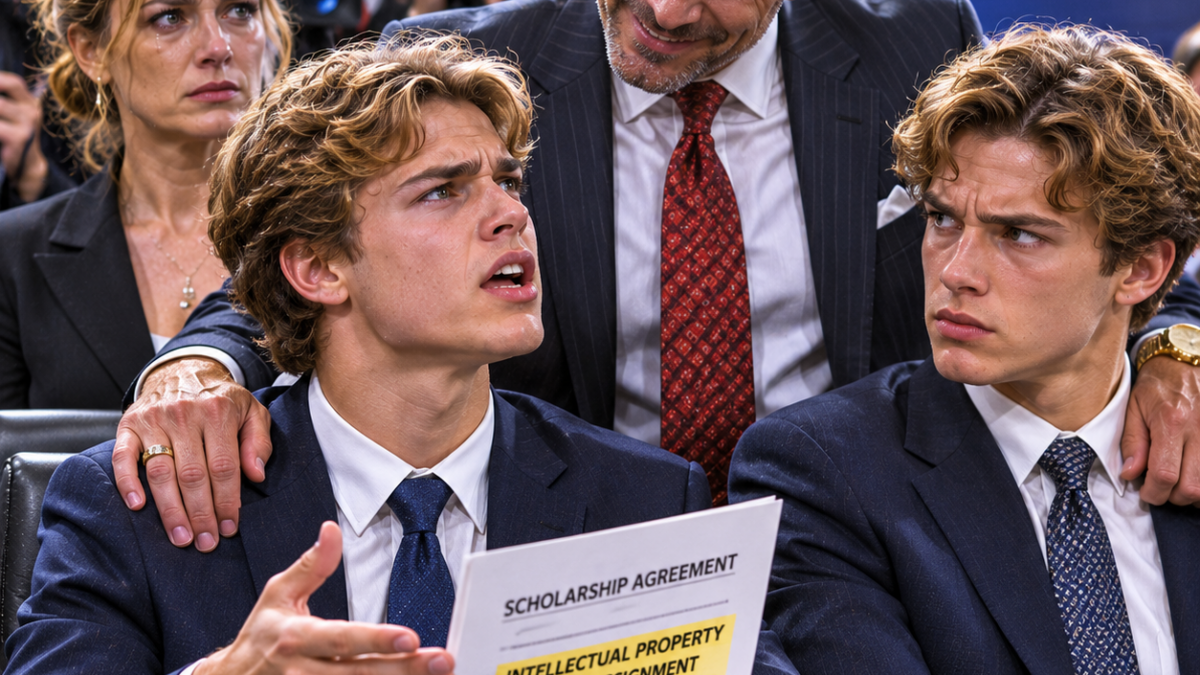
Fourteen years later, I sat between my sons at a scholarship dinner in downtown Columbus.
They were twenty.
Tall.
Smart.
Completely different despite sharing the same face shape and dark hair.
Owen was more reserved.
He thought before speaking.
Miles spoke while thinking and trusted himself to catch up.
Together, they had spent two years building a low-cost agricultural water-monitoring system designed for small farms.
The project started on my kitchen table.
It eventually consumed the kitchen table.
Then half the dining room.
Then the garage.
They tested sensors.
Burned out circuit boards.
Argued over code.
Broke a pump.
Rebuilt the pump.
Borrowed spare parts from a mechanic named Pete Alvarez.
Convinced a local farmer, Mr. Callahan, to let them test the system on his property.
I didn’t understand half the technical language they used.
But I understood what I saw.
Discipline.
Curiosity.
Purpose.
The scholarship could help fund their final two years of university and potentially give them access to engineering mentorship.
Neither of us realized Graham’s company had become the principal sponsor until the week before the gala.
By then, the boys were already finalists.
I asked whether they wanted to withdraw.
Owen looked at Miles.
Miles shrugged.
“We didn’t apply to Dad.”
“We applied to a scholarship.”
So we went.
Graham took the stage before dinner.
He looked older.
Silver at the temples.
More polished.
More expensive.
He stood beneath a giant projected logo for Pierce Infrastructure Group, the engineering and development company he’d helped build.
Vanessa sat in the front row wearing emerald silk.
Their teenage son, Caleb, held up his phone, recording.
Then Graham smiled at the audience.
“My greatest achievement has always been being a father.”
Beside me, Owen stopped clapping.
Miles slowly lowered his program.
Neither spoke for several seconds.
Then Miles leaned close.
“Did he seriously just say that?”
I stared at the stage.
“Yes.”
Owen looked toward the front row.
Caleb was smiling proudly at his father.
I felt something complicated twist inside me.
Not jealousy.
Not anger at the boy.
Caleb hadn’t stolen anything.
He had simply received what Owen and Miles didn’t.
A father who showed up.
Graham continued talking.
“Success isn’t measured only in buildings, contracts, or revenue.”
My jaw tightened.
“It’s measured in what we pass on.”
Owen looked down.
Graham talked about helping with homework.
Driving children to school.
Staying up late for science projects.
Showing up.
That word hurt.
Showing up.
I remembered a science fair when Owen and Miles were nine.
Both boys kept looking at the gymnasium entrance.
Their project was a small wind turbine made from salvaged parts.
Graham had promised to attend.
He never appeared.
Eventually, the custodian began switching off lights.
Owen asked me:
“Do you think Dad went to the wrong school?”
I had no answer.
Now that same man stood beneath stage lights talking about the importance of presence.
I reached under the table and squeezed Owen’s hand.
He squeezed back.
Neither of us looked at Graham.
After the speech, Graham stepped offstage to greet donors.
I went to the coffee station.
I had just picked up a cup when someone behind me said:
“Elise?”
I knew the voice before I turned.
Graham stood three feet away.
For a moment, neither of us spoke.
His expression moved through surprise, discomfort, and calculation.
“Elise.”
“Graham.”
His eyes flicked over my blue dress.
Then toward the ballroom.
“What are you doing here?”
I smiled faintly.
“Supporting my sons.”
His expression changed.
He looked past me.
Owen and Miles were approaching.
The recognition on Graham’s face was immediate.
But incomplete.
Like seeing a photograph from another life.
Owen stopped beside me.
Miles remained half a step behind.
Graham stared.
“Owen?”
“Yes.”
He turned.
“Miles?”
Miles answered before Graham could ask.
“Yeah.”
A silence opened between them.
Fourteen years inside one silence.
Graham reached for the easiest explanation.
“Your mother and I had our differences.”
Miles looked at him.
“You had our address.”
Graham’s face tightened.
I touched Miles’s arm.
Not to silence him.
To remind him he wasn’t alone.
Vanessa approached.
At first she smiled.
“Graham?”
Then she saw us.
The smile changed.
“Friends?”
Graham swallowed.
“My sons.”
Vanessa froze.
She knew the boys existed.
I could tell.
What shocked her was seeing them standing there.
Real.
Adult.
Impossible to reduce to a sentence about “a complicated first marriage.”
She recovered quickly.
“How wonderful.”
She looked toward them.
“Graham has always hoped you’d reconnect.”
Owen glanced at the program.
“Through which phone number?”
Vanessa’s smile disappeared.
Graham exhaled sharply.
“Owen.”
The finalists were called toward the stage entrance.
Miles looked toward his badge.
“We have to go.”
They left.
Graham watched them.
Then turned toward me.
“They’re finalists?”
I nodded.
“They designed a low-cost water-monitoring system for small farms.”
His posture changed immediately.
Business interest.
“How advanced?”
“Working prototype.”
“How long?”
“Two years.”
His eyes followed them.
“I could’ve helped.”
I looked at him.
“Yes.”
He glanced toward me.
I continued.
“You could have.”
PART2
The winners were announced an hour later.
The host opened the envelope.
“And this year’s Pierce Infrastructure Future Engineers Scholarship goes to…”
I held my breath.
“Owen and Miles Pierce.”
For half a second, neither boy moved.
Then Miles whispered:
“Holy hell.”
Owen laughed.
I stood.
Everyone at our table applauded.
I covered my mouth.
Their project appeared on the giant screen.
A photograph of the system attached to irrigation lines at Callahan Farm.
A small black control box.
Moisture and water-quality sensors.
Their names.
Their university.
Their faculty adviser.
I could barely see through tears.
For two years, those boys had built something from almost nothing.
I had eaten dinner standing at the counter for three months because circuit boards covered the table.
I had driven them to farms at five in the morning.
Worked night shifts after taking a temporary second job during one expensive semester.
Watched Miles fall asleep beside a soldering iron.
Watched Owen rewrite code until sunrise because a sensor kept sending bad readings.
And now people were standing for them.
Graham rose before anyone else.
He applauded above his head.
Then immediately began moving toward the stage.
Of course.
He was the sponsor.
The host announced:
“And presenting the award on behalf of Pierce Infrastructure Group, Graham Pierce.”
He stepped onto the stage smiling like a man walking into a photograph he’d already framed.
Owen and Miles joined him.
A giant ceremonial check stood on an easel.
Twenty-five thousand dollars.
Graham shook Owen’s hand.
Then Miles’s.
Flashbulbs went off.
He placed one hand on Owen’s shoulder.
“These are my boys.”
Owen moved half a step away.
It was subtle.
But everyone close enough saw it.
The host offered Owen the microphone.
“What inspired the project?”
Owen swallowed.
“Our faculty adviser, Dr. Patel, pushed us to simplify the design instead of making it expensive.”
Applause.
He continued.
“Mr. Callahan gave us access to his farm for testing.”
More applause.
“And Pete Alvarez donated parts when we couldn’t afford replacements.”
Then Owen looked toward me.
His expression changed.
“Our mom worked nights so we could keep going.”
The room became warm with applause.
I pressed my napkin against my mouth.
Graham’s smile tightened.
The host turned toward Miles.
“And what does winning tonight mean to you?”
Miles looked at the ceremonial check.
Then at a folder in his hand.
He didn’t take it.
Instead, he said:
“Before we accept, we need clarification.”
The host blinked.
“Clarification?”
Miles opened the folder.
“Yes.”
He held up a page.
“About this.”
Graham’s expression changed.
Only slightly.
But I saw it.
Miles continued.
“This page says intellectual property developed by scholarship recipients may be subject to sponsor review and assignment.”
The room quieted.
The host leaned closer.
“I wasn’t aware—”
Owen stepped beside his brother.
“The language isn’t in the main application.”
Miles nodded.
“It was attached to the finalist packet.”
Graham reached for the microphone.
“I can explain.”
Miles looked at him.
“Good.”
The ballroom went completely still.
“Please do.”
Graham smiled.
Corporate smile.
The one I’d seen whenever he was cornered.
“The provision is standard protective language.”
Miles didn’t move.
“Protecting who?”
A few people murmured.
Graham chuckled.
“It’s there to protect both the recipients and the sponsor in case company resources are used in further development.”
Owen opened another page.
“We didn’t use company resources.”
“Not yet.”
Owen stared.
“What does that mean?”
Graham looked toward the audience.
“Pierce Infrastructure often offers mentorship, laboratory access, commercialization support—”
Miles interrupted.
“Then why does the page say assignment?”
Graham’s smile disappeared.
The host glanced toward the event coordinator.
Someone backstage began moving quickly.
Miles continued.
“We applied for a scholarship.”
He held up the contract.
“Not an acquisition.”
Applause started somewhere near the back.
Small.
Then stopped.
Graham’s face hardened.
“This isn’t the appropriate place for contract interpretation.”
Miles nodded.
“I agree.”
He placed the ceremonial check back onto the easel.
“So we’ll wait.”
The room went silent.
Graham stared.
“What are you doing?”
Miles looked at him.
“Not accepting money until we know what we’re giving away.”
I felt something inside me swell.
Pride so sharp it almost hurt.
Graham lowered his voice.
“Miles.”
My son looked directly at him.
“You haven’t called me that in fourteen years.”
The microphone caught every word.
The ballroom changed.
It was no longer merely uncomfortable.
It was electric.
Graham looked toward the host.
Then the cameras.
Then me.
He knew exactly what was happening.
His two lives had collided.
The respected father.
The abandoned sons.
The generous sponsor.
The contract nobody wanted discussed.
And all of it was happening under the logo of his own company.
The host took the microphone.
“We’re going to pause for a moment while our legal team reviews the document.”
Miles nodded.
“That’s all we’re asking.”
Owen stood beside him.
Graham leaned toward both boys.
His microphone was lowered, but I could see his mouth moving.
Probably:
Let’s discuss this privately.
Probably:
Don’t embarrass me.
Probably something about misunderstanding.
The same words people use when truth becomes inconvenient.
Miles shook his head.
Owen stepped away.
Then both boys walked offstage.
Not with the check.
Not with Graham.
They came straight toward me.
Miles sat.
His hands were trembling.
Owen looked pale.
I touched both their shoulders.
“You okay?”
Miles laughed nervously.
“No.”
Owen whispered:
“Did we just blow twenty-five grand?”
I looked at them.
“Maybe.”
Miles closed his eyes.
“Great.”
I leaned closer.
“But you didn’t sell something you spent two years building because a room was clapping.”
Owen looked at me.
Then nodded slowly.
The scholarship director hurried over.
Her name was Rachel Bennett.
She looked horrified.
“I’m so sorry.”
Miles handed her the page.
“Did you know about this?”
Rachel read.
Her face changed.
“No.”
Graham appeared behind her.
“We need to stop turning routine language into a scandal.”
I stood.
For the first time that evening, I felt angry.
Not hurt.
Angry.
“Then explain it.”
Graham looked at me.
“This isn’t your issue.”
Miles spoke.
“It is if you were planning to use our project.”
Graham exhaled.
“No one is stealing anything.”
Owen pointed toward the page.
“Then delete the clause.”
Graham stared.
“It isn’t that simple.”
Miles nodded.
“Then neither is accepting the money.”
Vanessa approached.
Caleb stood behind her.
His phone was no longer raised.
Graham looked toward his wife.
“We’re handling it.”
Vanessa looked at the contract.
“What is it?”
“Nothing.”
Miles laughed.
“That seems to be Dad’s favorite number of things to explain.”
Graham glared.
“Elise, control him.”
My entire body went still.
Control him.
As though Miles were still six.
As though I had spent fourteen years raising two boys who needed to be managed when they spoke inconvenient truths.
I looked at Graham.
“They’re adults.”
“Then they should act like it.”
Owen spoke quietly.
“We are.”
He pointed toward the check.
“We’re reading before signing.”
A donor nearby actually laughed.
Graham heard.
His face reddened.
Vanessa read the clause.
Then looked at Graham.
“Did you know this was in the packet?”
He didn’t answer.
That silence was enough.
Her face changed.
“You did.”
“Vanessa—”
“You told me the scholarship was philanthropic.”
“It is.”
She looked at the language again.
“This looks like an option to obtain rights.”
Graham lowered his voice.
“This is a technical issue.”
Miles said:
“Funny. We’re engineers. We like technical issues.”
I almost smiled.
Graham looked furious.
Then the company general counsel arrived.
A woman named Karen Holt.
She read the page.
Once.
Then again.
Her jaw tightened.
“Who approved this version?”
Graham said:
“Karen—”
She looked up.
“I asked who approved it.”
The room around us had become a quiet circle of people pretending not to listen.
Graham lowered his voice.
“The innovation committee.”
Karen stared.
“I chair the innovation committee.”
Silence.
That was the first moment I saw genuine fear in Graham’s face.
Not embarrassment.
Fear.
Karen asked everyone directly involved to move into a private conference room.
Graham resisted.
The scholarship director insisted.
The boys agreed only after I went with them.
Vanessa stayed outside with Caleb.
Inside were Graham, Karen, Rachel, Owen, Miles, me, and another company attorney.
Karen placed the contract page on the table.
“Start at the beginning.”
Miles explained.
When finalists were notified, they received an electronic packet.
Most pages covered attendance, publicity, payment, eligibility, and tax information.
Then came the extra page.
It allowed the sponsor to request disclosure of technical details.
It also contained a provision granting the company broad rights to negotiate an assignment and, under certain conditions, claim sponsor-related development rights.
Owen had noticed it two nights earlier.
The boys asked their faculty adviser.
He told them not to sign until they understood it.
They hadn’t signed.
I hadn’t known any of this.
I turned toward them.
“You didn’t tell me?”
Miles shrugged.
“We didn’t want you worrying.”
I almost laughed.
“That worked beautifully.”
Karen looked toward Graham.
“Why was this added?”
Graham crossed his arms.
“It wasn’t targeted.”
Owen said:
“We never said it was.”
Graham’s jaw tightened.
Karen continued.
“Who drafted it?”
The second attorney shifted.
Graham answered:
“It was adapted from our corporate innovation agreement.”
Karen stared.
“For employees.”
“Yes.”
“These students are not employees.”
“I know.”
“Then why attach employee-style IP language to a scholarship?”
Graham leaned forward.
“Because some of these projects have commercial potential.”
There it was.
Finally.
Honesty.
Miles sat back.
“So you were shopping.”
Graham’s expression hardened.
“No.”
Owen looked at him.
“Then what would happen if a project looked valuable?”
Graham said nothing.
Karen answered instead.
“The company would ordinarily negotiate separately with the inventors.”
Miles pointed toward the page.
“Then why isn’t that what this says?”
No one answered immediately.
I watched Graham.
And suddenly understood.
The scholarship wasn’t necessarily fraudulent.
But someone had modified the paperwork to create leverage before winners received money.
Maybe Graham considered it clever.
Maybe efficient.
Maybe normal business.
But to two twenty-year-old students, it looked exactly like what it was.
A powerful company putting complicated rights language between young inventors and money they desperately needed.
And Graham’s sons had caught it.
Karen requested the electronic-document history.
Someone from the company sent it within twenty minutes.
The room stayed tense.
Graham paced.
Miles whispered to Owen.
I sat quietly.
Then Karen’s phone buzzed.
She read.
Her face hardened.
“Graham.”
He stopped.
“What?”
“The clause was added three weeks ago.”
He said nothing.
Karen continued.
“From your office.”
Rachel looked stunned.
The second attorney stared toward Graham.
He rubbed his forehead.
“It’s not what it looks like.”
Miles laughed once.
“Apparently that’s genetic.”
I almost told him not to.
Then decided Graham had survived worse.
Karen asked:
“Why?”
Graham looked toward the boys.
Then toward me.
Finally he said:
“I saw the finalist list.”
The room went still.
My stomach dropped.
Owen stared.
“When?”
“Three weeks ago.”
Miles leaned forward.
“You knew we were finalists.”
“Yes.”
The air seemed to leave the room.
Earlier, Graham had acted surprised.
They’re finalists?
A performance.
I looked at him.
“You lied to me an hour ago.”
He ignored me.
Owen asked:
“You saw our names and changed the contract?”
Graham shook his head.
“I didn’t change it because of you.”
Miles said:
“You just happened to add an IP clause after seeing that we submitted a potentially commercial engineering design?”
Graham’s voice rose.
“I was trying to create an opportunity.”
“For who?”
“For all of you.”
Owen stared.
“You could have called us.”
Graham stopped.
Owen’s voice remained calm.
“You had three weeks.”
Nothing.
“You could’ve called and said congratulations.”
Graham looked down.
“You could’ve asked what we built.”
Silence.
“You could’ve asked anything.”
Owen swallowed.
“Instead, you changed paperwork.”
That sentence hurt him more than shouting would have.
I saw it.
For a moment, Graham had no business answer.
No PR line.
No fatherhood speech.
Only the truth.
Given a chance to reconnect with his sons, he chose leverage.
Graham sat down.
“I didn’t know how to call.”
Miles laughed bitterly.
“You dial numbers.”
“Miles.”
“No. Seriously.”
His voice shook.
“You stood onstage talking about showing up.”
Graham rubbed his face.
“I made mistakes.”
“Fourteen years isn’t a mistake.”
Owen looked at his brother.
Miles continued.
“Missing a birthday is a mistake.”
His eyes filled.
“Missing fourteen of them is a decision.”
The room became painfully quiet.
I felt tears burning my eyes.
Graham looked toward me.
“You poisoned them against me.”
I stood so quickly my chair moved backward.
Karen looked up.
I stared at him.
For fourteen years, I had deliberately avoided doing exactly that.
I kept photographs.
Saved letters.
Never insulted him in front of the boys.
Never told them about missed support payments while they were children.
Never told them how often I called asking him to come.
Never showed them emails where he wrote that visiting was “too disruptive” to his new marriage.
I had spent years protecting the possibility that someday he might become their father again.
And he looked at me and said I poisoned them.
“No.”
My voice shook.
“You did that yourself.”
Graham stared.
I continued.
“When they were six, I told them traffic made you late.”
His face changed.
“When they were eight, I told them work kept you away.”
I swallowed.
“When they were nine, I sat in a school gym until the custodians turned off the lights because Owen thought you’d come to his science fair.”
Owen looked toward me.
I’d never told him I remembered that detail.
I continued.
“When they were eleven, Miles asked me to stop making excuses for you.”
Graham’s face went pale.
“I did not teach them to hate you.”
I stepped closer.
“I taught them not to wait.”
No one spoke.
Then Karen quietly said:
“We need to return to the contract.”
It sounded almost merciful.
The legal team concluded that the scholarship documents needed immediate review.
Karen made it clear the award would not be conditioned on the boys signing the disputed page.
Graham protested.
Karen ignored him.
The company would issue a written clarification that scholarship recipients retained ownership of independently developed intellectual property unless a separate voluntary agreement was negotiated later.
Owen asked:
“In writing?”
“Yes.”
Miles said:
“No retroactive claims?”
“Yes.”
“Not just for us?”
Karen understood immediately.
“For all scholarship recipients.”
Miles nodded.
“Then we’ll consider accepting.”
Graham looked toward him.
“Consider?”
Owen answered.
“We’re not taking anything tonight.”
I watched Graham’s face.
For him, the public check presentation had been the story.
Photo.
Applause.
Press release.
Father presents scholarship to sons.
A perfect resurrection.
But the boys refused to become props in it.
That was the part he couldn’t control.
When we returned to the ballroom, the event had moved awkwardly forward.
Dessert had been served.
People were whispering.
Phones were out.
The host asked whether Owen and Miles wanted to return to the stage.
They looked at each other.
Then Miles said:
“Only if we can explain why we paused.”
Rachel nodded.
Graham objected immediately.
Karen stopped him.
“They can speak.”
Graham stared.
“You’re letting this become a public disaster.”
Karen looked at him.
“It became public when you modified a public scholarship agreement.”
That ended the argument.
The boys returned to the stage.
I sat at the table.
My hands shook.
Owen took the microphone first.
“We want to thank the scholarship committee and judges.”
He paused.
“We’re proud of the work we submitted.”
Miles stood beside him.
“We also want students like us to know something.”
He held up the contract.
“Read everything.”
A few people laughed softly.
He smiled.
“Especially the boring pages.”
More laughter.
Then he became serious.
“If somebody offers money in exchange for your work, make sure you understand what you’re giving them.”
Owen continued.
“We were told tonight that this scholarship will be clarified so recipients retain ownership of projects they developed independently.”
The room applauded.
Graham sat motionless at the sponsor table.
Then Owen looked toward him.
For one brief moment, I wondered whether he would publicly humiliate his father.
He didn’t.
Instead, he said:
“We’ll review the revised terms before deciding whether to accept.”
That was all.
No attack.
No revenge.
The applause became louder.
Because dignity often embarrasses people more effectively than cruelty.
After the gala, reporters waited near the lobby.
The company had invited local business media because of the scholarship.
Now everyone wanted to know about the contract.
Karen handled most questions.
Rachel handled scholarship questions.
The boys declined interviews beyond a short statement.
Then Graham appeared.
A photographer called:
“Mr. Pierce, can we get a photo with your sons?”
Graham turned toward Owen and Miles.
For half a second, I saw hope.
Owen shook his head.
“No, thanks.”
Graham froze.
The photographer lowered the camera.
Miles added:
“We’re here as scholarship finalists, not as a family reunion.”
Then they walked toward the exit.
I followed.
Graham came after us.
“Elise.”
I stopped.
The boys stopped too.
He looked at them.
“Can we talk privately?”
Miles asked:
“About the contract or the fourteen years?”
Graham closed his eyes.
“Both.”
Owen looked toward me.
I said nothing.
This was theirs.
He turned back to Graham.
“Not tonight.”
Graham nodded slowly.
Then looked at me.
“Did you know they’d refuse the check?”
“No.”
He stared.
“You really didn’t.”
“No.”
A bitter smile crossed his face.
“They’re stubborn.”
I looked toward my sons.
Then back at him.
“They learned not to sign things just because someone older tells them to.”
Graham flinched.
Then I walked away.
The internet found the story before breakfast.
Not because the boys posted anything.
Someone in the ballroom had recorded Miles questioning the contract.
Another person captured Owen moving away when Graham said:
“These are my boys.”
A third clip showed the later announcement that scholarship IP terms would be reviewed.
By noon, the story was circulating among engineering students and local professional groups.
Most of the discussion focused on scholarship contracts.
Some focused on Graham’s fatherhood speech.
I hated that part.
Owen and Miles weren’t entertainment.
They weren’t evidence in a public trial of whether Graham was a good father.
I asked them how they felt.
Miles stared at his phone.
“Weird.”
Owen had already deleted two social apps.
“I don’t want strangers telling me how I should feel about Dad.”
I nodded.
“Then don’t read it.”
Miles looked at me.
“Are you reading it?”
“No.”
That was mostly true.
I had read enough to know the story was spreading.
Then stopped.
The boys deserved privacy even if Graham had accidentally turned them into public symbols.
Pierce Infrastructure issued a statement two days later.
The scholarship language had been “inconsistent with the intended philanthropic purpose.”
The disputed clause was removed.
All finalists received revised agreements.
The company stated clearly that student recipients retained ownership of independently developed intellectual property.
Karen Holt personally emailed Owen and Miles.
No pressure.
No publicity condition.
No sponsor claim.
Just the scholarship.
The boys spent an entire evening reviewing the new documents with their university’s technology-transfer office and an attorney provided through a student legal clinic.
Then Miles came into the kitchen.
“Mom?”
I looked up.
“Yeah?”
“We’re accepting.”
I smiled.
“Good.”
Owen followed.
“But we’re donating five thousand.”
I frowned.
“To what?”
“A student prototyping fund.”
My eyes filled.
“Why?”
Miles shrugged.
“Pete gave us parts when we had no money.”
Owen added:
“Somebody else should get parts.”
I stared at them.
Then laughed softly.
“You know you’re allowed to keep your scholarship money.”
“We are.”
Miles smiled.
“We’re keeping twenty thousand.”
I laughed.
“Excellent. I raised economists after all.”
Graham did not present the replacement check.
That was Owen’s request.
The scholarship committee agreed.
Instead, the university hosted a small presentation.
Dr. Patel handed them the award.
Mr. Callahan attended.
Pete Alvarez wore a suit that clearly hadn’t been out of his closet in ten years.
I sat in the front row.
There were no corporate logos behind the boys.
No father claiming them.
Just their names.
Their project.
Their work.
When the photographs were taken, Owen pulled me into one.
Miles grabbed Pete.
Dr. Patel joined.
Mr. Callahan stood at the edge.
That photograph eventually became my favorite.
Not because Graham wasn’t in it.
Because everybody who was in it had actually been there.
Three weeks later, Graham called Owen.
Not me.
Owen stared at the phone for almost a full minute.
Then answered.
He left the room.
He returned forty minutes later.
Miles looked up.
“Well?”
Owen sat down.
“He apologized.”
Miles waited.
“For what?”
“That was my question.”
I looked at Owen.
He rubbed his face.
“He said he was sorry he let things get complicated.”
Miles laughed.
“That’s not an apology.”
“I told him that.”
I stayed quiet.
Owen continued.
“He said he thought Mom made it difficult to see us.”
Miles looked toward me.
I felt anger rise.
Owen immediately added:
“I told him I remembered enough.”
My throat tightened.
“What do you remember?”
He looked at me.
“The waiting.”
I looked down.
He continued.
“I remember you calling him.”
I froze.
“What?”
“When I was little.”
His eyes filled.
“You used to go into the laundry room because you thought we couldn’t hear.”
I stopped breathing.
He continued.
“I heard you asking him to come to my birthday once.”
Tears filled my eyes.
“I didn’t know.”
“I know.”
He looked toward Miles.
“We always knew more than you thought.”
Miles nodded.
I felt as though someone had opened a room inside our past that I’d kept locked for years.
I whispered:
“I’m sorry.”
Both boys looked confused.
“For what?”
“For not protecting you better.”
Miles stared at me.
Then said:
“Mom.”
His voice softened.
“You were the one protecting us.”
That broke me.
I covered my face.
Owen moved beside me.
Miles followed.
I had two twenty-year-old sons hugging me at my own kitchen table.
The same table where their invention had lived for two years.
And for the first time, I allowed myself to stop wondering whether I had somehow failed because their father left.
Graham requested dinner.
The boys debated for almost a month.
Eventually, they agreed.
One dinner.
Neutral restaurant.
No Vanessa.
No Caleb.
No cameras.
No company people.
They asked whether I would come.
I said no.
Miles looked surprised.
“You don’t want to?”
“No.”
“Why?”
“Because you’re not six.”
I smiled.
“This conversation belongs to you.”
Owen nodded slowly.
They went.
I spent two hours pretending not to watch the clock.
When they returned, Miles went straight to the refrigerator.
That was usually a bad sign.
Owen sat at the table.
I waited.
Finally:
“He cried.”
Miles closed the refrigerator.
“He cried a lot.”
I nodded.
“Did that help?”
Owen thought.
“A little.”
Miles sat.
“He kept saying he didn’t know how to come back after being gone so long.”
I looked toward him.
“What did you say?”
“I said the longer he waited, the worse it got.”
Owen nodded.
“He admitted that.”
I stayed quiet.
Then Owen said:
“He apologized for the scholarship thing.”
Miles snorted.
“Eventually.”
I smiled slightly.
“What happened?”
Miles leaned back.
“He tried saying he thought the company could help develop our project.”
Owen said:
“I told him help requires asking.”
My chest tightened.
Good.
Miles continued.
“Then he admitted he saw our names and thought the scholarship would be a way to reconnect.”
I frowned.
“By changing the contract?”
“Exactly.”
Owen looked tired.
“He said business was the only language he knew how to use with us.”
I shook my head.
“That isn’t your responsibility.”
“We told him.”
For a moment, none of us spoke.
Then Miles said:
“He asked if we could start over.”
I looked at them.
“And?”
Owen stared at the table.
“I told him you don’t start over.”
I waited.
“You start from where you are.”
That was wiser than anything I could’ve told him.
They did not suddenly become a happy father-and-sons trio.
Life isn’t that clean.
Graham started calling once every couple of weeks.
Sometimes Owen answered.
Sometimes he didn’t.
Miles was slower.
He ignored the first six calls.
Then answered the seventh.
There were awkward coffees.
Short conversations.
One lunch.
A baseball game Owen agreed to attend.
No dramatic reunion.
No instant forgiveness.
And importantly, no pretending.
Graham had to learn their majors.
Their friends.
Their habits.
Their favorite foods.
The names of the professors who mattered to them.
Things a father normally learns over years.
He was trying to compress fourteen missing years into present tense.
The boys didn’t let him.
They made him go slowly.
Vanessa called me once.
I nearly didn’t answer.
Then curiosity won.
“Elise?”
“Yes.”
“This is Vanessa.”
“I know.”
She paused.
“I wanted to apologize.”
That surprised me.
“For what?”
“The gala.”
I waited.
She continued.
“I repeated something Graham told me. That he’d always hoped to reconnect.”
My jaw tightened.
She said:
“I realize now that wasn’t the full story.”
I looked out the window.
“No.”
She took a breath.
“Caleb saw the video.”
My stomach tightened.
“How is he?”
“Confused.”
I closed my eyes.
Of course.
The teenage son who had grown up believing his father embodied family devotion had watched two adult sons publicly reveal an entirely different history.
“He shouldn’t be dragged into this.”
“I agree.”
Her voice softened.
“Thank you.”
I waited.
Then she said:
“I asked Graham why he didn’t see the twins.”
I stared at the kitchen counter.
“What did he say?”
“That after the divorce, every year made calling harder.”
I almost laughed.
“He always did hate difficult conversations.”
Vanessa didn’t defend him.
Then she said something I didn’t expect.
“I told him hard isn’t the same as impossible.”
I smiled faintly.
“No.”
“It isn’t.”
Meanwhile, Owen and Miles kept working.
The scholarship money helped.
So did the attention the contract controversy generated, though they were careful about who they trusted.
Several companies approached them.
This time, they read everything.
Twice.
Their university helped them file appropriate intellectual-property protections for the parts of the system they had developed.
They formed a small student startup with guidance from their adviser and an entrepreneurship clinic.
They called it FieldLine Systems.
No Pierce Infrastructure investment.
At least not initially.
Graham asked once.
Miles said:
“No.”
Graham accepted it.
That may have been the first sign he was genuinely learning.
FieldLine’s early goal was modest.
Produce inexpensive monitoring equipment that could alert smaller farms to water-quality problems without requiring expensive industrial infrastructure.
They weren’t going to become billionaires overnight.
They knew that.
They still had reliability testing.
Manufacturing.
Compliance issues.
Costs.
Competition.
Real engineering problems that don’t disappear because a ballroom applauds you.
I loved watching that.
The scholarship wasn’t the ending.
It was fuel.
Nine months after the gala, Owen and Miles returned to Callahan Farm.
I went too.
The prototype had evolved.
Cleaner enclosure.
Better sensors.
More reliable data.
Mr. Callahan stood beside the irrigation line.
“You boys finally made this thing stop yelling at me every time a frog gets near the sensor?”
Miles laughed.
“Mostly.”
Pete Alvarez leaned against his truck.
“Mostly means no.”
Owen smiled.
“It means improved.”
We all laughed.
The system activated.
Data appeared on a tablet.
Mr. Callahan studied it.
Then nodded.
“Not bad.”
For him, that was equivalent to a standing ovation.
I looked toward my sons.
Wind moved through the fields.
Sunlight caught the side of Owen’s face.
Miles was arguing with Pete about a housing bracket.
For a moment, I saw them at six.
Then nine.
Then fourteen.
Then twenty.
Every age at once.
All the years Graham had missed.
I felt grief.
But not the old grief.
This one had edges softened by gratitude.
I had been there.
Not perfectly.
Not without exhaustion.
But there.
Pierce Infrastructure changed its scholarship program permanently.
Karen Holt became publicly responsible for the revised structure.
The company created an independent university advisory panel.
Scholarship contracts were shortened.
IP provisions were removed unless a separate optional development agreement was presented later.
Students received clear language explaining that accepting scholarship money did not require surrendering independently developed inventions.
Graham was removed from direct administration of the scholarship.
He remained with the company, but his authority over community programs was reduced.
He hated that.
I knew because Owen told me.
Apparently Graham said:
“Everyone thinks I’m some villain.”
Owen replied:
“Then stop worrying about everyone.”
I smiled when he told me.
“What did he say?”
“Nothing.”
“Good answer.”
A year after the gala, Pierce Infrastructure held the scholarship dinner again.
Owen and Miles were invited back.
Not as applicants.
As previous recipients.
They asked me to attend.
I hesitated.
Then agreed.
The ballroom looked almost identical.
Same chandeliers.
Same stage.
Different sponsor presentation.
Karen Holt gave the opening speech.
She talked about engineering.
Ethics.
Student ownership.
No speeches about fatherhood.
I almost laughed.
Graham attended as an executive.
He sat halfway back.
Vanessa beside him.
Caleb too.
When Owen and Miles walked onto the stage to talk about FieldLine, Graham applauded.
But he didn’t stand.
Didn’t wave.
Didn’t claim them.
He simply applauded.
That restraint meant more than his entire speech the year before.
Owen talked about reading contracts.
Miles talked about building things for people who couldn’t afford expensive solutions.
Then the host asked:
“What did last year’s scholarship allow you to do?”
Miles smiled.
“It bought us time.”
Owen nodded.
“And parts.”
Laughter.
Then Miles became serious.
“It also taught us that support is supposed to make your work more yours, not less.”
Applause spread through the room.
Graham looked down.
I didn’t know whether he felt embarrassed.
Proud.
Both.
That wasn’t my problem anymore.
After the event, Caleb approached the twins.
He was sixteen now.
Tall.
Nervous.
“Hey.”
Owen smiled.
“Hey.”
Miles looked toward him.
“You got taller.”
Caleb laughed awkwardly.
“So did you, probably.”
They all knew that made no sense.
They laughed anyway.
I stepped away.
Not far.
Just enough.
Caleb wasn’t responsible for his father’s failures.
Neither were my boys.
They talked for fifteen minutes.
School.
Engineering.
Baseball.
Nothing profound.
Then Caleb asked whether he could see the FieldLine prototype sometime.
Miles said:
“Sure.”
Graham stood across the room watching.
For once, he didn’t interfere.
Maybe that was progress.
Later, Graham approached me.
“Elise.”
“Graham.”
He looked toward the three boys.
“Our sons.”
I followed his gaze.
I could’ve corrected him.
Mine for fourteen years.
But I didn’t.
He continued.
“They’re incredible.”
“Yes.”
His eyes filled.
“You did a good job.”
That sentence landed strangely.
I had wanted it once.
Not from him specifically.
From someone.
Recognition that raising twins alone while working and surviving had been difficult.
Now it felt almost unnecessary.
I nodded.
“Thank you.”
He looked down.
“I should’ve been there.”
“Yes.”
No comfort.
No denial.
Just yes.
He swallowed.
“I don’t know if they’ll ever forgive me.”
I looked at him.
“That isn’t something you earn by waiting for it.”
His eyes met mine.
“You earn trust by doing the next right thing.”
He nodded slowly.
Then looked toward the boys.
“What if it isn’t enough?”
I thought about fourteen years.
The birthdays.
The science fairs.
The empty chair.
Then said:
“It might not be.”
His face tightened.
I continued.
“But doing the right thing only because it guarantees forgiveness isn’t really doing it for them.”
Graham went quiet.
That was the last serious conversation we ever had.
FieldLine eventually received a small seed investment.
Not from Pierce Infrastructure.
From a regional agricultural technology fund.
The boys negotiated carefully.
They retained control.
Pete got a consulting contract.
Mr. Callahan got free units for life.
I told them that last part was probably financially irresponsible.
Miles said:
“Mom, he’s the reason we have field data.”
I said:
“He also stole your sandwiches for two years.”
Mr. Callahan claimed this was false.
It was not.
Two years after the gala, Owen graduated.
Miles did too.
Same university.
Same weekend.
Different engineering specialties.
Graham asked whether he could attend.
The boys said yes.
He sat several rows behind me.
Not beside me.
Not in the place of honor.
Just present.
When Owen’s name was called, Graham stood.
Then seemed to realize he might be making the moment about himself.
He sat back down.
I noticed.
So did Owen.
Later, Miles told me:
“That was weird.”
“What?”
“He almost stood.”
I smiled.
“Maybe he’s learning.”
Miles shrugged.
“Maybe.”
That was enough.
After graduation, we had dinner at my house.
Pete came.
Dr. Patel came.
Mr. Callahan came with his wife.
Vanessa and Caleb came.
Graham came alone a little later.
For the first time in fourteen years, he entered a room where both his families existed without pretending one erased the other.
It was awkward.
Then food helped.
Food usually does.
Caleb asked Owen about software.
Miles argued with Pete about manufacturing costs.
Vanessa helped me carry dishes.
Graham stood near the kitchen table.
The same table where the original prototype had taken over my house.
He touched one of the old burn marks.
“This is from them?”
I nodded.
“Soldering iron.”
He smiled.
“You kept the table.”
“Of course.”
He looked around.
Then said quietly:
“I missed all of this.”
I looked at him.
“Yes.”
He swallowed.
For once, he didn’t ask me to make the truth softer.
That evening, after everyone left, Owen and Miles stayed behind.
The house was quiet.
I sat at the kitchen table.
Miles dropped into the chair opposite me.
Owen leaned against the counter.
“Mom?”
“Yeah?”
“Do you regret it?”
I frowned.
“What?”
“Not remarrying.”
I laughed.
“That came out of nowhere.”
Miles shrugged.
“Dad has Vanessa.”
I looked at them.
“I dated.”
Owen nodded.
“We know.”
“Thanks for monitoring.”
Miles grinned.
I smiled.
Then answered honestly.
“No.”
They waited.
“I don’t regret my life.”
Owen looked down.
“Even with all the hard stuff?”
“Especially because I know what it cost.”
I reached across the table.
“I would’ve preferred that your father stayed.”
Both boys looked at me.
“I wanted you to have him.”
My voice tightened.
“But I wasn’t going to let his absence become the center of our family.”
Miles swallowed.
“You never did.”
I smiled.
“That was the goal.”
Then Owen asked:
“Were you mad when he said being a father was his greatest achievement?”
I laughed.
“Very.”
They both smiled.
I continued.
“But mostly I was sad.”
“Why?”
“Because he believed the speech.”
Miles frowned.
I looked toward him.
“People can build versions of themselves that feel true because nobody around them challenges the missing pieces.”
I paused.
“He had Caleb. He showed up for Caleb.”
Owen nodded.
“That part wasn’t fake.”
“No.”
I smiled sadly.
“He just edited you two out of the story.”
Silence.
Then Miles said:
“We edited ourselves back in.”
I laughed.
“Yes.”
“You definitely did.”
Graham never became the father he’d claimed to be on that ballroom stage.
You can’t retroactively attend a second-grade science fair.
You can’t go back to a six-year-old’s birthday.
You can’t unmiss Christmas.
You can’t restore the exact version of trust that existed before a child learned not to expect you.
But he became something else.
Present.
Imperfectly.
Late.
Carefully.
He called.
He visited.
He stopped giving advice before being asked.
He stopped trying to buy connection.
He learned that when Miles said no, the answer was no.
He learned that Owen needed time.
He attended product demonstrations without introducing himself as their father unless they did first.
Small things.
But fourteen years of absence aren’t repaired through grand gestures.
They’re repaired, if they can be repaired at all, through hundreds of boring moments.
That was the lesson Graham had somehow missed.
Showing up isn’t a speech.
It’s repetition.
Three years after the scholarship gala, FieldLine installed its thousandth monitoring unit.
Not a billion-dollar company.
Not a magazine-cover miracle.
A real small business.
Employees.
Customers.
Problems.
Payroll.
Failures.
Growth.
The boys invited everyone who had helped.
The event took place at Callahan Farm.
Not a ballroom.
No chandeliers.
Folding chairs.
A small tent.
Barbecue.
Pete complained about the coffee.
Mr. Callahan complained about everything else.
I loved it.
Owen spoke first.
He thanked Dr. Patel.
Pete.
Mr. Callahan.
Their university.
The early agricultural fund.
Then Miles took the microphone.
“And our mom.”
I immediately shook my head.
He ignored me.
“FieldLine began on her kitchen table.”
People laughed.
“She let us destroy it.”
More laughter.
“She worked nights.”
My eyes filled.
“Drove us everywhere.”
I stared down.
“And when we almost signed away rights to the thing we’d built because there was a twenty-five-thousand-dollar check sitting in front of us…”
Miles smiled.
“She reminded us that money is expensive when you don’t understand what you’re paying with.”
I looked up.
I’d never said those exact words.
But apparently I’d taught them anyway.
Then Owen added:
“She also taught us that people who believe in you don’t need to own you.”
The applause began.
I cried.
There was no stopping it.
Then Miles looked toward Graham.
He sat beside Vanessa and Caleb.
Miles paused.
“Our dad is here too.”
Graham froze.
I saw his eyes fill immediately.
Miles continued.
“We’ve had a complicated relationship.”
Nobody moved.
“But he’s been showing up.”
Graham covered his mouth.
Miles didn’t overdo it.
Didn’t rewrite history.
Didn’t pretend.
He simply said:
“That matters.”
Then moved on.
It was probably the greatest gift Graham would ever receive from those boys.
Not forgiveness.
Recognition of effort.
Earned slowly.
Afterward, Graham found me near the fence.
He was crying.
“Elise.”
I smiled faintly.
“Don’t ruin it by giving a speech.”
He laughed through tears.
“I wasn’t going to.”
“Good.”
He looked toward Owen and Miles.
“Thank you.”
“For what?”
“For not making them hate me.”
I thought about that.
Then shook my head.
“I didn’t have that power.”
He looked at me.
“They decided what relationship they wanted with you.”
I paused.
“Just like they decided whether to accept your scholarship.”
Graham smiled sadly.
“They really are stubborn.”
I laughed.
“You keep calling integrity stubbornness.”
“Occupational habit.”
For the first time in decades, we stood beside each other without anger.
Not friends.
Not family.
Two people who once loved each other.
Two parents connected by sons who had grown beyond both of us.
That was enough.
I still have the program from that first scholarship gala.
It’s folded inside a box with the boys’ childhood drawings.
On the cover is the Pierce Infrastructure logo.
Inside is Graham’s opening biography.
One sentence says:
Graham Pierce considers fatherhood his greatest achievement.
The first time I read it, I wanted to tear the page out.
Now I leave it there.
Because the sentence became true in a way Graham never intended.
Not because he had been a great father.
Because fatherhood eventually forced him to face his greatest failure.
And then decide what kind of man he would be afterward.
The boys kept the ceremonial check too.
Not because it could be deposited.
It couldn’t.
It was cardboard.
Huge.
Ridiculous.
They hung it in the FieldLine office.
But they changed it.
Under the scholarship amount, Miles wrote in permanent marker:
READ PAGE 7.
Owen added underneath:
THEN READ IT AGAIN.
Every new intern asks what it means.
The boys tell the story.
Not the family part.
Usually.
They explain contracts.
Ownership.
Negotiation.
The danger of assuming money is free simply because someone uses the word scholarship.
Apparently, it has become company folklore.
I like that.
Sometimes people ask me what happened to the “extra page.”
I tell them it did exactly what hidden language often does once someone points at it.
It stopped being hidden.
Pierce Infrastructure removed it.
The scholarship changed.
Students kept their work.
And the company learned that generosity with strings attached stops looking generous the moment somebody reads the strings aloud.
As for Graham, the consequences were harder to summarize.
He didn’t lose everything.
Life rarely delivers perfect punishment.
He kept his career.
His marriage survived.
He remained wealthy.
But he lost the version of himself he’d spent years presenting without challenge.
After the gala, he could no longer stand on a stage and tell himself he had always been a devoted father.
Two grown sons had stood twenty feet away and contradicted the story simply by existing.
And once that happened, he had a choice.
Defend the image.
Or become better than it.
For a while, he tried both.
Eventually, he chose the second.
On the fifth anniversary of that gala, FieldLine sponsored its own student innovation award.
The boys invited me to the first ceremony.
I arrived early.
A small university auditorium.
Maybe eighty people.
No ballroom.
No luxury sponsors.
Four student teams.
Five-thousand-dollar awards.
The application packet was twelve pages.
Miles handed me a copy.
“Check page seven.”
I laughed.
“What did you put there?”
“Nothing evil.”
I opened it.
Page seven contained one bold sentence:
YOU RETAIN FULL OWNERSHIP OF YOUR INDEPENDENT WORK. THIS AWARD DOES NOT TRANSFER INTELLECTUAL PROPERTY RIGHTS.
I looked at him.
“You’re ridiculous.”
He grinned.
Owen joined us.
“It’s Miles’s favorite clause.”
Miles shrugged.
“Transparency is sexy.”
I groaned.
“Please never say that to scholarship applicants.”
Owen laughed.
Then Graham entered.
He stopped when he saw us.
No cameras.
No announcement.
He walked over.
“Hey.”
Owen smiled.
“Hey.”
Miles nodded.
“Dad.”
The word came naturally.
I noticed Graham noticed too.
His face softened.
He didn’t make a moment of it.
That was how I knew he’d learned something.
He simply said:
“Need help setting up chairs?”
Miles pointed.
“Back row.”
Graham went.
No speech.
No applause.
He began unfolding chairs.
I watched him for a moment.
Then Owen touched my shoulder.
“You okay?”
I smiled.
“Yeah.”
And I was.
At the ceremony, Miles spoke for three minutes.
He told the students that engineering was problem-solving.
Owen told them to ask uncomfortable questions.
Then one student raised her hand.
“What made you start this scholarship?”
The twins looked at each other.
Miles smiled.
“We once won one.”
Owen added:
“And learned something.”
“What?”
Owen glanced toward Graham.
Then toward me.
Finally he answered:
“Support should open doors.”
He paused.
“It shouldn’t quietly lock one behind you.”
I felt tears rise.
The students applauded.
Graham did too.
Afterward, we all went to dinner.
Me.
Owen.
Miles.
Graham.
Vanessa.
Caleb.
Pete somehow invited himself.
I never learned how.
At one point, Caleb asked:
“Dad, are you giving a speech?”
Graham laughed.
“No.”
Miles raised his glass.
“Growth.”
Everyone laughed.
Graham shook his head.
“I deserve that.”
“Yes,” Owen said.
He smiled.
“You do.”
Then Graham looked toward me.
For one second, I remembered that ballroom five years earlier.
His hand on Owen’s shoulder.
These are my boys.
The contract.
The silence.
The humiliation.
Then I looked around the table.
Owen arguing with Caleb.
Miles laughing with Pete.
Vanessa asking me about work.
Graham sitting quietly.
No ownership.
No performance.
Just people.
The kind of family dinner I’d stopped believing was possible.
Not the original family.
Not repaired into what it had been.
Something new.
Built honestly.
For fourteen years, I thought Graham’s absence was the defining wound in my sons’ lives.
I was wrong.
It shaped them.
But it didn’t define them.
They defined themselves.
When their father disappeared, they built.
When money was tight, they improvised.
When a scholarship contract tried to turn their desperation into leverage, they read the fine print.
When Graham reached for Owen onstage, Owen stepped away.
When someone handed Miles twenty-five thousand dollars and expected gratitude before questions, he asked the question anyway.
And when Graham eventually came back—not as the perfect father from his speech but as a flawed man asking for another chance—they didn’t surrender their anger or rewrite the past.
They made him earn whatever place he would have.
Slowly.
Honestly.
On their terms.
I spent years worrying that raising them without their father meant I was giving them half a childhood.
Now I know better.
Children do not measure love by how many parents appear in the photograph.
They measure it by who shows up when nobody is taking pictures.
Who stays after the science fair.
Who works nights.
Who remembers the broken pump.
Who drives to farms before sunrise.
Who makes excuses until the child is old enough to ask for the truth.
And who, eventually, respects them enough to stop making excuses.
Graham once stood under bright ballroom lights and told hundreds of strangers that fatherhood was his greatest achievement.
At the time, it was one of the most dishonest sentences I’d ever heard.
Five years later, watching him quietly unfold chairs at his sons’ scholarship event, I realized something.
Maybe fatherhood finally had become important to him.
Not because he said it.
Because nobody was applauding.
Because there were no cameras.
Because his sons hadn’t asked him to perform.
Because there was work to do, and he was there.
Late.
Far too late.
But there.
And sometimes the only honest redemption available is not pretending you can recover the years you lost.
It’s refusing to lose the next one.
As for the extra page?
The boys framed it.
Not the original.
A copy.
It hangs beneath the giant cardboard check in the FieldLine office.
Underneath, Miles added another line:
THE MOST EXPENSIVE WORD IN ANY CONTRACT IS THE ONE YOU DIDN’T READ.
Owen told him that’s technically inaccurate.
Miles told him nobody puts technically accurate slogans on walls.
They argued for twenty minutes.
I sat in the corner laughing.
That is my favorite ending.
Not Graham punished.
Not a company embarrassed.
Not the scholarship rewritten.
My sons.
Still building.
Still arguing.
Still refusing to sign anything they don’t understand.
Still theirs.
And every time I see that ridiculous framed check, I remember the night Graham walked onto a stage believing twenty-five thousand dollars and a camera could instantly turn him back into their father.
He was wrong.
Money could sponsor their invention.
His company could print their names on a program.
He could stand beside them beneath the lights and call them “my boys.”
But fatherhood wasn’t something he could claim in front of a ballroom.
It was something he had to prove afterward.
One call.
One dinner.
One apology.
One ordinary day at a time.
And my sons?
They never needed his name to make their project valuable.
They never needed his company to make their future possible.
And they never needed his check badly enough to give away what they had built.
That was the moment Graham finally understood the difference between sponsoring something and owning it.
Including his sons.








