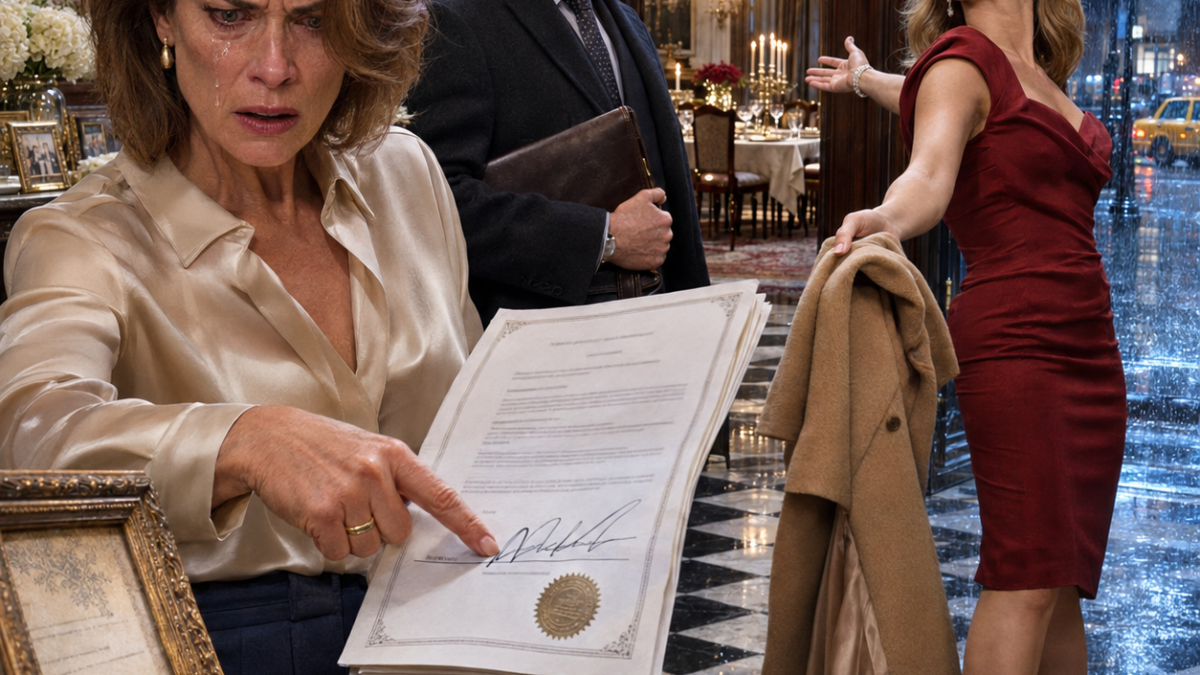
𝗙𝗨𝗟𝗟 𝗦𝗧𝗢𝗥𝗬:“TAKE MY COAT, HOUSEKEEPER—THIS HOUSE BELONGS TO ME NOW!” My Husband’s Mistress Walked Into the Manhattan Townhouse I Had Called Home for 26 Years, Ordered Me to Prepare Dinner, and Bragged About Becoming the Next Mrs. Vale—Then She Showed Me the Agreement Adrian Had Signed, Bearing My Name… A Signature I Had Never Written.
He never mentioned the corporate lunches, private events, or contracts that paid for most of the renovation he later described as “our investment.”
I had stopped correcting him because correcting Adrian always ruined an evening.
Apparently, preserving his comfort had gradually erased me from my own life.
“What name should I put on your place card?” I asked.
Celeste’s smile widened.
“Future Mrs. Vale.”
She lowered her voice conspiratorially.
“That’s what his mother calls me.”
Something inside me went quiet.
Not broken.
Finished.
I walked into the pantry and called my sister.
“Julia?”
“You sound strange.”
“Do you still have the guest room?”
“For you? Always.”
“I may need it tonight.”
Silence.
“What happened?”
“Bring the blue folder from my office. The one marked HOUSE.”
“Meredith—”
“Please.”
“I’m leaving now.”
Next, I called my operations manager.
“Redirect tomorrow’s deliveries to the commercial kitchen. Nobody comes to the townhouse.”
“Everything okay?”
“No.”
Then I returned to the dining room.
At 6:45, Adrian’s mother arrived carrying champagne.
She saw me.
Stopped.
“Meredith.”
“I thought you were away.”
“So did Celeste.”
Her face changed.
Celeste appeared behind her.
“You two know each other?”
My mother-in-law looked at the floor.
That told me enough.
Then Adrian’s car pulled up.
He entered laughing with two couples from his golf club.
The laughter died when he saw me standing beside Celeste’s white coat.
For half a second, my husband looked like a boy who had thrown a baseball through a neighbor’s window.
Then he recovered.
“Meredith.”
His voice hardened.
“Not tonight.”
Celeste looked from him to me.
“Wait.”
Her face drained.
“You’re his wife?”
I laid her coat over the chair.
“Yes.”
Adrian reached toward my elbow.
I stepped away.
“Before anyone sits down, I have one question.”
Nobody moved.
I looked directly at Celeste.
“Who told you that you were getting this house?”
Her confidence faltered.
Then returned.
“Adrian did.”
“He can tell you anything.”
She opened her handbag.
“He put it in writing.”
Adrian went completely still.
Celeste removed a folded agreement.
She opened it on my dining table.
At the bottom appeared my full name.
Meredith Elaine Vale.
Beside it was a signature.
My signature.
Except it wasn’t mine.
FULL STORY CONTINUATION
For several seconds, nobody in that room moved.
I could hear the tiny mechanical ticking of the brass clock above the mantel.
A taxi horn somewhere outside.
The refrigerator compressor turning on in the kitchen.
Ordinary sounds.
That was what made the moment feel unreal.
My entire marriage had just tilted sideways, and the world was continuing to behave as though nothing had happened.
Celeste touched the paper.
“That’s your signature.”
“No.”
She blinked.
“What?”
“That is my name.”
I looked at the looping M.
The long final stroke.
Someone had tried.
They had studied me.
But I had signed thousands of purchase orders, payroll forms, contracts, tax documents, vendor agreements, bank authorizations, and catering proposals over the years.
I knew the shape my own hand made without thinking.
That signature looked like someone performing Meredith Vale.
It wasn’t me.
“I never signed that.”
Celeste stared at Adrian.
He finally spoke.
“Meredith, don’t start.”
I turned toward him.
It was such an Adrian sentence.
Not What agreement?
Not Let me see that.
Not This must be a mistake.
Don’t start.
The phrase he had used for years whenever reality threatened to become inconvenient.
Don’t start at dinner.
Don’t start in front of my mother.
Don’t start before the clients arrive.
Don’t start because you’re tired.
Don’t start because you’re emotional.
Don’t start because I already explained this.
Twenty-six years of marriage and my husband still believed the greatest danger in the room was my reaction to what he had done.
Celeste lifted the document.
“You told me she signed.”
Adrian looked at her.
“Put that away.”
“You told me the house was settled.”
“Celeste.”
“You said the transfer was agreed.”
“I said put it away.”
Something in her face changed.
For the first time since walking through my front door, she looked less like a triumphant mistress and more like a woman who had suddenly realized the floor beneath her might not exist.
I held out my hand.
“May I see it?”
Adrian moved first.
“No.”
Celeste stepped backward.
His face tightened.
“Give me the document.”
She clutched it against her chest.
“No.”
That single word changed the energy in the room.
Adrian was accustomed to both of us orbiting his version of events.
I had done it for years.
Celeste had apparently done it for months.
Now neither of us was cooperating.
My mother-in-law finally spoke.
“Adrian, what is that?”
He snapped:
“Nothing.”
Celeste laughed once.
It was not a happy sound.
“Nothing?”
She looked at his mother.
“Your son took three hundred and twenty thousand dollars from me based on this nothing.”
The room went silent again.
One of the golf couples suddenly found the floor very interesting.
The other woman whispered:
“Adrian…”
I looked at Celeste.
“How much?”
Her eyes shifted to me.
“Three hundred and twenty thousand.”
“For what?”
Adrian stepped between us.
“This is private.”
I almost smiled.
“You brought it into my dining room.”
“Meredith.”
“And apparently into my name.”
I held out my hand again.
“Celeste.”
She hesitated.
Then gave me the agreement.
Adrian swore under his breath.
I ignored him.
The document was six pages.
Not professionally elegant.
But professional enough to fool someone who wanted to believe it.
A heading referred to a future transfer and residential settlement arrangement.
There were clauses discussing Adrian and me living separately.
A supposed acknowledgment that I had agreed to transfer my interest in the townhouse after completion of marital proceedings.
Another clause described a renovation and equity contribution from Celeste.
My stomach tightened.
I kept reading.
Celeste had paid Adrian money.
Not for dinner.
Not jewelry.
Not vacations.
She believed she was purchasing a future financial interest in the home.
My home.
The house I inherited from my parents.
The house Adrian had never owned.
I reached the signature page again.
My name.
His.
Celeste’s.
And below Adrian’s signature, a date from six weeks earlier.
I remembered that date.
I had spent that afternoon at my commercial kitchen because one of our ovens failed before a corporate event.
Adrian texted me at nine that night asking whether I would be home soon.
I had apologized.
Apologized.
To the man who apparently spent part of that day signing a document promising my house to his mistress.
“Where did you sign this?” I asked.
Celeste swallowed.
“A private dining room at the Halston Club.”
“Was I there?”
She looked embarrassed.
“No.”
“Then how did I supposedly sign?”
Adrian interrupted.
“She signed earlier.”
I turned.
“When?”
“Meredith, enough.”
“No.”
My voice remained quiet.
“When did I sign it?”
His jaw worked.
“You signed a stack of documents.”
“What documents?”
“Household planning.”
“Household planning.”
“You never read anything I give you.”
That was almost funny.
Almost.
I ran a company.
I read ingredient contracts down to liability clauses about spoiled cream.
I reviewed delivery agreements.
Insurance.
Commercial leases.
Employment forms.
Adrian had spent years telling people I was whimsical while routinely handing me his own paperwork because he did not have patience for details.
But now I was apparently a woman who signed away an inherited Manhattan townhouse without noticing.
I looked at Celeste.
“Did you ever see me sign anything?”
“No.”
“Did you speak to my lawyer?”
“No.”
“Did you speak to anyone representing me?”
She shook her head.
“Adrian said you wanted discretion.”
I nodded slowly.
“Of course he did.”
The front door opened.
Julia walked in carrying my blue folder.
My sister took one look at the dining room and stopped.
Adrian.
His mother.
Four guests.
Celeste in red.
Me holding a contract.
“Okay.”
She closed the door.
“I brought the folder.”
Adrian’s face changed.
“Julia, this does not concern you.”
She stared at him.
“My sister called me in a voice I have heard exactly twice in my entire life.”
She crossed the room.
“It concerns me now.”
She handed me the folder.
Inside were documents I had not looked at in months.
The deed.
Probate documents from my parents’ estate.
Title records.
Insurance.
Renovation permits.
Copies of the paperwork confirming what I already knew.
The house had come to me through my family.
Adrian’s name was not on the deed.
He had never been added.
Celeste stared.
“What is that?”
“The deed.”
Adrian laughed dismissively.
“You think waving around an old deed changes anything?”
I looked at him.
“No.”
“It confirms something.”
“What?”
“You never had this house to promise.”
His mother sat down.
Slowly.
I watched her face.
That was when another painful realization arrived.
She knew about Celeste.
She had apparently called her future Mrs. Vale.
She knew I had been told to be away.
But maybe she did not know this part.
The forged agreement.
The money.
There are degrees of betrayal.
Learning which degree someone chose does not necessarily comfort you.
Celeste took out her phone.
Her fingers were shaking now.
“I transferred the money.”
Adrian closed his eyes briefly.
“Stop.”
She ignored him.
“Three payments.”
She opened her banking app.
“First one was one hundred twenty thousand.”
Another screen.
“One hundred.”
Then another.
“One hundred.”
She looked up.
“You told me it was being held for renovation and transfer costs.”
Adrian’s voice became cold.
“I told you not to discuss private finances in front of strangers.”
One of his golf friends looked offended.
“Strangers?”
Adrian ignored him.
Celeste stared at my husband as if she had never seen him clearly before.
“Where is my money?”
He said nothing.
“Adrian.”
Nothing.
I recognized the silence.
I had lived with it.
The silence he used when refusing to answer became more powerful than answering.
Eventually the other person filled the space.
Apologized.
Changed the subject.
Became tired.
I wondered if Celeste had been trained the same way.
Apparently she was done too.
“Where is it?”
He finally snapped:
“It was used.”
“For what?”
“Expenses.”
“What expenses?”
“Do not interrogate me.”
She laughed.
“You took three hundred and twenty thousand dollars from me.”
“You gave it voluntarily.”
“Based on a contract.”
“That you signed.”
“With a forged signature on it!”
Adrian looked at me.
“This is exactly what you wanted.”
That sentence was so absurd I genuinely had to pause.
“What?”
“You always wanted to humiliate me.”
Julia made a sound behind me.
I raised one hand slightly.
Not yet.
I wanted to hear him.
Adrian continued.
“You’ve been resentful for years.”
“About what?”
“My career.”
I stared.
He actually believed that.
For years, Adrian worked in private wealth management.
He wore beautiful suits.
Sat on nonprofit boards.
Played golf with people whose names appeared in newspapers.
My work involved delivery vans.
Hot kitchens.
Flour.
Burns.
Payroll.
Servers calling out sick thirty minutes before an event.
He considered his career important because wealthy men knew his name.
He considered mine a hobby because people ate the results.
I said:
“I have never resented your career.”
“You’ve always needed to prove you’re independent.”
“I am independent.”
“There.”
He pointed at me.
“That tone.”
Julia muttered:
“Oh my God.”
I looked back at her.
She pressed her lips together.
Adrian’s mother finally spoke.
“Adrian.”
He turned.
“What?”
She looked older than she had twenty minutes earlier.
“Did you sign Meredith’s name?”
His face changed.
Not much.
Enough.
“No.”
“Did someone else?”
“No.”
“Then how is it there?”
He looked toward Celeste.
“She told me her attorney handled the paperwork.”
Celeste recoiled.
“My attorney?”
Adrian realized his mistake immediately.
She stepped forward.
“You told me your attorney prepared this.”
He said nothing.
She laughed again.
This time tears appeared.
“You said your attorney had spoken with hers.”
I looked down at the pages.
There was no attorney letterhead.
No names.
Nothing.
Just enough language to sound formal.
Enough to convince someone emotionally invested in believing a married man was almost free.
Celeste looked at me.
“I thought you knew.”
I met her eyes.
“You walked into my house and called me the housekeeper.”
Her face turned red.
“I know.”
“You mocked the woman you believed was his wife.”
“I know.”
“You were planning dinner in her house.”
“Yes.”
She swallowed.
“I am not asking you to feel sorry for me.”
“Good.”
“But I did not know that signature was fake.”
I believed her.
Not because she deserved immediate trust.
Because her terror looked real.
And because Adrian had just tried to tell us opposite stories within two minutes.
I photographed every page of the agreement.
Adrian tried to stop me.
Julia stepped between us.
“Don’t touch her.”
“Move.”
“No.”
“This is my home too.”
Julia laughed.
That was the wrong thing for him to say.
She turned toward me.
“Is it?”
I looked at the deed.
Then at Adrian.
“For tonight, we’re not having that argument.”
He stared.
I continued.
“But nobody is taking that agreement anywhere.”
Celeste pulled it back toward herself.
“I’m keeping the original.”
“Good.”
Adrian pointed.
“That document contains confidential information.”
She looked at him.
“So does my banking history.”
His face darkened.
“You are making this worse.”
“For whom?”
No answer.
The dinner never happened.
That seems obvious now.
At the time, nobody knew what to do with the food.
I had prepared pastry.
My staff had delivered several components earlier.
Champagne stood unopened.
Eight chairs around a table intended for two.
One of the golf couples excused themselves first.
The man looked at Adrian.
“I think you need to resolve this privately.”
His wife looked at me.
“Meredith, I’m sorry.”
I did not ask what she was apologizing for.
Knowing?
Not knowing?
Being there?
It did not matter.
They left.
The other couple followed.
Adrian’s mother remained.
So did Celeste.
Julia sat beside me.
Adrian poured himself wine.
That detail still amazes me.
My husband had been confronted with his mistress, his wife, a forged document, and missing money.
He opened wine.
Perhaps routine was the last piece of control he had.
He took one sip.
Then said:
“We’re all emotional.”
Julia actually laughed.
Adrian glared.
She said:
“Sorry. That was extraordinary.”
He ignored her.
“We need to approach this calmly.”
I looked at the glass.
“I’m calm.”
“Yes, Meredith, you’re performing calm.”
There it was again.
Even my composure belonged to him as evidence against me.
If I cried, hysterical.
If I shouted, unstable.
If I remained calm, manipulative.
There was no version of my reaction he could not use.
That realization freed me.
“I’m leaving tonight.”
His expression changed.
“What?”
“I’m staying with Julia.”
His shoulders relaxed slightly.
He misunderstood.
He thought I was surrendering the house.
I continued.
“Tomorrow morning I’m meeting an attorney.”
The relaxation disappeared.
“Don’t be dramatic.”
“Celeste has a document bearing my forged signature.”
“We don’t know that.”
“I do.”
“That is your opinion.”
“No.”
I held up my hands.
“This is my signature.”
I pointed to the page.
“That isn’t.”
Celeste said quietly:
“I’m calling my attorney too.”
Adrian looked between us.
“Wonderful.”
His voice sharpened.
“So now the two of you are allies?”
“No,” I said.
Celeste looked at me.
I continued.
“We are two women who need separate lawyers because we trusted the same man.”
That silenced everyone.
My mother-in-law began crying.
Not loudly.
I had almost forgotten she was there.
“Meredith.”
I looked at her.
“I am sorry.”
“For which part?”
She flinched.
Fair.
She deserved the question.
“I knew about Celeste.”
“Yes.”
“Adrian said the marriage was finished.”
“We ate breakfast together this morning.”
She covered her mouth.
“He said you were waiting until after your anniversary to announce it.”
I stared.
That was such a bizarre detail that I almost admired it.
Adrian had built different calendars for different people.
To his mother, our marriage had a scheduled expiration date.
To me, we were celebrating twenty-six years.
To Celeste, the divorce was practically complete.
To his golf friends, apparently nothing needed explaining until tonight.
“What did you call her?” I asked.
My mother-in-law looked confused.
“What?”
“Future Mrs. Vale.”
Celeste closed her eyes.
My mother-in-law began to cry harder.
“I was trying to support Adrian.”
I thought about all the years I had supported Adrian.
His promotions.
His father’s illness.
His mother’s surgeries.
Corporate dinners.
Board events.
Christmases.
The year his firm nearly collapsed after a partner left.
I had catered their emergency client reception for free.
I had stood beside him.
Supported.
Apparently support, in the Vale family, meant validating whatever Adrian needed to be true.
I said:
“You should go home.”
She looked at me.
“Please.”
“I don’t want to discuss forgiveness tonight.”
She stood.
Picked up her handbag.
Then turned toward her son.
I expected one final maternal defense.
Instead, she said:
“If you signed Meredith’s name, I don’t know you.”
Adrian scoffed.
She left.
Celeste stayed five more minutes.
She put on her coat herself this time.
At the door, she turned to me.
“I’m sorry about what I said when I came in.”
I said nothing.
She nodded.
“I knew he was married.”
That honesty surprised me.
“I told myself it was over because he said it was over.”
She wiped beneath one eye carefully.
“I wanted to believe him.”
I looked at her.
“That doesn’t excuse walking into another woman’s home and laughing at her.”
“No.”
“At least we agree.”
She nodded.
Then:
“If my lawyer needs to contact yours…”
“I’ll have my attorney communicate.”
Her face tightened.
“Okay.”
She opened the door.
I called:
“Celeste.”
She turned.
“Don’t give Adrian the original agreement.”
Her expression changed.
I saw the moment she understood why.
“I won’t.”
Then she left.
Adrian and I were alone for the first time.
Julia stood in the kitchen pretending not to listen.
I removed my apron.
Folded it.
Placed it over the back of a chair.
Adrian watched.
“Are you really doing this?”
I looked at him.
“Doing what?”
“Destroying twenty-six years.”
I almost lost my calm then.
Not because the accusation hurt.
Because of the sheer arrogance required to make it.
I walked closer.
“I did not give your mistress a key.”
He stared.
“I did not tell her I was the housekeeper.”
“Meredith—”
“I did not tell your mother our marriage was over.”
“Lower your voice.”
I hadn’t raised it.
“I did not promise anyone my parents’ house.”
His jaw tightened.
“And I did not sign my name to that agreement.”
He looked away.
I whispered:
“You did this.”
He stared toward the dining room.
“You don’t understand.”
“Then explain.”
Silence.
For the first time, I refused to rescue him from it.
Five seconds.
Ten.
Twenty.
Finally:
“I needed liquidity.”
There it was.
Not an apology.
A business term.
“Three hundred and twenty thousand dollars?”
He rubbed his forehead.
“Things got complicated.”
“What things?”
“My firm.”
“Your firm?”
“Some investments underperformed.”
I stared.
“You took money from Celeste because investments underperformed?”
“I intended to replace it.”
“How?”
He looked at me.
“We were going to restructure.”
The word we chilled me.
“Restructure what?”
He did not answer.
I knew.
The house.
Maybe my business.
Maybe accounts.
I no longer wanted guesses.
“What money is left?”
His silence answered.
“Adrian.”
“Not much.”
“How much?”
“I don’t know exactly.”
“You work in wealth management.”
His face tightened.
“You know exactly.”
“Meredith—”
“How much?”
He whispered:
“About eighteen.”
I stared.
“Eighteen thousand?”
He nodded.
Three hundred and two thousand dollars gone.
Celeste had given him three hundred and twenty.
He had eighteen.
“Where did it go?”
“Debt.”
“What debt?”
“Personal.”
My stomach turned.
“How much?”
“Meredith.”
“How much debt?”
He sat.
And suddenly he looked old.
Not sympathetic.
Just tired.
“More than you know.”
That was probably the first completely true sentence he had spoken all evening.
Julia drove me to her apartment after midnight.
I packed one suitcase.
Business laptop.
Medication.
My mother’s jewelry.
The blue folder.
Nothing else.
Adrian stood in the bedroom doorway.
“You’re making a mistake.”
I zipped the bag.
“No.”
“You think Julia is helping you.”
“She is.”
“You think some attorney is going to tell you exactly what you want to hear.”
“I hope my attorney tells me the truth.”
That hurt him.
Good.
Not because I wanted cruelty.
Because truth should sting after enough lies.
He said:
“You’ll come back when you calm down.”
I looked around the bedroom we had shared for twenty-six years.
My side.
His side.
Wedding photograph.
The chair where he dropped his jackets despite my asking him not to.
The lamp we bought in Paris.
Marriage is not one thing.
That is why betrayal is so disorienting.
A liar can still have made you coffee when you were sick.
A cheater can still have sat beside your mother while she died.
A man can betray you terribly without every prior morning becoming fake.
I hated that complexity.
It would have been easier if Adrian had always been monstrous.
He hadn’t.
That was why I stayed twenty-six years.
I carried the suitcase downstairs.
At the door, Adrian said:
“Meredith.”
I stopped.
He seemed suddenly desperate.
“If you call police, this becomes something we can’t undo.”
I looked at him.
“Funny.”
“What?”
“I was thinking the same thing about the signature.”
Then I left.
Julia’s guest room had yellow curtains.
I had helped choose them twelve years earlier.
I lay awake until almost four.
At 5:15, I finally cried.
Not elegantly.
Not silently.
The kind that makes your ribs hurt.
Julia came in without knocking.
Sat beside me.
Said nothing.
I cried for the anniversary dinner.
For the key.
For Celeste calling me the housekeeper.
For my mother-in-law knowing.
For the forged signature.
For three hundred thousand dollars I did not own but that somehow proved the scale of the lie.
Mostly, I cried because I could suddenly see twenty-six years differently.
Not falsely.
Differently.
How many times had Adrian corrected me in front of people?
How many times had I lowered my voice to preserve his dignity?
How many times had I laughed when he called my company a hobby?
How many accomplishments had I made smaller so he would not feel threatened?
There is a particular grief in discovering that peace in a marriage was partly purchased with your silence.
Julia held my hand.
Eventually I said:
“I feel stupid.”
“No.”
“I let him make me disappear.”
“No.”
“I helped.”
She looked at me.
“You compromised.”
“Too much.”
“Yes.”
I stared.
She continued.
“You want me to lie?”
“No.”
“You gave up too much space.”
I began crying again.
Julia squeezed my hand.
“That doesn’t mean he had permission to steal the rest.”
At nine the next morning, I met attorney Lena Roth.
Julia had used her for a business matter years earlier.
Lena was in her late forties, direct, calm, and entirely unimpressed by Adrian Vale.
I liked her immediately.
I showed her the deed.
Then photographs of Celeste’s agreement.
Lena read every page twice.
“Do you have the original?”
“Celeste does.”
“Good.”
I frowned.
“You trust her?”
“No.”
“Then why good?”
“Because Adrian doesn’t have it.”
Fair.
Lena looked at my deed.
“You inherited the house?”
“Yes.”
“Was Adrian ever added to title?”
“No.”
“Any refinancing with both names?”
“No.”
“Any deed transfers?”
“Not that I signed.”
She nodded.
“We’ll verify independently.”
I appreciated that.
Not you’re safe.
Verify.
Facts.
She continued.
“This agreement does not magically transfer title to Celeste.”
I exhaled.
“But.”
Of course there was a but.
“But a forged document bearing your name is serious.”
“I know.”
“We preserve everything.”
“Texts.”
“Emails.”
“Financial records.”
“Do not destroy anything.”
“Do not secretly access accounts you aren’t authorized to access.”
“Do not threaten Adrian.”
“Do not negotiate with Celeste directly.”
I nodded.
“What about the house?”
“That depends on several facts, including current occupancy and the marital situation.”
She raised one hand before I could ask.
“Don’t change locks today.”
“Don’t remove his property.”
“Don’t create a side dispute while we’re dealing with the real one.”
Realistic.
Annoying.
Correct.
“So what do I do?”
“You document.”
“And?”
“You protect your business.”
That got my attention.
“Why?”
“Because if he’s desperate enough to use a forged document involving your home, I want to know whether he has attempted to represent himself as having authority over anything else.”
My stomach dropped.
My catering company.
That afternoon became an audit of my own life.
Not dramatic.
Computer screens.
Passwords.
Bank authorizations.
Corporate registrations.
Vendor portals.
Insurance.
Payroll access.
My operations manager sat beside me.
“Adrian doesn’t have signing authority.”
“Check.”
“He has never had admin access.”
“Check anyway.”
We changed passwords.
Updated recovery contacts.
Reviewed bank records.
Adrian had no formal authority.
Relief.
Then my bookkeeper found something.
Three months earlier, Adrian had emailed one of our restaurant clients from his personal account.
He introduced himself as “Meredith’s financial adviser” and offered to discuss expanding payment terms.
The restaurant ignored him and forwarded it to my operations manager.
She had assumed I knew.
I hadn’t.
I stared at the email.
Meredith tends to focus on creative operations. I handle the financial side.
Creative operations.
I ran the financial side.
He had never seen our monthly cost sheets.
I printed the email.
Added it to Lena’s folder.
One more tiny theft of identity.
Celeste’s attorney contacted Lena the following day.
Celeste had bank records.
Texts.
Emails.
And the original agreement.
More importantly, she had messages from Adrian.
I did not see all of them immediately.
Lena summarized only what mattered.
Adrian had repeatedly represented that I knew about the arrangement.
He told Celeste I was already living elsewhere part-time.
False.
He told her I had agreed to transfer the townhouse as part of a private settlement.
False.
He told her my catering business was failing and I wanted cash quickly.
False.
And in one message, when Celeste asked why my attorney had not contacted her, Adrian replied:
Meredith doesn’t like lawyers involved because she doesn’t want her business finances examined.
That one actually made me laugh.
My company was audited annually.
Adrian knew.
He simply needed Celeste not to contact anyone who would expose the lie.
Lena looked at me.
“You okay?”
“Yes.”
“You’re laughing.”
“I know.”
“Why?”
“Because he always said I was too obsessed with paperwork.”
Lena almost smiled.
“Paperwork may become your friend.”
We filed a police report concerning the suspected forgery.
I hated doing it.
Not because Adrian deserved protection.
Because reporting your husband feels different from hiring a divorce lawyer.
A divorce says:
Our marriage failed.
A police report says:
I believe you may have committed a crime against me.
I sat in the station staring at the form.
Lena had offered to accompany me.
I wanted Julia instead.
The officer took the facts.
No theatrics.
No immediate handcuffs.
No detective bursting out of a back room.
Evidence would be reviewed.
The document examined.
Financial records obtained through proper channels if appropriate.
That realism almost disappointed the angry part of me.
I wanted consequences to arrive as quickly as betrayal had.
They don’t.
Consequences need evidence.
So we gave them evidence.
Adrian called me seventeen times over the next three days.
I did not answer.
Then came emails.
We need to talk like adults.
Celeste is manipulating you.
Your sister has always hated me.
You are destroying my reputation over a misunderstanding.
Then:
I made mistakes, but twenty-six years should count for something.
That one sat with me.
Twenty-six years did count.
That was why it hurt.
But longevity is not immunity.
A long marriage does not create a discount on betrayal.
I forwarded everything to Lena.
No response.
My mother-in-law called once.
I answered.
“Meredith.”
“Yes.”
“I need to tell you something.”
I sat.
She sounded exhausted.
“I met Celeste four times.”
Four.
“Okay.”
“Adrian told me you were separated.”
“Yes.”
“He said you were keeping up appearances because of clients.”
I closed my eyes.
“Did you ask me?”
Silence.
“No.”
“Why?”
“I believed my son.”
Fair answer.
Painful.
She continued.
“He told me you had become cold.”
I laughed softly.
“Cold.”
“He said you barely spoke.”
I thought of all the evenings I stopped speaking because Adrian corrected every sentence.
“He said you cared more about the business.”
The business that paid my staff.
Supported restaurants.
Gave me a life outside his shadow.
“What did you tell Celeste about me?”
My mother-in-law started crying.
“That you were difficult.”
I swallowed.
“And?”
“That Adrian deserved someone who admired him.”
That one hurt.
I had admired Adrian once.
Deeply.
Then admiration became a duty I was expected to perform regardless of his behavior.
“Did you call her future Mrs. Vale?”
“Yes.”
I said nothing.
“I am ashamed.”
I believed that too.
“What do you want me to say?”
“Nothing.”
“Then why are you calling?”
“Because I need you to know I did not know about the house.”
I closed my eyes.
There it was.
The boundary of her guilt.
She needed me to know which betrayal belonged to her and which did not.
“I believe you.”
She exhaled.
“Thank you.”
“That doesn’t mean I’m okay with what you did.”
“I know.”
“Do you?”
“Yes.”
She cried harder.
I did not comfort her.
That was new for me.
For twenty-six years, I comforted everyone.
Adrian.
His mother.
His father.
Clients.
Staff.
Family.
That afternoon, I let another adult sit inside the feeling she had created.
It was not cruelty.
It was boundaries.
Celeste and I did not meet again for almost three weeks.
Our attorneys arranged it.
Not because either lawyer wanted us becoming friends.
Because there were factual questions.
The meeting took place in Lena’s conference room.
Celeste arrived without red.
Gray pants.
Black sweater.
No diamonds.
She looked younger.
Or maybe simply less armored.
Her attorney sat beside her.
She placed the original agreement on the table inside a protective sleeve.
I stared at my fake signature.
Again.
Lena asked:
“Ms. March, when did Mr. Vale first tell you he intended to transfer the property?”
Celeste answered.
“About five months ago.”
“When did you first pay money?”
“Four months ago.”
My stomach tightened.
Before he told his mother our marriage was over.
Before the agreement date.
This had been developing for months.
Celeste continued.
“He said Meredith was asking for a large cash settlement but wanted the house transferred quietly.”
I looked at her.
“Why would I want that?”
She swallowed.
“I didn’t think hard enough.”
At least she knew.
“He said you hated the house.”
I almost laughed.
My father’s mirror was still hanging in the hallway.
My mother’s magnolia was outside the window.
I had personally chosen every cabinet during restoration.
“I didn’t hate it.”
“I understand that now.”
Her attorney asked:
“What did the money represent?”
Celeste looked embarrassed.
“Part renovation contribution.”
“Part proof of liquidity.”
“And…”
She stopped.
Her attorney prompted gently.
“Go ahead.”
“Adrian said if I contributed cash before the divorce announcement, he could move quickly once Meredith signed.”
I looked at her.
“You were buying your way into my home before you believed I had moved out.”
Her face reddened.
“Yes.”
It mattered that she did not hide behind Adrian for that.
She was deceived.
She was also morally responsible for her own choices.
Both could be true.
I asked:
“Did you ever wonder why a fifty-three-year-old woman would quietly give up the house she inherited from her parents so her husband could move his girlfriend in?”
Celeste looked at me.
“Yes.”
“When?”
“After I met you.”
That answer was better than an excuse.
She gave us copies of messages.
One froze me.
Celeste had written:
Are you sure Meredith won’t fight over the house?
Adrian replied:
She doesn’t fight. She folds. Give her enough silence and she’ll sign anything to make the tension stop.
I read it twice.
Then a third time.
My hands became cold.
Lena touched the page.
“Meredith?”
“I’m fine.”
I wasn’t.
Because that message revealed something worse than infidelity.
He knew.
He knew exactly what silence did to me.
All those years when he withdrew.
Days without speaking.
Meals eaten in tension.
Doors closed quietly.
He knew I would eventually apologize just to restore peace.
He didn’t merely happen to communicate that way.
He understood its effect.
And he had described it to another woman as strategy.
That line ended my marriage more completely than Celeste ever could.
I asked for a break.
Went to the restroom.
Locked the door.
Looked at myself.
Fifty-three.
Fine lines around my eyes.
Flour still sometimes lived beneath my fingernails no matter how well I scrubbed.
My father used to tell me I had my mother’s stubborn mouth.
Adrian had spent years calling that stubbornness “drama” until I stopped using it.
I stared into the mirror.
Then whispered:
“He knew.”
My reflection did not answer.
“He knew.”
That was what I cried about.
Not Celeste.
Not the sex.
Not even the house.
The deliberate use of my desire for peace against me.
I cried quietly for five minutes.
Washed my face.
Returned.
Sat.
“Continue.”
Lena looked at me.
“Are you sure?”
“Yes.”
For once, yes meant yes.
The financial records took longer.
Adrian resisted.
His lawyer argued.
Requests went back and forth.
Eventually, enough information emerged to show why the three hundred and twenty thousand dollars had disappeared.
No secret island account.
No second mansion.
Nothing glamorous.
Debt.
Credit cards.
Personal loans.
Payments tied to poor investments.
Expensive hotels.
Travel.
Jewelry.
Restaurants.
Membership dues.
A tax obligation.
And transfers between accounts that suggested he had been plugging financial holes for months.
Adrian, who had lectured me for years about financial discipline, had built a private life on borrowed money and confidence.
The irony brought no pleasure.
Celeste’s money had not funded a future.
It had funded Adrian’s past.
We also discovered he had taken more from our marriage than I knew.
Not everything illegally.
Some spending had occurred through accounts he had authority to use.
That distinction mattered legally.
Emotionally, it still hurt.
He had spent marital money on hotels with Celeste.
Gifts.
Travel.
Then lied about business meetings.
My attorney documented it for the financial negotiations.
No dramatic courtroom gasp.
Numbers.
Statements.
Dates.
Receipts.
Betrayal translated into spreadsheets.
Perhaps that is how adult consequences usually arrive.
Not thunder.
Columns.
My catering company became my safest place.
That surprised me.
I expected humiliation.
People knew.
Staff always know eventually.
My operations manager, Dana, came into my office one morning.
“We don’t have to talk about it.”
“Good.”
She set down a coffee.
“But we do need your approval on the Lexington menu.”
I almost kissed her.
Work did not ask whether I felt abandoned.
It asked whether the pistachio crust should stay.
Something normal.
I opened the menu.
“Keep it.”
Dana nodded.
“Good.”
Then she turned.
“Also, your husband is an idiot.”
“Dana.”
“I said we didn’t have to talk.”
She left.
I laughed for the first time in days.
My company became more visible too.
Not because I suddenly got revenge-success.
It had already been successful.
I was the one who had hidden it to make Adrian comfortable.
A restaurant client asked me to speak at a hospitality panel.
Normally I would have said no.
Adrian hated when I scheduled weekend events because he said they made us look “chaotic.”
I said yes.
I stood in front of eighty people and talked about commercial-kitchen margins.
Staff retention.
Supply disruptions.
Scaling without damaging quality.
Nobody called it a hobby.
Afterward, a young woman approached.
“I’ve followed your company for years.”
I almost asked:
Really?
Then stopped myself.
Of course.
My work had existed even when my husband refused to describe it accurately.
That became a recurring realization.
Things do not become real when the person diminishing them finally acknowledges them.
Adrian moved out of the townhouse under an interim agreement worked out through counsel.
It was not dramatic.
No suitcases thrown onto the sidewalk.
No locksmith in the night.
Dates.
Inventory.
Arrangements.
He collected clothing.
Books.
Golf equipment.
His father’s desk.
I was present with Julia.
When he reached the hallway mirror, he stopped.
My father’s mirror.
For years, Adrian had loved telling guests it was an antique commissioned for us.
He never mentioned my father carved it.
“Are you keeping that?”
I stared.
“Yes.”
“It was a wedding gift.”
“From my father.”
“To both of us.”
I stepped closer.
“My father made it.”
Adrian looked at me.
There were dozens of legal arguments he could have chosen.
Instead, he dropped his eyes.
“Fine.”
He walked away.
Victory did not feel like winning.
It felt like protecting one object from a life that had already taken enough.
Before leaving, Adrian stood in the dining room.
The same room.
No Celeste.
No guests.
Table empty.
“Are you really divorcing me?”
I almost laughed.
The question was so late.
“Yes.”
He sat.
“Twenty-six years.”
“I know.”
“You don’t feel anything?”
I looked at him.
“That is the cruelest part.”
“What?”
“I feel everything.”
He stared.
I continued.
“I remember our first apartment.”
“The year your father was sick.”
“The trip to Maine.”
“You holding my hand when Mom died.”
“Every Christmas.”
“Every terrible fight.”
“Every good morning.”
I swallowed.
“I love parts of who you were to me.”
His eyes filled.
“Then why—”
“Because love is not permission.”
He looked down.
“I made a mistake.”
I shook my head.
“You had an affair.”
“That’s a betrayal.”
“You lied to your mother.”
“Another.”
“You told Celeste I was practically divorced.”
“Another.”
“You took her money.”
“Another.”
“You promised her my home.”
“Another.”
“You used my signature.”
His face changed.
“Do not reduce this to one mistake because the word is easier to forgive.”
He cried then.
I had seen Adrian cry maybe six times in twenty-six years.
Part of me wanted to sit beside him.
Touch his shoulder.
Comfort him.
My body almost moved before my mind stopped it.
Habit.
I stayed where I was.
He needed to learn to carry his own pain.
So did I.
The forensic examination of the agreement took time.
I was asked for genuine signature samples.
Dozens.
Business documents.
Tax forms.
Old deeds.
Checks.
Cards.
The expert did not make theatrical declarations in front of us.
A report came later.
There were significant inconsistencies between the questioned signature and my known writing.
That did not single-handedly resolve everything.
But it became evidence.
Alongside messages.
Financial transfers.
Adrian’s contradictory explanations.
The investigation continued.
Eventually, prosecutors pursued fraud-related allegations connected to Celeste’s money and the false paperwork.
I will not pretend I understood every procedural detail.
I had lawyers for that.
Nor did I sit in court every day praying for the maximum possible punishment.
By then, I wanted distance more than spectacle.
Adrian ultimately accepted a negotiated resolution that included financial consequences and restitution obligations.
The money did not magically reappear.
That mattered.
Celeste recovered only part through available assets and later payments.
Real harm is not always reversible.
A judgment does not recreate cash that has already been spent.
She learned that painfully.
So did Adrian.
Our divorce took almost a year.
People expected me to be furious about the time.
I wasn’t.
After twenty-six years, another several months spent doing things properly did not frighten me.
Assets were valued.
Accounts reviewed.
House records confirmed.
Business interests documented.
Spending examined.
Agreements negotiated.
My catering company remained mine under the final arrangement.
The townhouse remained with me.
Not because a judge dramatically awarded it as revenge.
Because ownership documents, inheritance history, and the eventual settlement supported that outcome.
Adrian retained assets that were properly his.
Shared property was divided through the process.
Boring.
Fairer than drama.
I appreciated boring.
Celeste testified in the criminal matter when needed.
We never became friends.
That would have been too neat.
People love stories where wife and mistress link arms and destroy the cheating husband.
Real life was messier.
Celeste had knowingly participated in an affair.
She had walked into my home believing I had been conveniently erased.
She had insulted me without knowing my name.
I did not forget those choices.
But she had also been defrauded.
Adrian lied to her about the property.
The signature.
My knowledge.
The status of our marriage.
She deserved truth too.
Months later, she sent one letter.
No excuse.
No request for friendship.
It ended:
I am sorry I was willing to believe a story in which you had to become small so I could have the life he promised me.
I read that line several times.
Then put the letter away.
I did not respond for a week.
Eventually I wrote:
Thank you for saying that. I hope we both choose better stories from now on.
That was all.
Enough.
My mother-in-law took longer.
She asked to meet six months after Adrian moved out.
I chose a café.
Neutral ground.
She looked smaller.
Grief does that.
Not only death.
The collapse of who you believed your child was can age someone.
She said:
“I failed you.”
I looked at my tea.
“Yes.”
Her eyes filled.
I appreciated that she did not ask me to soften it.
“I believed him because he was my son.”
“I understand.”
“I wanted to believe he was unhappy rather than dishonest.”
I looked at her.
“That cost me.”
“I know.”
“You did not call me.”
“No.”
“You sat with another woman and discussed becoming your daughter-in-law while I was still making your birthday dinners.”
She cried.
“Yes.”
I let the silence remain.
Then she said:
“I am not asking you to forgive me.”
That helped more than asking would have.
“I don’t know what forgiveness looks like yet.”
She nodded.
“Can I apologize anyway?”
“Yes.”
She did.
Not beautifully.
No perfect speech.
Specific things.
She apologized for calling Celeste future Mrs. Vale.
For assuming Adrian’s version was enough.
For treating my silence as evidence that I did not care about the marriage.
For never asking what I needed.
I listened.
When she finished, I said:
“Thank you.”
We did not hug.
Months later, we exchanged Christmas cards.
That was our relationship now.
Smaller.
More honest.
Sometimes repair does not restore the old structure.
It builds something modest from what remains.
The townhouse changed after Adrian left.
At first, silence everywhere.
His shoes gone.
No shaving things in the bathroom.
No golf bag by the back staircase.
No voice asking what dinner was while ignoring that I had just returned from twelve hours at work.
I expected loneliness.
Sometimes it came.
But something else came too.
Space.
I moved my catering paperwork from the tiny upstairs study into the larger room Adrian had called his library.
My father had built shelves there.
For years, Adrian filled them with books chosen partly because they looked impressive behind him during video calls.
I packed the books he wanted.
Then placed my business records there.
Menus.
Photographs.
Client notes.
Awards I had kept boxed because Adrian said displaying them looked “commercial.”
One afternoon, Julia came in.
Stopped.
“What?”
She pointed.
“You hung the hospitality award.”
I looked at it.
“Yes.”
“You’ve had that for seven years.”
“I know.”
“Why now?”
I considered.
“Because apparently walls survive pride.”
She laughed.
I repainted the dining room.
Not because Adrian chose the color.
Because Celeste’s first photographs had captured it.
For months, every time I entered, I heard:
You’ll need to redo that.
So I did.
Deep green.
Warmer.
Darker.
Mine.
I kept the table.
Obviously.
Furniture was not guilty.
I kept my father’s mirror.
I kept the magnolia.
I kept memories too.
Some.
You do not have to burn a life to leave a marriage.
You can sort.
Keep what was true.
Discard what was harmful.
Accept that some objects contain both.
On the first anniversary after Adrian left, I forgot the date until noon.
That surprised me.
For twenty-six years, the date structured February.
Reservation.
Gift.
Card.
Flowers.
Then one year, I was at the commercial kitchen arguing about butter prices when Dana said:
“Are you okay today?”
“Why?”
She looked uncomfortable.
I realized.
“Oh.”
I waited for grief.
It came.
Small.
Manageable.
I went home that night.
Set one place at the dining table.
Made pasta.
Opened the good Bordeaux.
Not as a statement.
Because I liked it.
That was another thing I had forgotten.
Sometimes living for yourself is less dramatic than people imagine.
It looks like pouring the wine you once saved for someone else’s approval.
My business grew gradually.
Not explosively.
I did not become a celebrity chef because my husband cheated.
Pain is not a business strategy.
We added two restaurant clients.
Lost one.
Hired three people.
Replaced an aging van.
Negotiated a new commercial-kitchen lease.
Normal business.
What changed was the way I spoke about it.
Someone at a party asked:
“What do you do?”
For years, I said:
“I have a little catering business.”
Little.
Adrian’s adjective.
That evening I said:
“I own a catering company that supplies restaurants and private clients.”
The person asked questions.
I answered without apologizing.
That tiny moment felt enormous.
I also stopped calling myself lucky that Adrian had “supported” me.
We supported each other financially in different ways over twenty-six years.
My business income had paid household expenses.
Renovations.
Travel.
His parents’ anniversary celebration.
Emergency repairs.
Taxes.
I had documentation.
But more than money, I had supported his life with labor nobody invoiced.
Schedules.
Meals.
Family obligations.
Emotional repair.
That did not mean he owed me endless gratitude.
Marriage is not a ledger.
But it did mean his old story—successful husband carrying hobbyist wife—was false.
And I no longer participated in it.
The blue house folder stayed in my office.
I added the forged agreement copy.
Not because I enjoyed seeing it.
Because documents matter.
My father used to say:
“People remember what helps them. Paper remembers what happened.”
He was talking about construction invoices.
Turns out the lesson travels.
One afternoon, years later—no, not years, about eighteen months after the divorce—I found myself looking at the fake signature again.
The imitation.
The almost-Meredith.
It bothered me less.
I realized why.
For years, Adrian had been forging me in other ways.
Not my handwriting.
My identity.
He told people I did not work seriously.
That I disliked money.
That I was fragile.
Difficult.
Cold.
Unambitious.
Dependent.
Each description was a small false signature at the bottom of my life.
And I let some stand uncorrected.
The forged agreement was simply the first one obvious enough that I could no longer ignore the pattern.
That realization changed something.
I stopped asking why I had not seen the affair sooner.
The larger betrayal had been visible for years.
I had seen it.
I simply kept calling it compromise.
Therapy helped.
I resisted initially.
At fifty-three, I thought I understood myself.
Apparently not.
My therapist asked me one afternoon:
“Why did you stop correcting Adrian?”
“To avoid fights.”
“And what did avoiding fights cost?”
I hated that question.
“Peace.”
She waited.
I sighed.
“No.”
“What did it cost?”
“My voice.”
There it was.
I cried.
Again.
I had become excellent at crying by fifty-four.
Unexpected skill.
She asked:
“What do you want from future relationships?”
I laughed.
“Future relationships?”
“Eventually.”
“I want to be alone.”
“Fine.”
“What do you want from the relationships you already have?”
That I could answer.
“Reciprocity.”
“Explain.”
“I don’t want to be the one who always makes things comfortable.”
That became a rule.
Not rigid.
Not selfish.
Just noticeable.
If a friendship existed only because I accommodated everything, I stepped back.
If family expected me to fix discomfort I did not create, I let discomfort exist.
The world did not collapse.
Amazing.
Julia loved the new version of me.
Mostly.
When I told her no to hosting Thanksgiving because of a major catering weekend, she said:
“I liked empowered Meredith until it affected dinner.”
I laughed.
“Your house.”
She groaned.
We ordered catering.
From my company.
Full price.
She complained.
I charged her anyway.
Healing.
Adrian and I communicated only when necessary.
Mostly through attorneys at first.
Later through email about residual financial matters.
His tone changed over time.
Angry.
Then accusing.
Then pleading.
Then almost normal.
The final message that mattered came more than a year after that dinner.
I understand now that I spent a long time needing you to be smaller so I could feel bigger. I don’t expect an answer.
I stared at it.
That was the apology I had wanted.
Or close.
And it changed almost nothing.
That surprised me.
We imagine apologies as keys.
Sometimes they arrive after you have built another door.
I replied only:
I hope understanding that changes how you live.
Then I closed the email.
Adrian never moved into my house with Celeste.
Obviously.
He never became the man he promised her either.
Their relationship ended almost immediately after the dinner.
Not because she suddenly developed perfect ethics.
Trust collapsed.
You cannot easily build a future with someone after learning the paperwork describing that future is fabricated.
Celeste eventually moved on.
I heard through lawyers that she took a job in Boston.
I wished her well privately.
Not warmly.
Not bitterly.
Simply enough.
My father’s magnolia bloomed heavily the spring after the divorce.
More flowers than usual.
Julia called it symbolic.
I told her trees do not care about marital status.
She said I had become intolerable.
Maybe.
I stood beneath the branches anyway.
My mother planted herbs nearby when I was a child.
My father restored the back wall.
The house had contained a life before Adrian.
Then a life with Adrian.
Now one after.
Buildings survive stories.
That comforted me.
I hosted dinner again.
Eventually.
Eight people.
That number initially made me laugh.
Julia.
Dana.
Two restaurant clients who became friends.
A neighbor.
My cousin.
And two women from the hospitality panel.
No place cards.
No performance.
We cooked together.
Someone spilled wine.
Nobody cared.
At seven-thirty, I realized we were sitting at the same table where Celeste had placed the forged agreement.
I looked around.
Laughter.
Food.
Green walls.
My father’s mirror reflecting everyone.
The memory did not hurt.
Not much.
That was healing too.
A room can belong to a new night.
After everyone left, Julia helped carry glasses to the kitchen.
She leaned against the counter.
“You okay?”
“Yes.”
“You sure?”
I looked toward the dining room.
“Yes.”
She smiled.
“Good.”
Then:
“By the way, your pastry was dry.”
I threw a towel at her.
Sisters keep you humble.
Later that night, I found Celeste’s old white coat in my memory.
The physical coat had left with her.
But I remembered the weight when she dropped it into my arms.
The casual assumption.
Take this.
Serve me.
Disappear.
At the time, I thought the humiliating part was that she mistook me for hired help.
Years later, I understood something.
There is nothing humiliating about being a housekeeper.
The insult was not the work.
The insult was the assumption that whoever appeared to be serving did not matter enough to know.
Celeste looked through me because Adrian had taught her I was irrelevant.
Adrian looked through me long before that.
Eventually, I had learned to look through myself.
That was the part I had to undo.
I no longer wear that dark apron at home.
Not because of Celeste.
Because it belongs at the commercial kitchen.
I bought another.
Bright red.
The color Adrian once said was too loud for a woman my age.
The first time I wore it, Julia noticed.
“Subtle.”
“I like red.”
“Since when?”
I thought about it.
“Maybe always.”
That made us both quiet.
How many preferences do we lose because someone repeatedly tells us they do not suit us?
Red was small.
Still.
I kept the apron.
My fifty-fifth birthday dinner was at the townhouse.
No Adrian.
No mother-in-law.
No Celeste.
Julia gave me a red dress.
I laughed so hard I cried.
Then wore it.
Not revenge.
Not a message.
Adrian never saw it.
That was the point.
If your freedom still needs your ex to witness it, he remains involved.
I wore red because I liked red.
Simpler.
Better.
The criminal case eventually closed.
The divorce paperwork became final.
The last financial transfer happened.
Lena sent me an email.
This concludes our representation on the remaining settlement matter.
I stared.
Concludes.
Twenty-six years had been translated into a final administrative sentence.
I called her.
“Is that really it?”
“Yes.”
“No more documents?”
“I sincerely hope not.”
I laughed.
“Thank you.”
“You did the hard part.”
“No.”
I looked at the blue folder.
“I did the paperwork.”
Lena smiled through the phone.
“Sometimes that is the hard part.”
I put the final divorce decree into the folder.
Then hesitated.
The blue folder had originally been marked HOUSE.
It now contained the deed.
Inheritance documents.
Forgery evidence.
Divorce records.
I peeled the old label off.
For a moment, I considered writing:
MINE.
Too dramatic.
Instead, I wrote:
HOME.
That felt right.
Home is different from ownership.
Ownership is paper.
Home is memory.
Safety.
The right to exist in a room without performing a smaller version of yourself.
For twenty-six years, I owned that house.
For some of those years, I had gradually stopped inhabiting myself inside it.
After Adrian left, I had to learn home again.
The strangest part is that I do not hate him.
People are disappointed when I say that.
They want cleaner endings.
Hate feels satisfying in stories.
Real life made me tired.
Adrian hurt me.
Deeply.
He lied.
Cheated.
Tried to use my name in an agreement I did not authorize.
Took money from another woman under false pretenses.
Manipulated his mother.
Manipulated me.
None of that requires hatred to remain true.
I simply no longer organize my life around him.
Indifference is quieter than revenge.
It is also far more complete.
I sometimes remember our first year married.
Adrian was thirty.
I was twenty-seven.
He burned toast constantly.
I worked too much.
We had barely enough money for the neighborhood we wanted.
My parents still lived in the townhouse then.
When Dad died years later and Mom followed, the house came to me.
Adrian cried with me.
That grief was real.
I refuse to rewrite it.
The man who held me after my father died later tried to promise my father’s house to someone else.
Both happened.
Human beings can contain terrible contradictions.
Understanding that helps me trust my own memory.
I was not stupid for loving the man he had sometimes been.
I simply stayed too long after he stopped treating me like someone he loved.
Different.
The forged signature taught me another lesson.
Identity cannot be delegated.
For years, I allowed Adrian to introduce me.
Explain me.
Describe my work.
Translate my moods to other people.
He became an unofficial narrator.
Bad idea.
Now, when someone asks about me, I answer.
I own a catering company.
I inherited my home from my parents.
I like red.
I work too much.
I make excellent pastry except when Julia is being cruel.
I am fifty-five.
Divorced.
Happy more often than not.
No translator required.
One afternoon, a new client visited the townhouse for a private tasting.
She looked around.
“This place is beautiful.”
“Thank you.”
“Your husband must love entertaining here.”
Old instinct rose.
Correct gently.
Preserve comfort.
Then I smiled.
“I’m divorced.”
She looked embarrassed.
“I’m sorry.”
“Don’t be.”
I pointed toward the dining room.
“The house and I are doing very well.”
She laughed.
So did I.
No tension.
No apology.
That was the life I wanted.
Years from now, maybe the story will become simpler in memory.
My husband’s mistress mistook me for the housekeeper.
Forged signature.
Missing money.
Divorce.
It makes a good dramatic summary.
But the actual lesson was quieter.
The most dangerous lie in my marriage was not the agreement.
It was the story that I was small.
Adrian told it.
His mother repeated pieces.
Celeste believed it.
And eventually, I cooperated by lowering my voice.
That forged signature shocked me because it was visible.
But I had been watching him forge a version of me socially for years.
A dependent wife.
A hobbyist.
A woman too emotional for financial discussions.
A person who would fold to end tension.
He wrote that character slowly.
I finally stopped playing her.
The night Celeste walked into my house, she thought she was meeting the help.
In a strange way, she was.
She met the version of me who had spent decades helping everyone else preserve their preferred story.
I carried her coat.
I listened.
I did not correct her immediately.
Old Meredith.
But then I asked questions.
Who told you the house was yours?
Show me the agreement.
Where is the money?
Those questions opened everything.
Sometimes your life does not change when you finally find an answer.
It changes when you stop being afraid to ask the question.
I still have my father’s hallway mirror.
Of course.
The carved frame has small imperfections.
He made it by hand.
One corner is slightly uneven.
Adrian once suggested replacing it with something more modern.
I refused.
Good decision.
Every morning when I walk past it, I see myself.
Not always glamorous.
Sometimes hair a mess.
Sometimes apron.
Sometimes tired.
Sometimes red lipstick.
But me.
No one else’s description.
On the second anniversary of the night everything happened, Julia came over.
She brought champagne.
Same brand my mother-in-law carried that evening.
I stared at the bottle.
“You’re sick.”
“I thought it was funny.”
“It is.”
We opened it.
Sat at the dining table.
Julia raised her glass.
“To the housekeeper.”
I laughed.
“No.”
“To the future Mrs. Vale?”
“Absolutely not.”
She thought.
“To Meredith.”
That caught me.
Simple.
“To Meredith.”
We drank.
Later, Julia went home.
I stood alone in the dining room.
Two years earlier, that room held Adrian.
Celeste.
His mother.
Four confused guests.
A false signature.
A marriage collapsing.
Now the table was empty.
Clean.
Quiet.
I touched the back of the chair where Celeste had dropped her coat.
I remembered the opening sentence.
Take my coat, and try not to burn dinner. Adrian says the last woman was useless.
I smiled.
Not because it was funny.
Because I finally understood something she never could have known.
There had never been a “last woman.”
There was only me.
The woman Adrian had spent years describing inaccurately until even his mistress walked into my home expecting somebody else.
He told Celeste I was gone.
Told his mother I was cold.
Told clients my business was a hobby.
Told himself I would fold.
Then wrote my name on a document as if one more false version of Meredith Vale would be enough.
It wasn’t.
I did not need to throw anyone out dramatically.
Did not need to destroy Adrian’s career with a phone call.
Did not need Celeste to become my best friend.
Did not need my mother-in-law begging on the front steps.
Did not need a judge announcing that I had won.
I needed facts.
A deed.
A bank record.
A signature sample.
A sister carrying a blue folder.
A lawyer willing to say, Document everything.
And eventually, I needed myself.
The version who finally stopped sacrificing truth to keep dinner pleasant.
Adrian once wrote to Celeste:
She doesn’t fight. She folds.
He was right about one thing.
For years, I did.
I folded my opinions.
My success.
My anger.
My needs.
My work.
My voice.
Everything into smaller and smaller shapes until it fit comfortably beside him.
But paper has another property.
Fold it enough times and eventually it becomes too thick to bend again.
That was me at fifty-three.
Not suddenly fearless.
Just finally out of room to fold.
The house still belongs to me.
But that isn’t the ending.
My business still exists.
Not the ending either.
Adrian faced consequences.
Celeste lost money.
The forged agreement became evidence.
Still not the ending.
The ending came much later on an ordinary Tuesday morning.
I was in the kitchen.
Flour on my apron.
Sunlight through the window.
The magnolia outside.
My phone rang.
A restaurant client needed an emergency dessert order for forty people.
I said yes.
Then carried coffee into the hallway.
I passed my father’s mirror.
Stopped.
Looked at myself.
Red apron.
Hair tied badly.
Fifty-five years old.
Alone in the house.
Not lonely.
And I realized I had gone nearly an entire week without thinking about Adrian.
That was the moment.
No courtroom.
No confrontation.
No applause.
Just absence.
He had finally become smaller than my life.
So when people ask me when my marriage actually ended, I don’t say the day the divorce was signed.
I don’t say the night I discovered the affair.
I don’t even say the moment I saw my forged signature.
It ended when I read Adrian’s message to Celeste:
She doesn’t fight. She folds.
Because in that sentence, I finally saw the entire marriage from outside it.
He knew exactly how much of myself I had been surrendering to preserve peace.
And he had mistaken gentleness for permanent permission.
He was wrong.
That evening, another woman walked into my home and handed me her coat.
She thought I was the housekeeper.
I carried it for her.
Listened while she ordered my dinner.
Watched her admire my rooms.
Heard her call herself future Mrs. Vale.
And let her speak long enough to expose the lie my husband believed he could manage forever.
Then she placed a piece of paper on my table.
My name.
Someone else’s handwriting pretending to be mine.
For years, Adrian had been telling the world who Meredith Vale was.
That night, for the first time in a very long time, I answered for myself.
“No.”
“That is my name.”
“But that is not my signature.”
And from that moment forward, neither Adrian nor anyone else ever got to sign my life for me again.








