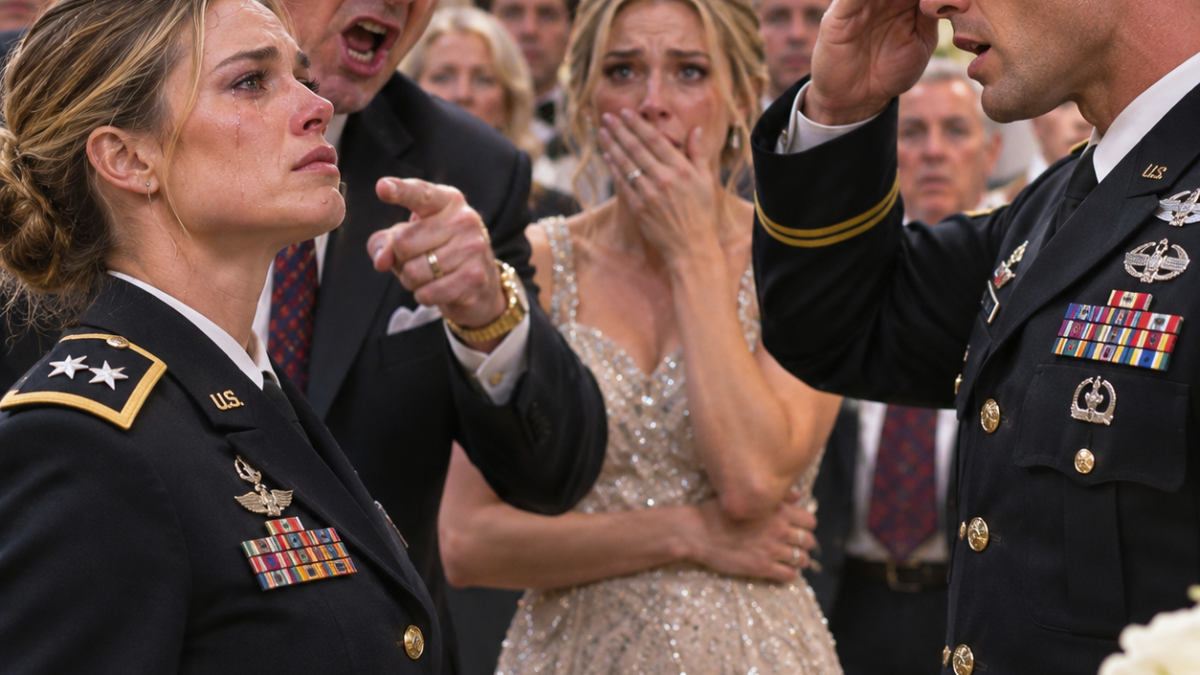
𝗙𝗨𝗟𝗟 𝗦𝗧𝗢𝗥𝗬:“SHE’S THE DAUGHTER WHO NEVER MADE US PROUD!” My Father Humiliated Me at My Sister’s Engagement—Until Her Special Forces Fiancé Saw My Two Silver Stars and Immediately Saluted…
𝗙𝗨𝗟𝗟 𝗦𝗧𝗢𝗥𝗬
Then he asked the question that changed the evening.
“General, does your family know you were the commander responsible for bringing my team home?”
A faint gasp moved through the crowd.
My sister’s champagne glass stopped halfway to her lips.
My father stared at Knox.
“What on earth are you talking about?”
But I wasn’t looking at Roderick.
I was looking at the man who would soon marry my sister.
I hadn’t recognized Knox immediately.
I’d reviewed hundreds of names across commands and operations.
But now I remembered a briefing.
A difficult deployment.
A Special Forces unit whose safe return had depended on disciplined coordination between people working far apart.
And a captain whose report had stood out because he’d credited every member of his team before mentioning himself.
I looked at Knox.
“Captain Sheridan.”
His expression tightened.
“Yes, ma’am.”
“Your team did the difficult work.”
He shook his head.
“Respectfully, General, we wouldn’t have made it home without the command decisions you helped make.”
The room remained silent.
I could feel everyone watching.
My father had wanted me to occupy a chair in the corner.
He had introduced me as an embarrassment.
And now a man he admired more than either of his own daughters was looking at me with unmistakable respect.
I could have enjoyed the moment.
I could have exposed every cruel remark Roderick had made about me over the years.
Instead, I turned toward my sister.
Genevieve—Jenna to everyone who knew her well—stood beside the grand piano, her face pale.
She looked confused.
Hurt.
And suddenly very young.
I hadn’t come to Nashville to humiliate her.
I’d come because she’d called me six months earlier and said she wanted her big sister at her engagement.
So I looked back at Knox.
“Tonight is about Jenna and you, Captain.”
He nodded.
“Yes, ma’am.”
I offered a small smile.
“Congratulations.”
He smiled back.
“Thank you.”
Then I turned toward my father.
For the first time in my life, he seemed unable to find a sentence that would make me smaller.
And that frightened him more than any two silver stars ever could.
I had spent most of my childhood learning how to disappear without leaving a room.
My father owned businesses, negotiated acquisitions, and treated every family dinner like a board meeting in which he expected complete agreement.
He loved speaking about discipline.
Ambition.
Winning.
He believed people were valuable when their accomplishments could be displayed beside his own.
My older sister was everything he wanted in a daughter.
Elegant.
Socially accomplished.
Comfortable at charity galas and fundraising dinners.
She knew which fork to use, which donor had supported which foundation, and when to laugh at one of Roderick’s jokes.
I wasn’t like that.
I preferred practical clothes and direct conversations.
I liked solving problems.
I didn’t enjoy being watched.
When I joined the military, my father reacted as though I’d announced I was abandoning a promising career to become a street performer.
“It’s a phase,” he told his friends.
When the phase became a profession, he said I’d chosen government work because I couldn’t compete in business.
When I advanced, he stopped asking.
And when he stopped asking, I stopped explaining.
It seemed easier.
My mother understood.
She never demanded that I make my life impressive to her friends.
She asked whether I was eating enough.
Whether I was sleeping.
Whether the people under my command had good leaders looking after them.
Before she died, she once told me, “Clara, you don’t owe anyone a performance of your worth.”
I had carried those words into more difficult places than my father’s drawing room.
But on the night of Jenna’s engagement, I discovered that knowing your worth and being willing to defend it against your own father were two different things.
PART2
The reception continued, although the atmosphere had changed.
People who’d ignored me earlier began approaching.
A bank executive wanted to know where I’d served.
A retired judge asked about my responsibilities.
A woman who’d laughed at my father’s joke now insisted she had always admired women in uniform.
I answered politely.
Carefully.
I was off duty and attending a family celebration. I had no intention of turning the evening into a seminar about military rank.
But each conversation made my father’s face harder.
He stood near the bar, watching people drift toward me.
For Roderick Dunar, attention was currency.
And I’d become an unexpected expense.
I could almost hear him calculating how to regain control.
Then Jenna approached.
“Clara.”
I turned.
Her smile was strained.
“Can we talk?”
“Of course.”
She glanced toward Knox.
He was speaking with an older couple near the fireplace.
Then she touched my elbow.
“Outside?”
I nodded.
We stepped through the French doors onto the stone terrace.
The Nashville night was cooler than I’d expected.
Moonlight fell across the garden.
Beyond the trees, I could hear faint traffic from the road.
Jenna folded her arms.
For a long moment, neither of us spoke.
Then she turned toward me.
“Why didn’t you tell me?”
I looked at her.
“Tell you what?”
She gave a disbelieving laugh.
“Clara.”
I waited.
“Knox called you a major general.”
“Yes.”
She stared.
“A major general.”
I nodded.
“That’s my rank.”
Her eyes widened.
“And you never thought to mention it?”
I leaned against the stone railing.
“Jenna, we’ve spoken about my work.”
“Not like this.”
“What would you have wanted me to say?”
She opened her mouth.
Then closed it.
I watched her struggle with the question.
Finally, she whispered, “That you’d accomplished something extraordinary.”
I felt an old ache return.
“Would you have believed me?”
Her expression changed.
I hadn’t meant the question cruelly.
But it was honest.
For years, Jenna had listened while our father dismissed my career.
Sometimes she’d laughed along.
Sometimes she’d looked uncomfortable.
Rarely had she challenged him.
She looked away.
“I didn’t realize he was wrong about everything.”
I studied her.
“Did you ever ask?”
She lowered her eyes.
The silence between us felt heavier than the one inside.
Then Jenna said, “We’ve talked on the phone for six months.”
I nodded.
“We have.”
“You helped me through all the wedding planning arguments. You listened when I was worried Knox’s family wouldn’t like me. You stayed on the phone when Dad made me cry.”
Her voice trembled.
“And all that time, you never said anything.”
I looked toward the garden.
“You called because you needed your sister.”
She swallowed.
“I know.”
“I didn’t want the conversations to become about my rank.”
She stared at me.
“Was that really why?”
I considered lying.
It would have been easier.
Instead, I said, “Partly.”
“What was the other part?”
I looked back toward the house.
“Dad.”
Jenna followed my gaze.
“He only respects things he thinks he created.”
Her expression tightened.
I continued.
“If I told him I was promoted, he’d find a way to make it sound small. If I brought documentation, he’d accuse me of showing off. If I asked him to attend a ceremony, he’d complain that I was making him travel.”
I paused.
“After a while, you stop carrying good news into a room where someone is determined to spoil it.”
Jenna’s eyes filled.
“Clara…”
I smiled sadly.
“It’s okay.”
She shook her head.
“No. I don’t think it is.”
For the first time that evening, I saw something in her expression I hadn’t expected.
Not embarrassment.
Not jealousy.
Regret.
And it made me wonder whether the engagement had exposed more than my father’s contempt.
Maybe it had finally forced Jenna to see how long she’d lived inside his version of our family.
Jenna stayed beside me, looking through the glass doors.
Inside, our father was laughing with a group of guests.
Anyone who hadn’t witnessed the introduction would have thought nothing unusual had happened.
Roderick’s tie was straight.
His smile was wide.
His hand moved in broad, confident gestures as he told another story that required everyone around him to admire his cleverness.
Jenna watched him.
“Do you know what he told Knox about you?”
I exhaled.
“I can imagine.”
“He said you had a minor desk job and didn’t like talking about it because you were embarrassed.”
I felt something cold move through my chest.
Jenna continued.
“He said you never finished anything.”
I stared at her.
“He actually said that?”
She nodded.
“And that you depended on the family whenever you needed money.”
For a moment, I forgot the garden and the reception and the distant sound of traffic.
I thought about twenty years of service.
The deployments.
The soldiers I’d worked beside.
The families who’d trusted us with people they loved.
The decisions that kept me awake at night long after everyone else had gone home.
And my father had reduced it all to a story about a failed daughter who couldn’t support herself.
I laughed once.
There was no humor in it.
“That’s interesting.”
Jenna looked alarmed.
“What is?”
“I haven’t taken a dollar from him since I left for college.”
She looked down.
“I know that now.”
“Did he tell you I borrowed money?”
Her silence answered me.
I nodded.
“Of course he did.”
Jenna’s cheeks reddened.
“He said he helped with your mortgage.”
“I don’t have a mortgage.”
She looked up sharply.
“What?”
“I own my home.”
“Dad said—”
“I know what Dad said.”
The words came out more sharply than I intended.
I softened my voice.
“Jenna, I’m not angry at you for not knowing every detail of my finances.”
Her eyes filled.
“But I am hurt that you never wondered why he needed me to look like a failure.”
She wiped a tear from her cheek.
“I thought you didn’t care what he said.”
I looked toward the house.
“I learned not to react.”
I swallowed.
“That’s different.”
For a moment, Jenna stared at me.
Then she whispered, “I’m sorry.”
I didn’t rush to tell her it was fine.
Because it hadn’t been fine.
For years, I’d sat through Thanksgiving dinners while relatives asked whether I was still doing “that military thing.”
I’d listened to Roderick joke that the Army must need someone to organize its filing cabinets.
I’d watched Jenna smile awkwardly and change the subject.
I loved her.
I knew she wasn’t responsible for everything our father said.
But silence could hurt too.
“I don’t need you to defend my rank,” I told her.
She nodded.
“I need you to stop treating Dad’s version of me as the truth.”
Her chin trembled.
“I can do that.”
I wanted to believe her.
For the moment, that was enough.
When we returned inside, Knox was waiting near the doorway.
He stepped toward us.
“Everything okay?”
Jenna looked at me.
Then nodded.
“We’re talking.”
He studied her face.
Then turned toward me.
“General, I hope I didn’t make things difficult for you.”
I almost smiled.
“Captain, your recognition wasn’t the problem.”
He seemed relieved.
“I didn’t mean to make the evening about rank.”
“Neither did I.”
He glanced toward Roderick.
His expression tightened slightly.
“I wasn’t expecting that introduction.”
“Believe me,” I said, “I’ve heard worse.”
Knox looked genuinely troubled.
“From your own family?”
I held his gaze.
“Yes.”
He seemed uncertain what to say.
I appreciated that he didn’t offer some dramatic declaration about how he’d never tolerate such disrespect.
He’d known me for only a few minutes.
He was about to marry into the family.
And the relationship between a senior officer and a captain was not a weapon either of us should use to win a private argument.
I understood the distinction.
I hoped he did too.
“Captain Sheridan,” I said gently, “you’re here to celebrate your engagement.”
He nodded.
“Yes, ma’am.”
“Then do that.”
He smiled faintly.
“Understood.”
I glanced toward Jenna.
“Take care of my sister.”
Knox looked at her.
His expression softened.
“That’s the plan.”
Jenna’s eyes filled again.
For a brief moment, I saw the reason I’d traveled to Nashville in the first place.
My sister was happy.
She loved this man.
And whatever problems existed between the rest of us, I wasn’t going to destroy her celebration to prove a point.
Then Knox looked back at me.
“May I ask something, General?”
“Go ahead.”
“Do you prefer Clara when we’re outside work?”
I laughed.
“Very much.”
He smiled.
“Then Clara, I’m glad you came.”
Something about the sincerity in his voice surprised me.
“Thank you, Knox.”
He glanced toward Jenna.
“I think she is too.”
My sister smiled through tears.
And for one brief moment, I allowed myself to believe the evening might still end peacefully.
It didn’t.
At eleven forty-five, someone knocked on my bedroom door.
Three hard knocks.
Not a request.
A warning.
I was staying in my father’s guest wing for the engagement celebrations. I’d accepted the room because Jenna had begged me to remain for the weekend.
Now I regretted the decision.
“Come in,” I called.
Roderick entered carrying a thick folder.
He shut the door behind him.
Then stood near the desk, staring at me.
The cheerful patriarch from the reception was gone.
His face had settled into the cold expression I remembered from childhood—the one he wore when a business negotiation wasn’t proceeding according to his plan.
“You embarrassed me tonight.”
I closed the book I’d been reading.
“Good evening to you too, Dad.”
“Don’t be clever.”
I set the book aside.
“I wasn’t aware accepting an introduction was embarrassing.”
He dropped the folder onto the desk.
The sound cracked through the room.
“You knew exactly what you were doing.”
I looked at him.
“What was I doing?”
“Making a spectacle of yourself.”
I stared.
“You introduced me as a failure.”
He waved one hand.
“Oh, for heaven’s sake. It was a joke.”
“Was it?”
“Everyone knows I tease my children.”
I thought of the laughter.
The raised eyebrows.
The way he’d pointed toward the empty corner chair.
“That wasn’t teasing.”
Roderick’s jaw tightened.
“You’ve become remarkably sensitive.”
I almost laughed.
Thirty years of being told my feelings were irrelevant, and he still believed that calling me sensitive could end a conversation.
Instead, I said, “Knox recognized me. I didn’t ask him to salute.”
“You should have stopped him.”
“I told him to stand at ease.”
“Before he announced it to everyone!”
I looked toward the window.
“Dad, he recognized a senior officer. His response was his own.”
Roderick stared at me.
Then said, “You always did enjoy proving me wrong.”
I turned back.
“Would you have preferred he pretend not to know me?”
He didn’t answer.
I waited.
Then he took a slow breath.
“Enough.”
The word was familiar.
When I was twelve, it meant the argument was over.
When I was sixteen, it meant I would lose a privilege if I kept speaking.
When I was twenty, it meant he would threaten to stop paying for something I had already arranged to pay for myself.
Now, standing in a guest room as a forty-something major general, I heard the same word and felt the same instinctive pressure to fall silent.
I noticed it.
Then let it pass.
“Why are you really here?” I asked.
My father’s expression changed.
He glanced toward the folder.
And I understood that the humiliation at the reception had only been the opening act.
He opened the folder and pushed several documents across the desk.
“Sign these.”
I looked down.
The first page was titled Real Property Transfer Agreement.
I recognized the legal description almost immediately.
Four hundred acres along the Duck River.
The land my mother had left exclusively to me.
I looked up.
“What is this?”
“A consolidation of family assets.”
I stared at him.
“My land isn’t a family asset.”
Roderick laughed sharply.
“Don’t start with semantics.”
“It’s not semantics.”
I picked up the first page.
The property had been identified for transfer to a newly formed development company.
The consideration listed in the draft was complicated enough that I couldn’t understand every term at a glance.
But the central purpose was clear.
The agreement would place my mother’s land under the control of people I hadn’t chosen.
I turned another page.
There were preliminary references to industrial buildings.
Warehouse access.
Road improvements.
Utility corridors.
I felt my stomach tighten.
“What are you planning to build?”
Roderick folded his arms.
“A regional logistics facility.”
I looked at him.
“On Mother’s property?”
“Yes.”
I stared at the map.
The Duck River curved across the northern boundary.
A stand of old trees covered the slope beyond the meadow.
The narrow gravel track leading to the cabin was marked for widening.
The area where my mother had grown wildflowers was labeled future loading and service access.
I felt something inside me go very still.
“No.”
Roderick blinked.
“What?”
“I said no.”
He let out an impatient breath.
“Clara, don’t be childish.”
I placed the document on the desk.
“That land is not available.”
“Seven million dollars is at stake.”
“Then you’ll need another property.”
His face hardened.
“You don’t understand the opportunity.”
I looked at him.
“I understand exactly what you’re asking.”
He leaned forward.
“It’s four hundred acres of largely unused land.”
I stared.
“Unused?”
“You visit twice a year at most.”
“That’s not the measure of whether land matters.”
He waved one hand.
“Mother left it to you because she knew you were sentimental.”
I felt my throat tighten.
“She left it to me because she wanted me to keep it.”
Roderick’s eyes narrowed.
“She trusted you to do what was best for the family.”
I shook my head.
“She left it to me outright.”
He stared at me.
Then tapped the folder.
“Sign.”
I looked down at the documents.
And realized the thing that frightened my father most that evening wasn’t my rank.
It was that the woman he’d introduced as worthless was the only person in the family who could say no to his seven-million-dollar plan.
My mother used to call the Duck River property her quiet place.
Not her investment.
Not her retirement plan.
Not a parcel of underdeveloped acreage waiting for someone with enough money to improve it.
Her quiet place.
When I was a girl, she drove us out there whenever the house became too loud.
Roderick spent most of my childhood on the telephone, arguing over contracts and acquisitions. He considered every disagreement a contest and every compromise a sign of weakness.
My mother was different.
She liked early mornings.
Birds along the riverbank.
The smell of damp earth after rain.
The sound of water moving around the roots of old sycamores.
She would park near the little cabin, hand me a pair of rubber boots, and tell me we were going exploring.
Sometimes Jenna came with us.
But she preferred shopping trips and afternoons with her friends, and my father usually encouraged those interests because they fit the future he’d imagined for her.
I was the daughter who wanted to know why the river bent where it did.
Why certain flowers grew near the water.
How to tell whether a trail had been used by deer.
My mother never laughed at those questions.
She answered the ones she could.
And when she didn’t know, she said we’d find out together.
I remembered a summer afternoon when I was fourteen.
We’d walked to a small clearing overlooking the river.
My mother sat on a fallen log and watched the current.
Then she said, “Clara, do you know why I love this place?”
I shook my head.
She smiled.
“Because nobody here wants me to be somebody else.”
At fourteen, I didn’t understand.
At forty-three, standing in a bedroom with my father demanding that I surrender the property she’d left me, I understood perfectly.
Roderick tapped the papers again.
“You’re being emotional.”
I looked up.
“I’m being clear.”
His mouth tightened.
“You cannot seriously intend to let four hundred acres sit idle while a major development opportunity passes us by.”
I folded the transfer documents closed.
“I can, and I do.”
He stared at me.
Then gave a cold laugh.
“That’s the difference between you and me.”
I waited.
“You’ve spent your life following orders. I’ve spent mine building things.”
I felt my pulse quicken.
He said it with the absolute confidence of a man who believed the words would humiliate me.
I looked at him.
“Dad, I haven’t spent my career simply following orders.”
He waved his hand.
“Oh, spare me the military speeches.”
I held his gaze.
“You don’t need to understand my career to respect my decision about my property.”
His eyes narrowed.
“You always think you know better.”
“No.”
I paused.
“I know I own the land.”
Roderick’s face reddened.
He leaned forward.
“Do you have any idea how much work I’ve put into this arrangement?”
“Without speaking to me?”
“I knew you’d be difficult.”
I almost smiled.
“So you waited until the contracts were nearly ready and expected me to sign?”
“That’s how business works.”
“No. That’s how you work.”
His jaw tightened.
For a moment, I thought he might shout.
Instead, he became very quiet.
That was worse.
My father had a talent for turning his anger into threats delivered in a conversational tone.
“There’s an important dinner at the Cumberland Club on Saturday.”
I said nothing.
“You will attend.”
“I planned to.”
“And you will keep this evening’s little revelation to yourself.”
I stared.
“Meaning?”
“No military titles. No stories. No encouraging Knox to make a spectacle.”
I studied him.
“Knox is a grown man.”
“Don’t be obtuse, Clara.”
He straightened his jacket.
“This weekend is about Genevieve’s future. Not yours.”
I could hear the warning beneath the words.
He wanted me to disappear again.
To occupy the corner chair.
To let him control the story.
Then he gestured toward the folder.
“And I expect the transfer documents signed before the dinner.”
“No.”
His expression hardened.
“You’ll regret making this difficult.”
I stood.
“Is that a threat?”
He gave a thin smile.
“It’s a statement of fact.”
I waited.
Then he said, “A property dispute can become very expensive.”
I felt something cold move through my chest.
He continued.
“Legal challenges. Questions about your mother’s intentions. Questions about your capacity to manage the property while holding a demanding government position.”
I stared.
He was discussing my mother’s estate as though it were a vulnerable company he could pressure into surrendering an asset.
“I can keep that land tied up for years,” he said.
I didn’t speak.
“Years, Clara. Until the legal costs make whatever sentimental attachment you have to it seem foolish.”
He moved toward the door.
Then stopped.
“Saturday. Cumberland Club. Seven o’clock.”
I held his gaze.
“Good night, Dad.”
He stared at me, clearly waiting for an apology.
When none came, he opened the door.
“Don’t test me.”
Then he left.
The door remained open behind him.
I stood beside the desk with the transfer documents in my hands.
And for the first time all evening, I felt angry enough that I had to consciously steady my breathing.
Not because he’d insulted me.
Not because he’d dismissed my rank.
Because he’d threatened the place my mother loved, believing that I would surrender it rather than challenge him.
I looked at the map.
The river.
The trees.
The little cabin.
And whispered, “Not this time.”
I called my attorney the following morning.
Not a military attorney.
Not someone connected to my command.
An independent Tennessee property lawyer named Rebecca Mills who had helped me with matters involving the land before.
I had known her for several years.
She was practical, careful, and unimpressed by dramatic people.
When I described the situation, she listened without interrupting.
Then she asked one question.
“Did you sign anything?”
“No.”
“Good.”
I looked toward the desk.
“He threatened to challenge the title.”
“On what basis?”
“I don’t know. He mentioned my mother’s intentions.”
Rebecca was quiet for a moment.
“Clara, your mother’s estate was settled years ago. The deed was recorded in your name. Unless your father has a genuine legal basis that we haven’t seen, his dissatisfaction doesn’t give him an ownership interest.”
I exhaled.
“He says seven million dollars is involved.”
“That may explain his urgency. It doesn’t create authority to transfer your land.”
I closed my eyes.
“Can he make things difficult anyway?”
“He can make threats. Anyone can attempt to file a claim. Whether it has merit is a different question.”
I nodded.
“What should I do?”
“Send me the documents. Don’t sign anything. Don’t consent to access, surveys, construction, or development activity without reviewing it. We’ll check the current property records and communicate your position formally.”
I looked toward the bedroom door.
“And if he tells the investors he has my approval?”
“Then we need to correct that representation promptly and accurately.”
I thanked her.
Then scanned the documents Roderick had left with me.
I sent every page.
Including the proposed transfer.
The map.
The development-company information.
And a schedule referencing the Cumberland Club meeting.
Within an hour, Rebecca called again.
Her voice had changed.
“Clara, there’s something I want you to understand.”
I stood by the window.
“What?”
“The proposed agreement lists the Duck River property as essential to the project’s access and development plan.”
I looked toward the trees outside.
“Meaning?”
“Without your consent, they may not have the land they need to proceed as proposed.”
I swallowed.
“So Dad can’t simply substitute something else?”
“Not without revisiting the plan.”
I looked down at the folder.
Then asked, “Has he already promised them the land?”
Rebecca paused.
“The drafts suggest he’s been representing the project as though the property can be acquired. We need to establish precisely what he’s told the other parties.”
I stared at the papers.
Roderick hadn’t merely wanted my signature to improve a business arrangement.
He’d built a business arrangement around the assumption that my signature was inevitable.
And now he was threatening me because I’d refused to make his assumption true.
At breakfast, my father behaved as though nothing had happened.
He sat at the head of the dining table reading financial news on his tablet.
A silver coffee pot stood beside him.
The staff moved quietly between the kitchen and dining room.
Jenna was already seated.
She looked exhausted.
When I entered, Roderick didn’t look up.
“Morning, Clara.”
I poured myself coffee.
“Morning.”
He turned a page.
“Did you sleep well?”
“Fine.”
“Good. I trust you’ve given some thought to our conversation.”
Jenna glanced up.
I sat down.
“Yes.”
Roderick smiled.
“Excellent.”
I took a sip of coffee.
“My answer is still no.”
The room went quiet.
My father slowly lowered his tablet.
“Must we do this at breakfast?”
“You brought it up.”
Jenna looked between us.
“What conversation?”
Roderick waved a hand.
“Business.”
I watched him.
“It’s about Mother’s land.”
Jenna frowned.
“The Duck River property?”
“Yes.”
My father sighed dramatically.
“Clara is being difficult about a perfectly reasonable arrangement.”
Jenna turned toward me.
“What arrangement?”
I set down my cup.
“Dad wants me to transfer the property to a development company for a warehouse project.”
My sister’s face changed.
“Mother’s land?”
I nodded.
“The whole four hundred acres?”
“That’s what the documents cover.”
Roderick leaned back.
“It’s a tremendous opportunity.”
Jenna stared at him.
“But Mom loved that land.”
My father shook his head.
“Sentimentality doesn’t pay bills.”
I looked toward him.
“The land doesn’t need to pay your bills.”
His eyes flashed.
“Clara.”
Jenna looked between us.
Then asked, “Does Knox know about this?”
Roderick went still.
For a moment, I saw the question land.
Then he said, “The Sheridans are aware of the proposed development.”
Jenna stared.
“What does that mean?”
“Several people connected to the family are interested in the investment.”
My sister’s expression tightened.
“You’re discussing this with Knox’s relatives?”
“Business and family relationships often overlap.”
Jenna pushed her chair back slightly.
“Dad, this is our engagement weekend.”
He looked irritated.
“Yes, dear. I’m aware.”
“Then why are you using it to pressure Clara about property?”
The words surprised me.
Roderick turned toward her.
“Genevieve, stay out of matters you don’t understand.”
Jenna’s face flushed.
For a moment, she looked sixteen again.
A girl who’d learned that disagreeing with our father meant disappointing him.
Then she straightened.
“I understand that Mother left the land to Clara.”
Roderick set his cup down.
“This conversation is over.”
I looked at him.
“Agreed.”
Then I picked up my coffee.
But across the table, Jenna was still staring at our father.
And I realized the evening’s revelation had changed something for her too.
She was beginning to notice that his version of love came with a price.
I found Jenna in the garden later that afternoon.
She was sitting on the stone bench near the fountain, holding a folder of wedding photographs.
She looked up as I approached.
“Hey.”
I sat beside her.
“Hey.”
For a while, we listened to the water.
Then she said, “I didn’t know about the warehouses.”
I nodded.
“I figured.”
She traced one finger along the edge of the folder.
“Dad told me there was a business opportunity connected to the engagement.”
I looked at her.
“He said it was a chance to strengthen the relationship between our families.”
She laughed without humor.
“I thought he meant networking.”
“Maybe he did.”
She turned toward me.
“Clara.”
I met her eyes.
“Do you think he’s using my marriage to get that deal?”
I considered the question carefully.
“I don’t know how much he’s told the Sheridans.”
She nodded.
“But?”
“But he brought unsigned transfer documents to my room before midnight and threatened me when I refused.”
Jenna’s face crumpled.
“He threatened you?”
“Yes.”
“What did he say?”
I told her.
Not every word.
Enough.
The property dispute.
The legal costs.
The demand that I remain quiet at the Cumberland Club.
When I finished, she looked toward the house.
Her expression was unfamiliar.
Not the embarrassed discomfort I’d seen when our father humiliated me in public.
Anger.
“He had no right.”
I nodded.
“No.”
She swallowed.
“Why would he think you’d sign?”
I looked toward the fountain.
“Because for most of my life, he’s assumed my refusal is temporary.”
Jenna was quiet.
Then she said, “He does that to me too.”
I turned.
She gave a small, sad smile.
“Not about land.”
I waited.
“But if I don’t want to attend a dinner, he tells me I’m ungrateful. If I disagree about a guest list, he says I’m embarrassing the family.”
Her eyes filled.
“And when I told him I wanted a smaller wedding, he said I was wasting an opportunity to strengthen important relationships.”
I felt something ache.
“Jenna…”
She shook her head.
“I thought I was different.”
I looked at her.
“What do you mean?”
“I thought he respected me.”
She laughed bitterly.
“Because I did what he wanted.”
I said nothing.
She turned toward me.
“But that’s not the same thing, is it?”
I reached for her hand.
“No.”
For a long moment, she looked down.
Then she whispered, “I don’t want my marriage to begin as part of one of Dad’s negotiations.”
I squeezed her hand.
“Then it shouldn’t.”
She looked up.
“And I don’t want you giving up Mom’s land because of me.”
My throat tightened.
“I wouldn’t blame you for his decision.”
“I know.”
Her voice grew firm.
“But I want you to know I don’t support it.”
For the first time since arriving in Nashville, I felt something warmer than anger.
I felt the possibility that my sister and I might finally have a relationship that didn’t require our father standing between us.
That evening, Knox asked to speak with me privately.
We sat in a quiet room off the main hall.
He looked uncomfortable.
I suspected he was still thinking about the salute.
“Clara, I owe you an apology.”
I raised an eyebrow.
“For what?”
“For putting you in the spotlight last night.”
I shook my head.
“You recognized a senior officer. I understand your reaction.”
He nodded.
“But I could have handled it more discreetly.”
I smiled faintly.
“Perhaps.”
He looked relieved by the honesty.
I continued.
“I’m not angry with you.”
“Thank you.”
I studied him.
“Jenna told you about the land?”
He hesitated.
“Yes.”
I nodded.
“Does your family know Dad doesn’t own it?”
Knox leaned forward.
“That’s what I wanted to discuss.”
My pulse quickened.
He continued.
“My father mentioned a proposed commercial development involving land near the Duck River.”
I waited.
“I didn’t know it was your property.”
“Did he?”
Knox frowned.
“He understood that Roderick had a family connection to it.”
I looked down.
“That isn’t the same as ownership.”
“No, ma’am.”
His face reddened slightly.
“Sorry. Clara.”
I smiled.
“It’s fine.”
He continued.
“I’ve spoken with my father. He said they haven’t completed an acquisition agreement with the owner.”
I exhaled.
“Good.”
“He also said the proposed project depends on obtaining the necessary property rights.”
I nodded.
“Which they won’t obtain from me.”
Knox studied my face.
“Are you certain?”
“Completely.”
He was quiet.
Then he nodded.
“Then I think the people involved should know before anyone makes promises they can’t keep.”
I looked at him.
“I agree.”
He hesitated.
“Jenna is worried Dad is going to use the dinner to pressure you.”
I gave a small smile.
“She’s right to be worried.”
Knox looked troubled.
“Would it help if I spoke to him?”
I shook my head.
“This is a civilian property matter.”
He nodded immediately.
“Understood.”
“I don’t need military rank introduced into the dispute. And I don’t need my sister’s fiancé acting as an intermediary because he happens to recognize my authority.”
Knox looked straight at me.
“That makes sense.”
I softened my voice.
“But I appreciate that you asked.”
He nodded.
Then said, “I want you to know something.”
I waited.
“My father can make his own investment decisions. I can’t control that.”
“Of course.”
“But Jenna and I aren’t part of this deal.”
I studied him.
He continued.
“And I won’t let anyone convince her that our wedding depends on it.”
My expression softened.
“Good.”
He smiled faintly.
“She’s been worried you’ll blame her.”
I looked toward the doorway.
“I don’t.”
“I’ll tell her.”
“Thank you.”
He stood.
Then hesitated.
“Clara?”
“Yes?”
“For what it’s worth, I didn’t know the way your father spoke about you was normal in this house.”
I gave a tired smile.
“It was normal.”
He looked at me.
“But it shouldn’t have been.”
For a moment, I couldn’t answer.
Then I nodded.
“No, Captain.”
My voice softened.
“It shouldn’t have.”
By Friday evening, Rebecca had reviewed the available property records.
The deed was in my name.
The estate documents confirmed my mother’s transfer.
There was no authorization from me to convey the property to Roderick’s development company.
Rebecca prepared a formal written notice stating that I had not consented to any sale, transfer, development rights, or project representation involving the property.
She sent the notice to the appropriate project representatives identified in the documents, making clear that future communications about the land should be directed through my counsel.
She also preserved the copy of the transfer agreement my father had presented.
When she called to confirm, I was standing outside my guest room.
“Clara, the notice has been delivered.”
I exhaled.
“Thank you.”
“I want you to remember something tomorrow.”
“What?”
“You don’t have to argue about the validity of your ownership at a dinner party.”
I smiled.
“I know.”
“If your father attempts to pressure you into discussing terms, you can direct him to me.”
I looked toward the hallway.
“And if he announces the land is part of the project?”
“Correct the statement factually. You don’t need to turn it into a fight.”
I nodded.
Rebecca continued.
“Don’t sign anything. Don’t make promises on the spot. And don’t let the social setting make you feel obligated.”
I thought about the roomful of people who’d laughed at Roderick’s introduction.
The high ceilings.
The expensive glasses.
The way my father could make an insult sound like a compliment until everyone joined in.
Then I said, “I’ve spent most of my life learning how to speak under pressure.”
Rebecca laughed softly.
“Then you know the value of saying only what’s necessary.”
I smiled.
“Yes.”
After the call, I looked at the copy of Mother’s deed.
The name printed beside the ownership information was mine.
Clara Dunar.
Not Roderick Dunar.
Not the Dunar family holding company.
Not an unnamed development partnership.
Mine.
The land had been entrusted to me.
And I was beginning to understand that protecting it didn’t require me to be the loudest person in the room.
Only the one who refused to surrender authority she actually possessed.
Saturday arrived with bright sunshine and a warm breeze.
The Cumberland Club was one of my father’s favorite places.
He loved its carved stone entrance, expensive chandeliers, and carefully controlled atmosphere.
He liked being recognized by the staff.
He liked knowing who occupied which table.
He liked the fact that people lowered their voices when he approached, unsure whether he was about to offer a business opportunity or a public criticism.
The engagement dinner was scheduled for seven.
I arrived a little early.
Not because I wanted to make an entrance.
Because I wanted time to see the room before my father could direct me toward another corner chair.
I wore a simple dark blue dress and a tailored jacket.
No uniform.
No medals.
No ceremonial display.
I carried a small handbag containing my phone and the contact information for my attorney.
My silver stars were not part of the evening’s attire.
They didn’t need to be.
My identity hadn’t changed because I’d left them off.
When I entered, Jenna was standing near the flowers.
She wore a soft ivory dress.
Her hair was pinned back.
She looked beautiful.
But when she saw me, the relief in her face mattered more than any compliment I could have offered.
“You came.”
I smiled.
“I said I would.”
She hugged me.
For a moment, she held on tightly.
Then she whispered, “Dad’s been in a terrible mood.”
I looked toward the dining room.
“I’m not surprised.”
She stepped back.
“Please don’t let him ruin tonight.”
I touched her hand.
“I won’t.”
Her eyes filled.
Then she said, “And I won’t let him ruin it for you either.”
I studied her.
For the first time, I believed she meant it.
The dinner began smoothly.
Knox greeted me by name, without the formal salute that had startled everyone two nights earlier.
His father, a distinguished-looking man with silver hair, introduced himself and thanked me for attending.
I smiled.
“I’m glad to celebrate Jenna and Knox.”
He nodded warmly.
“That’s what matters tonight.”
For a moment, I wondered whether he already knew about the property issue.
But I didn’t ask.
This was my sister’s evening.
I intended to let it remain that way unless someone made my land part of the conversation.
We were seated at a long table beneath a crystal chandelier.
Roderick occupied the center position.
Jenna and Knox sat close beside him.
I was several seats away, next to a woman who worked with a local children’s charity.
We talked about her work.
About the city.
About a program supporting military families.
It was pleasant.
Ordinary.
Then my father rose with his glass.
The room quieted.
He smiled broadly.
“Friends, family, and distinguished guests.”
I felt Jenna stiffen beside Knox.
Roderick continued.
“Tonight is about two remarkable young people and the bright future ahead of them.”
There was applause.
Jenna smiled.
Knox reached for her hand.
I relaxed slightly.
Perhaps he’d finally decided to behave like a father at his daughter’s engagement.
Then Roderick said, “And of course, their union represents the coming together of families with shared values, shared ambitions, and extraordinary opportunities.”
My stomach tightened.
I looked toward Jenna.
She was staring at him.
Roderick continued.
“We have some exciting possibilities on the horizon—opportunities that will leave a lasting mark on this region.”
I set down my glass.
“Dad,” Jenna whispered.
He ignored her.
One of the guests leaned forward.
Roderick smiled.
“In fact, I’m delighted to say that the Dunar family is preparing to bring a substantial tract of Duck River land into a transformative new development.”
The room grew quiet.
I heard my mother in my memory.
Nobody here wants me to be somebody else.
Roderick lifted his glass.
“A project that represents the kind of bold future my daughters can be proud to—”
I stood.
Not quickly.
Not dramatically.
I simply rose from my chair.
And waited for him to look at me.
My father stopped speaking.
His glass remained raised.
Across the table, several guests turned toward me.
The silence was not as sudden as the one that had followed Knox’s salute.
This time, people were waiting to see what I would say.
Roderick smiled tightly.
“Clara, I’m in the middle of a toast.”
“I know.”
His eyes narrowed.
“Then please sit down.”
I looked at Jenna.
Her hand was still in Knox’s.
She gave the smallest nod.
I turned back toward my father.
“I need to correct one thing before you continue.”
Roderick laughed.
“Ladies and gentlemen, my younger daughter has apparently decided to address the gathering.”
A few people shifted uncomfortably.
I kept my voice calm.
“The Duck River property is not being contributed to the development.”
My father’s smile disappeared.
The room went still.
I continued.
“The four hundred acres belong to me. I have not agreed to sell or transfer them.”
Someone near the far end of the table lowered a glass.
Roderick stared at me.
“Clara.”
I met his eyes.
“The property isn’t available for the proposed project.”
He gave a short laugh.
“That’s a rather simplistic description of a complicated family arrangement.”
I shook my head.
“It’s a straightforward statement about ownership.”
His face reddened.
“We have been discussing the matter privately.”
“Yes.”
I paused.
“And I have declined.”
There was a long silence.
Then one of the guests spoke.
“Roderick, are you saying the owner hasn’t agreed?”
My father turned toward him.
“It’s an internal matter.”
The man looked toward me.
I recognized him as one of the prospective investors named in the project materials.
I nodded.
“The owner has not agreed.”
Roderick set down his glass.
Hard.
“Clara, this is not the place.”
I looked at him.
“I agree.”
He blinked.
“Then sit down.”
“I would have preferred not to discuss it tonight.”
I paused.
“But you announced a transaction involving property you don’t own.”
His mouth opened.
I continued before he could interrupt.
“My attorney has already provided written notice to the project representatives. Any further discussion of my land should go through her.”
Then I sat.
Not because my father ordered me to.
Because I’d said what needed to be said.
For several seconds, nobody moved.
Then Mr. Sheridan cleared his throat.
“Roderick.”
My father turned toward him.
“Thomas, surely you understand—”
“I understand we need to be careful about describing a proposed project as though the required property rights have been secured.”
Roderick’s face tightened.
“This is simply a misunderstanding.”
Mr. Sheridan glanced toward me.
Then back at my father.
“Your daughter seems quite clear.”
I felt Jenna’s hand close around mine beneath the table.
I looked toward her.
She was pale, but her chin was lifted.
Roderick tried to laugh.
“Clara has always been sentimental about the old family property.”
I looked at him.
“Sentiment isn’t the issue.”
He stared.
“Ownership is.”
The words were quiet.
But they carried.
Mr. Sheridan nodded.
“Then the investment discussion needs to be paused until the property position is clarified.”
Roderick’s expression hardened.
“Thomas—”
“We’re not going to make assumptions about land that isn’t ours.”
Knox looked toward his father.
There was a brief exchange between them.
Nothing dramatic.
No military authority.
No public declaration of loyalty.
Just a son watching his father insist on basic business discipline.
Roderick looked trapped.
For years, he’d relied on the assumption that he could control the story if he controlled the room.
Now the room contained people who had their own legal and financial responsibilities.
And they weren’t interested in accepting his version of ownership simply because he spoke confidently.
He looked toward me.
I could see the fury in his eyes.
But I no longer felt compelled to make it disappear.
Jenna stood.
My heart tightened.
For a moment, I thought she might ask me to apologize.
That she’d tell me I’d ruined her evening.
That she’d beg me to let Dad finish and deal with the land later.
Instead, she took a breath.
“Dad.”
Roderick turned.
“What is it, Genevieve?”
Her voice trembled.
“Please stop.”
The room remained quiet.
He stared at her.
“This doesn’t concern you.”
Jenna swallowed.
“Yes, it does.”
I looked up sharply.
She glanced toward Knox.
He squeezed her hand.
Then she faced our father.
“This is my engagement dinner.”
Roderick blinked.
“Of course it is, darling.”
“Then why are we discussing a warehouse project?”
He looked irritated.
“Because the future of this family—”
“Knox and I are the future we’re supposed to be celebrating tonight.”
Her voice grew steadier.
“We’re getting married. That’s enough.”
Roderick stared at her.
Jenna continued.
“I didn’t agree to have my engagement used to pressure Clara into selling Mother’s property.”
A soft murmur moved through the guests.
My father leaned closer.
“Genevieve, sit down.”
She didn’t.
I felt my chest tighten.
I’d heard that tone so many times.
The instruction that meant an argument was over.
The warning that affection might be withdrawn.
The command designed to make a daughter remember who held power.
Jenna took a slow breath.
“No, Dad.”
For a moment, Roderick looked genuinely stunned.
She continued.
“I’m not asking you to choose between me and Clara.”
Her eyes filled.
“I’m asking you to stop pretending we only matter when we do what you want.”
The room went completely silent.
Knox rose beside her.
He didn’t speak over her.
Didn’t turn the moment into a confrontation between men.
He simply stood close enough that she knew she wasn’t alone.
Jenna looked toward me.
Then back at our father.
“I’m proud of my sister.”
My eyes burned.
Her voice shook.
“And I’m not going to apologize for saying it.”
I lowered my head for a moment.
Because after twenty years of sitting through jokes about my failures, hearing those words from Jenna hurt and healed something at the same time.
Roderick looked around the room.
I could almost see him searching for someone who would rescue his authority.
A friend who might laugh.
An investor who might change the subject.
A relative who would tell Jenna to sit down.
But nobody moved.
At last, he set his glass on the table.
“Fine.”
The word was cold.
“If everyone has finished making their little speeches, perhaps we can return to the purpose of the evening.”
Jenna sat slowly.
Knox followed.
My father looked toward the guests.
He tried to smile.
But something had changed.
Not because we’d humiliated him.
Because we’d stopped pretending his behavior was ordinary.
Mr. Sheridan cleared his throat.
“I’d like to say a few words about my son and his fiancée.”
The room turned toward him.
He rose.
His speech was simple.
He spoke about Knox’s character.
His service.
His kindness.
The way Jenna made him laugh.
He welcomed her to the family without mentioning business deals, property, or financial opportunities.
Then he raised his glass.
“To Jenna and Knox. May they build a marriage in which both people are heard.”
I felt my throat tighten.
Across the table, Jenna looked at me.
Her eyes were wet.
She smiled.
I smiled back.
The guests applauded.
And for the first time all evening, the applause felt as though it belonged to the people being celebrated.
Later, I found my father in a small lounge off the main dining room.
He was standing beside the window with his arms folded.
I hadn’t gone looking for him to argue.
I wanted to collect my coat and leave quietly.
But he saw me.
“Clara.”
I stopped.
“Dad.”
He stared at me for a long moment.
Then said, “I hope you’re satisfied.”
I looked at him.
“With what?”
“You’ve jeopardized a seven-million-dollar opportunity.”
I took a breath.
“I didn’t promise you the land.”
His jaw tightened.
“You could have handled this privately.”
“I did.”
He blinked.
“I told you no in the guest room. I retained counsel. My attorney sent notice.”
I held his gaze.
“You were the one who announced the property at dinner.”
Roderick looked away.
For a moment, the older man standing near the window looked smaller than the father I’d feared as a child.
His shoulders were still broad.
His suit was immaculate.
His voice remained commanding.
But without an audience, his anger seemed less impressive.
He rubbed his forehead.
“You don’t understand what this deal meant.”
I waited.
Then asked, “To whom?”
He looked at me sharply.
“What?”
“Who needed it, Dad?”
His expression tightened.
I continued.
“You keep saying family. But Jenna didn’t want her engagement tied to the deal. I didn’t agree to sell. Mother left the property to me.”
I paused.
“So who was this supposed to help?”
Roderick stared out the window.
“Business relationships require confidence.”
I nodded.
“Then you shouldn’t have represented property as available when it wasn’t.”
He turned toward me.
For a moment, I expected another threat.
Another lecture.
But when he spoke, his voice was quieter.
“I thought you’d see reason.”
I studied him.
“Reason?”
“Seven million dollars, Clara.”
I took a breath.
“Mother’s land isn’t something I have to surrender because you see a business opportunity.”
His face hardened.
“She would have wanted the family to prosper.”
I shook my head.
“She wanted the land protected.”
“You don’t know that.”
“I do.”
He stared.
Then I said something I’d never said aloud to him.
“She talked to me about it for years. She told me what she loved about the river. She told me why she didn’t want the place turned into another project.”
My voice trembled.
“She left it to me because she knew I’d listen.”
For a moment, my father looked away.
I wondered whether he was remembering her too.
The woman who’d spent so many years beside him.
The woman who understood his ambitions but didn’t share his appetite for turning everything into a transaction.
Then he said, “I suppose that’s the end of it.”
I nodded.
“As far as selling the property is concerned.”
He looked toward the door.
Then, almost reluctantly, asked, “And the rest?”
I stared at him.
“The rest of what?”
He gestured vaguely.
“The family.”
For a moment, I could hardly believe what I was hearing.
My father had spent decades dismissing me.
Threatened me over land my mother had left me.
Humiliated me at my sister’s engagement.
And now he wanted to know whether the family would simply continue as before.
I looked at him.
“That depends on whether you’re willing to treat us differently.”
His expression tightened.
“I’ve always done what’s best for my daughters.”
I felt tears gathering.
“Dad, you introduced me to a roomful of strangers by telling them I’d never amounted to anything.”
He looked down.
I continued.
“You threatened to drag Mother’s property into years of legal disputes because I wouldn’t sign your documents.”
His jaw moved.
“And you tried to make Jenna’s engagement part of a development negotiation.”
I swallowed.
“I need you to understand that none of those things was love.”
He didn’t answer.
For a long moment, the only sound was the distant music from the dining room.
Then he said, “You expect an apology.”
I looked at him.
“I expect you to take responsibility.”
He stared at the floor.
I waited.
But he didn’t apologize.
Not that night.
And for the first time in my life, I didn’t stay to persuade him.
I picked up my coat.
“Good night, Dad.”
Then I walked away.
The weeks after Jenna’s engagement were quieter than I’d expected.
My father didn’t call.
I didn’t call him.
For years, I’d been the one who ended every disagreement by pretending nothing had happened.
I’d send a birthday message.
Ask about his health.
Thank him for a gift he’d chosen without asking whether I wanted it.
I’d tell myself he was difficult because he’d grown up in a different generation.
That he showed affection through criticism.
That he meant well.
But after the Cumberland Club dinner, I couldn’t keep inventing explanations.
Roderick knew how to behave respectfully when respect served him.
I’d watched him do it with investors, clients, and influential guests my entire life.
He knew how to listen.
How to apologize.
How to make another person feel valued.
He simply hadn’t believed his daughters were entitled to the same treatment.
That realization hurt more than anything he’d said at the reception.
Because it meant the cruelty hadn’t come from an inability to understand.
It had come from a belief that he didn’t need to change.
Rebecca handled the property matter carefully.
The records confirmed my ownership.
The development representatives had received notice that the Duck River property was not available.
Without an agreement from me, the project could not proceed on the terms my father had presented.
The investors began discussing alternatives that didn’t depend on my land.
Eventually, the proposed transaction involving my property was abandoned.
There was no dramatic courtroom victory.
No sheriff arriving at my father’s house.
No criminal investigation into a development proposal that had never received my signature.
The documents remained unsigned.
The ownership remained unchanged.
And the land remained mine.
That was the outcome I’d wanted from the beginning.
One afternoon, Rebecca called with the final update.
“The development company has confirmed it won’t pursue the Duck River parcel under the current proposal.”
I sat at my desk.
For a moment, I couldn’t speak.
Then I whispered, “Thank you.”
She smiled through the phone.
“You made your position clear, Clara.”
I looked toward the framed photograph of my mother beside my computer.
“I should have done that years ago.”
Rebecca’s voice softened.
“You’ve done it now.”
When the call ended, I sat quietly for a long time.
Then I opened the map of the property.
Four hundred acres.
The cabin.
The trees.
The meadows.
The river.
Nothing had changed on the map.
But everything had changed in the way I looked at it.
For years, I’d considered the land something my mother left me to care for.
Now I understood that caring for it sometimes meant protecting it from people who believed love entitled them to take whatever they wanted.
Jenna called me almost every week after the dinner.
Not to discuss our father.
At least, not always.
Sometimes she asked about my work.
Sometimes she wanted advice about wedding plans.
Sometimes she called because she was frustrated or happy or simply wanted someone to listen.
And slowly, we began learning about each other without Roderick’s commentary filling every silence.
She asked about my career.
Not my rank.
My actual work.
What leadership felt like.
What I enjoyed.
What I worried about.
What I’d learned from the people who served beside me.
I answered what I could.
I kept professional boundaries where necessary.
But I no longer felt I had to hide the parts of my life that mattered.
One evening, she said, “I wish I’d asked you these things years ago.”
I looked toward the window.
“So do I.”
Her voice trembled.
“Can we start now?”
I smiled.
“Yes.”
And we did.
Knox remained respectful, but our relationship became less formal.
When he called, he used my first name.
When we met socially, he didn’t make a show of my rank.
He understood that being a soldier wasn’t the only thing I was.
Sometimes we talked about military life.
Sometimes we talked about Jenna.
Sometimes we simply shared coffee and discussed ordinary things.
One afternoon, he asked whether I’d been bothered by his salute that first evening.
I smiled.
“You’ve apologized for that more than once.”
He laughed.
“I know.”
I studied him.
“Can I tell you something?”
“Of course.”
“I spent years thinking my father would finally respect me if I achieved enough.”
Knox grew quiet.
“I kept moving forward. Taking on responsibility. Doing the work.”
I looked toward him.
“And every time, I imagined there would be some accomplishment he couldn’t dismiss.”
He waited.
“Then you recognized my rank in his drawing room.”
Knox nodded.
“And for a moment, I saw what I’d spent twenty years waiting for.”
His expression softened.
“What?”
“My father couldn’t deny what was in front of him.”
I took a breath.
“But it still didn’t make him respect me.”
Knox looked down.
I continued.
“That was when I understood I’d been asking the wrong person to define what I was worth.”
He was silent for a moment.
Then said, “I’m glad I had the chance to meet you.”
I smiled.
“I’m glad you’re marrying my sister.”
He laughed.
“So am I.”
I returned to the Duck River property late that summer.
The grass was high.
The river moved slowly beneath the trees.
A few birds called from the woods as I walked down the old path toward the cabin.
I hadn’t visited in several months.
My schedule had been demanding, and the engagement weekend had taken more out of me emotionally than I’d expected.
But the moment I stepped onto the property, I felt something inside me settle.
I followed the path my mother used to take.
Past the meadow.
Around the old sycamore.
Toward the clearing above the river.
The cabin stood where it always had.
Small.
Weathered.
Unimpressive by my father’s standards.
I unlocked the door and stepped inside.
The familiar scent of old wood greeted me.
Sunlight fell across the worn floor.
There were a few books on the shelves.
A chipped ceramic bowl my mother had loved.
And a framed photograph of her standing beside the river in rubber boots, smiling as though she hadn’t a care in the world.
I picked it up.
For a moment, I was a girl again.
Fourteen years old.
Standing beside her on a fallen log.
Listening as she explained why this place mattered.
Nobody here wants me to be somebody else.
I touched the edge of the frame.
“I kept it, Mom.”
My voice broke.
“I kept your place safe.”
The cabin was quiet.
Outside, the wind moved through the leaves.
I sat in her old chair and cried.
Not because I’d lost.
Because for once, I hadn’t surrendered something precious just to keep my father happy.
Later that afternoon, I walked down to the river.
The water slipped around the rocks, clear and steady.
I sat on the same fallen log where my mother and I had once watched the current.
I thought about Nashville.
The grand drawing room.
The laughter.
The two silver stars on my jacket.
Captain Knox Sheridan stepping backward and saluting.
My father’s stunned expression.
The black folder.
The threatened land dispute.
And my sister standing at the Cumberland Club, telling our father to stop.
For years, I’d believed the most important moment in that story was when Knox recognized me.
I thought the salute had changed everything.
But sitting beside the Duck River, I realized it hadn’t.
The salute had only exposed something that was already true.
I’d earned my position long before I entered my father’s house.
I’d built my career without his approval.
I’d made difficult decisions.
Accepted responsibility.
Served alongside extraordinary people.
And learned to remain steady under pressure.
None of that became more real because an audience finally witnessed it.
What changed everything was what happened afterward.
I stopped allowing my father to decide which parts of my life mattered.
I stopped confusing his disappointment with my failure.
I stopped believing I owed him obedience simply because he had raised me.
And when he demanded my mother’s land, I said no.
Not as a general.
Not as a commander.
As Clara.
The woman who loved her mother.
The daughter who remembered what had been entrusted to her.
The property owner who had every right to decide what happened to her land.
And the sister who wanted Jenna’s marriage to begin with love instead of a business arrangement.
My father eventually sent a letter.
It arrived several months after the engagement dinner.
His handwriting was precise.
His words were careful.
He acknowledged that the Duck River proposal had been mishandled.
He wrote that he’d been disappointed by the public disagreement.
Then, near the end, he admitted that introducing me as a failure had been unfair.
It wasn’t the apology I’d spent my childhood imagining.
It didn’t erase twenty years.
And it didn’t repair the relationship overnight.
But I read the letter.
Then I placed it in a drawer.
I didn’t rush to call him.
I didn’t treat one sentence as proof that everything had changed.
If we were ever going to build a healthier relationship, it would require more than a letter written after a failed deal.
It would require respect.
Honesty.
And the willingness to hear no without turning love into a punishment.
For the first time, I was willing to wait and see whether he could offer those things.
Not because I needed his approval.
Because I no longer did.
The following spring, Jenna and Knox married.
Their ceremony was smaller than my father had originally wanted.
There were flowers.
Music.
Friends.
Family.
And two people who looked genuinely happy to be standing beside each other.
I attended as Jenna’s sister.
Not as a distinguished guest.
Not as a military officer invited for ceremonial attention.
Just Clara.
When Jenna saw me before the ceremony, she wrapped her arms around me.
“I’m glad you’re here.”
I hugged her.
“Wouldn’t miss it.”
She stepped back.
Her eyes were wet.
Then she whispered, “Thank you for not giving up on me.”
I felt my throat tighten.
“Jenna…”
She shook her head.
“I mean it.”
I looked at her.
For a moment, I saw the little girl who used to follow our mother through the garden.
The sister I’d spent too many years believing I had nothing in common with.
And the woman who’d stood in a room full of influential guests and finally refused to let our father speak for her.
I smiled.
“I love you.”
She began crying.
“I love you too.”
Then she laughed and wiped her eyes.
“Great. Now I have to fix my makeup.”
I laughed.
For the first time in years, being with my family felt uncomplicated.
Not perfect.
But honest.
And that was enough.
I sometimes think about what would have happened if Knox hadn’t noticed the silver stars.
My father would have made his joke.
The guests would have laughed.
I would have occupied the corner chair.
And perhaps the weekend would have passed with everyone assuming I was still the disappointing younger daughter.
But I know one thing with absolute certainty.
When Roderick brought those transfer documents to my room, I still would have refused.
Because my mother’s land wasn’t mine to protect only when people respected me.
It was mine to protect because she’d trusted me with it.
And my dignity wasn’t something I earned when another person finally acknowledged my rank.
It had belonged to me all along.
My father introduced me as the daughter who never amounted to anything. He didn’t know that the quiet woman standing in his drawing room had earned the respect of soldiers who’d trusted her with their lives.
But the greatest victory of that weekend wasn’t watching him fall silent when a Special Forces captain saluted me.
It was the moment I refused to sign away my mother’s four hundred acres, looked my father in the eyes, and realized I no longer needed his permission to be proud of the life I’d built.
I sat beside the Duck River that evening until the sunlight faded behind the trees.
Then I stood, brushed the dust from my clothes, and walked back toward the cabin.
For once, there was no audience.
No applause.
No one to salute.
And no father waiting to tell me what I was worth.
There was only the river, the land my mother loved, and the quiet certainty that I was exactly where I belonged.








