𝗙𝗨𝗟𝗟 𝗦𝗧𝗢𝗥𝗬:“SHE’S OUT COLD AGAIN—BRING THE HARBOR POINT PAPERS BEFORE SHE WAKES!” My Husband Had Been Drugging Me at His Parents’ Dinners While Convincing Everyone I Was Just Weak—But the Fourth Time, I Hid a Recorder in My Purse and Heard the One Conversation That Could Destroy His Entire Family…
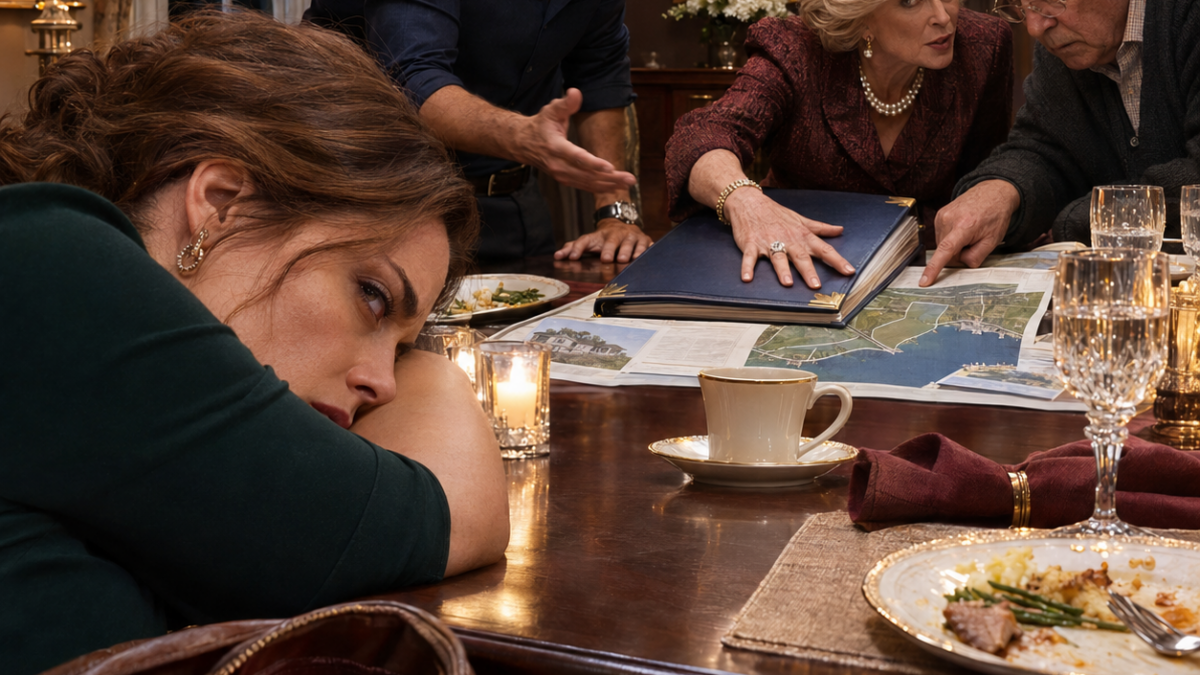
The third dinner was when fear finally became evidence.
Before leaving our apartment, I photographed myself in the bathroom mirror.
Blouse buttoned correctly.
Necklace centered.
Watch in place.
Beneath my watchband, I drew a tiny line with a permanent marker.
At dinner, Loretta served soup.
I tasted something faintly bitter.
My pulse jumped.
I pretended to become dizzy.
Brandon stood immediately.
Too quickly.
“I’ve got her.”
He carried me upstairs.
I kept my eyelids barely open.
He put me on the bed.
Then pulled out his phone.
Two flashes.
He was photographing me.
When he left, I fought the heaviness long enough to sit up.
The mark beneath my watch had been partially wiped.
The top button of my blouse had been disturbed.
Later that night, one of Brandon’s photographs automatically synchronized to our shared cloud account.
I enlarged it.
Beside the bed was a man’s hand.
Broad fingers.
A thick black ring.
I knew that ring.
Howard Pierce had worn it every day since I’d met him.
I stared at the image until dawn.
Then I made my first truly intelligent decision.
I told Brandon nothing.
PART2
For the next six days, I became the wife he expected.
I kissed him before work.
Asked about his projects.
Smiled when he complained about subcontractors.
When Loretta called about the upcoming family dinner, I answered cheerfully.
“Of course we’ll be there.”
She sounded delighted.
“Wonderful. Howard has two associates visiting from Dallas. Come early.”
“Who?”
“Dale Mercer and Curtis Vaughn.”
I recognized the names.
Dale worked around private financing.
Curtis was attached to real-estate acquisitions.
Both had been mentioned in connection with something Brandon and Howard had been discussing for months.
Harbor Point.
I knew almost nothing about the project outside work.
That mattered, because six months earlier my auditing team had conducted limited review work involving several entities indirectly connected to Harbor Point.
One subsidiary had bothered me.
Harbor Point Logistics Holdings.
Transfers between affiliated companies didn’t reconcile cleanly.
Supporting documentation was thin.
I recorded the issue in my workpapers, elevated it, and moved on when the matter went back to the client.
At the time, I thought it was ordinary professional friction.
I didn’t yet understand that Howard Pierce had become desperate for the unanswered questions to disappear.
That Saturday, I bought a small voice recorder.
I also bought a compact camera disguised as an ordinary charging device.
I created a private cloud account.
Changed passwords Brandon didn’t know existed.
Photographed my clothing again.
And texted my closest friend, Nina.
I’m going to Brandon’s parents tomorrow. If I don’t contact you by 10:00 p.m., call me. If I don’t answer, call the police.
She responded immediately.
Gwen, what is happening?
I stared at the screen.
Then typed the only honest answer.
I think something happens to me there when I lose consciousness.
Three dots appeared instantly.
Do not go.
I closed my eyes.
Part of me agreed.
But another part needed to know.
I wasn’t trying to play detective for entertainment.
I needed proof that I wasn’t losing my mind.
I texted back.
I’m not drinking anything. I’m not eating enough to make me sick. I’m staying alert. If anything changes, I leave.
Nina called.
I ignored the first call.
She called again.
I answered.
“Gwen, this is insane.”
“I know.”
“You think they’re drugging you.”
“I don’t know.”
“That means you don’t go.”
I pressed my forehead against the kitchen cabinet.
“If I accuse them now, Brandon will say I’m paranoid.”
“Then leave Brandon.”
“I need to know what’s real.”
There was a long silence.
Nina’s voice softened.
“You are real.”
My throat tightened.
She continued.
“Your fear is real.”
“I know.”
“No, I don’t think you do.”
I closed my eyes.
She took a breath.
“Promise me one thing.”
“What?”
“If you feel even slightly wrong, you get out. You don’t wait for proof.”
I swallowed.
“I promise.”
That promise would save my life.
Sunday evening, Brandon drove.
He was unusually cheerful.
“You’ve been quiet all weekend.”
“Work.”
He smiled.
“You need to stop letting that place consume you.”
The irony almost made me laugh.
Instead, I looked through the window.
Houston moved past us in bright fragments.
Restaurants.
Traffic lights.
Couples walking dogs.
People living ordinary lives while I headed toward a house where I’d lost nine hours of memory over three months.
Brandon reached across the center console and squeezed my knee.
“You okay?”
I looked at him.
His face was familiar.
The scar beside his chin from a bicycle accident when he was twelve.
The tiny crease between his eyebrows.
The wedding ring I had placed on his finger.
I almost told him everything.
Almost asked:
Have you been hurting me?
Then I remembered the photographs.
Howard’s ring.
And Brandon dismissing every question.
I smiled.
“Just tired.”
He nodded.
“See? I keep telling you.”
My blood went cold.
The Pierce mansion glowed against the evening.
Loretta opened the door wearing pearls and a pale blue dress.
“There she is.”
She hugged me.
I had to stop myself from flinching.
Howard appeared behind her.
“Gwen.”
He kissed my cheek.
The black ring touched my shoulder.
I felt nausea rise.
Dale Mercer stood near the fireplace holding bourbon.
He greeted me politely.
Curtis Vaughn didn’t bother hiding the way he watched me.
Brandon leaned toward me.
“Relax.”
I looked at him.
“I’m relaxed.”
He smiled.
“Good.”
We sat for drinks.
Howard poured wine.
I lifted the glass.
Touched it to my lips.
Didn’t swallow.
Curtis watched.
“Not a wine person?”
I smiled.
“Long week.”
He laughed.
“Maybe you need something stronger.”
Howard grinned.
“Careful, Curtis.”
Loretta appeared.
“Dinner.”
At the table, I pretended to eat.
Small bites.
Mostly moving food around the plate.
I noticed Loretta watching my glass.
Howard glanced toward Brandon twice.
Brandon checked his phone beneath the table.
My pulse climbed.
At 7:18, I touched my forehead.
“I feel strange.”
Brandon’s fork stopped.
Howard looked up.
Loretta froze.
Then Brandon’s face arranged itself into concern.
“Again?”
I nodded.
He stood.
“I’ll take her upstairs.”
Curtis leaned back.
Dale frowned.
“Is she okay?”
“Blood sugar,” Brandon said smoothly.
My blood turned cold.
He had used the excuse before I said anything.
He helped me upstairs.
I let my steps become loose.
My head sagged toward his shoulder.
He whispered beside my ear:
“There you go.”
The tenderness in his voice terrified me more than anger would have.
He lowered me onto the guest bed.
I let my eyes close.
He kissed my forehead.
“Rest, babe.”
Then his footsteps moved away.
The door closed.
The lock turned from the outside.
I opened my eyes.
My pulse was so violent I could see movement beneath my blouse.
I reached into my purse.
Recorder on.
Backup phone on silent.
Nina’s number ready.
Then footsteps came down the hall.
A man’s voice:
“She went down fast tonight.”
Curtis.
Howard answered:
“We gave her a little more.”
My hand went numb.
I hadn’t swallowed the wine.
I’d barely eaten.
What had they given me?
Then I realized.
The water.
Loretta had insisted I drink water when we arrived.
My stomach dropped.
The door opened.
I closed my eyes.
One.
Two.
Three sets of footsteps.
Seven seconds after the latch clicked, Brandon spoke.
“Did you turn off the hallway camera?”
Curtis answered.
“Yes.”
“And her phone?”
“Already offline.”
My husband.
My husband wasn’t discovering the crime.
He was managing it.
Howard spoke.
“Get the Harbor Point documents.”
Paper moved.
Curtis said, “You sure she’s out?”
Brandon’s answer came without hesitation.
“She won’t wake up.”
I forced myself to keep breathing evenly.
Howard moved closer.
“She fought the sedation last month.”
Brandon gave a quiet laugh.
“She thought she had hypoglycemia.”
My stomach turned.
Curtis chuckled.
“You really had her believing that?”
“Gwen believes whatever sounds rational.”
That sentence would stay with me longer than any insult he ever shouted.
Not because he called me gullible.
Because I heard pride.
He was proud of how effectively he’d manipulated me.
Howard tapped paper against something hard.
“Enough. We need her signature.”
Curtis lowered his voice.
“Which page?”
“Certification first. Then the supplemental acknowledgment.”
Brandon asked, “What if the signatures don’t match?”
Howard scoffed.
“We’ve got three prior examples from when she was impaired. That’s what tonight is for.”
My blood went ice cold.
Three prior examples.
They hadn’t merely been disturbing my clothing.
They had been testing how easily they could manipulate my hand.
Howard continued.
“Once the financing group has an auditor’s acknowledgment tied to the original review, Harbor Point moves.”
Curtis whispered, “And if she later claims fraud?”
Brandon said:
“She already has a history of blacking out and confusion.”
Everything inside me went still.
There it was.
The entire architecture.
Drug me.
Make me doubt myself.
Create a medical narrative.
Use my signature.
And if I ever discovered the fraud, say I was confused.
Howard spoke again.
“Make it quick.”
Then I felt fingers near the collar of my blouse.
My body screamed.
I had planned to stay still.
To capture everything.
But every instinct I possessed said the plan was over.
Nina’s warning hit me.
If anything changes, you leave.
I opened my eyes.
Curtis was leaning over me.
Howard held a folder.
Brandon stood near the foot of the bed.
For half a second, nobody moved.
Then Brandon’s face changed.
“Gwen?”
I swung my arm toward the bedside lamp.
The ceramic base crashed onto the hardwood.
The sound exploded through the room.
I screamed.
Not words.
Pure sound.
Curtis jumped backward.
Howard shouted.
Brandon lunged toward me.
I rolled off the opposite side of the bed.
My knee slammed into the floor.
Pain shot up my leg.
“Gwen, stop!”
I crawled toward the doorway.
Howard grabbed at my sleeve.
Fabric tore.
I kicked backward blindly.
Someone cursed.
Then I was in the hallway.
I ran.
Brandon followed.
“GWEN!”
I reached the stairs.
Loretta appeared at the bottom.
Her face was white.
“What happened?”
I screamed:
“CALL THE POLICE!”
She didn’t move.
Behind me, Brandon shouted.
“She’s confused!”
Of course.
Of course that was his first move.
Not she’s hurt.
Not help her.
She’s confused.
I reached the bottom.
Dale stood near the foyer.
“What the hell is going on?”
Howard came down the stairs.
“She had another episode.”
I backed away.
“No.”
My voice shook.
“I heard you.”
Brandon descended slowly.
“Babe.”
“Don’t call me that.”
Dale looked between us.
Curtis appeared behind Howard.
I reached the front door.
Turned the handle.
Locked.
I pulled again.
Nothing.
I looked toward Loretta.
She stared at me.
“Unlock it.”
Her lips trembled.
“Gwen, calm down.”
“UNLOCK THE DOOR.”
Howard’s voice hardened.
“Sit down before you hurt yourself.”
I turned.
“Stay away from me.”
Brandon raised both hands.
“No one’s going to hurt you.”
I laughed.
It came out broken.
“No one?”
His face tightened.
The backup phone vibrated inside my waistband.
10:00 p.m.
Nina.
I reached for it.
Brandon saw the movement.
His eyes widened.
“Where did you get that?”
He lunged.
Dale stepped between us.
“Whoa.”
Brandon stopped inches from him.
“Move.”
Dale’s expression changed.
“Why?”
“It’s my wife.”
Dale stared.
“So?”
I answered the call.
“Nina.”
Her voice exploded.
“GWEN?”
“Call 911.”
Brandon’s face went white.
Howard moved toward me.
I backed up.
“I’m at the Pierce house. I’m locked inside. Call the police.”
Howard hissed, “Give me the phone.”
I shouted the address.
Then ran toward the kitchen.
Loretta moved into my path.
“Gwen, don’t.”
I stared.
“Move.”
Her eyes filled.
“You don’t understand.”
“MOVE.”
“Howard will lose everything.”
For one second, the entire room disappeared.
There it was.
Not denial.
Not confusion.
She knew.
Maybe not every detail.
But enough.
I looked at her.
“And that’s why you let them drug me?”
Her face crumpled.
“It’s not that simple.”
“It is tonight.”
I shoved past her.
Reached the back door.
Unlocked it.
And ran barefoot into the dark.
Cold patio stone cut my feet.
I didn’t care.
Behind me, Brandon shouted my name.
I ran across manicured grass.
Past the pool.
Through a side gate.
Onto the neighboring property.
A security light snapped on.
I pounded on a door.
“PLEASE!”
Nothing.
I hit it again.
“PLEASE CALL 911!”
A woman opened the door wearing a bathrobe.
She looked at me.
My torn sleeve.
Bare feet.
Blood on one knee.
Then she stepped back.
“Come inside.”
No questions.
No suspicion.
She pulled me in and locked the door.
Her husband appeared from the hallway.
“What’s happening?”
“Police,” I gasped.
“They’re coming.”
I collapsed against the wall.
My body started shaking violently.
The woman wrapped a blanket around me.
“My name is Susan.”
I stared at her.
“Gwen.”
“You’re safe here.”
The words broke me.
Safe.
I had forgotten what that felt like.
Outside, voices moved along the property line.
Then sirens.
Blue lights washed across the windows.
I started crying.
Susan sat beside me.
“You’re okay.”
I shook my head.
“No.”
My voice cracked.
“My husband was in there.”
She squeezed my hand.
I looked at her.
“He knew.”
Police entered the Pierce property.
I remained next door.
An officer named Daniel Martinez—not related to anyone I knew—sat several feet from me and spoke calmly.
“Gwen, can you tell me what happened?”
I told him what I could.
Dinner.
Pretending to faint.
The locked room.
Howard.
Curtis.
Brandon.
The papers.
My recorder.
When I mentioned the recorder, his expression changed.
“Where is it?”
“My purse.”
“Inside the bedroom?”
“Yes.”
“Any other device?”
“A small camera.”
“Where?”
I explained.
He wrote everything down.
Then asked, “Do you believe you were given something without your knowledge tonight?”
“Yes.”
“Previously?”
“I think so.”
My teeth were chattering.
He nodded.
“We’re going to have medical personnel evaluate you.”
I looked toward the Pierce house.
“Please don’t let Brandon come near me.”
“You don’t have to speak with him.”
I swallowed.
“My mother-in-law knew something.”
“Tell the detective everything you remember.”
I nodded.
Then suddenly thought of the Harbor Point papers.
“They wanted my signature.”
Martinez looked up.
“For what?”
“A development deal.”
I pressed both hands against the blanket.
“They were going to make it look like I approved financial records.”
He nodded slowly.
“Don’t worry about proving all of that tonight.”
I stared at him.
“What?”
“Tonight, you tell us what happened to you.”
His voice softened.
“Let investigators determine the rest.”
I began crying again.
Because for months, I had been trying to prove my own reality.
And now someone was telling me I didn’t have to do all of it alone.
The hospital became a blur of bright lights and quiet voices.
A medical team evaluated me for possible drug exposure.
I gave them the timeline.
The bitter taste at earlier dinners.
The blackouts.
The memory gaps.
I told them I had pretended to consume very little that evening but had accepted water.
Blood and urine samples were collected.
I was offered specialized medical and advocacy support because there was concern that my physical boundaries may have been violated while I was incapacitated.
That possibility almost destroyed me.
I sat on the examination bed clutching the hospital blanket.
Nina sat beside me.
She had arrived so quickly I wondered whether she had broken traffic laws.
Neither of us mentioned that.
I whispered:
“What if something happened?”
She took my hand.
“We deal with what we know.”
“What if I never remember?”
“Then you don’t have to invent memories.”
My eyes filled.
“I woke up with my clothes wrong.”
“I know.”
“And Brandon knew.”
“I know.”
I began sobbing.
Nina moved beside me.
For months I’d believed the worst possibility was that my husband was cheating.
Now infidelity seemed almost irrelevant.
What he’d done was far worse.
He’d helped turn my own body into something I couldn’t trust.
Detective Lena Morales met me the following afternoon.
She looked tired but alert.
No dramatic speeches.
No promises that everyone would be in prison by dinner.
She opened a notebook.
“Let’s start with the first episode.”
I told the story four times in different forms over the next week.
Every retelling exhausted me.
But details mattered.
What food was served.
Who poured drinks.
Who escorted me upstairs.
Who was present afterward.
When I remembered something uncertain, Morales wrote uncertain.
When I knew, she wrote known.
That distinction mattered.
Then she told me they’d recovered the recorder pursuant to the investigation.
My hands went cold.
“Did it work?”
“There is audio.”
I stared.
“How much?”
“Enough that we’re taking it very seriously.”
I closed my eyes.
“And the papers?”
“Documents were also recovered.”
My pulse accelerated.
“What were they?”
“We’re coordinating with financial investigators and your employer. I don’t want to speculate before the documents are fully analyzed.”
I nodded.
Then she paused.
“Gwen, investigators also recovered materials indicating this may not have been the first time documents were placed in that bedroom.”
My stomach dropped.
“What?”
She watched me carefully.
“There are photographs and draft materials that appear to predate Sunday.”
I stopped breathing.
Brandon’s photographs.
Three earlier nights.
Howard had said they had examples.
I covered my mouth.
Morales continued.
“We’re going to determine whether any prior signatures attributed to you are genuine.”
I shook my head.
“I never signed Harbor Point documents at that house.”
“That’s important.”
Tears filled my eyes.
“And if they forged them?”
“Then we follow the evidence.”
I looked at her.
“Can they destroy my career?”
“Not if the evidence establishes that you didn’t authorize the documents.”
“But people will think—”
“Gwen.”
Her tone stopped me.
“You are not responsible for somebody else misusing your name.”
I looked down.
It sounded so obvious when someone else said it.
Yet Brandon had spent months convincing me everything happening around me somehow originated inside me.
My fatigue.
My confusion.
My blackouts.
My fear.
Always me.
For the first time, someone put responsibility where it belonged.
My employer placed me on temporary administrative leave.
I panicked.
Daniel Cho, my supervisor, asked me to come in with counsel.
I sat across from him expecting to hear that I’d been terminated.
Instead, he said:
“We’re preserving every file connected to Harbor Point.”
I swallowed.
“Am I under investigation?”
“The records are being reviewed.”
My chest tightened.
He leaned forward.
“That is not the same as assuming you did something wrong.”
I stared at him.
He continued.
“Your original workpapers exist.”
I felt my pulse jump.
“All of them?”
“Yes.”
He turned his monitor.
“Version histories too.”
I almost cried.
Months earlier, I’d written notes about the questionable transactions.
I’d insisted that supporting schedules didn’t reconcile.
I’d flagged the lack of documentation.
Those comments were still there.
Daniel said:
“If someone created a later document claiming you cleared those issues, the earlier audit trail matters.”
I leaned back.
For the first time since the police arrived, something resembling professional instinct returned.
“What was Harbor Point trying to close?”
Daniel hesitated.
“It’s larger than the portion our firm reviewed.”
“How large?”
He looked at counsel.
Then answered.
“Financing commitments across the development were approaching nine figures.”
I stared.
Nine figures.
Howard hadn’t risked prison over a small consulting fee.
The deal was enormous.
Daniel continued.
“Our role was limited. But a false acknowledgment attributed to one of our auditors could’ve been used to strengthen representations made to lenders or investors.”
My stomach twisted.
“So my name was valuable.”
“Yes.”
I laughed bitterly.
“Apparently more valuable unconscious.”
Daniel didn’t smile.
Then he said something that made me sit very still.
“Gwen, the internal records show you refused to clear two items Howard’s side wanted resolved.”
I looked up.
“When?”
“Six months ago.”
I remembered.
Two sets of transfers.
One involving a shell entity.
Another tied to a property acquisition account.
I had sent them back for more documentation.
Daniel leaned forward.
“You didn’t kill Harbor Point.”
I swallowed.
“But I became a problem.”
He nodded.
And suddenly the entire nightmare had a beginning.
Not the first dinner.
The audit.
Within three weeks, Harbor Point began to collapse.
Not because of one dramatic recording.
Because the recording gave investigators a reason to examine documents already full of problems.
Financial regulators became involved.
Lenders requested clarification.
Investors began asking why an auditor’s alleged supplemental approval did not match her firm’s retained workpapers.
A title company questioned representations.
One financing group paused its commitment.
Then another.
Curtis Vaughn’s acquisition entity began producing records under legal pressure.
Howard’s name appeared repeatedly.
So did Brandon’s.
My husband hadn’t merely protected his father.
He had been helping coordinate construction commitments dependent on Harbor Point moving forward.
If the deal failed, Brandon’s promised promotion and compensation package disappeared with it.
He had a personal stake.
A large one.
That hurt in a strangely clean way.
It meant the truth was simpler than the explanations I’d tried to invent.
Brandon hadn’t done this because he loved his father too much.
He did it because he wanted something.
And I stood between him and getting it.
Loretta left me a voicemail.
I listened only after my attorney, Elena Park, told me it was safe to preserve and review.
Her voice trembled.
“Gwen.”
A long pause.
“I know you believe I was involved.”
I stared at the wall.
She continued.
“I knew Howard was giving you something.”
My breathing stopped.
“I knew it made you sleep.”
She began crying.
“I thought it was only so they could get the papers signed.”
Only.
I almost threw the phone.
She kept talking.
“I didn’t know Curtis would be upstairs.”
My stomach turned.
“I didn’t know how far Howard intended to go.”
Then:
“I was afraid.”
I closed my eyes.
“Howard said if Harbor Point collapsed, we’d lose everything.”
There it was.
Money again.
Loretta continued.
“The house. Retirement. Investments. He said Brandon would lose his career.”
My hands shook.
“And I told myself you wouldn’t remember.”
I whispered into the empty apartment:
“You told yourself wrong.”
Then Loretta said something that would later matter enormously.
“Howard kept copies of the prior signature pages in his study.”
I sat up.
Copies.
Prior signature pages.
The same thing Howard had mentioned in the bedroom.
Loretta continued.
“I should have stopped him the first time.”
I pressed pause.
Nina sat across from me.
Neither of us spoke.
Then I resumed.
Loretta whispered:
“I’m sorry.”
The message ended.
I forwarded it to Detective Morales.
Then I sat on the floor and cried.
Not because Loretta had confessed enough to make everything easy.
Because she had confirmed there was a first time.
A second.
A third.
She had known.
And every month, she had set the table again.
The search of Howard’s study uncovered far more than I expected.
I learned the details through the investigation and my employer’s counsel over time.
There were copies of documents bearing signatures attributed to me.
Several were inconsistent with my normal signature.
Others were disturbingly close.
There were practice pages.
Photographs.
Printed examples.
Draft certifications.
Emails discussing “cleaning up” the Harbor Point review.
One message from Curtis asked Howard:
How much does she remember afterward?
Howard’s reply:
Enough to ask questions. Not enough to prove anything.
Another from Brandon said:
I can keep her calm.
That sentence made me physically ill.
Not:
I’ll protect her.
Not:
I’ll stop this.
I can keep her calm.
Like I was a problem to manage.
Investigators also found communications suggesting the fourth dinner had been intended as the final attempt.
The financing deadline was approaching.
They needed a signed acknowledgment attached to a packet supporting revised representations.
My signature was supposed to make the package look legitimate.
My body was simply the tool they planned to use to obtain it.
Brandon requested a private meeting.
I refused.
He tried through his attorney.
I refused again.
Then he sent a letter.
Elena placed it on the table.
“You don’t have to read it.”
I stared at the envelope.
Three years of marriage.
Hundreds of ordinary mornings.
Thousands of texts.
Vacations.
Birthdays.
Arguments over laundry.
Plans for children we hadn’t had yet.
And now communication required lawyers.
I opened it.
Gwen,
I need you to understand that things got out of control.
I almost laughed.
Not I did something unforgivable.
Things got out of control.
The passive language of cowards.
I continued.
Dad convinced me Harbor Point would collapse if you didn’t correct the audit issue.
Correct.
As though my concern had been an error.
He said thousands of people would lose jobs.
I kept reading.
The first time, I thought you would simply sleep and we’d get one signature.
My hand began shaking.
There it was.
The first time.
Brandon knew from the beginning.
I never wanted you physically hurt.
I stopped reading.
For several minutes, I couldn’t continue.
That sentence exposed something monstrous.
He believed there was a version of secretly drugging his wife and guiding her hand across financial documents that didn’t count as hurting her.
I folded the letter.
Nina watched me.
“Done?”
“No.”
I reopened it.
I wanted to know exactly who he was.
Brandon continued.
After the first dinner, you started asking questions. Dad said if we stopped then, everything we’d already done would become obvious.
There it was.
Escalation.
Not inevitability.
Choice after choice.
I should have stopped.
Yes.
I was scared.
So was I.
I love you.
I laughed aloud.
A single hard sound.
Nina flinched.
I reached the final paragraph.
Please don’t destroy my entire life over one terrible mistake.
I stared at those words.
One mistake.
Four dinners.
Months of gaslighting.
Photographs.
Practice signatures.
Locked doors.
A financial scheme.
One mistake.
I folded the letter.
Then handed it to Elena.
“Include it wherever it’s legally relevant.”
She nodded.
“And the divorce?”
I looked at my wedding ring.
Then removed it.
“File.”
The divorce filing was almost anticlimactic compared with everything else.
Brandon tried to contest financial issues.
Tried to claim certain accounts.
Tried to present himself as a husband swept into his father’s scheme.
But evidence has a way of simplifying performances.
Financial records showed what Brandon stood to gain.
Messages showed his involvement.
My medical records documented the episodes.
The recorder captured his voice.
The fourth dinner wasn’t an isolated burst of panic.
It was part of a pattern.
Elena was careful.
She never promised me I’d get everything.
Never told me the divorce court would punish him simply because he had been a terrible husband.
She focused on the law.
Property.
Debts.
Disclosure.
Protection.
And allowing the criminal process to address the crimes.
That distinction helped me.
I didn’t want my future to depend on how severely someone could punish Brandon.
I wanted it to depend on how completely I could get away from him.
Six months after the dinner, I returned to work full-time.
The firm’s internal review cleared me.
The disputed Harbor Point documents did not match the authentic audit history.
Metadata contradicted the dates represented on several drafts.
My original workpapers showed I had explicitly requested additional documentation.
I hadn’t approved what Howard later claimed I approved.
Daniel called me into his office.
For one terrible second, I imagined another catastrophe.
Instead, he closed the door.
“The review is complete.”
I held my breath.
“And?”
“Your work was appropriate.”
I stared.
He smiled faintly.
“You were right to flag the transactions.”
My eyes filled.
“So I’m not being terminated?”
“No.”
I laughed and cried at the same time.
Daniel pushed a box of tissues toward me.
“Try not to interpret that as permission to become unbearable.”
I laughed harder.
Then covered my face.
For months, I’d been afraid that even if I survived my marriage, I’d lose the career I’d worked years to build.
I looked at him.
“Thank you.”
He shook his head.
“You documented your work.”
I nodded.
“That’s what saved me professionally.”
He leaned back.
“No.”
I looked at him.
“Your integrity saved you professionally. The documentation proved it.”
That distinction mattered.
I carried it with me.
Harbor Point did not survive.
The financing collapsed after investigators and lenders uncovered enough discrepancies to make the original representations unreliable.
Deals were suspended.
Commitments withdrawn.
Civil claims followed.
Howard’s reputation in Houston’s development world evaporated faster than I imagined possible.
For decades, he had entered rooms expecting people to move toward him.
Now former associates refused his calls.
His advisory positions disappeared.
Companies distanced themselves.
The Pierces’ social circle didn’t vanish because everyone suddenly became morally courageous.
Many vanished because scandal is expensive.
That used to make me angry.
Then I stopped caring why they left.
Howard had built a life around influence.
Now influence could no longer insulate him from evidence.
That was enough.
The confrontation I remember most happened nine months after the fourth dinner.
Not in the River Oaks mansion.
Not in a police interrogation room.
In a conference suite during a court-supervised civil settlement session involving several financial claims connected to Harbor Point and my separate marital case.
I was there with Elena and counsel from my firm.
Brandon sat across the room with his attorneys.
Howard sat farther down the table.
Loretta was not beside him.
She had begun cooperating separately.
Curtis was represented by his own counsel.
The room smelled of coffee and paper.
No dramatic chandeliers.
No expensive wine.
No locked bedrooms.
Just fluorescent lights and documents.
Howard looked older.
His hair had gone almost entirely gray.
Brandon looked thinner.
For months I’d imagined what I might feel seeing him again.
Rage.
Fear.
Love.
Instead, I felt clarity.
He was no longer the man who decided what reality meant.
He was simply another person seated across a table.
The mediator began.
Attorneys spoke.
Financial claims were outlined.
Then Howard’s counsel suggested that I had misunderstood my role in the Harbor Point review.
I actually smiled.
Elena looked toward me.
I shook my head slightly.
Let them continue.
Howard’s attorney said:
“Ms. Hartley’s memory of the relevant period was admittedly affected by significant medical episodes.”
I looked directly at Howard.
There it was.
The old plan.
Even now.
Use my symptoms against me.
Daniel’s counsel opened a folder.
“That’s precisely why the contemporaneous electronic audit records matter.”
A screen illuminated.
My original workpapers appeared.
Date.
Timestamp.
User identification.
My notes.
INSUFFICIENT SUPPORT FOR INTERCOMPANY TRANSFER. DO NOT CLEAR PENDING ADDITIONAL DOCUMENTATION.
Another page.
NO APPROVAL PROVIDED FOR SUPPLEMENTAL CERTIFICATION.
Then the later document Howard’s group had circulated appeared beside it.
Same project.
My supposed signature.
A date on which I had never seen the document.
The metadata showed the file had been created from a device associated with Howard’s office.
Howard’s face tightened.
His lawyer objected to characterization.
The attorneys argued.
I sat quietly.
Then another exhibit appeared.
A photograph recovered from Howard’s study.
A practice page.
My name written repeatedly.
Different attempts.
Different pressure.
Different slants.
Brandon looked down.
Howard didn’t.
Then came the audio.
I hadn’t listened to the full recording since that night.
I didn’t want to.
But portions were played because they mattered.
The room filled with Brandon’s voice.
“Did you turn off the hallway camera?”
My hands went cold.
Then Curtis:
“Yes.”
Brandon:
“And her phone?”
Then Howard:
“Get the Harbor Point documents.”
Nobody moved.
The next excerpt came.
Howard:
“Once the financing group has an auditor’s acknowledgment tied to the original review, Harbor Point moves.”
Then Brandon:
“She already has a history of blacking out and confusion.”
My husband sat fifteen feet away while his own voice explained the conspiracy more effectively than any attorney could.
He looked at me.
I held his gaze.
For the first time since our wedding, Brandon looked ashamed.
Howard looked furious.
Not ashamed.
Furious.
He leaned toward his attorney.
“This recording—”
His lawyer whispered something.
Howard stopped.
The mediator called for a break.
Chairs moved.
Attorneys gathered.
I stood.
Brandon approached before Elena could stop him.
He remained several feet away.
“Gwen.”
My whole body tensed.
Elena stepped beside me.
I lifted one hand.
“It’s okay.”
Brandon stared.
His eyes were red.
“I need to say something.”
“No.”
His face crumpled.
“Please.”
I looked at him.
For months, I had imagined shouting.
Telling him how terrified I’d been.
Asking how he could touch my forehead after putting me into that room.
Instead, my voice came out calm.
“You had four months to say something.”
He swallowed.
“Dad—”
I almost laughed.
“No.”
He stopped.
“You don’t get to start with your father.”
His eyes filled.
“I was afraid of him.”
“So was I.”
That shut him up.
I continued.
“You knew what he was doing to me.”
Brandon looked down.
“You photographed me.”
His jaw trembled.
“You lied when I woke up.”
Tears slid down his cheeks.
“You listened while I asked whether I was sick.”
He whispered, “I’m sorry.”
I took one step closer.
Elena remained beside me.
“You know what the worst part was?”
He shook his head.
“You made me afraid of my own mind.”
He covered his mouth.
“For months, every time I felt tired, I wondered if something was wrong with me.”
I swallowed.
“You knew the truth. And you watched.”
His shoulders shook.
“I loved you.”
I stared at him.
“No.”
He looked up.
“You loved what my trust allowed you to do.”
That sentence seemed to hit him physically.
He whispered, “Gwen…”
I stepped back.
Then Howard’s voice came from across the room.
“Enough melodrama.”
Everything stopped.
Brandon turned.
Howard stood near the conference table.
His face was red.
“You’re acting like we were trying to kill you.”
I stared at him.
A strange calm moved through me.
I walked back toward the table.
Elena followed.
Howard pointed toward the exhibits.
“Harbor Point would’ve created thousands of jobs.”
I looked at him.
“And that gave you the right to drug me?”
His lawyer said, “Mr. Pierce—”
Howard ignored him.
“We were trying to get a deal closed.”
I stared.
“You locked me in a bedroom.”
“You were never in danger.”
I felt something inside me become perfectly still.
“Your son turned off a camera.”
Howard stopped.
I continued.
“You had someone disable my phone.”
His face tightened.
“You practiced my signature.”
His attorney grabbed his arm.
“Howard, stop talking.”
But Howard was too angry to stop.
“We would’ve corrected everything afterward.”
I laughed.
“You would’ve corrected me?”
His mouth closed.
I leaned forward.
“No, Howard. You planned to discredit me.”
Silence.
“You planned to use the symptoms you caused as proof I couldn’t remember what happened.”
His eyes flickered.
I saw it.
Everyone did.
I continued.
“You didn’t think I mattered enough to fight back.”
Howard stared.
Then I smiled.
Not because anything was funny.
Because for the first time, I understood the thing he’d underestimated most.
“You should’ve remembered what I do for a living.”
His expression hardened.
I pointed toward the documents.
“I follow trails.”
Then I walked out.
The settlement session didn’t end the criminal cases.
It didn’t need to.
Its importance to me was personal.
For months, Howard and Brandon had controlled the narrative.
That day, their own words sat beside the records.
The evidence didn’t scream.
It didn’t insult.
It didn’t threaten.
It simply existed.
And their story couldn’t survive it.
Loretta eventually agreed to meet me through lawyers.
I almost refused.
Then I decided I wanted one answer.
Not an apology.
An answer.
We met in a neutral office.
She entered looking older than I’d ever seen her.
No pearls.
No perfect makeup.
No polished hostess smile.
She sat across from me.
For several seconds, neither of us spoke.
Then she whispered:
“I am sorry.”
I nodded.
“Why did you keep inviting me back?”
She began crying.
I waited.
“Why, Loretta?”
She looked down.
“Howard said if we stopped suddenly, you’d become suspicious.”
I felt sick.
“So you cooked dinner.”
She nodded.
“Served me.”
“Yes.”
“Watched me drink.”
Her shoulders shook.
“Yes.”
“And then watched your son carry me upstairs.”
Loretta covered her face.
I didn’t comfort her.
Finally she whispered:
“I hated myself every time.”
I stared.
“That didn’t help me.”
“I know.”
“Did you ever think about telling me?”
“Every time.”
“Then why didn’t you?”
She looked up.
“Because I was afraid of losing my life.”
I almost laughed.
“You mean your lifestyle.”
She flinched.
I continued.
“The house?”
Tears ran down her cheeks.
“Yes.”
“The money?”
“Yes.”
“Howard?”
She hesitated.
“Yes.”
I leaned back.
“So you traded my safety for yours.”
Loretta broke down.
I watched.
Then said:
“I needed someone in that house to choose me once.”
She cried harder.
“You called me your daughter.”
“I know.”
“No.”
My voice shook.
“You liked saying it.”
She looked up.
“But when it cost something, I wasn’t your daughter.”
Neither of us spoke.
Then Loretta whispered:
“No.”
It was the only honest answer she could give.
I stood.
She looked terrified.
“Gwen.”
I paused.
“I don’t know whether I forgive you.”
Her face collapsed.
“But I know I don’t owe you an answer today.”
Then I left.
The criminal cases eventually ended through a combination of pleas and adjudicated findings based on the evidence against the individuals involved.
I won’t turn the consequences into entertainment.
The details belonged to the courts.
What mattered to me was that the conduct was formally recognized as serious wrongdoing.
Drugging someone without consent.
Trying to obtain signatures while they were incapacitated.
Financial fraud.
Conspiracy around falsified documents.
Interference with a person’s ability to protect herself.
Those were no longer family disagreements.
No longer misunderstandings.
No longer my blood sugar.
Howard lost his freedom for a substantial period and faced devastating financial consequences tied to the fraudulent conduct.
Curtis faced his own criminal and civil liability.
Brandon’s sentence and legal consequences reflected his participation and cooperation after the evidence became overwhelming.
Loretta also faced consequences connected to the assistance she knowingly provided, though her later cooperation affected how her case was handled.
Dale was never charged in connection with my drugging. His testimony about the night I escaped became important because he had witnessed the immediate aftermath and Brandon’s attempt to reach me when I called for help.
Harbor Point never recovered.
The financing died.
Civil suits consumed what remained.
Howard’s firm collapsed.
Brandon’s employer terminated him.
The River Oaks mansion was eventually sold.
The dining room where I’d blacked out disappeared into someone else’s life.
I found that strangely comforting.
Buildings don’t remember us.
People do.
My divorce became final fourteen months after the night I escaped.
The courthouse was almost disappointingly ordinary.
No dramatic crowd.
No applause.
No one announcing that good had defeated evil.
The judge signed the final order.
Elena touched my arm.
“It’s done.”
I stared at the paper.
Three years of marriage.
Reduced to signatures.
This time, mine was fully conscious.
Fully informed.
Mine.
I began crying.
Elena waited.
Then asked:
“Are you okay?”
I laughed through tears.
“I don’t know.”
She smiled.
“That’s allowed.”
I looked down at the decree.
Then whispered:
“I thought I’d feel happy.”
“You might later.”
I swallowed.
“I just feel tired.”
Elena nodded.
“Then go be tired somewhere safe.”
Those words followed me home.
I moved into a small apartment overlooking a park.
Nothing like River Oaks.
No marble foyer.
No wine cellar.
No guest bedroom nobody wanted to explain.
I chose every piece of furniture myself.
My couch was too large for the living room.
My dining table had a scratch from the delivery.
The kitchen cabinets were cheap.
I loved everything.
The first night, I locked the door.
Then unlocked it.
Then locked it again.
My therapist told me trauma often made ordinary safety feel unfamiliar.
I spent weeks learning that a locked door could belong to me.
That sleep didn’t have to mean danger.
That waking confused for three seconds in the morning didn’t mean someone had tampered with my body.
I stopped wearing blouses with buttons for almost six months.
Nobody told me to.
I simply couldn’t.
Then one morning, I stood in a department-store dressing room holding a cream-colored blouse.
Almost identical to the one I’d worn the fourth night.
My hands started shaking.
I almost put it back.
Then I looked at myself in the mirror.
I buttoned the first button.
Then the second.
Then the third.
Correctly.
Slowly.
No one waiting outside.
No one touching me.
No one telling me what had happened.
When I finished, I stared at my reflection.
Then I bought it.
That blouse became more important to me than my wedding dress ever had.
At work, I became more careful.
Not paranoid.
Careful.
There is a difference.
I stopped apologizing for asking questions twice.
Stopped worrying that people would consider me difficult when a document didn’t reconcile.
A year after I returned, Daniel gave me a larger portfolio.
“You sure?” I asked.
He laughed.
“You’re asking whether I trust the auditor who caught the problem everyone else wanted to wave away?”
I smiled.
“Fair.”
Then he became serious.
“Gwen, what happened to you doesn’t define your professional value.”
I nodded.
“I know.”
He raised an eyebrow.
“Do you?”
I thought.
Then smiled.
“I’m getting there.”
Several months later, I received a promotion.
Nina brought champagne to my apartment.
I stared at the bottle.
She froze.
“Oh, God. Sorry.”
I laughed.
“No.”
I took it.
“We’re drinking this.”
She studied me.
“You sure?”
“Yes.”
I opened the bottle myself.
Poured my own glass.
Watched the bubbles rise.
Then raised it.
Nina smiled.
“To what?”
I thought about Brandon.
Howard.
Loretta.
The guest bedroom.
The recorder.
The audit file.
The courthouse.
My apartment.
Then I smiled.
“To knowing what’s in your own glass.”
Nina laughed and clinked mine.
“That’s dark.”
“I’m an auditor.”
“You’re impossible.”
I smiled.
“Finally.”
On the second anniversary of my escape, I drove past River Oaks.
Not because I needed closure.
I think closure is overrated.
Some wounds don’t close.
They scar.
They become part of the landscape.
I drove there because I wanted to see whether the house still frightened me.
The Pierce mansion had new owners.
Different cars.
Children’s bicycles near the side gate.
A delivery driver carrying groceries.
I parked across the street.
The upper bedroom window looked ordinary.
No monster lived behind it.
No secret waited there for me.
The danger had never been the room.
It had been people.
And those people no longer controlled my life.
I sat there for five minutes.
Then drove away.
That evening, Nina hosted dinner.
First Sunday of the month.
Years earlier, that phrase would have tightened my stomach.
Now it meant pizza.
Too many friends.
Music.
People arguing about movies.
Someone always forgetting dessert.
Nina raised her glass.
“First Sunday.”
Everyone lifted theirs.
I smiled.
“To better traditions.”
We drank.
Halfway through dinner, my lipstick smudged.
I saw it on my napkin.
For one second, my chest tightened.
Then I laughed.
Nina looked over.
“What?”
I shook my head.
“Nothing.”
I walked to the bathroom.
Looked at myself in the mirror.
A red mark at the corner of my mouth.
Just lipstick.
Nothing else.
I wiped it away.
Then looked at my blouse.
Every button exactly where I’d put it.
I smiled at my reflection.
And returned to dinner.
People sometimes ask whether I regret using the recorder.
I don’t.
But the recorder wasn’t the hero.
It was evidence.
A machine.
The person who saved me was the woman who finally stopped explaining away what frightened her.
Me.
That is difficult to say without feeling arrogant.
For a long time, I believed bravery had to look dramatic.
Screaming.
Fighting.
Winning.
But sometimes courage is sitting at dinner with your heart pounding and deciding not to drink the wine.
Sometimes it’s writing down a date.
Sending a message to a friend.
Keeping a second phone.
Running barefoot.
Knocking on a stranger’s door.
Sometimes it’s telling a police officer the humiliating truth.
Sometimes it’s sitting across from the man who betrayed you and saying:
“You made me afraid of my own mind.”
And refusing to carry his shame for him.
I never listened to the entire recording again.
I didn’t need to.
Seven seconds were enough.
Seven seconds to hear Brandon’s voice.
Seven seconds to understand that my husband wasn’t outside the conspiracy trying to protect me.
He was inside it.
For months, I thought those seven seconds destroyed my life.
I was wrong.
My life had already been under attack.
Those seven seconds gave it back to me.
They separated fear from confusion.
They turned the question:
Am I imagining this?
into:
What do I do now that I know?
That difference changed everything.
Two years after the divorce, I stood in my office overlooking downtown Houston.
Construction cranes moved in the distance.
Somewhere beyond them lay the abandoned Harbor Point site, eventually divided and restructured under entirely different ownership after the original deal collapsed.
I didn’t feel triumphant looking at it.
Too many innocent people had lost work and money because powerful men believed rules existed only for other people.
But I felt something else.
Peace.
I had once believed Howard was too connected to challenge.
Brandon had believed family loyalty could bury anything.
Loretta believed silence would preserve her life.
Curtis believed my memory could be manipulated.
All of them mistook temporary control for permanent power.
The documents outlived them.
The audio outlived their excuses.
The audit trail outlived their stories.
And I outlived the version of myself who thought loving someone meant letting them explain my own reality to me.
I still have the cream blouse.
The one I bought after the divorce.
Sometimes I wear it to important meetings.
Nobody knows why.
They see an auditor in a cream blouse carrying a laptop and asking uncomfortable questions about financial records.
That’s enough.
Before leaving my apartment, I button it slowly.
One.
Two.
Three.
Four.
Then I look in the mirror.
Not because I’m afraid the buttons will move.
Because I like reminding myself that my hands are the ones fastening them.
My decisions.
My clothes.
My signature.
My body.
My life.
Mine.
Brandon once wrote to me after the criminal proceedings were nearly over.
I did not answer.
But there was one sentence in his letter I kept.
Not because it comforted me.
Because it proved he finally understood what he’d done.
He wrote:
I thought your trust made you easy to control.
I read that sentence many times.
Then I wrote my own beneath it.
My trust was never your power. My deception was.
And once I knew the truth, the power disappeared.
The last time I saw Howard Pierce, he was being escorted from a courtroom.
He looked toward me.
For a second, the old arrogance returned.
That expression I’d seen at his dining table.
The expression of a man accustomed to being obeyed.
Then he glanced at the attorneys.
The reporters.
The financial victims.
The investigators.
And something changed.
He looked tired.
Small.
Human.
He opened his mouth.
I don’t know what he intended to say.
I turned away before he could.
That was my final answer to him.
He had spent months trying to take away my ability to choose.
Now even whether I listened belonged to me.
If I could return to the first night I woke confused in that guest room, I would sit beside the frightened twenty-seven-year-old woman staring at her blouse.
She would ask me:
“Am I losing my mind?”
And I would tell her no.
She would ask:
“Does my husband love me?”
I would tell her that sometimes the answer we fear is still better than living inside a lie.
She would ask:
“What happens if I find out the truth?”
And I would tell her this:
You survive it.
Not without damage.
Not without grief.
Not without nights when you wake afraid.
But you survive.
You run.
You tell someone.
You let people help.
You rebuild.
You laugh again.
You eat dinner again.
You wear lipstick again.
You wear the blouse again.
You stop apologizing for questions.
And one day, the room where you thought your life ended becomes only a room in somebody else’s house.
For four months, Brandon told me my blood sugar was dropping.
Howard told me I worked too hard.
Loretta served dinner with a smile.
Curtis waited upstairs.
And every one of them depended on the same thing.
That I would trust their explanation more than my own fear.
They almost succeeded.
But the fourth Sunday, I stopped swallowing what they handed me.
Not just the wine.
The story.
I pretended to sleep.
I listened.
And seven seconds later, I heard the truth.
They thought they were waiting for me to lose consciousness.
What they were really waiting for was the moment I finally woke up.
And once I did, Harbor Point collapsed.
Their lies collapsed.
My marriage collapsed.
But I didn’t.
I ran barefoot through the dark, knocked on a stranger’s door, handed the truth to people who knew how to preserve it, and spent the next two years rebuilding a life nobody else had permission to sign away.
Today, when someone asks me what saved me, I don’t say the recorder.
I don’t say the police.
I don’t say the audit trail.
All of those mattered.
But the answer is simpler.
I finally believed myself.
And that was the one thing Brandon Pierce had never planned for.








