𝗙𝗨𝗟𝗟 𝗦𝗧𝗢𝗥𝗬:“PLEASE DON’T LET THAT SHOE BE ALL I HAVE LEFT OF HIM!” A Missing Boy’s Mother Fell to Her Knees—Then a Mud-Covered Labrador Led Us Somewhere That Made Grown Men Cry
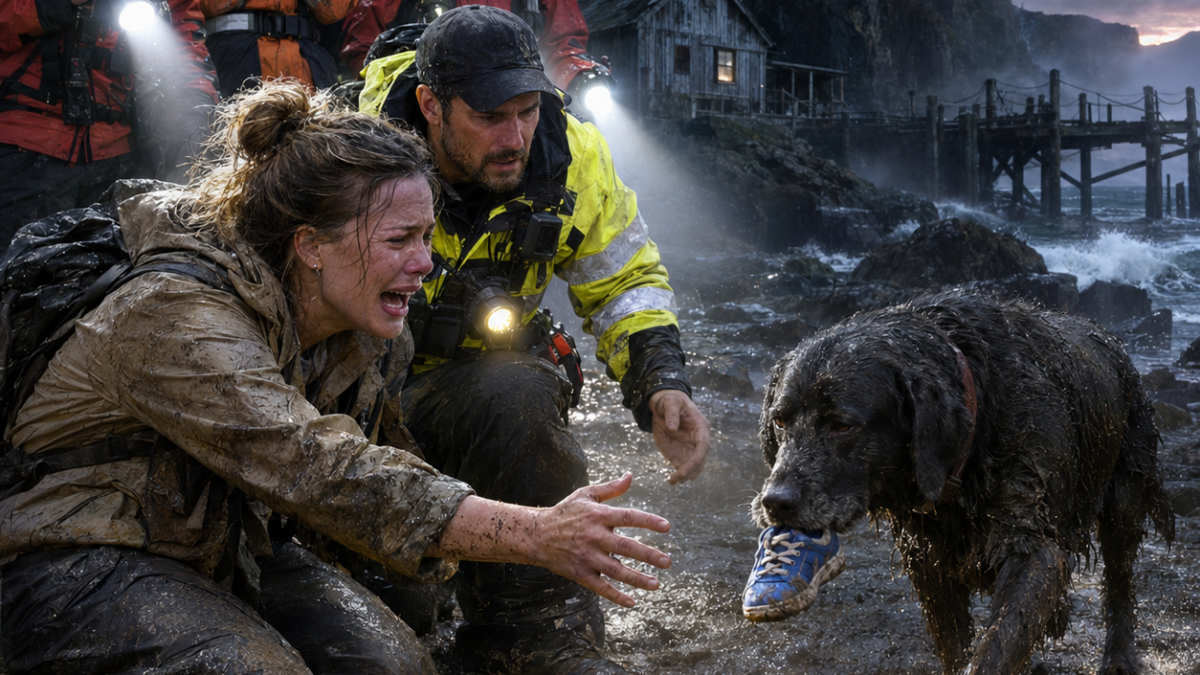
“Jeff.”
“I see it.”
The dog stared at us.
Then barked through the object he was carrying.
I approached slowly.
“Hey, sweetheart. What have you got?”
He took a step backward.
Not because he wanted to leave.
Because he seemed afraid I might take the object and forget about him.
I crouched.
“It’s okay. We’re here.”
He looked toward the path behind him.
Then back at me.
I held out my hand.
After a long moment, he stepped forward and released what he was carrying.
A tiny blue sneaker.
The fabric was soaked.
Mud filled the grooves of its sole.
One lace had come undone.
I lifted it carefully.
My chest tightened.
No adult could have worn that shoe.
Jeff looked toward me.
“Could it be the boy’s?”
I didn’t answer.
I turned toward Eliza.
She’d heard the barking and was already coming down the path.
When she saw what I held, she stopped.
Her face changed.
Then she made a sound I will never forget.
“No.”
She staggered closer.
“No, no, no…”
“Eliza—”
She took the sneaker from my hand.
Her fingers moved over the blue fabric.
The white rubber toe.
The little scratch along one side.
Then she pressed it against her chest.
“It’s his.”
Her knees buckled.
Jeff caught her before she fell.
“It’s Theodore’s.”
Her voice broke.
“I tied this shoe for him yesterday.”
The Labrador began barking again.
I looked toward him.
He wasn’t staring at the sneaker.
He was looking beyond us, toward a narrow trail running along the cliff.
Then he took several steps in that direction.
Stopped.
Turned back.
And barked.
Once.
Twice.
Urgently.
I felt my pulse quicken.
Jeff followed my gaze.
“Maya?”
I stood.
“I think he wants us to follow.”
Eliza lifted her tear-streaked face.
“Then we’re going.”
Jeff hesitated.
“The terrain beyond that trail is dangerous.”
Eliza clutched the sneaker.
“That’s my son.”
Her voice rose.
“I’m not staying here while somebody else goes looking for him!”
The Labrador barked again.
This time he ran a few yards down the trail before returning.
I looked into his exhausted brown eyes.
“Okay, boy,” I whispered. “Show us.”
He turned immediately.
And as we followed him toward the cliffs, I realized the dog wasn’t trying to escape us.
He was terrified we’d stop following before he could lead us to Theodore.
PART2
FULL STORY CONTINUATION
The Labrador broke into a run.
Not a wild, frightened sprint, but a determined rush that carried him several yards ahead before he stopped and looked back.
“Slow down, boy!” I called.
He waited.
The moment I caught up, he turned and hurried forward again.
Jeff followed just behind me, keeping one hand near his radio. Eliza was close enough that I could hear her breathing.
She still held Theodore’s sneaker.
I looked back.
“Eliza, watch your footing.”
“I am.”
The words came quickly, almost angrily.
But her anger wasn’t directed at me.
It was fear.
I recognized it from countless emergencies. When someone you love is missing, every warning to slow down can sound like a request to abandon them.
I softened my voice.
“We’re going to follow him. I just need you to reach Theodore safely when we find him.”
Her expression changed.
She looked at the shoe.
Then nodded.
“Okay.”
Ahead of us, the dog barked.
We hurried after him.
The trail narrowed almost immediately.
Grass and thorny brush pressed against our legs. The ground sloped toward the water, and loose stones shifted beneath our boots.
Below us, waves struck the base of the cliffs.
The ocean was loud enough to swallow ordinary conversation.
Jeff lifted his radio.
“Search command, this is Miller. We’ve located a dog carrying footwear believed to belong to the missing child. We’re following him along the lower coastal trail toward the southern cove.”
A crackling response came through.
“Copy. Do you have eyes on the child?”
“Negative.”
“Maintain contact and advise on location.”
Jeff looked at me.
I nodded.
We kept moving.
I had no proof the dog knew where Theodore was.
He might have found the shoe along the trail.
He might have been carrying it because dogs sometimes pick up objects.
He might simply have been frightened and trying to return somewhere familiar.
But there was something about his behavior I couldn’t dismiss.
He kept checking that we were behind him.
He changed direction whenever we drifted away from the route he wanted.
And when Eliza called Theodore’s name, he seemed to move faster.
I couldn’t explain what he understood.
I only knew he was taking us somewhere.
And after a night without answers, I wasn’t willing to ignore the only living creature who appeared to have a destination.
The dog led us past the last clearly marked section of the coastal path.
I’d worked in the area before. I’d responded to injuries along the waterfront and helped search the cliffs after storms. I knew the main walking trails, the public beach entrances, and the places where people sometimes wandered too close to unstable ground.
But I’d never taken this particular route.
It descended between two walls of rough stone, then curved through a stretch of scrubby vegetation that almost completely blocked the view ahead.
Jeff glanced toward the rocks.
“This doesn’t look like a public trail.”
“It might not be.”
Eliza was struggling to keep up.
Her shoes slipped in the mud, and she caught herself against a low branch.
I reached for her arm.
“Careful.”
She nodded without looking at me.
Then called, “Theodore!”
The wind carried her voice down the narrow passage.
No answer came.
The Labrador stopped.
His ears rose.
For a moment, he looked toward the ocean.
Then he hurried forward.
Jeff touched my shoulder.
“Maya, look.”
The path opened toward a little cove hidden beneath the cliffs.
From above, it would have been almost invisible. Two rocky slopes enclosed the water, and a cluster of tall bushes concealed the narrow approach.
The sound of the surf was different here.
Closer.
Heavier.
A hollow echo rolled through the stone whenever a wave struck the shoreline.
There were no vacation houses.
No boats.
No people.
Only rock, seaweed, tangled brush, and an enormous boulder standing near the far side of the cove.
The dog ran directly toward it.
Then stopped.
He barked once.
Scratched at the ground.
And looked back at us.
I followed him, keeping my footing on the wet stones.
“What is it, boy?”
He pushed his nose against the base of the boulder.
Then scratched again.
His claws scraped over the rock.
I knelt.
Behind the boulder, almost completely concealed by brush, was a narrow opening.
Not a cave.
A passage.
It wound between the stone and the cliff face, disappearing into shadow.
Jeff came closer.
“Good Lord.”
I stared into the opening.
“I wouldn’t have seen that from the trail.”
Eliza stepped beside me.
“Theodore?”
Her voice trembled.
“Honey, are you in there?”
Nothing.
The dog squeezed into the gap.
Then barked from the other side.
I looked toward Jeff.
“Flashlight.”
He switched it on.
The beam illuminated wet rock, broken branches, and a narrow strip of earth.
The opening was passable, but only just.
Jeff checked his radio again, reporting our position as accurately as he could.
Then he looked at me.
“We need to stay together.”
I nodded.
Eliza clutched the blue sneaker against her chest.
“Please.”
She was staring into the darkness.
“Please don’t stop now.”
I touched her shoulder.
“We’re not stopping.”
Then I took the first careful step into the passage.
The air changed immediately.
The wind was weaker between the rocks, but the smell of saltwater and damp wood grew stronger.
Branches scraped against my jacket.
Loose pebbles shifted beneath my boots.
The dog was waiting just ahead.
When my flashlight found him, his tail moved.
“Good boy,” I whispered.
He turned and continued.
A few yards later, the passage opened onto a narrow shelf of ground sheltered beneath the cliff.
And there, almost hidden beneath an overhang, stood an old fisherman’s shack.
I stopped.
The structure looked as though it had been abandoned for years.
Its wooden siding was gray and weathered.
Rust stained the hinges.
One corner of the roof sagged.
Weeds grew against the walls.
The door stood partly open.
From the main trail, the shack would have been almost impossible to see.
Even from the cove, the boulder and surrounding brush concealed most of it.
Jeff stepped beside me.
“Did you know this was here?”
“No.”
Eliza stared at the building.
“Theodore?”
She took a step forward.
I gently stopped her.
“Let Jeff check the entrance first.”
Her eyes filled.
“Why?”
“Because we don’t know whether anyone is inside.”
For the first time, the full danger of what we might have found seemed to reach her.
Her gaze moved from the shack to Theodore’s sneaker.
She swallowed.
“Someone brought him here?”
“I don’t know yet.”
Jeff raised his radio and reported the possible structure.
He requested additional officers and rescue personnel, then moved carefully toward the door.
The Labrador refused to stay behind.
He trotted after Jeff and stopped beside the entrance, looking up at him.
Jeff glanced back at me.
“Your friend seems pretty certain.”
I nodded.
“Let’s see why.”
Jeff called out.
“Police! Anyone inside?”
No answer.
He repeated the call.
Still nothing.
Then, with his flashlight illuminating the floor, he cautiously checked the room.
I remained just outside with Eliza until he signaled that we could approach.
The dog went in immediately.
I followed.
And the moment my light swept across the interior, I knew we weren’t looking at an ordinary abandoned building.
The shack smelled of mildew, old wood, and damp clothing.
Light entered through gaps in the siding, creating thin gray stripes across the floor.
At first, the room appeared empty.
There was an old mattress near one wall.
A small table.
A few dirty bowls.
A broken chair.
Dust covered parts of the floor, but other sections showed signs of recent disturbance.
I looked down.
Footprints had tracked mud across the boards.
Some looked small.
Others were larger.
Jeff moved his flashlight slowly.
“Someone’s been here.”
I nodded.
“Recently.”
I didn’t want to say more than we knew.
But my pulse was racing.
The Labrador sniffed the mattress, then moved toward the back wall.
He stopped beside a dark corner.
Whined.
Then returned to us.
I followed the beam of Jeff’s light.
A rope hung from a metal ring fixed to the wall.
My stomach tightened.
I crouched to examine the area without disturbing anything.
There was no reason to assume the rope had been used for anything specific, but it was one more detail that made the room feel wrong.
Jeff saw it too.
He immediately reported the finding.
Eliza stood in the doorway, staring at the mattress.
“Why would Theodore be here?”
Her voice was barely audible.
I turned toward her.
“We haven’t confirmed that yet.”
She shook her head.
Then pointed toward the floor.
“Maya.”
I followed her gaze.
A small piece of brightly colored paper lay beside the table.
Then another.
Candy wrappers.
The kind sold near checkout counters in grocery stores.
I remembered Theodore’s photograph from the search brief.
A little boy with large blue eyes, a wide smile, and dark hair falling across his forehead.
I imagined him sitting somewhere in this room, frightened, trying to understand why he wasn’t home.
My throat tightened.
But we needed evidence.
Not guesses.
I crouched beside the mattress and illuminated the floor beneath it.
Something pale caught the light.
A folded corner of paper.
I reached carefully, making sure Jeff could see what I was doing.
Then I lifted the paper by its edge.
It was a child’s drawing.
The sheet had been torn from a larger piece.
The lines were uneven.
A large yellow sun filled the top of the page.
Beneath it stood a boy.
Beside him was a dog.
Both were smiling.
And beneath the dog, written in the awkward handwriting of a young child, were two words.
MY FRIEND.
For a moment, I couldn’t breathe.
Eliza stepped closer.
When she saw the drawing, her expression crumpled.
“Oh, my God.”
I looked up.
“Eliza?”
She nodded rapidly.
“Theodore draws Buddy all the time.”
I stared at her.
“Buddy?”
“Our dog.”
She began crying.
“Our Labrador. His name is Buddy.”
I looked toward the animal standing beside the wall.
The mud-covered coat.
The scraped paws.
The exhausted eyes.
The dog who had carried a tiny blue sneaker through the darkness and refused to stop barking until someone noticed him.
Buddy.
He had a name.
He wasn’t a random animal who’d discovered a missing child’s shoe.
He belonged to Theodore.
Eliza stared at him.
“Buddy?”
The dog turned toward her.
His tail moved.
And then, before anyone could say another word, he sprang toward the back of the shack.
He barked.
Sharp.
Urgent.
Different from the calls we’d heard at the pier.
Jeff turned immediately.
“What’s he found?”
Buddy disappeared through an opening behind the rear wall.
Then his barking grew louder.
I set the drawing down carefully for the officers to document.
“Come on.”
We hurried after him.
Behind the shack, the ground dropped away into a narrow recessed area.
It looked like a small storage space or old cellar entrance built below the level of the surrounding earth.
A heavy wooden panel covered the opening.
From the path above, it would have looked like part of the debris around the abandoned building.
Buddy stood directly over it.
He was scratching the wood with both front paws.
His nails scraped against the panel.
One paw was already tender from the rough ground he’d traveled.
He didn’t stop.
“Buddy!” Eliza cried.
The dog looked at her for half a second.
Then turned back to the wooden cover and barked.
I moved closer.
The panel was heavy and awkwardly positioned.
I could see a narrow gap near one side.
I crouched and called through it.
“Hello?”
No answer.
I tried again.
“Can anyone hear me?”
For a moment, I heard only the sea.
Then something faint came from below.
A movement.
A small sound.
I froze.
“Jeff.”
He turned.
“I heard something.”
Eliza rushed forward.
“Theodore?”
I held up one hand.
“Please, let us listen.”
She stopped.
Her face was white.
I bent closer to the gap.
“Theodore? My name is Maya. I’m a rescue worker. Can you hear me?”
Silence.
Then a tiny voice rose from the darkness.
“Mommy?”
Eliza made a sound that didn’t seem human.
She covered her mouth.
I felt my eyes fill.
I leaned closer.
“Theodore?”
The voice came again.
“Mommy, did you come?”
Eliza dropped to her knees beside me.
“BABY!”
Her hands shook.
“I’m here! I’m right here!”
From below, a child began crying.
“Mommy?”
“Yes, sweetheart!”
Eliza pressed her palm against the wooden panel.
“I’m here, honey! Mommy’s here!”
I looked toward Jeff.
His expression had changed completely.
He raised the radio.
“Search command, we have voice contact with the missing child. He’s located beneath the rear of the structure. Request immediate medical and rescue support.”
I barely heard the reply.
Because beneath us, in a dark cellar hidden under an abandoned shack, Theodore Kemp was answering his mother.
He was alive.
Getting to him required care.
The entrance was recessed and the wooden panel was heavy.
We couldn’t simply let Eliza climb through.
We didn’t know the condition of the steps below, whether the structure was stable, or whether Theodore had been injured.
Jeff coordinated with the responding officers as they reached the area.
Together, they carefully lifted the cover while I prepared to assess the child.
Buddy danced around their boots.
Not playing.
Not trying to interfere deliberately.
He seemed unable to bear the delay.
Every few seconds, he pushed his nose toward the opening.
Then looked up at us.
“Almost there, boy,” I whispered.
He whined.
When the panel finally moved, a cold, musty smell rose from the darkness.
My flashlight revealed a narrow stairway leading into a low cellar.
The steps looked old.
I checked them carefully before descending.
Eliza stood above me, gripping Jeff’s arm.
“Please be careful with him.”
I looked up.
“I will.”
Her lips trembled.
“Tell him I’m here.”
“I already have.”
She nodded, tears streaming down her face.
Then I descended into the cellar.
The light from my flashlight moved slowly across the walls.
The floor was damp.
The air was chilly.
And in the far corner, beneath a low beam, sat a small figure with his knees drawn against his chest.
A little boy.
His hair was tangled.
His clothes were dirty.
His hands were scraped.
His cheeks were streaked with tears and dust.
But when the light found his face, he lifted his head.
Large blue eyes stared back at me.
Theodore.
I knew him immediately from the photograph.
For one second, I couldn’t move.
Not because I was frightened.
Because after so many hours of searching, he was real.
Not a picture on a missing-child bulletin.
Not a name being called across the coastline.
Not a possibility everyone was desperately trying to hold onto.
He was there.
Alive.
Looking at me.
I knelt a short distance away.
“Hi, Theodore.”
He blinked.
“Who are you?”
My voice shook despite every effort to control it.
“My name is Maya. I’m here to help you.”
He looked toward the opening above.
“Where’s my mommy?”
“She’s right upstairs.”
His lips began trembling.
“Really?”
I nodded.
“Really.”
He stared at me.
Then whispered, “She found me?”
I swallowed.
“We found you.”
From above, Eliza called his name.
“Theodore! Baby, I’m here!”
His entire face changed.
“Mommy!”
The sound broke my heart.
It was the voice of a child who had spent too long being afraid he would never hear his mother again.
I moved closer.
“I’m going to check that you’re okay before we bring you up.”
He nodded.
His small hands trembled.
I checked his responsiveness and looked for obvious injuries while asking simple questions.
He was cold.
Dehydrated.
Hungry.
Exhausted.
There were scrapes on his hands, but I saw no immediately obvious severe injury.
He needed medical care and a proper assessment.
But he was conscious.
He was speaking.
And he was reaching toward me.
I crouched beside him.
“Can I help you get out of here?”
He nodded.
Then he asked something that made my throat close.
“Is Buddy okay?”
I stared at him.
“Buddy?”
“My dog.”
His voice was thin.
“He stayed with me.”
I looked toward the entrance.
Above us, Buddy barked.
Theodore’s eyes widened.
“BUDDY!”
I felt tears spill down my cheeks.
“He’s here, Theodore.”
The little boy smiled for the first time.
“I knew he’d come back.”
I swallowed.
“What do you mean?”
Theodore looked at me seriously.
“I told him to get help.”
My chest tightened.
“He was with you?”
He nodded.
“All night.”
I looked up toward the dog silhouetted against the morning light.
Theodore continued.
“He kept coming close and putting his nose on me. I told him I was scared.”
His voice began shaking.
“He stayed.”
I held his hand.
“I’m glad he did.”
Theodore looked toward the opening.
“Then I told him to find somebody.”
He swallowed.
“I knew he’d come back.”
I didn’t have a word for what I felt in that moment.
Relief.
Grief.
Astonishment.
Gratitude.
All of it at once.
Because the dog we’d followed across the cliffs hadn’t simply led us to a hidden place.
He’d come back for the little boy who believed he would.
I wanted to carry Theodore out immediately.
Every instinct in my body was urging me to lift him, climb the steps, and place him into his mother’s arms.
But I’d spent enough years in emergency response to know that relief could make people careless.
He’d been missing through the night.
We didn’t know everything he’d experienced.
The cellar was cold, the stairs were narrow, and the abandoned structure wasn’t a place to rush.
I spoke gently.
“Theodore, I need you to tell me if anything hurts.”
He looked down at his hands.
“My fingers.”
I examined the small scrapes.
“Anything else?”
He thought for a moment.
“My tummy.”
“Does it hurt?”
He shook his head.
“I’m hungry.”
I felt my throat tighten.
“Okay.”
His eyes filled again.
“Can I see Mommy now?”
I smiled.
“Yes, sweetheart. We’re getting you out.”
He reached for me.
I supported him carefully as we moved toward the stairs.
He felt terribly light.
His little arms wrapped around my neck, and he held on so tightly I could feel his fingers gripping the fabric of my jacket.
From above, Eliza called again.
“Theodore?”
He lifted his head.
“Mommy, I’m coming!”
Her answer came through sobs.
“I’m right here, baby!”
Jeff and the other officer helped us navigate the opening safely.
The morning light struck Theodore’s face as we emerged.
He blinked.
Then saw his mother.
For a moment, he stared at her as though he couldn’t believe she was real.
Eliza took one step forward.
Then another.
Her hands were outstretched.
“Oh, my baby.”
Her voice broke.
“Theodore.”
I lowered him carefully into her arms.
And she held him as though the rest of the world had disappeared.
I’ve witnessed many reunions.
I’ve watched parents find their children after an evacuation.
I’ve seen frightened spouses rush into hospital rooms.
I’ve helped elderly people reconnect with family members after days of confusion.
But the sound Eliza made when she held Theodore was unlike anything I had ever heard.
It wasn’t just crying.
It was the release of a fear so enormous that her body could barely contain it.
She pressed her face against his hair.
“My baby.”
Theodore wrapped his arms around her neck.
“Mommy.”
She kissed his forehead.
Then his cheeks.
Then his hair again.
“I’ve got you.”
He began sobbing.
“I wanted you.”
Her shoulders shook.
“I know, sweetheart.”
“I called for you.”
“I know.”
She held him closer.
“I’m here now.”
I stepped back.
Jeff stood beside me, staring at the ground.
His eyes were wet.
For a moment, neither of us said anything.
We had searched the cliffs believing we might find a clue.
Then perhaps a location.
Then, if we were fortunate, a child.
But standing there, watching that mother hold her son, I understood how much more we’d brought back than a missing person.
We’d returned her ability to breathe without fear.
Theodore lifted his head.
Then looked past his mother’s shoulder.
“Buddy?”
The Labrador was standing near the cellar entrance.
His tail was wagging so quickly that his entire body moved.
Theodore reached toward him.
“BUDDY!”
Eliza turned.
And Buddy rushed forward.
Not violently.
Not recklessly.
Just with the kind of desperate joy that made his whole body seem too small to contain it.
He pressed his face against Theodore’s hands.
Licked his fingers.
Nuzzled his chest.
Then pushed his nose beneath the boy’s chin.
Theodore laughed through his tears.
“Buddy!”
The dog whined softly.
“I told you to come back.”
Buddy licked his cheek.
Theodore wrapped his arms around the dog’s neck as best he could while Eliza held him.
“You did it, Buddy.”
I covered my mouth.
“You found Mommy.”
The Labrador pressed closer.
His tail never stopped moving.
And I realized that the person who looked most relieved after Eliza might have been the dog himself.
We moved the reunion away from the unstable structure as soon as it was safe.
The additional officers secured the shack and surrounding area for the investigation.
The medical team met us at an accessible section of the cove, where Theodore could be assessed properly.
Eliza stayed close.
Buddy stayed closer.
The little boy was examined for dehydration, exposure, and injury.
His hands were scraped.
His clothes were dirty.
He was hungry and exhausted.
He needed fluids, food when appropriate, rest, and careful follow-up.
But there were no immediately apparent severe physical injuries.
When the medical team explained that he was stable, Eliza began crying again.
This time, the sound was different.
She pressed her fingers against her eyes.
“Thank you.”
I sat beside her.
“You don’t need to thank me right now.”
She looked toward Theodore.
He was sitting on a blanket while a responder checked him.
Buddy lay beside him.
Every few moments, the boy reached down and touched his dog’s head.
And every time, Buddy looked up as though checking that Theodore was still there.
Eliza followed my gaze.
“How did you know?”
I looked at her.
“Know what?”
“Where to find him.”
Her voice broke.
“Everyone was searching. We looked everywhere. How did you know to go behind those rocks?”
I took a breath.
“We didn’t.”
She stared at me.
“We followed Buddy.”
Her eyes moved toward the Labrador.
I continued.
“He brought Theodore’s sneaker to the pier. Then he kept leading us down the trail, stopping whenever we fell behind.”
Eliza pressed a hand against her mouth.
“He showed us the hidden passage. The shack. The cellar entrance.”
Her face crumpled.
I looked toward Buddy.
“He didn’t give up until we found your son.”
Eliza rose slowly.
Then approached the dog.
Buddy watched her.
His ears moved.
She knelt in the grass.
For several seconds, she simply stared at him.
Then she placed both hands around his face.
“Oh, Buddy.”
Her voice trembled.
“Oh, sweetheart.”
The dog leaned forward.
She began crying.
“Thank you.”
Buddy licked her wrist.
“Thank you for staying with him.”
Her forehead rested gently against his.
“I don’t know what I would have done.”
The dog stood patiently while she cried.
Then he turned toward Theodore.
As if there were still one person he needed to watch.
We arranged appropriate transport away from the cove.
Theodore was going to receive a further medical evaluation, and investigators would need to speak with the family when he was ready.
The Labrador’s paws also needed attention.
He’d traveled rough coastal ground, likely over a considerable distance, and he was visibly exhausted.
I sat beside him while we waited for the next stage of transport.
The adrenaline that had carried him from the pier appeared to be fading.
He lowered himself onto the ground.
His sides rose and fell.
Mud covered the fur along his legs.
Small burrs clung near his ears.
I carefully removed one that had become caught in his coat.
“Hey, boy.”
His eyes moved toward me.
I stroked his head.
“You did good.”
His tail tapped the ground once.
I smiled.
“Really good.”
He shifted closer.
For a moment, he rested his head against my knee.
I looked toward the rock opening where we’d found him scratching.
I could still hear his claws against the wooden cover.
Still remember the urgency in his barking.
Still picture Eliza holding Theodore’s sneaker and following us through the narrow passage.
I wondered how many times Buddy had returned to the cellar entrance before deciding to seek help.
How long he’d barked at the pier.
How frightened he must have been.
And how much he understood about the little boy who had disappeared into the darkness.
I couldn’t know the answers.
But I knew what he’d done.
He’d brought us a clue.
He’d led us along a concealed trail.
And he’d refused to stop at the shack because Theodore wasn’t merely inside the building.
He was beneath it.
Buddy had shown us exactly where to look.
Jeff came toward me while I was sitting beside the dog.
He lowered himself onto a nearby rock.
For a while, we watched the water.
Then he said, “That was close.”
I nodded.
“Too close.”
He looked toward the shack.
“You know what bothers me?”
I turned.
“What?”
“We searched the main coastal trail during the night.”
I nodded.
“I know.”
“We had officers near the pier. Volunteers checking the beach. People looking along the roads.”
He shook his head.
“And the boy was hidden right there.”
I stared toward the opening behind the boulder.
We’d been close.
Geographically, perhaps closer than we’d realized.
But the narrow passage was so well concealed that an ordinary search from the main trail might never have revealed it.
Jeff continued.
“If that dog hadn’t come back for help…”
He stopped.
He didn’t finish the sentence.
He didn’t need to.
I looked down at Buddy.
The dog was dozing beside my knee, his ears still responding whenever Theodore spoke nearby.
“I know,” I whispered.
Jeff rubbed his forehead.
Then looked at me.
“I’ve worked missing-person cases before. Sometimes the smallest lead changes everything.”
I glanced toward Theodore’s blue sneaker, now documented as part of the search.
“One shoe,” I said.
Jeff nodded.
“One dog.”
We sat quietly.
Then he stood.
“I need to speak with the search supervisor.”
I nodded.
He took a step.
Then looked back toward Buddy.
“Good job, pal.”
The Labrador lifted one ear.
Jeff smiled.
“I mean it.”
The investigation into Theodore’s disappearance began while the family was still recovering from the rescue.
I wasn’t the lead investigator.
My role had been to help find Theodore and provide immediate care.
But I later learned the essential findings.
The abandoned shack was connected to a man who had already attracted police attention because of previous concerning approaches to children.
Investigators established that Theodore had been taken from the yard of his family home during the brief moment Eliza had gone inside.
It was the kind of ordinary moment that becomes unbearable when something terrible happens.
A mother stepping away for a minute.
A child still in the yard.
A door opening and closing.
Then silence.
Theodore had been taken along the rocky coastal route to the hidden shack.
And Buddy had followed.
That was the part that stayed with me.
The suspect apparently hadn’t anticipated that the Kemp family’s Labrador would track them.
Buddy was only two years old.
He’d been adopted from a shelter as a puppy.
He hadn’t undergone specialized search-and-rescue training.
He wasn’t a police dog.
He was a family pet.
A playful, affectionate Labrador who loved his people.
But when Theodore was taken away, Buddy followed.
Through unfamiliar paths.
Across rough ground.
Toward the cliffs.
Into the darkness.
The dog remained near the cellar entrance after the man left the shack, apparently intending to get his vehicle.
And when the man didn’t return, Buddy eventually went looking for help.
He found the pier.
He barked until someone heard him.
Then he carried Theodore’s blue sneaker into our search.
I couldn’t tell you whether Buddy consciously reasoned through every step the way a person might.
But the sequence was clear.
He stayed close to Theodore.
He found people.
And he led them back.
The investigators also established that the suspect had panicked after noticing the search activity.
He attempted to leave the area, but his vehicle became stuck in mud several miles away.
He abandoned it and tried to hide.
Police dogs located him within hours, and he was arrested that same day.
I learned the news later.
By then, Theodore was receiving care and Buddy was finally resting.
I felt relief that the man was in custody.
But I didn’t want the rest of Theodore’s life to be defined by the person who had frightened him.
I wanted him to be known as the little boy who came home.
And I wanted Buddy remembered for making that possible.
The following morning, I drove to the Kemp family’s house.
I wasn’t on duty.
I’d gotten very little sleep.
My clothes from the search were still in the laundry, and my boots sat by the door with dried mud in their treads.
But after checking that the family was comfortable with a visit, I couldn’t stay away.
I needed to see Theodore somewhere other than that cellar.
I needed to see Buddy clean and warm.
Most of all, I needed to know that the image I’d carried home from the cove wasn’t the last one I would remember.
The street was quiet when I arrived.
A few cars were parked along the curb.
The front lawn looked ordinary.
There were small toys near the porch and a child’s bicycle leaning against the fence.
Nothing about the house suggested that it had been the center of a desperate search just one day earlier.
I stood beside my car for a moment.
Then walked to the front door.
Eliza answered.
She looked exhausted.
Her eyes were red.
Her hair was pulled into a loose ponytail.
But when she saw me, she smiled.
“Maya.”
“Hi.”
She stepped forward and hugged me.
I hadn’t expected it.
For a moment, I simply held her.
Then she pulled back.
“Come in.”
I entered the living room.
And there, on the couch, was Theodore.
A blanket was wrapped around his shoulders.
His feet were tucked beneath him.
He held a cup with both hands.
And Buddy lay beside him, his head resting on the boy’s lap.
I stopped.
It was such a simple picture.
A child.
A dog.
A living room.
Morning sunlight.
Yet it nearly brought me to tears.
Theodore looked up.
“Maya!”
I smiled.
“Hey, sweetheart.”
He sat straighter.
“Buddy, look.”
The Labrador raised his head.
His tail moved.
I laughed softly.
“Hello again, hero.”
Buddy thumped his tail against the couch.
Theodore grinned.
“He remembers you.”
I crouched beside them.
“I remember him too.”
The little boy looked at me seriously.
“He found you.”
I nodded.
“He did.”
Then Theodore looked down at Buddy and stroked his head.
“I told him to.”
Eliza brought me coffee.
She sat in the chair across from the couch, keeping Theodore within sight.
I noticed she rarely looked away from him for long.
Whenever he shifted beneath the blanket, her eyes moved toward him.
Whenever Buddy lifted his head, she checked Theodore’s face.
I understood.
The search had ended.
But the fear hadn’t vanished simply because the child was home.
That would take time.
Theodore reached toward me.
“Want to see something?”
“Of course.”
He pointed toward the coffee table.
A stack of drawings lay beside a box of crayons.
Eliza picked them up.
“He wanted to draw this morning.”
She sounded relieved and worried at the same time.
Theodore chose one of the papers.
It showed a little boy and a yellow dog standing beneath a bright sun.
I smiled.
“That’s beautiful.”
He pointed.
“That’s me.”
“I thought so.”
“And that’s Buddy.”
“He looks very handsome.”
Theodore giggled.
“Buddy’s always handsome.”
The dog sighed.
I laughed.
“Apparently he agrees.”
Then Theodore’s expression grew serious.
“I made one like it in the little house.”
My throat tightened.
“The one by the water?”
He nodded.
“I didn’t have my crayons.”
I remembered the torn paper beneath the mattress.
The rough pencil drawing.
The sun.
The dog.
The words MY FRIEND.
I nodded.
“We found it.”
Theodore’s eyes widened.
“You did?”
“Yes.”
He looked toward Eliza.
“Mommy, they found my picture.”
She leaned forward.
“They did, honey.”
He smiled faintly.
“I didn’t want to forget Buddy.”
I felt a sharp ache in my chest.
“But Buddy was there,” I said gently.
Theodore nodded.
“Sometimes I couldn’t see him.”
He looked down at the Labrador.
“But I could hear him.”
Eliza lowered her eyes.
I stayed quiet.
Theodore continued, speaking with the simple honesty children sometimes use when describing something adults can barely bear to hear.
“He was scratching outside.”
I remembered the wooden cover.
“And he kept making little sounds.”
I nodded.
“What did you do?”
“I talked to him.”
His fingers moved through Buddy’s fur.
“I told him I was scared.”
I swallowed.
“And what happened?”
Theodore looked at me as though the answer were obvious.
“He stayed.”
For a moment, nobody spoke.
Buddy lifted his head and nudged Theodore’s hand.
The little boy smiled.
“See?”
I nodded.
“I see.”
Theodore looked toward the window.
“I couldn’t see Mommy.”
Eliza’s expression crumpled.
He continued.
“I wanted to go home.”
She rose from her chair immediately.
“Oh, baby.”
Theodore looked up.
Eliza sat beside him and wrapped an arm around his shoulders.
He leaned into her.
“I know,” she whispered.
“I wanted you,” he said.
“I know.”
She kissed his hair.
“I wanted you too.”
I looked down at my coffee.
There was nothing useful I could say to make that moment easier.
Theodore had been frightened.
Eliza had been terrified.
Buddy had done everything he could.
And all three were still carrying pieces of the experience.
But they were together.
That mattered more than anything I might have said.
After a while, Theodore looked toward me again.
“Do you know why Buddy went away?”
I took a breath.
“Why do you think?”
He stroked the dog’s ear.
“Because I told him to find someone.”
I nodded slowly.
He continued.
“I said, ‘Go get help, Buddy.’”
His voice was quiet.
“I was scared he’d leave.”
Eliza held him closer.
“But he came back,” Theodore whispered.
I smiled through my tears.
“Yes.”
He looked at me.
“He came back with you.”
I couldn’t answer immediately.
So I reached over and gently touched his hand.
“He sure did.”
Theodore wanted to tell me more about Buddy.
Not about the man who had taken him.
Not about the cellar.
Not about the dark.
At least, not that morning.
He wanted to talk about his dog.
How Buddy liked carrying socks around the house.
How he sometimes slept upside down with his paws in the air.
How he barked at the vacuum cleaner but hid behind the couch during thunderstorms.
How he knew when Theodore was sad.
“He puts his head right here,” the boy said, patting his knee.
Buddy immediately placed his head on the spot.
I laughed.
“Well, that’s convenient.”
Theodore smiled.
“He listens.”
Eliza shook her head affectionately.
“Only when Theodore asks.”
The boy grinned.
“Buddy likes me best.”
His mother raised an eyebrow.
“Oh, really?”
“Uh-huh.”
“Who feeds him breakfast?”
“You.”
“Who cleans up his muddy paw prints?”
“You.”
“Who buys his dog food?”
“You.”
Theodore thought about it.
Then nodded solemnly.
“But he still likes me best.”
I laughed so hard I nearly spilled my coffee.
Eliza smiled.
For a moment, her face looked lighter.
There was something healing about hearing the little boy tease his mother.
It didn’t mean the ordeal was forgotten.
It didn’t mean there would be no difficult nights.
But it meant Theodore was still Theodore.
He could still laugh.
Still make jokes.
Still love his dog.
And still feel safe enough to be a child.
Before I left, Eliza walked me toward the front door.
Theodore remained on the couch with Buddy.
I could hear him talking softly to the Labrador.
Eliza stopped in the hallway.
“Maya.”
I turned.
She looked toward her son.
Then back at me.
“I don’t know how to thank you.”
I shook my head.
“You don’t have to.”
Her eyes filled.
“I keep imagining what might have happened.”
I waited.
“If Buddy hadn’t found you.”
Her voice broke.
“If you hadn’t followed him.”
I stepped closer.
“But we did.”
She nodded.
“I know.”
“Your son is home.”
She covered her mouth.
For a moment, she couldn’t speak.
Then she whispered, “I was so afraid I’d never see him again.”
I felt tears gathering.
I remembered her on the trail.
The blue sneaker held against her chest.
The way she’d insisted on following despite the dangerous ground.
The desperate calls of “Theodore!” disappearing into the wind.
I touched her arm.
“You kept going.”
She shook her head.
“I didn’t know what else to do.”
I nodded.
“Most people don’t when someone they love is missing.”
Her eyes moved toward the living room.
Then she whispered, “Buddy knew.”
I looked toward the dog.
He was still lying beside Theodore.
His ears moved each time the boy spoke.
I smiled faintly.
“He certainly knew how to keep us following.”
Eliza nodded.
Then gave me another hug.
When she stepped back, she looked almost embarrassed.
“I’m sorry. I keep crying.”
I smiled gently.
“You’ve been through a terrible night.”
She wiped her cheeks.
“I know.”
I glanced toward Theodore.
“He’s going to need time.”
Eliza nodded.
“The doctors told us.”
“Let him talk when he’s ready. Keep the support available. And make sure you get some help for yourself too.”
She looked at me.
For a moment, I thought she might argue.
Then she whispered, “I’ll try.”
I smiled.
“That’s enough for today.”
That evening, Eliza sent me a photograph.
Theodore was asleep in his bed.
A soft blanket covered him.
His blue sneakers stood beside the bedroom door, cleaned and placed together again.
And Buddy lay across the threshold, his head resting on his paws.
The Labrador’s eyes were open.
His ears were lifted.
He looked toward the hallway.
Eliza’s message was short.
He won’t leave Theodore’s door.
I stared at the photograph for a long time.
Then another message arrived.
Every time Theodore moves, Buddy looks up to check on him.
I sat down.
I remembered the cellar.
The scratches on Buddy’s paws.
The way he’d barked until we uncovered the opening.
The way Theodore had called his name before asking for water or food.
Now they were home.
And Buddy was still doing what he’d done beside the cliff.
Staying close.
Listening.
Watching.
Protecting his boy.
I typed a reply.
Give Buddy a gentle scratch behind the ears for me. And tell Theodore I’m glad they’re both home.
Eliza sent back a photograph of Buddy looking directly at the camera.
His tail was blurred from wagging.
I laughed through my tears.
Then I set the phone beside me.
For the first time since the search began, I felt I could sleep.
The days that followed were quieter.
Theodore returned gradually to familiar routines, with support from his family and the professionals helping him recover from the experience.
There were difficult moments.
Eliza told me that some nights he woke frightened and wanted to know whether the doors were locked.
Other times, he asked to keep a light on.
Sometimes he followed his mother from room to room, reluctant to let her out of sight.
She worried about every change in his behavior.
I reminded her that recovery after frightening events isn’t always immediate or predictable.
A child can be physically safe and still need reassurance.
And parents may need time to feel secure again too.
But there were also good days.
Days when Theodore played in the yard.
Days when he laughed with Buddy.
Days when he forgot about everything except building a fort out of couch cushions or chasing a ball across the grass.
Eliza began sending occasional updates.
One showed Theodore sitting on the porch beside Buddy.
Another showed the dog sprawled across the kitchen floor while the boy attempted to read him a picture book.
One photograph made me laugh.
Buddy sat in the living room wearing a paper crown.
Theodore had drawn a large star on the front.
Underneath, Eliza wrote:
Apparently Buddy is the king of the house now.
I smiled.
He had probably been Theodore’s hero long before anyone at the pier knew his name.
Now the rest of us were beginning to understand why.
The community heard about Buddy before the week was over.
At first, it was simply a story shared between the volunteers who’d helped search for Theodore.
Someone mentioned the dog at the pier.
Someone else described the blue sneaker.
Jeff told another officer how Buddy had stopped at the boulder and refused to move until we followed him into the hidden passage.
Then people began talking about the cellar.
The wooden cover.
The frightened little boy underneath it.
And the Labrador who’d kept scratching until we understood where Theodore was.
I hadn’t intended for Buddy to become famous.
Neither had Eliza.
But in a small coastal community, a story like that travels quickly.
People who had spent the night searching wanted to know how the child had been found.
Neighbors wanted to know whether he was recovering.
Parents who’d held their own children closer after hearing about Theodore wanted to express their relief.
And almost everyone wanted to meet the dog.
Eliza was careful about that.
She wanted Theodore’s return home to remain a source of comfort, not become an overwhelming public event.
The family needed privacy.
So did the little boy.
But when Theodore was ready to go outside and play, he began noticing that people treated Buddy differently.
Neighbors stopped to say hello.
People crouched beside the Labrador and offered gentle scratches.
A few brought him dog treats after checking with Eliza.
One older man who had helped search the shoreline stood near the Kemp family’s fence and stared at Buddy for a long moment.
Then he removed his cap.
“Well, aren’t you something.”
Buddy wagged his tail.
The man looked toward Theodore.
“You’ve got a very good friend there.”
The little boy smiled.
“I know.”
The man nodded.
“I reckon you do.”
The drawings started arriving soon afterward.
Children from the neighborhood made pictures for Theodore and Buddy.
Some showed a yellow dog wearing a cape.
Others showed a boy and a dog beneath a bright blue sky.
One had an enormous red heart with four legs sticking out of it.
Theodore found that one hilarious.
“Buddy doesn’t look like that!”
Eliza laughed.
“No, but I think they were trying to draw how much they love him.”
Theodore studied the picture.
Then nodded.
“Okay.”
He placed it beside the others.
Before long, there was a small collection on the family’s refrigerator.
Bright paper.
Crayon suns.
Paw prints.
Hearts.
Messages welcoming Theodore home.
And drawings celebrating Buddy.
One afternoon, Eliza invited me to see them.
Theodore stood in front of the refrigerator like a museum guide.
“This one is from Emma.”
He pointed toward a yellow dog beneath a rainbow.
“And this one is from Jackson.”
The next drawing showed Buddy wearing a bright red firefighter helmet.
I laughed.
“That’s a good one.”
Theodore looked proud.
“Because you helped find me.”
I nodded.
“Buddy helped us.”
He pointed toward the picture.
“So you’re both rescuers.”
I felt my throat tighten.
“Something like that.”
He studied the drawings for a moment.
Then looked toward me.
“Maya?”
“Yeah?”
“Do you think Buddy knows people think he’s brave?”
I glanced toward the Labrador resting beneath the kitchen table.
He was asleep.
One paw twitched gently.
I smiled.
“I don’t know, sweetheart.”
Theodore looked disappointed.
So I added, “But I think he knows you love him.”
The little boy smiled immediately.
“Oh, he knows that.”
Then he hurried across the kitchen and dropped to his knees beside the dog.
“Buddy!”
The Labrador opened his eyes.
Theodore hugged him.
“I love you!”
Buddy licked his cheek.
And Theodore laughed as though it were the funniest thing in the world.
A local shop began selling a special dog biscuit called Buddy’s Biscuits.
The owner had heard the story and wanted to support the volunteer groups who helped locate missing people.
She arranged for the proceeds from the biscuits to benefit search-and-rescue organizations.
I visited the shop one afternoon after hearing about it.
A small photograph of Buddy stood beside the display.
The packages were neatly stacked.
The sign was simple.
BUDDY’S BISCUITS — SUPPORTING SEARCH AND RESCUE
I stood in front of it, smiling.
The woman behind the counter noticed.
“You know Buddy?”
I nodded.
“A little.”
She laughed.
“Everybody thinks they know him now.”
I looked toward the photograph.
His eyes were bright.
His mouth was slightly open.
He looked like any happy Labrador enjoying an ordinary afternoon.
The shop owner came around the counter.
“Were you part of the search?”
“Yes.”
She grew quiet.
Then said, “I’m so glad that little boy came home.”
I nodded.
“So am I.”
She looked toward the photograph.
“We wanted to do something useful with the story.”
I smiled.
“This is a good way.”
She nodded.
“Search volunteers do so much work people never hear about.”
I looked down at the biscuits.
Then thought about the muddy trail.
The narrow passage.
Jeff’s flashlight.
Eliza calling her son’s name.
And a Labrador who had managed to attract attention when no one knew where to look.
“You’re right,” I said.
“They do.”
I bought a package for Buddy.
Then left a separate contribution for the organization the shop supported.
Later that evening, I dropped the biscuits off at the Kemp house.
Theodore looked at the package.
Then burst into laughter.
“Buddy has his own cookies?”
I nodded.
“Apparently.”
He held it toward the dog.
“Buddy, you’re famous!”
The Labrador sniffed the package enthusiastically.
Eliza laughed.
“I think he cares more about the cookies.”
I smiled.
“Probably.”
Theodore looked toward me.
Then said very seriously, “That’s okay. Famous dogs need snacks too.”
I began stopping near the Kemp family’s house when my work brought me through the neighborhood.
Not every day.
Not in a way that interrupted their routines.
But often enough that Theodore came to recognize the sound of my vehicle.
Sometimes he’d be playing in the yard.
Sometimes he was sitting on the porch with Buddy beside him.
Whenever he noticed me, he’d wave.
“Maya!”
I’d wave back.
And almost every time, Buddy would come trotting toward the fence, tail swinging.
There were days when the sight made me smile.
And days when it nearly brought me to tears.
Because I couldn’t see Theodore running through the yard without remembering him curled in the cellar.
I couldn’t see Buddy happily chasing a ball without remembering his bleeding, scratched paws against the wooden cover.
The contrast never completely disappeared.
But gradually, the happy images became stronger.
A little boy laughing in sunshine.
A dog racing across grass.
A mother watching from the porch.
The kind of ordinary family life that had almost been taken from them.
One afternoon, Theodore showed me the blue sneaker.
Eliza had cleaned it as best she could.
It wasn’t perfect.
The fabric had a faint stain.
One lace was newer than the other.
But it was recognizable.
The same little shoe I’d held near the pier.
Theodore sat on the porch steps with it in his lap.
“Mommy said Buddy carried this to you.”
I nodded.
“He did.”
Theodore examined the sneaker.
“Why?”
I thought carefully before answering.
“Maybe it was a familiar thing that belonged to you. Maybe he wanted someone to follow him, and carrying it helped get our attention.”
He looked toward Buddy.
The dog was sniffing a patch of grass.
Theodore smiled.
“He’s good at carrying stuff.”
I laughed.
“I’ve heard.”
“He carries my socks.”
“So your mom told me.”
“And my slippers.”
I nodded.
“And apparently your shoes.”
Theodore laughed.
Then his expression became thoughtful.
“What if he’d brought a sock instead?”
I smiled gently.
“Then I hope we’d still have followed him.”
He nodded slowly.
Then looked toward the sneaker again.
“I’m glad you did.”
I felt a lump in my throat.
“So am I, Theodore.”
There was another question I carried for a long time.
Why had Buddy brought us to the pier?
The investigation had established the basic sequence, but it couldn’t tell us exactly what the dog had been thinking.
The pier was a place where people sometimes gathered early in the morning.
Fishermen came there before sunrise.
Workers walked along the waterfront.
It was one of the few nearby places where a dog barking repeatedly was likely to attract attention.
Maybe Buddy had learned that from previous walks.
Maybe he’d simply followed familiar sounds.
Maybe he had searched until he heard human voices.
Whatever the reason, he went there.
And he barked.
Over and over.
When people approached, he had Theodore’s shoe.
When we examined it, he didn’t wander away.
He insisted we follow.
I kept returning to one image.
Buddy running ahead through the narrow trail, stopping beneath the cliffs, then looking back to make certain we were still there.
He hadn’t been content simply to get our attention.
He needed us to keep coming.
And when we reached the abandoned shack, he still wasn’t satisfied.
He ran behind it.
Scratched at the hidden entrance.
Barked until we lifted the cover.
For a dog without specialized training, his persistence was remarkable.
But perhaps what moved me most wasn’t how clever he’d been.
It was that he kept acting on the need to find Theodore help.
Even when he was exhausted.
Even when his paws were scraped.
Even when nobody immediately understood what he wanted.
He continued.
And eventually, someone listened.
Theodore turned seven after the ordeal.
I went to see him near his birthday, bringing a picture book and a small new toy for Buddy.
The backyard was decorated with colorful streamers.
A few children were playing.
Eliza was arranging snacks on a table beneath the porch awning.
Theodore saw me and ran over.
“MAYA!”
I laughed.
“Happy birthday!”
He wrapped his arms around my waist.
I hugged him carefully.
“Seven years old?”
He nodded proudly.
“Seven.”
“That’s pretty grown up.”
He grinned.
“Mommy says I’m still her baby.”
I looked toward Eliza.
She smiled from the porch.
“I absolutely do.”
Theodore rolled his eyes in exaggerated embarrassment.
Then took my hand.
“Come see Buddy.”
The Labrador was lying beneath a tree, watching the children.
His coat was clean.
His paws had healed.
And his tail began wagging the moment he saw me.
I crouched.
“Hello, handsome.”
Buddy leaned into my hand.
Theodore stood beside us.
“He’s doing really good.”
I nodded.
“So are you.”
The little boy looked thoughtful.
Then said, “Sometimes I still get scared at night.”
I felt my smile soften.
“I know.”
“But Buddy sleeps near my door.”
I nodded.
“That probably helps.”
He smiled.
“A lot.”
Then he bent down and kissed the top of Buddy’s head.
The dog closed his eyes.
Theodore looked toward me.
“I don’t like the dark sometimes.”
I waited.
“But I know Mommy’s close.”
I nodded.
“And Buddy.”
His smile widened.
“Always Buddy.”
I looked toward the house.
Eliza was watching us.
Her eyes were wet, but she was smiling.
I realized that recovery didn’t mean the frightening memories had vanished.
It meant Theodore was learning, day by day, that he was safe again.
And his dog was helping him feel that safety in ways no adult explanation could fully replace.
Later that afternoon, after the birthday cake had been cut and the children had returned to their games, Eliza came to sit beside me on the porch.
We watched Theodore and Buddy playing on the lawn.
The boy tossed a ball.
Buddy ran after it.
Then returned with the ball held proudly between his teeth.
Theodore laughed.
“Good boy!”
Eliza smiled.
For several moments, neither of us spoke.
Then she said, “Do you know what I remember most about that morning?”
I turned toward her.
“The shoe?”
She shook her head.
“Not exactly.”
Her eyes followed her son.
“I remember the way Buddy kept looking back.”
I felt my chest tighten.
“You noticed that too?”
She nodded.
“Every time we slowed down, he stopped. Like he couldn’t understand why we weren’t running faster.”
I looked toward the yard.
Buddy dropped the ball at Theodore’s feet.
The little boy picked it up and threw it again.
Eliza continued.
“I was so frightened that I barely knew where I was. I don’t remember every rock we climbed over. I don’t remember what Jeff said on his radio.”
Her voice softened.
“But I remember that dog looking at us.”
I nodded.
“Me too.”
She pressed her hands together.
“And I remember thinking, Please, Buddy. Please know where he is.”
I stared toward the grass.
Eliza swallowed.
“When we reached the cellar, I thought my heart was going to stop.”
I didn’t speak.
“I heard Theodore call me.”
Her eyes filled.
“And for a moment, I couldn’t believe it was his voice.”
She covered her mouth.
“I’d spent the whole night imagining the worst.”
I reached for her hand.
She squeezed it.
“Then suddenly he was there.”
Her voice broke.
“And Buddy had brought us to him.”
We sat quietly while the children played.
After a while, Eliza looked at me.
“I’ve never loved that dog more than I did that day.”
I smiled through my tears.
“I don’t think anyone who was there will ever forget him.”
I returned to the old pier several weeks later.
It wasn’t part of an assignment.
I simply wanted to see the place again.
The weather was clear.
Fishing boats moved slowly beyond the harbor.
A few people stood along the wooden railing, watching the water.
The pier looked completely ordinary.
There was no sign of the desperate search.
No emergency vehicles.
No frightened mother.
No muddy Labrador barking as if his life depended on getting someone to listen.
I walked to the spot where I’d first seen Buddy.
Then stopped.
I remembered his exhausted body.
The burrs tangled in his fur.
The scratched paws.
The blue sneaker hanging from his mouth.
I remembered kneeling in front of him and wondering why he wouldn’t simply let us take the shoe.
At the time, I’d thought I was trying to understand a frightened animal.
Now I knew I’d been trying to understand a message.
Not a message made of words.
A message made of movement.
Urgency.
Persistence.
And the refusal to stop until someone followed.
I leaned against the railing.
The sea stretched toward the horizon.
Somewhere beyond the cliffs lay the hidden cove and the abandoned fisherman’s shack.
I couldn’t see them from where I stood.
That was the point.
We had been searching places people could identify on maps.
Roads.
Paths.
Beaches.
Accessible shoreline.
But Theodore had been hidden beyond a narrow opening that looked like nothing more than brush and stone.
Without Buddy, we might never have noticed it in time.
I stared toward the water.
Then whispered, “Good boy.”
The wind carried the words away.
But I smiled anyway.
I’ve spent years working as a rescuer.
I’m trained to assess emergencies.
To recognize hazards.
To remain calm when everyone around me is frightened.
To use equipment, communication, and teamwork to bring people to safety.
Those skills mattered that morning.
Jeff’s police work mattered.
The search teams mattered.
The medical care mattered.
And the investigation that followed mattered.
But none of those things changed the simple fact that a two-year-old Labrador gave us the lead that brought us to Theodore.
He wasn’t wearing a rescue harness.
He didn’t understand our radio procedures.
He couldn’t explain the location of the hidden cellar.
He couldn’t tell us what had happened in the shack.
He could only do what dogs do.
Run.
Bark.
Carry something familiar.
Look back.
Wait.
And lead.
That was enough.
Because eventually, we stopped trying to make sense of his behavior from a distance.
We followed.
I think about that when I remember how easily his barking could have been dismissed as noise.
How easily someone might have taken the sneaker and assumed the dog had finished helping.
How easily we might have searched the abandoned shack, found nobody inside the main room, and turned back.
But Buddy wouldn’t let us stop at the doorway.
He knew Theodore was farther in.
Or, at the very least, he knew the place where he’d last been close enough to hear his boy.
He ran behind the shack.
He scratched at the heavy wooden panel.
And he kept barking until we finally understood that the search wasn’t over.
Today, when my work takes me near the Kemp family’s neighborhood, I sometimes see Theodore playing in the yard.
He’s seven now.
A little taller.
A little more confident.
Still curious.
Still full of questions.
And almost always, Buddy is nearby.
Sometimes Theodore is throwing a ball.
Sometimes he’s sitting in the grass reading aloud to his dog.
Sometimes the two of them are simply lying beneath the tree, enjoying the sunshine.
Whenever Theodore spots me, he waves.
“Hi, Maya!”
I wave back.
“Hi, Theodore!”
Then Buddy usually comes running toward the fence.
His tail swings so fast that his whole body seems to follow it.
Theodore laughs.
“Buddy says hello!”
I smile.
“Well, tell Buddy I said hello too.”
The little boy bends toward his dog.
Then looks back at me.
“He wants to know how you’re doing!”
I laugh.
“Tell him I’m doing wonderfully.”
Theodore nods solemnly.
Then whispers something into Buddy’s ear.
The Labrador lifts his head.
I add, “And tell him he’s still my hero.”
Theodore grins.
“Buddy, she says you’re her hero!”
The dog barks once.
A bright, happy bark.
Nothing like the desperate sound I’d heard at the pier.
Theodore laughs.
“See? He knows!”
I smile.
Maybe Buddy understands the praise.
Maybe he simply loves the attention.
Maybe he knows only that his boy is safe, the people around him are kind, and there’s a familiar voice calling his name.
Whatever the answer, it’s enough for me.
Because I don’t need to know exactly what Buddy thinks to understand what he did.
One evening, Eliza sent me another photograph.
Theodore had fallen asleep on the couch with a book open against his chest.
Buddy lay beside him.
His head rested on the boy’s lap.
One of Theodore’s hands was buried in the dog’s yellow fur.
Sunlight spilled across the blanket.
The room looked warm and peaceful.
Eliza had written a short message beneath the picture.
This is what home looks like again.
I stared at those words for a long time.
Then I thought about the drawing we’d found beneath the mattress.
A child.
A dog.
A large sun.
And two words written beside the dog.
MY FRIEND.
Theodore had drawn that picture while frightened and far from home.
He’d drawn himself beside Buddy.
Even in that terrible place, when he didn’t know whether anyone was coming, he’d chosen to picture the friend who stayed near him.
Now, in his own living room, the boy and his dog were resting together beneath the afternoon sun.
No cellar.
No locked-away darkness.
No rocky path separating him from his mother.
Only home.
I put down my phone and cried.
Not because I was afraid for Theodore anymore.
But because sometimes the happiness of an ordinary moment feels overwhelming when you know how close someone came to losing it.
People sometimes ask me what made Buddy special.
I could say he was intelligent.
He was.
I could say he was persistent.
He certainly was.
I could describe how he carried Theodore’s blue sneaker to the pier, led three frightened people through a hidden coastal passage, and scratched at a cellar entrance until we opened it.
Every part of that would be true.
But when I think of Buddy, the image that comes first isn’t the dog running along the cliffs.
It’s Theodore sitting on his couch the following morning, one hand resting against Buddy’s head.
I can still hear the little boy saying, “I told him I was scared.”
And then, so simply, “He stayed.”
That was the beginning of everything.
Before Buddy found the pier.
Before he brought us the shoe.
Before anyone called him a hero.
He stayed near a frightened little boy who needed him.
And when staying wasn’t enough, he went for help.
That’s the part I’ll carry with me.
Not the mystery of how he found his way.
Not the attention he received afterward.
Not even the extraordinary moment we discovered Theodore beneath the shack.
I’ll remember that he stayed.
And then he came back.
I used to believe rescue was something that began when trained people arrived.
Now I know help can begin much earlier.
Sometimes it begins with a neighbor hearing a strange sound.
Sometimes with a stranger noticing something out of place.
And sometimes with a muddy Labrador standing near an old fishing pier, refusing to stop barking because the little boy he loves is still waiting somewhere in the dark.
That morning, I held a blue sneaker in my hands and feared what it might mean.
A missing child.
A frightened mother.
A search that had already taken too long.
The shoe was all we had.
But Buddy knew it wasn’t the end of the trail.
He kept moving.
And we followed.
When we finally reached the hidden cellar, Theodore looked up at me with frightened blue eyes and asked whether his mother had come.
I told him she was waiting above.
Then he asked about Buddy.
Even after everything he’d endured, he wanted to know whether his dog was safe.
And when he heard Buddy bark from the opening, the little boy smiled.
That smile is something I will never forget.
Because in that moment, I understood that Theodore hadn’t been completely alone in the darkness.
He’d had a friend.
A friend who stayed nearby.
A friend who went looking for help.
A friend who came back.
That mud-covered blue sneaker was the only clue we had, and Buddy carried it to us as though nothing in the world mattered more.
He led us through the cliffs, past a hidden passage, and to a dark cellar where a frightened little boy was still waiting to hear his mother’s voice.
And when Theodore finally came home, Buddy didn’t ask for praise, a medal, or anyone’s attention.
He simply lay beside his boy and went back to doing what he’d always done.
Loving him.
Watching over him.
Staying close.
Theodore had told Buddy to find someone, and somehow, that faithful dog found us. But the most beautiful part of the story wasn’t that Buddy knew how to leave and get help.
It was that he knew exactly who he had to come back for.








