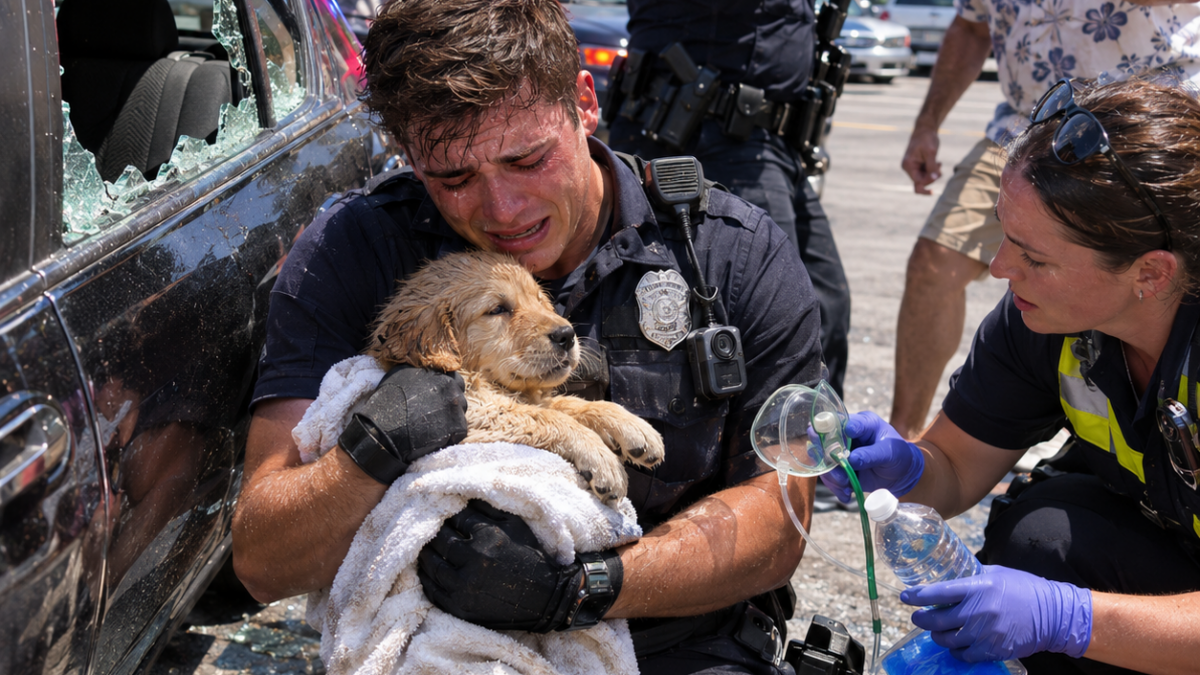
𝗙𝗨𝗟𝗟 𝗦𝗧𝗢𝗥𝗬:“PLEASE, DON’T LET HIM D!E!” I Was Only 5 Days Into My Police Career When I Smashed a Window to Rescue a Dying Puppy—My Captain Summoned Me the Next Morning, and I Feared I’d Lost Everything
PART 2 and FULL ENDING  Thank you

For one terrible moment, my training and my instincts began pulling me in opposite directions.
I knew procedures existed for a reason.
I knew damaging a citizen’s vehicle could have serious consequences if it wasn’t justified or authorized.
I knew I was the newest officer at the station.
And I knew that any mistake I made would be examined by people with far more experience than me.
Then I looked through the glass again.
The puppy was no longer trying to stand.
His head had fallen sideways against the seat.
His little chest moved so quickly that I could barely count the breaths.
I tapped the window.
“Hey, buddy.”
Nothing.
“Come on, little guy. Look at me.”
One brown eye opened.
Then closed.
I felt panic rising.
I called for urgent assistance and tried to locate the owner.
But every second felt enormous.
I could wait for Dos.
Wait for someone to find the driver.
Wait for another officer to confirm what I could already see.
Or I could act.
The puppy’s mouth opened.
A thin whimper escaped.
Then he stopped moving except for the desperate rise and fall of his chest.
I drew my baton.
My hands shook.
“I’m sorry,” I whispered, though I wasn’t sure whether I was speaking to the puppy, the car’s owner, or my own future.
Then I struck a side window away from the puppy.
The glass broke.
The sound exploded across the parking lot.
People turned.
Someone shouted.
I cleared the opening as carefully as I could, unlocked the door, and reached inside.
The heat hit my face like air from an open oven.
I lifted the puppy out.
He was frighteningly hot.
Far too still.
And as I held him against my uniform, I felt the weakest movement of his tongue against my wrist.
“Stay with me,” I whispered.
I carried him toward the shade.
“Please, little guy. Stay with me.”
I didn’t know whether he’d live.
I didn’t know whether I’d still have a badge tomorrow.
All I knew was that I’d broken the window, and there was no taking that decision back.
Then someone behind me shouted, “WHO THE HELL SMASHED MY CAR?”
I turned.
A man in his fifties stood several yards away, shopping bags hanging from both hands.
His face was turning red.
He looked at the broken window.
Then my baton.
Then the tiny puppy in my arms.
And he started walking straight toward me.
FULL STORY CONTINUATION
For a few seconds, I couldn’t decide which frightened me more.
The puppy’s condition.
Or the expression on the man’s face.
He marched across the parking lot with the kind of anger that makes strangers instinctively move aside.
His shopping bags swung against his legs.
One contained a package of paper towels. Another held groceries.
Ordinary things.
The kind of ordinary things someone buys when he expects to return to his car and continue his day.
But now there was shattered glass beside his vehicle.
And a young officer sitting on the pavement with a dog in his arms.
“WHAT HAPPENED TO MY WINDOW?”
I wanted to answer.
I opened my mouth.
But before I could speak, I heard Dos behind me.
“Alban?”
I turned.
He stood near the store entrance holding two bottles of water.
He looked at the broken glass.
Then at me.
Then at the puppy.
For a moment, his expression became unreadable.
I’d learned in my first five days that Dos wasn’t a man who reacted dramatically to much.
He didn’t yell when someone made a small mistake.
He didn’t smile when someone expected praise.
He watched, listened, and usually waited until he understood exactly what had happened before he spoke.
That calmness had made him intimidating to me.
Now, as the owner continued approaching, I desperately wanted him to say something.
Anything.
Instead, Dos came closer and crouched beside me.
“How’s the puppy?”
“Bad,” I whispered.
I could hear the tremor in my own voice.
“Heat exposure. Weak breathing. He was barely moving when I got him out.”
Dos handed me a bottle of water.
“Okay.”
He looked toward the shade.
“Let’s keep him cool and get veterinary help here.”
I nodded.
A woman who had watched from the sidewalk hurried toward us with another bottle.
“Can I do anything?”
Dos looked up.
“Please give us room. And help keep people back so the responders can get through.”
She nodded.
Then looked at the puppy.
Her eyes filled.
“Oh, sweetheart.”
I carried him a few more feet beneath the shelter of a building awning.
The pavement there was cooler.
I lowered myself carefully and supported his body across my lap.
With Dos guiding me, I gently moistened the puppy’s paws, ears, and belly with cool—not icy—water while we waited for veterinary assistance.
His little body trembled.
His eyes were only partly open.
I kept looking at his chest.
Watching each breath.
Counting.
Waiting.
Hoping.
“Come on,” I whispered.
“You can do this.”
The puppy moved his head.
Just a little.
Then his tongue touched my finger.
Once.
Weakly.
But unmistakably.
I stared at him.
“Dos.”
My partner looked down.
“He licked me.”
Dos’s face softened.
“Good.”
I swallowed.
“He’s still fighting.”
“Then we’re going to help him keep fighting.”
The owner reached us seconds later.
“Which one of you did that?”
His voice cut through the air.
He pointed toward the sedan.
“THAT’S MY CAR!”
Dos stood.
I remained seated with the puppy.
The man looked from one of us to the other.
“I was in the store for fifteen minutes!”
Dos didn’t raise his voice.
“Sir, your puppy was in serious distress.”
The man frowned.
“What?”
“The vehicle was locked, the engine was off, and the temperature outside is around one hundred degrees.”
The man looked at the puppy.
Then back at the car.
“I wasn’t gone that long.”
Dos’s expression remained calm.
“Even a short period in a parked vehicle can be dangerous in this heat.”
I looked down.
The puppy’s breathing was still too fast.
I felt my stomach tighten.
The owner pointed toward the broken window again.
“You can’t just smash my property!”
Dos stepped slightly between us.
“Sir, my partner removed your puppy from a life-threatening situation.”
The man stared at him.
Then at me.
His face remained red.
I braced myself.
He could make a complaint.
He could demand an investigation.
He could accuse me of acting outside procedure.
And because I was a rookie, I had no experience to fall back on except what I’d learned in training.
Dos continued.
“If you believe the window was damaged improperly, there are ways to raise that concern.”
The man opened his mouth.
“But right now,” Dos said, his voice firm, “the urgent issue is the dog you left inside.”
The man looked toward the puppy again.
For the first time, his anger seemed to falter.
He crouched several feet away.
“Is he…”
His voice changed.
“Is he okay?”
I looked at Dos.
Then back at the owner.
“We’ve requested veterinary help,” I said.
My voice sounded younger than I wanted.
“He was struggling to breathe when I found him. We’re cooling him carefully and monitoring him until the veterinarian gets here.”
The man stared.
The shopping bags slipped from one hand.
He didn’t seem to notice.
Then he whispered, “Oh, God.”
He looked at the puppy for a long time.
I watched his face change.
The anger didn’t disappear all at once.
It gave way slowly.
First to confusion.
Then alarm.
Then a kind of stunned recognition.
He’d walked out of the store and seen damage to his car.
Now he was beginning to understand what had happened inside it while he was gone.
His eyes moved over the puppy’s small body.
The weak breathing.
The wet fur.
The trembling paws.
And something inside him seemed to collapse.
“I didn’t think…”
His voice broke.
“I thought I’d be right back.”
Dos crouched beside him.
“What’s your name, sir?”
“Keller.”
The man swallowed.
“Mr. Keller.”
Dos nodded.
“Mr. Keller, do you understand why my partner acted?”
Mr. Keller didn’t answer.
He looked toward the car.
Then toward the puppy.
After a moment, he whispered, “I think I do.”
He pressed one hand against his forehead.
“Oh, God.”
I looked down at the dog.
His breathing remained labored, but he was responding more than before.
I stroked the soft fur near his ear.
“Stay with me, buddy.”
Mr. Keller looked toward me.
“Can I touch him?”
I hesitated.
Then nodded.
“Gently.”
He reached forward.
His fingers trembled.
He touched the puppy’s back.
For a moment, the dog didn’t react.
Then one ear moved.
Mr. Keller made a broken sound.
“Oh, sweetheart.”
His eyes filled.
And suddenly the man who’d been shouting about his window was staring at the little animal as though he couldn’t believe how close he’d come to losing him.
“Is he your dog?” Dos asked.
Mr. Keller looked up.
He hesitated.
Then shook his head.
“Not exactly.”
I frowned.
“What do you mean?”
He swallowed.
“He’s for my granddaughter.”
I looked toward the puppy.
Mr. Keller continued.
“Her birthday.”
His voice grew quieter.
“I was bringing him to her.”
He rubbed his hands together.
“I drove three hours to pick him up.”
For a moment, I couldn’t speak.
I imagined a little girl waiting at home.
Maybe she’d been told she was getting a puppy.
Maybe she hadn’t.
Maybe there was a ribbon or a little dog bed ready in her room.
Maybe she’d spent months asking her family for a dog.
Mr. Keller looked at the puppy.
“He’s supposed to be a surprise.”
The words seemed to hurt him.
He shook his head.
“I wanted everything to be perfect.”
His face crumpled.
“And I nearly…”
He couldn’t finish.
I swallowed.
Dos waited quietly.
Mr. Keller pressed the heels of his hands against his eyes.
Then whispered, “What have I done?”
The question didn’t sound like an attempt to excuse himself.
It sounded like a man finally seeing the consequences of a careless decision.
I looked down at the puppy.
His eyes opened slightly.
I felt a small movement against my arm.
“Mr. Keller,” I said quietly, “right now, he’s alive.”
The man looked at me.
“And we’re getting him medical care.”
His mouth trembled.
I continued.
“That’s what we need to focus on.”
He nodded.
But tears were already running down his face.
At twenty-four years old, I didn’t know much about what made people behave the way they did.
I understood laws and procedures.
I knew how to write reports.
I knew that people sometimes made dangerous decisions.
But I hadn’t yet spent enough time in uniform to understand how complicated the circumstances behind those decisions could be.
Mr. Keller sat on the pavement beside us.
He stared at the broken window.
Then at his shopping bags.
Then at the puppy.
After several minutes, he began talking.
At first, the words came slowly.
“I lost my job three months ago.”
Dos looked at him.
Mr. Keller continued.
“Thirty years working, and then suddenly I’m home every day.”
He tried to smile.
It didn’t work.
“My wife hasn’t been well.”
His voice trembled.
“We’ve had doctor visits. Bills. Things I never thought we’d be worrying about.”
I kept my hands supporting the puppy.
I listened.
Mr. Keller stared at the ground.
“My granddaughter is the brightest part of our lives right now.”
His eyes filled.
“She still thinks Grandpa can fix anything.”
I felt something tighten in my chest.
He looked at the puppy.
“I wanted to give her something wonderful.”
He swallowed.
“Something she’d remember.”
For a moment, he couldn’t continue.
Then he whispered, “And I nearly killed him.”
I looked toward Dos.
My partner didn’t interrupt.
Mr. Keller rubbed his face.
“I’ve been so tired.”
He took a shaky breath.
“So tired I barely know what I’m doing half the time.”
The parking lot continued moving around us.
People pushed shopping carts.
Cars pulled into spaces.
Someone laughed near the store entrance.
Ordinary life went on while Mr. Keller sat beside a shattered window, realizing the terrible mistake he’d made.
“I should have taken him inside with me or made other arrangements,” he whispered.
I nodded.
“Yes, sir.”
He looked at me.
I didn’t soften that answer.
His exhaustion might explain how he’d become careless.
It didn’t make leaving an animal in a dangerously hot car safe.
He seemed to understand.
His eyes lowered.
“I know.”
Then he whispered, “I really do.”
Mr. Keller looked toward the car again.
“How much is the window going to cost?”
I blinked.
“What?”
He gestured weakly toward the broken glass.
“Who’s paying for it?”
Before I could answer, Dos spoke.
“Mr. Keller, we’ll document what happened, and the normal process will address any property-damage questions.”
The man looked at him.
Dos continued.
“But the window is replaceable.”
He glanced toward the puppy.
“That little life isn’t.”
Mr. Keller’s face changed.
For a moment, he looked as though someone had struck him.
Then he bent forward and began crying.
Not loudly.
Not for attention.
The sobs came in short, exhausted breaths, as though he’d been holding something inside for months and no longer had the strength to keep it there.
“I almost ruined everything,” he whispered.
Dos put a steady hand on his shoulder.
“What matters now is that you understand the danger and don’t let it happen again.”
Mr. Keller nodded.
“I won’t.”
He looked toward me.
“I swear I won’t.”
I studied his face.
There was no arrogance left.
No anger about the window.
Only shame.
Fear.
And the terrible relief of seeing the puppy still breathing.
I looked down at the little golden body in my arms.
“Come on, buddy,” I whispered.
“Help’s coming.”
The puppy opened his eyes.
For a moment, they met mine.
Deep brown.
Exhausted.
Still fighting.
And I knew that whatever happened with my career, I would never regret getting him out.
I heard the emergency vehicle before I saw it.
A distant siren rose above the traffic and grew louder as it approached the shopping center.
Dos stood and signaled toward the entrance.
“Over here!”
I’d been concentrating so hard on the puppy that the noise startled me.
I looked up.
The veterinary emergency team had arrived with Dr. Hart, a young veterinarian whose focused expression immediately made me feel that someone more qualified was finally taking control.
She crossed the parking lot carrying medical equipment.
“Where’s the puppy?”
I lifted him carefully.
“Here.”
She crouched.
“What happened?”
I told her what I’d seen.
A locked sedan.
The engine off.
Windows closed.
Outside temperature near 100 degrees.
The puppy lying on the back seat with rapid, shallow breathing and barely enough strength to move.
I explained how we’d removed him, brought him into the shade, and begun gentle cooling.
Dr. Hart listened without interruption.
Then she began examining him.
She checked his responsiveness.
His breathing.
His heart.
His temperature.
His hydration status.
I watched every movement.
Her calmness helped, but I could see how seriously she was taking his condition.
Mr. Keller moved closer.
“Doctor, is he going to die?”
His voice was so quiet that I almost didn’t hear him.
Dr. Hart looked up.
“He’s experienced dangerous heat exposure, and we need to treat that seriously.”
The man swallowed.
“Can you save him?”
“We’re going to give him the care he needs and monitor him closely.”
I felt my stomach tighten.
It wasn’t the certainty I wanted.
But it was an honest answer.
Dr. Hart looked toward me.
“How long was he inside?”
“The owner estimates around fifteen minutes.”
She nodded.
Then asked about the puppy’s condition when I’d first reached the car.
I described the trembling.
The weakness.
The way he’d stopped trying to lift his head.
The rapid breathing.
She continued her assessment.
Then gently supported him while a technician prepared the next steps.
The puppy raised his head slightly.
Dr. Hart smiled.
“There you are.”
I leaned forward.
“Is that good?”
“It’s encouraging that he’s responding.”
She looked at me.
“But we’re not going to assume he’s out of danger yet.”
I nodded.
“Of course.”
For several minutes, the team worked quietly.
Mr. Keller stood beside Dos, clutching the shopping bag he’d somehow remembered to pick up.
He looked like a man afraid that if he spoke, someone would tell him the worst.
I understood the feeling.
Because I was waiting for the same thing.
Eventually, Dr. Hart looked toward us.
“His condition is improving with treatment.”
My knees nearly gave way.
I stared at her.
“Really?”
She nodded.
“He needs further observation, but he’s more responsive, and we’re seeing encouraging signs.”
Mr. Keller let out a sound that was half sob and half breath.
I closed my eyes.
The veterinarian continued.
“Getting him out of the car when you did was very important. Prolonged heat exposure could have caused a much worse outcome.”
I looked toward the shattered window.
Then back at the puppy.
“So I wasn’t too late?”
Dr. Hart’s expression softened.
“No.”
The word seemed to lift an enormous weight from my chest.
She looked at me.
“You acted in time to give him a chance.”
I swallowed.
For the first time since I’d seen that tiny body on the back seat, I allowed myself to breathe normally.
Then the puppy turned his head.
He looked at me.
His tail moved faintly.
Just a little movement against the towel beneath him.
I laughed.
Then immediately felt tears run down my face.
“Hey, little guy.”
Dr. Hart smiled.
“He’s still going to need veterinary monitoring. But we’re hopeful.”
Mr. Keller approached slowly.
“Doctor?”
She looked up.
“I want you to understand how dangerous this situation was,” she told him.
He nodded.
“I do.”
“A parked car can heat up rapidly. Even a brief shopping trip can expose an animal to life-threatening temperatures.”
Mr. Keller lowered his eyes.
“I know that now.”
Dr. Hart studied him.
“Please make sure this never happens again.”
He nodded repeatedly.
“It won’t.”
His voice cracked.
“I promise.”
She turned back to the puppy.
I watched her adjust the towel around his small body.
There was something almost impossible about the scene.
An hour earlier, I’d been worried about remembering every procedure I’d learned.
Now I was sitting on the ground beside a broken car window, listening to a veterinarian explain that a tiny golden puppy might survive because I’d decided not to wait.
I looked at Dos.
He was watching me.
His expression was calm.
But his eyes were bright.
I nodded toward the puppy.
“He’s going to make it.”
Dos smiled slightly.
“Looks like he’s got a fighting chance.”
And for the first time that day, I smiled too.
After the puppy was transferred into Dr. Hart’s care, I stood.
My legs felt unsteady.
I hadn’t realized how long I’d been sitting in the heat.
The back of my uniform shirt was damp.
My hands were trembling.
There was a small cut near one knuckle from the broken glass, though I barely noticed it.
Dos looked at me.
“You okay?”
I nodded.
“Yeah.”
He raised an eyebrow.
“Alban.”
I exhaled.
“I’m not sure.”
He looked toward the veterinary vehicle.
“Understandable.”
Mr. Keller stood nearby.
He hadn’t said much since Dr. Hart explained the danger.
Now he approached.
“Officer?”
I turned.
“Yes, sir?”
He looked at my uniform.
Then my face.
“Are you new?”
I hesitated.
I couldn’t tell whether the question was another criticism.
Maybe he thought only an inexperienced officer would break a car window.
Maybe he wanted to know whom to name in a complaint.
“Fifth day,” I answered.
He stared.
“Your fifth day?”
“Yes, sir.”
His eyes filled again.
He looked toward the shattered window.
Then the veterinary team.
Then back at me.
“Five days.”
I nodded.
For a moment, neither of us spoke.
Then he said something I wasn’t prepared to hear.
“Your father would be proud of you.”
The words hit me harder than his earlier shouting.
I looked away.
I don’t know why Mr. Keller said it.
Maybe he saw how young I was.
Maybe he recognized that I’d been frightened.
Maybe he was thinking about what he hoped someone would do for his own family in an emergency.
But something about those words reached a part of me I’d been trying to ignore since I first put on the uniform.
My father had always believed that the measure of a person was what he did when doing the right thing came with a cost.
He wasn’t a police officer.
He didn’t know much about patrol procedures.
But he’d spent my childhood teaching me that responsibility wasn’t the same as appearing important.
I remembered standing beside him years earlier after finding an injured bird near our house.
I’d wanted to leave it because I was afraid of touching it.
My father had helped me arrange safe assistance.
Then he’d said, “When something helpless needs you, don’t spend so much time worrying about how you look that you forget to help.”
I’d carried that lesson with me.
But until that afternoon, I’d never understood how frightening it could be to follow.
I turned back toward Mr. Keller.
“Thank you, sir.”
My voice nearly failed.
He nodded.
Then whispered, “And I’m sorry.”
I looked at him.
“For yelling at you.”
He swallowed.
“I saw my window and got angry before I understood what you’d done.”
I nodded slowly.
He continued.
“I should have been thinking about that puppy.”
His eyes filled.
“Instead, I was thinking about the car.”
I looked toward the veterinary team.
“The important thing now is getting him better.”
Mr. Keller nodded.
“Yes.”
He wiped his face.
“Thank you for not waiting.”
I swallowed.
Then looked toward Dos.
My partner said nothing.
But the small nod he gave me meant more than any speech could have.
We still had to document the incident.
That reality returned as the immediate crisis eased.
A broken window was still a broken window.
A citizen’s vehicle had been damaged.
A puppy had required emergency veterinary care.
And I’d taken action that needed review under department procedures.
Dos stepped aside to use his radio.
I watched him.
For the first time since I’d pulled the puppy from the car, anxiety returned.
I could almost hear the questions I’d be asked.
Why didn’t you wait for your partner?
What exact signs of distress did you observe?
What other options did you consider?
Why did you decide immediate entry was necessary?
Could you have done something differently?
I looked toward the window.
The broken opening seemed enormous now.
Glass glittered on the pavement.
A few people had stopped to watch from a distance.
Mr. Keller stood beside the vehicle, looking at the empty back seat.
He seemed older than he had when he first approached.
I wondered whether he’d be angry again once the fear wore off.
I wondered whether he’d complain about the damage.
I wondered whether Dos would tell the captain I should have waited.
Then my partner returned.
“The station’s been notified.”
I felt my stomach drop.
I nodded.
“Okay.”
Dos looked at me.
“We have to report what happened.”
“I know.”
He studied my face.
“You’re worried.”
I laughed weakly.
“Is it that obvious?”
“Pretty obvious.”
I rubbed the back of my neck.
“Did I violate procedure?”
Dos didn’t answer immediately.
Then he said, “You made an emergency judgment. The department will review it.”
I looked down.
“That doesn’t sound reassuring.”
He stepped closer.
“Alban, listen to me.”
I raised my eyes.
“You saw an animal in immediate danger. You called for help. You acted. And now you’re going to explain exactly what you observed and why you believed waiting would put that puppy at greater risk.”
I swallowed.
“What if they say I should’ve waited?”
“Then we’ll deal with that question.”
He paused.
“But I’m not going to pretend the puppy wasn’t in danger.”
I nodded.
Dos placed a hand on my shoulder.
“I’m with you.”
Three words.
That’s all he said.
But in that moment, they mattered more than he could have known.
Back at the station, I wrote my report.
I included the time.
The weather.
The vehicle’s location.
The visible condition of the puppy.
The absence of the owner.
The steps I’d taken to seek assistance.
My assessment that the animal was deteriorating.
The window entry.
The care provided afterward.
The veterinary response.
And the conversation with Mr. Keller.
I tried to be precise.
I didn’t describe myself as brave.
I didn’t suggest I’d saved the puppy single-handedly.
Dos, the bystander, Dr. Hart, and the veterinary team had all helped.
And I didn’t pretend I had been completely calm.
I hadn’t.
I’d been frightened.
I’d known I was making a consequential decision with imperfect information.
But I’d believed the puppy couldn’t safely wait.
I wrote that too.
When I finished, I read the report twice.
Then a third time.
I wanted every word correct.
Dos came over with two cups of coffee.
“You going to wear a hole through that keyboard?”
I looked up.
“Just checking everything.”
He set one cup beside me.
“Good habit.”
I took a sip.
The coffee was bitter.
I barely tasted it.
“Dos?”
“Yeah?”
“Do you think the captain’s going to be angry?”
He leaned against the desk.
“Captain Morrison takes incidents seriously.”
I stared at him.
“That wasn’t the question.”
Dos smiled faintly.
“I know.”
I sighed.
He looked toward my report.
“Tell the truth. Don’t exaggerate. Don’t leave out anything because you’re embarrassed.”
I nodded.
“Okay.”
He started to walk away.
Then turned.
“And Alban?”
“Yeah?”
“You did not look away when that puppy needed help.”
I swallowed.
He held my gaze.
“Remember that.”
That night, I couldn’t sleep.
I lay on my back staring at the ceiling, replaying the afternoon.
The locked sedan.
The weak whimper.
The puppy’s head falling sideways.
The baton in my hand.
The sound of breaking glass.
Mr. Keller’s shout.
Dos stepping between us.
Dr. Hart telling me the puppy was improving.
Every time I began to drift off, I remembered the moment I’d raised the baton.
There had been a split second when I could still choose not to strike.
I knew it.
My hand had hesitated.
I could have stepped backward.
Waited for more information.
Called again.
Kept trying to find the owner.
Maybe the puppy would have survived anyway.
Maybe he wouldn’t.
I’d never know.
But I knew what I’d seen through the window.
An animal losing the strength to lift his head.
And I knew the temperature.
One hundred degrees outside.
A locked vehicle sitting in direct sunlight.
I turned onto my side.
The digital clock beside my bed glowed 2:17 a.m.
I closed my eyes.
And imagined arriving at work the next morning only to be told I’d made a mistake too serious to forgive.
Five days.
That’s how long I’d been a police officer.
I’d worked for the badge.
Studied.
Trained.
Imagined what it would mean to serve my community.
And now I was frightened that the very first decision that truly tested me might be the one that ended my career.
I remembered my father’s words.
When something helpless needs you, don’t forget to help.
I whispered into the darkness, “I tried.”
Then I lay awake wondering whether trying would be enough.
The message arrived shortly after I reported for duty the next morning.
OFFICER ALBAN — REPORT TO CAPTAIN MORRISON’S OFFICE.
My stomach dropped.
I stared at the notice.
Then read it again.
There was no explanation.
No reassuring sentence.
No indication whether the meeting was routine or disciplinary.
Just an instruction to report.
Dos was near the coffee machine.
He saw my expression.
“What?”
I held up the notice.
He looked at it.
Then nodded.
“Go.”
I swallowed.
“That’s it?”
“What else do you want me to say?”
“Maybe that everything’s going to be fine.”
He smiled slightly.
“Would you believe me?”
I thought about it.
“No.”
“Then go talk to him.”
I took a deep breath.
Straightened my uniform.
And walked down the hallway.
Each step seemed louder than the last.
Captain Morrison’s office was near the end.
I’d been inside only once before, during my introduction to the department.
He was around sixty, with silver hair, a lined face, and eyes that made you feel he could hear the thoughts you were trying not to say aloud.
He’d spent decades in law enforcement.
His office was immaculate.
There were commendations on the wall.
Framed photographs.
A neatly organized desk.
A few personal items that suggested a life outside the badge.
I knocked.
“Come in.”
I opened the door.
Captain Morrison was sitting behind his desk.
He didn’t smile.
“Officer Alban.”
“Sir.”
“Close the door.”
I did.
Then stood in front of him with my hands behind my back.
My heart was beating so loudly I could hear it.
He looked down at a file.
Then up at me.
“Yesterday, you broke the window of a citizen’s vehicle without first obtaining the authorization ordinarily required under department procedure.”
I swallowed.
“Yes, sir.”
He leaned back.
“You knew that requirement?”
“Yes, sir.”
“And you acted anyway.”
I could feel sweat gathering beneath my uniform.
“Yes, sir.”
He studied me.
For a long time, he said nothing.
Then he asked, “Why?”
I took a breath.
“Because the puppy was in immediate danger.”
His eyes remained on mine.
I continued.
“The windows were closed. The engine was off. The outside temperature was near one hundred degrees. The puppy was weak, breathing rapidly, and becoming less responsive.”
The captain listened.
“I believed waiting longer could cost him his life.”
He looked down at the report.
“And you decided to break the window.”
“Yes, sir.”
“Were you frightened?”
The question surprised me.
I hesitated.
Then answered honestly.
“Yes, sir.”
“Of the owner?”
“Of making the wrong decision.”
Captain Morrison studied me.
Then asked, “And what frightened you more?”
I looked down.
For a moment, I considered the safest answer.
Something polished.
Something about public service.
But Dos had told me to tell the truth.
So I did.
“The thought of watching that puppy die while I stood outside worrying about my career.”
The captain didn’t move.
I held my breath.
And waited.
Captain Morrison opened the file again.
For a moment, the only sound in the room was the hum of the air conditioner.
He turned one page.
Then another.
I watched his hands.
They were steady.
Mine weren’t.
Finally, he closed the folder.
“Officer Alban, do you know why procedures exist?”
I swallowed.
“To protect people, sir. And to make sure officers act lawfully and consistently.”
He nodded.
“And what happens when officers decide rules don’t apply to them?”
“People get hurt.”
“Exactly.”
I lowered my eyes.
Captain Morrison continued.
“An officer who believes his intentions are always good can become a dangerous officer.”
I felt my stomach tighten.
He leaned forward.
“Because good intentions don’t eliminate the need for judgment, restraint, or accountability.”
“Yes, sir.”
He studied me.
“Do you think you’re above the rules?”
I looked up immediately.
“No, sir.”
“Do you think saving the puppy means nobody has the right to question how you acted?”
“No, sir.”
“Then why are you standing there looking as though you’ve already been sentenced?”
I blinked.
For a moment, I didn’t know what to say.
The captain’s expression softened slightly.
“Sit down, Alban.”
I hesitated.
Then sat.
He looked toward a framed photograph on the wall.
It showed a much younger Captain Morrison standing beside an ambulance, wearing an old-fashioned uniform.
He was smiling.
I hadn’t paid much attention to it during my first visit.
Now he stared at the picture for several seconds.
Then he said, “Thirty-five years ago, I broke a car window.”
I looked at him.
“Sir?”
He nodded.
“I was a young officer. Not much older than you.”
I sat straighter.
“It was summer.”
His voice became quieter.
“A little girl had been left in the back seat of a car.”
My chest tightened.
He looked toward the window.
“Her mother had forgotten she was there.”
For several seconds, neither of us spoke.
Then he continued.
“The car was hot. The child was in distress. I couldn’t wait.”
I watched him.
“I broke the window.”
He looked down at his hands.
“And just like you, I knew I’d have to explain why.”
My throat tightened.
“What happened to her?”
The captain smiled faintly.
“She survived.”
I let out a breath.
He looked toward the photograph again.
“She was very young then. Only a few years old.”
His eyes softened.
“Today, she’s thirty-eight.”
I stared at him.
“She has two children of her own.”
He opened a drawer.
For a moment, I wondered whether he was reaching for another report.
Instead, he removed a greeting card.
The envelope was decorated with a red ribbon and a little green wreath.
He held it carefully.
“Every Christmas, she sends me a card.”
I felt something tighten in my chest.
He looked at it.
“Thirty-five years.”
I could barely speak.
“Every year?”
He nodded.
“Every single one.”
He opened the card.
I couldn’t read the message from where I sat.
But I saw the captain’s expression change.
The sternness disappeared.
For a moment, he wasn’t a commander evaluating a rookie’s conduct.
He was a man remembering a frightened little girl whose life had continued because someone acted when she couldn’t protect herself.
He carefully returned the card to its envelope.
Then looked at me.
“Some decisions stay with you, Alban.”
I swallowed.
“Yes, sir.”
“Sometimes because you regret them.”
He paused.
“And sometimes because you’re grateful you made them.”
Captain Morrison folded his hands on the desk.
“I want you to understand what I’m about to say.”
I straightened.
“Yes, sir.”
“The law matters.”
I nodded.
“Procedures matter.”
“Yes, sir.”
“Authorization requirements matter. Reporting matters. Careful judgment matters.”
I kept my eyes on him.
“And if you ever begin believing that your personal feelings give you unlimited power to damage property or ignore lawful instructions, you won’t be fit to wear that uniform.”
My stomach tightened again.
He leaned forward.
“But an emergency isn’t always going to wait for a perfect set of circumstances.”
I listened.
“Sometimes you’ll have seconds to assess the danger, consider the available options, and choose an action that can be justified afterward.”
He paused.
“The important question isn’t whether you felt emotional.”
His voice became firm.
“It’s whether you had a reasonable basis for believing immediate action was necessary, whether the response was proportionate, and whether you can account honestly for what you did.”
I nodded.
He glanced at my report.
“Your observations were specific. You requested help. You chose a window away from the animal. You removed him from danger and sought veterinary care.”
I felt my throat tighten.
He continued.
“I’ve reviewed the circumstances and spoken with your partner.”
My heart began racing again.
“Sir?”
Captain Morrison looked directly at me.
“I am not imposing disciplinary sanctions.”
For a moment, I didn’t understand the words.
Then they reached me.
I felt my shoulders drop.
I drew a breath that seemed to come from somewhere deep inside my chest.
“Thank you, sir.”
He lifted a hand.
“Don’t thank me yet.”
I straightened.
“There’s still a lesson here.”
“Yes, sir.”
“I want you to remember the importance of acting on evidence, not impulse.”
He pointed toward the file.
“Yesterday, you saw an animal in immediate danger. You assessed the situation and acted to protect a life.”
His expression softened.
“And in those circumstances, I believe your judgment was sound.”
My eyes burned.
I looked down quickly.
The captain noticed.
He pretended not to.
Then he said, “You know, Alban, when I was young, I thought the badge was the most important part of being an officer.”
I looked up.
He smiled faintly.
“Took me a while to learn that the badge doesn’t make your decisions for you.”
I swallowed.
“No, sir.”
“Your training helps.”
He nodded toward the report.
“Your procedures guide you. Your partners support you.”
Then he placed one hand against the desk.
“But eventually, there will be a moment when someone needs help and you have to decide what the situation actually requires.”
I thought about the puppy.
The closed windows.
The weak breathing.
The baton.
Captain Morrison continued.
“When that moment comes, you need a clear head, a sound reason for acting, and the courage to be accountable afterward.”
I nodded.
“I understand.”
He studied me for a moment.
Then said, “One more thing.”
“Yes, sir?”
“Don’t stop asking yourself whether you did the right thing.”
I frowned slightly.
He smiled.
“The officers who frighten me most are the ones who never question themselves.”
I sat quietly.
Then nodded.
“Yes, sir.”
Captain Morrison opened the file again.
“You may return to duty.”
I stood.
“Thank you, Captain.”
He looked up.
“And Alban?”
I stopped.
“Yes, sir?”
His eyes softened.
“How’s the puppy?”
I felt a smile spread across my face.
“Dr. Hart says he’s improving.”
The captain nodded.
“Good.”
Then he returned to his paperwork.
I walked out of the office feeling as though the air in the entire building had changed.
Dos was waiting in the hallway.
Two cups of coffee.
One in each hand.
He looked at my face.
Then at the closed office door.
“Well?”
I stood there for a moment.
He raised an eyebrow.
“Alban?”
I swallowed.
“I still have a job.”
Dos grinned.
Then handed me one of the cups.
“Told you.”
I laughed.
“You did not tell me.”
“Sure I did.”
“You told me to go talk to him.”
“Same thing.”
I shook my head.
For the first time since the incident, I felt genuinely light.
Dos took a sip of coffee.
“So, what did he say?”
I told him.
The review.
The questions.
The story about the little girl.
The Christmas cards.
And the decision not to discipline me.
Dos listened.
Then nodded.
“Sounds like Morrison.”
I looked at him.
“You knew about the little girl?”
“Not the whole story.”
I studied his face.
He smiled.
“Captain doesn’t talk about himself much.”
We walked toward the break room.
Then Dos added casually, “Besides, I told him I’d resign if he punished you.”
I stopped.
“What?”
He kept walking.
“Yep.”
“Dos.”
He looked back.
“What?”
“Please tell me you’re joking.”
He grinned.
“Can’t afford to lose your partner, can I?”
I stared at him.
“We’ve worked together for five days.”
“Five excellent days.”
I laughed.
He continued.
“And I told him the whole station would fall apart without me.”
I shook my head.
“You’re impossible.”
“That’s why they keep me.”
I followed him into the break room.
But beneath the joke, I understood something important.
Dos had stood beside me when the owner was furious.
He’d helped the puppy.
He’d told the truth in his report.
And he’d made certain the captain understood what he’d seen.
He hadn’t protected me by pretending I couldn’t make mistakes.
He’d protected me by being honest about what happened.
That meant more than any dramatic promise to quit.
The rest of the week passed quietly.
Or as quietly as a police station ever gets.
There were calls to answer.
Reports to complete.
Patrol areas to cover.
People who needed assistance.
And ordinary problems that didn’t involve broken windows or endangered animals.
I was grateful for the routine.
But I still found myself thinking about the puppy.
Every time I passed a parked car, I looked through the windows.
Whenever I saw an animal outside on a hot day, I paid attention to whether it had shade and water.
I didn’t suddenly believe every situation required dramatic intervention.
If anything, the experience had made me more careful.
I understood now how quickly things could become serious.
And how important it was to distinguish discomfort from immediate danger while still acting promptly when life was at risk.
Dos noticed.
One afternoon, we were stopped at an intersection when he glanced toward me.
“You checking every car in town now?”
I smiled sheepishly.
“Maybe.”
He nodded.
“Good to stay observant.”
Then he added, “Just remember to look at the road too.”
I laughed.
“Got it.”
He smiled.
For the first time, I felt as though he was treating me less like a nervous recruit and more like a real partner.
I was still learning.
I made small mistakes.
I asked questions that probably seemed obvious to him.
But I was no longer terrified of admitting what I didn’t know.
And that was another lesson I hadn’t expected to learn from a puppy.
Asking for guidance wasn’t weakness.
Pretending you had nothing left to learn was.
A few days later, a letter arrived at the station.
It was addressed to me.
Not electronically.
Not through an official department form.
A real envelope with my name written carefully across the front.
Dos spotted it first.
“Fan mail.”
I looked up.
“What?”
He held it out.
“Your first admirer.”
I took the envelope.
The handwriting was unfamiliar.
There was no return address I immediately recognized.
I opened it carefully.
Inside was a handwritten letter.
At the top was a name.
Mr. Keller.
My stomach tightened.
For a moment, I worried that it might be a complaint.
Maybe he’d reconsidered his apology.
Maybe the cost of replacing the window had upset him.
Maybe he’d decided to challenge my actions after all.
Then I began reading.
And everything changed.
Mr. Keller wrote that the puppy had recovered completely.
Dr. Hart had continued monitoring him after the rescue, and his condition had improved without the lasting harm everyone had feared that afternoon.
The little golden dog was eating normally.
Playing.
Sleeping comfortably.
And behaving like a puppy who had no idea how close he’d come to dying.
I read those lines twice.
Then I let out a long breath.
Dos glanced toward me.
“Well?”
I held up one finger.
“Wait.”
I kept reading.
Mr. Keller wrote that he’d finally brought the puppy to his granddaughter.
Her name was Emma.
When she saw him, she’d burst into tears.
At first, they were tears of excitement.
Then Mr. Keller had explained what happened.
Not every frightening detail.
But enough for her to understand that the puppy had been trapped in a dangerously hot car and that a police officer had broken the window to save him.
Emma had cried again.
Then she’d held the little dog against her chest and told her grandfather that he needed a name.
She chose Sunny.
Because his fur was the color of sunlight.
And because, according to Mr. Keller, she’d said that a puppy who survived such a frightening day deserved a name that sounded happy.
I stared at the page.
Sunny.
For days, I’d been calling him the puppy.
Or the little guy.
Now he had a name.
And a family.
And a little girl who wanted to spend every possible minute with him.
I felt tears gathering.
The letter continued.
Mr. Keller wrote that Emma considered me a hero.
She’d asked her grandfather whether I had a cape.
When he told her I wore a police uniform, she’d apparently declared that a uniform was better because heroes could wear one every day.
I laughed out loud.
Dos looked up.
“What?”
I shook my head.
“His granddaughter thinks I should wear a cape.”
Dos grinned.
“Absolutely not. The station already has enough problems.”
I laughed harder.
Then kept reading.
The last part of Mr. Keller’s letter was different.
The handwriting grew slightly less steady.
He wrote about losing his job.
About his wife’s illness.
About feeling exhausted and overwhelmed for months.
He admitted that he’d been so focused on making Emma’s birthday special that he’d ignored the danger of leaving Sunny inside the vehicle.
He didn’t ask me to excuse the decision.
He didn’t blame the heat.
He didn’t blame the store.
He didn’t blame the fact that he’d been gone only fifteen minutes.
He wrote that he’d made a terrible mistake.
And that seeing Sunny struggling to breathe had frightened him more than any broken window ever could.
Then he told me something I hadn’t expected.
He had begun speaking with a psychologist.
He’d realized that his grief, exhaustion, and anxiety were affecting his judgment and his ability to manage ordinary responsibilities.
He wanted help.
Not because an officer had forced him to seek it.
Because he didn’t want to put anyone he loved in danger again.
I sat very still.
The letter continued.
He said that for the first time in months, he felt a little hope.
Not because his problems had disappeared.
His job was still gone.
His wife still needed medical care.
The bills still existed.
But he’d begun taking steps to face those problems instead of trying to carry them alone.
And he was grateful that Sunny had survived long enough to become part of Emma’s life.
Then I reached the final paragraph.
I read it once.
Then again.
And finally a third time.
You taught me that it’s never too late to make the right choice. Thank you, Officer Alban, for saving Sunny. And thank you for reminding me of the kind of man I still want to be.
I lowered the paper.
Dos was watching me.
“Good letter?”
I nodded.
My voice wouldn’t come.
He waited.
Then I handed it to him.
He read quietly.
When he finished, he folded it carefully.
Then looked at me.
“You going to keep that?”
I nodded.
“Yeah.”
He smiled.
“Good.”
I looked toward the window.
Outside, the afternoon sun was shining on the parking lot.
For a moment, I saw Sunny as he’d been that day.
Small.
Overheated.
Barely moving.
Then I imagined him running across a living-room floor while Emma laughed.
I smiled through my tears.
“I think he’s going to be okay.”
Dos nodded.
“Sounds like more than one person is.”
I put the letter in the drawer of my desk.
I didn’t frame it.
Didn’t post it online.
Didn’t show it to everyone who came into the station.
It wasn’t a trophy.
It was a reminder.
On difficult days, when I worried that my work wasn’t making much difference, I sometimes opened the drawer and read it.
The paper gradually softened along the folds.
The ink remained clear.
And the message never became less meaningful.
Mr. Keller had made a dangerous mistake.
Sunny had nearly died.
But the outcome hadn’t ended with blame, anger, and a broken window.
There had been accountability.
An apology.
A lesson about heat safety.
A man recognizing he needed help.
And a puppy growing stronger in a home where a little girl adored him.
I thought about how easily the entire story might have ended differently.
A few more minutes in the car.
A later discovery.
A moment when I looked at the closed door and decided it wasn’t my problem.
But it hadn’t ended that way.
Sunny was alive.
And every time I looked at Mr. Keller’s letter, I remembered why.
Three years have passed since that afternoon.
I’m still a police officer.
I still put on my uniform every morning.
Still check my equipment.
Still climb into a patrol car and wonder what the day will bring.
And Dos is still my partner.
We still drink coffee together before our shifts.
He still complains that I ask too many questions.
I still tell him that someone needs to make sure he doesn’t become too comfortable.
And he still responds by reminding me that I was five days into the job when I decided to break a car window.
Usually, he says it with a grin.
Sometimes, when we’re having a difficult day, he says it more quietly.
As a reminder that we came into this profession to help people and protect lives, not simply to complete reports.
Captain Morrison retired last year.
The station felt different after he left.
He’d been the kind of leader whose presence made everyone stand a little straighter.
Not because he frightened them.
Because he expected them to take the work seriously.
On his final day, we held a small gathering.
There were photographs.
Stories.
A cake someone had decorated with a slightly crooked police badge.
Morrison made a short speech about teamwork and responsibility.
Then he stepped away from the microphone.
I found him standing beside the window, looking out toward the parking lot.
“Captain?”
He turned.
“Alban.”
I smiled.
“Just wanted to say thank you.”
He raised an eyebrow.
“For what?”
I looked at him.
“For what you said after the puppy incident.”
His expression softened.
“Still thinking about that?”
“Every day.”
He nodded slowly.
“Good.”
I laughed.
“You never did like making things easy.”
He smiled.
“Easy answers don’t always make good officers.”
For a moment, neither of us spoke.
Then he placed one hand on my shoulder.
“How’s the dog?”
I grinned.
“Doing great.”
“Good.”
He looked toward the window again.
“Keep learning, Alban.”
I nodded.
“I will.”
“And remember that the person behind the badge matters more than the shine on it.”
My throat tightened.
“Yes, sir.”
He smiled.
Then walked back toward the celebration.
I watched him go.
And I thought about the little girl whose Christmas cards he’d kept for thirty-five years.
Some acts of service become memories that follow you for the rest of your life.
I knew mine would.
Sunny is three years old now.
He’s no longer the tiny golden puppy I could hold easily against my chest.
He’s grown into a strong, beautiful dog with a thick golden coat, bright brown eyes, and a tail that seems incapable of staying still.
Emma sends photographs through her grandfather.
Usually about once a month.
Sometimes more often when Sunny does something particularly ridiculous.
There’s one of him lying upside down in the grass.
Another of him sitting beside a birthday cake decorated with a dog-shaped candle.
One of him asleep on a blanket with his paws stretched toward the fireplace.
And countless pictures of Emma smiling beside him.
She’s grown older too.
But in every photograph, there’s the same expression on her face.
That unmistakable happiness of a child who feels completely loved by an animal.
Sometimes Sunny is wearing a little bandanna.
Sometimes he’s covered in mud.
Sometimes he’s holding a tennis ball and staring toward the camera as though he’s impatient for everyone to stop taking pictures and throw it.
I keep my favorites.
Not because I want credit for saving him.
Because they remind me what was at stake.
When I broke that window, I didn’t know about Emma.
I didn’t know about Mr. Keller’s lost job.
I didn’t know about his wife’s illness.
I didn’t know that the puppy was supposed to be a birthday present.
I saw one small life in danger.
That was enough.
But now, when I look at those photographs, I understand that Sunny’s life became intertwined with so many others.
Emma’s.
Mr. Keller’s.
His wife’s.
Mine.
Even Dos’s, though he’d never admit how often he asks whether we’ve received another photograph.
I visited Sunny once.
Mr. Keller invited me to the house where Emma lived with her family.
It was a quiet afternoon.
The weather was mild.
There were flowers near the front steps and children’s toys scattered around the yard.
When I arrived, Emma was waiting at the door.
She recognized me immediately.
“Officer Alban!”
I smiled.
“Hi, Emma.”
She looked at my hands.
“Did you bring Sunny a present?”
I laughed.
“Should I have?”
She grinned.
“Probably.”
Then she opened the door wider.
And a golden blur came charging down the hallway.
“Sunny!” she called.
The dog ran toward me with his tail wagging so hard that his entire body moved.
I crouched.
“Hey, buddy!”
He reached me.
Stopped.
Sniffed my hands.
Then pressed his head against my knee.
For a moment, I couldn’t move.
The sensation was so familiar.
The warmth of his fur.
The pressure of his head.
Those deep brown eyes looking straight into mine.
I was back in the parking lot.
Sitting beneath the store awning.
Holding a tiny puppy who had barely enough strength to lick my finger.
Only now he was healthy.
Strong.
Full of life.
I placed one hand against his neck.
“Look at you.”
Sunny wagged harder.
I laughed.
“You got big.”
Emma crouched beside us.
“He remembers you.”
I looked at her.
She said it with the absolute certainty only a child can have.
“He always remembers.”
I smiled.
“Maybe he does.”
She stroked Sunny’s back.
“Grandpa told me you saved him.”
I looked down.
“He had a pretty rough day.”
Emma nodded solemnly.
“Grandpa said Sunny was very sick.”
“He was.”
She looked at the dog.
Then at me.
“And you broke the window so he could get out.”
I nodded.
“Yes.”
Her eyes widened.
“Were you scared?”
The question surprised me.
I could have smiled and told her no.
I could have acted like the fearless officer she seemed to imagine.
But I remembered Captain Morrison.
Don’t stop asking yourself whether you did the right thing.
I looked at Emma.
“Very scared.”
She frowned.
“Of the puppy?”
I shook my head.
“No. I was scared he might not survive.”
She looked down at Sunny.
Then wrapped both arms around his neck.
The dog leaned gently against her.
For a moment, she said nothing.
Then she whispered, “But he did.”
I felt my throat tighten.
“Yes.”
I smiled.
“He did.”
Mr. Keller joined us in the living room.
He looked different from the man I’d met in the parking lot.
His face was more relaxed.
The exhausted look in his eyes had softened.
He still carried the weight of the difficulties he’d described in his letter, but he no longer seemed to be collapsing beneath them.
He shook my hand.
“Good to see you, Officer.”
“You too, Mr. Keller.”
He smiled.
“Please. Just Keller is fine.”
We sat down.
Sunny settled beside Emma’s chair, occasionally glancing toward me.
Mr. Keller brought coffee.
Then sat opposite me.
For a while, we talked about ordinary things.
Emma’s school.
Sunny’s habits.
The way he liked to steal socks and carry them around the house.
The trouble he’d caused by digging a hole near the flower bed.
The time he’d splashed water all over the kitchen after deciding his drinking bowl was better used as a toy.
Emma laughed so hard telling that story that she nearly fell off her chair.
I laughed with her.
And as I listened, I kept thinking about how different the room would have been if Sunny hadn’t survived.
No dog sleeping near the couch.
No mud tracked across the floor.
No stolen socks.
No little girl laughing about a ridiculous animal who made every ordinary day more interesting.
The absence would have been enormous.
Yet in the parking lot, before I broke the window, all I’d seen was a tiny golden body.
I hadn’t known how much joy that little life might bring.
I was grateful I’d acted before it was too late to find out.
When Emma went outside to throw Sunny’s ball, Mr. Keller and I remained near the window.
We watched the dog race across the yard.
He caught the ball.
Dropped it.
Then ran back toward Emma as though he’d forgotten what game they were playing.
She laughed.
Mr. Keller smiled.
For a while, neither of us spoke.
Then he said, “I still think about that day.”
I looked at him.
“So do I.”
He stared toward the yard.
“I’ve replayed it a thousand times.”
I waited.
“The store. The shopping list. The moment I decided he’d be fine in the car.”
His expression changed.
“I don’t know why I thought that.”
I looked toward Sunny.
“He’s here now.”
Mr. Keller nodded.
“I know.”
He swallowed.
“But I need to remember why it was dangerous. I don’t ever want to make a mistake like that again.”
I respected the distinction.
He wasn’t asking me to tell him he’d done nothing wrong.
He knew he had.
He’d made a decision that placed a helpless animal in danger.
What mattered was that he’d taken responsibility and changed.
He glanced toward me.
“I never properly thanked you for what happened afterward.”
I frowned.
“You wrote me a letter.”
He smiled.
“I did.”
“A very good one.”
His eyes softened.
“I meant every word.”
I nodded.
He continued.
“I started getting help, like I told you.”
I looked at him.
“How’s that going?”
“Better.”
He smiled faintly.
“Not perfect. But better.”
I nodded.
“I’m glad.”
He looked toward the yard again.
“Sometimes when you’re struggling, you start believing you have to keep everything together by yourself.”
His voice grew quieter.
“I thought if I just pushed harder, worked harder, did more, I could make everything right.”
I listened.
“Losing my job, worrying about my wife, trying to be the grandfather Emma deserved…”
He shook his head.
“I was exhausted.”
Then he looked at me.
“And I stopped paying attention to something I should never have overlooked.”
I didn’t interrupt.
He continued.
“That day frightened me into understanding I needed to change.”
I looked out toward Emma.
Sunny was lying on the grass with his tongue hanging out.
He looked perfectly content.
Mr. Keller smiled.
“My granddaughter has a wonderful dog.”
I nodded.
“She does.”
He looked at me.
“And I still get to see them together.”
I felt my throat tighten.
“I’m glad.”
He held out his hand.
“Thank you, Alban.”
I took it.
This time, there was no anger in his eyes.
No broken window between us.
No fear that the puppy might die.
Only gratitude.
And the shared memory of a moment when a terrible mistake had nearly become irreversible.
Before I left, Emma brought me a photograph.
It showed her standing beside Sunny in the backyard.
She was smiling.
Sunny was looking directly at the camera.
His ears were lifted.
His mouth was open.
And his tail was a golden blur.
Emma handed it to me.
“This is for your desk.”
I smiled.
“Really?”
She nodded.
“So you can remember him.”
I looked at the photograph.
Then at Sunny.
He’d followed her inside and was standing near the door, waiting for someone to notice him.
I crouched one last time.
“Come here, buddy.”
Sunny approached.
I stroked his ears.
For a few seconds, he rested his head against my knee.
Just as he had when he greeted me.
I looked into those warm brown eyes.
And I remembered the faint lick against my finger in the parking lot.
That tiny movement had told me he was still alive.
Now he could run.
Play.
Bark.
Sleep in a safe home.
And spend his days beside a little girl who loved him completely.
I smiled through the sudden ache in my chest.
“Take care of her, okay?”
Sunny wagged his tail.
Emma laughed.
“He will.”
I looked up.
She was smiling at me.
“He always does.”
People sometimes ask me about the most important lesson I’ve learned in my police career.
They expect a story about a dangerous arrest.
A dramatic pursuit.
A situation involving an armed suspect.
Some moment when courage looked the way it does in movies.
But I usually tell them about Sunny.
A tiny golden puppy locked inside a car on a 100-degree day.
A rookie officer who had been wearing his uniform for five days.
A senior partner who stood beside him.
A frightened owner who had made a terrible mistake.
A veterinarian who helped save a life.
And an experienced captain who understood that procedures matter most when officers apply them with sound judgment and genuine responsibility.
I don’t tell that story because I believe every difficult choice can be resolved by breaking a window.
It can’t.
Laws vary.
Circumstances vary.
Officers must assess emergencies carefully, consider the available options, and be accountable for what they do.
But I do believe something I didn’t fully understand when I first entered the academy.
The purpose of public service isn’t merely to demonstrate authority.
It’s to protect people and lives that may be unable to protect themselves.
It’s to recognize danger.
To act responsibly.
To tell the truth afterward.
And to remember that behind every incident report there may be someone whose future depends on the decisions made in a few critical seconds.
My father’s words still come back to me.
He used to say that people wouldn’t remember how many tickets I wrote or how impressive I looked in my uniform.
They would remember whether I was there when they needed help.
When I was younger, I thought that sounded like something fathers said because they wanted their children to become good people.
Now I understand how much truth was in it.
Nobody at the shopping center knew my name that afternoon.
Most of the people who heard the glass break probably forgot about it within a week.
To them, it was a brief disturbance in a parking lot.
A police officer.
A broken window.
A dog being carried into the shade.
Then they returned to their shopping.
But for Sunny, it was the moment his life continued.
For Emma, it was the reason she got to grow up with her best friend.
For Mr. Keller, it became a painful lesson that helped him recognize how badly he needed support.
And for me, it was the day I began understanding what my uniform was supposed to represent.
The photograph Emma gave me is on my desk.
Mr. Keller’s letter is in the drawer beneath it.
Some mornings, before Dos and I leave for patrol, I look at both.
The photograph reminds me of the outcome.
The letter reminds me that the people involved in an emergency may carry burdens I can’t see.
And the memory of Captain Morrison reminds me that good judgment requires more than good intentions.
Dos usually appears beside me carrying coffee.
He glances at Sunny’s photograph.
Then says something ridiculous about how the dog is better looking than I am.
I tell him that’s a low standard.
He laughs.
And we go to work.
Life continues.
Calls come in.
People need help.
I make decisions.
Some are easy.
Others aren’t.
And when I face a difficult one, I remember that hot parking lot.
The moment I lifted my baton.
The fear in my stomach.
And the little golden puppy who had almost stopped responding behind the glass.
I remember wondering whether doing what I believed was right would cost me the career I’d barely begun.
Then I remember Sunny running across Emma’s backyard three years later.
Healthy.
Happy.
Loved.
And I know which part of that memory matters most.
The window was replaced. The complaint I feared never ended my career. But the life behind that glass could never have been replaced if I had waited too long.
I was twenty-four years old, five days into my first police assignment, when a little puppy taught me something I will carry for the rest of my career.
A badge gives an officer authority. Training gives him tools. Procedures give him guidance. But when a helpless life is in immediate danger, what matters is whether he has the judgment and courage to protect it responsibly.
Three years later, Sunny is still running through the grass with Emma.
His tail is still wagging.
His eyes are still bright.
And every photograph reminds me of the same simple truth.
Sometimes the sound that changes a life forever is not a siren, a command, or a gunshot.
Sometimes it’s the sound of a window breaking—and the first free breath of a puppy who gets to live.








