𝗙𝗨𝗟𝗟 𝗦𝗧𝗢𝗥𝗬:“PAY ME $22,000 OR YOUR HOUSE SALE IS DE@D!” HOA Karen Held My Closing Hostage on Moving Day—She Never Expected Me to Question the One Document She Was Hiding
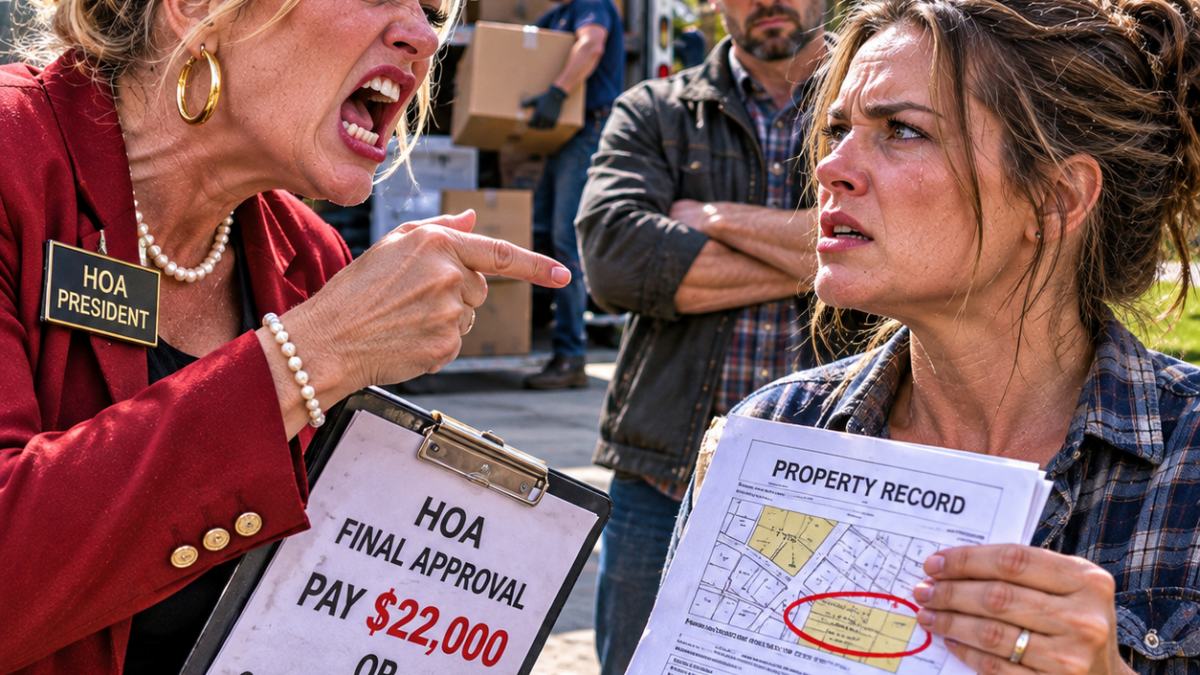
“And now there’s a transfer contribution.”
“Show me the authority.”
She laughed.
“Your inability to understand association policy is not my problem.”
I stared at the empty living room.
“Karen, my moving truck is loaded.”
“Then perhaps you should have planned better.”
I felt my face grow hot.
“My buyer is waiting to close.”
“Then pay the fee.”
“My new house depends on this sale.”
“That sounds like a personal financial issue.”
I could barely believe what I was hearing.
“You’re threatening to destroy two real-estate transactions over money I don’t owe.”
Karen’s voice dropped.
“Let me make this very clear.”
I tightened my grip.
“Your resale certificate will not be cleared until the association receives its twenty-two thousand dollars.”
I swallowed.
“Even if that causes the buyer to walk away?”
“Actions have consequences.”
I looked toward the moving truck.
Then asked one final question.
“Karen, are you seriously telling me that after eleven years of paying every legitimate assessment, I have to pay you another twenty-two thousand dollars just to leave?”
She answered without hesitation.
“That’s exactly what I’m telling you.”
Then she added, with a little laugh I would remember for a long time, “You can argue about the policy after you pay.”
The call ended.
I stood motionless.
A mover knocked on the front door and asked where I wanted the remaining boxes.
I couldn’t answer.
Because somewhere inside Stonebrook Ridge’s paperwork, Karen had found a way to turn the final hours of my home sale into a financial trap.
And if I couldn’t find a way around it, I might lose far more than twenty-two thousand dollars.
PART2
I called Rachel back.
She answered immediately.
“Please tell me you didn’t agree to pay her.”
“No.”
“Good.”
I rubbed my forehead.
“But she won’t release the certificate.”
“I know.”
“Rachel, my belongings are on a truck.”
“I know.”
“The buyer’s expecting the keys.”
“I know.”
“My new lender is expecting this transaction to close.”
Her voice softened.
“I understand exactly what’s at stake.”
I looked toward the window.
“Then what do we do?”
Rachel paused.
Then her tone changed.
It became the same calm, precise voice she’d used during the complicated parts of my purchase agreement.
“First, you are not going to destroy your own transaction out of anger.”
I closed my eyes.
“Okay.”
“Second, we’re going to separate the charges you actually owe from the fee we’re disputing.”
I listened.
“And third, we’re going to make Stonebrook Ridge identify the legal authority for that twenty-two-thousand-dollar demand.”
“What if they refuse?”
“Then we’ll deal with that refusal through the appropriate process.”
I looked at the moving truck.
“Can we save the closing?”
“That’s our priority.”
I took a slow breath.
For the first time since Karen’s phone call, I felt something other than panic.
Not relief.
Not confidence.
But direction.
Rachel wasn’t promising a miracle.
She was telling me we had a problem that could be approached one document at a time.
And that was enough to get me moving.
I’d lived in Stonebrook Ridge for eleven years.
It wasn’t a terrible neighborhood.
That was the part people often misunderstood when I eventually told them what happened.
There were tree-lined streets, walking paths, maintained common areas, and a clubhouse used for neighborhood events.
The lawns were neatly kept.
The private roads were serviced.
Residents generally respected one another.
And the HOA had genuine responsibilities.
My deed was subject to the recorded declaration.
I knew that when I bought the house.
I’d paid annual assessments.
I’d followed the architectural requirements.
When I wanted to replace part of my front landscaping, I’d submitted the required application.
Years earlier, I’d even volunteered on a neighborhood landscaping committee.
I wasn’t someone who believed an HOA could never enforce a rule.
But there was a difference between enforcing an actual obligation and inventing a new one.
I understood that difference.
And so did Rachel.
“Your house is part of the association,” she told me later that afternoon.
“I know.”
“So we’re not going to argue that Stonebrook Ridge has no authority over you.”
I nodded.
“That would be ridiculous.”
“Exactly.”
She opened the declaration on her computer.
“Our question is narrower.”
I leaned closer.
“Where did this twenty-two-thousand-dollar transfer charge come from, and what gives the association the right to make it a condition of closing?”
I stared at the document.
That was the question Karen didn’t want to answer.
My financial record with the HOA was clean.
Not nearly clean.
Completely clean.
There were no unpaid regular assessments.
No late fees.
No outstanding architectural violations.
No unresolved fines.
No special assessment that had already been legally imposed and left unpaid.
The association’s ordinary resale-processing fee was $325.
I paid it.
Without protest.
Rachel had specifically instructed me to do so.
“If there’s a legitimate fee,” she’d said, “we pay it. We don’t complicate our position by refusing obligations that actually exist.”
That approach was important.
Because Karen had already begun acting as though I was trying to avoid paying the association.
I wasn’t.
I’d paid everything I owed.
I was refusing one extraordinary charge that appeared only when I was preparing to leave.
Rachel requested an updated written statement from North Valley Community Management, the company Stonebrook Ridge used for its billing and resale certificates.
It arrived in the afternoon.
Five lines.
Regular assessments: current.
Late fees: zero.
Violations: zero.
Resale processing: $325 paid.
And then:
TRANSFER CAPITAL CONTRIBUTION: $22,000.
I stared at that last line.
It looked official.
That’s what frightened me.
If I hadn’t asked questions, the charge would have appeared on the closing documents alongside taxes, title costs, and mortgage payoffs.
It would have looked like any other amount required to finish the sale.
But twenty-two thousand dollars was more than some people earned in several months.
It was money I needed for the transition to my next home.
And Karen was demanding it at the moment when I had the least flexibility.
Rachel requested the policy supporting the charge.
North Valley sent a PDF titled:
STONEBROOK RIDGE TRANSFER AND RESERVE POLICY
It had the association logo.
A formal adoption date.
A fee schedule.
Language about reserve funding.
And a table dividing home sales into price brackets.
The higher the sale price, the larger the transfer contribution.
My contract price placed me in the $22,000 bracket.
I read the policy twice.
It claimed the contribution was mandatory.
It stated that sellers had to pay before receiving a clear resale certificate.
And it cited the Stonebrook Ridge Declaration as its authority.
I looked toward Rachel.
“Does that make it legal?”
She shook her head.
“A policy isn’t automatically enforceable simply because somebody puts an association logo on it.”
She scrolled toward the citation.
Then stopped.
Her eyes narrowed.
I leaned forward.
“What?”
“Look at this.”
I read the line.
Article 12, Section 8.
Rachel opened the recorded declaration beside it.
“Here’s Article 12.”
I watched her scroll.
Section 1.
Section 2.
Section 3.
Then Sections 4, 5, and 6.
After Section 6, Article 12 ended.
There was no Section 7.
And no Section 8.
I stared at the screen.
“Rachel.”
She nodded.
“I see it.”
“They cited a section that doesn’t exist?”
“Yes.”
For a moment, neither of us spoke.
Then I laughed.
It was short and bitter.
“Twenty-two thousand dollars.”
Rachel looked at me.
“What?”
“Karen wants twenty-two thousand dollars, and her policy relies on a section of the declaration that isn’t there.”
Rachel’s expression remained serious.
“That doesn’t answer every question yet. There could be another valid recorded provision or amendment. We need to verify the complete governing documents.”
I nodded.
“But the citation is wrong.”
“Yes.”
I leaned back.
“And Karen told me I could argue about it after paying.”
Rachel closed the policy.
“Then she may be disappointed.”
The first person Rachel called wasn’t Karen.
It was my buyer’s attorney.
I didn’t understand that decision until later.
At the time, I was furious. I wanted someone to call the HOA president, demand the certificate, and threaten her with every legal consequence available.
But Rachel was thinking about something more immediate.
My sale.
“You have a buyer who wants the property,” she told me. “We need to keep him in the transaction.”
She made the call while I sat across from her desk.
I could hear only her side of the conversation.
“Yes, the seller’s assessments are current.”
A pause.
“No, this isn’t an unpaid fine or existing special assessment.”
Another pause.
“The association has asserted a transfer charge whose governing authority we haven’t been able to confirm.”
I watched her write something on a legal pad.
“We’re asking for a brief extension to resolve the documentation issue without jeopardizing your client’s purchase.”
She listened.
Then nodded.
“That’s appreciated.”
When she ended the call, I leaned forward.
“Well?”
“The buyer still wants your house.”
I exhaled.
“Thank God.”
“But he needs certainty. We can’t leave him waiting indefinitely.”
I nodded.
“What does he want?”
“A short written extension with the existing purchase terms protected while we address the resale certificate.”
I stared at her.
“So he isn’t walking away?”
“Not at this point.”
For a moment, I felt the tension in my shoulders loosen.
Rachel lifted one finger.
“Don’t confuse that with the problem being solved.”
“I won’t.”
“We still have a closing to protect, a lender to update, and a management company refusing to clear a certificate.”
I looked out the window.
“And a moving truck full of furniture.”
“That too.”
She gave me a small, sympathetic smile.
“Let’s deal with each problem before it grows into three more.”
The moving company was not thrilled.
I couldn’t blame them.
Their crew had packed half my household and loaded most of the furniture. They’d scheduled the move according to my original closing date.
Now I had no confirmed time when the keys to my next house would be available.
The supervisor stood beside the truck with a tablet in his hand.
“So you want us to unload everything?”
I shook my head.
“Not back into the house.”
He frowned.
“Then where?”
“Short-term storage.”
He checked his schedule.
“We can do that. But there’ll be an additional handling charge, and storage is billed separately.”
“I understand.”
He looked at me.
“You sure?”
I glanced toward the nearly empty living room.
For eleven years, that house had been home.
Now it was mostly bare.
I could see the lighter squares on the walls where photographs had hung.
The rug was rolled up.
The dining table was gone.
And my belongings were packed inside a truck while an HOA president demanded a payment nobody had been able to justify.
“No,” I admitted. “I’m not sure about any of this.”
The supervisor’s expression softened.
“Rough day?”
I laughed without humor.
“You could say that.”
He nodded.
“We’ll make the storage arrangements and give you the revised invoice.”
I thanked him.
Then watched the truck pull away.
I had to remind myself that I was making the right decision.
Temporary storage cost money.
But allowing the sale to collapse could cost far more.
Rachel was right.
I couldn’t let Karen turn my anger into another financial problem.
My lender for the new house needed an explanation as well.
That was another phone call I never expected to make.
I’d already arranged the financing, coordinated the purchase timelines, and prepared everything necessary for a straightforward move.
Now I was explaining that my existing HOA was withholding closing documentation over an unverified transfer fee.
The loan officer sounded surprised.
“Twenty-two thousand dollars?”
“Yes.”
“Is it a recorded assessment?”
“Not that our attorney has found.”
“Are you challenging it?”
“Yes.”
He asked for written documentation.
Rachel provided it.
The lender agreed to review an appropriate extension rather than treating the delay as an unexplained failure on my part.
That didn’t make the extension free.
But it kept the purchase alive.
By the end of that day, I’d accomplished something that hardly felt like an accomplishment.
My buyer hadn’t canceled.
My new lender hadn’t withdrawn.
My furniture was safe in storage.
And I still hadn’t paid Karen a cent of the disputed fee.
But the association continued refusing to release the certificate.
I drove back to my empty house after dark.
There was no couch to sit on.
No dining table.
No bed.
I sat on the bottom stair with my phone in my hand.
Then a message arrived from Rachel.
The important thing is that both transactions are still alive. We keep moving.
I read it twice.
Then put my head in my hands.
Karen had chosen the worst possible moment to make her demand.
But she hadn’t finished me.
Not yet.
The following morning, Rachel wrote to the association’s outside attorney.
Her letter was precise.
She didn’t call Karen a thief.
She didn’t accuse anyone of fraud.
She didn’t waste words describing how angry I was.
She requested five things.
First, the exact declaration provision authorizing the transfer contribution.
Second, the board resolution adopting the policy.
Third, the official minutes documenting the vote.
Fourth, any legal opinion approving the fee.
And fifth, any recorded amendment required to impose a new obligation on sellers.
I sat beside her while she reviewed the letter.
“That’s it?”
She looked at me.
“That’s enough to start.”
I frowned.
“No demand that Karen resign?”
“No.”
“No threat to sue her personally?”
“Not in this letter.”
“Nothing about ruining my closing?”
“The urgent closing problem is addressed separately and clearly.”
She folded her hands.
“Daniel—”
She caught herself, then continued, “You want this resolved on the strongest possible grounds, don’t you?”
“Of course.”
“Then we ask the question they must answer.”
She pointed toward the letter.
“Where is the authority?”
I leaned back.
It seemed almost too simple.
But after hearing Karen’s voice on the phone, I understood why Rachel was approaching it that way.
Karen had given me speeches about responsibility.
Reserves.
Community improvements.
Eleven years of benefiting from association services.
None of those speeches identified a governing provision.
And now the association’s own lawyer would have to find one.
The reply came sooner than expected.
Not a formal legal argument.
Not a memorandum explaining the declaration.
Just a question.
Rachel called me while I was reviewing another storage invoice.
“I heard from Stonebrook Ridge’s attorney.”
My stomach tightened.
“What did he say?”
There was a short pause.
Then Rachel answered.
“He asked, ‘What transfer contribution?’”
I stared at the phone.
“What?”
“He says he doesn’t know what we’re talking about.”
I sat down.
“Karen told me the policy had been approved.”
“I know.”
“She said it was mandatory.”
“I know.”
“And the association’s attorney hasn’t even heard of it?”
“Apparently not.”
I looked toward the ceiling.
For several seconds, I couldn’t speak.
Then I said, “Rachel, how can the HOA charge twenty-two thousand dollars under a policy its own lawyer doesn’t know exists?”
“That,” she said, “is becoming a very important question.”
The attorney requested the policy from North Valley Community Management.
They sent him the same PDF we’d received.
Same logo.
Same fee brackets.
Same supposedly official authority.
When he reviewed it, his reaction changed the entire dispute.
He called Rachel.
She later described the conversation to me.
He told her he hadn’t drafted the policy.
He hadn’t reviewed the final document.
He hadn’t approved the $22,000 amount.
And he hadn’t advised the board that the recorded declaration authorized such a charge.
Rachel asked whether his office had supplied a legal opinion supporting implementation.
He said no.
I stared at her when she finished.
“Then Karen lied.”
Rachel paused.
“We have a documented contradiction between what the policy represents and what counsel says occurred.”
I rubbed my forehead.
“She told management the policy was approved, didn’t she?”
“We’re looking into that.”
I looked toward my empty living room.
The words I’d heard on the phone returned to me.
You can debate policy later.
It had sounded like an arrogant dismissal.
Now it sounded like something more calculated.
Karen needed the money collected before anyone examined the policy closely.
She needed me under enough pressure to pay.
Once my sale closed, she could make the problem sound like a completed transaction instead of an unsupported demand.
I felt sick.
Because I wasn’t the first person to sell a house in Stonebrook Ridge.
And suddenly, I wondered whether I was the first person who had refused to pay.
Paul Ellis managed Stonebrook Ridge’s account for North Valley Community Management.
I’d never met him.
I’d spoken to employees at the management company over the years about assessments, architectural applications, and routine documents.
But Paul worked behind the scenes.
He handled association matters at the portfolio level.
And when the outside attorney asked him to explain the transfer policy, Paul began searching through the implementation records.
What he found made the situation worse.
Months earlier, Karen had proposed imposing a capital contribution on sellers because Stonebrook Ridge’s reserve funding needed attention.
The development had private roads that would require resurfacing.
The clubhouse’s heating and cooling equipment was aging.
The reserve study recommended building up funds for future major repairs.
Those weren’t imaginary concerns.
They were real expenses.
And the HOA board had been discussing ways to address them.
But discussing an idea wasn’t the same as approving a binding obligation.
Paul had warned Karen about that.
In writing.
Rachel obtained the relevant correspondence through the association’s review process.
Paul’s message was straightforward.
The proposed transfer fee might require specific declaration authority or an amendment.
North Valley would not activate a new fee without board-approved documentation and confirmation from association counsel.
I read that message in Rachel’s office.
“Paul told her not to do it.”
Rachel shook her head slightly.
“He told her what documentation management required before implementation.”
I pointed toward the email.
“Board approval and legal review.”
“Yes.”
“And neither existed?”
“That’s what the evidence currently indicates.”
I looked down.
“Then how did the fee get into their system?”
Rachel opened another document.
“Because Karen later sent him this.”
It was titled:
FINAL BOARD CERTIFICATION — TRANSFER AND RESERVE POLICY
The wording looked formal.
The document stated that Stonebrook Ridge’s board had adopted the transfer contribution.
It said association counsel had reviewed the policy and confirmed that it was enforceable.
It included Karen Whitmore’s electronic signature.
And beneath it appeared the typed name of Evelyn Ross, the association secretary.
The accompanying email was short.
Counsel review complete. Board approved. Effective immediately for all pending and future resales.
I read it three times.
Then I looked toward Rachel.
“Karen sent this herself?”
“Yes.”
“To Paul?”
“Yes.”
“And Paul put the fee into the resale software?”
“North Valley activated the schedule after receiving the certification.”
I leaned back slowly.
My hands felt cold.
It wasn’t merely that Karen had a bad idea.
She had been told she needed certain approvals before the idea could become a real charge.
Then she sent a document stating those approvals had happened.
And the management company acted on it.
I looked at the secretary’s name.
“Who is Evelyn Ross?”
“Stonebrook Ridge’s board secretary.”
“Did she approve it?”
Rachel’s expression sharpened.
“We’re going to find out.”
Evelyn denied approving the certification.
Not vaguely.
Not with a carefully worded statement about forgetting a meeting.
She said she had never authorized that document.
She hadn’t signed off on the fee schedule.
And she hadn’t attested that the board approved the final transfer policy.
The association’s attorney also denied providing the legal approval the certification claimed.
I remember Rachel reading those responses to me.
She didn’t raise her voice.
She didn’t smile.
But I could hear the change in her tone.
The evidence was beginning to point toward something much more serious than a poorly drafted HOA rule.
I sat across from her.
“So what now?”
“From this point forward, don’t contact Karen directly.”
I nodded.
“Fine.”
“No neighborhood social media posts.”
“Fine.”
“No angry messages to board members.”
I exhaled.
“Rachel, I don’t want a fight on Facebook. I want to sell my house.”
She smiled slightly.
“Good. Because that’s what we’re going to focus on.”
Then she leaned forward.
“We need to solve the closing without letting the disputed money go to the HOA.”
I frowned.
“How?”
She turned her legal pad toward me.
“Escrow.”
Rachel proposed a neutral arrangement.
I would continue paying every undisputed association charge.
That included the $325 resale-processing fee and any other amount legitimately due through closing.
But if the title process required security for the contested $22,000, the money could be placed in an attorney-controlled escrow account while the dispute over its validity was resolved.
The funds wouldn’t be released to Stonebrook Ridge merely because Karen demanded them.
And the buyer’s transaction wouldn’t fail simply because the money wasn’t available if the charge was ultimately found valid.
I studied the proposal.
“So I’m not admitting I owe it.”
“Correct.”
“And Karen doesn’t get the money.”
“Correct.”
“But the sale can still proceed?”
“If the parties agree and any required approvals are obtained, that is the goal.”
I nodded slowly.
It seemed reasonable.
Painful, perhaps, to tie up twenty-two thousand dollars temporarily.
But far less damaging than letting two real-estate contracts collapse.
Rachel presented it to the HOA’s outside attorney.
He considered the arrangement reasonable enough to discuss.
Karen did not.
Her written instruction to North Valley was blunt.
Escrow is not payment. The transfer contribution must fund association reserves before title changes. Do not clear the resale certificate.
I stared at the message.
Then looked at Rachel.
“She rejected it.”
“Yes.”
“Even though it would preserve the money while everyone sorted out the legal issue?”
“Yes.”
I felt anger rise again.
“Then this isn’t about protecting the HOA.”
Rachel looked directly at me.
“Her refusal is relevant evidence.”
I leaned forward.
“Of what?”
“That she was given a neutral way to avoid disrupting the closing while the disputed charge was examined.”
She tapped the printed email.
“And she insisted that the money had to be paid directly to the association first.”
I looked down.
Karen had turned the sale into leverage.
But now that leverage was documented.
And Rachel was ready to ask a judge to stop her from using it.
I never expected to go to court over a fee I hadn’t paid.
I’d bought and sold property before.
There had been title questions, inspection issues, lender requirements, and negotiations over repairs.
But I’d never stood on the edge of losing a legitimate home sale because an HOA president refused to identify the covenant supporting a five-figure closing charge.
Rachel filed for limited emergency relief.
She explained the request to me before filing.
“We’re not asking the court to decide every possible issue involving Karen,” she said.
I nodded.
“We’re asking for enough relief to protect the closing.”
“Exactly.”
She reviewed the proposed request.
The association could continue collecting legally authorized assessments and charges.
My account wasn’t being treated as exempt from ordinary HOA obligations.
The question was whether Stonebrook Ridge could refuse the resale certificate solely because I hadn’t paid a newly imposed $22,000 contribution for which it could not presently show governing authority.
I stared at the papers.
“Will the judge understand how much pressure we’re under?”
“We’ll document the transaction dates, the buyer’s position, your next purchase, and the actual consequences of the delay.”
I looked toward my phone.
Another storage charge was approaching.
“What about Karen?”
Rachel’s expression remained calm.
“She may attend or respond through counsel. But the case doesn’t depend on whether she behaves badly in front of the judge.”
I sighed.
“I know.”
“It depends on whether the claimed obligation has legal support.”
She paused.
“And right now, that’s exactly what we’ve asked the association to produce.”
The emergency hearing was shorter than I expected.
I had imagined hours of testimony.
Witnesses.
Cross-examinations.
Karen standing up to explain why sellers needed to pay her association twenty-two thousand dollars.
Instead, the central issue was almost painfully simple.
Rachel presented the recorded declaration.
The amendments.
The transfer-policy PDF.
The payoff statement.
The board certification.
And the correspondence showing that the final fee lacked confirmed legal review.
The judge examined the documents.
Stonebrook Ridge’s outside attorney did not attempt to invent a missing Section 8.
He acknowledged that the association was investigating how the policy had been adopted and whether the necessary authority existed.
Then the judge asked a question I would remember for the rest of my life.
“Can the association identify a recorded covenant, valid amendment, or properly exercised board authority that presently makes this twenty-two-thousand-dollar payment a condition of transfer?”
I held my breath.
The attorney reviewed his notes.
Then answered that he could not identify such authority from the available record.
The silence felt enormous.
It was the exact question I’d been asking since the moving truck arrived.
Where is the authority?
Karen had answered with insults.
The management company had answered with a policy.
The policy had answered with a nonexistent section.
And now, before a judge, the association still couldn’t identify the document giving it the right to charge me.
Rachel remained composed.
I gripped the edge of my chair.
The judge explained that the immediate question wasn’t whether the association might lawfully establish some future charge through the proper procedures.
It was whether the presently disputed fee could be used to prevent this closing.
On the evidence submitted, the court granted temporary relief.
Stonebrook Ridge could collect every legitimate amount I owed.
It could collect the paid $325 resale fee.
It could account for authorized assessment adjustments.
But it could not continue refusing the certificate solely because I hadn’t paid the unsupported $22,000 transfer contribution while it lacked evidence establishing that obligation.
I stared at Rachel.
She turned toward me.
And for the first time in days, she smiled.
Not broadly.
Just enough.
I leaned closer.
“Does that mean—”
“It means the closing can move forward once the corrected certificate is issued and the remaining conditions are satisfied.”
I closed my eyes.
My hands were trembling.
Karen hadn’t lost every argument she might ever make.
The underlying investigation wasn’t finished.
But the immediate financial trap she’d placed around my sale had just been opened.
North Valley issued the corrected resale certificate.
The disputed contribution was no longer listed as a condition preventing the transfer.
My buyer’s attorney received the document.
The title company completed its remaining work.
The lender confirmed the updated schedule.
And at long last, I returned to the closing table.
This time, there was no unexpected twenty-two-thousand-dollar demand waiting beside my signature.
Rachel reviewed the closing statement with me line by line.
Mortgage payoff.
Taxes.
Title charges.
Broker fees.
Authorized HOA amounts.
The $325 resale-processing fee.
Everything that belonged there.
I scanned the pages.
Then looked up.
“It’s not there.”
Rachel smiled.
“No.”
“The twenty-two thousand?”
“Not on this closing statement.”
I let out a breath so long I nearly laughed.
For days, that amount had seemed larger than everything else in my life.
Now it was simply absent.
Not because Karen had given me a favor.
Not because she’d decided to reduce the fee.
And not because I had negotiated a discount.
The association hadn’t established the authority to impose that payment as a condition of my sale.
The closing proceeded without it.
I signed.
The buyer signed.
The transaction was completed.
And the house I’d lived in for eleven years officially belonged to someone else.
I closed on my next home shortly afterward.
My furniture came out of storage.
The movers carried boxes into rooms that smelled faintly of fresh paint and clean wood.
I finally had a place to sleep that wasn’t a temporary arrangement.
I unpacked my coffee maker first.
Then a few dishes.
Then the framed photograph I’d kept on my old living-room wall for years.
Late that evening, I sat in my new kitchen.
There were still boxes stacked in the hallway.
The curtains weren’t hung.
I couldn’t remember which container held my favorite mug.
But both home transactions had survived.
I hadn’t lost my buyer.
I hadn’t lost the next house.
And I hadn’t paid the disputed contribution.
I called Rachel.
“It’s done.”
“I heard.”
I looked around the kitchen.
“I’m in.”
She smiled through the phone.
“Congratulations.”
For a moment, I was quiet.
Then I asked, “So Karen’s finished?”
Rachel didn’t answer immediately.
“Your closing is complete.”
I frowned.
“That’s not what I asked.”
“I know.”
I leaned back.
She continued.
“The association still has to determine how that policy entered its system, whether other sellers were charged, and what losses resulted from the dispute.”
I looked toward the boxes.
“And my expenses?”
“We’ll calculate those carefully.”
I sighed.
“Right.”
Rachel’s voice softened.
“But tonight, enjoy your new home.”
I stared toward the window.
Then smiled.
“I think I will.”
The next morning, I received a copy of the final closing documents.
I went through them again.
Not because I needed to.
Because I still couldn’t quite believe it was over.
The sale price was exactly what my buyer had agreed to pay before Karen interfered.
The buyer got the property.
The lender funded.
The recorded transaction moved forward.
Nothing about the fee dispute had forced me to accept a lower price.
And nothing about it caused me to lose the purchase of my next house.
Those details would become important later.
Rachel was determined that any claim for damages reflect what had actually happened.
Not the worst-case scenarios I’d feared.
Not imaginary losses.
Only the costs we could support.
I remember saying, “But Karen could have destroyed everything.”
Rachel nodded.
“She could have caused much more serious harm.”
“Doesn’t that matter?”
“It matters to the history of the dispute.”
She looked at me.
“But we don’t claim you lost a buyer who never left.”
I nodded reluctantly.
“And we don’t claim you lost a house you successfully purchased.”
I stared at the statement.
“Or twenty-two thousand dollars that I never paid.”
“Exactly.”
She smiled slightly.
“Actual loss. Actual documentation. One recovery.”
I didn’t realize how important that discipline would become.
Because once the HOA started examining its own records, the financial story grew far bigger than my closing.
Stonebrook Ridge called a special board meeting.
By then, I no longer owned property in the development.
I wasn’t an association member.
And frankly, I had no desire to walk back into the clubhouse and spend another evening listening to Karen talk about community responsibility.
But my unresolved civil claim remained connected to the association’s actions.
Rachel attended in connection with those matters and obtained the relevant records through the proper channels.
She later walked me through what happened.
The meeting centered on the reserve policy and the certification that Karen had sent to North Valley.
Evelyn Ross brought the official minutes.
Martin Shaw, the HOA treasurer, brought financial records.
Paul Ellis attended to explain how the policy had entered the management company’s software.
The association’s outside attorney was present.
And Karen arrived insisting that everyone was overreacting.
According to the records and accounts Rachel reviewed, Karen began by emphasizing that Stonebrook Ridge genuinely needed more money in its reserves.
On that point, she wasn’t wrong.
The private roads would eventually require resurfacing.
The clubhouse heating and cooling system was aging.
The reserve study had identified funding gaps.
The board had been considering options.
Higher annual assessments.
A special assessment.
Delaying certain cosmetic projects.
And the possibility of asking sellers to make a capital contribution when properties transferred.
The problem was that the board had never finally adopted Karen’s $22,000 fee schedule.
It had discussed possible methods of raising revenue.
Then it had authorized Karen to obtain legal advice and return with a recommendation.
That was the actual vote.
Nothing more.
Rachel showed me the minutes the next afternoon.
I read the recorded motion carefully.
President authorized to obtain legal review of transfer contribution options and return a recommendation to the board before implementation.
I stared at it.
“That’s all?”
Rachel nodded.
“No dollar amounts were approved.”
I kept reading.
“No fee schedule?”
“No.”
“No authorization to implement?”
“No.”
I looked up.
“Then the board told her to ask the lawyer and come back.”
“Precisely.”
I laughed bitterly.
“And she never came back.”
Rachel shook her head.
“She sent management a certification claiming the board and attorney had already approved the policy.”
I stared at the document.
Karen’s electronic signature.
Evelyn’s typed name.
The statement that legal review was complete.
I felt a chill.
For weeks, Karen had acted as though I was challenging a valid policy because I didn’t want to contribute to the community.
But the actual board had never authorized her to collect that money.
She hadn’t been carrying out a decision.
She’d been creating the appearance of one.
And by doing so, she’d made the management company believe sellers could legally be charged thousands of dollars at closing.
I looked at Rachel.
“How many people paid?”
Her expression changed.
“That was the next question Martin Shaw asked.”
Martin had apparently looked at Paul Ellis during the board meeting and said, “If this policy has been active for months, how many closing statements included the fee?”
The room went quiet.
Paul reviewed the resale records.
There were three completed sales.
Three sellers who had paid the transfer contribution.
The first paid $8,500.
The second paid $12,000.
The third paid $16,000.
A total of $36,500.
I sat back when Rachel told me.
“Thirty-six thousand five hundred dollars?”
“Yes.”
“And none of them challenged it?”
“Apparently not.”
I stared at the table.
I thought about my own moving day.
The truck.
The boxes.
The buyer waiting.
The lender deadlines.
Then I imagined being handed an official closing statement containing a fee I didn’t recognize.
Would I have questioned it if the amount were smaller?
Would I have trusted the management company?
Would I have been too frightened of losing the transaction to argue?
I didn’t know.
And that uncertainty made me angry.
Because I could see exactly how Karen’s policy worked.
It didn’t need to convince people on an ordinary Tuesday afternoon.
It appeared when their houses were already sold.
When their belongings were packed.
When the buyers expected keys.
When the sellers faced the cost of delay.
The first three had paid.
My proposed $22,000 contribution would have brought the collections to $58,500.
I stared at Rachel.
“She wasn’t just doing this to me.”
“No.”
“And those three people thought the charges were mandatory.”
“Yes.”
I rubbed my forehead.
“Does the HOA still have the money?”
“That has to be reconciled. But the board has already frozen further implementation.”
I looked toward the window.
Three families had given up thousands of dollars without knowing the policy lacked the approvals it claimed to have.
And I was beginning to understand why Karen had been so furious when I asked her to identify the covenant.
My refusal hadn’t merely threatened one payment.
It had threatened the entire arrangement.
The board suspended the transfer contribution immediately.
Then its outside attorney contacted the three former sellers.
I don’t know exactly what those conversations sounded like.
I wasn’t present.
And I wouldn’t pretend I knew what each family felt when someone called to explain that a fee they’d paid at closing had never received the approval the association claimed.
But I could imagine the surprise.
The anger.
The questions.
One seller had paid $8,500.
Another $12,000.
Another $16,000.
Those weren’t small amounts.
That was money people could have used to furnish a new home, pay moving expenses, support their children, or simply keep in savings.
Instead, they’d been told the contribution was mandatory.
So they’d paid it.
And moved away.
Now, after my closing dispute exposed the problem, the board authorized the return of all $36,500.
Each former seller received the principal amount he or she had paid.
The first got $8,500 back.
The second got $12,000.
The third got $16,000.
Not a combined payment to me.
Not a bonus for challenging Karen.
Not money awarded twice.
Those funds went back to the people from whom they’d actually been collected.
When Rachel told me, I sat quietly for a moment.
Then asked, “All three?”
“Yes.”
“Every dollar of the principal?”
“Yes.”
I closed my eyes.
“Good.”
Rachel paused.
“You sound relieved.”
I looked down at the closing statement on my desk.
“I am.”
She waited.
Then I said, “Those people probably didn’t even know they could question the charge.”
“Possibly.”
I thought about the first moment I’d seen the fee.
The shock.
The fear.
The moving truck.
Then I imagined three other households facing the same pressure without someone catching the missing authority.
I swallowed.
“I’m glad they got their money back.”
Rachel’s voice softened.
“So am I.”
Karen’s explanation at the board meeting was that she believed the earlier discussion had given her enough authority to implement the policy.
She insisted the board supported the goal of increasing reserves.
She said the association needed immediate funding.
And she suggested that the final certification was merely an administrative reflection of what everyone had already agreed should happen.
But Evelyn Ross wasn’t willing to accept that explanation.
According to the meeting record, she asked a simple question.
“Karen, what legal review did you obtain?”
Karen reportedly replied that she’d discussed transfer contributions with counsel.
The association’s attorney corrected her.
He explained that they’d discussed whether transfer contributions could exist in some circumstances.
That was not the same as approving this particular policy.
He had not reviewed the final fee schedule.
He had not confirmed that the recorded declaration authorized it.
And he had not approved the statement that sellers could be charged before receiving resale clearance.
Evelyn then asked about the board certification.
Karen insisted she had understood the earlier vote broadly.
Martin Shaw interrupted.
“The board told you to obtain legal review and return with a recommendation.”
Karen said the association needed revenue.
Martin asked again why the certification stated that final approval had already occurred.
Karen replied that the overall intent had been clear.
I wasn’t in the room.
But Rachel showed me the written records, and I could almost hear Karen’s voice.
That same impatient tone.
That same assumption that an explanation became sufficient if she repeated it confidently enough.
Martin’s response was the part I kept thinking about.
The association’s need for revenue wasn’t the question.
Whether transfer contributions could ever be legal wasn’t the question.
Whether the board liked the general concept wasn’t the question.
The question was why Karen’s document stated that three specific approvals had occurred when the records indicated they hadn’t.
Board approval.
Counsel approval.
Secretary attestation.
Three claims.
Three serious problems.
And none could be fixed by saying the reserves needed money.
Stonebrook Ridge’s insurer requested the original electronic records.
Not just printed copies.
The actual policy files.
The PDF.
The certification.
The email chain.
The board minutes.
The management company’s implementation records.
And the relevant file information needed to establish where the certification had come from.
A digital forensics consultant was engaged to preserve and examine the electronic evidence properly.
I remember Rachel explaining why that mattered.
“People see a document with a signature and assume the signature proves approval.”
I nodded.
“Doesn’t it?”
“Not always.”
She opened a PDF on her computer.
“A document can contain a copied signature block. A typed name can remain after the text above it has been changed.”
I stared at the screen.
“And someone could reuse an old document?”
“Yes.”
I looked toward the disputed certification.
“Is that what happened here?”
“That’s what the forensic review is examining.”
I leaned back.
The situation was beginning to feel unreal.
An official-looking fee schedule had nearly stopped my house sale.
A certification had convinced North Valley to activate it.
Three sellers had already paid.
And the very document used to establish authority was now being examined to determine whether it had been altered.
I looked at Rachel.
“How did Karen think nobody would notice?”
Rachel didn’t answer immediately.
Then she said, “Perhaps she expected the certifications to be accepted without anyone comparing them with the original records.”
I thought about my own experience.
If I’d paid the $22,000, the closing would probably have proceeded.
The transaction would have been over.
I’d have moved away.
And I might never have returned to question how the policy entered the system.
The first three sellers hadn’t.
Karen’s strategy had worked.
Until the amount became too large for me to ignore.
While the forensic review continued, Rachel and I began calculating my losses.
That part of the process was surprisingly uncomfortable.
I had spent so many days furious about the twenty-two-thousand-dollar demand that it felt strange to assemble a claim for expenses that were much smaller.
The moving company had charged for changing the schedule and handling my belongings differently.
Storage had continued longer than planned.
My financing for the new home had required an extension.
The title company had completed extra work.
There were additional documented expenses tied directly to the closing delay.
And Rachel had spent substantial time reviewing the governing documents, communicating with the parties, preparing the emergency request, and protecting the transaction.
We placed the invoices on the table.
Rachel worked through them carefully.
“This one?”
I looked at the receipt.
“Storage.”
“Directly caused by the delay?”
“Yes.”
She included it.
Then she opened another invoice.
“Financing extension.”
I nodded.
“From the lender on the next house.”
She added it.
The moving company’s revised invoice followed.
Then the additional title expenses.
Then a smaller group of documented closing-delay costs.
Next came her legal bills.
I felt embarrassed watching her review her own time entries.
“You don’t have to cut anything just to make me feel better,” I said.
She looked up.
“I’m not.”
“Then what are you doing?”
“Separating the legal work necessary to protect your sale from work relating primarily to the association’s later internal investigation.”
I frowned.
“Wasn’t all of that Karen’s fault?”
“That’s not the test we’re applying to your civil claim.”
I sat back.
She continued.
“We want a defensible number connected to the expenses your dispute caused.”
I looked toward the invoices.
“No estimates of what might have happened?”
“No imaginary lost buyer.”
“No lost house.”
“No twenty-two-thousand-dollar payment that never occurred.”
I nodded.
“And no recovery of money that belongs to the three former sellers.”
“Exactly.”
I smiled bitterly.
“Karen made a mess of everything, and you’re still making sure the accounting is perfect.”
Rachel’s expression softened.
“That’s one reason we’re in a much stronger position than if you’d tried to turn the dispute into a public feud.”
I looked down.
She was right.
Again.
When the final civil accounting was complete, my supported claim was $18,800.
It reflected documented costs associated with the delayed transaction and the legal work reasonably tied to resolving the resale certificate dispute.
There was no inflated claim for losing my buyer.
He hadn’t left.
No claim for losing the house I purchased.
I’d completed that purchase.
No demand for reimbursement of the $22,000.
I’d never paid it.
And no attempt to recover the $36,500 refunded to other sellers.
That was their money.
Rachel kept the categories and supporting documents organized so no one could reasonably accuse us of counting the same loss twice.
North Valley Community Management had its own exposure.
Paul Ellis had correctly warned Karen that documentation and legal confirmation were needed before a new fee could be implemented.
But once Karen provided the certification, North Valley had loaded an unusually large seller charge into its system without independently verifying the claimed final approvals.
That failure mattered.
So did the fact that the association had permitted its president’s certification to become the basis of a mandatory closing charge.
Insurance representatives reviewed the record.
After negotiations, the resolution of my civil claim was structured between two sources.
North Valley’s insurer contributed $6,000.
Stonebrook Ridge’s liability carrier contributed $12,800.
Together, those payments totaled $18,800.
The amount of my supported civil recovery.
Not $18,800 plus the original disputed charge.
Not an extra refund.
Not a speculative windfall.
One documented loss.
One recovery.
When Rachel called to confirm the settlement, I was standing in the kitchen of my new house.
I looked around at the furniture I’d finally finished arranging.
Then asked, “Does this resolve my claim?”
“Yes.”
I exhaled.
“And the three sellers got their refunds?”
“Yes.”
“And Karen?”
Rachel paused.
“The association is still dealing with her separately.”
I looked toward the window.
Of course it was.
Because my case had been about stopping an unauthorized demand from destroying my home sale.
The association’s case concerned the costs and consequences of its own president’s conduct.
Those were connected problems.
But they weren’t the same losses.
And Karen was about to discover that distinction.
The forensic results came back after my civil claim had been resolved.
Rachel called me to explain what the consultants had found.
The disputed certification hadn’t been created as an entirely new document.
It had originated from a legitimate earlier certification relating to the Stonebrook Ridge clubhouse roof replacement.
That older certification was genuine.
The board had actually approved the roof project.
Karen had signed the related document.
Evelyn’s secretary attestation belonged to the approved record.
The problem was what happened afterward.
The forensic history showed that the older file had been opened from Karen’s HOA-issued laptop.
The roof-project language had been replaced with transfer-policy language.
The statement of board approval had been changed to refer to the new fee.
A claim of counsel approval had been inserted.
Karen’s electronic signature remained.
Evelyn’s typed attestation remained.
Then the altered document was exported and sent to North Valley as the final certification for the transfer contribution.
I stared at Rachel.
“Are you telling me she took a real approval for the clubhouse roof and turned it into a fake approval for the transfer fee?”
Rachel chose her words carefully.
“The technical findings show the older certified file was reused and materially changed. The disputed document asserted approvals the board and counsel say did not occur.”
I shook my head.
“That is unbelievable.”
Rachel looked at me.
“It’s exactly why examining the underlying records mattered.”
I remembered the first phone call.
Karen telling me I didn’t understand HOA governance.
Karen saying I could challenge the fee after paying.
Karen insisting the charge was mandatory.
Now I was looking at a document that had borrowed the appearance of authenticity from a completely different project.
I felt a cold anger settle in my stomach.
She hadn’t just demanded money.
She’d used an official-looking record to make the demand appear unquestionable.
And the secretary whose name appeared on it hadn’t approved the new document at all.
Karen’s attorney argued that reusing an older certification as a template was ordinary administrative practice.
That argument wasn’t unreasonable by itself.
Offices reuse templates all the time.
Forms get updated.
Old documents are adapted for new matters.
But Rachel explained why that didn’t resolve the problem.
“The issue isn’t that someone reused formatting.”
I nodded.
“The issue is what the final certification said.”
“Exactly.”
It stated that the board had approved the policy.
The recorded minutes said Karen was supposed to obtain legal advice and return before implementation.
It stated that counsel had approved the policy.
Counsel denied doing so.
And it presented Evelyn’s attestation as part of the new approval when she had never authorized that document.
The forensic history helped establish how the document had been created and transmitted.
The emails helped show what Karen had been told beforehand.
The actual minutes showed what the board had and hadn’t decided.
And North Valley’s implementation records showed how those claims turned into real charges on sellers’ closing statements.
Every document reinforced the next.
Karen could argue about whether the association needed reserves.
She could argue that the board liked the idea of a transfer contribution.
But she couldn’t transform a discussion into a recorded vote merely by saying everyone had understood her intentions.
And she couldn’t create legal approval from an attorney who had never given it.
Stonebrook Ridge removed Karen’s authority over collections, resale certificates, financial policies, and vendor communications.
Then the membership voted to remove her as president.
She lost her board seat entirely.
When I heard, I didn’t celebrate.
I sat quietly at my kitchen table.
For eleven years, Karen had presented herself as the person who knew what was best for Stonebrook Ridge.
She corrected residents publicly.
She dismissed objections.
She treated the governing documents as though they existed to reinforce her personal decisions.
And when I challenged her $22,000 fee, she spoke to me as though I were a delinquent child trying to avoid a debt.
Now the members of the very community she’d claimed to protect had removed her from office.
I opened the copy of the policy Rachel had kept in my file.
The association logo.
The fee schedule.
The nonexistent declaration citation.
The certification.
I read it again.
Then I set it aside.
The document looked no different from the first day I saw it.
What had changed was that someone had checked.
The association still had financial damage to address.
That was another area where Rachel insisted on keeping the accounting precise.
Returning the $36,500 to former sellers wasn’t treated as though the HOA had lost money it had been entitled to keep.
It had collected principal under an unauthorized policy.
Repaying the principal returned the money to its rightful owners.
The association’s actual avoidable expenses required a separate calculation.
Those included items such as interest paid to the affected sellers, outside legal review, emergency audit work, the insurance deductible, management correction costs, forensic review expenses, and portions of settlement costs not otherwise covered.
The accountant also removed items that had been reimbursed, credited, or would have been incurred anyway.
After those adjustments, Stonebrook Ridge identified $31,700 in remaining avoidable expenses.
Karen disputed personal responsibility.
Her attorney maintained that the board had discussed transfer contributions and that North Valley had voluntarily implemented the fee.
But the association returned to the original email.
Paul’s warning that management wouldn’t activate a new transfer charge without board documentation and counsel confirmation.
Then Karen’s later statement that both approvals were complete.
The dispute proceeded to mediation.
Ultimately, Karen agreed to pay Stonebrook Ridge $24,000 toward its remaining avoidable costs.
That money went to the association.
Not to me.
It did not overlap with my $18,800 settlement.
And it did not treat the $36,500 seller refunds as if the association had permanently lost its own money.
When Rachel explained the result, I nodded.
“Good.”
She looked at me.
“That’s all?”
I smiled faintly.
“What else should I say?”
“You’ve been dealing with this for months.”
I looked toward the closing documents on my desk.
“I got my sale through. The former sellers got their money back. And the association is recovering part of the costs of undoing the policy.”
I paused.
“That’s a lot better than where we started.”
Rachel smiled.
“Yes.”
Then her expression became serious.
“But there’s one more matter.”
I looked up.
“The county?”
She nodded.
“The certification has been referred for investigation.”
I leaned back slowly.
Karen had lost her position.
She’d agreed to pay the association.
The policy had been frozen.
And my civil claim was finished.
But an official-looking document had been used to collect money from three people.
That was no longer only an internal HOA governance problem.
The county wanted to know whether the false statements had been made knowingly.
And the records Karen had believed would protect her were now the very evidence investigators were examining.
The county investigation was quieter than most people expected.
There was no dramatic raid at the Stonebrook Ridge clubhouse.
No shouting in the parking lot.
No sheriff dragging Karen away in handcuffs while the neighbors watched from their porches.
Investigators collected records.
They interviewed people.
They examined the original files.
And they compared what the certification claimed with what the association had actually approved.
Evelyn Ross explained that she had never attested to the transfer policy.
Paul Ellis explained the documentation North Valley required before activating the fee.
The association’s attorney confirmed that he hadn’t reviewed or approved the final schedule.
The three former sellers described the charges they’d paid at closing.
Rachel provided my closing file.
And I gave a statement confirming that Karen had demanded $22,000 as a condition of releasing the resale certificate.
I also confirmed that she’d refused the neutral escrow proposal.
That detail mattered.
She hadn’t simply sent an invoice by mistake.
When offered a way to preserve the disputed funds while allowing the transaction to proceed, she’d insisted the money go directly to the association.
I remembered her voice on the phone.
You can debate policy later.
I hadn’t understood how much that statement revealed until the investigators began asking about the sequence of events.
The charge appeared when sellers were under pressure.
The first three paid.
I questioned it.
Karen refused to compromise.
And only when a court intervened did the certificate finally get released.
The prosecutor’s focus was narrower than the outrage surrounding the case.
It wasn’t a crime for an HOA board to discuss raising revenue.
Stonebrook Ridge genuinely needed to fund future road maintenance and clubhouse repairs.
It wasn’t necessarily unlawful for an association to impose a transfer contribution under every possible set of governing documents and legal conditions.
The issue was whether Karen had knowingly provided a materially false certification that caused North Valley to impose and collect a charge that had not received the approvals the certification claimed.
That distinction was essential.
Bad ideas could be debated.
Legitimate assessments could be adopted through proper procedures.
But Karen had been told she needed board documentation and legal confirmation.
She hadn’t obtained them.
Then she’d sent a document stating that she had.
The evidence didn’t depend on my opinion of her.
It depended on what she’d done.
Karen maintained that she believed the board’s earlier discussions gave her broad authority to finalize the policy.
But the minutes didn’t say that.
They directed her to obtain legal review and return with a recommendation before implementation.
Paul’s email didn’t say North Valley could activate the fee whenever Karen considered it necessary.
It required documentation and legal confirmation.
And the final certification didn’t say the board might approve a policy later.
It said the board had already approved it.
Those differences were not minor.
They were the difference between a proposal and a purportedly enforceable demand.
The criminal case ultimately ended through a plea agreement rather than a lengthy public trial.
Karen pleaded guilty to one felony count involving the use of a materially false business record in connection with obtaining property for the association and one misdemeanor related to the unauthorized collection certification.
When Rachel told me, I sat quietly.
For a moment, I remembered the moving truck outside my old house.
Karen laughing at my questions.
The way she’d told me I couldn’t leave without paying.
Now she was formally accepting criminal responsibility for conduct connected to the very certification she’d insisted I had no right to challenge.
I didn’t feel like cheering.
I felt exhausted.
And relieved that the record was finally catching up with what had happened.
At sentencing, the judge reviewed the civil refunds and settlements.
The three former sellers had already received their $36,500 in principal.
My $18,800 civil claim had already been resolved.
Stonebrook Ridge had a separate $24,000 repayment agreement with Karen.
Those amounts weren’t simply collected a second time under a criminal restitution order.
The judge imposed ninety days in county jail, with part of the term eligible for work release under applicable local rules.
Karen also received three years of supervised probation, two hundred hours of community service, court costs, and limited restitution for qualifying investigative expenses not already compensated through the other proceedings.
Stonebrook Ridge’s amended eligibility requirements also prevented her from returning to its board during probation.
I remember hearing the sentence and thinking about the last conversation I’d had with her.
Actions have consequences.
She’d said those words to me when I worried about losing my buyer.
She’d used them to make an unsupported fee sound like an inevitable punishment for refusing her demands.
Now the consequences belonged to her.
Not because she’d proposed raising money.
Not because people disliked her personality.
And not because an HOA president wasn’t allowed to make unpopular decisions.
They followed from records showing that she’d represented approvals as complete when they hadn’t occurred, and that those false statements had been used to collect money.
Stonebrook Ridge continued without Karen.
That surprised some people.
A few residents had expected the controversy to tear the association apart.
Others believed the entire HOA should be dissolved because its president had abused her authority.
But the new board took a different approach.
The roads still needed maintenance.
The clubhouse still needed repairs.
The common areas still needed attention.
And homeowners still lived under the recorded declaration they had agreed to when purchasing their properties.
The solution wasn’t to pretend the association had no legitimate responsibilities.
It was to make those responsibilities subject to enforceable checks.
The new board revised its procedures.
Any proposed transfer or capital charge had to identify the exact governing authority supporting it.
If an amendment was required, that amendment had to be properly approved and recorded before implementation.
Major fee schedules required certification from two authorized officers.
Charges above a modest administrative threshold required written review by association counsel.
And management could no longer load a new seller fee into its closing software based solely on one board officer’s email.
North Valley changed its own compliance procedures as well.
Before activating a new transfer contribution for any community it managed, the company required verification of governing-document authority, board approval, and legal review when necessary.
I read those changes and shook my head.
It seemed extraordinary that so much damage had been caused by safeguards that should have existed from the beginning.
The association still needed money for its reserves.
Karen’s departure didn’t magically resurface the roads.
It didn’t repair the clubhouse HVAC system.
And it didn’t erase the long-term funding requirements identified in the reserve study.
The new board delayed a cosmetic improvement project.
It revised the reserve-funding schedule.
And it proposed a modest increase in assessments through the procedures permitted by its governing documents.
Some residents supported the proposal.
Others opposed it.
They debated the amount.
Asked for financial projections.
Discussed the timing of future repairs.
And requested clearer explanations of where the money would go.
That was how it should have worked.
A board could propose a fee.
Owners could ask questions.
The declaration and applicable law could determine what approvals were necessary.
And the final decision could be recorded accurately.
Karen’s mistake hadn’t been recognizing that the association needed revenue.
It had been treating that need as permission to collect money through a certification that falsely claimed the required approvals were complete.
The difference was everything.
Months after the case ended, Rachel asked me whether I still regretted selling my old house.
We were sitting in her office, reviewing the last documents that needed to be filed away.
I thought about the question.
Stonebrook Ridge had been my home for eleven years.
I’d enjoyed living there.
I’d walked the trails.
Planted flowers in the backyard.
Had friends over for dinner.
Watched seasons change through the living-room windows.
The place held memories I would always value.
Karen hadn’t erased those.
“No,” I finally said.
Rachel smiled.
“Good.”
I looked toward the closing statement.
“I regret that she turned the sale into a nightmare.”
Rachel nodded.
“But the house was right for me when I bought it, and moving was the right decision when I sold it.”
I paused.
“What she did doesn’t change that.”
Rachel closed the folder.
“That’s a healthy way to look at it.”
I laughed softly.
“Don’t make me sound wise. I spent the first week wanting to scream every time my phone rang.”
She smiled.
“I remember.”
I looked at her.
“You probably saved me from making things worse.”
“You helped by following the plan.”
I shook my head.
“I wanted to call Karen every hour.”
“But you didn’t.”
“I wanted to tell the whole neighborhood what she’d done.”
“But you preserved the evidence instead.”
I looked at the documents.
“And I paid what I actually owed.”
Rachel nodded.
“Exactly.”
For a moment, we sat in silence.
Then I asked, “What happens to the buyer?”
She looked puzzled.
“What do you mean?”
“He owns my old house now. Does he have to deal with that policy?”
“No. The unauthorized transfer schedule was removed from North Valley’s system.”
I nodded.
“He still has the real declaration?”
“Of course. The ordinary legitimate assessments and architectural obligations remain.”
I smiled.
“That’s fine.”
Because I’d never asked to leave Stonebrook Ridge without paying my lawful obligations.
I’d asked not to be charged $22,000 under authority nobody could establish.
And eventually, that was exactly what the record showed.
A year later, the neighborhood was still standing.
The private roads were maintained.
The clubhouse operated.
Homeowners continued attending meetings.
The board kept records of contracts and votes.
And future resale certificates reflected ordinary authorized charges unless the governing documents were properly changed.
Karen was no longer the president.
Her transfer fee was gone.
The three former sellers had been refunded.
My documented losses had been compensated.
And the association had adopted safeguards intended to prevent a single officer from creating another mandatory closing charge without the required approvals.
I sometimes wondered what would have happened if I’d paid.
The question usually came when I looked at the file I’d kept from the dispute.
It was a thick binder.
Rachel had organized everything.
The recorded declaration.
The amendments.
The policy PDF.
The payoff statement.
The correspondence with North Valley.
The emergency court order.
The corrected certificate.
The final closing statement.
And the settlement records.
I knew where the story began.
With one question.
Where is Article 12, Section 8?
The policy cited it.
But Article 12 ended at Section 6.
It was a small inconsistency.
Almost boring.
Not the kind of thing that would make an exciting headline.
Yet that missing section led Rachel to ask about the board vote.
The board minutes led her to question the certification.
The certification led to the attorney’s denial.
The secretary’s denial led to the original electronic records.
And those records revealed how the document had been altered and used.
Every answer led to another question.
And every question made Karen’s claim of unquestionable authority weaker.
I thought about those first three sellers.
They hadn’t known the policy lacked approval.
They’d been given official closing statements and told the money was mandatory.
They’d paid because their sales were already underway.
I understood their decision.
I’d felt the same pressure.
The only difference was that my proposed charge was so large that I couldn’t ignore it.
Twenty-two thousand dollars.
A number big enough to force me to ask why.
And once I asked, Karen’s entire system began coming apart.
There was one detail I never forgot.
The day Karen demanded the money, she didn’t say, “Let’s review the declaration.”
She didn’t say, “I’ll send you the recorded amendment.”
She didn’t say, “Our attorney can explain the board’s authority.”
She said I could argue after paying.
That was the strategy.
Collect first.
Explain later.
Use the closing deadline.
Make the seller afraid.
And rely on the fact that most people would rather pay than risk losing everything they’d spent months arranging.
It might have worked on me if Rachel hadn’t insisted on checking every document.
It might have worked if I’d treated the fee as just another line on a closing statement.
It might have worked if I’d allowed the moving truck, the buyer’s mortgage, and my new purchase to frighten me into surrendering.
But Rachel understood that the strongest response wasn’t necessarily the loudest one.
She didn’t need to threaten Karen.
She didn’t need to invent damages.
She didn’t need to turn the HOA into an enemy that had no legitimate role in the neighborhood.
She needed the declaration.
The board minutes.
The certification.
And proof that the people named as approvers had actually approved what the document claimed.
When those things didn’t match, Karen’s confidence stopped mattering.
The final document in my binder is my closing statement.
I keep it in a clear sleeve.
Every amount is listed.
The mortgage payoff.
The prorated taxes.
The title costs.
The broker fees.
The legitimate HOA resale-processing charge of $325.
The expenses that actually belonged to the transaction.
But there’s no $22,000 transfer contribution.
Sometimes I take the statement out and look at that absence.
It reminds me of how close I came to losing control of an ordinary decision.
I wanted to sell my house.
I’d found a buyer.
We’d agreed on a price.
We’d completed the necessary steps.
And a woman who believed her title made her untouchable tried to put a twenty-two-thousand-dollar toll between me and the closing table.
She expected me to pay because the truck was loaded.
Because the buyer was waiting.
Because my next home depended on the sale.
Because she believed pressure would succeed where legitimate authority was missing.
But the question never changed.
Where was the covenant?
Where was the valid amendment?
Where was the final board vote?
Where was counsel’s approval?
Where was the secretary’s authorization?
Karen had answers for everything except those questions.
And when the records were finally examined, the truth was simpler than any of her speeches.
The HOA had not lawfully established the debt she was demanding from me.
I hadn’t failed to pay an authorized $22,000 obligation.
There had never been an authorized $22,000 obligation to pay.
I live in a different house now.
I have a different view from my kitchen window.
Different neighbors.
Different routines.
Life is quieter.
Sometimes I still think about that afternoon in my old living room.
The moving truck idling outside.
The empty walls.
The phone pressed against my ear.
Karen laughing as she told me I couldn’t leave without paying.
I remember how powerless I felt.
How frightened I was that one person could ruin two transactions simply by refusing to sign off on a certificate.
And I remember what Rachel told me.
Pay what you owe. Challenge what you don’t. Preserve the documents.
Those words saved me from turning an already difficult dispute into something worse.
They kept my buyer in the deal.
Kept my new purchase alive.
Kept my losses documented.
And kept the case focused on what Karen could never explain.
Her authority.
Or the lack of it.
Karen thought her signature at the bottom of an official-looking document gave her the power to demand money from anyone desperate enough to sell.
But a signature isn’t a substitute for a valid vote.
A policy isn’t a substitute for a recorded covenant.
And a president’s confidence isn’t a substitute for the law.
She tried to charge me $22,000 for the privilege of leaving a home I already owned—and threatened to destroy my closing if I refused.
I never paid her fee, my buyer got the house, three other sellers recovered their $36,500, and the records Karen believed would protect her ultimately exposed what she’d done.
In the end, the twenty-two-thousand-dollar wall she’d built between me and my buyer turned out to be nothing more than paper.
And all it took to bring it down was one question she could never answer.
“Karen, show me exactly where it says you have the right.”








