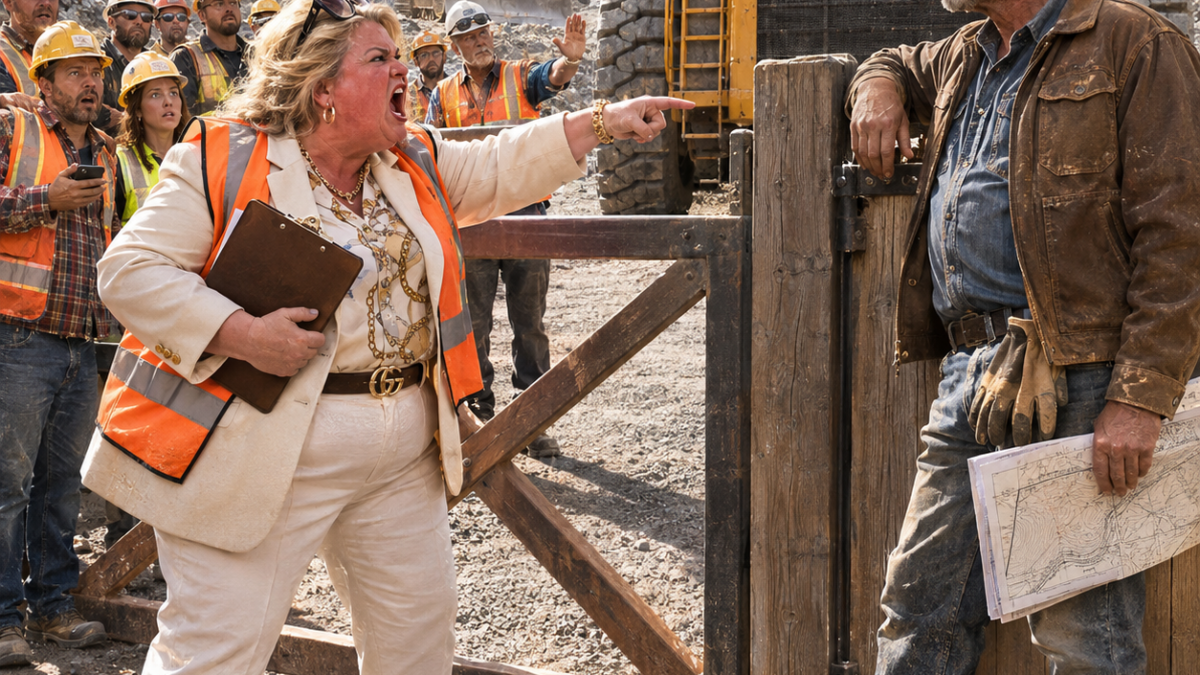
𝗙𝗨𝗟𝗟 𝗦𝗧𝗢𝗥𝗬:“MOVE YOUR DAMN TRUCKS, DANIEL! THIS IS AN HOA-APPROVED CONSTRUCTION ZONE, AND I DON’T NEED PERMISSION FROM SOME GRAVEL HAULER TO USE IT!” Karen Whitmore shouted in front of a dozen construction workers, pointing at the forty-ton quarry truck waiting outside my gate as though the land my father had left me belonged to her.
𝗙𝗨𝗟𝗟 𝗦𝗧𝗢𝗥𝗬
She hesitated.
Then said, “The board already decided.”
I glanced toward the old concrete boundary monument beside my fence.
A marker my father had shown me when I was fifteen.
The same marker identified on my recorded survey.
“The board doesn’t own my yard.”
Karen gave a dismissive laugh.
“You don’t understand how community development works.”
I could hear people talking in the background.
Then she continued.
“Your gravel lot is hardly an attractive feature of Stonebrook Ridge, and for once, it can contribute something useful to the neighborhood.”
I stared at the equipment.
“That’s my business yard.”
“Oh, please.”
Her voice dripped with contempt.
“A few piles of crushed rock and some dirty trucks? Daniel, we’re building a two-million-dollar community facility. Your little side operation can survive a temporary inconvenience.”
I felt something inside me settle.
Very still.
Very clear.
“Karen, you have no permission to use my property.”
She snapped, “I don’t need to stand here negotiating with you.”
“Yes, you do.”
“No.”
Her voice rose.
“You need to learn that living beside an HOA means cooperating with your neighbors.”
I looked toward my gate.
“Cooperation requires permission.”
She laughed again.
“And permission isn’t something you get to withhold simply because you’re stubborn.”
Then she said the sentence I would later remember every time I looked at the paperwork.
“YOUR YARD IS EMPTY MOST OF THE TIME, DANIEL. STOP ACTING LIKE YOU OWN THE WHOLE WORLD.”
I looked around.
Forty acres.
My father’s land.
My business.
My equipment.
And a woman who had never paid a dime toward any of it had decided my property was available because she didn’t like looking at gravel.
I took a slow breath.
“Karen.”
“What?”
“Move everything.”
Her voice became sharp.
“Absolutely not.”
“Today.”
“You don’t give orders to this board.”
“I don’t need to.”
I looked at the sign.
“I’m the landowner.”
She was silent for a moment.
Then said, “We’ll see about that.”
The call ended.
I stood beside my truck, listening to machinery operating where my loader should have been.
And I realized something.
Karen Whitmore believed she’d already won.
She thought I was a stubborn landowner who would eventually accept being pushed aside.
She had no idea that three contracted quarry deliveries were scheduled through that yard.
And when those forty-ton trucks returned, the contractor would have to choose between Karen’s imaginary authority and the property records she had deliberately ignored.
That choice was going to cost her far more than she could imagine.
PART2
My name is Daniel Mercer.
At the time, I owned forty acres on the edge of Stonebrook Ridge, a fast-growing residential development built beside land that had once supported small quarry and excavation operations.
My father had worked in aggregate hauling for most of his life.
He wasn’t a wealthy man.
He didn’t own a chain of construction companies or a giant mining operation.
He owned trucks, equipment, and enough practical knowledge to keep them working.
He believed a man’s reputation mattered more than the shine on his vehicles.
He also believed land was something you protected.
Not because owning dirt made you important.
Because land represented years of work, sacrifice, and responsibility.
When he died, the property became mine.
I kept the house.
Maintained the machine shed.
And continued using the western gravel pad for aggregate staging and a small supply operation serving local contractors.
The yard wasn’t impressive.
There was no marble entrance.
No decorative fountain.
No row of expensive ornamental trees.
There were stockpiles of crushed stone, a compacted turnaround, a loader, and equipment that needed room to operate safely.
But the yard served a real purpose.
Without it, I couldn’t load trucks efficiently or move heavy trailers without damaging the surrounding pasture.
To Karen Whitmore, it looked like unused space.
To me, it was part of my livelihood.
Stonebrook Ridge had been expanding for years.
The houses were large.
Many had stone facades, three-car garages, and carefully maintained lawns.
The main entrance featured an elaborate sign surrounded by landscaping.
The community had a pool, tennis courts, walking trails, and a clubhouse.
None of that bothered me.
People were entitled to enjoy the neighborhood they’d paid to live in.
The trouble was that some residents, especially Karen, seemed to believe that an attractive entrance sign gave their association control over everything visible from the road.
My property predated much of the development.
I lived beside Stonebrook Ridge.
I wasn’t part of its association.
My deed didn’t grant Karen authority over my business.
And there was no recorded right allowing the HOA to use my gravel yard as its personal equipment depot.
I considered those facts so obvious that I never expected to argue about them.
I was wrong.
Karen had been HOA president for three years.
She was in her late forties, with carefully styled blonde hair, expensive clothes, and an almost religious devotion to the phrase property values.
She loved standing in front of a microphone.
Loved telling people what was acceptable.
Loved implying that anyone who disagreed with her was threatening the neighborhood.
At board meetings, she’d talk about community image, future buyers, and maintaining premium standards.
She spoke as though every mailbox, driveway, and flowerbed existed beneath her personal supervision.
The clubhouse renovation was her favorite project.
Two million dollars.
An expanded fitness room.
New locker rooms.
A larger patio.
A covered outdoor pavilion.
Updated landscaping.
She referred to it as a landmark investment.
Sometimes she called it her legacy.
I didn’t particularly care what Karen called it.
The clubhouse belonged to Stonebrook Ridge.
My gravel yard belonged to me.
As long as both parties respected those boundaries, there was no reason we couldn’t get along.
The first warning appeared several weeks before the construction equipment arrived.
I noticed concrete delivery trucks waiting on the county road near my western gate.
That didn’t concern me immediately.
Construction projects required deliveries.
Drivers occasionally waited for instructions.
Then one afternoon, I found a survey stake near my gravel yard.
It wasn’t mine.
The next morning, another appeared.
I called the HOA office.
Karen answered.
“Daniel, what now?”
I looked toward the stake.
“Your contractor is marking my property.”
She didn’t hesitate.
“That’s for temporary staging.”
I stared.
“Staging where?”
“Along the western edge.”
“Karen, that’s my western edge.”
She sighed.
“Don’t be so possessive.”
For a moment, I couldn’t believe she’d said it.
“Possessive?”
“Yes.”
Her voice grew impatient.
“We’re not constructing a building on your land. We simply need somewhere to store materials.”
“You have association common area.”
“It’s landscaped.”
“So is mine, in the sense that I maintain it for its intended purpose.”
She laughed.
“Daniel, nobody considers a gravel pile landscaping.”
I took a breath.
“That isn’t the point.”
She interrupted.
“You live next to a premium residential community. Sometimes that comes with responsibilities.”
I stared at the stake.
“Not responsibilities you can invent.”
Her tone sharpened.
“We’ll discuss it at the board meeting.”
I answered, “There is nothing to discuss. You don’t have my permission.”
Then I ended the call.
Three days later, a man named Mike Larson arrived at my gate.
He wore a yellow reflective vest and carried a clipboard.
He introduced himself as the site foreman for Ridgeway Construction.
He seemed uncomfortable before the conversation even began.
“Mr. Mercer?”
“That’s me.”
He glanced toward my gravel pad.
“We’re supposed to start receiving materials through this access.”
I looked at him.
“Through my gate?”
He nodded.
“That’s what the plan says.”
“Who told you it was available?”
“The association.”
I folded my arms.
“Did they give you a signed access agreement?”
Mike hesitated.
“They gave us a site logistics plan.”
“Can I see it?”
He turned his clipboard.
A photocopied aerial image showed the clubhouse project and nearby roads.
A thick blue line ran across my gravel yard.
There was no properly identified parcel boundary.
No recorded easement.
No deed reference.
No signature.
No written consent from me.
Just a blue line drawn across somebody else’s land.
I pointed at it.
“Mike, that’s my property.”
He looked toward the paper.
“Karen said the access was cleared.”
“By whom?”
He shifted his weight.
“I assumed—”
“Don’t assume. Ask her for the document.”
He looked embarrassed.
“Look, I’m trying to keep our deliveries moving.”
“I understand.”
I nodded toward the yard.
“So am I.”
Mike was not the kind of man who enjoyed confrontation.
I could see that.
He wanted to run a construction site.
Schedule deliveries.
Keep workers busy.
Finish the job.
He didn’t want to argue with a landowner about a boundary dispute created by somebody in a blazer.
I wasn’t angry at him.
Not yet.
He’d been given inaccurate information.
But now he knew there was a problem.
I expected him to verify it before allowing equipment onto my land.
Unfortunately, Karen had already decided verification was unnecessary.
A week passed.
Nothing happened.
No trucks.
No delivery trailers.
No fresh stakes.
I thought Mike had spoken with the project manager and that somebody at Ridgeway had realized Karen’s plan was unacceptable.
I went back to work.
Processed orders.
Maintained equipment.
Loaded crushed stone.
Checked delivery schedules.
Then Monday morning arrived.
And I discovered the entire western yard had been taken over.
After Karen hung up on me, I called my attorney.
Rachel Boone had handled property matters and business contracts for me for years.
She was direct, meticulous, and completely unimpressed by people who relied on confident voices instead of documents.
When I explained what happened, she didn’t raise her voice.
She asked one question.
“Did you sign anything?”
“No.”
“Anything at all?”
“No.”
“Lease?”
“No.”
“Temporary access agreement?”
“No.”
“License?”
“No.”
“Did you grant verbal permission?”
“Absolutely not.”
She paused.
Then said, “Don’t touch their equipment.”
I looked toward the yard.
“I wasn’t planning to.”
“Good.”
Her voice became firm.
“Photograph everything. Keep a record of dates and times. And send me your deed, survey, tax map, and every HOA communication you have.”
I nodded.
“Already photographing.”
Rachel paused.
Then said something I never forgot.
“Let them create the evidence, Daniel. Don’t help them hide it.”
She arrived that afternoon.
We walked the perimeter.
She inspected the concrete boundary monuments.
Compared their locations with my survey.
Studied the equipment placement.
Then looked toward the temporary office.
“Did they move your stockpiles?”
“Yes.”
“Who authorized that?”
“Nobody.”
“Did they grade this area?”
“Looks like it.”
She took photographs.
Then looked toward me.
“Do not interfere physically with the work crews.”
I nodded.
“Understood.”
She glanced toward the portable office.
“But we are going to make it very clear that this occupation is unauthorized.”
Two hours later, Rachel sat at my kitchen table with the recorded plat spread before us.
She pointed toward the western boundary.
“Here.”
I leaned closer.
“The stone drainage ditch.”
“Exactly.”
She traced the line.
“The association common area ends here.”
Then she moved her finger.
“Your gravel yard begins on the other side.”
I nodded.
“That’s what I’ve been telling them.”
Rachel examined the access records.
“There is a recorded easement farther north.”
I leaned forward.
She continued.
“Twelve feet wide. Existing farm lane. Different location. Different purpose.”
She pointed toward Karen’s staging area.
“Nearly two hundred feet south.”
I stared.
Rachel looked at me.
“Daniel, there isn’t even a plausible recorded access right for what they’re doing.”
That should have ended the dispute immediately.
A reasonable HOA president would have looked at the plat.
Called the contractor.
Apologized.
And arranged to remove the equipment.
Karen wasn’t reasonable.
She’d already told the construction company that the space was available.
She’d already let workers unload materials.
She’d already allowed a portable office to be installed.
And admitting she was wrong meant admitting that her prized clubhouse project had been organized around land she didn’t control.
She couldn’t tolerate that.
So she did what she always did when confronted with a fact she didn’t like.
She acted more confident.
And became more aggressive.
The next morning, Rachel sent formal notice to Stonebrook Ridge HOA, Ridgeway Construction, and the project manager.
It identified my parcel.
Attached the relevant property information.
Explained that no permission had been granted.
And demanded removal of the unauthorized equipment, materials, and structures.
The notice also reserved my right to seek documented losses and restoration costs.
It was professional.
Clear.
And impossible to misunderstand.
Karen responded within an hour.
Her email claimed the association had historically used the gravel area for project access.
I stared at the sentence.
Historically?
I’d lived there eleven years.
Nobody from Stonebrook Ridge had ever used my gravel yard for construction staging.
No HOA truck had regularly crossed it.
No clubhouse project had used it.
The only unusual access I’d allowed was a one-time emergency utility crossing years earlier after a water main broke.
Karen was attempting to turn that temporary act of neighborly cooperation into a permanent privilege.
Rachel answered with a single question.
Please identify the recorded instrument authorizing Stonebrook Ridge HOA to use Parcel 14B for contractor staging.
Karen didn’t respond in writing.
Instead, my phone rang.
I answered.
“Daniel Mercer.”
Karen’s voice came through immediately.
“You have made this unnecessarily adversarial.”
I almost laughed.
“Karen, you put a construction site on my property.”
“We’re halfway through a major project.”
“Then you should have planned it on land you own.”
She sighed dramatically.
“Do you understand how disruptive it will be if we move everything?”
“Yes.”
“Then why are you doing this?”
I stared through my kitchen window toward the yard.
“Because it’s my property.”
She went silent.
Then said, “You don’t live in a vacuum, Daniel.”
“No.”
Her voice hardened.
“You are surrounded by a community.”
I looked toward the boundary fence.
“And surrounded by property lines.”
She inhaled sharply.
“Don’t be disrespectful.”
I answered, “Don’t use my land.”
Then she hung up.
Two days later, Harold Price called.
Harold was a Stonebrook Ridge board director.
A careful man in his sixties who had always been polite when our paths crossed.
He sounded uneasy.
“Daniel, I saw the site plan.”
I leaned back.
“All right.”
“It doesn’t show your parcel number.”
“It shouldn’t.”
He hesitated.
“Karen told us the staging area was on association land.”
I stared toward the window.
“Did she show you a survey?”
“No.”
“A recorded plat?”
“No.”
“A signed agreement from me?”
He sighed.
“No.”
I waited.
Then Harold said quietly, “I think we’ve got a problem.”
I looked toward the construction office sitting beside my machine shed.
“Harold.”
“Yes?”
“You’ve had a problem since the first truck crossed my gate.”
That was the first crack in Karen’s little empire.
The board had approved temporary construction staging.
But according to Harold, Karen presented it as an arrangement involving land under association control.
There had been no specific vote authorizing entry onto my parcel.
No written agreement.
No negotiated lease.
No permission from me.
Karen had simply assured people she had the authority to offer the space.
And everybody had trusted her.
Until I started asking questions.
The following morning, Rachel asked me to come to her office.
When I arrived, she had three folders spread across the conference table.
One contained my property records.
One held the correspondence with Stonebrook Ridge.
The third was marked CONSTRUCTION LOGISTICS.
She looked up.
“Close the door, Daniel.”
I did.
Then sat across from her.
“What’s happened?”
Rachel tapped the third folder.
“Harold was right about the site plan.”
My stomach tightened.
“What did you find?”
She opened it.
“The HOA sent over the nonprivileged records we requested.”
I leaned forward.
“Board minutes?”
“Yes.”
“Contractor instructions?”
“Yes.”
“Earlier versions of the staging plan?”
She nodded.
“And that’s where things get interesting.”
The original site logistics plan showed all construction staging on Stonebrook Ridge property.
The arrangement was cramped.
It required carefully timed deliveries.
Trucks couldn’t simply arrive whenever they pleased.
The contractors would have to coordinate unloading around resident parking and existing access lanes.
But the plan was workable.
Rachel pointed toward an area behind the clubhouse.
“See this?”
I nodded.
“Their common area.”
“Exactly.”
She slid another document toward me.
“This was the revised version.”
I stared.
The marked staging area had moved west.
Across the property boundary.
Onto my gravel pad.
A handwritten note appeared beside the change.
MOVE STAGING WEST. USE EXISTING GRAVEL PAD.
Underneath was another instruction suggesting that I wouldn’t object once the project was underway.
I read it twice.
Then looked at Rachel.
“She wrote that?”
“The records attribute the revision to Karen.”
I felt heat rising in my face.
“After I told her no?”
Rachel nodded.
“That’s what the dates indicate.”
For a moment, I couldn’t speak.
The timing mattered.
Karen hadn’t simply made an innocent mistake about where the boundary lay.
She’d spoken with me.
Heard my refusal.
Then proceeded with a plan that represented my land as available.
She had taken the one thing she didn’t have—my consent—and quietly replaced it with her own expectation that I’d surrender once the equipment arrived.
Rachel continued.
“Mike Larson has confirmed that Karen told him you wouldn’t object.”
I stared.
“Did he tell her I objected at the gate?”
“He says he relayed your concern.”
“And she still proceeded?”
Rachel nodded.
I looked toward the revised plan.
The blue line crossing my property.
The note.
The dates.
My refusal.
Suddenly, the whole thing seemed less like a boundary dispute and more like an attempt to make an unauthorized arrangement too expensive to reverse.
Karen had counted on momentum.
If the contractor unloaded enough material, placed enough equipment, and scheduled enough work, she assumed everyone would pressure me into accepting what she’d done.
The project would become the excuse.
The neighbors would become the audience.
And I would be portrayed as the selfish landowner threatening a community investment.
Rachel looked at me.
“Daniel, I need you to understand something.”
I leaned back.
“Go ahead.”
“She’s going to argue that removing the equipment will hurt the association.”
“I know.”
“She’s going to imply you caused the problem.”
“I know.”
“And she may try to make you feel responsible for whatever delay follows.”
I looked toward her.
“Rachel, she put a temporary office where I park my loader.”
Rachel’s expression remained steady.
“Then keep remembering that fact.”
She reached for another document.
An invoice.
I scanned the description.
Clearing.
Grading.
Compaction.
Aggregate handling.
Then stopped.
“This is my yard.”
Rachel nodded.
“They’ve already charged the HOA for site preparation work on your property.”
I looked up.
“Without asking me.”
“Yes.”
“And the board paid for it?”
“According to the records.”
I leaned back.
For a long moment, I couldn’t speak.
They hadn’t merely parked a few trucks.
They had altered the surface of my business yard, relocated materials, and billed Stonebrook Ridge for the privilege of using land its president didn’t own.
I thought about my father.
The years he spent developing that pad.
The soil we’d removed.
The layers of stone we’d compacted.
How carefully we’d planned the turning radius for loaded trucks.
He’d been particular about the drainage.
“Water’s patient,” he’d tell me.
“It’ll find every mistake you make.”
Now somebody else’s contractor had graded part of the surface without consulting me.
I didn’t yet know whether the work had damaged anything.
But I knew why my father would’ve been furious.
A gravel yard isn’t just empty ground.
It is an engineered working surface.
A small change in slope can send water toward a stockpile.
A barrier in the wrong place can make a truck turn unsafely.
A telehandler parked in the loader’s swing path can stop the entire operation.
Karen saw a patch of gravel.
I saw years of work.
Rachel handed me the final sheet.
A material delivery record.
I scanned it.
Then frowned.
“Eighty tons?”
“Approximately.”
I looked up.
“They brought nearly eighty tons of aggregate into my yard?”
Rachel nodded.
“According to the contractor’s records.”
I stared toward the window.
Then almost laughed.
Not because it was funny.
Because the sheer arrogance was difficult to comprehend.
Karen had decided my aggregate yard would be convenient for storing aggregate belonging to somebody else’s project.
She couldn’t have selected a more absurd way to interfere with my business.
Rachel watched me.
“What are you thinking?”
I looked toward the delivery schedule folded in my shirt pocket.
“My trucks are coming back.”
She nodded.
“I know.”
“Three standing customer arrangements.”
“Yes.”
“The largest order is due to begin loading this week.”
Rachel leaned forward.
“Then we document every disruption.”
I swallowed.
“I already told the customers there might be a problem.”
“Good.”
“Didn’t cancel the orders.”
“Also good.”
She pointed toward my records.
“Keep the correspondence. Track any reasonable mitigation costs. Don’t inflate anything.”
I nodded.
“Wouldn’t dream of it.”
She gave me a small smile.
“I know.”
Then her expression became serious again.
“And Daniel?”
“Yes?”
“Don’t turn the trucks into a confrontation.”
I frowned.
“They need to operate.”
“Then let them arrive according to the legitimate schedule. Don’t block anybody deliberately, don’t move contractor equipment, and don’t put a driver in an unsafe position to prove a point.”
I nodded.
“That was never my plan.”
“Good.”
She closed the folder.
“Because the facts are already on your side.”
The next two days felt longer than they were.
Construction continued in the gravel yard.
I could hear engines from the house.
Watch unfamiliar workers enter my property.
See materials unloaded beside my shed.
Every instinct told me to walk down there and demand that they stop.
But Rachel had a reason for asking me to remain careful.
The notice had been served.
The records had been preserved.
The contractor had been told the right of entry was disputed.
If somebody continued using the land, that decision would belong to them.
Not to me.
I kept working where I could.
Handled orders.
Checked equipment.
Called customers.
Explained the temporary obstruction.
The conversations weren’t pleasant.
One contractor needed road-base material for a commercial site thirty miles away.
Another had a scheduled paving preparation job.
A third expected a smaller aggregate delivery.
Construction schedules aren’t flexible simply because a property owner is having a dispute with an HOA president.
A crew waiting on stone still has wages to pay.
Equipment still costs money.
A customer facing delay doesn’t particularly care how foolish Karen Whitmore has been.
They care whether the material arrives.
And I understood that.
One of my customers, Steve Nolan, called Thursday afternoon.
“Daniel, what’s happening with the yard?”
I looked toward the contractors across the fence.
“Unauthorized equipment is blocking the loading area.”
He was silent.
Then asked, “Whose equipment?”
“Stonebrook Ridge’s clubhouse contractor.”
A pause.
“On your property?”
“Yes.”
He gave a low whistle.
“You’ve got to be kidding.”
“I wish I were.”
He sighed.
“We’ve got a crew starting Monday.”
“I know.”
“Can you still supply us?”
I looked toward the loading pad.
“I’m working on a solution.”
Steve was quiet for a moment.
Then said, “I trust you, Daniel. But I can’t keep those guys standing around indefinitely.”
“I understand.”
When the call ended, I stared toward the yard.
This wasn’t a neighborhood argument anymore.
It was affecting people who had nothing to do with Karen’s clubhouse.
That evening, I sat in my father’s old office beside the machine shed.
His desk was still there.
Scratched oak.
A metal file cabinet.
An outdated calendar he’d never bothered to remove.
There was a photograph of him standing beside his first dump truck.
He looked young.
Proud.
His sleeves rolled above his elbows.
His hands resting on the door.
I picked up the photograph.
For a moment, I remembered the things he used to tell me.
Don’t take money for work you can’t finish.
Don’t promise delivery dates you can’t meet.
Don’t let somebody else’s emergency become an excuse for unsafe work.
And don’t ever sign a document you haven’t read.
I smiled sadly.
“Dad, you would’ve loved this mess.”
Then I looked through the window toward the portable office.
“No.”
My smile disappeared.
“You would’ve hated it.”
Friday morning, a loaded quarry truck came through my main gate.
The driver was a man named Pete Dawson.
He’d hauled material for me often enough to know every turn in that yard.
Pete was in his fifties, with a weathered face, broad hands, and the practical patience of someone who’d spent decades guiding heavy vehicles through places that looked much larger on paper than they did in real life.
His truck stopped just inside the entrance.
Then my phone rang.
“Daniel.”
“Morning, Pete.”
There was a pause.
“Where the hell am I supposed to go?”
I looked down the slope.
The concrete barriers blocked the loading lane.
A telehandler occupied the loader’s swing area.
The portable office sat directly in the turnaround.
“Stay there,” I said.
“Don’t try to squeeze past.”
Pete laughed without humor.
“Wasn’t planning to.”
I walked down to the yard.
Pete climbed out of his cab.
He looked around.
Then stared at the construction sign.
“What is this?”
“Karen Whitmore’s idea of temporary cooperation.”
Pete shook his head.
“You gave them the yard?”
“No.”
He stared.
“Then why are they here?”
“That’s what my attorney has been asking.”
Pete let out a long breath.
He looked at the concrete pump.
Then the office trailer.
Then my loader.
“Daniel, I can’t turn here.”
“I know.”
“And I can’t back a loaded trailer around those barriers safely.”
“I know.”
He folded his arms.
“So what now?”
I looked toward Ridgeway’s temporary office.
“Now we ask the contractor to explain how he intends to keep operating on land he doesn’t have permission to use.”
I called Mike Larson.
He came out carrying his clipboard.
The moment he saw Pete’s truck, his expression changed.
“Morning, Daniel.”
“Mike.”
I gestured toward the yard.
“That’s a scheduled quarry truck.”
He nodded.
“I see that.”
“We need the loading lane cleared.”
He looked toward the telehandler.
Then the barriers.
“I’m not sure I can do that right now.”
I studied him.
“Why not?”
He sighed.
“Karen says the space is part of our approved staging plan.”
I looked straight at him.
“Mike, Karen doesn’t own this property.”
His face tightened.
“I know what you’re saying.”
“No.”
I pointed toward the old concrete monument.
“I’m telling you what the recorded plat shows.”
He looked down.
I continued.
“Your company received Rachel’s notice. You’ve seen the ownership information. I’ve refused access in writing.”
Mike was silent.
Then he said quietly, “I know.”
I took a breath.
“I’m not asking you to do something unsafe.”
He looked up.
“Then what are you asking?”
“Stop using my yard until your company can produce legal authorization.”
He glanced toward the construction office.
Then toward Pete’s truck.
For several seconds, nobody spoke.
Then Mike reached for his phone.
“Let me call operations.”
That was the moment Karen’s entire strategy began collapsing.
Not when I shouted.
I didn’t.
Not when I threatened to move machinery.
I hadn’t.
And not when a judge arrived with some miraculous order that resolved everything in five minutes.
There was no such moment.
It happened when a contractor looked at a full-sized quarry truck waiting to conduct legitimate business and realized the HOA president’s assurances were no substitute for a right-of-entry agreement.
Mike’s job was to keep the project moving.
But he also had a duty not to place his company in an avoidable trespass dispute.
And suddenly, Karen’s confidence wasn’t worth the paper her unauthorized logistics map was printed on.
Within twenty minutes, the Ridgeway operations manager arrived.
His name was Thomas Keller.
A tall man in a navy work jacket, with close-cropped gray hair and the expression of someone who didn’t enjoy discovering expensive problems before breakfast.
He stepped from his SUV.
Looked at Pete’s truck.
Then my loader.
Then the concrete barriers.
Mike handed him the paperwork.
Thomas read Rachel’s notice.
Carefully.
He examined the survey.
Then the staging plan.
Then looked toward Mike.
“Where’s the right-of-entry agreement?”
Mike shook his head.
“We don’t have one.”
Thomas looked up sharply.
“What?”
Mike shifted his weight.
“Karen said the association had authorization.”
Thomas stared toward the office trailer.
Then asked, “From the landowner?”
Mike didn’t answer.
He didn’t need to.
Thomas turned toward me.
“Mr. Mercer?”
“Yes.”
“Did you authorize our company to occupy this yard?”
“No.”
“Not verbally?”
“No.”
“Not in writing?”
“No.”
He looked toward the boundary marker.
“Is the parcel privately owned?”
“Yes.”
“Do you have documentation?”
I held up Rachel’s survey copy.
He studied it.
Then looked toward his foreman.
For a moment, his jaw tightened.
He took out his phone.
And called Karen Whitmore.
She arrived in her white SUV less than fifteen minutes later.
Cream blazer.
Expensive sunglasses.
Perfectly arranged blonde hair.
She stepped out as though she were arriving to inspect a landscaping display.
Then she noticed Pete’s truck.
Her expression changed.
“What is that doing here?”
I stared.
“That’s my truck conducting my business on my property.”
Karen removed her sunglasses.
“Daniel, this is a restricted construction zone.”
Pete looked toward me.
I could tell he was struggling not to laugh.
I folded my arms.
“Karen, you don’t get to restrict access to land you don’t own.”
She turned toward Thomas.
“Why has work stopped?”
Thomas held up the notice.
“Mrs. Whitmore, we need to verify your authority for this staging area.”
Karen frowned.
“We’ve already approved the logistics plan.”
“That’s not my question.”
Her face hardened.
“What exactly are you asking?”
Thomas looked directly at her.
“DO YOU HAVE A SIGNED RIGHT-OF-ENTRY AGREEMENT FROM MR. MERCER?”
Karen stared.
For several seconds, she said nothing.
Then she lifted her chin.
“The board approved the staging arrangement.”
Thomas didn’t blink.
“Do you have the agreement?”
“The association owns this area.”
I pointed toward the concrete monument.
“No, it doesn’t.”
Karen looked down.
Then laughed.
“That old marker?”
Rachel’s vehicle pulled up behind us.
She stepped out carrying the recorded survey.
Karen’s expression tightened.
Rachel approached.
“Good morning.”
Thomas nodded.
“Counsel?”
“Rachel Boone. I represent Mr. Mercer.”
She opened the survey.
Then pointed.
“That old marker is a recorded property corner.”
Karen stared toward the document.
Rachel continued.
“The HOA’s common area ends at the drainage ditch. This gravel pad lies within Mr. Mercer’s parcel.”
Karen looked toward the monument.
Then the yard.
Then Rachel.
For the first time since I met her, she seemed unable to find an immediate insult.
Thomas looked toward Karen.
“Do you dispute this survey with another recorded instrument?”
She folded her arms.
“We’ve always had community access.”
Rachel didn’t raise her voice.
“Please identify the easement.”
Karen looked away.
“We’re not discussing legal technicalities beside a construction trailer.”
Thomas’s expression hardened.
“Mrs. Whitmore, whether we have permission to occupy someone else’s property is not a technicality.”
Karen stared at him.
Then pointed toward me.
“This man is deliberately sabotaging a community project.”
I looked toward Pete’s truck.
“He’s here for a scheduled business operation.”
Karen snapped, “You could have rescheduled.”
I stared.
“Because you wanted my yard?”
“Yes!”
The word came out before she could stop herself.
She caught it.
Then tried again.
“Because the community has invested millions in this renovation.”
Rachel looked toward Thomas.
“Mr. Keller, the ownership documentation is clear. The association has no identified authorization to use this parcel.”
Thomas took a breath.
Then turned toward Mike.
“Stop work in this staging area.”
Karen’s mouth opened.
“Excuse me?”
Thomas repeated the instruction.
“Stop all operations on this parcel until we have lawful access.”
Karen stepped forward.
“YOU CANNOT SHUT DOWN MY PROJECT!”
He looked at her.
Then answered calmly.
“I CAN STOP MY COMPANY FROM TRESPASSING.”
For a moment, the entire yard seemed to go silent.
The telehandler stopped moving.
Workers looked toward their foreman.
Pete stood beside his truck.
Rachel closed her survey folder.
And Karen Whitmore stood in the center of my gravel yard, surrounded by equipment she had brought onto land she didn’t own.
I didn’t smile.
Didn’t celebrate.
Didn’t say a word.
I simply watched the contractor’s operations manager do what Karen should have done before the first truck crossed my gate.
He recognized the property boundary.
And stopped pretending it didn’t matter.
Karen looked toward me.
Her face was red.
“This isn’t over, Daniel.”
I nodded.
“I’m sure.”
“You have no idea what you’ve just done.”
I looked around the yard.
Then answered, “I know exactly what I did.”
She waited.
I continued.
“I told you no.”
She climbed into her white SUV and slammed the door.
Gravel sprayed from beneath the tires as she drove away.
Thomas watched her leave.
Then looked toward Rachel.
“We need to coordinate removal.”
Rachel nodded.
“Correct.”
He glanced toward the equipment.
“We’ll do it safely and document the process.”
“That’s what we expect.”
Thomas turned toward me.
“Mr. Mercer, I apologize for the situation.”
I looked at the office trailer.
Then at Pete’s truck.
“I appreciate that.”
He nodded.
“We’ll begin clearing the occupied area.”
Pete walked beside me as the crew received instructions.
He looked toward the concrete barriers.
Then toward the exit.
“Daniel.”
“Yeah?”
“Think she’ll apologize?”
I stared down the road where Karen’s SUV had disappeared.
Then shook my head.
“Not voluntarily.”
Pete laughed.
“Fair enough.”
By that afternoon, Ridgeway had removed the portable office.
The next morning, workers relocated the telehandler.
Then the concrete barriers.
Then the forms.
Then the materials stacked beside my fence.
It wasn’t a simple operation.
The equipment had been placed according to Karen’s revised staging plan.
Removing it meant reorganizing deliveries and work sequences.
But the contractor worked with Rachel to get the equipment off my property.
I didn’t move a single piece myself.
Not one barrier.
Not one pallet.
Not one construction vehicle.
I watched.
Documented.
And waited for the yard to become usable again.
Across the road, Stonebrook Ridge’s carefully landscaped common area suddenly looked much smaller than Karen had pretended.
The original staging plan had required tight scheduling.
Her unauthorized version had removed that inconvenience by using my gravel pad.
Now the project had to return to the plan that should have been followed from the beginning.
And that meant delays.
Steel deliveries.
Concrete scheduling.
Pavilion framing.
Material storage.
Transportation.
The contractor needed a workable alternative.
The association needed to pay for it.
And Karen needed someone to blame.
She chose me.
Harold Price called that weekend.
I was standing in the yard looking at the open space where the portable office had been.
The crew had removed most of the equipment.
But the gravel surface looked different.
There were fresh tracks where large machines had turned.
A section near the stockpile had been graded.
Some of the material bins had been shifted.
I knew I would need a closer assessment before returning everything to normal.
My phone rang.
“Daniel?”
“Harold.”
He sighed.
“She’s telling everybody you shut down the clubhouse project.”
I looked toward the road.
“Did she mention the part where she put it on my property?”
There was a pause.
“Not exactly.”
I almost laughed.
“I’m shocked.”
Harold sounded exhausted.
“She’s saying you refused a reasonable community accommodation.”
“An accommodation requires somebody to ask.”
“I understand.”
“She didn’t ask, Harold. She told me she’d already decided.”
He was silent.
I continued.
“Then she ignored my refusal.”
“I know.”
“And instructed a contractor to occupy my yard.”
Another pause.
“I know.”
I took a breath.
“Then she caused the disruption.”
Harold lowered his voice.
“The board is furious.”
I looked toward the clubhouse.
“With me?”
“With her.”
That surprised me.
Not because Karen was innocent.
But because people in Stonebrook Ridge had spent years treating her word as final.
Harold continued.
“We didn’t understand where the staging area actually was.”
“Now you do.”
“Yes.”
He hesitated.
“And we’re hiring an independent consultant to review the construction impact.”
I nodded.
“That seems appropriate.”
He sounded uncomfortable.
“Daniel, I wanted you to hear it from me.”
I looked toward my father’s machine shed.
“I appreciate that.”
When the call ended, I walked slowly across the yard.
The morning sun revealed things I hadn’t noticed while the construction equipment was still present.
A shallow depression near one stockpile.
Freshly compacted tracks.
A slightly altered slope along the western edge.
I crouched and picked up a handful of gravel.
The surface had been changed.
That was undeniable.
Whether the changes created measurable damage would need to be assessed.
But I could already see why my father had been particular about how the pad was maintained.
Water had to drain away from the stockpiles.
Heavy trucks needed predictable footing.
And a working yard couldn’t be treated like disposable space just because someone else intended to occupy it briefly.
Rachel came by later that afternoon.
She brought a camera, measuring tape, and another folder.
“You look tired,” she said.
I smiled weakly.
“Been an exciting week.”
She looked toward the vacant area.
“Equipment gone?”
“Most of it.”
She nodded.
“Good.”
Then her expression turned serious.
“We need to separate your business losses from property restoration costs.”
I folded my arms.
“Why?”
“Because they’re different claims.”
She pointed toward the loading lane.
“Lost loading windows, alternate trucking, delay penalties, and replacement equipment are business losses.”
Then toward the graded pad.
“Repairing the altered surface is a restoration issue.”
I nodded.
She continued.
“We document each carefully. No estimates pretending to be invoices. No double counting.”
I smiled.
“Rachel, you know me.”
“I do.”
She looked toward the yard.
“That’s why I’m telling you before somebody else tries to turn this into a fight about exaggerated damages.”
She helped me build the records.
Customer communications.
Delivery schedules.
Trucking invoices.
Equipment rental receipts.
The delay penalty assessed under one customer contract.
Every relevant date.
Every amount.
Every reasonable step I’d taken to mitigate the disruption.
We weren’t going to claim the whole business had collapsed.
It hadn’t.
We weren’t going to demand millions because Karen had annoyed me.
I was angry.
But anger isn’t an accounting method.
My business had incurred actual costs.
And those costs could be documented.
One customer needed material delivered from another yard.
I arranged temporary trucking.
It cost more.
Another had to reschedule a loading window.
A contractor passed along a reasonable delay charge under our agreement.
And because my loader couldn’t safely access the normal stockpile during the obstruction, I hired another machine for several days.
Rachel collected the documentation.
Calculated the losses.
Then showed me the total.
$14,860.
I stared at it.
Not a million dollars.
Not an enormous imaginary settlement.
Fourteen thousand eight hundred sixty dollars.
Real money.
Enough to matter.
Enough to hurt.
And every dollar tied to an operational problem that wouldn’t have existed if Karen had accepted the first word I’d said to her.
No.
Rachel watched me.
“Daniel, don’t minimize it.”
I looked up.
“I wasn’t.”
She nodded.
“Good.”
I looked toward the total again.
“Fourteen thousand dollars because she didn’t want construction trucks blocking her neighbors’ parking.”
Rachel’s expression hardened.
“And because she thought your property was available to solve that problem without your permission.”
I leaned back.
For a moment, I didn’t speak.
Then I said, “My dad used to say people spend other people’s money very easily.”
Rachel nodded toward the documents.
“Karen appears to have been comfortable spending other people’s property too.”
The HOA’s independent consultant completed his review soon afterward.
The report was detailed.
Construction schedules.
Staging plans.
Delivery records.
Change orders.
Equipment movement.
Costs.
The consultant didn’t accuse every person involved of malicious intent.
He examined how the staging arrangements changed and what that change did to the project.
The original logistics plan had been tight.
But workable.
It required discipline.
Deliveries had to be coordinated.
Material storage was limited.
Construction vehicles couldn’t be parked wherever they pleased.
Karen’s revision made the project easier to operate in the short term by transferring its logistical burden onto my gravel yard.
Without authorization.
When Ridgeway was forced to return to HOA-controlled land, the contractor had to reorganize work.
The portable office had to be relocated.
Equipment moved.
Materials transferred.
Deliveries rescheduled.
New temporary fencing arranged.
And some work sequences revised.
The direct project impact attributed to the unauthorized staging decision came to:
$68,400.
Harold called me after the board received the report.
He sounded as though he’d aged ten years in two weeks.
“Daniel.”
“Harold.”
“We’ve got the consultant’s findings.”
I waited.
He sighed.
“Sixty-eight thousand four hundred dollars.”
I looked toward the window.
“For what?”
“Direct costs associated with the staging change and the resulting disruption.”
I whistled softly.
“That’s an expensive temporary arrangement.”
Harold didn’t laugh.
“No.”
A pause.
“It is.”
I looked toward my business records.
“What about the rest of the project?”
“Still moving.”
“Good.”
He hesitated.
“Karen claims the consultant is biased.”
I almost smiled.
“Because he read the documents?”
Harold sighed again.
“Something like that.”
The first time I saw Karen after Ridgeway left my yard, she was standing beside the clubhouse entrance speaking with two residents.
She wore sunglasses despite the cloudy weather.
Her arms were crossed.
Her posture was rigid.
I was driving toward town when she noticed my truck.
Her head turned.
I could see her expression change.
For a moment, she looked as though she might step into the road.
She didn’t.
But my phone rang fifteen minutes later.
“Daniel.”
I recognized the voice.
“Karen.”
“You seem very pleased with yourself.”
I kept my eyes on the road.
“I’m delivering material.”
“You know perfectly well what I mean.”
“No, Karen. I don’t.”
She inhaled sharply.
“You’ve embarrassed the association.”
I almost laughed.
“You used my yard without permission.”
“And now the project is delayed.”
“That’s a consequence of your decision.”
Her voice rose.
“You’re determined to make me the villain.”
I took a breath.
“I’m determined to keep my property available for my own business.”
She was silent.
Then said, “You won’t enjoy what happens next.”
I glanced toward the road shoulder.
“Is that supposed to be a threat?”
“No.”
Her voice became icy.
“It’s a warning that the board is not going to tolerate interference with an approved project.”
I answered, “Then the board should stop interfering with someone else’s property.”
And ended the call.
Two days later, Rachel forwarded me a letter from Karen.
It demanded that I reimburse Stonebrook Ridge HOA for construction delays caused by my alleged obstruction of an approved community project.
I stared at the page.
Then called Rachel.
“Is this serious?”
She sighed.
“She’s serious about sending it.”
“That’s not what I asked.”
“I know.”
I looked at the letter again.
“She wants me to pay for making her stop using my yard.”
“Yes.”
I sat down.
For a moment, I couldn’t find words.
Then I began laughing.
Not because the situation was funny.
Because Karen had taken her own mistake, surrounded it with expensive consequences, and attempted to put the bill in my mailbox.
Rachel waited until I stopped.
Then said, “I’ve already drafted a response.”
“What does it say?”
“One paragraph.”
I smiled.
“Let me hear it.”
She read:
Please identify the legal instrument by which Stonebrook Ridge HOA obtained possession or authorized use of Mr. Mercer’s property for construction staging.
I laughed again.
“That’s it?”
“That’s it.”
“Nothing about her attitude?”
“No.”
“Nothing about the ridiculous sign?”
“No.”
“Nothing about my father?”
“Daniel.”
I sighed.
“I know.”
She continued.
“The case turns on property rights and documented losses, not on whether Karen Whitmore is unpleasant.”
I smiled.
“Though she certainly is.”
Rachel didn’t disagree.
Karen’s attorney never answered the central question.
Instead, the HOA’s liability insurer began reviewing the matter.
That changed the atmosphere considerably.
Karen was used to controlling board meetings.
She was used to speaking first.
Interrupting other residents.
Describing her decisions as necessary.
But an insurer wasn’t particularly interested in how confidently she spoke.
The insurer wanted documents.
Who owned the land?
Who approved the staging?
Was there a right-of-entry agreement?
What did the board authorize?
What did the contractor rely on?
Who had communicated with me?
Had I signed anything?
Had I agreed verbally?
Were there recorded easements?
What losses could be documented?
Rachel explained the process to me over coffee.
“The insurer isn’t going to resolve this based on who has the loudest voice.”
I looked toward the stack of records.
“Good.”
“They’ll examine liability and coverage.”
“Good.”
“And Karen’s version will have to fit the documents.”
I smiled faintly.
“That’s going to be difficult.”
Rachel nodded.
“Apparently.”
The insurer asked for the board vote authorizing use of my property.
There wasn’t one.
They asked for a signed agreement.
There wasn’t one.
They asked for proof the association owned the gravel pad.
There wasn’t any.
They asked about the recorded easement.
It was twelve feet wide.
Farther north.
And unrelated to the occupied area.
Then they examined the revised logistics plan.
Karen’s handwritten instruction.
MOVE STAGING WEST. USE EXISTING GRAVEL PAD.
And the note suggesting I would not object.
According to the communications Rachel later reviewed, the insurer asked Karen directly whether I had given permission.
She initially insisted that the board had authorized the arrangement.
That wasn’t the question.
The insurer asked again.
Had Daniel Mercer agreed?
Karen said she’d spoken with me.
Had I agreed?
She answered that I hadn’t formally agreed.
Rachel called me immediately.
“Daniel.”
I was standing beside the loader.
“What?”
“She’s changed her wording.”
I frowned.
“How?”
“She’s acknowledging there was no formal agreement.”
I looked toward the gravel pad.
“And?”
Rachel’s voice sharpened.
“Daniel, your refusal was explicit.”
“Yes.”
“Her suggestion that you informally agreed conflicts with the communications we’ve documented.”
I nodded.
“Then we show them.”
“We will.”
For years, Karen had behaved as though her title made ordinary rules optional.
If she wanted a landscaping change, residents had to comply.
If she wanted a construction schedule adjusted, people were expected to cooperate.
If she wanted a gravel yard, she believed she could have it.
Now every assumption was being forced through a simple test.
Where was the permission?
And she didn’t have it.
The HOA’s liability insurer eventually accepted responsibility for my documented business losses.
$14,860.
I remember the moment Rachel told me.
I was sitting in the old office beside my machine shed.
The same office where my father once kept his invoices.
She called.
“Daniel, we’ve reached agreement on the business-loss claim.”
I sat straighter.
“How much?”
“The documented amount.”
I held my breath.
“All of it?”
“Fourteen thousand eight hundred sixty.”
I leaned back.
For a moment, I didn’t speak.
Then I closed my eyes.
It wasn’t a lottery win.
It wasn’t revenge money.
It was compensation for losses Karen’s unauthorized occupation had caused.
And that mattered.
Rachel wasn’t finished.
“We still need to address the yard surface.”
I looked toward the western pad.
“I’ve been checking it.”
“Any problems?”
I hesitated.
“Water collecting near the stockpile after rain.”
Her tone sharpened.
“Where?”
I described the location.
She told me to get a qualified grading contractor to assess it.
I did.
The contractor walked the pad with me.
He checked the slopes.
Studied the disturbed surface.
Compared the altered areas with the older drainage layout.
Then shook his head.
“They changed the grade here.”
I looked toward the shallow depression.
“That’s what I thought.”
He nodded.
“Water’s collecting because the surface isn’t shedding it the way it used to.”
I stared.
The phrase reminded me of my father.
Water’s patient.
It’ll find every mistake you make.
The repair wasn’t complicated in principle.
But it required proper equipment, material, grading, and compaction.
The contractor provided a documented estimate.
The work was completed.
And the restoration bill came to:
$9,740.
Rachel treated that separately from the business-loss claim.
The surface needed to be restored to its prior functional condition.
That didn’t mean I could count the same damage twice.
And I wasn’t interested in doing so.
The restoration was handled through the contractor’s insurance arrangements as part of resolving the property-damage issue.
When it was finished, the drainage worked properly again.
The loading pad was stable.
And my business could operate without having to work around unauthorized construction changes.
I stood on the gravel after the final compaction pass.
For a long moment, I listened to the quiet.
No portable office.
No concrete barriers.
No telehandler.
No strangers giving instructions beside my shed.
Just my yard.
And the low hum of my own loader waiting near the stockpile.
I looked toward the western boundary monument.
Then whispered, “About time.”
But Karen Whitmore still wasn’t finished fighting.
And by then, her own board was beginning to understand that the most expensive part of her decision wasn’t what she’d done to me.
It was what she’d done to Stonebrook Ridge.
The next board meeting was supposed to be about the clubhouse schedule.
At least, that was what Karen told residents.
She’d spent weeks telling people that the renovation was being delayed by an unreasonable neighboring landowner.
She described me as hostile.
Uncooperative.
Obsessed with technical property boundaries.
According to Harold, she repeatedly referred to the dispute as a minor misunderstanding that had been exaggerated by lawyers.
But the board now had the consultant’s report.
The original logistics plan.
The revised version bearing Karen’s instructions.
The recorded property survey.
The contractor’s correspondence.
And the insurer’s questions.
What had once been Karen’s personal version of events had become a documented business problem.
Harold called me the afternoon before the meeting.
His voice sounded tired.
“Daniel, I wanted to ask you something.”
I set down the wrench I was holding.
“Go ahead.”
“Did you ever authorize anybody from Stonebrook Ridge to use your gravel yard for the clubhouse project?”
I frowned.
“Harold, we’ve discussed this.”
“I know.”
“Then why ask again?”
He hesitated.
“Because Karen is still insisting there was an understanding.”
I looked toward the driveway.
“There wasn’t.”
“Not a verbal understanding?”
“No.”
“Not a temporary accommodation?”
“No.”
He sighed.
“Not even a conversation where you said you’d probably be okay with it?”
I closed my eyes.
“Harold.”
“Yes?”
“The first time Karen mentioned staging, I told her she didn’t have permission.”
He remained silent.
“I repeated that when Mike Larson came to my gate.”
Another pause.
“Then I told her again after equipment appeared.”
Harold exhaled.
“That’s what I thought.”
I took a breath.
“Are you asking because you’re trying to protect the board?”
He hesitated.
“I’m asking because I want the minutes to reflect the truth.”
I looked toward my father’s machine shed.
“Then write down that I refused.”
“I will.”
The meeting took place that evening.
I wasn’t present for the entire discussion, but Harold later described the relevant exchanges, and Rachel obtained the appropriate records.
Karen entered expecting to defend her leadership.
She left without her role as project liaison.
According to Harold, the board secretary began with a straightforward question.
“Karen, did Mr. Mercer grant written permission for the staging area?”
Karen folded her arms.
“Not in writing.”
The secretary looked toward the records.
“Did he give verbal permission?”
Karen hesitated.
“Not specifically.”
Several directors exchanged looks.
Harold leaned forward.
“Then why did you tell Ridgeway Construction he wouldn’t object?”
Karen’s expression hardened.
“Because I believed he wouldn’t.”
For a moment, the room went silent.
Then Harold said the sentence that would follow Karen through the rest of the dispute.
“YOU DON’T GET TO BELIEVE SOMEBODY ELSE’S PROPERTY IS YOURS.”
Karen reportedly snapped that the board was overreacting.
She argued that the yard was gravel.
That nothing permanent had been built.
That I had benefited from grading.
That the clubhouse was a major community investment.
And that removing the equipment had cost the association unnecessary money.
But every argument led back to the same problem.
She had known the property belonged to me.
I had refused permission.
And she had proceeded anyway.
The secretary asked for examples of my supposed history of providing community access.
Karen referenced the emergency utility crossing years earlier.
Harold asked whether that incident involved a broken water main.
Karen admitted it did.
He asked whether it had been an emergency.
Yes.
Then whether I had permitted the utility crew to cross temporarily to address that specific emergency.
She admitted that was the arrangement.
Harold looked toward the other directors.
“So a one-time emergency crossing became evidence that Daniel would allow us to store construction equipment there?”
Karen didn’t answer directly.
Instead, she complained that the board had lost sight of the association’s interests.
That argument didn’t work.
The board had begun calculating the cost of her version of the association’s interests.
The clubhouse project was delayed.
The original staging arrangements had been discarded.
New contractor plans were needed.
Insurance was involved.
Legal advice was expensive.
And residents were asking why the HOA had ever believed it could use private land without written authorization.
By the end of the meeting, Karen resigned as project liaison.
She remained HOA president temporarily.
But the authority she’d exercised without much resistance was weakening.
And for the first time, she couldn’t repair the situation merely by telling everyone they needed to trust her.
Harold called afterward.
“She stepped down.”
I leaned back in my chair.
“As liaison?”
“Yes.”
I nodded.
“That’s a start.”
He hesitated.
“Daniel, some of us should have asked more questions.”
I looked toward the yard.
“Probably.”
He sighed.
“I trusted her.”
I considered.
“Trusting somebody doesn’t mean you never verify what they’re asking you to approve.”
He was silent.
Then said, “I know that now.”
I wasn’t interested in humiliating every member of Stonebrook Ridge’s board.
Some had been careless.
Some had failed to review documents.
Some had accepted Karen’s representations without asking for proof.
Those mistakes mattered.
But the records also showed that several directors began correcting course once they understood what happened.
Harold called me when he discovered the parcel problem.
The board requested an independent review.
And eventually, the contractor was directed to proceed on land the HOA actually controlled.
That was how the matter should have been handled from the beginning.
The clubhouse renovation continued.
Not smoothly.
But responsibly enough to reach completion.
Ridgeway Construction returned to the original staging concept and made adjustments.
The association rented temporary offsite storage for oversized deliveries.
Material shipments were scheduled more carefully.
Contractor traffic had to be managed around residents.
And the pavilion framing crew worked within the revised sequence.
Those changes created inconvenience.
But inconvenience wasn’t the same thing as impossibility.
Karen had presented using my yard as essential.
The project ultimately proved it wasn’t.
I drove past the clubhouse one morning and watched a concrete delivery truck carefully reverse into the designated unloading area.
A worker guided the driver.
Another monitored pedestrian access.
The operation took longer than it would have on my large gravel pad.
But it worked.
Nobody needed my land.
Nobody had ever needed it badly enough to justify occupying it without permission.
Karen had simply preferred the easier option.
For herself.
The project finished six weeks later than originally planned.
By then, its additional costs had climbed to $83,700.
The independent review attributed $68,400 directly to the unauthorized staging decision and its consequences.
The remaining costs came from other construction changes.
Rachel made certain the distinction was clear.
The entire $83,700 wasn’t attributed to Karen.
And the association’s project costs were not the same as my damages.
My separate business-loss claim was $14,860.
The surface restoration was $9,740.
Those items had been addressed through the relevant insurance processes.
We weren’t adding everything together and inventing a giant penalty.
There was already enough documented harm.
Nobody needed to exaggerate.
When Harold gave me the final construction figures, I stared at the paper.
“Eighty-three thousand seven hundred?”
“Yes.”
I took a breath.
“And sixty-eight thousand four hundred tied to the staging decision?”
He nodded.
“That’s what the consultant concluded.”
I looked toward the clubhouse.
The pavilion was nearly finished.
Workers were installing the last exterior details.
“That’s one expensive way to avoid asking permission.”
Harold sighed.
“Tell me about it.”
The board then began reviewing whether Karen could be held personally responsible for any of the association’s uncovered costs.
Its governing documents allowed certain recovery actions involving officer misconduct, subject to the applicable procedures and legal advice.
That wasn’t something I controlled.
I wasn’t part of Stonebrook Ridge.
I didn’t vote on its officers.
I didn’t make decisions about its internal finances.
My concern had been getting my land back and recovering my documented losses.
But Karen’s actions had created a separate problem for her own association.
The board couldn’t simply pretend that problem belonged to me.
Negotiations followed between Karen’s attorney and the HOA.
There were records to review.
Questions about what she had represented.
What the board had actually authorized.
And which costs remained uncovered.
Eventually, the parties agreed that Karen would repay $41,500 to the association over eighteen months.
That was not a payment to me.
It did not include my $14,860 business-loss recovery.
And it did not include the $9,740 restoration work that had been handled separately.
The agreement addressed the association’s own documented, uncovered financial impact.
When Rachel called to tell me, I was standing near the loader.
“Forty-one thousand five hundred,” she said.
I stopped.
“Karen?”
“Yes.”
“Personally?”
“That’s the negotiated repayment amount to the HOA.”
For a moment, I stared toward the road.
I remembered the first conversation.
Her laughter.
The way she dismissed my gravel business.
How she told me to stop acting like I owned the world.
Then I remembered the portable office.
The barriers.
The unauthorized grading.
The delayed deliveries.
All because she believed she could force a private landowner to accommodate her clubhouse project.
I took a breath.
“That’s a lot of money.”
Rachel nodded.
“It is.”
I looked toward the yard.
“More than a signed temporary-use agreement would have cost, I’d imagine.”
“Most likely.”
I shook my head.
“She could have asked.”
Rachel was quiet.
Then answered, “Yes, Daniel.”
A pause.
“She could have.”
Karen was eventually removed as HOA president.
Harold told me after the board completed the necessary process.
There was no dramatic public arrest.
No fleet of police cars.
No scene where the sheriff dragged her away from the clubhouse.
The conflict had never required that kind of theatrical ending.
Karen lost the leadership position she’d used to justify her decisions.
She faced a substantial repayment obligation.
Her actions became part of the association’s documented record.
And the project she hoped would define her presidency instead exposed the consequences of her unauthorized use of another person’s land.
The news traveled quickly through Stonebrook Ridge.
Some residents were angry about the added costs.
Others were embarrassed.
A few initially believed Karen’s claim that I had forced the association into an unnecessary dispute.
But the independent report and property records made the basic facts difficult to deny.
The HOA didn’t own my yard.
Karen had no agreement.
The contractor had been instructed to use the space.
And relocating the staging area created avoidable costs.
One afternoon, a Stonebrook Ridge resident named Patricia stopped near my gate while I was checking the fence.
She was in her late fifties and lived on the road nearest my western boundary.
We’d exchanged friendly greetings over the years but never had much reason to talk.
She looked uncomfortable.
“Daniel?”
I turned.
“Morning.”
She hesitated.
“I wanted to apologize.”
I frowned.
“For what?”
She looked toward the clubhouse.
“I believed what Karen said at first.”
I waited.
“She told us you were blocking construction out of spite.”
I nodded slowly.
Patricia continued.
“I didn’t know they were actually using your property.”
I looked toward the gravel yard.
“They were.”
She lowered her eyes.
“I’m sorry.”
For a moment, I considered what to say.
Then I answered, “I appreciate that.”
She looked up.
“I hope this doesn’t make you hate everyone here.”
That surprised me.
I smiled faintly.
“Patricia, I’ve never had a problem with people wanting a nice neighborhood.”
She nodded.
“My problem was somebody deciding my land was available without asking.”
Her expression softened.
“I understand.”
Then she glanced toward my loader.
“Your father’s business, wasn’t it?”
I nodded.
“He started it.”
She looked toward the machine shed.
“He must have worked hard.”
I swallowed.
“He did.”
Patricia smiled sadly.
“I’m glad you got your yard back.”
That conversation stayed with me.
Because it reminded me that Karen wasn’t the entire neighborhood.
She was one person who had used her position badly.
Other residents were simply trying to live their lives.
Many had paid dues for years and expected their clubhouse project to be managed responsibly.
They hadn’t asked their HOA president to take over my property.
They hadn’t authorized the contractor to ignore my deed.
And they hadn’t wanted their association to spend tens of thousands of dollars fixing an avoidable problem.
They were affected too.
A few weeks after the final board decision, I received a letter from Ridgeway Construction.
I recognized the company letterhead immediately.
Mike Larson had signed it.
The letter acknowledged that the company entered my property without independently verifying the claimed right of entry.
It apologized for the disruption.
And explained that Ridgeway had changed its procedures.
Future projects involving privately owned staging areas would require appropriate documented authorization, such as a lease, signed temporary access agreement, or other valid right.
The company would no longer rely solely on a project sponsor’s informal assurances that land was available.
I read the letter twice.
Then called Mike.
He answered after a few rings.
“Larson.”
“Mike, it’s Daniel Mercer.”
There was a brief pause.
Then he said, “Hey, Daniel.”
“I got your letter.”
“Good.”
I looked toward the yard.
“Appreciate it.”
Mike exhaled.
“We should’ve verified before moving equipment in.”
I nodded.
“Yeah.”
He was quiet for a moment.
Then said, “I really thought Karen had everything cleared.”
“I know.”
He hesitated.
“Doesn’t make it right.”
“No.”
I looked toward the machine shed.
“But I appreciate your company changing the process.”
Mike sounded relieved.
“Thanks.”
I didn’t consider Mike my enemy.
He had made a mistake.
A serious one.
He trusted the wrong person’s representations.
But when the documents became clear, he and his operations manager helped stop the unauthorized use and arrange removal.
They didn’t keep arguing that Karen’s position made the property boundary irrelevant.
That mattered.
People make mistakes.
What they do after discovering those mistakes tells you something about them.
By the time the surface restoration was completed, my gravel yard looked almost exactly as it had before the whole mess began.
The drainage worked.
The stockpile area was accessible.
The loading lane was open.
The turnaround was clear.
The fence line was visible.
And every vehicle on the pad belonged there.
One cool morning, I stood beside the loader while Pete Dawson backed his quarry truck toward the designated loading position.
The reverse alarm sounded.
He moved slowly.
Carefully.
Stopped where he was supposed to.
I climbed into the loader.
Started the engine.
And felt a strange wave of relief.
The familiar controls.
The vibration.
The smell of diesel.
The ordinary rhythm of work.
I lifted the bucket.
Moved toward the stockpile.
And loaded the truck.
Stone rattled into the trailer.
Pete checked his mirrors.
The loader swung cleanly.
No barriers.
No telehandler.
No portable office.
No contractor shouting that I needed to move because the HOA had approved something.
Just the work I’d done for years.
When the load was ready, Pete climbed down.
He looked around.
Then grinned.
“Feels good to have this place back.”
I smiled.
“It always was ours.”
He laughed.
“Sure didn’t look like it for a while.”
I shook my head.
“No.”
Then I glanced toward the old property monument.
“But it never stopped being mine.”
Pete climbed back into the cab.
The engine rumbled.
He eased forward.
Turned through the open loading lane.
Then headed toward the county road.
I watched until the truck disappeared.
For a moment, I imagined my father standing beside me.
Arms folded.
Looking toward the driveway.
He wouldn’t have made a speech.
That wasn’t his style.
He probably would have checked the gravel grade, complained about a rut, and told me the loader needed servicing.
But I think he would have understood what the moment meant.
We hadn’t spent years maintaining that yard so somebody else could treat it like unused space.
Across the road, Stonebrook Ridge’s clubhouse was almost finished.
The new pavilion looked impressive.
The stonework was clean.
The landscaping was carefully maintained.
People had begun talking about the opening.
I didn’t resent the project.
I’d never resented it.
Residents wanted a better clubhouse.
Fine.
Build one.
Hire contractors.
Plan deliveries.
Spend association money according to the proper process.
Just don’t put your construction office in my business yard and tell me I’m selfish when I object.
A new sign appeared near the clubhouse’s construction entrance.
I noticed it one afternoon while driving past.
Its message was simple.
PRIVATE PROPERTY — ACCESS REQUIRES WRITTEN AUTHORIZATION
I stopped long enough to read it.
Then laughed.
Not loudly.
Just enough to surprise myself.
For months, Karen had insisted that my property rights were inconvenient technicalities.
Now her own association was reminding contractors that permission mattered.
A few weeks later, Stonebrook Ridge sent me a final letter.
It confirmed that the association claimed no right to stage construction equipment, store materials, park contractor vehicles, or conduct construction operations on my parcel without my written permission or another valid legal right.
Rachel forwarded me the signed copy.
I printed it.
Read it.
Then placed it in a frame.
I hung the letter in my father’s old office.
Right beside the photograph of him standing proudly next to his first dump truck.
Not because I needed it to establish ownership.
The deed already did that.
The survey already did that.
The recorded plat already did that.
I framed it because it represented something my father had understood from the beginning.
Property rights don’t become less important because somebody powerful finds them inconvenient.
And a person doesn’t gain authority over a neighbor’s land simply by winning an HOA election.
One evening, Harold stopped by.
He had called ahead.
Asked whether I had a few minutes.
I told him to come over.
We stood near the gravel yard while the sun lowered behind the trees.
The machine shed cast a long shadow across the pad.
My trucks were parked where they belonged.
The loader sat near the stockpile.
Everything was quiet.
Harold looked around.
“Looks better.”
I nodded.
“Back to normal.”
He smiled faintly.
“That’s good.”
For a while, neither spoke.
Then he said, “The clubhouse is officially finished.”
“I saw.”
“Opening next weekend.”
“Congratulations.”
He looked surprised.
“You mean that?”
I nodded.
“Of course.”
He studied me.
“After everything?”
I looked toward the new pavilion across the road.
“Harold, I never wanted the clubhouse to fail.”
He remained quiet.
“I wanted you to keep your construction equipment off my land.”
He nodded slowly.
“I know.”
Harold looked toward the gravel.
Then said, “Karen made people believe those were the same thing.”
I folded my arms.
“Yes.”
He sighed.
“I wish we’d caught it earlier.”
I glanced toward him.
“You did eventually.”
He smiled sadly.
“After it got expensive.”
I nodded.
“That’s often when people start paying attention.”
He looked down.
Then asked, “Do you think she’ll ever admit she was wrong?”
I considered.
I remembered Karen’s laughter.
Her threats.
Her refusal to produce a signed agreement.
The way she kept insisting the board had decided.
I shook my head.
“I don’t know.”
Harold nodded.
“Fair enough.”
Then I added, “But she doesn’t have to admit it to me anymore.”
He looked up.
I gestured toward the yard.
“My property is clear.”
A pause.
“My losses have been addressed.”
“And the association has corrected its records.”
I looked toward the clubhouse.
“That matters more than whether Karen ever says sorry.”
Harold extended his hand.
I shook it.
Then he started toward his car.
Before reaching the driveway, he stopped.
“Daniel?”
“Yeah?”
“For what it’s worth, I am sorry we didn’t verify the property boundaries before the contractor moved in.”
I looked toward him.
Then nodded.
“Thank you.”
He smiled.
And left.
Afterward, I stood in the yard alone.
For a long time, I listened to the evening sounds.
Birds moving through the trees.
A truck somewhere on the county road.
Wind touching the fence.
The faint hum of machinery across the neighborhood.
Nothing extraordinary.
Just a quiet business property on the edge of a residential development.
Exactly what it had been before Karen Whitmore decided it was hers to allocate.
I thought about how easily the whole dispute could have been avoided.
A phone call.
An honest question.
A temporary access proposal.
A written agreement if the terms worked for both parties.
Or a simple acceptance when I said no.
Instead, Karen chose entitlement.
Then concealment.
Then pressure.
Then blame.
Each decision made the next one more expensive.
She told the contractor the land was available.
The contractor relied on that assurance.
Equipment arrived.
The yard was altered.
My operations were obstructed.
The lawyer’s notices followed.
Then came the records.
The revised logistics plan.
The handwritten instructions.
The insurer’s questions.
The independent review.
And the settlement of documented costs.
Karen didn’t lose control because I was louder than she was.
She lost control because the facts remained the same no matter how loudly she argued.
My forty acres were still my forty acres.
The old concrete monument was still in the same place.
The easement still ran farther north.
My deed hadn’t changed.
My survey hadn’t changed.
And the right to refuse unauthorized construction staging hadn’t disappeared because the HOA president found that refusal irritating.
I didn’t have to sabotage the clubhouse.
Didn’t have to damage a machine.
Didn’t have to block a public road.
Didn’t have to invent some hidden legal trick.
I simply kept records, protected my business, worked with my attorney, and insisted that the association respect the boundary it should have verified before making promises to its contractor.
The strangest part was that Karen had always described herself as someone who cared deeply about property values.
She gave speeches about protecting investments.
Maintaining standards.
Preserving the neighborhood.
But when she saw my gravel yard, she couldn’t recognize the same principle.
My property was an investment too.
My business was a livelihood.
My father’s land was not a community resource waiting for somebody else to assign it a purpose.
And no amount of HOA authority could turn it into one.
That night, I went into my father’s old office.
Turned on the desk lamp.
And looked at the framed letter.
Beside it, my father smiled from his photograph.
His hand rested on the door of his first truck.
I stood there for a moment.
Then said quietly, “Well, Dad.”
I smiled.
“Looks like we kept the yard.”
The next morning, another quarry truck arrived.
I opened the gate.
The driver waved.
I waved back.
Then walked toward the loader.
Across the road, the new Stonebrook Ridge clubhouse stood beneath the morning sun.
It looked beautiful.
And it stood entirely on land the HOA actually had the right to use.
I considered that a satisfactory ending.
Karen Whitmore thought my gravel yard was an empty patch of land that could be temporarily borrowed by a powerful HOA. She filled it with construction equipment, ignored my refusal, misrepresented my cooperation to the board, and tried to blame me when the contractor had to move everything back onto association property.
The records proved otherwise. My documented business losses totaled $14,860, the yard required $9,740 in restoration, the unauthorized staging decision caused $68,400 in direct project costs, and Karen ultimately agreed to repay $41,500 to the HOA for uncovered losses before losing her presidency.
The outcome didn’t require a dramatic act of revenge.
It required accurate property records, responsible contractors, proper legal advice, and the patience to let Karen’s own decisions become impossible to explain away.
A few months earlier, she’d looked at me with that arrogant smile and said my little gravel business could survive a temporary inconvenience.
She was right about one thing.
My business survived.
But the inconvenience wasn’t temporary for her.
It followed her into the boardroom.
Into the consultant’s report.
Into the insurer’s investigation.
Into the repayment agreement.
And ultimately out of the president’s chair.
The day she took over my yard, Karen told me the board had already decided.
She believed those four words were enough to end the conversation.
But a board can only authorize what it has the right to control.
And Stonebrook Ridge never owned my gravel yard.
So when the next full quarry truck rolled through my gate, its tires grinding across the compacted stone my father had helped build, I watched it turn cleanly through the space Karen had tried to occupy.
The engine rumbled.
The loader moved.
The truck eased toward the stockpile.
And everything worked exactly as it should.
I didn’t need Karen to watch.
I didn’t need her to apologize.
I didn’t even need her to understand.
I had my business back.
My land was restored.
The documented losses had been resolved.
And the association had formally acknowledged the boundary it should never have crossed.
Karen thought she could take my gravel yard because her clubhouse was worth two million dollars. But when my quarry trucks returned, she learned a lesson no HOA title could protect her from: somebody else’s land doesn’t become yours just because your project is expensive—and the word “no” doesn’t stop meaning “no” when the person saying it owns the property.








