𝗙𝗨𝗟𝗟 𝗦𝗧𝗢𝗥𝗬:“LET’S SEE IF WYATT STILL WANTS YOU AFTER THIS!” My Father Smashed a Brick Into My Face While My Mother Laughed and My Younger Sister Waited to Take My Fiancé — But an Elderly Stranger Watching From Behind Our Curtain Recognized Something That Could Destroy the Secret My Family Had Kept for Years
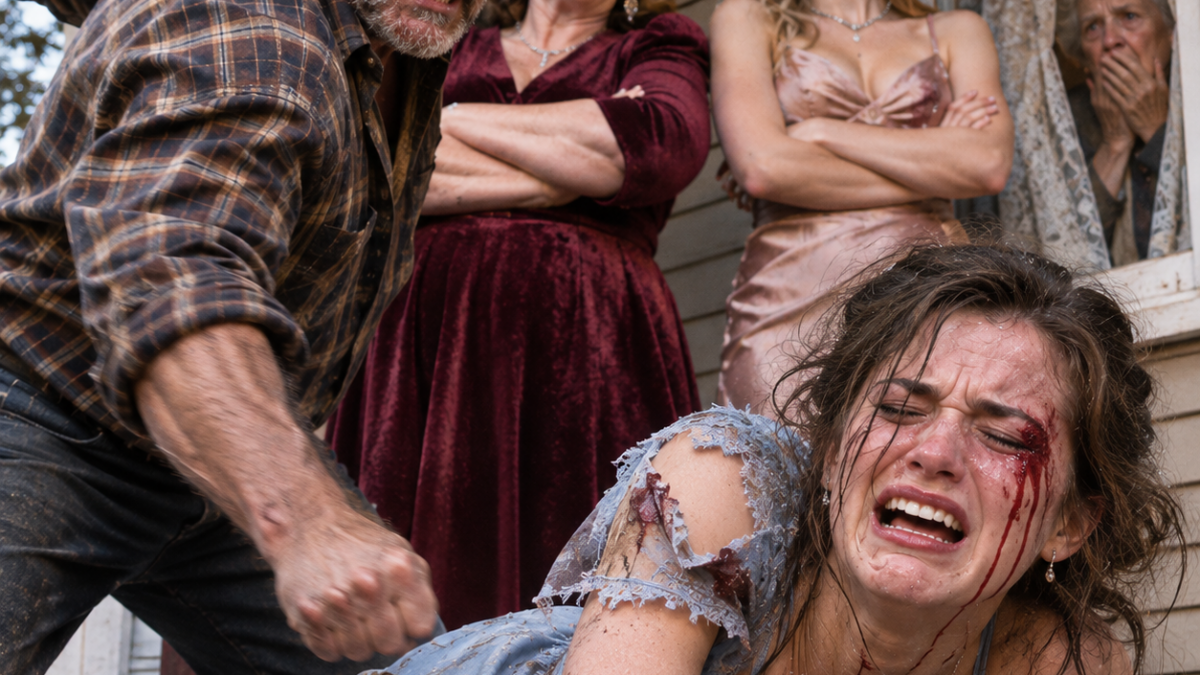
He wasn’t even frightened.
He looked angry that I was still conscious.
“I warned you,” he said.
My mother folded her arms.
“Well, maybe now she’ll finally understand.”
Then she laughed.
It wasn’t a nervous laugh. It wasn’t shock or disbelief.
It was the satisfied little laugh she used whenever Melanie got something she wanted.
My younger sister stepped onto the porch in a cream-colored designer dress, her hair falling perfectly over her shoulders.
She looked at me, then at Wyatt.
“I told you she wouldn’t move on her own.”
Wyatt slowly raised his head.
“What did you just say?”
Melanie shrugged.
“We tried being reasonable.”
I stared at her.
Three weeks earlier, Melanie had stood in my apartment and demanded that I break off my engagement.
She had told me Wyatt’s money was wasted on someone like me.
Two weeks earlier, Mom had suggested that Wyatt and Melanie would make a more impressive couple.
The previous Sunday, Dad had looked Wyatt directly in the face and said, “You made millions selling that company, and you’re really going to spend your life with Sadie?”
I had believed their cruelty had limits.
Now I knew I was wrong.
Wyatt stood, his body trembling with rage.
“You hit her with a brick!”
Dad pointed toward Melanie.
“You’re engaged to the wrong daughter.”
“She could lose her eye!”
“Then maybe you’ll reconsider.”
Wyatt took one step toward him.
I caught his sleeve.
“Please,” I whispered.
That stopped him.
He immediately turned back to me, kneeling so I could see his face.
“I’m here, Sadie. I’m right here.”
He pulled out his phone.
Dad knocked it from his hand.
The phone struck the porch railing and bounced onto the concrete.
“Nobody is calling anybody,” Dad announced.
My mother stepped closer.
“You two are going to calm down, and we’re going to discuss this like adults.”
Wyatt looked at her as if he no longer recognized the meaning of the word mother.
“Your daughter is bleeding.”
“She always was dramatic.”
I pressed my hand against my cheek.
When I pulled it away, my palm was red.
I felt suddenly cold.
From the side driveway came a man’s voice.
“What the hell is going on here?”
An electrician carrying a toolbox had appeared beside the garage.
He looked at me.
Then he looked at the brick.
His expression changed immediately.
“I’m calling 911.”
Dad turned toward him.
“This is a private family matter.”
“No,” the electrician replied, already reaching for his phone. “This is a crime.”
Dad stepped toward him.
“I’ll tell the police you started it.”
The man didn’t retreat.
“Go ahead. I saw what you did.”
For the first time, my father looked uncertain.
Wyatt pulled me closer, supporting my head against his chest.
I heard the electrician give our address to the emergency dispatcher.
Then I heard a neighbor shouting from across the street.
Someone else was running toward us.
My mother’s laughter stopped.
Dad looked around at the gathering witnesses, and I saw something shift behind his eyes.
He had expected obedience.
He had expected silence.
He had expected everyone to believe whatever story he decided to tell.
Instead, strangers were gathering around the front lawn, staring at him with horror.
The ambulance arrived with its siren screaming.
As paramedics lifted me onto a stretcher, I turned my head toward the house.
Through the living-room window, behind the pale curtains my mother kept perfectly arranged, stood an elderly man with silver hair and a deeply lined face.
His hand rested against the glass.
He looked devastated.
For one moment, our eyes met.
Then he raised his trembling hand, as though trying to tell me something.
My father noticed where I was looking.
His face drained of color.
And the old man disappeared behind the curtain.
FULL STORY CONTINUATION
“Who is that?” I tried to ask.
One of the paramedics leaned closer.
“Don’t try to talk right now, sweetheart. We’re taking care of you.”
I reached weakly toward the window.
“Man. Inside.”
Wyatt followed my gaze, but the curtain was motionless.
“There’s someone in the house?”
I nodded.
A fresh wave of pain swept through my face.
The paramedic gently guided my hand back onto the stretcher.
“Sadie, stay with me. Can you tell me your full name?”
I answered.
“Do you know what day it is?”
I tried to remember.
Saturday.
It was Saturday.
The day Wyatt and I were supposed to tell my family that we had chosen October eighteenth for our wedding.
I remembered the invitation samples sitting in my purse.
I remembered the bakery we had visited that morning.
I remembered Wyatt kissing the top of my head outside the florist and saying, “Six months from now, you’ll be my wife.”
Then I remembered my father’s face.
The brick.
My mother’s laughter.
The world began slipping away again.
“Sadie?”
Wyatt’s voice sounded frightened.
“Look at me, honey.”
I tried.
Everything on my left side was dark.
“Wyatt,” I whispered, “I can’t see.”
His hand tightened around mine.
“I know. The doctors are going to help you.”
“What if they can’t?”
He swallowed.
I saw the effort it took for him not to cry.
“Then we’ll figure it out together.”
Behind him, through the open ambulance doors, I caught one final glimpse of my parents’ house.
My mother stood on the porch beside Melanie.
Dad was speaking furiously to a police officer.
None of them looked toward the ambulance.
None of them called my name.
I had spent twenty-nine years trying to earn the love of three people who had just watched me nearly die.
And somehow, even then, the most painful part was that a small, terrified piece of me still wanted my mother to come running.
The ambulance doors closed.
She never did.
At the hospital, everything happened in fragments.
Bright lights.
A blood pressure cuff tightening around my arm.
Someone cutting the fabric near my shoulder.
A nurse asking whether I was allergic to medication.
The sharp smell of disinfectant.
Wyatt refusing to let go of my hand.
Then a woman’s calm voice.
“Sadie, I’m Dr. Evelyn Hart.”
I tried to turn my head.
She gently stopped me.
“Don’t move yet. You’ve suffered a significant injury to the left side of your face. We’re getting imaging studies, and our surgical team is evaluating you.”
“My father,” I whispered.
Dr. Hart leaned closer.
“What about your father?”
“He hit me.”
Her expression remained composed, but something changed in her eyes.
“With what?”
“A brick.”
She paused.
“Did he do that intentionally?”
I could hear my mother’s voice in my head.
Don’t embarrass this family.
I could hear Dad saying the same thing he had said whenever Melanie and I fought as children.
What happens in this house stays in this house.
For a moment, my mouth went dry.
Then Wyatt squeezed my hand.
I looked at Dr. Hart.
“Yes,” I said. “He did it on purpose.”
She nodded.
“Thank you for telling me.”
Those five words nearly broke me.
She didn’t ask what I had done to provoke him.
She didn’t tell me that fathers sometimes lost their tempers.
She didn’t suggest I forgive him because he was family.
She simply believed me.
While the medical team worked, a nurse asked permission to photograph my injuries for the record.
I agreed.
Every photograph felt humiliating.
My swollen face.
The bruising spreading around my eye.
The blood on my neck.
My beautiful blue dress, now folded into a hospital evidence bag.
That dress had been a gift from my grandfather.
He had bought it for me when I graduated from college.
I remembered laughing when I opened the box.
“Grandpa, it’s too expensive.”
He had smiled.
“Then wear it somewhere important.”
I had saved it for years.
Now it was covered in my blood.
When the nurse moved away, I began crying.
Not loudly.
I simply couldn’t stop the tears from slipping down the side of my face that wasn’t bandaged.
Wyatt leaned over the bed.
“I’m sorry,” he whispered.
I shook my head.
“You didn’t do anything.”
“I should have seen it coming.”
“No.”
“I knew they were getting worse.”
“So did I.”
He lowered his forehead against our joined hands.
“I should never have taken you there.”
I forced myself to speak clearly.
“Wyatt, my father did this. Not you.”
He looked up.
His eyes were red.
I had seen Wyatt angry before.
He had run a construction company for twelve years. He knew how to handle arguments, dishonest contractors, unexpected disasters, and people who thought yelling made them powerful.
But I had never seen him look helpless.
“I love you,” he said.
I closed my eyes.
A terrible thought had been growing inside me since the ambulance.
I didn’t want to ask.
But I needed to.
“What if I never look the same?”
Wyatt stared at me.
Then he moved closer, carefully avoiding the injured side of my face.
“Sadie, look at me.”
I tried.
“I loved you this morning.”
My throat tightened.
“I loved you when we walked up those steps.”
He kissed my uninjured hand.
“I loved you when your father attacked you.”
His voice cracked.
“And whatever happens next, I will love you through it.”
“What if my eye—”
“Then we’ll face that.”
“What if I have scars?”
“Then I’ll kiss them if you’ll let me.”
“What if I’m not the person you wanted?”
His expression changed.
He looked almost hurt by the question.
“You’re the person I want.”
I started sobbing.
He held my hand until I could breathe again.
For the first time that evening, I began to understand just how thoroughly my parents had poisoned the way I thought about love.
They had spent my entire childhood teaching me that affection depended on how useful, obedient, attractive, or convenient I could be.
Wyatt was offering something I had never learned how to accept.
Love without conditions.
Detective Aaron Beckett arrived while the doctors were preparing me for surgery.
He was a tall man with tired eyes and a quiet voice.
He introduced himself, explained why he was there, and asked whether I felt able to answer a few questions.
I nodded.
Wyatt stayed beside me.
“Tell me what happened,” Detective Beckett said.
I began with the brick.
Then I went backward.
I told him about Wyatt selling his company.
About Melanie suddenly deciding she was in love with him.
About my mother arranging family dinners where Melanie always sat beside him.
About my father repeatedly suggesting Wyatt had made a terrible mistake proposing to me.
I told him about the night Melanie followed Wyatt into the garage and tried to kiss him.
Wyatt interrupted quietly.
“I pushed her away and told her never to do that again.”
Detective Beckett wrote something down.
“What happened afterward?”
“My parents said I was being jealous,” I replied.
I swallowed.
“They said Melanie was just being friendly.”
“And today?”
I looked at Wyatt.
“We came to announce our wedding date.”
Detective Beckett waited.
“Mom wanted us to sit down first. Melanie was already there, dressed like she was going to a party. Dad started talking about how much money Wyatt had now.”
My hands began trembling.
“He said people with money had to make smarter decisions.”
“What did he mean?”
“He meant Melanie.”
The detective’s pen stopped.
“Did he say that directly?”
“Yes.”
I remembered my father leaning forward across the dining-room table.
You don’t want to waste a fortune on a wife who can’t keep up with you.
I remembered Melanie smiling.
I remembered my mother touching Wyatt’s arm and saying, You should think about what kind of woman belongs beside a successful man.
Wyatt had stood up.
He had told them we were getting married.
He had told them the conversation was over.
Then Dad had blocked the front door.
We had gone outside because Wyatt refused to continue arguing in the house.
I thought leaving would end it.
Instead, my father followed us onto the porch.
“He picked up a brick from the landscaping border,” I whispered.
“Had you threatened him?”
“No.”
“Had you touched him?”
“No.”
“Did he warn you he was going to strike you?”
I stared at the blanket.
“He said, ‘Let’s see if Wyatt still wants you after this.’”
Detective Beckett sat very still.
Then he closed his notebook for a moment.
“Sadie, I want you to understand something. We already have several independent witnesses.”
I looked up.
“What?”
“Six people have provided accounts consistent with yours.”
Wyatt straightened.
“Six?”
“The electrician who called 911. Neighbors who witnessed the confrontation. Other people who were nearby.”
The detective opened his notebook again.
“We also have video evidence, although we’re still reviewing it.”
I stared at him.
My father had spent years convincing me that nobody would believe me over him.
He was respected in our town.
He belonged to the country club.
He donated to charity events.
He knew judges, business owners, and local politicians.
At home, he shouted until everyone became quiet.
Outside, he smiled until everyone agreed with him.
For the first time in my life, people were listening to what I said without waiting for his permission.
“Where is he?” I asked.
Detective Beckett’s expression was serious.
“Your father has been arrested.”
The words hardly seemed real.
“My mother?”
“She and your sister are being questioned. We’re also examining what happened before the assault and whether either of them tried to interfere with emergency assistance.”
I closed my eyes.
Then I remembered the window.
“The old man.”
The detective leaned forward.
“What old man?”
“There was someone inside the house.”
I described the silver hair, the hand against the glass, and the terrified expression.
Wyatt nodded.
“I saw Sadie looking at the window. I didn’t see the man clearly.”
Detective Beckett made another note.
“Do you know who he was?”
“No.”
“Was he a relative?”
“I don’t think so.”
“Had you seen him before?”
I hesitated.
Something about his face had seemed familiar.
Not familiar enough to name.
Only enough to make me feel that I should have recognized him.
“I don’t know,” I said.
The detective nodded.
“We’ll look into it.”
He stood.
“Sadie, your account matters. But you should know that this case does not depend only on your statement.”
I started crying again.
Because for twenty-nine years, every conflict in my family had depended on whether my parents were willing to acknowledge what had happened.
This time, they wouldn’t get to decide.
Shortly before the surgical team came for me, a hospital volunteer approached Wyatt.
She carried a small white envelope.
“Someone asked me to give this to you.”
Wyatt looked confused.
“Who?”
“An older gentleman. He didn’t leave his name.”
My heart began beating faster.
“Was he silver-haired?”
The volunteer thought for a moment.
“Yes.”
Wyatt looked at me.
The volunteer handed him the envelope.
Inside was a business card.
Samuel Grayson, Attorney at Law — Estate Planning and Trust Administration.
On the back were six handwritten words.
Ask about your grandfather’s final will.
I stared at the card.
My grandfather had been dead for nearly six years.
His name was Thomas Whitmore.
He had been the only person in my family who ever made me feel as though I didn’t have to compete for the right to exist.
He taught me to ride a bicycle.
He taught me how to change a tire.
He took me fishing even though I hated touching bait.
When Melanie received expensive dolls and jewelry, Grandpa gave me notebooks, books, and little envelopes containing twenty-dollar bills.
“For something that makes you happy,” he would say.
I never understood why he always looked sad when my parents told me to give those things to Melanie.
I had believed he left everything to my father.
That was what Dad told us after the funeral.
He said Grandpa’s affairs were private.
He said the property had been settled.
He said there was no reason for me to ask questions.
And I had believed him.
Now someone was telling me to ask about his final will.
“Do you know this lawyer?” Wyatt asked.
I shook my head.
The surgical nurse appeared at the door.
“Sadie, we’re ready.”
Wyatt quickly slipped the card into his pocket.
He bent to kiss my forehead.
“I’ll find out what this means.”
“Don’t leave,” I whispered.
“I’ll be right here when you wake up.”
They began moving my bed.
As the doors closed between us, one thought kept repeating in my mind.
Why would my grandfather’s attorney become involved because my father had attacked me?
I woke after surgery feeling as though someone had packed the left side of my face with broken glass.
There were bandages around my cheek and eye.
My mouth felt dry.
My shoulder ached.
When I tried to move my head, pain surged behind my eye.
A monitor beeped beside me.
Wyatt was sleeping in a chair.
He looked terrible.
His shirt was wrinkled. His hair was disheveled. There were dark circles beneath his eyes.
One hand remained wrapped around mine.
Even asleep, he hadn’t let go.
“Wyatt,” I whispered.
He woke immediately.
“Sadie?”
He leaned toward me.
“Hey. Hey, sweetheart.”
I tried to smile.
It hurt.
“Don’t,” he said gently. “You don’t have to.”
“How bad?”
He understood.
“The doctors repaired what they could. Dr. Hart said there’s still swelling, and they need time to understand how much vision will come back.”
I looked toward the covered side of my face.
“Did they save my eye?”
“They’re hopeful.”
That wasn’t the answer I wanted.
But it was the answer he had.
I appreciated that he didn’t lie.
Later, Dr. Hart explained that the blow had fractured several bones around my left eye.
The surgeons had stabilized the damaged structures and addressed the immediate injuries, but the healing process would be long.
There was a possibility of permanent visual impairment.
There was a possibility I would need further procedures.
She didn’t pretend otherwise.
I stared at the ceiling.
“Will I be able to get married?”
Dr. Hart looked surprised.
Then her expression softened.
“Of course you can get married, Sadie.”
“I mean, looking like this.”
She pulled up a chair.
“I don’t know exactly how your face will heal. But I do know that what happened to you does not make you less worthy of being loved.”
I turned my face away.
She waited.
Then she said something I would remember for the rest of my life.
“You were injured by someone else’s violence. Your injury is not a failure on your part.”
I cried until I was exhausted.
The first photograph arrived that afternoon.
A nurse brought an envelope to my room.
“There was no sender’s name,” she explained. “Hospital staff checked it before bringing it up.”
Wyatt opened it.
Inside was an old black-and-white photograph.
My grandfather stood beside a young boy wearing a slightly oversized coat.
The boy couldn’t have been older than twelve.
Grandpa’s hand rested on his shoulder.
I studied the picture.
“Who is that?”
Wyatt turned it over.
Four words were written on the back.
He was never forgotten.
I didn’t understand.
Grandpa looked much younger than I remembered.
The boy was unfamiliar.
His expression was solemn.
But there was something about his eyes.
Something I had seen recently.
Wyatt held the photograph closer.
“Do you think this is connected to the man at the window?”
“I don’t know.”
He placed it beside Samuel Grayson’s card.
“I’m calling the attorney.”
I nodded.
Wyatt stepped into the hallway, but I could still hear the low murmur of his voice.
When he returned, he looked deeply unsettled.
“Samuel Grayson knows who you are.”
I stared at him.
“He knew your grandfather. He says he’s been expecting a call for years.”
“Why?”
“He wouldn’t explain everything over the phone.”
Wyatt sat beside me.
“He’s coming tomorrow. He wants to speak to you personally.”
I looked at the photograph.
My grandfather had been gone six years.
Yet somehow, he was reaching into the worst moment of my life.
I didn’t know whether to feel comforted or afraid.
That evening, Detective Beckett returned.
He brought more information.
The electrician had recorded part of the argument on his phone after arriving at the driveway.
A neighbor’s security camera had captured my father approaching me with the brick.
Other witnesses had confirmed the events surrounding the assault.
The detective explained that the six independent eyewitness accounts were consistent on the central facts.
My father had moved toward me.
I had not threatened him.
He had struck me deliberately.
My mother and Melanie had witnessed what happened.
Neither had attempted to help.
Wyatt listened without interrupting.
When Detective Beckett mentioned the video, I looked away.
“I don’t want to watch it.”
“You don’t have to,” he replied.
“Will I have to see it in court?”
“Possibly. But we’ll explain the process and what support is available if that happens.”
I took a slow breath.
Then I asked the question I had been avoiding.
“What are they saying?”
“Your father initially claimed the brick slipped from his hand during an argument.”
I let out a bitter laugh.
“He swung it at my head.”
“The video evidence does not support his account.”
“What about my mother?”
“She said everyone was upset and the incident was misunderstood.”
“Misunderstood?”
Wyatt’s voice rose.
“She laughed while Sadie was bleeding!”
Detective Beckett nodded.
“We’re aware of that allegation. Several witnesses described her reaction.”
I stared at my hands.
“And Melanie?”
“She says she had nothing to do with the assault.”
I thought of my sister stepping onto the porch.
I told you she wouldn’t move.
We tried asking nicely.
The memory made me shiver.
“They knew,” I whispered.
Detective Beckett watched me carefully.
“What makes you believe that?”
I looked at him.
“Because they spent months trying to get me out of Wyatt’s life.”
I had never said those words so plainly.
Not to Wyatt.
Not to my friends.
Not even to myself.
“My sister wanted my fiancé. My parents wanted his money. They thought hurting me would make him leave.”
The detective was quiet for a moment.
Then he said, “We’re investigating what each person knew and did. We’ll follow the evidence.”
That was the first time I truly understood the difference between revenge and justice.
Revenge would have been wanting my parents to suffer because I had suffered.
Justice meant finding out what they had done, proving it, and making sure they could not simply walk away.
I wanted justice.
But I also wanted something I had never been allowed to have.
A life where I wasn’t afraid of my family.
The next morning, Samuel Grayson arrived carrying two dark leather document cases.
He was in his late sixties, with silver-rimmed glasses and the patient manner of a man accustomed to difficult conversations.
Wyatt stood when he entered.
“Mr. Grayson?”
“Samuel, please.”
He came to my bedside.
“Sadie Whitmore.”
I nodded.
His expression changed.
For a moment, he looked almost overcome.
“You have your grandfather’s eyes.”
My throat tightened.
“You knew him?”
“For more than twenty years.”
Samuel took a chair.
“Your grandfather was my client. He was also my friend.”
I looked toward the document cases.
“Why are you here?”
He folded his hands.
“Because Thomas prepared instructions for a situation he hoped would never happen.”
I felt Wyatt move closer.
“What situation?”
Samuel glanced at my bandaged face.
“A situation in which someone in your family seriously harmed you.”
Silence filled the room.
I stared at him.
“My grandfather thought my father would do this?”
Samuel shook his head gently.
“He didn’t predict a brick, Sadie. He couldn’t have known the exact form the cruelty would take.”
He paused.
“But he knew the people involved. He understood their priorities. And he was deeply afraid that your father’s resentment toward you might eventually become dangerous.”
I wanted to argue.
Not because I believed my father was innocent.
But because the idea that Grandpa had seen something so terrible years earlier made me feel exposed.
“Why didn’t he tell me?”
Samuel’s eyes softened.
“He tried to protect you without making you carry the full weight of what he feared.”
He opened the first case.
Inside were property records, trust instruments, correspondence, and several folders bearing my grandfather’s signature.
“Your parents have told you that your grandfather left the house and most of his property to your father, correct?”
“Yes.”
“That’s not entirely true.”
My stomach tightened.
Samuel removed a document.
“Thomas created a protected family trust many years before his death. The house, several investment properties, and other significant assets were placed under its administration.”
Wyatt leaned forward.
“Then Sadie’s father doesn’t own the house?”
“Not outright.”
I stared at Samuel.
Dad had spent years boasting about inheriting everything.
He referred to the house as his property.
He told everyone how his father had trusted him to continue the family legacy.
Samuel turned a page.
“Your father was granted certain rights to occupy the primary residence and receive distributions, subject to the terms of the trust.”
“Subject to what?”
Samuel looked directly at me.
“Among other things, a provision dealing with intentional harm toward another family member.”
I couldn’t speak.
He continued.
“Thomas was concerned that financial control could become a weapon. He directed the trustees to suspend benefits and seek appropriate enforcement of the trust’s terms if a beneficiary intentionally caused serious harm to another family member.”
Wyatt stared at him.
“You’re saying her father could lose his access to everything?”
“I’m saying the documented circumstances justify immediate protective action and a formal review.”
Samuel was careful with every word.
“The legal process matters. There will be notices, evidence, and possibly a court proceeding. But Thomas made his wishes extremely clear.”
My eyes filled.
“Why?”
Samuel’s expression grew sad.
“Because he had watched your father use money to control people for years.”
I looked down.
Grandpa had known.
He had known about the pressure.
The favoritism.
The way my father spoke to me when nobody else was listening.
And I had spent so many years believing I was simply too sensitive.
Samuel reached into the case and removed another envelope.
“There’s more.”
Before Samuel could open it, I asked him to stop.
He looked up.
“Of course.”
I needed a moment.
I needed to understand how the world had changed so completely.
Two days earlier, I had believed my father owned the house.
I believed my grandfather had left him everything.
I believed that any attempt to challenge my parents would end with them cutting me out of the family permanently.
Now I was learning that my father had been living under conditions he never mentioned.
Conditions my grandfather had created specifically because he worried about me.
“Did Dad know?” I asked.
Samuel hesitated.
“He received the documents required to explain his rights and obligations.”
“Did he know about the provision?”
“Yes.”
I stared at him.
“He knew he could lose his inheritance if he hurt someone?”
“He knew the trust contained a disqualification provision.”
I felt cold.
My father had known there could be consequences.
And he had struck me anyway.
Wyatt rubbed my hand.
“What about Sadie’s mother and sister?”
Samuel answered carefully.
“Your mother does not hold an independent ownership interest in the trust property. Her right to live at the residence depends on the existing arrangements. Melanie does not control those assets either.”
I thought of my sister parading through the house.
Of her using Grandpa’s dining room to host expensive birthday parties.
Of Mom telling guests that Melanie would eventually inherit the estate because she was the daughter who understood the value of family reputation.
“What does Melanie inherit?”
Samuel looked at me.
“Nothing automatically.”
I closed my eyes.
It wasn’t the money that stunned me.
It was realizing how much of my family’s cruelty had been built on assumptions they never bothered to question.
My father assumed wealth belonged to him.
My mother assumed his power belonged to her.
Melanie assumed everything they possessed would eventually become hers.
And all three had assumed that I would accept whatever they decided I deserved.
Samuel waited until I opened my eyes.
Then he said, “There’s someone else you should know about.”
He took the black-and-white photograph from the bedside table.
“Do you know who this boy is?”
I shook my head.
“His name is Edgar Hayes.”
“Edgar?”
Samuel nodded.
“He’s the elderly man you saw behind the curtain.”
My pulse quickened.
“The man in the house?”
“Yes.”
I looked at the photograph again.
Edgar Hayes.
The name stirred something.
A distant memory.
A summer afternoon.
A man helping Grandpa repair a fence.
Someone handing me lemonade when I was small.
“Mr. Edgar?”
Samuel smiled sadly.
“You remember him.”
“Barely.”
“He worked for your grandfather for decades.”
“Why was he there?”
Samuel rested the photograph on the blanket.
“Because your grandfather never entirely trusted your father’s treatment of you, and Edgar had promised to keep an eye on the property.”
I looked toward Wyatt.
The stranger had been there for a reason.
Samuel continued.
“Edgar was raised by his grandmother, who worked for the Whitmore family. Your grandfather knew him from childhood and later employed him. This photograph was taken long before you were born.”
I touched the edge of the picture.
“Why send it to me?”
“He wanted you to recognize that he wasn’t a stranger appearing out of nowhere.”
“And the words on the back?”
Samuel looked down.
“Your father has a habit of making people feel disposable when they’ve outlived their usefulness. Edgar wanted you to know that Thomas never forgot the people who mattered to him.”
My chest tightened.
Grandpa had kept the photograph.
He had kept Edgar close.
And apparently, he had kept something else.
A promise.
Samuel told us Edgar had been at the house that afternoon to meet a maintenance contractor.
The electrician had been scheduled to inspect wiring near the rear portion of the property.
Edgar, who occasionally assisted with maintenance under the trust’s arrangements, had arrived earlier to make sure the work could proceed.
He had been in the living room when the argument began.
At first, he thought he was hearing another family disagreement.
Then he heard my father shouting.
He moved toward the window.
And saw the brick.
“Why didn’t he come outside?” I asked.
Samuel’s face tightened.
“He’s seventy-eight, Sadie. He was frightened. Your father has threatened him before.”
I remembered the trembling hand against the glass.
“He looked terrified.”
“He was.”
“Then why did he disappear?”
“He went to make a call.”
I stared at him.
“To you?”
Samuel nodded.
“He contacted me because he remembered your grandfather’s instructions.”
Wyatt leaned forward.
“What instructions?”
Samuel opened a smaller folder.
“Thomas left a sealed directive with the trustees and my office. If credible evidence emerged that Sadie had suffered serious intentional harm at the hands of a family member, I was to ensure that the trust’s protections were reviewed immediately and that she received the documents Thomas prepared for her.”
I looked at him.
“Edgar knew about that?”
“He knew enough to alert us.”
“What happened after he called?”
“He gave a statement to the police and agreed to cooperate. He was frightened for his safety, so he was taken somewhere secure while investigators arranged a formal interview.”
I felt a wave of relief.
“He’s alive?”
Samuel looked startled.
“Of course.”
“I thought my father might have—”
I couldn’t finish.
Samuel understood.
“Edgar is safe.”
I closed my eyes.
The old man who had watched me fall had not disappeared because he wanted to forget.
He had disappeared because he remembered.
Samuel opened the second document case.
This one contained fewer papers.
He removed a sealed envelope bearing my grandfather’s signature.
My name was written across the front.
For Sadie Whitmore — When She Is Ready to Know the Truth.
I stared at the handwriting.
I recognized the long curve of the S.
The careful way Grandpa formed every capital letter.
My vision blurred.
“He wrote that?”
Samuel nodded.
“Years before he died.”
I reached for the envelope.
Then stopped.
“Why didn’t I get it when he passed away?”
“Because Thomas instructed that certain personal documents be held until specific circumstances arose. He also provided a separate process for the disposition of his estate.”
I looked at the seal.
“What circumstances?”
Samuel’s expression was solemn.
“If his fears about your family’s treatment of you were ever confirmed by serious events.”
Wyatt moved his chair closer.
Samuel continued.
“Before you read the letter, there is something else I need to explain.”
I waited.
“Your grandfather’s final estate plan did not name your father as the ultimate recipient of the trust’s remaining assets.”
I stared at him.
“Then who?”
Samuel looked directly at me.
“You.”
The room went silent.
I could hear the monitor beside the bed.
The muffled footsteps in the hallway.
Someone laughing at the nurses’ station.
But inside the room, nobody moved.
“Me?”
“Yes.”
I shook my head.
“That can’t be right.”
Samuel placed the document on the table.
“It is.”
“But Dad said—”
“I know what your father said.”
“Melanie told everyone she would inherit—”
“I understand.”
I looked at Wyatt.
He was staring at Samuel.
Then I looked back at the lawyer.
“Why would Grandpa leave it to me?”
Samuel’s eyes filled with emotion.
“Because he trusted you to treat people differently.”
I began crying.
For years, my family had told me Grandpa was old-fashioned, sentimental, and too easily manipulated.
They laughed when he gave me practical gifts.
They mocked the time he spent teaching me about the properties.
They said he favored me because I was the quiet one.
I had never considered that he was trying to prepare me for a future I couldn’t yet imagine.
Samuel gently pushed the envelope toward me.
“Would you like to read it?”
I nodded.
My hands shook as I opened it.
Inside were several pages.
The first began:
My dearest Sadie,
If you are reading this under the circumstances I fear, then I owe you an apology for not being able to protect you while I was alive.
I covered my mouth.
Wyatt moved closer, but he didn’t interrupt.
I read on.
Grandpa wrote about the day I was born.
He remembered how I had slept against his chest while my father complained that the hospital visit was taking too long.
He remembered teaching me to plant roses.
He remembered how I always insisted on helping him carry grocery bags even when they were almost as big as I was.
Then the letter changed.
Your father believes that respect comes from possession. He measures people by what they own, what they earn, and what they can do for him. I have tried to teach him otherwise, but there are lessons a parent cannot force an adult child to learn.
I stopped.
My vision blurred with tears.
I have watched you apologize for things you did not do. I have watched you surrender what was yours to avoid an argument. I have watched your mother tell you that keeping the peace is more important than being treated fairly.
I pressed the paper against my chest.
Grandpa had seen it.
All of it.
I kept reading.
I do not want you to mistake their treatment of you for a measure of your worth.
I have arranged my affairs so that the home and assets I worked to build cannot be used indefinitely as weapons against you.
These documents do not mean that you must fight for money. They mean that you have the right to make your own choices without being threatened into obedience.
Then I reached the final paragraph.
I hope you marry someone who sees your heart before he sees anything else. I hope you build a life full of laughter, kindness, and peace. I hope your father learns to love you as you deserve before it is too late.
And finally:
But if the day ever comes when your own family tries to break you because they cannot control your future, remember this, my darling girl: you were never the child I doubted, and you are not the one who should be ashamed.
I couldn’t continue holding the pages.
They slipped into my lap.
Wyatt caught them before they fell to the floor.
I covered my face with my hands.
For years, I had imagined how different my life might have been if someone had stood beside me when my parents were cruel.
Now I knew someone had.
He just hadn’t lived long enough to tell me everything himself.
I cried for a long time.
Samuel didn’t rush me.
Wyatt sat beside me, his arm carefully around my shoulders.
When I finally looked up, the attorney was waiting.
“I don’t want revenge,” I whispered.
Samuel nodded.
“That’s understandable.”
“But I don’t want them to get away with this.”
“Those are not the same thing.”
I looked down at Grandpa’s letter.
“I loved my father.”
My voice broke.
“I know he was difficult. I know he was unfair. But I loved him.”
Wyatt held me tighter.
“And I loved my mother.”
I swallowed.
“I thought if I just became someone they could be proud of, eventually they would stop comparing me to Melanie.”
Nobody spoke.
“I graduated from college. I got a good job. I paid my own bills. I tried not to ask for anything.”
I laughed bitterly.
“When Melanie wanted something, they gave it to her. When I wanted something, they asked why I couldn’t be happy with what I already had.”
Samuel listened.
“I thought getting married would finally make them see that I had built something good.”
My chest tightened.
“Instead, Dad tried to destroy it.”
Wyatt kissed my forehead.
“Sadie, nothing he did changes what we’ve built.”
I looked at him.
“I’m terrified that it will.”
He didn’t deny it.
He simply said, “Then we’ll work through that fear together.”
Samuel gathered the documents.
“I want to be clear about something,” he said.
“Your grandfather’s arrangements are significant, but there is a legal process ahead. We will need to establish the facts, protect the trust property, and make sure every required procedure is followed.”
I nodded.
“We won’t pretend everything changes overnight.”
“Good.”
“Will my parents know?”
“Your father will receive formal notices regarding the review of his rights under the trust.”
I looked at the letter.
“And my mother?”
“She’ll learn that living in a house is not the same as owning it.”
I almost smiled.
Almost.
Then I remembered her laughter.
And the smile disappeared.
My parents found out three days later.
I wasn’t there.
I was in the hospital, learning how to sit upright without feeling dizzy.
Wyatt had brought me a soft blanket from home and a small framed picture of us at the beach.
My face in the photograph was untouched.
I couldn’t look at it for very long.
That morning, Samuel called to tell me the trustees had initiated protective measures.
Dad’s distributions were being reviewed and discretionary payments had been suspended pending further action under the trust.
The property records were being examined to ensure no unauthorized transactions occurred.
My parents had received notices explaining the process.
“They’re going to be furious,” I said.
Samuel’s voice was calm.
“They may be.”
“What if they come after me?”
“Your attorney and the authorities can help address any threats. You should not engage with them directly.”
I looked at Wyatt.
He nodded.
We had already discussed it.
We weren’t going to answer their calls.
We weren’t going to argue with Melanie.
We weren’t going to try to convince anyone that what happened was serious enough to matter.
The evidence would speak for itself.
An hour later, my phone began vibrating.
Mom.
Then Melanie.
Then Mom again.
I stared at the screen.
The name Mom had once made me feel obligated to answer immediately.
When I was a teenager, she would call repeatedly until I picked up.
If I didn’t, she accused me of disrespect.
If I told her I was busy, she demanded to know what could possibly matter more than family.
Now I watched her name appear and disappear.
Wyatt sat beside me.
“You don’t have to answer.”
“I know.”
The phone rang again.
I turned it off.
That simple action felt harder than anything I had done in years.
The first message came through Wyatt’s phone.
It was from Melanie.
Tell Sadie to stop being dramatic and call Mom.
Wyatt showed it to me.
I stared at the words.
Dramatic.
My face was bandaged.
My eye had been injured.
I had undergone surgery.
And Melanie was still using the same word she had used when we were children.
Dramatic.
She had said it when I cried after she broke my favorite doll.
She had said it when Mom forgot my birthday.
She had said it when Dad told me I wasn’t worth the tuition he had paid for college.
I had heard that word so often that I sometimes used it against myself.
Maybe I was dramatic.
Maybe I made things worse.
Maybe if I could stop reacting, everyone would be happier.
Wyatt looked at the message.
Then at me.
“I’m not responding.”
“Good.”
He put the phone away.
A few minutes later, another message arrived.
Dad didn’t mean it. You know how he gets.
I closed my eyes.
I did know how he got.
That was the problem.
Then came a longer message.
You’re destroying this family over an accident. Mom has barely slept. The lawyers are threatening everything Grandpa left us. Is this what you wanted?
I read it twice.
Melanie wasn’t asking whether I could see.
She wasn’t asking whether I was in pain.
She wasn’t asking whether I was frightened.
She wanted to know whether I felt guilty about the consequences facing them.
I handed the phone back.
“Please save that.”
Wyatt nodded.
“For the detective?”
“Yes.”
He took screenshots and forwarded them to our attorney.
That afternoon, I asked the nurse whether the hospital had someone I could speak to about trauma.
It was the first time in my life I had sought help without asking whether my mother would approve.
My counselor’s name was Rachel.
She was kind, but she didn’t treat me like I was fragile.
During our first conversation, I told her I was embarrassed.
“About what?” she asked.
I stared at my hands.
“That I didn’t leave them sooner.”
Rachel waited.
“That I kept going back. That I believed they loved me.”
She leaned forward slightly.
“Sadie, children don’t begin life knowing they need to protect themselves from their parents.”
I looked away.
“They learn what love is from the people raising them,” she continued. “If love is mixed with criticism, fear, and conditional approval, it can take years to separate those things.”
I swallowed.
“What if part of me still misses them?”
“Then that part of you deserves compassion, too.”
I began to cry.
I missed the family I had always wanted.
Not necessarily the one I actually had.
I missed the imagined mother who would run to my hospital bed.
The imagined father who would beg forgiveness.
The imagined sister who would hug me and say she couldn’t believe what had happened.
None of those people had appeared.
Instead, my real family was sending messages about money.
Rachel helped me understand that grief did not require a death.
Sometimes you grieved people who were still alive.
Sometimes you grieved a childhood that had never been safe.
And sometimes you grieved the possibility that the people who hurt you might one day become the people you needed.
I left that conversation exhausted.
But something inside me had shifted.
For the first time, I stopped asking what I needed to do to make my parents love me.
I started asking what I needed to do to keep myself safe.
The investigation continued.
Detective Beckett met with Wyatt several times.
He reviewed the video evidence, collected additional statements, and worked with the prosecutor to determine the appropriate charges.
The six independent witnesses were identified and interviewed separately.
There was the electrician, Daniel Mercer, who had been scheduled to inspect the property’s electrical system.
There was our neighbor across the street, Mrs. Collins, who had been watering flowers near her front walkway.
There was a delivery driver who had stopped at the neighboring house.
There was a landscaper working two houses down.
There was a woman walking her dog along the sidewalk.
And there was a retired teacher who had been sitting on her front porch when she heard the shouting.
Each had seen different portions of the confrontation.
Together, their accounts supported the same essential sequence.
Dad moved toward me with the brick.
I was unarmed.
I did not attack him.
He struck me.
My mother laughed.
Melanie did not intervene.
Daniel Mercer called 911.
The security footage provided further confirmation.
When Detective Beckett explained the evidence to me, he didn’t dramatize it.
He didn’t need to.
One statement stayed with me.
Mrs. Collins had told him, “That girl looked scared before he even raised his arm.”
I thought about that for hours.
Because she was right.
I had been frightened before the brick.
I was frightened when Dad stood up from the dining-room table.
I was frightened when he followed us outside.
I was frightened when Mom said we weren’t leaving until Wyatt came to his senses.
The violence hadn’t begun when the brick struck me.
The brick was simply the moment the rest of the world could finally see it.
Edgar Hayes visited the hospital the following week.
I recognized him immediately.
He stood in the doorway holding his hat in both hands.
He was smaller than I remembered from the window.
His silver hair had been carefully combed.
His shoulders were slightly stooped.
He looked exhausted.
“Miss Sadie?”
I smiled as much as my injuries allowed.
“Mr. Edgar.”
His eyes filled.
“Oh, child.”
He took a step forward, then stopped.
“May I come in?”
“Please.”
Wyatt stood and offered him a chair.
Edgar sat beside my bed.
For several moments, he couldn’t speak.
Then he looked at my bandages.
“I am so sorry.”
I shook my head.
“You didn’t do anything.”
His hands trembled.
“I saw him pick it up.”
I watched him.
“I heard the argument. I knew your father was angry. I should have gone outside.”
“Mr. Edgar—”
“I should have stopped him.”
I reached for his hand.
He looked surprised.
“You called Samuel,” I said.
He nodded.
“You told the police what you saw.”
“Yes.”
“You helped me.”
His face crumpled.
“I’ve known your father since he was a boy,” he whispered. “Your grandfather tried so hard with him.”
I listened.
“He was never an easy child. Always wanting more. Always angry when someone else was praised.”
Edgar looked toward the window.
“Thomas used to say that money could make a selfish man more comfortable, but it couldn’t make him kind.”
I almost smiled.
That sounded exactly like Grandpa.
Edgar wiped his eyes.
“He loved you dearly.”
“I know.”
“No,” Edgar said gently. “I don’t think you understand how much.”
I swallowed.
He reached into his coat pocket and removed a small folded piece of paper.
It was a copy of a note Grandpa had once written to him.
If Sadie ever needs help and I am not here, please make sure someone hears her.
I stared at it.
“When did he write this?”
“Several years before he died.”
“Why?”
Edgar took a slow breath.
“Because he had seen you frightened in that house.”
I felt the familiar shame rising.
“I never told him everything.”
“He didn’t need you to.”
Edgar looked at me.
“He knew what it was like to watch you become quiet whenever your father entered a room.”
I began crying.
Edgar squeezed my hand.
“You were never invisible to him, Sadie.”
Those words stayed with me.
Because invisibility had been the defining feeling of my childhood.
Melanie could enter a room and everyone noticed.
She could cry and the household stopped.
She could demand something and my parents rearranged their lives to provide it.
I could disappear into silence and nobody asked why.
Except Grandpa.
He always asked.
As the swelling around my face slowly decreased, my injuries became more visible in ways I hadn’t expected.
The bruises changed color.
The bandages were adjusted.
I could see the beginning of scars.
Dr. Hart told me the healing process would not be linear.
Some days would be better.
Other days would feel discouraging.
She was right.
One morning, I woke feeling almost hopeful.
The next, I couldn’t bear to look in the mirror.
Sometimes I felt angry.
Sometimes I felt numb.
Sometimes I wanted to hide under the blanket and never let anyone see me again.
Wyatt stayed patient, but I could see the strain on him.
He was frightened for me.
He was furious with my family.
He was trying to manage calls from attorneys, medical appointments, and the ordinary responsibilities of our lives.
One evening, I found him sitting alone near the hospital window.
He was staring at his hands.
“Wyatt?”
He turned immediately.
“Hey.”
“Are you okay?”
“I’m fine.”
I knew he wasn’t.
“Please don’t do that.”
“Do what?”
“Tell me you’re fine because you think I can’t handle the truth.”
He looked down.
For a moment, he said nothing.
Then his shoulders sagged.
“I keep seeing it.”
My chest tightened.
“The brick?”
He nodded.
“I keep hearing the sound.”
I reached toward him.
He came to sit beside me.
“I’ve been in dangerous situations before,” he said quietly. “Construction sites. Accidents. I’ve seen people hurt.”
He swallowed.
“But I’ve never watched someone deliberately do that to a person I love.”
I held his hand.
“I thought you were going to die.”
His voice broke.
I moved closer.
He wrapped his arms around me carefully, trying not to touch my injured shoulder.
For the first time since the attack, he cried.
Not because he was weak.
Because he had been carrying fear he didn’t know where to put.
We sat together for a long time.
And I realized that healing wouldn’t be something he did for me.
It would be something we worked through together.
Two weeks after the attack, my father appeared in court for an initial hearing.
I wasn’t required to attend, and my doctors advised me to focus on recovery.
Wyatt went with our attorney.
I stayed at home for the first time since leaving the hospital.
Our apartment felt strangely unfamiliar.
Everything was exactly where I had left it.
My shoes near the door.
A coffee mug on the kitchen counter.
Wedding magazines stacked beside the sofa.
The invitation samples were still in my purse.
I took them out.
October eighteenth.
The date we had chosen.
I looked at the elegant lettering.
Then I put the invitations away.
I wasn’t ready to think about a wedding.
Not yet.
When Wyatt returned, he sat beside me.
“How was it?”
He hesitated.
“Your father pleaded not guilty.”
I nodded slowly.
“What did he say?”
“Not much in court.”
“Did he look sorry?”
Wyatt looked at me.
I knew the answer before he spoke.
“No.”
I closed my eyes.
“He looked angry.”
“Of course he did.”
Wyatt took my hand.
“The prosecutor described the injuries and the evidence. There are serious charges, Sadie.”
I looked toward the window.
My father was facing the possibility of prison.
The man who had controlled every argument in our family was no longer the person deciding how the story would be told.
I expected to feel triumphant.
Instead, I felt hollow.
Wyatt seemed to understand.
“You don’t have to celebrate.”
“I don’t.”
“You don’t have to feel guilty either.”
I looked at him.
“I’m trying.”
He kissed my hand.
“I know.”
The next major development came from the financial investigation.
Samuel called us into his office after I was well enough to travel.
He had gathered records showing how my father had managed the trust’s distributions and the family’s use of the properties.
There were questions about certain expenses.
There were records that required further explanation.
But Samuel was careful not to accuse anyone of wrongdoing before the independent accounting was complete.
“Your grandfather’s trust allowed your father certain benefits,” he explained. “It did not give him unrestricted authority to treat trust assets as his personal property.”
Wyatt nodded.
“What happens now?”
“The trustees are reviewing past transactions and determining whether any distributions violated the trust’s terms.”
I looked at the documents.
Dad had always spoken as though the family’s wealth were proof of his personal superiority.
He mocked people who rented homes.
He criticized relatives who struggled financially.
He told Melanie that money was the only reliable protection against disappointment.
Now the source of that power was under scrutiny.
“Will they lose the house?” I asked.
Samuel folded his hands.
“That depends on the legal findings and the trust’s provisions. But your father’s continued use of the property is no longer something he can take for granted.”
I thought of Mom standing on the porch.
Her arms folded.
Her expression delighted.
Let’s see whether Wyatt still loves you now.
For the first time, I wondered what she would say when she realized the house she used to humiliate people might no longer be hers to control.
I wasn’t proud of the thought.
But I couldn’t pretend it didn’t exist.
Melanie tried to visit me in early May.
She appeared outside our apartment building wearing sunglasses and carrying a large bouquet of white roses.
Wyatt saw her on the security camera.
He came into the bedroom.
“Sadie, your sister’s downstairs.”
My stomach dropped.
“Why?”
“She says she needs to talk.”
I sat up.
“What did you tell her?”
“Nothing yet.”
I thought about it.
Part of me wanted to hear what she had to say.
Another part remembered her standing on the porch, looking irritated that I hadn’t simply disappeared from Wyatt’s life.
“Does she know we don’t want contact?”
“Yes.”
“Then why is she here?”
Wyatt didn’t answer.
He didn’t need to.
Melanie had spent her entire life treating boundaries as personal insults.
If someone told her no, she assumed they simply needed more pressure.
I looked at the flowers on the security screen.
White roses.
My favorites.
For a moment, I almost laughed.
She had never once remembered my favorite flowers.
But now that the family was facing consequences, she apparently knew exactly what to bring.
“Tell her to leave,” I said.
Wyatt nodded.
He spoke through the building’s intercom.
“Melanie, Sadie isn’t receiving visitors. Please leave.”
Her face changed instantly.
“Wyatt, don’t be ridiculous.”
“I’m serious.”
“I need five minutes.”
“No.”
She removed her sunglasses.
“It’s my sister.”
Wyatt’s voice remained calm.
“And she has asked not to see you.”
Melanie stared into the camera.
Then her expression hardened.
“She can’t hide behind you forever.”
Wyatt didn’t respond.
She stepped closer.
“Do you know what she’s doing to our parents?”
I felt my chest tighten.
Wyatt said, “Melanie, leave.”
“Dad could go to prison!”
“That’s a matter for the court.”
“Mom could lose her home!”
“Then she should speak to her attorney.”
Melanie’s eyes filled with angry tears.
“She has turned you against us!”
Wyatt looked directly into the camera.
“No, Melanie. I saw what happened.”
For a moment, my sister had nothing to say.
Then she threw the roses onto the pavement.
“You’ll regret this!”
Wyatt ended the call.
We saved the security footage and reported the unwanted visit.
I sat on the edge of the bed, shaking.
Wyatt came toward me.
“Are you okay?”
I nodded.
Then shook my head.
“I don’t know.”
He sat beside me.
“That’s okay.”
I stared at the floor.
“She’s still trying to make it about her.”
“Yes.”
“She really believes that if Dad goes to prison, it’s because of me.”
Wyatt was quiet.
Then he said, “She may believe that. It doesn’t make it true.”
I leaned against him.
For the first time, I didn’t feel tempted to call Melanie and explain myself.
I had spent twenty-nine years explaining.
I was finished.
The months that followed were difficult.
There were medical appointments.
Physical discomfort.
Legal meetings.
Questions from people who had heard about the attack.
Some were kind.
Others were merely curious.
A few people who knew my father sent messages suggesting that families should resolve disagreements privately.
I stopped reading those messages.
One woman wrote that my father had always been generous to her church.
Another said he had helped her husband find work.
A former family friend called the incident “an unfortunate misunderstanding.”
I stared at that phrase.
An unfortunate misunderstanding.
As if my father had accidentally mistaken my head for a wall.
As if my mother had misunderstood what bleeding meant.
As if Melanie had misunderstood the difference between love and ownership.
I didn’t reply.
But I did begin to understand something important.
People often preferred a comfortable story to an ugly truth.
If my father was the respectable businessman they knew, then they didn’t have to question their judgment.
If my mother was the charming hostess they admired, then they didn’t have to imagine her laughing while her daughter lay injured.
If Melanie was the sweet younger sister from family photographs, then nobody had to acknowledge the cruelty beneath her polished appearance.
Their version of my family was easier to accept.
Mine was documented in hospital records.
One afternoon, I received a letter from my mother.
It arrived through our attorney.
I recognized her handwriting.
For several minutes, I couldn’t bring myself to open it.
Wyatt sat beside me.
“Do you want me to read it first?”
I shook my head.
“I need to know what she says.”
The letter began:
Sadie,
I cannot believe you have allowed this situation to go so far.
I stopped reading.
Wyatt watched me.
“Do you want to put it away?”
“No.”
I continued.
Mom wrote about the family’s reputation.
She wrote about Dad’s health.
She wrote about the stress Melanie was experiencing.
She wrote about legal bills and the humiliation of seeing our family discussed publicly.
She mentioned my injuries once.
I’m sorry you were hurt, but you must understand how much pressure your father was under.
I stared at the sentence.
Then I read it again.
I’m sorry you were hurt, but…
There it was.
The apology I had waited for my entire life.
And it contained the same word that had always followed every expression of concern.
But.
She ended by asking me to persuade the prosecutor to reconsider the case and to tell Samuel that I wanted the trust proceedings stopped.
She wrote that Grandpa would have been ashamed of me for turning against my family.
I folded the letter.
My hands were steady.
Wyatt looked surprised.
“Sadie?”
I placed it on the table.
“She doesn’t know me.”
He waited.
“She never has.”
I looked toward the window.
“She thinks mentioning Grandpa will make me feel guilty.”
“Does it?”
I thought about his letter.
About Edgar.
About Samuel.
About the provisions he had created because he feared what my father might someday do.
“No,” I said.
And I meant it.
My vision recovered slowly, but not completely.
By summer, I could distinguish more shapes and light through my left eye, though some areas remained blurred.
The doctors were cautiously optimistic about certain improvements, but they warned that some damage might be permanent.
There were days when I felt grateful.
There were days when I felt furious.
Sometimes both feelings existed at once.
My scars changed as they healed.
They became less swollen.
Less angry-looking.
But they didn’t disappear.
I began learning how to look at myself again.
At first, I could barely stand in front of a mirror.
I saw the girl who had gone to her parents’ house.
Then I saw the woman who had come home.
The difference seemed unbearable.
One morning, Wyatt found me sitting on the bathroom floor.
The mirror was still fogged from my shower.
I had been crying.
He knelt beside me.
“What’s wrong?”
I shook my head.
“Nothing.”
He waited.
Then I whispered, “I hate my face.”
His expression tightened.
“Sadie—”
“Please don’t tell me I’m beautiful.”
He stopped.
I looked at him.
“I know you love me. I know you’re trying to help. But I don’t need you to tell me the scars aren’t there.”
He nodded slowly.
“Okay.”
“I need someone to admit that what happened was terrible.”
Wyatt sat down beside me.
“It was terrible.”
I began crying harder.
“It wasn’t fair.”
“No.”
“I didn’t deserve it.”
His eyes filled.
“No, you didn’t.”
I leaned against him.
He wrapped an arm around my shoulders.
For a long time, we sat on the bathroom floor.
He didn’t try to fix my feelings.
He didn’t tell me I should be grateful things weren’t worse.
He simply allowed me to grieve what had been taken.
That mattered more than any compliment.
In August, Samuel called with news about the trust proceedings.
The trustees had completed an initial review of the relevant evidence.
My father’s intentional conduct was central to their determination.
The trust documents provided for loss of certain benefits under circumstances involving serious intentional harm.
My father challenged the action.
He argued that Grandpa had never intended the provision to apply to a family disagreement.
Samuel told me this without changing his expression.
“A family disagreement?” I repeated.
“Yes.”
“He struck me with a brick.”
“That is precisely why the evidence matters.”
The trustees had reviewed the witness statements, the video footage, the medical documentation, and the available investigative records.
They had also reviewed correspondence from Grandpa explaining his concerns about Dad’s behavior.
The matter proceeded through the required legal channels.
I attended one hearing by agreement with my doctors and attorney.
It was the first time I had been in the same room as my father since the attack.
I almost turned around when I saw him.
He wore a dark suit.
His hair was neatly combed.
He sat beside his attorney, looking as though he were attending an important business meeting.
For a moment, he looked like the father I remembered from childhood.
The man who had taken me to baseball games.
The man who had taught me to swim.
The man who sometimes brought home ice cream when he was in a good mood.
Then he turned toward me.
His expression hardened.
And I remembered everything.
Wyatt took my hand.
“You can leave if you need to.”
I shook my head.
“No.”
I was terrified.
But I wanted to stay.
Not to confront my father.
Not to prove I was brave.
Simply because I had a right to be present when decisions about my grandfather’s wishes were being made.
Samuel presented the trust documents.
The opposing attorney argued that my father’s rights should not be terminated without a full review.
The court considered the evidence and the terms of the agreement.
I listened as people discussed property, distributions, conditions, and administrative authority.
For years, my father had spoken about the estate as though it were a personal kingdom.
Now the documents themselves were being examined.
I looked across the room.
Dad was becoming increasingly agitated.
He whispered to his attorney.
He shook his head.
At one point, he looked directly at me.
I felt the old instinct.
Lower your eyes.
Don’t provoke him.
Don’t make him angry.
Instead, I looked back.
Not defiantly.
Not dramatically.
I simply refused to disappear.
He turned away first.
The hearing did not resolve everything that day.
There were additional filings and evidence to consider.
But when we left, Samuel told me the protective restrictions remained in place while the matter continued.
My father could not simply resume treating the trust as though nothing had happened.
I walked out holding Wyatt’s hand.
For the first time in my life, my father’s anger had not changed the decision.
The criminal case developed alongside the trust proceedings.
The prosecutor reviewed evidence concerning my mother and Melanie’s conduct before and after the assault.
Investigators examined messages exchanged among them, along with the statements each had made.
The evidence showed that the pressure on Wyatt had not been a harmless misunderstanding.
My parents and sister had discussed ways to force me out of the engagement.
They had repeatedly tried to isolate Wyatt from me.
They had planned the confrontation that afternoon.
But determining who knew my father intended physical violence was a separate question.
The prosecutor did not treat every cruel statement as proof of a criminal conspiracy.
That distinction mattered.
I wanted my family held accountable.
I did not want the truth exaggerated.
Eventually, prosecutors filed charges relating to the conduct they believed they could prove, including efforts to prevent emergency help from being summoned.
My father faced the most serious charges because he had committed the attack.
My mother and Melanie faced their own legal consequences based on their actions and the evidence against them.
The process was slower than I expected.
There were hearings.
Motions.
Negotiations.
Delays.
I learned that justice was rarely the dramatic moment people imagined.
It was paperwork.
Witness interviews.
Medical records.
Waiting rooms.
Long conversations with attorneys.
And the exhausting discipline of telling the truth again and again.
By September, I could return to work part-time.
I had been a project coordinator for a regional design firm before the attack.
I loved my work.
I loved solving problems, organizing difficult schedules, and seeing a complicated project come together.
But returning was frightening.
I worried that everyone would stare.
I worried they would pity me.
I worried they would pretend not to notice the scars.
My manager, Laura, met me at the door on my first day.
She hugged me gently.
“Welcome back.”
I swallowed.
“Thank you.”
She stepped away.
“Your desk is exactly where you left it. We’ve adjusted your workload for the next few weeks, and if you need anything, just tell me.”
That was all.
No dramatic speech.
No uncomfortable questions.
No forced optimism.
I nearly cried with gratitude.
Later, a coworker brought me coffee.
Another asked whether I wanted help reviewing a complicated set of drawings.
Someone made a joke about the ancient office printer.
I laughed.
And for a few moments, I felt like myself again.
Not the injured daughter.
Not the woman whose father was on trial.
Not the beneficiary of a disputed family trust.
Just Sadie.
Someone with a job to do.
Someone with friends.
Someone who existed beyond what her family had done to her.
The wedding date came and went.
October eighteenth.
We didn’t get married that day.
I had spent weeks feeling guilty about it.
Wyatt never pressured me.
One evening, we went for a walk near the lake.
The trees were turning gold.
The air was cool.
I wore a soft scarf and a jacket that covered the lingering bruising near my shoulder.
We sat on a bench overlooking the water.
“I’m sorry,” I said.
Wyatt turned.
“For what?”
“The wedding.”
He looked confused.
“Sadie.”
“We were supposed to be married today.”
He took my hand.
“And we still will be.”
“I know, but everything’s different.”
He nodded.
“Yes.”
I looked down.
“I feel like they stole it.”
He was quiet for a moment.
Then he said, “They stole the day we planned. They don’t get to steal every day after it.”
I looked at him.
He smiled gently.
“We’ll choose another date.”
“What if something else happens?”
“Then we’ll face that, too.”
I leaned against his shoulder.
“I don’t want our wedding to be about what my father did.”
“Neither do I.”
“I want it to be about us.”
He kissed my hair.
“Then that’s what it’ll be.”
We sat watching the sunset.
And I realized something.
My parents had tried to destroy our future because they couldn’t control it.
But Wyatt and I were still the ones deciding what came next.
That was worth protecting.
In November, the trust matter reached an important resolution.
After the required proceedings and consideration of the evidence, the court upheld the enforcement of the relevant provisions.
My father’s rights to further trust benefits were terminated under the applicable terms.
The trustees were directed to administer the remaining assets according to Grandpa’s final estate plan.
Samuel called me that afternoon.
“Sadie, the ruling is in.”
I sat down.
Wyatt stood beside me.
“What happened?”
Samuel explained the decision carefully.
My father no longer had the authority he had claimed.
The trust would proceed toward its final distribution as Grandpa had directed, subject to the remaining administrative requirements.
I was the designated ultimate beneficiary.
The house and other assets would be handled according to those instructions.
I stared at Wyatt.
He was listening closely.
Samuel continued.
“There are still practical matters to complete. Records, transfers, accounting, and final administration. But the legal determination is significant.”
I nodded.
“Thank you.”
When the call ended, I sat very still.
Wyatt knelt beside me.
“Sadie?”
I looked at him.
“Grandpa meant it.”
He smiled sadly.
“Yes.”
“He really meant for me to have it.”
Wyatt squeezed my hands.
“He trusted you.”
I started crying.
Not because of the money.
Not because of the house.
Because I could hear Grandpa’s voice as clearly as if he were sitting beside me.
You don’t have to earn your place, sweetheart.
I had spent my life believing the opposite.
Now the man who had loved me most had left behind proof that I had always belonged.
My parents did not accept the decision gracefully.
Mom sent another letter.
This time, she accused me of stealing the family home.
She claimed Grandpa had been confused when he signed the documents.
She said I was punishing Melanie for being younger and more attractive.
She wrote that I would never be happy if I built my future on the suffering of my parents.
I read the letter once.
Then I handed it to Samuel.
“Please keep it with the records.”
He nodded.
“Of course.”
I didn’t respond.
A few days later, Melanie sent Wyatt a message.
You could still fix this if you wanted to.
He showed it to me.
I stared at the screen.
“What does she mean?”
Wyatt shook his head.
“I don’t know.”
A second message appeared.
Sadie won’t be able to manage all that property. You know I understand that world better than she does.
I felt a bitter laugh rise in my throat.
Melanie still thought the answer was to convince Wyatt that I wasn’t good enough.
Even after everything.
Even after the attack.
Even after the investigation.
Even after the trust ruling.
She was still trying to become the woman beside him.
Wyatt typed one message.
Do not contact either of us again.
Then he blocked her.
I looked at him.
“You didn’t even argue.”
He shrugged.
“There’s nothing to argue about.”
That simple sentence felt like freedom.
The criminal trial began the following spring.
By then, I had made considerable progress physically.
My left eye still caused problems, especially in bright light and when I was tired.
The scars had softened but remained visible.
I had learned to adjust my routines.
I had also learned that recovery wasn’t the same as returning to the person I had been before.
Some things were different.
Some things always would be.
I was nervous about testifying.
Rachel helped me prepare emotionally.
My attorney explained what to expect.
Detective Beckett assured me that I could take the time I needed to answer questions.
But nothing fully prepared me for walking into the courtroom and seeing my father.
He looked older.
His expression was hard.
Mom sat behind him.
Melanie was beside her.
For one brief moment, my mother looked at me.
Her eyes moved over my face.
I waited for some sign of regret.
Something.
Anything.
Instead, she looked away.
I felt an old ache.
Then I sat down beside Wyatt.
And the ache passed.
When I took the witness stand, I was terrified.
My hands were cold.
My mouth was dry.
The courtroom seemed impossibly quiet.
The prosecutor asked me to describe the day of the attack.
I began with the wedding date.
I explained why Wyatt and I had visited my parents.
I described the argument.
The pressure to end our engagement.
Melanie’s demands.
My father’s anger.
Then came the question I had been dreading.
“What happened when you went outside?”
I looked toward the jury.
“My father followed us.”
“Did you threaten him?”
“No.”
“Did you strike him?”
“No.”
“Did he have anything in his hands?”
I took a breath.
“A brick.”
“What did he say?”
My throat tightened.
I could almost feel the porch beneath my feet.
The afternoon sunlight.
Wyatt’s hand holding mine.
My father stepping closer.
I looked directly ahead.
“He said, ‘Let’s see if Wyatt still wants you after this.’”
The prosecutor waited.
“What happened next?”
“He hit me.”
The words sounded small.
Too small for what they described.
But they were true.
“Where did he hit you?”
“On the left side of my face.”
“What happened after that?”
“I fell.”
I swallowed.
“Wyatt caught me.”
“Did your father try to help?”
“No.”
“Did your mother?”
“No.”
“Did your sister?”
“No.”
I took another breath.
“My mother laughed.”
A murmur moved through the courtroom before the judge restored order.
The prosecutor asked whether I remembered anything else.
I nodded.
“My father said Wyatt was engaged to the wrong daughter.”
I looked toward my father.
He was staring at the table.
For once, he wasn’t looking at me.
The defense tried to portray the confrontation as an argument that had escalated unexpectedly.
They questioned my memory because I had suffered a head injury.
They suggested I might have misunderstood some of the statements.
They asked whether family tensions had influenced my interpretation.
I answered as carefully as I could.
When I didn’t remember something, I said so.
When I did, I explained exactly what I remembered.
I didn’t embellish.
I didn’t guess.
I didn’t try to sound dramatic.
Then the prosecutor introduced the video evidence.
I had been warned.
I knew it was coming.
Still, hearing my father’s voice again made my stomach twist.
The courtroom watched him approach me.
The footage showed the movement of his arm.
The strike.
My collapse.
Wyatt catching me.
I stared at my hands.
I couldn’t watch.
But I heard the silence afterward.
A silence different from the one in the hospital.
The jury was no longer hearing only my account.
They were seeing what happened.
When the recording ended, the prosecutor asked one final question.
“Sadie, did you ever give your father permission to strike you?”
I looked up.
“No.”
“Did you do anything that justified that attack?”
My voice shook.
“No.”
“Thank you.”
I stepped down.
Wyatt was waiting.
He took my hand.
And for the first time, I walked past my father without feeling the need to look at him.
The witnesses testified over the following days.
Daniel Mercer described arriving at the property and seeing my father threatening to prevent anyone from calling for help.
Mrs. Collins described hearing the argument and seeing Dad approach me.
The delivery driver confirmed the timing.
The landscaper described my collapse.
The dog walker testified about my mother’s reaction.
The retired teacher described the confrontation immediately afterward.
Their details differed in ordinary ways.
Where they stood.
What they heard clearly.
What they saw from their positions.
But the central facts remained consistent.
Edgar Hayes also testified.
He walked slowly to the witness stand.
He looked frightened.
But he spoke clearly.
He explained why he had been at the house.
He described hearing the argument and moving toward the window.
He described seeing my father raise the brick.
Then he paused.
The prosecutor asked whether he needed a moment.
Edgar nodded.
He took a breath.
“I’ve known that family most of my life,” he said.
His voice trembled.
“I never thought I’d have to sit here and say this.”
The courtroom was silent.
“But I saw him strike that young woman.”
He looked toward me.
“I saw it.”
My eyes filled.
Edgar continued.
“And I wasn’t going to pretend I didn’t.”
I lowered my head.
Because that was what so many people had done throughout my childhood.
They had seen things.
Heard things.
Suspected things.
And looked away.
Edgar hadn’t.
Not this time.
The medical testimony was difficult.
Dr. Hart explained the nature of my injuries.
The fractures.
The surgery.
The risk to my vision.
The long recovery.
The possibility of lasting impairment.
She spoke clinically.
Precisely.
Without exaggeration.
When she described the severity of the force required to cause the damage, my stomach tightened.
I had spent months trying to reduce the memory to something manageable.
An accident in my life.
A terrible day.
A family conflict.
But hearing a physician explain the injuries reminded me that my father had not simply lost his temper.
He had used an object capable of causing permanent harm.
And he had aimed it at his daughter.
I looked toward Mom.
She was crying.
For one moment, hope flickered.
Then I saw her whisper something angrily to Melanie.
My sister squeezed her hand.
Neither looked at me.
I turned away.
I no longer needed to know what they were thinking.
The verdict came after the jury completed its deliberations.
I sat beside Wyatt with my hands clasped tightly in my lap.
Samuel was there.
Edgar sat a few rows behind us.
Rachel had helped me prepare for the possibility of different outcomes.
I knew that no verdict could erase what happened.
But I also knew how much this moment mattered.
When the jury announced its decision, I stopped breathing.
My father was found guilty of the serious assault charges supported by the evidence.
I heard someone behind me inhale sharply.
Wyatt’s hand tightened around mine.
My father stared forward.
His expression barely changed.
Then he turned.
For the first time since the attack, he looked directly at me without anger.
He looked stunned.
As though he had never truly believed that anything he did inside the family could result in consequences outside it.
I didn’t smile.
I didn’t cheer.
I simply lowered my head and cried.
Because the man who had frightened me for most of my life had finally been told no by someone he couldn’t intimidate.
At sentencing, I gave a victim impact statement.
I had written it over several weeks.
I revised it with Rachel.
I read it aloud to Wyatt until I could get through the first paragraph without shaking.
But when I stood in court, my hands still trembled.
I looked at the judge.
Then at my father.
“I came to my parents’ home to announce my wedding date,” I began.
My voice sounded unfamiliar.
“I believed that even though my family had disagreements, there were things they would never do.”
I paused.
“I was wrong.”
The courtroom was silent.
“My father struck me with a brick because he wanted the man I loved to choose my younger sister.”
I looked down at my pages.
“He wanted to make me less desirable. He wanted to make me feel that I could be replaced.”
My throat tightened.
“The injuries changed my face. They affected my vision. They changed how I sleep, how I work, and how safe I feel.”
I took a breath.
“But the worst part was knowing that my father could look at me on the ground and feel no concern.”
My eyes filled.
“I spent my childhood trying to make him proud. I tried to be obedient. I tried to make good grades. I tried to avoid arguments.”
I looked directly at him.
“I believed that if I worked hard enough, he would eventually love me without conditions.”
He didn’t move.
“I understand now that nothing I did could have made his choices for him.”
I swallowed.
“I am not responsible for his anger. I am not responsible for his violence. And I am not responsible for the consequences of what he did.”
My voice became steadier.
“I don’t want him punished because I hate him.”
I paused.
“I want him held accountable because what he did was wrong.”
Then I said the words I had needed to say for years.
“I’m his daughter. I always deserved to be safe with him.”
I folded my statement.
And sat down.
My father received a substantial prison sentence.
The judge considered the seriousness of the injuries, the evidence of intentional violence, and the circumstances of the offense.
The sentence did not make me happy.
It didn’t heal my eye.
It didn’t erase my scars.
It didn’t give me back the childhood I had spent being afraid.
But it meant my father could no longer pretend that what happened was an ordinary family disagreement.
My mother and Melanie’s cases proceeded separately.
They were held accountable for the offenses established through the evidence, with consequences reflecting their individual conduct.
Neither received the same punishment as my father because neither had wielded the brick.
I understood that distinction.
I also understood that moral responsibility and criminal liability were not always identical.
My mother could not undo her laughter.
Melanie could not erase the months she spent trying to destroy my relationship.
Even where the law treated their conduct differently, I was no longer obligated to welcome them into my life.
That was a decision I could make for myself.
And I did.
Several months later, the trust administration was completed.
The property transfers and final accounting took time.
There were fees, records, taxes, and practical responsibilities I had never imagined.
Samuel made sure I understood everything before I signed.
I didn’t suddenly become someone who enjoyed discussing investments.
I still preferred ordinary workdays and quiet evenings with Wyatt.
But I took the responsibility seriously.
Grandpa had not left me wealth so I could use it to humiliate people.
He had left it because he believed I could be trusted.
The house required the most difficult decision.
For weeks, I couldn’t imagine walking through the front door.
I could see the porch whenever I closed my eyes.
I could hear my father’s voice.
I could smell the grass.
I could feel the impact.
Finally, I told Samuel I wanted to visit the property once before deciding what to do with it.
Wyatt came with me.
So did Edgar.
We arrived on a cool afternoon.
The gardens were overgrown.
The porch looked smaller than I remembered.
The brick border had been repaired after the investigation.
I stared at the place where I had fallen.
Wyatt stood beside me.
“Do you want to leave?”
I shook my head.
“Not yet.”
Edgar waited near the walkway.
I took a slow breath.
Then I walked up the steps.
For the first time in my life, I entered that house without asking permission.
Inside, everything looked familiar.
The same staircase.
The same dark wood furniture.
The same portrait above the fireplace.
But the atmosphere had changed.
My mother’s perfume was gone.
Melanie’s shopping bags no longer filled the hallway.
My father’s voice wasn’t booming from the study.
The house was quiet.
I walked into the living room.
The pale curtains moved slightly in the breeze.
I stopped in front of the window.
This was where Edgar had stood.
I looked out toward the porch.
From there, I could see the exact place where my father attacked me.
My chest tightened.
Edgar came to stand beside me.
“I was right here.”
I nodded.
“I know.”
He looked down.
“I’ve thought about that day every morning since.”
“So have I.”
He swallowed.
“I wish I’d been faster.”
I turned toward him.
“You saved me in a way you might not understand.”
His eyes filled.
“You told the truth,” I said.
He shook his head.
“It was the least I could do.”
“No.”
I reached for his hand.
“In my family, telling the truth was never the least someone could do.”
He looked at me.
“It was the thing everyone was most afraid of.”
We stood together in silence.
Then Edgar pointed toward the far wall.
“Your grandfather used to keep a photograph there.”
I followed his gesture.
It was a picture of Grandpa standing beside a rose garden.
I remembered the day it had been taken.
I had been sixteen.
Grandpa had insisted I help him plant new roses along the southern fence.
I complained about the heat.
He handed me a shovel.
“You’ll appreciate them later.”
He had been right.
I walked closer to the photograph.
My heart ached.
Then I noticed something.
Behind Grandpa, barely visible among the roses, stood a younger version of me.
Laughing.
Unaware of the camera.
Unaware that anyone was watching.
For a moment, I saw what Grandpa had seen.
Not the disappointing daughter.
Not the less impressive sister.
Not the girl who needed to become someone else.
Just Sadie.
Happy.
Alive.
Enough.
I didn’t keep the house.
That decision surprised people.
Some assumed I would want to move in and enjoy the victory.
Others thought selling it meant my parents had won.
But I didn’t see it that way.
The house held too many painful memories.
Grandpa’s love had lived there.
So had my father’s cruelty.
I didn’t want to spend the rest of my life trying to separate them.
After discussing the decision with Samuel and the trustees, I chose to sell the property through the appropriate process.
I preserved several things that mattered.
Grandpa’s photographs.
His old fishing tackle box.
The small wooden desk where he had taught me to balance a checkbook.
The rosebushes were carefully transplanted to the garden of the home Wyatt and I eventually chose.
I also made arrangements to honor Grandpa’s longtime employees and the people who had helped maintain the properties.
Edgar protested when I offered to support his retirement arrangements.
“Miss Sadie, your grandfather already took good care of me.”
I smiled.
“Then consider this a thank-you from me.”
He shook his head.
“You’re just like him.”
I laughed softly.
“No. I’m trying to become someone he’d be proud of.”
Edgar looked at me.
“He already was.”
I cried all the way home.
The final letter from my mother arrived just before Christmas.
It was shorter than the others.
She wrote that she had lost her marriage as she knew it, her social position, and the home she believed would always belong to her.
She said Melanie was struggling.
She said everyone had turned against them.
Then she wrote:
I hope you’re satisfied.
I sat at the kitchen table holding the letter.
Wyatt was making coffee.
Snow was falling outside.
Our apartment smelled like cinnamon from the cookies we had baked the night before.
For a moment, I thought about replying.
I imagined telling Mom that I wasn’t satisfied.
That I had nightmares.
That I still flinched when someone raised their voice.
That I had lost part of my vision.
That I would give almost anything to have grown up with a mother who loved me without treating me as competition for her younger daughter.
But then I realized something.
She had written about losing her house.
Her reputation.
Her comfort.
Her place in society.
She had not written one sentence about my pain.
Not one.
I folded the letter.
I placed it in the folder with the others.
And I went to help Wyatt finish breakfast.
That was the day I stopped expecting an apology.
Our wedding took place the following June.
It was smaller than we had originally planned.
We invited friends, coworkers, people who had supported us, and the few relatives who had treated me with genuine kindness.
Samuel attended.
So did Dr. Hart.
Detective Beckett sent a kind note wishing us well.
Edgar came wearing a navy-blue suit.
He looked nervous when I asked whether he would walk with me before the ceremony.
“Me?”
I smiled.
“Only if you’d like to.”
His eyes filled.
“I would be honored.”
The ceremony was held in a garden overlooking a lake.
There were white flowers.
Soft music.
Rows of chairs beneath the trees.
And roses.
Grandpa’s roses.
We had planted several near the ceremony space that spring.
I wore an ivory dress with simple sleeves.
My hair was pinned back.
A small scar remained visible near my left eye.
I had considered covering it.
For weeks, I thought about makeup techniques that might hide every mark.
Then one morning, I stood in front of the mirror and looked at myself.
Really looked.
I saw the scar.
I saw the unevenness that hadn’t existed before.
I saw the woman who had survived.
And I decided I didn’t want to spend my wedding day pretending none of it had happened.
I didn’t need to display my injuries as proof of strength.
I didn’t need to hide them as proof of shame.
They were part of my face.
And my face was mine.
Before the ceremony, Wyatt came to see me.
Tradition said we weren’t supposed to see each other.
Neither of us cared.
He knocked on the dressing-room door.
“Can I come in?”
I smiled.
“Only if you promise not to cry.”
“No promises.”
He stepped inside.
Then stopped.
For a moment, he didn’t speak.
I felt suddenly nervous.
“What?”
He shook his head.
“Nothing.”
“Wyatt.”
He smiled.
“You’re beautiful.”
My eyes filled.
I laughed.
“You always say that.”
“Because it’s always true.”
He came closer.
I touched the scar near my eye.
“Even now?”
His expression softened.
“Sadie.”
I looked at him.
He took both my hands.
“I fell in love with you when we had almost nothing.”
I smiled through my tears.
“I remember.”
“I was driving a truck that barely started. My company was three months away from bankruptcy. And you brought me dinner because I was too stubborn to go home.”
I laughed.
“You were eating crackers out of a vending machine.”
“And you told me nobody could build anything worthwhile if they forgot to take care of themselves.”
I wiped my eyes.
“You listened for about three days.”
He grinned.
“I’m a slow learner.”
Then his expression became serious.
“I loved you when you believed in me before anyone else did.”
He lifted my hands.
“I loved you before the company sold.”
My throat tightened.
“I loved you before your family decided that money made me worth fighting over.”
He moved closer.
“And I loved you every moment after that terrible day.”
Tears slipped down my cheeks.
“But I don’t love you because you survived something awful,” he said. “I love you because you’re Sadie.”
He kissed my forehead.
“And I’m the luckiest man alive because you chose me.”
I leaned into him.
For a long moment, we simply held each other.
Then someone knocked.
“Five minutes!”
Wyatt laughed.
I wiped my face.
“Go.”
He kissed my hand.
“I’ll see you out there.”
I smiled.
“You’d better.”
Edgar was waiting near the garden entrance.
He looked at my dress.
Then he looked away quickly, wiping his eyes.
“Oh, Miss Sadie.”
I laughed softly.
“Please don’t cry yet. You’ll make me start.”
He offered his arm.
I took it.
The music began.
We walked slowly toward the ceremony.
I could see Wyatt waiting beneath the flowers.
His eyes were already wet.
The guests stood.
The afternoon sunlight moved through the trees.
For one brief moment, I thought of Grandpa.
I wished he were there.
I wished he could see the roses.
I wished he could hear the vows.
Then Edgar leaned toward me.
“Your grandfather would have loved this.”
I squeezed his arm.
“I know.”
When we reached Wyatt, Edgar placed my hand in his.
He smiled.
“Take good care of each other.”
Wyatt nodded.
“We will.”
Edgar stepped aside.
And I stood facing the man my family had tried to take from me.
Our vows were simple.
Wyatt promised to love me through ordinary days and difficult ones.
He promised to listen when I was afraid.
To celebrate when I succeeded.
To tell me the truth even when it was uncomfortable.
To build a life with me instead of trying to control mine.
When it was my turn, my voice shook.
I looked at him.
“Before I met you, I thought love was something I had to earn.”
His eyes filled.
“I thought being loved meant never disappointing anyone.”
I took a breath.
“You taught me that love can be steady.”
I smiled through my tears.
“That it can be kind.”
“That it doesn’t disappear when life becomes difficult.”
I held his hands tighter.
“I promise to love you with that same steadiness. To stand beside you when life is beautiful and when it is frightening. To tell you when I’m hurting instead of pretending I’m fine. To keep choosing the future we build together.”
I paused.
“And to never forget that neither of us belongs to anyone but ourselves.”
Wyatt smiled.
The officiant pronounced us married.
He kissed me gently.
The guests applauded.
And for the first time since the attack, I felt something I hadn’t expected to feel so completely again.
Joy.
Not relief.
Not survival.
Not satisfaction that my family had lost.
Just joy.
Pure and uncomplicated.
That evening, after the celebration, Wyatt and I walked alone near the lake.
The music from the reception drifted through the trees.
I carried my shoes in one hand.
He carried my bouquet.
We sat on a wooden bench overlooking the water.
For a while, neither of us spoke.
Then Wyatt looked at me.
“What are you thinking?”
I smiled.
“That Grandpa would have loved the cake.”
Wyatt laughed.
“He would have eaten three pieces.”
“Four.”
“Definitely four.”
I leaned against his shoulder.
The sky was turning pink.
A breeze moved over the lake.
After a moment, Wyatt said, “Do you ever think about that day?”
I knew which day he meant.
“Yes.”
He nodded.
“So do I.”
I looked at the water.
“For a long time, I thought that was going to be the moment that defined the rest of my life.”
Wyatt listened.
“I thought everyone would always see me as the woman whose father attacked her.”
I touched the scar near my eye.
“And sometimes, I still see that woman when I look in the mirror.”
He took my hand.
“But she’s not all I am.”
“No,” he said softly.
I smiled.
“I’m your wife.”
He grinned.
“My wife.”
“I have a job I love.”
“Yes.”
“I have friends who care about me.”
“More than you realize.”
I looked toward the reception lights.
“And I had a grandfather who loved me enough to make sure his kindness outlived him.”
Wyatt squeezed my hand.
I thought about my parents.
I knew where my father was.
I knew my mother and sister were living very different lives from the ones they had imagined.
I knew the family name no longer protected them from the truth.
But I didn’t feel the need to check on their suffering.
I didn’t need updates about their humiliation.
I didn’t need to know whether Melanie regretted trying to take Wyatt.
I didn’t need Mom to admit that she had been wrong.
Their lives were no longer the center of mine.
That was the freedom I had wanted all along.
A year after the wedding, Wyatt and I bought a home with a small garden.
It wasn’t the largest property I could afford.
It wasn’t impressive enough for my mother’s social circle.
It was simply a place that felt right.
The kitchen had large windows.
There was a porch overlooking the backyard.
And there was room for roses.
We planted Grandpa’s transplanted rosebushes along the fence.
Edgar came to help us.
He insisted on supervising the spacing.
“Thomas would have told you these are too close together,” he said.
I laughed.
“Then we’d better listen.”
Wyatt brought out a tape measure.
Edgar grinned.
“That’s more like it.”
We spent the afternoon working in the sunshine.
Afterward, we sat on the porch drinking lemonade.
Edgar told stories about Grandpa.
Funny ones.
Embarrassing ones.
Stories about the young man he had been long before I was born.
I learned that Grandpa once tried to repair a tractor and accidentally drove it into a fence.
I learned that he hated losing at cards.
I learned that he always carried candy in his coat pocket because he believed no child should leave his house empty-handed.
For the first time, I was hearing memories of my grandfather that weren’t filtered through my father’s resentment.
It felt like getting part of him back.
When Edgar finally left, I watched his car disappear down the driveway.
Then I turned toward Wyatt.
“Do you think Grandpa knew what would happen?”
Wyatt thought for a moment.
“I think he knew what your father was capable of.”
I nodded.
“And he hoped he’d never have to be right.”
“Yes.”
I looked at the roses.
“I’m glad he prepared anyway.”
Wyatt put his arm around me.
“Me too.”
Sometimes people ask whether I ever forgave my family.
It’s a complicated question.
I no longer spend my days imagining how to punish them.
I don’t wake up hoping they are miserable.
I don’t measure my happiness by how much they’ve lost.
But I haven’t invited them back into my life.
I haven’t reopened the door simply because time has passed.
I have learned that forgiveness, if it comes, does not require reconciliation.
And reconciliation would require safety, accountability, and real change.
I have not seen evidence of those things.
So I keep my distance.
I continue to work.
I continue to heal.
Some mornings, my left eye still bothers me.
Some nights, a sudden noise can bring back memories I wish I could forget.
But those moments no longer control every part of my life.
I have a husband who knows how to sit beside me when I am afraid.
I have friends who don’t confuse loyalty with silence.
I have a home where nobody slams a door to make a point.
And I have a garden full of roses that reminds me of the man who saw my worth long before I did.
On the second anniversary of the attack, I opened Grandpa’s letter again.
I hadn’t read it in months.
The paper was beginning to soften at the folds.
I sat on the porch while the morning sun warmed the garden.
Wyatt was inside making breakfast.
The roses were blooming.
I read the letter slowly.
This time, I didn’t cry at the beginning.
I smiled at the memories.
I laughed at the little details.
And when I reached the final sentence, I understood it in a way I hadn’t been able to understand from a hospital bed.
You were never the child I doubted, and you are not the one who should be ashamed.
For years, shame had followed me everywhere.
Shame when my parents criticized me.
Shame when Melanie received praise and I didn’t.
Shame when I wanted something for myself.
Shame when I was hurt.
Shame when I needed help.
Even after the attack, some part of me had wondered whether I had caused the disaster by refusing to give my sister what she wanted.
But Grandpa had been right.
I wasn’t responsible for my father’s violence.
I wasn’t responsible for my mother’s cruelty.
I wasn’t responsible for Melanie’s jealousy.
And I wasn’t responsible for protecting them from the consequences of their choices.
I folded the letter and held it against my chest.
From inside the house, Wyatt called, “Sadie? Breakfast is ready!”
I smiled.
“Coming!”
I looked once more at the roses.
Then I stood.
For the longest time, I had believed the day my father struck me with that brick was the day he destroyed my future.
He had certainly changed it.
He had left injuries I would carry for the rest of my life.
But he had not taken my ability to love.
He had not taken my right to choose.
And he had not taken the future Wyatt and I were building.
My mother had laughed because she believed a scar could make me unlovable.
My father had attacked me because he believed fear would make me obedient.
My sister had watched because she believed she could take my place.
All three had been wrong.
I walked into our kitchen.
Wyatt was standing by the stove, holding two plates.
He smiled when he saw me.
“Good morning, beautiful.”
I smiled back.
“Good morning.”
He kissed me.
And in that ordinary, peaceful moment, surrounded by a life nobody could force me to surrender, I finally understood what my grandfather had been trying to tell me all along.
The greatest inheritance he left me wasn’t the house, the money, or even the will that exposed my family’s lies.
It was the knowledge that I had never needed their permission to be worthy of love.
And when I sat down across from my husband, with sunlight pouring through the windows and roses blooming just beyond the porch, I knew that my father had failed at the one thing he had been so determined to do.
He had tried to make Wyatt stop loving me.
Instead, he had forced me to see just how deeply I was loved.
And, at last, I had learned to love myself.








