𝗙𝗨𝗟𝗟 𝗦𝗧𝗢𝗥𝗬:“LET HER FREEZE! MAYBE NEXT TIME SHE’LL OBEY!” My Ex-Husband Left Our 15-Year-Old Daughter Unconscious in the Pouring Rain—Then I Found the Note She Was Too Afraid to Show Me…
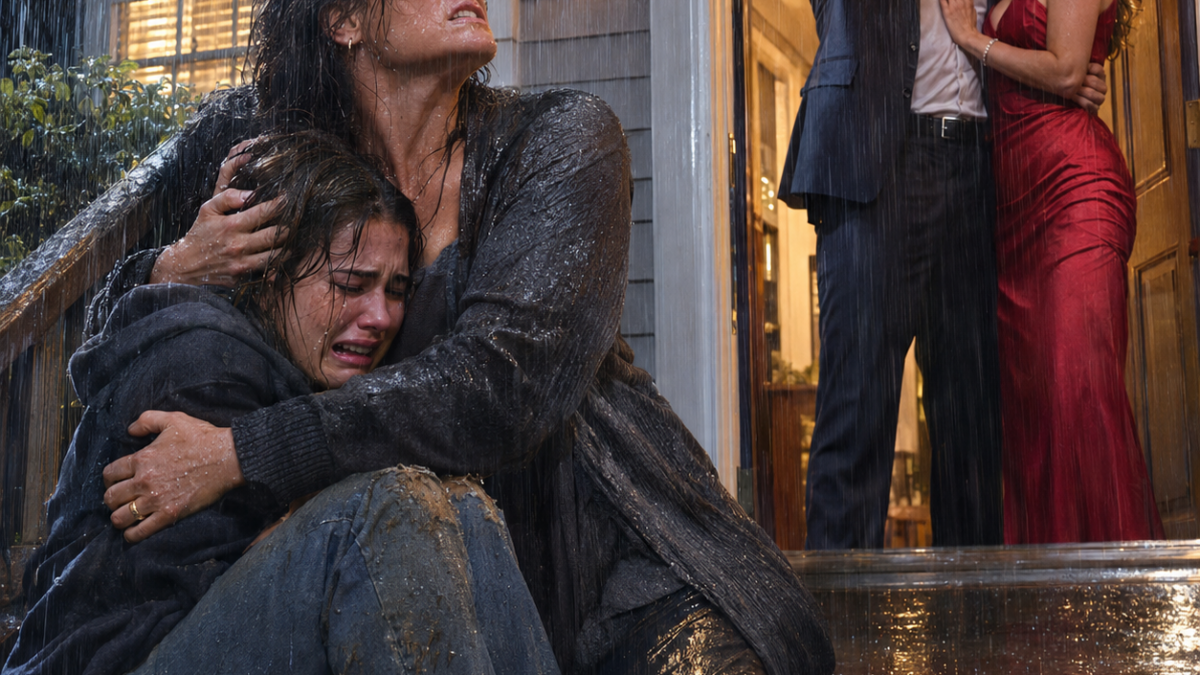
He glanced toward Maya.
Then shrugged.
“She’s being dramatic.”
For a moment, I couldn’t understand the words.
My brain simply refused to process them.
“What?”
Richard took another sip.
“She was throwing one of her tantrums. I told her she could come inside when she apologized.”
I looked at Maya.
Her chest was moving, but her breathing seemed frighteningly shallow.
Rainwater rolled down her nose.
Her lips were nearly colorless.
I looked back at him.
“HOW LONG HAS SHE BEEN OUT HERE?”
He rolled his eyes.
“I don’t know. A while.”
“A WHILE?”
“Stop screaming.”
Patricia appeared behind him.
His new wife.
Perfect hair.
Cream-colored sweater.
Bare feet safely inside the warm house.
She looked down at Maya with an expression of mild annoyance.
“She refused to follow the rules,” Patricia said.
I stared at her.
“She’s unconscious!”
Patricia folded her arms.
“She knows how to get attention.”
Something inside me seemed to split open.
I pulled out my phone and dialed 911.
When the dispatcher answered, my voice shook so violently that I struggled to give the address.
“My daughter—she’s fifteen—she’s outside in the rain, and I can’t wake her up!”
The dispatcher began asking questions.
Was she breathing?
Was she injured?
How long had she been unconscious?
I answered as carefully as I could.
The dispatcher instructed me how to help her safely while emergency responders were on their way.
I followed every direction, protecting her from further exposure as best I could without moving her unnecessarily.
I took off my coat and used it to shield her from the rain.
Then I looked up at Richard.
“Bring blankets!”
He frowned.
“Sarah, stop exaggerating.”
I stared.
“YOUR DAUGHTER NEEDS HELP!”
He leaned against the doorframe.
“If she passed out, she can learn not to defy me again.”
My hand tightened around the phone.
I wanted to scream.
I wanted to drag him off that porch and make him look at what he’d done.
But Maya needed me.
So I turned away from him.
I bent close to my daughter’s face.
“Mommy’s here.”
My voice cracked.
“Do you hear me, baby? Mommy’s right here.”
Then I heard sirens.
The ambulance stopped at the curb.
Two paramedics rushed toward us with their equipment.
One knelt beside Maya.
The other began assessing her condition.
They asked questions, checked her breathing and circulation, and moved with the controlled urgency of people who understood how serious the situation could be.
I stepped aside only when they needed room.
My entire body was shaking.
One paramedic, a man with tired eyes and a name tag reading MARK DAVIS, glanced toward the porch.
His expression changed.
He looked at the address.
Then at Richard.
Then back at me.
“Ma’am,” he said quietly, “I’ve responded to this house before.”
My breath caught.
“What?”
He hesitated.
His gaze returned to Maya.
“I remember this address.”
I stared at him.
A cold feeling spread through my chest.
“Was it for my daughter?”
He didn’t answer immediately.
And somehow, that silence frightened me more than anything Richard had said.
PART2
FULL STORY CONTINUATION
I don’t remember the ambulance ride as a continuous sequence.
I remember fragments.
The flashing lights reflecting off wet windows.
A paramedic speaking into a radio.
The sharp sound of medical equipment being opened.
Maya’s pale face beneath a blanket.
And my own voice asking the same question until I was almost hoarse.
“Is she going to be okay?”
Mark kept his attention on her.
“We’re taking her to the hospital as quickly and safely as we can.”
I swallowed.
“Why won’t she wake up?”
He glanced toward me.
“We’re assessing several possibilities. The emergency department will need to evaluate her.”
I looked at Maya.
She seemed impossibly small.
Fifteen years old.
Almost as tall as I was.
Old enough to argue about curfews, worry about chemistry exams, and roll her eyes when I asked whether she’d packed a sweater.
But lying there beneath the emergency blanket, she looked like the little girl who used to climb into my bed during thunderstorms.
I reached for her hand when the paramedics said it was safe.
“Maya.”
My voice broke.
“Sweetheart, please.”
Her fingers remained still.
I wanted to pull her against me.
Wanted to make the cold disappear.
Wanted to undo whatever had happened before I arrived.
Instead, I sat beside her while trained professionals worked to keep her stable.
And I tried not to think about the man standing on the porch when I found her.
Her father.
The one person who should have been protecting her while she was in his care.
Richard had called me at 7:42 that evening.
Not to tell me Maya was hurt.
Not to say she needed medical help.
He’d called to complain.
“Your daughter is being impossible.”
Those were his first words.
I’d been standing in the kitchen, making dinner.
I remember holding a wooden spoon.
The pasta water was boiling.
I had a grocery receipt beside the stove.
Normal things.
A normal Thursday evening.
I put the spoon down.
“What’s wrong?”
Richard sighed.
“She’s refusing to apologize to Patricia.”
“For what?”
“She was disrespectful.”
I waited.
He didn’t elaborate.
“Richard, what did she say?”
“That’s not the point.”
I rubbed my forehead.
“Then what is the point?”
“The point is that you undermine me every time I try to discipline her.”
My stomach tightened.
I’d heard that accusation before.
Whenever Maya resisted his rules.
Whenever I asked why she came home withdrawn.
Whenever I suggested that he and Patricia might need to be more patient with a teenager adjusting to two households.
Richard would accuse me of interfering.
“You’ve got her spoiled,” he’d say.
Or, “She knows she can run to Mommy whenever she doesn’t get her way.”
That evening, I tried to keep my voice calm.
“Is Maya there?”
“No.”
I frowned.
“What do you mean?”
“She needs time to think about her behavior.”
“Richard.”
He exhaled dramatically.
“Just pick her up at eight-thirty like we agreed.”
Then he ended the call.
I stared at my phone.
I should have called back.
I should have demanded to speak to Maya.
I should have asked exactly where she was.
But I believed she was somewhere inside the house, angry and refusing to talk.
I believed Richard was exaggerating another argument.
And I believed the man I’d once married would never allow our daughter to come to serious harm.
At 8:24, I pulled into his driveway.
Rain was falling so hard that my windshield wipers could barely keep up.
I grabbed my purse and hurried toward the front steps.
Then my headlights caught something blue near the porch.
A sweatshirt.
A backpack.
A body.
And the world I’d trusted shattered in a single second.
At the emergency department, a physician examined Maya and ordered the tests needed to assess her loss of consciousness and exposure to cold and rain.
I answered questions about her medical history.
Her medications.
Her allergies.
Whether she’d been sick.
Whether she’d eaten that day.
That last question stopped me.
“Had she eaten?”
The doctor looked at me.
“Do you know?”
I opened my mouth.
Then closed it.
She’d been at Richard’s house since Tuesday afternoon.
It was Thursday night.
I knew what I’d packed in her school bag.
I knew she’d eaten breakfast with me Tuesday morning.
But I had no idea what she’d eaten afterward.
I swallowed.
“I don’t know.”
The doctor nodded and continued the evaluation.
I felt sick.
How many basic things had I stopped knowing about my daughter’s days because she was spending them in another household?
What had she been eating?
Where had she been sleeping?
Had she been frightened?
Had someone been locking her outside?
I stared toward the treatment room.
My breathing became shallow.
A nurse touched my shoulder.
“Ms. Bennett?”
I turned.
“Sarah Bennett?”
I nodded.
“Your daughter is being closely monitored. The physician will update you as soon as possible.”
I tried to speak.
Then whispered, “Please don’t let her be alone.”
The nurse’s expression softened.
“We’ll take care of her.”
I nodded.
Then sat down.
For the first time since finding Maya, I had nothing to do but wait.
And waiting gave my mind room to remember things I’d spent months explaining away.
Maya used to love going to her father’s house.
When Richard and I first divorced, she was twelve.
The separation had been difficult, but we both promised her that she would never have to choose between us.
Richard moved into a house about twenty minutes from mine.
At first, the custody schedule worked reasonably well.
Maya stayed with him on alternating weekends and one or two evenings during the week.
He took her to movies.
Helped her with school projects.
Bought her a bicycle for her thirteenth birthday.
Sometimes she came home laughing about something silly he’d done.
I was relieved.
Whatever had happened between Richard and me, I wanted Maya to have a healthy relationship with her father.
Then Patricia came into his life.
At first, I tried to welcome the change.
Maya deserved peace in both homes.
Patricia seemed polite when we met.
She worked in real estate.
She had a confident smile and a habit of speaking as though she was always the most organized person in the room.
When Richard told me they were getting married, I congratulated them.
I even encouraged Maya to give Patricia a chance.
“She’s going to be part of your dad’s life,” I’d said.
“That doesn’t mean she replaces me. It just means there’ll be another adult around.”
Maya hadn’t looked convinced.
But she’d nodded.
For a while, I thought things would settle.
Instead, they slowly became worse.
The changes were subtle at first.
Maya stopped talking about her weekends.
I’d pick her up and ask what she’d done.
“Nothing.”
“Did you go anywhere?”
“No.”
“How was dinner?”
“Fine.”
At first, I thought she was simply becoming a teenager.
Fifteen-year-olds don’t always want to share every detail of their lives.
She had school.
Friends.
Homework.
The complicated emotional world of adolescence.
So I tried not to interrogate her.
But then she began arriving home unusually quiet.
Sometimes she barely touched dinner.
Sometimes she went straight upstairs and closed her bedroom door.
Once, I knocked after hearing her cry.
“Maya?”
There was a long silence.
Then she said, “I’m fine, Mom.”
I stood outside her door.
“Sweetheart, you can tell me if something’s wrong.”
Another silence.
“Nothing’s wrong.”
I believed she needed privacy.
I told myself not to push.
And I walked away.
Now, sitting in the emergency department, I remembered that closed bedroom door and felt something like ice settle in my stomach.
What if she hadn’t needed privacy?
What if she’d been waiting for me to ask again?
A few months earlier, I’d noticed she was losing weight.
Not dramatically.
But enough that her jeans seemed looser.
One afternoon, I asked whether she’d been eating lunch.
She rolled her eyes.
“Mom.”
“I just want to make sure you’re taking care of yourself.”
“I’m fine.”
I looked at her.
“You’ve been tired lately.”
“School’s stressful.”
It was a believable explanation.
She had exams.
She’d joined a new science course.
And the divorce had created emotional strain that sometimes resurfaced.
I told myself I was watching too closely.
Then I remembered the way she’d flinched when a cabinet door slammed in my kitchen.
I had dropped something while putting dishes away.
The sound was sudden.
Maya jerked so hard that the glass of water in her hand spilled across the table.
I apologized immediately.
“Sorry, honey. I didn’t mean to startle you.”
She stared at the cabinet.
Her face had gone pale.
Then she forced a smile.
“It’s okay.”
I cleaned up the water.
And didn’t ask why a simple noise had frightened her so much.
That memory now made me feel physically ill.
A doctor approached just after midnight.
I stood so quickly that my chair scraped against the floor.
“Is she okay?”
The doctor introduced herself as Dr. Elena Brooks.
Her expression was serious but reassuring.
“Maya is responding to treatment.”
I pressed a hand against my chest.
“Thank God.”
Dr. Brooks continued.
“She was significantly cold and dehydrated when she arrived. We’re also evaluating other possible contributors to her loss of consciousness.”
I swallowed.
“Can I see her?”
“Yes. She’s being monitored, and we want her to rest.”
I nodded quickly.
Dr. Brooks paused.
“Sarah, we also need to discuss the circumstances in which she was found.”
My stomach tightened.
I looked toward her.
“She was outside her father’s house.”
The doctor nodded.
“We understand.”
“In the rain.”
“Yes.”
I felt my voice rise.
“And he wouldn’t help her.”
Dr. Brooks remained calm.
“We’re documenting the information you’ve provided, and our social work team is involved.”
I stared.
“Does that mean Child Protective Services?”
“It means we have concerns about a minor’s safety, and we’ll follow the reporting requirements that apply.”
My eyes filled.
I looked down.
For three years, I’d tried to make shared custody work.
I’d attended school events with Richard.
Agreed to schedule changes.
Supported Maya having time with him.
And told myself that cooperation meant protecting our daughter from another family conflict.
Now a doctor was explaining that the situation might require child-protection intervention.
I swallowed.
“Please do whatever you need to.”
She nodded.
“We will.”
Then she led me toward Maya’s room.
I recognized her hair first.
It was spread across the pillow.
Long brown strands that had finally begun drying after hours in the rain.
A monitor beeped softly beside the bed.
Her skin was still pale.
An IV line ran toward her arm.
She looked smaller than she had that morning.
I approached slowly.
“Maya?”
Her eyes moved beneath her eyelids.
Then opened.
For a second, she looked confused.
She stared at the ceiling.
Then at the medical equipment.
Then at me.
“Mom?”
I nearly collapsed.
“Oh, sweetheart.”
I moved to her bedside.
“I’m here.”
Her eyes widened.
She looked toward the door.
Then back at me.
Her breathing changed.
“Is…”
The word caught.
I stroked her hair.
“What, honey?”
She swallowed.
“Is Dad here?”
My chest tightened.
I looked into her eyes.
There was terror there.
Not irritation.
Not the anger of a teenager who’d been grounded.
Terror.
I shook my head.
“No.”
Her lips trembled.
“He’s not here?”
“No, baby.”
I took her hand.
“It’s just me and the hospital staff.”
For a moment, she stared at me.
Then her entire body seemed to loosen.
A sob escaped her throat.
She turned her face toward the pillow.
And began crying.
Not quietly.
Not the irritated tears I’d seen after arguments about school.
She cried with the terrible relief of someone who had been holding fear inside for far too long.
I sat beside her.
“Oh, Maya.”
I touched her hair.
“I’m here.”
She shook her head against the pillow.
“I thought…”
Her voice broke.
I leaned closer.
“What?”
“I thought you wouldn’t come.”
My heart seemed to stop.
I swallowed.
“Why would you think that?”
She cried harder.
“I didn’t know if he’d let me inside.”
I looked toward the door.
Then back at her.
“Maya, what happened?”
She pressed her lips together.
Her eyes filled with panic.
“Please don’t tell Dad I said anything.”
And in that moment, I understood that the storm outside Richard’s house had been only the beginning of what I needed to learn.
I wanted to ask a hundred questions.
I wanted to know how long Richard had been doing this.
What Patricia had said.
Why Maya hadn’t told me.
Whether she’d been locked outside before.
Whether anyone had hurt her.
But the moment I saw her expression, I knew that demanding answers would only frighten her more.
So I sat beside the bed.
And kept holding her hand.
“Okay,” I whispered.
Maya looked at me through tears.
“Okay?”
“You don’t have to tell me everything tonight.”
Her lips trembled.
I swallowed.
“But I need you to know something.”
She stared.
“You are not in trouble.”
Her face crumpled.
I continued.
“Nothing that happened tonight is your fault.”
She shook her head.
“Dad said—”
“I know what he said.”
My voice cracked.
“I heard him.”
Maya’s eyes widened.
“You did?”
I nodded.
“He said you were pretending.”
She began crying again.
I moved closer.
“Sweetheart, I found you unconscious in the rain.”
Her breathing quickened.
“I’m sorry.”
The words nearly destroyed me.
I stared at her.
“What?”
“I’m sorry, Mom.”
She covered her face.
“I didn’t mean for you to have to call an ambulance.”
I couldn’t breathe.
My fifteen-year-old daughter had been left outside in a storm until she collapsed.
And now she was apologizing because someone had called 911 to save her.
I gently moved her hands away from her face.
“Maya, look at me.”
She hesitated.
Then met my eyes.
“You never have to apologize for needing help.”
Her lips trembled.
“Never.”
She looked away.
I continued quietly.
“You didn’t embarrass me.”
A tear slid down her cheek.
“You didn’t cause this.”
I swallowed.
“And you didn’t deserve to be left outside.”
For several seconds, she was silent.
Then she whispered, “He said I did.”
I felt anger rise so fast that my hands began shaking.
But I kept my voice calm.
“Richard was wrong.”
Maya looked frightened.
I took a breath.
“Your father was wrong to leave you there.”
Her eyes filled.
“And I’m going to make sure the people responsible for protecting you understand what happened.”
She stared at me.
“Are you going to make me go back?”
The question was barely audible.
I felt my throat close.
“No, sweetheart. I’m going to work with the hospital, the child-protection team, and the court to keep you safe.”
She swallowed.
“But the schedule—”
“We’ll deal with the custody schedule.”
Her voice trembled.
“Dad said judges don’t care what kids want.”
I looked directly into her eyes.
“Your safety matters, Maya. And your voice matters.”
She began crying again.
Then reached for me.
I leaned forward carefully, avoiding the medical equipment.
She wrapped her arms around my neck.
And held on.
For a long time, neither of us spoke.
Maya fell asleep shortly after one in the morning.
I stayed beside her.
The room was quiet except for the monitor and the faint sounds of staff moving through the hallway.
At some point, a nurse brought me a cup of water.
I thanked her.
Then sat back down.
My daughter’s wet backpack had been placed inside a clear belongings bag.
It sat near the chair beside her bed.
I’d grabbed it from the driveway before following the paramedics.
At the time, I hadn’t been thinking about her school things.
I simply knew she wouldn’t want them left outside.
Maya carried that backpack everywhere.
It was dark green with a small embroidered sunflower near the zipper.
I’d bought it for her before the school year began.
She’d complained that the color was too plain.
Then spent half an hour choosing little key chains to attach to it.
Now the fabric was soaked.
Water had seeped through the seams.
And I knew her notebooks were probably ruined.
I looked toward Maya.
She was sleeping.
Her breathing had become calmer.
I stood quietly and moved the bag to a nearby table.
I started removing the wet contents so they could dry, mindful that the hospital might need to preserve anything related to the incident.
A chemistry textbook.
A pencil case.
A half-empty packet of tissues.
A small notebook.
An umbrella with a broken strap.
I laid everything carefully on a towel.
Then I reached into the main compartment.
My fingers touched something caught beneath the lining.
I frowned.
The fabric had pulled loose along one inner seam.
Behind it was a small folded paper.
At first, I thought it was a forgotten assignment.
I pulled it out.
The paper was soft from moisture.
Folded into a narrow rectangle.
Then folded again.
I could see handwriting through the damp page.
Maya’s handwriting.
Small letters.
Careful spacing.
The same handwriting that covered sticky notes on our refrigerator.
I unfolded the paper.
And began reading.
At the top, she’d written:
THINGS THAT HAPPENED AT DAD’S HOUSE
Below the heading was a list of dates.
Some were from weeks earlier.
Others stretched back months.
The first entry I read made me stop breathing.
Tuesday: Locked outside for three hours. Dad said I could come in when I admitted Patricia was right.
I stared.
Three hours.
I read it again.
Then another line.
Sunday: Phone taken away. Patricia stood in the doorway and laughed when I asked to call Mom.
My hand flew to my mouth.
There were more.
Wednesday: Dad said I wasn’t allowed to eat dinner until I apologized.
Friday: Patricia said I was making everyone miserable and Dad agreed.
Saturday: I asked to come home early. Dad said Mom would think I was manipulating her.
I felt the room begin spinning.
I sat down.
The paper trembled in my hands.
Maya had been documenting incidents.
Quietly.
Secretly.
On a folded sheet of notebook paper she’d hidden inside her backpack.
She hadn’t written long explanations.
Just dates.
A few sentences.
The kind of notes someone makes when they’re afraid they’ll forget the details—or afraid someone else will insist they never happened.
I continued reading.
Dad said if I told Mom, the judge would make me stay here more because I was being disrespectful.
My eyes filled.
That was why she’d stopped talking.
That was why she’d always said everything was fine.
She’d been afraid that telling the truth would make things worse.
I turned the page over.
There was one final entry near the bottom.
The writing was darker.
Pressed so hard into the paper that I could see the indentations.
If they do it again, my only choice is to wait out in the storm until Mom gets here. If I knock on the door, they make me start the punishment over.
The sentence was underlined twice.
I stared at it.
Then at Maya.
She was sleeping beneath the hospital blankets.
Her face looked peaceful for the first time since I’d found her.
I looked back at the paper.
And suddenly remembered every conversation I’d had with her over the past year.
Every question she’d answered with fine.
Every time she’d asked whether she really had to go to Richard’s house.
Every time she’d become quiet when I mentioned Patricia.
And every time I’d told her to be patient.
To be respectful.
To give her father’s new marriage a chance.
A wave of nausea rose in my throat.
I set the paper on the table.
Then covered my face with both hands.
“Oh, Maya.”
My voice was barely a whisper.
“Oh, baby, I’m so sorry.”
I remembered one particular Sunday.
It had been about a month earlier.
Maya came home from Richard’s house looking exhausted.
She dropped her bag near the stairs and went straight to her room.
I followed her.
“Hey, sweetheart.”
She sat on the edge of the bed.
Her eyes were red.
“Can I ask you something?”
“Of course.”
She looked down.
“Do I have to go to Dad’s next weekend?”
I remember how quickly I’d answered.
“Maya, the schedule is important.”
She didn’t look up.
“I know.”
“Your dad loves you.”
Silence.
I sat beside her.
“I know things are different now that Patricia lives there, but everyone needs time to adjust.”
Maya picked at the edge of her blanket.
“What if I don’t like being there?”
I sighed.
“Sometimes living with different rules is difficult.”
She swallowed.
“Patricia has a right to set boundaries in her own home.”
Maya’s face changed.
I didn’t notice it then.
Or maybe I noticed and chose the easier explanation.
Teenage frustration.
Resentment.
Resistance to a stepparent.
I touched her shoulder.
“Just try to be respectful, honey.”
She nodded.
Then whispered, “Okay.”
Now I remembered the way she’d said it.
Not annoyed.
Defeated.
I looked at the note.
If I knock on the door, they make me start the punishment over.
I began trembling.
I’d been so determined not to become the difficult ex-wife.
So desperate to prove I could cooperate.
So afraid that Richard would accuse me of turning Maya against him.
That I’d mistaken my daughter’s fear for ordinary teenage reluctance.
I had listened to the explanations.
But I hadn’t asked enough questions.
And the price had been paid by the person I loved most.
A nurse entered just as I started crying.
She stopped.
“Sarah?”
I looked up.
The paper was still in my hand.
She approached carefully.
“What’s wrong?”
I tried to answer.
My voice broke.
“I found something.”
She glanced toward the page.
I swallowed.
“My daughter wrote this.”
I handed it to her.
She read silently.
Her expression became serious.
When she finished, she looked toward Maya.
Then back at me.
“May I notify the physician and our social worker?”
I nodded immediately.
“Yes.”
She returned the paper carefully.
“We should document this and preserve the original.”
I looked down.
For a moment, panic rose in me.
“What if Richard says she made it up?”
The nurse’s voice remained calm.
“The appropriate professionals will review all available information.”
I swallowed.
“She hid it.”
The nurse nodded.
“I can see that.”
I looked toward my daughter.
“She’s been afraid to tell anyone.”
The nurse’s expression softened.
“Then it’s important that she be given a safe opportunity to speak, without pressure.”
I pressed the paper against my chest.
For the first time that night, I understood what needed to happen next.
I couldn’t simply take Maya home and pretend Richard would never hurt her again.
There was a custody order.
A legal relationship.
A father who had already shown he could dismiss his daughter’s suffering while she lay unconscious.
I needed help.
Not from people who would tell me to be reasonable.
Not from relatives who would urge us to work things out privately.
From professionals who could act on evidence and protect Maya.
I looked toward the nurse.
“Please call whoever needs to be called.”
She nodded.
“We will.”
At exactly seven the next morning, I stood in the hospital corridor holding a paper cup of black coffee.
I hadn’t slept.
My clothes were wrinkled.
My hair was tied into a messy knot.
And I felt as though I’d aged ten years overnight.
I stared at the number on my phone.
Then pressed call.
Silvia Vance answered on the third ring.
“Sarah?”
Her voice was sharp and alert.
Silvia was the family-law attorney who’d handled my divorce.
She had a reputation for being relentless in court.
I knew her as a woman who could listen to an hour of emotional accusations, identify the three legally relevant facts, and refuse to waste time on anything else.
She’d helped me negotiate the original custody order.
And she’d warned me that co-parenting required cooperation without surrendering my responsibility to protect Maya.
I’d thought I understood her.
Now I wasn’t so sure.
“Silvia.”
My voice broke.
“Something happened.”
She went quiet.
“Tell me.”
I told her.
The driveway.
The rain.
Maya unconscious.
Richard standing on the porch.
Patricia refusing to help.
The ambulance.
The paramedic recognizing the address.
Then I read Maya’s note.
Every line.
Every date.
Every frightening entry.
By the time I reached the final sentence, I was crying so hard I had to stop.
Silvia waited.
Then she said, very calmly, “Sarah, listen to me carefully.”
I wiped my face.
“Okay.”
“Do not go to Richard’s house.”
My jaw tightened.
“Silvia—”
“Do not threaten him.”
I closed my eyes.
“I’m trying not to.”
“Do not post about this on social media. Do not send angry messages. Do not argue about the note with him.”
I stared at the corridor wall.
“He deserves to know what he’s done.”
“The investigators and the court need to know what happened,” she replied. “Richard’s reaction to an angry confrontation won’t protect Maya.”
I swallowed.
Silvia continued.
“We need medical records, properly obtained emergency-response records, the original note, relevant messages, and a clear timeline.”
I nodded.
“We need an emergency custody application and a plan for Maya’s safety.”
My breathing became uneven.
“Can we do that?”
“We can seek emergency relief. The judge will determine what orders are appropriate, but we have serious concerns to present.”
I pressed my hand against my forehead.
“I should have known.”
Silvia’s voice softened slightly.
“Sarah.”
I began crying again.
“She tried to tell me.”
“We’re going to focus on what protects her now.”
I looked through the hospital window.
The sun was rising over the parking lot.
A normal morning.
People were arriving for appointments.
Cars were pulling into spaces.
Someone laughed near the elevator.
And my entire life had changed overnight.
I swallowed.
“What do you need me to do?”
Silvia answered immediately.
“Stay with Maya. Cooperate with the hospital’s child-protection team. Preserve everything. I’ll begin preparing the filings.”
I nodded.
Then she added, “And Sarah?”
“Yes?”
“Do not allow your anger to become the story.”
My grip tightened around the phone.
“Why?”
“Because Maya’s safety is the story.”
I closed my eyes.
She was right.
And that truth hurt more than I wanted to admit.
Two hours later, Silvia called again.
I was sitting beside Maya’s bed, watching her sleep, when my phone vibrated against the chair.
I stepped into the hallway.
“Silvia?”
Her voice was serious.
“Sarah, there’s another development.”
My stomach tightened.
“What?”
“The hospital’s safeguarding team is coordinating with Child Protective Services. And the paramedic from last night—Mark Davis—has made a report.”
I pressed a hand against the wall.
“Mark?”
“Yes.”
“He said he’d been to Richard’s house before.”
Silvia paused.
“His report identifies a previous emergency response involving Maya at the same address.”
I felt the air leave my lungs.
“When?”
“Approximately three months ago.”
Three months.
I closed my eyes.
And suddenly I remembered a phone call.
Richard had contacted me on a Saturday afternoon.
I’d asked whether Maya was all right because she hadn’t answered the messages I’d sent that morning.
He sounded irritated.
“She got dizzy because she skipped breakfast.”
I remember frowning.
“Is she okay?”
“She’s fine.”
“Do I need to come over?”
“No.”
He’d sighed.
“I had a neighbor who’s a nurse check on her.”
I remember feeling relieved.
I remember thanking him for making sure she was okay.
Then I’d moved on with my day.
Now Silvia was telling me there had been an emergency response at his house.
My knees weakened.
I sat down on a bench.
“Richard told me a neighbor checked her.”
Silvia was quiet.
“What?”
“He said Maya got dizzy.”
My voice broke.
“He said a neighbor who’s a nurse looked at her.”
Silvia took a slow breath.
“Write down exactly what he told you and approximately when. Do you have the call record or any messages from that day?”
I stared at my phone.
“I think so.”
“Preserve them.”
I nodded.
Then asked the question I could barely bear to hear answered.
“What happened to Maya that day?”
“The official records need to be obtained through the proper process,” Silvia said. “Mark’s report raises concerns, but we shouldn’t fill in the missing details with guesses.”
I pressed my fingertips against my eyes.
“Was she hurt?”
“I don’t have a verified medical account to give you yet.”
My voice trembled.
“Silvia, he lied to me.”
She paused.
“If he told you there was only a neighbor’s assessment while emergency responders had attended, that’s a significant discrepancy. We’ll document it.”
I stared toward Maya’s room.
Three months earlier, my daughter had needed emergency help.
And I hadn’t known.
I felt something close to panic rise.
“What else don’t I know?”
Silvia’s voice became firm.
“That’s what the investigation needs to establish.”
I took a shaking breath.
She continued.
“The important thing is that Maya is in a medical setting where concerns have been documented. You’re cooperating. And we’re taking steps to obtain protective orders.”
I looked through the hallway window.
“Okay.”
Then Silvia said something I will never forget.
“Sarah, the facts are beginning to form a pattern. We need to let the evidence establish that pattern properly.”
I swallowed.
“And if it does?”
“Then we’ll ask the court to act on it.”
When I returned to Maya’s room, she was awake.
She was sitting against the pillows, looking toward the window.
I stopped at the doorway.
For a moment, I just watched her.
My beautiful girl.
The child I’d taught to tie her shoes.
The little girl who used to insist that every stuffed animal needed its own blanket.
The teenager who loved astronomy, hated algebra, and had recently started drawing tiny stars in the margins of her notebooks.
She turned when she heard me.
“Mom?”
I smiled, though my eyes were wet.
“Hey, sweetheart.”
She looked at the phone in my hand.
“Was that Dad?”
The fear returned immediately.
I shook my head.
“No. It was Silvia.”
Her expression changed.
“The lawyer?”
“Yes.”
Maya looked down.
“Am I in trouble?”
I crossed the room.
“No.”
She pulled at the blanket.
“Dad said if I caused more problems, he’d tell the judge I was lying.”
I sat beside her.
“Maya, listen carefully.”
She looked up.
“I’ve contacted Silvia because adults need to take responsibility for keeping you safe.”
Her lips trembled.
“You’re not doing anything wrong by telling the truth.”
She looked down again.
“What if he gets mad?”
My heart tightened.
I wanted to tell her she’d never have to see Richard again.
I wanted to promise that every legal decision would go exactly the way I hoped.
But I couldn’t control the court.
And I’d already spent too long giving Maya reassuring answers without understanding what she was actually experiencing.
So I told her something I could stand behind.
“Your father being angry doesn’t mean you did anything wrong.”
She looked at me.
“And you won’t have to handle this by yourself.”
Maya swallowed.
For a moment, she seemed uncertain.
Then she whispered, “Will you believe me?”
I felt tears gather.
“Yes.”
She stared.
“Even if he says I’m exaggerating?”
I nodded.
“Yes.”
“Even if Patricia says I started it?”
I took her hand.
“I will listen to you. And I will make sure the people responsible for investigating understand what you’ve told us.”
Her eyes filled.
Then she asked, “Why didn’t you believe me before?”
The question went straight through me.
I could have defended myself.
I could have told her she’d never explained exactly what was happening.
That she always said she was fine.
That I couldn’t have known someone was locking her outside.
That I’d tried to protect her relationship with her father.
All of those things were true in some way.
But none was what she needed from me.
I looked directly at her.
“I made a mistake.”
Maya went still.
I swallowed.
“When you told me you didn’t want to go there, I assumed it was because adjusting to Patricia was difficult.”
Her eyes filled.
“I know.”
“I should have asked more questions.”
She looked down.
“I tried.”
My chest tightened.
“I know that now.”
I took a breath.
“And I’m sorry.”
She began crying quietly.
I continued.
“You were trying to tell me something was wrong, and I kept explaining why you needed to be patient.”
Maya wiped her cheeks.
“Dad said you’d think I was being difficult.”
I swallowed.
“And I let that fear shape the way I listened.”
For a moment, I couldn’t speak.
Then I said, “I’m not going to ask you to protect my feelings.”
She looked up.
“You can be angry with me.”
Her lips trembled.
“You can tell me I got something wrong.”
I held her hand.
“And I will listen.”
Maya stared at me for a long moment.
Then she leaned closer.
I put my arm around her.
She rested her head against my shoulder.
And whispered, “I didn’t know how to make you understand.”
I closed my eyes.
“I’m listening now, baby.”
The hospital social worker came later that morning.
Her name was Denise Walker.
She spoke softly and explained her role before asking Maya any questions.
I appreciated that.
After everything my daughter had experienced, I didn’t want another adult walking into the room and demanding an explanation.
Denise let Maya know she could take breaks.
She explained that the hospital had concerns about her safety.
That certain information would need to be shared with child-protection professionals.
And that the goal was to understand what had happened and what support she needed.
Maya looked at me.
I squeezed her hand.
“You can tell the truth.”
Denise sat near the bed.
“Maya, would you feel comfortable telling me about last night?”
My daughter lowered her eyes.
For a moment, she said nothing.
Then she whispered, “Patricia got mad.”
Denise waited.
“About what?”
Maya rubbed her thumb against the edge of her blanket.
“I wouldn’t tell her my phone password.”
I felt my stomach tighten.
Denise remained calm.
“What happened next?”
“She said I was hiding things.”
Maya swallowed.
“I told her I wasn’t.”
Her voice trembled.
“Dad came in and said I was being disrespectful.”
I watched her.
She looked so frightened that I wanted to stop the conversation.
But Denise wasn’t rushing her.
And Maya was speaking.
Maybe for the first time in months, she was being given the chance to describe what happened without someone immediately telling her she was wrong.
Maya took a shaky breath.
“Patricia took my phone.”
I swallowed.
“Then she told Dad I needed to learn consequences.”
Denise nodded gently.
“What did that mean that evening?”
Maya stared at the blanket.
“Dad told me to go outside until I apologized.”
My chest tightened.
“In the rain?”
Maya nodded.
Denise asked, “Did you have a coat?”
“No.”
Her voice broke.
“I thought he’d let me back in after a few minutes.”
I pressed my lips together.
Maya continued.
“But he didn’t.”
She began crying.
I moved closer, but Denise gave her a moment.
“Can you tell me what you remember next?”
Maya wiped her face.
“I knocked.”
Her shoulders shook.
“Patricia opened the door.”
I felt my hands clench.
“She asked if I was ready to apologize.”
Maya swallowed.
“I told her I was cold.”
Silence.
Then she whispered, “She said being uncomfortable was the point.”
I looked away.
I could feel anger moving through my body.
But I stayed quiet.
Maya continued.
“Then she closed the door.”
My daughter told Denise that she’d tried knocking again.
Richard had opened the door the second time.
He told her that every time she interrupted him, the punishment would start over.
So she stopped knocking.
She sat near the steps.
Rain soaked her clothes.
The temperature continued dropping.
She became frightened and increasingly weak.
Without her phone, she couldn’t call me.
She tried to convince herself that if she waited quietly enough, Richard would let her back inside.
But the door remained closed.
Her voice grew smaller as she described the last moments she remembered.
“I got really cold.”
I stared at her.
“My fingers were hurting.”
She swallowed.
“I started feeling dizzy.”
Denise nodded.
“Then what?”
Maya shook her head.
“I don’t remember.”
My breath caught.
She looked toward me.
“The next thing I knew, I was here.”
I closed my eyes.
For a moment, I could almost see the scene.
My daughter sitting beside a locked door.
Rain running through her hair.
Cold seeping into her clothes.
Waiting for an adult to decide she’d been punished enough.
And then losing consciousness.
I wanted to scream.
Instead, I leaned toward her.
“I’m so glad I came when I did.”
Maya looked at me.
Her eyes filled.
“Me too.”
Denise also asked about the earlier incidents.
Maya hesitated.
Then looked toward the table where the folded note had been placed in a protective sleeve.
“I wrote things down.”
Denise nodded.
“Your mom told us.”
Maya’s face tightened.
“Am I going to get in trouble for keeping notes?”
“No.”
The answer was gentle and immediate.
Maya stared at her.
“Even though Dad said I wasn’t allowed to write bad things about him?”
Denise looked toward her.
“Writing down your experiences isn’t something you should be punished for.”
Maya began crying quietly.
I felt my chest tighten.
Denise let her take a moment.
Then asked whether Maya wanted to explain any of the entries.
My daughter nodded.
She began with the Tuesday she’d been locked outside for three hours.
It had started over a disagreement about household chores.
Patricia said Maya hadn’t cleaned the kitchen properly.
Maya insisted she had.
Richard told her she needed to learn respect.
And the consequence was being made to wait outside.
Maya said she’d been afraid to knock again after Richard threatened to extend the punishment.
The Sunday entry concerned her phone.
Patricia had taken it after Maya asked to call me.
When she protested, Patricia stood in the doorway and laughed.
“She said I was too old to go crying to Mommy.”
I closed my eyes.
Maya’s voice broke.
“Then Dad said she was right.”
Denise remained steady.
She asked open questions, gave Maya space, and didn’t force her to recount everything at once.
I sat nearby, silently watching the world I’d believed existed inside Richard’s house fall apart.
There had been rules.
Of course there had been rules.
Every household has them.
But what Maya described wasn’t ordinary discipline.
It was repeated intimidation, isolation, and punishment that placed her safety at risk.
And the worst part was how carefully she’d learned to hide her fear.
When Denise left, Maya looked exhausted.
I tucked the blanket around her.
She watched me.
“Mom?”
“Yes?”
“Are you mad?”
I paused.
“I’m upset about what happened to you.”
Her face tightened.
“At me?”
I shook my head.
“No, sweetheart.”
She looked away.
“Dad always says you’re mad when I cause problems.”
I swallowed.
“You haven’t caused this problem.”
She was silent.
I brushed a strand of hair away from her face.
“Adults are responsible for keeping children safe.”
Her eyes moved toward mine.
“That includes your father.”
I took a breath.
“And it includes me.”
Maya began crying softly.
I continued.
“I wish I’d understood sooner. But I’m here now, and I’m going to do the work necessary to protect you.”
She stared.
“Even if Dad hates you?”
I felt something tighten inside me.
For years, I’d been afraid of Richard’s anger.
Not physically.
But of his accusations.
His threats to return to court.
His insistence that I was unreasonable whenever I questioned him.
I’d spent so much energy trying to keep peace between households.
And somewhere along the way, I’d forgotten that peace wasn’t real if Maya had to remain silent to maintain it.
I looked directly at her.
“Yes.”
Her eyes widened.
I nodded.
“Even then.”
She took a shaky breath.
Then whispered, “Okay.”
And closed her eyes.
Later that afternoon, Silvia came to the hospital.
She didn’t arrive with dramatic declarations.
She carried a folder, a laptop, and a legal pad.
She asked first about Maya’s condition.
Then about the hospital’s safeguarding procedures.
She reviewed the original custody order, the notes I’d made about Richard’s statements, and the preserved copy of Maya’s handwritten record.
I told her about the hospital interview.
She listened carefully.
Then explained the next steps.
“We’re preparing a request for immediate temporary custody and suspension of unsupervised parenting time pending further review.”
I nodded.
“How soon?”
“We’re pursuing the fastest procedure available under the court’s rules.”
My hands trembled.
“What if the judge doesn’t believe us?”
Silvia looked at me.
“Sarah, the hospital has documented Maya’s condition. There are witness accounts concerning how she was found. There’s her handwritten record, and investigators are examining the earlier emergency response.”
I swallowed.
She continued.
“Those are concrete matters the court can evaluate.”
I looked toward Maya.
She was asleep again.
Silvia lowered her voice.
“We should also arrange appropriate mental-health support for her.”
I nodded.
“Absolutely.”
“And we need a plan for communication with Richard.”
My stomach tightened.
“What kind of plan?”
“One that protects Maya’s safety and avoids exposing her to pressure while the investigation and court process are ongoing.”
I stared at her.
“Can he call her?”
“That will depend on the applicable orders and the safeguarding decisions. We’ll ask the court to address it explicitly.”
I nodded.
Silvia continued.
“I want you to understand something.”
I looked up.
“This isn’t about winning an argument with your ex-husband.”
I swallowed.
“It’s about making sure Maya doesn’t have to return to an environment where she may be harmed.”
I glanced toward my daughter.
Then back at Silvia.
“That’s all I want.”
Silvia studied me.
Then said, “Good. Stay focused on that.”
Richard began calling me that evening.
The first call came at 5:18.
I didn’t answer.
The second came eleven minutes later.
Then another.
By six o’clock, I’d received three voice messages and a string of texts.
Where is Maya?
You had no right to take her to the hospital without involving me.
Stop making this into a custody issue.
Then came the one that made my blood run cold.
If Maya has been telling stories about Patricia, you need to make her understand there will be consequences.
I stared at the message.
For a long moment, I couldn’t move.
Consequences.
That was the word Maya had used.
That was the word Richard used to justify putting his daughter outside in dangerous weather.
And now he was using it again, after learning she’d been hospitalized.
I saved the messages and forwarded them to Silvia.
Then I put the phone down.
My hands were shaking.
I wanted to answer.
Wanted to tell him that Maya had been unconscious when I found her.
That she’d been cold, dehydrated, and frightened.
That she’d asked whether he was at the hospital before she’d asked almost anything else.
But I remembered Silvia’s warning.
Don’t let your anger become the story.
So I left the messages unanswered and allowed our attorneys to manage communication.
A few minutes later, another text arrived.
You are turning our daughter against me.
I looked toward Maya’s bed.
She was sitting upright, eating a little of the meal the hospital had brought her.
She glanced at me.
“Is that Dad?”
I hesitated.
Then nodded.
Her face changed.
I immediately put the phone away.
“You don’t need to deal with that right now.”
She looked down at her food.
“Is he mad?”
I took a breath.
“He’s sending messages, but Silvia is handling the legal communication.”
Maya swallowed.
“Does he know I told?”
I sat beside her.
“The hospital and the appropriate professionals are reviewing what happened.”
Her eyes filled.
“What’s he going to do?”
I looked at her.
“I can’t predict his reaction.”
She began trembling.
I took her hand.
“But you’re not going to handle it alone.”
Maya stared at me.
Then whispered, “He always finds a way to make it my fault.”
I felt my throat tighten.
I moved closer.
“That’s one of the things we’re going to work on changing.”
She frowned.
“What?”
“The idea that you’re responsible for managing his anger.”
Her eyes filled again.
I squeezed her hand.
“You aren’t.”
Maya was discharged after the medical team determined she was stable and provided follow-up instructions.
Before we left, Dr. Brooks spoke with me privately.
She reviewed the findings, the need for continued care, and the safeguarding concerns documented during the hospitalization.
I listened carefully.
Then asked, “Will she recover completely?”
Dr. Brooks took a breath.
“Her immediate physical condition has improved significantly. We’ll want appropriate follow-up to make sure there aren’t lingering medical concerns.”
I nodded.
“And emotionally?”
The doctor looked toward Maya’s room.
“That may take longer.”
My throat tightened.
She continued.
“Children who experience frightening or unsafe conditions can need time and professional support to regain a sense of security.”
I swallowed.
“She hasn’t been sleeping well for months.”
“That’s something to discuss with her follow-up providers.”
I nodded.
Dr. Brooks paused.
“Sarah, make sure Maya has a calm environment where she doesn’t feel pressured to repeatedly retell the events.”
I looked down.
“I’ve been asking myself a thousand questions.”
“That’s understandable.”
She continued gently.
“But let the appropriate professionals conduct the interviews they need. At home, focus on making sure she feels safe and knows what to expect.”
I swallowed.
Then asked the question I’d been afraid to say aloud.
“Do children ever stop being afraid after something like this?”
Dr. Brooks’s expression softened.
“Many children improve with safety, stable support, and appropriate care. Recovery isn’t always quick or straightforward, but fear doesn’t have to define the rest of her life.”
I nodded.
Then looked toward the hallway where Maya was waiting.
For the first time since the storm, I allowed myself to imagine something beyond the next legal hearing.
A future in which my daughter could laugh without checking whether someone disapproved.
A future in which she could disagree with an adult without believing she’d be abandoned outside.
A future in which the sound of a closing door was just a sound.
Not a threat.
When we arrived home, Maya stopped in the doorway.
I was carrying her discharge paperwork and a small bag of belongings.
She stood on the front step.
Motionless.
I turned.
“Sweetheart?”
Her eyes moved toward the door.
Then toward me.
“Can I ask you something?”
“Anything.”
She swallowed.
“Do I have to keep my bedroom door open?”
I frowned.
“No. You can close it whenever you want, as long as we’re following our usual household safety rules.”
Her expression changed.
“And if I get mad at you?”
I felt a sharp ache in my chest.
“You’re allowed to be mad at me.”
Maya looked confused.
“Even if I yell?”
“We’ll still work on speaking respectfully. But being upset doesn’t mean you lose your right to safety.”
She looked at the threshold.
Then whispered, “Dad said I needed to learn how to behave before I could be part of the household.”
I swallowed.
I set the bag down.
Then crouched slightly so I could look into her eyes.
“Maya, this is your home.”
Her lips trembled.
“You don’t have to earn your place in it.”
She began crying.
I opened my arms.
She stepped into them.
For a long time, we stood just inside the doorway.
Then I gently closed the door behind us.
Maya stiffened.
I felt it immediately.
I stepped back.
“Hey.”
She looked toward the handle.
I turned it and opened the door again.
“See?”
Her eyes widened.
I smiled gently.
“It opens.”
She stared.
I closed it.
Then opened it once more.
“That’s all.”
Maya swallowed.
I held the handle out toward her.
“You want to try?”
She hesitated.
Then reached for it.
Turned it.
The door opened.
Rain had stopped.
The sky outside was clear.
She looked at the doorway for a long moment.
Then closed it herself.
And walked into the house.
The emergency court hearing took place shortly afterward.
Silvia prepared me carefully.
She warned me that Richard might deny the allegations.
That he might argue the incident was misunderstood.
That Patricia might support his account.
And that the judge would want evidence rather than assumptions.
I understood.
But understanding didn’t make the morning easier.
When I entered the courthouse, Richard was already there.
He wore a dark suit.
His hair was perfectly combed.
He stood beside Patricia and their attorney, speaking quietly.
For one second, my stomach tightened.
He looked familiar.
The man I’d once married.
The man who’d held Maya as a newborn.
The man who used to fall asleep on the couch with her curled against his chest.
Then he saw me.
His expression hardened.
He began walking toward us.
Silvia moved slightly closer.
“Richard,” she said.
He stopped.
His eyes locked on mine.
“Sarah.”
I didn’t answer.
He glanced at Silvia.
“Can I speak to my ex-wife for a minute?”
Silvia’s voice was calm.
“Any necessary communication can go through counsel.”
Richard gave a bitter laugh.
“Unbelievable.”
He looked at me.
“You’ve really decided to ruin my life over a teenage tantrum.”
I felt my pulse pounding.
He continued.
“Do you know what this is doing to Patricia?”
I stared at him.
For a moment, I couldn’t believe he’d said it.
Patricia.
Again.
He was worried about Patricia.
Not the daughter who’d spent a night in an emergency department.
I looked directly at him.
“How is Maya?”
He frowned.
“What?”
I held his gaze.
“Have you thought about how Maya is doing?”
Richard’s expression changed.
Then he looked away.
“She’s fine.”
I felt something inside me go cold.
The same words.
The same dismissal.
Even now.
Silvia touched my elbow.
“We should go inside.”
I nodded.
Richard spoke behind me.
“Sarah, you’re going to regret turning this into a public spectacle.”
I stopped.
For a second, I wanted to turn around.
Wanted to tell him exactly what I thought of him.
Then I remembered Maya’s face when she’d asked whether I would believe her.
I kept walking.
The hearing wasn’t the dramatic confrontation I’d imagined during those sleepless nights.
It was more controlled.
More procedural.
And, in some ways, much harder.
Silvia presented the emergency medical documentation available to the court.
The circumstances in which I’d found Maya.
The statements I reported hearing from Richard and Patricia.
The original handwritten note and its documented preservation.
The hospital’s safeguarding referral.
The concerns raised by the earlier emergency-response history.
And the immediate risks that needed to be considered while the fuller investigation continued.
Richard’s attorney challenged the allegations.
He argued that his client had been attempting to enforce reasonable household rules.
That Maya had chosen to remain outside rather than apologize.
And that the situation had been misunderstood.
I sat perfectly still.
Maya had chosen to remain outside.
I looked toward Richard.
He was watching the judge with an expression of practiced seriousness.
I remembered my daughter lying unconscious on the concrete.
The rain running across her face.
The way she’d barely been breathing when I reached her.
And now her father was treating her collapse as a choice.
Silvia responded calmly.
“Your Honor, whatever the disagreement, a parent’s responsibility for a minor’s safety does not disappear because that child refuses to apologize.”
The judge listened.
Then asked questions.
About the timing.
About whether Maya had access to her phone.
About Richard’s response when I arrived.
About the previous emergency call.
Richard gave careful answers.
Sometimes vague ones.
Sometimes explanations that didn’t match what he’d told me that night.
At one point, the judge asked whether he’d known Maya was in medical distress.
Richard said, “I believed she was exaggerating.”
I felt my stomach twist.
The judge asked, “What did you do to verify that belief?”
Richard hesitated.
He looked toward his attorney.
Then said, “I checked on her.”
I stared at him.
Because when I arrived, he’d been standing on the porch drinking coffee.
And he’d shown no urgency at all.
The judge reviewed the available evidence and the urgent safety concerns.
The decision wasn’t a final determination of every disputed fact.
But it was decisive about what would happen while those facts were investigated.
Maya would remain in my care under an emergency temporary custody order.
Richard’s unsupervised parenting time was suspended pending further review.
Any contact would be governed by protective conditions established through the court and the involved professionals.
A more complete hearing would follow.
I sat motionless as the order was explained.
For a moment, the words barely registered.
Then Silvia leaned toward me.
“Sarah.”
I turned.
Her expression was gentle.
“Maya is coming home with you.”
My eyes filled.
I nodded.
I wanted to cry.
Wanted to smile.
Wanted to call my daughter immediately.
But there was still so much to do.
The investigation.
The longer-term custody hearing.
The emotional damage Maya had carried for months.
Still, one enormous fear had been lifted.
I wasn’t required to hand my daughter back to Richard’s household that weekend.
Not while the court examined what had happened.
I looked toward the bench.
Then closed my eyes.
And let myself breathe.
The next stage of the investigation brought more evidence.
Child-protection professionals obtained the relevant records through their authorized procedures.
The earlier emergency-response documentation confirmed that medical personnel had attended Richard’s address approximately three months before the storm.
The report described Maya as fearful, guarded, and reluctant to speak.
It also recorded discrepancies between Richard’s explanation and the responder’s observations.
When Silvia explained the documented findings to me, I sat at my kitchen table and stared at the wall.
Three months.
Three months ago, Maya had been frightened enough that the emergency responders noted it.
Three months ago, Richard told me she’d skipped breakfast and a neighbor had checked her.
Three months ago, I’d believed him.
I looked toward the calendar hanging on the refrigerator.
That weekend was still marked.
A little blue star.
Maya’s father had been scheduled to take her to a family gathering.
I remembered asking her afterward whether she’d enjoyed it.
She’d said, “Not really.”
I’d laughed gently.
“Family gatherings can be boring.”
She hadn’t laughed back.
I remembered that now.
And I understood how many ordinary moments had been carrying things I didn’t know.
The previous responder records didn’t prove every allegation by themselves.
But together with Maya’s account, the handwritten entries, the recent medical findings, and the new witness statements, they gave investigators a clearer picture.
One that Richard couldn’t dismiss simply by calling his daughter dramatic.
Mark Davis also provided his account through the official investigative process.
I didn’t ask him to share confidential medical information with me.
That wasn’t his role.
But I learned that he’d followed the appropriate reporting procedures when he recognized the address and became concerned about the circumstances.
A few weeks later, I saw him briefly at the hospital during Maya’s follow-up visit.
He was walking through the corridor with another paramedic when he recognized me.
“Ms. Bennett?”
I turned.
“Mark?”
He nodded.
“How’s your daughter?”
For a moment, my throat tightened.
“She’s doing better.”
His expression softened.
“I’m glad to hear that.”
I hesitated.
Then said, “Thank you.”
He looked slightly surprised.
“For what?”
I swallowed.
“For noticing.”
He glanced away briefly.
Then said, “We take concerns about children seriously.”
I nodded.
“I know.”
My eyes filled.
“But I don’t think you understand what it meant to me when you said you’d been to that house before.”
He was quiet.
I continued.
“I thought the storm was the first time anything like that had happened.”
Mark looked toward the hallway.
Then back at me.
“I’m glad the right people are looking into the situation.”
I nodded.
“Me too.”
He gave me a small, respectful smile.
“Take care of her.”
I swallowed.
“I will.”
Then he continued down the hallway.
I stood there for a moment.
Thinking about all the people who had helped Maya.
The dispatcher.
The paramedics.
The emergency physician.
The nurse who helped preserve the note.
Denise.
Silvia.
The investigators.
The court.
None of them could undo what had happened.
But each had done something that helped move my daughter toward safety.
And for the first time, I wasn’t trying to solve everything alone.
Maya started seeing a counselor who specialized in working with teenagers after frightening family experiences.
Her name was Dr. Andrea Foster.
The first appointment was difficult.
Maya stood outside the office with her arms folded.
“I don’t want to talk to another stranger.”
I looked at her.
“I understand.”
She stared at the floor.
“Everybody keeps asking what happened.”
I felt my chest tighten.
“I know.”
She swallowed.
“I’m tired of telling people.”
I nodded.
“Then you can tell Dr. Foster that.”
Maya looked up.
“What?”
“You can tell her you’re tired. You can tell her you don’t want to answer certain questions today.”
Her expression changed.
“She’s not going to get mad?”
I shook my head.
“Her job is to help you feel safe enough to work through things at a pace that’s appropriate for you.”
Maya looked toward the office door.
Then whispered, “Can you stay in the waiting room?”
I smiled gently.
“Of course.”
She hesitated.
“And you won’t leave?”
The question broke my heart.
I took her hand.
“I’ll be here when you come out.”
She looked at me for a long moment.
Then nodded.
“Okay.”
I watched her walk into the office.
The door closed softly behind her.
I sat down in the waiting room.
And stayed exactly where she knew I’d be.
Healing came in small pieces.
There was no single morning when Maya woke up and announced she wasn’t afraid anymore.
Some nights she slept peacefully.
Others, she woke frightened.
Sometimes she wanted to talk.
Sometimes she didn’t.
There were days when she laughed with her friends and returned home excited about school.
Then a sudden noise would make her flinch.
Or a disagreement would leave her standing perfectly still, watching my face as though she expected punishment.
I learned to notice.
One evening, she accidentally spilled a glass of orange juice across the kitchen counter.
The glass rolled off the edge and shattered.
Maya froze.
Her face went pale.
Before I could speak, she began apologizing.
“I’m sorry.”
I reached for a towel.
“It’s okay.”
She stepped back.
“I didn’t mean to.”
“I know.”
Her breathing quickened.
“I’ll clean it. I promise.”
I looked up.
She was staring at the broken glass with terror in her eyes.
I put down the towel.
“Maya.”
She flinched.
I softened my voice.
“Sweetheart, it’s just a glass.”
Tears filled her eyes.
“Are you mad?”
I shook my head.
“No.”
She stared.
“But I broke it.”
I nodded.
“Accidents happen.”
Her lips trembled.
I gestured toward the glass.
“Let’s keep your feet away from the pieces. I’ll get the broom.”
She didn’t move.
I looked at her.
“You’re not in trouble.”
For several seconds, she seemed unable to understand.
Then she whispered, “Dad would’ve made me stand outside.”
I felt my throat tighten.
I set the towel aside and approached slowly.
“Not here.”
Her eyes filled.
“Even if I broke something expensive?”
I nodded.
“Even then.”
She began crying.
I opened my arms.
She stepped into them.
And I held my daughter in the middle of the kitchen while orange juice spread across the counter and broken glass lay on the floor.
Neither mattered.
All I cared about was the frightened girl who needed to learn that a mistake didn’t make her disposable.
I began changing how I listened.
Not dramatically.
Not through grand speeches.
Through ordinary conversations.
When Maya came home from school looking upset, I stopped immediately offering explanations.
I stopped saying, “I’m sure they didn’t mean it.”
Or, “Maybe you’re overreacting.”
Or, “Try to see it from their perspective.”
Instead, I asked, “Do you want to tell me what happened?”
Sometimes she did.
Sometimes she shrugged.
Sometimes she went upstairs.
I learned not to take silence as proof that everything was fine.
But I also learned not to turn every quiet moment into an interrogation.
We created time for each other.
Saturday breakfasts.
Walks after dinner.
A few minutes together before bedtime.
Sometimes we’d make popcorn and watch terrible movies.
Sometimes we’d sit at the kitchen table while she worked on homework and I answered emails.
And sometimes we’d simply exist in the same room.
That became important.
Maya didn’t always need another serious conversation.
Sometimes she needed to know that being near me didn’t require explaining herself.
One Saturday morning, she was sitting at the kitchen counter eating pancakes when she looked up.
“Mom?”
I smiled.
“Yeah?”
“Can I ask you something?”
“Of course.”
She hesitated.
“Do you really want me here all the time?”
I stopped moving.
The spatula was still in my hand.
I turned toward her.
“What do you mean?”
She looked down.
“Dad said you liked having weekends without me.”
My chest tightened.
“He said you wanted time for yourself.”
I swallowed.
Maya continued.
“And Patricia said I was making things difficult because both houses had to plan around me.”
She traced a finger along the edge of her plate.
“So I thought maybe you were happier when I wasn’t here.”
For a moment, I couldn’t speak.
Then I set the spatula down and sat beside her.
“Maya.”
She looked up.
“I love having you here.”
Her eyes filled.
I continued.
“That doesn’t mean every day is easy. We’re both human. Sometimes we’re tired or frustrated.”
She nodded slowly.
“But you are never a burden to me.”
Her lips trembled.
“Not when you need help.”
I took her hand.
“Not when you’re upset.”
She looked at me.
“And not when your life is complicated.”
A tear slid down her cheek.
I smiled gently.
“You’re my daughter. You belong here.”
She stared at me for several seconds.
Then whispered, “Okay.”
And returned to her pancakes.
But a few minutes later, she moved her chair closer to mine.
She didn’t say anything.
She just sat beside me.
And I understood that sometimes reassurance needs to be repeated through a hundred ordinary mornings before it starts feeling true.
The final custody proceedings took months.
By then, the court had more information than it possessed during the emergency hearing.
The hospital records documented Maya’s condition after being found unconscious in the rain.
The original note and her subsequent account helped establish the timeline of her experiences.
The earlier emergency-response records raised concerns about what had happened three months before.
The messages Richard sent after her hospitalization showed that he continued framing the incident as misbehavior rather than a serious safety issue.
Professionals involved in the case documented their findings through the appropriate channels.
And Maya’s welfare, rather than Richard’s anger or my determination, remained the central issue.
There were disagreements over the evidence.
Richard maintained that he’d been misunderstood.
Patricia supported his version of events.
Their attorney argued that strict discipline wasn’t the same as mistreatment.
Silvia didn’t spend time making dramatic accusations.
She kept returning to the facts.
A fifteen-year-old had been left outside in dangerous weather.
She had lost consciousness.
The adults responsible for her care had not obtained medical assistance before I arrived.
And the available evidence raised serious concerns about repeated unsafe punishment.
During the proceedings, Richard tried to portray my actions as an attempt to destroy his relationship with Maya.
But the court wasn’t being asked to decide whether I was a perfect ex-wife.
It was being asked to determine what custody and contact arrangements would protect a child.
That difference mattered.
More than any angry message.
More than any argument in the courthouse hallway.
More than anything Patricia said about rules or respect.
Maya’s safety mattered.
And the legal process finally treated it that way.
I didn’t force Maya to sit through every adult disagreement.
She had already carried too much.
The court used appropriate procedures to consider her experiences and wishes without making her responsible for deciding the entire case.
Silvia explained each step to me.
I explained to Maya what she needed to know in language she could understand.
And whenever she asked whether she had to make the adults happy, I told her the same thing.
“No.”
She’d look uncertain.
I’d repeat it.
“You don’t have to protect your father from the truth.”
Sometimes she’d cry.
Sometimes she’d simply nod.
And sometimes she’d ask whether I was sure.
I was.
When the final order was issued, I was sitting beside Silvia in the courtroom.
My hands were clasped so tightly that my fingers hurt.
Richard sat across the aisle.
Patricia was beside him.
I didn’t look at them.
I kept my eyes on the judge.
The court awarded me sole physical custody and decision-making responsibility under the final custody order.
Richard was not permitted unsupervised contact with Maya.
Any future contact would have to comply with the court’s protective conditions and the required professional assessments.
The ruling also addressed the steps necessary before any modification could be considered.
I listened carefully.
I didn’t smile.
I didn’t celebrate.
I simply felt the terrible pressure inside my chest begin to loosen.
Maya would not be required to return to Richard’s house under the old schedule.
She would not be expected to keep spending weekends with adults who had placed her in danger.
The court had established protections.
And the responsibility for changing those protections did not rest on Maya proving she could endure more.
When the hearing ended, Silvia touched my arm.
“Sarah.”
I looked at her.
“It’s over.”
I swallowed.
“The immediate custody case is resolved,” she clarified gently. “There may still be related proceedings and follow-up requirements.”
I nodded.
I knew.
But the most urgent question had been answered.
My daughter was coming home with me.
Not just for a few weeks.
Not until the next exchange.
Home.
I covered my face.
And cried.
Richard approached as we were leaving the courthouse.
Silvia noticed him first.
She stepped slightly forward.
“Richard, any communication should go through counsel.”
He ignored her.
His eyes were fixed on me.
“Are you happy now?”
I stopped.
For a moment, I studied his face.
The man I’d once loved.
The father of my daughter.
The person who’d stood on a porch while Maya lay unconscious in the rain.
I took a breath.
“This wasn’t about making me happy.”
He scoffed.
“You took my daughter away.”
I felt anger rise.
But I kept my voice steady.
“Richard, Maya was found unconscious outside your house.”
His jaw tightened.
“She was being dramatic.”
I stared at him.
Even now.
Even after the hospital records.
The investigation.
The hearings.
The testimony.
He was still repeating the same sentence.
I felt something inside me go quiet.
There was no argument left to have.
I looked directly at him.
“You had a frightened child standing outside your door.”
He glanced away.
“You could have opened it.”
For a moment, he said nothing.
I continued.
“You could have brought her inside.”
My voice trembled.
“You could have called for help when she became unwell.”
His expression hardened.
“Sarah—”
“But you decided teaching her a lesson mattered more.”
I swallowed.
“That was your decision.”
He stared at me.
I held his gaze.
“And now you have to live with the consequences.”
Silvia touched my elbow.
I turned.
And walked away.
I didn’t wait for Richard to apologize.
I didn’t need him to agree with me.
The court had made its order.
And my responsibility was to go home to Maya.
When I returned, my daughter was sitting at the kitchen table.
Claire had stayed with her while I attended the hearing.
There were colored pencils scattered across the surface.
Maya was drawing.
For a moment, I stood in the doorway.
She looked up.
Her face changed.
“Mom?”
I smiled through tears.
“Hey, sweetheart.”
She put down the pencil.
“What happened?”
I walked toward her.
Sat beside her.
And took her hand.
“The judge made the final custody decision.”
Her eyes widened.
I swallowed.
“You’re going to live here with me.”
She stared.
“Always?”
I took a breath.
“This is your permanent home under the order. You won’t have to go back to your dad’s house under the old schedule.”
Her lips trembled.
“And I don’t have to spend weekends there?”
“No.”
She looked down.
For several seconds, she said nothing.
Then she whispered, “Really?”
I nodded.
“Really.”
Her face crumpled.
And suddenly she was in my arms.
Crying.
Holding me so tightly that I could barely breathe.
“Thank you.”
The words broke me.
I stroked her hair.
“Oh, baby.”
She cried harder.
“Thank you, Mom.”
I held her.
And wished more than anything that she’d never had to thank me for helping her reach a place where she felt safe.
But this was where we were.
So I held her until the crying stopped.
Then we sat together at the kitchen table.
And for the first time in months, Maya began talking about things she wanted to do.
Not things she was afraid might happen.
Things she wanted.
She wanted to join the art club at school.
She wanted to go to a friend’s birthday party.
She wanted to repaint her bedroom.
And she wanted to stop worrying every Thursday about whose house she’d be sleeping in that weekend.
I listened.
Then smiled.
“Okay.”
She looked up.
“Okay?”
I nodded.
“Let’s start with the bedroom.”
She laughed through tears.
And it was the most beautiful sound I’d heard in a very long time.
Six months after the storm, Maya was doing better.
Not perfectly.
Not as though nothing had happened.
There were still difficult nights.
Still moments when a sudden noise frightened her.
Still memories that made her quiet.
But she was laughing again.
She’d joined the art club.
Made a few close friends.
And begun filling sketchbooks with drawings she’d once been too embarrassed to show anyone.
Her appetite had improved.
She slept more regularly.
And she was learning to tell me when something bothered her instead of automatically saying everything was fine.
One evening, I found her sitting on the living room floor with her backpack open.
The same green backpack.
The one with the embroidered sunflower.
We’d cleaned it carefully after the hospital and replaced the books that had been damaged by rain.
Maya had insisted on keeping it.
At first, I didn’t understand why.
Then she told me.
“It’s mine.”
I looked at her.
She shrugged.
“I don’t want them to be the reason I have to throw away something I like.”
I smiled.
“Fair enough.”
Now she was arranging her school supplies.
I sat on the couch.
“Homework?”
She nodded.
“Art project.”
I watched her for a moment.
Then noticed a folded piece of paper on the floor beside her.
My stomach tightened.
It looked almost exactly like the note I’d found inside the lining months earlier.
Maya saw me looking.
“Oh.”
She picked it up.
“It’s okay, Mom.”
I swallowed.
“What is it?”
She hesitated.
Then handed it to me.
I unfolded the page.
At the top, in her familiar handwriting, she’d written:
THINGS I WANT TO REMEMBER
I stared.
Below the heading were several short entries.
Monday: Mom knocked before coming into my room.
Wednesday: I got a bad grade, and nobody yelled at me.
Friday: I spilled juice, and Mom helped me clean it up.
Saturday: Went to the movies with Olivia. Had fun.
My eyes filled.
Then I reached the final line.
The handwriting was darker there.
Pressed firmly into the paper.
But this time, the words weren’t frightening.
They were simple.
I don’t have to be scared when I make a mistake anymore.
I pressed a hand against my mouth.
Maya watched me.
“Mom?”
I looked up.
She seemed nervous.
“Is that weird?”
I shook my head.
“No.”
A tear slipped down my cheek.
“Not weird at all.”
She looked toward the paper.
“Dr. Foster suggested writing down things that help me feel safe.”
I nodded.
“That’s a good idea.”
Maya smiled slightly.
“I like making lists.”
I laughed through tears.
“I know you do.”
She glanced toward the old backpack.
Then back at me.
“I used to write down bad things because I thought nobody would believe me.”
My throat tightened.
She continued.
“Now I write down good things because sometimes I forget they can happen.”
I couldn’t speak.
Maya looked at the paper.
Then smiled.
“I want to remember.”
I set it down carefully.
Then opened my arms.
She leaned into me.
And I held her.
I used to believe being a good mother meant keeping peace.
Making sure Maya had a relationship with both parents.
Avoiding conflict.
Giving people second chances.
Being reasonable.
Cooperative.
Patient.
Those things can matter.
But the night I found my daughter unconscious in the rain, I learned that peace without safety isn’t peace at all.
Sometimes children don’t tell us what they’re experiencing because they’re afraid.
Sometimes they use ordinary words to hide extraordinary pain.
I’m fine.
It was nothing.
I don’t want to talk about it.
And sometimes the clues appear in small changes that are easy to mistake for something else.
A sudden silence.
A lost appetite.
A frightened reaction to a loud noise.
A child who begins asking whether she really has to go somewhere she once enjoyed.
I can’t go back and hear those early questions differently.
I can’t undo the times I told Maya to give her father another chance.
I can’t erase the nights she spent worrying about whether anyone would believe her.
But I can be the mother she needs now.
I can listen.
Ask.
Believe her when she tells me she’s frightened.
Work with professionals when something is beyond what I can solve alone.
And make sure she never feels responsible for protecting adults from the consequences of their choices.
Most of all, I can keep showing her that she doesn’t have to earn a place in my home by being perfect.
She belongs here because she’s my daughter.
That was always true.
It always will be.
Sometimes I still think about the storm.
The driveway.
The porch light.
Richard holding his coffee mug while Maya lay on the concrete.
The rain rushing across her face.
The ambulance doors closing.
Mark looking toward the house and saying he’d been dispatched there before.
And that small piece of paper hidden inside her backpack.
A folded note written by a fifteen-year-old girl who was too frightened to speak openly about what was happening.
I remember the final sentence.
If they do it again, my only choice is to wait out in the storm until Mom gets here.
For a long time, I couldn’t read those words without crying.
Because she was waiting for me.
And I hadn’t understood how much she needed me.
But now, when I look at Maya, I don’t see only the child I found outside Richard’s house.
I see the girl who survived a frightening experience.
The girl who found the courage to tell the truth.
The girl who sat in a courtroom process she never should have needed and learned that her safety mattered.
The girl who is slowly rediscovering how to be fifteen.
Drawing.
Laughing.
Arguing about homework.
Eating pancakes on Saturday mornings.
And leaving her backpack by the front door without worrying that someone will use it as an excuse to punish her.
The other night, she came into the kitchen while I was washing dishes.
“Mom?”
I turned.
“Yeah, sweetheart?”
She stood beside me for a moment.
Then asked, “Can we do something this weekend?”
I smiled.
“Sure. What were you thinking?”
She looked toward the window.
“Maybe go hiking?”
I nodded.
“I’d love that.”
She smiled.
Then said, “I want to take pictures.”
“Of what?”
She shrugged.
“Trees. Clouds. Whatever.”
I laughed.
“Sounds good.”
She started walking toward the stairs.
Then stopped.
Turned.
And looked at me.
“Mom?”
“Yes?”
Her expression softened.
“Thanks for coming that night.”
For a moment, my chest tightened.
Then I set down the dish towel.
I walked toward her.
And wrapped my arms around her shoulders.
“I’ll always come when you need me.”
She hugged me back.
This time, she didn’t ask whether I meant it.
She just held on for a moment.
Then went upstairs.
I stood in the kitchen listening to her footsteps.
The sound of her bedroom door opening.
Then closing.
An ordinary sound.
A door shutting inside a safe home.
No punishment.
No fear.
No child left outside to prove she was obedient.
Just my daughter going to her room.
And the quiet certainty that she could open that door again whenever she wanted.
Richard thought leaving Maya in the storm would teach her to obey him. Instead, it exposed the cruelty she’d been hiding, brought the truth before a court, and ended his ability to control her through fear.
The first note I found inside her backpack recorded the days she had suffered in silence.
The second recorded the days she was beginning to feel safe.
And when I think about the difference between those two pieces of paper, I understand what mattered most.
I couldn’t give Maya back every night she’d spent afraid.
But I could help give her a future where fear no longer decided how she lived.
My daughter once waited outside a locked door, praying her mother would arrive before she collapsed. Today, she sleeps behind a door she can open herself, in a home where she never has to beg to be let inside.








