𝗙𝗨𝗟𝗟 𝗦𝗧𝗢𝗥𝗬:“LEAVE HIM THERE—HE’S ONE LESS PROBLEM FOR THIS FAMILY!” My Parents Abandoned My 16-Year-Old Son Trapped in a Wrecked SUV, Trying to Force Him to Take the Blame for My Sister—But They Had No Idea the Vehicle Had Recorded Who Was Driving, Whose Phone Controlled It, and What Happened Before the Crash.
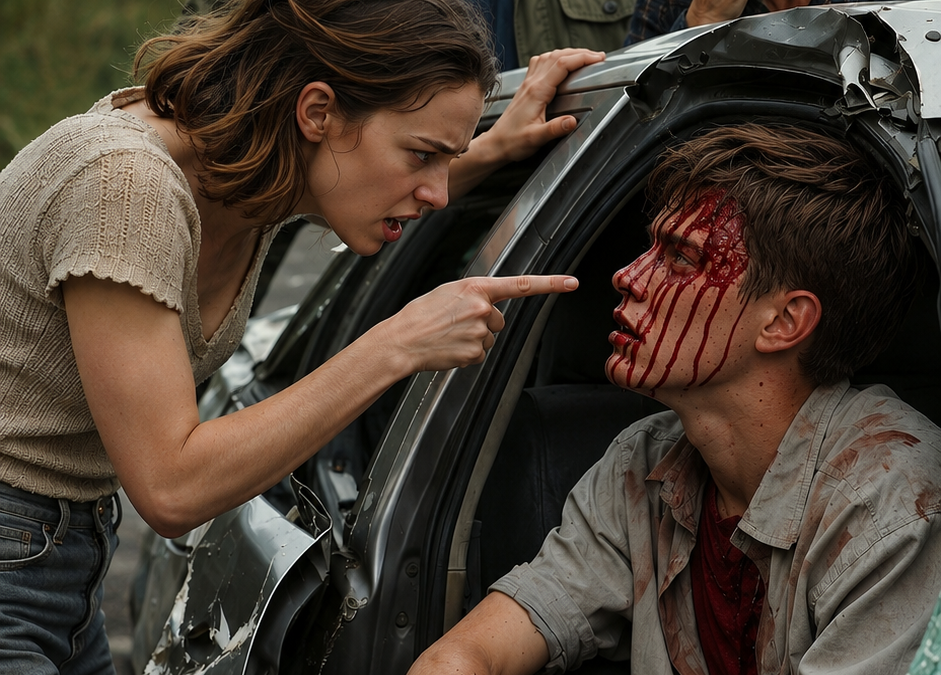
The line disconnected.
I was already moving.
I called emergency services.
Gave Ethan’s number.
His shared location was still active through the family tracking app.
A backroad west of Castle Rock.
Twenty-seven miles from where I stood.
I forwarded everything I could.
Then I drove.
I do not remember most of that drive.
I remember red lights.
My hands shaking against the steering wheel.
Calling Ethan again.
No answer.
Calling Ashley.
No answer.
My mother.
Nothing.
My father.
Nothing.
I called dispatch twice.
The second time, the operator told me rescue crews were approaching the location.
“Is my son alive?”
“I don’t have that information yet.”
“Please.”
“Ma’am, crews are there.”
That was all she could say.
I drove faster.
Earlier that evening, Ethan had eaten dinner at my parents’ house because I was working overtime.
Ashley was there too.
My younger sister.
Thirty-one.
Beautiful.
Charming.
The child my parents had spent three decades rescuing from consequences.
When Ashley crashed my father’s car at seventeen, Dad told the insurance company he had been driving.
When she failed out of college the first time, Mom told everyone the university had mishandled her records.
When she was fired from a marketing job for missing work, my parents paid her rent for eight months and told relatives her employer had discriminated against her.
Ashley was never allowed to fail.
Someone always rearranged reality before the consequences reached her.
I had spent my entire life being told I was “the strong one.”
What that really meant was simple.
I was the child expected to absorb what Ashley could not.
That night, my sixteen-year-old son became the next person in line.
Ashley had been drinking with dinner.
Ethan later told me he saw wine.
Then something stronger.
He offered to call me.
Ashley laughed.
“Your mother’s working.”
My father could have driven him home.
My mother could have.
They could have called a rideshare.
Instead, Ashley said she was fine.
And my parents let her take the keys.
Twenty-three minutes later, the SUV left the road on a curve and struck a tree.
Ashley got out.
Ethan did not.
Then Ashley did not call 911.
She called my parents.
They arrived before emergency crews.
Not to save my son.
To save her story.
PART2
By the time I reached the crash site, red and blue lights turned the trees into moving shadows.
An ambulance blocked half the road.
Firefighters surrounded a dark SUV folded hard against a pine.
The passenger side was crushed.
My knees nearly gave out.
A deputy stopped me.
“You can’t go past here.”
“My son is in that car.”
“Name?”
“Ethan Bennett.”
He looked toward a paramedic.
Then back at me.
“He’s alive.”
I started crying.
“He’s alive?”
“Yes.”
“But they’re still working to get him out.”
“Where is my family?”
The deputy frowned.
“What family?”
“My sister was driving.”
“My parents were here.”
His expression changed.
“There was nobody here when the first unit arrived.”
My stomach dropped.
“They left?”
“I don’t know.”
“They were here.”
I grabbed my phone.
“I heard them.”
The deputy became more attentive.
“What do you mean you heard them?”
“My son called me.”
I looked toward the SUV.
“My mother said to leave him.”
The deputy’s face changed completely.
“Ma’am.”
“I have the call.”
At least part of it.
My phone automatically recorded calls through a work-compliance app because some of my job involved client authorizations.
I had forgotten it was running.
That accident would become the most important recording of my life.
The deputy asked:
“Can you preserve that?”
“Yes.”
“Don’t edit it.”
“I won’t.”
Then metal shrieked.
A firefighter had cut part of the passenger door away.
I heard someone shout.
Minutes later, they brought Ethan out.
Neck stabilized.
Oxygen mask.
One leg immobilized.
Blood on his sleeve, but not the horror my imagination had created during the drive.
“Ethan!”
His eyes opened.
“Mom?”
“I’m here.”
He began crying.
So did I.
A paramedic stopped me from touching him until they secured the stretcher.
“What happened?”
I asked.
Ethan tried to speak.
The medic said:
“Not now.”
He looked at me.
“Hospital.”
I rode behind the ambulance.
My parents never called.
Ashley never called.
At the emergency department, doctors found a complicated leg fracture, a serious cut on Ethan’s arm, a concussion, and several smaller injuries.
Serious.
Painful.
But survivable.
The word survivable became sacred to me.
A trauma surgeon explained that Ethan would need surgery.
Possibly more than one procedure.
Rehabilitation.
Months before sports.
Maybe longer.
I nodded through everything.
Signed forms.
Called his father, my ex-husband, who was working in Utah and immediately started driving.
Then a traffic detective entered.
Rebecca Collins.
Late forties.
Short dark hair.
Calm voice.
She did not begin by interrogating Ethan.
She spoke to me first.
“Your son is stable enough for us to preserve information, but I’m not going to interview him fully tonight unless the doctors clear it.”
“Okay.”
“I understand he called you from the scene.”
“Yes.”
“Do you have the phone?”
“No.”
I stopped.
“I thought it was with him.”
Rebecca looked toward the nurse.
They checked his belongings.
Wallet.
One shoe.
Broken watch.
No phone.
My stomach tightened.
“They tried to take it.”
“Who?”
“My father.”
That came from the hospital bed.
Ethan’s eyes had opened.
Rebecca turned.
“Ethan, you don’t have to talk right now.”
“They took it.”
His voice was weak.
“Grandpa grabbed for it.”
“Did he get it?”
Ethan shook his head.
“I dropped it.”
“Where?”
“Car.”
Rebecca nodded.
“Then we’ll look.”
I touched Ethan’s hand.
“What happened?”
His eyes filled.
“Aunt Ashley was driving.”
“I know.”
“She was going fast.”
He swallowed.
“Grandma told me to say it was me.”
My throat tightened.
Rebecca remained calm.
“What exactly did she say?”
Ethan closed his eyes.
“She said Ashley could lose everything.”
“Her job.”
“Her license.”
“Then Grandpa came to my window.”
He started crying.
“I thought he was going to pull me out.”
I covered my mouth.
“He leaned in.”
Ethan continued.
“He said, ‘You were driving.’”
“And I said no.”
“Then Grandma said if I ruined Ashley’s life, nobody would forgive me.”
His face crumpled.
“I thought they were going to leave me.”
They did.
That sentence nearly destroyed me.
I took his hand.
“They don’t get to decide what happened.”
Rebecca looked toward me.
“No.”
She said it firmly.
“They don’t.”
Just after two in the morning, an officer recovered Ethan’s phone from beneath the passenger seat.
Cracked screen.
Damaged case.
Still functional enough for forensic extraction.
The call to me existed.
Location records.
Impact detection.
A partial emergency alert Ethan had apparently canceled or failed to complete.
But Rebecca told me something important.
“Your son’s phone tells us where he was.”
She paused.
“It does not, by itself, prove who was driving.”
I appreciated that.
She was not building a case from what we wanted to be true.
She wanted what could be proved.
“What about the car?”
“It’s being impounded.”
“Why?”
“Because we have conflicting accounts and possible evidence tampering.”
“Conflicting?”
I stared.
“Who gave another account?”
Rebecca did not answer immediately.
Then:
“Your father called the sheriff’s office at 12:26.”
My blood went cold.
“What did he say?”
“That Ethan had taken the vehicle without permission after dinner.”
I laughed.
I genuinely laughed.
Then started crying.
“They’re saying my son stole the car?”
Rebecca’s jaw tightened slightly.
“He said Ashley followed in another vehicle and your parents arrived afterward.”
“That is insane.”
“Do not contact them tonight.”
“I want to call my mother.”
“I strongly recommend you don’t.”
“What did Ashley say?”
“We have not located her for interview yet.”
Of course.
Rebecca continued.
“Your father’s statement creates a problem for them if physical evidence contradicts it.”
I looked toward Ethan.
“He was in the passenger seat.”
Rebecca nodded.
“Then the evidence should tell us something.”
At 6:15 the next morning, while Ethan was in surgery, my mother finally called.
I was sitting in a plastic chair outside the operating suite.
I stared at her name.
Rebecca had advised no confrontation.
So I answered and said almost nothing.
“Claire.”
Mom’s voice sounded exhausted.
“Where are you?”
“Hospital.”
A pause.
“How is Ethan?”
I nearly screamed.
Instead:
“In surgery.”
“Oh.”
Not horror.
Not guilt.
Oh.
Then:
“You need to understand what happened.”
“I’m listening.”
“Ashley wasn’t driving.”
There it was.
“You were there?”
“We arrived afterward.”
“What happened?”
“Ethan took your father’s SUV.”
“Why?”
“He was angry.”
“About what?”
Silence.
Then she invented something.
“You’ve been working too much.”
I closed my eyes.
My sixteen-year-old son had supposedly stolen his grandfather’s SUV because I worked overtime.
“Mom.”
“Yes?”
“I heard you.”
Silence.
“When?”
“At the scene.”
Another silence.
“I heard what you said.”
Her voice became sharper.
“You were hysterical.”
“I have a recording.”
Nothing.
For almost five seconds.
Then:
“Claire, you cannot use private family conversations to destroy your sister.”
There it was.
Not denial.
Not:
I never said that.
Destroy your sister.
“I need to go.”
“Claire.”
I hung up.
Saved the voicemail log.
Sent the call information to Rebecca.
Then I sat beside the vending machines and shook until Ethan’s father arrived.
Mark and I had divorced four years earlier.
Peacefully compared with most people.
We were bad spouses and decent parents.
When I told him what my family had done, his face went completely blank.
“What did Diane say?”
I repeated it.
He turned away.
For several seconds, he stared through the hospital window.
Then:
“Tell me you reported it.”
“Yes.”
“Good.”
He sat beside me.
“Claire.”
“What?”
“Do not protect them.”
That sentence mattered because he knew me.
For forty-two years, I had protected my parents from the truth about themselves.
Diane was harsh because she had anxiety.
Richard avoided confrontation because he grew up poor.
Ashley was fragile.
Ashley needed help.
Ashley had always struggled.
Every explanation ended the same way.
Claire could handle it.
That day, I stopped handling it.
Ethan’s surgery lasted almost four hours.
Successful.
The orthopedic surgeon repaired his leg.
The arm injury was treated.
His concussion required monitoring.
When he woke, he was confused and afraid.
Then he saw me.
“Mom?”
“I’m here.”
“Did Grandma come?”
That question cut through me.
“No.”
His eyes closed.
“Good.”
My son was relieved his grandmother had not come to see whether he survived.
There are moments when childhood ends abruptly.
That was one.
Rebecca returned that afternoon.
She had something new.
“The SUV has a lot of electronic systems.”
I nodded.
“It’s a 2024 model.”
“My father loves gadgets.”
“Good for us.”
She sat.
“This model stores multiple driver profiles through the infotainment and seat-memory system.”
I leaned forward.
“What does that mean?”
“It doesn’t automatically identify a driver beyond doubt.”
Careful again.
“But it records which saved profile loads, which paired device is actively connected, certain control interactions, and other event data.”
My heart started pounding.
“What did it show?”
“Manufacturer-assisted extraction is still being validated.”
She held up a hand.
“I don’t want you treating preliminary data as a verdict.”
“Okay.”
“But approximately four minutes before the collision, the system loaded a saved driver profile labeled ‘Ashley.’”
I stopped breathing.
Rebecca continued.
“The driver seat repositioned to coordinates associated with that profile.”
My father was six feet two.
Ashley was five foot four.
Ethan was five foot eight.
The seat had moved far forward.
“The active Bluetooth device was Ashley’s phone.”
My eyes filled.
“The navigation destination was your address.”
“Can that happen from the passenger seat?”
“Yes.”
My hope dropped.
Rebecca continued.
“But we also have steering-wheel control interactions made while Ashley’s phone was connected.”
“What does that prove?”
“Alone?”
“Not enough.”
“Combined with the seat position, the saved driver profile, impact data, physical evidence, and other records?”
Her eyes held mine.
“It matters.”
Then she gave me the detail that changed everything.
“There’s more.”
The SUV stored a post-collision automated diagnostic packet.
The driver’s seat occupancy sensor recorded an adult weight range.
The passenger seat recorded another occupant.
Both front seatbelt pretensioners activated.
That destroyed my father’s claim that Ethan had been alone.
But it still did not identify the occupants.
Then investigators examined the airbags.
The passenger-side airbag and interior surfaces had biological material consistent with Ethan’s injury location.
The driver’s side did not.
More important, paramedics documented Ethan being physically trapped in the passenger compartment before any family member returned.
He could not have moved from the driver seat after the crash.
Richard’s story was already collapsing.
Then Rebecca said:
“We obtained security video from a convenience store six minutes before the collision.”
I covered my mouth.
The SUV had stopped for fuel.
Ashley got out.
Went inside.
Returned.
Opened the driver door.
Ethan entered passenger side.
Clear.
Simple.
Undramatic.
Truth.
“But the car helped us know exactly where to look.”
Rebecca said.
“The navigation log gave us the route.”
“The vehicle clock matched the store system.”
“Your family did not know how much the SUV recorded.”
I started crying.
Not from relief alone.
Because Ethan had been telling the truth from the beginning.
And somewhere inside me, a child version of myself had still been afraid that my parents could speak loudly enough to overwrite reality.
They couldn’t.
Not anymore.
Investigators found Ashley the following afternoon.
At my parents’ house.
Of course.
She had not gone to the hospital.
She had not asked about Ethan.
According to Rebecca, when officers arrived, Ashley initially repeated the story that Ethan drove.
Then they told her there was convenience-store video.
Her account changed.
Ethan drove from dinner.
Then switched seats at the store.
They showed her the video of Ashley returning to the driver’s side.
Another change.
She claimed Ethan forced her to drive because he was tired.
Then vehicle data showed her phone active and the route entered before leaving my parents’ neighborhood.
Another story.
Then investigators obtained restaurant receipts from earlier that evening.
Alcohol charges.
My parents’ card.
Multiple drinks.
That did not, by itself, establish Ashley’s exact impairment at the moment of the crash.
Too much time had passed for a timely standard test.
But it mattered to the timeline.
So did messages recovered from Ashley’s phone after legal process.
One message to my mother from thirty-eight minutes before the crash:
I’M FINE TO DRIVE. STOP BEING DRAMATIC.
My mother replied:
JUST GO SLOW.
They knew.
Another message from Ashley to Dad after the crash:
I’M SCREWED.
Richard replied:
DON’T SAY ANYTHING. WE’RE COMING.
That message made me sit down when Rebecca showed me.
They had not made a bad decision in shock after arriving.
They were thinking about concealment before they reached Ethan.
The audio mattered too.
My work recording captured more than I realized.
Mom:
Leave him right there. If he bleeds to death, that will be one less problem for this family.
Dad:
We need to fix this before anybody gets here.
Ethan:
Grandpa, please get me out.
Dad:
You were driving.
Ethan:
No. Aunt Ashley was driving.
Mom:
If you ruin your aunt’s life, nobody will ever forgive you.
Then me shouting.
Then a muffled struggle.
Then the line dying.
When investigators enhanced the audio, another phrase became audible.
Ashley.
Crying.
Mom, get his phone.
My sister wanted Ethan’s phone removed while he was trapped.
I listened once.
Never again.
Three days after the crash, my parents hired an attorney.
That was their right.
I was glad.
Good lawyers sometimes stop frightened people from making worse decisions.
My mother sent me a message before apparently being advised not to contact me.
YOU ARE TEARING THIS FAMILY APART OVER AN ACCIDENT.
I stared.
Then replied once.
The accident happened when Ashley hit the tree. What happened afterward was a choice.
Then I blocked her.
Ethan came home eleven days later.
Not to my old routine.
To a hospital bed in the downstairs guest room.
Wheelchair.
Physical therapy scheduled.
Nightmares.
He hated sleeping.
Every time he closed his eyes, he felt the impact again.
Then he felt himself trapped.
Then he heard Grandma.
One less problem.
At sixteen, he had been sarcastic, independent, permanently attached to headphones, and allergic to conversations longer than thirty seconds.
After the crash, he became quiet.
He asked if I could sit in his room until he fell asleep.
So I did.
Every night.
I worked from the chair.
Laptop on my knees.
Sometimes he woke and whispered:
“Mom?”
“I’m here.”
That became our ritual.
I’m here.
The opposite of what my parents had done.
One night, two weeks after he came home, Ethan asked:
“Why does Grandma hate me?”
My chest cracked.
“She doesn’t get to decide what you’re worth.”
“That isn’t what I asked.”
He was right.
I put down my laptop.
“I don’t know what she feels.”
“She said I was a problem.”
“Yes.”
“Did she always think that?”
“No.”
At least I believed that.
“Then why say it?”
I took a long breath.
“Because she was trying to protect Ashley.”
“Why?”
There it was.
The question I had asked my entire childhood.
Why Ashley?
Why always Ashley?
I could have lied.
Instead:
“Your grandmother has spent a very long time believing that protecting Ashley from consequences is the same as loving her.”
Ethan stared at the ceiling.
“Is that why Aunt Ashley is like this?”
Partly.
But I refused to turn Ashley into an object created by our parents.
“She is responsible for what she did too.”
He nodded.
Then:
“Are they going to jail?”
“I don’t know.”
“Do you want them to?”
Hard question.
“I want the truth to matter.”
Ethan looked at me.
“That sounds like a mom answer.”
“It is.”
He almost smiled.
First time since the crash.
I would have paid anything for that smile.
But for once, money had nothing to do with it.
The district attorney eventually filed charges based on the evidence available.
Not the fantasy version people expect in stories.
Nobody was charged with attempted murder because an angry sentence sounded monstrous.
Criminal cases depend on statutes and provable conduct.
Ashley faced serious charges related to the crash, unsafe driving, injury, leaving the scene, and the alleged efforts afterward.
My parents faced allegations connected to leaving an injured minor without seeking aid, false reporting, interference with evidence, and the coordinated attempt to mislead investigators.
Their lawyers disputed parts.
Some charges changed.
That is how real cases work.
But the biggest thing happened before any trial.
Ashley’s lawyer asked for a meeting with prosecutors.
She wanted to cooperate.
My parents were furious.
For the first time in her life, their golden child was preparing to save herself without preserving them.
The irony was brutal.
Ashley admitted she had been driving.
Admitted she had consumed alcohol.
Admitted she lost control on the curve.
Admitted she called Mom instead of emergency services because she panicked about a prior driving incident affecting her insurance and employment.
Admitted my parents told her not to call anyone until they arrived.
Then admitted the part I cared about most.
When Richard leaned into the passenger side and told Ethan to say he had been driving, Ashley did not stop him.
She let them try.
Later, she asked Mom to get Ethan’s phone.
I read the summary through our victim advocate.
Then went into the bathroom and cried.
There had always been a part of me hoping Ashley would say:
No.
Stop.
He’s hurt.
Call an ambulance.
She didn’t.
My sister looked at my injured child and still chose herself.
That truth ended our relationship more completely than the crash.
My parents blamed Ashley for cooperating.
Mom sent a message through an aunt:
Ashley is betraying us after everything we’ve done for her.
I laughed when I heard it.
Not because it was funny.
Because finally the machine had turned inward.
For thirty years, my parents protected Ashley from consequences.
The moment consequences reached them, they called her disloyal.
That was never love.
It was a bargain.
We protect you as long as you participate in the lie.
Ashley had spent her life benefiting from that bargain.
Now she was learning the price.
My father tried to contact Ethan.
He sent a letter.
I gave Ethan the choice whether to read it.
He said no.
I kept it unopened for three months.
Then one afternoon he asked for it.
Richard wrote:
I was scared that night.
Not enough.
I saw Ashley standing outside the car and you trapped inside, and I made the worst decision of my life.
Better.
I thought if I could control the story, I could keep everything from collapsing.
There it was.
Instead, I left my grandson alone when he needed me.
Ethan stopped reading.
His hands shook.
“Do I have to forgive him?”
“No.”
“Ever?”
“No.”
He looked at me.
“What if he’s really sorry?”
“Then he’s sorry.”
“That doesn’t create a debt.”
Ethan cried.
I held him.
I wished someone had taught me that at sixteen.
An apology does not create a debt.
Mom’s letter was different.
She did not apologize.
She explained.
Ashley was vulnerable.
Ashley had worked hard.
Ashley could lose her career.
Ashley had already suffered.
Mom said her words on the phone were “taken during a traumatic moment.”
Then:
No grandmother wants her grandson hurt.
Ethan read that sentence twice.
Then tore the letter in half.
I did not stop him.
He looked at me.
“She didn’t say sorry.”
“No.”
“She said she didn’t want me hurt.”
“Yes.”
“But she left.”
“Yes.”
He tore the paper again.
Then threw it away.
That was his answer.
Physical therapy was miserable.
Ethan hated every session.
His therapist, Luis, was patient.
“Pain is information.”
Ethan muttered:
“Pain is stupid.”
Luis laughed.
“Also true.”
At first Ethan could barely bend the repaired leg.
Then more.
Then stand with support.
Then crutches.
Every milestone looked small to outsiders.
Inside our house, they were victories.
The first time he walked from the kitchen to the living room without assistance, I cried.
He rolled his eyes.
“Mom.”
“I’m allowed.”
“You cried when I opened a jar.”
“That jar was difficult.”
Gradually, my son returned.
Sarcasm first.
Then appetite.
Then friends.
Then music too loud from the bedroom.
Beautiful noise.
School was harder.
Rumors spread.
Somebody had seen Ashley’s name in local coverage.
People asked Ethan whether he had been driving.
One boy joked about his “DUI aunt.”
Ethan punched a locker.
Not the boy.
Progress.
His counselor helped.
So did therapy.
He eventually told me:
“The worst part isn’t the crash.”
“What is?”
“That they wanted people to think I did it.”
I understood.
Physical injury heals in measurable ways.
Bone.
Skin.
Range of motion.
Betrayal has no X-ray.
“How do I prove I’m not who they said?”
“You don’t.”
He stared.
“What?”
“You don’t spend your life disproving somebody else’s lie.”
“But people might believe it.”
“Some will.”
“That’s unfair.”
“Yes.”
He looked furious.
I continued.
“The people who matter will look at evidence.”
“And the ones who prefer gossip?”
I shrugged.
“You cannot live inside their heads.”
Ethan hated that answer.
So did I.
It was still true.
The vehicle data became central at the preliminary hearing.
Not because the SUV magically announced:
ASHLEY WAS DRIVING.
Technology is rarely that neat.
Instead, it created a chain.
Saved driver profile Ashley.
Seat moved automatically to Ashley’s stored position.
Ashley’s phone active through Bluetooth.
Navigation to my home.
Steering-wheel media input logged through the active device.
Crash event showing occupants in both front seats.
Physical evidence showing Ethan remained in the passenger position.
Convenience-store video confirming Ashley drove away from the store with Ethan beside her.
Phone messages.
Audio.
My parents’ false report.
Together, they formed something far stronger than any one dramatic clue.
I watched the defense attorney attack each piece separately.
A phone can connect from anywhere.
True.
A profile can be selected by someone else.
True.
Seat position is not identity.
True.
Video can have blind spots.
True.
Then the prosecutor asked Rebecca Collins:
“Does your conclusion rely on one of those things?”
“No.”
“What does it rely on?”
“The totality.”
That word stayed with me.
The totality.
Families lie the same way defense strategies sometimes work.
Isolate every incident.
Mom only said one cruel thing.
Dad only told one lie.
Ashley only made one mistake.
But put them together.
Totality.
A system.
A pattern.
Ashley eventually entered a plea agreement.
She accepted responsibility for driving, causing serious injury through reckless conduct, leaving the scene instead of seeking aid, and participating in the false account afterward.
The exact sentence was less dramatic than people expected and more serious than my parents wanted.
License consequences.
Probation after custody requirements.
Mandatory treatment and education.
Financial restitution.
Restrictions.
A criminal record that affected the career she had been so desperate to protect.
When the judge asked whether she wanted to address the court, Ashley stood.
I had not seen her since the hospital.
She looked thinner.
Older.
She turned toward Ethan.
Then me.
“I’m sorry.”
Ethan stared at her.
Ashley cried.
“I was scared about losing my job.”
She swallowed.
“And I let that matter more than his life.”
The room went completely silent.
“That is the worst thing I have ever done.”
I felt Ethan move beside me.
Ashley continued.
“I spent my whole life expecting Mom and Dad to fix things.”
Her voice broke.
“When I crashed, I called them because that is what I always did.”
She looked toward our parents.
They sat behind their attorney.
Mom would not meet her eyes.
“And they came.”
Ashley cried harder.
“But for the first time, fixing things meant hurting someone else badly enough that I can’t pretend anymore.”
She looked at Ethan.
“I don’t expect you to forgive me.”
Ethan said nothing.
Good.
Ashley sat.
I believed she was sorry.
I also believed consequences still belonged to her.
Both could be true.
My parents did not take plea agreements immediately.
My father eventually did.
My mother fought longer.
That was consistent.
Richard admitted making a false report and participating in the attempt to shift responsibility.
His attorney negotiated an outcome involving probation, community requirements, and consequences tied to the specific offenses that could be proved.
Before sentencing, Richard asked to speak.
He looked directly at Ethan.
“I was supposed to pull you out.”
Ethan’s face tightened.
Richard cried.
“I remember looking through the broken window and seeing you.”
His voice failed.
“You said, ‘Grandpa, please.’”
I began crying too.
“I will hear that until I die.”
Ethan looked down.
Richard continued.
“I thought I was protecting my daughter.”
Then shook his head.
“I was protecting myself from seeing what she had done.”
That was painfully accurate.
He sat.
Ethan did not forgive him that day.
But two years later, he answered one of Richard’s letters.
Not reunion.
A beginning.
Sometimes that is enough.
My mother went to trial on disputed portions of the case.
Not because she believed she had done nothing wrong.
Because she believed what she did was justified.
That was harder to forgive than panic.
On the stand, Diane admitted she arrived before emergency crews.
Admitted seeing Ethan injured.
Admitted she did not immediately call emergency services.
Her attorney argued she believed help was already on the way and that her cruel words were emotional exaggeration rather than genuine intent to abandon him.
Then the prosecution played the recording.
The courtroom heard my mother’s voice.
Leave him right there. If he bleeds to death, that will be one less problem for this family.
I watched jurors’ faces.
Then:
If you ruin your aunt’s life, nobody will ever forgive you.
And Dad:
You were driving.
Then Ashley:
Mom, get his phone.
My mother stared straight ahead.
For the first time, she heard herself without family context protecting her.
No:
You know how Mom is.
No:
She was upset.
No:
She didn’t mean it.
Just the words.
Rebecca testified about the SUV.
The defense tried to suggest Ethan might have switched seats after the crash.
Rebecca explained the passenger-side entrapment.
Fire-rescue photographs.
Door deformation.
Airbag evidence.
Seat location.
Medical injury pattern.
Then convenience-store footage.
My mother’s attorney pivoted.
Maybe Ashley drove from the store but Ethan took over later.
Then vehicle event logs.
No door-open event between the store and crash.
No ignition cycle.
No seat-profile change.
No evidence consistent with a driver swap.
The fabrication did not collapse because of one magical computer.
It collapsed because every new story required another impossible event.
That is the weakness of lies.
They require maintenance.
Truth just sits there.
My mother was convicted on some counts and acquitted on another.
Again, reality was complicated.
The judge imposed penalties reflecting her conduct, age, record, and the specific findings.
There was no melodramatic sentence designed for audience satisfaction.
But there was accountability.
A formal judgment saying what happened was not “family business.”
Not a misunderstanding.
Not my overreaction.
Actions.
Consequences.
For me, that mattered more than spectacle.
Before sentencing, Diane was allowed to speak.
She looked at me.
Then Ethan.
“I loved Ashley too much.”
I felt anger rise.
Then she corrected herself.
“No.”
She shook her head.
“That’s not right.”
The courtroom went quiet.
“I protected Ashley too much.”
Better.
“And I called it love.”
Her face crumpled.
“I expected Claire to be strong.”
My throat tightened.
“I expected Ethan to be strong.”
She started crying.
“And I let the people I thought were strongest carry what Ashley should have carried herself.”
That sentence reached deep.
Because it described my entire childhood.
“I said something unforgivable.”
She whispered.
“I left my grandson when he needed me.”
Ethan remained still.
Diane looked at him.
“You owe me nothing.”
That was the first sentence from her in months that I respected.
Afterward, Ethan asked:
“Do you think she meant it?”
“That you owe her nothing?”
“Yes.”
“I think she did today.”
“What about tomorrow?”
“I don’t know.”
He nodded.
Then:
“I don’t want to see her.”
“Okay.”
No guilt.
No:
But she’s your grandmother.
Okay.
I had finally learned.
The insurance agency fired me.
That sounds terrible.
It was one of the best things that happened.
Not immediately.
At first, I panicked.
I had missed too much work during Ethan’s surgeries and the investigation.
Technically, they called it “restructuring.”
Everyone knew.
My supervisor gave me a severance package and said:
“We need someone who can be fully available.”
For years, I had sacrificed family time to prove I could be fully available.
Then the one time my child truly needed me, the job reminded me what it thought availability meant.
I went home.
Cried.
Then laughed.
Ethan looked at me from the couch.
“You okay?”
“I’m unemployed.”
“Cool.”
“No.”
He smiled.
“You always said you hated that place.”
“I need health insurance.”
“Less cool.”
We figured it out.
I found another job three months later.
Claims investigation for a regional carrier.
Better hours.
Slightly less money.
Far better life.
The irony was not lost on me.
After spending months watching detectives reconstruct what happened to Ethan from records, I moved into investigative claims work.
Patterns.
Timelines.
Evidence.
Turns out I was good at it.
Ashley lost her job.
For years, my parents would have paid her bills.
Now they could not fix everything.
For the first time, she worked through consequences herself.
She completed treatment.
Moved into a small apartment.
Took an administrative job.
No glamour.
No parents calling employers.
No rescue.
A year after sentencing, she wrote Ethan.
Not me.
To him.
She said:
I used to think Mom and Dad saving me meant I was loved more. Now I understand it meant I never learned how to save myself. That is not an excuse for what I did to you.
Ethan read the letter.
Then put it away.
“What are you going to do?”
I asked.
“Nothing.”
“Okay.”
Six months later, he answered.
One paragraph.
He did not show me.
I did not ask.
His relationship.
His choice.
Richard and Ethan eventually rebuilt something small.
Letters first.
Then a phone call.
Then coffee in a public place with me nearby.
My father looked twenty years older.
When Ethan walked in using no cane, Richard started crying.
Ethan said:
“Don’t.”
Richard stopped.
Good.
They talked about baseball.
School.
Cars.
Not the crash.
At the end, Richard said:
“Thank you for coming.”
Not:
I’m your grandfather.
Not:
You should forgive me.
Thank you.
That mattered.
They never returned to the relationship they had before.
Maybe they shouldn’t.
Some broken things are repaired into different shapes.
Still useful.
Still real.
Not original.
My relationship with my mother remained distant.
For years.
Birthday cards.
No calls.
Then one day, when Ethan was twenty-one, Diane asked through Richard whether I would meet her.
I said no.
A year later, she asked again.
No.
Another year.
By then Ethan was in college studying mechanical engineering.
He joked the SUV had given him “a personal interest in crash-resistant design.”
Dark humor.
Healthy enough.
Then Mom sent me a letter.
Not an explanation.
An apology.
Claire,
For most of your life, I punished you for being capable.
I stopped reading.
Started again.
I called you strong so I would not have to help you.
My eyes filled.
I called Ashley sensitive so I would not have to let her fail.
Then:
The night of the crash, I did to Ethan what I had done to you in smaller ways for decades. I asked the stronger child to absorb the consequences of the weaker one.
I sat in my kitchen and cried.
Not because the letter erased anything.
Because finally she named it.
I cannot ask you to forgive me. I can only stop pretending my intentions matter more than what I did.
That line mattered.
I agreed to one meeting.
Mom looked old.
That shocked me.
Parents are frozen in our minds.
Then one day you look and time has continued without permission.
We met at a library café.
Neutral.
She did not reach for me.
Good.
“Thank you for coming.”
I nodded.
For several minutes, nothing.
Then she said:
“I used to think you hated Ashley.”
“I didn’t.”
“I resented her.”
“Yes.”
“Because you made her problems mine.”
Mom cried.
“I know.”
“You did it with money.”
“Attention.”
“Rules.”
“Everything.”
“I know.”
“And then you did it to Ethan.”
Her face collapsed.
“Yes.”
I waited.
No defense.
That was new.
Then she whispered:
“I heard him asking Richard for help.”
My chest tightened.
“I know.”
“I still hear it.”
“Good.”
The word came out before I could soften it.
Mom flinched.
I almost apologized.
Didn’t.
She nodded.
“Good.”
Then:
“I deserve to.”
“No.”
I shook my head.
“Don’t turn guilt into another form of self-importance.”
She stared.
“You are not the main victim of what you did.”
That landed.
Mom lowered her head.
“You’re right.”
Progress.
Painful.
But progress.
We did not hug that day.
We met again six months later.
Then again.
Ethan chose not to.
Mom respected it.
That was the condition.
No messages through me.
No surprise gifts.
No:
Tell him Grandma misses him.
If Ethan wanted contact, he would initiate.
For the first time in her life, Diane learned that love sometimes looks like leaving a closed door alone.
Ethan did eventually contact her.
At twenty-four.
Not because she earned a deadline.
Because he wanted to.
He met her at the same café.
I did not go.
Afterward, he called.
“How was it?”
“Fine.”
“Fine good or fine terrible?”
“Fine complicated.”
Fair.
Then:
“She apologized.”
“Okay.”
“She cried.”
“Okay.”
“I didn’t.”
“Okay.”
He laughed.
“You’ve gotten annoyingly healthy.”
“Therapy.”
“Gross.”
Then he said:
“I don’t think I’ll ever call her like I used to.”
“You don’t have to.”
“I know.”
That was the point.
He knew.
The SUV was eventually released after the case ended.
Insurance declared it a total loss.
My father asked whether I wanted anything from it.
“No.”
Then Ethan said:
“I do.”
He wanted the passenger-side door handle.
At first I thought that was disturbing.
Then he explained.
“I kept pulling it.”
After the crash.
Trapped.
The interior handle would not open because the door was crushed.
He had pulled until his fingers hurt.
“I want it.”
“Why?”
“Because I got out anyway.”
Not by himself.
Firefighters cut him out.
But I understood.
The handle became a reminder that an exit can exist even when the door does not open the way you expect.
He kept it on a shelf for years.
Later, when he graduated engineering school, I noticed it in his apartment beside his diploma.
I cried.
He pretended not to notice.
Detective Rebecca Collins attended his graduation.
Ethan invited her.
She looked surprised when she received the invitation.
“You remember me?”
Ethan laughed.
“You proved I wasn’t driving.”
Rebecca shook her head.
“No.”
“You told the truth.”
“I documented it.”
Then she smiled.
“The car helped.”
He grinned.
That became a running joke.
The SUV that testified.
But Rebecca always corrected us.
“Cars don’t testify.”
“They record.”
“People still have to interpret responsibly.”
That lesson applied to families too.
Facts can exist for years.
Somebody still has to be willing to look.
Years after the crash, I asked Ethan what he remembered most.
I expected the impact.
The tree.
Grandma’s sentence.
Instead he said:
“Your voice.”
“What?”
“On the phone.”
My eyes filled.
“You kept saying my name.”
I had forgotten.
He remembered.
“I thought they were going to take my phone.”
“And I remember thinking if I could still hear you, I wasn’t alone.”
I cried.
He laughed awkwardly.
“Mom.”
“Sorry.”
“You always cry.”
“I earned it.”
He smiled.
Then:
“You called 911.”
“Of course.”
“No.”
His face became serious.
“You didn’t say:
Let me call Grandma back.”
“You didn’t ask whether Ashley was okay first.”
“You didn’t tell me not to make trouble.”
“You believed me.”
That sentence shattered me.
Because apparently being believed had become extraordinary.
“I will always believe you?”
I stopped.
No.
That was not right either.
Blind belief can create another Ashley.
So I corrected myself.
“I will always listen to you.”
Ethan nodded.
Better.
That is what my parents failed to do.
They did not investigate.
Did not pause.
Did not ask.
Ashley said she was in trouble, and they immediately decided Ethan had to carry it.
They believed protecting family meant choosing who would be sacrificed.
I know better now.
Family should be the place where truth becomes safer to tell.
Not more dangerous.
People who hear my story usually focus on my mother’s sentence.
I understand.
It is monstrous.
Leave him there. If he bleeds to death, that will be one less problem.
I spent years wishing she had never said it.
Now I think the sentence exposed something that existed long before the crash.
Not that she wanted Ethan dead.
I do not believe that.
What existed was a hierarchy.
Ashley’s future mattered so much that, for a few terrible minutes, everyone else became negotiable.
My son’s safety.
My trust.
The law.
Truth.
That was the real sickness in our family.
The crash only made it visible.
And the SUV?
That became the symbol people liked best.
My parents thought they could control the story because Ethan was injured and frightened.
They did not understand that modern systems leave traces.
Driver profile.
Seat position.
Bluetooth connection.
Navigation history.
Occupancy sensors.
Crash data.
Security video linked through the route.
No single clue shouted:
ASHLEY DID IT.
But together, they refused to cooperate with the lie.
Machines do not love the golden child.
They do not care who Mom protects.
They do not understand family loyalty.
They record what happened.
Sometimes that is exactly what justice needs.
The most satisfying ending is not that my parents suffered.
They did.
Ashley did too.
But punishment was never the part that healed Ethan.
What healed him was walking again.
Driving again.
Yes.
Driving.
That took almost two years.
The first time he sat behind a steering wheel after the crash, he froze.
Hands on ten and two.
Engine running.
Could not move.
I sat beside him.
Same side of the car he had once been trapped in.
“Want to stop?”
He shook his head.
Five minutes passed.
Then he backed out.
Slowly.
Drove around the block.
When we returned, he turned off the engine.
Then started crying.
So did I.
“Seriously?”
He said.
“Yes.”
“Every milestone?”
“Every one.”
He laughed.
That laugh was the ending I cared about.
Ashley eventually became sober.
Stayed sober.
Rebuilt employment.
Not the career she had before.
A life.
She never asked me to call our relationship repaired.
Smart.
At Ethan’s college graduation, she sent a card.
No money.
No guilt.
Just:
I’m proud of you. I’m sorry I once cared more about protecting my future than protecting yours.
Ethan kept the card.
Did not invite her.
Boundaries can coexist with compassion.
Richard died when Ethan was twenty-seven.
Stroke.
Ethan visited the hospital.
His choice.
He sat beside my father.
Richard could barely speak.
He squeezed Ethan’s hand.
Ethan later told me Grandpa whispered:
“Should’ve pulled you out.”
Ethan answered:
“They did.”
Richard looked confused.
“The firefighters.”
Then Ethan said:
“But you got another chance afterward.”
My father cried.
He died the next morning.
Ethan was sad.
Also angry.
Also peaceful.
Grief can hold contradictions.
Mom lived longer.
She never regained the authority she once had over the family.
That was healthy.
Relationships became voluntary.
Ashley set boundaries.
I set boundaries.
Ethan set the strongest ones.
Diane had to meet each person where they were willing.
No commanding.
No guilt.
No:
After all I’ve done.
Maybe that was her final education.
Love without control.
Late.
Still worth learning.
At seventy-eight, she asked me something during one of our occasional lunches.
“Do you think you would have spoken to me again if I had never admitted what I did?”
I thought.
“No.”
She nodded.
“Fair.”
Then:
“Was saying sorry enough?”
“No.”
Another nod.
“What was?”
“Respecting the no after.”
Mom stared.
Then smiled sadly.
“I wish I understood that thirty years earlier.”
“So do I.”
We ate lunch.
No dramatic reconciliation.
No mother-daughter movie ending.
Just two women who finally stopped lying about what had happened between them.
Sometimes peace is quieter than forgiveness.
I never returned to being “the strong one” in my family.
I retired the role.
When Ashley had a problem, I did not automatically fix it.
When Mom was lonely, I did not abandon my plans.
When someone said:
“You’re better at this.”
I learned to ask:
“Does that make it my responsibility?”
Usually, no.
Strength is not a family utility everyone else gets to use without permission.
That may be the most important thing I learned.
Ethan is thirty now.
Married.
Civil engineer specializing in vehicle safety systems.
Yes.
Of course.
When he told me his specialty, I laughed.
“What?”
He asked.
“You’re really going to spend your career making cars better witnesses?”
He rolled his eyes.
“Mom.”
His work is more sophisticated than that.
Crash protection.
Occupant safety.
Sensor integration.
Structural design.
But part of me likes the poetry.
A vehicle almost killed him.
Then its records helped save his name.
Now he helps make vehicles safer for people he will never meet.
That feels like transformation.
Not revenge.
Something better.
He and his wife had a daughter last year.
My granddaughter.
Grace.
The first time I held her, I thought about the accident.
Not because I wanted to.
Trauma keeps strange calendars.
Ethan saw my face.
“What?”
“Nothing.”
“Mom.”
I looked at that tiny baby.
Then at my son.
“You were sixteen.”
“I know.”
“They left you.”
His face softened.
“I know.”
“I’m sorry.”
He came closer.
“You didn’t.”
I started crying.
Again.
Ethan laughed.
“Grandma Claire is going to be emotionally unstable.”
“Probably.”
He handed me a tissue.
Then said:
“You came.”
Two words.
You came.
That was what he remembered.
Not my thirty-minute drive.
Not 911.
Not detectives.
I came.
My parents’ worst failure was not being imperfect.
Every parent is imperfect.
It was making the decision that Ashley’s protection mattered more than Ethan’s safety.
Then trying to alter reality so they would not have to live with the decision.
Lies often begin as avoidance.
If Ethan drove, then Ashley did not.
If Ashley did not, then Mom and Dad were not wrong to let her drive.
If they were not wrong, then nobody had failed.
The whole fabrication was an attempt to escape one unbearable sentence:
We should have protected him, and we didn’t.
Truth eventually forced them to say it.
That was justice too.
I still have the original audio file.
Not on my phone.
Archived with the legal records.
I have not listened to it in years.
I do not need to.
For a long time, I thought keeping it meant protecting the truth.
Then I realized the truth no longer depended on my recording.
Court records existed.
Investigative findings.
Ashley’s admission.
Richard’s admission.
The vehicle data.
Video.
Ethan’s life.
No one could successfully turn him back into the driver.
So the recording became what it always should have been.
Evidence.
Not a shrine.
I stopped visiting it.
And if you ask what happened to the phrase that started everything—
“If he dies, that’s one less problem.”
My mother eventually addressed it directly.
Years later.
She said:
“I didn’t want Ethan dead.”
I looked at her.
“I know.”
Relief crossed her face too quickly.
Then I continued.
“That doesn’t make the sentence harmless.”
Her face fell.
“I know.”
“You wanted the problem to disappear more than you wanted to face Ashley’s consequences.”
Tears filled her eyes.
“Yes.”
“That’s what I heard.”
She nodded.
“So did Ethan.”
“I know.”
There was nothing else to say.
Sometimes accountability means allowing the ugliest sentence you ever said to remain ugly.
No explanation.
No polishing.
No request that the person you wounded make it easier to live with yourself.
Mom finally learned that.
The night of the crash, I believed I was racing toward the worst moment of my life.
In some ways, I was.
My child was injured.
My family betrayed him.
My sister lied.
My parents tried to turn him into a scapegoat while he was still trapped.
But that night also ended something that had poisoned our family for decades.
Ashley could no longer be protected from reality at everyone else’s expense.
My parents could no longer call sacrifice “love” when someone else was always the sacrifice.
And I could no longer call myself strong when what I really meant was available for mistreatment.
The crash changed all of us.
Not neatly.
Not kindly.
But permanently.
If there is one image I keep, it is not the wrecked SUV.
Not my mother in court.
Not Ashley crying.
Not even Ethan on crutches.
It is Ethan at twenty-eight standing beside a vehicle prototype at work.
He sent me a photo.
Hard hat.
Safety vest.
Huge smile.
Caption:
THIS ONE RECORDS EVERYTHING. TELL GRANDMA.
I laughed so hard I cried.
Then texted back:
Absolutely not.
He replied:
COWARD.
There he was.
My son.
Alive.
Funny.
Whole enough to joke about what almost broke him.
That was the victory.
My parents abandoned my sixteen-year-old son inside a wreck because they thought they could protect their favorite child by sacrificing mine.
They believed an injured teenager would be easy to silence.
They believed family loyalty would overpower evidence.
They believed I would eventually calm down, protect everyone’s reputation, and help stitch the lie together because that was what I had always done.
They were wrong.
I did not argue.
I called 911.
Saved the recording.
Handed over the phone.
Sat beside my son.
And let the evidence speak.
The SUV remembered Ashley’s driver profile.
Her phone.
Her seat position.
Her route.
The crash event.
A convenience-store camera remembered who opened the driver door.
Messages remembered what my parents knew.
My recording remembered what they said.
And Ethan remembered the truth.
That was enough.
For most of my life, my mother taught me that family meant protecting one another.
I still believe that.
I just define protection differently now.
Protection is calling the ambulance.
Telling the truth.
Letting the guilty person face consequences instead of recruiting an innocent person to carry them.
Listening before choosing sides.
Respecting boundaries.
Showing up.
Protection is not hiding what happened.
It is making sure the person who was hurt does not have to fight alone to prove it happened.
The night my son called me from that destroyed SUV, he whispered:
“Mom, I can’t move my leg.”
Years later, he ran his first five-kilometer race after rehab.
Slow.
Painful.
He finished near the back.
I screamed like he had won the Olympics.
At the finish line, he bent over, breathing hard.
Then looked at me.
“Still one less problem?”
I burst into tears.
He laughed.
Then hugged me.
“No.”
I said.
“You were never the problem.”
He knew.
Finally.
So did I.
The problem had been a family system that mistook one person’s comfort for everyone else’s duty.
The crash destroyed that system far more completely than it destroyed the SUV.
And from everything left behind, Ethan built a life.
So did I.
That is the ending.
Not punishment.
Not revenge.
Not even the evidence that exposed the lie.
My son walked away from a story his grandparents tried to force onto him and became the person who got to write the rest himself.
And nobody in my family will ever take that away from him again.








