𝗙𝗨𝗟𝗟 𝗦𝗧𝗢𝗥𝗬:“I’M MOVING BACK IN—JUST LIKE BEFORE!” My Husband Returned With His Golf Clubs After His Affair Fell Apart, Certain He Could Walk Back Into Our Lives—Then He Noticed Patty Sitting in the Dining Room, Holding a Folder With His Signature on Every Page.
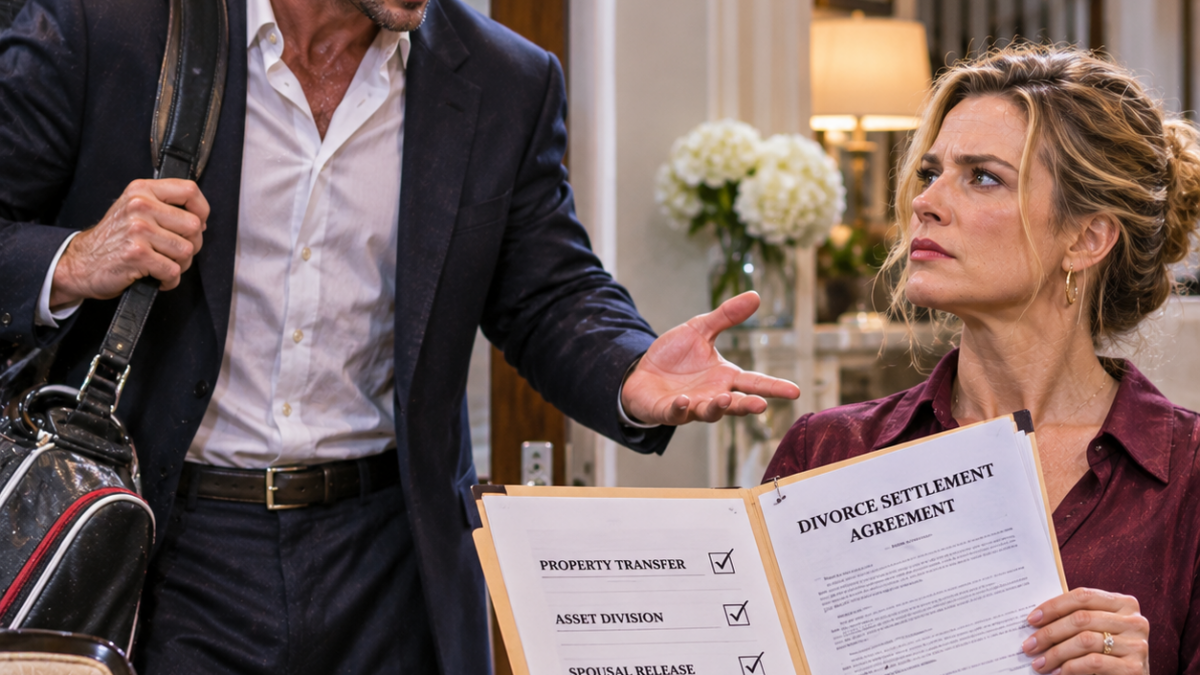
𝗙𝗨𝗟𝗟 𝗦𝗧𝗢𝗥𝗬
“Patty.”
“I’m here.”
“What do I do?”
Her answer came immediately.
“What do you want to do?”
That question stopped me.
Four months earlier, I wouldn’t have known.
Four months earlier, Roger leaving had felt like somebody had pulled the foundation out from beneath the house while I was still standing inside it.
I had begged for explanations.
Cried until my eyes swelled.
Missed work.
Lost six pounds.
Spent entire nights replaying twenty-two years of marriage and trying to locate the exact moment when I’d become disposable.
Back then, if Roger had returned after one week and said he’d made a mistake, I probably would have opened the door before he finished the sentence.
But four months is a strange amount of time.
Long enough to still hurt.
Long enough to begin noticing that you can breathe anyway.
I looked toward the dining room.
The folder was already there.
Blue.
Neatly labeled by my attorney.
Patty and I had been reviewing it over coffee that morning.
The timing was almost offensive in its perfection.
I picked up my phone.
“Come over.”
“Already putting on shoes.”
I almost laughed.
“You’re sixty-two.”
“And retired. I have nowhere more interesting to be.”
The doorbell rang.
Roger.
One cheerful ring.
As though he were delivering flowers.
I stood in the hallway.
Then remembered something Patty had told me during the worst week of my life.
If that man ever comes back and you don’t want him there, call me. I’ll stand beside you while he collects whatever is left.
At the time, I had laughed.
Now I straightened my sweater.
Walked to the door.
And opened it.
Roger smiled.
Actually smiled.
“Hey, Jo!”
I stared at him.
He lifted one suitcase slightly as though explaining itself.
“Well.”
He laughed.
“Long story short, Melissa kicked me out.”
I said nothing.
“So…”
He glanced toward the interior of the house.
“I’m moving back home.”
I blinked.
“Was that supposed to make me happy?”
Roger laughed harder.
He genuinely thought I was joking.
“Oh, come on.”
He leaned down for one suitcase.
“Don’t make this weird.”
That sentence nearly did it.
Twenty-two years.
An affair.
Four months of silence except for logistical texts and financial negotiations.
And I was apparently in danger of making things weird.
Instead, I stepped aside.
“Okay.”
Roger stopped.
“What?”
I smiled.
“Come in.”
His whole face relaxed.
Like a man who had just discovered that consequences were optional.
“I knew you’d be reasonable.”
He rolled the first suitcase across the threshold.
Then the second.
Then carried in the golf clubs.
I closed the door.
And thought:
Keep smiling, Roger.
You’re going to need it.
PART2
My name is Joanne Brennan.
I’m fifty-one years old, and until that summer I would’ve described my marriage as ordinary.
Not romantic in the way movies define romance.
Roger didn’t write poetry.
I didn’t greet him at the door wearing lipstick and pearls.
We had bills.
Work.
A grown son.
Laundry.
Arguments about thermostats.
A yellow two-story house on Maple Court with gutters Roger promised to clean every October and somehow never did.
I worked reception at a dental office.
Roger sold insurance.
Every Saturday morning, unless there was snow, he played golf.
He forgot anniversaries unless I reminded him.
Left socks beside the hamper instead of inside it.
Bought unnecessary gadgets after watching late-night television.
But he also warmed my car on freezing Ohio mornings.
Made popcorn during crime shows.
Knew I hated driving in heavy rain and would call if he heard thunder while I was at work.
I loved those small things.
I thought they meant we were okay.
That was probably why the end shocked me so badly.
There had been no giant screaming fight.
No plate thrown against a wall.
No announcement that our marriage was dying.
Just one Tuesday in June.
I came home at 5:40.
Roger was packing.
His largest suitcase sat open on our bed.
Shirts folded inside.
Shoes lined along the bottom.
His toiletry bag beside them.
I stood in the doorway.
“Business trip?”
He didn’t look at me.
“No.”
I laughed.
“What, golf weekend?”
“Joanne.”
Something in his voice changed my breathing.
“What?”
He zipped the suitcase halfway.
Then finally looked at me.
“I’m leaving.”
I stared.
“Leaving where?”
He rubbed his jaw.
“I’ve met someone.”
The room became extremely quiet.
I remember hearing the ceiling fan.
One blade made a faint clicking sound.
Click.
Click.
Click.
I stared at my husband.
“What does that mean?”
Roger sighed as though I were making him explain something obvious.
“It means I’ve met somebody and I need a fresh start.”
“A fresh…”
I couldn’t finish.
He looked uncomfortable.
Not guilty.
Uncomfortable.
As though my devastation was making his departure unnecessarily awkward.
“How long?”
He said nothing.
“How long, Roger?”
“A few months.”
My chest hurt.
“A few months?”
“It wasn’t planned.”
I laughed.
A terrible sound.
“You accidentally had an affair for a few months?”
“Don’t do that.”
“Do what?”
“Turn everything into an attack.”
I stared at him.
“You are packing a suitcase to leave your wife for another woman.”
He rubbed the back of his neck.
“I haven’t been happy for a long time.”
That sentence hurt worse than the affair.
Because I’d asked.
God, I had asked.
“Are you okay?”
“You seem distant.”
“Is something bothering you?”
Every time:
I’m fine, Jo.
Work.
Just tired.
Nothing’s wrong.
I stared at him.
“You told me we were fine.”
“I didn’t want to hurt you.”
I almost laughed.
“So you decided to wait until you were leaving?”
He zipped the suitcase.
“There’s no point fighting.”
Twenty-two years.
Reduced to an inconvenience he’d prefer not to discuss.
“Who is she?”
He paused.
“Melissa.”
“Melissa who?”
“Melissa Carter.”
I knew the name.
Thirty-nine.
Worked for a regional brokerage Roger dealt with.
Divorced.
Blonde.
Liked posting photographs from wine tastings.
I’d met her twice.
Once she had complimented my earrings.
I sat down.
Roger lifted the suitcase.
“I’m sorry.”
I looked at him.
He actually seemed to believe saying it completed something.
Then he walked downstairs.
I followed.
Not because I wanted to stop him.
Because I couldn’t believe this was really happening.
He loaded the suitcase into the Buick.
Then the golf clubs.
I stood on the porch.
“Roger.”
He turned.
“What?”
“Twenty-two years.”
His face tightened.
“I know.”
“You’re really doing this?”
He looked away.
“I need to find out who I am.”
Then he got into the car.
I watched him leave.
For three days, I barely slept.
Our son Trevor flew in from Denver the following weekend.
He was twenty-six.
Software engineer.
Too tall for my kitchen chairs.
He hugged me inside the airport terminal and held on longer than usual.
In the car, neither of us said much.
That evening, we sat at the kitchen table.
Trevor rubbed both hands over his face.
“Dad called.”
I looked down.
“What did he say?”
“That you two had been unhappy for years.”
I stared at him.
“We were?”
Trevor’s face changed.
“He made it sound mutual.”
“It wasn’t.”
My voice cracked.
“I didn’t even know he was unhappy.”
Trevor moved his chair closer.
“Mom.”
“I asked him.”
Tears came.
“I asked him so many times.”
Trevor took my hand.
“I believe you.”
That sentence mattered more than he knew.
Because betrayal does strange things to your memory.
Roger had already begun rewriting our marriage.
If he was unhappy for years, maybe I should’ve known.
Maybe I’d failed.
Maybe I’d been inattentive.
Maybe the affair wasn’t the beginning but merely the consequence of something I’d done wrong.
Trevor interrupted every one of those thoughts.
“I believe you.”
That night, I slept almost five hours.
It was the most I’d managed since Roger left.
Then came Patty.
Patricia Collins lived next door.
Sixty-two.
Retired emergency-room nurse.
Widowed six years.
Gray hair she refused to dye because, as she said, “I earned every one of these.”
Patty brought chicken casserole.
Then soup.
Then banana bread.
After the third delivery, I told her she was going to make me gain twenty pounds.
“Good.”
She pushed past me into the kitchen.
“Roger always looked like a man who preferred women slightly hungry.”
I laughed for the first time since he’d left.
Patty became my emergency contact without either of us announcing it.
She walked with me every evening.
Listened when I talked.
Listened when I couldn’t.
One night, sitting on her porch, I said something humiliating.
“Part of me wants him back.”
Patty didn’t react.
“Okay.”
I looked at her.
“You don’t think that’s pathetic?”
“No.”
“He cheated.”
“Yes.”
“He left.”
“Yes.”
“And I still want him to call.”
“That doesn’t mean you should take him back.”
I stared at the street.
She continued.
“You spent twenty-two years loving somebody. Your nervous system didn’t get the memo just because his zipper did.”
I choked on my tea.
“Patty!”
“What?”
I laughed so hard I cried.
Then cried because I was laughing.
She held my hand.
After a while she said:
“If he comes back and you want him, that’s your decision.”
I looked at her.
“If he comes back and you don’t want him…”
She sat straighter.
“Call me.”
“Why?”
“I’ll stand right beside you while he collects his crap.”
We shook hands.
At the time, it felt like a joke.
The first month was grief.
The second was paperwork.
That saved me.
Grief likes empty space.
Paperwork fills it.
I met with a divorce attorney named Evelyn Grant.
She was fifty-nine, wore bright glasses and had no patience for romantic nonsense.
“Do you want a divorce?”
I hesitated.
“I don’t know.”
“That is an acceptable answer.”
She opened a legal pad.
“Do you want to understand your finances?”
“Yes.”
“Excellent. We can do that without deciding anything else today.”
That was how I began learning what twenty-two years of marriage looked like when translated into numbers.
Mortgage.
Retirement accounts.
Savings.
Cars.
Insurance.
Roger’s commissions.
My modest 401(k).
Credit cards.
Home equity.
For years, Roger had handled most financial decisions.
Not because he forbade me.
Because it was easier.
He sold insurance.
He liked spreadsheets.
I trusted him.
Now I sat at my dining table learning everything I should’ve known years earlier.
And surprisingly, I liked it.
Numbers calmed me.
That was why I enrolled in an evening accounting course at the community college.
At fifty-one.
Terrified.
The oldest student in the room except one man retraining after retirement from the postal service.
The first night, I almost left before class began.
Then the professor wrote an equation on the board.
Something simple.
Assets = Liabilities + Equity.
And I thought:
Well. At least numbers don’t wake up one Tuesday and announce they’ve met someone else.
I stayed.
Roger wanted a quick financial separation.
That surprised Evelyn.
“He’s motivated.”
I knew why.
Melissa.
Roger and Melissa had rented a luxury townhouse outside Columbus.
She wanted furniture.
A vacation.
A new beginning.
Apparently fresh starts are expensive.
Roger suggested I keep the Maple Court house if I could buy out his equity.
I nearly laughed.
“You want me to keep the house?”
He shrugged during our meeting with lawyers.
“You love it.”
I did.
“But can you afford it?”
I hated the doubt in his voice.
Evelyn placed one hand over her legal pad.
“We have reviewed Ms. Brennan’s finances.”
Roger looked toward me.
“You have?”
“Yes.”
I didn’t explain.
With refinancing, some savings and adjustments to other marital assets, I could buy out his interest.
It would be tight.
But possible.
Roger accepted quickly.
Too quickly.
Because he wanted cash.
He wanted freedom.
He wanted Melissa.
He signed the settlement documents.
Signed the necessary property paperwork.
Accepted the agreed buyout.
And within weeks, the deed records reflected what he had willingly agreed to.
The Maple Court house was mine.
Roger’s share had been paid.
He deposited the money.
Then he started posting photographs from Napa with Melissa.
I saw one accidentally.
They were holding wine glasses beside a vineyard.
Caption:
NEW BEGINNINGS.
I cried for twenty minutes.
Then blocked both of them.
The third month was when something changed.
Not dramatically.
I simply stopped waking every morning expecting Roger to come home.
I repainted the bedroom.
The beige walls he liked became soft green.
I moved his giant recliner out of the family room.
Patty bought it for twenty dollars and immediately donated it to a veterans’ center because she said nobody should own a chair that ugly.
I laughed.
We reorganized the garage.
Found three boxes of golf magazines from 2008.
Disposed of them without ceremony.
I changed the downstairs den into a study area for my accounting classes.
For the first time in decades, the house began reflecting decisions I made without asking anyone whether they liked them.
I missed Roger.
But I also noticed things I didn’t miss.
His television always being too loud.
His irritation when I worked late.
His assumption that dinner happened by itself.
The way every weekend revolved around golf.
The way he’d gradually stopped asking questions about my day.
Pain sometimes hides inconvenience.
Once the pain eased, I could see both.
Then, during the fourth month, Roger’s money began moving strangely.
I knew because the separation disclosures still required some transparency while the divorce remained pending.
Large withdrawals.
Charges.
Payments associated with Melissa’s townhouse.
Furniture stores.
A resort deposit.
Then money slowed.
I didn’t ask.
It wasn’t my business anymore.
But Evelyn said something during one meeting.
“People often imagine leaving a marriage means keeping the lifestyle while losing only the spouse.”
I smiled.
“Doesn’t work that way?”
“Rarely.”
I thought about Roger.
New townhouse.
New girlfriend.
Same golf membership.
Same car payment.
Reduced savings.
Buyout money disappearing.
I said nothing.
The afternoon before Roger returned, Patty and I had been sitting at my dining table reviewing the latest divorce documents.
The final hearing was approaching.
The property issues were largely resolved.
The house was mine.
Roger had signed.
Money transferred.
The remaining legal process was moving toward final dissolution.
Patty tapped the folder.
“So after all that crying, this is what twenty-two years looks like?”
“Apparently.”
“Blue folder?”
“And two attorneys’ invoices.”
“Romance.”
I laughed.
Then she pointed toward my accounting textbook.
“How’s school?”
“I got a ninety-six on the midterm.”
Patty slapped the table.
“Look at you.”
“Please don’t make it weird.”
“I’m making it extremely weird.”
She opened my refrigerator and produced sparkling cider.
“Patty.”
“It’s Tuesday.”
“Exactly.”
“Every day is special when you’re retired.”
We toasted my ninety-six.
Then she went home.
The folder stayed on the dining table.
Twenty-four hours later, Roger appeared.
He rolled both suitcases into my foyer and looked around.
Then frowned.
“Where’s my chair?”
I almost laughed.
“What?”
“My recliner.”
“Gone.”
His face changed.
“Gone where?”
“Veterans’ center.”
“You donated my chair?”
“Technically Patty did.”
Right on cue, the back door opened.
Patty walked in carrying a plate of cookies.
Roger stared.
She smiled brightly.
“Welcome back, Romeo.”
“Patty.”
He said her name like a dental diagnosis.
She placed the cookies on the counter.
“I hear things didn’t work out with the fresh start.”
Roger looked at me.
“You told her?”
“I live six feet from the woman.”
Patty shrugged.
“Seven, if you count the hydrangeas.”
Roger exhaled.
“Joanne, can we talk privately?”
Patty looked toward me.
I remembered our handshake.
I smiled.
“No.”
Roger blinked.
“What?”
“Patty stays.”
“This is our marriage.”
“No.”
I walked toward the dining room.
“It was our marriage.”
He followed.
His eyes landed on the blue folder.
Then narrowed.
“What is that?”
“Sit.”
He laughed nervously.
“Joanne.”
“Sit down, Roger.”
Something in my voice reached him.
He sat.
Patty took the chair beside me.
Roger looked between us.
“This is ridiculous.”
I opened the folder.
“No.”
I slid one document toward him.
“This is ridiculous.”
He looked down.
His signature.
The property settlement.
His eyes moved lower.
Then to the deed-related documents.
Then back at me.
“What?”
I said:
“You said you’re moving back home.”
“Yes.”
“This isn’t your home anymore.”
He stared.
“Excuse me?”
“You sold me your interest.”
His mouth opened.
“That was part of the separation.”
“Yes.”
“We’re still married.”
“For a few more weeks.”
His face changed.
“You filed?”
I looked at him.
“Yes.”
“When?”
“Three weeks ago.”
He leaned back.
“You filed for divorce without telling me?”
Patty actually coughed.
I couldn’t tell whether she was choking on a cookie or trying not to laugh.
I looked at Roger.
“You moved in with another woman four months ago.”
“That isn’t the same thing.”
I stared.
“What part feels different?”
His face reddened.
“I thought we were working toward a separation.”
“We did.”
I tapped the paperwork.
“You got your buyout.”
He glanced toward the hall.
His suitcases were visible through the doorway.
“So what?”
“So you can’t simply decide Melissa no longer wants you and reverse the transaction.”
He looked at me as though I had spoken another language.
“This is my house too.”
“No.”
“Joanne.”
“No.”
I pushed the recorded property document toward him.
“This is my house.”
Silence.
Patty bit into a cookie.
Loudly.
Roger looked at her.
“Could you not?”
She swallowed.
“I could.”
Then took another bite.
Roger turned back to me.
“Where am I supposed to go?”
That question almost broke whatever composure I had left.
Because four months earlier, I had asked myself exactly the same thing emotionally.
Where do I go after twenty-two years?
Who am I if I’m not Roger’s wife?
What happens to the future I thought we had?
Nobody had solved that for me.
I had simply started walking.
“I don’t know.”
He stared.
“You don’t know?”
“No.”
“I have nowhere else.”
“What about Melissa?”
His face tightened.
“We had a disagreement.”
Patty raised one eyebrow.
I asked:
“What kind?”
Roger looked away.
“It doesn’t matter.”
“It mattered enough to bring your golf clubs here.”
He exhaled.
“She told me to leave.”
“I understood that part.”
He rubbed both hands over his face.
“She said I wasn’t honest about my finances.”
I almost laughed.
Not because it was funny.
Because it was perfect.
“What did you tell her?”
Roger glared.
“Do we have to do this?”
“No.”
I closed the folder.
“You can leave now.”
He looked stunned.
“Jo.”
That old nickname.
For one dangerous second, the last four months disappeared.
Twenty-two years returned.
Roger making pancakes badly.
Roger warming my car.
Roger asleep on the sofa.
Roger holding Trevor as a newborn.
Then I remembered him packing.
I’ve met someone.
I sat straighter.
“Don’t.”
His face softened.
“Jo, come on.”
“No.”
“We’ve been together more than twenty years.”
“Yes.”
“That has to mean something.”
“It does.”
My voice cracked slightly.
“It means I gave you twenty-two years before you left me for somebody else.”
His expression collapsed.
“I made a mistake.”
“A mistake?”
“I was confused.”
Patty shifted beside me.
I raised one hand.
I wanted to answer.
“You did not accidentally spend months having an affair.”
Roger looked down.
“You did not accidentally pack your suitcase.”
Silence.
“You did not accidentally tell Trevor we had both been unhappy.”
His eyes lifted.
“I never said—”
“He told me.”
Roger went pale.
I continued.
“You rewrote our marriage so you wouldn’t have to feel guilty.”
His mouth opened.
Then closed.
“And now Melissa has thrown you out, so suddenly twenty-two years means something again.”
“That’s not fair.”
I almost smiled.
“You know what’s interesting?”
“What?”
“Four months ago, I would’ve agreed with you.”
He stared.
“I would’ve said our history mattered more than what you did.”
My throat tightened.
“I would’ve let you come back.”
Roger’s face changed.
Hope.
I hated seeing it.
So I finished.
“But that woman doesn’t live here anymore.”
Roger stood.
“There’s someone else.”
I blinked.
“What?”
His face twisted.
“There has to be.”
Patty slowly put down her cookie.
I almost laughed.
“No.”
“You wouldn’t be acting like this otherwise.”
“Like what?”
“Cold.”
There it was.
A word men sometimes use when a woman stops making their discomfort easier.
I looked at him.
“I took an accounting class.”
He stared.
“What?”
“I started school.”
“Joanne—”
“I learned the finances.”
I gestured toward the room.
“I refinanced the house.”
His expression changed.
“I changed the bedroom.”
He looked toward the stairs.
“I got rid of your chair.”
Patty lifted a hand.
“I helped.”
Roger ignored her.
“I made decisions without you.”
I leaned forward.
“There isn’t another man.”
His face remained confused.
“There is another me.”
That silenced him.
Then the front door opened.
“Mom?”
Trevor.
Roger spun around.
Our son stepped inside carrying a duffel bag.
I’d known he was flying in that evening for the weekend.
Roger didn’t.
Trevor stopped.
Looked at the suitcases.
Then the golf clubs.
Then his father.
“Dad.”
Roger’s face brightened.
“Trevor.”
He opened his arms.
Trevor didn’t move into them.
The gesture slowly died.
“What are you doing here?”
Roger laughed nervously.
“Things didn’t work out with Melissa.”
Trevor stared.
“And?”
“And I’m back.”
Trevor looked toward me.
Then toward Patty.
Understanding arrived.
He turned back.
“No.”
Roger’s expression changed.
“What?”
“You don’t get to say that.”
“Say what?”
“I’m back.”
Roger stiffened.
“I’m your father.”
“I know.”
“Then don’t talk to me like—”
Trevor’s jaw tightened.
“I flew home when you left.”
Silence.
“I watched Mom cry for three weeks.”
Roger looked toward me.
Trevor continued.
“You told me you two were both unhappy.”
“We were.”
“No.”
His voice sharpened.
“Mom wasn’t.”
Roger inhaled.
“Trevor, marriage is complicated.”
“Then explain the simple part.”
Roger stared.
Trevor stepped closer.
“Why did you tell me she wanted the separation too?”
Roger didn’t answer.
“Why?”
“I didn’t want you picking sides.”
Trevor laughed.
“You mean you didn’t want me blaming you.”
Roger looked down.
Trevor’s face tightened.
Then his voice softened.
“You left, Dad.”
“I know.”
“For someone else.”
“I know.”
“You don’t get kicked out and come back here like the last four months were a hotel reservation.”
Roger’s eyes filled.
That surprised me.
“Trevor.”
Our son shook his head.
“I love you.”
Roger looked up.
“But Mom doesn’t owe you a house because your girlfriend changed her mind.”
Patty looked toward the ceiling like she was asking God to prevent her from applauding.
Roger sat down again.
Everything had gone out of him.
“I messed up.”
Nobody spoke.
He looked toward me.
“Badly.”
I waited.
“I thought…”
He rubbed his face.
“I thought Melissa made me feel alive.”
That sentence once would have destroyed me.
Now I almost pitied him.
Roger continued.
“She listened.”
I nodded.
“She laughed at everything.”
Patty muttered:
“That should’ve been suspicious.”
“Patty.”
“Sorry.”
Roger gave her a look.
Then continued.
“She wanted to travel.”
His voice weakened.
“Go places.”
I asked:
“And I didn’t?”
He looked at me.
“You always worried about money.”
I stared.
“We had a mortgage.”
“I know.”
“Trevor’s college.”
“I know.”
“Retirement.”
He looked down.
“I know.”
I leaned back.
“So Melissa made life feel easier because she wasn’t responsible for the life we had built.”
Roger didn’t answer.
That was answer enough.
He whispered:
“I thought the buyout would be enough.”
Ah.
There it was.
“How much is left?”
His face tightened.
I didn’t need a number.
Patty did what retired nurses apparently do when uncomfortable conversations need surgery.
“How much, Roger?”
He glared.
She stared back.
Finally:
“About eighteen thousand.”
My stomach dropped.
His buyout had been far more than that.
“Roger.”
He looked ashamed.
“We furnished the townhouse.”
“We?”
“Mostly me.”
“Vacation?”
He nodded.
“Car?”
Another nod.
“Her car?”
Silence.
Patty closed her eyes.
“Oh, Roger.”
Even she sounded disappointed.
Roger covered his face.
“She thought I had more money.”
I looked at him.
“Did you tell her you did?”
“I didn’t exactly correct her.”
There it was.
The same behavior in a different marriage.
Avoiding uncomfortable truth until reality forced the conversation.
Melissa hadn’t discovered a different Roger.
She had discovered the same one sooner.
He slept in a hotel that night.
Not my guest room.
Not the couch.
The hotel.
I gave him time to remove his suitcases from the foyer.
Patty stood beside me as promised.
Trevor carried the golf clubs out.
Roger stopped at the door.
“Joanne.”
I looked at him.
“Could I at least leave some things here?”
“No.”
His face tightened.
“Not even for a few days?”
I thought of the storage unit I’d paid for during the first month because Roger had left half his belongings behind.
“Your remaining things are already in storage.”
He stared.
“What?”
“Evelyn sent you the information two weeks ago.”
“I haven’t checked that email.”
“That sounds familiar.”
He winced.
I hadn’t meant it cruelly.
But it was true.
He looked around the house.
Pictures.
Green walls.
No recliner.
My accounting books on the desk in what had once been his den.
Then his eyes filled.
“You really moved on.”
I swallowed.
“I’m moving.”
That distinction mattered.
Some days I still hurt.
Some mornings I woke expecting to hear him in the shower.
Moving on wasn’t a door I had walked through.
It was a direction.
Roger nodded.
Then went outside.
He placed his suitcases into the Buick.
Trevor put the golf clubs in last.
Roger hugged our son.
Trevor allowed it.
For a few seconds.
Then Roger drove away.
Patty came beside me.
“You okay?”
I watched the taillights disappear.
“No.”
She nodded.
“Good answer.”
Then she took my hand.
“But?”
I breathed.
“But I will be.”
Roger rented a small furnished apartment.
The kind of place he would’ve mocked two years earlier.
One bedroom.
Parking lot view.
No golf-course access.
He canceled his club membership.
Sold the Buick six months later and bought something cheaper.
I know those details because Trevor remained in contact with him.
And because the divorce required enough financial disclosure that some information crossed my path.
Melissa did not take him back.
Apparently the fight that ended their relationship began when she learned exactly how much money remained from his house buyout.
Roger accused her of caring only about money.
I appreciated the irony but didn’t celebrate it.
Melissa hadn’t made vows to me.
Roger had.
I did not need her punished.
Our divorce became final seven weeks after he returned to the porch.
The hearing was brief.
Almost insultingly brief considering the marriage had lasted twenty-two years.
A judge asked questions.
Our attorneys confirmed agreements.
Property issues were reviewed.
I signed.
Roger signed.
Then it was done.
I stared at the final decree.
Evelyn touched my elbow.
“You okay?”
I laughed quietly.
“I keep expecting a bell to ring.”
“No bell.”
“Confetti?”
“Budget cuts.”
I laughed.
Then cried.
Evelyn waited.
“Wasn’t I supposed to feel relieved?”
“You can feel more than one thing.”
I nodded.
Twenty-two years were not erased because Roger behaved badly during the last year.
There had been good memories.
Real ones.
Our son’s birth.
Christmas mornings.
Vacations.
Ordinary Tuesdays.
Roger could have betrayed me and still once have loved me.
Both things could be true.
That made the ending sadder.
But clearer.
I kept the house.
That mattered more than I expected.
Not because it was valuable.
Because I had feared losing it.
The yellow house on Maple Court contained my entire adult life.
Trevor’s height marks remained inside the pantry door.
There was a dent in the hallway wall from the year he tried indoor hockey.
The maple tree Roger and I planted on our tenth anniversary was now taller than the roof.
For a while, I wondered if staying meant being trapped in memory.
Then one Saturday, Patty arrived carrying paint samples.
“What are those?”
“Freedom.”
“Freedom is apparently eggshell finish?”
“Exactly.”
We painted the kitchen.
Then the hallway.
Trevor came home and helped replace cabinet hardware.
I changed the curtains.
Bought a dining table slightly smaller than the old one.
Suddenly the house stopped feeling like the place Roger left.
It became the place I stayed.
There is a difference.
My accounting course became another.
Then another.
At the dental office, our office manager noticed I had begun fixing small bookkeeping errors before they reached the accountant.
One afternoon she called me in.
“Joanne.”
I thought I was in trouble.
“Yes?”
“You know you’re doing half of Carol’s reconciliation work now.”
I laughed.
“I like numbers.”
“Apparently.”
Six months later, when Carol retired, they offered me a hybrid receptionist/bookkeeping position.
More money.
Better hours.
Benefits improved.
I accepted.
At fifty-two, I got a promotion I hadn’t known existed when Roger left.
I called Trevor.
He shouted so loudly I had to hold the phone away.
Then Patty came over with a grocery-store cake that read:
ACCOUNTANT-ISH QUEEN.
“Patty.”
“The bakery refused to write ‘financial dominatrix.’”
I almost dropped the cake.
We laughed until my stomach hurt.
Roger called me on our old wedding anniversary.
I almost didn’t answer.
Then did.
“Hello?”
“Jo.”
I closed my eyes.
“Roger.”
He paused.
“I know what day it is.”
“So do I.”
“I almost sent flowers.”
“Thank you for not doing that.”
He laughed softly.
“Yeah.”
Silence.
Then:
“I’ve been thinking.”
I smiled faintly.
“That sounds dangerous.”
He laughed again.
For one second we sounded like the people we’d once been.
Then he said:
“I owe you an apology.”
I waited.
“A real one.”
“Okay.”
“I was unhappy.”
I braced myself.
“But that doesn’t mean you caused it.”
My breathing changed.
Roger continued.
“I think I got old enough to realize time was moving faster, and instead of dealing with that, I blamed the life I had.”
I sat down.
“I looked at Melissa and thought she represented a version of me that was younger.”
He exhaled.
“Freer.”
I said nothing.
“She didn’t.”
“No.”
“She was just another person.”
That was probably the wisest thing I’d ever heard Roger say.
He continued.
“And you were right.”
“About?”
“I rewrote our marriage.”
My throat tightened.
“I told Trevor we’d both been unhappy because I couldn’t stand saying I was leaving someone who still loved me.”
I closed my eyes.
“Roger.”
“I know.”
His voice broke.
“I was a coward.”
I didn’t rescue him from the word.
He needed to own it.
Then he said:
“When Melissa threw me out, I came to your house because I assumed you’d still be there waiting.”
I whispered:
“Yes.”
“That might be the worst part.”
I stared out my kitchen window.
He continued.
“I didn’t even call first.”
“No.”
“I just showed up.”
“With golf clubs.”
He laughed through what sounded like tears.
“The golf clubs were a bad touch.”
“Very.”
Then silence.
Finally, Roger said:
“I am sorry.”
This time he didn’t ask for forgiveness.
Didn’t ask to come back.
Didn’t explain.
Just apologized.
And because he wasn’t demanding anything from me, I could actually hear it.
“Thank you.”
He inhaled.
“I know it doesn’t fix anything.”
“No.”
“I know.”
We talked for ten minutes.
Then hung up.
I did not cry.
That surprised me.
Roger and Trevor repaired their relationship slowly.
Not completely.
Not magically.
Trevor met him for breakfast sometimes.
They watched a football game together.
Roger flew to Denver for Trevor’s birthday and stayed in a hotel without complaining.
He learned something he’d somehow forgotten during the affair.
Love is not ownership.
Showing up after causing pain doesn’t entitle you to instant restoration.
It just gives you the opportunity to behave better.
Trevor allowed him that opportunity.
On Trevor’s terms.
I stayed out of it.
Their relationship belonged to them.
A year after the divorce, Roger attended Trevor’s engagement party.
Trevor had proposed to his girlfriend, Leah.
The party was in my backyard.
Patty was supervising food as though managing a trauma unit.
Roger arrived carrying wine.
He looked nervous.
“Am I early?”
“Ten minutes.”
“Sorry.”
“That’s generally considered good.”
He smiled.
Then looked at the yard.
I’d changed it.
New patio furniture.
Flower beds.
String lights.
He nodded.
“Looks nice.”
“Thank you.”
His eyes moved toward the kitchen window.
For a second, I knew he was seeing the old life.
Then Patty appeared.
“Roger.”
He sighed.
“Patty.”
She handed him a tray.
“If you’re standing, you’re working.”
He actually laughed.
“Yes, ma’am.”
Watching him carry appetizers across my yard felt strange.
Not painful.
Just strange.
We had become people who once shared a life.
There was sadness in that.
But also peace.
Later that evening, he found me near the hydrangeas.
“Jo.”
I turned.
“Yeah?”
He looked toward Trevor and Leah.
“They look happy.”
“They are.”
He nodded.
Then said:
“You look happy too.”
I thought.
“I am.”
It didn’t feel triumphant.
Just true.
Roger smiled sadly.
“Good.”
Then he went back to the party.
No declaration.
No request.
No attempt to rewrite the ending.
That was when I finally believed he understood.
I finished my accounting certificate eighteen months after he left.
There were twenty-four people in my class.
Most were younger than Trevor.
When my name was called, Patty stood and yelled:
“THAT’S MY GIRL!”
Everyone laughed.
I covered my face.
Trevor clapped louder than anyone.
After the ceremony, he hugged me.
“Mom.”
“What?”
“You know what I remember most from when Dad left?”
My stomach tightened.
“What?”
“The first month.”
I looked down.
“You were wrecked.”
“Lovely.”
He smiled.
“You were.”
“Thanks.”
“But then every time I came home, there was something different.”
I frowned.
“The walls?”
“Everything.”
He looked at me.
“Class.”
“Patty.”
“The house.”
“You.”
My eyes filled.
He continued.
“I think Dad expected you to stay exactly where he left you.”
I thought of Roger standing on the porch with suitcases.
I’m moving back home.
Trevor smiled.
“He got the surprise of his life.”
I laughed.
“Yes.”
Then I looked toward Patty.
She was stealing extra cupcakes.
“Technically Patty helped.”
Trevor laughed.
“Of course she did.”
Patty eventually confessed that on the day Roger returned, she had been prepared for something much more dramatic.
“How dramatic?”
We were sitting on my porch.
She sipped lemonade.
“I had a whistle.”
I stared.
“A whistle?”
“Emergency-room habit.”
“For what?”
“If he became aggressive.”
I laughed.
“What would a whistle do?”
“Confuse him.”
I nearly fell out of my chair.
She continued.
“I also had Mr. Landry from across the street watching.”
“You recruited witnesses?”
“Neighborhood security.”
“Patty.”
“What?”
“You’re insane.”
“Yes.”
She looked pleased.
“But useful.”
I couldn’t argue.
Two years after Roger left, I replaced the front door.
Not because anything was wrong with it.
I simply wanted one with more glass.
The installer removed the old door and leaned it against the garage.
I stood looking at it.
That was the door Roger had walked through thousands of times.
The door he’d closed behind himself when he left for Melissa.
The door he’d stood outside four months later expecting me to open his old life again.
Patty came over.
“Keeping it?”
“No.”
“Burning it ceremonially?”
“No.”
“Disappointing.”
I laughed.
The installer hauled it away.
The new door let afternoon sunlight flood the hallway.
I loved it.
People occasionally asked whether I regretted not taking Roger back.
Mostly relatives.
People love reconciliation when they don’t have to live inside it.
“He apologized.”
“Yes.”
“You were married twenty-two years.”
“Yes.”
“People make mistakes.”
“Yes.”
“Maybe you could’ve worked it out.”
Maybe.
I don’t pretend reconciliation would have been impossible.
Some couples survive affairs.
Some rebuild.
But surviving betrayal isn’t a moral obligation.
And Roger didn’t return because he had independently realized he’d destroyed something precious.
He returned because Melissa expelled him.
That distinction mattered.
If she had not kicked him out, would he have come?
I knew the answer.
No.
The woman on the porch wasn’t his first choice.
She was his backup plan.
I refused to spend the rest of my life being grateful somebody else’s rejection returned my husband to me.
Three years after the divorce, Roger remarried.
Not Melissa.
A woman named Diane.
I met her at Trevor and Leah’s wedding.
She was fifty-five.
A librarian.
Funny.
Quiet.
Nothing like Melissa.
Nothing like me either.
Roger introduced us awkwardly.
“Joanne, this is Diane.”
I smiled.
“It’s nice to meet you.”
She smiled back.
“You too.”
That was it.
No jealousy.
No competition.
Later, Diane approached me privately.
“I hope this isn’t strange.”
“Everything about divorced families is strange.”
She laughed.
Then said:
“Roger talks about you respectfully.”
I raised one eyebrow.
“He learned.”
She smiled.
“He told me he didn’t the first time.”
That surprised me.
Then she said:
“He said losing your marriage taught him what honesty costs when you postpone it.”
I looked toward Roger across the reception.
He was talking to Trevor.
Older.
Less polished.
Maybe wiser.
“I’m glad he learned something.”
Diane nodded.
“So am I.”
And I meant it.
Roger becoming a better man for someone else did not diminish me.
I no longer needed to be the person receiving every lesson life taught him.
At the wedding reception, Trevor danced with me.
Midway through, he smiled.
“You remember the golf clubs?”
I groaned.
“Why are we discussing your father’s golf clubs at your wedding?”
“Because Leah asked me what the funniest moment of the divorce was.”
“There was no funny part.”
“Dad showing up saying ‘I’m back’ was objectively funny.”
“It was not funny at the time.”
“It is now.”
I thought about it.
Then laughed.
“Yes.”
He smiled.
“You looked so calm.”
“I was not calm.”
“You were terrifying.”
“Patty was behind me eating a cookie.”
“That made it worse.”
We both laughed.
Then Trevor became serious.
“I’m proud of you.”
My eyes filled.
“Don’t make me cry during your wedding.”
“Mom.”
“I spent too much on this makeup.”
He laughed.
Then held me tighter.
“I mean it.”
I swallowed.
“Thank you.”
Across the room, Roger watched us.
Our eyes met.
He smiled.
I smiled back.
Not lovers.
Not enemies.
Parents of the same man.
That was enough.
I still live in the yellow house on Maple Court.
The mortgage is manageable.
The kitchen is brighter.
The den is my office now.
After earning my accounting certificate, I started doing bookkeeping work for three small businesses on evenings and weekends.
Then five.
Then eight.
Eventually I reduced my dental-office hours.
Patty calls me a “financial mogul.”
I remind her that my largest client is a landscaping company with four employees.
She says all empires start somewhere.
The old recliner never returned.
Neither did Roger’s golf trophies.
The height marks are still inside the pantry.
The maple tree is enormous.
Some things stay.
Some don’t.
That is life.
Every once in a while, I remember opening the door that afternoon.
Roger smiling.
Suitcases.
Golf clubs.
“My girlfriend kicked me out, so I’m moving back home.”
The audacity still amazes me.
But what I remember most isn’t his face when I showed him the deed.
It isn’t Trevor refusing to pretend nothing happened.
It isn’t Patty eating cookies while my marriage officially collapsed in the dining room.
What I remember is my own voice.
“Come in.”
Four months earlier, that sentence would’ve meant:
Please choose me again.
That afternoon it meant something entirely different.
It meant:
Come inside and see what changed while you assumed I was waiting.
Roger believed he’d left me frozen in June.
Same house.
Same job.
Same woman.
He imagined he could explore another life and, if it failed, simply return to the old one.
But people aren’t hotel rooms.
You cannot check out, disappear for four months, and expect your key to still work because you suddenly need somewhere familiar to sleep.
While Roger was building a new life with Melissa, I was building one too.
I just didn’t post photographs of mine.
Mine looked like attorney appointments.
Night classes.
Mortgage documents.
Walks with Patty.
Crying in the shower.
Learning spreadsheets.
Painting walls.
Signing my own name.
Very little of healing photographs well.
That doesn’t make it less real.
I once believed the most satisfying ending to my marriage would be Roger crawling back and begging me to forgive him.
Then he actually came back.
And I discovered that wasn’t satisfying at all.
What was satisfying was not needing him to.
I didn’t throw his suitcases into the street.
Didn’t scream.
Didn’t ruin his career.
Didn’t call Melissa.
Didn’t humiliate him publicly.
I opened the door.
Let him carry his own luggage inside.
Showed him the documents he had willingly signed.
And reminded him that while he had been searching for a “fresh start,” I had found one too.
His simply didn’t include my house.
Sometimes Patty still jokes about that afternoon.
“Best Tuesday I’ve ever had.”
I roll my eyes.
“You enjoyed that far too much.”
“Roger brought golf clubs to reconciliation.”
“He wasn’t reconciling.”
“Exactly.”
She laughs.
Then asks the question she has asked several times.
“If Melissa hadn’t kicked him out and he had come back because he genuinely realized he loved you, would you have taken him?”
Years ago, I wouldn’t have known how to answer.
Now I do.
“Maybe.”
Patty looks surprised every time.
Then I explain.
“Because forgiveness wasn’t impossible.”
She waits.
“But the man who came to my porch wasn’t coming back to repair what he’d broken.”
I look toward the new front door.
“He came because he needed somewhere to live.”
Patty nods.
“And you aren’t a motel.”
“Exactly.”
“Although your coffee is better.”
“Barely.”
The truth is, Roger did eventually become sorry.
Genuinely sorry.
He became a better father.
A more honest partner to Diane.
Probably a better man.
I’m glad.
But his growth did not require my return.
That may have been the biggest lesson for both of us.
Sometimes people believe an apology must restore the relationship or else forgiveness hasn’t happened.
I disagree.
I forgave Roger long before I trusted him again.
And I never trusted him in the same way.
Forgiveness changed what I carried.
It didn’t change where he lived.
Last summer, Patty and I sat on my porch watching a storm approach.
She is sixty-five now.
I am fifty-four.
She looked toward my house.
“You know what I thought the day Roger showed up?”
“What?”
“That you’d take him back.”
I turned.
“You did?”
“Yes.”
“Why didn’t you tell me?”
“It wasn’t my decision.”
I smiled.
She continued.
“You still loved him.”
“I did.”
“You probably still loved parts of him when you sent him to the hotel.”
I stared toward the street.
“Yes.”
Patty nodded.
“That was the part I admired.”
“What?”
“You didn’t wait until you stopped loving him to protect yourself.”
The words settled somewhere deep.
Because that was true.
Leaving would have been easier if Roger had become a monster.
He hadn’t.
He was a flawed man who made deeply selfish decisions.
I still remembered good things.
That was precisely why boundaries mattered.
You don’t need to hate someone before deciding they no longer get unlimited access to you.
I smiled.
“That’s surprisingly wise.”
Patty looked offended.
“I’m a retired nurse. I have seen people put objects in places that would destroy your faith in humanity. Of course I’m wise.”
I nearly spit out my lemonade.
If I could speak to the Joanne who stood in the bedroom doorway watching Roger pack his suitcase, I would not tell her to stop crying.
Cry.
I would not tell her Roger was worthless.
He wasn’t.
I would not tell her the marriage had been fake.
It hadn’t.
I would tell her something simpler.
His leaving is not proof that your life has ended.
You will still wake up.
Go to work.
Pay bills.
Laugh again.
You will learn the things you always assumed he handled better.
You will discover the house is not as frightening to maintain as he made it sound.
You will take classes.
You will get promoted.
Your son will still call.
Patty will bring too much food.
And one afternoon, the man you thought you could never survive without will stand on your porch asking to come back.
And the strangest thing will happen.
You will look at him.
You will still remember loving him.
You will still remember twenty-two years.
And you will realize that remembering love does not obligate you to restart it.
Four months after leaving me for another woman, Roger showed up carrying two suitcases and his golf clubs.
“She kicked me out,” he said.
“So I’m moving back home.”
I smiled.
I welcomed him inside.
Patty was waiting.
So were the documents.
The deed.
The buyout agreement.
The divorce papers.
Everything Roger had signed while he was busy building his new life.
He had assumed I was still his wife in the old sense.
Still his safety net.
Still standing exactly where he’d left me.
He was wrong.
I hadn’t become harder.
I hadn’t become bitter.
I had simply become someone who understood the difference between love and access.
Roger had every right to regret leaving.
He had every right to apologize.
He even had the right to become a better man.
But he no longer had the right to walk through my front door and announce that he lived there because another woman had stopped wanting him.
That house was mine.
The decision was mine.
And for the first time in twenty-two years, the future inside it was mine too.
Roger looked at me that afternoon as though I had changed beyond recognition.
Maybe I had.
But the truth was simpler.
He thought he was coming back to the woman he abandoned.
Instead, he met the woman she became after he left.
And she wasn’t waiting anymore.








