𝗙𝗨𝗟𝗟 𝗦𝗧𝗢𝗥𝗬:“HE WAS BLEEDING, FREEZING, AND BARELY ALIVE… BUT HE WOULDN’T MOVE!” I Tried to Rescue a German Shepherd in a Storm—Then Three Tiny Cries Revealed Why He Was Willing to d!e There
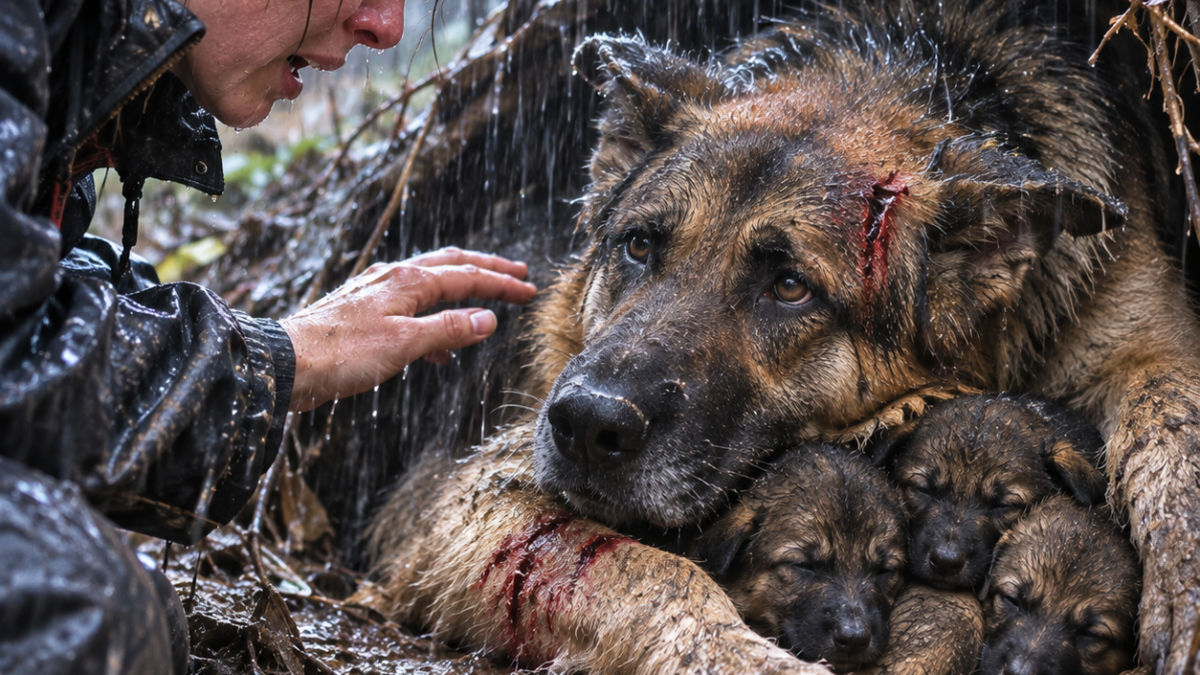
Nothing.
My stomach dropped.
“Hey, sweetheart.”
Still nothing.
I moved closer.
Then his eye opened.
Just one.
Dark brown.
Exhausted.
Alive.
I exhaled.
“Okay.”
“Okay, good.”
The Shepherd lifted his head perhaps two inches.
A growl came from deep in his chest.
Weak.
But unmistakable.
I stopped.
“Fair enough.”
His ears were flattened.
His breathing was shallow.
I could see blood around his front paws where the rough metal had rubbed through skin.
He had probably been there for hours.
“I’m not going to hurt you.”
His eye never left mine.
I took one small step.
The growl deepened.
Not aggressive in the way people imagine when they hear the word growl.
Not lunging.
Not snapping.
A warning.
Do not make me move.
I had worked with enough frightened animals to respect communication.
So I sat down.
Right there.
In the rain.
Several feet away.
“You’re doing a good job.”
His ears shifted.
I do not know why I said that.
Maybe instinct.
Maybe because something about his position felt deliberate.
“You’re doing a very good job.”
The growl softened.
“But I’m here to help.”
Rain ran down my face.
“I won’t hurt you.”
“I won’t hurt whatever you’re protecting.”
That was when I heard it.
Tiny.
Almost nothing.
A thin squeak.
Then another.
From beneath the grate.
I froze.
Looked at the dog.
He looked back.
Another cry came from underground.
Higher.
Fragile.
My heart started hammering.
“Oh.”
I whispered.
“Oh, Duke…”
I did not know his name yet.
But somehow I already understood.
He was not trapped on the storm drain.
He was guarding it.
I moved sideways enough to see through the metal gaps.
Darkness.
Water.
Leaves.
Then something moved.
A tiny pale shape.
I leaned.
The Shepherd growled again.
“I know.”
I backed up.
“I’m not touching them.”
Not yet.
I pulled my phone from beneath my coat and called our rescue coordinator.
“Margot?”
“I need a team at Willow Creek and Danner.”
“What do you have?”
“Senior Shepherd.”
“Possible hypothermia.”
“Three—”
I stopped and listened.
Another cry.
“At least three kittens below a storm grate.”
Silence.
Then:
“Kittens?”
“Yes.”
“And the dog?”
“Lying over them.”
“Can you move him?”
“No.”
“Won’t?”
“Can’t tell which.”
I looked at the Shepherd.
He had lowered his head again.
Still watching.
“I don’t think he’ll leave until they’re out.”
Our coordinator said:
“Flood level’s still rising.”
“I know.”
“How long?”
“Bring blankets.”
“Dry towels.”
“Carrier.”
“Food.”
“And tell everyone to approach quietly.”
I looked at the dog.
“No rushing.”
“Got it.”
I ended the call.
Then stayed exactly where I was.
Rain.
Dog.
Storm drain.
Tiny cries.
I spoke.
“You’re doing a good job.”
Again.
“You’ve got them.”
Again.
“I’m here now.”
Over and over.
Until the words became part of the weather.
PART2
For the next hour, I barely moved.
The water climbed around Duke’s paws.
His entire body trembled.
Sometimes his eyes closed for several seconds.
Then opened suddenly, as if sleep itself were dangerous.
I wanted to drag him off the grate.
Every practical part of me screamed to do it.
His gums looked pale.
He was cold.
Exhausted.
His paws were bleeding.
But every time I shifted closer, he watched the grate.
Then me.
Not himself.
Them.
The kittens.
I had seen protective mothers.
Dogs guarding puppies.
Cats protecting litters.
But Duke was an adult male German Shepherd.
These kittens were not his.
Different species.
No biological reason.
No familiar scent I could imagine.
Yet his body was positioned so precisely across the widest opening that floating debris struck him instead of dropping below.
He had become a living barricade.
I kept talking.
“You don’t know me.”
Rain hit my hood.
“But I’m going to stay.”
His ears moved.
“I know you’re tired.”
A blink.
“You’ve done enough.”
Nothing.
“You don’t believe me yet.”
I smiled faintly.
“That’s okay.”
He watched.
Behind us, somewhere down the block, a generator started.
A car alarm chirped.
Water rushed.
Duke remained.
Eventually my rescue team arrived.
Two volunteers.
Nina and Paul.
They stopped nearly fifty feet away.
I lifted one hand.
Stay.
They did.
Duke noticed them.
Head up.
Growl.
I said immediately:
“Easy.”
His eyes returned to me.
“They’re with me.”
I pointed.
“Blankets.”
“Food.”
“Help.”
He did not understand the words.
But he understood that I was not moving quickly.
So neither did he.
Nina set a carrier down.
Paul unfolded a heavy thermal blanket.
Then both waited.
Thirty minutes.
I began shivering badly.
Duke looked worse.
His breathing had slowed.
I worried about shock.
“Come on, old man.”
I whispered.
“Help me help you.”
His head lifted.
Our eyes met.
Then he made one small sound.
A bark.
Barely a bark.
More air than voice.
Not warning.
A question.
I extended my hand.
Slowly.
Palm up.
Open.
Duke watched.
I moved closer by inches.
He could have bitten.
He did not.
His nose moved toward my fingers.
Cold.
Wet.
He sniffed.
Then touched my hand.
I held still.
A second later, his tongue brushed my palm.
Once.
Weakly.
I nearly cried from relief.
“Okay.”
I whispered.
“Thank you.”
Duke lowered his head again.
That was permission.
Not to move him.
To help what he had been protecting.
I signaled Nina and Paul.
They approached slowly.
Duke watched them.
Then looked back at me.
I moved beside him.
“Me.”
I whispered.
“You watch me.”
His eyes locked onto mine.
Paul spread a blanket near the curb.
Nina prepared towels.
I crouched beside the grate.
The metal opening was narrow.
I removed one glove.
Reached between the bars.
Water freezing.
Debris scraped my wrist.
Nothing.
Then—
fur.
Tiny.
Warm but barely.
A body.
I slid my fingers beneath it.
Lifted.
The first kitten came out.
Maybe two weeks old.
Eyes barely open.
White and orange.
Completely soaked.
It squeaked.
Duke’s head snapped up.
“It’s okay.”
I held the kitten where he could see.
Nina wrapped it.
Duke watched every movement.
I reached again.
Second.
Black kitten.
Smaller.
Shivering violently.
Then third.
A tiny gray one.
Eyes still sealed.
I had to reach farther.
For several terrifying seconds I could feel the kitten but could not get a proper grip.
Water rushed beneath my arm.
Duke began whining.
“I know.”
My fingertips slipped.
I tried again.
Finally got my hand under its belly.
Lifted.
The kitten coughed water.
Then cried.
The loudest sound any of them had made.
Duke stopped whining.
I pulled the kitten through.
Nina wrapped it.
Three.
All alive.
For a few seconds nobody moved.
Duke stared at the bundle.
Then his body changed.
The tension disappeared.
He tried to stand.
His front legs shook.
Paws slipped on wet metal.
He collapsed once.
I caught his chest.
“Easy.”
He tried again.
This time he stood.
Barely.
One step.
Then another.
Toward the kittens.
Not away from the drain.
Not toward safety.
Toward them.
He reached the blanket.
Lowered himself beside the three tiny bod!es.
Pressed his nose against them.
One kitten squeaked and crawled toward his neck.
Duke exhaled.
Deep.
Long.
The kind of breath an animal releases only after believing the job is finished.
Then he closed his eyes.
And for the first time since I had arrived, he allowed himself to rest.
We carried all four to the rescue truck.
Duke resisted the stretcher until the kittens were placed where he could see them.
Then he stopped fighting.
Even exhausted, he needed visual confirmation.
At the veterinary emergency clinic, Dr. Helen Ward met us.
She looked at Duke first.
“Senior male.”
“Probably ten.”
“Hypothermic.”
“Paw trauma.”
“Dehydrated.”
“Maybe muscle injury.”
Then the kittens.
“Cold.”
“Underweight.”
“But responsive.”
I stood dripping onto the floor.
“What are their chances?”
Helen looked at me.
“Better than they had an hour ago.”
That was enough.
Duke lay on a padded mat with warmed fluids running.
The kittens were inside an incubator three feet away.
He watched them.
Would not sleep.
Helen finally moved the incubator closer.
Duke placed his head down.
Eyes closed.
We checked for a microchip.
There was one.
Registered owner:
Arthur Whitmore.
Address less than two miles from Willow Creek.
Phone disconnected.
We contacted county records.
Then a neighbor.
That was how we learned the rest.
Arthur Whitmore had been seventy-eight.
Widower.
Retired school custodian.
Lived alone.
Duke had been his dog for nearly ten years.
Arthur d!ed eleven days before the storm.
Heart attack.
At home.
His adult daughter lived in another state and had arrived after emergency services.
She believed Duke had gone to a relative.
The relative believed animal control had taken him.
A mistake made through grief, phone calls, assumptions and bad communication.
Nobody intentionally abandoned Duke.
Yet the result was the same.
The house became empty.
Duke remained in the fenced yard for days, neighbors occasionally throwing food over the fence while trying to determine who was responsible.
Then Cassie came.
A section of fence fell.
Duke left.
Somewhere between that empty house and Willow Creek Road, he found three kittens.
We later discovered where they likely came from.
A feral mother cat had been sheltering beneath a storage shed a block away.
The flood washed beneath it.
The mother disappeared.
Maybe she escaped.
Maybe not.
Three kittens were carried toward the drainage channel.
And Duke—
old.
Lost.
Grieving.
Alone himself—
found them.
No one saw exactly what happened.
But paw prints and fur near the ditch suggested he had moved alongside the kittens as water pushed them.
When they dropped beneath the storm grate, Duke lay over the opening.
That was where I found him.
Helen looked at his paws.
The pads were torn where metal edges had pressed.
“Hours.”
She said.
“At least.”
“How many?”
“Impossible.”
“He’s got pressure injuries.”
“Cramping.”
“Probably hasn’t eaten properly.”
She looked at me.
“If you found him an hour later?”
I knew.
Still asked.
“He might have lost consciousness.”
“And then?”
Helen looked toward incubator.
Water would have risen.
No need to finish.
The first night, Duke refused food.
Not because he was medically unable.
Because he watched the kittens.
Helen tried hand feeding.
Nothing.
I sat beside him.
“Eat.”
Nothing.
I moved the bowl near incubator.
Duke sniffed.
Then looked at kittens.
One squeaked.
He ate two bites.
Paused.
Another.
It was as though their continued existence gave him permission to take care of himself.
That broke something in me.
The kittens needed names for medical charts.
Nina called them Storm, Pip and Grace.
Storm was the orange-and-white one.
Pip was black.
Grace the tiny gray kitten.
I objected to naming too early.
Then used the names constantly.
Rescue workers are hypocrites.
Day two, Duke stood with assistance.
His back legs trembled.
Still, first movement was toward incubator.
Helen laughed.
“Sir.”
“He needs rest.”
Duke ignored her.
He lowered his head against the plastic wall.
Pip crawled toward the warmth.
Duke’s tail moved.
One slow wag.
First I had seen.
Arthur’s daughter, Melanie, called me that afternoon.
She had learned Duke was alive.
She cried immediately.
“I thought my cousin had him.”
“I thought…”
She couldn’t finish.
I let her cry.
Then she said:
“My father loved that dog more than anything.”
I looked at Duke.
“I believe you.”
“I can’t take him.”
The words came full of shame.
She lived in Seattle.
Apartment.
Two cats.
Partner severely allergic to dogs.
“I know what that sounds like.”
“It sounds like reality.”
She cried harder.
“Please don’t separate him from those kittens yet.”
I looked toward incubator.
“I wasn’t planning to.”
Melanie mailed photographs.
Arthur and Duke.
Duke younger.
Playing in backyard.
Sleeping under kitchen table.
Wearing a ridiculous Christmas bow.
Arthur sitting in a recliner with Duke’s head on his knee.
One photo showed Duke beside three neighborhood children.
Gentle.
Relaxed.
Normal.
He had not always been a wandering storm dog.
He had been somebody’s family.
Then one morning his person stopped coming home.
Animals do not receive explanations.
No funeral.
No estate meeting.
No clear sentence:
Arthur d!ed.
You did nothing wrong.
They simply experience absence.
Door no longer opens.
Voice gone.
Routine gone.
Maybe that was why Duke understood the kittens.
He knew what it was to suddenly have nobody.
By day four, Storm began climbing.
Tiny paws.
Determined.
He reached the edge of the warming nest whenever Duke came near.
Duke would lower his nose.
Storm slapped it.
Duke tolerated.
Pip became obsessed with Duke’s ear.
Grace preferred sleeping against his front leg.
We allowed supervised contact.
The first time all three kittens curled against Duke’s belly, he looked at me.
Almost confused.
Then put his head down around them.
Nina whispered:
“He adopted them.”
I shook my head.
“They adopted him too.”
Duke started eating normally.
Strength returned.
His paws were bandaged.
We walked him down clinic hallway.
Slowly.
Every ten feet, Duke turned around.
Where?
The kittens.
I understood.
“They’re there.”
We shortened walks.
Eventually brought kittens in a carrier for one supervised outdoor session.
Duke walked better.
Motivation.
A week after rescue, we faced the obvious question.
Placement.
Duke was adoptable.
Senior but gentle.
Kittens would eventually be adopted.
Separately was easier.
That is the word shelters use often.
Easier.
Easier for space.
Easier for applications.
Easier for logistics.
Not always wrong.
But sometimes not the full question.
Would it be better?
We did not know.
Duke became anxious whenever kittens were removed from sight for long.
Not panic.
But search.
Pacing.
Refusal to settle.
Kittens cried when separated from his warmth.
They were young enough to adapt.
Probably.
Still.
Nobody wanted to be the person who tested the theory quickly.
Then the Foster family called.
Their actual last name was Foster.
Which caused endless confusion.
“Foster family wants to foster?”
“Yes.”
“Which foster?”
“The Fosters.”
“Temporary?”
“Maybe permanent.”
Ridiculous.
Daniel and Emily Foster had two teenage daughters.
They had lost their house roof during Cassie and were staying temporarily with Emily’s mother in a large farmhouse outside town.
They saw Duke’s rescue story through our shelter page.
Not viral fame.
Just local updates.
Emily called.
“We want the dog.”
I started standard questions.
Then she interrupted.
“And the kittens.”
I paused.
“All three?”
“Yes.”
“That’s four animals.”
“I can count.”
Apparently everyone says this to rescuers.
I liked her already.
We did not hand them over immediately.
Home check.
Veterinary references.
Landlord equivalent—Emily’s mother owned farmhouse.
Fencing.
Cat safety.
Dog-cat introductions.
Financial reality.
Daniel had grown up with German Shepherds.
The daughters understood kittens were not toys.
Good.
The most important question:
“Why all four?”
Emily answered:
“Because the dog nearly d!ed making sure they stayed alive.”
“That doesn’t mean lifelong attachment is required.”
“I know.”
She paused.
“But if they choose to stay together, we have room.”
Choice.
Good answer.
Their first meeting happened at clinic.
Duke walked to Daniel.
Sniffed.
Accepted touch.
Then returned to kittens.
Emily sat on floor.
Did not call him.
Grace climbed into her lap.
Storm attacked shoelace.
Pip disappeared beneath chair.
Normal.
One daughter laughed.
The other cried.
Duke watched.
No tension.
After thirty minutes, he lay beside Daniel’s boots.
I wrote that down.
The move happened three weeks after the storm.
Duke’s paws healed.
Kittens stronger.
I drove them.
Because apparently I had become emotionally incapable of delegating.
The Foster farmhouse sat on six acres.
High ground.
Storm damage to barn but house intact.
Large fenced backyard.
Inside, a quiet room prepared for kittens.
Duke bed outside door.
Baby gates.
No forcing.
Perfect.
I opened vehicle.
Duke stepped down.
Then immediately turned toward kitten carrier.
Daniel lifted it.
“All together.”
Duke followed.
Inside.
First night, Emily sent photograph.
Duke on dog bed.
Three kittens on him.
Not beside.
On.
Pip on his chest.
Storm between front legs.
Grace tucked against neck.
Caption:
He finally fell asleep.
I cried.
Then lied to Nina and said allergies.
The Fosters chose permanent adoption after two weeks.
All four.
No hesitation.
Paperwork.
Duke Whitmore became Duke Foster on forms.
I found that strangely emotional.
Not because Arthur was erased.
He wasn’t.
We gave family his photographs.
Emily framed one beside Duke’s new bed.
Arthur mattered.
Home changes without deleting old home.
Duke’s adjustment was not instantly perfect.
He searched at night.
Sometimes stood near front door.
Probably Arthur.
Sometimes paced during thunderstorms.
Understandable.
He disliked being alone.
The family worked slowly.
Someone usually home.
Then short absences.
Return.
Routine.
Duke learned again.
Humans leave.
Humans return.
Kittens remain.
Food arrives.
Beds stay.
Life becomes predictable.
The kittens grew.
Fast.
Too fast.
Storm became large orange menace.
Pip sleek black thief.
Grace remained smallest but had highest authority.
They treated Duke like furniture.
Climbed.
Slept.
Stole his bed.
Drank from water bowl despite having two cat bowls.
Licked his ears.
Pounced on tail.
Duke tolerated nearly everything.
Once Storm attacked his back foot while Duke slept.
Duke lifted head.
Looked at him.
Sighed.
Went back to sleep.
Parenthood.
At six months, Grace began grooming Duke’s face.
Every evening.
She would sit beside him.
Lick eyebrow.
Ear.
Bridge of nose.
Duke closed eyes.
I visited once and watched.
Emily whispered:
“She’s done that since she was tiny.”
Duke leaned into it.
I had to look away.
I visited monthly initially.
Every time, same.
Front door opens.
Duke stands.
Walks toward me.
Sits.
Then places his head under my hand.
Not jumping.
Not frantic.
That same deliberate trust from the storm drain.
I scratch his ears.
“Hey, old man.”
Tail.
Then cats arrive.
Storm screams.
Pip steals my bag.
Grace sits on Duke.
Home.
Melanie visited too.
Arthur’s daughter.
She flew from Seattle six months after rescue.
Nervous.
“What if he doesn’t remember me?”
Maybe.
Maybe not.
Duke saw her.
Stopped.
Head tilted.
Then walked.
Sniffed her hands.
Her jacket.
Then leaned.
Melanie collapsed to knees.
Held him.
Cried.
“I’m sorry.”
I let it happen.
Duke stood.
No accusation.
Animals do not need us to stage courtroom forgiveness.
They experience what is present.
Melanie present.
Safe.
Duke stayed.
She gave the Fosters Arthur’s old blanket.
Duke sniffed.
Lay on it.
Slept.
Emily kept it near his bed.
Past and present sharing room.
That seemed right.
One year after storm, county held preparedness event.
People wanted Duke there.
I almost said no.
He was not mascot.
But Fosters asked.
Duke attended for one hour.
Calm.
Three cats stayed home.
People met him.
Children petted.
One little girl asked:
“Why did he save kittens?”
I said:
“I don’t know.”
She looked dissatisfied.
“Because he loved them?”
“Maybe.”
“He didn’t know them.”
“Not at first.”
She thought.
“Then maybe he knew they were babies.”
Possible.
Children prefer answers.
Adults often pretend uncertainty is weakness.
I have learned to respect it.
We do not know exactly why Duke did what he did.
We know what he did.
That is enough.
The local newspaper called him “The Storm Drain Dad.”
Terrible.
Everyone loved it.
Daniel bought Duke a bandana saying DAD.
Duke hated bandanas.
Fair.
Storm chewed it.
Problem solved.
Years passed.
Duke aged.
Ten became eleven.
Then twelve.
His muzzle grayed.
Hips stiffened.
Cats matured.
They no longer needed him for warmth.
They still chose him.
That mattered.
At night, they could sleep anywhere.
Beds.
Windows.
Couches.
Grace still often curled near Duke’s ribs.
Pip slept behind his back.
Storm sometimes on separate chair because he became enormous.
Choice.
Connection no longer survival.
Just love.
Duke developed arthritis.
Medication.
Rugs.
Ramp.
Cats adapted.
Grace stopped pouncing on him.
Mostly.
Pip began waiting at top of ramp when Duke went outside.
Storm followed more slowly because Storm followed everything more slowly except food.
Family rhythm.
At thirteen, Duke’s hearing faded.
He relied more on sight.
Cats seemed to notice.
They approached from front.
Grace touched nose before climbing near.
Small accommodations.
Animals adjust without meetings.
Humans need committees.
I continued rescue work.
Duke changed me.
Not because he proved dogs are morally superior.
I dislike that sentiment.
Animals are animals.
What changed me was his decision under stress.
He had lost his person.
Was hungry.
Wet.
Old.
Could reasonably have focused only on survival.
Instead, when he encountered three helpless lives, he stayed.
That made me ask different questions in later rescues.
Not just:
What is this animal afraid of?
But:
What is it trying to protect?
Sometimes aggression protects pain.
Sometimes refusal protects offspring.
Sometimes immobility protects kittens under a storm grate.
Behavior has purpose.
Find purpose before forcing change.
One summer call involved a stray female dog growling beneath porch.
Officer wanted catch pole immediately.
I thought of Duke.
Wait.
Listened.
Tiny cries.
Puppies.
We slowed down.
Everyone safer.
Duke’s lesson travelled.
Another case:
Old cat refused to leave burned house.
Kept returning.
People thought confusion.
We discovered kittens in crawlspace.
Again.
Purpose.
Not always.
But enough times.
Look before labeling.
Duke turned fourteen.
Remarkable for German Shepherd.
Veterinarian called him “stubborn.”
Correct.
His heart good.
Kidneys acceptable.
Arthritis managed.
He spent most afternoons on porch.
Cats nearby.
Emily sent videos.
Grace grooming ears.
Pip sleeping against tail.
Storm attempting to fit in cardboard boxes too small.
Duke watching like tired father.
On storm anniversary, Fosters did nothing public.
They made chicken.
Gave cats tuna.
Duke lay under table.
At 6 p.m., rain began lightly.
Duke stood.
Looked toward window.
For a moment, body stiffened.
Then Grace jumped onto couch.
Knocked pillow.
Duke turned.
Relaxed.
Past interrupted by present.
Healing sometimes looks like distraction.
At fifteen, Duke started having bad days.
Difficulty rising.
Occasional confusion at night.
Still eating.
Still interested.
Quality good.
We talked openly.
Because senior dog love includes knowing ending exists.
Emily cried.
Daniel asked practical questions.
Daughters, now young adults, came home more often.
Cats had known Duke entire lives.
That fact hit me.
They had no memory before him.
Their first safety had fur and Shepherd ears.
One night Grace began sleeping directly beside Duke’s head again.
Like kittenhood.
Was it instinct?
Recognition of decline?
Maybe simply warmth.
Still.
Family noticed.
Pip followed.
Storm nearby.
Three adult cats orbiting old dog.
The picture mirrored clinic incubator years earlier.
Roles changed.
Now they watched him.
Duke stopped eating one morning.
Emily called.
My heart sank.
They went vet.
Bloodwork.
Ultrasound.
Cancer.
Advanced.
Spleen.
Liver.
At fifteen.
Surgery not reasonable.
Comfort.
Days perhaps.
Maybe weeks.
I drove over.
Duke was on porch.
He heard or sensed truck.
Lifted head.
I sat beside him.
His head found my hand.
Same.
Always.
I whispered:
“You’re still doing your job.”
Then corrected.
“No.”
“You don’t have one anymore.”
Duke looked.
I scratched chin.
“You can just be here.”
The family chose hospice at home.
Chicken.
Pain control.
Sun.
Short yard trips.
Cats.
One afternoon Duke walked to fence, slowly.
Storm followed.
Duke stopped in grass.
Lay.
Storm sat beside.
I watched from porch.
The storm drain image returned so violently I had to breathe.
A dog lying in rain to protect a kitten.
Now old dog lying in sun beside grown cat.
Circle.
Not mystical.
Just time.
Still beautiful.
On Duke’s last morning, rain came.
Not a tropical storm.
Soft Florida rain.
Emily called me.
“It’s time.”
I arrived.
Duke lay in living room on Arthur’s old blanket.
Grace against chest.
Pip near hind legs.
Storm by couch.
Family around.
No clinic fear.
No drain.
No cold metal.
I sat.
Duke’s eyes opened.
Tail moved once.
I placed hand palm-up in front of his nose.
The same gesture from first day.
He sniffed.
Then licked my palm.
Once.
Weakly.
Exactly the same.
My voice broke.
“Okay.”
“Thank you.”
The veterinarian gave first medication.
Duke relaxed.
Grace stood.
Sniffed his face.
Duke’s breathing slowed.
I put my hand on his shoulder.
“You covered them.”
Tears.
“You did enough.”
Another breath.
“You can rest.”
He exhaled.
Long.
Like the night we pulled the last kitten from the drain.
Then his chest did not rise again.
No one spoke.
Rain tapped windows.
Grace curled against his neck.
Pip lay down.
Storm approached slowly.
Three cats.
No longer kittens.
All touching him.
I cried harder than I expected.
We allowed them time.
Important.
They sniffed.
Sat.
Eventually moved away.
Grace last.
She licked Duke’s ear.
Once.
Then walked to window.
I will never forget that.
The Fosters had Duke cremated.
Part of his ashes went beneath an oak in yard.
Arthur’s daughter received small keepsake urn with family permission.
The rest stayed in house.
Photograph above.
Arthur and Duke beside it.
No competition between homes.
Both loved him.
Different chapters.
Cats changed afterward.
Grace searched.
Pip slept in Duke’s bed.
Storm became unusually quiet.
For weeks, all three sometimes gathered where Duke used to lie.
Then gradually other places.
Sun.
Windows.
Beds.
Life.
They did not stop.
That mattered.
Emily told me one night:
“I thought they’d fall apart.”
I said:
“They learned safety from him.”
Maybe.
“He taught them enough.”
That sentence became truth I kept.
Duke protected them first with body.
Then with years of ordinary security.
Eventually they could survive his absence.
That may have been his greatest protection.
The rescue organization created no statue.
Good.
No dramatic memorial.
We did establish a small emergency fund in Duke’s name for senior animals found during disasters.
DUKE’S COVER FUND
I initially hated name.
Then loved it.
It paid for warming supplies.
Emergency boarding.
Transport.
Flood rescues.
Small practical things.
Exactly right.
One year later, Tropical Storm Helena brought flooding.
Not as severe.
Our team responded.
At one drainage ditch, volunteer found two kittens beneath debris.
Alive.
No dog this time.
We saved.
Nina looked at me.
“Duke would approve.”
I smiled.
Maybe.
Or he would complain someone else did job.
Hard to know.
I still visit the Fosters.
Cats are older now.
Grace sits on my lap.
Pip steals keys.
Storm is still enormous.
Duke’s bed is gone.
Eventually it had to be.
His photograph remains.
One image I took during first year.
Duke asleep in yard.
Three kittens on him.
Everybody safe.
That is how I prefer him.
Not storm drain.
Not bleeding paws.
Resting.
People ask whether Duke thought the kittens were his puppies.
No idea.
Whether he mistook cries for pups.
Possible.
Whether his protective instinct activated.
Possible.
Whether he understood danger of drain.
Likely enough to position himself there.
Do we need more?
Sometimes people make animal stories less powerful by forcing human explanations.
Duke did not need to be saint.
He was a dog.
An old German Shepherd.
He saw vulnerable animals.
Stayed.
Physical behavior is extraordinary enough.
I also reject the idea that his grief over Arthur somehow “gave him” kittens as replacement.
Nothing replaces.
Arthur remained part of Duke.
Melanie’s visit proved memory existed in whatever form dogs hold it.
The kittens did not replace Arthur.
They gave Duke a reason to engage with present.
Different.
Important.
We can love after loss without betraying what came before.
Dogs teach that without speeches.
Duke’s life after Arthur could have ended badly.
Old dog alone.
Fence down.
Storm.
Road.
Flood.
Instead he encountered three tiny creatures and made a choice that led eventually to another family.
That does not mean tragedy happens for a reason.
I hate that phrase.
Arthur did not need to d!e for Duke to love kittens.
Flood did not need to happen to create beauty.
Suffering is not a gift.
What matters is what living beings sometimes create despite it.
Connection.
Protection.
Home.
I think often about the hour I sat in rain.
My teeth chattering.
Hands numb.
Repeating words.
“You’re doing a good job.”
At the time, I was trying to calm Duke.
Years later, I understand why that sentence mattered to me too.
Rescue work creates impossible pressure.
Save.
Fix.
Hurry.
But sometimes the most useful action is to sit still and acknowledge what an animal is already doing.
Duke did not need me to be hero.
He was already protecting.
I needed to earn permission to join.
That changed how I work.
My younger volunteers sometimes rush.
Good hearts.
Too much urgency.
I tell Duke story.
Not as sentimental lesson.
As handling lesson.
A frightened protective dog may interpret force as threat.
Slow down when safe.
Read body.
Use distance.
Respect growl.
Growl is information.
Duke told me:
Not yet.
I listened.
Eventually he told me:
Okay.
That one lick.
Permission.
If I had ignored the growl and thrown a catch pole immediately?
Maybe we still save kittens.
Maybe Duke bites.
Maybe he injures himself.
Maybe trust breaks.
Unknown.
We had enough time to do slower.
So we did.
Good rescue is not fastest action.
It is safest effective action.
Duke taught that.
Three kittens survived because dog stayed.
Dog survived because humans eventually came.
Humans succeeded because we listened.
Everybody mattered.
No single hero.
Stories simplify.
Life collaborates.
Still, if you ask me who I see when I close my eyes—
Duke.
Rain streaming from ears.
Old body pressed to iron.
Eyes refusing to close completely.
Three cries below.
Not because I want to remember his suffering.
Because I remember determination.
He could have moved.
Maybe.
He did not.
Until they were safe.
Then he collapsed beside them.
That sequence lives in me.
There is something deeply moving about an animal who will not rest until another life can.
Parents know.
Rescuers know.
Caregivers.
Anyone who has kept watch at hospital bed.
Duke’s body said the simplest possible thing.
Not yet.
They need me.
Then when kittens were wrapped—
rest.
That was all.
Maybe that is why people responded to story.
Not because dog saved cats.
Unusual, yes.
Because everyone understands longing to have someone stand between us and danger.
Especially when small.
Afraid.
Unable to save ourselves.
We all want someone to say:
I see you.
I will stay.
I will take some of the rain.
Duke did that literally.
His body took rain.
Cold.
Metal.
Debris.
So theirs did not have to.
There is no metaphor needed.
It happened.
And then, beautifully, the cats returned that care for years.
Warm bod!es against arthritic joints.
Grooming ears.
Company.
Presence.
When Duke became fragile, they stayed.
Protection changed shape.
That is family.
Not one permanent rescuer and three permanent victims.
Roles move.
Everyone gets a turn being strong.
Everyone gets a turn needing help.
Grace became closest to him.
I sometimes wondered if she was smallest kitten I pulled last.
The one with closed eyes.
Yes.
Medical notes confirmed.
The kitten I nearly lost in moving water.
She grew into cat who groomed Duke’s face every night.
That detail still gets me.
The one he protected longest under the grate became the one who stayed closest to his head as he d!ed.
Life does not always make patterns.
Sometimes it does.
The Fosters eventually adopted another dog.
Years later.
A senior mixed breed named Walter.
The cats investigated.
Grace kept distance initially.
Pip stole his bed.
Storm ignored.
No Duke replacement.
Walter became Walter.
House remained capable of more love.
That pleased me.
Duke’s photograph moved from mantel to hallway when Walter arrived.
Emily apologized to me.
“Why?”
“I don’t want it to feel like we’re moving him.”
“Photos aren’t graves.”
I said.
“Move it wherever you look at it.”
She smiled.
Now Duke hangs near back door.
Good spot.
He always liked knowing where everyone was.
Arthur’s old blanket eventually fell apart.
Fabric does.
Melanie asked for one small piece.
Emily sent.
She framed it with photo of father and Duke.
Two families connected by one dog.
Nobody owns entire story.
I retired from full-time rescue several years after Duke.
Still volunteer.
You never fully leave.
Phone calls decrease.
Knees appreciate.
I train.
Talk.
Occasionally go on calls when weather bad because apparently I have learned nothing.
My yellow raincoat is gone.
New one.
Actually waterproof.
Growth.
Every major storm, I think about drainage grates.
I tell teams:
Check them.
Not only for blockage.
For lives.
Kittens.
Puppies.
Wildlife.
Anything.
Cassie taught us.
Duke taught us more.
One young volunteer asked:
“Would Duke have d!ed for them?”
I said:
“He nearly did.”
Then corrected.
“But don’t romanticize that.”
She looked confused.
“The good outcome is that he didn’t have to.”
Rescue should not worship sacrifice.
It should arrive before sacrifice becomes death.
Duke’s courage was beautiful.
Our responsibility was to end the need for it.
That distinction matters.
Sometimes social media captions call him “the dog who chose death to save kittens.”
No.
I correct when I can.
He chose to stay.
He did not choose death.
Survival was still in him.
When help came, he accepted.
He ate.
He healed.
He played.
He lived years.
That is more powerful than martyrdom.
Duke’s story is not about dying for someone.
It is about staying long enough for everybody to live.
That is the version I tell.
Because after storm drain, there was more.
Breakfasts.
Walks.
Cats on head.
Visitors.
Arthur remembered.
New family.
Arthritis.
Sun.
Age.
Goodbye.
A whole life.
Heroism was one night.
Love was everything after.
The last time I visited Duke before final week, months earlier, he was sleeping on porch.
Grace beside.
I sat.
Duke opened eye.
Did not stand.
Old age privileges.
I placed hand.
He licked once.
Then slept.
No dramatic interaction.
At time, almost forgettable.
Now precious.
That is how ordinary moments become after endings.
You wish you had paid more attention.
But maybe attention enough.
We cannot live every moment as final.
Too exhausting.
We simply live.
Then remember.
I remember his nose cold against fingers in rain.
I remember his paw pads bleeding.
I remember kitten fur in my hand beneath black water.
I remember long exhale.
I remember first tail wag in clinic.
I remember Storm attacking bandage.
I remember Grace asleep beneath Duke’s chin.
I remember Melanie crying.
I remember Duke refusing rain walks years later even though he survived a tropical storm.
Irony.
I remember his last lick.
That is enough life for one memory.
If I could speak to Duke now, I would not thank him for being a hero.
I think he would not care.
I would say:
“You did your job.”
Then:
“And after that, you got to stop.”
Because that is what I am happiest about.
He did not spend rest of life protecting.
The Fosters protected him.
The cats protected him.
Medicine protected him.
Warm house.
Fence.
Beds.
People.
Duke finally got to be old.
That is rescue.
Not only saving someone at crisis.
Giving them enough safety that they no longer need to be brave every minute.
On the storm drain, Duke had no choice but courage.
At home, he could sleep.
I will always love second image more.
There is a framed print at our rescue office now.
Not Duke photograph.
Just sentence.
I resisted initially because inspirational wall art annoys me.
But team voted.
It says:
BEFORE YOU MOVE THE ANIMAL, ASK WHAT IT IS TRYING TO PROTECT.
That came from Duke.
Practical.
Useful.
No wings.
No rainbow bridge language.
Just observation.
I can live with it.
Below the print, in small frame, one photo.
Duke.
Three cats.
Sleeping.
Fine.
I allowed that too.
When visitors ask story, someone tells.
Sometimes details drift.
Storm worse.
Water deeper.
Duke larger.
Kittens smaller.
Stories grow.
I correct essential parts.
Ten-year-old German Shepherd.
Owner had d!ed.
Three kittens.
Storm drain.
Hours.
Rescue.
All adopted together.
That is enough.
No need to exaggerate.
Truth already impossible enough.
The part I insist on most:
Duke was not aggressive when he growled.
He was communicating.
That does not mean all growling dogs are safe.
It means growls deserve interpretation.
He said:
Don’t come closer until I know you won’t hurt them.
I answered by waiting.
Eventually he changed answer.
That’s relationship.
The second thing:
The Fosters did not save them because “love is all you need.”
They had space.
Resources.
Experience.
Veterinary plan.
Safe introductions.
Love plus practical ability.
Important.
Emotion opens door.
Responsibility keeps animals safe.
Third:
Duke’s previous family did love him.
Arthur loved him.
Melanie loved him.
The gap after Arthur’s death came from human confusion and grief, not deliberate cruelty.
Important too.
Real life has fewer villains than viral stories prefer.
Sometimes tragedy comes from assumptions.
Which means systems matter.
Make plans for pets.
Put it in writing.
Emergency contacts.
Who takes animal?
Where records?
Arthur likely believed family would manage.
Family believed someone else had.
Duke fell through gap.
We can learn.
After his story, our rescue began distributing pet emergency cards.
Wallet cards.
Fridge forms.
IF SOMETHING HAPPENS TO ME, MY PET GOES TO…
Small administrative change.
Duke’s legacy again.
Maybe prevented another old dog from waiting alone.
I hope.
Melanie helped fund printing.
She said:
“If Dad had filled one out…”
Then stopped.
I put hand on hers.
“No alternate timelines.”
She nodded.
Still funded thousands.
Grief becoming prevention.
Good use.
Duke’s life connected people who would never otherwise meet.
Me.
Fosters.
Melanie.
Arthur through memory.
Volunteers.
Children.
Storm response.
Cats.
One old dog’s action widened into systems.
Not because universe planned.
Because people chose to carry lesson forward.
That is how meaning gets made.
We make it after.
I am sixty now.
Older than I was on Willow Creek.
Rain hurts knees.
I still have scar on wrist from reaching through grate.
Small line.
I sometimes touch it during storms.
Not trauma exactly.
Memory.
The skin healed.
Story stayed.
Last hurricane warning, I sat at home with emergency radio.
My own rescue dog, Annie, asleep.
She is nothing like Duke.
Small mutt.
Afraid of cardboard.
No heroic instincts apparent.
Perfect.
Not every dog needs to save kittens.
Some get to just be ridiculous.
Duke earned that too eventually.
That may be why I love Annie’s uselessness.
She reminds me safety means not needing heroism.
When thunder started, Annie climbed into my lap.
I stroked.
Thought of Duke.
Not grate.
Porch.
Old.
Cats nearby.
Resting.
That is where my mind goes now.
Good.
The story has healed inside me too.
People say animals teach unconditional love.
I find that phrase too simple.
Duke’s love had conditions.
He did not trust me at first.
He growled.
He watched.
He required proof.
Good.
Love without discernment is not always healthy.
Duke gave trust after evidence.
Then gave it fully.
Maybe better lesson.
Be open.
Observe.
Protect.
But let others earn access to what you protect.
Those kittens trusted because they had no choice.
Duke trusted because he chose.
Both matter.
If there is one image I could send backward to Duke lying on grate, it would be Grace at age five grooming his ear.
Or Storm sleeping on his tail.
Or Pip stealing his bed.
I would show him:
This is what happens if you hold on a little longer.
Not because heroes deserve rewards.
Because he deserved to know suffering would end.
Every frightened animal deserves that.
But animals do not receive future photographs.
They only have now.
Rain.
Cold.
Cry beneath.
So Duke made decision available in that now.
Stay.
That is all.
Sometimes lives are saved by people or animals who cannot see outcome.
They act anyway.
Margot sitting in rain had no guarantee.
Duke had no guarantee.
Kittens certainly had none.
The future formed one choice at a time.
I waited.
Duke trusted.
I reached.
Kittens came out.
Duke stood.
We transported.
Doctors treated.
Family adopted.
Years happened.
That is how miracles actually look when stripped of magic.
Work.
Timing.
Biology.
Luck.
Choice.
Again and again.
And yet, standing there at two in afternoon under impossible rain, pulling a blind gray kitten from black water while a bleeding German Shepherd watched every movement—
miracle is still a useful word.
Not explanation.
Feeling.
The final time Duke placed his head beneath my hand, on his last morning, I remembered the first lick.
Beginning and ending touching.
I did not need more.
He had lived.
They had lived.
Enough.
If someone asks me now what love looked like during Storm Cassie, I do not think of people embracing in shelters.
I think of a dog lying flat across cold iron.
Not moving.
Not because he was trapped.
Because three tiny cries came from below.
And somewhere inside that grieving old animal, a decision had been made.
They are smaller than me.
They cannot hold on.
So I will.
Maybe he did not think words.
Probably not.
His body still said them.
Then when human finally arrived, he did something equally important.
He allowed help.
People forget that part of courage.
Holding everything alone is not always strength.
Duke held until someone else could take over.
Then he licked my hand.
Let me reach.
Let volunteers lift him.
Let veterinarians warm him.
Let a family love him.
Protection eventually became trust.
That completed rescue.
We all need that lesson.
Hold when you must.
Then when safe hands appear—
let them help.
Duke did.
Three kittens grew up without knowing storm drain except perhaps in body memory too young to name.
Good.
They knew warm dog.
House.
Food.
Sun.
Hands.
Their dangerous beginning became something they did not have to carry consciously.
That is another form of rescue.
Children of trauma do not always need to remember trauma to honor survival.
Sometimes forgetting is grace.
Grace still touches Duke’s photograph occasionally.
Emily swears.
Cat jumps shelf.
Sniffs frame.
Could mean nothing.
Probably nothing.
Still sweet.
We do not need to turn it mystical.
Memory belongs to humans too.
Storm is now overweight.
Of course.
Orange cat.
Daniel says Duke would judge.
I say Duke let them eat from his bowl.
He created problem.
Pip opens cabinets.
Grace remains boss.
Life.
When I visit, all three eventually settle near same part of living room where Duke used to sleep.
Maybe warm.
Maybe habit.
Either way, house contains shape he left.
That is what love does.
It alters traffic patterns.
Furniture.
Schedules.
People.
Even after body gone.
I sometimes stand in doorway and remember Emily’s words the day they adopted all four:
“We’ll take them together.”
Simple.
No speech.
She did not know thirteen years of consequences.
Vet bills.
Hair.
Scratches.
Old-age care.
Goodbyes.
She said yes to present.
Then kept saying yes through future.
That is adoption.
Not one signature.
Daily renewal.
Duke said yes too.
To kittens.
To me.
To Fosters.
To life after Arthur.
Again and again.
That is why I refuse to end story at storm drain.
The rain is dramatic.
But the years matter more.
Heroism gets attention.
Ordinary care creates home.
So yes.
The first time I saw Duke, he was lying across a storm grate and I thought he was dead.
He wasn’t.
He was doing a job nobody assigned.
His owner was gone.
His home was gone.
Storm had torn apart the little world he knew.
And still, when he heard three lives beneath him, he found something left to give.
His body.
His warmth.
His time.
His refusal to move.
Then strangers came.
He growled.
Good.
He assessed.
Good.
He trusted carefully.
Good.
And when the last kitten was safe, he finally stood.
Walked to them.
Lay down.
Closed his eyes.
Rest.
The moment I always return to.
Not rescue.
Rest.
Because that was what he had earned.
Not as reward for bravery.
As basic right.
Every living thing deserves somewhere safe enough to sleep.
Duke eventually had that.
A bed.
A porch.
A family.
Three cats who climbed all over him.
A woman who made chicken when he got old.
A man who built a ramp.
Two girls who grew up with him.
Arthur’s photograph near his bed.
My monthly treats.
Years.
Enough years for his coat to gray.
Enough years for kittens to become cats.
Enough years for the storm to become a story instead of present tense.
That is rescue.
Time after danger.
And every time I remember the rain, I hear my own voice.
“You’re doing a good job.”
At the time I meant protecting kittens.
Now I mean all of it.
Surviving Arthur.
Leaving empty yard.
Finding those babies.
Trusting me.
Accepting another family.
Growing old.
Letting others care.
Duke did a good job.
A very good job.
The last kitten I pulled from beneath that grate was Grace.
Tiny.
Eyes closed.
Cold enough that I feared she would not survive.
Years later, she was last cat to lick Duke’s ear before we let him go.
If I wrote that in fiction, someone might call it too perfect.
Life occasionally ignores restraint.
When I think of them now, that is the image.
Not old dog shielding helpless kitten.
Old dog at end.
Adult cat beside him.
The one once protected now staying close.
No debt.
No repayment.
Just love changing direction.
That is what family does.
Storm Cassie took roofs.
Cars.
Trees.
Power.
A thousand small certainties.
But on Willow Creek Road, for several hours, an old German Shepherd refused to let it take three kittens.
Then the storm passed.
Duke got up.
And life, somehow, continued.
That is all any of us can hope to do.
Cover someone when we can.
Accept covering when we need it.
And when the rain finally stops—
go home together.








